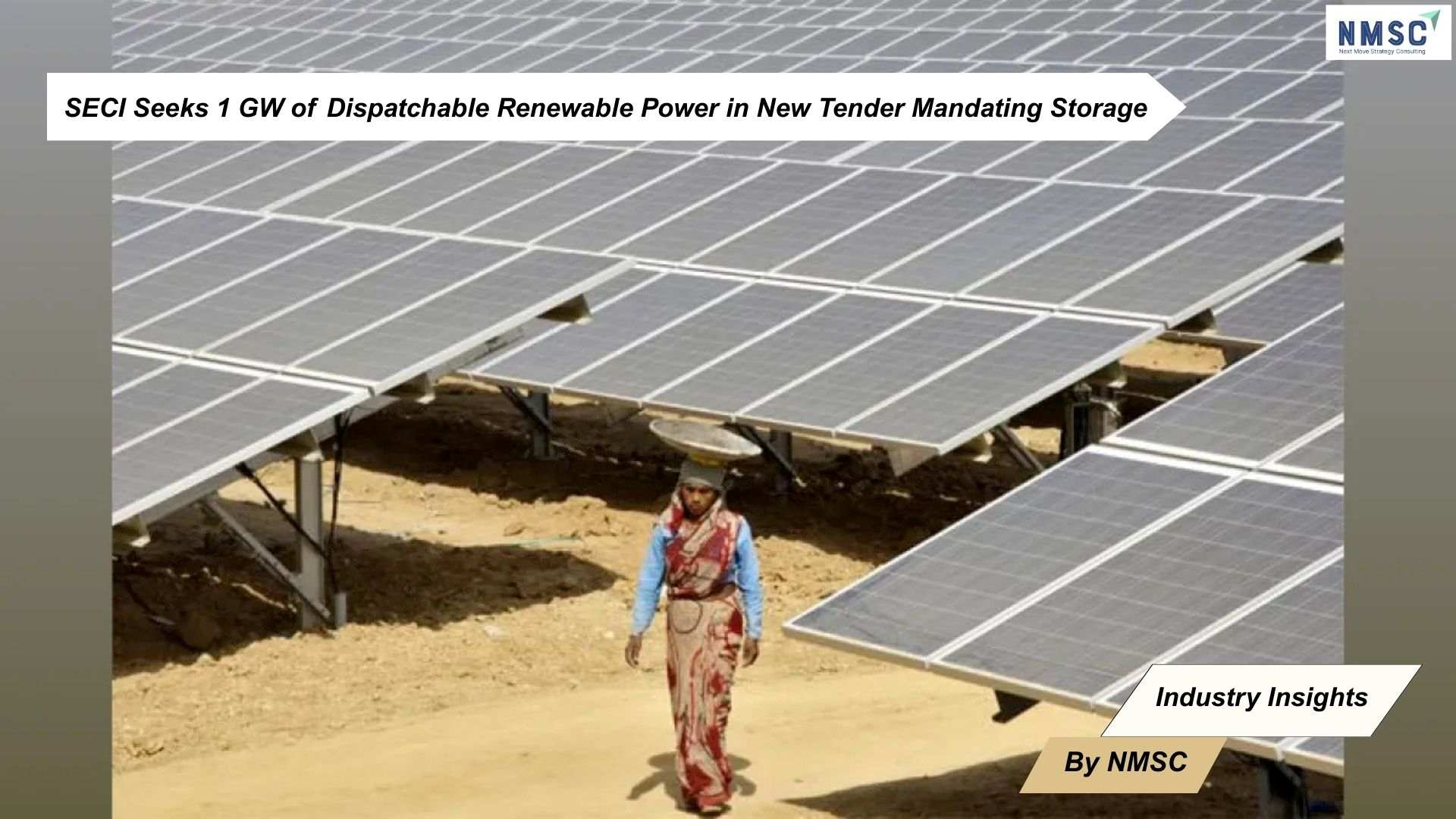
SECI Seeks 1 GW of Dispatchable Renewable Power in New Tender Mandating Storage
Industry Insights from Next Move Strategy Consulting
The Solar Energy Corporation of India (SECI) has launched a pivotal tender, inviting bids to supply 1,000 MW (1 GW) of excess renewable power from new projects, formally titled "FDRE-VIII." This initiative marks a strategic evolution in India's clean energy procurement, mandating co-located energy storage systems to ensure the power supplied is firm, dispatchable, and available exclusively during solar hours.
Bids for the tender must be submitted by January 30, 2026, with the bid opening scheduled for February 4, 2026. The tender targets power from new renewable projects that will have their own existing medium-term power purchase agreements (PPAs) for a base capacity, with SECI contracting for the surplus generation.
A New Model for Grid Reliability and Value Optimization
The "FDRE-VIII" tender represents a significant shift from procuring only variable renewable energy to securing a reliable and schedulable power supply. By focusing on "excess" power and making an energy storage system (ESS) mandatory, SECI aims to address grid integration challenges and enhance the utilization of renewable assets.
The mandatory storage must be charged exclusively from renewable sources, ensuring the integrity of the green power supply. Developers have the flexibility to own the storage system or procure it through a third party.
Key Tender Specifications and Requirements:
-
Bid Submission & Costs: Bids close January 30, 2026. The bidding document costs ₹50,000, with a bid processing fee of ₹20,000 per MW.
-
Financial Guarantees: An earnest money deposit of ₹954,000 per MW is required. Selected bidders must provide a performance bank guarantee of ₹2.38 million per MW.
-
Project & Grid Connection: Developers are responsible for setting up new renewable projects with storage, identifying land, and building the transmission network up to the delivery point. Connection to the interstate transmission system requires a minimum voltage of 220 kV.
-
Supply Obligation: Power must be supplied only during solar generation hours, with a minimum daily supply of 1.5 MWh for every 1 MW of contracted capacity under a 12-year PPA.
-
Penalty for Shortfall: A penalty of 1.5 times the PPA tariff applies for any monthly supply shortfall exceeding 25% of the scheduled energy during solar hours.
-
Financial Criteria: Bidders must demonstrate a net worth of at least ₹9.54 million per MW and an annual turnover of ₹1.66 million per MW.
-
Project Scale & Timeline: The bid capacity must be between 50 MW and 500 MW. Full project capacity must be operational within 18 months of the PPA effective date.
Building a Framework for Firm Renewable Energy
This tender establishes a disciplined and scalable framework designed to attract serious developers. The clear financial commitments, stringent performance guarantees, and well-defined penalties create a model for accountable and reliable clean energy procurement.
The requirement for developers to establish new projects specifically designed to generate surplus power for SECI, alongside their primary PPAs, encourages optimized plant design and more efficient use of infrastructure and grid connections.
Industry Response and Strategic Outlook
SECI's "FDRE-VIII" tender follows a consistent policy direction, building upon previous tenders such as October's "Tranche-VII" for 4,800 MWh of firm renewable energy. This pattern underscores a focused shift towards ensuring renewable energy can meet peak demand and provide grid ancillary services.
According to Next Move Strategy Consulting, this procurement strategy is poised to reshape market dynamics. "The explicit linkage of new renewable capacity to storage will accelerate the domestic battery energy storage ecosystem and drive innovation in system integration," the firm notes. "Financing models will increasingly evolve to evaluate the combined value of generation and storage, rewarding projects that deliver guaranteed power over those that merely generate it."
Pioneering the Next Phase of India's Energy Transition
SECI's 1 GW tender is more than a procurement exercise; it is a foundational step towards a modernized grid powered by dispatchable renewables. By creating a formal market for surplus clean energy backed by storage, India is addressing a critical bottleneck in its energy transition.
This initiative reinforces a strategic commitment to overcoming intermittency, ensuring that renewable energy can play a central, reliable, and bankable role in securing the nation's energy future. It sets a replicable benchmark for integrating large-scale variable resources into the grid while maintaining stability and reliability.
Source: Mercom India
Prepared by: Next Move Strategy Consulting
About the Author
 Sanyukta Deb
— Sanyukta Deb is Digital Marketing Team Lead at Next Move Strategy Consulting, where she has led content strategy and technical SEO for the firm's B2B market research publications for over 2 years. Her editorial process translates NextMSC's primary and secondary research — spanning technology, industrial, and consumer sectors — into commercial narratives, backed by search-intent, keyword, and competitive analysis. She brings 5 years of overall experience in digital marketing and content strategy.
Sanyukta Deb
— Sanyukta Deb is Digital Marketing Team Lead at Next Move Strategy Consulting, where she has led content strategy and technical SEO for the firm's B2B market research publications for over 2 years. Her editorial process translates NextMSC's primary and secondary research — spanning technology, industrial, and consumer sectors — into commercial narratives, backed by search-intent, keyword, and competitive analysis. She brings 5 years of overall experience in digital marketing and content strategy.
About the Reviewer
 Debashree Dey
— Debashree Dey is Assistant Manager at Next Move Strategy Consulting, where she supports cross-vertical market content and communications across diverse industries for 6 years. Her professional background includes senior content writing, communications, and published manuscript authorship, with experience developing audience-focused business narratives and maintaining clear, consistent messaging. Her role supports research-led content development and editorial quality across NextMSC publications.
Debashree Dey
— Debashree Dey is Assistant Manager at Next Move Strategy Consulting, where she supports cross-vertical market content and communications across diverse industries for 6 years. Her professional background includes senior content writing, communications, and published manuscript authorship, with experience developing audience-focused business narratives and maintaining clear, consistent messaging. Her role supports research-led content development and editorial quality across NextMSC publications.
















Add Comment