Sweet Robo’s ICEE Launch Tests Whether Robotic Cotton Candy Can Scale Up
ICEE-Branded Cotton Candy Robots Target Malls and Theaters While Six Flags Attendance Stalls and USDA Forecasts Tighter Sugar Output in Brazil, Thailand and the EU
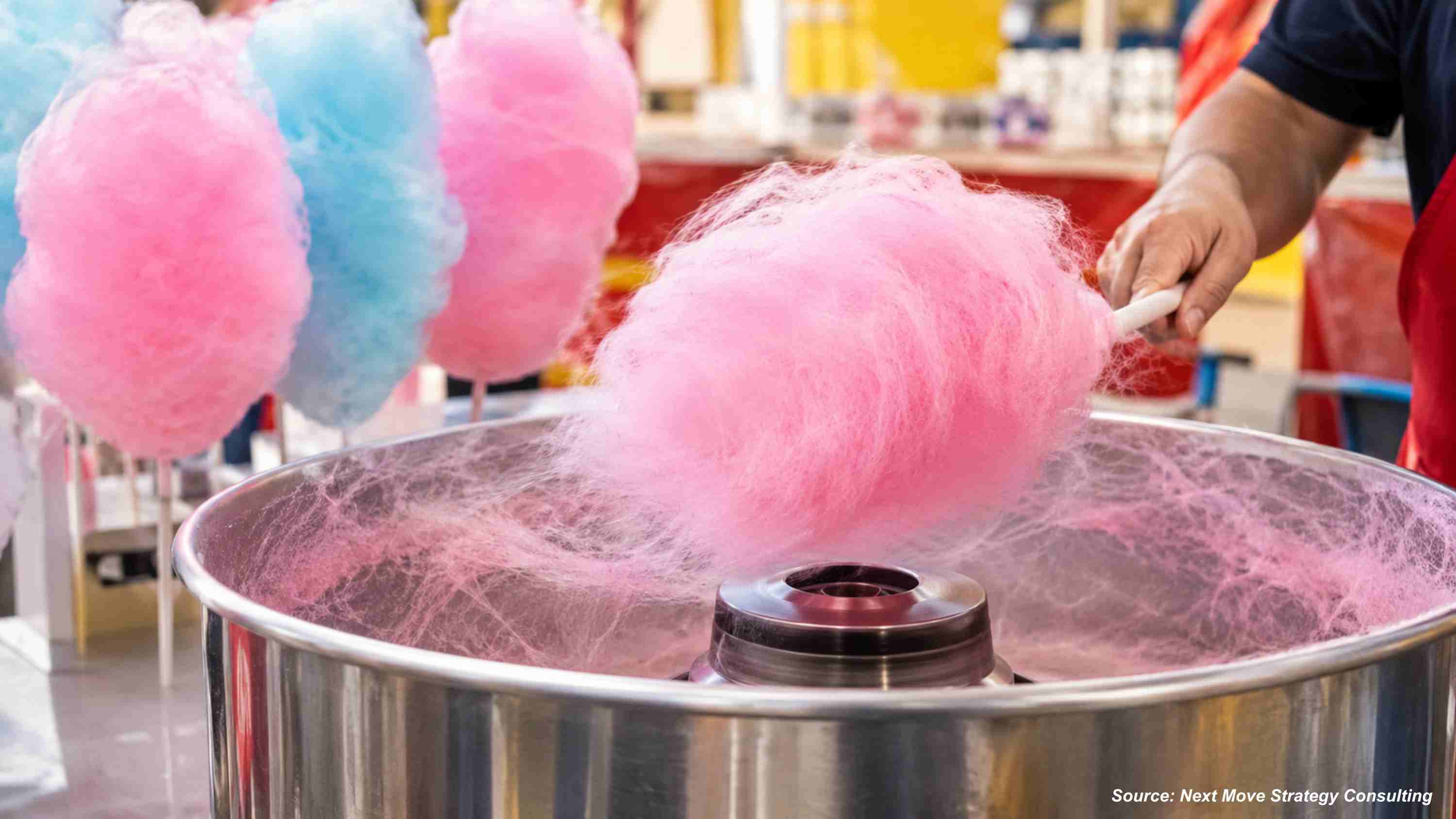
On July 22, 2026, Sweet Robo announced from Las Vegas the commercial launch of the ICEE Cotton Candy Machine, in partnership with Santa Cruz Fun Foods, the exclusive licensee of ICEE Cotton Candy. The launch covers two models: a fully automated, self-service ICEE Cotton Candy Vending Machine aimed at malls, family entertainment centers, amusement parks and theaters, and a compact countertop unit, the ICEE Cotton Candy Mini Pro, aimed at convenience stores and specialty retailers. Each machine offers four to six flavors. Sweet Robo first showed the machine at the Sweet & Snacks Expo in Las Vegas in May, and its release stated that a first shipment of 100 units was scheduled to leave production facilities by the end of June, with deployments planned across North America. The announcement pairs a licensed consumer brand with an unattended equipment platform, the format NextMSC research identifies as the fastest-growing product type.
According to Next Move Strategy Consulting's Cotton Candy Machines Market report, the global cotton candy machines market was valued at USD 826.81 million in 2025 and is projected to reach USD 1,425.75 million by 2035, growing at a CAGR of 5.6% from 2026 to 2035. NextMSC primary research and analysis identifies automatic cotton candy vending machines as the fastest-growing product type at a 5.9% CAGR over 2026 to 2035, and retail and vending operations as the fastest-growing application at 6.4%, the two formats the ICEE launch addresses directly.
For More Information: Download FREE Sample on Cotton Candy Machines Market Report
Why a Licensed Brand Matters for Unattended Placements
Sweet Robo’s strategy rests on borrowing demand that a beverage brand has already built. In the release, Piny Vind, Chief Executive Officer of Sweet Robo, positioned the product around visitor experience rather than sugar volume. Ken Whiting, President of Santa Cruz Fun Foods and a former chairman of the board of the International Association of Amusement Parks and Attractions, said the Sweet & Snacks Expo response confirmed demand for branded products paired with interactive formats. For a venue operator, a recognizable licensed flavor line shortens the decision to host an unattended machine, because the draw does not depend on an attendant spinning product at a counter.
“Consumers are looking for experiences, not just products.”
- Piny Vind, Chief Executive Officer, Sweet Robo, Sweet Robo and ICEE announcement, PR Newswire, July 22, 2026.
The Financial Logic: Spending Per Guest Is Holding While Admissions Yield Softens
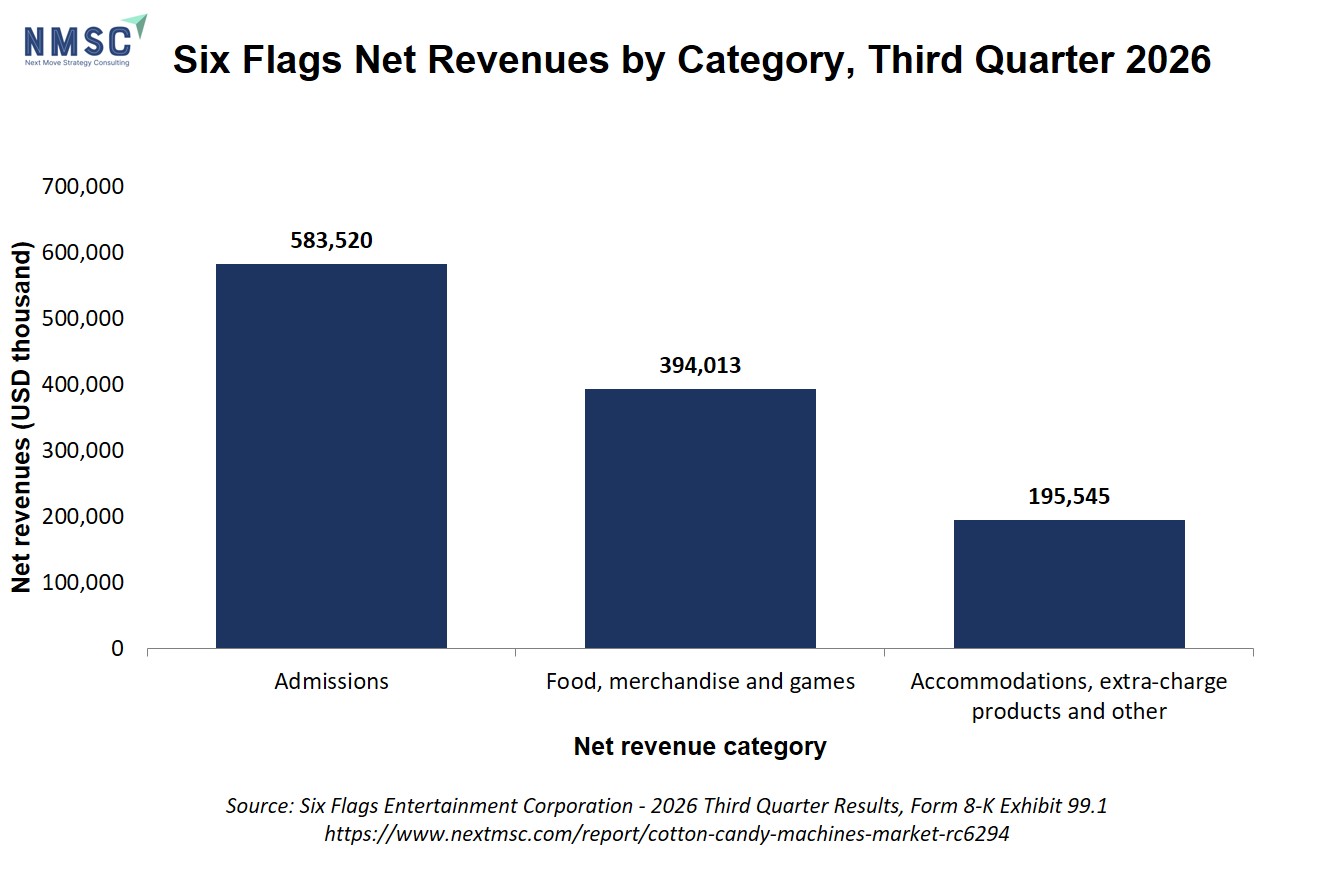
The venues Sweet Robo is targeting are reporting a split between admissions pressure and steady in-park spending. Six Flags Entertainment Corporation, which describes itself as the largest regional amusement park operator in North America, reported on November 5, 2026 that same-park attendance for the third quarter ended September 27, 2026 slipped 0.2% to 18.2 million, while same-park per capita spending rose 1.3% to $60.51. Within that figure, same-park admissions per capita spending rose 1.7% to $32.07 and in-park product per capita spending, which the company defines to include food and beverage, merchandise, games and extra-charge offerings, rose 0.7% to $28.44. Food, merchandise and games generated $394.0 million of the company’s $1,173.1 million in third-quarter net revenues.
Universal’s parks face a sharper admissions problem. Comcast Corporation reported on October 22, 2026 that Theme Parks revenue fell 4.4% to $2,597 million in the third quarter and Adjusted EBITDA fell 17.1% to $780 million, with the company attributing the revenue decline primarily to lower park admissions, including the effect of increased promotional activity. When operators discount entry to defend attendance, revenue earned after the gate carries more weight in the profit mix, which is the economic space an unattended snack machine occupies.
North American Attractions Operators, Third Quarter 2026
|
Operator and metric |
2026 |
Change versus 2025 |
|
Six Flags: net revenues, same-park basis |
$1,173.1 million |
+1.4% |
|
Six Flags: attendance, same-park basis |
18,195 thousand |
-0.2% |
|
Six Flags: per capita spending, same-park basis |
$60.51 |
+1.3% |
|
Comcast Theme Parks: revenue |
$2,597 million |
-4.4% |
|
Comcast Theme Parks: Adjusted EBITDA |
$780 million |
-17.1% |
Six Flags Same-Park Guest Spending Mix, Third Quarter
|
Per capita measure |
Q3 2025 |
Q3 2026 |
|
Admissions per capita spending |
$31.53 |
$32.07 |
|
In-park product per capita spending |
$28.23 |
$28.44 |
|
Total per capita spending |
$59.75 |
$60.51 |
Input Costs: USDA Forecasts Lower Sugar Output in Three Major Producers
Every serving is spun from sugar, so the cost side of unattended placements depends on the sugar market. The USDA Foreign Agricultural Service’s May 2026 edition of Sugar: World Markets and Trade forecast 2026/27 global sugar production down 1.2 million tons to 184.9 million, with lower output in Brazil, the European Union, the United States and Thailand more than offsetting a recovery in India. Brazil’s forecast fell 1.3 million tons to 42.5 million because mills are expected to favor ethanol at 52% of the mix, following an August 2025 increase in the ethanol blend in gasoline from 27% to 30%. The European Union’s forecast fell 1.2 million tons to 14.4 million on lower sugarbeet area amid weak prices and high input costs, and Thailand’s fell 1.8 million tons to 9.5 million after a lower farm-gate price reduced planted area.
Sugar Production by Leading Producer, 2025/26 and 2026/27 Forecast
|
Producer |
2025/26 (1,000 metric tons, raw value) |
2026/27 forecast (1,000 metric tons, raw value) |
|
Brazil |
43,800 |
42,500 |
|
India |
30,000 |
33,600 |
|
European Union |
15,519 |
14,353 |
|
China |
12,600 |
12,700 |
|
Thailand |
11,258 |
9,500 |
|
United States |
8,382 |
7,993 |
For the United States, which NextMSC primary research and analysis identifies as the largest national market for these machines, the USDA Economic Research Service’s Sugar and Sweeteners Outlook of September 17, 2026 lowered the 2026/27 domestic sugar supply by 168,000 short tons, raw value, from the prior month, with Mexican export volumes to the United States revised accordingly. The USDA figures describe sugar supply, not retail prices, and the agency does not forecast what operators will pay for machine-grade sugar. They do show that the input is not loosening in the year in which new vending placements are being contracted.
Online Channels: Census Data Show Where Equipment Buyers Are Moving
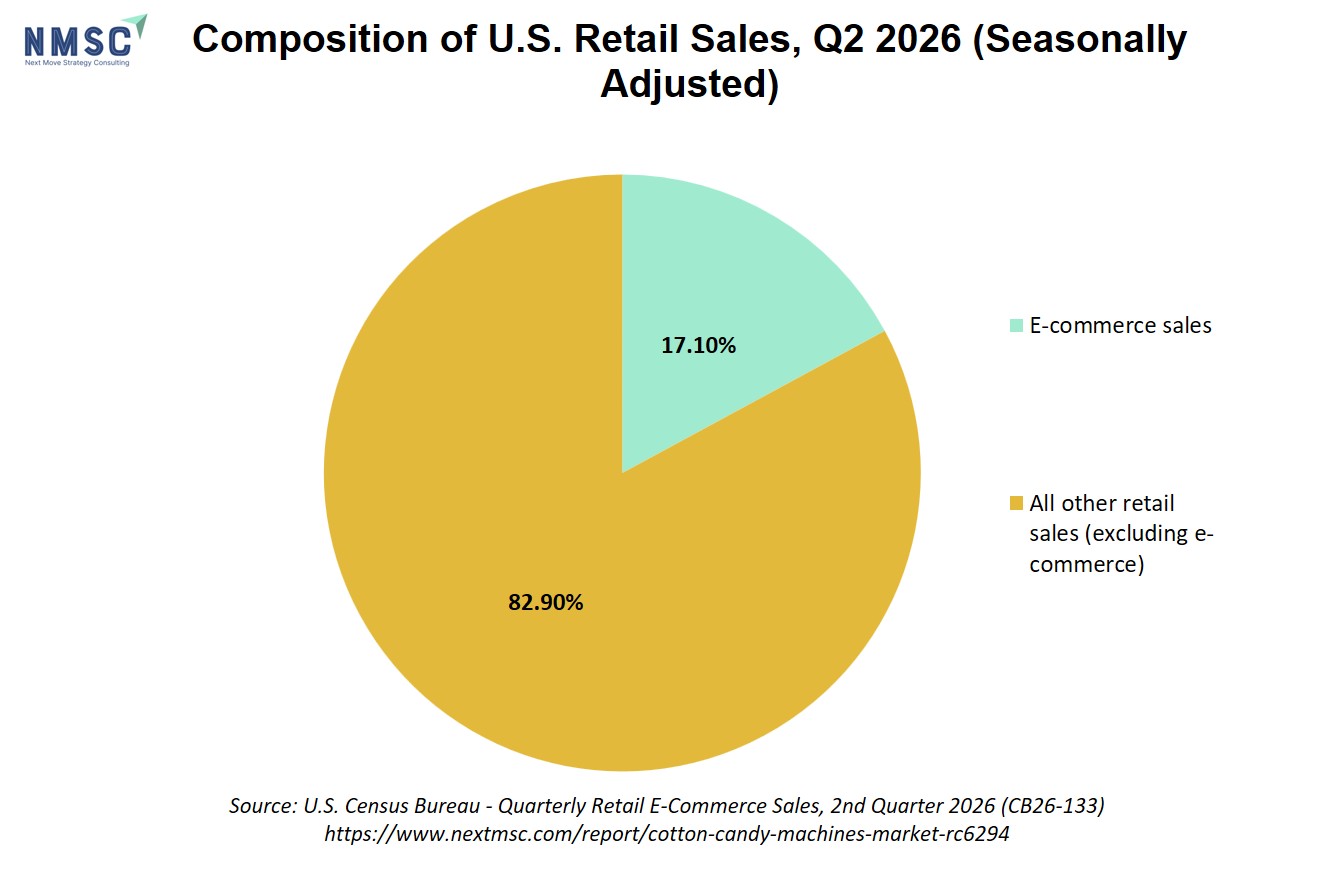
NextMSC primary research and analysis finds online retail to be the largest distribution channel for cotton candy machines, growing at a 6.9% CAGR from 2026 to 2035. The broader retail data are consistent with that direction. The U.S. Census Bureau reported on August 18, 2026 that U.S. retail e-commerce sales reached $340.2 billion in the second quarter of 2026, up 12.2% from a year earlier, and accounted for 17.1% of total retail sales on a seasonally adjusted basis, while total retail sales rose 6.7%.
Segment Dynamics: Where NextMSC Sees the Fastest Placements
NextMSC primary research and analysis shows commercial cotton candy machines holding the largest product share at about 51% of 2025 revenue, equal to USD 423.70 million, with residential machines at USD 253.32 million and automatic vending machines at USD 149.79 million. Vending is forecast to reach USD 266.60 million by 2035. By heating technology, induction heating machines are the fastest-growing category at a 5.8% CAGR, and by application, retail and vending operations lead at 6.4%. NextMSC research indicates the cost of robotic units is a restraint: price listings of about USD 15,000 for robotic machines limit adoption among smaller independent operators. A licensed brand that brings its own traffic can offset part of that capital burden, although the release did not disclose placement pricing.
Regional Outlook: North America Leads, Asia-Pacific Grows Fastest
According to NextMSC primary research and analysis, North America held about 34% of global revenue in 2025, or USD 281.12 million, supported by a dense network of theme parks, cinemas and fairs. Asia-Pacific is projected to expand at the fastest regional pace, an 8.4% CAGR over 2026 to 2035, reaching USD 499.01 million by 2035, with India growing from USD 44.65 million in 2025 at about 10.2% and China from USD 80.37 million in 2025 to USD 201.01 million by 2035 at 9.6%. The ICEE launch is scoped to North America, which leaves Asia-Pacific, the fastest-growing region in the NextMSC forecast, outside the first wave of licensed automation.
NMSC Strategic Perspective: Placement Economics Will Decide the Winners
NextMSC primary research and analysis indicates that the next phase of competition in cotton candy equipment will turn on placement economics rather than machine specifications. The market’s absolute opportunity of USD 552.64 million between 2026 and 2035 depends on how many venue and retail locations can be served profitably by units that run without an attendant. Three conditions now line up. First, operators in admissions-pressured parks have a reason to add post-gate revenue, as the Six Flags and Comcast results show. Second, licensed flavors reduce the marketing burden that a new machine carries. Third, sugar supply tightness outside India raises the value of machines with accurate portioning and low waste. NextMSC research indicates that suppliers able to offer verified uptime, service coverage and replacement-part availability will hold an advantage over vendors that compete only on unit price, because commercial viability for vending formats depends on venue footfall, machine uptime, replenishment and cleaning rather than on the purchase price alone.
The caution is that a single licensed launch is not evidence of a market-wide ramp. The ICEE units were scheduled to ship in a first batch of 100, which is a small base against a market that NextMSC estimates at USD 873.11 million in 2026, and the release did not disclose placement pricing, revenue-share terms or uptime data.
Competitive Landscape
NextMSC primary research and analysis profiles 20 participants in the cotton candy machines market, including Gold Medal Products Co., Inc., Nostalgia Products Group, Hamilton Beach Brands Holding, Inc., Paragon International, Inc., Benchmark USA Inc., Prince Castle, Inc., Winco Inc. and Waring Commercial, Inc. NextMSC finds that competition centers on durability, service reach and price positioning, with three archetypes: commercial equipment specialists, automated vending solution providers and broad appliance brands extending consumer lines. Sweet Robo’s July 22, 2026 announcement with Santa Cruz Fun Foods is the clearest dated example of the second archetype pairing an automation platform with a licensed consumer brand.
Bottom Line
The ICEE launch is a credible signal that cotton candy is moving from a manually operated concession item toward a branded, unattended retail format, but it is an early signal rather than proof of scale. Operators are looking for revenue beyond the gate: Six Flags kept same-park per capita spending rising 1.3% to $60.51 while attendance slipped 0.2%, and Comcast reported Theme Parks revenue down 4.4% on weaker admissions. Meanwhile, the USDA forecasts 2026/27 global sugar output of 184.9 million tons, down 1.2 million, which keeps input costs on the agenda. Against that backdrop, NextMSC primary research and analysis projects the market to grow from USD 826.81 million in 2025 to USD 1,425.75 million by 2035 at a 5.6% CAGR, with automatic vending at 5.9% and retail and vending operations at 6.4%. Buyers should weigh uptime, service coverage and brand-led traffic ahead of unit price, and watch whether the first North American deployments report utilization data over the coming quarters.
About Next Move Strategy Consulting
Next Move Strategy Consulting is a premier market research and management consulting firm that has been committed to provide strategically analysed well documented latest research reports to its clients. The research industry is flooded with many firms to choose from, what makes NMSC different from the rest is its top-quality research and the obsession of turning data into knowledge by dissecting every bit of it and providing fact-based research recommendation that is supported by information collected from over 500 million websites, paid databases, industry journals and one on one consultations with industry experts across a diverse range of industry sectors. The high-quality customized research reports with actionable insights and excellent end-to-end customer service help our clients to take critical business decisions that enables them to move beyond time and have competitive edge in the industry.
We have been servicing over 1000 customers globally that includes 90% of the Fortune 500 companies over a decade. Our analysts are constantly tracking various high growth markets and identifying hidden opportunities in each sector or the industry. We provide one of the industry’s best quality syndicate as well as custom research reports across 10 different industry verticals. We are committed to deliver high quality research solutions in accordance to your business needs. Our industry standard delivery solutions that ranges from the pre consultation to after-sales services, provide an excellent client experience and ensure right strategic decision making for businesses.
For more information, please contact:
Next Move Strategy Consulting
5th Floor 867 Boylston St, STE 500,
Boston, MA 02116, U.S.
E-Mail: [email protected]
Direct: +1-217-650-7991
Website: www.nextmsc.com
About the Author
 Sanyukta Deb
— Sanyukta Deb is Digital Marketing Team Lead at Next Move Strategy Consulting, where she has led content strategy and technical SEO for the firm's B2B market research publications for over 2 years. Her editorial process translates NextMSC's primary and secondary research — spanning technology, industrial, and consumer sectors — into commercial narratives, backed by search-intent, keyword, and competitive analysis. She brings 5 years of overall experience in digital marketing and content strategy.
About the Reviewer
 Debashree Dey
— Debashree Dey is Assistant Manager at Next Move Strategy Consulting, where she supports cross-vertical market content and communications across diverse industries for 6 years. Her professional background includes senior content writing, communications, and published manuscript authorship, with experience developing audience-focused business narratives and maintaining clear, consistent messaging. Her role supports research-led content development and editorial quality across NextMSC publications.
















Add Comment