Toyota's 300 kW Truck Fuel Cell Pushes Hydrogen Power into Heavy Freight
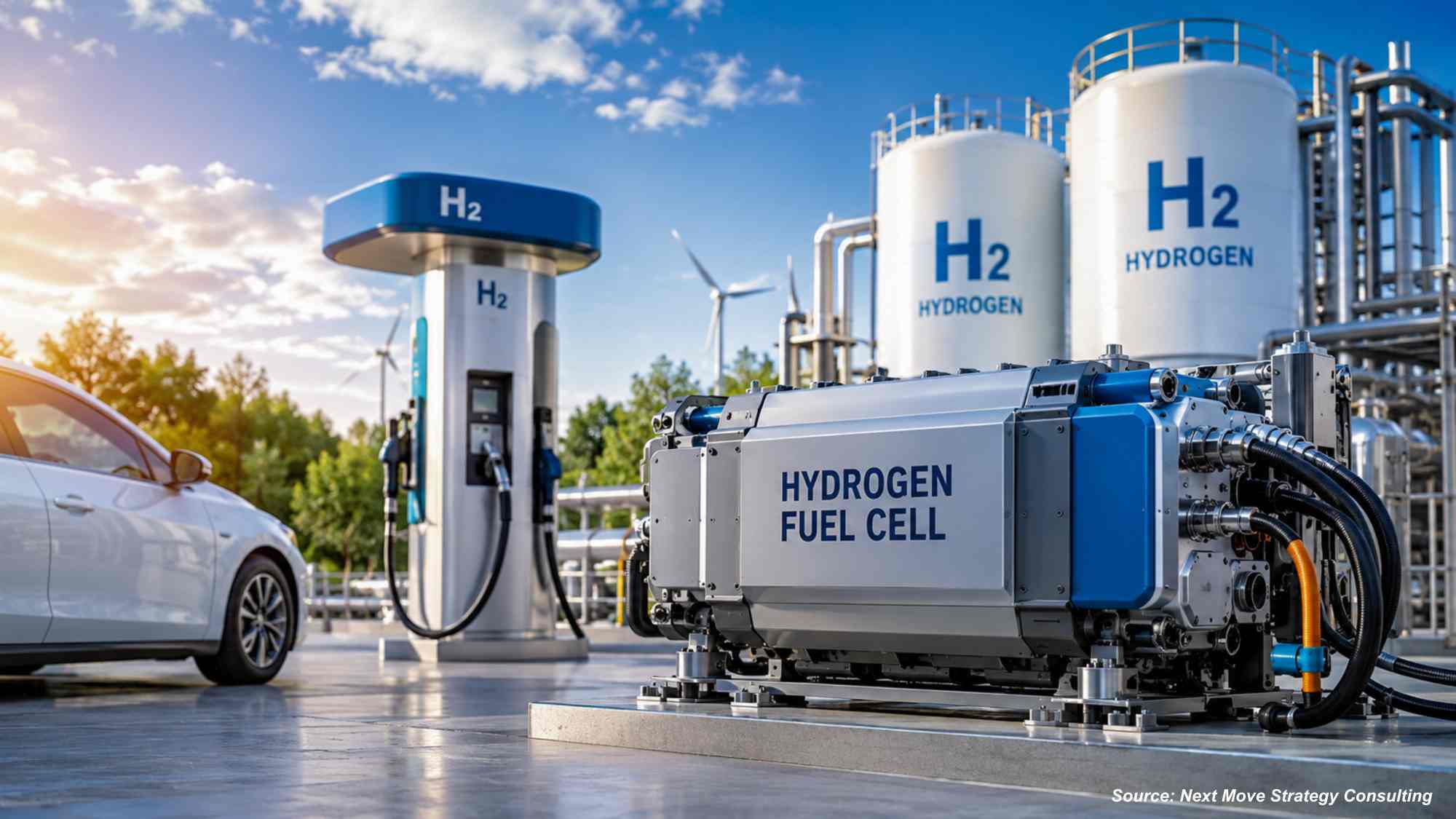
Toyota's Commercial Fuel Cell Launch, a One-Third cellcentric Stake and Ballard's Rail and Off-Grid Orders Show Hydrogen Moving From Pilot Fleets to Scheduled Supply
On 14 September 2026, at IAA Transportation in Hanover, Toyota Motor Europe presented a third-generation fuel cell system rated at 300 kW and built for commercial vehicles, with roughly double the output and durability of the previous generation and about 20% better fuel efficiency, according to the company's newsroom release. The launch came with named customer programs: Toyota will supply fuel cell systems for 40 heavy-duty vehicles in Scania's Pilot Partner programme, with first operations expected in the first quarter of 2027, and supplies the system for IVECO's S-eWay Fuel Cell truck, which is targeted at a range above 900 km and more than 25,000 operating hours. Together with the binding agreement signed in July 2026 for Toyota to join cellcentric as an equal shareholder alongside Volvo Group and Daimler Truck, the September launch shows European hydrogen fuel cells moving from component development to named vehicle programs with validation dates.
According to Next Move Strategy Consulting's Hydrogen Fuel Cells Market report, the global hydrogen fuel cells market was valued at USD 9.20 billion in 2025 and is projected to reach USD 66.36 billion by 2035, growing at a CAGR of 21.5% from 2026 to 2035. NextMSC primary research and analysis places 2026 revenue at USD 11.50 billion and attributes the largest upward pressure on that trajectory to data center and utility stationary power demand, heavy-duty vehicle decarbonization mandates and public hydrogen infrastructure funding, the three drivers its 2026-2035 model weights most heavily.
For More Information: Download FREE Sample on Hydrogen Fuel Cells Market Report
The Financial Logic: Data Center Load, Truck Mandates and Hydrogen Costs
The clearest stationary power signal of 2026 came on 13 April, when Bloom Energy announced that Oracle intends to purchase up to 2.8 GW of Bloom solid oxide fuel cell systems under a master services agreement, of which 1.2 GW is already contracted. According to the Bloom Energy release, deployment of the initial 1.2 GW is under way and continues into 2027, and Bloom reported delivering a system to Oracle in 55 days against a 90-day schedule the previous year. Aman Joshi, Chief Commercial Officer at Bloom Energy, said in the release that the company was pleased to expand its relationship with Oracle after a successful first deployment. The release does not state which fuel the systems consume, so the order evidences fuel cell demand from data centers rather than hydrogen volumes specifically. NextMSC primary research and analysis nonetheless ranks data center and utility stationary power as the largest single driver in its model, with a +3.2% impact on CAGR across North America and Asia-Pacific through 2035.
On the transport side, the economics turn on cost and duty cycle. Toyota stated in its 14 September 2026 release that the third-generation system carries substantially lower cost than its predecessor, and that the company is pursuing local hydrogen ecosystems, citing projects in Germany and the Netherlands, with 700 bar as its long-term standard for fuel cell vehicles. NextMSC primary research and analysis quantifies the counterweight: high hydrogen production and distribution costs reduce the forecast CAGR by 1.8%, the heaviest restraint in the model, followed by competition from battery-electric alternatives at 1.2% and limited refueling infrastructure at 0.8%. The California Energy Commission and California Air Resources Board's 2025 Annual Assessment of the Hydrogen Refueling Network, published in May 01, 2026, shows the infrastructure constraint in concrete terms: of 112 funded stations in California, 50 were open and available for fueling as of 2 September 2025, 11 had been temporarily nonoperational for more than 30 days, and 51 were still planned.
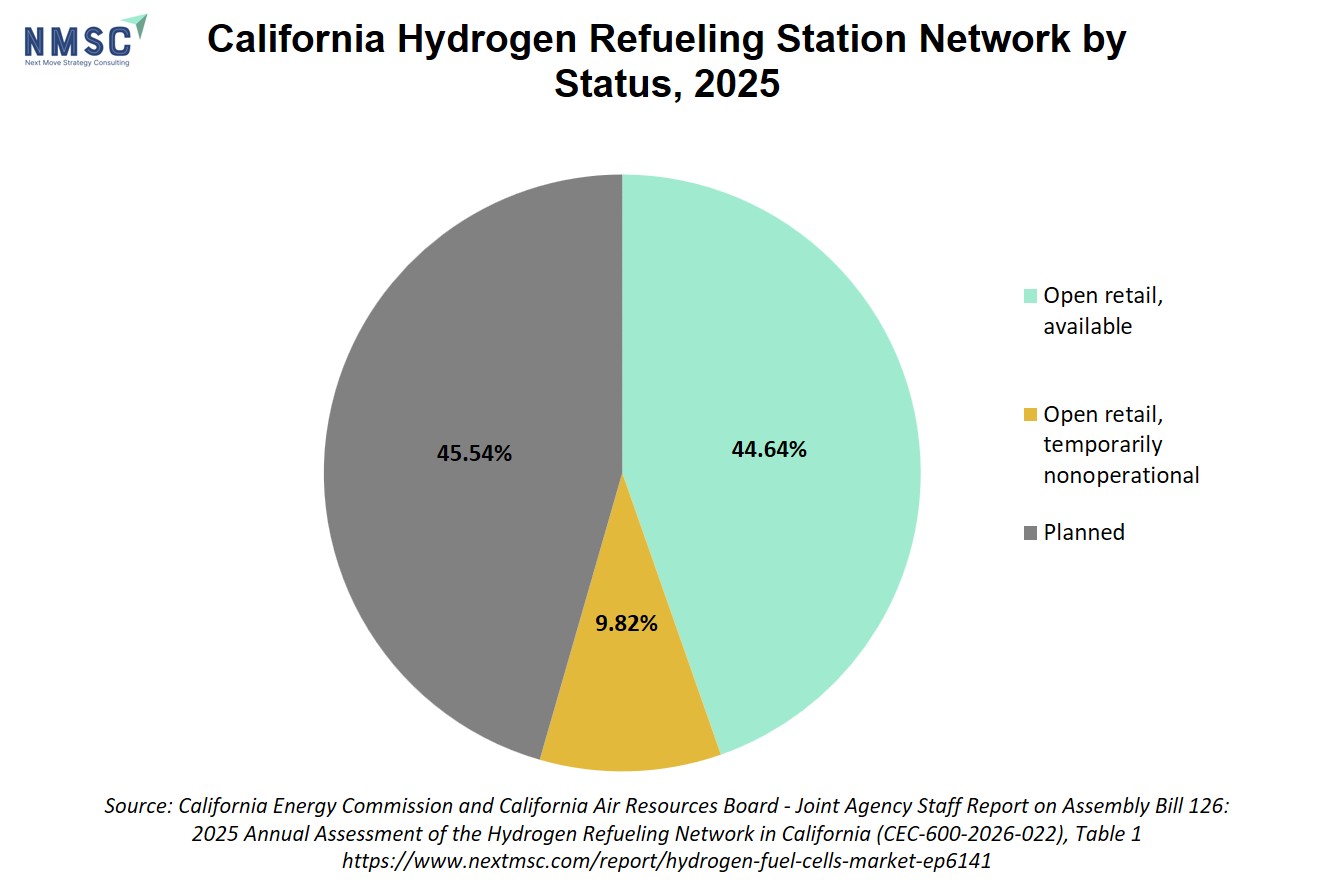
The California Energy Commission and California Air Resources Board report 112 funded hydrogen refueling stations in the state: 50 open retail stations available for customer fueling, 11 open retail stations that have been unavailable for more than 30 days, and 51 planned stations. The shares shown are calculated from those published counts.
The NextMSC revenue path is back-loaded. Global revenue rises from USD 9.20 billion in 2025 to USD 25.06 billion in 2030 and USD 66.36 billion in 2035, an absolute opportunity of USD 54.86 billion between 2026 and 2035.
Key Industry Developments: Five Dated Commitments Across Road, Rail and Power
In June 2026, Ballard Power Systems announced an order for 15 MW of FCmove-HD+ 100 kW fuel cell modules, 150 modules in total, from a company specializing in renewable off-grid power, with deliveries expected to begin in the second half of 2026. The modules will power hydrogen gensets for live events, construction sites, film sets and critical infrastructure. Marty Neese, Chief Executive Officer of Ballard Power Systems, said in the release that the order reflects growing acceptance of emission-free fuel cells for off-grid power.
On 7 October 2026, Ballard announced a 4.8 MW order from Siemens Mobility for 24 FCrail 200 kW fuel cell modules to power 12 Mireo Plus H passenger trains for Romania's Railway Reform Authority, described in the release as Romania's first hydrogen fleet. Fuel cell engine deliveries are scheduled for 2027 and 2028, with passenger service expected to begin in 2029. The lag between the 2026 order and 2029 passenger service shows why hydrogen rail and heavy-duty programs convert slowly into revenue even when volumes are contractually committed. Ballard's Q2 2026 results, filed on 31 July 2026, show how that lag appears in reported figures: quarterly revenue was USD 20.6 million, with bus the largest market at USD 9.7 million, while the order backlog reached USD 156.6 million at the end of the quarter, up 38.8% from the end of the first quarter.
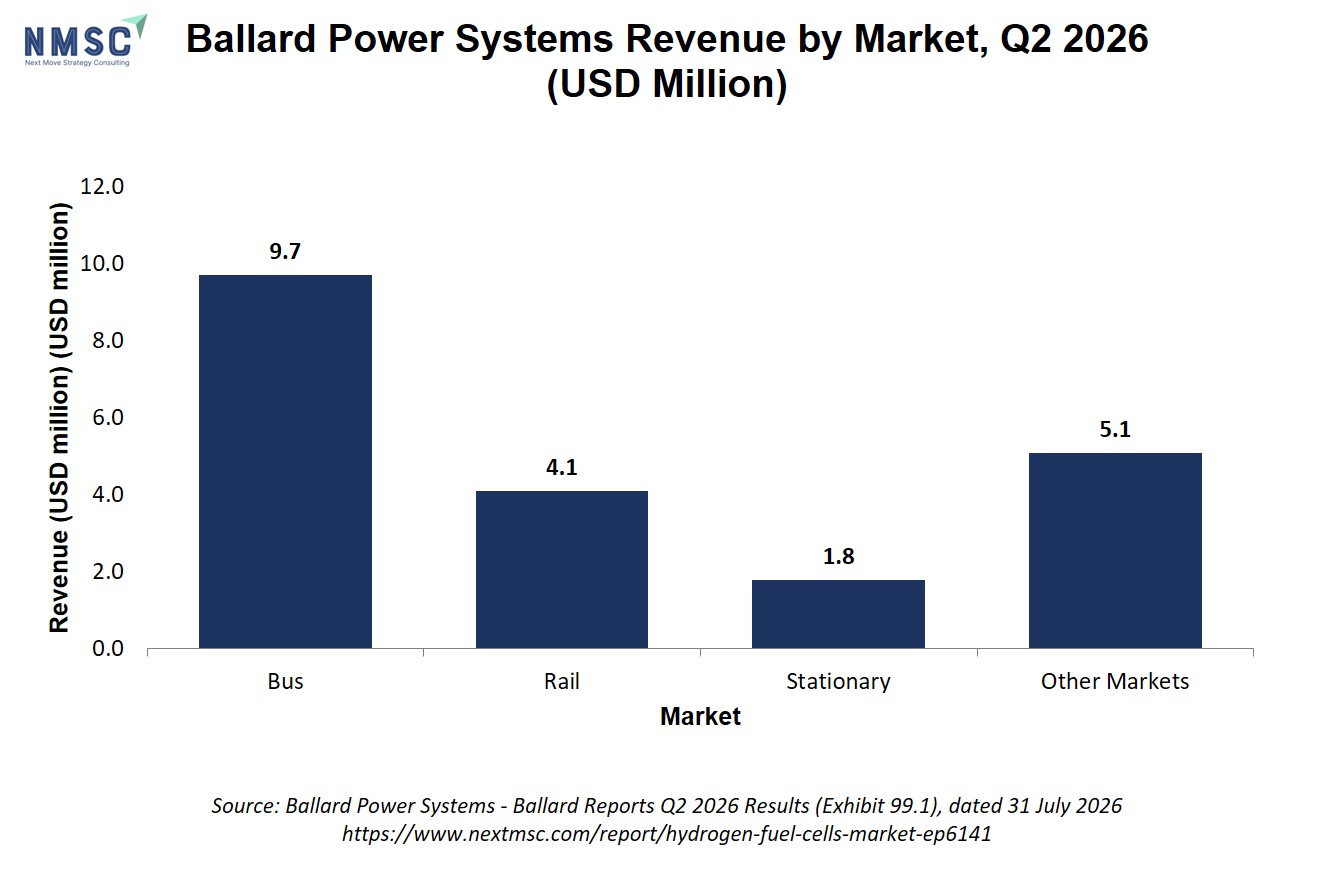
Ballard reported total Q2 2026 revenue of USD 20.6 million. Other Markets covers truck, marine, material handling, off-road and other applications, and the release notes that the listed market figures sum to 20.7 because of rounding.
Volvo Group announced on 27 July 2026 that Toyota Motor Corporation, Volvo Group and Daimler Truck had signed a binding agreement for Toyota to join cellcentric as an equal shareholder, with each of the three owners holding one third. The agreement follows a non-binding deal signed in late March 2026, and completion depends on regulatory approvals, with closing expected around the end of 2026 or in early 2027. According to the Volvo Group release, cellcentric operates from sites in Kirchheim/Teck, Esslingen and Stuttgart in Germany and Burnaby in Canada, employs more than 560 people and holds roughly 700 patents.
The Toyota Motor Europe release adds delivery detail on the heavy-duty side. IVECO leads development and validation of its truck under the EU-funded EMPOWER project, with validation starting in the fourth quarter of 2026 and on-road trials planned for the first half of 2027. Shinichi Yasui, Executive Vice President, R&D at Toyota Motor Europe, said in the release that hydrogen can support sustainable mobility where energy resilience and demanding operations matter, and that Toyota is developing the vehicles while also supporting the fuel infrastructure they need.
Five 2026 Fuel Cell Commitments at a Glance
|
Announcement |
Date |
Scale and timing |
|
Bloom Energy and Oracle, solid oxide fuel cell systems |
April 2026 |
Up to 2.8 GW under a master services agreement; 1.2 GW contracted |
|
Ballard Power Systems, off-grid power customer |
June 2026 |
15 MW; 150 FCmove-HD+ 100 kW modules; deliveries from the second half of 2026 |
|
Toyota, Volvo Group and Daimler Truck, cellcentric |
July 2026 |
Binding agreement; three equal shareholders; closing expected around year-end 2026 or early 2027 |
|
Toyota Motor Europe, IAA Transportation |
September 2026 |
300 kW third-generation system; 40 Scania vehicles from Q1 2027; IVECO validation from Q4 2026 |
|
Ballard Power Systems and Siemens Mobility, Romania |
October 2026 |
4.8 MW; 24 FCrail 200 kW modules; 12 trains; deliveries in 2027 and 2028 |
Segment Dynamics: Stationary Power Overtakes Transportation by 2035
According to NextMSC primary research and analysis, transportation was the largest application in 2025 at USD 4.78 billion, ahead of stationary power at USD 3.86 billion and portable power at USD 0.55 billion. The ranking reverses by 2035: stationary power is projected to reach USD 32.89 billion at a 23.8% CAGR, exceeding transportation at USD 30.30 billion and a 19.8% CAGR, while portable power reaches USD 3.17 billion at 18.5%. The crossover is consistent with the 2026 deal flow: of the capacity-denominated commitments tabulated above, the two largest, Bloom's 2.8 GW program and Ballard's 15 MW genset order, serve stationary or off-grid power, while the road and rail orders are counted in 40 Scania vehicles and 12 trains.
By technology, NextMSC primary research and analysis shows proton exchange membrane fuel cells leading with a 58% share, equal to USD 5.34 billion in 2025, while solid oxide fuel cells are the fastest-growing technology at a 26.6% CAGR. Bloom Energy's Oracle program uses solid oxide systems, which places the largest stationary order of 2026 in the technology class that NextMSC's model shows growing fastest.
Hydrogen Fuel Cells Market by Application, 2025 and 2035 (USD Billion)
|
Application |
2025 |
2035 |
CAGR (2026–2035) |
|
Transportation |
4.78 |
30.30 |
19.8% |
|
Stationary Power |
3.86 |
32.89 |
23.8% |
|
Portable Power |
0.55 |
3.17 |
18.5% |
Regional Outlook
NextMSC primary research and analysis shows Asia-Pacific holding the largest regional base at USD 4.05 billion in 2025, growing to USD 28.26 billion by 2035 at a 21.1% CAGR, while North America is the fastest-growing region, expanding from USD 2.76 billion to USD 22.84 billion at a 23.4% CAGR. Europe grows from USD 1.66 billion to USD 10.97 billion at a 20.4% CAGR, in the region where the Toyota, IVECO, Scania and cellcentric programs are concentrated.
At country level, China at a 25.8% CAGR and the United States at 24.2% lead growth, ahead of India at 22.8%, Germany at 21.2%, South Korea at 19.8% and Japan at 18.5%. Japan's slower modeled growth sits alongside an active public and private program. Asia Times reported on 5 October 2026 that the Japan Hydrogen Association proposed in April 2026 a 1,350 km freight corridor from Fukuoka to Fukushima with more than 1,000 hydrogen trucks targeted by the early 2030s, that Toyota and Isuzu plan a light-duty truck on Toyota's third-generation system with mass production targeted in the fiscal year to March 2028, and that the TOKYO H2 project targets 600 fuel cell taxis by 2030. The same report notes that Toyota sold about 25,000 Mirai passenger cars through 2023 and that sales fell because of limited fueling infrastructure and competition from EVs and hybrids.
Selected Country Revenue, 2025 and 2035 (USD Billion)
|
Country |
2025 |
2035 |
CAGR (2026–2035) |
|
China |
1.30 |
12.78 |
25.8% |
|
United States |
2.15 |
18.92 |
24.2% |
|
India |
0.405 |
3.21 |
22.8% |
|
Germany |
0.464 |
3.27 |
21.2% |
|
South Korea |
0.891 |
5.66 |
19.8% |
|
Japan |
1.05 |
6.06 |
18.5% |
Growth Drivers and Restraints
Hydrogen Fuel Cells Market — Growth Catalyst & Risk Assessment Matrix
|
Factor |
Type |
Impact on CAGR |
Geography |
Timeline |
|
Data center and utility stationary power demand |
Driver |
+3.2% |
North America, Asia-Pacific |
2026–2035 |
|
Heavy-duty vehicle and commercial fleet decarbonization mandates |
Driver |
+2.6% |
Global |
2026–2035 |
|
Government hydrogen hub and infrastructure funding |
Driver |
+2.0% |
North America, Asia-Pacific |
2026–2035 |
|
Material handling fleet electrification |
Driver |
+1.5% |
North America, Europe |
2026–2035 |
|
Chinese commercial vehicle subsidy-driven manufacturing |
Driver |
+1.2% |
Asia-Pacific |
2026–2032 |
|
Residential combined heat and power adoption in Japan |
Driver |
+0.8% |
Asia-Pacific |
2026–2032 |
|
High hydrogen production and distribution costs |
Restraint |
−1.8% |
Global |
2026–2035 |
|
Competition from battery-electric alternatives |
Restraint |
−1.2% |
Global |
2026–2032 |
|
Limited hydrogen refueling infrastructure |
Restraint |
−0.8% |
North America, Europe |
2026–2032 |
NMSC Strategic Perspective: Commercial Duty Cycles Now Set the Pace
NextMSC primary research and analysis reads the 2026 announcements as a change in who sets demand. The passenger fuel cell car, whose record Asia Times traces from the Mirai's 2014 launch to about 25,000 sales through 2023, is no longer the reference product. The reference product is a 300 kW commercial module paired with a vehicle target of more than 25,000 operating hours and a named truck, train or generator. NextMSC's application data supports the shift: stationary power grows at 23.8% against 19.8% for transportation, and the model's two heaviest drivers, data center and utility power at +3.2% and heavy-duty decarbonization mandates at +2.6%, are both commercial-scale loads.
Cost remains the gating variable. NextMSC's model assigns its largest restraint, −1.8%, to hydrogen production and distribution costs, and Toyota's response is instructive: rather than selling stacks alone, it is pairing them with local hydrogen ecosystems in Germany and the Netherlands and a 700 bar standard. NextMSC's recommendation for fuel cell suppliers is to contract fuel supply alongside hardware wherever duty cycles are fixed, such as depots, rail routes and off-grid sites, because the Ballard orders show that fixed-route and fixed-site customers commit capacity years ahead of service, as in the Siemens Mobility schedule that runs from 2027 deliveries to 2029 passenger service.
Consolidation is the third signal. The cellcentric agreement, subject to regulatory approval, would place European heavy-duty fuel cell development in one venture owned in equal thirds by Toyota, Volvo Group and Daimler Truck. NextMSC's assessment is that this raises the bar for stand-alone module makers in that segment, who will need committed multi-year volumes to compete on cost. For investors, the USD 54.86 billion absolute opportunity between 2026 and 2035 is weighted toward stationary power at a 23.8% CAGR, North America at 23.4% and China at 25.8%, all above the 21.5% market-wide rate.
Competitive Landscape
The 2026 record shows three competitive clusters, each traceable to company announcements. Automotive groups are integrating fuel cells into commercial vehicle platforms: Toyota Motor Europe with Scania and IVECO, and Toyota, Volvo Group and Daimler Truck through cellcentric. Specialist module makers are winning fixed-route and fixed-site orders: Ballard Power Systems with its 15 MW off-grid order in June 2026 and its 4.8 MW Siemens Mobility rail order in October 2026. Stationary power suppliers are scaling toward data center volumes: Bloom Energy with Oracle's program of up to 2.8 GW announced in April 2026. In passenger vehicles, Asia Times describes Hyundai's NEXO as the category leader at a few thousand vehicles a year, while Toyota's Mirai is priced above 8 million yen in Japan.
Bottom Line
Hydrogen fuel cells entered the final quarter of 2026 with dated, contract-backed commitments rather than pilot announcements. Toyota's 300 kW third-generation system, its pending one-third stake in cellcentric, Ballard's 15 MW off-grid and 4.8 MW rail orders, and Bloom Energy's 2.8 GW program with Oracle each carry named customers and delivery schedules. According to NextMSC primary research and analysis, the global hydrogen fuel cells market will grow from USD 9.20 billion in 2025 to USD 66.36 billion by 2035 at a 21.5% CAGR, with stationary power overtaking transportation at USD 32.89 billion against USD 30.30 billion. North America at a 23.4% CAGR and China at 25.8% lead regional growth. Hydrogen production and distribution cost, a 1.8% drag on CAGR, remains the principal restraint, and delivery schedules that stretch to 2029 mean revenue lags orders. Suppliers that pair durable modules with secured fuel supply and committed fixed-route or fixed-site customers are best placed to capture the USD 54.86 billion opportunity between 2026 and 2035.
About Next Move Strategy Consulting
Next Move Strategy Consulting is a premier market research and management consulting firm that has been committed to provide strategically analysed well documented latest research reports to its clients. The research industry is flooded with many firms to choose from, what makes NMSC different from the rest is its top-quality research and the obsession of turning data into knowledge by dissecting every bit of it and providing fact-based research recommendation that is supported by information collected from over 500 million websites, paid databases, industry journals and one on one consultations with industry experts across a diverse range of industry sectors. The high-quality customized research reports with actionable insights and excellent end-to-end customer service help our clients to take critical business decisions that enables them to move beyond time and have competitive edge in the industry.
We have been servicing over 1000 customers globally that includes 90% of the Fortune 500 companies over a decade. Our analysts are constantly tracking various high growth markets and identifying hidden opportunities in each sector or the industry. We provide one of the industry’s best quality syndicate as well as custom research reports across 10 different industry verticals. We are committed to deliver high quality research solutions in accordance to your business needs. Our industry standard delivery solutions that ranges from the pre consultation to after-sales services, provide an excellent client experience and ensure right strategic decision making for businesses.
For more information, please contact:
Next Move Strategy Consulting
5th Floor 867 Boylston St, STE 500,
Boston, MA 02116, U.S.
E-Mail: [email protected]
Direct: +1-217-650-7991
Website: www.nextmsc.com
About the Author
 Sanyukta Deb
— Sanyukta Deb is Digital Marketing Team Lead at Next Move Strategy Consulting, where she has led content strategy and technical SEO for the firm's B2B market research publications for over 2 years. Her editorial process translates NextMSC's primary and secondary research — spanning technology, industrial, and consumer sectors — into commercial narratives, backed by search-intent, keyword, and competitive analysis. She brings 5 years of overall experience in digital marketing and content strategy.
About the Reviewer
 Debashree Dey
— Debashree Dey is Assistant Manager at Next Move Strategy Consulting, where she supports cross-vertical market content and communications across diverse industries for 6 years. Her professional background includes senior content writing, communications, and published manuscript authorship, with experience developing audience-focused business narratives and maintaining clear, consistent messaging. Her role supports research-led content development and editorial quality across NextMSC publications.












Add Comment