U.S. Bans Chinese Humanoid Robot Imports on Security Grounds
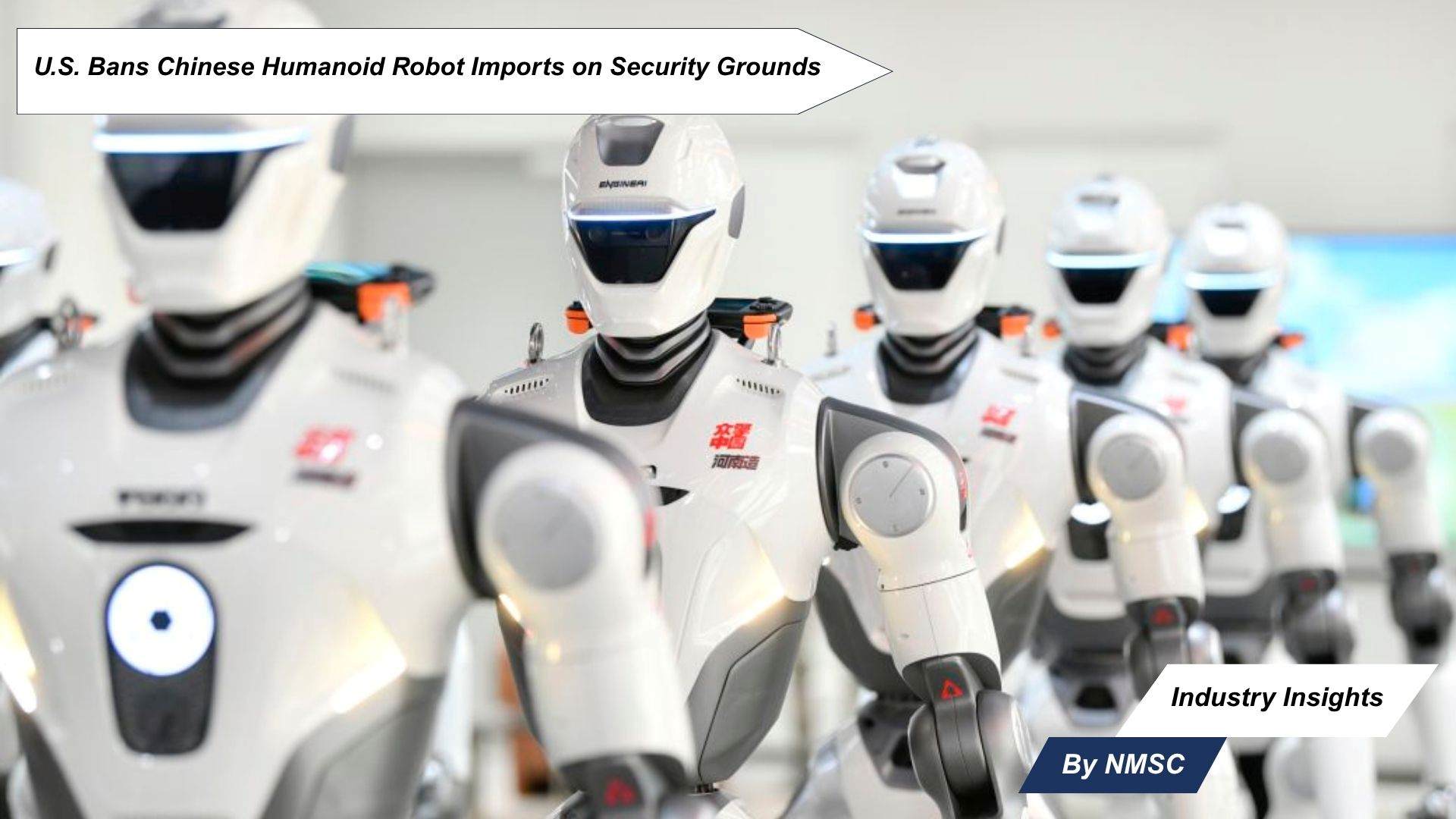
FCC Bars New Chinese Humanoid Robot Imports to Protect U.S. AI Supply Chain
WASHINGTON, U.S. — July 29, 2026 — The United States Federal Communications Commission (FCC) has imposed an immediate ban on imports of new Chinese humanoid and quadruped robots, citing national security vulnerabilities, cybersecurity risks, and the need to safeguard the country's artificial intelligence supply chain. The measures, announced on July 28, 2026, took effect upon publication and mark one of the most significant regulatory actions targeting the fast-growing household robots sector to date.
The restrictions, first reported by Reuters, were unveiled by the Trump administration as part of a broader effort to protect U.S. critical infrastructure from Chinese state-linked threats. The ban applies exclusively to robot and inverter models that have not yet been commercially released in the United States, though the FCC retains authority to revoke existing authorizations for previously approved models.
"These devices could create supply chain vulnerabilities that could disrupt U.S. economic and national security and could create a cybersecurity risk that threatened American critical infrastructure," the FCC stated in an official release. FCC Chairman Brendan Carr added that the agency would "continue to do our part to secure America's critical supply chains."
The ban is expected to significantly impact Unitree, a Chinese firm that holds approximately one-fifth of global humanoid robot market share, according to Counterpoint Research. Unitree was recently added to the Pentagon's list of alleged Chinese military-backed companies — a designation that has historically preceded more stringent U.S. action. The company had previously entered a partnership with Nvidia to integrate the chipmaker's Blackwell processors into its robot systems.
U.S. officials expressed concern that Chinese-manufactured robots could be used to surveil American industries, exfiltrate sensitive data to Beijing, or be remotely commandeered by malign actors. The FCC drew parallels to the Volt Typhoon hacking campaign of 2023, in which Chinese state-linked actors exploited privately owned routers to target U.S. critical infrastructure.
Following the announcement, the FCC is expected to exempt non-Chinese suppliers from the restrictions, consistent with its approach to prior bans on foreign drones and routers. U.S. Representative John Moolenaar, Republican Chair of the House Select Committee on China, stated the FCC move "protects our country and strengthens our nation's robotics industry."
Key Highlights:
-
The FCC banned imports of new Chinese humanoid and quadruped robots effective July 28, 2026, citing national security and cybersecurity concerns.
-
Unitree, which holds approximately 20% of global humanoid robot market share per Counterpoint Research, is the primary firm expected to be affected.
-
The ban applies only to unreleased robot models; the FCC retains authority to revoke authorizations for already-approved units.
-
Non-Chinese robot suppliers are expected to be exempted from the restrictions, in line with the FCC's precedent on drone and router bans.
Analyst Insight:
According to analysts at Next Move Strategy Consulting, the global household robots market is projected to reach USD 34.11 billion by 2030, expanding at a compound annual growth rate (CAGR) of 19.1% over the forecast period. NMSC analysts note that the FCC's import restrictions on Chinese humanoid robots introduce a significant supply-side disruption at a critical juncture for the industry. With Chinese manufacturers such as Unitree holding substantial global market share, the ban is likely to accelerate demand for domestically produced and non-Chinese alternatives, potentially reshaping competitive dynamics across the household and industrial robotics segments. The regulatory action also underscores growing government scrutiny over data privacy and cybersecurity risks embedded in AI-enabled domestic robots — a restraint factor that NMSC has identified as a key challenge to broader consumer adoption.
Industry Outlook:
The FCC's action signals a structural shift in how Western governments are approaching the household and humanoid robotics supply chain. As the U.S. moves to reshore key robotics manufacturing and insulate its AI infrastructure from foreign interference, non-Chinese robotics firms — particularly those based in North America, Europe, Japan, and South Korea — stand to benefit from redirected procurement and investment. The long-term trajectory of the household robots market remains robust, underpinned by aging demographics, rising demand for domestic automation, and accelerating AI integration. However, near-term supply chain recalibration and regulatory uncertainty may temper growth momentum for market participants with significant Chinese sourcing exposure.
Source: The Detroit News
For More Information – Download FREE Sample on Household Robots Market Report
Prepared By: Sanyukta Deb
About the Author
 Sanyukta Deb
— Sanyukta Deb is Digital Marketing Team Lead at Next Move Strategy Consulting, where she has led content strategy and technical SEO for the firm's B2B market research publications for over 2 years. Her editorial process translates NextMSC's primary and secondary research — spanning technology, industrial, and consumer sectors — into commercial narratives, backed by search-intent, keyword, and competitive analysis. She brings 5 years of overall experience in digital marketing and content strategy.
Sanyukta Deb
— Sanyukta Deb is Digital Marketing Team Lead at Next Move Strategy Consulting, where she has led content strategy and technical SEO for the firm's B2B market research publications for over 2 years. Her editorial process translates NextMSC's primary and secondary research — spanning technology, industrial, and consumer sectors — into commercial narratives, backed by search-intent, keyword, and competitive analysis. She brings 5 years of overall experience in digital marketing and content strategy.
About the Reviewer
 Debashree Dey
— Debashree Dey is Assistant Manager at Next Move Strategy Consulting, where she supports cross-vertical market content and communications across diverse industries for 6 years. Her professional background includes senior content writing, communications, and published manuscript authorship, with experience developing audience-focused business narratives and maintaining clear, consistent messaging. Her role supports research-led content development and editorial quality across NextMSC publications.
Debashree Dey
— Debashree Dey is Assistant Manager at Next Move Strategy Consulting, where she supports cross-vertical market content and communications across diverse industries for 6 years. Her professional background includes senior content writing, communications, and published manuscript authorship, with experience developing audience-focused business narratives and maintaining clear, consistent messaging. Her role supports research-led content development and editorial quality across NextMSC publications.
















Add Comment