U.S. Machine Tool Orders Hit 28-Year Record
U.S. Manufacturing Technology Orders Reach Historic Half-Year Peak, Signaling Structural Shift in Global Turning Machine Demand
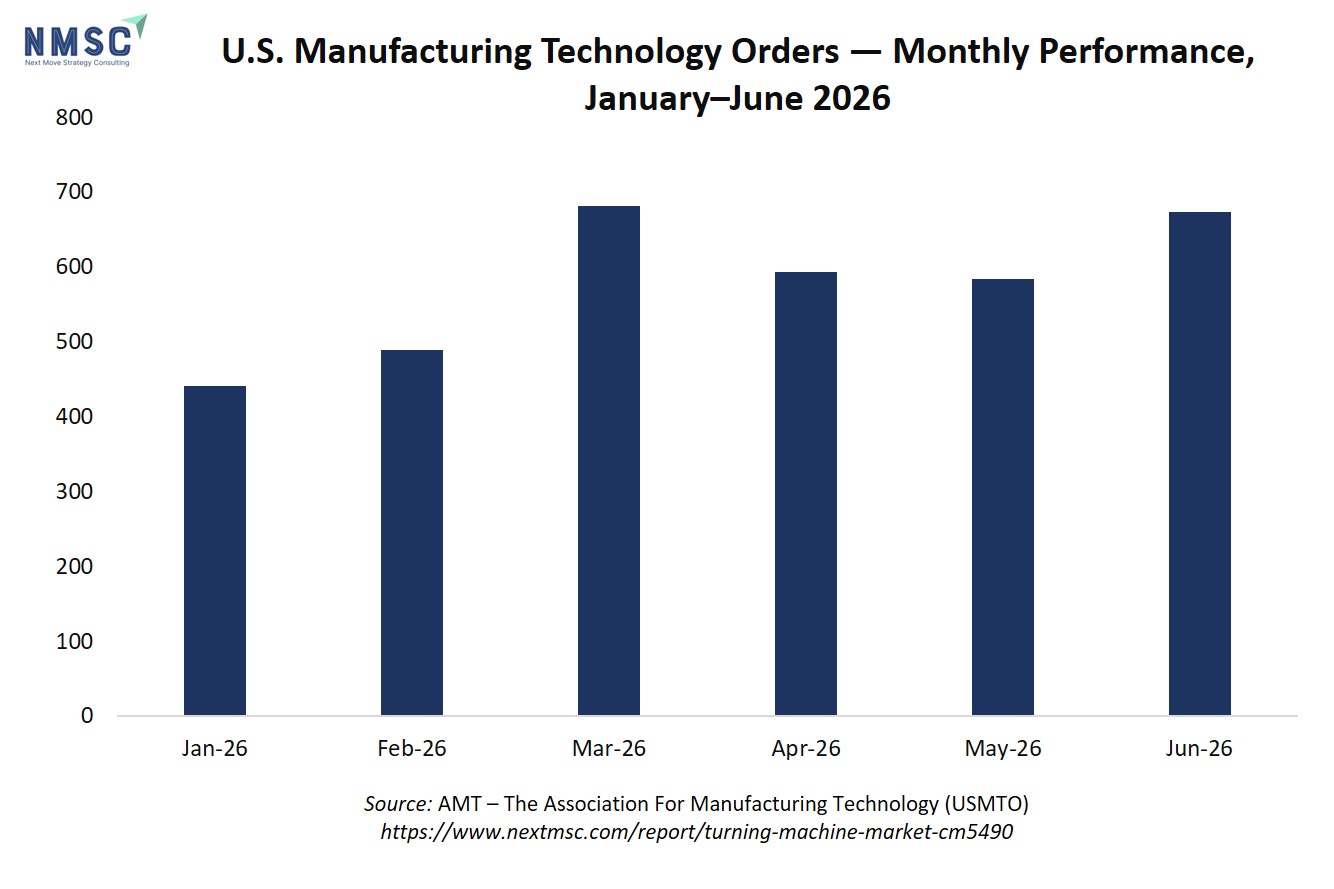
U.S. manufacturing technology orders reached their strongest half-year performance since the U.S. Manufacturing Technology Orders (USMTO) report began collecting data in 1998, according to AMT – The Association For Manufacturing Technology. Orders in the first half of 2026 totaled $3.44 billion, a 36.0% increase over the same period in 2025, with June 2026 orders alone reaching $672.7 million — a 56.8% year-over-year surge. The milestone, reported by AMT on August 10, 2026, reflects a broad-based acceleration in capital equipment investment across U.S. manufacturing sectors, driven by automation adoption, reshoring incentives, and semiconductor fabrication buildout.
The record-setting order momentum extends directly into the global Turning Machine Market, where precision CNC turning centres, multi-tasking machines, and robot-loaded automation cells represent a significant share of metalworking machinery procurement. According to Next Move Strategy Consulting, the global turning machine market is forecast to reach USD 24.03 billion by 2035, expanding at a 6.0% compound annual growth rate (CAGR) from 2026 to 2035. The market is projected to generate an absolute dollar opportunity of USD 9.83 billion between 2026 and 2035, presenting significant investment potential across robot-loaded automation cells, multi-tasking machine platforms, and semiconductor-linked precision turning capacity.
For More Information: Download FREE Sample on Turning Machine Market Report
Automation and Reshoring Drive Structural Demand Shift
The surge in U.S. manufacturing technology orders reflects structural forces reshaping the global machine tool industry. Automation adoption — particularly robot-loaded turning cells — is accelerating as labor-constrained job shops and contract manufacturers prioritize unattended, lights-out operation. Simultaneously, U.S. trade policy and reshoring incentives are driving significant capital investment in domestic manufacturing capacity, with the first half of 2026 establishing a new benchmark for industry demand.
Haas Automation, the largest machine tool builder in the western world by unit volume, is constructing a 2.4 million square foot manufacturing facility in Henderson, Nevada, with a projected completion date at the end of 2026. The company relocated 73 jobs from California to Nevada in August 2026, as part of its broader operational transition to the new facility. The Henderson plant is expected to double Haas Automation's production output, positioning the company to capture growing domestic demand tied to the current administration's manufacturing revival agenda.
Japanese machine tool builders are also expanding their North American footprint in response to tariff policy. Okuma, DMG Mori, and Yamazaki Mazak are broadening U.S. operations and service capacity to ease the impact of tariffs while capturing demand from reshoring-driven capital expenditure programs. DMG Mori reported record first-quarter fiscal year 2026 orders of JPY 155.4 billion, reflecting sustained capital investment confidence across the industry. The company simultaneously extended turning spindle and tool post warranties to five years from April 2026 shipments, underscoring its confidence in the long-term durability of its precision turning platforms.
The broader order recovery is consistent with AMT data showing that U.S. manufacturing technology orders totaled $5.74 billion for the full year 2025 — 22.5% above orders placed in 2024 — before accelerating further into the record-setting H1 2026 performance. December 2025 alone registered $814.3 million in orders, the highest monthly order value on record at the time.
DMG Mori and University of Tokyo Establish Machining Transformation Research Center
On the technology frontier, DMG Mori and the University of Tokyo formally established the Machining Transformation Research Center (MX Center) on April 1, 2026, with the opening announced on July 1, 2026. The center, backed by a JPY 1 billion investment, combines digital twin simulation with physical AI to advance integrated process prediction spanning cutting, grinding, and additive manufacturing.
The MX Center initiative exemplifies a broader industry trend toward data-driven, automated turning operations. Machine tool builders are increasingly investing in digital twin and physical AI capability to predict and visualize machining processes before production begins, elevating software and simulation capability alongside traditional mechanical precision as a purchasing criterion. According to Next Move Strategy Consulting's analysis, this shift toward integrated automation and digital process simulation is redefining capital equipment selection criteria across the turning machine market, with vendors unable to demonstrate credible automation integration and process simulation capability at risk of losing share among aerospace and semiconductor buyers demanding first-pass-yield improvements.
In March 2026, DMG Mori also launched the NLX 2500|700 2nd Generation CNC turning center, featuring enhanced machine rigidity, improved thermal stability, automation compatibility, and digital integration for high-precision turning applications — strengthening its portfolio for automotive, aerospace, and precision manufacturing customers.
IMTS 2026 Spotlights Multitasking and Automation Technologies
The International Manufacturing Technology Show (IMTS 2026), scheduled for September 14–19, 2026 at McCormick Place in Chicago, is expected to feature over 2,000 exhibitors across more than 1.2 million square feet of exhibit space, with an anticipated attendance of 90,000 visitors. AMT – The Association For Manufacturing Technology, which organizes IMTS, has highlighted industrial AI, automation, additive manufacturing, and digital technologies as central themes of the 2026 edition, with particular emphasis on multitasking, multifunction, and hybrid manufacturing equipment.
The IMTS 2026 platform reflects the industry's accelerating shift toward consolidated, multi-process platforms. Multi-Tasking Machines that combine turning, milling, and other operations on a single platform are gaining share as manufacturers seek to reduce part handling and setup time, particularly among aerospace and medical device manufacturers requiring complex, tight-tolerance geometries. According to Next Move Strategy Consulting, Multi-Tasking Machines represent the fastest-growing equipment segment within the turning machine market, expanding at an 8.4% CAGR from 2026 to 2035.
Market Segmentation: CNC Turning Centres Lead, Robot Loaded Automation Accelerates
Within the turning machine market, CNC Turning Centres held the dominant position with approximately 46% of market revenue in 2025, valued at USD 6.164 billion, according to Next Move Strategy Consulting. The segment's position as the default choice for precision, repeatable turning operations across job shops and contract manufacturers reflects the maturity and versatility of CNC platform technology across automotive, aerospace, and general machinery applications.
By automation level, Robot Loaded configurations are the fastest-growing segment at a 10.2% CAGR from 2026 to 2035, as machine tool builders bundle robotic loading directly into turning platforms rather than treating automation as an aftermarket addition. Standalone configurations, while still the largest automation level at USD 5.092 billion in 2025, are gradually ceding share to integrated automation solutions as labor constraints intensify across major manufacturing economies.
The Electronics and Semiconductors end-use industry is the fastest-growing demand segment at an 11.6% CAGR from 2026 to 2035, driven by semiconductor fabrication facility construction projects collectively exceeding USD 100 billion in the United States alone. Automotive remains the largest end-use industry at USD 3.886 billion in 2025, though cyclical capital expenditure patterns in vehicle manufacturing introduce periodic demand variability. Aerospace and Defence is the second-fastest-growing end-use segment at an 8.9% CAGR, supported by sustained demand for precision-turned components across commercial and defense supply chains.
U.S. Manufacturing Technology Orders — Monthly Performance, January–June 2026
|
Month |
Order Value (USD Million) |
Month-over-Month Change (%) |
Year-over-Year Change (%) |
|
January 2026 |
441.4 |
-45.8 |
+24.4 |
|
February 2026 |
488.9 |
+10.7 |
+27.4 |
|
March 2026 |
681.3 |
+40.3 |
+31.5 |
|
April 2026 |
593.6 |
-12.5 |
+33.2 |
|
May 2026 |
583.4 |
-1.8 |
+47.8 |
|
June 2026 |
672.7 |
+15.6 |
+56.8 |
|
H1 2026 Total |
3,440.0 (est.) |
— |
+36.0 |
Regional Dynamics: Asia-Pacific Leads, North America Accelerates
Asia-Pacific leads the global turning machine market with approximately 44% revenue share, valued at USD 5.896 billion in 2025, anchored by China's dominant domestic machine tool production and Japan's premium turning technology builders. China's turning machine market was valued at approximately USD 2.36 billion in 2025 and is projected to reach USD 4.23 billion by 2035, while India is the fastest-growing country at a 9.8% CAGR from 2026 to 2035, driven by automotive and general machinery supply chain expansion.
North America is expanding at a 7.0% CAGR — the second-fastest regional growth rate — supported by reshoring investment and semiconductor fabrication capacity growth. The United States turning machine market was valued at approximately USD 1.90 billion in 2025 and is projected to reach USD 3.75 billion by 2035. The Middle East and Africa region is the fastest-growing globally at a 7.7% CAGR, driven by industrial diversification programs and localized manufacturing initiatives across the Gulf states, including Saudi Arabia's Vision 2030-linked industrial programs.
Europe's market, valued at USD 3.484 billion in 2025, benefits from a deep precision automotive and aerospace component manufacturing base anchored by German and Swiss machine tool builders, though the region faces headwinds from cyclical automotive capital expenditure slowdowns and skilled machinist shortages.
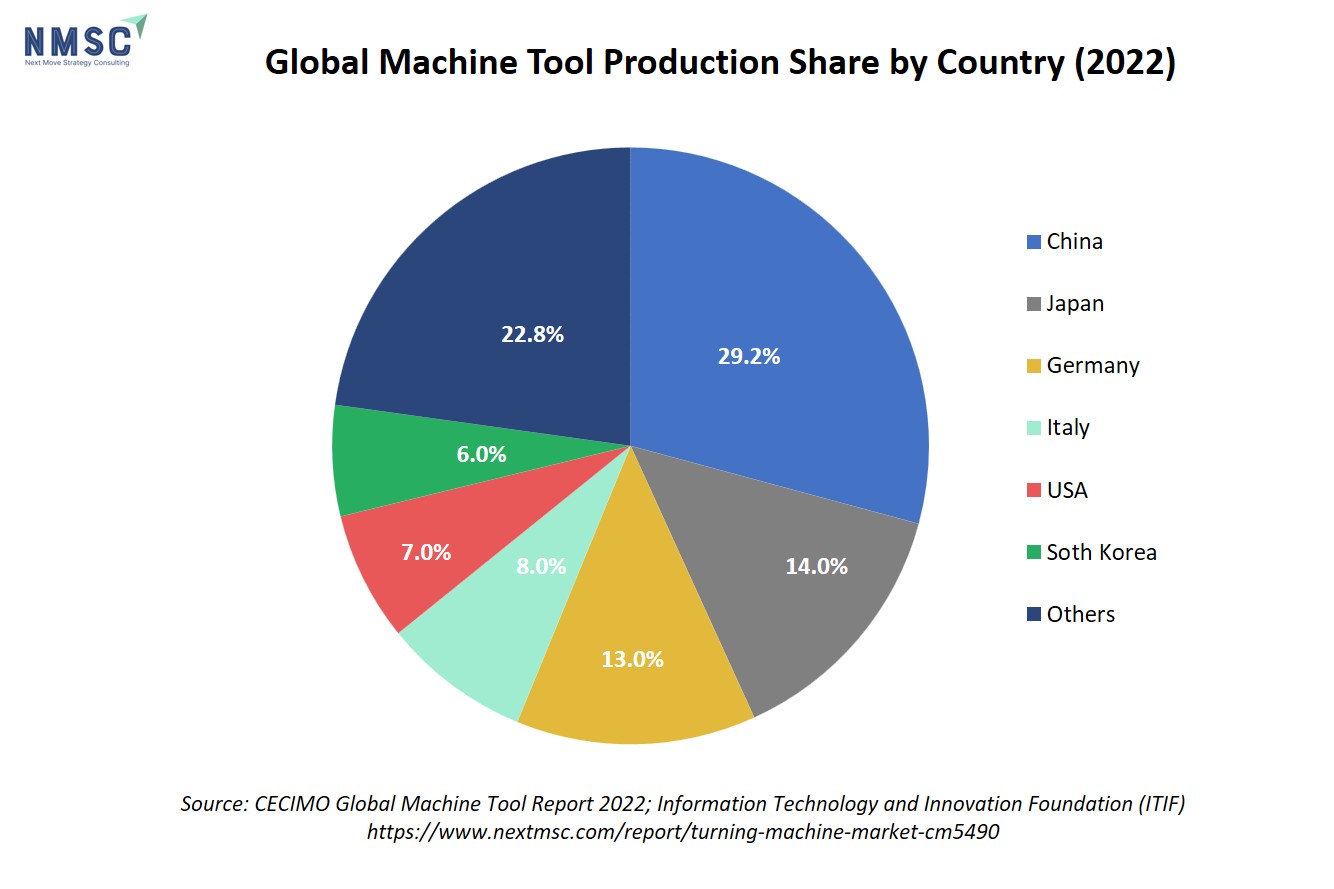
Global machine tool production across 54 countries tracked by Gardner Intelligence contracted from $88.3 billion in 2023 to $83.4 billion in 2024, reflecting a cyclical capital expenditure slowdown concentrated in China and automotive manufacturing. European machine tool production declined 9.2% to 25.1 billion EUR in 2024, according to CECIMO – the European Association of the Machine Tool Industries. However, the record-setting U.S. order momentum in H1 2026 signals a clear recovery trajectory, with demand accelerating across automation, aerospace, and semiconductor end-use categories.
Global Machine Tool Production — Key Market Indicators (2023–2024)
|
Indicator |
2023 |
2024 |
Year-over-Year Change |
|
Global Machine Tool Production (54 countries) |
USD 88.3 billion |
USD 83.4 billion |
-5.6% |
|
European Machine Tool Production (CECIMO members) |
EUR 27.6 billion* |
EUR 25.1 billion |
-9.2% |
|
U.S. Manufacturing Technology Orders (Annual) |
USD 4.69 billion (est.)** |
USD 4.69 billion |
— |
|
U.S. Manufacturing Technology Orders (Annual) |
— |
— |
2025: USD 5.74 billion (+22.5% vs. 2024) |
|
China's Share of Global MT Production |
~29% |
~29% |
— |
|
Japan's Share of Global MT Production |
~14% |
~14% |
— |
Competitive Landscape: Innovation and Capacity Investment Define Market Leadership
The turning machine market features a moderately consolidated competitive landscape, with Japanese, German, and Korean builders competing on precision, automation integration, and regional service depth. Two competitive archetypes dominate: premium Japanese and German builders offering high-precision, automation-integrated platforms, and value-oriented builders competing on price and domestic production scale.
DMG Mori, Yamazaki Mazak, and Okuma exemplify the premium archetype through advanced CNC control systems, thermal stability technologies, and digital twin integration. Haas Automation exemplifies the value archetype through its position as the largest machine tool builder in the western world by unit volume and its expanding Henderson, Nevada production capacity. DN Solutions, INDEX-Werke, EMAG, Citizen Machinery, Tsugami, Tornos, Star Micronics, Nakamura-Tome, JTEKT, and Fuji Machine are among the additional key participants shaping product innovation and regional capacity strategy within the global market.
Innovation and differentiation strategy increasingly center on digital twin simulation and extended equipment reliability. According to Next Move Strategy Consulting's analysis, vendors that combine robot-loaded platforms, digital twin capability, and extended reliability warranties will differentiate most clearly as buyers evaluate total cost of ownership over unit price, particularly as aerospace and semiconductor buyers intensify certification and traceability requirements.
Bottom Line
The global turning machine market is entering a period of accelerating structural transformation, anchored by record-breaking U.S. manufacturing technology order momentum, expanding North American production capacity, and deepening automation integration across precision manufacturing supply chains. The H1 2026 USMTO record of $3.44 billion — the strongest half-year since 1998 — confirms that the cyclical downturn of 2023–2024 has given way to a sustained recovery driven by reshoring investment, semiconductor fabrication buildout, and robot-loaded automation adoption.
For investors and capital equipment buyers, the most compelling opportunities lie in robot-loaded automation platforms (10.2% CAGR), multi-tasking machine configurations (8.4% CAGR), and semiconductor-linked precision turning capacity (11.6% CAGR end-use growth) through 2035. North America and the Middle East and Africa represent the fastest-growing regional markets, while Asia-Pacific maintains its dominant position anchored by China and Japan's established machine tool production bases.
Key risks include cyclical automotive capital expenditure slowdowns, high upfront costs of automated multi-axis platforms, and extended equipment lead times. Vendors that combine robot-loaded automation capability with digital twin process simulation and extended reliability warranties are best positioned to capture the turning machine market's projected USD 9.83 billion absolute dollar opportunity between 2026 and 2035.
About Next Move Strategy Consulting
Next Move Strategy Consulting is a premier market research and management consulting firm that has been committed to provide strategically analysed well documented latest research reports to its clients. The research industry is flooded with many firms to choose from, what makes NMSC different from the rest is its top-quality research and the obsession of turning data into knowledge by dissecting every bit of it and providing fact-based research recommendation that is supported by information collected from over 500 million websites, paid databases, industry journals and one on one consultations with industry experts across a diverse range of industry sectors. The high-quality customized research reports with actionable insights and excellent end-to-end customer service help our clients to take critical business decisions that enables them to move beyond time and have competitive edge in the industry.
We have been servicing over 1000 customers globally that includes 90% of the Fortune 500 companies over a decade. Our analysts are constantly tracking various high growth markets and identifying hidden opportunities in each sector or the industry. We provide one of the industry's best quality syndicate as well as custom research reports across 10 different industry verticals. We are committed to deliver high quality research solutions in accordance to your business needs. Our industry standard delivery solutions that ranges from the pre consultation to after-sales services, provide an excellent client experience and ensure right strategic decision making for businesses.
For more information, please contact:
Next Move Strategy Consulting
5th Floor 867
Boylston St, STE 500,
Boston, MA 02116, U.S.
E-Mail: [email protected]
Direct: +1-217-650-7991
Website: www.nextmsc.com
About the Author
 Sanyukta Deb
— Sanyukta Deb is Digital Marketing Team Lead at Next Move Strategy Consulting, where she has led content strategy and technical SEO for the firm's B2B market research publications for over 2 years. Her editorial process translates NextMSC's primary and secondary research — spanning technology, industrial, and consumer sectors — into commercial narratives, backed by search-intent, keyword, and competitive analysis. She brings 5 years of overall experience in digital marketing and content strategy.
Sanyukta Deb
— Sanyukta Deb is Digital Marketing Team Lead at Next Move Strategy Consulting, where she has led content strategy and technical SEO for the firm's B2B market research publications for over 2 years. Her editorial process translates NextMSC's primary and secondary research — spanning technology, industrial, and consumer sectors — into commercial narratives, backed by search-intent, keyword, and competitive analysis. She brings 5 years of overall experience in digital marketing and content strategy.
About the Reviewer
 Debashree Dey
— Debashree Dey is Assistant Manager at Next Move Strategy Consulting, where she supports cross-vertical market content and communications across diverse industries for 6 years. Her professional background includes senior content writing, communications, and published manuscript authorship, with experience developing audience-focused business narratives and maintaining clear, consistent messaging. Her role supports research-led content development and editorial quality across NextMSC publications.
Debashree Dey
— Debashree Dey is Assistant Manager at Next Move Strategy Consulting, where she supports cross-vertical market content and communications across diverse industries for 6 years. Her professional background includes senior content writing, communications, and published manuscript authorship, with experience developing audience-focused business narratives and maintaining clear, consistent messaging. Her role supports research-led content development and editorial quality across NextMSC publications.

















Add Comment