Ad Fraud Detection Market Size, Share, and Trends Analysis by Solution (Pre-Bid Fraud Prevention, Post-Bid Verification, Click and Conversion Protection, and Mobile and App Fraud Protection), Deployment (Cloud, On-Premises, Hybrid), Service Model (Self-Serve, Managed Service), Pricing Model (Subscription, Usage Based, Per Click Fee), Media Type (Web, Mobile App, CTV, Other), Buyer Type (Advertiser, Ad Tech Platform, & Others), and Region — Global Industry Report and Forecast, 2026–2035
Industry: ICT & Media | Publishing Date: July 24, 2026 | Last Updated: September 30, 2026 | No of Pages: N/A | No. of Tables: N/A | No. of Figures: N/A | Format: PDF | Report Code: IC5393
What Is the Ad Fraud Detection Market Size?
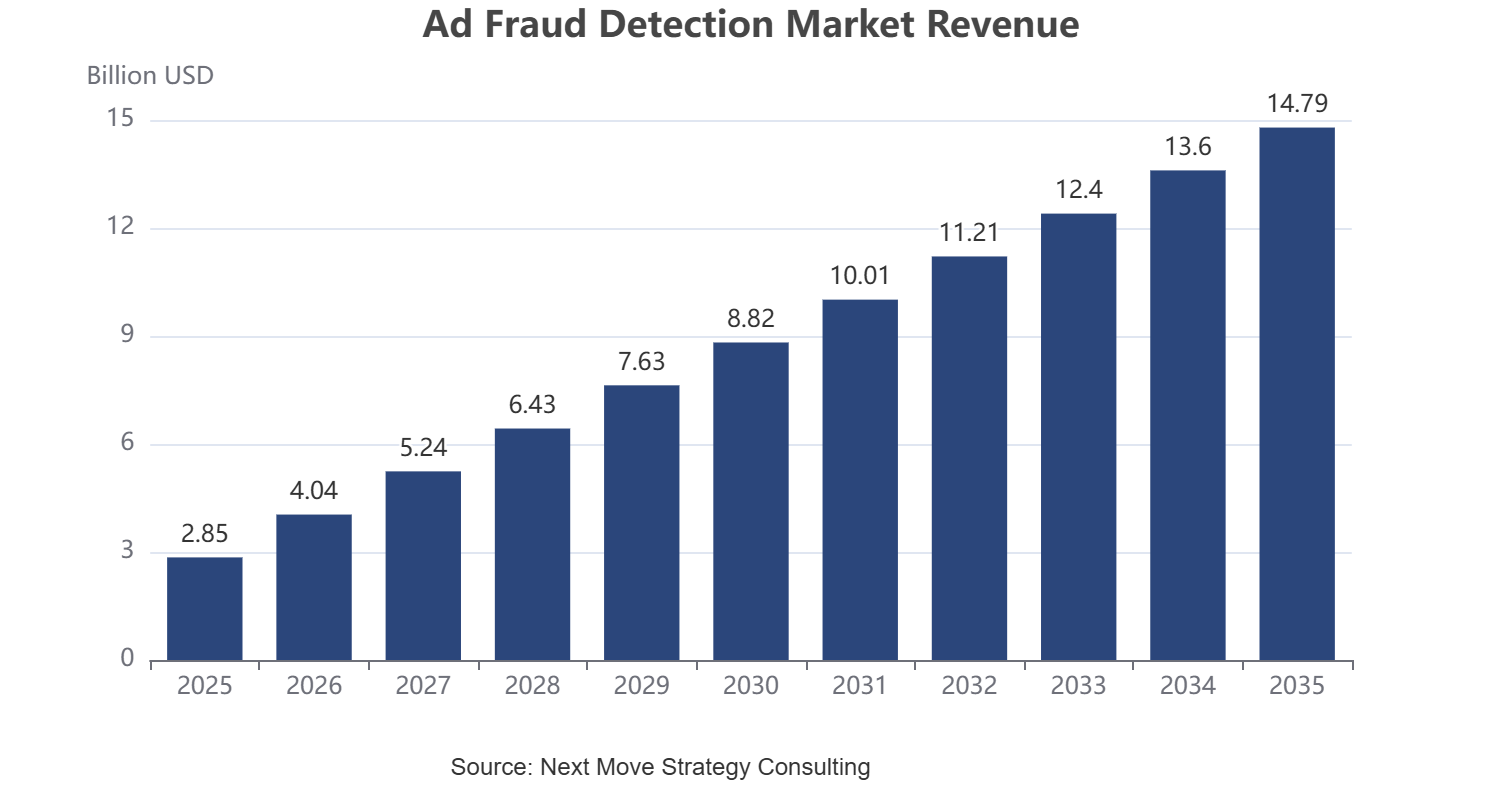
The global Ad Fraud Detection Market size reached USD 2.85 Billion in 2025 and is estimated at USD 3.36 Billion in 2026, forecast to reach USD 14.79 Billion by 2035 at a CAGR of 17.9% between 2026 and 2035. North America leads with an approximate 42% share, while Post-Bid Verification dominates the solution segment at approximately 34% share in 2025.
We observed that buyer-side scrutiny of programmatic spend, combined with tightening walled-garden measurement requirements, is keeping post-bid verification and click protection tightly linked even as mobile and CTV fraud protection scale as distinct growth engines.
|
Key Takeaways |
|
By Solution: Post-Bid Verification held the largest share, expanding from USD 0.97 billion in 2025 to USD 4.29 billion by 2035; Mobile and App Fraud Protection is the fastest-growing sub-segment at 23.8% CAGR from 2026–2035. |
|
By Deployment: Cloud held the largest share, reflecting programmatic infrastructure hosted by ad tech platforms; Hybrid is the fastest-growing sub-segment, as enterprises retain on-premises data control alongside cloud scale. |
|
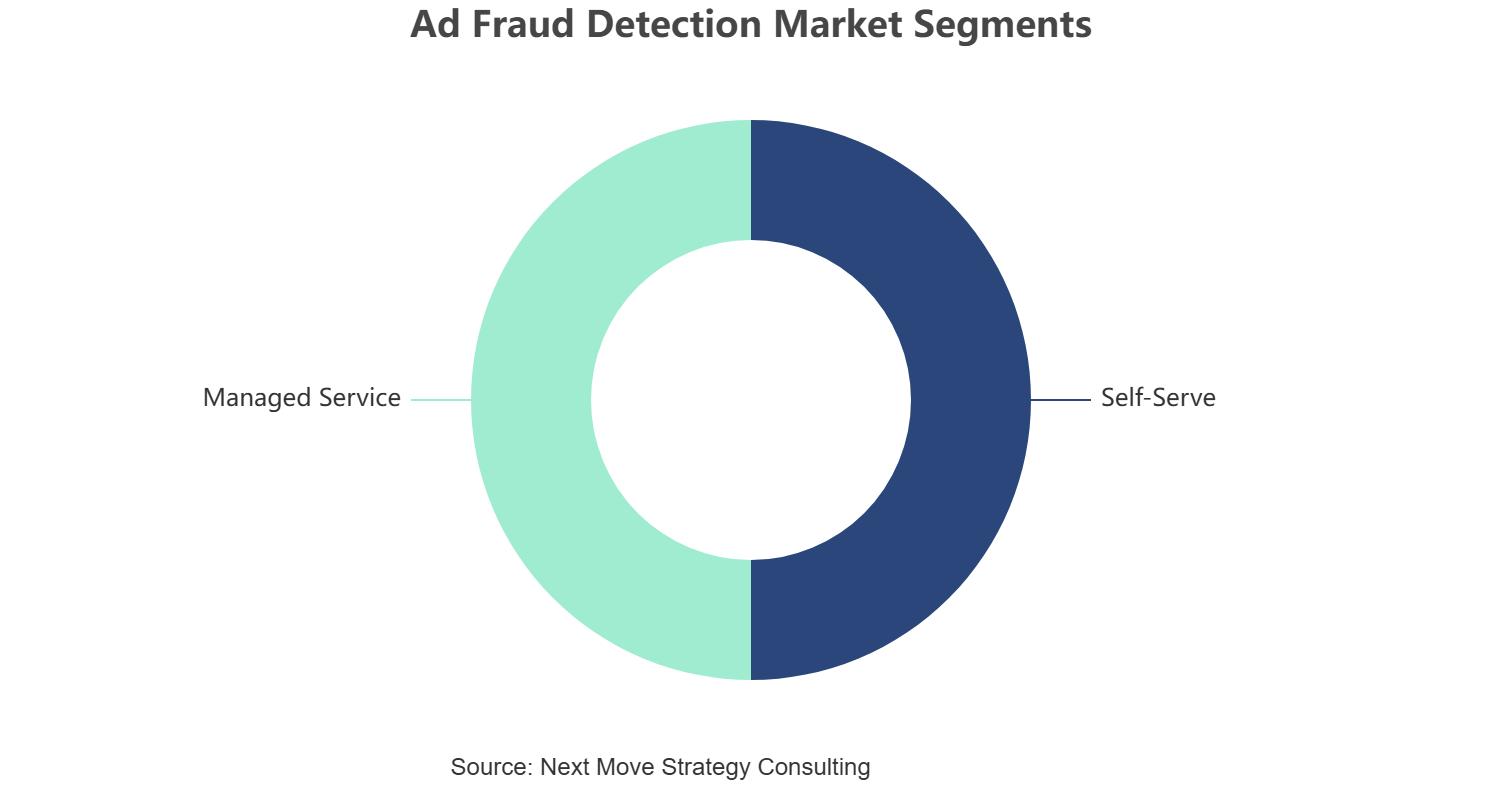
By Service Model: Self-Serve held the largest share, driven by in-housing of verification workflows by advertisers. |
|
By Pricing Model: Subscription held the largest share, supported by predictable enterprise verification contracts. |
|
By Media Type: Mobile App held the largest share, expanding from USD 0.91 billion in 2025 to USD 5.03 billion by 2035; CTV is the fastest-growing sub-segment at 24.9% CAGR from 2026–2035. |
|
By Buyer Type: Advertiser held the largest share, expanding from USD 1.07 billion in 2025 to USD 4.88 billion by 2035; Affiliate Network is the fastest-growing sub-segment at 27.5% CAGR from 2026–2035. |
|
Dominant Region: North America dominated with approximately 42% revenue share in 2025. |
|
Fastest-Growing Region: Asia-Pacific is expected to register the highest CAGR of 21.1% during 2026–2035. |
|
Dominant Country: The U.S. led the market, anchored by concentrated programmatic ad spend and MRC-accredited measurement. |
|
Fastest-Growing Country: India is the fastest-growing country, supported by rapid mobile app install-base expansion. |
The market presents an absolute investment opportunity of approximately USD 11.43 Billion between 2026 and 2035, calculated as the difference between the 2035 forecast of USD 14.79 Billion and the 2026 base of USD 3.36 Billion, positioning verification and fraud-scoring infrastructure as a high-conviction category for ad tech platforms and enterprise buyers alike.
According to NMSC analysis, the segment's durability stems from the buyer-side shift toward in-housing verification workflows, which is expanding self-serve and usage-based pricing adoption even as managed-service contracts remain dominant among large agency holding companies.
What does the Ad Fraud Detection Market Encompass?
The Ad Fraud Detection Market covers software and managed services that identify and block invalid traffic, impression fraud, click and conversion fraud, and mobile install fraud across web, mobile app, and CTV inventory. We observed that the market has evolved from basic bot-list filtering into a layered discipline spanning pre-bid supply path validation, post-bid verification, and attribution-level fraud scoring as programmatic spend has scaled.
Our findings suggest that MRC accreditation and the IAB/MRC Invalid Traffic Detection and Filtration Guidelines are the structural backbone shaping vendor methodology, classifying invalid traffic into General Invalid Traffic and Sophisticated Invalid Traffic categories that buyers now require disclosed. Technology adoption trends toward machine-learning-based anomaly detection and real-time bidstream analysis are further compressing the time between fraud occurrence and detection across all media types.
|
Parameters |
Details |
|
Market Size in 2025 |
USD 2.85 Billion |
|
Market Size in 2026 |
USD 3.36 Billion |
|
Revenue Forecast in 2035 |
USD 14.79 Billion |
|
Growth Rate |
CAGR of 17.9% from 2026 to 2035 |
|
Analysis Period |
2025–2035 |
|
Base Year Considered |
2025 |
|
Forecast Period |
2026–2035 |
|
Market Size Estimation |
USD Billion |
|
Companies Profiled |
20 |
|
Countries Covered |
38 |
|
Market Share |
Available for Top 10 Companies |
Key Emerging Trends
Based on research conducted by NMSC, we found that four structural trends are redefining how ad fraud detection vendors compete, price, and integrate with buyer workflows through 2035.
How Is Made For Advertising Site Blocking Transforming Pre-Bid Filtering?
We found that pre-bid filtering is shifting from simple domain blocklists toward continuous, AI-scored Made For Advertising site classification, which evaluates content density, ad load, and refresh rate before a bid is placed. This transformation reduces wasted spend before it occurs rather than reconciling it after delivery, giving advertisers earlier visibility into supply-path quality.
What Role Does Supply Path Validation Play in Adoption?
Our assessment indicates that supply path validation is becoming a default requirement in programmatic contracts as advertisers demand transparency into the intermediary chain between demand and publisher inventory. Vendors offering supply path validation alongside traditional verification are seeing faster enterprise adoption, since duplicate reseller paths are a documented source of invalid traffic inflation.
How Are Stakeholders Responding to Walled Garden Measurement Gaps?
We observed that advertisers and agencies are pressing walled-garden platforms for expanded measurement access, pushing vendors to build compliant integrations that verify fraud within closed environments without violating platform data policies. This stakeholder response is reshaping vendor roadmaps toward API-based partnerships rather than pixel-based tracking alone.
Why Is Mobile SDK Spoofing Detection Gaining Traction?
During our market evaluation, we noticed that SDK spoofing, where fraudulent actors fabricate device signals to mimic legitimate app installs, is prompting mobile attribution vendors to deploy on-device signal verification and probabilistic fingerprinting. AppsFlyer and Adjust have both expanded fraud-protection modules addressing SDK spoofing as install-fraud losses scale alongside mobile ad spend.
Growth Drivers & Restraints
Growth Catalyst & Risk Assessment Matrix
|
Factors |
Type |
(+/−) % Impact on CAGR |
Geographic Relevance |
Impact Timeline |
|
Rising programmatic and CTV ad spend |
Driver |
+4.6% |
Global |
2026–2035 |
|
MRC/IAB Invalid Traffic accreditation requirements |
Driver |
+3.0% |
North America, Europe |
2026–2032 |
|
Mobile app install-fraud losses from SDK spoofing |
Driver |
+2.4% |
Asia-Pacific, Global |
2026–2035 |
|
In-housing of verification by advertisers |
Driver |
+2.0% |
North America, Europe |
2026–2030 |
|
Expansion of Made For Advertising site classification |
Driver |
+1.3% |
Global |
2026–2033 |
|
Data access restrictions within walled gardens |
Restraint |
−2.2% |
Global |
2026–2035 |
|
Fragmented measurement standards across regions |
Restraint |
−1.8% |
Asia-Pacific, MEA |
2027–2035 |
|
Sophisticated Invalid Traffic evasion techniques |
Restraint |
−1.4% |
Global |
2026–2032 |
|
Pricing pressure on legacy CPM-based verification fees |
Restraint |
−1.0% |
North America |
2026–2035 |
What is the Primary Growth Driver in the Ad Fraud Detection Market?
The primary growth driver is the accelerating volume of programmatic and CTV advertising spend that requires independent fraud verification before and after each transaction. DoubleVerify reported 2025 full-year revenue of USD 748.3 Million, up 14% year-over-year, directly evidencing rising enterprise budget allocation toward verification and measurement services across CTV, social, and programmatic activation.
How is Regulatory and Standards Alignment Driving the Market Growth?
Our analysis shows that the Media Rating Council's Invalid Traffic Detection and Filtration Guidelines, developed with IAB and MMA participation, are compelling accredited measurement vendors to apply General Invalid Traffic and Sophisticated Invalid Traffic detection processes as a baseline requirement. This standards-driven compliance structure is reinforcing vendor accreditation as a competitive prerequisite rather than an optional certification.
What is Restraining the Ad Fraud Detection Market?
We found that the primary restraint is restricted data access within walled-garden platforms, which limits independent verification vendors' visibility into impression and click-level data on closed ecosystems. Industry-derived estimates suggest this visibility gap is a leading cause of measurement disputes between advertisers and platforms, slowing full-funnel fraud verification adoption in social and CTV environments.
Segmentation Analysis
Segment Sizing: By Solution
|
Segment |
2025 (USD Bn) |
2035 (USD Bn) |
CAGR% (2026–2035) |
|
Pre-Bid Fraud Prevention |
0.63 |
2.81 |
16.0% |
|
Post-Bid Verification |
0.97 |
4.29 |
15.9% |
|
Click and Conversion Protection |
0.68 |
3.11 |
16.1% |
|
Mobile and App Fraud Protection |
0.57 |
4.58 |
23.8% |
|
Total |
2.85 |
14.79 |
17.9% |
Which Solution Segment Dominates the Ad Fraud Detection Market?
Post-Bid Verification leads with USD 0.97 Billion in 2025, expanding to USD 4.29 Billion by 2035, reflecting its established role validating impression fraud and viewability after ad delivery. Mobile and App Fraud Protection is the fastest-growing segment at a 23.8% CAGR, driven by rising SDK spoofing and install-fraud losses that traditional post-bid tools were not originally built to address.
Segment Sizing: By Media Type
|
Segment |
2025 (USD Bn) |
2035 (USD Bn) |
CAGR% (2026–2035) |
|
Web |
1.31 |
4.88 |
13.7% |
|
Mobile App |
0.91 |
5.03 |
18.6% |
|
CTV |
0.46 |
3.99 |
24.9% |
|
Other |
0.17 |
0.89 |
18.0% |
|
Total |
2.85 |
14.79 |
17.9% |
Which Media Type Leads and Which Grows Fastest in the Ad Fraud Detection Market?
Web remains the largest media type at USD 1.31 Billion in 2025, though Mobile App overtakes it by 2035 at USD 5.03 Billion, reflecting the shift of ad budgets toward mobile commerce and app-based engagement. CTV is the fastest-growing media type at a 24.9% CAGR as streaming ad inventory scales and fraud actors increasingly target CTV's comparatively immature verification infrastructure.
Segment Sizing: By Buyer Type
|
Segment |
2025 (USD Bn) |
2035 (USD Bn) |
CAGR% (2026–2035) |
|
Advertiser |
1.07 |
4.88 |
16.1% |
|
Agency |
0.63 |
2.81 |
16.0% |
|
Publisher |
0.46 |
1.92 |
15.1% |
|
Ad Tech Platform |
0.34 |
2.22 |
21.0% |
|
App Developer |
0.20 |
1.63 |
23.7% |
|
Affiliate Network |
0.09 |
0.89 |
27.5% |
|
Other |
0.06 |
0.44 |
22.7% |
|
Total |
2.85 |
14.79 |
17.9% |
Which Buyer Type Dominates and Which is Fastest-Growing in the Ad Fraud Detection Market?
Advertisers dominate buyer-side demand at USD 1.07 Billion in 2025, growing to USD 4.88 Billion by 2035, as brand-side budgets fund the majority of verification spend directly. Affiliate Network is the fastest-growing buyer type at a 27.5% CAGR, reflecting rising performance-marketing fraud losses tied to fake leads and referral manipulation that affiliate networks are only now systematically addressing with dedicated protection tools.
Porter's Five Forces Analysis of the Ad Fraud Detection Industry
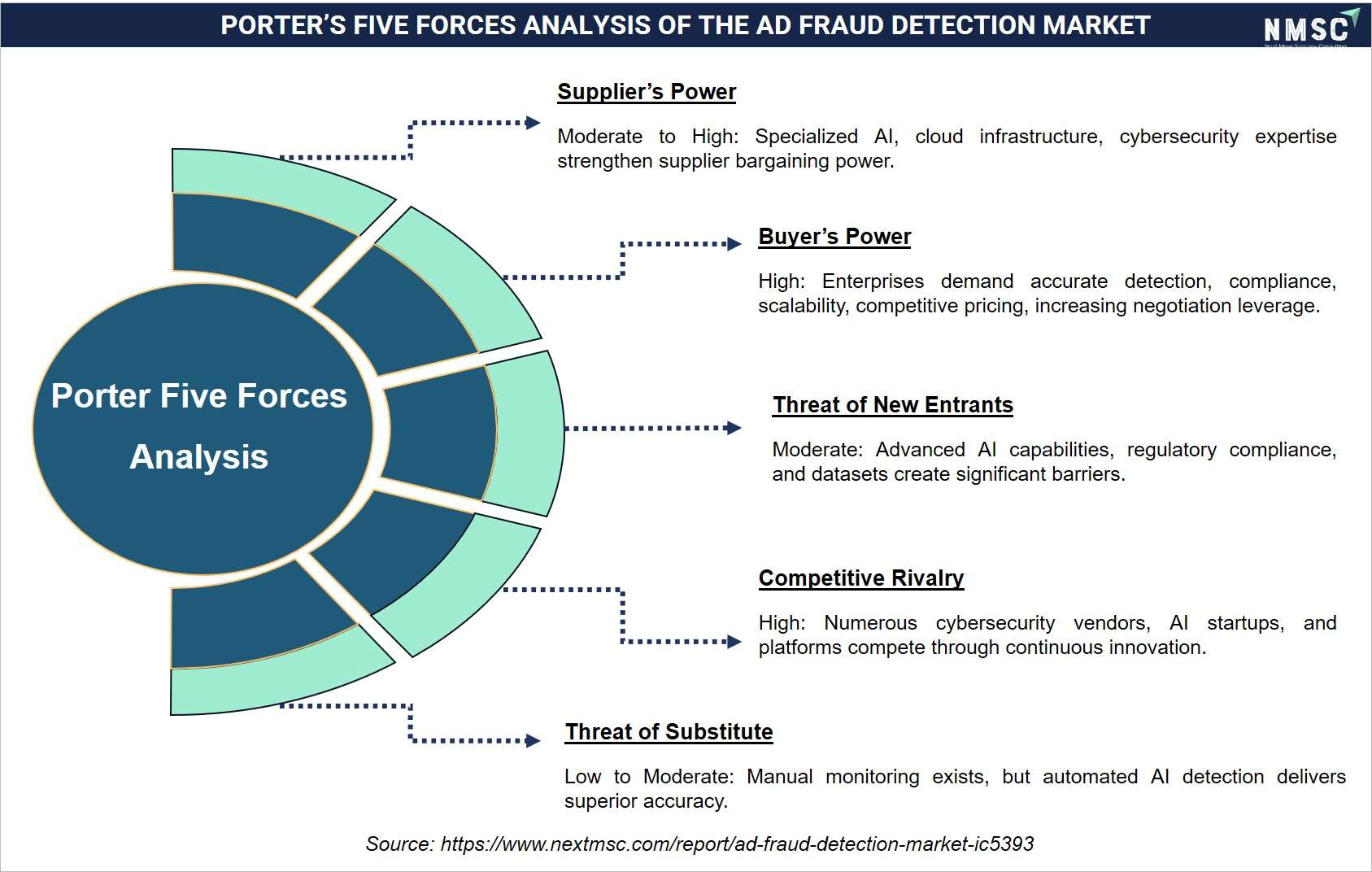
The above infographic presents a Porter's Five Forces analysis of the ad fraud detection market, where supplier power remains moderate to high due to reliance on specialized AI, cloud infrastructure, and cybersecurity expertise. At the same time, buyer power is significant as advertisers demand accurate detection and measurable ROI. The threat of new entrants is moderate, constrained by advanced AI capabilities and regulatory compliance requirements, though competitive rivalry is intense among cybersecurity vendors and AI startups. Looking ahead, we observed that the threat of substitutes remains low to moderate, as manual monitoring exists but automated AI detection delivers superior accuracy and efficiency.
Growth Opportunities
Our analysis shows that three whitespace opportunities stand out for vendors positioning ahead of 2035 demand.
Can CTV-Native Verification Unlock Streaming Ad Budgets in the Ad Fraud Detection Market?
Vendors that build CTV-native fraud detection, addressing server-side ad insertion and connected-device spoofing specifically, can capture a disproportionate share of streaming ad budgets as CTV inventory scales faster than any other media type, benefiting Post-Bid Verification and Mobile and App Fraud Protection providers with early CTV-specific tooling.
Does Affiliate and Performance-Marketing Fraud Scoring Create Value?
Vendors offering dedicated lead-fraud and referral-fraud scoring for affiliate networks can capture a fast-growing, underserved buyer segment currently reliant on manual review, benefiting Click and Conversion Protection providers positioned to formalize fraud scoring within performance-marketing platforms.
Can Walled-Garden-Compliant Integrations Expand Measurement Reach?
Vendors that secure formal API partnerships with social and CTV platforms to verify fraud within closed ecosystems can expand addressable measurement volume beyond the open web, benefiting Post-Bid Verification providers as advertisers push for full-funnel fraud visibility across all inventory types.
Regional Outlook
|
Region |
2025 (USD Bn) |
2035 (USD Bn) |
CAGR% (2026–2035) |
Key Driver |
|
North America |
1.20 |
5.47 |
16.2% |
Concentrated programmatic spend and MRC accreditation |
|
Europe |
0.74 |
3.55 |
16.9% |
IAB/MRC-aligned invalid traffic standards adoption |
|
Asia-Pacific |
0.63 |
4.14 |
21.1% |
Rapid mobile app install-base and ad spend growth |
|
Latin America |
0.17 |
1.04 |
20.1% |
Expanding e-commerce and mobile advertising penetration |
|
Middle East & Africa |
0.11 |
0.59 |
18.3% |
Emerging programmatic infrastructure investment |
|
Total |
2.85 |
14.79 |
17.9% |
|
North America Ad Fraud Detection Market
North America holds the largest regional share, supported by concentrated programmatic and CTV ad spend and the presence of MRC-accredited measurement vendors including DoubleVerify and HUMAN Security. We observed that enterprise in-housing of verification workflows is most advanced in this region, positioning North America as both the largest revenue base and a proving ground for new fraud-detection technology.
Europe Ad Fraud Detection Market
Europe's market is shaped by IAB Europe and MRC-aligned invalid traffic standards, with advertisers increasingly requiring supply path validation in programmatic contracts. Our findings suggest that regional adoption of walled-garden-compliant measurement integrations is accelerating as agencies push for cross-platform fraud visibility ahead of major retail and CTV ad-spend cycles.
Asia-Pacific Ad Fraud Detection Market
Asia-Pacific is the fastest-growing region, driven by rapid mobile app install-base expansion across China, India, and Southeast Asia. We found that mobile attribution vendors are scaling SDK spoofing and install-fraud detection fastest in this region, reflecting the outsized share of mobile-first advertising budgets relative to web and CTV spend.
Middle East & Africa Ad Fraud Detection Market
The Middle East & Africa region remains an early-stage market, with the UAE and South Africa leading early programmatic infrastructure investment. Industry-derived estimates suggest regional growth will track broader digital-advertising infrastructure buildout rather than fraud-specific regulatory mandates, given the comparatively nascent measurement-standards environment in the region.
Latin America Ad Fraud Detection Market
Latin America is expanding at a 20.1% CAGR, led by Brazil's growing e-commerce and mobile advertising base. We observed that Argentina's digital-advertising sector offers latent demand for click and conversion protection as performance-marketing budgets scale across the region's expanding affiliate and app-developer ecosystem.
U.S. Ad Fraud Detection Market
Based on our estimates, the U.S. market was valued at approximately USD 0.98 Billion in 2025 and is projected to reach USD 4.44 Billion by 2035 at a CAGR near 16.4%. Demand structure is anchored by concentrated programmatic and CTV ad spend, with high technology penetration among MRC-accredited vendors and strong competitive intensity between DoubleVerify, HUMAN Security, and Integral Ad Science.
Canada Ad Fraud Detection Market
The market in Canada was estimated at around USD 0.14 Billion in 2025, forecast to reach USD 0.63 Billion by 2035 at roughly 16.1% CAGR. Canada's demand structure closely mirrors U.S. programmatic adoption patterns, with agencies increasingly requiring supply path validation as a standard contractual term, supporting steady technology penetration and moderate competitive intensity.
UK Ad Fraud Detection Market
As per our estimate, the UK market stood near USD 0.19 Billion in 2025 and is expected to reach USD 0.86 Billion by 2035 at approximately 16.3% CAGR. Strong IAB Europe engagement and early adoption of walled-garden measurement partnerships support high technology penetration, with regulatory influence centered on advertiser-driven transparency demands rather than binding fraud-specific legislation.
Germany Ad Fraud Detection Market
According to our analysis, Germany's market was valued at about USD 0.20 Billion in 2025, projected to reach USD 0.94 Billion by 2035 at a CAGR near 16.7%. Germany's demand structure benefits from a large domestic programmatic advertising base and cautious enterprise data-governance practices that favor vendors with strong compliance credentials and transparent methodology disclosure.
France Ad Fraud Detection Market
Based on our estimates, France's market reached approximately USD 0.13 Billion in 2025 and is forecast to grow to USD 0.61 Billion by 2035 at around 16.5% CAGR. Demand is supported by growing CTV ad-spend allocation and rising advertiser scrutiny of programmatic supply paths, with moderate competitive intensity among regional and global verification vendors.
China Ad Fraud Detection Market
The market in China was valued at nearly USD 0.20 Billion in 2025 and is projected to reach USD 1.42 Billion by 2035 at approximately 21.9% CAGR. China's growth reflects its massive mobile app ecosystem and rapidly scaling programmatic ad spend, with domestic attribution and anti-fraud vendors competing intensely alongside global entrants for platform-level integration access.
India Ad Fraud Detection Market
As per our estimate, India's market was close to USD 0.11 Billion in 2025, expected to reach USD 0.89 Billion by 2035 at roughly 23.2% CAGR, the fastest among covered countries. Rising mobile app install volumes and performance-marketing spend are expanding feedstock for fraud detection, though technology penetration remains moderate as formal measurement standards continue to mature.
Japan Ad Fraud Detection Market
According to our analysis, Japan's market stood at about USD 0.14 Billion in 2025 and is forecast to reach USD 0.79 Billion by 2035 at approximately 18.9% CAGR. Japan's demand structure benefits from a mature, high-value programmatic advertising market with strong enterprise data-governance standards, supporting high technology penetration among established verification vendors.
South Korea Ad Fraud Detection Market
Based on our estimates, South Korea's market was valued near USD 0.09 Billion in 2025, projected to reach USD 0.58 Billion by 2035 at around 20.3% CAGR. Deep integration between domestic mobile gaming and app-publishing ecosystems and global attribution vendors supports rising technology adoption, with competitive intensity concentrated among a handful of mobile-first specialists.
Australia Ad Fraud Detection Market
As per our estimate, Australia's market reached approximately USD 0.06 Billion in 2025 and is expected to grow to USD 0.31 Billion by 2035 at roughly 17.9% CAGR. Australia's demand structure benefits from strong CTV ad-spend growth and advertiser-driven adoption of supply path validation, positioning the country as a steady adopter of global verification standards.
UAE Ad Fraud Detection Market
Based on our estimates, the UAE market was valued at about USD 0.03 Billion in 2025 and is forecast to reach USD 0.16 Billion by 2035 at approximately 19.6% CAGR. Growing digital-advertising infrastructure investment and expanding e-commerce activity support the UAE's emerging role as a regional programmatic hub, though fraud-specific regulatory frameworks remain in early development.
Saudi Arabia Ad Fraud Detection Market
According to our analysis, Saudi Arabia's market stood near USD 0.03 Billion in 2025, projected to reach USD 0.14 Billion by 2035 at around 18.9% CAGR. Vision 2030-linked digital-economy initiatives are supporting early-stage investment in programmatic advertising infrastructure, with competitive intensity currently limited to a small number of regional and global vendors.
South Africa Ad Fraud Detection Market
As per our estimate, South Africa's market was close to USD 0.02 Billion in 2025 and is expected to reach USD 0.11 Billion by 2035 at roughly 18.4% CAGR. A growing mobile-first advertising base gives South Africa the strongest technology penetration in the MEA region, supporting a strategic outlook centered on mobile and app fraud protection as smartphone ad spend accelerates.
Brazil Ad Fraud Detection Market
Based on our estimates, Brazil's market reached approximately USD 0.09 Billion in 2025 and is projected to reach USD 0.57 Billion by 2035 at around 20.5% CAGR. Rapid e-commerce and mobile-advertising expansion are driving demand structure, with regulatory alignment on data governance gradually strengthening technology penetration and strategic investment appeal among performance-marketing buyers.
Argentina Ad Fraud Detection Market
According to our analysis, Argentina's market was valued at about USD 0.03 Billion in 2025, forecast to reach USD 0.19 Billion by 2035 at approximately 19.8% CAGR. A growing affiliate and app-developer ecosystem offers rising demand for click and conversion protection, though competitive intensity remains moderate given the still-developing formal measurement infrastructure for digital advertising.
Regulatory Framework Impacting the Ad Fraud Detection Industry
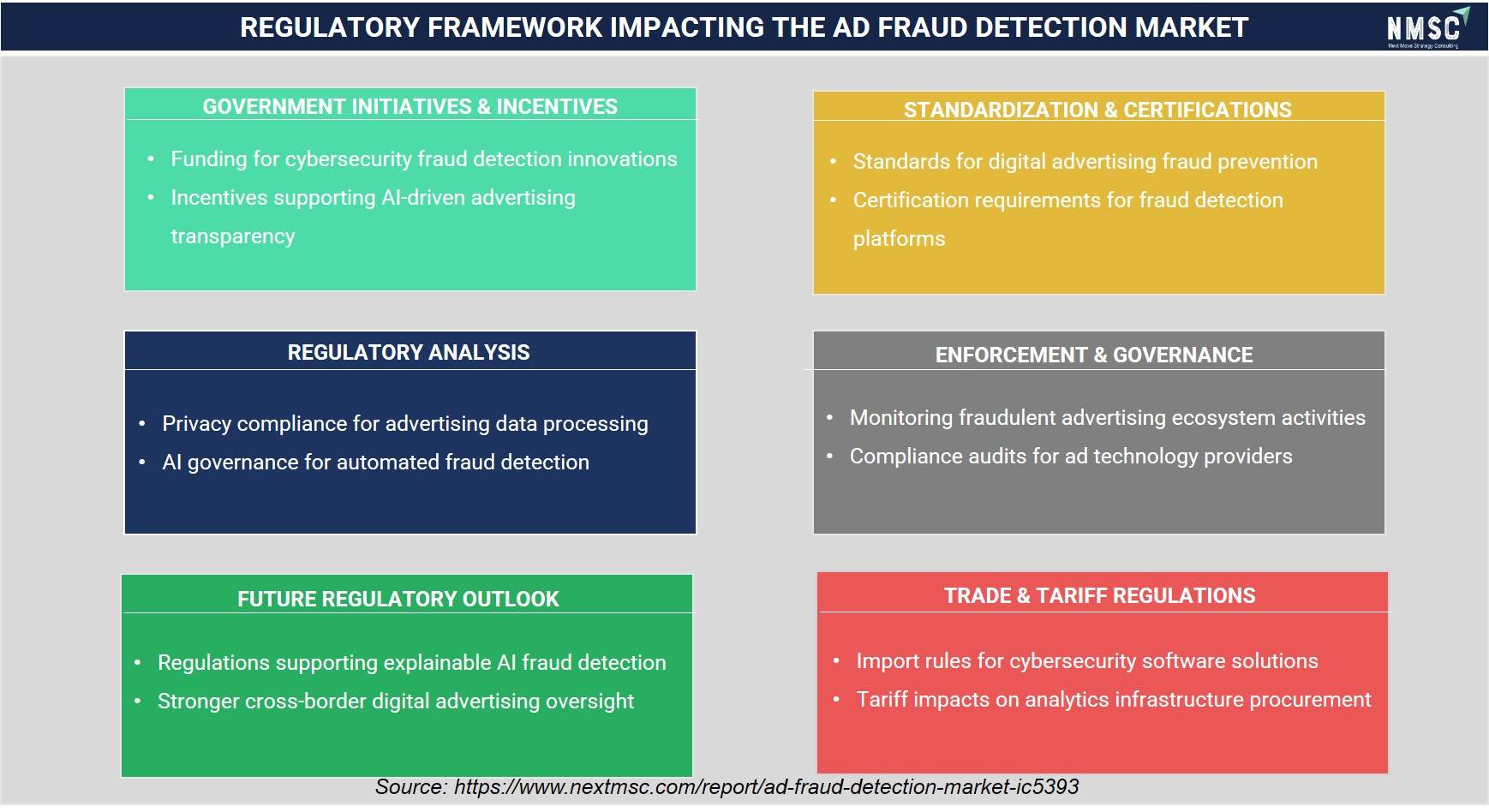
The above infographic presents a regulatory framework impacting the ad fraud detection market, where government funding and incentives are supporting cybersecurity innovations and AI-driven transparency. At the same time, privacy compliance and AI governance are shaping system deployment, while future regulations are focusing on explainable AI and cross-border oversight. Standardization through certification ensures platform reliability, and enforcement is reinforced by monitoring and compliance audits. Finally, import rules and tariffs continue to influence procurement costs and market accessibility across the sector.
Competitive Landscape
Our assessment indicates that the competitive landscape spans MRC-accredited measurement platforms, mobile attribution specialists, and performance-marketing fraud protection vendors, each competing on detection accuracy, media-type coverage, and integration breadth.
|
Key Takeaways |
|
Market Structure Moderately consolidated; top 10 companies hold the majority of Market Share, led by MRC-accredited verification platforms with broad media-type coverage |
|
Innovation Focus Machine-learning bidstream analysis, SDK spoofing detection, CTV-native verification, and walled-garden-compliant integrations |
|
M&A Activity Selective tuck-in acquisitions to add attribution, AI, or media-type-specific capability rather than large-scale consolidation |
How Do Companies Compete in the Ad Fraud Detection Market?
Companies compete primarily on detection accuracy, breadth of media-type coverage across web, mobile app, and CTV, and depth of integration with demand-side and supply-side platforms. Our findings suggest that MRC accreditation functions as a competitive prerequisite for enterprise contracts, since buyers increasingly require independently audited methodology before allocating verification budget.
Which Competitive Archetypes Dominate the Ad Fraud Detection Market?
MRC-accredited, multi-media verification platforms such as DoubleVerify and Integral Ad Science dominate enterprise advertiser and agency budgets through broad post-bid coverage, while mobile attribution specialists including AppsFlyer, Adjust, and Branch compete on install and in-app event fraud depth. Performance-marketing fraud vendors differentiate through click, lead, and affiliate fraud scoring underserved by broad verification platforms.
What Innovation and Differentiation Strategies Are Companies Pursuing?
We observed that leading vendors are investing in machine-learning-based bidstream analysis and real-time SDK spoofing detection to compress the gap between fraud occurrence and blocking. Differentiation increasingly rests on CTV-native verification capability and walled-garden-compliant integrations, since these are the segments where legacy pixel-based detection methods are least effective.
What M&A and Partnership Activity Is Shaping the Ad Fraud Detection Market?
DoubleVerify's agreement to acquire Rockerbox, a performance attribution and marketing measurement company, illustrates the industry's preference for targeted capability acquisitions over broad consolidation. Our analysis shows that such deals let incumbents extend from pure verification into attribution and optimization, deepening customer wallet share without the integration risk of large-scale mergers.
Key Market Players
Based on research conducted by NMSC, the following companies represent the validated set of leading participants across verification, mobile attribution, and performance-marketing fraud protection.
-
DoubleVerify
-
AppsFlyer
-
HUMAN Security
-
Adjust
-
Branch
-
Singular
-
Zefr
-
CHEQ
-
TrafficGuard
-
Lunio
-
mFilterIt
-
Adloox
-
Fraudlogix
-
Scalarr
-
fraud0
Latest Developments
We found that recent corporate activity reflects continued product expansion into CTV, social, and attribution capability even as overall ad-tech M&A activity remains selective.
|
Date |
Event |
|
February 2026 |
AppsFlyer introduced the beta Advanced Security Protect360 Module, an additional fraud protection layer for Android apps designed to detect and block attribution spoofing and manipulated traffic in real time before installs are attributed. The solution validates SDK traffic, identifies spoofed install activity, and helps advertisers prevent fraudulent installs, inflated metrics, data discrepancies, and wasted advertising expenditure. |
|
November 2025 |
Pixalate launched its AdFraud Indicators of Compromise Database, an open-source intelligence resource containing weekly updated high-risk indicators linked to invalid traffic. The database covers IP addresses, device IDs, data centers, fraudulent bundle IDs, made-for-advertising publishers, and delisted apps, providing actionable intelligence to help ad-tech participants identify and combat fraud. |
Expert Insights
 “Cybersecurity relies on community and information sharing, but the ad tech sector still operates in silos. With AdFraud IOC-DB, we are breaking down those barriers. By identifying and sharing the highest risk threat vectors observed by Pixalate - from botnet IPs to spoofed Bundle IDs - we are empowering the ad-tech community to take immediate action against the bad actors draining the digital economy.”
— Jalal Nasir, CEO at Pixalate
Statement made following Pixalate's launch of the AdFraud IOC-DB.
Market Interpretation
We observed that the statement highlights the growing importance of collaborative threat intelligence and real-time identification of fraud indicators in combating increasingly sophisticated digital advertising fraud. NMSC's analysis indicates that ad fraud detection is evolving toward intelligence-driven approaches that identify botnet IPs, spoofed identifiers, fraudulent Bundle IDs, and other high-risk signals across the advertising supply chain. Our findings suggest that the broader availability of actionable fraud intelligence can strengthen detection capabilities and enable advertisers, publishers, and ad-tech platforms to respond more rapidly to invalid traffic and fraudulent activity.
Investment Opportunities
Where Are Capital Inflows Concentrating in the Ad Fraud Detection Market?
Capital is concentrating in CTV-native verification and mobile SDK spoofing detection, the two fastest-growing sub-segments in this analysis. DoubleVerify's USD 300 Million share-repurchase authorization, the largest in its history, signals management confidence in sustained free cash flow generation from its verification and measurement product lines.
How Is Infrastructure Investment Shaping Long-Term Capacity?
Our findings suggest that infrastructure investment is shifting toward real-time bidstream machine-learning models that score fraud risk before impressions are purchased, reducing reliance on post-delivery reconciliation. This shift favors vendors with existing pre-bid and supply-path-validation infrastructure that can be extended rather than rebuilt for new media types.
What ESG Considerations Are Influencing Investment Decisions?
Environmental, Social, and Governance considerations in this market center primarily on data governance and consumer-privacy compliance rather than environmental impact, given the software-based nature of verification services. We found that investors increasingly favor vendors demonstrating MRC accreditation and transparent methodology disclosure as a proxy for strong governance practices.
Key Benefits for Stakeholders
How Does This Report Benefit the Ad Fraud Detection Market Leaders?
Industry leaders gain segment-level revenue forecasts and CAGR benchmarks across solution, media-type, and buyer-type axes, enabling product-roadmap decisions grounded in the same 2025–2035 figures used consistently throughout this analysis. Our findings on regional growth differentials further support market-entry and localization decisions.
How Does This Report Benefit Investors and Financial Analysts?
Investors and financial analysts gain a reconciled market-sizing model, competitive-landscape assessment, and named-company development tracking that supports valuation and capital-allocation decisions. The report's Growth Catalyst & Risk Assessment Matrix quantifies driver and restraint impact on CAGR, aiding scenario analysis for portfolio positioning.
How Does This Report Benefit Technology Vendors and Product Teams in the Ad Fraud Detection Market?
Technology vendors and product teams gain visibility into which solution and media-type segments, such as Mobile and App Fraud Protection and CTV, are growing fastest, informing where to prioritize engineering investment and go-to-market focus through 2035.
Key Market Segments
By Solution
-
Pre-Bid Fraud Prevention
-
Traffic Quality Filtering
-
Domain and App Spoofing Detection
-
Made For Advertising Site Blocking
-
Supply Path Validation
-
Other Pre-Bid Filtering
-
-
Post-Bid Verification
-
Impression Fraud Detection
-
Viewability Verification
-
Invalid Traffic Blocking
-
Walled Garden Measurement
-
Publisher Quality and Ad Server Audit
-
Other Post-Bid Verification
-
-
Click and Conversion Protection
-
Click Fraud Protection
-
Lead Fraud Protection
-
Affiliate Fraud Protection
-
Referral Fraud Protection
-
Other Click and Conversion Protection
-
-
Mobile and App Fraud Protection
-
Install Fraud Prevention
-
Attribution Fraud Prevention
-
In-App Event Fraud Prevention
-
SDK Spoofing Detection
-
Other Mobile and App Fraud Protection
-
By Deployment
-
Cloud
-
On-Premises
-
Hybrid
By Service Model
-
Self-Serve
-
Managed Service
By Pricing Model
-
Subscription
-
Usage Based
-
Per Click Fee
-
Performance Fee
By Media Type
-
Web
-
Mobile App
-
CTV
-
Other
By Buyer Type
-
Advertiser
-
Agency
-
Publisher
-
Ad Tech Platform
-
App Developer
-
Affiliate Network
-
Other
By Region
-
North America: U.S., Canada, Mexico
-
Europe: UK, Germany, France, Italy, Spain, Sweden, Denmark, Finland, Netherlands, Rest of Europe
-
Asia-Pacific: China, India, Japan, South Korea, Taiwan, Indonesia, Vietnam, Australia, Philippines, Malaysia, Rest of APAC
-
Middle East & Africa: Saudi Arabia, UAE, Egypt, Israel, Turkey, Nigeria, South Africa, Rest of MEA
-
Latin America: Brazil, Argentina, Chile, Colombia, Rest of LATAM
Conclusion & Recommendations
What Is the Long-Term Outlook for the Market?
The long-term outlook remains structurally positive, with the market expanding from USD 3.36 Billion in 2026 to USD 14.79 Billion by 2035 at a 17.9% CAGR, driven by rising programmatic, mobile, and CTV ad spend requiring independent verification. We observed that this growth trajectory is underpinned by standards-driven compliance demand rather than speculative adoption, supporting sustained enterprise budget allocation.
What Strategic Positioning Do We Recommend?
Our assessment indicates that vendors should prioritize CTV-native verification and mobile SDK spoofing detection to capture the fastest-growing media-type and solution segments. Companies without existing MRC accreditation should pursue it as a near-term priority, since accreditation is increasingly a prerequisite for enterprise advertiser and agency contracts rather than a differentiator.
How Attractive Is the Market for Investment?
Investment attractiveness is high in Asia-Pacific and Latin America given superior CAGR profiles of 21.1% and 20.1% respectively, while North America offers the largest absolute revenue base with strong recurring-contract visibility. We found that subscription and usage-based pricing models materially de-risk vendor revenue relative to legacy per-click fee structures.
What Are the Key Market Shifts and Risks?
Key risks include restricted data access within walled-garden platforms and the continued evolution of Sophisticated Invalid Traffic evasion techniques that outpace list-based detection methods. Our analysis shows that vendors unable to secure walled-garden-compliant integrations risk ceding share of the fastest-growing CTV and social measurement budgets to platform-native alternatives.
What Are the Primary Growth Pathways Through 2035?
Primary growth pathways include CTV-native product expansion, deeper mobile attribution integration to address SDK spoofing, and formal walled-garden partnerships that extend measurement reach into closed ecosystems. We observed that vendors combining all three pathways are best positioned to capture disproportionate share of the USD 11.43 Billion absolute opportunity created between 2026 and 2035.
About the Author
 Mayurima Roy
— Mayurima Roy is Research Analyst at Next Move Strategy Consulting, where she has spent 4 years working across the firm's full industry coverage rather than a single fixed vertical. Her work centers on structured research, ongoing trend tracking, competitive assessment, and insight-led content development, translating complex market data into clear, decision-ready narratives that support informed client decision-making across diverse global industries, market sectors, and world regions every day.
Mayurima Roy
— Mayurima Roy is Research Analyst at Next Move Strategy Consulting, where she has spent 4 years working across the firm's full industry coverage rather than a single fixed vertical. Her work centers on structured research, ongoing trend tracking, competitive assessment, and insight-led content development, translating complex market data into clear, decision-ready narratives that support informed client decision-making across diverse global industries, market sectors, and world regions every day.
About the Reviewer
 Supradip Baul
— Supradip Baul is an accomplished business consultant and strategist with over a decade of rich experience in market intelligence, strategy, technology, and business transformation. His work has included rigorous qualitative and quantitative analysis across multiple industries, helping clients shape investment decisions and long-term roadmaps. Earlier in his career, he was associated with Gartner, where he contributed to industry-leading reports and market share analyses. He has worked with leading global companies and holds an MBA with a dual specialization in Marketing and Finance.
Supradip Baul
— Supradip Baul is an accomplished business consultant and strategist with over a decade of rich experience in market intelligence, strategy, technology, and business transformation. His work has included rigorous qualitative and quantitative analysis across multiple industries, helping clients shape investment decisions and long-term roadmaps. Earlier in his career, he was associated with Gartner, where he contributed to industry-leading reports and market share analyses. He has worked with leading global companies and holds an MBA with a dual specialization in Marketing and Finance.
At Next Move Strategy Consulting, we understand that insightful market research is the cornerstone of successful business decisions. That's why we employ a robust and multifaceted approach, combining various methodologies to deliver the most accurate and actionable data for our clients.

Research Landscape
We navigate the world of research with two primary approaches:
Qualitative Approach
Our qualitative research methodologies involve immersive techniques such as in-depth interviews, focus groups, and observational studies. By engaging directly with individuals and stakeholders, we uncover valuable insights that quantitative data alone may overlook.

Quantitative Research
In tandem with qualitative methodologies, NMSC leverages the power of Quantitative Research to provide a robust foundation of numerical insights. Through systematic data collection and analysis, we quantify patterns, preferences, and market trends, offering a comprehensive view of the business landscape.
Our quantitative research approach employs diverse tools, including surveys, experiments, and statistical modelling. These methodologies enable us to gather data from a large and representative sample, ensuring the statistical significance of our findings. By employing structured questionnaires and standardized data collection methods, we guarantee the reliability and validity of the information we present to our clients.
Quantitative research is particularly effective in measuring the prevalence of trends, assessing market size, and gauging the impact of various factors on consumer behavior. The numerical precision attained through this approach equips our clients with actionable insights, facilitating data-driven decision-making and strategy formulation.


Our Specialized Toolbox for Industry-Specific Market Research
We deploy a specialized arsenal of techniques tailored to meet your unique requirements. Here's a glimpse into our comprehensive toolbox:

Information Procurement
The stage entails acquiring market data or relevant information through various sources and methodologies.


Market Research Approach
We utilize both top-down and bottom-up approaches in market research analysis to achieve a comprehensive understanding of the market dynamics, leveraging the broad perspective of industry trends and macroeconomic factors alongside detailed insights from specific segments and individual companies.

Porters Five Forces Analysis
We conduct Porter's Five Forces analysis to evaluate the competitive landscape of an industry, providing us with insights into factors that affect profitability and strategic positioning.

SWOT Analysis

Forecasting
We utilize a forecasting model to predict future consumption by considering parameters like population, economics, regulations, market competition, drivers, constraints, technology, and pricing. We also employ statistical techniques such as multilinear regression, exponential smoothing, moving average, ARIMA, and Monte Carlo simulations for accurate predictions. In econometric forecasting, we analyzed short-term and long-term event impacts, attributing values based on regulatory frameworks, economic factors, and market events.





 Speak to Our Analyst