AI Agents Market Global Industry Analysis and Forecast (2026–2035)

AI Agents Market size was USD 13.57 Billion in 2025, projected to reach USD 130.51 Billion by 2035, growing at a CAGR of 25.4% from 2026 to 2035. Key drivers include enterprise workflow automation demand, advances in reasoning-capable models, standardized integration protocols, with North America leading the global market.

Download Free Sample PDF
Base Year (2025)
$13.57 Billion
Forecast (2035)
$130.51 Billion
CAGR (2026-2035)
25.4%
Top Region
North America

What Is the AI Agents Market Size?

The global AI Agents Market reached USD 13.57 Billion in 2025 and is estimated at USD 17.02 Billion in 2026, forecast to reach USD 130.51 Billion by 2035 at a CAGR of 25.4% between 2026 and 2035. North America leads with approximately 37% revenue share in 2025, while Software is the dominant offering, holding approximately 58% of total market revenue.

We observed that technological shifts are moving AI agents from experimental copilots toward production-grade systems embedded in core operational stacks. Enterprises are deploying orchestration layers, governance frameworks, and secure identity controls that define how agents access data and act on behalf of users. Operational scale is expanding as organizations transition from single-task assistants to coordinated fleets of specialized agents that handle procurement, customer engagement, and information retrieval with measurable throughput gains.

AI Agents Market Global Industry Analysis and Forecast (2026–2035) Revenue Forecast

Values in USD Billion

2025 $13.57 Billion
2025
2026 $17.02 Billion
2026
2027 $21.34 Billion
2027
2028 $26.76 Billion
2028
2029 $33.56 Billion
2029
2030 $42.09 Billion
2030
2031 $52.78 Billion
2031
2032 $66.18 Billion
2032
2033 $82.99 Billion
2033
2034 $104.07 Billion
2034
2035 $130.51 Billion
2035

Key Takeaways

By Offering: Software held the largest share, expanding from USD 7.92 Billion in 2025 to USD 68.00 Billion by 2035; Services is the fastest-growing at 27.16% CAGR from 2026–2035.

By Function: Customer Service held the largest share, expanding from USD 1.94 Billion in 2025 to USD 15.40 Billion by 2035; IT and Cybersecurity Operations is the fastest-growing at 28.01% CAGR from 2026–2035.

By End User: BFSI held the largest share, expanding from USD 2.22 Billion in 2025 to USD 17.22 Billion by 2035; Energy and Utilities is the fastest-growing at 27.49% CAGR from 2026–2035.

By Buyer Type: Large Enterprises held the largest share, expanding from USD 6.73 Billion in 2025 to USD 53.90 Billion by 2035; SMEs is the fastest-growing at 28.22% CAGR from 2026–2035.

By Deployment: Public Cloud held the largest share, expanding from USD 6.36 Billion in 2025 to USD 53.77 Billion by 2035; Hybrid is the fastest-growing at 29.98% CAGR from 2026–2035.

By Pricing Model: Subscription held the largest share, expanding from USD 5.26 Billion in 2025 to USD 39.68 Billion by 2035; Outcome-based is the fastest-growing at 31.88% CAGR from 2026–2035.

By Distribution Channel: Direct Sales held the largest share, expanding from USD 8.32 Billion in 2025 to USD 71.65 Billion by 2035; Indirect Sales is the fastest-growing at 27.33% CAGR from 2026–2035.

Dominant Region: North America dominated the market with approximately 37% revenue share (USD 4.98 Billion) in 2025, supported by established commercial distribution networks, substantial investment scale, and large customer demand across North America.

Fastest-Growing Region: Asia-Pacific is projected to register the highest CAGR of 28.45% during 2026–2035, propelled by expanding production capacity, rapid economic development, and surging commercial adoption across Asia-Pacific.

Dominant Country: The U.S. led national demand with USD 4.17 Billion in 2025 (~84% of North America), projected to reach USD 32.95 Billion by 2035 at a 22.9% CAGR.

Fastest-Growing Country: India is the fastest-growing country market, expanding from USD 0.69 Billion in 2026 to USD 8.32 Billion by 2035 at a 31.87% CAGR over 2026–2035.

The AI agents market presents an absolute opportunity of USD 113.49 Billion between 2026 and 2035, measured as the increment from the USD 17.02 Billion current valuation to the USD 130.51 Billion forecast. Capturing this expansion requires suppliers to address deployment complexity, security assurance, and cross-application interoperability. Enterprises seeking to convert pilot programs into scaled operations will prioritize platforms that offer reliable execution, policy enforcement, and measurable productivity outcomes across departments.

Competitive consolidation in AI agents is being shaped by partnerships between frontier model developers, enterprise software vendors, and cloud infrastructure providers. Strategic alliances allow platform companies to embed agent capabilities into established workflow systems, reducing integration friction for large customers. Supply chain scale depends on access to compute capacity, data connectors, and developer ecosystems, which favors companies able to bundle infrastructure, orchestration tooling, and application libraries into coherent offerings for enterprise buyers.

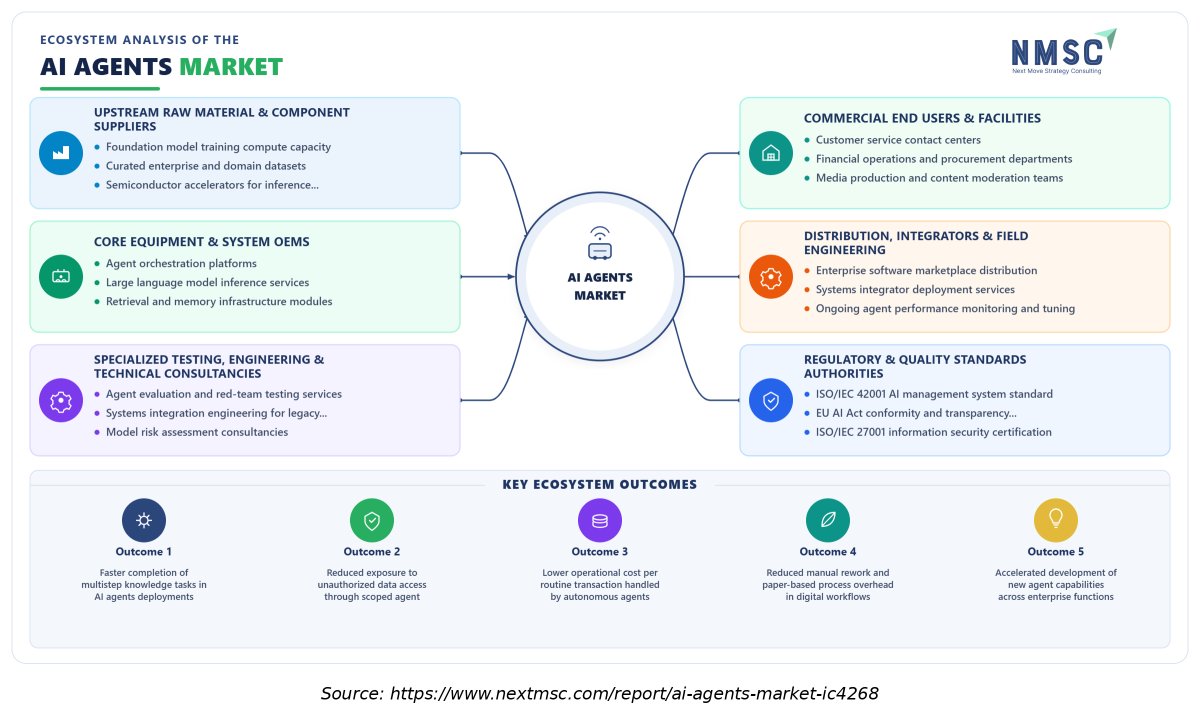
Ecosystem Analysis of the AI Agents Industry

This infographic maps the interactions among model developers, platform providers, integration specialists, enterprise adopters, and governance authorities. It highlights how each participant contributes capabilities that collectively determine deployment readiness. The structure reveals that platform integration and identity governance create the most durable strategic value for participants.

What Does the AI Agents Market Encompass?
The AI agents market covers software systems that perceive inputs, reason over objectives, invoke external tools, and complete tasks with limited human supervision. Product types include conversational service agents, workflow automation agents, research and retrieval agents, and coding assistants that operate within development environments. Core technologies span large language models, retrieval-augmented generation, planning modules, tool-calling APIs, and persistent memory stores that maintain context across sessions and applications.

Across the AI agents’ sector, design specifications emphasize reliable tool execution, deterministic guardrails, and transparent action logs that allow administrators to audit agent behavior. Innovation is concentrated in evaluation frameworks, sandboxed execution environments, and identity layers that assign verifiable credentials to autonomous processes. Certification and compliance expectations are emerging around data handling, access control, and model risk management, prompting vendors to document security architectures and governance procedures as part of standard enterprise procurement.

Market Drivers & Dynamics

Interactive Dataset
Enterprise Workflow Automation Demand driver High Immediate
Advances in Reasoning-Capable Models driver High Immediate
Standardized Integration Protocols driver Medium Medium-term
Security and Identity Concerns restraint High Immediate
Integration Complexity across Legacy Systems restraint Medium Medium-term
Reliability Variance in Autonomous Execution restraint Low Long-term
Source: Next Move Strategy Consulting

Growth Drivers

What Is the Primary Growth Driver in the AI Agents Industry?

The principal catalyst for AI agents is the enterprise push to convert knowledge-intensive work into autonomous execution. Organizations face persistent staffing pressure in service operations, finance, and procurement, and agents offer a route to handle high volumes of routine decisions. Growing confidence in reasoning models and tool integration has moved buyers from evaluation toward production rollouts, creating sustained demand for platforms that deliver measurable throughput gains within existing software environments.

How Are Industry Standards and Directives Driving the Market?

Regulatory expectations are shaping how AI agents are designed, documented, and purchased. Data protection frameworks require that agents access personal information only under defined purposes and retain auditable records of actions taken. Emerging AI governance guidance encourages risk classification, human oversight mechanisms, and transparency disclosures. Vendors demonstrating conformity with recognized security standards and documented model risk controls are better positioned to win enterprise contracts in regulated industries.

Growth Inhibitors

What Is Restraining the AI Agents Market?

Within the AI agents market, the principal restraint is the difficulty of connecting autonomous agents to heterogeneous enterprise environments without introducing operational risk. Many organizations operate legacy systems with inconsistent data structures, limited application programming interfaces, and fragmented permission models. Preparing these environments for agent access requires substantial data remediation and security redesign, which lengthens procurement cycles and constrains how quickly buyers can expand agent deployments beyond initial pilot use cases.

What Are the Growth Opportunities?

Can Multi-Agent Platforms Capture High-Density Enterprise Deployments?

Within the AI agents market, large enterprises managing thousands of simultaneous workflows represent a concentrated opportunity for coordinated agent platforms. These organizations require orchestration, shared memory, and centralized governance to manage fleets of specialized agents across departments. Providers that deliver scalable control planes and standardized monitoring can serve these accounts through multiyear agreements, converting pilot successes into enterprise-wide operating models supported by consistent performance reporting.

How Is Mid-Tier and Regional Facility Adoption Unlocking New Market Volume?

Mid-sized companies and regional service hubs are beginning to adopt AI agents through packaged solutions that require limited engineering resources. Prebuilt connectors for common business applications and simplified configuration interfaces lower entry barriers for these buyers. As subscription pricing becomes more accessible and implementation support improves, secondary facilities can contribute meaningful volume, broadening the customer base beyond large multinational deployments.

Can Specialized Vertical Implementations Become Distinct Premium Markets?

Regarding commercial AI agents’ deployments, industry-specific agents tailored to media production, telecommunications operations, and digital content moderation can command premium pricing. These implementations embed domain vocabularies, compliance rules, and workflow templates that generic assistants lack. Vendors offering vertical depth can justify higher contract values through faster time to value and reduced customization requirements, establishing differentiated positions within the broader ICT and media technology landscape.

Segmentation Analysis

2025 (USD Billion)
2035 (USD Billion)
Software 2025: $7.92 Billion | 2035: $9.83 Billion
Software
Services 2025: $5.65 Billion | 2035: $7.19 Billion
Services
Software $7.92 Billion $9.83 Billion USD 68.00 Billion
Services $5.65 Billion $7.19 Billion USD 62.51 Billion

Which Offering Segment Dominates the Market?

Software commands the primary revenue share in the AI agents market, accounting for approximately 58% of total demand and generating USD 7.92 Billion in 2025. Its dominance reflects the central role of platform-based agent frameworks that enterprises deploy to automate workflows, orchestrate tasks, and govern autonomous decision-making. Services, meanwhile, is expanding at a 27.16% CAGR through 2035, as organizations increasingly require integration, customization, and managed operations to move agents from pilot programs into production environments.

2025 (USD Billion)
2035 (USD Billion)
Digital Supp
Voice and Co
Code Generat
Testing and
Segment Item 2025 (USD Billion) 2035 (USD Billion) CAGR
Digital Support $10.0 USD Billion $40.0 USD Billion 25.0%
Voice and Contact Center $17.1 USD Billion $51.1 USD Billion 19.0%
Code Generation $24.2 USD Billion $62.2 USD Billion 9.0%
Testing and DevOps $31.3 USD Billion $73.3 USD Billion 27.0%

Segment-wise data is locked

Unlock complete segment-wise numbers for By Function.

Unlock Full Data

Which Function Segment Dominates the Market?

Regarding commercial AI agents deployments, Customer Service represents the largest functional baseline, holding roughly 14% share and USD 1.94 Billion in 2025. Conversational agents handling inquiries, resolution workflows, and case routing have matured into proven deployments with measurable service outcomes. IT and Cybersecurity Operations, however, is the fastest-growing function at a 28.01% CAGR, driven by the need for autonomous threat detection, incident response, and identity governance as agent activity expands across corporate networks.

2025 (USD Billion)
2035 (USD Billion)
Public Cloud
Private Clou
On Premises
Hybrid
Segment Item 2025 (USD Billion) 2035 (USD Billion) CAGR
Public Cloud $10.0 USD Billion $40.0 USD Billion 10.0%
Private Cloud $17.1 USD Billion $51.1 USD Billion 24.0%
On Premises $24.2 USD Billion $62.2 USD Billion 26.0%
Hybrid $31.3 USD Billion $73.3 USD Billion 20.0%

Segment-wise data is locked

Unlock complete segment-wise numbers for By Deployment.

Unlock Full Data

Which Deployment Segment Dominates the Market?

Across the AI agents sector, Public Cloud holds the leading deployment position with roughly 47% share and USD 6.36 Billion in 2025, supported by elastic compute availability and rapid access to foundation models. Organizations favor cloud-hosted agents for scalability and lower upfront infrastructure commitments. Hybrid deployment, however, is the fastest-growing model at a 29.98% CAGR through 2035, as enterprises balance cloud-based intelligence with on-premises control over sensitive data, latency-critical processes, and regulatory obligations.

2025 (USD Billion)
2035 (USD Billion)
BFSI
Healthcare a
Retail and E
IT and Telec
Manufacturin
Segment Item 2025 (USD Billion) 2035 (USD Billion) CAGR
BFSI $10.0 USD Billion $40.0 USD Billion 26.0%
Healthcare and Life Sciences $17.1 USD Billion $51.1 USD Billion 16.0%
Retail and Ecommerce $24.2 USD Billion $62.2 USD Billion 18.0%
IT and Telecom $31.3 USD Billion $73.3 USD Billion 8.0%
Manufacturing $38.4 USD Billion $84.4 USD Billion 23.0%

Segment-wise data is locked

Unlock complete segment-wise numbers for By End User Industry.

Unlock Full Data

Which End User Industry Segment Dominates the Market?

In the global AI agents industry, BFSI remains the leading end user industry with approximately 16% share and USD 2.22 Billion in 2025, reflecting heavy adoption in fraud screening, client servicing, and compliance-intensive document processing. Institutions in this sector value auditable decision trails and rapid transaction handling. Energy and Utilities is the fastest-growing vertical at a 27.49% CAGR through 2035, as grid operators and utilities deploy agents for predictive maintenance, demand forecasting, and operational monitoring across distributed infrastructure.

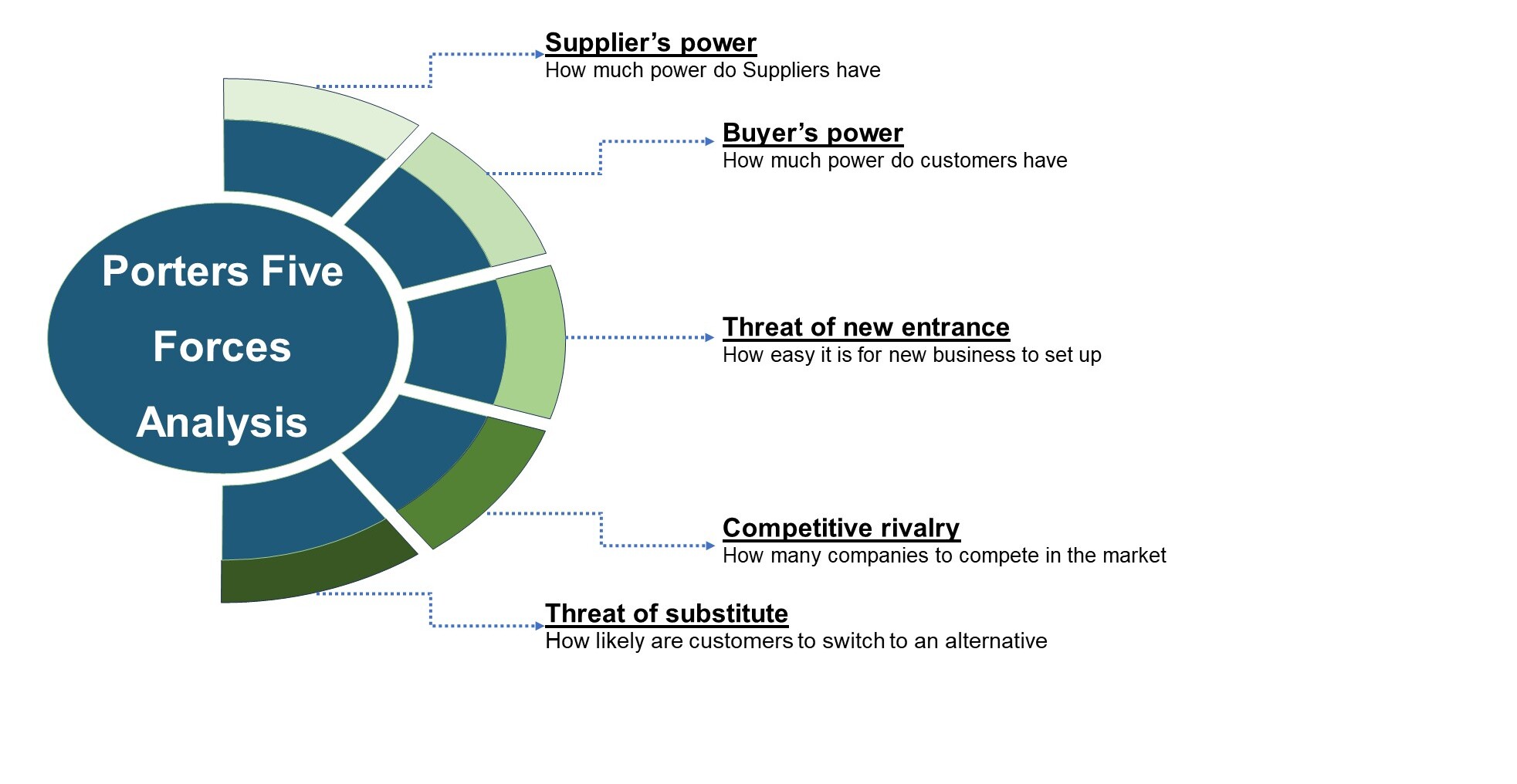
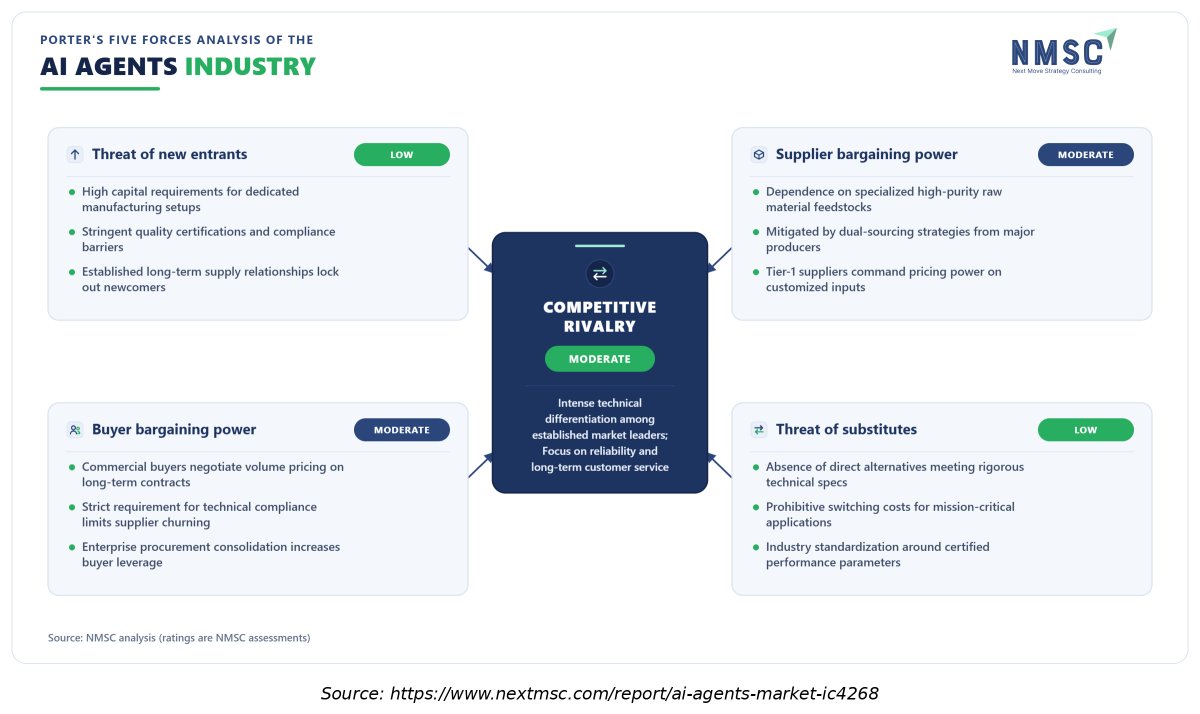
Porter's Five Forces Analysis of the AI Agents Industry

This infographic evaluates buyer bargaining power, supplier influence over model access, threats from substitute automation tools, entry barriers, and rivalry among platform vendors. It shows that compute and model access concentrate supplier leverage. Strategic implications point toward differentiation through governance depth and vertical workflow expertise.

Growth Opportunities

Our analysis shows that three structural whitespace opportunities are positioned to generate disproportionate commercial returns in the AI Agents Market through 2035:

Can Multi-Agent Platforms Capture High-Density Enterprise Deployments?

Within the AI agents market, large enterprises managing thousands of simultaneous workflows represent a concentrated opportunity for coordinated agent platforms. These organizations require orchestration, shared memory, and centralized governance to manage fleets of specialized agents across departments. Providers that deliver scalable control planes and standardized monitoring can serve these accounts through multiyear agreements, converting pilot successes into enterprise-wide operating models supported by consistent performance reporting.

How Is Mid-Tier and Regional Facility Adoption Unlocking New Market Volume?

Mid-sized companies and regional service hubs are beginning to adopt AI agents through packaged solutions that require limited engineering resources. Prebuilt connectors for common business applications and simplified configuration interfaces lower entry barriers for these buyers. As subscription pricing becomes more accessible and implementation support improves, secondary facilities can contribute meaningful volume, broadening the customer base beyond large multinational deployments.

Can Specialized Vertical Implementations Become Distinct Premium Markets?

Regarding commercial AI agents’ deployments, industry-specific agents tailored to media production, telecommunications operations, and digital content moderation can command premium pricing. These implementations embed domain vocabularies, compliance rules, and workflow templates that generic assistants lack. Vendors offering vertical depth can justify higher contract values through faster time to value and reduced customization requirements, establishing differentiated positions within the broader ICT and media technology landscape.

Regional Outlook

2025 (USD Billion)
2035 (USD Billion)
North Americ
Europe
Asia-Pacific
Latin Americ
Middle East
Region 2025 (USD Billion) 2035 (USD Billion) CAGR (%)
North America $10.0 USD Billion $40.0 USD Billion 9.0%
Europe $17.1 USD Billion $51.1 USD Billion 27.0%
Asia-Pacific $24.2 USD Billion $62.2 USD Billion 25.0%
Latin America $31.3 USD Billion $73.3 USD Billion 23.0%
Middle East & Africa $38.4 USD Billion $84.4 USD Billion 12.0%

Regional data is locked

Unlock complete regional numbers for this market.

Unlock Full Data

Competitive Landscape

The competitive structure of the AI agents market is anchored by large platform providers that combine foundation model capabilities with enterprise software distribution. Anthropic PBC, OpenAI Group PBC, Microsoft Corporation, Salesforce, Inc., Anysphere, Inc., Alphabet Inc., Amazon.com, Inc., ServiceNow, Inc., Sierra Technologies, Inc., and ElevenLabs, Inc. collectively shape product direction. Their scale in model development, existing enterprise relationships, and developer ecosystems create meaningful entry barriers for smaller entrants seeking to compete on core agent infrastructure.

How Do Companies Compete in the AI Agents Market?

In the global AI agents industry, competition centers on reasoning reliability, governance tooling, integration depth, and pricing flexibility. Platform vendors differentiate through pre-built connectors to enterprise systems and audit capabilities that satisfy compliance teams. Pricing strategies are diversifying from traditional subscriptions toward usage and outcome-linked models. Distribution combines direct enterprise sales with marketplace listings and partner-led implementation, allowing providers to reach both large accounts and fast-growing mid-market buyers.

Which Competitive Archetypes Dominate the AI Agents Market?

Three distinct participant archetypes are emerging in the AI agents market. Foundation model developers such as Anthropic PBC and OpenAI Group PBC supply core reasoning capabilities through APIs. Enterprise software incumbents, including Microsoft Corporation, Salesforce, Inc., and ServiceNow, Inc., embed agents directly within established workflow platforms. Specialized application builders such as Sierra Technologies, Inc. and Anysphere, Inc. focus on vertical agent experiences and developer tooling tailored to specific operational use cases.

What Innovation and Differentiation Strategies Are Companies Pursuing?

Sustainable advantages in the AI agents market arise from proprietary workflow data, deep integration with enterprise systems of record, and demonstrated governance frameworks. Providers that embed agents into mission-critical processes accumulate operational context that is difficult for competitors to replicate. Reliability track records, security certifications, and audit-ready action logs further strengthen customer retention and support premium pricing across regulated sectors.

What M&A and Partnership Activity Is Shaping the Market?

Merger and acquisition activity in the AI agents market is focused on acquiring specialized capabilities rather than scale alone. Platform leaders are expanding through targeted acquisitions of agent orchestration, identity management, and vertical application startups. Strategic investments by established technology firms in emerging agent developers are also accelerating consolidation, as incumbents seek to close capability gaps and secure access to differentiated talent and intellectual property.

Key Market Players

Based on research conducted by NMSC, the following 20 companies represent the validated leadership set across AI Agents Market developers, manufacturers, and solution providers:

Anthropic PBC OpenAI Group PBC Microsoft Corporation Salesforce, Inc. Anysphere, Inc. Alphabet Inc. Amazon.com, Inc. ServiceNow, Inc. Sierra Technologies, Inc. ElevenLabs, Inc. Glean Technologies, Inc. Cognition AI, Inc. Oracle Corporation SAP SE International Business Machines Corporation Palantir Technologies Inc. Databricks, Inc. UiPath, Inc. Snowflake Inc. Alibaba Group Holding Limited

Latest Developments

During our market evaluation, we noticed that recent commercial activities, platform introductions, and partnerships within the industry reflect the latest market developments:

Date Event
November 2026 Genpact launched Genpact Onyx, an agentic operations platform for building, running, and governing AI agents in enterprise operations. | https:/​/​www.​prnewswire.​com/​news-​releases/​genpact-​launches-​genpact-​onyx-​the-​agentic-​operations-​platform-​for-​building-​running-​and-​governing-​ai-​agents-​in-​enterprise-​operations-​302940973.​html
September 2026 Zendesk introduced Specialized AI Agents purpose-built for the specific work of individual businesses and industries. | https:/​/​www.​zendesk.​com/​newsroom/​press-​releases/​zendesk-​introduces-​specialized-​ai-​agents-​purpose-​built-​for-​your-​business/​
September 2026 Public launched AI agents that monitor prediction market probabilities and take action in response to changing conditions. | https:/​/​www.​prnewswire.​com/​news-​releases/​public-​launches-​ai-​agents-​for-​prediction-​markets-​302888505.​html
September 2026 MongoDB launched Atlas Agent Engine, a unified execution, memory, and governance layer for production AI agents. | https:/​/​www.​prnewswire.​com/​news-​releases/​mongodb-​launches-​atlas-​agent-​engine-​to-​put-​ai-​agents-​in-​production-​without-​a-​new-​stack-​302892753.​html
June 2026 CrowdStrike unveiled Continuous Identity for AI Agents to secure how agent identities operate. | https:/​/​www.​businesswire.​com/​news/​home/​20260615204794/​en/​CrowdStrike-​Unveils-​Continuous-​Identity-​for-​AI-​Agents
May 2026 Kore.ai Launches Artemis, the New Generation of the Kore.ai Agent Platform for Building, Governing, and Optimizing Enterprise AI. | https:/​/​businesswire.​com/​news/​home/​20260521284219/​en/​Kore.​ai-​Launches-​Artemis-​the-​New-​Generation-​of-​the-​Kore.​ai-​Agent-​Platform-​for-​Building-​Governing-​and-​Optimizing-​Enterprise-​AI

Expert Insights

Bill McDermott

Bill McDermott

Chairman and Chief Executive Officer | ServiceNow, Inc.

"This is the moment ServiceNow moves beyond the platform of platforms to become the AI agent of the enterprise."

Analyst Interpretation

ServiceNow's positioning of its platform as the governing agent layer signals that enterprise AI agent adoption will consolidate around incumbent workflow systems with embedded governance rather than standalone agent tools. Through the 2026-2035 horizon, this favors commercial expansion via platform bundling, deeper integration with ERP and ITSM estates, and recurring revenue from governed autonomous workflows, though it also raises competitive pressure on point-solution agent vendors.

Investment Opportunities

Where Are Capital Inflows Concentrating in the AI Agents Market?

Capital inflows are concentrating in agent orchestration platforms, foundation model access, and developer tooling that shorten the path from prototype to production. Investors favor companies with proprietary enterprise data connections and recurring revenue profiles. Strategic corporate investors are also committing funds to startups that address specialized functions, reflecting confidence that agent capabilities will become embedded across core business operations over the coming decade.

How Is Infrastructure Investment Shaping Market Capacity?

Infrastructure investment is expanding the computational backbone that agents require, including cloud inference capacity, data pipelines, and secure integration layers. Hybrid architectures are drawing particular attention, as providers build edge and on-premises options alongside public cloud regions. These investments increase the number of concurrent agent workloads that enterprises can run reliably, directly enabling the scale of deployment needed to support sustained market growth.

What ESG Considerations Are Influencing Market Investment?

Energy consumption of large-scale inference has become a material consideration for investors and enterprise buyers evaluating AI agents. Providers are responding with model efficiency improvements, workload scheduling aligned with renewable availability, and transparent reporting on computational footprints. Governance practices, including auditable action logs and access controls, also influence investment decisions, as organizations seek assurance that autonomous systems operate within defined accountability frameworks.

Key Benefits for Stakeholders

How Does This Report Benefit Industry Leaders and Enterprise Operators?

Operational executives, procurement directors, and commercial operators gain empirical benchmarks for evaluating agent investments against realistic adoption timelines. Segment-level analysis across functions, industries, and deployment models helps leaders prioritize use cases with the strongest near-term returns. Forecasts covering the 2026 to 2035 period support multi-year budgeting, vendor selection, and capability-building decisions in a rapidly evolving competitive environment.

How Does This Report Benefit Investors and Financial Analysts?

The market is projected to expand from USD 13.57 Billion in 2025 to USD 130.51 Billion by 2035, providing a clear valuation framework for analysts. The 25.4% CAGR across the 2026 to 2035 period, combined with segment-level growth differentials, enables comparative assessment of growth-oriented and mature sub-segments. Competitive structure and pricing model trends further inform margin expectations and investment risk evaluation.

How Does This Report Benefit Technology Vendors and Solution Platform Teams?

Product and platform teams can use segment performance data to align roadmaps with the fastest-growing functions, deployment models, and pricing approaches. Insights into hybrid deployment and outcome-based pricing highlight areas where product investment may yield differentiated commercial returns. Competitive dimension analysis supports positioning decisions that distinguish offerings on reliability, governance, and integration depth within the AI agents market.

Key Market Segments Evaluated

By Offering

  • Software 
    • Packaged Agents
      • Standalone Agents
      • Embedded Agents
    • Agent Platforms
      • Low Code and No Code Builders
      • Pro Code SDKs
      • Orchestration and Runtime
      • Integration and Connectivity
      • Governance and Observability
      • Integrated Suites
  • Services 
    • Advisory Services
    • Implementation Services
    • Managed Services

By Function

  • Customer Service 
    • Digital Support
    • Voice and Contact Center
  • Sales
  • Marketing
  • Software Development 
    • Code Generation
    • Testing and DevOps
  • IT and Cybersecurity Operations
  • Finance and Accounting
  • Legal and Compliance
  • HR and HCM
  • Procurement and SCM
  • Data Analytics and Research
  • Cross Functional Productivity
  • Other Functions

By End User Industry

  • BFSI
  • Healthcare and Life Sciences
  • Retail and Ecommerce
  • IT and Telecom
  • Manufacturing
  • Professional Services
  • Government and Defense
  • Energy and Utilities
  • Transportation and Logistics
  • Media and Entertainment
  • Education
  • Other Industries

By Buyer Segment

  • Large Enterprises
  • Mid Market
  • SMEs
  • Individual Users

By Deployment

  • Public Cloud
  • Private Cloud
  • On Premises
  • Hybrid

By Pricing Model

  • Subscription 
    • Per Seat
    • Per Agent and Platform
  • Usage Based 
    • Credits and Actions
    • Conversations and Sessions
  • Outcome Based
  • Project and Retainer Fees

By Distribution Channel

  • Direct Sales 
    • Field Sales
    • Self Serve
  • Indirect Sales 
    • Channel Partners
    • Cloud Marketplaces

By Region

  • North America 
    • U.S.
    • Canada
    • Mexico.
  • Europe 
    • UK
    • Germany
    • France
    • Italy
    • Rest of Europe.
  • Asia-Pacific 
    • China
    • India
    • Japan
    • South Korea
    • Australia
    • Rest of APAC.
  • Latin America 
    • Brazil
    • Argentina
    • Colombia
    • Rest of Latin America.
  • Middle East & Africa 
    • UAE
    • Saudi Arabia
    • South Africa
    • Rest of MEA.

Conclusion & Recommendations

What Is the Long-Term Outlook for the AI Agents Market?

The long-term outlook for the AI agents market is strongly positive, with revenue expanding from USD 17.02 Billion in 2026 to USD 130.51 Billion by 2035 at a 25.4% CAGR. Growth is underpinned by durable commercial demand expansion, the structural shift toward high-performance specialized solutions, and continuous design improvements across core offerings. Enterprise investment across leading regional markets, particularly North America and Asia-Pacific, will continue to anchor this trajectory through the forecast horizon.

What Strategic Positioning Recommendations Does NMSC Offer?

Market participants should prioritize governance-ready agent platforms that document every autonomous action for compliance and audit purposes. Vendors should align product roadmaps with high-growth functions such as IT and cybersecurity operations and with hybrid deployment requirements. Pursuing outcome-based pricing pilots and building integrator partnerships will help capture mid-market demand, while sustained investment in reasoning reliability will protect long-term competitive position.

How Attractive Is the AI Agents Market for Investment?

Investment attractiveness is high, supported by the USD 113.49 Billion absolute growth opportunity between 2026 and 2035 across the AI agents market. Subscription and outcome-based pricing models provide both recurring revenue stability and upside tied to verified performance. Strong demand drivers across large enterprises and SMEs, combined with expanding cloud and hybrid infrastructure, create a favorable backdrop for sustained margin development.

What Are the Key Market Shifts and Risks in the AI Agents Market?

A central structural shift is the movement from experimental agent pilots toward governed production deployments embedded in core enterprise workflows. Key risks include reliability failures in autonomous decision-making, dependence on a limited set of foundation model providers, and integration complexity with legacy systems of record. Vendors that address these constraints through transparent governance and robust integration tooling will be better positioned to sustain adoption.

What Are the Primary Growth Pathways through 2035?

Primary growth pathways include scaling services that support agent integration, expanding hybrid deployment offerings, and developing outcome-based commercial models. Targeting SMEs through packaged, low-code agent products will widen the addressable base considerably. Penetrating fast-growing functions such as IT and cybersecurity operations and energy and utilities will allow participants to capture a disproportionate share of the USD 113.49 Billion absolute growth opportunity.

Delivered Customizations

We have successfully delivered the following deep-dive customizations:

Client Request Customization Delivered Value Adds
Historical AI Agent Market Revenue Analysis
  • Historical revenue analysis of AI agent offerings, functions, and deployment models, 2020 to present, with sizing by major end-user industry.
  • Identifies the fastest-growing offerings, functions, and industries to prioritize for market entry and investment.
Company-Level AI Agent Revenue Split
  • Company-level revenue split across agent platforms, agent applications, and services, where publicly disclosed.
  • Shows which vendors monetize agents directly and which depend on platform or services revenue, informing competitive positioning and partnership choices.
Market Size Assessment: TAM, SAM, and VAM
  • Total, serviceable, and obtainable market sizing for AI agents across offering, function, deployment, and end-user industry segments, 2026 to 2035.
  • Defines realistic revenue pools by segment to guide go-to-market targeting and growth forecasting.
End-User Industry and Function Adoption Mapping
  • Adoption mapping of AI agent use cases by business function and end-user industry, with indicators of deployment maturity and production readiness.
  • Pinpoints high-readiness use cases in specific industries, supporting customer targeting and vertical product prioritization.
Agentic AI Ecosystem and Competitive Positioning Assessment
  • Mapping of foundation model providers, hyperscale cloud platforms, agent platform vendors, and vertical agent developers across offering layers.
  • Reveals where value is concentrated and where partnership, integration, or acquisition opportunities exist.
AI Agent Pricing and Monetization Model Benchmarking
  • Benchmarking of per-seat, per-task, outcome-based, and consumption-based pricing models across deployment types and end-user industries, using published vendor pricing.
  • Supports pricing strategy and monetization model selection by showing how deployment type and industry affect willingness to pay.

FAQs

About the Author

Tushmi Dutta

Tushmi Dutta

Tushmi Dutta is a focused researcher specializing in detailed analysis and insight-driven research across diverse business landscapes. She supports strategic initiatives through structured data interpretation, thorough validation, and clear communication of findings that aid informed decision-making. With a strong interest in writing, she enjoys presenting research insights in an engaging and accessible manner. Beyond work, she enjoys traveling, reading, painting, and continuously learning new skills that contribute to her creative and professional growth.

About the Reviewer

Supradip Baul

Supradip Baul

Supradip Baul is an accomplished business consultant and strategist with over a decade of rich experience in market intelligence, strategy, technology, and business transformation. His work has included rigorous qualitative and quantitative analysis across multiple industries, helping clients shape investment decisions and long-term roadmaps. Earlier in his career, he was associated with Gartner, where he contributed to industry-leading reports and market share analyses. He has worked with leading global companies and holds an MBA with a dual specialization in Marketing and Finance.

Download Free Sample

Nishant Awate

NISHANT AWATE

Business Development Global Sales

Zehnder Group Deutschland GmbH

Our experience working with Next Move Strategy Consulting was positive. The team was responsive, professional, and open to incorporating our specific requirements throughout the project. The India AHU market study was comprehensive and well structured, covering market value and volume forecasts, product and application segments, and key industry trends. The inclusion of both AHU and residential MVHR market insights made the study particularly relevant for our strategic market assessment. Overall, the report provides a solid foundation for evaluating market potential, identifying priority segments, and supporting business-development decisions in India.

Pratyush Kumar Das

PRATYUSH KUMAR DAS

Assistant Manager

Polycab India Limited

We would like to express our appreciation for the data and insights provided by nextmsc. We are very pleased with the quality and depth of the information, which has proven to be highly valuable and beneficial for our business decision-making.

Rishabh Jogani

RISHABH JOGANI

Strategy Analyst

Accenture Japan

We are incredibly impressed with the market report on the real estate market in India provided by Next Move Strategy Consulting. The report was thorough, insightful, and well-structured, offering deep analysis and actionable recommendations. It not only captured the current trends and dynamics but also provided a forward-looking perspective that has been invaluable for our strategic planning. Their team demonstrated exceptional professionalism, attention to detail, and a profound understanding of the industry. The data-driven insights and clarity of presentation exceeded our expectations, making complex market trends easy to understand. We highly recommend Next Move Strategy Consulting to anyone looking for reliable and comprehensive market research services. Their expertise has given us the confidence to navigate the complexities of the Indian real estate market with clarity and foresight.

Gustaf Hummel Burstrom

GUSTAF HUMMEL BURSTROM

Founder

Revline Tools AB

Joseph and the team at Next Move Strategy Consulting have been excellent to work with, in supplying us with relevant market data and forecasts for our specific category. We had some special requirements and they were able to do a custom package to suit our needs. We would definitely recommend them to any other company needing market data and forecasts

Ross J Mckenzie

ROSS J MCKENZIE

Business Insight Manager

Staysure Group

“Next MSC have been incredibly helpful in providing detailed & robust information on our market, alongside quantifying growth by different segments. The process to procure was simple and easy, with sample reports and regular contact to ensure we had what we needed. Succinct detail on their sources & methodologies is also greatly received, allowing transparency in this respect helps build trust in the detail you pay for. Joseph in particular was fantastic, and helped ensure efficient provision of the insight pack – thank you NMSC!”.

Custom Market Research Services

We will customize the research for you if the listed report does not fully match your requirements.

Get 30% Free Customization

Select License

This website uses cookies to ensure you get the best experience on our website. Learn more

✖