AI Capacity Planning Market Size, Share, Trends and Growth Analysis, By Offering (Software, and Services), By Deployment (Cloud, On Premises, and Hybrid), By Customer Size (Small and Medium Business, Mid-Market, and Enterprise), By End User Industry (Professional Services and Consulting, Manufacturing and Industrial, Technology and IT Services, and Others), By Sales Channel (Direct, Partner and Reseller, and Others), and Region -- Global Industry Report and Forecast, 2026-2035
Industry: ICT & Media | Publishing Date: July 17, 2026 | Last Updated: September 30, 2026 | No of Pages: N/A | No. of Tables: N/A | No. of Figures: N/A | Format: PDF | Report Code: IC5209
What Is the AI Capacity Planning Market Size?
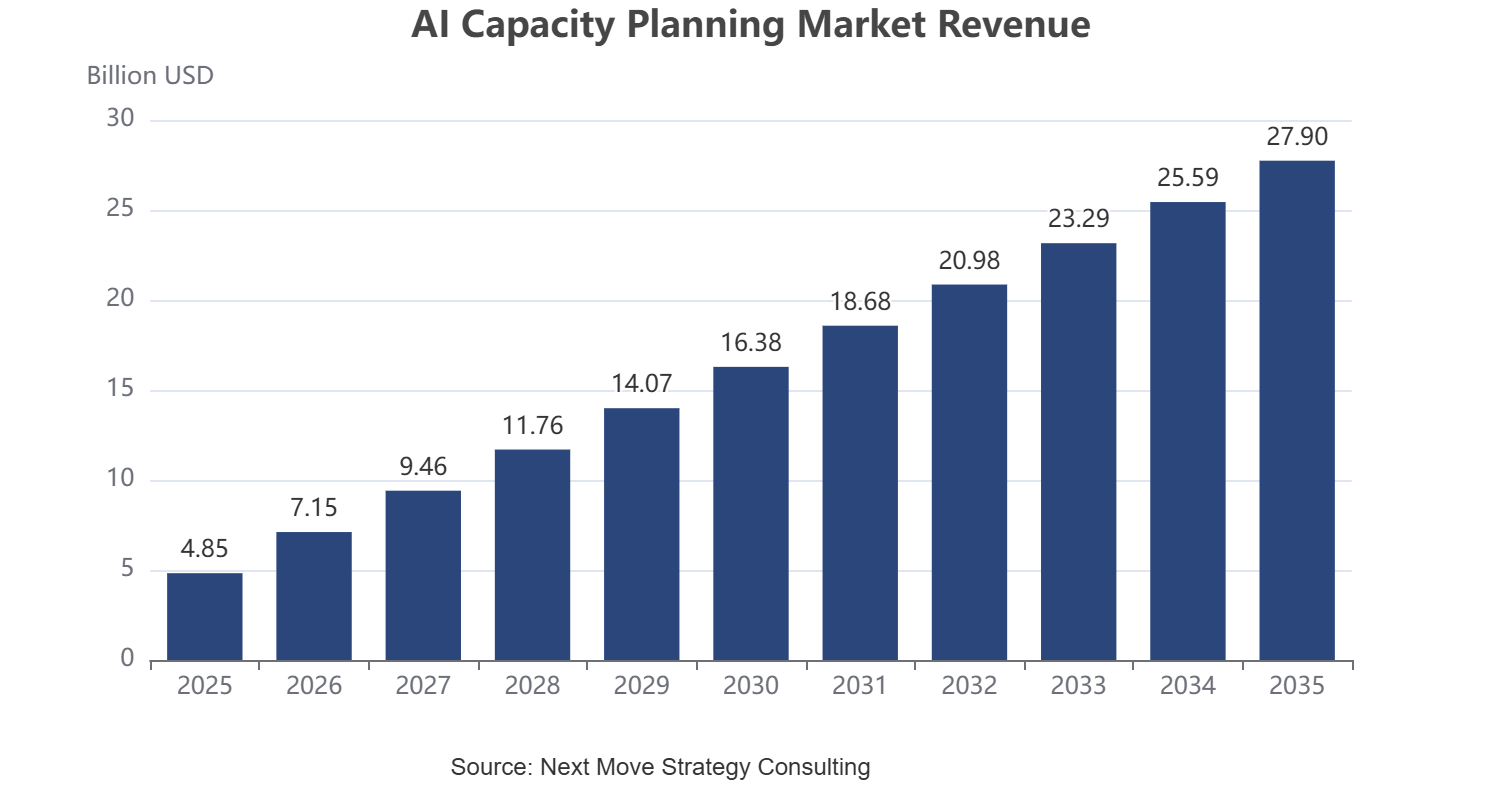
The global AI Capacity Planning Market size was valued at USD 4.85 Billion in 2025 and is estimated at USD 5.85 Billion in 2026, forecast to reach USD 27.90 Billion by 2035, expanding at a 19.0% CAGR between 2026 and 2035. North America leads with approximately 34% share, while under offering, Infrastructure Capacity Planning software dominates with approximately 18% share.
We observed that growth is broad-based across every segmentation axis, with cloud-native deployment and infrastructure-focused planning tools driving the dominant structural shifts through 2035, as enterprises rearchitect capacity forecasting around nonlinear, AI-driven compute and workforce demand.
|
Key Takeaways |
|
By Offering: Services held the largest share of approximately 30% (USD 1.46 Billion) in 2025; Infrastructure Capacity Planning is the fastest-growing sub-segment at 25.0% CAGR from 2026-2035. |
|
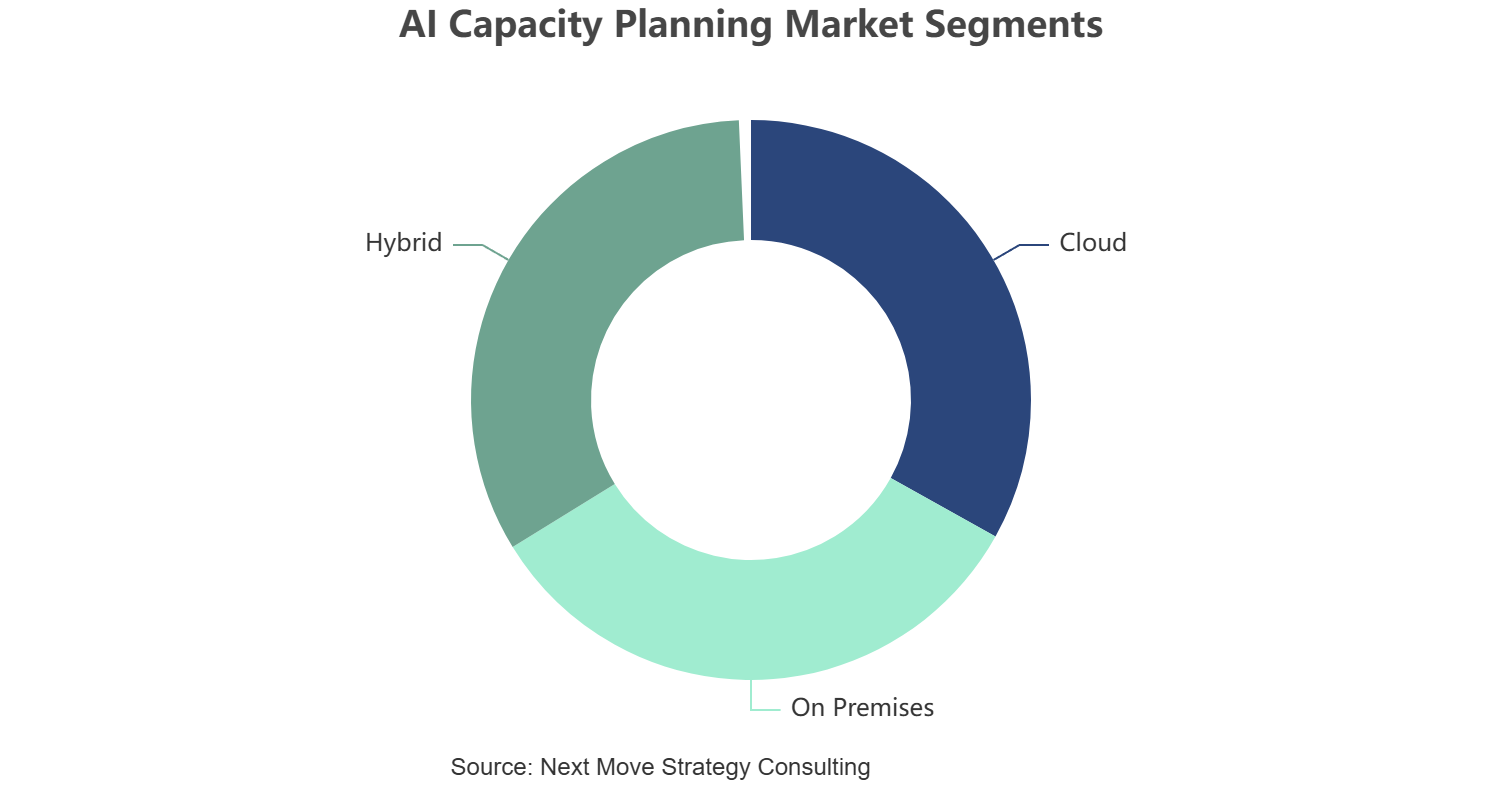
By Deployment: Cloud held the largest share of approximately 55% (USD 2.67 Billion) in 2025; Cloud is the fastest-growing sub-segment at 21.8% CAGR from 2026-2035. |
|
By Customer Size: Enterprise held the largest share of approximately 45% (USD 2.18 Billion) in 2025; Small and Medium Business is the fastest-growing sub-segment at 21.4% CAGR from 2026-2035. |
|
By End User Industry: Technology and IT Services held the largest share of approximately 20% (USD 960 Million) in 2025; Technology and IT Services is the fastest-growing sub-segment at 22.6% CAGR from 2026-2035. |
|
By Sales Channel: Direct held the largest share of approximately 45% (USD 2.18 Billion) in 2025; Marketplace is the fastest-growing sub-segment at 24.7% CAGR from 2026-2035. |
|
Dominant Region: North America dominated with approximately 34% revenue share (USD 1.66 Billion) in 2025. |
|
Fastest-Growing Region: Asia-Pacific is expected to register the highest CAGR of 21.4% during 2026-2035. |
|
Dominant Country: The United States led with approximately USD 1.36 Billion in 2025. |
|
Fastest-Growing Country: India is the fastest-growing country at approximately 23.9% CAGR from 2026 to 2035. |
Market Opportunity: Between 2026 and 2035, the AI Capacity Planning Market is set to generate an absolute dollar opportunity of USD 22.05 Billion, positioning cloud-native infrastructure capacity planning and AI-augmented workforce forecasting as compelling areas for capital allocation.
According to NMSC analysis, sustained enterprise investment in agentic, infrastructure-aware planning tools is reshaping procurement criteria for buyers across technology, manufacturing, and professional services, as vendors that combine compute, workforce, and supply chain forecasting into a single planning layer increasingly displace point solutions in vendor shortlisting.
What Does the AI Capacity Planning Market Encompass?
The AI Capacity Planning Market encompasses software platforms and advisory services that apply machine learning and predictive analytics to forecast and reconcile demand against available capacity across compute infrastructure, workforce, project portfolios, and supply chains. Our assessment indicates that the scope spans cloud, on-premises, and hybrid deployments serving small and medium businesses, mid-market firms, and large enterprises across technology, manufacturing, financial services, healthcare, retail, and public sector environments, where legacy spreadsheet-based planning can no longer accommodate nonlinear, AI-driven workload volatility.
We observed that the category has evolved from narrow, single-function scheduling tools into unified planning layers that reconcile compute, workforce, and production capacity within one forecasting model. Regulatory frameworks, including the U.S. Department of Energy's data center energy reporting guidance and the European Union's AI Act, shape disclosure and risk-management requirements for infrastructure-heavy deployments, while rising enterprise adoption of agentic AI workflows is redefining sourcing criteria across the AI Capacity Planning Market.
|
Parameters |
Details |
|
Market Size in 2025 |
USD 4.85 Billion |
|
Market Size in 2026 |
USD 5.85 Billion |
|
Revenue Forecast in 2035 |
USD 27.90 Billion |
|
Growth Rate |
CAGR of 19.0% from 2026 to 2035 |
|
Analysis Period |
2025–2035 |
|
Base Year Considered |
2025 |
|
Forecast Period |
2026–2035 |
|
Market Size Estimation |
Revenue (USD Billion) |
|
Companies Profiled |
20 |
|
Countries Covered |
38 |
|
Market Share |
Available for Top 10 Companies |
Key Emerging Trends
Based on research conducted by NMSC, we found that four structural trends are reshaping product development, adoption, and stakeholder engagement across the AI Capacity Planning Market.
How Is Agentic AI Transforming Infrastructure Capacity Planning?
Agentic AI systems that autonomously forecast, provision, and rebalance compute resources are replacing static, threshold-based capacity alerts. We observed that Datadog's State of AI Engineering 2026 report found nearly 5% of AI model requests failing in production, with almost 60% of those failures traced to capacity limits rather than model quality. Enterprises are responding by embedding predictive, agent-driven capacity forecasting directly into observability and infrastructure-management platforms, elevating capacity planning from a periodic exercise to a continuous, automated discipline.
Why Are Enterprises Consolidating Workforce and Infrastructure Planning Into One Platform?
Organizations are increasingly rejecting siloed workforce, project, and infrastructure planning tools in favour of unified platforms that reconcile human and compute capacity within a single model. Our findings suggest that ServiceNow's May 2026 expansion of its Autonomous Workforce, which added AI specialists spanning infrastructure monitoring, site reliability, asset lifecycle, and portfolio planning, illustrates how vendors are bundling previously separate planning disciplines to give operations leaders one coherent view of organizational capacity.
How Is Rising Data Center Power Demand Reshaping Infrastructure Capacity Planning Requirements?
Surging electricity consumption tied to AI workloads is forcing infrastructure planners to model power and cooling constraints alongside compute demand. We observed that the U.S. Department of Energy's Lawrence Berkeley National Laboratory projects data center electricity use climbing from 176 terawatt-hours in 2023 to between 325 and 580 terawatt-hours by 2028. This dynamic is pushing infrastructure capacity planning vendors to incorporate energy and grid-availability variables into forecasting models previously limited to compute and storage metrics alone.
What Role Does Scenario Simulation Play in Modern Capacity Planning Adoption?
Scenario simulation and digital-twin modelling are becoming standard features as organizations seek to stress-test capacity plans against demand volatility. Our analysis shows that supply chain and portfolio planning vendors, including Kinaxis, are integrating accelerated optimization engines such as NVIDIA cuOpt into their planning platforms to run large-scale scenario iterations in near real time, helping resource leaders evaluate multiple demand-supply configurations before committing capital or headcount.
Growth Drivers and Restraints
|
Factors |
Type |
(+/-) % Impact on CAGR |
Geographic Relevance |
Impact Timeline |
|
Enterprise adoption of agentic AI workflows |
Driver |
+3.2% |
Global |
2026–2035 |
|
Rising data center power and compute constraints |
Driver |
+2.6% |
North America, Asia-Pacific |
2026–2035 |
|
Shift to cloud-native, real-time planning platforms |
Driver |
+2.1% |
Global |
2026–2035 |
|
Consolidation of workforce, project, and infrastructure planning tools |
Driver |
+1.7% |
North America, Europe |
2026–2032 |
|
Expansion of AI-driven supply chain orchestration in Asia-Pacific |
Driver |
+1.9% |
Asia-Pacific |
2026–2035 |
|
Growing regulatory emphasis on AI governance and risk reporting |
Driver |
+1.1% |
Europe, North America |
2026–2035 |
|
Shortage of skilled capacity-planning and data science talent |
Restraint |
-1.4% |
Global |
2026–2032 |
|
High integration cost with legacy ERP and ITSM systems |
Restraint |
-1.0% |
North America, Europe |
2026–2035 |
|
Data privacy and cross-border AI governance constraints |
Restraint |
-0.7% |
Europe, Middle East & Africa |
2028–2035 |
What Is the Primary Growth Driver of the AI Capacity Planning Market?
Enterprise adoption of agentic AI workflows is the primary driver of the AI Capacity Planning Market. Datadog's State of AI Engineering 2026 report found that 69% of organizations now run three or more AI models simultaneously, compounding the operational complexity of forecasting compute and workforce demand. We observed that this shift is sustaining baseline demand for infrastructure capacity planning software across technology, manufacturing, and financial services enterprises seeking to avoid capacity-driven outages and cost overruns.
How Is Rising Data Center Power Demand Driving AI Capacity Planning Market Growth?
Constrained electricity supply for AI-scale data centers is accelerating demand for infrastructure capacity planning tools that model power, cooling, and compute jointly. The U.S. Department of Energy's Lawrence Berkeley National Laboratory reports that data centers consumed approximately 4.4% of total U.S. electricity in 2023 and are projected to reach between 6.7% and 12% by 2028. Our assessment indicates that this regulatory and grid-capacity pressure is compressing adoption timelines for AI-augmented infrastructure planning across North America and Asia-Pacific.
What Is Restraining AI Capacity Planning Market Expansion?
A persistent shortage of skilled capacity-planning and data science talent restrains broader adoption across the AI Capacity Planning Market. Enterprises frequently lack in-house expertise to configure, validate, and maintain AI-driven forecasting models, particularly across mid-market and small and medium-sized business segments. We found that smaller organizations face particular exposure, as limited internal capability slows platform deployment and increases dependence on costly implementation and advisory services relative to larger, resource-rich enterprises.
Segmentation Analysis
Segment Sizing: By Offering
|
Segment |
2025 (USD) |
2035 (USD) |
CAGR% (2026–2035) |
|
Workforce and Resource Planning |
0.73 |
3.35 |
16.0% |
|
Project and Portfolio Planning |
0.63 |
3.07 |
16.8% |
|
Supply Chain & Production Planning |
0.68 |
3.35 |
16.9% |
|
Infrastructure Capacity Planning |
0.87 |
7.81 |
25.0% |
|
Other Software |
0.48 |
1.95 |
14.4% |
|
Services |
1.46 |
8.37 |
18.9% |
Which Offering Segment Dominates the AI Capacity Planning Market?
Services, encompassing implementation, advisory, managed capacity planning, and support engagements, held the second-largest offering share in 2025, while Infrastructure Capacity Planning software led all software categories at USD 870 Million. We observed that Infrastructure Capacity Planning is also the fastest-growing offering, expanding at a 25.0% CAGR from 2026 to 2035, as enterprises prioritize compute and cloud-resource forecasting amid rising AI workload volatility and data center power constraints.
Segment Sizing: By Deployment
|
Segment |
2025 (USD) |
2035 (USD) |
CAGR% (2026–2035) |
|
Cloud |
2.67 |
18.97 |
21.8% |
|
On Premises |
1.21 |
3.35 |
9.7% |
|
Hybrid |
0.97 |
5.58 |
19.0% |
Which Deployment Mode Leads AI Capacity Planning Market Adoption?
Cloud deployment led the AI Capacity Planning Market with USD 2.67 Billion in 2025, reflecting enterprise preference for scalable, subscription-based planning platforms that integrate directly with cloud infrastructure telemetry. Our findings suggest that Cloud deployment is also the fastest-growing mode, registering a 21.8% CAGR from 2026 to 2035, while on-premises deployment continues to contract as regulated industries gradually migrate toward hybrid and cloud-native planning architectures.
Segment Sizing: By End User Industry
|
Segment |
2025 (USD) |
2035 (USD) |
CAGR% (2026–2035) |
|
Professional Services and Consulting |
0.87 |
4.18 |
16.6% |
|
Manufacturing and Industrial |
0.78 |
3.91 |
17.1% |
|
Technology and IT Services |
0.96 |
7.25 |
22.6% |
|
BFSI |
0.58 |
3.07 |
17.9% |
|
Healthcare and Life Sciences |
0.44 |
2.79 |
20.2% |
|
Retail and E Commerce |
0.39 |
2.23 |
18.9% |
|
Telecommunications |
0.34 |
1.67 |
16.9% |
|
Public Sector and Government |
0.24 |
1.40 |
19.2% |
|
Energy and Utilities |
0.15 |
0.84 |
18.6% |
|
Other Industries |
0.10 |
0.56 |
18.6% |
Which End User Industry Leads AI Capacity Planning Market Demand?
Technology and IT Services led end user demand within the AI Capacity Planning Market at USD 960 Million in 2025, driven by hyperscalers and software vendors managing volatile, AI-scale compute workloads. We observed that Technology and IT Services is also the fastest-growing end-user industry, expanding at a 22.6% CAGR from 2026 to 2035, as infrastructure-heavy technology organizations scale AI-augmented forecasting to manage compute cost and reliability.
Growth Opportunities
Our analysis shows that three forward-looking opportunities stand out for stakeholders positioning within the AI Capacity Planning Market over the 2026-2035 forecast period.
How Are Agentic Capacity Agents Creating Opportunities for Infrastructure Vendors?
Agentic, autonomously acting capacity agents present a whitespace opportunity for observability and cloud infrastructure vendors seeking to extend beyond monitoring into proactive resource provisioning. Vendors that commercialize agents capable of forecasting and rebalancing compute capacity without human intervention stand to capture recurring platform revenue from technology and IT services buyers managing multi-model AI production environments.
Why Is Mid-Market Expansion Emerging as a Growth Opportunity for Capacity Planning Vendors?
Mid-market organizations represent an underpenetrated opportunity as enterprise-grade forecasting capabilities become accessible through lower-cost, cloud-delivered subscription tiers. Vendors that package simplified, pre-configured workforce and infrastructure planning modules for mid-market buyers can secure long-term contracts with organizations previously reliant on spreadsheet-based planning, benefiting from recurring subscription revenue as adoption widens beyond large enterprises.
How Are Energy-Aware Planning Models Unlocking Opportunities for Data Center Operators?
Data center operators and utilities seeking to manage AI-driven power demand create an opportunity for vendors offering energy-aware infrastructure capacity planning models. Early movers that integrate grid-availability and power-cost variables into forecasting platforms can differentiate themselves with hyperscale and colocation operators pursuing resilient, cost-efficient capacity expansion amid tightening electricity supply across North America and Asia-Pacific.
Strategic Framework Analysis of the AI Capacity Planning Industry
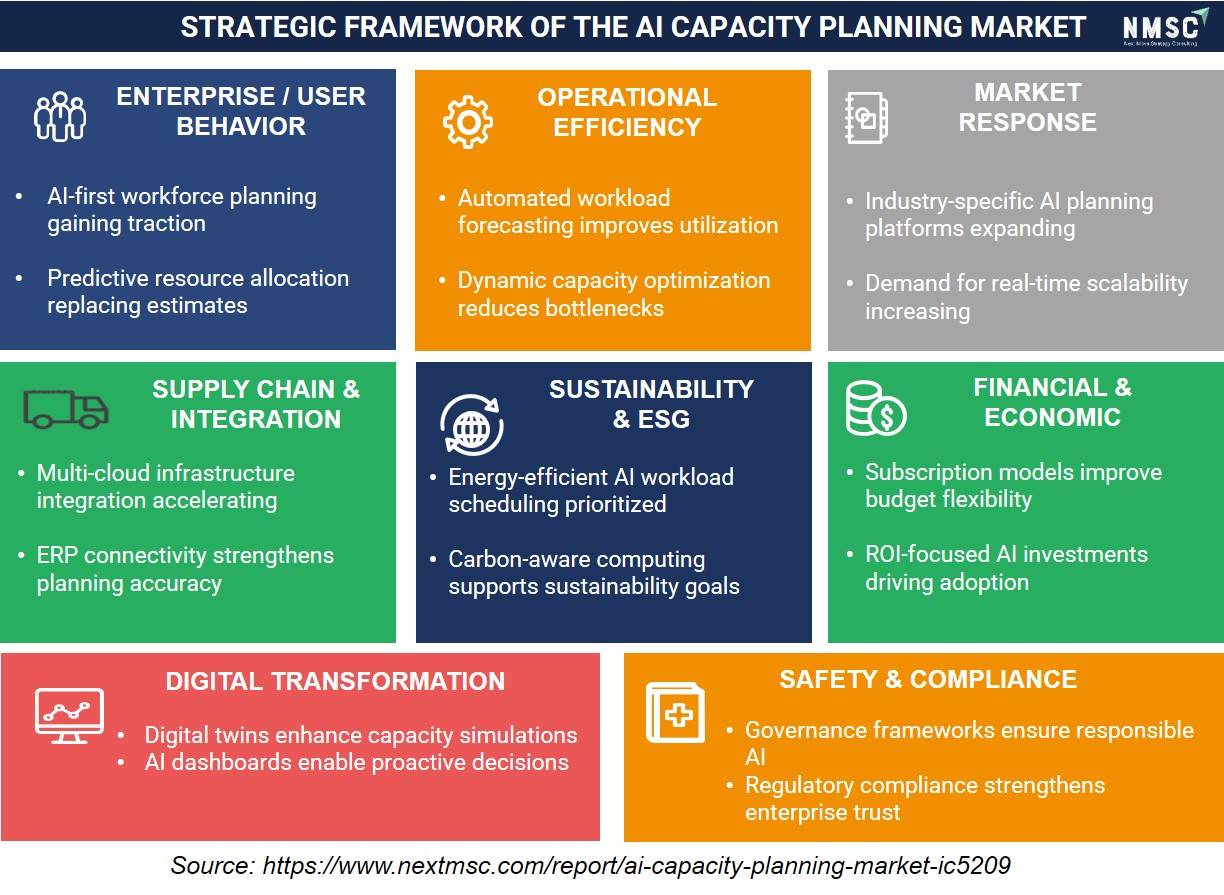
The above infographic presents a strategic framework of the AI capacity planning market, where predictive resource allocation and automated forecasting are improving operational efficiency. Industry-specific platforms are expanding, while multi-cloud integration and ERP connectivity strengthen planning accuracy. Energy-efficient scheduling supports sustainability, and subscription models drive adoption. Digital twins enable proactive decisions, all backed by governance frameworks and regulatory compliance to ensure responsible deployment and enterprise trust.
Regional Outlook
Geographic Performance Snapshot
|
Region |
2025 (USD) |
2035 (USD) |
CAGR% (2026–2035) |
Key Driver |
|
North America |
1.66 |
8.37 |
17.2% |
Mature enterprise IT spend and DOE-tracked data center power constraints |
|
Europe |
1.21 |
6.14 |
17.3% |
EU AI Act compliance requirements and enterprise cloud migration |
|
Asia-Pacific |
1.45 |
10.04 |
21.4% |
Rapid hyperscale data center expansion and manufacturing digitization |
|
Middle East & Africa |
0.29 |
1.95 |
21.0% |
Sovereign AI infrastructure investment and cloud modernization |
|
Latin America |
0.24 |
1.40 |
19.2% |
Expanding cloud adoption among mid-market enterprises |
North America
North America remained the most mature market within the AI Capacity Planning Market, valued at USD 1.66 Billion in 2025 on the back of established enterprise IT spend and early adoption of AI-augmented infrastructure planning. We observed that the U.S. Department of Energy data center energy tracking is prompting operators to formalize capacity forecasting practices. Regulatory clarity, mature cloud infrastructure, and concentrated hyperscaler activity continue to anchor the region's strategic outlook through 2035.
Europe
Europe held a substantial share of the AI Capacity Planning Market at USD 1.21 Billion in 2025, shaped by the European Union's AI Act and broader data governance requirements. Our assessment indicates that enterprises across Germany, the UK, and France are prioritizing compliant, auditable capacity forecasting platforms. Technology adoption remains steady, with competitive intensity concentrated among global vendors serving regulated financial services and manufacturing buyers.
Asia-Pacific
Asia-Pacific is the fastest-growing region within the AI Capacity Planning Industry, reaching USD 1.45 Billion in 2025 and expanding at a 21.4% CAGR through 2035. We found that rapid hyperscale data center construction across China, India, and Japan is driving urgent demand for infrastructure and workforce capacity forecasting. Rising technology adoption and expanding domestic cloud infrastructure investment support a strong strategic growth outlook.
Middle East & Africa
Middle East & Africa remains an emerging market for the AI Capacity Planning Market, valued at USD 290 Million in 2025. Our findings suggest that sovereign AI infrastructure investment across the UAE and Saudi Arabia is accelerating demand for compute capacity forecasting tools. Regulatory frameworks remain in early development, while technology adoption is concentrated among government-backed digital transformation initiatives and large enterprises.
Latin America
Latin America represented the smallest regional share of the AI Capacity Planning Market at USD 240 Million in 2025, with Brazil and Argentina leading regional demand. We observed that expanding cloud adoption among mid-market enterprises is gradually increasing the appetite for AI-augmented workforce and project planning tools. Regulatory oversight remains limited, and competitive intensity is lower than in more mature regions, supporting a steady long-term growth outlook.
United States
Based on our engagements, the United States' AI Capacity Planning Market was valued at approximately USD 1.36 Billion in 2025 and is projected to reach USD 6.53 Billion by 2035, growing at a 16.6% CAGR. The largest technology enterprise base and concentrated hyperscale data center construction sustain deep adoption of infrastructure and workforce capacity planning tools, with mature regulatory oversight from the U.S. Department of Energy on data center power reporting and strong competitive intensity among global software vendors shaping a stable strategic outlook.
Canada
Through our analysis, Canada's AI Capacity Planning Industry was valued at approximately USD 216 Million in 2025 and is projected to reach USD 1.25 Billion by 2035, growing at a 19.1% CAGR. Growing enterprise cloud migration and expanding data center investment are lifting demand for AI-augmented capacity forecasting, supported by a stable regulatory environment and increasing competitive activity from both domestic and global vendors targeting mid-market and enterprise buyers.
Mexico
From our assessment, Mexico's AI Capacity Planning Market was valued at approximately USD 83 Million in 2025 and is projected to reach USD 586 Million by 2035, growing at a 21.7% CAGR. Expanding nearshoring-driven manufacturing investment and rising cloud adoption are increasing demand for supply chain and production capacity planning tools, with a developing regulatory environment and moderate competitive intensity concentrated among regional systems integrators and global vendors.
United Kingdom
According to our evaluation, United Kingdom's AI Capacity Planning Market was valued at approximately USD 290 Million in 2025 and is projected to reach USD 1.41 Billion by 2035, growing at a 16.8% CAGR. Mature financial services and technology sectors drive steady adoption of workforce and infrastructure capacity planning tools, with the UK's evolving AI governance framework and strong cloud penetration supporting a stable, innovation-led strategic outlook.
Germany
Based on our engagements, Germany's AI Capacity Planning Market was valued at approximately USD 315 Million in 2025 and is projected to reach USD 1.54 Billion by 2035, growing at a 16.8% CAGR. Manufacturing-led demand for production and supply chain capacity planning remains strong, with European Union AI Act compliance requirements and deep enterprise resource planning integration shaping vendor selection and sustaining a resilient strategic outlook.
France
Through our analysis, France's AI Capacity Planning Industry was valued at approximately USD 194 Million in 2025 and is projected to reach USD 982 Million by 2035, growing at a 17.3% CAGR. Growing public sector and financial services adoption is expanding demand for workforce and portfolio capacity planning tools, with EU regulatory alignment and increasing cloud migration supporting steady competitive intensity among regional and global vendors.
China
From our assessment, China's AI Capacity Planning Market was valued at approximately USD 435 Million in 2025 and is projected to reach USD 2.81 Billion by 2035, growing at a 20.5% CAGR. Large-scale hyperscale data center expansion and domestic AI infrastructure investment are driving rapid adoption of infrastructure capacity planning tools, with an evolving regulatory environment and intense competitive activity among domestic cloud and enterprise software vendors.
India
According to our evaluation, India's AI Capacity Planning Market was valued at approximately USD 290 Million in 2025 and is projected to reach USD 2.41 Billion by 2035, growing at a 23.9% CAGR. Rapid growth in IT services and technology sector capacity demand is accelerating the adoption of AI-driven workforce and infrastructure planning tools, with expanding cloud infrastructure investment and rising competitive intensity among global and domestic vendors supporting the fastest country-level growth outlook.
Japan
Based on our engagements, Japan's AI Capacity Planning Industry was valued at approximately USD 261 Million in 2025 and is projected to reach USD 1.61 Billion by 2035, growing at a 19.8% CAGR. Steady enterprise technology investment and an aging workforce are increasing reliance on AI-augmented workforce capacity planning, with a mature regulatory environment and strong competitive presence from both domestic and global vendors supporting stable strategic growth.
South Korea
Through our analysis, South Korea's AI Capacity Planning Market was valued at approximately USD 160 Million in 2025 and is projected to reach USD 1.10 Billion by 2035, growing at a 21.5% CAGR. Concentrated semiconductor and electronics manufacturing investment is driving demand for production and infrastructure capacity planning tools, with strong cloud adoption and increasing competitive intensity among domestic and global vendors supporting a positive strategic outlook.
Australia
From our assessment, Australia's AI Capacity Planning Market was valued at approximately USD 131 Million in 2025 and is projected to reach USD 904 Million by 2035, growing at a 21.5% CAGR. Growing cloud adoption among mid-market and enterprise buyers is expanding demand for workforce and infrastructure capacity planning tools, with a stable regulatory environment and moderate competitive intensity among regional and global vendors supporting continued strategic growth.
UAE
According to our evaluation, the UAE's AI Capacity Planning Industry was valued at approximately USD 81 Million in 2025 and is projected to reach USD 526 Million by 2035, growing at a 20.5% CAGR. Sovereign AI infrastructure investment and rapid data center construction are driving strong demand for infrastructure capacity planning tools, with an emerging regulatory environment and rising competitive intensity among global vendors entering the market supporting rapid strategic expansion.
Saudi Arabia
Based on our engagements, Saudi Arabia's AI Capacity Planning Market was valued at approximately USD 70 Million in 2025 and is projected to reach USD 487 Million by 2035, growing at a 21.6% CAGR. Large-scale government-backed digital transformation programs are accelerating demand for infrastructure and workforce capacity planning tools, with a developing regulatory environment and increasing competitive activity from global vendors establishing regional operations supporting strong strategic growth.
South Africa
Through our analysis, South Africa's AI Capacity Planning Market was valued at approximately USD 41 Million in 2025 and is projected to reach USD 292 Million by 2035, growing at a 21.9% CAGR. Gradually expanding cloud adoption among enterprise and public sector buyers is increasing demand for workforce and project capacity planning tools, with a developing regulatory environment and limited but growing competitive intensity supporting steady strategic progress.
Brazil
From our assessment, Brazil's AI Capacity Planning Market was valued at approximately USD 106 Million in 2025 and is projected to reach USD 588 Million by 2035, growing at a 18.6% CAGR. Expanding financial services and retail sector cloud adoption is driving demand for workforce and infrastructure capacity planning tools, with a developing regulatory environment and moderate competitive intensity among regional and global vendors supporting steady strategic growth.
Argentina
According to our evaluation, Argentina's AI Capacity Planning Industry was valued at approximately USD 43 Million in 2025 and is projected to reach USD 266 Million by 2035, growing at a 19.9% CAGR. Gradually increasing enterprise cloud migration is lifting demand for workforce and project capacity planning tools, with a developing regulatory environment and limited competitive intensity concentrated among regional systems integrators supporting a modest but positive strategic outlook.
Supply Chain Analysis of the AI Capacity Planning Market
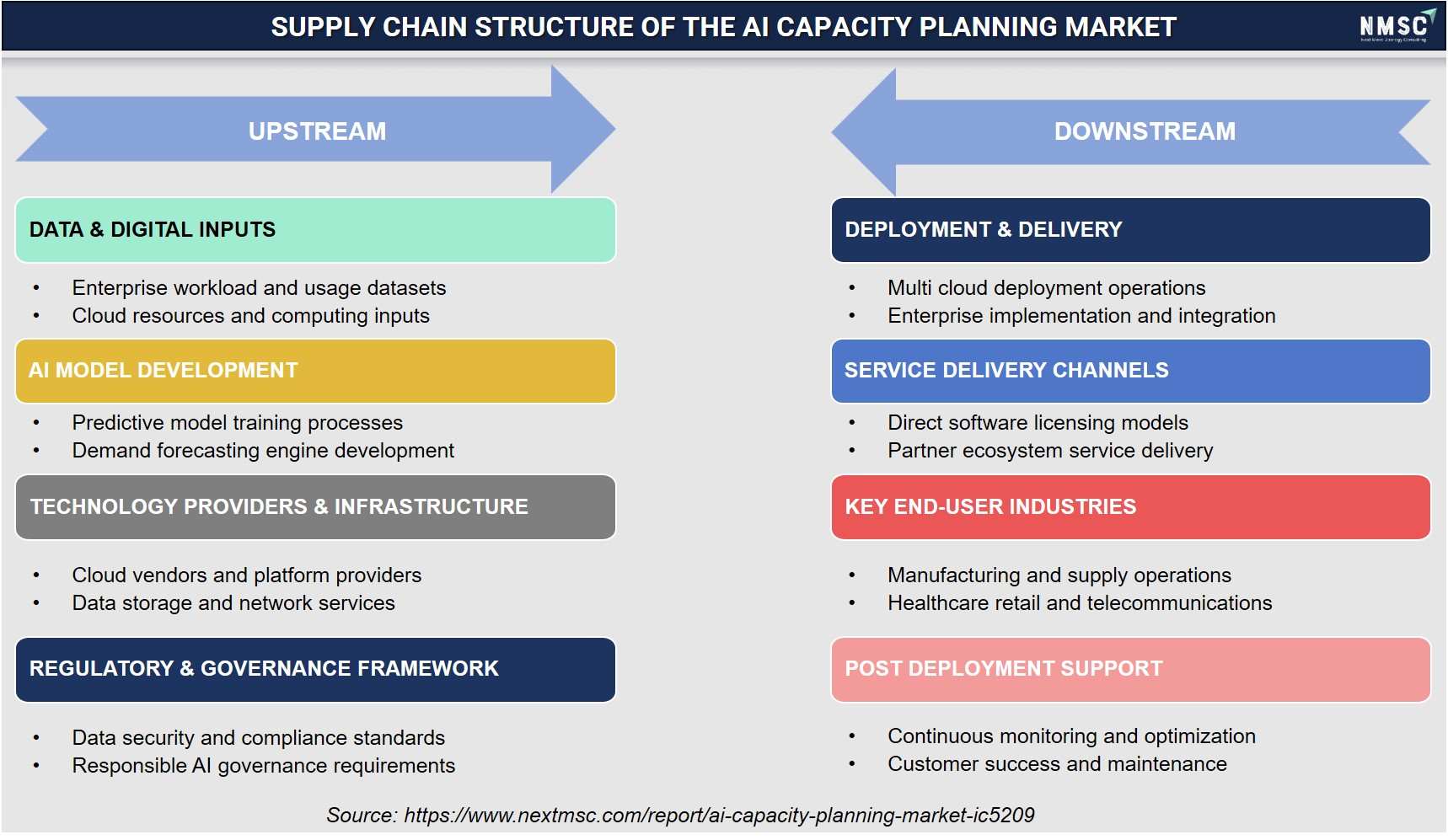
The above infographic presents the supply chain structure of the AI capacity planning market, segmented into upstream and downstream activities. Upstream begins with enterprise datasets and cloud inputs, moving into model training and forecasting development. Technology providers offer cloud platforms, while compliance ensures data security and governance. Moving downstream, deployment and integration enable service delivery across manufacturing, healthcare, retail, and telecom sectors. Looking ahead, we observed that post-deployment monitoring and optimization ensure long-term system reliability.
Competitive Landscape
We observed that the AI Capacity Planning Market features a moderately fragmented competitive landscape, with diversified enterprise software platforms competing alongside specialized infrastructure observability and supply chain planning vendors in terms of breadth, AI sophistication, and integration depth.
|
Dimension |
Description |
|
Market Structure |
Moderately fragmented, large enterprise platform vendors compete with specialized infrastructure observability and supply chain planning providers, while numerous mid-market-focused vendors serve cost-sensitive workforce and project planning demand. |
|
Innovation Focus |
Agentic AI capacity agents, unified workforce-infrastructure planning layers, and energy-aware infrastructure forecasting dominate current innovation pipelines across leading vendors. |
|
M&A Activity |
Selective consolidation continues as diversified enterprise software vendors acquire specialized planning and observability capabilities to broaden unified capacity planning portfolios. |
How Do Companies Compete in the AI Capacity Planning Market?
Companies compete primarily on breadth of integration, AI forecasting sophistication, and real-time data connectivity across the AI Capacity Planning Market. Diversified enterprise platforms such as SAP SE and Oracle Corporation leverage broad ERP and workforce management footprints to serve multinational buyers, while specialized providers including Kinaxis Inc. and Datadog Inc. compete on deep, domain-specific forecasting accuracy for supply chain and infrastructure capacity use cases respectively.
Which Competitive Archetypes Dominate the AI Capacity Planning Market?
Two archetypes dominate the AI Capacity Planning Market: diversified enterprise software groups offering integrated workforce, project, and infrastructure planning within broader ERP or ITSM suites, and specialized point-solution vendors focused on a single capacity domain. Microsoft Corporation and ServiceNow Inc. exemplify the diversified archetype through platform-wide AI integration, while Kinaxis Inc. and Dynatrace Inc. exemplify the specialized archetype through deep supply chain and infrastructure observability expertise.
How Are Companies Differentiating Through Innovation in AI Capacity Planning?
Innovation and differentiation strategy increasingly center on agentic, autonomously acting capacity forecasting and cross-domain data integration. ServiceNow Inc.'s May 2026 expansion of its Autonomous Workforce and Datadog Inc.'s Bits Agent Builder both extend AI-driven forecasting into proactive, self-adjusting capacity management. Our analysis shows that vendors unable to demonstrate credible agentic capabilities risk exclusion from enterprise request-for-proposal shortlists focused on infrastructure and workforce planning consolidation.
What M&A and Expansion Activity Is Shaping the AI Capacity Planning Market?
Mergers, acquisitions, and platform expansion continue to consolidate capacity planning capabilities within the AI Capacity Planning Market. Kinaxis Inc.'s integration of NVIDIA's cuOpt optimization engine into its Maestro platform illustrates how specialized vendors pursue technology partnerships to expand scenario-simulation capability, while broader enterprise software vendors continue to bundle acquired workforce and project planning tools into unified platform suites.
Key Market Players
Our assessment indicates that the following 20 companies represent the validated competitive set actively shaping product innovation, platform consolidation, and go-to-market strategy within the global AI Capacity Planning Market.
-
Microsoft Corporation
-
ServiceNow Inc.
-
Workday Inc.
-
Kinaxis Inc.
-
Blue Yonder Group Inc.
-
Broadcom Inc.
-
Cisco Systems Inc.
-
Hewlett Packard Enterprise Company
-
Anaplan Inc.
-
Planview Inc.
-
Infor Inc.
-
e2open LLC
-
Smartsheet Inc.
-
Kantata Inc.
-
Dynatrace Inc.
-
Datadog Inc.
-
Runn Global Inc.
Latest Developments
We found that recent product and platform developments within the AI Capacity Planning Market are concentrated on agentic AI capacity forecasting, reflecting the industry's broader shift toward autonomous, infrastructure-aware planning.
|
Date |
Event |
|
October 2025 |
Kinaxis announced integration of NVIDIA's cuOpt accelerated optimization engine into its Maestro supply chain orchestration platform to scale scenario simulation. |
|
May 2026 |
ServiceNow expanded its Autonomous Workforce at Knowledge 2026 with new AI specialists spanning infrastructure monitoring, site reliability, asset lifecycle, and portfolio planning. |
Investment Opportunities
What Capital Inflows Are Targeting the AI Capacity Planning Market?
Capital inflows into the AI Capacity Planning Market are increasingly directed toward agentic forecasting engines and cross-domain planning integration. Strategic technology partnerships, such as Kinaxis Inc.'s integration of NVIDIA's cuOpt engine, illustrate how vendors are funding accelerated optimization capability. We observed that investors favor vendors demonstrating measurable reductions in capacity-related production failures, viewing operational reliability as a proxy for durable enterprise contract retention.
How Is Infrastructure Investment Supporting AI Capacity Planning Market Growth?
Infrastructure investment is expanding data center and cloud capacity across North America and Asia-Pacific to support both AI workloads and the planning software that forecasts them. The U.S. Department of Energy's data center energy tracking underscores the scale of this build-out. Our findings suggest that planning software vendors are correspondingly investing in real-time telemetry integrations to keep forecasting models aligned with rapidly expanding physical infrastructure footprints.
What ESG Considerations Are Shaping AI Capacity Planning Investment Decisions?
Environmental, social, and governance considerations are increasingly central to investment decisions across the AI Capacity Planning Market, with energy-efficient infrastructure forecasting as a key criterion. The U.S. Department of Energy's data center electricity demand projections continue to inform enterprise sustainability disclosures. We found that investors increasingly favor vendors incorporating power and cooling constraints into forecasting models, treating energy-aware planning as a governance indicator alongside data privacy compliance.
Key Benefits for Stakeholders
How Does This Report Benefit Enterprise and Industry Leaders?
Enterprise and industry leaders gain access to validated segmentation, competitive benchmarking, and regional demand forecasts that support platform selection and capacity-planning investment decisions across the AI Capacity Planning Market. Our analysis shows that detailed offering, deployment, and end-user industry breakdowns help operations teams align procurement with infrastructure and workforce planning priorities while identifying underserved segments for internal capability expansion.
How Does This Report Benefit Investors and Financial Analysts?
Investors and financial analysts benefit from consistent, single-point market size and CAGR estimates that support valuation and capital-allocation decisions across the AI Capacity Planning Market vendor landscape. We observed that the report's regional and segment-level growth differentials help identify which infrastructure and workforce planning vendors are best positioned to capture above-market growth through 2035.
How Does This Report Benefit Technology Vendors and Product Teams?
Technology vendors and product teams gain insight into emerging requirements, including agentic capacity forecasting, energy-aware infrastructure planning, and unified workforce-infrastructure platforms, that are reshaping the AI Capacity Planning Market. Our findings suggest that this analysis helps product teams prioritize development roadmaps around the AI governance and integration capabilities increasingly required by enterprise request-for-proposal processes.
Key Market Segments
By Offering
-
Software
-
Workforce and Resource Planning
-
Team Capacity Scheduling
-
Skills-Based Allocation
-
Leave and Availability Management
-
Utilization Forecasting
-
-
Project and Portfolio Planning
-
Pipeline Demand Forecasting
-
Scenario Planning & Simulation
-
Resource Demand Vs Supply Matching
-
Portfolio Prioritization
-
-
Supply Chain & Production Planning
-
Demand Planning & Sensing
-
Supply Planning & Constraints
-
Production Scheduling & Sequencing
-
Inventory Capacity Optimization
-
-
Infrastructure Capacity Planning
-
Compute Capacity Planning
-
Storage Capacity Planning
-
Network Bandwidth Planning
-
Cloud Resource Capacity Planning
-
-
Other Softwares
-
-
Services
-
Implementation and Integration
-
Advisory and Assessment
-
Managed Capacity Planning Services
-
Maintenance and Support
-
Other Services
-
By Deployment
-
Cloud
-
On Premises
-
Hybrid
By Customer Size
-
Small and Medium Business
-
Mid-Market
-
Enterprise
By End User Industry
-
Professional Services and Consulting
-
Manufacturing and Industrial
-
Technology and IT Services
-
BFSI
-
Healthcare and Life Sciences
-
Retail and E Commerce
-
Telecommunications
-
Public Sector and Government
-
Energy and Utilities
-
Other Industries
By Sales Channel
-
Direct
-
Partner and Reseller
-
Marketplace
-
Other Channels
By Region
-
North America: U.S., Canada, Mexico
-
Europe: UK, Germany, France, Italy, Spain, Sweden, Denmark, Finland, Netherlands, Rest of Europe
-
Asia-Pacific: China, India, Japan, South Korea, Taiwan, Indonesia, Vietnam, Australia, Philippines, Malaysia, Rest of APAC
-
Middle East & Africa: Saudi Arabia, UAE, Egypt, Israel, Turkey, Nigeria, South Africa, Rest of MEA
-
Latin America: Brazil, Argentina, Chile, Colombia, Rest of LATAM
Conclusion and Recommendations
What Is the Long-Term Outlook for the AI Capacity Planning Market?
The AI Capacity Planning Market is set for sustained expansion from USD 5.85 Billion in 2026 to USD 27.90 Billion by 2035, reflecting a durable 19.0% CAGR as enterprises embed AI-driven forecasting into core operations. Our analysis shows that Infrastructure Capacity Planning software and Technology and IT Services end users will continue outpacing broader market growth, anchoring long-term demand around compute and cloud-resource forecasting rather than traditional workforce scheduling alone.
What Are the Strategic Positioning Recommendations for Vendors?
Vendors should prioritize unifying workforce, project, and infrastructure planning within a single AI-driven forecasting layer rather than competing as narrow point solutions. We observed that platforms combining agentic capacity forecasting with deep infrastructure telemetry integration, following the pattern set by ServiceNow's and Datadog's 2026 platform expansions, are best positioned to capture enterprise consolidation budgets and displace fragmented legacy planning tools.
How Attractive Is the AI Capacity Planning Market for Investment?
Investment attractiveness remains strong given the market's 19.0% CAGR and the absolute dollar opportunity of USD 22.05 Billion created between 2026 and 2035. Our assessment indicates that infrastructure-focused sub-segments, led by Infrastructure Capacity Planning software, offer the most attractive risk-adjusted growth profile, supported by structural tailwinds from rising data center power constraints and enterprise AI adoption.
What Market Shifts and Key Risks Should Stakeholders Monitor?
Stakeholders should monitor the shift toward agentic, autonomously acting capacity forecasting as a competitive differentiator, alongside the risk posed by persistent shortages of skilled capacity-planning talent. We found that tightening AI governance regulation across Europe and integration costs with legacy ERP and ITSM systems represent the most material near-term risks to adoption velocity across mid-market and regulated enterprise segments.
What Are the Key Growth Pathways for AI Capacity Planning Market Participants?
Key growth pathways include expanding into underpenetrated mid-market segments, developing energy-aware infrastructure forecasting models, and deepening AI agent capabilities that autonomously rebalance capacity. Our findings suggest that vendors pursuing these pathways in combination, rather than in isolation, will be best positioned to capture the fastest-growing sub-segments identified across the AI Capacity Planning Market's offering, deployment, and regional segmentation.
About the Author
 Mayurima Roy
— Mayurima Roy is Research Analyst at Next Move Strategy Consulting, where she has spent 4 years working across the firm's full industry coverage rather than a single fixed vertical. Her work centers on structured research, ongoing trend tracking, competitive assessment, and insight-led content development, translating complex market data into clear, decision-ready narratives that support informed client decision-making across diverse global industries, market sectors, and world regions every day.
Mayurima Roy
— Mayurima Roy is Research Analyst at Next Move Strategy Consulting, where she has spent 4 years working across the firm's full industry coverage rather than a single fixed vertical. Her work centers on structured research, ongoing trend tracking, competitive assessment, and insight-led content development, translating complex market data into clear, decision-ready narratives that support informed client decision-making across diverse global industries, market sectors, and world regions every day.
About the Reviewer
 Supradip Baul
— Supradip Baul is an accomplished business consultant and strategist with over a decade of rich experience in market intelligence, strategy, technology, and business transformation. His work has included rigorous qualitative and quantitative analysis across multiple industries, helping clients shape investment decisions and long-term roadmaps. Earlier in his career, he was associated with Gartner, where he contributed to industry-leading reports and market share analyses. He has worked with leading global companies and holds an MBA with a dual specialization in Marketing and Finance.
Supradip Baul
— Supradip Baul is an accomplished business consultant and strategist with over a decade of rich experience in market intelligence, strategy, technology, and business transformation. His work has included rigorous qualitative and quantitative analysis across multiple industries, helping clients shape investment decisions and long-term roadmaps. Earlier in his career, he was associated with Gartner, where he contributed to industry-leading reports and market share analyses. He has worked with leading global companies and holds an MBA with a dual specialization in Marketing and Finance.
At Next Move Strategy Consulting, we understand that insightful market research is the cornerstone of successful business decisions. That's why we employ a robust and multifaceted approach, combining various methodologies to deliver the most accurate and actionable data for our clients.

Research Landscape
We navigate the world of research with two primary approaches:
Qualitative Approach
Our qualitative research methodologies involve immersive techniques such as in-depth interviews, focus groups, and observational studies. By engaging directly with individuals and stakeholders, we uncover valuable insights that quantitative data alone may overlook.

Quantitative Research
In tandem with qualitative methodologies, NMSC leverages the power of Quantitative Research to provide a robust foundation of numerical insights. Through systematic data collection and analysis, we quantify patterns, preferences, and market trends, offering a comprehensive view of the business landscape.
Our quantitative research approach employs diverse tools, including surveys, experiments, and statistical modelling. These methodologies enable us to gather data from a large and representative sample, ensuring the statistical significance of our findings. By employing structured questionnaires and standardized data collection methods, we guarantee the reliability and validity of the information we present to our clients.
Quantitative research is particularly effective in measuring the prevalence of trends, assessing market size, and gauging the impact of various factors on consumer behavior. The numerical precision attained through this approach equips our clients with actionable insights, facilitating data-driven decision-making and strategy formulation.


Our Specialized Toolbox for Industry-Specific Market Research
We deploy a specialized arsenal of techniques tailored to meet your unique requirements. Here's a glimpse into our comprehensive toolbox:

Information Procurement
The stage entails acquiring market data or relevant information through various sources and methodologies.


Market Research Approach
We utilize both top-down and bottom-up approaches in market research analysis to achieve a comprehensive understanding of the market dynamics, leveraging the broad perspective of industry trends and macroeconomic factors alongside detailed insights from specific segments and individual companies.

Porters Five Forces Analysis
We conduct Porter's Five Forces analysis to evaluate the competitive landscape of an industry, providing us with insights into factors that affect profitability and strategic positioning.

SWOT Analysis

Forecasting
We utilize a forecasting model to predict future consumption by considering parameters like population, economics, regulations, market competition, drivers, constraints, technology, and pricing. We also employ statistical techniques such as multilinear regression, exponential smoothing, moving average, ARIMA, and Monte Carlo simulations for accurate predictions. In econometric forecasting, we analyzed short-term and long-term event impacts, attributing values based on regulatory frameworks, economic factors, and market events.





 Speak to Our Analyst