AI Spend Analytics Market Size, Share, Growth & Forecast by Offering Type (Software: Standalone Spend Analytics, Suite Embedded Analytics), Deployment Model (SaaS), Buyer Function (Procurement, Finance), Industry Vertical (Manufacturing, Financial Services, Healthcare and Life Sciences, Retail and CPG, Public Sector, Energy and Utilities), Enterprise Size (Large Enterprise), Spend Scope (Direct Spend, Indirect Spend, Tail Spend), Sales Channel (Direct Sales) — Global Analysis 2025–2035
Industry: ICT & Media | Publishing Date: July 8, 2026 | Last Updated: September 30, 2026 | No of Pages: N/A | No. of Tables: N/A | No. of Figures: N/A | Format: PDF | Report Code: IC5017
What Is the AI Spend Analytics Market Size?
The global AI Spend Analytics Market was valued at USD 3.2 billion in 2025 and is projected to reach USD 3.8 billion in 2026. Sustained enterprise investment in procurement transformation, AI-powered spend classification, and real-time supplier intelligence is expected to propel the market to USD 18.6 billion by 2035, advancing at a CAGR of 19.3% from 2026 to 2035. Key growth drivers include the rapid adoption of large language models for automated spend categorization, expanding regulatory pressure to improve procurement transparency, rising demand for tail spend management solutions, and the integration of AI analytics within source-to-pay platforms across multinational corporations.
|
Parameters |
Details |
|
Market Size in 2025 |
USD 3.2 Billion |
|
Market Size in 2026 |
USD 3.8 Billion |
|
Revenue Forecast in 2035 |
USD 18.6 Billion |
|
Growth Rate |
CAGR of 19.3% from 2026 to 2035 |
|
Analysis Period |
2025–2035 |
|
Base Year Considered |
2025 |
|
Forecast Period |
2026–2035 |
|
Market Size Estimation |
Billion USD |
|
Companies Profiled |
20 |
|
Countries Covered |
33 |
|
Market Share |
Top 10 |
AI Spend Analytics Market Overview
What Is the AI Spend Analytics Market?
The AI Spend Analytics Market encompasses software platforms, data services, and professional service offerings that apply artificial intelligence, machine learning, and natural language processing to classify, analyze, and optimize enterprise expenditure. These solutions enable procurement, finance, supply chain, and IT functions to achieve spend visibility, identify savings opportunities, assess supplier risk, and benchmark purchasing performance against peer organizations. The market supports a wide range of organizations from large enterprises to mid-market firms seeking intelligent alternatives to manual spend cube management and traditional reporting tools.
How Has the AI Spend Analytics Market Evolved?
The AI Spend Analytics Market has progressed through three distinct technology phases. The first generation consisted of rule-based spend classification tools requiring manual taxonomy mapping and significant data cleansing labor. The second generation introduced machine learning models capable of self-improving classification accuracy across UNSPSC, eCl@ss, and custom hierarchies. NMSC's analysis indicates that the current phase is defined by generative AI integration, enabling conversational spend querying, autonomous anomaly detection, natural language report generation, and real-time predictive savings modeling embedded directly within source-to-pay workflows across global enterprise deployments.
How Do Regulations Influence the AI Spend Analytics Market?
Regulatory developments are reshaping the AI Spend Analytics Market across multiple dimensions. The European Union's Corporate Sustainability Reporting Directive mandates detailed supplier spends disclosures aligned with ESG metrics, directly driving demand for AI-powered supply chain spend analysis. The U.S. Federal Acquisition Regulation requires federal agencies to maintain detailed procurement data traceability that AI spend analytics platforms are increasingly deployed to fulfill. Additionally, anti-corruption regulations under the UK Bribery Act and the U.S. Foreign Corrupt Practices Act are compelling enterprises to implement AI-driven accounts payable analytics for anomalous payment detection across global procurement operations.
How Is Technology Adoption Expanding Across the AI Spend Analytics Market?
Technology adoption across the AI Spend Analytics Market is accelerating as enterprises prioritize procurement digitization within broader ERP and finance transformation programs. From our research, we found that the integration of AI spend analytics with SAP S/4HANA, Oracle Fusion Cloud, and Microsoft Dynamics 365 is reducing implementation barriers for large enterprise buyers significantly. SaaS deployment models now account for the majority of new deployments, enabling mid-market buyers to access enterprise-grade spend intelligence without significant upfront capital investment. Cloud marketplace distribution through AWS and Azure has further democratized access to advanced AI spend analytics capabilities across global enterprise buyers.
|
Key Takeaways |
|
By offering type, Software solutions held the largest share of the AI Spend Analytics Market at USD 2.1 billion in 2025. Within software, Suite Embedded Analytics is the fastest-growing sub-segment, projected to expand from USD 0.6 billion in 2025 to USD 4.2 billion by 2035 at a CAGR of 21.4%, fueled by enterprise demand for integrated source-to-pay and ERP analytics embedded within existing procurement platforms. |
|
By deployment model, SaaS commanded the largest share at USD 1.9 billion in 2025, representing approximately 59% of total AI Spend Analytics Market revenue. Hybrid Cloud is the fastest-growing deployment mode at a CAGR of 22.1% from 2026 to 2035, driven by enterprises requiring flexible data residency options while maintaining connectivity to on-premises ERP and procurement systems. |
|
By buyer function, the Procurement function held USD 1.4 billion in 2025, the largest revenue share of the AI Spend Analytics Market. The Finance function is the fastest-growing buyer segment at a CAGR of 20.8% from 2026 to 2035, as CFOs demand AI-powered spend transparency for working capital optimization, audit readiness, and cost reduction mandates. |
|
By industry vertical, Financial Services held USD 0.6 billion in 2025. The Healthcare and Life Sciences segment is the fastest-growing vertical in the AI Spend Analytics Market at a CAGR of 22.6% from 2026 to 2035, driven by pharmaceutical procurement compliance requirements, hospital group purchasing organization analytics needs, and complex direct spend management across medical device supply chains. |
|
By enterprise size, Large Enterprises accounted for USD 1.8 billion in 2025, the dominant share of the AI Spend Analytics Market. The Mid Market is the fastest-growing enterprise size segment at a CAGR of 21.5% from 2026 to 2035, as cloud-native SaaS pricing models eliminate capital barriers that previously restricted AI spend analytics adoption among smaller procurement organizations. |
|
By spend scope, Indirect Spend led at USD 1.6 billion in 2025. The Tail Spend segment is the fastest-growing spend scope in the AI Spend Analytics Market at a CAGR of 23.2% from 2026 to 2035, as enterprises recognize that AI-enabled tail spend programs can unlock significant cost savings on historically unmanaged expenditure categories across their procurement portfolios. |
|
By sales channel, Direct Sales held the largest revenue share at USD 1.7 billion in 2025. Cloud Marketplaces is the fastest-growing distribution channel in the AI Spend Analytics Market at a CAGR of 24.5% from 2026 to 2035, as procurement technology buyers leverage committed cloud spend credits on AWS, Azure, and Google Cloud platforms. |
|
North America held the largest regional share at USD 1.5 billion in 2025, projected to reach USD 8.4 billion by 2035 at a CAGR of 19.5%, anchored by the global headquarters of leading AI spend analytics vendors, the highest enterprise procurement technology budgets, and the most mature adoption of AI-driven source-to-pay ecosystems worldwide. |
|
Asia-Pacific is the fastest-growing major region in the AI Spend Analytics Market at a CAGR of 22.4% from 2026 to 2035, driven by rapid manufacturing sector digitization in China and India, and expanding multinational procurement shared service centers across South Korea, the Philippines, and Southeast Asia. |
|
The United States is the single largest country market in the AI Spend Analytics Market, representing over 74% of North American revenue in 2025, underpinned by the world's highest concentration of AI spend analytics platform vendors and large enterprise procurement technology investment budgets. |
|
India is the fastest-growing national market in Asia-Pacific within the AI Spend Analytics Market at a CAGR of 25.5% from 2026 to 2035, propelled by the rapid growth of global capability centers, government procurement digitization under the Government e-Marketplace platform, and expanding corporate governance requirements for procurement spend transparency. |
Key Emerging Trends in the AI Spend Analytics Market
How Is Generative AI Transforming Spend Classification and Query in the AI Spend Analytics Market?
Generative AI is fundamentally reshaping how enterprises interact with spend data within the AI Spend Analytics Market. Large language models are now embedded within spend analytics platforms to enable natural language querying, allowing non-technical procurement professionals to extract complex spend insights without SQL proficiency. GEP SMART's AI assistant, for example, enables category managers to ask conversational questions across multi-billion-dollar spend portfolios and receive instant visualized responses. Our assessment indicates that this capability reduces spend analysis cycle times from weeks to hours, directly improving procurement agility across large enterprise deployments globally.
How Is Autonomous Spend Classification Reshaping the AI Spend Analytics Market?
Autonomous AI-driven spend classification is replacing manual taxonomy mapping as a core value driver in the AI Spend Analytics Market. Advanced machine learning models trained on billions of spend transactions now achieve classification accuracy levels exceeding 90%, reducing the data cleansing and normalization burden that historically limited spend analytics return on investment. Coupa's Business Spend Management platform leverages its Community Intelligence network of benchmarked spend data to enable autonomous classification across custom and standard taxonomies. Through our market assessment, we observed that enterprises achieving high classification accuracy recover significantly more savings opportunities than those relying on legacy rule-based approaches.
What Role Is Real-Time Supplier Intelligence Playing in the Evolution of the AI Spend Analytics Market?
Real-time supplier intelligence feeds are emerging as a critical value-add layer within the AI Spend Analytics Market, enabling procurement teams to contextualize spend data with live supplier risk signals, financial health indicators, and ESG performance scores. Platforms such as Ivalua and JAGGAER now integrate third-party supplier intelligence directly into spend analytics dashboards, allowing category managers to monitor supplier concentration risk alongside spend volume trends. Based on NMSC's research, we found that enterprises combining spend analytics with real-time supplier intelligence reduce supply chain disruption costs by identifying single-source exposure and financial instability signals before they escalate into operational crises.
How Is the Integration of AI Spend Analytics with ERP Systems Reshaping Enterprise Procurement?
The deep integration of AI spend analytics platforms with enterprise resource planning systems is fundamentally changing how procurement data is captured, classified, and acted upon within the AI Spend Analytics Market. Native connectors between AI spend analytics solutions and SAP S/4HANA, Oracle Fusion Procurement, and Microsoft Dynamics 365 Finance eliminate data extraction latency and enable real-time spend cube updates. Our findings suggest that organizations with fully integrated ERP-to-analytics architectures reduce manual data preparation effort substantially, enabling procurement teams to focus analytical resources on savings identification and supplier negotiation preparation rather than data engineering activities.
CONSUMER BEHAVIOR ANALYSIS OF THE AI SPEND ANALYTICS MARKET
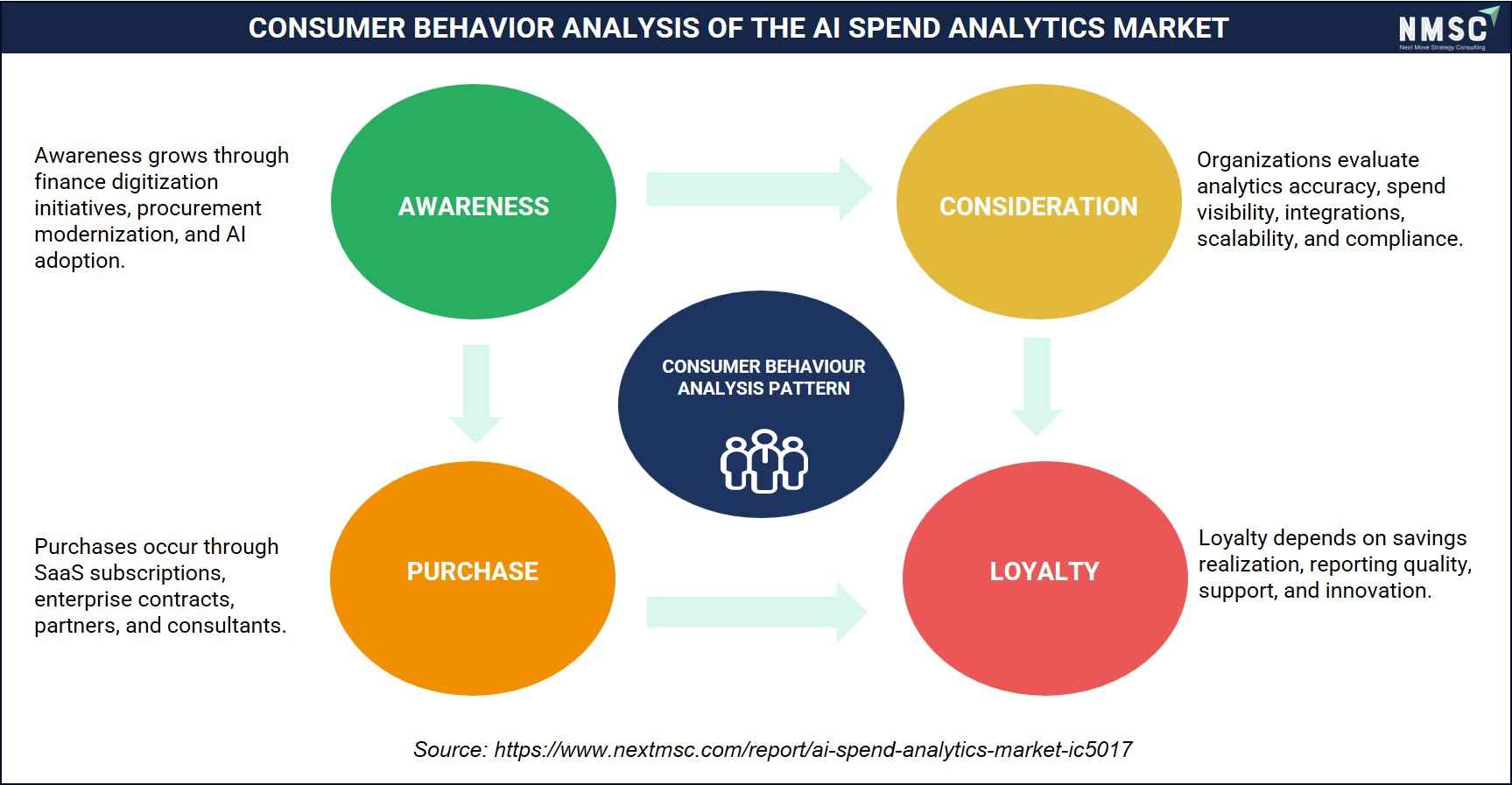
Consumer Behavior Analysis of the AI Spend Analytics Market examines how organizations are adopting AI-powered solutions to improve spending visibility, optimize procurement decisions, and reduce operational costs. Businesses are increasingly prioritizing platforms that provide real-time insights, automate spend classification, and identify savings opportunities. Demand is also being driven by the need for enhanced supplier management, compliance monitoring, and data-driven financial planning, reflecting a broader shift toward intelligent and automated enterprise spend management.
What Are the Key Market Drivers, Breakthroughs, and Investment Opportunities That Will Shape the AI Spend Analytics Market in the Next Decade?
The AI Spend Analytics Market is positioned for sustained multi-year expansion driven by convergent forces including procurement digitization, regulatory transparency mandates, AI platform commoditization, and the rising strategic importance of supply chain resilience. The following growth catalyst and risk assessment matrix quantifies the directional impact of primary drivers and restraints on the overall market CAGR forecast through 2035.
|
Drivers / Trends / Restraints |
(+/-) % Impact on CAGR Forecast |
Geographic Relevance |
Impact Timeline |
|
Rapid AI and ML Adoption in Procurement |
+2.6% |
Global (led by North America, Europe) |
2025–2030 |
|
ERP-Embedded Analytics Expansion |
+1.8% |
North America, Europe, Asia-Pacific |
2025–2028 |
|
Tail Spend Optimization Demand |
+1.5% |
Global (all regions) |
2026–2035 |
|
ESG and Supplier Transparency Mandates |
+1.2% |
Europe, North America, Asia-Pacific |
2026–2035 |
|
Cloud Marketplace Distribution Growth |
+1.0% |
North America, Europe |
2025–2032 |
|
GenAI-Powered Savings Identification |
+2.2% |
Global |
2026–2035 |
|
Supplier Intelligence Feed Monetization |
+1.1% |
North America, Europe |
2025–2032 |
|
Data Privacy and Sovereignty Regulations |
-1.1% |
Europe, APAC, North America |
Ongoing |
|
Legacy ERP Integration Complexity |
-0.9% |
Large Enterprise globally |
2025–2028 |
|
Talent Gap in AI Procurement Analytics |
-0.6% |
All regions |
Ongoing |
What Are the Growth Drivers of the AI Spend Analytics Market?
How Is Enterprise Procurement Digitization Driving AI Spend Analytics Market Growth?
Enterprise procurement digitization is the foundational driver of the AI Spend Analytics Market's sustained expansion. As organizations migrate from fragmented, spreadsheet-based spend management to integrated source-to-pay platforms, demand for embedded AI analytics capabilities is accelerating. The U.S. Government Accountability Office has documented the federal government's ongoing procurement modernization initiatives under the Procurement Innovation Lab, which are generating public sector demand for advanced spend data capabilities. NMSC's analysis indicates that enterprises completing end-to-end procurement digitization programs allocate a significantly higher proportion of technology budgets to AI spend analytics as a natural extension of their data-driven procurement strategies.
How Is the Rising Demand for Tail Spend Management Fueling AI Spend Analytics Market Expansion?
Tail spend, defined as the long tail of low-value, high-volume transactions that typically represent a small proportion of enterprise spend but an outsized proportion of purchase orders, is a primary growth driver of the AI Spend Analytics Market. Historically unmanaged due to the manual effort required, tail spend has become an AI-priority use case as automated classification and savings opportunity detection algorithms can process millions of line items without human intervention. The U.S. Office of Management and Budget's annual procurement scorecard methodology explicitly targets tail spend rationalization as a key metric for agency procurement performance, creating public sector demand that mirrors private sector adoption across the AI Spend Analytics Market globally.
How Are ESG Disclosure Requirements Driving Investment in the AI Spend Analytics Market?
ESG and sustainability disclosure obligations are increasingly compelling enterprises to invest in AI spend analytics platforms that can classify and report on supply chain expenditure by carbon intensity, supplier diversity status, and human rights compliance indicators. The European Union's Corporate Sustainability Reporting Directive, which came into force for large enterprises in 2024, mandates detailed supply chain spend disclosures that require AI classification capabilities to process at scale. The U.S. Securities and Exchange Commission's climate disclosure rules similarly require publicly traded companies to report Scope 3 supply chain emissions, creating a direct linkage between AI spend analytics investment and regulatory compliance across North America and Europe within this market.
What Are the Growth Inhibitors of the AI Spend Analytics Market?
How Does Legacy ERP Integration Complexity Constrain AI Spend Analytics Market Penetration?
Legacy ERP architectures represent one of the most significant structural constraints on AI Spend Analytics Market adoption across large enterprise buyers. Organizations operating heterogeneous ERP environments, combining SAP R/3, Oracle E-Business Suite, and multiple ERP instances acquired through mergers, face substantial data extraction, normalization, and integration challenges before AI analytics can be effectively deployed. The U.S. Government Accountability Office has documented analogous integration challenges in federal agency financial systems modernization, noting that data fragmentation and system interoperability gaps are the primary drivers of cost overruns and timeline extensions. These integration barriers extend procurement analytics implementation cycles from months to years, increasing total cost of ownership and dampening near-term AI Spend Analytics Market growth.
How Do Data Privacy and Cross-Border Data Sovereignty Requirements Limit AI Spend Analytics Market Expansion?
Data privacy regulations are creating structural complexity for AI Spend Analytics Market vendors serving multinational enterprise clients. Supplier master data, accounts payable records, and purchase order histories constitute personally identifiable and commercially sensitive information subject to GDPR in Europe, the Personal Information Protection and Electronic Documents Act in Canada, and equivalent frameworks across Asia-Pacific. The EU AI Act, which entered into force in 2024, introduces additional transparency and explainability requirements for AI systems used in business decision-making processes, imposing compliance obligations on AI spend analytics vendors serving European clients and extending platform certification timelines across regulated-market enterprise buyers.
What Are the Growth Opportunities in the AI Spend Analytics Market?
How Does Generative AI Create New Savings Identification Opportunities in the AI Spend Analytics Market?
Generative AI is unlocking a new category of autonomous savings identification within the AI Spend Analytics Market that goes beyond historical spend analysis into predictive and prescriptive procurement intelligence. LLM-powered platforms can now analyze spend patterns, supplier pricing trends, and market benchmarks simultaneously to generate specific negotiation recommendations, contract optimization suggestions, and demand aggregation opportunities without human analyst involvement. The U.S. National Institute of Standards and Technology AI Risk Management Framework provides a governance structure that enterprises are adopting to safely deploy generative AI in high-stakes procurement decision contexts, creating a credible framework for scaling AI spend analytics investment across regulated industries and government procurement organizations.
How Is Public Sector Procurement Transparency Creating a Structural Opportunity in the AI Spend Analytics Market?
Government procurement modernization programs across North America, Europe, and Asia-Pacific represent a significant and underserved growth opportunity within the AI Spend Analytics Market. The U.S. DATA Act of 2014 mandated electronic reporting of federal spending data through USASpending.gov, creating structured spend data that AI analytics platforms can be applied to optimize agency procurement performance. The EU's Open Data Directive requires member states to publish procurement data in machine-readable formats, enabling AI-powered benchmarking and savings detection applications. Our analysis shows that public sector AI spend analytics adoption is still at an early stage relative to private sector deployment, representing a multi-billion-dollar addressable market opportunity across the forecast period.
How Does Mid-Market Expansion Present a High-Growth Opportunity for the AI Spend Analytics Market?
The mid-market segment represents a strategically significant white-space opportunity within the AI Spend Analytics Market as cloud-native SaaS deployment models reduce the cost and complexity barriers that previously restricted advanced procurement analytics to large enterprise buyers. Organizations with annual revenues between USD 100 million and USD 1 billion historically lacked the internal data engineering resources required to implement and maintain standalone spend analytics solutions. NMSC's analysis indicates that SaaS-native platforms including SpendHQ, Simfoni, and Procure Ai are specifically targeting this underserved segment with simplified onboarding, pre-built taxonomy libraries, and subscription pricing structures aligned with mid-market procurement budgets and organizational maturity levels.
STRATEGIC FRAMEWORK OF THE AI SPEND ANALYTICS MARKET
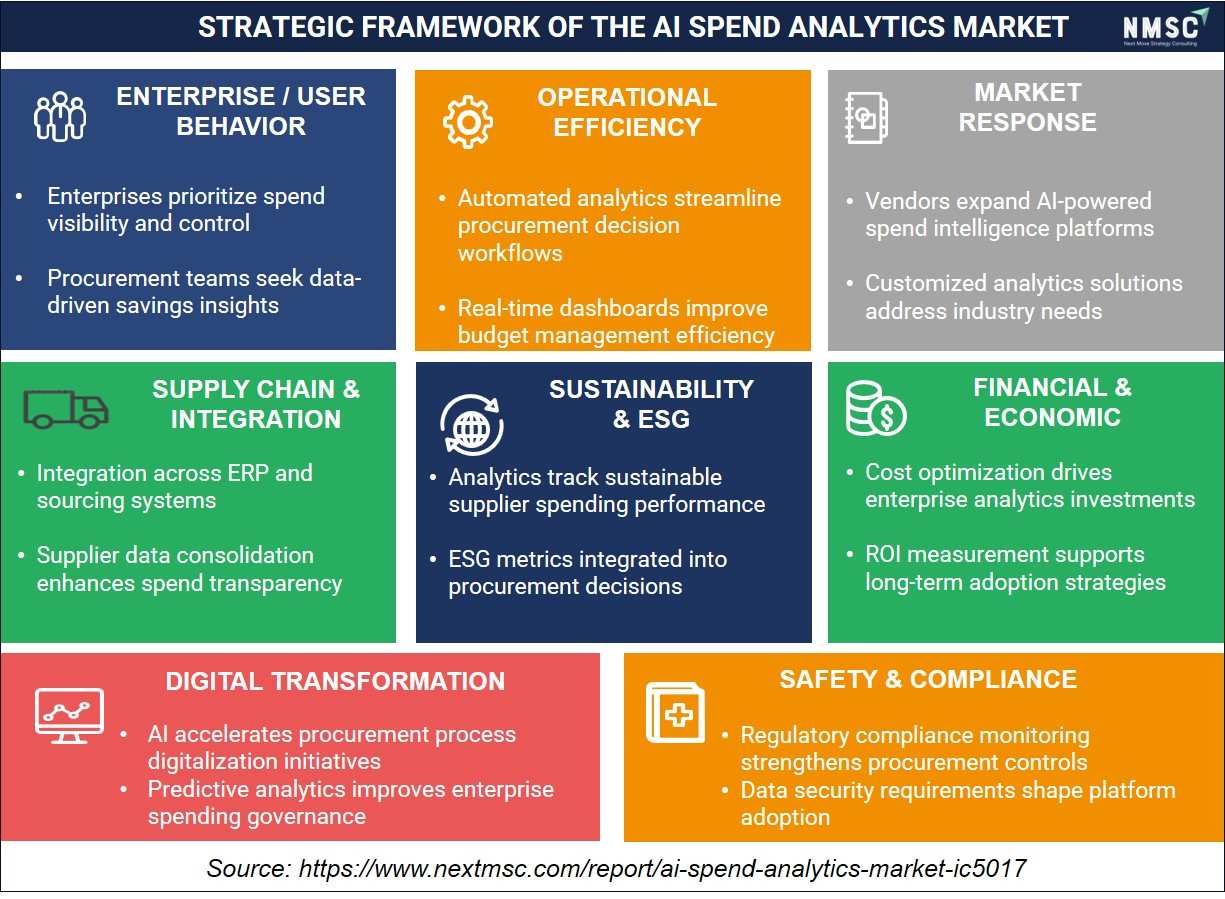
The Strategic Framework of the AI Spend Analytics Market illustrates the key factors shaping market growth and adoption across enterprises. Organizations are increasingly leveraging AI-driven spend analytics to enhance procurement efficiency, improve spending visibility, and support data-driven decision-making. Integration with ERP and supply chain systems, growing emphasis on ESG and regulatory compliance, and the need for cost optimization are accelerating market expansion. In response, vendors are developing advanced AI-powered analytics platforms tailored to evolving enterprise and industry requirements.
How Is the AI Spend Analytics Market Segmented in This Report, and What Are the Key Insights from the Segmentation Analysis?
By Offering Type
How Does Offering Type Segmentation Reveal the Structural Composition of the AI Spend Analytics Market?
|
Offering Type Segment |
2025 (USD Bn) |
2035 (USD Bn) |
CAGR (%) |
|
Software (Total) |
2.1 |
12.2 |
19.3% |
|
Standalone Spend Analytics |
0.8 |
4.1 |
17.8% |
|
Suite Embedded Analytics |
0.6 |
4.2 |
21.4% |
|
Services (Total) |
0.7 |
3.8 |
18.5% |
|
Implementation Services |
0.3 |
1.5 |
17.4% |
|
Managed Analytics |
0.2 |
1.4 |
21.5% |
|
Advisory Services |
0.2 |
0.9 |
16.2% |
|
Data and Content (Total) |
0.4 |
2.6 |
20.6% |
|
Supplier Intelligence Feeds |
0.2 |
1.4 |
21.5% |
|
Benchmark Data |
0.1 |
0.7 |
21.4% |
|
Taxonomy Data |
0.1 |
0.5 |
17.5% |
Based on our analysis of enterprise procurement technology investment patterns, the AI Spend Analytics Market is segmented by offering type into Software, Services, and Data and Content. The Software segment dominates at USD 2.1 billion in 2025, encompassing standalone spend analytics platforms that provide spend visibility, category analytics, supplier analytics, savings opportunity detection, and benchmarking capabilities, alongside suite-embedded analytics including source-to-pay analytics, ERP analytics, and accounts payable analytics integrated within broader procurement platforms. The Services segment, comprising implementation, managed analytics, and advisory services, supports enterprises requiring expert-led deployment. The Data and Content segment, covering supplier intelligence feeds, benchmark data, and taxonomy data, is growing rapidly at a CAGR of 20.6% as organizations seek enriched external data to improve classification accuracy and supplier risk scoring.
By Deployment Model
How Does Deployment Model Selection Shape Revenue Distribution Across the AI Spend Analytics Market?
|
Deployment Model |
2025 (USD Bn) |
2035 (USD Bn) |
CAGR (%) |
|
SaaS |
1.9 |
10.6 |
18.8% |
|
Private Cloud |
0.6 |
3.1 |
17.9% |
|
Hybrid Cloud |
0.5 |
3.4 |
22.1% |
|
On Premises |
0.2 |
1.5 |
22.3% |
From our assessment of enterprise cloud adoption and procurement infrastructure modernization strategies, the AI Spend Analytics Market is segmented by deployment model into SaaS, Private Cloud, Hybrid Cloud, and On Premises configurations. The SaaS segment commands the largest share at USD 1.9 billion in 2025, driven by its rapid deployment capability, automatic platform updates, and subscription-based pricing that aligns with enterprise procurement budget cycles. Private Cloud deployments remain significant among financial services and regulated enterprises requiring enhanced data control and governance. Hybrid Cloud is the fastest-growing deployment mode at a CAGR of 22.1%, enabling organizations to maintain sensitive spend data on-premises while leveraging cloud-native AI analytics processing. On Premises configurations retain relevance among government agencies and defense contractors with strict data sovereignty requirements.
By Buyer Function
Which Buyer Functions Are Driving Purchasing Decisions Across the AI Spend Analytics Market?
|
Buyer Function |
2025 (USD Bn) |
2035 (USD Bn) |
CAGR (%) |
|
Procurement |
1.4 |
7.7 |
18.6% |
|
Finance |
0.8 |
4.8 |
20.8% |
|
Supply Chain |
0.5 |
3.1 |
20.2% |
|
IT |
0.3 |
1.7 |
19.0% |
|
Shared Services |
0.2 |
1.3 |
20.8% |
Through our market evaluation, we observed that the AI Spend Analytics Market is segmented by buyer function into Procurement, Finance, Supply Chain, IT, and Shared Services. The Procurement function leads all buyer segments at USD 1.4 billion in 2025 given its primary mandate for spend visibility, supplier management, and savings delivery across the enterprise. The Finance function is the fastest-growing buyer at a CAGR of 20.8%, as chief financial officers deploy AI spend analytics for working capital optimization, budget variance analysis, and audit-ready expenditure reporting. Supply Chain functions are adopting spend analytics to understand direct spend concentration risk, while IT and Shared Services functions increasingly deploy spend analytics to manage decentralized technology and facilities expenditure across complex global organizational structures.
By Industry Vertical
Which Industry Verticals Generate the Most Value in the AI Spend Analytics Market?
|
Industry Vertical |
2025 (USD Bn) |
2035 (USD Bn) |
CAGR (%) |
|
Manufacturing |
0.6 |
3.4 |
19.1% |
|
Financial Services |
0.6 |
3.4 |
19.1% |
|
Healthcare and Life Sciences |
0.4 |
2.7 |
22.6% |
|
Retail and CPG |
0.4 |
2.3 |
19.3% |
|
Public Sector |
0.3 |
1.9 |
20.3% |
|
Energy and Utilities |
0.3 |
1.7 |
19.0% |
|
Technology and Telecom |
0.3 |
1.8 |
20.0% |
|
Professional Services |
0.2 |
1.0 |
17.5% |
|
Other Industries |
0.1 |
0.4 |
14.9% |
Based on our analysis of procurement technology investment patterns across enterprise verticals, the AI Spend Analytics Market is segmented into Manufacturing, Financial Services, Healthcare and Life Sciences, Retail and CPG, Public Sector, Energy and Utilities, Technology and Telecom, Professional Services, and Other Industries. Manufacturing and Financial Services jointly lead at USD 0.6 billion each in 2025, driven by complex direct material spend management needs and regulatory spend transparency requirements respectively. Healthcare and Life Sciences is the fastest-growing vertical at a CAGR of 22.6%, propelled by pharmaceutical procurement compliance, group purchasing organization analytics, and hospital supply chain cost reduction mandates. The Public Sector segment is growing steadily as government procurement modernization programs drive investment in AI-powered spend classification and reporting capabilities.
By Enterprise Size
How Does Enterprise Size Influence Adoption Patterns in the AI Spend Analytics Market?
|
Enterprise Size |
2025 (USD Bn) |
2035 (USD Bn) |
CAGR (%) |
|
Large Enterprise |
1.8 |
9.6 |
18.3% |
|
Mid Market |
1.1 |
7.1 |
21.5% |
|
Small Business |
0.3 |
1.9 |
20.3% |
Our assessment indicates that the AI Spend Analytics Market is segmented by enterprise size into Large Enterprise, Mid Market, and Small Business categories. Large Enterprises account for USD 1.8 billion in 2025 and continue to dominate, given their scale of procurement expenditure, complexity of multi-entity spend consolidation requirements, and established procurement analytics budgets. The Mid Market segment is the fastest-growing at a CAGR of 21.5%, as SaaS-native platforms with pre-built connectors, self-service dashboards, and simplified implementation methodologies make sophisticated AI spend analytics accessible to organizations with smaller procurement teams. Small Business adoption is emerging, supported by consumption-based pricing models and marketplace-distributed microservices that enable starter-level spend visibility without enterprise-scale investment.
By Spend Scope
How Does Spend Scope Segmentation Highlight Prioritization Within the AI Spend Analytics Market?
|
Spend Scope |
2025 (USD Bn) |
2035 (USD Bn) |
CAGR (%) |
|
Direct Spend |
1.1 |
6.0 |
18.5% |
|
Indirect Spend |
1.6 |
8.8 |
18.6% |
|
Tail Spend |
0.5 |
3.8 |
23.2% |
Based on NMSC's research, the AI Spend Analytics Market is segmented by spend scope into Direct Spend, Indirect Spend, and Tail Spend. The Indirect Spend segment leads at USD 1.6 billion in 2025, reflecting long-standing enterprise prioritization of marketing, professional services, facilities, and IT indirect categories as primary AI analytics targets due to their high fragmentation and savings potential. Direct Spend analytics, applied to raw materials, components, and contract manufacturing expenditure, is significant at USD 1.1 billion, particularly within manufacturing and life sciences verticals requiring detailed bill-of-materials spend intelligence. The Tail Spend segment is the fastest-growing at a CAGR of 23.2%, as AI-enabled automation makes it commercially viable to analyze and optimize historically ignored low-value purchase transactions at enterprise scale.
By Sales Channel
How Are Sales Channels Reshaping Go-to-Market Strategies in the AI Spend Analytics Market?
|
Sales Channel |
2025 (USD Bn) |
2035 (USD Bn) |
CAGR (%) |
|
Direct Sales |
1.7 |
8.9 |
18.0% |
|
Channel Partners |
1.1 |
6.3 |
19.2% |
|
Cloud Marketplaces |
0.4 |
3.4 |
24.5% |
Our analysis shows that the AI Spend Analytics Market is segmented by sales channel into Direct Sales, Channel Partners, and Cloud Marketplaces. Direct Sales leads at USD 1.7 billion in 2025, reflecting the enterprise preference for strategic account management, customized implementation support, and long-term vendor relationships when deploying AI spend analytics across complex, multi-entity procurement environments. Channel Partners, including systems integrators such as Accenture, Deloitte, and Capgemini, account for USD 1.1 billion, as these firms embed AI spend analytics capabilities within broader procurement transformation engagements. Cloud Marketplaces are the fastest-growing channel at a CAGR of 24.5%, as enterprise procurement buyers leverage committed cloud spend credits and simplified procurement workflows on AWS, Azure, and Google Cloud platforms.
Regional Outlook
Geographic Performance Snapshot
|
Region |
2025 (USD Bn) |
2035 (USD Bn) |
CAGR (%) |
Key Driver |
|
North America |
1.5 |
8.4 |
19.5% |
Vendor HQ, enterprise tech budgets, FAR compliance |
|
Europe |
0.8 |
4.3 |
18.2% |
CSRD compliance, ERP analytics adoption |
|
Asia-Pacific |
0.6 |
4.0 |
22.4% |
Manufacturing digitization, GCC expansion |
|
Middle East & Africa |
0.2 |
1.2 |
20.5% |
Vision 2030, procurement reform |
|
Latin America |
0.1 |
0.7 |
21.7% |
Nearshoring, procurement transparency |
North America AI Spend Analytics Market
North America is the global epicenter of the AI Spend Analytics Market, accounting for USD 1.5 billion in 2025 and forecast to reach USD 8.4 billion by 2035 at a CAGR of 19.5%. The region benefits from the headquarters of all leading AI spend analytics platform vendors including Coupa, GEP, JAGGAER, SpendHQ, Zycus, and Corcentric. Strong enterprise procurement technology budgets, mature source-to-pay adoption, and the world's deepest talent pool in procurement analytics underpin sustained market leadership. Regulatory maturity through the Federal Acquisition Regulation, the Foreign Corrupt Practices Act, and SEC climate disclosure rules is compelling enterprises to invest in AI-powered spendtransparency and supplier diversity analytics throughout the forecast period.
U.S. AI Spend Analytics Market
Based on our engagements with enterprise procurement organizations, the United States represents over 74% of the North American AI Spend Analytics Market and is the world's single largest national market. The U.S. benefits from the highest concentration of Fortune 500 enterprise procurement technology buyers, the headquarters of all major AI spend analytics platform vendors, and a mature venture capital ecosystem funding next-generation procurement AI startups. The U.S. Federal Acquisition Regulation modernization initiatives, overseen by the Office of Federal Procurement Policy, are generating public sector demand for cloud-delivered spend analytics capabilities. The U.S. DATA Act mandating electronic federal spending data on USASpending.gov further institutionalizes AI spend analytics investment across government agencies and reinforces procurement data transparency standards.
Canada AI Spend Analytics Market
Through our analysis, Canada represents approximately 18% of North American AI Spend Analytics Market revenue in 2025. Canadian financial institutions, mining corporations, and retail enterprises are significant enterprise AI spend analytics buyers, investing in cloud-native platforms for indirect spend management and supplier performance analytics. The federal government's Directive on the Management of Procurement under the Treasury Board of Canada Secretariat drives public sector spend data transparency requirements. Canadian data sovereignty concerns regarding cross-border data flows to U.S.-hosted platforms are driving adoption of Canadian cloud regions, available through AWS Canada and Azure Canada, for enterprise spend data processing within the AI Spend Analytics Market.
Mexico AI Spend Analytics Market
From our assessment, Mexico is a rapidly growing market within North America in the AI Spend Analytics Market, supported by the nearshoring wave driven by North American supply chain diversification from Asia. Mexican manufacturing enterprises are investing in direct spend analytics to manage increasingly complex supplier networks as multinational corporations expand production facilities in Nuevo Leon, Jalisco, and Baja California. The government's CompraNet public procurement portal represents an important structured spend data asset. Regulatory developments under the Ley Federal de Proteccion de Datos Personales are compelling enterprises to invest in compliant spend data governance solutions aligned with evolving data protection requirements.
Europe AI Spend Analytics Market
Europe is the second-largest region in the AI Spend Analytics Market, contributing USD 0.8 billion in 2025 and forecast to reach USD 4.3 billion by 2035 at a CAGR of 18.2%. Europe's regulatory environment, dominated by GDPR, the Corporate Sustainability Reporting Directive, the EU AI Act, and national supplier diversity requirements, is simultaneously a growth driver and an operational complexity factor for AI spend analytics vendors. The CSRD obligation on large EU enterprises to report detailed supply chain spend information aligned with ESG taxonomies is the single most significant demand catalyst specific to the European AI Spend Analytics Market throughout the forecast period.
UK AI Spend Analytics Market
According to our evaluation, the United Kingdom is Europe's largest individual country market for AI Spend Analytics, representing approximately 24% of European revenue in 2025. Post-Brexit, the UK maintains data governance standards through UK GDPR while implementing Procurement Act 2023 reforms that introduce new supplier diversity and spend transparency requirements for public sector procurement. The Financial Conduct Authority's supplier risk management guidelines for regulated financial institutions drive AI spend analytics adoption within the UK banking and insurance sector. London's concentration of global procurement shared service centers creates additional enterprise demand for AI spend analytics platforms across the forecast period.
Germany AI Spend Analytics Market
Based on our market evaluation, Germany is the second-largest European market for AI Spend Analytics, driven by its world-class manufacturing sector's complex direct material spend management requirements and stringent supplier compliance obligations under the Lieferkettensorgfaltspflichtengesetz, Germany's Supply Chain Due Diligence Act. German enterprises including automotive OEMs, chemical manufacturers, and mechanical engineering firms operate extensive multi-tier supplier networks requiring AI-powered spend classification and supplier analytics capabilities. The Federal Office for Information Security cloud security guidelines shape platform certification requirements for enterprise procurement technology deployments in Germany's compliance-conscious market environment.
France AI Spend Analytics Market
Through our analysis, France is the third-largest European AI Spend Analytics market, characterized by significant public sector digital transformation investment under the France Relance and France 2030 programs. French enterprises across aerospace, luxury goods, energy, and financial services are significant AI spend analytics buyers. The Devoir de Vigilance law, France's Duty of Vigilance Act, requires large French companies to assess and report on supplier human rights and environmental risks, creating a direct regulatory mandate for AI-powered supply chain spend analysis. The Direction des affaires juridiques provides public procurement compliance frameworks that are driving government AI spend analytics investment across French public sector entities.
Italy AI Spend Analytics Market
Based on our research, Italy is a growing European market for AI Spend Analytics, with adoption concentrated in manufacturing, automotive supply chain, and public administration sectors. The Italian government's PNRR digital transformation investments are driving procurement modernization programs that include AI spend analytics deployments across major public sector entities. Italian enterprises participating in global automotive and industrial supply chains are investing in direct spend analytics to manage increasing supplier complexity. The Garante data protection authority's active GDPR enforcement is compelling organizations to deploy GDPR-compliant AI spend analytics architectures with appropriate data governance controls and audit trail capabilities.
Spain AI Spend Analytics Market
From our assessment, Spain demonstrates growing momentum in the AI Spend Analytics Market, driven by a dynamic financial sector, expanding retail and CPG industries, and public sector digital transformation under the Agenda Espana Digital 2026. Spanish banks and insurance companies are significant buyers of AI spend analytics for indirect procurement management and supplier due diligence. The Agencia Espanola de Proteccion de Datos actively enforces GDPR, compelling enterprises to invest in privacy-engineering capabilities within spend analytics platforms. Spain's cloud market is growing steadily, with AWS, Google Cloud, and Azure operating local regions that support enterprise spend data residency requirements across the Spanish market.
Sweden AI Spend Analytics Market
Our findings suggest Sweden maintains a high-per-capita AI Spend Analytics adoption rate, supported by a highly digitized enterprise base, advanced telecommunications infrastructure, and a government committed to public sector procurement transparency. Swedish enterprises in automotive, financial services, and retail sectors are early adopters of AI-powered spend analytics platforms. Sweden's Kammarkollegiet framework agreements for public sector procurement technology create structured government AI spend analytics demand. Nordic sustainability leadership is also driving enterprise investment in supplier spend analytics for ESG performance monitoring and reporting aligned with Sweden's climate commitments.
Denmark AI Spend Analytics Market
Through our analysis, Denmark is among the most advanced digital economies in Europe for AI Spend Analytics adoption, consistently ranking at the top of the EU's Digital Economy and Society Index. Danish enterprises across pharmaceuticals, shipping, and financial services are significant AI spend analytics buyers with complex global supplier networks. Denmark's public procurement platform, SKI, drives structured government procurement spend data capabilities that support AI analytics deployments. High enterprise data literacy and digital procurement maturity make Denmark an early-adoption market for advanced AI spend analytics innovations within the broader European market throughout the forecast period.
Finland AI Spend Analytics Market
Our assessment indicates Finland's AI Spend Analytics Market is characterized by high cloud adoption, strong public sector digital innovation initiatives, and advanced manufacturing sector analytics requirements. Nokia's global supply chain operations create significant enterprise demand for direct material spend analytics and supplier intelligence capabilities. The Finnish government's Hansel central purchasing body drives public sector procurement data standards that support AI spend analytics deployments across government entities. Finland's open data initiatives and public procurement transparency framework provide a favorable policy environment for AI spend analytics investment and innovation across the Nordic region.
Netherlands AI Spend Analytics Market
Based on our market evaluation, the Netherlands is a critical hub for the European AI Spend Analytics Market, hosting European headquarters of multiple global AI spend analytics vendors and benefiting from excellent cloud infrastructure at Amsterdam's hyperscale data center campus. Dutch enterprises in financial services, logistics, and petrochemicals are significant AI spend analytics buyers, particularly for indirect procurement and supplier risk analytics. The Netherlands Enterprise Agency and Pianoo procurement expertise center provide structured government guidance on procurement technology, driving public sector AI spend analytics adoption. Philips, ING, and Shell represent anchor enterprise buyers shaping the Dutch AI spend analytics market landscape.
Rest of Europe AI Spend Analytics Market
From our assessment, the Rest of Europe, comprising Poland, Belgium, Switzerland, Austria, Portugal, Czech Republic, and other nations, represents a growing and commercially significant portion of the European AI Spend Analytics Market. Poland and Czech Republic are emerging as adoption leaders in Central and Eastern Europe, driven by shared service center expansions and nearshoring of procurement analytics functions from Western Europe. Switzerland, hosting major pharmaceutical and financial services headquarters, is a significant buyer of AI spend analytics for complex indirect and direct spend management. Belgium, as home to EU institutions, is an important demand center for public sector procurement analytics applications aligned with EU regulatory requirements.
Asia-Pacific AI Spend Analytics Market
Asia-Pacific is the fastest-growing major region in the AI Spend Analytics Market, advancing from USD 0.6 billion in 2025 to an estimated USD 4.0 billion by 2035 at a CAGR of 22.4%. The region's growth is propelled by rapid manufacturing sector digitization in China and India, expansion of global capability centers in India, South Korea, and the Philippines, and government procurement modernization programs across Southeast Asia. NMSC's analysis indicates that multinational corporations expanding Asia-Pacific shared service centers are generating strong demand for AI spend analytics platforms capable of consolidating spend data across complex multi-country, multi-currency procurement environments throughout the region.
China AI Spend Analytics Market
Through our analysis, China is the largest single market in Asia-Pacific for AI Spend Analytics, driven by its massive manufacturing economy, state-driven industrial procurement modernization programs, and the digital transformation ambitions of Chinese enterprises across manufacturing, energy, and financial services. China's government procurement law reforms and the State-owned Assets Supervision and Administration Commission guidelines for procurement governance at state-owned enterprises are creating structured demand for AI-powered spend classification and audit capabilities. Domestic AI platform vendors are developing procurement analytics capabilities, creating a competitive dynamic between local and international AI spend analytics providers in this high-growth market.
India AI Spend Analytics Market
Based on our research, India is the fastest-growing national market within Asia-Pacific for AI Spend Analytics, advancing at a CAGR of 25.5% from 2026 to 2035. India's Government e-Marketplace, overseen by the Ministry of Commerce and Industry, has processed substantial public procurement transaction volumes, creating a massive structured spend data environment that AI analytics platforms are increasingly applied to optimize. The rapid expansion of global capability centers across Bengaluru, Hyderabad, and Pune is generating enterprise demand for centralized AI spend analytics platforms serving multinational procurement organizations. India's growing manufacturing sector under the Production Linked Incentive scheme is also driving significant direct spend analytics investment.
Japan AI Spend Analytics Market
From our assessment, Japan is the second-largest Asia-Pacific market for AI Spend Analytics, supported by mature manufacturing, automotive, and electronics sectors with complex global supply chain spend management requirements. Japanese enterprises including Toyota, Honda, Hitachi, and Fujitsu are significant AI spend analytics buyers, particularly for direct material spend optimization and supplier performance analytics across multi-tier automotive supply chains. The Digital Agency's procurement digitization initiatives under Japan's Digital Government Action Plan are creating early public sector demand for AI-powered spend classification and reporting capabilities aligned with central government procurement transparency objectives.
South Korea AI Spend Analytics Market
Our findings suggest South Korea demonstrates high AI Spend Analytics maturity, supported by one of the world's highest broadband penetration rates, an advanced semiconductor and electronics manufacturing sector, and a proactive AI investment policy environment under the National AI Strategy. South Korean conglomerates including Samsung, LG, SK, and Hyundai are enterprise AI spend analytics buyers with complex global direct spend portfolios. The Public Procurement Service, Korea's central procurement authority, operates the KONEPS e-procurement system that provides structured government spend data supporting AI analytics deployments across public sector entities in the country.
Taiwan AI Spend Analytics Market
Taiwan's AI Spend Analytics Market is concentrated in semiconductor manufacturing, electronics supply chain management, and financial services procurement analytics. TSMC, Foxconn, MediaTek, and ASE Technology represent enterprise-class AI spend analytics buyers with extremely complex direct spend portfolios spanning advanced materials, equipment, and contract manufacturing. Taiwan's Government Procurement Act and the Government e-Procurement System provide the regulatory and data infrastructure for public sector AI spend analytics adoption. The Ministry of Economic Affairs' industrial digitization programs are supporting technology sector procurement analytics investments across Taiwan's dense electronics manufacturing ecosystem.
Indonesia AI Spend Analytics Market
Based on our analysis, Indonesia is among the most rapidly growing AI Spend Analytics markets in Southeast Asia, driven by its large digital economy, a rapidly expanding manufacturing sector under the Making Indonesia 4.0 program, and government procurement modernization through the Layanan Pengadaan Secara Elektronik e-procurement platform. Indonesian state-owned enterprises under the Ministry of SOEs are implementing AI spend analytics to improve procurement governance, supplier management, and cost optimization. Gojek, Bank Central Asia, and Telkom Indonesia represent leading private sector enterprise AI spend analytics buyers with substantial indirect procurement analytics requirements.
Vietnam AI Spend Analytics Market
Through our evaluation, Vietnam is an emerging high-growth market for AI Spend Analytics in Southeast Asia, supported by the rapid expansion of manufacturing operations driven by China-plus-one supply chain diversification strategies adopted by multinational corporations. International manufacturing companies establishing Vietnamese production facilities are deploying AI spend analytics to manage complex supplier networks and direct material procurement across the country's growing industrial zones. The Vietnam National E-Procurement System and the government's National Digital Transformation Program are creating public sector demand for procurement analytics capabilities across Vietnamese government entities.
Australia AI Spend Analytics Market
Our assessment indicates Australia is the most mature AI Spend Analytics market in Asia-Pacific outside Northeast Asia, with strong adoption across financial services, mining, government, and healthcare sectors. The Australian Government's Digital Sourcing Policy and the AusTender federal procurement data portal support public sector spend analytics deployments. Modern slavery reporting requirements under the Modern Slavery Act 2018 are compelling Australian enterprises to invest in AI-powered supplier spend analytics for supply chain due diligence documentation. Major mining companies including BHP and Rio Tinto represent significant enterprise buyers of direct spend analytics for complex global procurement networks requiring detailed expenditure intelligence.
Philippines AI Spend Analytics Market
Based on our market evaluation, the Philippines is a developing but rapidly growing AI Spend Analytics market, supported by its large business process outsourcing industry, which hosts procurement analytics shared service centers for multinational corporations. The Philippine Government Electronic Procurement System provides structured government procurement spend data supporting public sector analytics initiatives. Philippine banks including BDO, BPI, and UnionBank are increasing AI spend analytics investments for accounts payable analytics and indirect procurement management. The country's growing manufacturing sector in automotive components and electronics assembly is also generating direct spend analytics demand across the Philippine market.
Malaysia AI Spend Analytics Market
From our research, Malaysia is a mid-tier and growing AI Spend Analytics market in Southeast Asia, characterized by government-led digital transformation under the MyDigital strategy, a maturing financial sector, and Kuala Lumpur's emergence as a regional technology hub. The MyProcurement national e-procurement system provides structured government spend data that AI analytics platforms can be applied to optimize. Major enterprises including Petronas, Maybank, and Sime Darby are significant enterprise AI spend analytics buyers for complex supply chain and indirect procurement management across Malaysia's resource-rich and industrially diversified economy.
Rest of Asia-Pacific AI Spend Analytics Market
The Rest of Asia-Pacific, comprising Thailand, Singapore, Bangladesh, Sri Lanka, New Zealand, and smaller markets, collectively represents a growing share of the regional AI Spend Analytics Market. Singapore is a disproportionately important hub, hosting regional headquarters of multiple AI spend analytics vendors and benefiting from the Monetary Authority of Singapore's procurement governance guidelines for financial institutions and the GeBIZ e-procurement platform. Thailand's Board of Investment incentives for digital technology adoption and the National Digital Economy and Society Plan are driving enterprise AI spend analytics investment. New Zealand's cloud market is growing alongside broader Australia-New Zealand digital economy integration and procurement modernization.
Middle East and Africa AI Spend Analytics Market
The Middle East and Africa region is advancing rapidly in the AI Spend Analytics Market, growing from USD 0.2 billion in 2025 to USD 1.2 billion by 2035 at a CAGR of 20.5%. Vision-driven national transformation programs in Saudi Arabia and the UAE are the primary growth engines, with Vision 2030 and UAE National AI Strategy 2031 mandating procurement digitization and spend transparency across government entities and semi-government corporations. Sovereign procurement analytics requirements across the Gulf Cooperation Council are creating durable structural demand for AI spend analytics platforms with in-country data processing and regulatory compliance capabilities.
Saudi Arabia AI Spend Analytics Market
Based on our analysis, Saudi Arabia is the largest AI Spend Analytics market in the Middle East and Africa region, driven by Vision 2030's Procurement Digital Transformation initiatives, NEOM smart city procurement requirements, and ARAMCO's complex direct spend analytics needs across its vast global supply chain. The National Center for Government Procurement, established under the Ministry of Finance, has mandated e-procurement adoption across government entities, creating structured spend data that AI analytics platforms are being deployed to optimize. All major hyperscalers have established Saudi Arabia cloud regions, supporting in-kingdom spend data residency requirements for AI spend analytics platform deployments.
UAE AI Spend Analytics Market
Through our market evaluation, UAE is the second-largest AI Spend Analytics market in MEA, powered by Dubai and Abu Dhabi's ambitions as global AI and digital economy hubs. The UAE National AI Strategy 2031 and the Telecommunications and Digital Government Regulatory Authority digital transformation mandates include procurement digitization objectives that generate public sector AI spend analytics demand. The Abu Dhabi Global Market and Dubai International Financial Centre host significant concentrations of financial services enterprises that are advanced AI spend analytics adopters. Major infrastructure projects across the UAE generate complex procurement spend data requirements for ongoing analytics platform deployment.
Egypt AI Spend Analytics Market
Based on our research, Egypt is an emerging AI Spend Analytics market in Africa and the broader MEA region, supported by a large population base, rapidly growing digital banking sector, and the government's Egypt Vision 2030 digital transformation agenda. The Egyptian government's e-Government and Digital Egypt programs include public procurement modernization initiatives that create demand for AI-powered spend classification and reporting. Egyptian state-owned enterprises across energy, telecoms, and infrastructure sectors are beginning to invest in AI spend analytics as part of broader ERP modernization programs aligned with national digital transformation objectives.
Israel AI Spend Analytics Market
Our assessment indicates Israel occupies a unique position within the AI Spend Analytics Market as both a significant vendor technology origin country and an enterprise buyer. Israel's concentrated technology ecosystem hosts AI startup companies developing specialized procurement analytics capabilities, with several Israeli-founded procurement AI companies having achieved international commercial scale. Enterprise buyers in Israel's defense, technology, pharmaceutical, and financial services sectors are sophisticated AI spend analytics adopters. The Israel Government Procurement Administration, operating under the Ministry of Finance, manages government procurement frameworks that are progressively incorporating digital analytics requirements.
Turkey AI Spend Analytics Market
From our analysis, Turkey is a mid-sized and growing AI Spend Analytics market within the MEA region, characterized by a dynamic financial services sector, a large manufacturing industry, and increasing government focus on procurement transparency under the National Artificial Intelligence Strategy 2021-2025. Turkish enterprises including Koc Holding, Sabanci Group, and major banks such as Garanti BBVA and Is Bankasi are significant AI spend analytics buyers for complex indirect and supplier spend management. The Public Procurement Authority oversees Turkey's government procurement regulations, with ongoing digitization initiatives creating public sector demand for procurement analytics capabilities across Turkish state entities.
Nigeria AI Spend Analytics Market
Through our evaluation, Nigeria is Sub-Saharan Africa's largest and most dynamic AI Spend Analytics market, powered by its 220 million population, a rapidly growing fintech ecosystem, and significant multinational enterprise procurement operations in oil, gas, and telecoms sectors. The Bureau of Public Procurement, established under the Public Procurement Act 2007, mandates government procurement transparency requirements that AI spend analytics platforms are being applied to fulfill. International oil companies operating large Nigerian supply chains are significant direct spend analytics buyers. Nigerian banks are also increasingly investing in accounts payable analytics for payment fraud detection and working capital optimization across their operations.
South Africa AI Spend Analytics Market
Based on our market evaluation, South Africa is the most mature AI Spend Analytics market in Sub-Saharan Africa, driven by Johannesburg's status as the continent's financial capital and a well-established mining, financial services, and retail sector with complex procurement analytics requirements. The National Treasury Central Supplier Database and the Preferential Procurement Policy Framework Act create structured government spend data and supplier diversity reporting requirements that drive AI spend analytics investment. South African enterprises including Standard Bank, FirstRand, Anglo American, and Shoprite are significant AI spend analytics buyers for multi-category indirect spend management and supplier performance analytics.
Rest of MEA AI Spend Analytics Market
The Rest of Middle East and Africa, encompassing Kuwait, Qatar, Bahrain, Oman, Jordan, Morocco, Kenya, Ghana, and Ethiopia, collectively represents a growing segment of the AI Spend Analytics Market. GCC countries outside Saudi Arabia and UAE are investing in national procurement digitization programs modeled on Saudi Vision 2030, with Qatar's post-World Cup legacy procurement systems and Kuwait's national development plan both incorporating spend analytics requirements. Kenya is Africa's fastest-growing procurement technology market, with e-government procurement initiatives through the Public Procurement Regulatory Authority creating structured spend data for analytics deployment across public entities.
Latin America AI Spend Analytics Market
Latin America is a high-growth region in the AI Spend Analytics Market at a CAGR of 21.7% from 2026 to 2035, advancing from USD 0.1 billion in 2025 to USD 0.7 billion by 2035. Brazil and Mexico collectively account for approximately 75% of regional AI Spend Analytics revenue. Growing digital economy activity, multinational corporation shared service center expansion, and evolving procurement transparency legislation across major Latin American economies are the primary growth drivers. Manufacturing, financial services, and retail sectors lead AI spend analytics adoption across the region through the forecast period to 2035.
Brazil AI Spend Analytics Market
Based on our analysis, Brazil is the largest AI Spend Analytics market in Latin America, accounting for approximately 45% of regional revenue in 2025. Brazil's Lei de Responsabilidade Fiscal and the Comprasnet federal procurement portal under the Ministry of Management and Innovation are creating structured public sector spend data that AI analytics platforms are increasingly deployed to optimize. Brazilian enterprises including Petrobras, Itau Unibanco, Vale, and Embraer are significant AI spend analytics buyers with complex multi-tier supplier networks. AWS, Microsoft Azure, and Google Cloud all operate Sao Paulo-based cloud regions, supporting in-country spend data processing for Brazilian enterprise and government buyers.
Argentina AI Spend Analytics Market
Through our evaluation, Argentina is the second-largest AI Spend Analytics market in Latin America, with a strong technology talent ecosystem and a growing concentration of shared service centers hosting procurement analytics functions for multinational corporations. Argentina's Buenos Aires technology district hosts a growing community of AI and procurement analytics startups. The Office of the National Comptroller General oversees federal procurement compliance requirements that are increasingly encompassing digital transparency mandates. Argentine financial institutions and commodity companies are significant AI spend analytics buyers, with adoption resilient to economic volatility given the cost optimization mandate that AI spend analytics directly addresses across enterprise procurement organizations.
Chile AI Spend Analytics Market
Our assessment indicates Chile represents a stable and growing AI Spend Analytics market in Latin America, benefiting from one of the region's strongest economies, highest cloud penetration rates, and a proactive procurement modernization environment. Chile's ChileCompra public procurement platform is among the most advanced e-procurement systems in Latin America, providing structured government spend data that AI analytics can be applied to optimize. The financial sector including Banco de Chile, BancoEstado, and Santander Chile, and the mining sector anchored by Codelco and Antofagasta Minerals, represent primary enterprise AI spend analytics buyers in the Chilean market.
Colombia AI Spend Analytics Market
From our research, Colombia is among the fastest-growing AI Spend Analytics markets in Latin America, supported by Bogota's emergence as a regional technology hub, a dynamic fintech sector, and the government's Colombia Digital policy framework. Colombia's SECOP II public procurement platform, overseen by Colombia Compra Eficiente, provides structured government spend data supporting public sector analytics deployments. Major financial institutions including Bancolombia and Davivienda, telecoms, and the growing manufacturing sector are primary AI spend analytics buyers. AWS and Google Cloud operate Colombian cloud regions, supporting enterprise spend data processing with local residency options for Colombian enterprise buyers.
Rest of Latin America AI Spend Analytics Market
The Rest of Latin America, including Peru, Ecuador, Uruguay, Bolivia, Paraguay, Costa Rica, Panama, and Caribbean nations, represents a smaller but growing component of the AI Spend Analytics Market. Uruguay has a notably advanced e-procurement framework through the SICE national procurement system, supporting government AI spend analytics adoption. Costa Rica serves as a nearshore shared service hub for North American enterprises, generating procurement analytics demand across finance and procurement functions. Peru and Ecuador are experiencing early-stage cloud adoption growth, with mining sector enterprises and government entities beginning to invest in structured spend analytics capabilities aligned with national procurement transparency objectives.
Competitive Landscape
Competitive Dynamics and M&A Landscape
|
Key Takeaways |
Details |
|
Market Structure |
The AI Spend Analytics Market features multi-tiered competition among comprehensive source-to-pay platform vendors (Oracle, SAP, Coupa, GEP, JAGGAER), specialized standalone spend analytics providers (SpendHQ, Sievo, Simfoni, Rosslyn), and AI-native emerging challengers (hunterAI, Procure Ai, Tropic Technologies), each competing on classification accuracy, data richness, ERP integration depth, and AI analytics sophistication. |
|
Innovation Focus |
Innovation in the AI Spend Analytics Market centers on generative AI-powered spend querying, autonomous savings opportunity detection, real-time supplier risk integration, LLM-based invoice and purchase order classification, and prescriptive negotiation intelligence capabilities. Vendors embedding multi-model AI architectures within spend analytics platforms are differentiating on classification accuracy and time-to-insight metrics that directly impact procurement return on investment. |
|
M&A Activity |
The AI Spend Analytics Market is experiencing active consolidation as source-to-pay platform vendors acquire specialized AI and analytics capabilities. McKinsey's procurement analytics practice expansion, Corcentric's platform acquisitions, and private equity interest in specialized spend analytics vendors including Sievo and SpendHQ signal continued market consolidation. Investors are targeting companies combining AI classification accuracy with rich supplier intelligence datasets and strong recurring revenue profiles. |
How Do Companies Compete in the AI Spend Analytics Market?
The AI Spend Analytics Market is characterized by multi-tiered competition across three distinct vendor categories competing on overlapping but differentiated value propositions. Comprehensive source-to-pay platform vendors including Oracle, SAP, Coupa, GEP, and JAGGAER leverage their existing ERP and procurement workflow customer bases to cross-sell embedded AI spend analytics as platform extensions, competing on integration depth, total cost of ownership, and end-to-end procurement workflow coverage. Specialized standalone spend analytics providers including SpendHQ, Sievo, Corcentric, and Rosslyn differentiate on classification accuracy, data science expertise, and implementation speed. AI-native challengers including hunterAI, Procure Ai, and Tropic Technologies compete on next-generation generative AI capabilities, conversational spend querying, and subscription pricing models aligned with mid-market procurement budgets.
Which Kind of Companies Dominate the AI Spend Analytics Market?
Three distinct categories of companies dominate the AI Spend Analytics Market. First, enterprise resource planning and source-to-pay platform leaders including Oracle Corporation, SAP SE, and Coupa Software embed AI spend analytics within comprehensive procurement workflow platforms, leveraging their large installed bases of enterprise ERP customers to drive adoption of integrated spend analytics capabilities. Second, specialized procurement analytics platform providers including GEP, JAGGAER, Ivalua, Zycus, Basware, and Esker offer purpose-built AI analytics solutions that compete on classification accuracy, savings detection algorithms, and supplier intelligence depth. Third, AI-native and emerging category specialists including SpendHQ, Simfoni, Sievo, hunterAI, and Procure Ai are capturing market share through generative AI differentiation and mid-market focused SaaS pricing strategies.
AI-Native Differentiation and Open Standards Drive Market Success in the AI Spend Analytics Market
Innovation focus across the AI Spend Analytics Market is concentrated in four key areas. Generative AI integration enabling natural language spend querying and autonomous savings identification is the primary competitive differentiator as of 2025. Real-time supplier intelligence integration combining spend volume data with live financial health, ESG performance, and risk signals is a rapidly growing differentiation vector. ERP-native embedding delivering AI spend analytics within existing SAP, Oracle, and Microsoft Dynamics environments without additional data extraction layers is a critical enterprise competitive advantage. Benchmark data richness, derived from community intelligence networks of aggregated anonymized spend data, is a defensible moat that larger platform vendors are leveraging against specialist challengers within the AI Spend Analytics Market.
Market Players to Opt for Merger and Acquisition Strategies to Expand Their Presence in the AI Spend Analytics Market
Mergers and acquisitions are reshaping the competitive map of the AI Spend Analytics Market. Private equity firms including Vista Equity Partners and Thoma Bravo, historically active acquirers of enterprise procurement software companies, are evaluating the AI spend analytics segment as a high-growth consolidation opportunity. Established source-to-pay platform vendors are acquiring specialized AI classification and supplier intelligence capabilities to strengthen their analytics offerings against specialist competitors. The convergence of accounts payable automation, ERP analytics, and AI spend classification is attracting acquisition interest from ERP platform vendors seeking to build comprehensive finance and procurement intelligence suites within the AI Spend Analytics Market through the 2025 to 2030 consolidation phase.
Who Are the Key Market Players in the AI Spend Analytics Market?
-
Oracle Corporation
-
SAP SE
-
Coupa Software, Inc.
-
GEP
-
JAGGAER
-
McKinsey & Company
-
Ivalua
-
Zycus Inc.
-
Basware Oyj
-
Esker S.A.
-
Sievo Oy
-
SpendHQ, Inc.
-
Corcentric, LLC
-
Unit4 B.V.
-
Proactis Holdings PLC
-
Simfoni
-
Rosslyn Data Technologies plc
-
Tropic Technologies, Inc.
-
Procure Ai Ltd
-
hunterAI
What Are the Latest Developments in the AI Spend Analytics Market ?
|
Date |
Event |
|
January 2026 |
Ivalua announced major AI innovations and the expansion of its enterprise spend and supplier management platform, strengthening AI-driven procurement and spend analytics capabilities. |
|
January 2025 |
Zycus announced the launch of its Merlin Agentic AI Platform, designed to enable autonomous procurement workflows, spend visibility, and intelligent sourcing decisions. |
|
May 2024 |
Zycus unveiled its next-generation GenAI-powered procurement solutions at Horizon 2024, expanding the Merlin AI suite to improve spend analysis, sourcing intelligence, and procurement automation |
Expert Insights
 "As we continue to embed intelligence into Precoro, our focus remains on the people behind the screen. AI for Quotation makes intake so intuitive that even new hires can handle the process from day one. When adoption is this high, teams start following the standardized procedures without any workarounds, so maverick spend disappears."
— Andrew Zhyvolovych, CEO, Precoro
Statement made during the official launch of Precoro's AI for Quotation solution, highlighting the role of artificial intelligence in streamlining procurement workflows, improving user adoption, and eliminating maverick spending through standardized purchasing processes.
Market Interpretation
The statement underscores the growing importance of AI in transforming enterprise spend management by automating procurement activities and reducing uncontrolled or maverick spending. As organizations seek greater transparency and control over purchasing operations, AI Spend Analytics solutions are becoming essential for standardizing procurement workflows, enhancing spending visibility, identifying cost-saving opportunities, and enabling more data-driven financial decision-making. The increasing adoption of AI-enabled procurement tools is expected to accelerate the growth of the AI Spend Analytics market.
What Are the Investment Opportunities in the AI Spend Analytics Market?
Capital Inflows and Venture Investment Dynamics
The AI Spend Analytics Market is attracting sustained venture capital and growth equity investment as the convergence of generative AI and enterprise procurement creates a compelling investment thesis. AI-native procurement analytics startups including hunterAI, Procure Ai, Tropic Technologies, and Simfoni have attracted venture funding from enterprise software investors recognizing the market's structural growth drivers. Our assessment indicates that the intersection of AI classification accuracy, supplier intelligence integration, and SaaS delivery models represents a durable value creation opportunity for early-stage investors seeking exposure to enterprise AI software markets with clear procurement return on investment pathways and recurring revenue characteristics.
Infrastructure Investment in Spend Data and Classification Networks
A critical infrastructure investment opportunity within the AI Spend Analytics Market lies in the development of proprietary spend classification networks and benchmark data assets that generate sustainable competitive moats. Platforms with access to large volumes of aggregated anonymized spend transaction data can train more accurate AI classification models than competitors with smaller data footprints, creating a data-driven defensibility that intensifies as the platform scales. Our findings suggest that investors targeting spend data infrastructure assets, including taxonomy libraries, supplier master data repositories, and community intelligence networks, can build durable IP-protected positions within the AI Spend Analytics Market that remain difficult for new market entrants to replicate or displace.
ESG and Supply Chain Transparency as Investment Catalysts
ESG disclosure mandates are creating a structural investment catalyst within the AI Spend Analytics Market that extends platform value propositions beyond traditional cost optimization into regulatory compliance and sustainability reporting applications. The EU CSRD, SEC climate disclosure rules, and UK Modern Slavery Act reporting requirements are all generating enterprise demand for AI spend analytics platforms capable of classifying supply chain expenditure by ESG criteria and generating audit-ready sustainability reports. NMSC's research indicates that AI spend analytics platforms that successfully integrate ESG classification capabilities alongside traditional spend intelligence are positioned to expand their total addressable market by capturing ESG technology budget allocations in addition to procurement technology investments.
Digital Transformation and ERP Modernization as Demand Catalysts
Enterprise ERP modernization programs, particularly the large-scale migrations from SAP ECC to SAP S/4HANA and from Oracle E-Business Suite to Oracle Fusion Cloud, are creating a wave of AI spend analytics investment as organizations redesign their procurement data architectures during system transitions. These modernization programs represent natural inflection points where enterprises upgrade from legacy spend reporting to AI-powered spend analytics, creating a structured pipeline of displacement opportunities for AI spend analytics vendors with native integration capability. From our research, we found that SAP's ECC end-of-maintenance deadline is accelerating S/4HANA migrations and generating proportional AI spend analytics investment across European and North American enterprise customer bases.
Private Equity and Growth Equity Activity in the AI Spend Analytics Market
Private equity interest in the AI Spend Analytics Market is intensifying as established procurement software companies with strong recurring revenue profiles and high switching costs represent attractive leveraged buyout and add-on acquisition targets. Vista Equity Partners and Thoma Bravo, both active in enterprise software consolidation, have previously invested in procurement technology companies and are monitoring the AI spend analytics segment for consolidation opportunities. Our assessment indicates that the mid-market AI spend analytics platform segment, comprising vendors with USD 20 million to USD 100 million in annual recurring revenue, represents the highest density of PE acquisition targets given their established customer bases, proven AI classification capabilities, and white-space growth potential under platform expansion or geographic growth investment theses.
Key Benefits for Stakeholders
For Enterprise Procurement and Finance Leaders
Enterprise procurement and finance leaders gain a comprehensive, data-rich assessment of the AI Spend Analytics Market's growth trajectory, technology adoption patterns, and segment-level revenue forecasts through 2035. The market analysis enables CPOs and CFOs to benchmark their AI spend analytics maturity against industry peers, identify the highest-return investment priorities across offering types and deployment models, and evaluate build-versus-buy decisions for AI procurement analytics capabilities. Detailed competitive landscape analysis across 20 profiled vendors provides a structured framework for platform selection, vendor negotiation, and long-term procurement technology roadmap development within the evolving AI Spend Analytics Market.
For Technology Vendors and Platform Providers
AI spend analytics vendors and broader procurement technology platform providers gain actionable intelligence on white-space opportunities, competitive positioning gaps, and fastest-growing market segments within the AI Spend Analytics Market. Offering type analysis reveals underserved categories including Hybrid Cloud deployment and mid-market SaaS analytics. Regional outlook sections identify geographic expansion priorities with regulatory, maturity, and competitive context. Buyer function and sales channel analysis enables vendors to refine go-to-market strategies, optimize channel mix between direct sales, channel partners, and cloud marketplace routes, and identify cross-sell opportunities across their existing enterprise customer bases.
For Investors and Financial Analysts
Investors and financial analysts access a structured, data-rich assessment of the AI Spend Analytics Market's growth trajectory, competitive dynamics, M&A pipeline, and segment-level revenue forecasts through 2035. The CAGR analysis by segment, region, enterprise size, and buyer function enables precise portfolio construction and market sizing for investment memo development. Detailed company profiles of all 20 covered vendors, combined with latest development tracking and competitive strategy assessment, provide an early-signal framework for identifying acquisition targets, emerging market leaders, and at-risk incumbents within the global AI Spend Analytics Market through the forecast period.
For Government and Regulatory Bodies
Government agencies and regulatory bodies gain a structured analysis of how national procurement transparency mandates, data protection regulations, and AI governance frameworks are influencing the AI Spend Analytics Market's structure, vendor landscape, and geographic distribution. Country-level insights provide policymakers with evidence-based perspectives on how regulatory design choices affect digital economy competitiveness, procurement technology investment attraction, and enterprise spend analytics adoption. The public sector AI spend analytics analysis offers direct relevance to national government procurement modernization strategy development across North America, Europe, and Asia-Pacific.
Key Market Segments
By Offering Type
-
Software
-
Standalone Spend Analytics
-
Data Foundation
-
Data Ingestion
-
Data Cleansing
-
Data Classification
-
Data Enrichment
-
-
Analytics Applications
-
Spend Visibility
-
Category Analytics
-
Supplier Analytics
-
Savings Opportunity Detection
-
Benchmarking
-
-
-
Suite Embedded Analytics
-
Source to Pay Analytics
-
ERP Analytics
-
Accounts Payable Analytics
-
-
-
Services
-
Implementation Services
-
Managed Analytics
-
Advisory Services
-
-
Data and Content
-
Supplier Intelligence Feeds
-
Benchmark Data
-
Taxonomy Data
-
By Deployment Model
-
SaaS
-
Private Cloud
-
Hybrid Cloud
-
On Premises
By Buyer Function
-
Procurement
-
Finance
-
Supply Chain
-
IT
-
Shared Services
By Industry Vertical
-
Manufacturing
-
Financial Services
-
Healthcare and Life Sciences
-
Retail and CPG
-
Public Sector
-
Energy and Utilities
-
Technology and Telecom
-
Professional Services
-
Other Industries
By Enterprise Size
-
Large Enterprise
-
Mid Market
-
Small Business
By Spend Scope
-
Direct Spend
-
Indirect Spend
-
Tail Spend
By Sales Channel
-
Direct Sales
-
Channel Partners
-
Cloud Marketplaces
By Region
-
North America: U.S., Canada, and Mexico
-
Europe: UK, Germany, France, Italy, Spain, Sweden, Denmark, Finland, the Netherlands, and the rest of Europe
-
Asia Pacific: China, India, Japan, South Korea, Taiwan, Indonesia, Vietnam, Australia, Philippines, Malaysia and the rest of APAC
-
Middle East and Africa (MEA): Saudi Arabia, UAE, Egypt, Israel, Turkey, Nigeria, South Africa, and the rest of MEA
-
Latin America: Brazil, Argentina, Chile, Colombia, and the rest of LATAM
Conclusion and Recommendations
Long-Term Outlook
The AI Spend Analytics Market is entering its most consequential growth decade, driven by the convergence of generative AI, enterprise procurement digitization, ESG compliance mandates, and the structural shift from manual spend analysis to autonomous, AI-powered procurement intelligence. The market is forecast to grow from USD 3.8 billion in 2026 to USD 18.6 billion by 2035 at a CAGR of 19.3%. Our analysis shows that this growth reflects both the expansion of enterprise spend analytics addressable markets into mid-market and SMB segments previously excluded by cost and complexity, and the deepening penetration of AI analytics within large enterprise source-to-pay architectures across all major geographic markets.
Strategic Positioning Recommendations
Platform vendors should prioritize generative AI differentiation through embedded natural language spend querying, autonomous savings identification, and prescriptive negotiation intelligence capabilities. Organizations embedding AI analytics natively within existing ERP and source-to-pay workflows, rather than requiring separate data extraction and loading processes, will capture superior adoption economics and lower customer churn rates. Sovereign and hybrid cloud investment is strategically important for vendors targeting European, Gulf Cooperation Council, and regulated Asia-Pacific enterprise buyers who face data residency requirements that restrict the deployment of spend data outside national boundaries under emerging AI governance frameworks within the AI Spend Analytics Market.
Investment Attractiveness
The AI Spend Analytics Market represents an exceptionally attractive investment environment given its durable secular growth driver, recurring SaaS revenue models, high customer switching costs driven by classification training data lock-in, and a structural shift from capital-intensive analytical consulting toward scalable AI software platforms. Our assessment indicates that the highest-conviction investment themes include Tail Spend optimization platforms with autonomous AI classification at a CAGR of 23.2%, Hybrid Cloud deployment models at a CAGR of 22.1%, Healthcare and Life Sciences vertical adoption at a CAGR of 22.6%, and Cloud Marketplace channel growth at a CAGR of 24.5%, all substantially outpacing the overall market expansion rate through 2035.
Market Shifts and Key Risks
The most significant market shift underway within the AI Spend Analytics Market is the migration from discrete, best-of-breed spend analytics deployments toward consolidated AI procurement intelligence platforms combining spend analytics, supplier risk management, savings tracking, and contract compliance within unified architectures. This shift benefits full-suite source-to-pay vendors and ERP platform providers at the expense of standalone analytics specialists. Key risks include data privacy regulation escalation constraining cross-border spend data processing, macroeconomic pressures reducing procurement technology budgets, generative AI commoditization reducing differentiation advantages for mid-tier vendors, and enterprise AI governance requirements introducing compliance overhead that extends platform certification timelines.
Growth Pathways
Organizations seeking to maximize value from the AI Spend Analytics Market should pursue a three-horizon strategy. In the near term through 2027, prioritize spend data consolidation, taxonomy standardization, and SaaS platform deployment to establish the structured spend foundation required for advanced AI analytics. In the mid-term from 2027 to 2031, invest in generative AI-powered spend querying, autonomous savings detection, and supplier intelligence integration to capture AI-driven cost reduction value across procurement categories. In the long term from 2031 to 2035, position for prescriptive procurement intelligence, real-time market price benchmarking, and autonomous negotiation support capabilities as the AI Spend Analytics Market matures into core enterprise decision intelligence infrastructure.
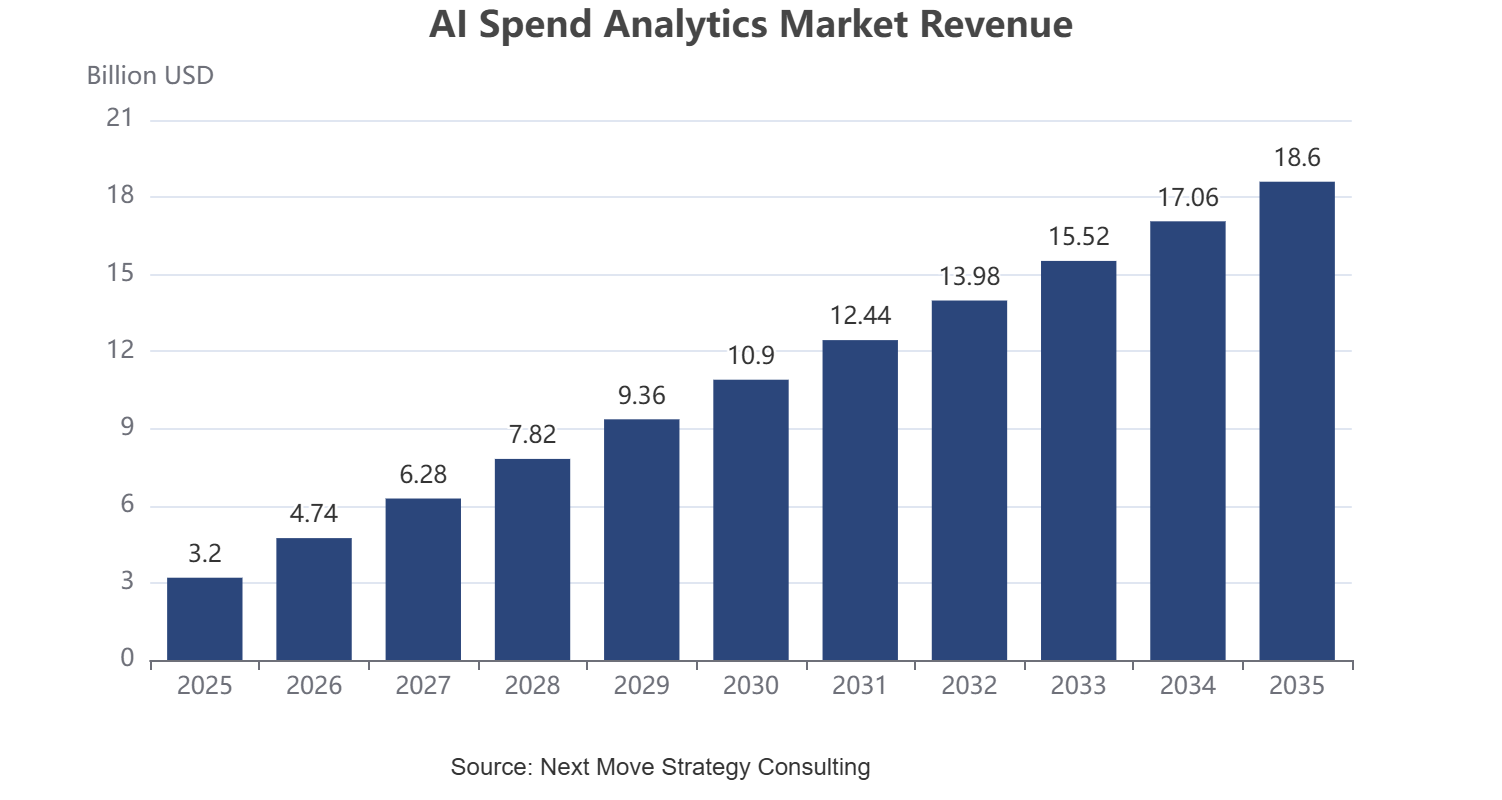
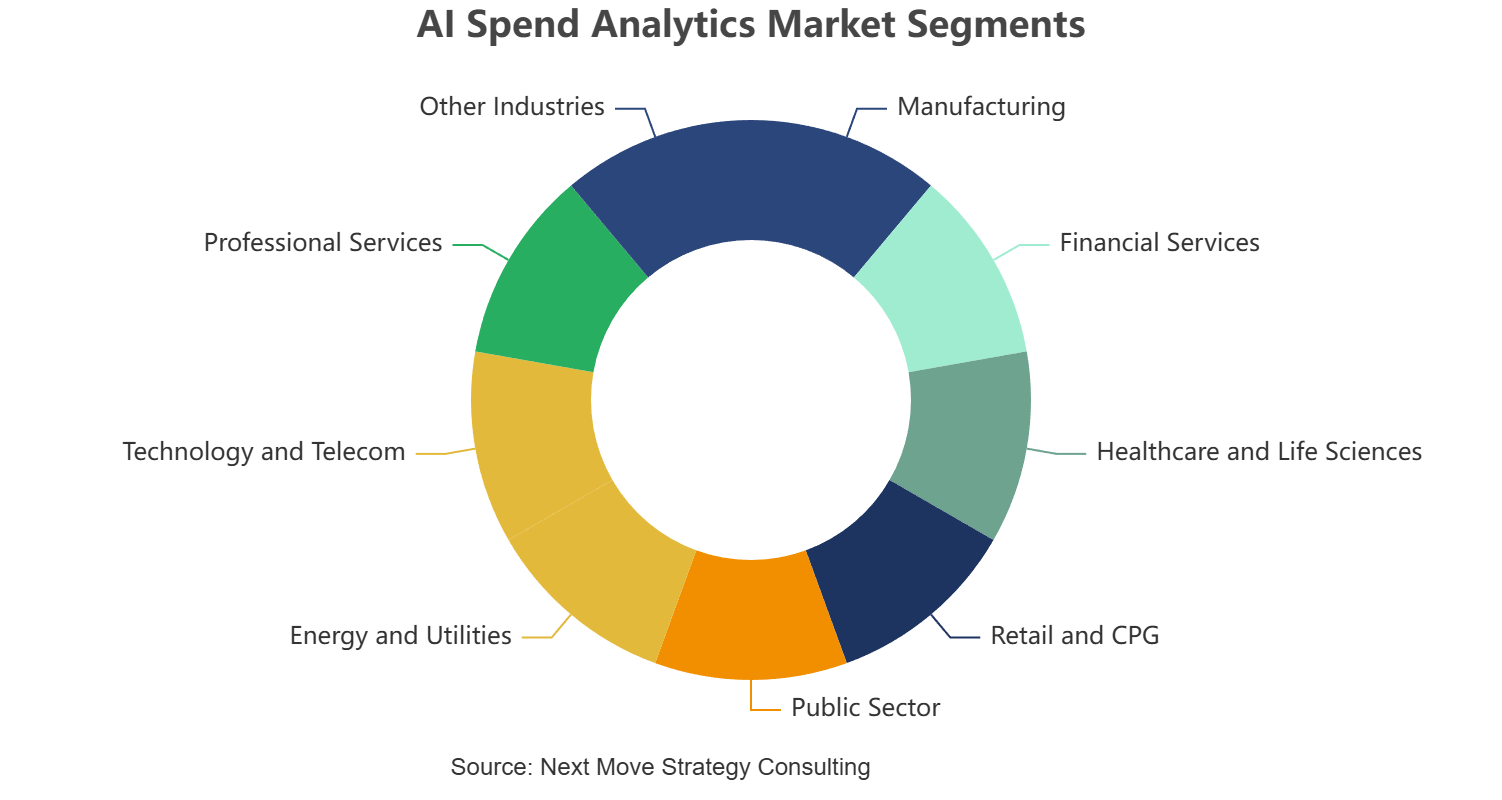
About the Author
 Liza Phukan
— Liza Phukan is Research Associate at Next Move Strategy Consulting, where she has covered emerging industries and market research across sectors for 3.5 years. Her work includes analyzing industry developments, validating market data, and developing structured business content from research findings. She uses secondary research and data-validation practices to turn complex market information into clear decision-useful market analysis for business audiences and support report development and B2B.
Liza Phukan
— Liza Phukan is Research Associate at Next Move Strategy Consulting, where she has covered emerging industries and market research across sectors for 3.5 years. Her work includes analyzing industry developments, validating market data, and developing structured business content from research findings. She uses secondary research and data-validation practices to turn complex market information into clear decision-useful market analysis for business audiences and support report development and B2B.
About the Reviewer
 Supradip Baul
— Supradip Baul is an accomplished business consultant and strategist with over a decade of rich experience in market intelligence, strategy, technology, and business transformation. His work has included rigorous qualitative and quantitative analysis across multiple industries, helping clients shape investment decisions and long-term roadmaps. Earlier in his career, he was associated with Gartner, where he contributed to industry-leading reports and market share analyses. He has worked with leading global companies and holds an MBA with a dual specialization in Marketing and Finance.
Supradip Baul
— Supradip Baul is an accomplished business consultant and strategist with over a decade of rich experience in market intelligence, strategy, technology, and business transformation. His work has included rigorous qualitative and quantitative analysis across multiple industries, helping clients shape investment decisions and long-term roadmaps. Earlier in his career, he was associated with Gartner, where he contributed to industry-leading reports and market share analyses. He has worked with leading global companies and holds an MBA with a dual specialization in Marketing and Finance.
At Next Move Strategy Consulting, we understand that insightful market research is the cornerstone of successful business decisions. That's why we employ a robust and multifaceted approach, combining various methodologies to deliver the most accurate and actionable data for our clients.

Research Landscape
We navigate the world of research with two primary approaches:
Qualitative Approach
Our qualitative research methodologies involve immersive techniques such as in-depth interviews, focus groups, and observational studies. By engaging directly with individuals and stakeholders, we uncover valuable insights that quantitative data alone may overlook.

Quantitative Research
In tandem with qualitative methodologies, NMSC leverages the power of Quantitative Research to provide a robust foundation of numerical insights. Through systematic data collection and analysis, we quantify patterns, preferences, and market trends, offering a comprehensive view of the business landscape.
Our quantitative research approach employs diverse tools, including surveys, experiments, and statistical modelling. These methodologies enable us to gather data from a large and representative sample, ensuring the statistical significance of our findings. By employing structured questionnaires and standardized data collection methods, we guarantee the reliability and validity of the information we present to our clients.
Quantitative research is particularly effective in measuring the prevalence of trends, assessing market size, and gauging the impact of various factors on consumer behavior. The numerical precision attained through this approach equips our clients with actionable insights, facilitating data-driven decision-making and strategy formulation.


Our Specialized Toolbox for Industry-Specific Market Research
We deploy a specialized arsenal of techniques tailored to meet your unique requirements. Here's a glimpse into our comprehensive toolbox:

Information Procurement
The stage entails acquiring market data or relevant information through various sources and methodologies.


Market Research Approach
We utilize both top-down and bottom-up approaches in market research analysis to achieve a comprehensive understanding of the market dynamics, leveraging the broad perspective of industry trends and macroeconomic factors alongside detailed insights from specific segments and individual companies.

Porters Five Forces Analysis
We conduct Porter's Five Forces analysis to evaluate the competitive landscape of an industry, providing us with insights into factors that affect profitability and strategic positioning.

SWOT Analysis

Forecasting
We utilize a forecasting model to predict future consumption by considering parameters like population, economics, regulations, market competition, drivers, constraints, technology, and pricing. We also employ statistical techniques such as multilinear regression, exponential smoothing, moving average, ARIMA, and Monte Carlo simulations for accurate predictions. In econometric forecasting, we analyzed short-term and long-term event impacts, attributing values based on regulatory frameworks, economic factors, and market events.





 Speak to Our Analyst