AI Audit Market Size, Share, Growth & Forecast by Offering (Software, Services, Data and Content), Deployment Model (Cloud Native SaaS, On-premises, Hybrid), End User Industry (Banking and Financial Services, Healthcare and Life Sciences, Technology and Telecommunications, Manufacturing and Automotive, Energy and Utilities, Other Industries), and Revenue Stream (Subscription, Usage Based, Professional Services, Managed Services, Perpetual License) — Global Analysis 2025–2035
Industry: ICT & Media | Publishing Date: July 6, 2026 | Last Updated: September 30, 2026 | No of Pages: N/A | No. of Tables: N/A | No. of Figures: N/A | Format: PDF | Report Code: IC4960
What Is the AI Audit Market Size?
The global AI Audit Market was valued at USD 13.4 billion in 2025 and is expected to reach USD 16.25 billion in 2026. Surging regulatory mandates, including the EU AI Act, the U.S. Executive Order on Safe, Secure, and Trustworthy AI, and emerging national AI governance frameworks, alongside escalating enterprise demand for algorithmic accountability are projected to drive the market to USD 82.06 billion by 2035, advancing at a CAGR of 19.7% from 2026 to 2035. Key growth drivers include mandatory compliance frameworks, escalating algorithmic bias litigation risk, rising adoption of AI governance platforms, and accelerating enterprise investment in responsible AI infrastructure across banking, healthcare, and public sector verticals.
|
Parameters |
Details |
|
Market Size in 2025 |
USD 13.4 Billion |
|
Market Size in 2026 |
USD 16.25 Billion |
|
Revenue Forecast in 2035 |
USD 82.06 Billion |
|
Growth Rate |
CAGR of 19.7% from 2026 to 2035 |
|
Analysis Period |
2025–2035 |
|
Base Year Considered |
2025 |
|
Forecast Period |
2026–2035 |
|
Market Size Estimation |
USD Billion |
|
Companies Profiled |
20 |
|
Countries Covered |
33 |
|
Market Share |
Top 10 |
AI Audit Market Overview
What Is the AI Audit Market and How Is It Defined?
The AI Audit Market encompasses the full ecosystem of software platforms, professional services, and data products designed to evaluate, monitor, and validate artificial intelligence systems for regulatory compliance, ethical integrity, security resilience, and operational reliability. NMSC's analysis indicates that the scope of the AI Audit Market spans pre-deployment testing and bias assessment through to continuous post-production monitoring, model risk validation, and independent third-party assurance. This market is positioned at the intersection of AI governance, enterprise risk management, and digital regulatory compliance, serving organizations that deploy AI in high-stakes domains such as credit decisioning, clinical diagnostics, and public benefits administration.
How Has the AI Audit Market Evolved Structurally Over Time?
Our assessment indicates that the AI Audit Market has undergone a significant structural evolution, transitioning from ad hoc, manual review processes into formalized, platform-driven governance ecosystems. Early audit activity was largely confined to academic and research institutions assessing specific algorithmic outputs. By 2022, enterprise demand for systematic model risk management had accelerated, driven by high-profile failures in facial recognition, predictive policing, and loan origination AI. From our research, we found that the market began consolidating around dedicated AI governance platforms offering policy engines, model registries, and automated bias testing workflows, establishing the foundation for the current segmentation across software, services, and data products.
How Does the Regulatory Environment Shape the AI Audit Market?
The regulatory environment is one of the most powerful structural forces shaping AI audit market revenue and adoption trajectories. Through NMSC's assessment, we found that the European Union's AI Act, enforced from August 2024 with high-risk AI system obligations phasing in through 2026, creates legally binding audit and conformity assessment requirements for AI systems deployed in areas such as recruitment, education, law enforcement, and critical infrastructure. Parallel mandates from the U.S. National Institute of Standards and Technology (NIST) AI Risk Management Framework, the UK's AI Safety Institute, and Singapore's Model AI Governance Framework are collectively establishing a global baseline of audit obligations that directly expand addressable market demand.
How Is Technology Adoption Accelerating Across the AI Audit Market?
Based on NMSC's research, we found that technology adoption in the AI Audit Market is accelerating on multiple vectors: automated explainability tooling, real-time drift detection, red-teaming orchestration platforms, and federated bias monitoring architectures. The proliferation of large language models (LLMs) in enterprise environments has introduced new audit complexity, including prompt injection vulnerabilities and hallucination risk, spurring development of LLM-specific security and safety testing tools. Cloud-native SaaS delivery is now the dominant deployment architecture, enabling scalable, continuous assurance capabilities that legacy on-premises audit tools cannot replicate. Integration with MLOps pipelines and enterprise GRC platforms is further expanding technology penetration across regulated industries.
|
Key Takeaways |
|
By Offering, Software dominated the market with USD 7.50 billion in 2025, driven by widespread use of governance platforms and AI monitoring tools across regulated industries. Data and Content is the fastest-growing segment, supported by rising demand for bias testing tools, performance benchmarks, and regulatory policy libraries. |
|
By Deployment Model, Cloud Native SaaS led the market at USD 8.00 billion in 2025, supported by scalability, lower cost, and continuous compliance updates. Hybrid deployment is the fastest-growing model, driven by increasing data sovereignty and regulatory requirements in sensitive industries. |
|
By End User Industry, Technology and Telecommunications held the largest share at USD 2.70 billion in 2025, driven by hyperscalers and platform providers embedding AI audit capabilities into internal governance systems. Banking and Financial Services is the fastest-growing vertical, supported by stricter model risk governance and regulatory compliance frameworks. |
|
By Revenue Stream, Subscription-based models dominated the market at USD 5.50 billion in 2025, reflecting strong demand for recurring SaaS-based governance tools. Usage-based pricing is the fastest-growing model, as enterprises increasingly prefer pay-per-use structures for audit APIs and testing workloads. |
|
By Region, North America led the market with USD 5.10 billion in 2025, supported by early regulatory frameworks, strong enterprise AI adoption, and a mature governance vendor ecosystem. Asia-Pacific is the fastest-growing region, expanding at a CAGR of 21.0% from 2026 to 2035, driven by evolving national AI governance regulations and rapid digital transformation. |
|
By Country, the United States was the largest national market, supported by the NIST AI RMF framework, federal AI accountability initiatives, and strong enterprise adoption across Fortune 500 companies. India is the fastest-growing country market, driven by rapid AI deployment across financial services, healthcare, and government-backed digital governance initiatives. |
Key Emerging Trends in the AI Audit Market
How Is Regulatory Harmonization Reshaping AI Audit Platform Design?
NMSC's analysis indicates that the simultaneous rollout of the EU AI Act, the NIST AI Risk Management Framework, and Singapore's Model AI Governance Framework is compelling AI audit platform developers to build multi-standard compliance architectures. Vendors such as Credo AI and Holistic AI have launched policy engine modules capable of mapping AI system attributes against multiple regulatory taxonomies simultaneously. This regulatory harmonization trend is expanding the total addressable market by incentivising multinational enterprise to adopt unified governance platforms rather than fragmented, country-specific audit tools.
How Is Large Language Model Proliferation Expanding the AI Audit Market Scope?
The enterprise AI adoption of LLMs, including retrieval-augmented generation systems, AI copilots, and autonomous agents, is introducing a new generation of audit requirements beyond traditional machine learning model validation. From our research, we found that LLM-specific risks, including prompt injection, hallucination, data memorization, and adversarial jailbreaks, are generating dedicated demand for red-teaming orchestration, prompt injection defense, and privacy leak detection tools. Vendors including Lakera and CalypsoAI have specifically addressed LLM security auditing, which is emerging as the fastest-evolving sub-category within the Security and Safety segment of the AI Audit Market.
How Are Continuous Assurance Models Displacing Periodic Audit Cycles?
Traditional annual or periodic AI audit cycles are being structurally displaced by continuous assurance architectures that integrate model performance tracking, drift detection, and bias monitoring directly into production AI pipelines. Through our market assessment, we observed that enterprises in banking and healthcare are particularly driving adoption of real-time audit tooling, given that regulatory bodies such as the U.S. Office of the Comptroller of the Currency and the European Banking Authority expect ongoing model validation rather than point-in-time reviews. This shift directly expands managed audit services revenue and subscription-based production monitoring platform demand within the AI Audit Market.
How Is the Convergence of AI Auditing and Cybersecurity Frameworks Creating New Market Opportunities?
Our findings suggest that AI audit and enterprise cybersecurity frameworks are increasingly converging, particularly as AI systems are recognized as critical infrastructure components. NIST's AI RMF Playbook explicitly addresses adversarial machine learning threats, and the EU AI Act's cybersecurity requirements for high-risk AI systems have created demand for integrated AI security and audit platforms. Companies including Protect AI, Securiti, and LatticeFlow AI are developing offerings that bridge model governance with AI-specific threat intelligence, positioning the Security and Safety offering segment as one of the highest-growth categories in the AI Audit Market through 2035.
What Are the Key Market Drivers, Breakthroughs, and Investment Opportunities That Will Shape the AI Audit Market in the Next Decade?
|
Drivers / Trends / Restraints |
(+/-) % Impact on CAGR Forecast |
Geographic Relevance |
Impact Timeline |
|
EU AI Act Mandatory Conformity Assessments |
+2.8% |
Europe, Global |
Immediate (2025–2027) |
|
NIST AI Risk Management Framework Adoption |
+1.9% |
North America, Global |
Near-Term (2025–2028) |
|
LLM Security and Safety Audit Demand |
+2.3% |
North America, Europe, APAC |
Near-Term (2025–2028) |
|
Enterprise MLOps Integration of Audit Tooling |
+1.5% |
Global |
Medium-Term (2026–2030) |
|
Algorithmic Bias Litigation Risk Awareness |
+1.2% |
North America, Europe |
Near-Term (2025–2028) |
|
High Implementation Complexity and Talent Scarcity |
-1.4% |
Global |
Ongoing (2025–2030) |
|
Lack of Standardized Audit Methodologies |
-0.9% |
Global |
Ongoing (2025–2028) |
|
SME Adoption Barriers (Cost and Expertise) |
-0.7% |
LATAM, MEA |
Medium-Term (2026–2030) |
|
PE/VC Investment in AI Governance Startups |
+1.1% |
North America, Europe |
Near-Term (2025–2027) |
|
Public Sector AI Governance Mandates |
+1.0% |
Global |
Medium-Term (2026–2030) |
What Are the Growth Drivers of the AI Audit Market?
How Are Binding AI Regulations Creating Mandatory Market Demand?
The EU AI Act, which entered into force in August 2024, establishes the world's first comprehensive binding legal framework for AI, requiring mandatory conformity assessments, technical documentation, and ongoing monitoring for high-risk AI systems across sectors including employment, credit, healthcare, and law enforcement. According to the European Commission's published AI Act impact assessment, an estimated 5,000 to 6,000 high-risk AI applications are subject to mandatory third-party conformity assessments within the EU alone, directly creating institutional demand for professional AI audit services. In parallel, the U.S. Executive Order on AI (October 2023) mandated federal agencies to implement NIST AI RMF-aligned risk assessments, expanding regulatory-driven adoption of AI audit tooling across the North American public sector. These binding obligations are the primary structural driver of AI Audit Market growth across North America and Europe.
How Does Algorithmic Bias and Accountability Risk Drive Enterprise Adoption?
Escalating regulatory enforcement and litigation activity around algorithmic discrimination is accelerating enterprise investment in AI audit tools as a risk mitigation strategy. The U.S. Equal Employment Opportunity Commission (EEOC) has issued guidance affirming that algorithmic hiring tools are subject to Title VII and Americans with Disabilities Act requirements, exposing employers to substantial legal liability for biased AI systems. The Consumer Financial Protection Bureau (CFPB) has similarly issued guidance on adverse action requirements for AI-based credit decisions, and the Department of Housing and Urban Development has investigated algorithmic appraisal bias. Based on our market evaluation, we noticed that these enforcement signals are driving financial institutions, healthcare providers, and HR technology platforms to invest in bias and fairness testing, pre-deployment validation, and ongoing production monitoring capabilities as defensive measures against regulatory penalties and reputational damage.
How Does the Acceleration of Enterprise AI Deployment Expand the AI Audit Addressable Market?
The global proliferation of AI across enterprise operations, spanning customer service automation, fraud detection and prevention, clinical decision support, and supply chain optimization, is fundamentally expanding the universe of AI systems requiring governance, validation, and audit. According to the OECD's AI Policy Observatory, as of 2024, more than 70 countries had adopted or were developing national AI policies, signalling a broad regulatory tailwind. The Stanford AI Index 2024 documented a significant increase in the number of AI model deployments globally across both private and public sectors. Our analysis shows that each new AI system in production represents an audit requirement, meaning enterprise AI deployment growth is a direct and proportional driver of AI Audit Market revenue expansion. This dynamic creates an inherently self-reinforcing growth loop as AI adoption accelerates.
What Are the Growth Inhibitors of the AI Audit Market?
How Does the Absence of Universal Audit Standards Constrain Market Scalability?
The lack of universally adopted, technically precise AI audit standards remain a significant market growth inhibitor, creating fragmentation in audit methodologies, inconsistent outcome interpretability, and enterprise hesitancy to commit to specific audit platforms that may not satisfy evolving regulatory requirements. While NIST's AI RMF and ISO/IEC 42001 provide governance guidance, they are voluntary frameworks rather than prescriptive technical standards specifying measurable audit thresholds. According to ISO/IEC JTC 1/SC 42, the AI standards body is still actively developing technical specifications for AI system testing and performance measurement. This standards gap means enterprises must maintain platform flexibility, slowing standardized vendor adoption and reducing the lock-in economics that would otherwise accelerate subscription revenue growth in the AI Audit Market.
How Does AI Audit Implementation Complexity Limit Mid-Market Penetration?
Enterprise AI audit implementation requires specialized expertise spanning machine learning engineering, legal compliance, statistical fairness analysis, and enterprise risk management, a rare combination that creates significant talent barriers to adoption. Based on NMSC's research, we found that small and medium-sized enterprises deploying AI systems frequently lack the internal expertise to configure, interpret, and act upon AI audit platform outputs, particularly for advanced capabilities such as counterfactual explainability, adversarial robustness testing, and multi-stakeholder bias impact assessment. This implementation complexity limits mid-market penetration, creates customer acquisition costs for managed audit service providers, and increases dependence on advisory and readiness services, constraining gross margin profiles and limiting the pace of self-serve platform adoption that would otherwise compound AI Audit Market growth.
What Are the Growth Opportunities in the AI Audit Market?
How Does the Emergence of the AI Safety Institute Network Create Institutional Market Opportunities?
The establishment of national AI Safety Institutes, including the U.S. AI Safety Institute (AISI) within NIST, the UK AISI, and the nascent EU AI Office, is creating a network of institutional demand centers for AI evaluation methodologies, benchmark datasets, and third-party audit capacity. The U.S. AISI published its initial evaluation framework in 2024 and has engaged private-sector AI audit providers for frontier model evaluations. According to NIST's published roadmap, the AI TEVV (Testing, Evaluation, Validation, and Verification) program is actively seeking standardized benchmark tools and independent assurance providers. This institutional infrastructure represents a high-value, recurring revenue opportunity for vendors with government-grade audit capabilities, independent third-party assurance credentials, and NIST AI RMF-aligned offerings.
How Do AI Governance Requirements in Emerging Markets Present Expansion Opportunities?
Emerging economies across Asia-Pacific, the Middle East, and Latin America are progressively introducing AI governance regulations, creating greenfield market opportunities for AI audit platform vendors and service providers. India's Digital Personal Data Protection Act (DPDPA), Saudi Arabia's National AI Strategy, and Brazil's proposed AI governance bill are among the regulatory initiatives establishing audit-relevant obligations outside the traditional North America–Europe axis. Through our market assessment, we observed that multinational AI audit vendors are beginning to localize offerings for these markets, partnering with regional systems integrators and regulatory advisory firms to capture first-mover positions in underpenetrated geographies where AI adoption is accelerating rapidly ahead of regulatory enforcement.
How Is the Integration of AI Audit Into Enterprise ESG Reporting Creating New Revenue Streams?
The incorporation of AI governance metrics into Environmental, Social, and Governance (ESG) reporting frameworks is emerging as a significant demand catalyst for AI audit services. The European Financial Reporting Advisory Group (EFRAG) has incorporated digital and AI accountability dimensions into the European Sustainability Reporting Standards (ESRS), while investor-led initiatives including the Responsible AI Principles from the Principles for Responsible Investment (PRI) are prompting asset managers and portfolio companies to adopt structured AI risk assessment programs. Our findings suggest that this ESG integration is creating a new enterprise buyer persona, the Chief Sustainability Officer, and expanding the AI Audit Market beyond its traditional technology and compliance buyer base, opening subscription and professional services revenue streams from organizations that may not yet deploy high-risk AI but face investor-driven audit disclosure pressure.
PESTEL Analysis of the AI Audit Market
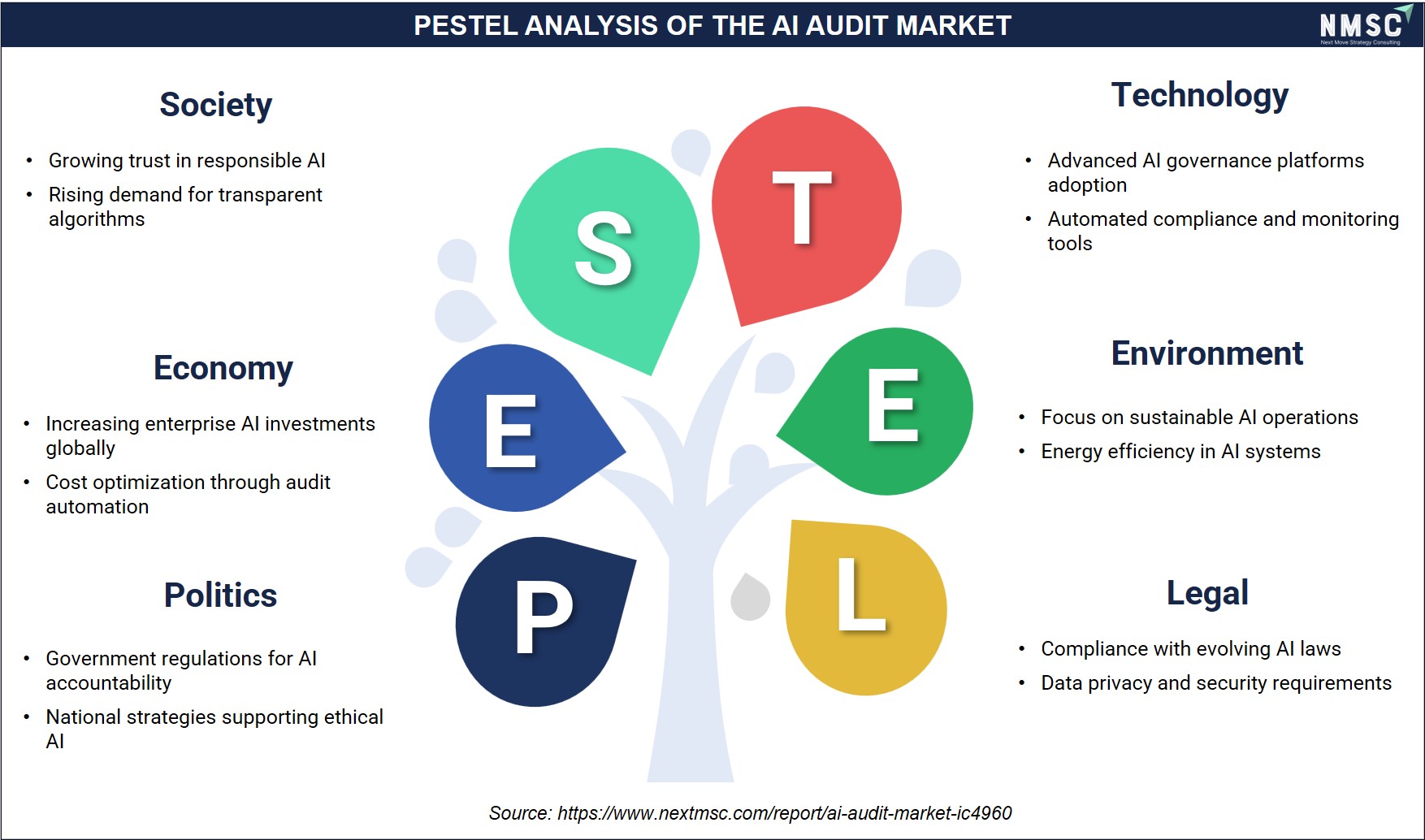
The above infographic illustrates the PESTEL framework applied to the AI Audit Market, mapping macro-environmental forces shaping its growth trajectory. It highlights political, economic, social, technological, environmental, and legal drivers influencing adoption, regulation, and innovation. The framework further underscores how tightening AI governance laws, rapid technological advancement, and rising societal trust concerns collectively accelerate demand for structured, compliant, and transparent AI audit solutions across industries.
How Is the AI Audit Market Segmented and What Are the Key Insights from the Segmentation Analysis?
By Offering
How Do Software, Services, and Data Products Structure the AI Audit Offering Landscape?
|
Offering Segment |
2025 (USD Billion) |
2035 (USD Billion) |
CAGR (%) |
|
Software |
7.50 |
45.00 |
20.0% |
|
Services |
4.50 |
27.50 |
19.6% |
|
Data and Content |
1.40 |
9.56 |
19.8% |
Software leads the AI audit market offerings, with governance platforms such as policy engines, model registries, and workflow controls being the most widely adopted due to their role in enterprise-wide compliance, while production monitoring tools are the fastest growing as organizations shift toward continuous assurance; security and safety solutions are also expanding rapidly with rising LLM risks, alongside steady demand for testing and validation tools used in pre-deployment risk checks. In services, independent third-party audits remain dominant, advisory and readiness services are growing with regulatory frameworks, and managed services are the fastest expanding as enterprises outsource continuous assurance. Data and content, including benchmarks, bias test suites, and regulatory templates, acts as a critical enabling layer supporting both software and services growth.
By Deployment Model
Which Deployment Architecture Is Shaping AI Audit Platform Adoption Trajectories?
|
Deployment Model |
2025 (USD Billion) |
2035 (USD Billion) |
CAGR (%) |
|
Cloud Native SaaS |
8.00 |
50.00 |
20.8% |
|
On-Premises |
3.30 |
18.00 |
18.5% |
|
Hybrid |
2.10 |
14.06 |
19.0% |
Cloud Native SaaS leads AI audit market deployment as enterprises increasingly adopt scalable, continuously updated platforms that simplify global compliance management, with SaaS-based governance, monitoring, and testing tools tightly integrated into major cloud MLOps ecosystems, driving strong adoption momentum. On-premises deployment remains relevant in highly regulated industries such as defense and finance due to strict data residency and security needs, while hybrid models are gaining traction as organizations balance cloud scalability with localized control, particularly in banking where sensitive model risk systems are retained on-premises, a trend expected to strengthen with expanding data localization regulations across regions.
By End User Industry
Which Industries Are Leading and Which Are Fastest Growing in AI Audit Adoption?
|
End User Industry |
2025 (USD Billion) |
2035 (USD Billion) |
CAGR (%) |
|
Banking and Financial Services |
3.50 |
21.00 |
19.9% |
|
Healthcare and Life Sciences |
2.40 |
14.50 |
19.7% |
|
Technology and Telecommunications |
2.70 |
17.00 |
20.2% |
|
Public Sector and Government |
1.80 |
10.50 |
19.4% |
|
Retail and Ecommerce |
1.20 |
7.00 |
18.9% |
|
Manufacturing and Automotive |
0.80 |
4.80 |
19.6% |
|
Energy and Utilities |
0.50 |
3.06 |
19.7% |
|
Other Industries |
0.50 |
4.20 |
22.5% |
Banking and Financial Services leads the AI audit market end-user landscape, driven by extensive AI use in credit scoring, fraud detection, AML monitoring, and trading systems under strict regulatory frameworks, with institutions increasingly demanding integrated audit capabilities such as production monitoring, model validation, and compliance assurance as regulatory scrutiny intensifies. Technology and Telecommunications follows, fueled by hyperscalers embedding responsible AI governance, while Healthcare and Public Sector adoption is rising due to medical device regulations and government AI risk mandates. Retail, Manufacturing, and Energy are steadily expanding as AI-driven personalization, industrial automation, and grid optimization face growing fairness, safety, and compliance requirements across regulated environments.
By Revenue Stream
What Revenue Models Are Driving Commercial Growth in the AI Audit Market?
|
Revenue Stream |
2025 (USD Billion) |
2035 (USD Billion) |
CAGR (%) |
|
Subscription |
5.50 |
34.00 |
20.1% |
|
Usage Based |
3.20 |
20.00 |
20.1% |
|
Professional Services |
2.50 |
15.00 |
19.7% |
|
Managed Services |
1.50 |
9.56 |
19.9% |
|
Perpetual License |
0.70 |
3.50 |
17.5% |
Subscription revenue dominates the AI audit market as governance platforms increasingly rely on continuous access to regulatory updates, policy engines, and monitoring dashboards, making recurring SaaS models the natural fit, with leading vendors adopting subscription architectures aligned to ongoing compliance needs. Usage-based pricing is also expanding as enterprises scale audit testing, red-teaming, and evidence generation based on AI workload volume, while professional services remain important for advisory and third-party audits. Managed services are emerging as the fastest-growing model due to rising demand for outsourced continuous assurance, whereas perpetual licenses continue to decline as the market shifts structurally toward recurring and consumption-based revenue models that improve scalability and predictability.
Regional Outlook
Geographic Performance Snapshot
|
Region |
2025 (USD Billion) |
2035 (USD Billion) |
CAGR (%) |
Key Driver |
|
North America |
5.10 |
31.00 |
19.5% |
Regulatory mandates, enterprise AI scale |
|
Europe |
3.00 |
17.30 |
19.0% |
EU AI Act, GDPR enforcement |
|
Asia-Pacific |
3.80 |
25.30 |
21.0% |
AI adoption, digital governance rollout |
|
Middle East & Africa |
0.80 |
4.50 |
18.0% |
Digital transformation, Vision 2030 |
|
Latin America |
0.70 |
3.96 |
16.5% |
Growing AI governance awareness |
North America AI Audit Market
North America commands the largest share of the AI Audit Market at USD 5.10 billion in 2025, projected to reach USD 31.00 billion by 2035 at a CAGR of 19.5%. The region's market maturity is driven by a combination of proactive federal regulatory action, deep enterprise AI deployment in financial services and healthcare, and a dense ecosystem of AI governance software vendors headquartered in the U.S. and Canada. The NIST AI RMF, U.S. Executive Order on AI, and state-level AI bias laws in New York, Illinois, and California are collectively establishing a multi-layered regulatory environment that sustains persistent audit demand. Based on NMSC's research, we found that North America also hosts the highest concentration of PE/VC investment in AI governance platforms globally.
United States AI Audit Market
Based on our engagements with enterprise stakeholders, the United States accounts for the dominant share within the North American AI Audit Market, supported by the NIST AI RMF's voluntary but widely adopted governance standard, the EEOC's algorithmic hiring guidance, and the CFPB's adverse action requirements for AI credit decisions. Market demand is concentrated in banking, healthcare, technology, and the federal government sector. The Biden Administration's Executive Order on AI (October 2023) mandated AI safety evaluations for frontier models, and the subsequent Trump Administration's January 2025 executive order maintained AI governance as a federal priority, sustaining institutional AI audit procurement. Competitive intensity in the U.S. is high, with over 15 of the 20 profiled vendors headquartered or primarily operating in the American market.
Canada AI Audit Market
Through our analysis, Canada emerges as a high-maturity AI Audit Market within North America, supported by the Artificial Intelligence and Data Act (AIDA) proposed under Bill C-27, which, if enacted, would establish legally binding AI impact assessment obligations. Canada's OSFI (Office of the Superintendent of Financial Institutions) has issued model risk guidance aligning with international best practices, driving financial sector audit adoption. The Pan-Canadian AI Strategy and the AI governance research ecosystem at Vector Institute, Mila, and the Alberta Machine Intelligence Institute create strong institutional knowledge transfer between research and enterprise adoption, positioning Canada as a policy-forward AI audit market with distinctive strength in financial services and public health AI governance.
Mexico AI Audit Market
From our assessment, Mexico represents an emerging AI Audit Market opportunity within Latin North America, with adoption currently concentrated in the financial services and telecommunications sectors operating under Banxico and CNBV oversight. Mexico's INAI (National Institute for Transparency, Access to Information and Personal Data Protection) has issued preliminary guidance on algorithmic accountability within its data protection framework. While mandatory AI audit requirements are not yet enacted, multinational corporations operating in Mexico are extending enterprise AI governance programs to Mexican subsidiaries, creating demand for advisory and readiness services and cloud-native SaaS-deployed governance tools that align with both U.S. and emerging Mexican regulatory expectations.
Europe AI Audit Market
Europe represents USD 3.00 billion in 2025, growing to USD 17.30 billion by 2035 at a CAGR of 19.0%. The EU AI Act is the singular most significant regulatory driver in the European AI Audit Market, establishing binding conformity assessment obligations for high-risk AI systems across all EU member states. GDPR enforcement history provides a precedent for significant financial penalties for non-compliance, signaling to enterprises that EU AI Act violations carry material litigation risk. Germany, France, and the Netherlands are the primary enterprise AI audit adoption centers, while the UK, post-Brexit, is developing an independent but broadly aligned AI regulatory framework through its AI Safety Institute. Technology adoption in Europe is characterised by strong enterprise preference for on-premises and hybrid deployment due to data sovereignty requirements under GDPR.
United Kingdom AI Audit Market
Based on our engagements, the United Kingdom represents one of Europe's largest individual AI audit markets, operating outside EU jurisdiction but maintaining close regulatory alignment through the AI Safety Institute established in November 2023. The ICO's guidance on AI and data protection, the FCA's model risk requirements for financial services AI, and the CMA's AI foundation model review collectively create a multi-regulator audit environment. The UK government's National AI Strategy and significant public investment in AI safety research at GCHQ and the Alan Turing Institute support institutional demand for AI evaluation capabilities. UK-based financial services firms, NHS digital health programs, and public sector AI deployments represent the primary enterprise AI audit market demand centers.
Germany AI Audit Market
Through our analysis, Germany is the largest national AI audit market in continental Europe, driven by the automotive sector's AI governance requirements for autonomous systems, the banking sector's BaFin model risk oversight, and Germany's established industrial AI deployment in manufacturing and logistics. The German Federal Data Protection Act (BDSG) and GDPR enforcement by the Bavarian data protection authority reflect a stringent regulatory environment that sustains enterprise AI audit demand. Germany's Mittelstand industrial base is increasingly deploying AI in quality control and supply chain optimization, expanding the addressable market for manufacturing-sector AI audit solutions beyond the large-enterprise segment into mid-market industrial companies.
France AI Audit Market
From our assessment, France is a significant European AI audit market shaped by CNIL's AI accountability guidelines, BNP Paribas and Société Générale's model risk governance requirements, and the French government's EUR 1.5 billion AI investment program announced in 2021. The French AI governance ecosystem benefits from INRIA's trustworthy AI research, the Institut Montaigne's policy outputs on algorithmic accountability, and the active participation of French regulators in the EU AI Act implementation. Healthcare AI governance is an emerging demand driver, with French hospital groups deploying diagnostic AI systems that require validation against EU Medical Device Regulation requirements, creating growing demand for clinical AI audit services.
Italy AI Audit Market
According to our evaluation, Italy's AI Audit Market is developing in alignment with EU AI Act implementation timelines, with the Garante (Italian Data Protection Authority) emerging as an active algorithmic accountability regulator. Italy's enforcement action against OpenAI in 2023 under GDPR established a regulatory precedent for AI accountability scrutiny that is driving enterprise AI audit adoption among Italian digital service providers. The Italian banking sector, including Intesa Sanpaolo and UniCredit, is advancing model risk governance programs, while Italy's significant manufacturing and fashion technology sectors are initiating AI governance assessments for supply chain and recommendation AI systems.
Spain AI Audit Market
Based on our engagements, Spain's AI Audit Market is shaped by the AESIA (Spanish Agency for the Supervision of Artificial Intelligence), established as a designated EU AI Act national competent authority, which represents the first dedicated AI supervisory body in Europe and signals Spain's proactive regulatory posture. BBVA and Santander's mature AI governance programs anchor financial sector AI audit demand in Spain, while the Spanish government's National AI Strategy targets public sector AI deployment across healthcare, justice, and social services, each of which requires AI audit compliance under the EU AI Act. Spain's emerging tech sector in Madrid and Barcelona is generating growing enterprise demand for SaaS-delivered governance platforms.
Sweden AI Audit Market
Through our analysis, Sweden demonstrates strong institutional readiness for AI audit adoption, anchored by the Swedish Authority for Privacy Protection (IMY) and the Swedish AI Commission's 2024 national AI strategy recommendations. Sweden's financial services sector, including Nordea, Swedbank, and SEB, maintains mature model risk governance programs that are expanding to incorporate EU AI Act-aligned audit documentation. Sweden's strength in industrial IoT and manufacturing AI, combined with Ericsson's telecommunications AI governance requirements, creates diverse vertical demand for AI audit tooling. Sweden's high digital maturity index and strong enterprise cloud adoption support cloud-native SaaS AI governance platform penetration.
Denmark AI Audit Market
From our assessment, Denmark's AI Audit Market benefits from a high-trust regulatory environment and strong public sector AI deployment, particularly in healthcare, social services, and municipal government. The Danish Data Ethics Council and the Agency for Digital Government have published AI ethics principles that align with EU AI Act requirements, creating enterprise preparedness for mandatory audit adoption. Denmark's strength in life sciences and pharmaceutical AI, including applications in drug discovery and clinical trial optimization, creates growing demand for GxP-compliant AI validation and audit services from Danish-headquartered multinationals operating in EU regulatory frameworks.
Finland AI Audit Market
According to our evaluation, Finland is a policy-forward AI audit market supported by the Finnish Center for Artificial Intelligence (FCAI), the Finnish data protection ombudsman's active AI oversight, and Nokia's AI governance requirements for telecom network optimization systems. Finland's Aurora AI program, a public sector AI initiative, has established algorithmic transparency requirements that serve as a model for EU AI Act implementation. The Finnish financial technology sector and health technology companies are generating enterprise demand for bias testing and explainability tooling, while Finland's strong public-private R&D ecosystem supports development of indigenous AI audit capabilities.
Netherlands AI Audit Market
Based on our engagements, the Netherlands is a high-maturity European AI audit market shaped by the Dutch Data Protection Authority (AP)'s active enforcement of algorithmic accountability, the Netherlands' status as a European financial services hub, and the Amsterdam-based concentration of technology and digital media companies. The AP's investigation into the Dutch benefits fraud detection algorithm (SyRI), which was ruled unlawful by Dutch courts in 2020, established a landmark algorithmic accountability precedent that continues to shape enterprise AI governance practices. ING, ABN AMRO, and Rabobank are sophisticated AI audit buyers, and the Netherlands' role as a European headquarters for many U.S. technology companies creates further demand for AI governance and audit services aligned with EU regulations.
Rest of Europe AI Audit Market
Through our market assessment, we observed that the Rest of Europe, comprising Austria, Belgium, Poland, Czech Republic, Switzerland, and other markets, collectively represents a growing AI Audit Market opportunity as EU AI Act obligations propagate to all member states and EEA-affiliated nations. Switzerland, while outside the EU, maintains close regulatory alignment through bilateral agreements and has issued FINMA guidance on AI model governance for the financial sector. Poland and Czech Republic are developing AI governance frameworks, driven by EU AI Act transposition requirements and growing enterprise AI deployment in financial services and manufacturing. Eastern European markets represent cost-efficient advisory and readiness service delivery opportunities for pan-European AI audit firms.
Asia-Pacific AI Audit Market
Asia-Pacific is the fastest-growing regional market, valued at USD 3.80 billion in 2025 and projected to reach USD 25.30 billion by 2035 at a CAGR of 21.0%. The region's superior growth trajectory reflects a combination of aggressive AI deployment across China, India, and Southeast Asia, progressive AI governance regulatory rollouts, and large-scale digital transformation programs in government and financial services. China's Generative AI Regulations, India's Digital Personal Data Protection Act, Singapore's Model AI Governance Framework, and South Korea's AI Act are collectively establishing an APAC regulatory environment that will increasingly mandate AI audit adoption. NMSC's analysis indicates that Asia-Pacific's growth will outpace all other regions through 2030 due to the convergence of rapid AI adoption with regulatory maturation.
China AI Audit Market
Based on our engagements, China's AI Audit Market is unique in that it is shaped by a dual mandate of national AI capability advancement and algorithmic accountability regulation. The Cyberspace Administration of China (CAC) has implemented multiple AI governance regulations, including the Provisions on the Management of Algorithmic Recommendations (2022) and the Interim Measures for the Management of Generative AI Services (2023), both of which require algorithmic assessments and security evaluations. China's AI audit demand is concentrated among technology platforms including Baidu, Alibaba, Tencent, and ByteDance, which deploy AI at scale across social media, e-commerce, and financial services under direct regulatory oversight from the CAC and PBOC. Indigenous Chinese AI governance vendors are emerging alongside international platforms.
India AI Audit Market
Through our analysis, India is one of the fastest growing country markets within Asia-Pacific, driven by rapid AI deployment in fintech, healthcare, and government programs combined with the Digital Personal Data Protection Act (DPDPA), which establishes accountability requirements for automated data processing. The Reserve Bank of India's IT risk guidelines and SEBI's algorithmic trading regulations create sector-specific AI governance obligations for financial market participants. India's National AI Strategy and MeitY's Responsible AI documents signal a trajectory toward mandatory audit requirements for public sector AI systems. The large and growing Indian IT services sector, including Infosys, TCS, and Wipro, is actively developing AI governance and audit practices to serve global enterprise clients.
Japan AI Audit Market
From our assessment, Japan's AI Audit Market is shaped by METI's AI Governance Guidelines for Business (2023), which recommend audit practices for AI systems in high-risk applications, and the FSA's model governance requirements for financial sector AI. Japan's cultural emphasis on quality management and process auditability (rooted in ISO/TQM traditions) creates strong organizational receptivity to AI audit framework implementation. Toyota, Sony, and major Japanese financial institutions are advancing internal AI governance programs, while the Japanese government's AI strategy positions trustworthy AI as a core national competitiveness priority. Japan's significant semiconductor and industrial AI deployment is expanding the audit-eligible AI system universe within the country.
South Korea AI Audit Market
According to our evaluation, South Korea passed the AI Basic Act in December 2024, establishing a regulatory framework for AI risk classification, transparency requirements, and governance obligations, making it one of the first Asian nations to enact binding AI legislation. The Financial Supervisory Service (FSS) and Financial Services Commission (FSC) have issued model risk guidelines for AI use in financial services, driving institutional AI audit adoption among major Korean banks and insurers. Samsung, Hyundai, SK Telecom, and NAVER are deploying AI at enterprise scale and are subject to growing domestic and international AI governance obligations. South Korea's active AI legislative environment positions it as the highest regulatory maturity market in Southeast Asia for AI audit demand.
Taiwan AI Audit Market
Based on our engagements, Taiwan's AI Audit Market is emerging around its globally significant semiconductor manufacturing sector, where AI applications in yield optimization, defect detection, and supply chain management are entering governance frameworks. TSMC and other semiconductor manufacturers face AI governance obligations from customers and investors aligned with responsible AI principles. Taiwan's financial regulator FSC has issued guidance on AI in financial services, and Taiwan's government-funded AI labs (including NCHC and ITRI) are developing AI evaluation methodologies that support market infrastructure for audit service delivery.
Indonesia AI Audit Market
Through our analysis, Indonesia represents a rapidly developing AI Audit Market driven by one of Southeast Asia's largest digital economies, Bank Indonesia's AI governance guidance for the financial sector, and the Kominfo (Ministry of Communication and Information Technology)'s AI ethics framework. Indonesia's large fintech sector, serving over 100 million unbanked and underbanked consumers with AI-powered credit scoring and payments, creates significant demand for algorithmic fairness and bias testing, particularly as OJK (Financial Services Authority) scrutiny of fintech lending AI increases. Indonesia's AI Audit Market is currently in early-stage development, with managed audit services and advisory providers capturing initial market demand.
Vietnam AI Audit Market
From our assessment, Vietnam's AI Audit Market is nascent but growing, supported by the government's National AI Strategy to 2030 and the Ministry of Science and Technology's guidance on AI ethics. Vietnam's rapidly expanding fintech and e-commerce sectors,led by VPBank, Techcombank, and Shopee Vietnam, are deploying AI at scale, with increasing awareness of model risk governance requirements from international investors and banking partners. Vietnam's AI Audit Market is primarily served by international advisory firms and managed service providers, with domestic capability development in early stages. Government AI programs in healthcare diagnostics and public services are creating initial institutional demand for AI validation and evaluation services.
Australia AI Audit Market
According to our evaluation, Australia is a high-maturity AI Audit Market driven by the Australian Government's Voluntary AI Safety Standard released in 2024, the APRA (Australian Prudential Regulation Authority)'s model risk management guidelines for financial institutions, and the Office of the Australian Information Commissioner's (OAIC) AI accountability guidance. Australia's banking sector, Commonwealth Bank, ANZ, NAB, and Westpac, maintains sophisticated model risk governance programs that increasingly extend to AI-specific audit requirements. Australia's significant healthcare AI deployments and government digitization programs are expanding the addressable AI audit market, while proximity to Asian growth markets positions Australian AI governance vendors for regional expansion.
Philippines AI Audit Market
Based on our engagements, the Philippines' AI Audit Market is in the early adoption phase, driven primarily by the financial services sector operating under Bangko Sentral ng Pilipinas (BSP) guidance on technology risk management and by multinational corporations extending enterprise AI governance programs to Philippine operations. The Philippines' National Privacy Commission enforces the Data Privacy Act of 2012, which includes provisions relevant to automated decision-making, providing a partial regulatory foundation for AI accountability. The country's rapidly growing BPO and technology sector, combined with BSP's progressive approach to fintech regulation, creates conditions for AI audit market development ahead of formal AI legislation.
Malaysia AI Audit Market
Through our market assessment, we observed that Malaysia's AI Audit Market is developing within the framework of the National AI Roadmap (AI-Rmap), Bank Negara Malaysia's (BNM) model risk guidelines for financial institutions, and the Personal Data Protection Act (PDPA) revision underway as of 2024. Malaysia's financial sector, including Maybank, CIMB, and RHB, is actively advancing AI governance programs under BNM scrutiny. The Malaysia Digital Economy Corporation (MDEC)'s AI governance initiatives and the government's AI National Centre are building institutional capacity for AI evaluation, creating ecosystem conditions for AI audit market growth, particularly in financial services and public sector applications.
Rest of Asia-Pacific AI Audit Market
From our assessment, the Rest of Asia-Pacific collectively represent an emerging AI Audit Market frontier driven by financial inclusion AI programs, e-government initiatives, and multinational enterprise AI governance extensions. Thailand's PDPA enforcement and the Bank of Thailand's technology risk guidelines are creating financial sector AI governance obligations. New Zealand's Algorithm Charter for Aotearoa New Zealand establishes public sector algorithmic transparency commitments that align with AI audit principles. These markets are primarily served through managed audit services and cloud-native SaaS platforms deployed by Asia-Pacific regional vendors.
Middle East and Africa AI Audit Market
The Middle East and Africa AI Audit Market is valued at USD 0.80 billion in 2025, projected to reach USD 4.50 billion by 2035 at a CAGR of 18.0%. Growth is driven by ambitious national AI transformation programs including Saudi Vision 2030, UAE's National AI Strategy 2031, and Egypt's National AI Strategy, which collectively position AI as a core economic diversification pillar. Market maturity varies significantly across the region, with Gulf Cooperation Council (GCC) states representing the most advanced AI governance environments, while Sub-Saharan African markets are in the earliest adoption stages. NMSC's analysis indicates that the MEA region will benefit disproportionately from managed audit services and cloud-native SaaS delivery models given nascent domestic AI audit vendor ecosystems and significant talent gaps in AI governance expertise.
Saudi Arabia AI Audit Market
Based on our engagements, Saudi Arabia is the largest AI Audit Market in the Middle East, anchored by SDAIA (Saudi Data and Artificial Intelligence Authority)'s national AI governance framework, the NCA (National Cybersecurity Authority)'s AI security requirements, and the Vision 2030 mandate to deploy AI across banking, healthcare, and government services. Saudi Arabia's financial sector, led by Al Rajhi Bank, SNB, and Saudi Aramco's fintech operations, is advancing model risk governance programs that align with SAMA's (Saudi Arabian Monetary Authority) technology risk principles. The Kingdom's large-scale government AI projects in smart city, e-government, and national security create sustained institutional demand for AI validation and compliance audit services.
UAE AI Audit Market
Through our analysis, the UAE is the most advanced AI governance market in the Middle East, supported by the UAE Government's National AI Strategy 2031, the ADGM (Abu Dhabi Global Market) AI regulatory framework for financial services, and the Dubai AI and Web3 Campus initiative. The UAE Cabinet Office has issued AI ethics principles aligned with OECD guidelines, and CBUAE (Central Bank of UAE) model risk guidance extends to AI systems deployed in banking and insurance. The UAE's status as a regional technology hub and free-zone economy makes it the primary entry market for international AI audit vendors seeking MEA market presence, with strong demand from ADGM and DIFC-licensed financial institutions.
Egypt AI Audit Market
From our assessment, Egypt's AI Audit Market is in an early development phase, supported by the National AI Strategy published in 2021 and Egypt's ongoing financial digitization under CBE (Central Bank of Egypt) guidance. Egypt's large financial inclusion AI programs, extending mobile banking and credit scoring to underbanked populations, create growing demand for algorithmic fairness validation, particularly given regulators' focus on equitable financial access. Egypt's academic AI research ecosystem, anchored at Cairo University and Nile University, is developing AI governance research capacity that provides a foundation for future domestic AI audit service delivery.
Israel AI Audit Market
According to our evaluation, Israel is a distinctive AI Audit Market shaped by a high concentration of AI-focused cybersecurity and governance technology companies, a mature venture capital ecosystem investing in AI safety and governance startups, and the Israel Innovation Authority's responsible AI programs. Israel's financial regulator (Bank of Israel and ISA) has issued model governance guidance, and Israel's defense-adjacent AI programs create classified audit requirements that support specialized AI validation capabilities. Israel's strong AI export orientation, with technology companies selling AI audit and governance tools to global enterprise customers, positions it as both a market participant and a vendor innovation hub within the MEA region.
Turkey AI Audit Market
Based on our engagements, Turkey's AI Audit Market is developing under the influence of KVKK (Personal Data Protection Authority)'s guidance on automated decision-making, BRSA (Banking Regulation and Supervision Agency)'s model risk oversight, and Turkey's National AI Strategy 2025. Turkey's large banking sector, including Iş Bankası, Ziraat Bankası, and Garanti BBVA, maintains active model governance programs, creating institutional AI audit demand. Turkey's position at the intersection of European regulatory alignment and Middle Eastern market access creates a strategic entry point for international AI audit vendors seeking to serve both markets from a single regional base.
Nigeria AI Audit Market
Through our analysis, Nigeria represents the largest Sub-Saharan African opportunity in the AI Audit Market, driven by one of Africa's largest fintech ecosystems (including Flutterwave, Paystack, and Kuda), the Central Bank of Nigeria's (CBN) technology risk framework, and NITDA (National Information Technology Development Agency)'s Nigeria Data Protection Regulation. AI applications in credit scoring, fraud detection, and mobile payments for Nigeria's 50+ million unbanked population create meaningful algorithmic accountability risk that is beginning to attract AI audit service attention from international providers. Nigeria's AI Audit Market is currently in nascent development, primarily served through advisory services and basic bias assessment tools.
South Africa AI Audit Market
From our assessment, South Africa is the most mature Sub-Saharan African AI Audit Market, underpinned by the Protection of Personal Information Act (POPIA)'s algorithmic accountability provisions, the FSCA (Financial Sector Conduct Authority)'s model governance expectations, and South Africa's established financial services sector with sophisticated model risk management programs. Standard Bank, FirstRand, Nedbank, and Absa have advanced AI governance frameworks that are beginning to incorporate structured AI audit requirements. South Africa's AI research capacity at UCT, Wits, and CSIR provides a talent pipeline for domestic AI audit capability development, and the country's regulatory maturity positions it as the primary MEA market entry point for international AI audit vendors.
Rest of Middle East and Africa AI Audit Market
According to our evaluation, the Rest of the Middle East and Africa represents an emerging AI Audit Market frontier. Qatar's National Vision 2030 and the Qatar Central Bank's fintech regulatory framework are creating early AI governance obligations. Kenya's vibrant fintech sector (including M-Pesa and Safaricom's AI programs) and the Communications Authority of Kenya's emerging digital framework are establishing preconditions for AI audit adoption. Morocco's proximity to the EU creates alignment pressure with EU AI Act standards for Moroccan enterprises exporting to European markets. These markets are primarily served through managed audit services and cloud-native SaaS platforms delivered by MEA-regional advisory firms.
Latin America AI Audit Market
Latin America's AI Audit Market is valued at USD 0.70 billion in 2025, projected to reach USD 3.96 billion by 2035 at a CAGR of 16.5%. While growth rates are lower than Asia-Pacific, the region benefits from Brazil's advanced AI governance legislative activity, Colombia's AI ethics guidelines, and Chile's data protection reform. The financial services sector, operating under central bank AI governance frameworks in Brazil, Mexico, and Colombia, drives the majority of enterprise AI audit demand. NMSC's analysis indicates that Latin America's Market will be primarily served through SaaS-delivered platforms given limited domestic vendor ecosystems, with international vendors using Brazil and Mexico as regional anchors for LATAM market expansion.
Brazil AI Audit Market
Based on our engagements, Brazil is the largest Latin American AI Audit Market, anchored by the Lei Geral de Proteção de Dados (LGPD)'s automated decision-making provisions, BACEN (Banco Central do Brasil)'s model risk guidelines for financial institutions, and Brazil's Draft AI Act (PL 2338/2023) under Senate consideration. Brazil's large banking sector, Itaú Unibanco, Bradesco, and Nubank, maintains sophisticated model risk governance programs that are expanding to formal AI audit requirements. Brazil's position as South America's leading AI adopter in agriculture, healthcare, and e-commerce creates growing demand for production monitoring and bias testing across non-financial AI deployments, representing the market's emerging frontier.
Argentina AI Audit Market
Through our analysis, Argentina's AI Audit Market is developing within a challenging macroeconomic environment but benefits from a high concentration of technology talent, the PDPA (Personal Data Protection Act) revision underway, and BCRA (Central Bank of Argentina)'s risk management guidelines for fintech and financial AI. Argentina's strong academic AI research community, including CONICET and UTN, contributes to AI governance awareness. Argentine technology companies, including Mercado Libre, which operates AI extensively in e-commerce and fintech across Latin America, are advancing internal AI governance programs that create enterprise audit demand both domestically and across the region.
Chile AI Audit Market
From our assessment, Chile is one of the most regulatory-forward AI audit markets in Latin America, with a new Data Protection Law (Ley 21.719) enacted in 2024 that includes automated decision-making accountability provisions aligned with GDPR. The CMF (Comisión para el Mercado Financiero)'s technology risk guidelines and SBIF's model governance expectations create financial sector AI audit requirements for Chilean banks and insurers. Chile's high financial inclusion through digital banking, combined with the government's AI National Strategy, positions the country as a growth market for AI audit services, particularly in financial services, healthcare, and public sector applications.
Colombia AI Audit Market
According to our evaluation, Colombia has demonstrated proactive AI governance leadership in Latin America through SIC (Superintendencia de Industria y Comercio)'s AI ethics guidelines and the National Ministry of ICT's Responsible AI framework published in 2022. Colombia's financial regulator (SFC) has issued guidance on algorithmic model risk for the banking sector, driving AI audit adoption among major Colombian financial institutions including Bancolombia and Davivienda. Colombia's growing insurtech and healthtech sectors are creating AI governance demand beyond financial services, while international advisory firms are establishing Colombia-based delivery centers for LATAM AI audit service delivery.
Rest of Latin America AI Audit Market
Based on our engagements, the Rest of Latin America represents an early-stage AI Audit Market opportunity driven by regional financial digitization, multilateral development bank AI governance programs, and the cross-border influence of Brazil's LGPD and Chile's data protection reforms on regulatory development. Uruguay's mature data protection framework (Ley 18.331) and advanced digital government programs create relative regulatory readiness. Peru and Ecuador are developing AI ethics guidelines in coordination with regional bodies. The IDB (Inter-American Development Bank)'s AI governance programs represent an institutional demand catalyst across smaller LATAM markets, creating advisory and readiness services opportunities for international AI audit providers.
Regulatory Framework Impacting the AI Audit Market
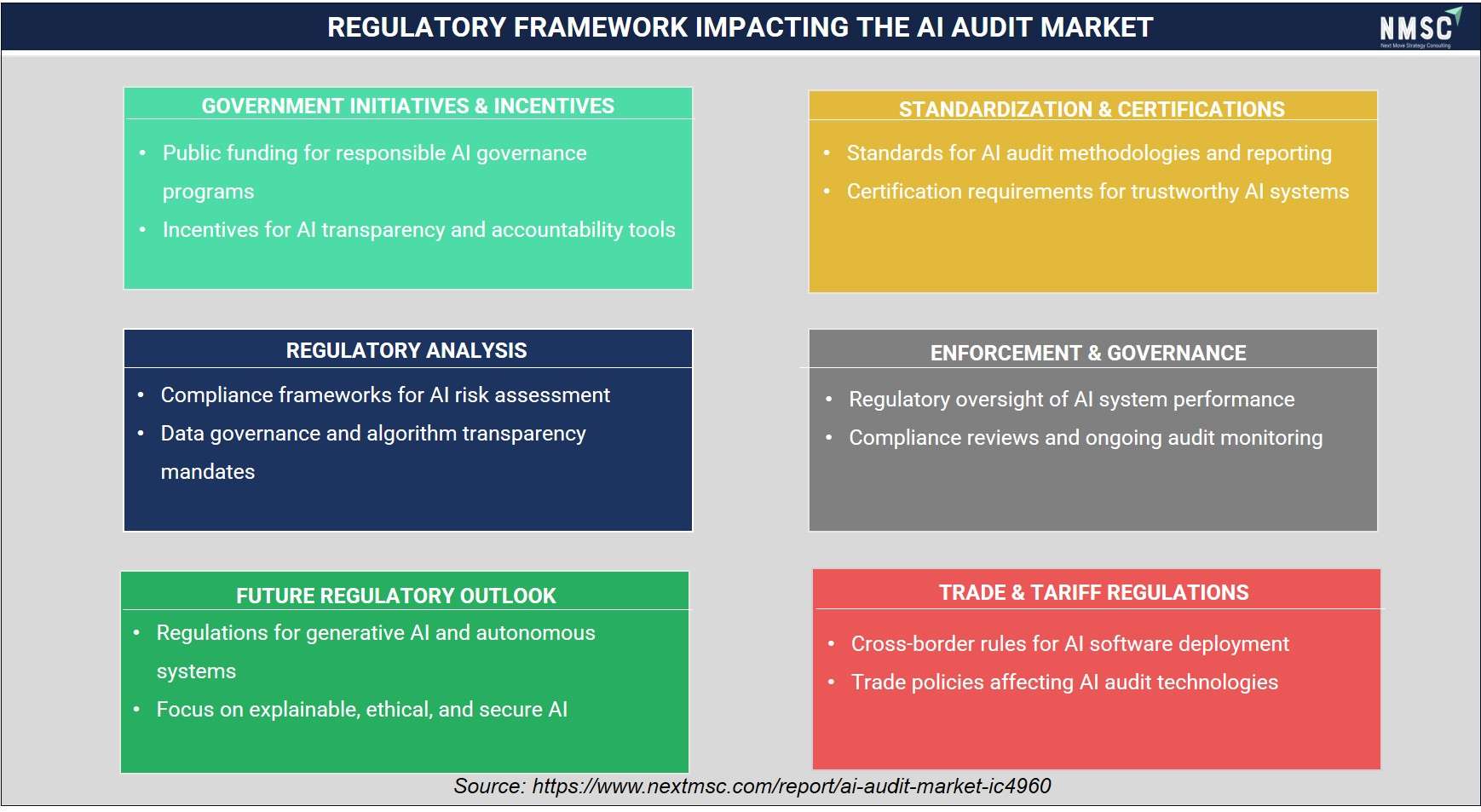
The above framework outlines the regulatory landscape shaping the AI Audit Market across government initiatives, compliance standards, enforcement, and trade policies. We observed that public funding for responsible AI governance and incentives for transparency tools drive adoption, while compliance frameworks for AI risk assessment and data governance mandates define the regulatory environment. Standards for audit methodologies and certification requirements for trustworthy AI systems ensure accountability, with regulatory oversight and compliance reviews enforcing adherence. Future outlook points toward regulations for generative AI and autonomous systems, emphasizing explainable and secure AI. Cross-border deployment rules and trade policies further influence technology access and global market dynamics.
Competitive Landscape
Competitive Dynamics and M&A Landscape
|
Parameter |
Details |
|
Market Structure |
The AI Audit industry is highly fragmented, with 20+ specialised vendors, multiple enterprise software suite providers, and professional services firms competing across distinct offering categories. No single vendor commands dominant market share, reflecting the market's early-stage commercial development and the diversity of buyer needs across compliance audit, production monitoring, and AI security sub-segments. |
|
Innovation Focus |
Innovation is concentrated in three primary areas: LLM-specific audit tooling (prompt injection defense, hallucination detection, AI red-teaming), automated multi-framework compliance mapping aligned with EU AI Act and NIST AI RMF, and MLOps-integrated continuous monitoring architectures that eliminate the need for separate audit platform deployments. |
|
M&A Activity |
The AI Audit Market is experiencing accelerating M&A activity as larger enterprise software vendors including SAP, IBM, and Salesforce evaluate acquisitions of AI governance specialists to embed audit capability into enterprise platforms. PE-backed consolidation of mid-size AI audit vendors is also underway, driven by the attractive recurring revenue profiles of subscription-based governance platforms and the scalability of usage-based models. |
How Do Companies Compete in the AI Audit Market?
Competition in the AI Audit Market is multi-dimensional, with vendors differentiating across technical depth, regulatory coverage breadth, integration ecosystem, and service delivery capability. AI-native vendors including Credo AI, Holistic AI, and Fiddler AI compete primarily on platform completeness and ease of integration with enterprise MLOps workflows, while established enterprise software providers compete on existing customer relationships and bundle economics. Pricing strategies vary significantly; pure-play AI governance vendors favour subscription and usage-based models that align with continuous audit obligations, while professional services firms price third-party audit engagements on project-based terms. NMSC's analysis indicates that vendors with pre-built regulatory content libraries aligned with EU AI Act and NIST AI RMF requirements are achieving faster enterprise sales cycles than those requiring custom compliance mapping.
Which Kind of Companies Dominate the AI Audit Market?
The AI Audit Market is dominated by three distinct company archetypes. AI-native governance platform companies, including Credo AI, Holistic AI, Arthur AI, Arize AI, WhyLabs, and Fiddler AI, represent the market's most specialized competitors, offering purpose-built governance, monitoring, and testing platforms with deep MLOps integration. Enterprise data and AI platform vendors, including Dataiku, DataRobot, and H2O.ai, are extending existing ML platform capabilities into formal AI audit and governance functionality, leveraging large existing customer bases. Specialized security and privacy vendors, including Protect AI, Lakera, Securiti, and CalypsoAI, address the AI security and data privacy dimensions of AI audit, competing in the fastest-growing Security and Safety segment. Professional services firms including the Big Four accounting networks are building AI audit practices that compete for independent third-party assurance engagements.
AI-Native Differentiation and Open Standards Drive Market Success in the AI Audit Market
Based on NMSC's research, we found that the most commercially successful AI Audit Market vendors share several structural characteristics: native support for open AI governance standards (including NIST AI RMF, ISO/IEC 42001, and IEEE standards for algorithmic bias), pre-built integrations with leading MLOps platforms (AWS SageMaker, Azure ML, Google Vertex AI, MLflow, and Kubeflow), and the ability to generate audit-ready evidence documentation that satisfies regulatory inspection requirements without manual curation. Vendors that offer multi-framework compliance mapping, enabling enterprise customers to simultaneously assess AI systems against EU AI Act, GDPR, NIST AI RMF, and sector-specific requirements, are achieving premium pricing and lower churn rates than single-framework competitors.
Market Players to Opt for Merger and Acquisition Strategies to Expand Their Presence in the AI Audit Market
Our assessment indicates that M&A is emerging as the primary inorganic growth strategy for AI Audit Market participants seeking to expand offering breadth, geographic presence, or talent capabilities faster than organic growth allows. AI governance platform vendors are acquiring bias test dataset companies to strengthen Data and Content offerings, while enterprise software conglomerates are evaluating bolt-on acquisitions of AI audit specialists to accelerate entry into the governance platform segment. Financial investors, including Andreessen Horowitz, Sequoia Capital, and several sovereign wealth funds, have funded multiple AI governance vendors, establishing exit premium expectations that will drive M&A consolidation as the market matures toward 2027-2030. Companies with strong EU AI Act regulatory compliance libraries are particularly attractive acquisition targets given the near-term mandatory compliance timeline.
Who Are the Key Market Players in the AI Audit Market?
-
Credo AI
-
Monitaur
-
Holistic AI
-
Asenion
-
Fiddler AI
-
Arthur AI
-
Arize AI
-
WhyLabs
-
Dataiku
-
DataRobot
-
Securiti
-
MindBridge
-
Optro
-
MetricStream
-
Protect AI
-
H2O.ai
-
Lakera
-
CalypsoAI
-
Giskard
-
LatticeFlow AI
What Are the Latest Developments in the AI Audit Market?
|
Date |
Event |
|
May 2026 |
RegScale announced major expansion of its AI-driven continuous controls monitoring (CCM) platform, automating evidence collection and real-time compliance validation. This marks a shift in the AI audit market from periodic audits to always-on assurance systems powered by AI agents and automated risk validation. |
Expert Insights

“AI governance must now be measurable, auditable, and defensible, I feel this recognition reinforces our mission: to build the operating system for AI trust — so leaders can scale innovation with confidence. Governance you can prove. AI you can trust.”
— Navrina Singh, Founder & CEO of Credo AI
Statement made by Credo AI leadership during a company communication highlighting the evolving requirements of AI governance as enterprises scale artificial intelligence systems across regulated and high-risk environments.
Market Interpretation
The statement reflects the structural shift in the AI audit and governance market toward verifiable and evidence-based compliance frameworks. As organizations deploy AI at scale, governance is increasingly required to be measurable, auditable, and defensible, driving demand for platforms that function as an operating system for AI trust. This reinforces the market transition from policy-based oversight to continuous, proof-driven AI assurance systems.
What Are the Investment Opportunities in the AI Audit Market?
Capital Flowing
The AI Audit Market is attracting substantial capital inflows across both venture and growth equity stages, driven by investor recognition of mandatory compliance tailwinds from the EU AI Act and NIST AI RMF. AI governance platform vendors including Credo AI and Holistic AI have completed significant funding rounds, while AI security specialists including Protect AI and Lakera have attracted investment from cybersecurity-focused funds recognizing the convergence of AI governance and enterprise security. Based on our market evaluation, we noticed that AI audit remains an early-stage but rapidly maturing investment category, with valuations reflecting both software revenue multiples and the strategic option value of compliance-critical enterprise platform positioning.
Infrastructure Investment
Infrastructure investment in AI audit is expanding along three vectors: cloud-native compute infrastructure for large-scale bias testing and red-teaming workloads, data infrastructure for curating and maintaining benchmark datasets and policy libraries, and integration infrastructure enabling AI audit tooling to connect with enterprise MLOps stacks and GRC platforms. Hyperscalers including AWS, Microsoft Azure, and Google Cloud are investing in AI safety and governance tooling layers built on their core cloud platforms, creating both competitive pressure and co-investment opportunities for AI audit vendors that develop certified integrations with hyperscaler AI services. NMSC's analysis indicates that infrastructure investment is a prerequisite for the scale of continuous assurance capabilities that enterprise and regulatory demand will require through 2035.
ESG Considerations
ESG integration is reshaping the AI Audit Market investment thesis by creating a new category of institutional demand from asset managers and corporate sustainability officers. The Principles for Responsible Investment (PRI) network, representing over USD 120 trillion in assets under management, has incorporated AI governance into its responsible investment frameworks, creating investor pressure on portfolio companies to adopt AI audit practices. EFRAG's European Sustainability Reporting Standards (ESRS) are establishing algorithmic accountability disclosure requirements that will drive enterprise AI audit adoption among publicly listed European companies. Our findings suggest that ESG-motivated AI audit adoption represents an incremental demand layer above and beyond regulatory compliance-driven adoption, meaningfully expanding the total addressable market beyond the currently projected USD 82.06 billion by 2035.
Digital Transformation
Enterprise digital transformation programs, spanning cloud migration, intelligent automation, and data modernization, are creating embedded AI audit investment opportunities as organizations build governance capability alongside AI capability. Chief Information Officers and Chief Risk Officers are increasingly including AI governance platform procurement within broader digital transformation budgets, linking AI audit investment to risk management, compliance modernization, and technology infrastructure initiatives. Based on NMSC's research, we found that AI audit vendors positioned as digital transformation enablers, rather than standalone compliance tools, are achieving higher average contract values and lower sales cycle duration by entering procurement processes aligned with approved enterprise digital transformation initiatives rather than competing for standalone compliance budget allocation.
PE and VC Activity
PE and VC activity in the AI Audit Market is entering an intensification phase, driven by the combination of mandatory EU AI Act compliance deadlines (creating near-term revenue certainty for EU-aligned audit vendors), a large and growing enterprise total addressable market, and recurring subscription revenue models that generate favourable private equity return profiles. Andreessen Horowitz (a16z), Sequoia Capital, and several deep tech–focused VCs have invested in AI governance platform companies. Our assessment indicates that the 2025–2027 period will see consolidation as well-capitalized AI audit vendors pursue M&A to expand geographic coverage and offering breadth ahead of the EU AI Act's full enforcement timeline. Strategic corporate venture arms from financial services, healthcare, and technology corporations represent an additional PE/VC capital source that is beginning to invest in AI audit platforms aligned with their sectors' specific governance requirements.
Key Benefits for Stakeholders
For Enterprise AI Deployers
Enterprise AI deployers gain access to structured compliance documentation aligned with the EU AI Act and NIST AI Risk Management Framework (AI RMF), enabling systematic governance of deployed AI systems. The framework reduces regulatory penalty exposure while ensuring operational continuity and strengthening enterprise reputation in increasingly regulated AI environments.
For Financial Services Institutions
Financial services institutions benefit from automated model risk governance aligned with SR 11-7, European Banking Authority (EBA) guidelines, and Basel regulatory requirements. This reduces manual audit workloads, improves model validation efficiency, and supports measurable reductions in operational losses and supervisory findings related to model risk management.
For Healthcare Organizations
Healthcare organizations gain AI system validation frameworks and bias monitoring mechanisms designed for clinical decision support systems, supporting compliance with FDA and CE marking requirements. These capabilities enhance patient safety, reduce clinical liability risks, and improve trust in AI-enabled diagnostics and treatment planning systems.
For Government and Public Sector Organizations
Government and public sector institutions gain transparent and auditable AI decision-making frameworks for citizen-facing applications. This supports legal compliance, improves public accountability, and reduces litigation and judicial challenge risks associated with algorithmic decision systems deployed in governance and public services.
For Technology and Platform Vendors
Technology and platform vendors receive independent third-party assurance frameworks that strengthen enterprise customer trust and support procurement in regulated industries. These governance credentials act as a competitive differentiator, enabling faster adoption and improved market access in sectors requiring strict AI compliance documentation.
For Investors and Asset Managers
Investors and asset managers gain access to AI governance performance indicators and audit-based attestations that support ESG-aligned investment evaluation and responsible portfolio reporting. This enhances risk-adjusted decision-making and supports compliance with PRI principles, UN Sustainable Development Goals (SDGs), and European Sustainability Reporting Standards (ESRS).
For Regulators and Supervisory Bodies
Regulators and supervisory authorities gain access to standardized AI audit evidence frameworks and assessment methodologies that support effective enforcement and market oversight. This enables efficient supervision of AI-deployed institutions while avoiding excessive compliance burdens and maintaining innovation incentives within regulated sectors.
For Research and Academic Institutions
Research and academic institutions benefit from access to AI audit methodologies, benchmark datasets, and evaluation frameworks that advance responsible AI research. These resources enhance academic output quality and create stronger collaboration opportunities with industry stakeholders in the rapidly evolving AI governance ecosystem.
Regulatory Framework Impacting the AI Audit Market
The above framework outlines the regulatory landscape shaping the AI Audit Market across government initiatives, compliance standards, enforcement, and trade policies. We observed that public funding for responsible AI governance and incentives for transparency tools drive adoption, while compliance frameworks for AI risk assessment and data governance mandates define the regulatory environment. Standards for audit methodologies and certification requirements for trustworthy AI systems ensure accountability, with regulatory oversight and compliance reviews enforcing adherence. Future outlook points toward regulations for generative AI and autonomous systems, emphasizing explainable and secure AI. Cross-border deployment rules and trade policies further influence technology access and global market dynamics.
AI Audit Market Key Segments
By Offering
-
Software
-
Governance Platform
-
Policy Engine
-
Model Registry
-
Controls Workflow
-
Approval Workflow
-
Audit Evidence Capture
-
-
Production Monitoring
-
Drift Detection
-
Performance Tracking
-
Bias Monitoring
-
Alert and Remediation
-
-
Security and Safety
-
Red Teaming Tools
-
Prompt Injection Defense
-
Privacy Leak Detection
-
Model Hardening
-
-
Testing and Validation
-
Pre-deployment Testing
-
Bias and Fairness Testing
-
Robustness Testing
-
Explainability Tools
-
-
-
Services
-
Independent Third-party Audit
-
Regulatory Compliance Audit
-
Algorithmic Bias Assessment
-
Model Risk Validation
-
-
Advisory and Readiness
-
Framework Implementation
-
Gap Analysis
-
Training and Certification
-
-
Managed Audit Services
-
Continuous Assurance
-
Outsourced Monitoring
-
-
-
Data and Content
-
Benchmark Datasets
-
Bias Test Suites
-
Performance Benchmarks
-
Policy Libraries
-
Regulatory Templates
-
Control Frameworks
-
By Deployment Model
-
Cloud Native SaaS
-
On-Premises
-
Hybrid
By End User Industry
-
Banking and Financial Services
-
Healthcare and Life Sciences
-
Technology and Telecommunications
-
Public Sector and Government
-
Retail and Ecommerce
-
Manufacturing and Automotive
-
Energy and Utilities
-
Other Industries
By Revenue Stream
-
Subscription
-
Usage Based
-
Professional Services
-
Managed Services
-
Perpetual License
By Region
-
North America: U.S., Canada, and Mexico.
-
Europe: UK, Germany, France, Italy, Spain, Sweden, Denmark, Finland, the Netherlands, and the rest of Europe.
-
Asia Pacific: China, India, Japan, South Korea, Taiwan, Indonesia, Vietnam, Australia, Philippines, Malaysia and the rest of APAC.
-
Middle East & Africa (MEA): Saudi Arabia, UAE, Egypt, Israel, Turkey, Nigeria, South Africa, and the rest of MEA.
-
Latin America: Brazil, Argentina, Chile, Colombia, and the rest of LATAM.
Conclusion and Recommendations
Long-Term Outlook
The AI Audit Market is positioned for structurally mandated, decade-long growth, underpinned by globally converging AI regulation, accelerating enterprise AI deployment, and the institutionalization of AI governance as a board-level risk management priority. NMSC's analysis indicates that the trajectory from USD 13.4 billion in 2025 to USD 82.06 billion by 2035 is supported by binding regulatory tailwinds including the EU AI Act, NIST AI RMF adoption, and national AI governance frameworks across 70+ countries, collectively ensuring that AI audit demand will expand in proportion to the breadth and depth of global AI deployment over the forecast period.
Strategic Positioning: Platform Completeness and Regulatory Depth as Differentiators
Vendors that achieve strategic advantage in the AI Audit Market will be those that successfully combine platform completeness, spanning governance, monitoring, security, and testing, with deep regulatory content aligned with multiple international frameworks simultaneously. Based on our market evaluation, we noticed that single-point solutions addressing only bias testing or only model monitoring are increasingly commoditised and face pricing pressure, while integrated governance platform providers with pre-built EU AI Act, NIST AI RMF, and sector-specific compliance workflows are achieving premium contract values and strong customer retention. Strategic positioning requires investment in regulatory content development as a proprietary asset layer alongside software capability.
Investment Attractiveness: High-Conviction Asset Class with Recurring Revenue Foundation
The AI Audit Market represents a high-conviction investment category combining mandatory compliance demand (providing revenue floor), secular enterprise AI adoption growth (providing revenue ceiling expansion), and subscription/usage-based commercial models (providing revenue predictability and software-like margin profiles). Our findings suggest that AI audit platform companies with multi-framework regulatory content, strong MLOps integrations, and documented enterprise customer retention rates above 90% represent the most attractive investment targets, particularly ahead of the EU AI Act's full enforcement timeline in 2026–2027, which will create a compliance-driven demand surge across European and multinational enterprise customers.
Market Shifts: From Periodic Audit to Continuous Assurance Architecture
The most significant structural market shift underway in the AI Audit Market is the transition from periodic, project-based audit engagements to continuous, real-time assurance architectures integrated directly into production AI pipelines. Through our market assessment, we observed that this shift is transforming the competitive dynamics of the market: it favours platform vendors with production monitoring and drift detection capabilities over pure professional services providers, expands the recurring revenue opportunity for subscription and usage-based offerings, and increases switching costs for enterprise customers that deeply integrate AI audit tooling with their internal MLOps workflows.
Key Risks: Standards Fragmentation and Talent Scarcity
The primary risks to AI Audit Market growth forecasts are regulatory fragmentation, where divergent national standards create compliance complexity that slows enterprise platform standardization, and AI governance talent scarcity, which limits the pace at which enterprises can implement audit programs internally. Our assessment indicates that vendors offering managed audit services and advisory support as demand-side capability extensions are positioned to monetize these risks as growth opportunities, capturing clients that cannot build internal AI audit expertise and converting them into long-term managed services revenue relationships.
Growth Pathways: Emerging Market Entry and Vertical Deepening
The primary organic growth pathways for established AI Audit Market participants are emerging market geographic entry, particularly in APAC, MEA, and LATAM where regulatory frameworks are maturing ahead of enterprise adoption, and vertical deepening within existing markets by developing healthcare-specific, financial services-specific, and public sector-specific audit content and methodology packages that command premium pricing over horizontal governance platforms. Based on NMSC's research, we found that vertical specialization is increasingly the commercial strategy of choice for mid-size AI audit vendors seeking to differentiate from large platform competitors on depth of regulatory and industry expertise rather than on breadth of platform capability.
Summary Recommendation: Early Positioning Captures Regulatory Compliance Wave
NMSC's analysis confirms that the 2025–2028 period represents the optimal window for enterprises, investors, and vendors to establish AI Audit Market positioning ahead of full EU AI Act enforcement, NIST AI RMF institutionalization, and APAC regulatory convergence. Enterprises should prioritize governance platform procurement and third-party audit program development now, before compliance deadlines create procurement bottlenecks. Investors should focus on vendors with demonstrable EU AI Act regulatory content depth, subscription revenue visibility, and multi-industry deployment history. Vendors should invest in geographic localization, strategic partnerships with regional systems integrators, and managed services capability to capture the mid-market AI audit opportunity that pure platform strategies alone cannot address at scale.
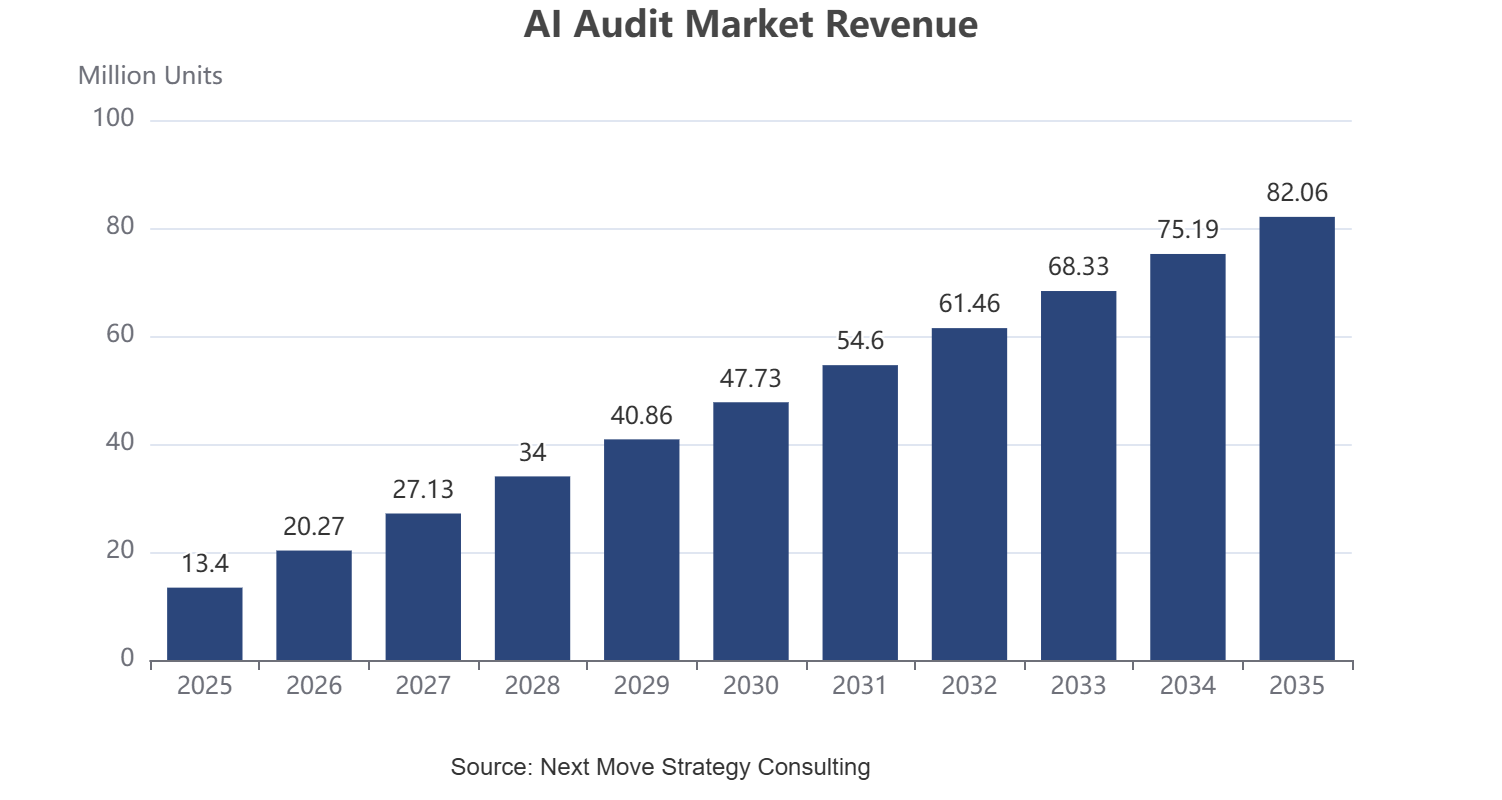
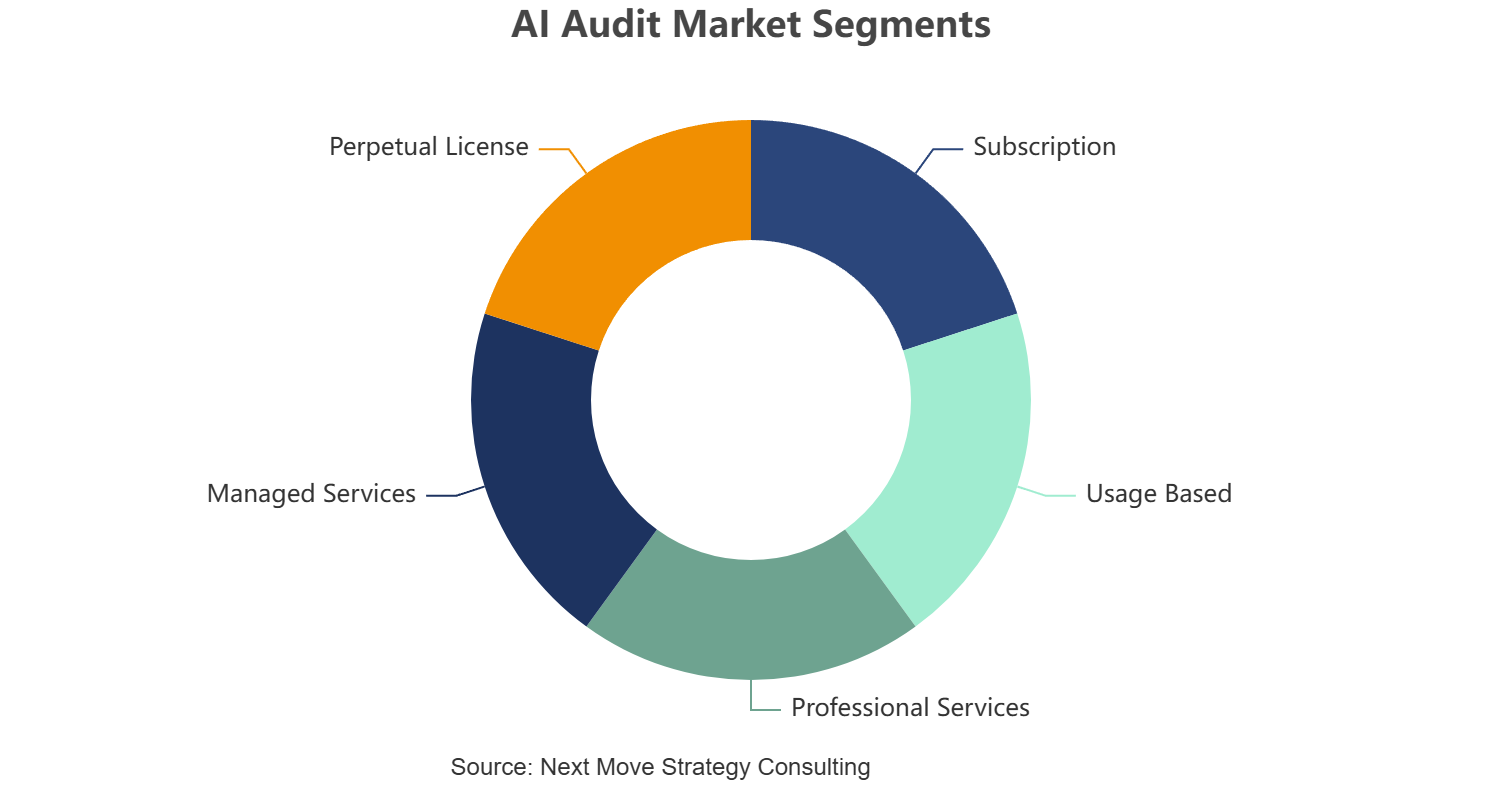
About the Author
 Mayurima Roy
— Mayurima Roy is Research Analyst at Next Move Strategy Consulting, where she has spent 4 years working across the firm's full industry coverage rather than a single fixed vertical. Her work centers on structured research, ongoing trend tracking, competitive assessment, and insight-led content development, translating complex market data into clear, decision-ready narratives that support informed client decision-making across diverse global industries, market sectors, and world regions every day.
Mayurima Roy
— Mayurima Roy is Research Analyst at Next Move Strategy Consulting, where she has spent 4 years working across the firm's full industry coverage rather than a single fixed vertical. Her work centers on structured research, ongoing trend tracking, competitive assessment, and insight-led content development, translating complex market data into clear, decision-ready narratives that support informed client decision-making across diverse global industries, market sectors, and world regions every day.
About the Reviewer
 Supradip Baul
— Supradip Baul is an accomplished business consultant and strategist with over a decade of rich experience in market intelligence, strategy, technology, and business transformation. His work has included rigorous qualitative and quantitative analysis across multiple industries, helping clients shape investment decisions and long-term roadmaps. Earlier in his career, he was associated with Gartner, where he contributed to industry-leading reports and market share analyses. He has worked with leading global companies and holds an MBA with a dual specialization in Marketing and Finance.
Supradip Baul
— Supradip Baul is an accomplished business consultant and strategist with over a decade of rich experience in market intelligence, strategy, technology, and business transformation. His work has included rigorous qualitative and quantitative analysis across multiple industries, helping clients shape investment decisions and long-term roadmaps. Earlier in his career, he was associated with Gartner, where he contributed to industry-leading reports and market share analyses. He has worked with leading global companies and holds an MBA with a dual specialization in Marketing and Finance.
At Next Move Strategy Consulting, we understand that insightful market research is the cornerstone of successful business decisions. That's why we employ a robust and multifaceted approach, combining various methodologies to deliver the most accurate and actionable data for our clients.

Research Landscape
We navigate the world of research with two primary approaches:
Qualitative Approach
Our qualitative research methodologies involve immersive techniques such as in-depth interviews, focus groups, and observational studies. By engaging directly with individuals and stakeholders, we uncover valuable insights that quantitative data alone may overlook.

Quantitative Research
In tandem with qualitative methodologies, NMSC leverages the power of Quantitative Research to provide a robust foundation of numerical insights. Through systematic data collection and analysis, we quantify patterns, preferences, and market trends, offering a comprehensive view of the business landscape.
Our quantitative research approach employs diverse tools, including surveys, experiments, and statistical modelling. These methodologies enable us to gather data from a large and representative sample, ensuring the statistical significance of our findings. By employing structured questionnaires and standardized data collection methods, we guarantee the reliability and validity of the information we present to our clients.
Quantitative research is particularly effective in measuring the prevalence of trends, assessing market size, and gauging the impact of various factors on consumer behavior. The numerical precision attained through this approach equips our clients with actionable insights, facilitating data-driven decision-making and strategy formulation.


Our Specialized Toolbox for Industry-Specific Market Research
We deploy a specialized arsenal of techniques tailored to meet your unique requirements. Here's a glimpse into our comprehensive toolbox:

Information Procurement
The stage entails acquiring market data or relevant information through various sources and methodologies.


Market Research Approach
We utilize both top-down and bottom-up approaches in market research analysis to achieve a comprehensive understanding of the market dynamics, leveraging the broad perspective of industry trends and macroeconomic factors alongside detailed insights from specific segments and individual companies.

Porters Five Forces Analysis
We conduct Porter's Five Forces analysis to evaluate the competitive landscape of an industry, providing us with insights into factors that affect profitability and strategic positioning.

SWOT Analysis

Forecasting
We utilize a forecasting model to predict future consumption by considering parameters like population, economics, regulations, market competition, drivers, constraints, technology, and pricing. We also employ statistical techniques such as multilinear regression, exponential smoothing, moving average, ARIMA, and Monte Carlo simulations for accurate predictions. In econometric forecasting, we analyzed short-term and long-term event impacts, attributing values based on regulatory frameworks, economic factors, and market events.





 Speak to Our Analyst