AI Deepfake Detection Market Size, Share, Growth & Forecast by Live Identity (Face, Voice, Session, Other Live Checks), Media Forensics (Image, Video, Audio, Text and Narrative, Multimodal), Provenance (Capture, Edit, Watermark Verification), Services, Deployment (Cloud API, SaaS, On-Premise, Edge SDK, Hybrid), Buyer, Channel, End User,(BFSI, Government Public Sector,and Others) Revenue Stream,((Subscription, Usage Based API, Embedded License, and Others)- Global Analysis 2025-2035
Industry: ICT & Media | Publishing Date: July 7, 2026 | Last Updated: September 30, 2026 | No of Pages: N/A | No. of Tables: N/A | No. of Figures: N/A | Format: PDF | Report Code: IC4993
What Is the AI Deepfake Detection Market Size?
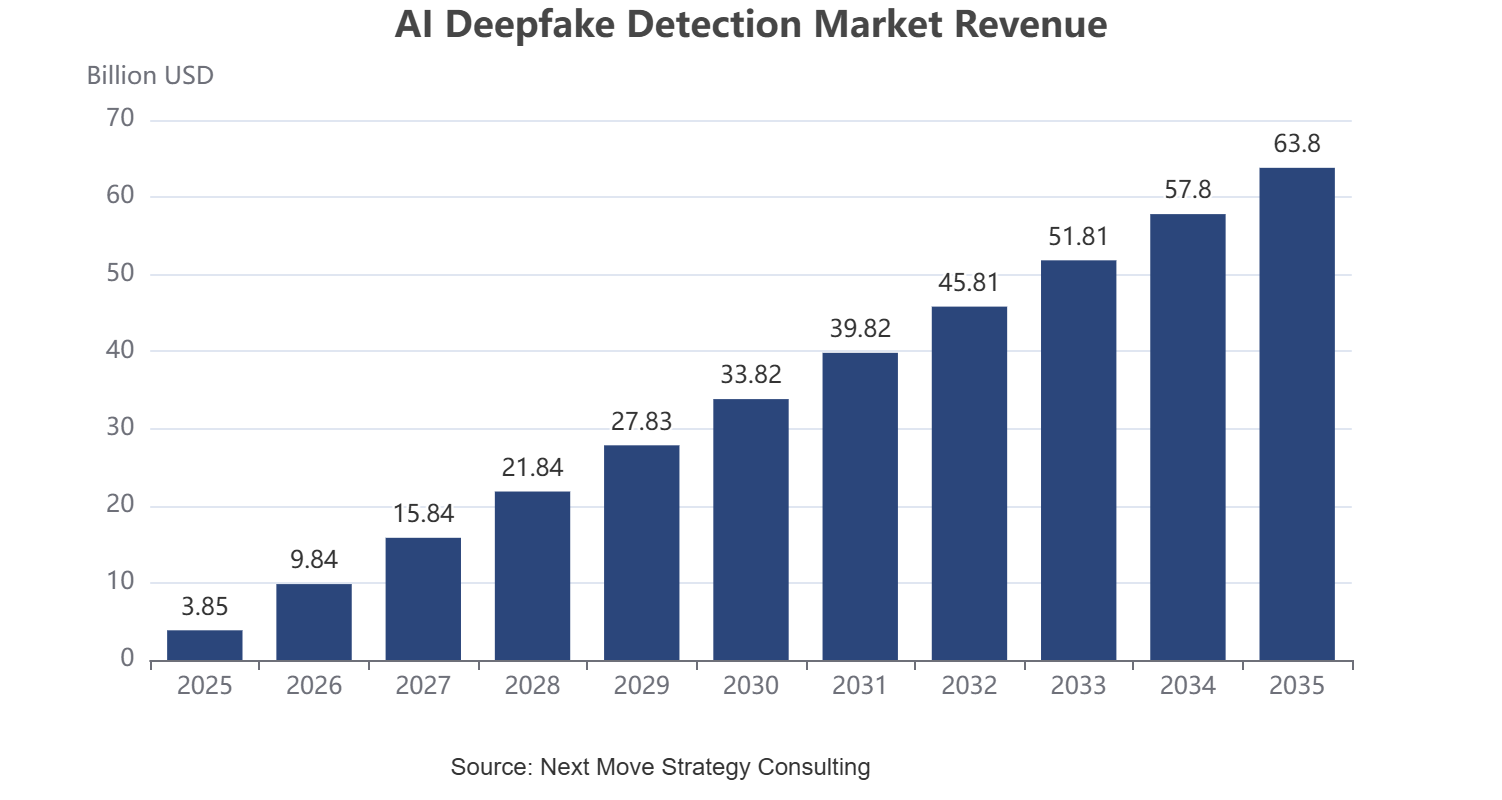
The global AI Deepfake Detection Market was valued at USD 3.85 billion in 2025 and is estimated to reach USD 5.10 billion in 2026. From our research, we found that escalating synthetic media fraud, biometric liveness verification mandates, and AI-driven content provenance standards are projected to drive the market to USD 63.8 billion by 2035, advancing at a CAGR of 32.4% from 2026 to 2035. Key growth drivers include rising deepfake-enabled financial fraud, regulatory mandates for synthetic content labeling, expanding enterprise identity verification budgets, and growing adoption of real-time voice and video authentication across BFSI, government, and media sectors.
|
Parameters |
Details |
|
Market Size in 2025 |
USD 3.85 Billion |
|
Market Size in 2026 |
USD 5.10 Billion |
|
Revenue Forecast in 2035 |
USD 63.8 Billion |
|
Growth Rate |
CAGR of 32.4% from 2026 to 2035 |
|
Analysis Period |
2025-2035 |
|
Base Year Considered |
2025 |
|
Forecast Period |
2026-2035 |
|
Market Size Estimation |
Billion USD |
|
Companies Profiled |
20 |
|
Countries Covered |
33 |
|
Market Share |
Top 10 |
AI Deepfake Detection Market Overview
What Is the AI Deepfake Detection Market?
The AI Deepfake Detection Market comprises software platforms, application programming interfaces, software development kits, and professional services that verify whether digital identities, images, video, audio, and text are authentic or synthetically generated. Through our market assessment, we observed that the market spans live identity verification, media forensics, and content provenance, serving enterprises, governments, platforms, and consumers seeking to counter fraud, misinformation, and impersonation risks associated with generative AI tools. The AI Deepfake Detection Market report covers segmentation, regional analysis, competitive landscape, and revenue forecasts through 2035.
How Has the AI Deepfake Detection Market Evolved?
The AI Deepfake Detection Market has progressed through three structural phases. The initial phase relied on rule-based forensic checks for static image manipulation. The second phase introduced machine learning classifiers trained on labeled deepfake datasets to flag manipulated video and audio. In our observation, the current phase centers on multimodal, real-time detection systems that combine liveness checks, voice biometrics, and content provenance signals such as cryptographic watermarking to counter increasingly realistic generative AI outputs across enterprise and consumer applications.
How Do Regulations Influence the AI Deepfake Detection Market?
Regulatory developments are a structural growth factor across the AI Deepfake Detection Market. The European Union's AI Act, under Article 50, requires providers of AI systems generating synthetic audio, image, video, or text to mark outputs as machine-readable and detectable, with deployer disclosure obligations for deepfakes applying from August 2026. We further analysed that India's Digital Personal Data Protection Act and the U.S. Federal Trade Commission's enforcement actions on AI-enabled impersonation are compelling enterprises, platforms, and governments to invest in detection, provenance verification, and identity assurance infrastructure.
How Is Technology Adoption Expanding Across the AI Deepfake Detection Market?
Technology adoption across the AI Deepfake Detection Market is accelerating as enterprises embed liveness checks, voice biometrics, and media forensics directly into onboarding, contact center, and content moderation workflows. Cloud APIs and SaaS platforms are lowering integration barriers for mid-market buyers, while edge SDKs enable on-device detection for video calls and mobile applications. Based on our market evaluation, we noticed that large enterprises increasingly deploy multimodal detection pipelines combining face, voice, session, and document forensics to address coordinated synthetic identity fraud across digital channels.
|
Key Takeaways |
|
By live identity, Face verification held the largest share at USD 2.00 billion in 2025, supported by widespread adoption of facial liveness checks across identity verification and onboarding workflows. Voice verification is the fastest-growing live identity sub-segment at a CAGR of 35.5% from 2026 to 2035, driven by surging voice cloning fraud across contact centers and financial services. |
|
By media forensics, Video forensics generated USD 1.35 billion in 2025, maintaining the largest share as video-based impersonation remains the most prevalent deepfake threat vector. Multimodal forensics is the fastest-growing media forensics sub-segment at a CAGR of 39.4% from 2026 to 2035, as enterprises adopt unified pipelines analyzing image, video, audio, and text signals together. |
|
By provenance, Capture Provenance led with USD 1.54 billion in 2025, reflecting growing adoption of camera-level content authentication standards. Watermark Verification is the fastest-growing provenance sub-segment at a CAGR of 37.3% from 2026 to 2035, as cryptographic watermarking standards scale across generative AI platforms. |
|
By services, Implementation services generated USD 1.93 billion in 2025, representing the dominant services sub-segment as enterprises integrate detection APIs and SDKs into existing identity and content workflows. Model Tuning is the fastest-growing services sub-segment at a CAGR of 35.6% from 2026 to 2035, reflecting continuous retraining needs as generative AI models evolve. |
|
By deployment, Cloud API generated USD 1.46 billion in 2025, holding the largest deployment share due to flexible integration and rapid scalability. Edge SDK is the fastest-growing deployment mode at a CAGR of 43.1% from 2026 to 2035, driven by on-device, real-time detection requirements for mobile and video conferencing applications. |
|
By buyer, Enterprise buyers generated USD 1.46 billion in 2025, commanding the dominant share. Government is the fastest-growing buyer segment at a CAGR of 35.1% from 2026 to 2035, as public sector agencies adopt detection tools for election integrity, benefits fraud, and law enforcement investigations. |
|
By channel, Direct channel sales generated USD 1.85 billion in 2025. Marketplace is the fastest-growing channel at a CAGR of 40.4% from 2026 to 2035, as cloud hyperscaler marketplaces accelerate procurement of detection APIs. |
|
By end user, BFSI generated USD 1.00 billion in 2025, leading all end-user verticals. Education is the fastest-growing end-user vertical at a CAGR of 46.1% from 2026 to 2035, while Healthcare is the second-fastest-growing vertical at a CAGR of 39.7%. |
|
By revenue stream, Subscription revenue generated USD 1.62 billion in 2025, the largest revenue stream. Usage Based API is the fastest-growing revenue stream at a CAGR of 35.0% from 2026 to 2035, reflecting consumption-based pricing aligned with detection call volumes. |
|
North America held the largest regional share at USD 1.54 billion in 2025, projected to reach USD 20.42 billion by 2035 at a CAGR of 29.5%, supported by concentrated vendor presence, mature enterprise fraud budgets, and early regulatory engagement on synthetic media. |
|
Latin America is the fastest-growing region at a CAGR of 36.3% from 2026 to 2035, while Asia Pacific is the fastest-growing major region at a CAGR of 36.0%, both propelled by rapid digital identity rollouts, fintech expansion, and rising deepfake fraud incidents. |
|
The United States is the largest country market, underpinned by concentrated vendor headquarters, advanced enterprise fraud prevention budgets, and active federal and state-level regulatory attention on synthetic media and biometric identity. |
|
India is among the fastest-growing country markets, propelled by the Digital Personal Data Protection Act, large-scale digital identity infrastructure, and rapidly expanding fintech and telecom fraud prevention investments. |
Key Emerging Trends in the AI Deepfake Detection Market
How Is Real-Time Voice Cloning Detection Reshaping the AI Deepfake Detection Market?
Real-time voice cloning detection is becoming a core capability across the AI Deepfake Detection Market as fraudsters use synthetic voices to bypass contact center authentication. We found that vendors such as Pindrop have expanded voice intelligence platforms to score live calls for synthetic speech artifacts within milliseconds. Banks, insurers, and telecom providers are embedding these checks into interactive voice response systems, transforming voice biometrics from a convenience feature into a frontline fraud control across enterprise contact center operations.
How Is Multimodal Fusion Detection Transforming the AI Deepfake Detection Market?
Multimodal fusion, combining face, voice, document, and behavioral session signals into a single risk score, is reshaping the AI Deepfake Detection Market. Through our market evaluation, we observed that vendors including iProov and Jumio have integrated liveness checks with document forensics and device telemetry to counter coordinated synthetic identity attacks. This convergence reduces reliance on any single detection modality, improves accuracy against increasingly sophisticated generative adversarial network outputs, and is becoming a procurement requirement for enterprise identity verification platforms.
How Is Content Provenance Becoming a Core Layer of the AI Deepfake Detection Market?
Content provenance verification, anchored by the Coalition for Content Provenance and Authenticity's C2PA standard, is emerging as a structural layer within the AI Deepfake Detection Market. We noticed that C2PA had surpassed 6,000 members and affiliates by January 2026, with camera makers and smartphone manufacturers embedding cryptographic Content Credentials at capture. This shift extends detection from post-hoc forensic analysis toward verifiable provenance chains, creating new demand for watermark verification and capture provenance services among media, government, and platform stakeholders.
How Are Edge and On-Device Deployment Models Expanding the AI Deepfake Detection Market?
Edge and on-device deployment models are expanding access across the AI Deepfake Detection Market as smartphone chipsets gain dedicated AI inference capacity. Based on our analysis, we found that real-time detection embedded directly into video conferencing applications and mobile banking apps reduces latency and keeps sensitive biometric data on-device. This trend is lowering integration costs for SMB and consumer-facing platforms while supporting hybrid architectures that combine on-device pre-screening with cloud-based forensic escalation for higher-risk cases.
SWOT Analysis of the AI Deepfake Detection Market
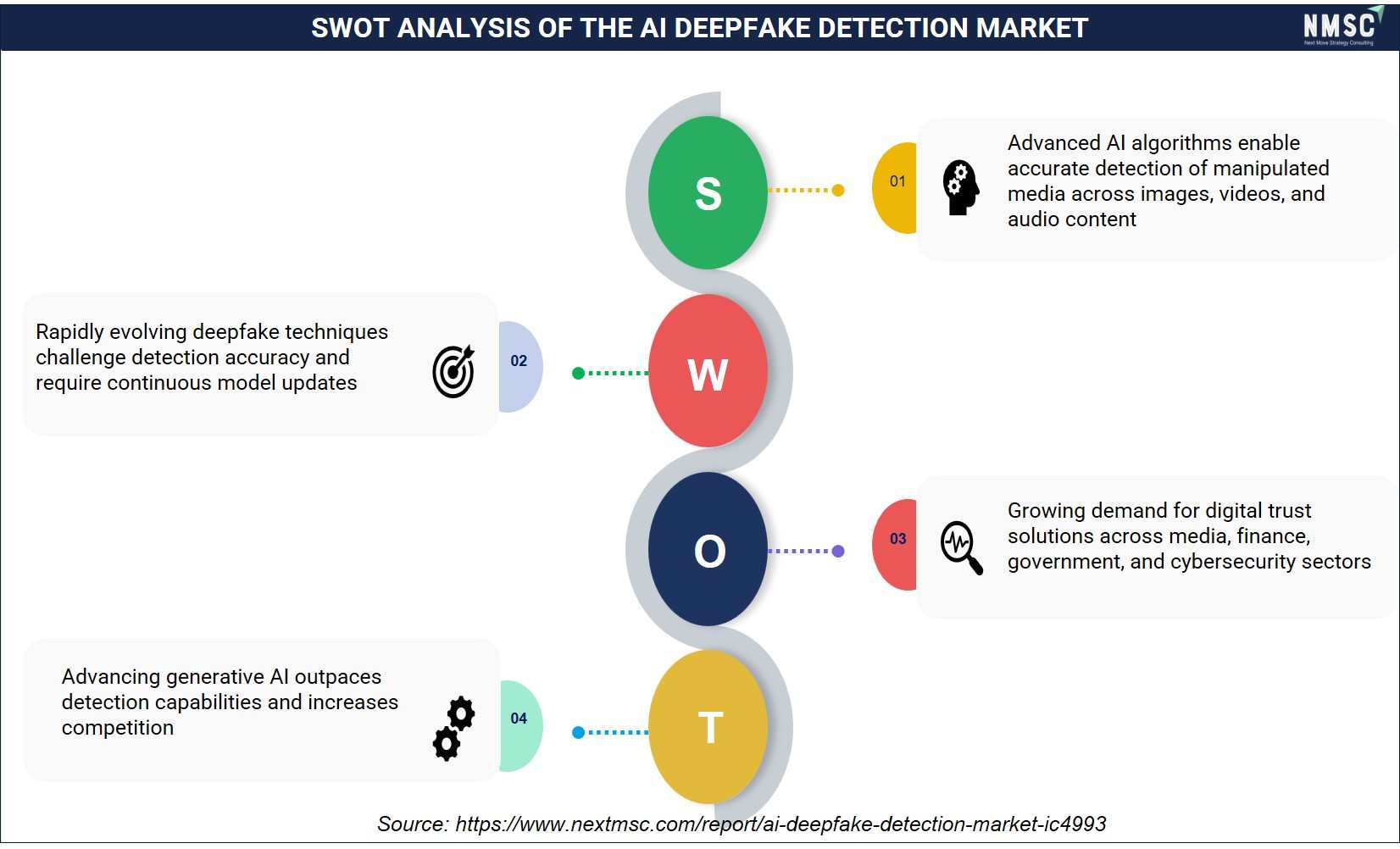
Based on our comprehensive assessment, we found that the AI Deepfake Detection Market is supported by continuous advancements in artificial intelligence, machine learning, and multimodal content analysis technologies that enhance the identification of manipulated media. Growing concerns regarding misinformation, identity fraud, and digital trust are creating significant growth opportunities across government, media, financial services, and cybersecurity sectors. However, rapidly evolving deepfake generation techniques require constant algorithm upgrades, while increasing competition and technological complexity present ongoing challenges for solution providers.
What Are the Key Market Drivers, Breakthroughs, and Investment Opportunities That Will Shape the AI Deepfake Detection Market in the Next Decade?
|
Drivers / Trends / Restraints |
(+/-) % Impact on CAGR Forecast |
Geographic Relevance |
Impact Timeline |
|
Escalating Deepfake-Enabled Financial Fraud |
+3.2% |
Global (led by North America, APAC) |
2025-2030 |
|
Regulatory Mandates for Synthetic Content Disclosure |
+2.4% |
Europe, North America, APAC |
2025-2032 |
|
Expansion of Real-Time VoiceAuthentication |
+2.0% |
Global |
2025-2030 |
|
Growth of Content Provenance and Watermarking Standards |
+1.7% |
North America, Europe |
2026-2035 |
|
Rising Accessibility of Generative AI Models |
+1.5% |
Global |
2026-2032 |
|
Government Digital Identity Modernization Programs |
+1.3% |
Asia Pacific, MEA, Latin America |
2026-2035 |
|
Edge AI Chipsets Enabling On-Device Detection |
+1.1% |
North America, Asia Pacific |
2027-2035 |
|
High False Positive Rates Undermining Trust |
-1.1% |
Global |
Ongoing |
|
Shortage of Skilled Forensic AI Talent |
-0.7% |
North America, Europe |
2025-2029 |
|
Fragmented Regulatory Standards Across Jurisdictions |
-0.9% |
Europe, Asia Pacific, North America |
Ongoing |
What Are the Drivers of the AI Deepfake Detection Market Growth?
How Is the Rise in Deepfake-Enabled Financial Fraud Driving the AI Deepfake Detection Market?
Deepfake-enabled fraud is accelerating enterprise investment in detection infrastructure across the AI Deepfake Detection Market. According to the FBI's Internet Crime Complaint Center 2024 Internet Crime Report, total reported cybercrime losses reached USD 16.6 billion, a 33% increase over 2023, with AI-enabled business email compromise alone accounting for USD 2.77 billion in losses across 21,442 incidents. Banks, insurers, and telecom operators are responding by embedding voice, face, and document verification into onboarding and transaction authorization workflows.
How Are EU AI Act Transparency Requirements Driving the AI Deepfake Detection Market?
The European Union's AI Act is a direct regulatory catalyst for the AI Deepfake Detection Market. Under Article 50 of Regulation (EU) 2024/1689, providers of AI systems generating synthetic audio, image, video, or text must ensure outputs are marked in a machine-readable format and detectable as artificially generated, with deployer disclosure obligations for deepfakes applying from August 2026. This mandate is compelling platforms, broadcasters, and enterprises operating in the European Union to adopt detection and provenance verification tools ahead of enforcement.
How Does Expanding Digital Identity Infrastructure Drive the AI Deepfake Detection Market?
Government-led digital identity programs are expanding the addressable base for the AI Deepfake Detection Market. India's Digital Personal Data Protection Act 2023, notified under the Ministry of Electronics and Information Technology, establishes governance obligations for entities processing biometric and identity data at national scale. From our research, we found that large-scale digital identity ecosystems such as India's Aadhaar framework increasingly require liveness and deepfake detection layers to prevent synthetic identity fraud during remote onboarding and benefits disbursement processes.
What Are the Growth Inhibitors of the AI Deepfake Detection Market?
How Do High False Positive Rates Restrain the AI Deepfake Detection Market?
False positive and false negative rates remain a structural restraint on the AI Deepfake Detection Market. Detection accuracy varies significantly across video compression levels, lighting conditions, and languages, leading to user friction during legitimate onboarding and occasional failure to catch sophisticated synthetic media. We noticed that the U.S. National Institute of Standards and Technology has highlighted the need for standardized evaluation benchmarks for AI system trustworthiness, underscoring that inconsistent accuracy across detection vendors continues to slow enterprise procurement decisions and extend vendor evaluation cycles.
How Does Regulatory Fragmentation Restrain the AI Deepfake Detection Market?
Regulatory fragmentation across jurisdictions constrains global scalability within the AI Deepfake Detection Market. The European Union's AI Act, the United States' state-by-state approach to biometric privacy and deepfake disclosure laws, and differing data residency requirements across Asia Pacific create overlapping and sometimes conflicting compliance obligations for detection vendors. We assessed that this patchwork increases the cost of building globally deployable detection products and extends sales cycles for vendors serving multinational enterprise and government clients across multiple regulatory regimes.
What Are the Growth Opportunities in the AI Deepfake Detection Market?
How Does Content Provenance Standardization Create Opportunity in the AI Deepfake Detection Market?
The Coalition for Content Provenance and Authenticity's C2PA standard is creating a durable opportunity within the AI Deepfake Detection Market. We found that C2PA membership exceeded 6,000 organizations and affiliates by January 2026, with major camera and smartphone manufacturers embedding Content Credentials at the point of capture. Vendors offering watermark verification and capture provenance services are positioned to capture demand from media organizations, government agencies, and platforms seeking to comply with emerging content authenticity requirements.
How Does Edge AI Hardware Create Opportunity in the AI Deepfake Detection Market?
Advances in edge AI chipsets are creating new product opportunities within the AI Deepfake Detection Market. On-device inference capacity in modern smartphones and laptops enables real-time face and voice liveness checks without cloud round-trips, reducing latency and data exposure. Through our analysis, we observed that vendors offering edge SDKs can address video conferencing, mobile banking, and consumer messaging use cases that previously could not support cloud-dependent detection, opening a substantial total addressable market among SMB and consumer-facing platform buyers.
How Does Digital Public Infrastructure Expansion Create Opportunity in the AI Deepfake Detection Market?
Digital public infrastructure programs across Asia Pacific, the Middle East, and Latin America present a structural opportunity for the AI Deepfake Detection Market. India's Digital Personal Data Protection Act and national digital identity frameworks across Southeast Asia and the Gulf Cooperation Council are creating demand for liveness verification and synthetic identity detection at population scale. Based on our market evaluation, we noticed that government procurement of detection infrastructure for benefits disbursement, voter verification, and border control is an early but structurally significant demand driver.
How Is the AI Deepfake Detection Market Segmented in This Report, and What Are the Key Insights from the Segmentation Analysis?
How Does Live Identity Segmentation Define the AI Deepfake Detection Market?
|
Live Identity Segment |
2025 (USD Bn) |
2035 (USD Bn) |
CAGR (%) |
|
Face |
2.00 |
28.07 |
30.2% |
|
Voice |
0.92 |
19.14 |
35.5% |
|
Session |
0.62 |
11.48 |
33.9% |
|
Other Live Checks |
0.31 |
5.11 |
32.3% |
Based on our analysis of enterprise identity verification deployments, we observed that the AI Deepfake Detection Market's live identity dimension spans Face, Voice, Session, and Other Live Checks. Face verification leads at USD 2.00 billion in 2025, anchored by widespread liveness check adoption in banking and onboarding workflows. Voice verification is the fastest-growing sub-segment at a CAGR of 35.5% from 2026 to 2035, reflecting surging synthetic voice fraud in contact centers. Session checks, which analyze behavioral signals across a user's device interaction, are gaining traction as a supplementary layer against coordinated synthetic identity attacks.
How Does Media Forensics Segmentation Shape the AI Deepfake Detection Market?
|
Media Forensics Segment |
2025 (USD Bn) |
2035 (USD Bn) |
CAGR (%) |
|
Image |
0.96 |
12.76 |
29.5% |
|
Video |
1.35 |
19.14 |
30.4% |
|
Audio |
0.69 |
11.48 |
32.4% |
|
Text and Narrative |
0.23 |
5.10 |
36.3% |
|
Multimodal |
0.46 |
12.76 |
39.4% |
|
Other Forensic Checks |
0.16 |
2.56 |
32.4% |
Through our market assessment, we observed that the Media Forensics dimension of the AI Deepfake Detection Market encompasses Image, Video, Audio, Text and Narrative, Multimodal, and Other Forensic Checks. Video forensics dominates at USD 1.35 billion in 2025 given the prevalence of face-swap video attacks. Audio forensics is expanding rapidly as voice cloning fraud escalates. Multimodal forensics is the fastest-growing sub-segment at a CAGR of 39.4% from 2026 to 2035, as enterprise security teams adopt unified detection pipelines that simultaneously analyze multiple signal types to counter sophisticated coordinated synthetic media attacks.
How Does Provenance Segmentation Define Value Creation in the AI Deepfake Detection Market?
|
Provenance Segment |
2025 (USD Bn) |
2035 (USD Bn) |
CAGR (%) |
|
Capture Provenance |
1.54 |
20.42 |
29.5% |
|
Edit Provenance |
0.96 |
14.04 |
30.7% |
|
Watermark Verification |
0.96 |
22.97 |
37.3% |
|
Other Provenance |
0.39 |
6.37 |
32.4% |
Our analysis indicates that the Provenance dimension of the AI Deepfake Detection Market includes Capture Provenance, Edit Provenance, Watermark Verification, and Other Provenance. Capture Provenance leads at USD 1.54 billion in 2025, driven by C2PA-standard adoption in cameras and mobile devices. Watermark Verification is the fastest-growing sub-segment at a CAGR of 37.3% from 2026 to 2035, reflecting demand from broadcasters, social platforms, and regulators for cryptographic confirmation of content authenticity from AI-generated and camera-captured media sources.
What Services Drive Revenue Across the AI Deepfake Detection Market?
|
Services Segment |
2025 (USD Bn) |
2035 (USD Bn) |
CAGR (%) |
|
Implementation |
1.93 |
25.52 |
29.5% |
|
Model Tuning |
1.16 |
24.24 |
35.6% |
|
Investigation Support |
0.76 |
14.04 |
33.7% |
Based on NMSC's research, we found that the Services dimension of the AI Deepfake Detection Market spans Implementation, Model Tuning, and Investigation Support. Implementation services dominate at USD 1.93 billion in 2025, reflecting the significant engineering effort required to integrate detection APIs into existing enterprise identity and content workflows. Model Tuning is the fastest-growing sub-segment at a CAGR of 35.6% from 2026 to 2035, as enterprises continuously retrain detection models against novel generative AI architectures. Investigation Support serves law enforcement and enterprise fraud teams with expert forensic analysis and evidence preparation.
How Does Deployment Mode Shape Revenue Distribution in the AI Deepfake Detection Market?
|
Deployment Segment |
2025 (USD Bn) |
2035 (USD Bn) |
CAGR (%) |
|
Cloud API |
1.46 |
21.69 |
31.0% |
|
SaaS |
1.08 |
17.23 |
32.0% |
|
On Premise |
0.62 |
7.66 |
28.7% |
|
Hybrid |
0.46 |
8.93 |
34.4% |
|
Edge SDK |
0.23 |
8.29 |
43.1% |
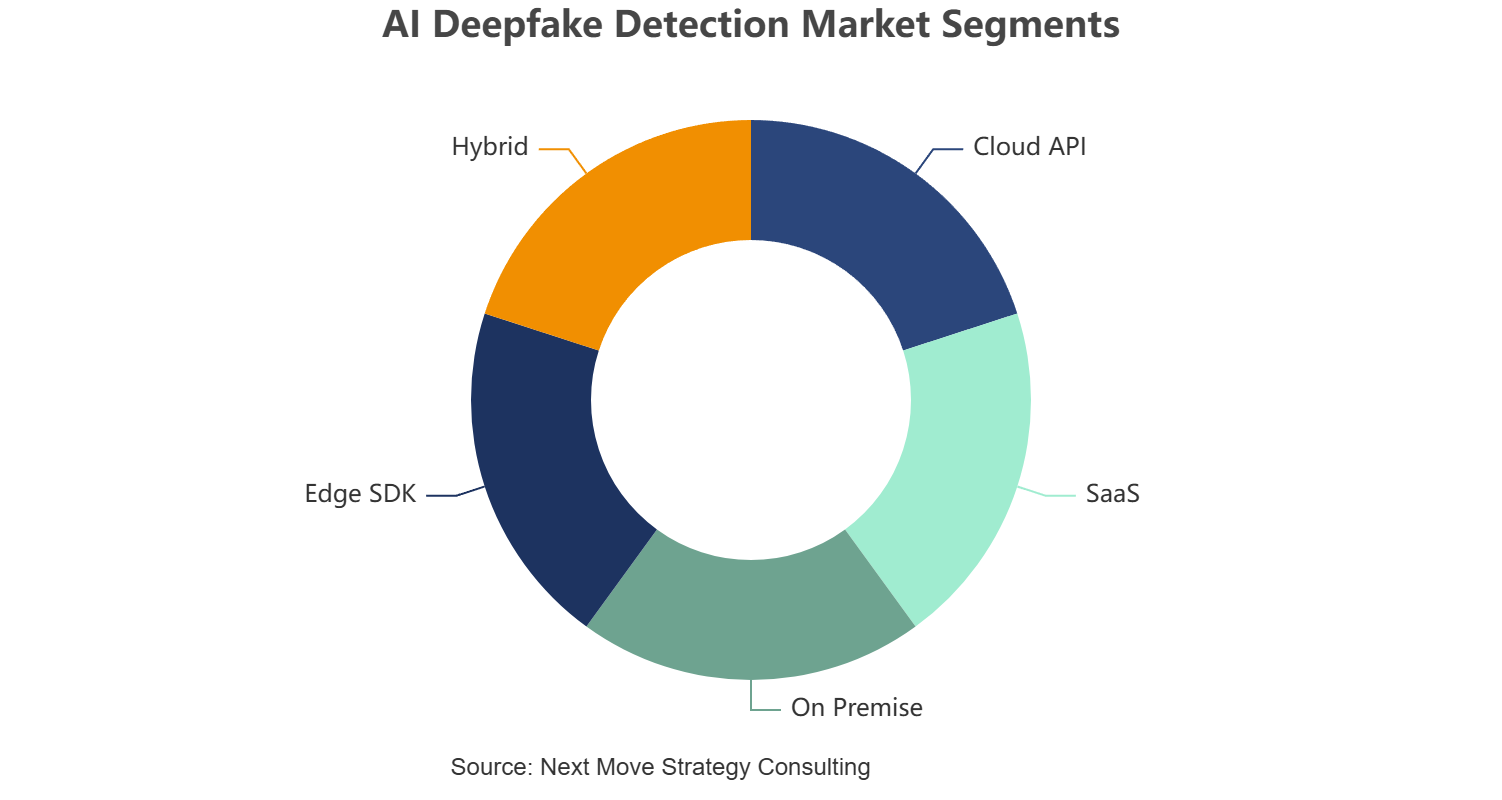
NMSC's analysis indicates that the Deployment dimension spans Cloud API, SaaS, On-Premise, Hybrid, and Edge SDK models. Cloud API dominates at USD 1.46 billion in 2025 due to ease of integration and elastic scalability for high-volume identity checks. Edge SDK is the fastest-growing sub-segment at a CAGR of 43.1% from 2026 to 2035, as on-device inference eliminates cloud round-trips for real-time deepfake detection in video calls and mobile banking. On-Premise deployments remain relevant for government agencies and financial institutions with strict data residency requirements.
Which Buyer Segments Drive the AI Deepfake Detection Market?
|
Buyer Segment |
2025 (USD Bn) |
2035 (USD Bn) |
CAGR (%) |
|
Enterprise |
1.46 |
21.05 |
30.6% |
|
Government |
0.69 |
14.04 |
35.1% |
|
Platform |
0.92 |
15.31 |
32.4% |
|
SMB |
0.50 |
8.29 |
32.4% |
|
Consumer |
0.28 |
5.11 |
34.2% |
Our findings suggest that the Buyer dimension of the AI Deepfake Detection Market encompasses Enterprise, Government, Platform, SMB, and Consumer categories. Enterprise buyers dominate at USD 1.46 billion in 2025, anchored by BFSI, media, and telecom organizations building internal fraud operations centers. Government is the fastest-growing buyer segment at a CAGR of 35.1% from 2026 to 2035, driven by public sector programs for election integrity, benefits verification, border control, and law enforcement investigations. SMB adoption is expanding via SaaS and marketplace channels offering subscription-based detection without significant upfront investment.
How Are Channels Reshaping Go-to-Market Strategies in the AI Deepfake Detection Market?
|
Channel Segment |
2025 (USD Bn) |
2035 (USD Bn) |
CAGR (%) |
|
Direct |
1.85 |
25.52 |
30.1% |
|
Partner |
1.08 |
17.86 |
32.4% |
|
OEM |
0.53 |
8.94 |
32.4% |
|
Marketplace |
0.39 |
11.48 |
40.4% |
We noticed that the Channel dimension of the AI Deepfake Detection Market spans Direct, Partner, OEM, and Marketplace channels. Direct sales dominate at USD 1.85 billion in 2025 given enterprise preference for vendor-led integration support on identity infrastructure. Marketplace is the fastest-growing channel at a CAGR of 40.4% from 2026 to 2035, as cloud hyperscaler marketplace listings accelerate procurement through existing cloud spend commitments. OEM licensing is gaining traction as identity platform vendors embed detection capabilities directly into their core authentication products through technology partnerships.
Which End-User Verticals Generate the Most Value in the AI Deepfake Detection Market?
|
End User Segment |
2025 (USD Bn) |
2035 (USD Bn) |
CAGR (%) |
|
BFSI |
1.00 |
14.04 |
30.2% |
|
Government Public Sector |
0.39 |
7.02 |
33.7% |
|
Media Broadcast |
0.31 |
4.47 |
30.7% |
|
Telecom Contact Center |
0.46 |
7.02 |
31.3% |
|
Social Platform |
0.62 |
9.56 |
31.6% |
|
General Enterprise |
0.69 |
10.85 |
31.7% |
|
Law Enforcement Judiciary |
0.19 |
4.47 |
37.0% |
|
Healthcare |
0.13 |
3.82 |
39.7% |
|
Education |
0.06 |
2.55 |
46.1% |
From our assessment, the End User dimension of the AI Deepfake Detection Market covers BFSI, Government Public Sector, Media Broadcast, Telecom Contact Center, Social Platform, General Enterprise, Law Enforcement Judiciary, Healthcare, and Education. BFSI leads at USD 1.00 billion in 2025 given its intense exposure to synthetic identity fraud in account opening and wire transfer authorization. Education is the fastest-growing vertical at a CAGR of 46.1% from 2026 to 2035, with Healthcare second at 39.7%, both driven by rapidly rising AI-enabled academic fraud and patient identity impersonation incidents respectively.
How Do Revenue Streams Define Monetization in the AI Deepfake Detection Market?
|
Revenue Stream Segment |
2025 (USD Bn) |
2035 (USD Bn) |
CAGR (%) |
|
Subscription |
1.62 |
22.97 |
30.4% |
|
Usage Based API |
1.08 |
21.69 |
35.0% |
|
Embedded License |
0.46 |
8.93 |
34.4% |
|
Professional Services |
0.69 |
10.21 |
30.9% |
Our analysis shows that the Revenue Stream dimension of the AI Deepfake Detection Market comprises Subscription, Usage Based API, Embedded License, and Professional Services. Subscription revenue dominates at USD 1.62 billion in 2025 as enterprises prefer predictable recurring costs for continuous detection coverage. Usage Based API is the fastest-growing revenue stream at a CAGR of 35.0% from 2026 to 2035, aligning vendor billing with actual detection call volumes and supporting flexible adoption by platforms processing variable synthetic media threat loads. Embedded License monetization is expanding as identity platform vendors build detection into core products.
Pain Point Analysis of the AI Deepfake Detection Market
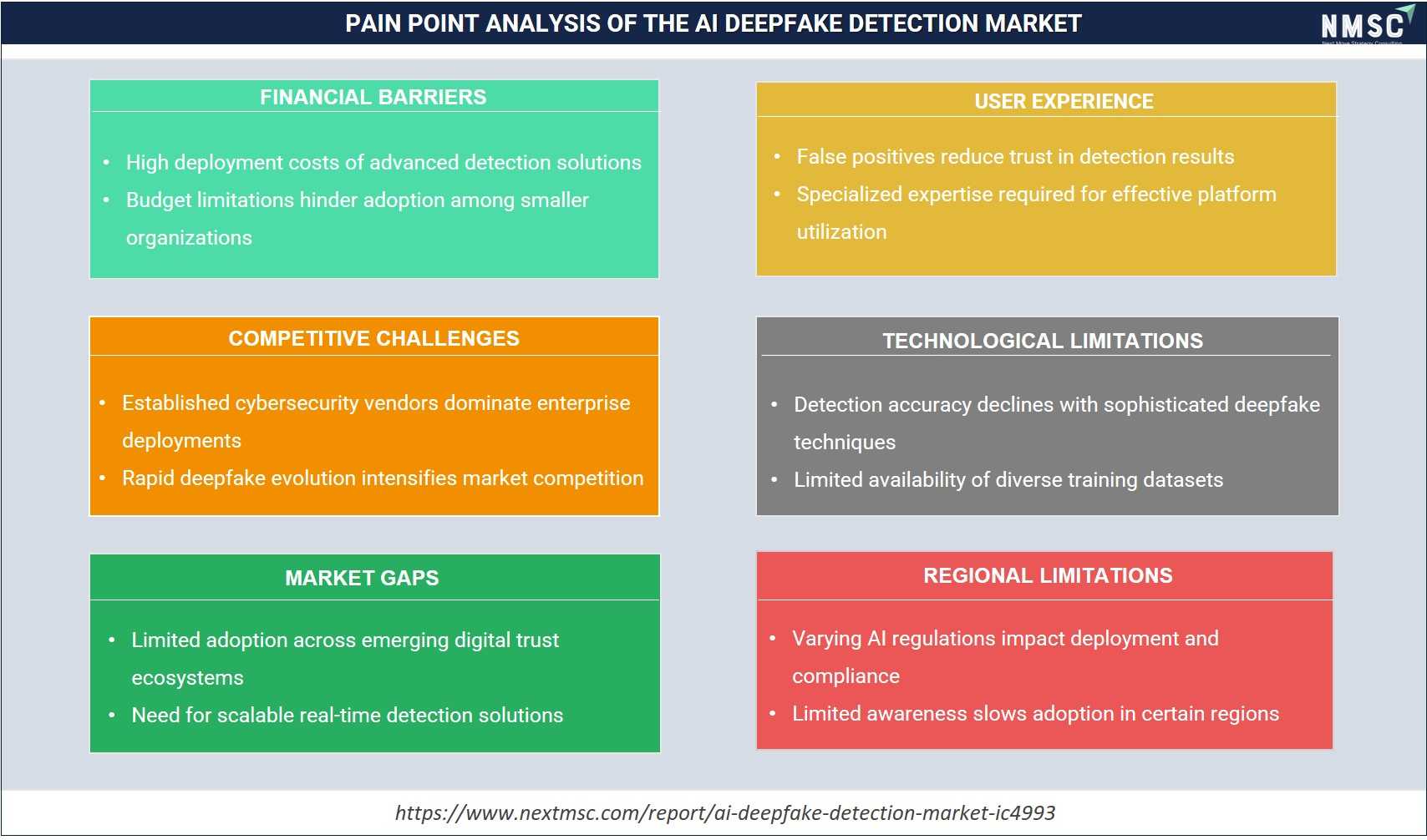
Based on our comprehensive assessment, we found that the AI Deepfake Detection Market faces several adoption and implementation challenges despite strong demand growth. High deployment costs, specialized technical requirements, and concerns regarding false-positive detections can affect user confidence and operational efficiency. Furthermore, increasingly sophisticated deepfake content continues to challenge detection accuracy, requiring continuous model refinement and extensive training datasets. Regulatory variations across regions and limited awareness in emerging markets further constrain widespread adoption and market scalability.
Regional Outlook
Geographic Performance Snapshot
|
Region |
2025 (USD Bn) |
2035 (USD Bn) |
CAGR (%) |
Key Driver |
|
North America |
1.54 |
20.42 |
29.5% |
Concentrated vendor HQ, enterprise fraud budgets |
|
Europe |
0.92 |
13.40 |
30.7% |
EU AI Act compliance, biometric regulation |
|
Asia Pacific |
0.89 |
19.14 |
36.0% |
Digital identity programs, fintech fraud surge |
|
Middle East and Africa |
0.27 |
5.74 |
35.8% |
Vision 2030, national AI strategies |
|
Latin America |
0.23 |
5.10 |
36.3% |
Fintech expansion, digital onboarding growth |
North America AI Deepfake Detection Market
North America leads the AI Deepfake Detection Market at USD 1.54 billion in 2025, projected to reach USD 20.42 billion by 2035 at a CAGR of 29.5%. The region benefits from the global concentration of detection platform vendors, the highest enterprise cybersecurity budgets, and active federal regulatory attention on AI-generated content. The U.S. Federal Trade Commission's prohibition on AI-enabled impersonation and the FBI's documented escalation of AI-assisted fraud losses are compelling financial institutions, social platforms, and media organizations to scale detection investments across enterprise and government-facing deployments.
U.S. AI Deepfake Detection Market
Based on our engagements with industry stakeholders, the United States is the largest single national market in the AI Deepfake Detection Market, representing over 80% of North American revenue in 2025. Demand structures are concentrated in BFSI, social platforms, and government. Vendors including Reality Defender, Pindrop, Jumio, and Truepic maintain U.S. headquarters. The FBI's 2024 Internet Crime Report documenting USD 16.6 billion in cybercrime losses, including USD 2.77 billion in AI-enabled business email compromise, directly drives enterprise budget allocation toward synthetic identity and voice detection platforms.
Canada AI Deepfake Detection Market
Through our analysis, Canada represents approximately 12% of North American AI Deepfake Detection revenue. Canadian financial institutions are among the most sophisticated enterprise buyers, integrating liveness verification into digital banking software and investment account onboarding. The Office of the Privacy Commissioner of Canada actively enforces the Personal Information Protection and Electronic Documents Act, creating compliance pressure for biometric identity solutions. The government's Digital Ambition strategy is expanding public sector demand for identity assurance tools, supporting liveness and voice detection adoption across financial services and insurance.
Mexico AI Deepfake Detection Market
From our assessment, Mexico is the fastest-growing AI Deepfake Detection market in North America. A rapidly expanding fintech sector, with over 500 financial technology firms operating under the Ley Fintech regulatory framework, is driving demand for digital identity verification and liveness detection. The National Commission for the Protection and Defense of Financial Services Users regulates financial institution customer identification obligations. Growing e-commerce penetration and digital onboarding across banking and insurance create sustained demand for face and voice detection services integrated into mobile-first customer acquisition workflows.
Europe AI Deepfake Detection Market
Europe is the second-largest region in the AI Deepfake Detection Market at USD 0.92 billion in 2025, forecast to reach USD 13.40 billion by 2035 at a CAGR of 30.7%. The EU AI Act's Article 50 transparency obligations, applying from August 2026, are the region's primary structural growth catalyst. Regulatory mandates for synthetic content labeling, combined with GDPR's strict biometric data governance requirements under Article 9, are compelling enterprises and platforms across the European Union to invest in detection, watermark verification, and provenance tools. Sovereign and on-premise deployment preferences are shaping vendor product roadmaps for European compliance.
UK AI Deepfake Detection Market
Based on our engagements, the United Kingdom is the largest national AI Deepfake Detection market in Europe. The Financial Conduct Authority's digital identity verification standards for regulated firms and the Online Safety Act's obligations on platforms to remove manipulated content are primary regulatory drivers. Post-Brexit, the UK maintains GDPR-equivalent standards through UK GDPR, preserving enterprise compliance requirements for biometric data processing. London-based financial institutions and insurance firms are early adopters of multimodal deepfake detection integrated into identity verification and fraud operations center workflows.
Germany AI Deepfake Detection Market
According to evaluation of Germany's technology adoption landscape, Germany is the second-largest European AI Deepfake Detection market. German enterprises are stringent data privacy buyers, requiring on-premise or EU-sovereign cloud detection deployments compliant with the Bundesdatenschutzgesetz. The Federal Office for Information Security's cloud certification framework influences procurement requirements for enterprise identity and detection platforms. Manufacturing and automotive sector adoption of synthetic media detection for supplier verification and executive communication integrity represents an emerging use case alongside financial services and public sector deployments.
France AI Deepfake Detection Market
Through our analysis, France is the third-largest European AI Deepfake Detection market. The Commission Nationale de l'Informatique et des Libertés is among Europe's most active biometric data regulators, requiring explicit consent and data minimization for facial recognition and liveness verification systems. The France 2030 national AI investment program includes provisions for content authenticity and cybersecurity research. French media organizations, public broadcasters, and government agencies are investing in content provenance verification tools ahead of EU AI Act enforcement. OVHcloud's sovereign hosting infrastructure supports local data residency requirements.
Italy AI Deepfake Detection Market
From our assessment, Italy is a growing AI Deepfake Detection market supported by financial services, telecommunications, and public administration adoption. The Garante per la Protezione dei Dati Personali has taken active enforcement positions on biometric data processing, shaping enterprise deployment architectures toward privacy-by-design identity verification. The Piano Nazionale di Ripresa e Resilienza is directing investment toward public sector digital transformation, creating demand for identity assurance and detection tools in government service delivery. Italian banks and telecom operators are expanding contact center voice authentication programs.
Spain AI Deepfake Detection Market
Based on our market evaluation, Spain demonstrates growing momentum in the AI Deepfake Detection Market. The Agencia Espanola de Proteccion de Datos actively enforces biometric data processing restrictions under GDPR, requiring compliant liveness verification architectures from financial and insurance sector adopters. Spanish banking groups and fintech companies are integrating facial liveness detection into mobile banking onboarding workflows. The Agenda Espana Digital 2026 supports broader enterprise digitalization investment. Public sector demand for document and identity verification is expanding through national e-government service modernization programs.
Sweden AI Deepfake Detection Market
Through our analysis, Sweden is a high-per-capita adopter within the European AI Deepfake Detection Market. The Integritetsskyddsmyndigheten enforces GDPR biometric data obligations and has issued guidance on AI system transparency requirements that shapes enterprise detection platform architecture. Sweden's advanced digital banking sector, led by institutions such as Swedbank and SEB, deploys liveness and voice verification across digital channels. Government e-identification infrastructure through BankID, used by over eight million residents for digital authentication, creates an established baseline for enterprise-grade identity assurance investment.
Denmark AI Deepfake Detection Market
Based on our analysis, Denmark is among the most digitally advanced AI Deepfake Detection markets in Scandinavia. Consistent top rankings in the EU Digital Economy and Society Index reflect high digital literacy and rapid enterprise technology adoption. Danish financial institutions, healthcare organizations, and public sector agencies are early adopters of liveness checks integrated into digital service delivery. The Datatilsynet actively enforces GDPR and has emphasized synthetic media risks in its advisory guidance to data processors, creating compliance-driven investment in detection and content authenticity verification capabilities.
Finland AI Deepfake Detection Market
According to our evaluation, Finland's AI Deepfake Detection Market benefits from high cloud adoption, advanced telecommunications infrastructure, and a proactive government stance on digital trust. Nokia's global operations create enterprise demand for voice integrity and communication authentication tools. The Finnish government's MyData initiative has established a human-centric data governance model that informs enterprise biometric verification practices. The Office of the Data Protection Ombudsman provides active GDPR oversight, and state-owned organizations are early procurement candidates for identity assurance and synthetic media detection services.
Netherlands AI Deepfake Detection Market
Through our assessment, the Netherlands is a strategically important hub for the European AI Deepfake Detection Market. Dutch financial institutions including ING, ABN AMRO, and Rabobank are significant buyers of identity verification and deepfake detection solutions for digital banking and payment onboarding. The Autoriteit Persoonsgegevens has issued major GDPR enforcement decisions on biometric data processing. The Netherlands serves as a regional European headquarters for multiple detection vendors, and its data center infrastructure supports sovereign and hybrid cloud deployments for enterprise clients across the European Union.
Rest of Europe AI Deepfake Detection Market
The Rest of Europe, encompassing Poland, Switzerland, Belgium, Austria, Portugal, Czech Republic, and other markets, collectively represents a growing portion of the European AI Deepfake Detection Market. Poland and Czech Republic are expanding enterprise cybersecurity and identity verification investments, supported by EU cohesion fund allocations for digital infrastructure. Switzerland hosts major financial and pharmaceutical multinationals that are early deepfake detection adopters for executive communication security. Belgium, as the seat of EU institutions, is a key demand center for policy-compliant synthetic media detection tools ahead of AI Act enforcement timelines.
Asia Pacific AI Deepfake Detection Market
Asia Pacific is the fastest-growing major region in the AI Deepfake Detection Market, advancing from USD 0.89 billion in 2025 to an estimated USD 19.14 billion by 2035 at a CAGR of 36.0%. Regional growth is driven by India's Digital Personal Data Protection Act, China's synthetic media governance regulations, and advanced digital identity ecosystems in Japan, South Korea, Taiwan, and Australia. Southeast Asia's rapidly expanding fintech sector, increasing deepfake fraud incidents in mobile banking, and government digital identity programs across ASEAN are expanding the addressable market substantially through the forecast period.
China AI Deepfake Detection Market
Based on our engagements with regional technology stakeholders, China is the largest AI Deepfake Detection market in Asia Pacific. The Cyberspace Administration of China's Provisions on the Administration of Deep Synthesis Internet Information Services, effective January 2023, mandate that deep synthesis service providers implement detection and labeling systems for AI-generated content. The Ministry of Industry and Information Technology oversees compliance with synthetic media governance requirements. Domestic technology leaders including Alibaba, Tencent, Baidu, and ByteDance are investing in proprietary detection systems across their social media, payments, and enterprise platforms.
India AI Deepfake Detection Market
Through our analysis, India is among the fastest-growing AI Deepfake Detection markets in Asia Pacific. The Digital Personal Data Protection Act 2023, notified under the Ministry of Electronics and Information Technology, creates data governance requirements compelling enterprises to invest in compliant biometric verification infrastructure. India's Aadhaar-linked identity ecosystem, with over one billion enrolled users, requires liveness and deepfake detection layers to prevent synthetic identity fraud. The Telecom Regulatory Authority of India has flagged AI-voice cloning as an emerging consumer fraud risk, driving telecom operator investment in voice authentication systems.
Japan AI Deepfake Detection Market
From our assessment, Japan is the second-largest AI Deepfake Detection market in Asia Pacific, supported by mature financial services, media, and technology sectors. The Act on the Protection of Personal Information, enforced by the Personal Information Protection Commission, governs biometric data processing and influences enterprise detection architecture decisions. Japan's Digital Agency is modernizing public sector identity verification infrastructure, creating demand for liveness and synthetic identity detection capabilities. Major enterprises including NTT, Sony, and Fujitsu are investing in content authenticity and enterprise communication security platforms.
South Korea AI Deepfake Detection Market
According to our evaluation, South Korea demonstrates high AI Deepfake Detection maturity, driven by the Personal Information Protection Act and active legislative attention on deepfake-enabled content crimes. The Act on Special Cases concerning the Punishment of Sexual Crimes was amended to explicitly criminalize non-consensual deepfake content, creating strong regulatory pressure on social platforms and media organizations to deploy proactive detection tools. South Korea's advanced semiconductor, financial services, and telecommunications sectors are enterprise buyers for biometric and media forensics solutions.
Taiwan AI Deepfake Detection Market
Based on our analysis, Taiwan's AI Deepfake Detection Market is concentrated in financial services, semiconductor industry supply chain communications security, and government digital services. Taiwan's high-technology manufacturing ecosystem creates enterprise demand for executive identity verification and synthetic media integrity tools. The Personal Data Protection Act provides the regulatory baseline for biometric data governance. Government agencies responsible for election integrity and national security are investing in detection capabilities to counter synthetic media disinformation threats, given the heightened geopolitical information environment.
Indonesia AI Deepfake Detection Market
From our assessment, Indonesia is a rapidly growing AI Deepfake Detection market in Southeast Asia. The Personal Data Protection Law enacted in 2022 establishes data governance requirements for biometric processing. Indonesia's large and digitally active population, with high smartphone penetration, creates substantial exposure to deepfake fraud in mobile banking and e-commerce. Bank Indonesia and the Financial Services Authority have issued digital identity and electronic know-your-customer guidelines that drive liveness verification adoption across the financial sector. Major digital platforms including Gojek and Tokopedia are investing in identity authentication and synthetic content detection capabilities.
Vietnam AI Deepfake Detection Market
Through our analysis, Vietnam is an emerging AI Deepfake Detection market within Southeast Asia. Decree 13/2023/ND-CP on Personal Data Protection establishes data governance obligations applicable to biometric identity processing by Vietnamese enterprises. The State Bank of Vietnam's electronic know-your-customer circulars require remote customer identification with biometric verification, directly driving liveness detection adoption across commercial banks. Vietnam's rapidly growing fintech and e-commerce sectors, combined with increasing mobile banking penetration, are expanding the addressable base for cloud API-based detection services.
Australia AI Deepfake Detection Market
Based on our engagements, Australia is the most mature AI Deepfake Detection market in Asia Pacific outside of Northeast Asia. The Privacy Act 1988, as amended by the Privacy Legislation Amendment Act 2022, strengthens biometric data handling requirements. The Australian Communications and Media Authority has flagged AI-generated disinformation as a priority concern. All major Australian banks are investing in liveness and voice verification for digital account opening. The government's Digital Identity Framework, overseen by the Digital Transformation Agency, is creating structured public sector demand for identity assurance infrastructure.
Philippines AI Deepfake Detection Market
According to our evaluation, the Philippines is a developing but growing AI Deepfake Detection market. The Data Privacy Act of 2012, enforced by the National Privacy Commission, governs biometric data processing. Philippine banks including BDO Unibank, BPI, and UnionBank are expanding digital onboarding programs that require facial liveness detection as part of electronic know-your-customer processes mandated by the Bangko Sentral ng Pilipinas. The large business process outsourcing sector creates demand for voice authentication systems to secure contact center operations against synthetic voice fraud.
Malaysia AI Deepfake Detection Market
From our assessment, Malaysia is a growing AI Deepfake Detection market, characterized by strong government-led digital transformation and a rapidly developing financial sector. Bank Negara Malaysia's risk management guidelines for digital financial services require identity verification with liveness checks for remote customer onboarding. The Personal Data Protection Act 2010 provides the governance baseline for biometric data. Malaysia's MyDigital strategy creates structured public and private sector demand for identity assurance and synthetic media detection capabilities across financial services, e-government, and telecommunications sectors.
Rest of Asia Pacific AI Deepfake Detection Market
The Rest of Asia Pacific, comprising Singapore, Thailand, Bangladesh, New Zealand, Sri Lanka, and smaller regional markets, collectively represents a growing share of the AI Deepfake Detection Market. Singapore punches above its size as a regional technology hub, with the Monetary Authority of Singapore's digital banking license framework requiring robust liveness checks. Thailand's Personal Data Protection Act and national AI strategy are driving enterprise compliance investment. New Zealand is expanding digital identity infrastructure through the Digital Identity Services Trust Framework Act 2023, creating structured demand for liveness verification services.
Middle East and Africa AI Deepfake Detection Market
The Middle East and Africa is a fast-growing region in the AI Deepfake Detection Market, advancing from USD 0.27 billion in 2025 to USD 5.74 billion by 2035 at a CAGR of 35.8%. National Vision programs in Saudi Arabia and the UAE are the primary growth engines, supported by active AI governance frameworks. Israel's advanced cybersecurity sector contributes both vendor innovation and enterprise demand. South Africa and Nigeria lead Sub-Saharan African adoption, driven by fintech expansion and mobile identity verification investment across large digital populations.
Saudi Arabia AI Deepfake Detection Market
Based on our engagements, Saudi Arabia is the largest AI Deepfake Detection market in the Middle East and Africa. The Saudi Data and AI Authority has published the National Data Governance Framework and AI Ethics Principles that create governance requirements for synthetic media and biometric systems deployed across government and regulated private entities. Vision 2030's digital economy programs are driving identity verification investments across financial services, healthcare, and government portals. All major hyperscalers operate Saudi Arabia cloud regions, enabling sovereign in-country deployment of detection APIs.
UAE AI Deepfake Detection Market
Through our analysis, the UAE is the second-largest AI Deepfake Detection market in the Middle East and Africa. Dubai's ambition as a global AI hub and the UAE National AI Strategy 2031 are primary policy drivers. The UAE's Personal Data Protection Law and sector-specific biometric data guidelines from the Central Bank of the UAE create compliance demand for liveness and synthetic identity detection. Abu Dhabi and Dubai financial free zones maintain internationally aligned data protection regimes that are attracting global identity verification vendors to establish regional operations serving enterprise clients.
Egypt AI Deepfake Detection Market
From our assessment, Egypt is an emerging AI Deepfake Detection market. The Personal Data Protection Law enacted in 2020, regulated by the National Telecommunication Regulatory Authority, establishes data governance requirements for biometric systems. Egypt's Central Bank has issued know-your-customer guidelines requiring facial verification for digital banking account opening, driving commercial bank adoption of liveness detection services. Egypt Vision 2030's government digital transformation programs are creating early public sector demand for identity assurance and synthetic media detection capabilities.
Israel AI Deepfake Detection Market
Based on our market analysis, Israel occupies a unique dual role in the AI Deepfake Detection Market as both a leading vendor origin country and a significant enterprise buyer. The Protection of Privacy Law and the Privacy Protection Authority govern biometric data practices. Israeli cybersecurity firms contribute innovative detection algorithms, and the country's defense and intelligence sectors drive demand for advanced forensic media analysis platforms. Israeli per-capita investment in cybersecurity, including deepfake detection, ranks among the highest in the MEA region, reflecting both the national security environment and an innovation culture.
Turkey AI Deepfake Detection Market
According to our evaluation, Turkey is a mid-sized and growing AI Deepfake Detection market. Turkey's Personal Data Protection Law, enforced by the Personal Data Protection Authority, creates compliance obligations for biometric data processing by financial institutions and enterprises. Turkish banks including Is Bankasi and Garanti BBVA are early adopters of facial liveness detection for digital banking onboarding. Turkey's growing technology startup ecosystem and Istanbul's emergence as a regional innovation hub support broader enterprise digitalization, creating incremental demand for cloud API-based detection services.
Nigeria AI Deepfake Detection Market
Through our analysis, Nigeria is Sub-Saharan Africa's largest AI Deepfake Detection market. The Nigeria Data Protection Act 2023, enforced by the Nigeria Data Protection Commission, establishes biometric data governance requirements. The Central Bank of Nigeria's open banking framework and digital banking license program require identity verification with liveness checks for remote customer onboarding. Nigeria's rapidly expanding fintech sector, including Flutterwave and Interswitch, is driving demand for mobile-first facial verification and voice authentication services, with telecom operator SIM swap fraud prevention as an additional demand driver.
South Africa AI Deepfake Detection Market
From our assessment, South Africa is the most mature AI Deepfake Detection market in Sub-Saharan Africa. The Protection of Personal Information Act, administered by the Information Regulator, provides a rigorous biometric data governance framework shaping enterprise detection deployment architectures. South African financial institutions including Standard Bank, FirstRand, and Nedbank are integrating facial liveness verification into digital banking onboarding and high-value transaction authorization. The South African Reserve Bank's digital bank licensing program supports structured identity verification investment across the financial sector.
Rest of MEA AI Deepfake Detection Market
The Rest of MEA, encompassing Kuwait, Qatar, Bahrain, Oman, Jordan, Morocco, Kenya, Ghana, and Ethiopia, represents a growing segment of the AI Deepfake Detection Market. Gulf Cooperation Council countries outside Saudi Arabia and UAE are investing in national AI strategies and digital identity infrastructure aligned with Vision-style transformation programs. Kenya is Sub-Saharan Africa's fastest-growing digital economy after Nigeria, with M-Pesa's financial ecosystem creating fintech demand for identity fraud detection. Morocco serves as a nearshore technology hub for European enterprises seeking MEA-resident identity verification and detection services.
Latin America AI Deepfake Detection Market
Latin America is the fastest-growing region in the AI Deepfake Detection Market at a CAGR of 36.3% from 2026 to 2035, advancing from USD 0.23 billion in 2025 to USD 5.10 billion by 2035. Brazil and Mexico collectively account for approximately 65% of regional revenue. Rapidly expanding digital financial services, increasing deepfake fraud incidents in mobile banking and e-commerce, and evolving data protection legislation across major economies are the primary regional growth drivers throughout the forecast period.
Brazil AI Deepfake Detection Market
Based on our engagements, Brazil is the largest AI Deepfake Detection market in Latin America. The Lei Geral de Protecao de Dados, enforced by the Autoridade Nacional de Protecao de Dados, requires lawful basis for biometric data processing, shaping enterprise detection architectures. The Central Bank of Brazil's PIX instant payment infrastructure and Open Finance program are generating demand for real-time identity verification and synthetic identity detection. Brazilian banks including Itau Unibanco, Bradesco, and Nubank are investing in facial liveness and voice authentication for high-volume digital onboarding workflows.
Argentina AI Deepfake Detection Market
Through our analysis, Argentina is the second-largest AI Deepfake Detection market in Latin America, with a strong technology sector and high technology talent concentration. Argentina's Personal Data Protection Law is undergoing GDPR-aligned modernization. Buenos Aires hosts a growing concentration of fintech and cybersecurity firms creating regional demand for identity verification services. Argentine financial institutions are buyers of facial liveness detection for digital account opening, and the technology services export sector is creating enterprise demand for secure collaboration and identity verification tools.
Chile AI Deepfake Detection Market
From our assessment, Chile represents a stable and growing AI Deepfake Detection market. Chile's new Data Protection Law approved in 2024 aligns with GDPR standards and establishes biometric data governance requirements for enterprise adopters. The financial sector, including Banco de Chile and BancoEstado, is integrating liveness detection into digital banking onboarding. Google Cloud and Microsoft Azure operate Chilean cloud regions, enabling local data residency for compliant detection service deployment across regulated sectors. Government digital identity infrastructure modernization is creating public sector demand.
Colombia AI Deepfake Detection Market
According to our evaluation, Colombia is among the fastest-growing AI Deepfake Detection markets in Latin America. Bogota is emerging as a regional technology hub, and Colombia's Statutory Law on Personal Data Protection regulated by the Superintendencia de Industria y Comercio provides the biometric data governance baseline. Bancolombia and Davivienda are investing in digital onboarding identity assurance. The growing fintech sector and e-commerce adoption are driving demand for mobile-first facial liveness and voice authentication APIs across Colombian consumer-facing platforms.
Rest of Latin America AI Deepfake Detection Market
The Rest of Latin America, including Peru, Uruguay, Ecuador, Costa Rica, and Panama, represents a smaller but growing component of the AI Deepfake Detection Market. Uruguay has an advanced data protection framework and a high-technology services export industry with enterprise-grade identity verification requirements. Costa Rica serves as a nearshore technology services hub for North American enterprises, creating professional services demand for secure identity verification tools. Peru and Ecuador are experiencing early-stage digital banking growth beginning to drive liveness detection adoption across financial sector onboarding workflows.
Competitive Landscape
Competitive Dynamics and M&A Landscape
|
Key Takeaways |
Details |
|
Market Structure |
The AI Deepfake Detection industry features multi-tiered competition among AI-native pure-play detection vendors, biometric identity platform providers that embed detection, and enterprise cybersecurity firms adding synthetic media capabilities to existing fraud prevention portfolios. |
|
Innovation Focus |
Innovation centers on multimodal detection fusion, real-time voice biometrics, edge-deployable inference models, content provenance via C2PA watermarking, and investigation-grade forensic APIs designed for law enforcement and enterprise fraud operations teams. |
|
M&A Activity |
Strategic acquisitions are consolidating the market as identity platform leaders acquire specialized detection startups to add voice, video, and document forensics. Private equity-backed rollups of deepfake detection and digital identity verification companies are expected to accelerate through the 2025-2028 period. |
How Do Companies Compete in the AI Deepfake Detection Market?
The AI Deepfake Detection Market is characterized by multi-tiered competition among AI-native pure-play vendors, integrated identity platform providers, and enterprise security firms. Pure-play vendors including Reality Defender, Sensity, and GetReal Security compete on detection accuracy, API integration simplicity, and speed of model updates. Identity platform providers including iProov, Jumio, Entrust, and AU10TIX differentiate by bundling liveness and deepfake detection within broader identity verification and onboarding suites. Pricing strategies range from usage-based API billing favored by high-volume platforms to annual subscription contracts preferred by enterprise fraud operations teams.
Which Kind of Companies Dominate the AI Deepfake Detection Market?
Three distinct company categories lead the AI Deepfake Detection Market. First, AI-native detection specialists such as Reality Defender, Sensity, DuckDuckGoose AI, and Hive AI build proprietary foundation models specifically for synthetic media classification, competing on detection accuracy benchmarks and model update frequency. Second, full-stack identity verification platform leaders including iProov, Jumio, AU10TIX, Entrust, and FaceTec integrate deepfake detection within end-to-end onboarding and authentication workflows, competing on conversion rate improvement and compliance coverage. Third, voice biometrics and contact center security specialists including Pindrop and Resemble AI address growing enterprise demand for real-time call center fraud prevention.
AI-Native Differentiation and Open Standards Drive Market Success in the AI Deepfake Detection Market
Innovation focus across the AI Deepfake Detection Market is concentrated in multimodal signal fusion combining face, voice, document, and behavioral signals; real-time inference at edge and cloud API endpoints; integration with C2PA content provenance standards; and investigation-grade forensic APIs meeting evidentiary standards for law enforcement. Vendors that embed continuous model retraining against emerging generative AI architectures, offer explainable detection outputs for compliance use cases, and support open content provenance standards are commanding premium contract terms and accelerating enterprise land-and-expand motions globally.
Market Players to Opt for Merger and Acquisition Strategies to Expand Their Presence in the AI Deepfake Detection Market
Strategic mergers and acquisitions are reshaping the competitive dynamics of the AI Deepfake Detection Market. Identity verification platform leaders are acquiring specialized voice and video detection startups to accelerate multimodal capability expansion. Enterprise cybersecurity firms are adding media forensics to existing fraud intelligence portfolios. Private equity firms with established enterprise software portfolios are identifying AI Deepfake Detection specialists as attractive add-on acquisition targets. Strategic consolidation around investigation support, edge SDK technology, and content provenance verification vendors is anticipated throughout the 2025-2028 window.
Key Market Players in the AI Deepfake Detection Market
-
Pindrop Security, Inc.
-
AU10TIX Ltd.
-
iProov Limited
-
Jumio Corporation
-
Entrust Corporation
-
FaceTec, Inc.
-
Reality Defender, Inc.
-
Veridas Digital Authentication Solutions, S.L.
-
OZ Forensics B.V.
-
Netarx LLC
-
GetReal Security, Inc.
-
Paravision, Inc.
-
Facia Technologies Ltd.
-
DuckDuckGoose AI, Inc.
-
Resemble AI, Inc.
-
Hive AI (Hive Media Group, Inc.)
-
identifAI, Inc.
-
Sensity B.V.
-
Deep Media, Inc.
-
Truepic, Inc.
What Are the Latest Developments in the AI Deepfake Detection Industry?
|
Date |
Event |
|
September 2025 |
FaceTec, Inc. released Version 10 of its 3D Face Verification suite, representing a major architectural upgrade that integrates enhanced liveness detection protocols specifically designed to neutralize Level 4 biometric spoof and bypass attempts. |
|
December 2025 |
Netarx LLC expanded its multi-modal detection platform, unifying deepfake and impersonation defense across communication channels like Microsoft Teams and Zoom, a move that earned the firm Enterprise Security Tech’s 2025 Cybersecurity Top Innovation Award |
Expert Insights
 "Deepfakes have finally reached ubiquity to the point where 'seeing is believing' is no longer a proverb, but a liability."
— Ben Colman, Co-Founder and CEO, Reality Defender
Published in Reality Defender's annual industry review on December 9, 2025, in which Colman argued that 2025 was the year synthetic media threats shifted from looming to ever-present
Market Interpretation
The erosion of default human trust in digital content represents the single most powerful demand catalyst for deepfake detection technology. As cognitive trust in visual and audio media collapses, enterprises, governments, and media organizations face systemic vulnerability creating a structural, long-cycle market need for authenticated content verification infrastructure.
What Are the Investment Opportunities in the AI Deepfake Detection Market?
Capital Inflows and Venture Activity
The AI Deepfake Detection Market is attracting accelerating venture capital and growth equity investment. Reality Defender secured USD 33 million in Series B funding in 2025, highlighting investor conviction in specialized AI-native detection platforms. The broader digital identity verification sector continues to attract institutional capital as enterprise fraud prevention budgets expand. Our assessment indicates that early-stage investment in voice biometrics, edge detection SDKs, and multimodal forensic APIs represents the highest-conviction venture opportunity within the 2025-2028 investment horizon for stakeholders in the AI Deepfake Detection Market.
Infrastructure Investment
Detection infrastructure investment is scaling as enterprises embed API-based verification into onboarding, contact center, and content platforms. Cloud hyperscalers are investing in AI inference infrastructure that directly enables low-latency deepfake detection at global scale. Microsoft's USD 80 billion FY2025 AI data center investment program and Alphabet's USD 75 billion 2025 capital expenditure commitment are expanding the compute capacity available for detection API delivery, reducing per-call inference costs and supporting volume-based growth across the AI Deepfake Detection Market at enterprise-grade latency targets.
ESG Considerations
Environmental and governance considerations are influencing AI Deepfake Detection investment thesis development. Detection platforms that reduce financial fraud losses contribute measurable social harm reduction outcomes relevant to ESG-linked institutional investment mandates. Governance considerations, specifically compliance with EU AI Act synthetic media transparency obligations and NIST AI Risk Management Framework requirements, are becoming procurement prerequisites that favor vendors with documented model governance, bias testing across demographic groups, and transparent accuracy reporting across the AI Deepfake Detection Market.
Digital Transformation Enablement
AI Deepfake Detection platforms serve as identity trust foundations for broader enterprise digital transformation, making them structurally integral to multi-year cybersecurity and compliance investment programs. Organizations implementing digital onboarding, contactless banking, telehealth, and remote government services require deepfake detection as a prerequisite for maintaining identity assurance standards at digital scale. We further analysed that the NIST AI Risk Management Framework and the EU AI Act's transparency obligations are elevating detection from optional capability to compliance infrastructure within enterprise digital transformation roadmaps.
Private Equity and Strategic M&A Activity
Private equity firms with enterprise software and cybersecurity portfolios are identifying the AI Deepfake Detection Market as a structurally attractive consolidation target. The combination of recurring API-based revenue, high enterprise retention rates, and regulatory tailwinds creates a favorable investment profile. Strategic M&A targets include investigation support specialists, edge SDK developers, and content provenance verification platforms. Through our assessment, we found that acquirers should monitor consolidation opportunities in voice biometrics for contact centers, multimodal detection fusion platforms, and forensic investigation services as the market matures through the 2025-2028 period.
Key Benefits for Stakeholders
For Enterprise Buyers
Enterprise buyers gain comprehensive, vendor-neutral insights into the AI Deepfake Detection Market trends, including quantitative sizing across live identity, media forensics, provenance, deployment, and end-user verticals. This intelligence supports vendor evaluation, procurement strategy, and multi-year fraud prevention technology roadmaps. NMSC's competitive landscape analysis enables security and identity teams to benchmark detection accuracy claims and evaluate integration complexity across pure-play and embedded detection platforms with rigorous analytical support.
For Investors and Financial Analysts
Investors and financial analysts access a structured, data-rich assessment of the AI Deepfake Detection Market's growth trajectory, competitive dynamics, M&A pipeline, and segment-level revenue forecasts through 2035. The CAGR analysis by segment, deployment mode, and region enables precise portfolio construction within the digital identity and fraud prevention investment landscape. Coverage of all 20 profiled vendors, combined with regulatory catalyst tracking and venture activity documentation, provides an early-signal framework for identifying acquisition targets and emerging market leaders.
For AI Deepfake Detection Vendors and Technology Providers
Detection platform vendors gain actionable intelligence on white-space opportunities, competitive positioning gaps, and fastest-growing sub-segments in the AI Deepfake Detection Market. Edge SDK, Marketplace channel, Voice verification, and Multimodal forensics represent the highest-growth opportunity areas. Regional analysis identifies geographic expansion priorities with regulatory maturity context. Revenue stream and buyer segment analysis enables vendors to refine go-to-market strategies, optimize channel mix, and prioritize product roadmap investments for maximum commercial impact.
For Government and Regulatory Bodies
Government agencies and regulatory bodies gain a structured analysis of how national data governance frameworks, the EU AI Act's Article 50 obligations, India's Digital Personal Data Protection Act, and the U.S. regulatory environment for AI-generated content are influencing the AI Deepfake Detection Market. Country-level insights provide policymakers with evidence-based perspectives on how regulatory design choices affect synthetic media detection investment, enterprise compliance burden, and national digital identity security posture.
AI Deepfake Detection Market Key Segments
By Live Identity
-
Face
-
Voice
-
Session
-
Other Live Checks
By Media Forensics
-
Image
-
Video
-
Audio
-
Text and Narrative
-
Multimodal
-
Other Forensic Checks
By Provenance
-
Capture Provenance
-
Edit Provenance
-
Watermark Verification
-
Other Provenance
By Services
-
Implementation
-
Model Tuning
-
Investigation Support
By Deployment
-
Cloud API
-
SaaS
-
On Premise
-
Edge SDK
-
Hybrid
By Buyer
-
Enterprise
-
Government
-
Platform
-
SMB
-
Consumer
By Channel
-
Direct
-
Partner
-
OEM
-
Marketplace
By End User
-
BFSI
-
Government Public Sector
-
Media Broadcast
-
Telecom Contact Center
-
Social Platform
-
General Enterprise
-
Law Enforcement Judiciary
-
Healthcare
-
Education
By Revenue Stream
-
Subscription
-
Usage Based API
-
Embedded License
-
Professional Services
By Region
-
North America: U.S., Canada, and Mexico.
-
Europe: UK, Germany, France, Italy, Spain, Sweden, Denmark, Finland, the Netherlands, and the rest of Europe.
-
Asia Pacific: China, India, Japan, South Korea, Taiwan, Indonesia, Vietnam, Australia, Philippines, Malaysia, and the rest of APAC.
-
Middle East and Africa (MEA): Saudi Arabia, UAE, Egypt, Israel, Turkey, Nigeria, South Africa, and the rest of MEA.
-
Latin America: Brazil, Argentina, Chile, Colombia, and the rest of LATAM.
Conclusion and Recommendations
Long-Term Outlook
The AI Deepfake Detection Market is entering a period of accelerating structural expansion, driven by the convergence of generative AI accessibility, enterprise digital identity investment, and regulatory mandates for synthetic content transparency. The market is forecast to grow from USD 5.10 billion in 2026 to USD 63.8 billion by 2035 at a CAGR of 32.4%. Our analysis indicates that this growth reflects both the expanding threat surface created by accessible generative AI tools and the increasing enterprise and regulatory willingness to invest in detection as infrastructure rather than a discretionary cybersecurity capability.
Strategic Positioning Recommendations
Detection vendors should prioritize multimodal fusion capabilities as the core differentiator, given enterprise demand for unified scoring across face, voice, document, and session signals. Edge SDK investment is non-negotiable for vendors targeting video conferencing, mobile banking, and consumer-facing platform buyers who cannot tolerate cloud round-trip latency. Content provenance via C2PA integration positions vendors to capture demand from media, broadcast, and government stakeholders seeking verifiable content authenticity chains alongside forensic detection capabilities within the AI Deepfake Detection Market.
Investment Attractiveness
The AI Deepfake Detection Market represents a compelling investment environment given recurring API-based revenue models, strong enterprise retention economics, regulatory tailwinds across North America and Europe, and a structural secular driver in the form of increasingly accessible generative AI tools. The highest-conviction investment themes through 2035 include Edge SDK deployment at a CAGR of 43.1%, Marketplace channel distribution at 40.4%, Education vertical adoption at 46.1%, and Voice verification at 35.5%. Investors should monitor emerging consolidation in investigation support platforms as near-term M&A opportunities.
Market Shifts and Key Risks
The most significant market shift underway is the transition from post-hoc forensic investigation toward real-time, always-on detection embedded in enterprise workflows. This shift benefits API-first, latency-optimized vendors at the expense of forensic consulting models that rely on manual expert review. Key risks for the AI Deepfake Detection Market include rapid generative AI model improvement outpacing detection update cycles, regulatory fragmentation increasing compliance costs for global vendors, and potential consolidation by hyperscalers integrating detection into bundled identity and security services that reduce addressable market for pure-play specialists.
Growth Pathways
Organizations seeking to maximize value from the AI Deepfake Detection Market should pursue a three-horizon strategy. In the near term through 2027, prioritize cloud API-based voice and face detection integration into onboarding and contact center workflows to address the highest-frequency fraud vectors. In the mid-term from 2027 to 2031, invest in multimodal fusion platforms and content provenance infrastructure. In the long term from 2031 to 2035, position for edge-native, on-device detection capabilities as AI chipsets mature and real-time synthetic media creation proliferates across consumer and enterprise communication channels.
About the Author
 Saista Faiyaz
— Saista Faiyaz is Research Associate at Next Move Strategy Consulting, where she has covered consumer markets and healthcare technologies for 3 years. Her work includes primary interview review, secondary-source validation, market sizing, and structured analysis of company and industry data. She supports research by comparing evidence across sources, organizing findings into market narratives, and documenting assumptions used in analysis. Her scope includes cross-market benchmarking, and reports.
Saista Faiyaz
— Saista Faiyaz is Research Associate at Next Move Strategy Consulting, where she has covered consumer markets and healthcare technologies for 3 years. Her work includes primary interview review, secondary-source validation, market sizing, and structured analysis of company and industry data. She supports research by comparing evidence across sources, organizing findings into market narratives, and documenting assumptions used in analysis. Her scope includes cross-market benchmarking, and reports.
About the Reviewer
 Supradip Baul
— Supradip Baul is an accomplished business consultant and strategist with over a decade of rich experience in market intelligence, strategy, technology, and business transformation. His work has included rigorous qualitative and quantitative analysis across multiple industries, helping clients shape investment decisions and long-term roadmaps. Earlier in his career, he was associated with Gartner, where he contributed to industry-leading reports and market share analyses. He has worked with leading global companies and holds an MBA with a dual specialization in Marketing and Finance.
Supradip Baul
— Supradip Baul is an accomplished business consultant and strategist with over a decade of rich experience in market intelligence, strategy, technology, and business transformation. His work has included rigorous qualitative and quantitative analysis across multiple industries, helping clients shape investment decisions and long-term roadmaps. Earlier in his career, he was associated with Gartner, where he contributed to industry-leading reports and market share analyses. He has worked with leading global companies and holds an MBA with a dual specialization in Marketing and Finance.
At Next Move Strategy Consulting, we understand that insightful market research is the cornerstone of successful business decisions. That's why we employ a robust and multifaceted approach, combining various methodologies to deliver the most accurate and actionable data for our clients.

Research Landscape
We navigate the world of research with two primary approaches:
Qualitative Approach
Our qualitative research methodologies involve immersive techniques such as in-depth interviews, focus groups, and observational studies. By engaging directly with individuals and stakeholders, we uncover valuable insights that quantitative data alone may overlook.

Quantitative Research
In tandem with qualitative methodologies, NMSC leverages the power of Quantitative Research to provide a robust foundation of numerical insights. Through systematic data collection and analysis, we quantify patterns, preferences, and market trends, offering a comprehensive view of the business landscape.
Our quantitative research approach employs diverse tools, including surveys, experiments, and statistical modelling. These methodologies enable us to gather data from a large and representative sample, ensuring the statistical significance of our findings. By employing structured questionnaires and standardized data collection methods, we guarantee the reliability and validity of the information we present to our clients.
Quantitative research is particularly effective in measuring the prevalence of trends, assessing market size, and gauging the impact of various factors on consumer behavior. The numerical precision attained through this approach equips our clients with actionable insights, facilitating data-driven decision-making and strategy formulation.


Our Specialized Toolbox for Industry-Specific Market Research
We deploy a specialized arsenal of techniques tailored to meet your unique requirements. Here's a glimpse into our comprehensive toolbox:

Information Procurement
The stage entails acquiring market data or relevant information through various sources and methodologies.


Market Research Approach
We utilize both top-down and bottom-up approaches in market research analysis to achieve a comprehensive understanding of the market dynamics, leveraging the broad perspective of industry trends and macroeconomic factors alongside detailed insights from specific segments and individual companies.

Porters Five Forces Analysis
We conduct Porter's Five Forces analysis to evaluate the competitive landscape of an industry, providing us with insights into factors that affect profitability and strategic positioning.

SWOT Analysis

Forecasting
We utilize a forecasting model to predict future consumption by considering parameters like population, economics, regulations, market competition, drivers, constraints, technology, and pricing. We also employ statistical techniques such as multilinear regression, exponential smoothing, moving average, ARIMA, and Monte Carlo simulations for accurate predictions. In econometric forecasting, we analyzed short-term and long-term event impacts, attributing values based on regulatory frameworks, economic factors, and market events.





 Speak to Our Analyst