AI-Native Insurance Platform Market Size, Share, Trends and Growth Analysis, By Platform Type (Full-Stack Core Platforms, Underwriting and Pricing Platforms, Claims Intelligence Platforms, Distribution and Embedded Insurance Platforms, Insurance Data and Workflow Platforms, Insurance Analytics Platforms, and Other Insurance AI Platforms), By Line of Business, By Deployment, By Revenue Model, By Sales Channel, By Buyer Type, and Region — Global Industry Report and Forecast, 2026–2035
Industry: BFSI | Publishing Date: July 27, 2026 | Last Updated: September 30, 2026 | No of Pages: N/A | No. of Tables: N/A | No. of Figures: N/A | Format: PDF | Report Code: BF5427
What Is the AI-Native Insurance Platform Market Size?
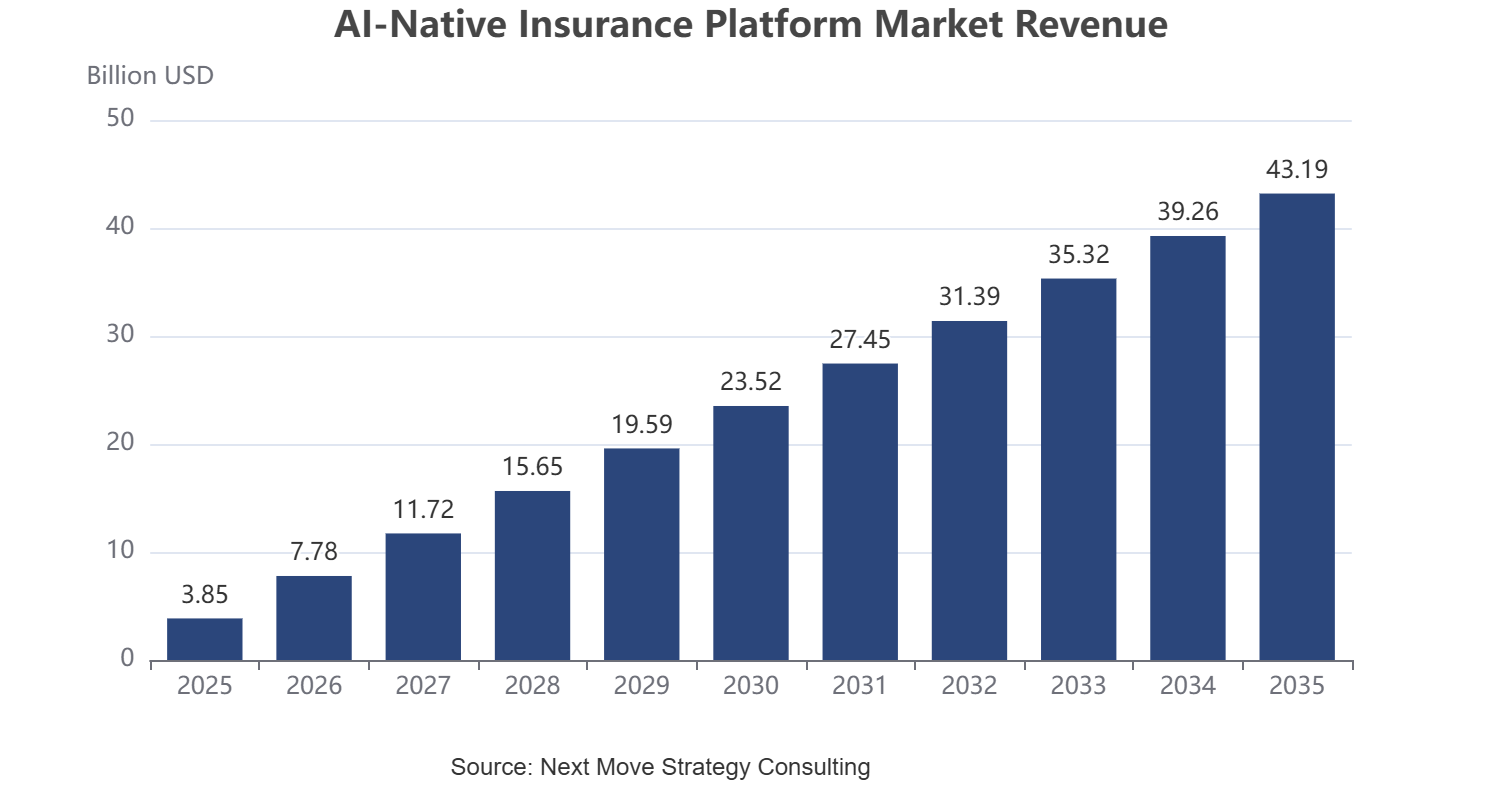
The global AI-Native Insurance Platform market size was valued at USD 3.85 Billion in 2025 and is estimated at USD 4.85 Billion in 2026, forecast to reach USD 43.19 Billion by 2035, expanding at a 27.5% CAGR between 2026 and 2035. North America leads with approximately 36% share, while Full-Stack Core Platforms dominate all other platform types with approximately 28% share.
We observed that growth is broad-based across every segmentation axis, with underwriting automation and embedded distribution models driving the dominant structural shifts through 2035.
|
Key Takeaways |
|
By Platform Type: Full-Stack Core Platforms held the largest share of approximately 28% (USD 1.07 Billion) in 2025; Distribution and Embedded Insurance Platforms is the fastest-growing sub-segment at 30.3% CAGR from 2026–2035. |
|
By Line of Business: Property and Casualty held the largest share of approximately 41% (USD 1.58 Billion) in 2025; Speciality Insurance is the fastest-growing sub-segment at 31.7% CAGR from 2026–2035. |
|
By Deployment: SaaS held the largest share of approximately 54% (USD 2.08 Billion) in 2025; Hybrid Cloud is the fastest-growing sub-segment at 30.4% CAGR from 2026–2035. |
|
By Revenue Model: Subscription held the largest share of approximately 47% (USD 1.81 Billion) in 2025; Usage-Based revenue is the fastest-growing sub-segment at 32.6% CAGR from 2026–2035. |
|
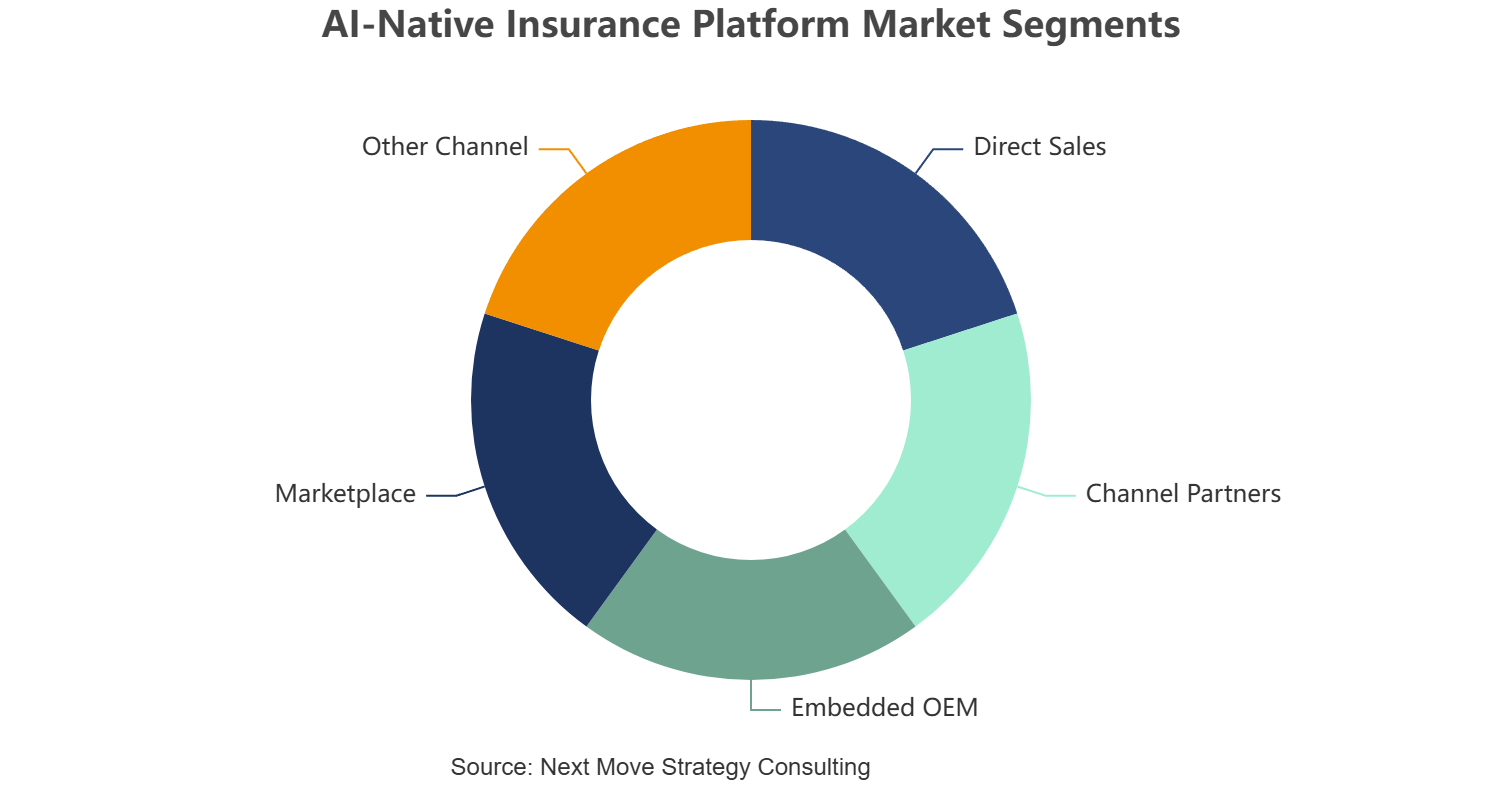
By Sales Channel: Direct Sales held the largest share of approximately 45% (USD 1.73 Billion) in 2025; Embedded OEM is the fastest-growing sub-segment at 33.1% CAGR from 2026–2035. |
|
By Buyer Type: Insurance Carriers held the largest share of approximately 49% (USD 1.89 Billion) in 2025; MGAs and Program Administrators is the fastest-growing sub-segment at 31.4% CAGR from 2026–2035. |
|
Dominant Region: North America dominated with approximately 36% revenue share (USD 1.39 Billion) in 2025. |
|
Fastest-Growing Region: Asia-Pacific is expected to register the highest CAGR of 30.3% during 2026–2035. |
|
Dominant Country: U.S. led with approximately USD 1.05 Billion in 2025. |
|
Fastest-Growing Country: India is the fastest-growing country at approximately 33.4% CAGR from 2026–2035. |
Market Opportunity: The AI-Native Insurance Platform market is expected to create an absolute dollar opportunity of USD 38.34 Billion between 2026 and 2035, presenting significant investment potential across the underwriting, claims, and embedded distribution value chain.
What Does the AI-Native Insurance Platform Market Encompass?
The AI-Native Insurance Platform market encompasses software built with artificial intelligence embedded at the architectural core, spanning policy administration, underwriting, claims, billing, distribution, and analytics for insurance carriers, managing general agents, brokers, and third-party administrators. Our assessment indicates that the scope covers cloud-native cores, risk data intelligence engines, claims triage and fraud detection systems, and embedded insurance infrastructure, extending the broader insurtech ecosystem beyond legacy rules-based cores that cannot support real-time, model-driven decisioning.
Regulatory frameworks such as the U.S. National Association of Insurance Commissioners' Model Bulletin on the Use of Artificial Intelligence Systems and the European Union's Artificial Intelligence Act shape explainability and governance requirements for underwriting and claims models. We observed that technology adoption is shifting toward large language model-based document intelligence and agentic claims workflows. Next Move Strategy Consulting's analysis indicates that this structural shift, combined with embedded and API-first distribution demands, is redefining vendor selection criteria across the market.
|
Parameters |
Details |
|
Market Size in 2025 |
USD 3.85 Billion |
|
Market Size in 2026 |
USD 4.85 Billion |
|
Revenue Forecast in 2035 |
USD 43.19 Billion |
|
Growth Rate |
CAGR of 27.5% from 2026 to 2035 |
|
Analysis Period |
2025–2035 |
|
Base Year Considered |
2025 |
|
Forecast Period |
2026–2035 |
|
Market Size Estimation |
Revenue (USD Billion) |
|
Companies Profiled |
20 |
|
Countries Covered |
33 |
|
Market Share |
Available for Top 10 Companies |
Key Emerging Trends
Our findings suggest that the AI-Native Insurance Platform market is being reshaped by four structural trends that are transforming how carriers underwrite, price, and settle risk.
How Is Agentic AI Transforming Claims Adjudication?
Agentic AI systems capable of independently triaging, investigating, and recommending claims outcomes are moving beyond pilot deployments into production claims desks. We observed that these systems reduce manual first-notice-of-loss handling time while flagging complex or fraud-suspect claims for human review. Sprout.ai Ltd. and Tractable Ltd. have both expanded agentic claims automation offerings, reflecting stakeholder demand for faster, more consistent claims outcomes across property, auto, and health lines through 2035.
Why Are Carriers Adopting Real-Time Risk Data Intelligence?
Property and casualty carriers are integrating satellite imagery, IoT telemetry, and behavioural data feeds directly into underwriting workflows to price risk more precisely at the point of quote. Based on research conducted by Next Move Strategy Consulting, we found that this shift is reducing adverse selection and improving loss ratios for early adopters. ZestyAI, Inc. has expanded its property risk intelligence suite, illustrating how granular, near-real-time data is becoming a baseline underwriting requirement rather than a differentiator.
How Is Embedded Insurance Reshaping Distribution?
Insurance is increasingly being sold at the point of need through non-insurance digital platforms, requiring API-first, low-latency policy issuance infrastructure. Our analysis shows that embedded distribution is expanding fastest in travel, mobility, and e-commerce verticals, where Sure, Inc. and Bold Penguin, Inc. have built infrastructure connecting carriers to third-party digital storefronts. This trend is compressing traditional agent and broker touchpoints for simple, standardized policy types.
What Role Does Generative AI Play in Underwriting Submissions?
Generative AI is being deployed to extract, structure, and summarize unstructured submission documents, accelerating underwriter decision cycles for commercial lines. We observed that Indico Data Solutions, Inc. and omni:us AG have both expanded document intelligence modules that convert broker submissions into structured underwriting data within minutes rather than hours, freeing underwriters to focus on judgment-intensive risk assessment rather than manual data entry.
SWOT Analysis of the AI-Native Insurance Platform Market
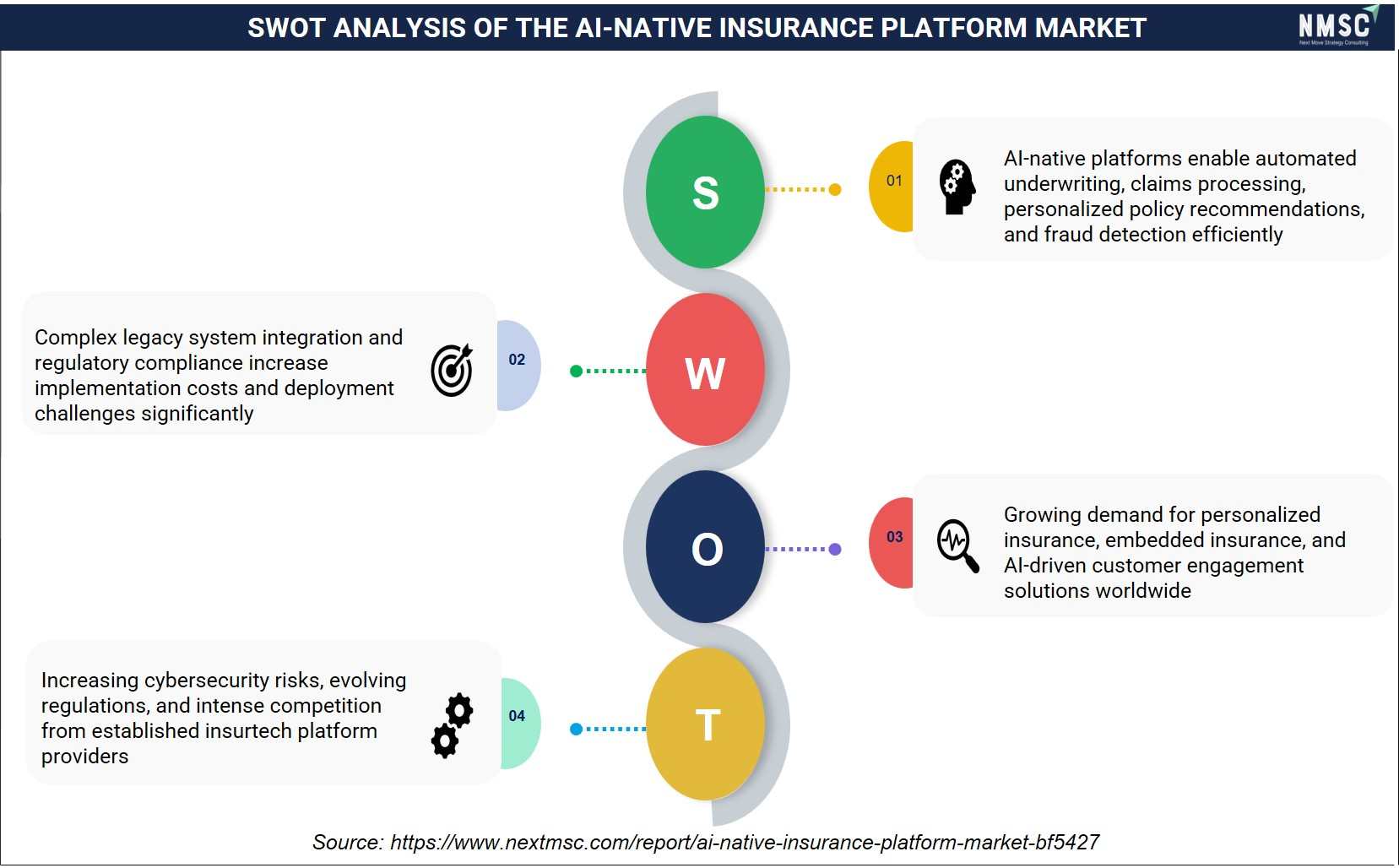
Our analysis indicates that the AI-Native Insurance Platform Market benefits from AI-powered underwriting, claims automation, fraud detection, and personalized policy recommendations that improve operational efficiency and customer experience. However, legacy system integration, regulatory compliance, and deployment complexity increase implementation costs. Rising demand for personalized and embedded insurance creates significant growth opportunities, while cybersecurity threats, evolving regulations, and intense competition from established insurtech providers remain key challenges for sustained market expansion.
Growth Drivers & Restraints
Growth Catalyst & Risk Assessment Matrix
|
Factors |
Type |
(+/−) % Impact on CAGR |
Geographic Relevance |
Impact Timeline |
|
Rising adoption of AI-native cores over legacy policy administration systems |
Driver |
+6.2% |
Global |
2026–2035 |
|
Growth of embedded and API-first insurance distribution |
Driver |
+5.4% |
North America, Europe |
2026–2032 |
|
Expansion of real-time risk data intelligence for underwriting |
Driver |
+4.8% |
North America, Asia-Pacific |
2026–2035 |
|
Increasing regulatory pressure to modernize claims fraud detection |
Driver |
+3.6% |
Europe, North America |
2027–2035 |
|
Growth of MGA and program administrator digital infrastructure spend |
Driver |
+3.1% |
Global |
2026–2033 |
|
Data privacy and AI governance compliance burden |
Restraint |
−2.4% |
Europe |
2026–2030 |
|
Legacy core system integration complexity at large carriers |
Restraint |
−2.1% |
North America, Europe |
2026–2032 |
|
Shortage of insurance-domain AI talent |
Restraint |
−1.7% |
Global |
2026–2029 |
|
Model explainability requirements for underwriting decisions |
Restraint |
−1.3% |
North America, Europe |
2027–2035 |
What Is the Primary Growth Driver of the AI-Native Insurance Platform Market?
The primary growth driver is the replacement of legacy, rules-based policy administration systems with AI-native cores capable of continuous learning and real-time decisioning. Our findings suggest that carriers face mounting pressure to modernize as claims and underwriting cycle times become a competitive differentiator. According to the U.S. National Association of Insurance Commissioners, a majority of state insurance regulators have adopted or proposed AI governance guidance since 2023, accelerating structured platform adoption over ad hoc automation tools.
How Is Embedded Distribution Driving the Market Growth?
Embedded insurance infrastructure is driving growth by allowing carriers and MGAs to distribute policies through non-insurance digital touchpoints without building bespoke integrations for each partner. We observed that this lowers customer acquisition cost relative to traditional agent channels. The European Insurance and Occupational Pensions Authority has noted rising cross-border digital distribution activity, reflecting increasing regulatory attention to embedded models as a mainstream, rather than niche, distribution channel.
What Is Restraining the AI-Native Insurance Platform Market?
Data privacy and AI governance compliance requirements are restraining faster platform adoption, particularly in Europe under the Artificial Intelligence Act's high-risk classification for insurance underwriting and pricing systems. Our assessment indicates that compliance documentation and model explainability obligations extend implementation timelines for carriers deploying automated underwriting decisions. Smaller MGAs and regional carriers face proportionally higher compliance costs, slowing near-term adoption relative to well-resourced national and multinational carriers.
Segmentation Analysis
Segment Sizing: By Platform Type
|
Segment |
2025 (USD Billion) |
2035 (USD Billion) |
CAGR% (2026–2035) |
|
Full-Stack Core Platforms |
1.07 |
10.37 |
25.3% |
|
Underwriting and Pricing Platforms |
0.85 |
9.07 |
26.8% |
|
Claims Intelligence Platforms |
0.69 |
8.64 |
29.1% |
|
Distribution and Embedded Insurance Platforms |
0.54 |
7.34 |
30.3% |
|
Insurance Data and Workflow Platforms |
0.39 |
4.75 |
28.7% |
|
Insurance Analytics Platforms |
0.23 |
2.16 |
25.0% |
|
Other Insurance AI Platforms |
0.08 |
0.86 |
27.0% |
|
Total |
3.85 |
43.19 |
27.5% |
Which Platform Type Dominates the Market?
Full-Stack Core Platforms dominate with approximately 28% share in 2025, valued at USD 1.07 Billion, as carriers prioritize consolidated policy administration, claims, and billing infrastructure over point solutions. Distribution and Embedded Insurance Platforms is the fastest-growing sub-segment at 30.3% CAGR through 2035, driven by rising demand from non-insurance digital platforms embedding coverage at checkout, a shift reinforced by MGA and program administrator infrastructure investment across e-commerce and mobility verticals.
Segment Sizing: By Line of Business
|
Segment |
2025 (USD Billion) |
2035 (USD Billion) |
CAGR% (2026–2035) |
|
Property and Casualty |
1.58 |
16.41 |
26.4% |
|
Life Insurance |
0.73 |
7.34 |
26.0% |
|
Health Insurance |
0.81 |
8.64 |
26.8% |
|
Speciality Insurance |
0.46 |
6.91 |
31.7% |
|
Multi-Line Insurance |
0.27 |
3.89 |
31.1% |
|
Total |
3.85 |
43.19 |
27.5% |
Which Line of Business Leads Adoption?
Property and Casualty leads with approximately 41% share in 2025, valued at USD 1.58 Billion, reflecting high claims volume and pricing complexity that reward AI-native automation. Speciality Insurance is the fastest-growing line at 31.7% CAGR through 2035, as cyber and marine underwriters adopt behavioural and business risk intelligence tools to price emerging, thinly-benchmarked exposures that traditional actuarial tables do not adequately capture.
Segment Sizing: By Deployment
|
Segment |
2025 (USD Billion) |
2035 (USD Billion) |
CAGR% (2026–2035) |
|
SaaS |
2.08 |
24.62 |
28.3% |
|
Private Cloud |
0.77 |
6.05 |
22.6% |
|
Hybrid Cloud |
0.69 |
9.50 |
30.4% |
|
On-Premises |
0.31 |
3.02 |
25.5% |
|
Total |
3.85 |
43.19 |
27.5% |
Which Deployment Model Is Growing Fastest?
SaaS dominates with approximately 54% share in 2025, valued at USD 2.08 Billion, as carriers favor vendor-managed infrastructure to reduce internal maintenance burden. Hybrid Cloud is the fastest-growing deployment model at 30.4% CAGR through 2035, reflecting large carriers' need to keep sensitive policyholder data on private infrastructure while running AI inference workloads on scalable public cloud capacity, a configuration increasingly required by regional data residency regulation.
Growth Opportunities
Our analysis shows three whitespace opportunities where platform vendors can capture disproportionate share as carriers modernize.
Can MGAs Become a Primary Growth Channel for Platform Vendors?
Managing general agents and program administrators are underpenetrated relative to large national carriers and represent a faster sales cycle for platform vendors, since they lack legacy core systems requiring displacement. Federato Technologies, Inc. and Gradient AI, Inc. stand to benefit from purpose-built underwriting and risk workflows tailored to MGA operating models.
Does Reinsurance Analytics Represent an Underserved Opportunity?
Reinsurers remain reliant on spreadsheet-based catastrophe and portfolio analysis, creating whitespace for AI-native reinsurance analytics tools. Concirrus Ltd. and CLARA Analytics, Inc. are positioned to capture this segment as treaty renewal cycles increasingly demand faster, model-driven exposure aggregation across marine, property, and speciality portfolios.
Can Embedded Insurance Infrastructure Expand Into New Verticals?
Embedded insurance infrastructure built for travel and mobility is extensible to healthcare, logistics, and gig-economy verticals with minimal re-architecture. Sure, Inc. and Bold Penguin, Inc. are positioned to benefit as digital platforms in these adjacent verticals seek point-of-need coverage without building bespoke carrier integrations.
Regional Outlook
|
Region |
2025 (USD Billion) |
2035 (USD Billion) |
CAGR% (2026–2035) |
Key Driver |
|
North America |
1.39 |
13.38 |
25.4% |
Legacy core replacement at national carriers |
|
Europe |
1.04 |
11.23 |
27.0% |
AI Act-driven governance modernization |
|
Asia-Pacific |
0.92 |
12.53 |
30.3% |
Digital-first carrier and MGA expansion |
|
Middle East & Africa |
0.31 |
3.89 |
29.1% |
Insurance market digitization mandates |
|
Latin America |
0.19 |
2.16 |
27.7% |
Embedded insurance in e-commerce |
|
Total |
3.85 |
43.19 |
27.5% |
— |
North America AI-Native Insurance platform Market
North America is the most mature market for AI-native insurance platforms, led by large carriers replacing decades-old policy administration systems supporting the broader North America P&C Insurance Core Platform Market. Our assessment indicates that the region benefits from deep AI talent pools and early regulatory guidance from the National Association of Insurance Commissioners, though implementation cycles at large carriers remain multi-year. Strategic outlook favors vendors with proven claims and underwriting modules over unproven point solutions through 2035.
Europe AI-Native Insurance platform Market
Europe's market is shaped directly by the Artificial Intelligence Act's high-risk classification of insurance underwriting and pricing systems, requiring documented model governance and reflecting the broader trajectory of the Europe P&C Insurance Core Platform Market. We observed that this regulatory rigor is slowing adoption speed but improving long-term platform durability, as vendors that achieve compliance early gain a defensible advantage. Germany, France, and the UK lead regional deployment, with cross-border MGA activity accelerating platform standardization.
Asia-Pacific AI-Native Insurance platform Market
Asia-Pacific is the fastest-growing region as digital-first carriers and MGAs in China, India, and Southeast Asia bypass legacy core systems entirely. Based on research conducted by Next Move Strategy Consulting, we found that mobile-first distribution and embedded insurance are structurally more advanced in the region than in mature markets, favoring cloud-native, API-first platform vendors over traditional on-premises core providers.
Middle East & Africa AI-Native Insurance platform Market
Middle East & Africa is undergoing accelerated insurance market digitization as national regulators in the UAE and Saudi Arabia mandate digital policy issuance and claims infrastructure. Our findings suggest that South Africa's more established insurance sector is adopting claims fraud detection tools fastest within the region, while Gulf markets prioritize full-stack core platform deployment tied to broader financial sector digitization strategies.
Latin America AI-Native Insurance platform Market
Latin America's market is driven by embedded insurance growth within e-commerce and mobility platforms in Brazil and Argentina. We observed that regional carriers face higher legacy integration costs than digital-native MGAs, favoring lightweight distribution and underwriting automation tools over full core replacements. Regulatory modernization remains uneven across the region, tempering near-term platform standardization relative to North America and Europe.
U.S. AI-Native Insurance platform Market
Based on our estimates, the U.S. AI-Native Insurance Platform market was valued at approximately USD 1.05 Billion in 2025 and is projected to reach approximately USD 9.85 Billion by 2035 at a CAGR of 25.1%. Demand is concentrated among top-20 national carriers replacing legacy cores, with high technology penetration and strong regulatory clarity from state insurance departments supporting steady, competitively intense vendor selection cycles through 2035.
Canada AI-Native Insurance platform Market
The market in, Canada is valued at approximately USD 0.21 Billion in 2025, projected to reach approximately USD 1.98 Billion by 2035 at a CAGR of 25.3%. Adoption is concentrated among mid-sized carriers and MGAs, with moderate technology penetration and a regulatory environment shaped by the Office of the Superintendent of Financial Institutions supporting steady, low-volatility platform modernization through 2035.
UK AI-Native Insurance platform Market
As per our estimate, the UK market was valued at approximately USD 0.34 Billion in 2025, projected to reach approximately USD 3.68 Billion by 2035 at a CAGR of 26.9%. The UK's Financial Conduct Authority-supervised environment and London's speciality and reinsurance hub support high technology penetration and competitive intensity among claims and underwriting platform vendors targeting both retail and speciality lines through 2035.
Germany AI-Native Insurance platform Market
The market in, Germany was valued at approximately USD 0.24 Billion in 2025, projected to reach approximately USD 2.58 Billion by 2035 at a CAGR of 27.0%. Demand structure favors full-stack core platforms among large composite carriers, consistent with trends observed in the broader Germany P&C Insurance Core Platform Market, with the Federal Financial Supervisory Authority's AI governance expectations shaping cautious, compliance-first adoption and strong competitive intensity among European and domestic vendors through 2035.
France AI-Native Insurance platform Market
According to our analysis, France was valued at approximately USD 0.19 Billion in 2025, projected to reach approximately USD 2.02 Billion by 2035 at a CAGR of 26.8%. Regulatory influence from the Autorité de Contrôle Prudentiel et de Résolution shapes model governance requirements, while moderate technology penetration and steady demand from mutual insurers support a strategic outlook favoring vendors with strong compliance documentation through 2035.
China AI-Native Insurance platform Market
Based on our estimates, China was valued at approximately USD 0.31 Billion in 2025, projected to reach approximately USD 4.51 Billion by 2035 at a CAGR of 31.2%. High technology penetration among digital-first insurers and strong regulatory support for insurtech innovation from national financial authorities support intense competitive activity among domestic platform vendors targeting large-scale retail insurance distribution through 2035.
India AI-Native Insurance platform Market
As per our estimate, India was valued at approximately USD 0.18 Billion in 2025, projected to reach approximately USD 3.02 Billion by 2035 at a CAGR of 33.4%, the fastest of any country covered, mirroring rapid growth already visible in the India P&C Insurance Core Platform Market. The Insurance Regulatory and Development Authority of India's digital-first regulatory sandbox and rapid embedded insurance growth support high adoption velocity among both established carriers and digital-native MGAs through 2035.
Japan AI-Native Insurance platform Market
The market in, Japan was valued at approximately USD 0.16 Billion in 2025, projected to reach approximately USD 1.51 Billion by 2035 at a CAGR of 25.0%. Demand is concentrated among large composite carriers modernizing claims processing, with moderate technology penetration and a conservative regulatory posture from the Financial Services Agency supporting steady, incremental platform adoption through 2035.
South Korea AI-Native Insurance platform Market
As per our estimate, South Korea was valued at approximately USD 0.11 Billion in 2025, projected to reach approximately USD 1.29 Billion by 2035 at a CAGR of 27.9%. High technology penetration and strong government support for AI adoption from the Financial Services Commission support competitive intensity among domestic and international vendors targeting both life and non-life insurance segments through 2035.
Australia AI-Native Insurance platform Market
According to our analysis, Australia was valued at approximately USD 0.09 Billion in 2025, projected to reach approximately USD 1.02 Billion by 2035 at a CAGR of 27.4%. The Australian Prudential Regulation Authority's operational resilience standards shape platform governance requirements, while moderate technology penetration among mid-sized carriers supports steady demand for claims and underwriting automation through 2035.
UAE AI-Native Insurance platform Market
Based on our estimates, the UAE was valued at approximately USD 0.06 Billion in 2025, projected to reach approximately USD 0.79 Billion by 2035 at a CAGR of 29.9%. Strong government-led financial sector digitization initiatives and the Central Bank of the UAE's insurance technology guidance support high technology penetration among regional and international carriers operating from the emirate through 2035.
Saudi Arabia AI-Native Insurance platform Market
The market in, Saudi Arabia was valued at approximately USD 0.07 Billion in 2025, projected to reach approximately USD 0.91 Billion by 2035 at a CAGR of 29.5%. The Saudi Central Bank's insurance digitization mandates under national economic diversification programs support rising technology penetration, with strategic outlook favoring vendors offering Arabic-language and Sharia-compliant product configuration capabilities through 2035.
South Africa AI-Native Insurance platform Market
As per our estimate, South Africa was valued at approximately USD 0.05 Billion in 2025, projected to reach approximately USD 0.62 Billion by 2035 at a CAGR of 28.9%. The Financial Sector Conduct Authority's digital insurance guidance and a relatively mature domestic insurance sector support moderate to high technology penetration, with claims fraud detection tools seeing the strongest regional adoption through 2035.
Brazil AI-Native Insurance platform Market
According to our analysis, Brazil was valued at approximately USD 0.10 Billion in 2025, projected to reach approximately USD 1.16 Billion by 2035 at a CAGR of 27.9%. The Superintendência de Seguros Privados' open insurance regulatory framework supports rising technology penetration, with embedded insurance distribution through e-commerce and mobility platforms driving the strongest demand segment through 2035.
Argentina AI-Native Insurance Platform Market
Based on our estimates, Argentina was valued at approximately USD 0.04 Billion in 2025, projected to reach approximately USD 0.47 Billion by 2035 at a CAGR of 27.6%. Moderate technology penetration among mid-sized carriers and a developing regulatory framework from the Superintendencia de Seguros de la Nación support gradual platform adoption, with strategic outlook favoring cost-efficient, cloud-based deployment models through 2035.
Regulatory Framework Impacting the AI-Native Insurance Platform Market
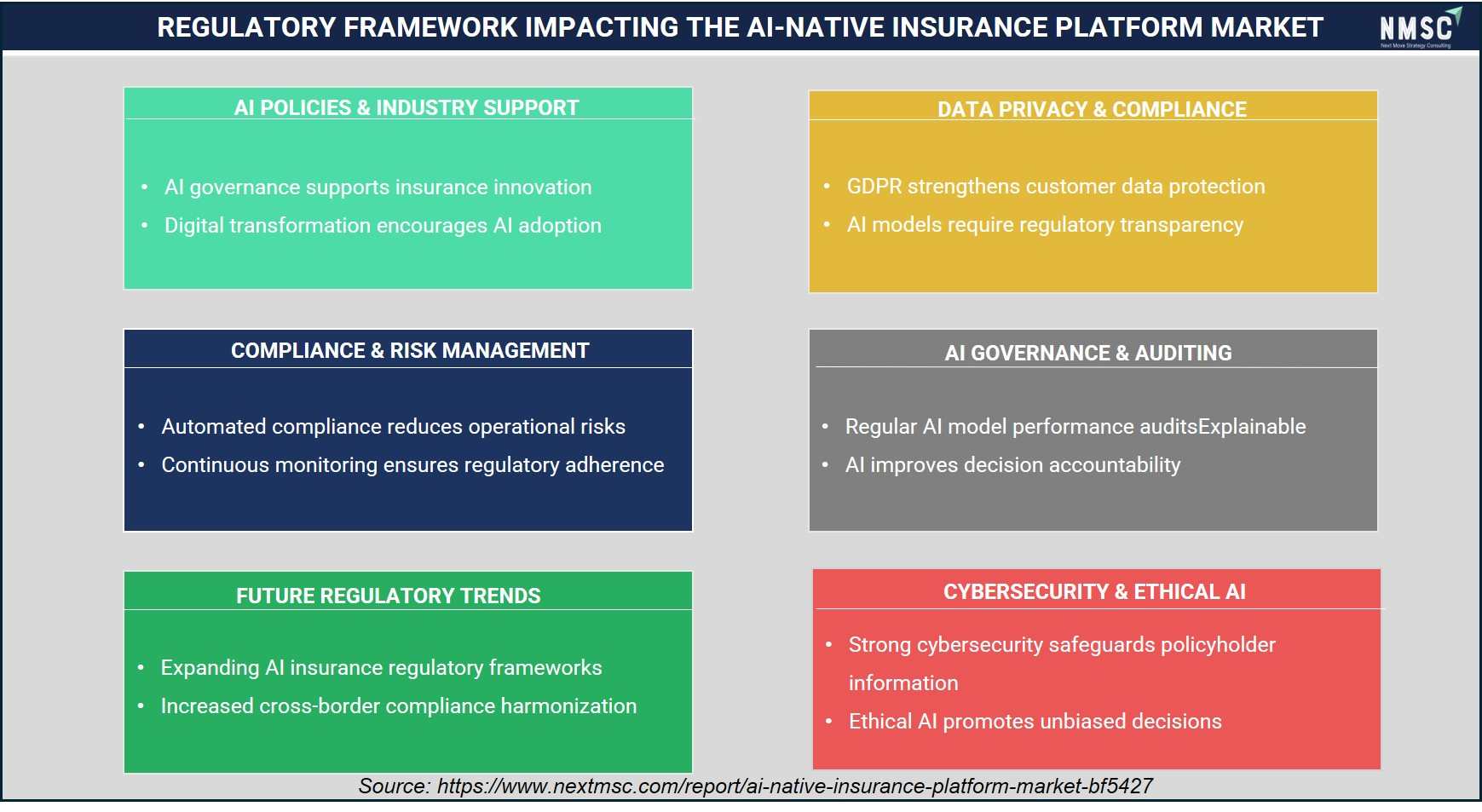
Our analysis indicates that the regulatory framework of the AI-Native Insurance Platform Market is shaped by AI governance policies, data privacy regulations, compliance requirements, and cybersecurity standards. Governments promote responsible AI adoption through digital transformation initiatives, while regulations emphasize transparent AI models, automated compliance, and secure data management. Expanding regulatory frameworks, ethical AI guidelines, and cross-border compliance harmonization continue to strengthen market confidence, encourage innovation, and support the responsible deployment of AI-driven insurance platforms.
Competitive Landscape
Our analysis shows that the competitive landscape remains fragmented across functional categories, with no single vendor offering a dominant full-stack solution across underwriting, claims, and distribution.
|
Dimension |
Description |
|
Market Structure |
Fragmented across functional categories, with full-stack and point-solution vendors both competing for carrier budget |
|
Innovation Focus |
Agentic claims automation, generative AI document intelligence, and real-time risk data integration |
|
M&A Activity |
Moderate and rising, concentrated among claims intelligence and risk data vendors seeking underwriting workflow integration |
How Do Companies Compete in The AI-Native Insurance Platform Market?
Companies compete primarily on model accuracy, integration speed with legacy carrier systems, and depth of insurance-domain data used to train underwriting and claims models. Our findings suggest that vendors with proprietary claims or risk datasets, such as Shift Technology SAS and Tractable Ltd., hold a durable data advantage that is difficult for new entrants to replicate, while pricing competition remains secondary to functional differentiation among enterprise carrier buyers.
Which Competitive Archetypes Dominate the AI-Native Insurance Platform market?
Two archetypes dominate: full-stack core platform vendors targeting carrier-wide modernization, and specialized point-solution vendors targeting a single workflow such as claims fraud detection or pricing optimization. Socotra, Inc. and INSTANDA Limited represent the full-stack archetype, while Akur8 SAS and hyperexponential Ltd. represent the specialized pricing intelligence archetype, each competing on depth versus breadth of carrier value delivered.
What Innovation and Differentiation Strategies Are Vendors Pursuing?
Vendors are differentiating through agentic AI capabilities that reduce human-in-the-loop requirements for routine underwriting and claims decisions. We observed that Federato Technologies, Inc. and Gradient AI, Inc. have both expanded decision-support automation, while others pursue open API architectures to accelerate integration with existing carrier cores, reducing implementation timelines from years to months for mid-market carriers and MGAs.
What M&A Activity Is Shaping the Competitive Landscape?
M&A activity is concentrated among risk data and claims intelligence vendors seeking to embed proprietary datasets directly into underwriting workflow platforms. Our assessment indicates that acquirers are prioritizing targets with regulatory-compliant data pipelines and existing carrier integrations over standalone AI model providers, reflecting the market's shift toward embedded, workflow-native intelligence rather than bolt-on analytics tools.
Key Market Players
Our analysis identifies twenty companies shaping the competitive structure of the AI-Native Insurance Platform market across core platforms, underwriting intelligence, claims automation, and embedded distribution.
-
Shift Technology SAS
-
Tractable Ltd.
-
Socotra, Inc.
-
hyperexponential Ltd.
-
Akur8 SAS
-
INSTANDA Limited
-
ZestyAI, Inc.
-
Federato Technologies, Inc.
-
Sure, Inc.
-
Sprout.ai Ltd.
-
Gradient AI, Inc.
-
CLARA Analytics, Inc.
-
Concirrus Ltd.
-
Indico Data Solutions, Inc.
-
omni:us AG
-
Insurance Quantified, Inc.
-
Bold Penguin, Inc.
-
Snapsheet, Inc.
-
Pace AI, Inc.
-
Talem AI, Inc
Latest Developments
This section tracks recent product, partnership, and regulatory activity relevant to the AI-Native Insurance Platform market.
|
Date |
Event |
|
June 2026 |
hyperexponential (hx) deployed its AI-native pricing and underwriting platform across Allianz Commercial's priority lines of business, successfully delivering 13 new pricing tools in 13 weeks as part of a major multi-year digital transformation. |
|
March 2026 |
Shift Technology SAS renewed its strategic partnership with AXA for five years, extending an AI-driven collaboration across 15 countries in Europe, Asia, and Latin America to scale decisioning systems for claims, fraud detection, and underwriting. |
|
February 2026 |
Akur8 SAS announced an expanded partnership with insurer Branch, which adopted the Akur8 Discover solution to provide on-demand visibility into U.S. regulatory filings, streamline research workflows, and support data-driven pricing decisions. |
Expert Insights
 "In fairly short order, I would say in the next two to three years, this will be table stakes in which everybody will need to utilize some form of AI to remain competitive. The challenge for the incumbents and the larger insurance companies is having a technological infrastructure that allows them to plug that in."
— Rick McCathron, CEO, Hippo Holdings
Statement made during an interview with S&P Global Market Intelligence discussing the increasing adoption of artificial intelligence across the insurance industry and the technological challenges insurers face in integrating AI into their operations.
Market Interpretation
The comment highlights the rapid emergence of artificial intelligence as a fundamental competitive requirement across the insurance industry. As AI becomes integral to underwriting, claims processing, risk assessment, fraud detection, and customer engagement, insurers are increasingly transitioning toward AI-native platforms that seamlessly integrate AI into core insurance operations. However, legacy technology infrastructure remains a significant barrier for established insurers, driving investments in modern, cloud-based AI-native insurance platforms that enable scalable AI deployment, improve operational efficiency, and enhance data-driven decision-making.
Investment Opportunities
Where Are Capital Inflows Concentrated?
Capital inflows remain concentrated in claims intelligence and underwriting automation vendors, where measurable loss-ratio and cycle-time improvements support clearer return-on-investment cases for carrier buyers. Our findings suggest that investors favor vendors with existing carrier customer bases over pre-revenue model providers, reflecting a broader shift toward proven deployment traction as a funding prerequisite in the current capital environment.
What Infrastructure Investment Is Required for Scale?
Scaling requires sustained investment in secure, carrier-grade cloud infrastructure capable of meeting data residency and model governance requirements across jurisdictions. We observed that vendors serving both North American and European carriers must maintain region-specific data pipelines to satisfy divergent regulatory regimes, raising infrastructure costs relative to single-market competitors but strengthening long-term enterprise defensibility.
How Do ESG Considerations Factor Into Investment Decisions?
Environmental, Social, and Governance considerations increasingly factor into investment decisions through model fairness and bias-testing requirements for underwriting and pricing algorithms. Our analysis shows that investors are prioritizing vendors with documented algorithmic fairness testing, particularly for health and life insurance applications where discriminatory pricing carries acute regulatory and reputational risk under emerging AI governance frameworks.
Key Benefits for Stakeholders
How Does This Report Benefit Insurance Carrier and MGA Leaders?
This report equips carrier and MGA leaders with segmented market sizing, competitive benchmarking, and regional adoption data to prioritize platform investment decisions. Our analysis provides evidence-based guidance on which platform categories and deployment models are gaining the fastest adoption, supporting more confident vendor selection and budget allocation across underwriting, claims, and distribution modernization initiatives through 2035.
How Does This Report Benefit Investors and Financial Analysts?
Investors and financial analysts gain a structured view of market sizing, growth trajectories, and competitive positioning across twenty profiled companies. Our findings suggest that segment- and region-level CAGR data supports more precise capital allocation decisions, while the competitive landscape analysis clarifies which archetypes and geographic markets present the strongest near-term growth and consolidation opportunities.
How Does This Report Benefit Technology Vendors and Product Teams?
Technology vendors and product teams benefit from detailed segmentation across platform type, line of business, deployment, revenue model, and buyer type, clarifying where whitespace opportunities remain. Our assessment indicates that this analysis supports more informed roadmap and go-to-market prioritization, particularly for vendors evaluating expansion into underserved segments such as reinsurance analytics and MGA-focused underwriting workflows.
Key Market Segments
By Platform Type
-
Full-Stack Core Platforms
-
Policy Administration
-
Product Configuration
-
Policy Lifecycle Management
-
-
Claims Management
-
Claims Processing
-
Claims Servicing
-
-
Billing and Payments
-
Premium Billing
-
Collections Management
-
Commission Management
-
-
-
Underwriting and Pricing Platforms
-
Risk Data Intelligence
-
Property Risk Intelligence
-
Business Risk Intelligence
-
Behavioural Risk Intelligence
-
Health Risk Intelligence
-
Other Risk Intelligence
-
-
Underwriting Automation
-
Submission Intake
-
Risk Assessment
-
Decision Support
-
Portfolio Optimization
-
-
Pricing Intelligence
-
Rate Development
-
Pricing Optimization
-
Portfolio Pricing Analytics
-
-
Claims Intelligence Platforms
-
Claims Triage
-
Fraud Detection
-
Damage Assessment
-
Claims Decision Automation
-
Recovery and Subrogation
-
-
-
Distribution and Embedded Insurance Platforms
-
Agency Platforms
-
Broker Platforms
-
MGA Platforms
-
Embedded Insurance Platforms
-
Digital Sales Platforms
-
-
Insurance Data and Workflow Platforms
-
Document Intelligence
-
Data Extraction
-
Workflow Orchestration
-
Integration Platforms
-
Conversational AI Platforms
-
-
Insurance Analytics Platforms
-
Actuarial Analytics
-
Portfolio Analytics
-
Catastrophe Analytics
-
Reinsurance Analytics
-
Regulatory Analytics
-
-
Other Insurance AI Platforms
-
Compliance Automation
-
General Insurance AI Applications
-
Other Insurance AI Platforms
-
By Line of Business
-
Property and Casualty
-
Personal Lines
-
Commercial Lines
-
-
Life Insurance
-
Health Insurance
-
Speciality Insurance
-
Cyber
-
Marine
-
Aviation
-
Other Speciality
-
-
Multi-Line Insurance
By Deployment
-
SaaS
-
Private Cloud
-
Hybrid Cloud
-
On-Premises
By Revenue Model
-
Subscription
-
Usage-Based
-
Transaction-Based
-
License
-
Implementation Services
-
Managed Services
By Sales Channel
-
Direct Sales
-
Channel Partners
-
Embedded OEM
-
Marketplace
-
Other Channel
By Buyer Type
-
Insurance Carriers
-
MGAs and Program Administrators
-
Brokers and Agencies
-
TPAs
-
Reinsurers
-
Embedded Insurance Providers
-
Other Insurance Buyers
By Region
-
North America: U.S., Canada, Mexico
-
Europe: UK, Germany, France, Italy, Spain, Sweden, Denmark, Finland, Netherlands, Rest of Europe
-
Asia-Pacific: China, India, Japan, South Korea, Taiwan, Indonesia, Vietnam, Australia, Philippines, Malaysia, Rest of APAC
-
Middle East & Africa: Saudi Arabia, UAE, Egypt, Israel, Turkey, Nigeria, South Africa, Rest of MEA
-
Latin America: Brazil, Argentina, Chile, Colombia, Rest of LATAM
Conclusion & Recommendations
What Is the Long-Term Outlook?
The long-term outlook remains strongly positive, with the market projected to grow from USD 4.85 Billion in 2026 to USD 43.19 Billion by 2035 at a 27.5% CAGR. Our analysis shows that this trajectory is underpinned by structural legacy-core replacement demand rather than cyclical spending, suggesting durable growth even under moderate macroeconomic variation across the forecast period.
What Strategic Positioning Should Vendors Pursue?
Vendors should prioritize deep integration with existing carrier cores and demonstrable loss-ratio or cycle-time improvements over breadth of feature claims. Our findings suggest that carriers increasingly evaluate vendors on measurable outcomes within pilot deployments, making reference-customer proof points a stronger competitive lever than generalized AI capability claims in enterprise sales cycles.
How Attractive Is the Market for Investment?
The market presents high investment attractiveness given its 27.5% forecast CAGR and structural, non-discretionary modernization demand. We observed that claims intelligence and embedded distribution sub-segments offer the strongest near-term return profiles, supported by measurable efficiency gains and expanding MGA-driven demand that is less exposed to large-carrier procurement delays.
What Market Shifts and Key Risks Should Stakeholders Monitor?
Stakeholders should monitor tightening AI governance regulation, particularly under the European Union's Artificial Intelligence Act, which could extend implementation timelines for underwriting and pricing models. Our assessment indicates that vendors unable to demonstrate model explainability face rising competitive disadvantage as regulatory scrutiny of automated insurance decisions intensifies across major markets through 2035.
What Are the Primary Growth Pathways?
Primary growth pathways include expansion into underserved MGA and reinsurance analytics segments, geographic expansion into Asia-Pacific's fastest-growing carrier base, and deepening embedded distribution partnerships beyond travel and mobility verticals. Next Move Strategy Consulting's analysis indicates that vendors pursuing multiple pathways simultaneously are best positioned to sustain growth as individual segment adoption curves mature at different rates through 2035.
About the Author
 Saista Faiyaz
— Saista Faiyaz is Research Associate at Next Move Strategy Consulting, where she has covered consumer markets and healthcare technologies for 3 years. Her work includes primary interview review, secondary-source validation, market sizing, and structured analysis of company and industry data. She supports research by comparing evidence across sources, organizing findings into market narratives, and documenting assumptions used in analysis. Her scope includes cross-market benchmarking, and reports.
Saista Faiyaz
— Saista Faiyaz is Research Associate at Next Move Strategy Consulting, where she has covered consumer markets and healthcare technologies for 3 years. Her work includes primary interview review, secondary-source validation, market sizing, and structured analysis of company and industry data. She supports research by comparing evidence across sources, organizing findings into market narratives, and documenting assumptions used in analysis. Her scope includes cross-market benchmarking, and reports.
About the Reviewer
 Supradip Baul
— Supradip Baul is an accomplished business consultant and strategist with over a decade of rich experience in market intelligence, strategy, technology, and business transformation. His work has included rigorous qualitative and quantitative analysis across multiple industries, helping clients shape investment decisions and long-term roadmaps. Earlier in his career, he was associated with Gartner, where he contributed to industry-leading reports and market share analyses. He has worked with leading global companies and holds an MBA with a dual specialization in Marketing and Finance.
Supradip Baul
— Supradip Baul is an accomplished business consultant and strategist with over a decade of rich experience in market intelligence, strategy, technology, and business transformation. His work has included rigorous qualitative and quantitative analysis across multiple industries, helping clients shape investment decisions and long-term roadmaps. Earlier in his career, he was associated with Gartner, where he contributed to industry-leading reports and market share analyses. He has worked with leading global companies and holds an MBA with a dual specialization in Marketing and Finance.
At Next Move Strategy Consulting, we understand that insightful market research is the cornerstone of successful business decisions. That's why we employ a robust and multifaceted approach, combining various methodologies to deliver the most accurate and actionable data for our clients.

Research Landscape
We navigate the world of research with two primary approaches:
Qualitative Approach
Our qualitative research methodologies involve immersive techniques such as in-depth interviews, focus groups, and observational studies. By engaging directly with individuals and stakeholders, we uncover valuable insights that quantitative data alone may overlook.

Quantitative Research
In tandem with qualitative methodologies, NMSC leverages the power of Quantitative Research to provide a robust foundation of numerical insights. Through systematic data collection and analysis, we quantify patterns, preferences, and market trends, offering a comprehensive view of the business landscape.
Our quantitative research approach employs diverse tools, including surveys, experiments, and statistical modelling. These methodologies enable us to gather data from a large and representative sample, ensuring the statistical significance of our findings. By employing structured questionnaires and standardized data collection methods, we guarantee the reliability and validity of the information we present to our clients.
Quantitative research is particularly effective in measuring the prevalence of trends, assessing market size, and gauging the impact of various factors on consumer behavior. The numerical precision attained through this approach equips our clients with actionable insights, facilitating data-driven decision-making and strategy formulation.


Our Specialized Toolbox for Industry-Specific Market Research
We deploy a specialized arsenal of techniques tailored to meet your unique requirements. Here's a glimpse into our comprehensive toolbox:

Information Procurement
The stage entails acquiring market data or relevant information through various sources and methodologies.


Market Research Approach
We utilize both top-down and bottom-up approaches in market research analysis to achieve a comprehensive understanding of the market dynamics, leveraging the broad perspective of industry trends and macroeconomic factors alongside detailed insights from specific segments and individual companies.

Porters Five Forces Analysis
We conduct Porter's Five Forces analysis to evaluate the competitive landscape of an industry, providing us with insights into factors that affect profitability and strategic positioning.

SWOT Analysis

Forecasting
We utilize a forecasting model to predict future consumption by considering parameters like population, economics, regulations, market competition, drivers, constraints, technology, and pricing. We also employ statistical techniques such as multilinear regression, exponential smoothing, moving average, ARIMA, and Monte Carlo simulations for accurate predictions. In econometric forecasting, we analyzed short-term and long-term event impacts, attributing values based on regulatory frameworks, economic factors, and market events.





 Speak to Our Analyst