The global AI observability market size was valued at USD 2.94 billion in 2025 and is estimated at USD 3.86 billion in 2026, forecast to reach USD 44.20 billion by 2035, expanding at a 31.1% CAGR between 2026 and 2035. North America leads with approximately 38% share, while software offerings dominate all other categories with approximately 74% share.
We observed that growth is broad-based across every segmentation axis, with agentic AI monitoring and AI guardrails software driving the dominant structural shifts through 2035.
|
Key Takeaways |
|
By Offering: Software held the largest share of approximately 74% (USD 2.18 Billion) in 2025; AI Guardrails is the fastest-growing sub-segment at 38.4% CAGR from 2026–2035. |
|
By Deployment Model: SaaS held the largest share of approximately 57% (USD 1.68 Billion) in 2025; Hybrid is the fastest-growing sub-segment at 40.7% CAGR from 2026–2035. |
|
By AI Workload: Predictive AI held the largest share of approximately 48% (USD 1.41 Billion) in 2025; Agentic AI is the fastest-growing sub-segment at 36.9% CAGR from 2026–2035. |
|
By Buyer Type: AI Engineering held the largest share of approximately 29% (USD 0.85 Billion) in 2025; Security and Compliance is the fastest-growing sub-segment at 39.6% CAGR from 2026–2035. |
|
By Pricing Model: Subscription held the largest share of approximately 41% (USD 1.21 Billion) in 2025; Usage-Based is the fastest-growing sub-segment at 37.2% CAGR from 2026–2035. |
|
By End User: Software and Internet held the largest share of approximately 33% (USD 0.97 Billion) in 2025; Banking, Financial Services and Insurance is the fastest-growing sub-segment at 36.4% CAGR from 2026–2035. |
|
Dominant Region: North America dominated with approximately 38% revenue share (USD 1.12 Billion) in 2025. |
|
Fastest-Growing Region: Asia-Pacific is expected to register the highest CAGR of 37.0% during 2026–2035. |
|
Dominant Country: U.S. led with approximately USD 950 million in 2025. |
|
Fastest-Growing Country: India is the fastest-growing country at approximately 40.7% CAGR from 2026–2035. |
Market Opportunity: The AI observability market is expected to create an absolute dollar opportunity of USD 40.34 billion between 2026 and 2035, presenting significant investment potential across the AI engineering, MLOps, platform engineering, and security and compliance tooling value chain.
According to Next Move Strategy Consulting analysis, enterprises are increasingly consolidating point observability tools into unified platforms that span predictive, generative, and agentic AI workloads, a shift that favors vendors with cross-workload telemetry over single-purpose model-monitoring tools as agentic deployments scale through 2035.
The AI observability market encompasses software and services that provide visibility into the performance, behavior, cost, and risk posture of machine learning models, generative AI applications, and autonomous agents running in production. Our assessment indicates that the scope spans model observability, data observability, explainability and responsible AI tooling, LLM and agent observability, AI evaluation, AI guardrails, and AI application performance monitoring, delivered through SaaS, self-hosted, private cloud, and hybrid deployment models to AI engineering, data science, MLOps, platform engineering, SRE, and security and compliance buyers.
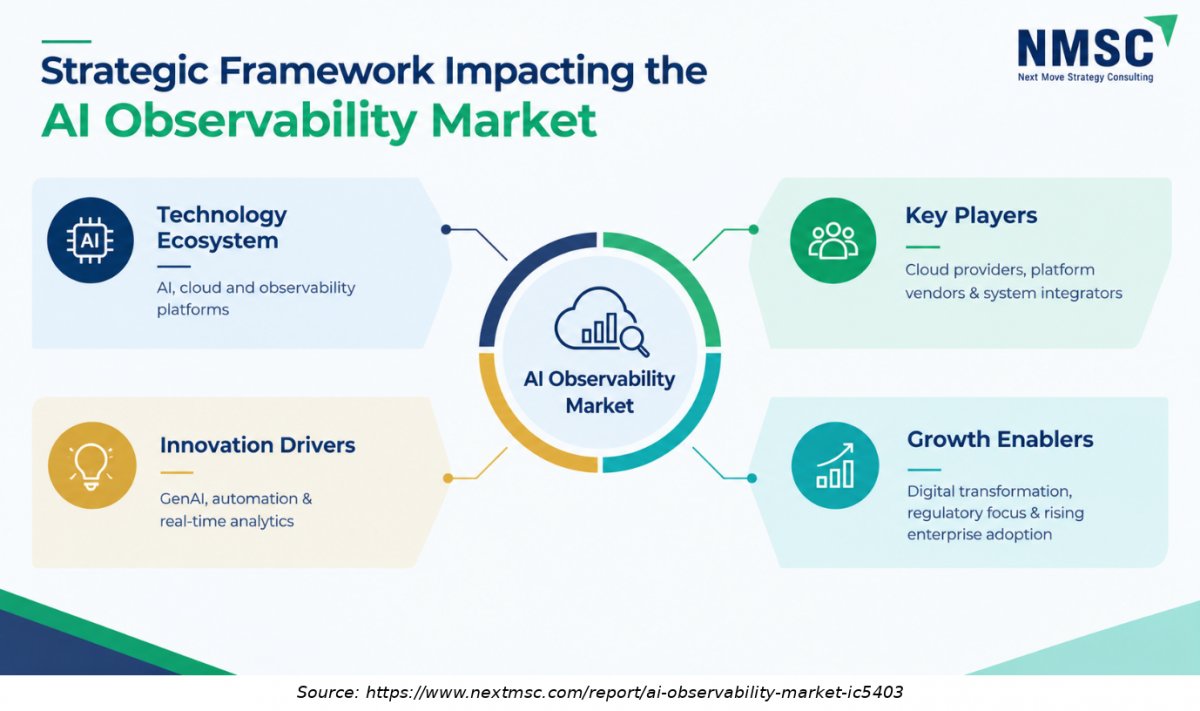
Regulatory frameworks such as the NIST AI Risk Management Framework and the European Union's AI Act are shaping continuous-monitoring and audit-documentation requirements for high-risk AI systems, while sector regulators increasingly expect evidence of ongoing model performance and bias testing. We observed that technology adoption is shifting from static, pre-deployment model validation toward continuous, runtime observability that tracks drift, hallucination, and agent behavior in real time. Next Move Strategy Consulting's analysis indicates that this structural shift, combined with rising agentic AI deployment, is redefining buying criteria across the AI observability market.
|
Parameter |
Details |
|
Market Size in 2025 |
USD 2.94 Billion |
|
Market Size in 2026 |
USD 3.86 Billion |
|
Revenue Forecast in 2035 |
USD 44.20 Billion |
|
Growth Rate |
CAGR of 31.1% from 2026 to 2035 |
|
Analysis Period |
2025–2035 |
|
Base Year Considered |
2025 |
|
Forecast Period |
2026–2035 |
|
Market Size Estimation |
Revenue (USD Billion) |
|
Companies Profiled |
17 |
|
Countries Covered |
33 |
|
Market Share |
Available for Top 10 Companie |
Based on research conducted by Next Move Strategy Consulting, we found that four structural trends are reshaping product development, sourcing, and stakeholder engagement across the AI observability industry.
Autonomous, multi-step AI agents are pushing observability beyond single-model monitoring toward tracing delegation chains, tool calls, and cross-agent communication. We observed that vendors are launching agent-tracing modules that log the full decision path an agent takes before executing an action, rather than only the model's final output. Enterprises deploying agents for customer service and internal workflow automation are prioritizing this trace-level visibility to contain the risk of irreversible actions taken without human review.
AI guardrails, which enforce content, safety, and policy boundaries at inference time, are emerging as a distinct budget line rather than a feature bundled into broader platforms. Our findings suggest that security and compliance buyers increasingly specify guardrails separately from model observability, reflecting a split between performance monitoring and real-time policy enforcement. This is positioning guardrails vendors as a premium, higher-margin category within the broader market segmentation structure.
Frameworks such as the NIST AI Risk Management Framework and the EU AI Act's obligations for high-risk systems are pushing organizations toward continuous, evidence-based monitoring rather than periodic compliance reviews. We observed that observability platforms are adding audit-trail and documentation modules designed to satisfy these evolving frameworks. Brand and platform owners are consolidating vendor relationships around suppliers that can demonstrate mapped controls to recognized risk-management frameworks.
Data observability, tracking input-data quality and distributional drift feeding into production models, is emerging as a foundational layer beneath model and LLM observability. Our analysis shows that MLOps and platform engineering teams are piloting integrated data-and-model observability stacks to catch quality issues before they propagate into degraded model outputs. This convergence is reducing the historical separation between data-engineering tooling and AI-specific monitoring platforms.
Our findings suggest that the AI Observability Market experiences moderate supplier power due to specialized AI infrastructure and cloud platform dependencies, while buyers possess strong bargaining power because of multiple solution providers and rising expectations for transparency and governance. The threat of new entrants remains moderate owing to technical complexity and compliance requirements. Substitution risk is limited as enterprises require dedicated observability capabilities, whereas competitive rivalry is high, driven by continuous innovation, strategic partnerships, and expanding enterprise AI deployments.
|
Factors |
Type |
(+/−) % Impact on CAGR |
Geographic Relevance |
Impact Timeline |
|
Rising generative and agentic AI deployment in production |
Driver |
+3.4% |
Global |
2026-2035 |
|
NIST AI RMF and EU AI Act monitoring obligations |
Driver |
+2.6% |
North America, Europe |
2026-2035 |
|
Enterprise AI cost and performance governance needs |
Driver |
+2.1% |
Global |
2026-2035 |
|
Expansion of MLOps and platform engineering functions |
Driver |
+1.7% |
North America, Asia-Pacific |
2026-2035 |
|
Rising security scrutiny of AI applications and agents |
Driver |
+1.5% |
Global |
2026-2035 |
|
Cloud hyperscaler bundling of native monitoring tools |
Restraint |
-1.4% |
Global |
2026-2035 |
|
Shortage of skilled MLOps and AI-security talent |
Restraint |
-1.1% |
North America, Europe |
2026-2032 |
|
Fragmented and evolving AI regulatory landscape |
Restraint |
-0.9% |
Europe, Asia-Pacific |
2026-2032 |
|
Data privacy constraints on cross-border telemetry sharing |
Restraint |
-0.7% |
Europe, Middle East & Africa |
2028-2035 |
Rising deployment of generative and agentic AI systems in production environments is the primary driver of the market. The National Institute of Standards and Technology's AI Risk Management Framework explicitly calls for continuous, evidence-based monitoring across the AI lifecycle rather than one-time validation. We observed that this guidance, combined with the operational complexity of autonomous agents, continues to anchor baseline demand for model, data, and agent observability tooling across enterprises of every size.
Regulatory frameworks are accelerating market growth toward continuous-monitoring architectures. The NIST AI Risk Management Framework's Measure and Manage functions call for ongoing post-deployment monitoring, vendor oversight, and incident response, while the European Union's AI Act imposes similar obligations on high-risk systems. Our assessment indicates that this regulatory pressure, combined with enterprise risk-committee scrutiny, is compressing adoption timelines for continuous observability platforms across North America and Europe.
Bundling of basic monitoring capabilities into cloud hyperscalers' native AI platforms restrains standalone vendor growth in cost-sensitive segments. Enterprises already committed to a single cloud provider's AI stack frequently default to its built-in telemetry tools before evaluating independent observability platforms. We found that this dynamic is most pronounced among small and mid-sized enterprises, where budget constraints and limited MLOps staffing reduce willingness to add a specialized observability vendor alongside existing cloud tooling.
|
Segment |
2025 (USD) |
2035 (USD) |
CAGR% (2026–2035) |
|
Software |
USD 2.18 Billion |
USD 33.35 Billion |
31.4% |
|
Services |
USD 0.76 Billion |
USD 10.85 Billion |
30.5% |
|
Total |
USD 2.94 Billion |
USD 44.20 Billion |
31.1% |
Software dominates the offering segmentation with approximately 74% share in 2025, reflecting enterprise preference for self-service, API-integrated observability platforms over consulting-led deployments. We observed that Services, while smaller in absolute terms, is scaling nearly as fast as Software as enterprises seek implementation and managed-monitoring support for complex agentic AI rollouts. Next Move Strategy Consulting's analysis indicates that Software's dominance will persist through 2035 as platform vendors expand self-serve onboarding and pre-built integrations.
|
Segment |
2025 (USD) |
2035 (USD) |
CAGR% (2026–2035) |
|
Predictive AI |
USD 1.41 Billion |
USD 14.10 Billion |
25.9% |
|
Generative AI |
USD 1.02 Billion |
USD 18.30 Billion |
33.5% |
|
Agentic AI |
USD 0.51 Billion |
USD 11.80 Billion |
36.9% |
|
Total |
USD 2.94 Billion |
USD 44.20 Billion |
31.1% |
Agentic AI is the fastest-growing workload segment at 36.9% CAGR, driven by enterprises moving from single-turn generative AI assistants toward multi-step autonomous agents that require trace-level observability. Our findings suggest that Predictive AI, while the largest base in 2025 given its maturity in fraud detection and demand forecasting, is expanding more slowly as it represents an already-instrumented legacy workload. Generative AI sits between the two, benefiting from rapid enterprise chatbot and copilot deployment.
|
Segment |
2025 (USD) |
2035 (USD) |
CAGR% (2026–2035) |
|
SaaS |
USD 1.68 Billion |
USD 24.50 Billion |
30.7% |
|
Self-Hosted |
USD 0.55 Billion |
USD 5.60 Billion |
26.1% |
|
Private Cloud |
USD 0.46 Billion |
USD 6.50 Billion |
30.3% |
|
Hybrid |
USD 0.25 Billion |
USD 7.60 Billion |
40.7% |
|
Total |
USD 2.94 Billion |
USD 44.20 Billion |
31.1% |
Hybrid deployment is the fastest-growing model at 40.7% CAGR as regulated enterprises seek to keep sensitive model telemetry on-premises while using cloud-hosted analytics for aggregate reporting. We observed that SaaS retains the largest share given its faster time-to-value for mid-market buyers. Next Move Strategy Consulting's analysis indicates that Hybrid's rapid growth from a smaller base signals a structural shift among large, security-conscious enterprises evaluating their first dedicated observability platform.
Three forward-looking opportunities stand out for vendors and investors positioning ahead of the market's 2026–2035 growth curve.
What Opportunity Does Compliance-as-a-Service Present?
Packaging AI Risk Management Framework and AI Act mapping directly into observability dashboards creates a compliance-as-a-service opportunity for vendors serving regulated industries. Security and compliance buyers in banking, financial services, insurance, and healthcare and life sciences stand to benefit most from pre-built regulatory mapping modules.
Usage-based and per-model pricing structures lower the entry barrier for mid-market enterprises previously priced out of enterprise observability suites. Data science and MLOps teams at growth-stage technology and retail and commerce companies stand to benefit as vendors extend consumption pricing beyond early-stage startups.
|
Region |
2025 (USD) |
2035 (USD) |
CAGR% (2026–2035) |
Key Driver |
|
North America |
USD 1.12 Billion |
USD 14.70 Billion |
29.4% |
Enterprise AI governance and regulatory readiness |
|
Europe |
USD 0.71 Billion |
USD 9.35 Billion |
29.4% |
EU AI Act compliance monitoring mandates |
|
Asia-Pacific |
USD 0.68 Billion |
USD 15.80 Billion |
37.0% |
Rapid enterprise AI and cloud adoption |
|
Middle East & Africa |
USD 0.24 Billion |
USD 2.55 Billion |
26.7% |
National AI strategy investment programs |
|
Latin America |
USD 0.19 Billion |
USD 1.80 Billion |
25.2% |
Digital banking and fintech AI adoption |
|
Total |
USD 2.94 Billion |
USD 44.20 Billion |
31.1% |
|
North America leads the global market, supported by concentrated enterprise AI spending and early regulatory attention from U.S. federal agencies through the NIST AI Risk Management Framework. We observed that large technology, financial services, and healthcare organizations are the earliest adopters of full-stack observability platforms spanning predictive, generative, and agentic workloads. Vendor headquarters concentration and mature MLOps talent pools reinforce the region's leadership, with strategic outlook remaining strongly positive through 2035.
Europe's market is shaped decisively by the EU AI Act's risk-tiered obligations, which require ongoing monitoring and documentation for high-risk AI systems. Our assessment indicates that financial services and industrial manufacturers are prioritizing compliance-oriented observability deployments ahead of enforcement milestones. Technology adoption is maturing steadily, with strategic outlook favoring vendors that can demonstrate explicit regulatory framework alignment.
Asia-Pacific is the fastest-growing region as China, India, Japan, and South Korea scale enterprise cloud and AI adoption from a comparatively smaller observability base. We observed that regional technology conglomerates and financial institutions are investing heavily in agentic AI pilots, creating strong secondary demand for monitoring tooling. Regulatory frameworks remain less prescriptive than Europe's, giving vendors room to compete primarily on functionality and price through 2035.
Middle East & Africa's market is anchored by national AI strategy programs in the Gulf states that fund large-scale public-sector and banking AI deployments. Our findings suggest that Saudi Arabia and the UAE are the region's demand centers, with sovereign investment vehicles backing AI infrastructure that requires embedded observability. Technology adoption outside these hubs remains nascent, with strategic outlook tied closely to continued public investment.
Latin America's market is driven primarily by digital banking and fintech adoption of AI-based credit-scoring and fraud-detection models that require ongoing performance monitoring. We observed that Brazil and Argentina lead regional demand, supported by growing e-commerce and telecommunications AI use cases. Regulatory frameworks remain in early development, and strategic outlook favors vendors offering flexible, lower-cost SaaS deployment suited to mid-sized enterprises.
Based on our estimates, the U.S. accounted for approximately USD 950 million in 2025 and is projected to reach USD 12.60 billion by 2035 at a CAGR of approximately 29.5%, underpinned by concentrated enterprise AI budgets, mature MLOps talent, and early NIST AI Risk Management Framework adoption. Demand structure favors full-stack platforms spanning predictive, generative, and agentic workloads, with strong adoption across technology, financial services, and healthcare. Regulatory influence is growing through sector-specific guidance, competitive intensity is high among both established and venture-backed vendors, and strategic outlook remains firmly positive.
The market in Canada was valued at approximately USD 95 million in 2025 and is forecast to reach USD 1.15 billion by 2035, growing at a CAGR of approximately 28.3%. Demand is concentrated among banking and telecommunications enterprises adopting responsible-AI monitoring in line with federal AI governance guidance. Technology penetration is rising steadily in mid-sized enterprises, competitive intensity remains moderate relative to the U.S., and strategic outlook favors vendors offering data-residency-compliant deployment options.
As per our estimate, the UK market stood at approximately USD 150 million in 2025 and is expected to reach USD 1.85 billion by 2035 at a CAGR of approximately 28.6%. Demand structure is led by financial services and public-sector adopters responding to the UK's principles-based AI regulatory approach. Technology adoption is advancing quickly among London-based financial institutions, regulatory influence is moderate but rising, and strategic outlook favors vendors with strong explainability and audit-trail capabilities.
According to our analysis, Germany's market was valued at approximately USD 130 million in 2025 and is projected to reach USD 1.70 billion by 2035, at a CAGR of approximately 29.3%. Demand is concentrated among industrial manufacturers and automotive suppliers integrating AI observability into quality-critical production systems. Regulatory influence from the EU AI Act is substantial, technology penetration is expanding through Mittelstand digitalization programs, and strategic outlook favors vendors offering on-premises and hybrid deployment.
Based on our estimates, France's market reached approximately USD 100 million in 2025 and is forecast to grow to USD 1.25 billion by 2035 at a CAGR of approximately 28.7%. Demand structure is anchored by banking and public-sector AI governance initiatives aligned with national AI strategy funding. Technology adoption is accelerating among large enterprises, regulatory influence from the EU AI Act shapes procurement criteria, and strategic outlook remains favorable for compliance-oriented platforms.
The market in China was valued at approximately USD 220 million in 2025 and is expected to reach USD 5.35 billion by 2035, expanding at a CAGR of approximately 37.6%. Demand is driven by large domestic technology platforms and financial institutions deploying generative and agentic AI at scale. Regulatory influence from domestic algorithm-registration requirements is significant, competitive intensity is high among domestic vendors, and strategic outlook favors locally compliant, cloud-native platforms.
As per our estimate, India's market stood at approximately USD 105 million in 2025 and is projected to reach USD 3.20 billion by 2035 at a CAGR of approximately 40.7%, the fastest among covered countries. Demand structure is led by IT services firms and fintech companies embedding observability into AI products built for global clients. Technology penetration is rising rapidly among startups and global capability centers, regulatory influence remains developing, and strategic outlook is strongly positive.
According to our analysis, Japan's market was valued at approximately USD 165 million in 2025 and is forecast to reach USD 2.95 billion by 2035 at a CAGR of approximately 33.4%. Demand is concentrated among manufacturing and financial services enterprises integrating AI observability into robotics and trading systems. Regulatory influence remains guidance-based rather than mandatory, technology adoption is steady among large keiretsu-affiliated enterprises, and strategic outlook favors vendors with strong systems-integration partnerships.
Based on our estimates, South Korea's market reached approximately USD 95 million in 2025 and is expected to grow to USD 2.05 billion by 2035 at a CAGR of approximately 36.0%. Demand structure is driven by large technology conglomerates and telecommunications operators scaling generative AI consumer applications. Technology penetration is high given the country's advanced digital infrastructure, regulatory influence is emerging through national AI framework development, and strategic outlook remains favorable.
The market in Australia was valued at approximately USD 80 million in 2025 and is projected to reach USD 1.10 billion by 2035 at a CAGR of approximately 30.0%. Demand is concentrated among banking and mining-sector enterprises adopting AI governance practices aligned with national AI ethics guidance. Technology adoption is steady among large enterprises, competitive intensity is moderate, and strategic outlook favors vendors partnering with regional cloud hyperscaler operations.
As per our estimate, the UAE market stood at approximately USD 95 million in 2025 and is forecast to reach USD 1.10 billion by 2035 at a CAGR of approximately 27.8%. Demand structure is anchored by government-backed AI strategy programs and banking-sector deployment of AI-driven services. Regulatory influence is shaped by national AI governance guidelines, technology penetration is rising through smart-government initiatives, and strategic outlook remains strongly positive given sustained public investment.
According to our analysis, Saudi Arabia's market reached approximately USD 80 million in 2025 and is expected to reach USD 0.95 billion by 2035 at a CAGR of approximately 28.1%. Demand is concentrated in banking and energy-sector AI deployments supported by national digital transformation programs. Regulatory influence is developing alongside the country's broader AI strategy, technology adoption is accelerating in large state-linked enterprises, and strategic outlook favors vendors with strong local partnership networks.
Based on our estimates, South Africa's market was valued at approximately USD 35 million in 2025 and is projected to reach USD 0.35 billion by 2035 at a CAGR of approximately 25.9%. Demand structure is led by banking-sector adoption of AI-based credit and fraud models requiring ongoing monitoring. Technology penetration remains concentrated among large financial institutions, regulatory influence is still forming, and strategic outlook is positive but dependent on continued digital-infrastructure investment.
The market in Brazil was valued at approximately USD 100 million in 2025 and is forecast to reach USD 0.95 billion by 2035 at a CAGR of approximately 25.2%. Demand is concentrated among digital banks and e-commerce platforms deploying AI-based personalization and fraud-detection models. Regulatory influence is developing under Brazil's evolving data-protection and AI governance discussions, technology adoption is steady, and strategic outlook favors vendors offering Portuguese-language support and local data hosting.
As per our estimate, Argentina's market reached approximately USD 40 million in 2025 and is expected to grow to USD 0.38 billion by 2035 at a CAGR of approximately 25.2%. Demand structure is anchored by fintech and telecommunications adoption of AI-driven customer analytics requiring monitoring support. Technology penetration remains early-stage relative to Brazil, regulatory influence is limited, and strategic outlook is favorable for cost-competitive SaaS offerings.
Our analysis indicates that the AI Observability Market benefits from real-time monitoring, model governance, and operational transparency that strengthen AI reliability and decision-making. However, deployment complexity, integration challenges, and the need for specialized expertise increase implementation costs and timelines. Growing enterprise AI adoption creates substantial opportunities for comprehensive observability platforms, while rapid technological innovation, evolving cybersecurity requirements, and stricter regulatory expectations intensify competitive pressure and require continuous product enhancement.
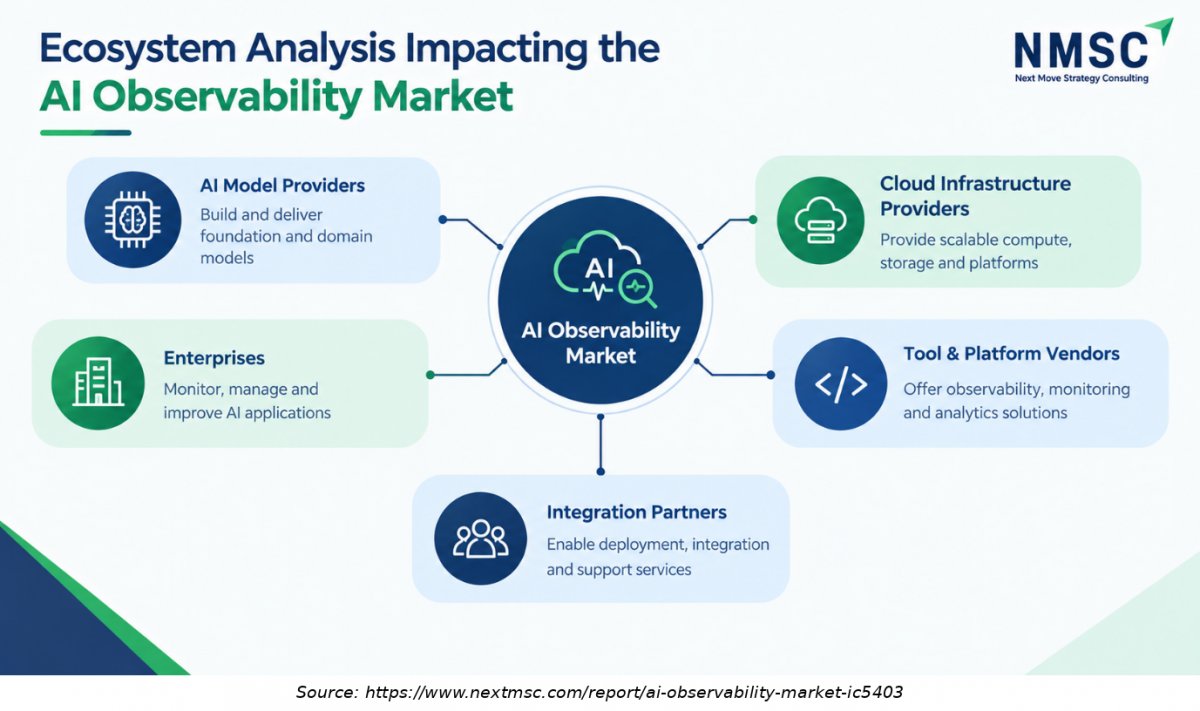
We observed that the competitive landscape spans established infrastructure-monitoring incumbents extending into AI observability and specialist AI-native vendors built specifically for model, LLM, and agent monitoring.
|
Parameter |
Details |
|
Market Structure |
Moderately fragmented, with a mix of large infrastructure-monitoring incumbents and specialist AI-native vendors competing across offering and deployment segments. |
|
Innovation Focus |
Agent-tracing, AI guardrails, and regulatory-framework mapping are the leading areas of active product development. |
|
M&A Activity |
Infrastructure-monitoring incumbents are acquiring specialist AI observability and evaluation startups to close capability gaps in LLM and agent monitoring. |
Companies compete primarily on breadth of workload coverage, depth of integration with popular AI development frameworks, and speed of onboarding for new model and agent types. Our findings suggest that vendors able to monitor predictive, generative, and agentic workloads within a single platform hold an advantage over point solutions. Pricing flexibility, particularly usage-based models, is increasingly a competitive lever among vendors targeting mid-market and startup customers.
Two archetypes dominate: infrastructure-monitoring incumbents extending existing application-performance-monitoring platforms into AI observability, and AI-native specialists built exclusively for model, LLM, and agent monitoring. We observed that incumbents compete on existing enterprise footprint and unified dashboards, while specialists compete on depth of LLM-specific evaluation and guardrail functionality that broader platforms have not yet matched.
Leading vendors are differentiating through agent-tracing depth, automated evaluation pipelines, and pre-built regulatory-framework mapping. Our assessment indicates that vendors investing early in agentic AI tracing are positioning themselves ahead of an anticipated wave of enterprise agent deployments. Open-source observability frameworks are also shaping competitive dynamics, with several vendors offering open-core models to drive developer adoption before monetizing enterprise features.
M&A activity is accelerating as infrastructure-monitoring incumbents acquire specialist AI evaluation and guardrails startups to close capability gaps rapidly rather than build LLM-specific functionality internally. We found that this consolidation trend is most visible among the largest platform vendors, who are positioning acquired capabilities as extensions of existing observability suites rather than standalone products, reinforcing platform breadth as the primary competitive differentiator.
We observed that the following companies represent the validated set of leading providers shaping the competitive structure of the AI observability market.
Datadog, Inc.
Dynatrace, Inc.
Cisco Systems, Inc.
New Relic, Inc.
Elastic N.V.
Honeycomb.io, Inc.
Chronosphere, Inc.
Observe, Inc.
Sentry, Inc.
Coralogix Ltd.
Arize AI, Inc.
Fiddler AI, Inc.
Galileo Technologies, Inc.
Weights & Biases, Inc.
Langfuse GmbH
Aporia Technologies Ltd.
Arthur AI, Inc.
Braintrust Data, Inc
We observed that recent product and go-to-market announcements reflect the industry's rapid shift toward LLM and agent-specific observability capabilities.
|
Date |
Event |
|
June 2026 |
Datadog announced the expansion of its automated DevOps suite at DASH 2026, introducing embedded AI agents, such as Bits Code and Bits Release, designed to autonomously generate validation plans, propose code remediations, and monitor rollouts directly from the platform's core observability metrics. |
|
June 2026 |
Arize AI launched its next-generation Arize AX platform capabilities at its annual Observe 2026 conference, introducing automated agent-as-a-judge feedback loops, full-harness agent experimentation, and native voice-agent observability to help engineering teams systematically identify and resolve complex production failures. |
|
June 2026 |
Dynatrace released its State of Log Management 2026 report, highlighting that enterprise AI workloads have driven a 93% surge in telemetry log volumes over the preceding 12 months, pushing traditional, fragmented logging tools to their breaking point and forcing organizations toward unified platform architectures |
"AI is everywhere, but most organizations are still figuring out how to monitor and trust these systems. That visibility gap makes scaling risky and that's why observability matters. Unlike traditional software, AI's decision making is often hidden, making it hard to explain or trust, yet errors can cause substantial financial loss, reputational damage and regulatory scrutiny."
— Padraig Byrne, Vice President Analyst, Gartner
Statement made while discussing the growing need for AI observability, highlighting the importance of visibility, explainability, and governance in enabling organizations to safely scale AI deployments while mitigating operational, financial, and regulatory risks.
The statement underscores the increasing importance of AI observability as enterprises expand the deployment of AI models across mission-critical business operations. As organizations seek greater transparency, explainability, and governance over AI-driven decisions, AI observability platforms are becoming essential for monitoring model performance, detecting anomalies, ensuring regulatory compliance, and building trust in AI systems. Furthermore, the growing complexity of generative AI and large language models is accelerating demand for advanced observability solutions, supporting sustained growth in the global AI Observability Market.
Venture and growth-equity capital continues to flow into AI-native observability startups building agent-tracing and evaluation tooling. Our assessment indicates that investors are prioritizing platforms demonstrating integration breadth across multiple AI development frameworks over point solutions tied to a single model provider, reflecting expectations of continued enterprise consolidation toward fewer, broader observability vendors through 2035.
Cloud hyperscalers and observability vendors are investing in telemetry-processing infrastructure capable of handling the higher data volumes generated by agentic AI tracing compared with traditional application monitoring. We observed that this infrastructure investment is concentrated in regions with existing cloud data-center density, reinforcing North America and parts of Asia-Pacific as primary investment destinations for observability infrastructure buildout.
Environmental, social, and governance considerations increasingly intersect with AI observability through responsible-AI and explainability tooling that supports fairness and bias-monitoring disclosures. Our findings suggest that institutional investors evaluating AI-focused portfolio companies are placing growing weight on governance tooling maturity, including observability platform adoption, as an indicator of responsible AI deployment practices ahead of anticipated disclosure requirements.
Enterprise and industry leaders gain a structured view of segment-level growth rates, deployment-model trade-offs, and regional adoption patterns that inform build-versus-buy and vendor-selection decisions. Our analysis shows that leaders responsible for AI governance can use the report's regulatory-driver findings to prioritize observability investments ahead of anticipated compliance deadlines.
Investors and financial analysts gain segment- and region-level revenue forecasts, competitive-landscape analysis, and M&A activity context that support portfolio construction and company-level diligence. We observed that the report's growth-driver and restraint analysis helps analysts stress-test growth assumptions against regulatory and macroeconomic variables specific to the AI observability category.
Technology vendors and product teams gain visibility into which offering, workload, and deployment segments are growing fastest, informing roadmap prioritization between predictive, generative, and agentic AI monitoring capabilities. Our findings suggest that product teams can use the competitive-landscape and key-trends sections to benchmark differentiation strategy against both infrastructure-monitoring incumbents and AI-native specialists.
Software
Model Observability
Data Observability
Explainability and Responsible AI
LLM and Agent Observability
AI Evaluation
AI Guardrails
AI Application Performance Monitoring
Other AI Observability Software
Services
Professional Services
Managed Services
By Deployment Model
SaaS
Self-Hosted
Private Cloud
Hybrid
By AI Workload
Predictive AI
Generative AI
Agentic AI
By Buyer Type
AI Engineering
Data Science
MLOps
Platform Engineering
SRE and IT Operations
Security and Compliance
By Pricing Model
Subscription
Usage-Based
Per Model
Open Source with PSDC
Direct Sales
Cloud Marketplace
Channel Partners
By End User
Software and Internet
Banking, Financial Services and Insurance
Healthcare and Life Sciences
Retail and Commerce
Telecommunications and Media
Manufacturing
Government and Public Sector
Energy and Utilities
Other Industries
By Region
North America: U.S., Canada, Mexico
Europe: UK, Germany, France, Italy, Spain, Sweden, Denmark, Finland, Netherlands, Rest of Europe
Asia-Pacific: China, India, Japan, South Korea, Taiwan, Indonesia, Vietnam, Australia```html, Philippines, Malaysia, Rest of APAC
Middle East & Africa: Saudi Arabia, UAE, Egypt, Israel, Turkey, Nigeria, South Africa, Rest of MEA
Latin America: Brazil, Argentina, Chile, Colombia, Rest of LATAM
The long-term outlook remains strongly positive as generative and agentic AI move from pilot to core production infrastructure across every major industry. We observed that observability is transitioning from an optional engineering tool to a governance requirement, a shift that should sustain double-digit growth well beyond the current 2026–2035 forecast window as AI workloads continue to expand.
Vendors should prioritize cross-workload platform breadth spanning predictive, generative, and agentic AI rather than narrow point solutions. Our assessment indicates that vendors combining strong agent-tracing depth with pre-built regulatory-framework mapping are best positioned to capture enterprise security and compliance budgets as purchasing authority shifts toward those buyer groups.
Investment attractiveness remains high given the market's 31.1% forecast CAGR and the structural, regulation-driven nature of demand. We found that investors should weigh vendor differentiation carefully, as cloud hyperscaler bundling of basic monitoring features could compress margins for undifferentiated point solutions over the forecast period.
Key shifts to monitor include the standardization of agent-tracing protocols, evolving AI Act enforcement timelines in Europe, and continued consolidation through M&A among infrastructure-monitoring incumbents. Our findings suggest that fragmentation in global AI regulation remains the primary risk, as divergent national requirements could raise compliance-engineering costs for vendors serving multinational enterprises.
Primary growth pathways include expansion into agentic AI tracing, compliance-as-a-service offerings mapped to recognized risk frameworks, and usage-based pricing that broadens the addressable market to mid-sized enterprises. Next Move Strategy Consulting's analysis indicates that vendors executing on these three pathways simultaneously are best positioned to sustain above-market growth through the forecast period.