Collaborative Ecosystem Product Development Market Size, Share, Trends and Growth Analysis, By Application (Product Co-Design and Engineering, Supply Chain Collaboration, Innovation and Idea Management, Requirements and Compliance Management, and Prototype and Testing Collaboration), By Offering, By Deployment Mode, By Organization Size, By End-Use Industry (Automotive, Aerospace and Defense, Industrial Equipment, and Others, and Region — Global Industry Report and Forecast, 2026–2035
Industry: ICT & Media | Publishing Date: August 8, 2026 | Last Updated: August 8, 2026 | No of Pages: N/A | No. of Tables: N/A | No. of Figures: N/A | Format: PDF | Report Code: IC5641
What Is the Collaborative Ecosystem Product Development Market Size?
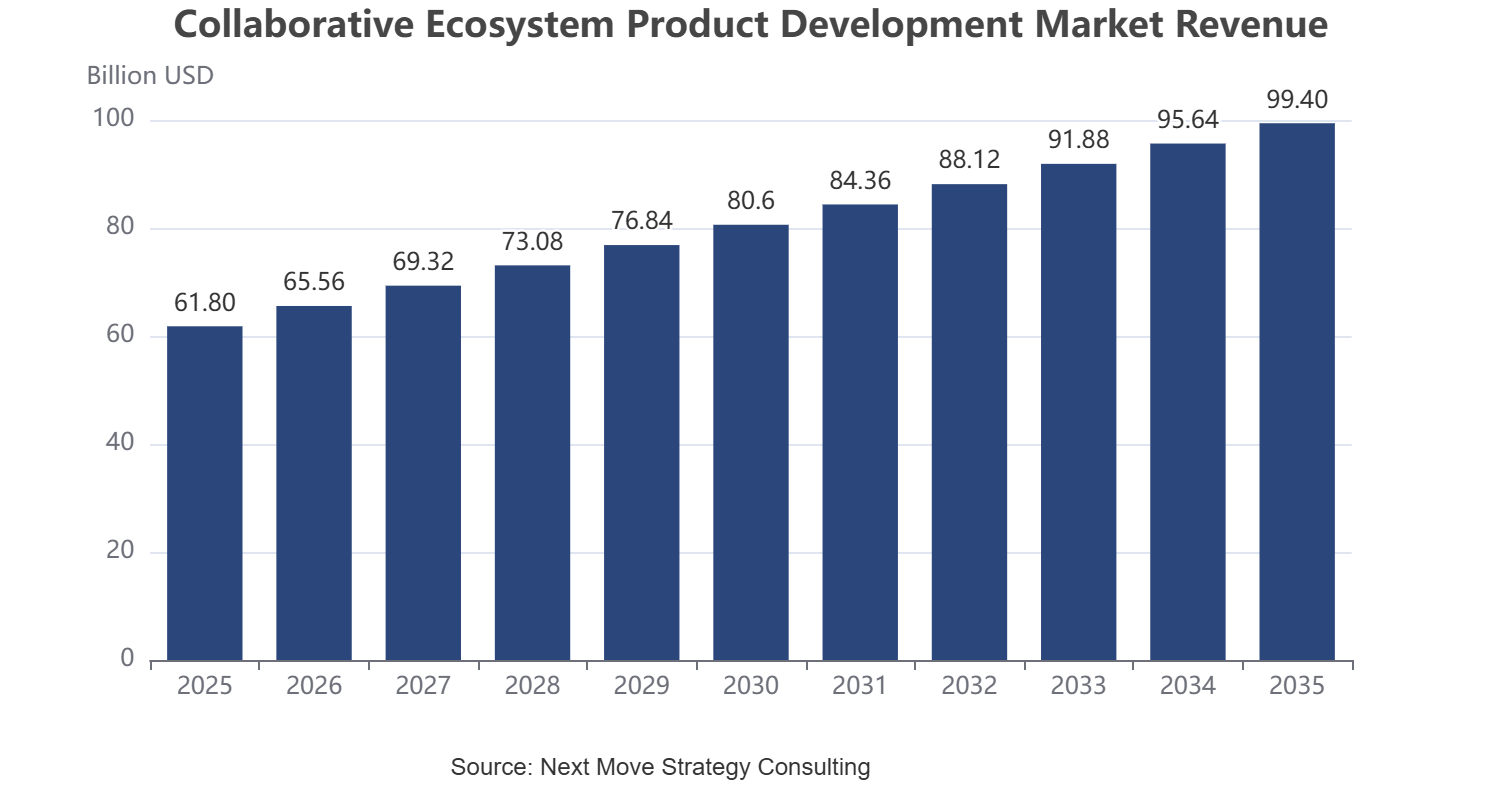
The global collaborative ecosystem product development market size was valued at USD 61.80 Billion in 2025 and is estimated at USD 64.70 Billion in 2026, forecast to reach USD 99.40 Billion by 2035, expanding at a 4.90% CAGR between 2026 and 2035. North America leads with approximately 38% share, while product co-design and engineering dominates all other applications with approximately 34% share.
We observed that growth is broadening across cloud-based deployment and innovation-management applications, with healthcare-sector adoption and Asia-Pacific manufacturing expansion driving the fastest structural gains through 2035.
|
Key Takeaways |
|
By Application: Product Co-Design and Engineering held the largest share of approximately 34% (USD 21.0 Billion) in 2025; Innovation and Idea Management is the fastest-growing sub-segment at 6.9% CAGR from 2026–2035. |
|
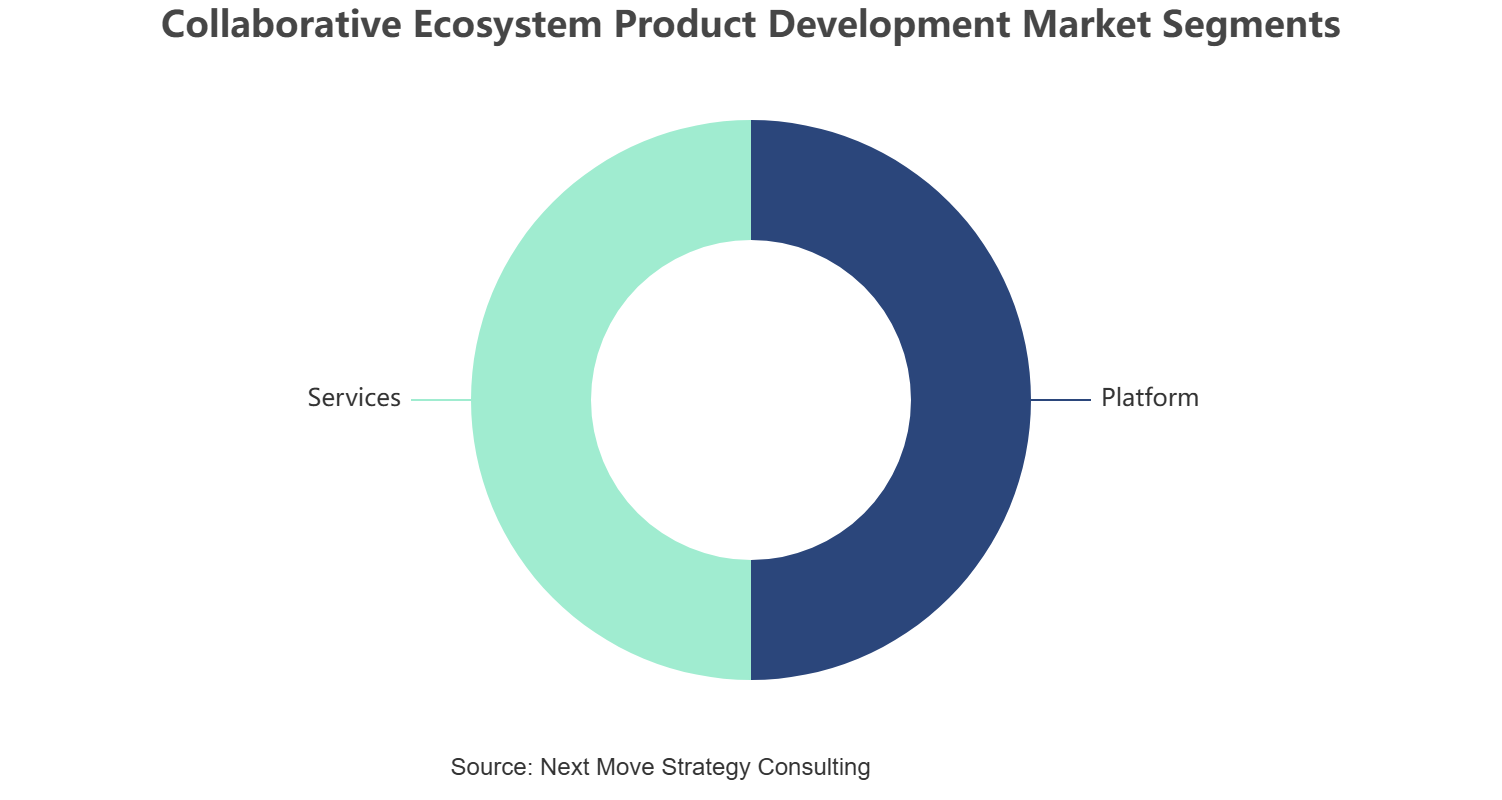
By Offering: Platform held the largest share of approximately 60% (USD 37.08 Billion) in 2025; Platform is also the fastest-growing sub-segment at approximately 5.8% CAGR from 2026–2035. |
|
By Deployment Mode: Cloud held the largest share of approximately 68% (USD 42.0 Billion) in 2025; Cloud is also the fastest-growing sub-segment at approximately 6.2% CAGR from 2026–2035. |
|
By Organization Size: Large Enterprises held the largest share of approximately 71% (USD 43.9 Billion) in 2025; Small and Medium Enterprises is the fastest-growing sub-segment at approximately 6.5% CAGR from 2026–2035. |
|
By End-Use Industry: Automotive held the largest share of approximately 32% (USD 19.76 Billion) in 2025; Healthcare and Medical Devices is the fastest-growing sub-segment at approximately 7.9% CAGR from 2026–2035. |
|
Dominant Region: North America dominated with approximately 38% revenue share (USD 23.48 Billion) in 2025. |
|
Fastest-Growing Region: Asia-Pacific is expected to register the highest CAGR of approximately 7.2% during 2026–2035. |
|
Dominant Country: U.S. led with approximately USD 18.5 Billion in 2025. |
|
Fastest-Growing Country: China is the fastest-growing country at approximately 8.5% CAGR from 2026–2035. |
Market Opportunity: The collaborative ecosystem product development market is expected to create an absolute dollar opportunity of USD 34.70 Billion between 2026 and 2035, presenting significant investment potential across cloud-based co-design platforms, healthcare-sector deployment, and Asia-Pacific manufacturing expansion.
According to NMSC analysis, manufacturers are increasingly consolidating co-design, supply chain collaboration, and compliance management into unified cloud platforms rather than maintaining separate point solutions, a shift that favors vertically integrated platform providers over single-function tool vendors as enterprise procurement standards tighten through 2035.
What Does the Collaborative Ecosystem Product Development Market Encompass?
The collaborative ecosystem product development market encompasses cloud and on-premise software platforms and services that enable multiple stakeholders, including original equipment manufacturers, suppliers, engineering partners, and customers, to jointly design, engineer, and validate products across a shared digital environment. Our assessment indicates that the scope spans product co-design and engineering tools, supply chain collaboration modules, innovation and idea-management systems, requirements and compliance tracking, and prototype and testing collaboration platforms. The category has evolved from siloed product lifecycle management systems into interconnected, multi-tenant ecosystems where external partners access shared design data under governed permission structures.
Regulatory frameworks such as data-residency requirements under the European Union’s General Data Protection Regulation and export-control compliance rules shape platform architecture for cross-border collaboration. We observed that technology adoption is shifting toward cloud-native architectures, real-time three-dimensional design collaboration, and AI-assisted requirements validation. NMSC’s analysis indicates that this structural shift, combined with rising integration of real-time 3D collaboration platform technology, is redefining how distributed engineering teams co-develop products across the collaborative ecosystem product development market.
|
Parameters |
Details |
|
Market Size in 2025 |
USD 61.80 Billion |
|
Market Size in 2026 |
USD 64.70 Billion |
|
Revenue Forecast in 2035 |
USD 99.40 Billion |
|
Growth Rate |
CAGR of 4.90% from 2026 to 2035 |
|
Analysis Period |
2025–2035 |
|
Base Year Considered |
2025 |
|
Forecast Period |
2026–2035 |
|
Market Size Estimation |
Revenue (USD Billion) |
|
Companies Profiled |
20 |
|
Countries Covered |
33 |
|
Market Share |
Available for Top 10 Companies |
Key Emerging Trends
Based on research conducted by NMSC, we found that four structural trends are reshaping product development, sourcing, and stakeholder engagement across the industry.
How Is AI-Assisted Design Validation Transforming Engineering Collaboration?
AI-assisted requirements validation and design-conflict detection tools are replacing manual cross-team review cycles across multi-stakeholder engineering programs. We observed that Dassault Systèmes’ expanded AI-powered design-validation capabilities within its 3DEXPERIENCE platform, broadened in 2025, target automated compliance and interference checking across supplier-submitted design data. Platform providers are retooling architecture to embed AI validation directly into collaborative review workflows, while enterprises redesign approval processes around automated flagging.
Why Is Cloud-Native Architecture Gaining Adoption Over On-Premise Deployment?
Cloud-native platform architecture is gaining share as enterprises seek to onboard external suppliers and partners without extending internal network infrastructure. Our findings suggest that PTC’s expanded cloud-hosted Windchill+ deployment option, scaled through 2025, increasingly targets multi-tier supplier networks requiring rapid onboarding. Platform vendors such as Siemens and Autodesk are expanding cloud-first product lines, positioning cloud deployment as the default architecture within the broader deployment-mode segmentation.
How Is Supply Chain Collaboration Reshaping Supplier Integration Strategy?
Rising demand for real-time supply chain collaboration is pushing platform providers toward direct supplier-portal integration that bypasses traditional email-based design-change communication. We observed that Aras Corporation’s expanded supplier collaboration module, updated in 2025, increasingly targets automotive and aerospace multi-tier supply networks. This trend is elevating demand for permission-governed shared workspaces among enterprise customers, while smaller suppliers adapt to platform-mandated collaboration standards.
What Role Does Healthcare Sector Adoption Play in Market Expansion?
Rising healthcare and medical device manufacturer adoption of collaborative product development platforms is emerging as a differentiator amid stricter regulatory documentation requirements. Our analysis shows that platform providers are integrating digital twin governance capabilities to support traceable design-history documentation for regulatory submissions. Centric Software’s expanded compliance-tracking module for medical device manufacturers, introduced in 2025, exemplifies this direction with dedicated audit-trail functionality for regulatory-submission workflows.
Ecosystem Analysis of the Collaborative Ecosystem Product Development Market
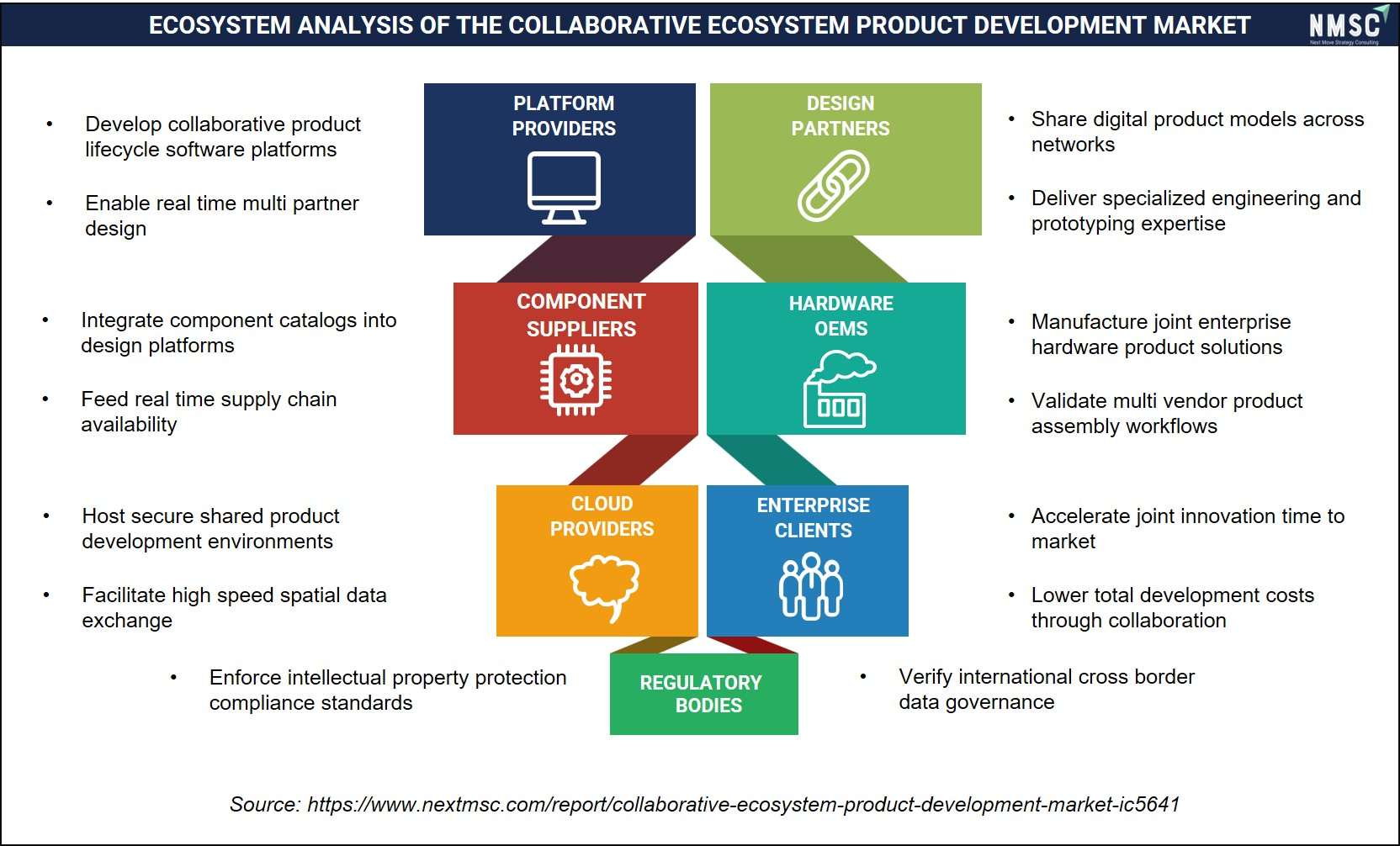
NMSC’s analysis indicates that the Collaborative Ecosystem Product Development Market operates within a connected framework joining platform providers, design partners, component suppliers, and hardware OEMs. Cloud providers host secure development environments, allowing enterprise clients to lower costs and accelerate time to market. Ultimately, regulatory bodies enforce intellectual property protection compliance and verify international cross-border data governance, maintaining secure multi-partner workflows across global supply networks.
Growth Drivers & Restraints
Growth Catalyst & Risk Assessment Matrix
|
Factors |
Type |
(+/−) % Impact on CAGR |
Geographic Relevance |
Impact Timeline |
|
Rising multi-tier supplier collaboration requirements |
Driver |
+1.4% |
North America, Europe |
2026–2035 |
|
Growth of cloud-native platform adoption |
Driver |
+1.1% |
Global |
2026–2033 |
|
Expanding healthcare and medical device compliance needs |
Driver |
+0.9% |
North America, Europe |
2027–2035 |
|
Rising Asia-Pacific manufacturing digitalization investment |
Driver |
+0.8% |
Asia-Pacific |
2026–2032 |
|
Growth of AI-assisted design validation tools |
Driver |
+0.6% |
Global |
2026–2031 |
|
High platform integration and onboarding complexity |
Restraint |
−0.7% |
Global |
2026–2030 |
|
Data-security concerns in multi-stakeholder environments |
Restraint |
−0.5% |
North America, Europe |
2026–2029 |
|
Limited adoption among smaller supply-chain participants |
Restraint |
−0.4% |
Asia-Pacific, Latin America |
2026–2031 |
What Is the Primary Growth Driver of the Collaborative Ecosystem Product Development Market?
Rising multi-tier supplier collaboration requirements represent the primary growth driver, as original equipment manufacturers increasingly mandate shared digital workspaces across extended supply networks. Data from national manufacturing statistical agencies indicates sustained growth in multi-tier supplier integration programs across automotive and aerospace sectors through 2025. This expanding requirement is prompting platform providers to scale supplier-onboarding capacity to meet enterprise procurement mandates.
How Is Cloud-Native Platform Adoption Driving the Market Growth?
Growing cloud-native platform adoption is driving market growth, as enterprises seek faster external-partner onboarding without extending internal network infrastructure. Government digital-infrastructure investment data confirms sustained cloud-computing capital allocation across major manufacturing economies through 2025. Platform providers are responding by expanding cloud-hosted deployment options to capture enterprise demand for rapid multi-stakeholder onboarding.
What Is Restraining the Collaborative Ecosystem Product Development Market Growth?
High platform integration and onboarding complexity restrains market growth by extending implementation timelines across multi-stakeholder deployments. Government enterprise-technology adoption surveys have documented extended implementation cycles for multi-party collaborative software deployments across recent reporting periods. These conditions are prompting platform providers to develop standardized onboarding templates to reduce integration complexity for new supplier and partner participants.
Segmentation Analysis
Segment Sizing: By Application
|
Segment |
2025 (USD Billion) |
2035 (USD Billion) |
CAGR% (2026–2035) |
|
Product Co-Design and Engineering |
21.00 |
32.50 |
5.0% |
|
Supply Chain Collaboration |
14.80 |
23.00 |
5.0% |
|
Innovation and Idea Management |
12.40 |
22.50 |
6.9% |
|
Requirements and Compliance Management |
8.60 |
13.50 |
5.1% |
|
Prototype and Testing Collaboration |
5.00 |
7.90 |
5.2% |
|
Total |
61.80 |
99.40 |
4.90% |
Which Application Dominates the Collaborative Ecosystem Product Development Market?
Application segmentation divides the market into product co-design and engineering, supply chain collaboration, innovation and idea management, requirements and compliance management, and prototype and testing collaboration. Product co-design and engineering holds the dominant position, supported by sustained enterprise investment in shared design environments across automotive and aerospace supply chains. Innovation and idea management is the fastest-growing sub-segment, driven by rising enterprise adoption of structured idea-capture platforms that formalize cross-partner innovation pipelines.
Segment Sizing: By Offering
|
Segment |
2025 (USD Billion) |
2035 (USD Billion) |
CAGR% (2026–2035) |
|
Platform |
37.08 |
61.60 |
5.8% |
|
Services |
24.72 |
37.80 |
4.8% |
|
Total |
61.80 |
99.40 |
4.90% |
Which Offering Leads the Collaborative Ecosystem Product Development Market?
Offering segmentation spans platform and services. Platform offerings dominate the segment, reflecting sustained enterprise licensing of core collaborative software across design, supply chain, and compliance modules. Platform offerings are also the fastest-growing category, supported by expanding modular add-on adoption as enterprises scale collaborative functionality across additional business units without proportional increases in implementation-services spending.
Segment Sizing: By End-Use Industry
|
Segment |
2025 (USD Billion) |
2035 (USD Billion) |
CAGR% (2026–2035) |
|
Automotive |
19.76 |
29.82 |
4.7% |
|
Aerospace and Defense |
12.98 |
20.88 |
5.4% |
|
Industrial Equipment |
11.12 |
17.89 |
5.4% |
|
Consumer Electronics |
8.03 |
12.92 |
5.4% |
|
Healthcare and Medical Devices |
6.80 |
13.42 |
7.9% |
|
Others |
3.11 |
4.47 |
4.1% |
|
Total |
61.80 |
99.40 |
4.90% |
Which End-Use Industry Leads Collaborative Ecosystem Product Development Adoption?
End-use industry segmentation covers automotive, aerospace and defense, industrial equipment, consumer electronics, healthcare and medical devices, and other sectors. Automotive dominates the segment, reflecting established multi-tier supplier collaboration mandates across global vehicle-manufacturing programs. Healthcare and medical devices is the fastest-growing end-use industry, driven by tightening regulatory documentation requirements that push manufacturers toward traceable, audit-ready collaborative design platforms.
Growth Opportunities
Beyond current demand drivers, three forward-looking whitespace opportunities are positioned to reshape competitive positioning through 2035.
How Can Providers Capture Healthcare Compliance Documentation Demand?
Providers can capture rising healthcare-sector demand by embedding regulatory-submission-ready audit trails directly into collaborative design workflows. Requirements and compliance management platform providers stand to benefit most, as medical device manufacturers increasingly prioritize traceable documentation capability over standalone design-collaboration features alone.
What Opportunity Exists in SME-Focused Cloud Platform Tiers?
Expanding simplified, lower-cost cloud platform tiers designed for small and medium enterprise suppliers presents a scalable growth mechanism as large manufacturers push collaboration mandates down their supply chains. Cloud-native platform providers benefit directly, converting supplier-mandated onboarding into recurring subscription revenue across previously underserved smaller supplier segments.
How Can Asia-Pacific Manufacturing Digitalization Unlock Regional Growth?
Expanding localized platform deployment to support Asia-Pacific manufacturing digitalization initiatives creates a durable opportunity to capture regional supplier-network growth. Platform providers with established regional data-center infrastructure benefit most, as data-residency preferences increasingly favor locally hosted collaborative environments over centralized global deployments.
Regional Outlook
Geographic Performance Snapshot
|
Region |
2025 (USD Billion) |
2035 (USD Billion) |
CAGR% (2026–2035) |
Key Driver |
|
North America |
23.48 |
35.79 |
4.8% |
Established automotive and aerospace multi-tier supplier collaboration mandates |
|
Europe |
17.30 |
27.63 |
5.3% |
Regulatory-driven compliance documentation and cross-border collaboration standards |
|
Asia-Pacific |
14.20 |
26.44 |
7.2% |
Rapid manufacturing digitalization and expanding supplier-network integration |
|
Middle East & Africa |
3.71 |
5.57 |
4.6% |
Growing industrial diversification and manufacturing infrastructure investment |
|
Latin America |
3.11>11 |
3.97 |
2.8% |
Gradual adoption of cloud-based collaborative engineering platforms |
|
Total |
61.80 |
99.40 |
4.90% |
— |
North America Collaborative Ecosystem Product Development Market
North America leads the global collaborative ecosystem product development market, supported by established automotive and aerospace multi-tier supplier collaboration mandates across major manufacturing programs. Data-security and export-control regulation shapes platform architecture for cross-border supplier collaboration. Technology adoption is advancing through AI-assisted design-validation tools, and providers are pursuing a strategic focus on healthcare-sector compliance modules to sustain leadership through 2035.
Europe Collaborative Ecosystem Product Development Market
Europe maintains a strong position in the collaborative ecosystem product development market, driven by regulatory-driven compliance documentation requirements and mature cross-border collaboration standards. EU data-residency regulation shapes platform-hosting architecture for multi-country supplier networks. Technology adoption centers on cloud-native deployment, with providers strategically expanding compliance-tracking modules to capture regulatory-driven demand across the region.
Asia-Pacific Collaborative Ecosystem Product Development Market
Asia-Pacific is the fastest-growing collaborative ecosystem product development region, propelled by rapid manufacturing digitalization and expanding supplier-network integration across major economies. National industrial-digitalization programs are incentivizing enterprise adoption of collaborative engineering platforms. Technology adoption is advancing through localized cloud infrastructure, and providers are strategically prioritizing regional data-center expansion to capture rising manufacturing-sector demand through 2035.
Middle East & Africa Collaborative Ecosystem Product Development Market
The Middle East and Africa region is expanding steadily, supported by growing industrial diversification programs and manufacturing infrastructure investment across Gulf economies. Regulatory authorities are establishing new data-governance frameworks for enterprise software adoption. Technology adoption includes expanding cloud-hosted deployment, with providers strategically positioning regional partnerships to capture emerging industrial-sector demand.
Latin America Collaborative Ecosystem Product Development Market
Latin America is growing gradually, driven by increasing adoption of cloud-based collaborative engineering platforms among regional manufacturing enterprises. National industrial-modernization agencies are supporting digital-transformation initiatives across manufacturing sectors. Technology adoption is advancing through expanded reseller partnerships, with providers strategically broadening regional distribution to capture rising manufacturing-sector demand through 2035.
U.S. Collaborative Ecosystem Product Development Market
Based on our estimates, the U.S. collaborative ecosystem product development market was valued at approximately USD 18.5 Billion in 2025 and is projected to reach approximately USD 28.2 Billion by 2035 at a CAGR of approximately 4.8%. Demand structure centers on automotive and aerospace multi-tier supplier collaboration, supported by high technology penetration in cloud-native platforms, established data-security regulatory oversight, and intense competitive activity among leading providers pursuing strategic capacity expansion.
Canada Collaborative Ecosystem Product Development Market
The market in Canada was valued at approximately USD 2.8 Billion in 2025 and is projected to grow at a CAGR of approximately 4.6% through 2035. Demand structure reflects growing aerospace and industrial equipment supplier collaboration adoption, supported by moderate technology penetration, stable regulatory oversight, and a competitive landscape shaped by cross-border platform provider partnerships pursuing selective strategic expansion.
UK Collaborative Ecosystem Product Development Market
As per our estimate, the UK collaborative ecosystem product development market was valued at approximately USD 6.2 Billion in 2025 and is projected to grow at a CAGR of approximately 5.1% through 2035. Demand structure is anchored in aerospace and automotive supplier collaboration platforms, supported by high technology adoption in cloud-native architecture, post-EU data-regulation alignment, and a competitive landscape shaped by established platform providers pursuing sustained strategic expansion.
Germany Collaborative Ecosystem Product Development Market
According to our analysis, the Germany collaborative ecosystem product development market was valued at approximately USD 4.6 Billion in 2025 and is projected to grow at a CAGR of approximately 5.4% through 2035. Demand structure reflects strong automotive supplier-network collaboration demand, supported by high technology penetration, EU regulatory alignment, and a competitive landscape featuring both domestic and international providers pursuing steady strategic growth.
France Collaborative Ecosystem Product Development Market
Based on our estimates, the France collaborative ecosystem product development market was valued at approximately USD 3.4 Billion in 2025 and is projected to grow at a CAGR of approximately 5.3% through 2035. Demand structure centers on aerospace and defense supplier collaboration, supported by high technology adoption, EU data-governance regulation, and competitive activity among domestic providers such as Dassault Systèmes pursuing distribution-channel strategic broadening.
China Collaborative Ecosystem Product Development Market
The market in China was valued at approximately USD 4.6 Billion in 2025 and is projected to reach approximately USD 10.3 Billion by 2035 at a CAGR of approximately 8.5%, the fastest among covered countries. Demand structure reflects rapidly rising manufacturing digitalization and expanding domestic supplier-network integration, supported by expanding technology penetration, evolving data-governance regulation, and a competitive landscape where domestic and international providers are pursuing aggressive strategic expansion.
India Collaborative Ecosystem Product Development Market
As per our estimate, the India collaborative ecosystem product development market was valued at approximately USD 2.3 Billion in 2025 and is projected to grow at a CAGR of approximately 8.1% through 2035. Demand structure is driven by expanding automotive and industrial equipment manufacturing digitalization, supported by rising technology penetration, evolving data-regulation frameworks, and a competitive landscape where domestic providers are pursuing significant strategic capacity additions.
Japan Collaborative Ecosystem Product Development Market
According to our analysis, the Japan collaborative ecosystem product development market was valued at approximately USD 3.1 Billion in 2025 and is projected to grow at a CAGR of approximately 6.2% through 2035. Demand structure centers on automotive and industrial equipment supplier collaboration, supported by high technology penetration, stable regulatory oversight, and a competitive landscape featuring established domestic distributors pursuing selective strategic partnerships.
South Korea Collaborative Ecosystem Product Development Market
Based on our estimates, the South Korea collaborative ecosystem product development market was valued at approximately USD 1.6 Billion in 2025 and is projected to grow at a CAGR of approximately 7.0% through 2035. Demand structure reflects rising electronics and automotive manufacturer collaboration adoption, supported by high technology adoption, evolving data-governance regulation, and a competitive landscape where domestic providers are pursuing targeted strategic expansion.
Australia Collaborative Ecosystem Product Development Market
The market in Australia was valued at approximately USD 1.3 Billion in 2025 and is projected to grow at a CAGR of approximately 5.6% through 2035. Demand structure centers on industrial equipment and defense-sector supplier collaboration, supported by moderate technology penetration, stable regulatory oversight, and a competitive landscape featuring international providers pursuing selective strategic distribution expansion.
UAE Collaborative Ecosystem Product Development Market
As per our estimate, the UAE collaborative ecosystem product development market was valued at approximately USD 0.85 Billion in 2025 and is projected to grow at a CAGR of approximately 5.9% through 2035. Demand structure is shaped by growing industrial diversification and manufacturing infrastructure investment, supported by high technology penetration, streamlined data-governance regulation, and a competitive landscape where international providers are pursuing aggressive strategic distribution development.
Saudi Arabia Collaborative Ecosystem Product Development Market
According to our analysis, the Saudi Arabia collaborative ecosystem product development market was valued at approximately USD 0.68 Billion in 2025 and is projected to grow at a CAGR of approximately 6.3% through 2035. Demand structure is driven by industrial diversification programs under national manufacturing-expansion initiatives, supported by rapidly rising technology penetration, evolving data-regulation frameworks, and a competitive landscape featuring significant strategic distribution commitments.
South Africa Collaborative Ecosystem Product Development Market
Based on our estimates, the South Africa collaborative ecosystem product development market was valued at approximately USD 0.42 Billion in 2025 and is projected to grow at a CAGR of approximately 4.4% through 2035. Demand structure centers on industrial equipment manufacturing collaboration adoption, supported by moderate technology penetration, stable regulatory oversight, and a competitive landscape featuring regional distributors pursuing selective strategic expansion.
Brazil Collaborative Ecosystem Product Development Market
The market in Brazil was valued at approximately USD 1.35 Billion in 2025 and is projected to grow at a CAGR of approximately 3.1% through 2035. Demand structure reflects gradual adoption of cloud-based collaborative platforms among regional automotive manufacturers, supported by expanding technology penetration, evolving data-governance regulation, and a competitive landscape where regional distributors are pursuing steady strategic wholesale expansion.
Argentina Collaborative Ecosystem Product Development Market
As per our estimate, the Argentina collaborative ecosystem product development market was valued at approximately USD 0.62 Billion in 2025 and is projected to grow at a CAGR of approximately 2.4% through 2035. Demand structure is centered on gradual industrial equipment manufacturer platform adoption, supported by moderate technology penetration, stable regulatory oversight, and a competitive landscape featuring regional distributors pursuing targeted strategic expansion.
Strategic Framework of the Collaborative Ecosystem Product Development Market
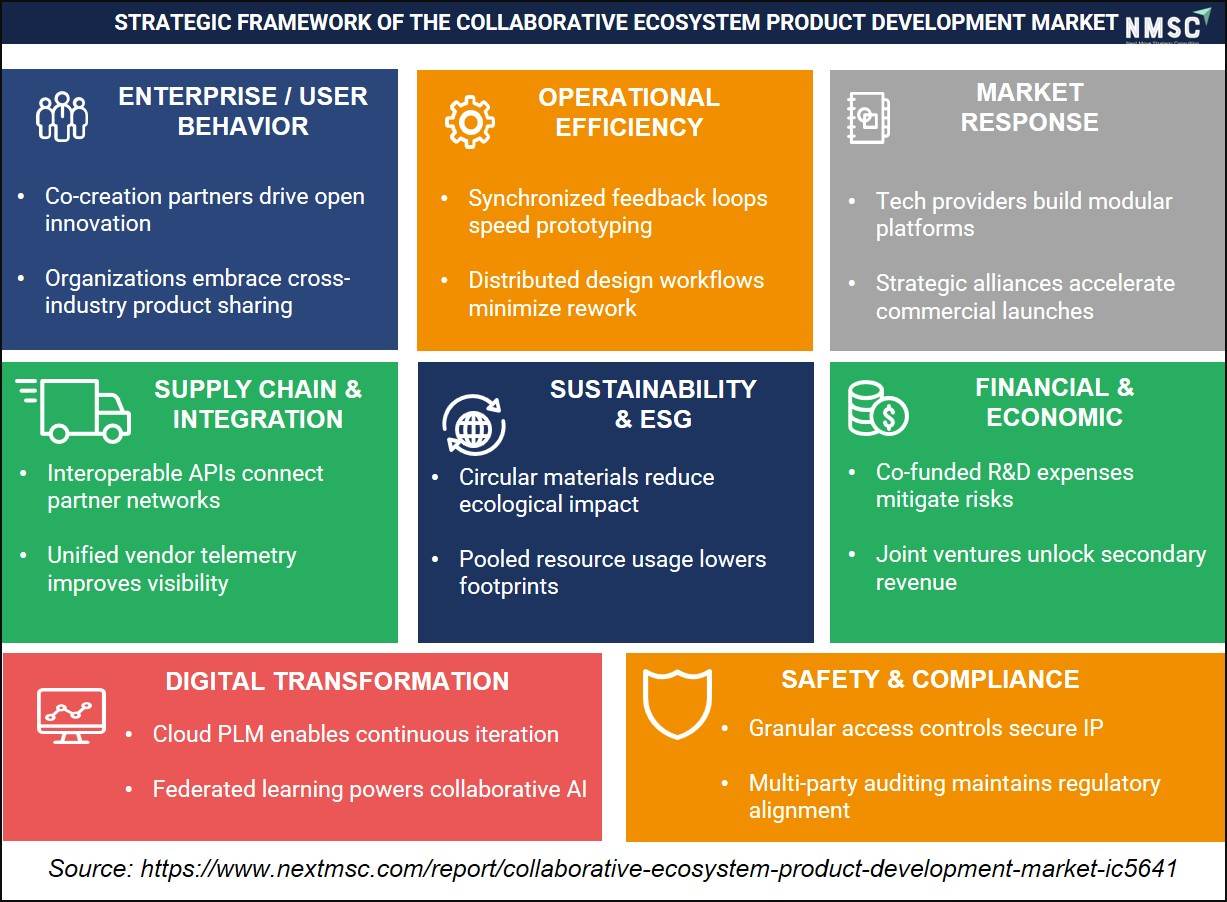
Based on research conducted by NMSC, we found that co-creation partners, open innovation, and cross-industry sharing drive the Collaborative Ecosystem Product Development Market. Operational efficiency improves through synchronized prototyping feedback loops, while interoperable APIs and vendor telemetry streamline supply integration. Furthermore, co-funded R&D reduces financial risks, while Cloud PLM and federated learning advance digital transformation. Concurrently, granular access controls and multi-party auditing maintain robust IP security.
Competitive Landscape
We observed that the competitive landscape is moderately consolidated, with established enterprise software providers accounting for a substantial share of global collaborative platform capacity.
|
Dimension |
Assessment |
|
Market Structure |
Moderately consolidated, led by established enterprise PLM and collaboration software providers. |
|
Innovation Focus |
AI-assisted design validation, cloud-native architecture, and real-time supplier collaboration modules. |
|
M&A Activity |
Selective acquisitions of specialized innovation-management and compliance-tracking software vendors. |
How Do Companies Compete in the Collaborative Ecosystem Product Development Market?
Companies compete primarily on platform breadth, supplier-onboarding speed, and depth of compliance-tracking functionality rather than on price alone. Cloud-native architecture and AI-assisted validation capability are key differentiators for large platform providers, while specialized vendors compete on niche functionality such as innovation-idea management or prototype-testing collaboration. Industry participants are increasingly investing in open application-programming-interface ecosystems to strengthen third-party integration capability.
Which Competitive Archetypes Dominate the Collaborative Ecosystem Product Development Market?
Two archetypes dominate the industry: diversified enterprise software conglomerates offering integrated product lifecycle management suites, and specialized point-solution providers focused on single functions such as innovation management or requirements compliance. The diversified archetype benefits from cross-selling integrated platform bundles, while specialists differentiate through deep functional expertise. This dual structure explains why market share remains distributed across both large conglomerates and focused independent vendors.
What Innovation and Differentiation Strategies Are Companies Pursuing?
Companies are pursuing AI-assisted design validation, cloud-native platform migration, and expanded supplier-collaboration modules as core differentiation strategies. Siemens’ expanded AI-integrated Teamcenter collaboration capabilities, scaled through 2025, illustrate a strategy of embedding automated validation directly into multi-stakeholder design review workflows. Providers across the industry are prioritizing open integration architecture to strengthen enterprise customer retention against point-solution competitors.
What M&A Activity Is Shaping the Competitive Landscape?
M&A activity centers on selective acquisitions of specialized innovation-management and compliance-tracking software vendors by larger platform providers seeking to broaden functional coverage. PTC’s continued acquisition-driven portfolio expansion through recent strategic additions reflects this consolidation pattern. Geographic expansion and functional-module broadening remain the primary competitive levers across the current consolidation cycle, ahead of pricing-based strategies.
Key Market Players
We found that the competitive set below reflects the validated group of companies most active in shaping global collaborative ecosystem product development supply as of 2026.
-
Siemens AG
-
Dassault Systèmes SE
-
PTC Inc.
-
Autodesk, Inc.
-
Aras Corporation
-
Propel PLM Inc.
-
Configit A/S
-
Centric Software, Inc.
-
Infor, Inc.
-
Bentley Systems, Incorporated
-
Hexagon AB
-
Jama Software, Inc.
-
Rockwell Automation, Inc. (Kalypso)
-
Sopheon plc
-
Planview, Inc.
-
Aha! Labs Inc.
-
Productboard, Inc.
-
IdeaScale, Inc.
Latest Developments
Our analysis shows that recent company activity reflects continued platform-capability expansion and strategic partnership development across the provider base.
|
Date |
Event |
|
June 2026 |
PTC introduced a major portfolio update featuring the new PTC Orbit and PTC Jetstream solutions, a unified AI platform, 12 AI agents, 10 integrations, and more than 100+ enhancements across CAD, PLM, ALM, and service lifecycle solutions to strengthen intelligent product lifecycle collaboration across enterprise ecosystems. |
|
May 2026 |
Centric Software launched Centric AI Studio, a generative AI platform natively integrated with Centric PLM. The solution connects visual generative AI directly to trusted PLM product data and operational workflows, enabling enterprise design, merchandising, and development teams to generate concepts and visualize product assortments faster across the lifecycle. |
|
March 2026 |
Siemens launched the Teamcenter Digital Reality Viewer and Digital Twin Composer as key building blocks of its Industrial AI Operating System. The solutions integrate Siemens Xcelerator PLM software with NVIDIA Omniverse technologies to enable high-performance, photorealistic, immersive 3D digital twins for collaborative product engineering. |
|
February 2026 |
Dassault Systèmes and NVIDIA announced a long-term strategic partnership to establish a shared industrial AI architecture combining virtual twins with NVIDIA AI infrastructure. The collaboration enables scalable industrial AI, science-based world models, and AI-powered virtual companions through the 3DEXPERIENCE platform for collaborative engineering ecosystems. |
Investment Opportunities
What Capital Inflows Are Shaping the Collaborative Ecosystem Product Development Market?
Capital inflows are concentrating on cloud-native platform development and AI-assisted validation capability. Strategic enterprise software acquirers and private equity investors are directing sustained capital toward specialized innovation-management and compliance-tracking vendors. This inflow pattern is enabling providers to accelerate functional-module expansion while diversifying revenue between platform licensing and implementation-services income streams through 2035.
How Is Infrastructure Investment Supporting Market Expansion?
Infrastructure investment in regional cloud data centers and enterprise integration middleware is directly supporting collaborative ecosystem product development expansion. Government-backed digital-infrastructure programs across North America, Europe, and Asia-Pacific are expanding capacity for enterprise cloud-hosting operations. This infrastructure buildout is reducing data-residency constraints, reinforcing demand for locally hosted collaborative platforms across newly expanded regional data-center facilities.
What ESG Considerations Are Influencing Investment Decisions?
Environmental, Social, and Governance considerations are increasingly shaping investment decisions, with investors favoring platform providers demonstrating verified data-governance practices and energy-efficient cloud infrastructure. Third-party data-security certification and renewable-energy-powered data-center commitments are gaining preference among institutional investors evaluating long-term enterprise software assets. This ESG-linked capital allocation is reinforcing demand for governed, sustainably hosted collaboration platforms.
Key Benefits for Stakeholders
How Does This Report Benefit Industry Leaders?
Industry leaders gain a validated view of segment-level revenue distribution, competitive positioning, and regional growth trajectories that inform platform-investment and functional-expansion decisions. The report’s segmentation and regional analysis clarify where demand is concentrating, enabling platform executives to prioritize capital allocation toward the highest-growth applications and end-use industries through 2035.
How Does This Report Benefit Investors and Financial Analysts?
Investors and financial analysts gain access to consistent market-sizing figures, CAGR forecasts, and competitive-landscape assessment that support valuation and portfolio-allocation decisions across enterprise software assets. The report’s regional and segmental breakdowns provide a defensible basis for evaluating growth-adjusted investment opportunities across the collaborative ecosystem product development value chain through the 2026–2035 forecast period.
How Does This Report Benefit Technology and Product Vendors?
Technology and product vendors supplying cloud infrastructure, AI-validation tools, and integration middleware gain insight into which applications and end-use industries are expanding fastest. This analysis helps vendors prioritize product roadmaps toward the highest-growth integration points, including compliance-tracking automation and supplier-collaboration technology favored by the dominant segments identified in this report.
Key Market Segments
By Application
-
Product Co-Design and Engineering
-
Supply Chain Collaboration
-
Innovation and Idea Management
-
Requirements and Compliance Management
-
Prototype and Testing Collaboration
By Offering
-
Platform
-
Services
By Deployment Mode
-
Cloud
-
On-Premise
By Organization Size
-
Large Enterprises
-
Small and Medium Enterprises
By End-Use Industry
-
Automotive
-
Aerospace and Defense
-
Industrial Equipment
-
Consumer Electronics
-
Healthcare and Medical Devices
-
Others
By Region
-
North America: U.S., Canada, Mexico
-
Europe: UK, Germany, France, Italy, Spain, Sweden, Denmark, Finland, Netherlands, Rest of Europe
-
Asia-Pacific: China, India, Japan, South Korea, Taiwan, Indonesia, Vietnam,Australia, Philippines, Malaysia, Rest of APAC
-
Middle East & Africa: Saudi Arabia, UAE, Egypt, Israel, Turkey, Nigeria, South Africa, Rest of MEA
-
Latin America: Brazil, Argentina, Chile, Colombia, Rest of LATAM
Conclusion & Recommendations
What Is the Long-Term Outlook for the Collaborative Ecosystem Product Development Market?
The long-term outlook remains positive, with the market expanding from USD 64.70 Billion in 2026 to USD 99.40 Billion by 2035 at a 4.90% CAGR. Sustained multi-tier supplier collaboration mandates, expanding cloud-native platform adoption, and rising healthcare-sector compliance demand collectively support continued growth across the fastest-expanding regions and applications through the full forecast period.
What Strategic Positioning Should Providers Pursue?
Providers should prioritize AI-assisted design validation, cloud-native platform migration, and compliance-tracking module development to strengthen competitive positioning. Diversified enterprise software conglomerates are advised to expand functional-module breadth, while specialized point-solution vendors should scale supplier-onboarding capacity to capture recurring demand across both established and emerging manufacturing markets.
How Attractive Is the Collaborative Ecosystem Product Development Market for Investment?
The market presents solid investment attractiveness, supported by an absolute dollar opportunity of USD 34.70 Billion between 2026 and 2035. Asia-Pacific offers the highest growth-adjusted returns given its 7.2% regional CAGR, while established North American and European markets provide stable, lower-volatility exposure to enterprise platform-licensing assets.
What Market Shifts and Key Risks Should Stakeholders Monitor?
Stakeholders should monitor high platform integration and onboarding complexity, data-security concerns in multi-stakeholder environments, and limited adoption among smaller supply-chain participants. Additionally, tightening data-residency requirements demand continuous regional infrastructure investment, as providers unable to adapt hosting architecture risk losing share to more regionally compliant competitors.
What Are the Key Growth Pathways Through 2035?
Key growth pathways include expanding AI-assisted validation capability, scaling cloud-native supplier-onboarding infrastructure, and deepening healthcare-sector compliance-tracking functionality across emerging regional markets. Providers pursuing coordinated expansion across these three pathways, supported by continued regional data-center investment, are best positioned to capture disproportionate share of the USD 34.70 Billion incremental opportunity through 2035.
About the Author
 Saista Faiyaz
— Saista Faiyaz is Research Associate at Next Move Strategy Consulting, where she has covered consumer markets and healthcare technologies for 3 years. Her work includes primary interview review, secondary-source validation, market sizing, and structured analysis of company and industry data. She supports research by comparing evidence across sources, organizing findings into market narratives, and documenting assumptions used in analysis. Her scope includes cross-market benchmarking, and reports.
Saista Faiyaz
— Saista Faiyaz is Research Associate at Next Move Strategy Consulting, where she has covered consumer markets and healthcare technologies for 3 years. Her work includes primary interview review, secondary-source validation, market sizing, and structured analysis of company and industry data. She supports research by comparing evidence across sources, organizing findings into market narratives, and documenting assumptions used in analysis. Her scope includes cross-market benchmarking, and reports.
About the Reviewer
 Supradip Baul
— Supradip Baul is an accomplished business consultant and strategist with over a decade of rich experience in market intelligence, strategy, technology, and business transformation. His work has included rigorous qualitative and quantitative analysis across multiple industries, helping clients shape investment decisions and long-term roadmaps. Earlier in his career, he was associated with Gartner, where he contributed to industry-leading reports and market share analyses. He has worked with leading global companies and holds an MBA with a dual specialization in Marketing and Finance.
Supradip Baul
— Supradip Baul is an accomplished business consultant and strategist with over a decade of rich experience in market intelligence, strategy, technology, and business transformation. His work has included rigorous qualitative and quantitative analysis across multiple industries, helping clients shape investment decisions and long-term roadmaps. Earlier in his career, he was associated with Gartner, where he contributed to industry-leading reports and market share analyses. He has worked with leading global companies and holds an MBA with a dual specialization in Marketing and Finance.
At Next Move Strategy Consulting, we understand that insightful market research is the cornerstone of successful business decisions. That's why we employ a robust and multifaceted approach, combining various methodologies to deliver the most accurate and actionable data for our clients.

Research Landscape
We navigate the world of research with two primary approaches:
Qualitative Approach
Our qualitative research methodologies involve immersive techniques such as in-depth interviews, focus groups, and observational studies. By engaging directly with individuals and stakeholders, we uncover valuable insights that quantitative data alone may overlook.

Quantitative Research
In tandem with qualitative methodologies, NMSC leverages the power of Quantitative Research to provide a robust foundation of numerical insights. Through systematic data collection and analysis, we quantify patterns, preferences, and market trends, offering a comprehensive view of the business landscape.
Our quantitative research approach employs diverse tools, including surveys, experiments, and statistical modelling. These methodologies enable us to gather data from a large and representative sample, ensuring the statistical significance of our findings. By employing structured questionnaires and standardized data collection methods, we guarantee the reliability and validity of the information we present to our clients.
Quantitative research is particularly effective in measuring the prevalence of trends, assessing market size, and gauging the impact of various factors on consumer behavior. The numerical precision attained through this approach equips our clients with actionable insights, facilitating data-driven decision-making and strategy formulation.


Our Specialized Toolbox for Industry-Specific Market Research
We deploy a specialized arsenal of techniques tailored to meet your unique requirements. Here's a glimpse into our comprehensive toolbox:

Information Procurement
The stage entails acquiring market data or relevant information through various sources and methodologies.


Market Research Approach
We utilize both top-down and bottom-up approaches in market research analysis to achieve a comprehensive understanding of the market dynamics, leveraging the broad perspective of industry trends and macroeconomic factors alongside detailed insights from specific segments and individual companies.

Porters Five Forces Analysis
We conduct Porter's Five Forces analysis to evaluate the competitive landscape of an industry, providing us with insights into factors that affect profitability and strategic positioning.

SWOT Analysis

Forecasting
We utilize a forecasting model to predict future consumption by considering parameters like population, economics, regulations, market competition, drivers, constraints, technology, and pricing. We also employ statistical techniques such as multilinear regression, exponential smoothing, moving average, ARIMA, and Monte Carlo simulations for accurate predictions. In econometric forecasting, we analyzed short-term and long-term event impacts, attributing values based on regulatory frameworks, economic factors, and market events.





 Speak to Our Analyst