AI Pipeline Inspection Market by Offering (Inspection Equipment, Others), Inspection Technology (Ultrasonic Testing, Others), AI Function (Anomaly Detection, Others), Pipeline Threat (Metal Loss and Corrosion, Cracking, Others), Pipeline System (Transmission, Others), Transported Medium (Natural Gas, Others), Pipeline Setting (Onshore, Others), End-use Industry (Oil and Gas, Others), and Buyer Type (Pipeline Owner-Operators, Others) – Global Industry Report and Forecast, 2026–2035
Industry: Energy & Power | Publishing Date: July 20, 2026 | Last Updated: September 30, 2026 | No of Pages: N/A | No. of Tables: N/A | No. of Figures: N/A | Format: PDF | Report Code: EP5245
What Is the AI Pipeline Inspection Market Size?
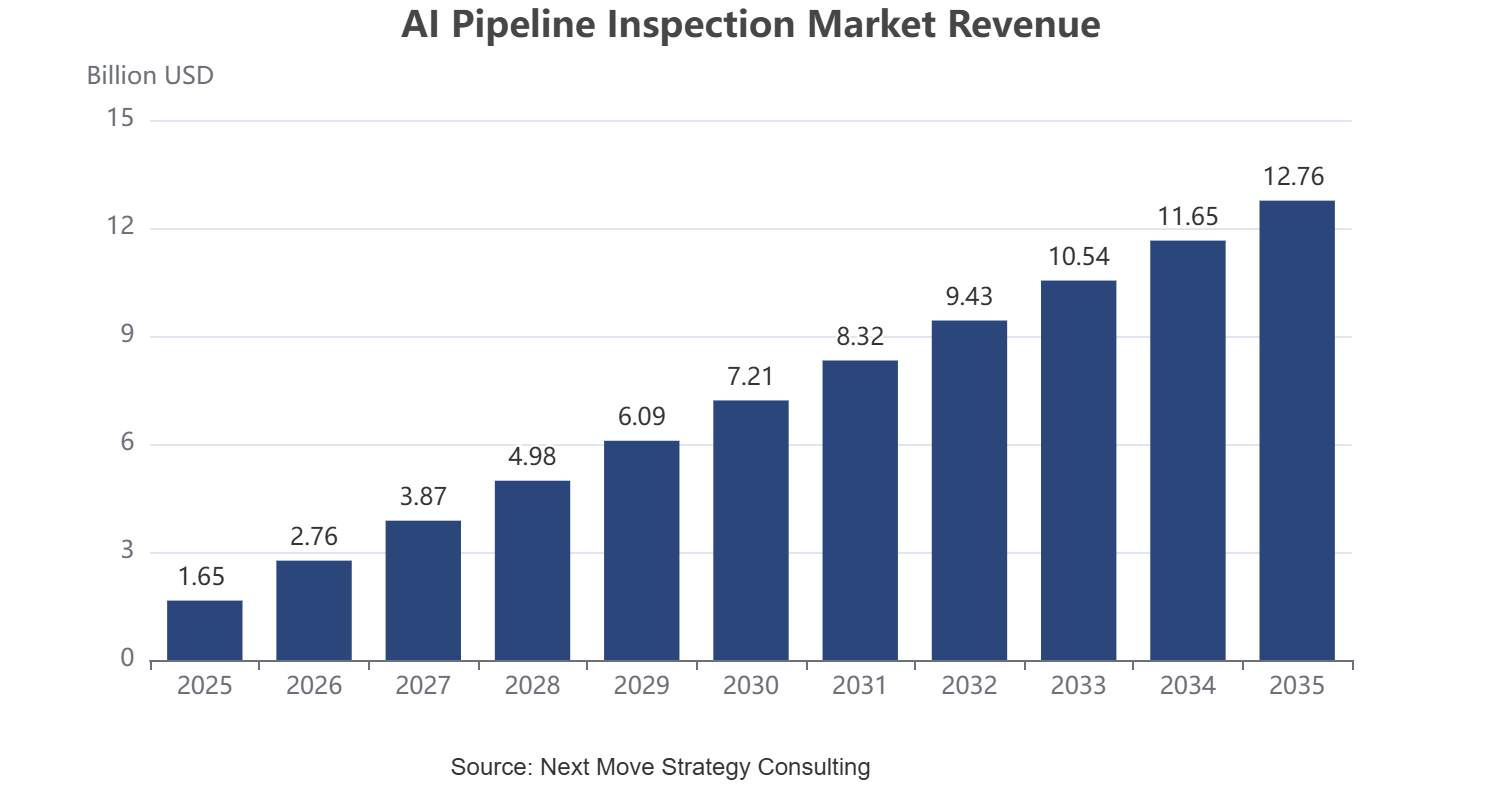
The global AI Pipeline Inspection Market size was valued at USD 1.65 Billion in 2025 and is estimated at USD 2.02 Billion in 2026, forecast to reach USD 12.76 Billion by 2035, expanding at a 22.7% CAGR between 2026 and 2035. North America leads with approximately 35% share, while under offering, Hardware dominates with approximately 46% share.
We observed that growth is broad-based across every segmentation axis, with software-driven analytics adoption and offshore deployment expansion driving the dominant structural shifts through 2035.
|
Key Takeaways |
|
By Offering: Hardware held the largest share of approximately 46% (USD 759 Million) in 2025; Software is the fastest-growing sub-segment at 27.5% CAGR from 2026–2035. |
|
By Inspection Technology: Ultrasonic Testing held the largest share of approximately 24% (USD 396 Million) in 2025; Fiber Optic Distributed Sensing is the fastest-growing sub-segment at 34% CAGR from 2026–2035. |
|
By Commercial Model: Project-Based Service held the largest share of approximately 29% (USD 478 Million) in 2025; Software Subscription is the fastest-growing sub-segment at 28.7% CAGR from 2026–2035. |
|
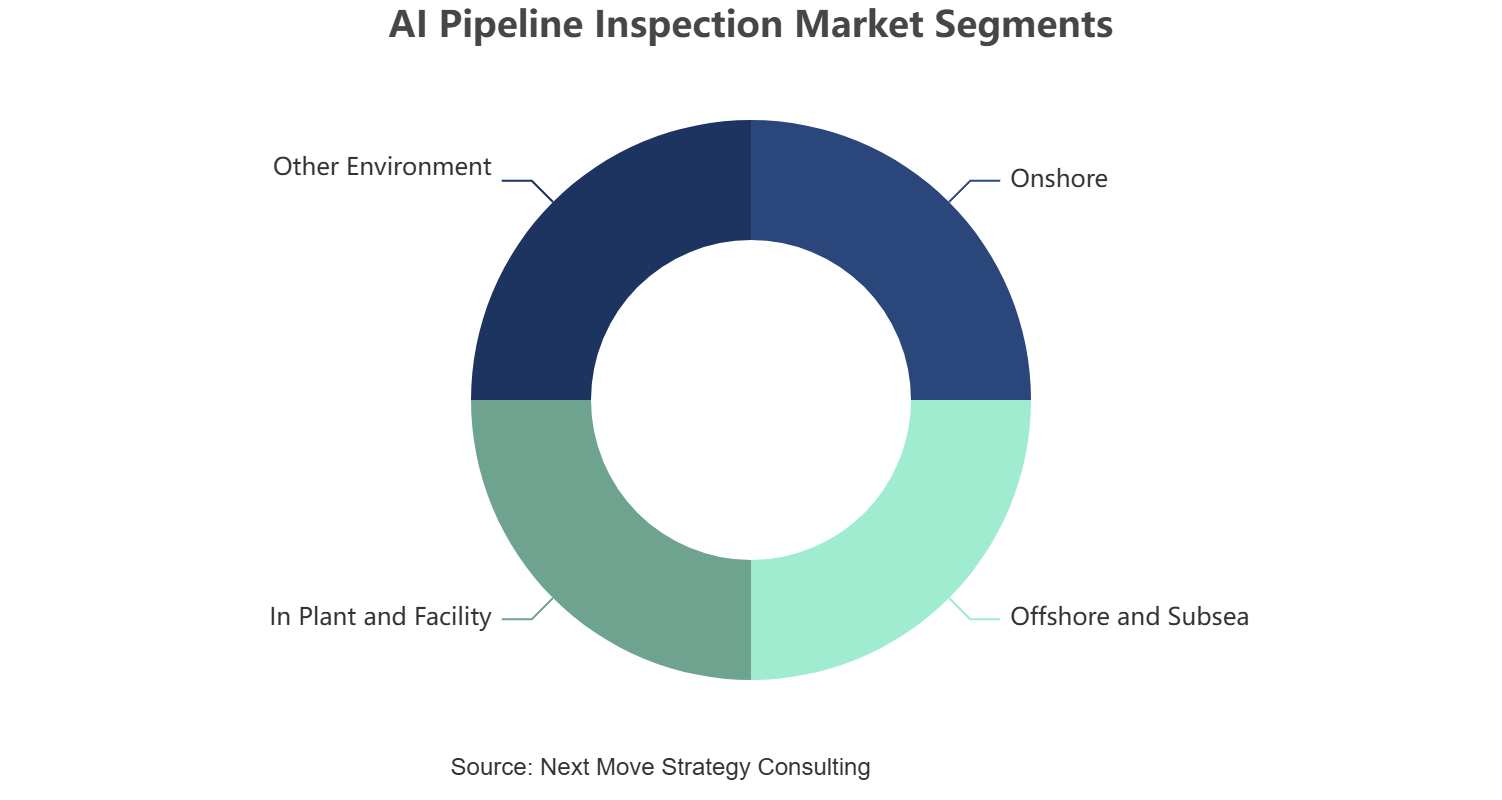
By Deployment Environment: Onshore held the largest share of approximately 52% (USD 858 Million) in 2025; Offshore and Subsea is the fastest-growing sub-segment at 25.1% CAGR from 2026–2035. |
|
By End Use Industry: Oil and Gas held the largest share of approximately 42% (USD 693 Million) in 2025; Water and Wastewater is the fastest-growing sub-segment at 25.6% CAGR from 2026–2035. |
|
Dominant Region: North America dominated with approximately 35% revenue share (USD 577 Million) in 2025. |
|
Fastest-Growing Region: Asia-Pacific is expected to register the highest CAGR of 27.5% during 2026–2035. |
|
Dominant Country: U.S. led with approximately USD 456 Million in 2025. |
|
Fastest-Growing Country: India is the fastest-growing country at approximately 31.4% CAGR from 2026–2035. |
Market Opportunity: Between 2026 and 2035, the AI Pipeline Inspection Market is set to generate an absolute dollar opportunity of USD 10.74 Billion, positioning AI-driven defect analytics and digital twin platforms as a compelling area for capital allocation.
According to NMSC analysis, sustained investment in machine learning-based anomaly detection and integrity management software is reshaping procurement criteria for pipeline operators, as regulatory-driven inspection intensity increasingly determines vendor shortlisting across oil and gas and water infrastructure categories.
Ecosystem Analysis of the AI Pipeline Inspection Industry
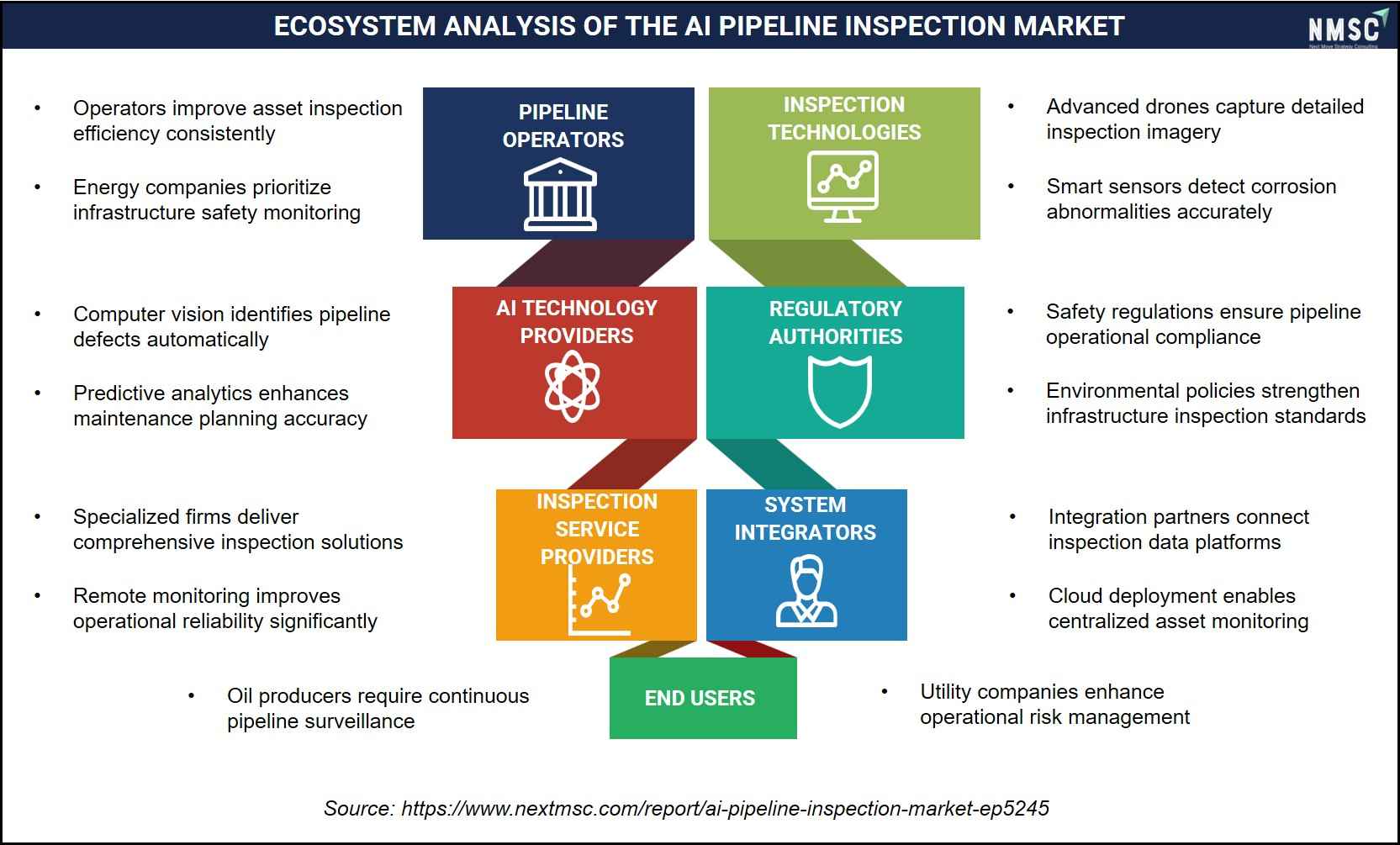
The above infographic presents an ecosystem analysis of the market, where pipeline operators and energy companies are leveraging advanced drones and smart sensors to detect corrosion abnormalities and improve asset inspection efficiency. These capabilities are supported by AI technology providers and inspection service specialists who deliver predictive analytics and comprehensive inspection solutions. Regulatory authorities enforce safety and environmental policies to ensure operational compliance, while system integrators connect inspection data platforms and enable cloud-based centralized monitoring. Looking ahead, we observed that these interconnected elements collectively help oil producers and utility companies enhance operational reliability and strengthen risk management across their infrastructure.
What Does the AI Pipeline Inspection Industry Encompass?
The AI Pipeline Inspection Market encompasses hardware, software, and services that apply artificial intelligence and machine learning to detect, classify, and predict pipeline defects such as corrosion, cracking, and metal loss. Our assessment indicates that the scope spans inline inspection tools, robotic platforms, handheld devices, and fixed sensors integrated with defect detection analytics, integrity management software, and field and consulting services supplied to oil and gas, water, chemical, power, and mining pipeline operators worldwide. The category has evolved from manual data review toward automated, machine-learning-driven anomaly classification, driven by aging infrastructure, rising leak-prevention mandates, and the digitization of asset integrity workflows globally.
Regulatory frameworks such as the U.S. Pipeline and Hazardous Materials Safety Administration's pipeline safety regulations and the European Union's Pipeline Safety Directive shape inspection frequency and data retention requirements, while national energy regulators increasingly reference AI-assisted inspection in risk-based inspection guidance. We observed that technology adoption is shifting toward multi-sensor inline tools and cloud-based digital twin platforms that replace manual data review with automated feature classification. NMSC's analysis indicates that this structural shift, combined with growing demand for continuous fiber optic and acoustic monitoring, is redefining sourcing criteria across the AI Pipeline Inspection Market.
|
Parameters |
Details |
|
Market Size in 2025 |
USD 1.65 Billion |
|
Market Size in 2026 |
USD 2.02 Billion |
|
Revenue Forecast in 2035 |
USD 12.76 Billion |
|
Growth Rate |
CAGR of 22.7% from 2026 to 2035 |
|
Analysis Period |
2025–2035 |
|
Base Year Considered |
2025 |
|
Forecast Period |
2026–2035 |
|
Market Size Estimation |
Revenue (USD Billion) |
|
Companies Profiled |
20 |
|
Countries Covered |
38 |
|
Market Share |
Available for Top 10 Companies |
Key Emerging Trends
Based on research conducted by NMSC, we found that four structural trends are reshaping product development, sourcing, and stakeholder engagement across the AI Pipeline Inspection Market.
How Is AI-Powered Data Fusion Transforming Pipeline Risk Assessment?
AI-powered data fusion platforms are replacing siloed inspection reviews to combine inline inspection results with above-ground survey and environmental data into unified integrity models. We observed that ROSEN Group's NIPA solution layers close-interval potential survey, direct current voltage gradient, and large standoff magnetometry data with AI-supported virtual in-line inspection predictions drawn from its Integrity Data Warehouse. Operators are adopting these fused models to extend risk assessment to unpiggable pipelines, while integrity engineers gain confidence in anomaly detection without additional physical inspection runs.
Why Are Robotic and Free-Swimming Inspection Platforms Gaining Adoption?
Robotic crawler and free-swimming inspection platforms are gaining share as operators seek to inspect unpiggable and hard-to-access pipeline segments without service interruption. Our findings suggest that water utilities and midstream operators increasingly specify tethered and free-swimming robots for small-diameter and low-pressure lines where traditional inline tools cannot pass. Manufacturers such as RedZone Robotics and SewerAI are expanding robotic portfolios, positioning these platforms as a growth category within the broader AI Pipeline Inspection Market segmentation structure.
How Is Machine Learning Improving Ultrasonic and Magnetic Flux Leakage Data Interpretation?
Machine learning models are increasingly layered onto ultrasonic testing and magnetic flux leakage tools to automate defect classification and reduce manual data review time. We observed that NDT Global's CIGMA-x platform applies ultrasonic Lamb Wave technology combined with advanced signal processing and machine learning insights to improve crack detection reliability in gas pipelines. This trend is elevating demand for signal pattern recognition software among inline inspection service providers, while reducing the false-call rates that previously required extensive manual verification.
What Role Do Digital Twin and Geospatial Intelligence Play in Pipeline Integrity Management?
Digital twin and geospatial intelligence platforms are emerging as a central component of integrity management, allowing operators to visualize inspection history alongside 3D asset models. Our analysis shows that integrity software vendors are integrating geospatial mapping with fitness-for-service engines to support proactive maintenance scheduling. Baker Hughes' Cordant industrial software platform, updated in September 2025 with expanded hybrid AI and physics analytics, exemplifies this direction with plant-wide asset performance visualization across energy and industrial operations.
Growth Drivers and Restraints
Growth Catalyst and Risk Assessment Matrix
|
Factors |
Type |
(+/-) % Impact on CAGR |
Geographic Relevance |
Impact Timeline |
|
Rising global pipeline leak-prevention regulation |
Driver |
+2.4% |
Global |
2026–2035 |
|
Aging transmission pipeline infrastructure requiring inspection |
Driver |
+2.0% |
North America, Europe |
2026–2035 |
|
Adoption of machine learning for defect classification |
Driver |
+2.2% |
Global |
2026–2035 |
|
Expansion of robotic inspection for unpiggable pipelines |
Driver |
+1.5% |
North America, Asia-Pacific |
2026–2035 |
|
Growth of water and wastewater infrastructure monitoring |
Driver |
+1.3% |
Asia-Pacific, Europe |
2026–2035 |
|
Digital twin adoption for integrity management |
Driver |
+1.1% |
Global |
2026–2032 |
|
Rising private equity investment in inspection service providers |
Driver |
+0.9% |
Global |
2026–2033 |
|
High capital cost of AI-enabled inline inspection tools |
Restraint |
-1.1% |
Global |
2026–2035 |
|
Data integration complexity across legacy SCADA systems |
Restraint |
-0.8% |
North America, Europe |
2026–2032 |
|
Shortage of skilled data science personnel in energy sector |
Restraint |
-0.6% |
Global |
2028–2035 |
What Is the Primary Growth Driver of the AI Pipeline Inspection Market?
Rising global pipeline leak-prevention regulations are the primary driver of the AI Pipeline Inspection Industry. The U.S. Pipeline and Hazardous Materials Safety Administration continues to expand inline inspection and integrity management program requirements for hazardous liquid and gas transmission pipelines. We observed that this regulatory pressure, reinforced by aging infrastructure across North America and Europe, continues to anchor baseline demand for inline inspection tools and integrity management software across developed and emerging pipeline networks alike.
How Is Machine Learning Adoption Driving AI Pipeline Inspection Market Growth?
Machine learning adoption for automated defect classification is accelerating the market growth toward software-centric business models. NDT Global's commercial launch of its CIGMA-x ultrasonic platform, combining Lamb Wave technology with machine learning insights, illustrates how vendors are embedding automated interpretation into inspection tools. NMSC's analysis indicates that this shift, combined with growing operator demand for reduced manual data review, is compressing adoption timelines for AI-enabled defect detection and classification software across gas and liquid pipeline networks.
What Is Restraining AI Pipeline Inspection Market Expansion?
High capital cost associated with deploying AI-enabled inline inspection tools and integrating them with legacy SCADA and data historian systems restrains margin stability and adoption pace across the AI Pipeline Inspection Market. Smaller regional operators face particular exposure, as limited capital budgets delay tool fleet upgrades compared with larger, vertically integrated pipeline operators and international inspection service providers with dedicated digital transformation budgets.
Segmentation Analysis
Segment Sizing: By Offering
|
Segment |
2025 (USD) |
2035 (USD) |
CAGR% (2026–2035) |
|
Hardware |
USD 759 Million |
USD 4.34 Billion |
18.7% |
|
Software |
USD 478 Million |
USD 5.23 Billion |
27.5% |
|
Services |
USD 413 Million |
USD 3.19 Billion |
22.7% |
|
Total |
USD 1.65 Billion |
USD 12.76 Billion |
22.7% |
Which Offering Segment Dominates the AI Pipeline Inspection Market?
Hardware, encompassing inline inspection tools, robotic platforms, and fixed sensors, led the AI Pipeline Inspection Market with USD 759 Million in 2025, supported by continued deployment of inspection tool fleets across established pipeline networks. We observed that Software is the fastest-growing offering, expanding at a 27.5% CAGR from 2026 to 2035, as defect detection analytics and integrity management platforms gain adoption alongside existing hardware investments.
Segment Sizing: By Inspection Technology
|
Segment |
2025 (USD) |
2035 (USD) |
CAGR% (2026–2035) |
|
Ultrasonic Testing |
USD 396 Million |
USD 2.42 Billion |
19.6% |
|
Magnetic Flux Leakage |
USD 314 Million |
USD 1.79 Billion |
18.6% |
|
Electromagnetic Acoustic Transducer |
USD 149 Million |
USD 1.15 Billion |
22.7% |
|
Eddy Current |
USD 132 Million |
USD 893 Million |
20.9% |
|
Radiographic Testing |
USD 116 Million |
USD 638 Million |
18.2% |
|
Visual and Optical |
USD 182 Million |
USD 1.02 Billion |
18.5% |
|
Acoustic Emission and Vibration |
USD 99 Million |
USD 893 Million |
24.8% |
|
Fiber Optic Distributed Sensing |
USD 83 Million |
USD 1.4 Billion |
34% |
|
Laser Profilometry |
USD 66 Million |
USD 893 Million |
30.6% |
|
Multi-sensor |
USD 83 Million |
USD 1.4 Billion |
34% |
|
Other Technology |
USD 33 Million |
USD 255 Million |
22.7% |
|
Total |
USD 1.65 Billion |
USD 12.76 Billion |
22.7% |
Which Inspection Technology Segment Leads AI Pipeline Inspection Market Demand?
Ultrasonic Testing remained the leading inspection technology within the AI Pipeline Inspection Market, valued at USD 396 Million in 2025, on sustained adoption for crack and metal loss detection in liquid and gas pipelines. Our findings suggest that Fiber Optic Distributed Sensing is the fastest-growing technology, registering a 34% CAGR from 2026 to 2035, as operators increasingly specify continuous distributed monitoring for leak detection and third-party interference alerts across long-distance transmission corridors.
Segment Sizing: By End Use Industry
|
Segment |
2025 (USD) |
2035 (USD) |
CAGR% (2026–2035) |
|
Oil and Gas |
USD 693 Million |
USD 4.34 Billion |
19.9% |
|
Water and Wastewater |
USD 281 Million |
USD 2.68 Billion |
25.6% |
|
Chemicals and Petrochemicals |
USD 215 Million |
USD 1.79 Billion |
23.7% |
|
Power Generation and Utilities |
USD 182 Million |
USD 1.66 Billion |
25% |
|
Mining and Metals |
USD 99 Million |
USD 766 Million |
22.7% |
|
Industrial Manufacturing |
USD 149 Million |
USD 1.28 Billion |
24.2% |
|
Other Industries |
USD 33 Million |
USD 255 Million |
22.7% |
|
Total |
USD 1.65 Billion |
USD 12.76 Billion |
22.7% |
Which End Use Industry Segment Dominates the AI Pipeline Inspection Market?
Oil and Gas remained the dominant end-use industry across the AI Pipeline Inspection Market, reaching USD 693 Million in 2025 due to extensive transmission and gathering pipeline networks requiring regulatory-driven inspection. Based on research conducted by NMSC, we found that Water and Wastewater is the fastest-growing end-use segment, expanding at a 25.6% CAGR from 2026 to 2035, reflecting utilities' efforts to modernize aging potable water and sewer infrastructure using AI-assisted condition assessment.
Growth Opportunities
NMSC's analysis shows that three forward-looking opportunities stand out for stakeholders positioning within the AI Pipeline Inspection Market over the 2026–2035 forecast period.
How Are Robotic Inspection Platforms Creating Opportunities for Water Utilities?
Robotic crawler and free-swimming inspection platforms present a whitespace opportunity for water and wastewater utilities seeking to assess aging potable water mains and sewer networks without excavation. Suppliers that commercialize AI-guided robotic inspection stand to capture recurring service revenue as municipal utilities shift toward condition-based asset management across the water and wastewater end-use segment.
Why Are Digital Twin Platforms Emerging as a Growth Opportunity for Midstream Operators?
Midstream transmission operators represent an underpenetrated opportunity for digital twin and geospatial intelligence platforms engineered to unify inspection history with 3D asset models. Vendors that develop validated digital twin platforms for large-diameter transmission networks can secure long-term software subscription contracts with midstream operators, benefiting from recurring platform revenue tied to continuous integrity monitoring programs.
How Are Fiber Optic Monitoring Services Unlocking Opportunities for Offshore Operators?
Offshore and subsea pipeline operators seeking continuous leak and third-party interference detection create an opportunity for fiber optic monitoring service providers offering distributed acoustic sensing systems. Early movers that secure validated managed monitoring contracts for subsea pipelines can differentiate with offshore operators pursuing continuous surveillance commitments across deepwater and shelf production infrastructure.
Regional Outlook
Geographic Performance Snapshot
|
Region |
2025 (USD) |
2035 (USD) |
CAGR% (2026–2035) |
Key Driver |
|
North America |
USD 577 Million |
USD 3.57 Billion |
19.7% |
PHMSA regulatory-driven inspection and aging pipeline modernization |
|
Europe |
USD 396 Million |
USD 2.55 Billion |
20.3% |
EU Pipeline Safety Directive and REACH-aligned integrity mandates |
|
Asia-Pacific |
USD 363 Million |
USD 3.96 Billion |
27.5% |
Expanding pipeline networks and rising government digitization spending |
|
Middle East & Africa |
USD 215 Million |
USD 1.91 Billion |
24.7% |
Vision 2030-linked infrastructure diversification and export pipeline growth |
|
Latin America |
USD 99 Million |
USD 766 Million |
22.7% |
Growing midstream investment and modernizing water infrastructure |
|
Total |
USD 1.65 Billion |
USD 12.76 Billion |
22.7% |
-- |
North America
North America leads the AI Pipeline Inspection Market with an established pipeline operator base and mature regulatory-driven inspection cadence. We observed that U.S. Pipeline and Hazardous Materials Safety Administration integrity management program requirements sustain demand for advanced inline inspection tools, while operators increasingly specify AI-enabled analytics to meet risk-based inspection mandates. Technology adoption remains advanced, with digital twin and integrity software platforms gaining traction across the region's mature midstream transmission network.
Europe
Europe's AI Pipeline Inspection Market reflects a mature but regulation-intensive landscape shaped by the European Union's Pipeline Safety Directive and REACH chemical-safety requirements. Our findings suggest that operators across Germany, France, and the UK are accelerating adoption of fiber optic monitoring and integrity management software to satisfy extended inspection-interval obligations. Technology adoption favors multi-sensor inline tools, supported by regional service providers investing in AI-enabled analytics platforms.
Asia-Pacific
Asia-Pacific is the fastest-growing region, propelled by expanding pipeline construction in China and India and rising government digitization spending. We found that regulatory frameworks remain less harmonized than in Europe, giving operators flexibility to scale robotic and handheld inspection adoption rapidly. Technology adoption is accelerating as regional service providers, including several China-based inspection firms, expand capacity to serve growing domestic transmission networks.
Middle East & Africa
The Middle East & Africa AI Pipeline Inspection Market is expanding as Gulf Cooperation Council economies diversify into export pipeline infrastructure and hospitality-driven utility investment rises. Our analysis shows that Saudi Arabia and the UAE are attracting inspection technology investment tied to domestic and export pipeline expansion. Regulatory influence remains moderate, while technology adoption is gradually shifting toward imported AI-enabled inline inspection systems as regional operators align with global integrity standards.
Latin America
Latin America's AI Pipeline Inspection Market is supported by growing midstream investment in Brazil and Argentina and expanding water infrastructure modernization programs. We observed that regulatory frameworks are less stringent than in North America or Europe, though multinational operators active locally are introducing AI-enabled inspection specifications. Technology adoption remains centered on ultrasonic and magnetic flux leakage tools, with competitive intensity increasing as regional distributors partner with global inspection technology providers.
U.S.
Based on our engagements, the U.S. market was valued at approximately USD 456 Million in 2025 and is projected to reach USD 2.75 Billion by 2035, growing at a 19.4% CAGR. Demand structure reflects North America operator practices shaped by U.S. Pipeline and Hazardous Materials Safety Administration integrity management requirements. Technology penetration favors AI-enabled inline inspection, and competitive intensity remains high among established inspection service providers serving national transmission operators.
Canada
Through our analysis, the Canada AI Pipeline Inspection Market was valued at approximately USD 81 Million in 2025 and is projected to reach USD 536 Million by 2035, growing at a 20.6% CAGR. Demand structure reflects North America operator practices shaped by Canada Energy Regulator pipeline safety oversight. Technology penetration favors robotic and multi-sensor inline tools, and competitive intensity remains moderate given reliance on cross-border service delivery from U.S.-based providers.
UK
From our assessment, the UK AI Pipeline Inspection Market was valued at approximately USD 75 Million in 2025 and is projected to reach USD 459 Million by 2035, growing at a 19.5% CAGR. Demand structure reflects Europe operator practices shaped by post-Brexit pipeline safety and Health and Safety Executive oversight. Technology penetration favors fiber optic monitoring adoption, and competitive intensity remains steady among domestic and European inspection providers.
Germany
According to our evaluation, the Germany AI Pipeline Inspection Market was valued at approximately USD 95 Million in 2025 and is projected to reach USD 587 Million by 2035, growing at a 19.7% CAGR. Demand structure reflects Europe operator practices shaped by Germany's alignment with the EU Pipeline Safety Directive. Technology penetration favors AI-enabled defect classification software, and competitive intensity remains high given concentration of leading integrity software vendors headquartered domestically.
France
Based on our engagements, the France market was valued at approximately USD 59 Million in 2025 and is projected to reach USD 383 Million by 2035, growing at a 20.3% CAGR. Demand structure reflects Europe operator practices shaped by French pipeline safety and environmental transition legislation. Technology penetration favors digital twin and geospatial platforms, and competitive intensity remains moderate among established regional service providers.
China
Through our analysis, the China AI Pipeline Inspection Market was valued at approximately USD 138 Million in 2025 and is projected to reach USD 1.58 Billion by 2035, growing at a 28.2% CAGR. Demand structure reflects Asia-Pacific operator practices shaped by gradually tightening national pipeline safety standards. Technology penetration favors export-oriented robotic inspection production upgrades, and competitive intensity remains elevated among numerous China-based inspection technology suppliers.
India
From our assessment, the India AI Pipeline Inspection Market was valued at approximately USD 58 Million in 2025 and is projected to reach USD 831 Million by 2035, growing at a 31.4% CAGR. Demand structure reflects Asia-Pacific operator practices shaped by Petroleum and Natural Gas Regulatory Board inspection mandates. Technology penetration favors AI-assisted defect analytics, and competitive intensity remains rising as domestic and international inspection providers expand their presence.
Japan
According to our evaluation, the Japan AI Pipeline Inspection Market was valued at approximately USD 62 Million in 2025 and is projected to reach USD 514 Million by 2035, growing at a 23.8% CAGR. Demand structure reflects Asia-Pacific operator practices shaped by stringent national gas pipeline safety codes. Technology penetration favors multi-sensor inline inspection tools, and competitive intensity remains moderate among established domestic engineering firms.
South Korea
Based on our engagements, the South Korea AI Pipeline Inspection Market was valued at approximately USD 36 Million in 2025 and is projected to reach USD 356 Million by 2035, growing at a 26% CAGR. Demand structure reflects Asia-Pacific operator practices shaped by Korea Gas Safety Corporation oversight. Technology penetration favors acoustic emission and vibration monitoring, and competitive intensity remains moderate among regional inspection service providers.
Australia
Through our analysis, the Australia AI Pipeline Inspection Market was valued at approximately USD 29 Million in 2025 and is projected to reach USD 277 Million by 2035, growing at a 25.6% CAGR. Demand structure reflects Asia-Pacific operator practices shaped by Australia's National Energy Resources pipeline safety framework. Technology penetration favors digital twin and geospatial mapping platforms, and competitive intensity remains moderate among regional and international inspection providers.
UAE
From our assessment, the UAE AI Pipeline Inspection Market was valued at approximately USD 58 Million in 2025 and is projected to reach USD 498 Million by 2035, growing at a 24.2% CAGR. Demand structure reflects Middle East & Africa operator practices shaped by domestic energy infrastructure safety oversight. Technology penetration favors AI-enabled inline inspection tools, and competitive intensity remains high among international and regional service providers.
Saudi Arabia
According to our evaluation, the Saudi Arabia AI Pipeline Inspection Market was valued at approximately USD 66 Million in 2025 and is projected to reach USD 612 Million by 2035, growing at a 25.1% CAGR. Demand structure reflects Middle East & Africa operator practices shaped by Vision 2030-linked energy infrastructure diversification programs. Technology penetration favors large-diameter ultrasonic inline inspection tools, and competitive intensity remains high given the concentration of export pipeline investment.
South Africa
Based on our engagements, the South Africa AI Pipeline Inspection Market was valued at approximately USD 28 Million in 2025 and is projected to reach USD 249 Million by 2035, growing at a 24.7% CAGR. Demand structure reflects Middle East & Africa operator practices shaped by national pipeline safety and environmental oversight. Technology penetration favors handheld and portable inspection devices, and competitive intensity remains moderate among regional distributors.
Brazil
Through our analysis, the Brazil AI Pipeline Inspection Market was valued at approximately USD 47 Million in 2025 and is projected to reach USD 367 Million by 2035, growing at a 23% CAGR. Demand structure reflects Latin America operator practices shaped by Brazil's national petroleum agency pipeline safety oversight. Technology penetration favors ultrasonic and magnetic flux leakage tools, and competitive intensity remains moderate among regional service providers.
Argentina
From our assessment, the Argentina AI Pipeline Inspection Market was valued at approximately USD 16 Million in 2025 and is projected to reach USD 122 Million by 2035, growing at a 22.7% CAGR. Demand structure reflects Latin American operator practices shaped by domestic energy regulatory oversight amid infrastructure investment. Technology penetration favors standard inline inspection tools, and competitive intensity remains centered on a small number of regional distributors.
Pain Point Analysis of the AI Pipeline Inspection Industry
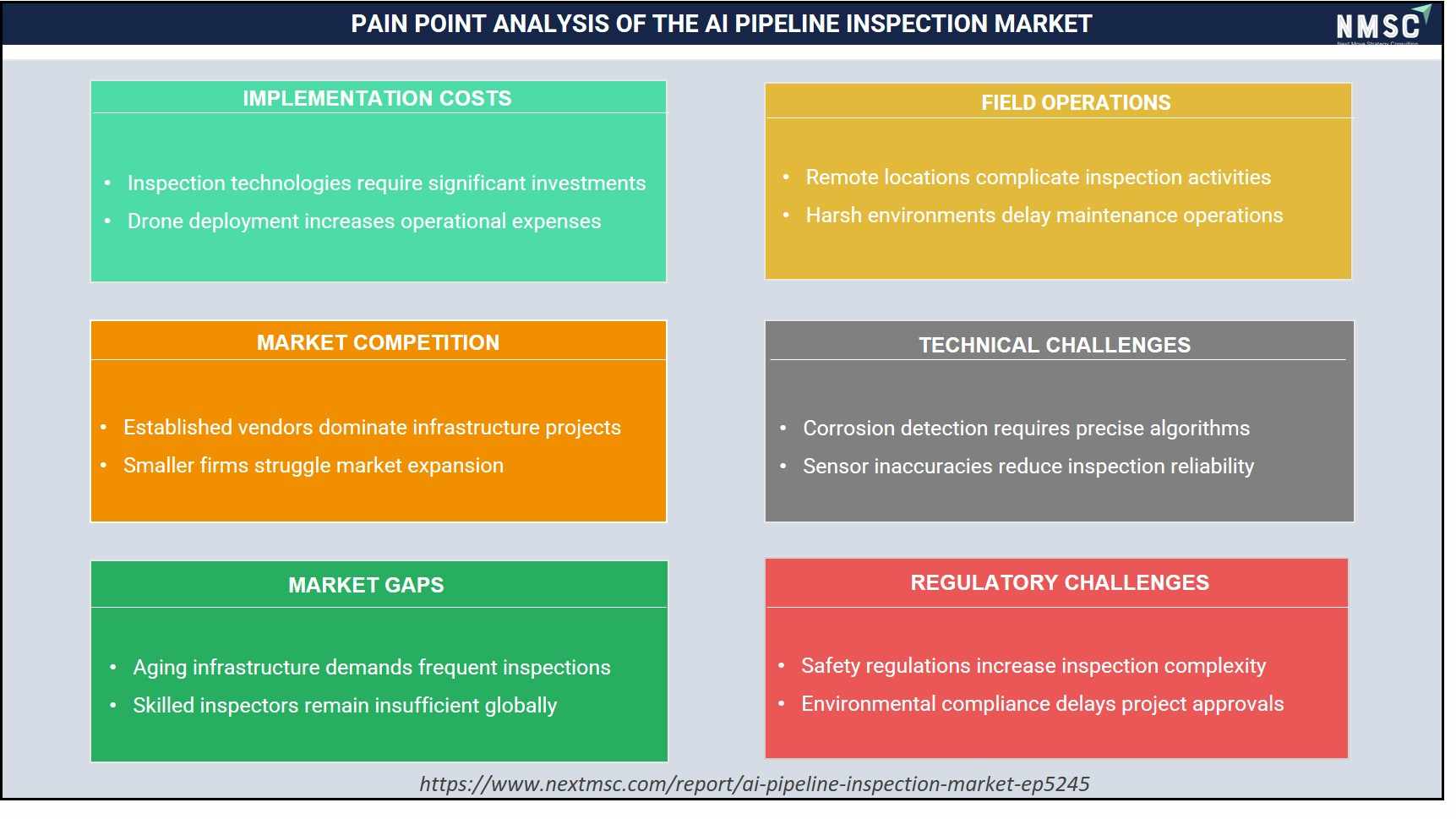
The above infographic presents a pain point analysis of the AI pipeline inspection market, highlighting key challenges across implementation costs, competition, market gaps, operations, technology, and regulation. High inspection costs and drone deployment expenses are straining budgets, while established vendors dominate the space and smaller firms struggle to expand. Aging infrastructure and a global shortage of skilled inspectors are creating significant market gaps, just as remote locations and harsh environments complicate field operations. Technical challenges such as corrosion detection and sensor inaccuracies further reduce inspection reliability, while safety regulations and environmental compliance continue to delay project approvals and increase operational complexity across the sector.
Competitive Landscape
We observed that the AI Pipeline Inspection Market features a moderately consolidated competitive landscape, with global inspection technology specialists competing alongside regional Asia-Pacific service providers on cost, innovation, and data analytics credentials.
|
Key Takeaways |
|
Market Structure Moderately consolidated, the top companies profiled in this report collectively account for a majority of global AI Pipeline Inspection Market revenue, while numerous regional Asia-Pacific service providers serve cost-sensitive standard inspection demand. |
|
Innovation Focus Machine learning-based defect classification, robotic inspection platforms, and digital twin integration dominate current innovation pipelines across leading suppliers. |
|
M&A Activity Selective consolidation through platform acquisitions, exemplified by Partners Group's acquisition of ROSEN Group to expand its testing, inspection, and certification portfolio. |
How Do Companies Compete in the AI Pipeline Inspection Market?
Companies compete primarily on data analytics credentials, inspection tool fleet breadth, and global service footprint across the AI Pipeline Inspection Market. Global players such as ROSEN Group and Baker Hughes Company leverage broad inline inspection technology portfolios to serve multinational pipeline operators, while regional Asia-Pacific providers compete on cost efficiency and rapid deployment turnaround for standard inspection formats supplied to smaller domestic operators.
Which Competitive Archetypes Dominate the AI Pipeline Inspection Market?
Two archetypes dominate the AI Pipeline Inspection Market: diversified global inspection and testing groups offering full-service integrity management support, and specialized technology vendors focused on AI-enabled software and robotic platforms. DNV and SGS S.A. exemplify the diversified archetype through integrated inspection-to-certification service delivery, while BrightAI and VAPAR Innovation Pty Ltd exemplify the specialized software archetype serving defect analytics and geospatial intelligence demand.
How Are Companies Differentiating Through Innovation in the AI Pipeline Inspection Market?
Innovation and differentiation strategy increasingly center on machine learning-based defect classification and integrity data fusion. NDT Global's CIGMA-x platform and ROSEN Group's NIPA solution both apply advanced signal processing and AI-supported predictions to improve anomaly detection confidence. NMSC's analysis indicates that suppliers unable to demonstrate credible AI-driven interpretation risk exclusion from operator request-for-proposal shortlists across North America and Europe.
What M&A and Expansion Activity Is Shaping the AI Pipeline Inspection Market?
Mergers, acquisitions, and geographic expansion continue to consolidate inspection technology capabilities within the AI Pipeline Inspection Market. Partners Group's acquisition of ROSEN Group aims to expand automation and AI adoption for data analysis across ROSEN's global inspection footprint, while established players continue investing in robotic and software-centric capacity to serve growing water infrastructure and midstream transmission demand.
Key Market Players
NMSC's assessment indicates that the following 20 companies represent the validated competitive set actively shaping product innovation, data analytics capability, and service expansion within the global AI Pipeline Inspection Market.
-
ROSEN Swiss AG
-
NDT Global GmbH
-
T.D. Williamson, Inc.
-
Intero Integrity Services B.V.
-
PIPECARE Group AG
-
Baker Hughes Company
-
MISTRAS Group, Inc.
-
Applus Services, S.A.
-
Xylem Inc.
-
Oceaneering International, Inc.
-
Fugro N.V.
-
SGS SA
-
Intertek Group plc
-
TEAM, Inc.
-
ULC Technologies, LLC
-
Diakont Advanced Technologies Inc. (KINEGGE)
-
Enduro Pipeline Services, Inc.
-
COKEBUSTERS LIMITED
-
INGU Solutions Inc.
-
SewerAI Corporation
Latest Developments
We found that recent product launches and corporate developments within the AI Pipeline Inspection Market are concentrated on AI-enabled defect classification and integrity data fusion platforms.
|
Date |
Event |
|
June 2025 |
SLB partnered with an independent energy company to deploy its OptiSite facility, equipment, and pipeline solutions, integrating AI, digital twins, and predictive analytics for pipeline monitoring. The deployment provides automated insights to optimize pipeline throughput, integrity monitoring, and operational decision-making across energy assets. |
|
April 2025 |
SewerAI partnered with RJN Group to accelerate AI-powered sewer pipeline inspection and condition assessment across U.S. utilities. The collaboration combines AI computer vision with engineering expertise to automate defect identification, infrastructure assessment, and asset management for wastewater pipeline networks. |
Investment Opportunities
What Capital Inflows Are Targeting the AI Pipeline Inspection Market?
Capital inflows into the AI Pipeline Inspection Market are increasingly directed toward AI software development and robotic platform manufacturing capacity upgrades. Private equity groups and strategic acquirers continue to fund service-provider consolidation, as seen in Partners Group's planned acquisition of ROSEN Group. We observed that investors favor suppliers demonstrating validated machine learning-based detection accuracy, viewing analytics credibility as a proxy for long-term contract retention with multinational pipeline operators.
How Is Infrastructure Investment Supporting AI Pipeline Inspection Market Growth?
Infrastructure investment is expanding inspection service capacity across Asia-Pacific, particularly in China and India, to serve rising domestic pipeline construction. Our findings suggest that regional service providers are investing in automated data processing centers to improve turnaround time for ultrasonic and magnetic flux leakage inspection campaigns, supporting the precision required for large-diameter transmission and gathering pipeline networks.
What ESG Considerations Are Shaping AI Pipeline Inspection Market Investment Decisions?
Environmental, social, and governance considerations are central to investment decisions across the AI Pipeline Inspection Market, with leak-prevention effectiveness and reduced inspection-related emissions as key criteria. We found that investors increasingly favor inspection technology providers with third-party validated detection performance, treating it as a governance indicator alongside worker safety and regulatory compliance track records.
Key Benefits for Stakeholders
How Does This Report Benefit Enterprise and Industry Leaders?
Enterprise and industry leaders gain access to validated segmentation, competitive benchmarking, and regional demand forecasts that support sourcing and technology-portfolio decisions across the AI Pipeline Inspection Market. Our analysis shows that detailed offering, inspection technology, and end use industry breakdowns help procurement teams align specifications with regulatory and data-analytics requirements while identifying underserved end use segments for portfolio expansion.
How Does This Report Benefit Investors and Financial Analysts?
Investors and financial analysts benefit from consistent, single-point market size and CAGR estimates that support valuation and capital-allocation decisions across the AI Pipeline Inspection Market supply chain. We observed that the report's regional and segment-level growth differentials help identify which service providers and software vendors are best positioned to capture above-market growth in software and offshore deployment categories through 2035.
How Does This Report Benefit Technology Vendors and Product Teams?
Technology vendors and product teams gain insight into emerging design requirements, including machine learning-based classification, robotic platform engineering, and digital twin integration, that are reshaping the AI Pipeline Inspection Market. Our findings suggest that this analysis helps R&D teams prioritize development roadmaps around detection accuracy and integrity data fusion capabilities increasingly required by operator request-for-proposal processes.
Key Market Segments
By Offering
-
Inspection Equipment
-
In-line Inspection Equipment
-
External Inspection Equipment
-
Remote Inspection Equipment
-
Other Inspection Equipment
-
-
Inspection Software
-
Inspection Analytics Software
-
Inspection Data Management Software
-
Inspection Workflow Software
-
Inspection Autonomy Software
-
Other Inspection Software
-
-
Inspection Services
-
In-line Inspection Services
-
External Inspection Services
-
Remote and Robotic Inspection Services
-
Data Interpretation and Integrity Services
-
Continuous Monitoring Services
-
Other Inspection Services
-
By Inspection Technology
-
Ultrasonic Testing
-
Magnetic Flux Leakage
-
Eddy Current Testing
-
Electromagnetic and Potential Field Inspection
-
Optical and Visual Inspection
-
Radiographic Testing
-
Acoustic Inspection
-
Fiber Optic Sensing
-
Multisensor Inspection
-
Other Inspection Technology
By AI Function
-
Anomaly Detection
-
Defect Classification
-
Defect Sizing and Measurement
-
Data Fusion
-
Predictive Analytics
-
Automated Reporting and Coding
-
Workflow Automation
-
Autonomous Navigation and Control
-
Other Artificial Intelligence Functions
By Pipeline Threat
-
Metal Loss and Corrosion
-
Cracking
-
Deformation and Mechanical Damage
-
Geohazards and Ground Movement
-
Leak Detection and Localization
-
Coating and Cathodic Protection Defects
-
Material and Weld Anomalies
-
Multi-Threat
-
Other Pipeline Threats
By Pipeline System
-
Transmission Pipelines
-
Distribution Pipelines
-
Gathering Pipelines
-
Flowlines
-
Process and Facility Piping
-
Water and Wastewater Networks
-
Other Pipeline Systems
By Transported Medium
-
Natural Gas
-
Crude Oil
-
Refined Products
-
Natural Gas Liquids
-
Water
-
Wastewater
-
Chemicals and Petrochemicals
-
Hydrogen
-
Carbon Dioxide
-
Other Transported Media
By Pipeline Setting
-
Onshore
-
Offshore Topside
-
Nearshore
-
Subsea
-
Plant and Facility
By End-use Industry
-
Oil and Gas
-
Upstream
-
Midstream
-
Downstream
-
-
Water and Wastewater
-
Chemical and Petrochemical
-
Power and Utilities
-
Mining and Minerals
-
Other Industrial
By Buyer Type
-
Pipeline Owner-Operators
-
Engineering, Procurement and Construction Contractors
-
Industrial Asset Owners
-
Government and Municipal Utilities
-
Inspection Service Providers
-
Other Buyers
By Region
-
North America: U.S., Canada, Mexico
-
Europe: UK, Germany, France, Italy, Spain, Sweden, Denmark, Finland, Netherlands, Rest of Europe
-
Asia-Pacific: China, India, Japan, South Korea, Taiwan, Indonesia, Vietnam,Australia, Philippines, Malaysia, Rest of APAC
-
Middle East & Africa: Saudi Arabia, UAE, Egypt, Israel, Turkey, Nigeria, South Africa, Rest of MEA
-
Latin America: Brazil, Argentina, Chile, Colombia, Rest of LATAM
Conclusion and Recommendations
What Is the Long-Term Outlook for the AI Pipeline Inspection Market?
The long-term outlook for the AI Pipeline Inspection Market remains positive, with global revenue projected to expand more than sevenfold from USD 1.65 Billion in 2025 to USD 12.76 Billion by 2035 at a 22.7% CAGR. We observed that sustained regulatory-driven inspection intensity, machine learning adoption, and offshore deployment expansion will continue underpinning demand across oil and gas, water, and chemical end use industries through the forecast period.
What Strategic Positioning Should AI Pipeline Inspection Market Suppliers Pursue?
Suppliers should prioritize AI-enabled software platforms and robotic inspection capabilities while pursuing validated detection-accuracy credentials to secure long-term operator contracts. Our assessment indicates that providers investing early in machine learning-based classification and integrity data fusion will be best positioned to capture premium pricing within the AI Pipeline Inspection Market.
How Attractive Is the AI Pipeline Inspection Market for New Investment?
The AI Pipeline Inspection Market presents an attractive investment case, supported by a USD 10.74 Billion absolute dollar opportunity between 2026 and 2035 and above-average growth in Asia-Pacific and software categories. We found that investment attractiveness is highest for providers combining analytics credentials with scaled service delivery capacity, positioning them to serve both cost-sensitive and premium operator segments simultaneously.
What Market Shifts and Key Risks Should Stakeholders Monitor?
Stakeholders should monitor data integration complexity with legacy SCADA systems, skilled personnel shortages, and competitive pressure from manual inspection alternatives as key risks to the AI Pipeline Inspection Market. Our analysis shows that suppliers unable to adapt to AI-enabled specifications risk losing contracts to competitors with certified machine learning detection platforms, particularly within North America's increasingly regulated pipeline environment.
What Are the Key Growth Pathways for the AI Pipeline Inspection Market?
Key growth pathways include expanding robotic and digital twin software portfolios, scaling AI-enabled analytics capacity, and deepening penetration into water and wastewater and offshore end use channels. NMSC's analysis indicates that suppliers pursuing these pathways while maintaining cost competitiveness in standard hardware categories will be best positioned to capture the AI Pipeline Inspection Market's projected growth through 2035.
About the Author
 Mayurima Roy
— Mayurima Roy is Research Analyst at Next Move Strategy Consulting, where she has spent 4 years working across the firm's full industry coverage rather than a single fixed vertical. Her work centers on structured research, ongoing trend tracking, competitive assessment, and insight-led content development, translating complex market data into clear, decision-ready narratives that support informed client decision-making across diverse global industries, market sectors, and world regions every day.
Mayurima Roy
— Mayurima Roy is Research Analyst at Next Move Strategy Consulting, where she has spent 4 years working across the firm's full industry coverage rather than a single fixed vertical. Her work centers on structured research, ongoing trend tracking, competitive assessment, and insight-led content development, translating complex market data into clear, decision-ready narratives that support informed client decision-making across diverse global industries, market sectors, and world regions every day.
About the Reviewer
 Supradip Baul
— Supradip Baul is an accomplished business consultant and strategist with over a decade of rich experience in market intelligence, strategy, technology, and business transformation. His work has included rigorous qualitative and quantitative analysis across multiple industries, helping clients shape investment decisions and long-term roadmaps. Earlier in his career, he was associated with Gartner, where he contributed to industry-leading reports and market share analyses. He has worked with leading global companies and holds an MBA with a dual specialization in Marketing and Finance.
Supradip Baul
— Supradip Baul is an accomplished business consultant and strategist with over a decade of rich experience in market intelligence, strategy, technology, and business transformation. His work has included rigorous qualitative and quantitative analysis across multiple industries, helping clients shape investment decisions and long-term roadmaps. Earlier in his career, he was associated with Gartner, where he contributed to industry-leading reports and market share analyses. He has worked with leading global companies and holds an MBA with a dual specialization in Marketing and Finance.
At Next Move Strategy Consulting, we understand that insightful market research is the cornerstone of successful business decisions. That's why we employ a robust and multifaceted approach, combining various methodologies to deliver the most accurate and actionable data for our clients.

Research Landscape
We navigate the world of research with two primary approaches:
Qualitative Approach
Our qualitative research methodologies involve immersive techniques such as in-depth interviews, focus groups, and observational studies. By engaging directly with individuals and stakeholders, we uncover valuable insights that quantitative data alone may overlook.

Quantitative Research
In tandem with qualitative methodologies, NMSC leverages the power of Quantitative Research to provide a robust foundation of numerical insights. Through systematic data collection and analysis, we quantify patterns, preferences, and market trends, offering a comprehensive view of the business landscape.
Our quantitative research approach employs diverse tools, including surveys, experiments, and statistical modelling. These methodologies enable us to gather data from a large and representative sample, ensuring the statistical significance of our findings. By employing structured questionnaires and standardized data collection methods, we guarantee the reliability and validity of the information we present to our clients.
Quantitative research is particularly effective in measuring the prevalence of trends, assessing market size, and gauging the impact of various factors on consumer behavior. The numerical precision attained through this approach equips our clients with actionable insights, facilitating data-driven decision-making and strategy formulation.


Our Specialized Toolbox for Industry-Specific Market Research
We deploy a specialized arsenal of techniques tailored to meet your unique requirements. Here's a glimpse into our comprehensive toolbox:

Information Procurement
The stage entails acquiring market data or relevant information through various sources and methodologies.


Market Research Approach
We utilize both top-down and bottom-up approaches in market research analysis to achieve a comprehensive understanding of the market dynamics, leveraging the broad perspective of industry trends and macroeconomic factors alongside detailed insights from specific segments and individual companies.

Porters Five Forces Analysis
We conduct Porter's Five Forces analysis to evaluate the competitive landscape of an industry, providing us with insights into factors that affect profitability and strategic positioning.

SWOT Analysis

Forecasting
We utilize a forecasting model to predict future consumption by considering parameters like population, economics, regulations, market competition, drivers, constraints, technology, and pricing. We also employ statistical techniques such as multilinear regression, exponential smoothing, moving average, ARIMA, and Monte Carlo simulations for accurate predictions. In econometric forecasting, we analyzed short-term and long-term event impacts, attributing values based on regulatory frameworks, economic factors, and market events.





 Speak to Our Analyst