Methane Abatement and MMRV Technology Market Size, Share, Growth & Forecast by Offering Type (Monitoring and Measurement Hardware, Data Analytics and Digital MMRV, and Others), Deployment Form (Fixed Site, Portable, Mobile, Aerial, Orbital, On Farm), End-User Industry (Upstream Oil and Gas, Midstream Oil and Gas, LNG and Refining, Waste and Landfill, Agriculture and Livestock, Coal Mining), Buyer Type, Commercial Model, and Sales Channel — Global Analysis 2026–2035
Industry: Energy & Power | Publishing Date: July 13, 2026 | Last Updated: September 30, 2026 | No of Pages: N/A | No. of Tables: N/A | No. of Figures: N/A | Format: PDF | Report Code: EP5095
What Is the Methane Abatement and MMRV Technology Market Size?
The global Methane Abatement and MMRV Technology Market was valued at USD 4.8 billion in 2025 and is expected to reach USD 5.5 billion in 2026. Strengthening regulatory mandates, expanding voluntary carbon commitments, and the proliferation of satellite-based methane detection capabilities are projected to propel the market to USD 18.6 billion by 2035, advancing at a CAGR of 14.6% from 2026 to 2035. Key growth catalysts include tightening methane regulations under the U.S. Environmental Protection Agency (EPA) and the EU Methane Regulation, surging upstream oil and gas LDAR compliance spending, accelerating agricultural methane reduction programs, and the rapid commercialization of satellite and aerial MMRV platforms that are lowering the cost of quantification and verification at basin scale.
|
Parameters |
Details |
|
Market Size in 2025 |
USD 4.8 Billion |
|
Market Size in 2026 |
USD 5.5 Billion |
|
Revenue Forecast in 2035 |
USD 18.6 Billion |
|
Growth Rate |
CAGR of 14.6% from 2026 to 2035 |
|
Analysis Period |
2025–2035 |
|
Base Year Considered |
2025 |
|
Forecast Period |
2026–2035 |
|
Market Size Estimation |
Billion USD |
|
Companies Profiled |
20 |
|
Countries Covered |
36 |
|
Market Share |
Top 10 |
Methane Abatement and MMRV Technology Market Overview
What Is the Methane Abatement and MMRV Technology Market?
The Methane Abatement and MMRV Technology Market encompasses the full spectrum of solutions designed to measure, monitor, report, and verify (MMRV) methane emissions and to reduce or eliminate those emissions across industrial, agricultural, and energy-sector sources. From fixed optical gas imaging systems and satellite remote sensing platforms to enteric feed additives and pneumatic replacement equipment, the market addresses the complete lifecycle of methane emissions management. NMSC's analysis indicates that the market is undergoing rapid structural maturation as regulatory frameworks globally transition from voluntary disclosure to mandatory quantification and verification standards.
How Has the Methane Abatement and MMRV Technology Market Evolved?
The Methane Abatement and MMRV Technology Market has evolved through three distinct phases. The first phase centered on point-source detection using handheld catalytic sensors and conventional LDAR walk-down surveys. The second phase introduced optical gas imaging and ground-based laser spectroscopy, substantially improving detection sensitivity and survey throughput. Our analysis shows that the current phase is defined by orbital and aerial remote sensing integration, AI-driven quantification analytics, and the rise of emissions data platforms that aggregate multi-source MMRV data into unified reporting and verification workflows for regulators and carbon market participants alike.
How Do Regulations Influence the Methane Abatement and MMRV Technology Market?
Regulatory frameworks have become the primary structural driver of the Methane Abatement and MMRV Technology Market growth. In the United States, the EPA's Subpart W and the Inflation Reduction Act methane fee (effective 2024) impose direct financial penalties on excess methane emissions from reporting facilities. The EU Methane Regulation, which entered into force in 2024, mandates measurement-based reporting for oil, gas, and coal operators, with third-party verification required for large emitters. Additionally, the Global Methane Pledge, endorsed by over 150 countries, has committed signatories to a 30% reduction in methane emissions by 2030 from 2020 levels, driving investment across the entire MMRV and abatement value chain.
How Is Technology Adoption Expanding Across the Methane Abatement and MMRV Technology Market?
Technology adoption across the Methane Abatement and MMRV Technology Market is accelerating as satellite constellations, drone payloads, and AI-powered analytics converge to create basin-scale continuous monitoring capabilities at dramatically lower cost per site. Based on our market evaluation, we noticed that platforms integrating multi-sensor data fusion, where satellite detects super-emitter events and ground-based fixed monitors provide continuous quantification, are emerging as the preferred architecture for large upstream operators. Simultaneously, biological methane reduction products for enteric fermentation are entering commercial scale-up, with regulatory acceptance frameworks under development in the EU, U.S., and Australia.
| Key Takeaways |
|
By offering type, Abatement Equipment and Systems held the largest share of the Methane Abatement and MMRV Technology Market at USD 1.7 billion in 2025. The Data, Analytics and Digital MMRV segment is the fastest-growing sub-segment, projected to expand from USD 0.6 billion in 2025 to USD 3.4 billion by 2035 at a CAGR of 18.9%, fueled by enterprise demand for satellite data platforms, quantification analytics, and reporting and verification software. |
|
By technology, Infrared technology commanded the largest share at USD 1.4 billion in 2025, representing approximately 29% of total market revenue. AI and Machine Learning is the fastest-growing technology in the Methane Abatement and MMRV Technology Market at a CAGR of 22.3% from 2026 to 2035, driven by the integration of deep learning models into satellite and aerial data processing pipelines for automated super-emitter detection and quantification. |
|
By deployment form, Fixed Site deployment accounted for USD 1.3 billion in 2025, the largest revenue share of the Methane Abatement and MMRV Technology Market. The Orbital deployment form is the fastest-growing at a CAGR of 21.8% from 2026 to 2035, as commercial satellite constellations from providers such as GHGSat and Kayrros expand global methane monitoring coverage. |
|
By end-user industry, the Upstream Oil and Gas segment held USD 2.1 billion in 2025. The Agriculture and Livestock segment is the fastest-growing end-user industry in the Methane Abatement and MMRV Technology Market at a CAGR of 17.2% from 2026 to 2035, as enteric fermentation reduction mandates and voluntary sustainability programs drive adoption of biological methane reduction products and on-farm monitoring systems. |
|
By buyer type, Asset Operators held the largest revenue share at USD 2.4 billion in 2025. Carbon and ESG Programs are the fastest-growing buyer type in the Methane Abatement and MMRV Technology Market at a CAGR of 19.4% from 2026 to 2035, as carbon credit integrity standards increasingly require third-party MMRV verification for methane offset issuance. |
|
By commercial model, Asset Sale led at USD 1.9 billion in 2025. Subscription commercial models are emerging as a high-growth structure in the Methane Abatement and MMRV Technology Market, particularly prevalent in satellite data, emissions data platforms, and continuous monitoring software services. |
|
By sales channel, Direct Enterprise held the largest revenue share at USD 2.2 billion in 2025. Public Tender and Grant channels are the fastest-growing distribution mechanism in the Methane Abatement and MMRV Technology Market, as government-funded methane abatement programs in the U.S., EU, and emerging economies channel significant procurement through public contracting processes. |
|
North America held the largest regional share at USD 2.1 billion in 2025, projected to reach USD 7.4 billion by 2035 at a CAGR of 13.5%, anchored by EPA regulatory enforcement, the world's largest upstream oil and gas sector, and the highest concentration of MMRV technology vendors globally. |
|
Asia-Pacific is the fastest-growing major region in the Methane Abatement and MMRV Technology Market at a CAGR of 17.2%, while the Middle East and Africa records accelerating adoption at 15.8% CAGR, driven by national oil company methane reduction programs and coal mine methane abatement initiatives in China, India, and Australia. |
|
The United States is the single largest country market in the Methane Abatement and MMRV Technology Market, representing over 78% of North American revenue in 2025, underpinned by EPA Subpart W enforcement, the IRA methane fee, and the world's highest concentration of upstream oil and gas LDAR compliance activity. |
|
China is the fastest-growing national market in Asia-Pacific within the Methane Abatement and MMRV Technology Market share at a CAGR of 19.4%, propelled by national coal mine methane abatement mandates, the China Emission Trading Scheme expansion, and significant investment in domestic methane monitoring infrastructure across Xinjiang and other major hydrocarbon-producing regions. |
Key Emerging Trends in the Methane Abatement and MMRV Technology Market
How Are the Proliferation of Commercial Methane Satellite Constellations Transforming Detection and Quantification Capabilities in the Methane Abatement and MMRV Technology Market?
Commercial satellite constellations are fundamentally reshaping the Methane Abatement and MMRV Technology Market by enabling near-real-time, basin-scale methane detection at costs previously unachievable with aerial or ground-based methods. GHGSat's constellation now delivers facility-level methane measurements for thousands of sites globally, while Kayrros processes multi-satellite data streams to identify super-emitter events within hours. From our research, we found that operators using satellite-based continuous monitoring have been able to identify previously unknown emission sources that conventional bi-annual LDAR surveys missed entirely, substantially altering the risk calculus for upstream oil and gas compliance programs.
How Are AI and Machine Learning Algorithms Accelerating Methane Quantification Accuracy in the Methane Abatement and MMRV Technology Market?
AI and machine learning integration into MMRV platforms is delivering step-change improvements in methane quantification accuracy and operational throughput. Through our market assessment, we observed that neural network models trained on multi-spectral satellite imagery can now distinguish methane plumes from atmospheric noise with sensitivity approaching purpose-built point sensors. Bridger Photonics deploys AI-powered LiDAR analytics to quantify leak rates from aerial surveys with sub-percent uncertainty, while SeekOps integrates onboard ML inference into drone payloads for real-time source attribution. This AI convergence is compressing the time from detection to remediation across upstream and midstream sectors.
What Role Are Biological Methane Reduction Products Playing in the Agricultural Segment of the Methane Abatement and MMRV Technology Market?
Biological methane reduction products represent the fastest-growing and most strategically differentiated segment within the broader Methane Abatement and MMRV Technology Market. NMSC's analysis indicates that dsm-firmenich's Bovaer supplement has secured regulatory approval in over 50 countries and demonstrated 20-30% enteric methane reduction per animal in commercial deployments. The agricultural sector, which contributes approximately 32% of global anthropogenic methane emissions according to the U.S. EPA, is increasingly subject to methane reduction requirements under national climate strategies. Feed additive adoption is accelerating as food and beverage companies seek verified methane reductions through their agricultural supply chains.
How Is the Transition from Leak Detection to Continuous Monitoring Reshaping Operational Models in the Methane Abatement and MMRV Technology Market?
The operational paradigm across the Methane Abatement and MMRV Technology Market is shifting decisively from periodic survey-based leak detection and repair (LDAR) toward continuous, real-time monitoring architectures. Based on our market evaluation, we noticed that EPA's Alternative Work Practice regulations and the EU Methane Regulation both create regulatory pathways for continuous monitoring as an alternative or supplement to traditional LDAR surveys. Emerson Electric's Sensia continuous monitoring platform and Honeywell's BWT fixed infrared detector arrays represent early-market fixed-site deployments. This transition is driving a structural increase in recurring revenue from data subscription and managed service commercial models for MMRV technology vendors.
What Are the Key Market Drivers, Breakthroughs, and Investment Opportunities that Will Shape the Methane Abatement and MMRV Technology Industry in the Next Decade?
|
Drivers / Trends / Restraints |
(+/-) % Impact on CAGR Forecast |
Geographic Relevance |
Impact Timeline |
|
EPA Methane Fee and Subpart W Enforcement |
+2.4% |
North America |
2025–2030 |
|
EU Methane Regulation Mandatory MMRV |
+2.1% |
Europe |
2025–2030 |
|
Satellite Constellation Cost Reduction |
+1.8% |
Global |
2026–2035 |
|
Agricultural Methane Reduction Mandates |
+1.6% |
Global (EU, APAC) |
2026–2035 |
|
Carbon Market Methane Credit Demand |
+1.4% |
Global |
2025–2035 |
|
AI-Driven Quantification Platforms |
+1.3% |
North America, Europe |
2025–2032 |
|
Biological Feed Additive Commercialization |
+1.1% |
Europe, APAC, Americas |
2026–2035 |
|
Data Privacy and Security in MMRV Data |
-0.7% |
Europe, North America |
Ongoing |
|
High Upfront Cost of Continuous Monitoring |
-0.9% |
SME Operators Globally |
2025–2028 |
|
Measurement Uncertainty and Data Quality Challenges |
-0.6% |
All Regions |
Ongoing |
What Are the Growth Drivers of the Methane Abatement and MMRV Technology Market?
How Is the U.S. EPA Methane Fee Driving Mandatory Investment Across the Methane Abatement and MMRV Technology Market?
The U.S. EPA's methane emissions charge, established under the Inflation Reduction Act and applicable to petroleum and natural gas facilities reporting under the Greenhouse Gas Reporting Program, imposes fees beginning at USD 900 per metric ton in 2024, rising to USD 1,500 per metric ton by 2026 for methane emissions above established waste emission thresholds. Our findings suggest that this fee creates a compelling financial incentive for upstream and midstream operators to invest in both MMRV technology, to accurately characterize emissions baselines, and abatement equipment, to reduce payable emissions below fee thresholds. The EPA's GHGRP currently covers over 7,500 facilities across the U.S., all of which now have direct financial exposure to methane quantification accuracy.
How Is the EU Methane Regulation Creating a Structural Demand Catalyst for MMRV Technology Across European and Imported Gas Supply Chains?
The EU Methane Regulation, which entered into force in August 2024, mandates measurement-based monitoring and reporting for oil, gas, and coal operations within the EU and, critically, extends MMRV requirements to methane intensity reporting for natural gas, LNG, and coal imported into the EU market. Through NMSC's assessment, we found that this extraterritorial application is compelling major LNG exporters in the U.S., Qatar, Australia, and Norway to adopt EU-aligned MMRV protocols across their upstream and midstream operations, dramatically expanding the addressable market for Methane Abatement and MMRV Technology beyond EU borders. The European Commission estimates that the regulation covers approximately 70% of European gas supply.
How Is the Global Methane Pledge and Voluntary Carbon Market Integrity Driving Demand for Verified Methane Abatement Solutions?
The Global Methane Pledge, coordinated through the Climate and Clean Air Coalition and endorsed by over 150 countries as of 2024, has established a voluntary framework committing signatories to a 30% reduction in methane emissions by 2030 from 2020 levels. Our assessment indicates that this political commitment is translating into procurement action across governments, national oil companies, and private operators seeking to demonstrate measurable progress. Furthermore, the Integrity Council for the Voluntary Carbon Market (ICVCM) has established Core Carbon Principles that require robust third-party MMRV verification for methane-based carbon credits, directly driving demand for verified abatement and high-integrity quantification platforms within the Methane Abatement and MMRV Technology Market.
What Are the Growth Inhibitors of the Methane Abatement and MMRV Technology Market?
How Does the High Capital Cost of Continuous Monitoring Infrastructure Constrain Adoption Among Small and Medium Operators in the Methane Abatement and MMRV Technology Market?
Despite strong regulatory tailwinds, the high upfront capital cost of deploying fixed continuous monitoring networks remains a significant adoption barrier for small and medium-sized upstream operators, which represent a substantial portion of total industry methane emissions. A continuous monitoring deployment across a single production site may require USD 50,000 to USD 200,000 in hardware, installation, and network infrastructure, excluding ongoing data subscription costs. Our analysis shows that operators with fewer than 100 active production wells face particular challenges justifying these investments without regulatory mandates that specify continuous monitoring as a compliance pathway, limiting near-term market penetration in the fragmented independent operator segment.
How Does Measurement Uncertainty and Lack of Standardized Protocols Undermine Data Confidence and Slow Market Adoption in the Methane Abatement and MMRV Technology Market?
Measurement uncertainty and the absence of globally harmonized MMRV protocols represent a structural challenge for the Methane Abatement and MMRV Technology Market. The U.S. NIST has documented significant variability in methane quantification results across different measurement technologies for equivalent emission sources. Discrepancies between bottom-up inventory approaches (used by national governments) and top-down satellite or aerial measurements continue to create regulatory and reputational uncertainty for asset operators. Based on our market evaluation, we noticed that this measurement heterogeneity extends procurement timelines and increases the cost and complexity of independent verification for carbon offset issuance, limiting confidence in MMRV data quality among buyers and carbon market participants.
What Are the Growth Opportunities in the Methane Abatement and MMRV Technology Market?
How Does the Expansion of Methane Performance Certificates and Natural Gas Methane Intensity Standards Create a Multi-Billion Dollar Commercial Opportunity in the Methane Abatement and MMRV Technology Market?
Methane performance certificate programs, analogous to renewable energy certificates, are emerging as a commercial mechanism through which producers can differentiate low-methane-intensity natural gas. Project Canary's Responsibly Sourced Gas certification and the MiQ methane standard both require continuous or high-frequency MMRV verification as a precondition for certificate issuance. Our findings suggest that premium pricing of USD 0.02 to USD 0.10 per MMBtu is achievable for certified low-methane gas in LNG and utility supply chains, creating a direct revenue return on MMRV investment for certified producers. This market mechanism is expected to scale significantly as EU importers incorporate methane intensity into procurement specifications under the EU Methane Regulation framework.
How Does the Coal Mine Methane Abatement Opportunity in China and India Represent a High-Growth Frontier Market Within the Methane Abatement and MMRV Technology Market?
China and India together account for over 70% of global coal mine methane emissions, according to the International Energy Agency (IEA), and both countries have made explicit commitments to expand coal mine methane capture and utilization programs. China's 14th Five-Year Plan for coal mine safety includes specific methane monitoring and drainage targets for high-gas mines, while India's Ministry of Coal has launched the Coal Mine Methane policy framework to commercialize methane drainage from pre-mining, in-mining, and post-mining stages. NMSC's analysis indicates that this coal mine methane opportunity represents an addressable market of USD 800 million to USD 1.2 billion within the Methane Abatement and MMRV Technology Market by 2030, spanning monitoring hardware, drainage capture equipment, and verification services.
How Does the Agricultural Methane Abatement Market Emerge as a Structurally New Segment Within the Methane Abatement and MMRV Technology Market?
Agriculture accounts for approximately 32% of global anthropogenic methane emissions, with enteric fermentation from ruminant livestock representing the single largest agricultural methane source. The EU Farm to Fork Strategy and the U.S. Agriculture Innovation Mission for Climate have both committed to developing pathways for agricultural methane reduction, creating a nascent but rapidly growing opportunity for biological methane reduction products, on-farm monitoring systems, and manure management abatement solutions. Our assessment indicates that the convergence of verified agricultural methane credits, food company scope 3 emissions reporting requirements, and commercially available enteric methane reduction products such as Bovaer is creating the conditions for rapid market expansion across the agricultural segment of the Methane Abatement and MMRV Technology Market.
Ecosystem Analysis of the Methane Abatement and MMRV Technology Market
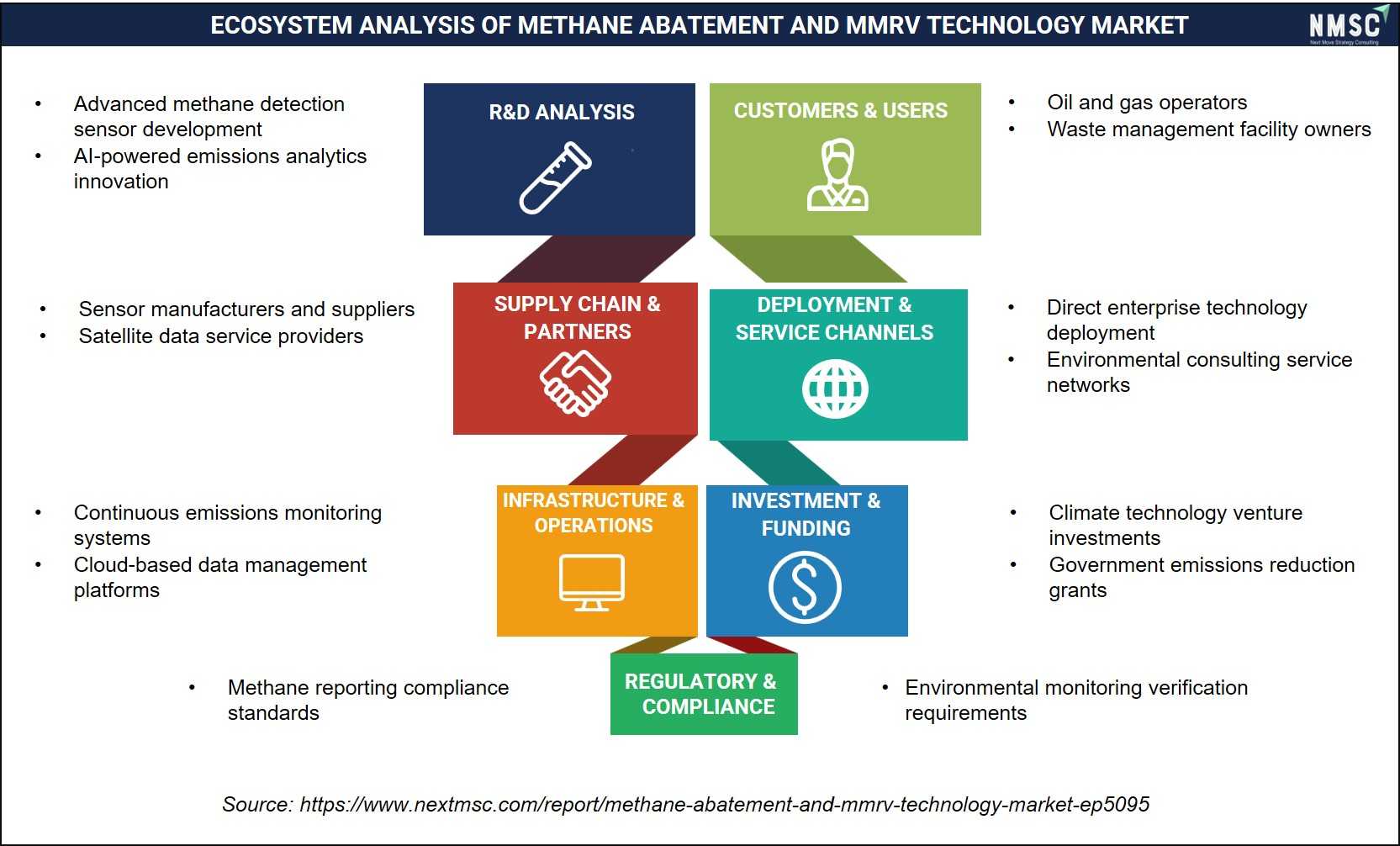
NMSC’s analysis indicates that the Methane Abatement and MMRV Technology market is supported by an ecosystem encompassing sensor providers, satellite data services, monitoring platforms, technology developers, and regulatory agencies. Our assessment finds that increasing methane reduction commitments, advancements in emissions analytics, and expanding monitoring infrastructure are accelerating adoption. Furthermore, compliance requirements, climate-focused investments, and verification standards continue to strengthen market growth.
How Is the Methane Abatement and MMRV Technology Market Segmented in This Report, and What Are the Key Insights from the Segmentation Analysis?
How Does Offering Type Segmentation Reveal the Structural Composition and Value Distribution Across the Methane Abatement and MMRV Technology Market?
|
Offering Type Segment |
2025 (USD Bn) |
2035 (USD Bn) |
CAGR (%) |
|
Monitoring and Measurement Hardware |
1.2 |
3.9 |
12.5% |
|
Data, Analytics and Digital MMRV |
0.6 |
3.4 |
18.9% |
|
Field Services |
0.8 |
2.6 |
12.5% |
|
Abatement Equipment and Systems |
1.7 |
6.1 |
13.6% |
|
Biological Methane Reduction Products |
0.5 |
2.6 |
17.9% |
Based on our analysis of market adoption patterns and regulatory compliance requirements, we observed that the Methane Abatement and MMRV Technology Market is segmented into Monitoring and Measurement Hardware, Data Analytics and Digital MMRV, Field Services, Abatement Equipment and Systems, and Biological Methane Reduction Products. Abatement Equipment and Systems continues to hold the largest share of USD 1.7 billion in 2025, driven by regulatory mandates requiring gas capture and recovery, flare system upgrades, and pneumatic replacement programs across upstream oil and gas operations. Monitoring and Measurement Hardware spans fixed monitors, portable detectors, optical gas imaging systems, remote sensing hardware, and analytical instruments, reflecting the breadth of detection modalities deployed across industrial and agricultural sources. Data, Analytics and Digital MMRV is the fastest-growing offering, encompassing satellite data, emissions data platforms, quantification analytics, and reporting and verification software, as operators transition from periodic measurement to continuous data-driven emissions management frameworks.
How Do Technology Variations Drive Differentiation and Competitive Positioning Within the Methane Abatement and MMRV Technology Market?
|
Technology Segment |
2025 (USD Bn) |
2035 (USD Bn) |
CAGR (%) |
|
Infrared |
1.4 |
4.6 |
12.6% |
|
Laser Spectroscopy |
0.7 |
2.6 |
14.0% |
|
Hyperspectral Imaging |
0.4 |
2 |
17.4% |
|
LiDAR |
0.3 |
1.4 |
16.7% |
|
MEMS and MOS |
0.4 |
1.1 |
10.7% |
|
Catalytic and Electrochemical |
0.4 |
1 |
9.6% |
|
Acoustic |
0.2 |
0.6 |
11.6% |
|
Mechanical Capture |
0.4 |
1.4 |
13.4% |
|
Biological Inhibition |
0.4 |
2.1 |
18.0% |
|
AI and Machine Learning |
0.2 |
1.4 |
22.3% |
|
Other Technology |
0.1 |
0.4 |
14.9% |
Through our market assessment, we observed that the Methane Abatement and MMRV Technology Market is segmented across Infrared, Laser Spectroscopy, Hyperspectral Imaging, LiDAR, MEMS and MOS, Catalytic and Electrochemical, Acoustic, Mechanical Capture, Biological Inhibition, and AI and Machine Learning technologies. Infrared technology continues to dominate due to its proven sensitivity, regulatory acceptance in optical gas imaging standards, and broad deployment across handheld, fixed, and aerial OGI systems. Laser spectroscopy, including cavity ring-down spectroscopy and tunable diode laser absorption spectroscopy, is witnessing strong adoption for high-precision quantification in pipeline and facility monitoring applications. AI and Machine Learning is the fastest-growing technology segment, driven by its integration into satellite data processing, aerial survey analytics, and continuous monitoring platforms that require automated anomaly detection and source attribution at scale.
How Does Deployment Form Differentiate Market Participation Across Fixed, Mobile, and Orbital Applications in the Methane Abatement and MMRV Technology Market?
|
Deployment Form Segment |
2025 (USD Bn) |
2035 (USD Bn) |
CAGR (%) |
|
Fixed Site |
1.3 |
4.3 |
12.7% |
|
Portable |
0.8 |
2.5 |
12.1% |
|
Mobile |
0.5 |
1.7 |
13.0% |
|
Aerial |
0.6 |
2.4 |
14.9% |
|
Orbital |
0.3 |
2 |
21.8% |
|
On Farm |
0.4 |
1.8 |
16.3% |
|
Plant Integrated |
0.6 |
2 |
12.8% |
|
Other Deployment Form |
0.3 |
1.9 |
20.4% |
In our observation, the Methane Abatement and MMRV Technology Market is segmented by deployment form into Fixed Site, Portable, Mobile, Aerial, Orbital, On Farm, Plant Integrated, and Other deployments. Fixed Site deployment leads the market due to the widespread adoption of continuous monitoring architectures at compressor stations, wellpads, processing facilities, and landfills, which demand permanent, network-connected sensor infrastructure. Aerial deployment is witnessing strong momentum as regulatory acceptance of mobile measurement methods expands and drone payload miniaturization reduces survey costs. Orbital deployment is the fastest-growing form, driven by commercial satellite constellation expansion and the regulatory shift toward requiring top-down measurement data as corroboration for facility-level inventory reporting.
Which End-User Industries Are Generating the Greatest Demand Across the Methane Abatement and MMRV Technology Market?
|
End-User Industry Segment |
2025 (USD Bn) |
2035 (USD Bn) |
CAGR (%) |
|
Upstream Oil and Gas |
2.1 |
7.2 |
13.1% |
|
Midstream Oil and Gas |
0.7 |
2.4 |
13.1% |
|
LNG and Refining |
0.5 |
1.8 |
13.6% |
|
Waste and Landfill |
0.5 |
1.7 |
13.0% |
|
Agriculture and Livestock |
0.5 |
2.4 |
17.2% |
|
Coal Mining |
0.3 |
1.3 |
15.8% |
|
Shipping |
0.1 |
0.5 |
17.5% |
|
Industrial Utilities |
0.4 |
1.3 |
12.5% |
|
Other End-User Industry |
0.1 |
0 |
— |
Based on our analysis of regulatory compliance requirements and voluntary emissions reduction commitments, we observed that the Methane Abatement and MMRV Technology Market is segmented into Upstream Oil and Gas, Midstream Oil and Gas, LNG and Refining, Waste and Landfill, Agriculture and Livestock, Coal Mining, Shipping, Industrial Utilities, and Other end-user industries. Upstream Oil and Gas dominates at USD 2.1 billion in 2025, driven by EPA Subpart W obligations, IRA methane fee exposure, and the sector's high density of fugitive emission sources including wellheads, storage tanks, and pneumatic controllers. Agriculture and Livestock is the fastest-growing end-user segment, as enteric fermentation reduction programs, manure management abatement investments, and on-farm monitoring deployments scale across the EU, U.S., and Australia under both regulatory and voluntary sustainability frameworks.
How Do Different Buyer Types Shape Procurement Dynamics and Competitive Strategy in the Methane Abatement and MMRV Technology Market?
|
Buyer Type Segment |
2025 (USD Bn) |
2035 (USD Bn) |
CAGR (%) |
|
Asset Operators |
2.4 |
8.2 |
13.1% |
|
Utilities |
0.6 |
2.1 |
13.4% |
|
EPCs and OEMs |
0.5 |
1.6 |
12.3% |
|
Regulators and Public Agencies |
0.4 |
1.4 |
13.4% |
|
Carbon and ESG Programs |
0.3 |
1.8 |
19.4% |
|
Other Buyer Type |
0.6 |
3.5 |
19.2% |
Our assessment indicates that the Methane Abatement and MMRV Technology Market is segmented by buyer type into Asset Operators, Utilities, EPCs and OEMs, Regulators and Public Agencies, Carbon and ESG Programs, and Other Buyer Types. Asset Operators constitute the largest buyer segment due to their direct regulatory compliance obligations, operational liability for methane emissions, and the financial incentive to characterize and reduce emission inventories under EPA fee structures and EU Methane Regulation requirements. Carbon and ESG Programs represent the fastest-growing buyer type, driven by voluntary carbon market expansion, corporate net-zero commitments, and increasingly rigorous third-party MMRV verification requirements for methane offset issuance under frameworks such as the ICVCM Core Carbon Principles.
How Are Commercial Models Evolving to Reflect New Value Capture Structures in the Methane Abatement and MMRV Technology Market?
|
Commercial Model Segment |
2025 (USD Bn) |
2035 (USD Bn) |
CAGR (%) |
|
Asset Sale |
1.9 |
6.2 |
12.5% |
|
Subscription |
0.9 |
3.9 |
15.8% |
|
Managed Service |
0.7 |
2.9 |
15.3% |
|
Project and EPC |
0.8 |
2.6 |
12.5% |
|
Lease and Rental |
0.4 |
1.6 |
14.9% |
|
Other Commercial Model |
0.1 |
1.4 |
30.0% |
From our research, we found that the Methane Abatement and MMRV Technology Market is segmented by commercial model into Asset Sale, Subscription, Managed Service, Project and EPC, Lease and Rental, and Other commercial models. Asset Sale leads the market, as upfront procurement of monitoring hardware, abatement equipment, and biological reduction products remains the primary transactional model for large upstream operators managing capital expenditure programs. Subscription commercial models are witnessing the strongest revenue growth acceleration, driven by satellite data services, emissions data platform access, and continuous monitoring software, where recurring data delivery and analytics updates align naturally with SaaS-style contractual structures. Managed Service models are also expanding as operators outsource LDAR program management, aerial survey campaigns, and verification and assurance workflows to specialist MMRV service providers.
How Are Sales Channels Adapting to Serve Diverse Buyer Profiles in the Methane Abatement and MMRV Technology Market?
|
Sales Channel Segment |
2025 (USD Bn) |
2035 (USD Bn) |
CAGR (%) |
|
Direct Enterprise |
2.2 |
7.2 |
12.6% |
|
Distributor |
0.9 |
2.9 |
12.4% |
|
Integrator and OEM Partner |
0.8 |
2.7 |
12.9% |
|
Public Tender and Grant |
0.6 |
3 |
17.4% |
|
Other Sales Channel |
0.3 |
2.8 |
25.1% |
We noticed that the Methane Abatement and MMRV Technology Market is segmented by sales channel into Direct Enterprise, Distributor, Integrator and OEM Partner, Public Tender and Grant, and Other Sales Channel. Direct Enterprise sales dominate due to strong operator preference for customized deployment support, long-term strategic account management, and complex multi-site program coordination that require vendor engagement beyond transactional product supply. Public Tender and Grant channels are the fastest-growing distribution pathway in the Market, reflecting the substantial government-funded methane abatement programs being deployed through the U.S. EPA Methane Emissions Reduction Program, EU Just Transition Fund, and national coalmine methane programs in China and India, all of which channel procurement through competitive public contracting processes.
Regional Outlook
Geographic Performance Snapshot
|
Region |
2025 (USD Bn) |
2035 (USD Bn) |
CAGR (%) |
Key Driver |
|
North America |
2.1 |
7.4 |
13.5% |
EPA enforcement, upstream O&G LDAR compliance |
|
Europe |
1.2 |
4.6 |
14.4% |
EU Methane Regulation, voluntary carbon market |
|
Asia-Pacific |
0.9 |
4.2 |
17.2% |
Coal mine abatement, agricultural programs |
|
Middle East & Africa |
0.4 |
1.6 |
15.8% |
National oil company ESG, LNG export MMRV |
|
Latin America |
0.2 |
0.8 |
15.0% |
Oil field abatement, agricultural methane programs |
North America Methane Abatement and MMRV Technology
North America is the global epicenter of the Methane Abatement and MMRV Technology Market, accounting for USD 2.1 billion in 2025 and forecast to reach USD 7.4 billion by 2035 at a CAGR of 13.5%. The region benefits from the world's most extensive upstream oil and gas infrastructure, the most mature LDAR regulatory framework under EPA Subpart W, and the highest concentration of MMRV technology vendors globally. The IRA methane fee, EPA's Alternative Work Practice continuous monitoring pathway, and Project Canary's Responsibly Sourced Gas certification ecosystem are collectively driving unprecedented investment in both monitoring and abatement solutions across the Permian, Appalachian, and Bakken basins.
U.S. Methane Abatement and MMRV Technology
Based on our engagements with upstream operators and regulatory stakeholders, the United States represents over 78% of North American Methane Abatement and MMRV Technology revenue in 2025 and is the world's single largest national market. The EPA's Greenhouse Gas Reporting Program covers over 7,500 oil and gas and other industrial facilities, all of which face increasing MMRV compliance requirements. The IRA methane fee, rising from USD 900 per metric ton in 2024 to USD 1,500 per metric ton by 2026, has materially shifted the investment calculus toward proactive abatement, while satellite-based continuous monitoring is being adopted by major operators including ExxonMobil, Chevron, and ConocoPhillips to supplement LDAR survey programs.
Canada Methane Abatement and MMRV Technology
Through our analysis, Canada is a strategically important market within the North America Methane Abatement and MMRV Technology landscape, with Oil Sands and conventional upstream operators subject to the federal Methane Regulations for the Upstream Oil and Gas Sector, which mandate progressively tighter emission reduction targets through 2030. The government of Canada has committed to reducing methane emissions from the oil and gas sector by 75% below 2012 levels by 2030, creating durable demand for both abatement equipment and MMRV verification services. Alberta and British Columbia's provincial regulatory frameworks complement federal requirements, ensuring a layered compliance environment that sustains technology investment from major producers such as Suncor, Canadian Natural Resources, and Cenovus.
Mexico Methane Abatement and MMRV Technology
According to our evaluation, Mexico is an emerging market within North America for Methane Abatement and MMRV Technology, driven by Pemex's operational scale as one of Latin America's largest upstream oil and gas operators and by growing pressure from international partners and ESG investors to reduce methane intensity across its aging production infrastructure. Mexico's National Climate Change Strategy includes methane emission reduction targets, and SENER is developing sector-specific MMRV frameworks aligned with UNFCCC reporting obligations. International financial institutions including the World Bank have provided technical assistance funding for methane measurement and abatement capacity building in Mexico's hydrocarbon sector.
Europe Methane Abatement and MMRV Technology
Europe is the second-largest region in the Methane Abatement and MMRV Technology Market, contributing USD 1.2 billion in 2025 and forecast to reach USD 4.6 billion by 2035 at a CAGR of 14.4%. The EU Methane Regulation, which entered into force in August 2024, is the most consequential piece of methane-specific legislation globally, mandating measurement-based MMRV for EU-based operators and establishing methane intensity reporting requirements for imported gas, LNG, and coal. European carbon market integration, the EU Emissions Trading System, and growing voluntary demand for certified low-methane-intensity gas are creating a sophisticated multi-stakeholder demand environment for Methane Abatement and MMRV Technology.
UK Methane Abatement and MMRV Technology
Based on our engagements, the United Kingdom maintains an active Methane Abatement and MMRV Technology market supported by the North Sea Transition Deal, which commits UK oil and gas operators to reducing production emissions by 50% by 2030. The Oil and Gas Authority (now the North Sea Transition Authority) mandates emissions performance standards and MMRV reporting for all licensed operators. UK government investment in hydrogen production and gas infrastructure decarbonization also drives demand for methane leak prevention and monitoring technologies across the distribution network and industrial gas processing sectors.
Germany Methane Abatement and MMRV Technology
Through our analysis, Germany represents a significant market for Methane Abatement and MMRV Technology, driven by its large landfill gas and wastewater sector, industrial gas distribution network, and strong agricultural emissions reduction commitments under the German Climate Action Programme. Germany's Bundesnetzagentur regulates gas infrastructure operators, and the Federal Environment Agency (Umweltbundesamt) administers MMRV requirements consistent with EU Methane Regulation standards. German engineering firms including Drägerwerk AG and major industrial operators are active both as technology suppliers and buyers within the European MMRV ecosystem.
France Methane Abatement and MMRV Technology
From our assessment, France is an important European market for Methane Abatement and MMRV Technology, with demand anchored in agricultural methane reduction programs, landfill gas management, and natural gas distribution network integrity monitoring. France has committed to a 30% reduction in agricultural methane emissions by 2030 under the national low-carbon strategy, driving investment in on-farm monitoring and biological methane reduction products. Air Liquide, headquartered in Paris, operates globally as both a supplier and user of methane abatement technologies across industrial gas, LNG, and hydrogen value chains.
Italy Methane Abatement and MMRV Technology
Based on our engagements, Italy is a mid-tier European market for Methane Abatement and MMRV Technology, with demand concentrated in gas distribution network integrity monitoring, wastewater treatment, and agricultural methane management. Italy imports the majority of its natural gas, including significant volumes of LNG, and faces growing MMRV requirements for imported gas methane intensity under the EU Methane Regulation. Snam, Italy's major gas infrastructure operator, has announced methane emission reduction targets and is investing in advanced MMRV capabilities across its transmission and distribution networks.
Spain Methane Abatement and MMRV Technology
According to our evaluation, Spain demonstrates growing momentum in the Methane Abatement and MMRV Technology Market, anchored by its role as a major European LNG import hub through the Barcelona and Huelva terminals, and by Spain's large agricultural sector with significant cattle and swine methane emissions. Enágas, Spain's gas system operator, is implementing methane leak detection and repair programs across its transmission network. Spain's Integrated National Energy and Climate Plan commits to methane emission reductions across multiple sectors, creating regulatory demand for MMRV infrastructure investment.
Sweden Methane Abatement and MMRV Technology
Through our analysis, Sweden is an advanced market for agricultural methane abatement, driven by Sweden's progressive national climate targets and strong adoption of biogas production from manure and agricultural waste. The Swedish Energy Agency supports methane capture and utilization projects through grant programs. Swedish food and dairy companies face growing consumer and regulatory pressure to reduce scope 3 methane emissions from livestock supply chains, driving interest in biological feed additives and on-farm methane monitoring systems compatible with Swedish and EU verification standards.
Denmark Methane Abatement and MMRV Technology
From our assessment, Denmark is a notable market for agricultural methane abatement, reflecting the country's large livestock industry and ambitious national climate targets requiring a 70% reduction in GHG emissions by 2030. Denmark's Climate Agreement for Agriculture and Land Use introduces methane-specific measures for the livestock sector, creating regulatory demand for on-farm monitoring, manure additives, and enteric fermentation reduction products. Danish biogas producers represent a significant segment of the gas supply chain, requiring MMRV verification of biomethane quality and methane slip from digesters.
Finland Methane Abatement and MMRV Technology
Based on our engagements, Finland represents a niche but technologically progressive market for Methane Abatement and MMRV Technology, with particular demand in landfill gas management, peat extraction emissions monitoring, and biogas facility verification. Finland's Climate Change Act and national methane inventory reporting obligations drive MMRV investment in the waste and agriculture sectors. The Finnish Meteorological Institute and VTT Technical Research Centre contribute to national methane measurement methodology development, supporting the validation of new MMRV technologies relevant to Nordic operating conditions.
Netherlands Methane Abatement and MMRV Technology
According to our evaluation, the Netherlands is a strategically important market for Methane Abatement and MMRV Technology, driven by its role as Europe's major natural gas trading hub, its large Groningen gas field legacy infrastructure, and the country's leading position in LNG import and re-export infrastructure. Nederlandse Aardolie Maatschappij and the Shell-operated Pernis refinery are subject to EU Methane Regulation requirements. The Netherlands Authority for the Financial Markets (AFM) is also developing ESG disclosure requirements that are driving corporate methane reporting across industrial sectors.
Rest of Europe Methane Abatement and MMRV Technology
Through our analysis, the rest of Europe encompasses diverse Methane Abatement and MMRV Technology market dynamics across Norway, Poland, Romania, Ukraine, and other European gas-producing and consuming nations. Norway's offshore oil and gas sector, operated primarily by Equinor, is subject to stringent CO2 and methane emission fees under the Norwegian CO2 tax framework, driving continuous MMRV investment. Poland and Romania, as significant coal and gas producers within the EU, face accelerating methane reporting requirements under the EU Methane Regulation, representing emerging growth markets for MMRV technology deployment.
Asia-Pacific Methane Abatement and MMRV Technology
Asia-Pacific is the fastest-growing major region in the Methane Abatement and MMRV Technology Market at a CAGR of 17.2%, contributing USD 0.9 billion in 2025 and forecast to reach USD 4.2 billion by 2035. The region's growth is anchored by China's coal mine methane abatement mandate, India's expanding upstream oil and gas sector, Australia's LNG export MMRV compliance requirements under the EU Methane Regulation, and the rapid expansion of agricultural methane reduction programs across Southeast Asia. NMSC's analysis indicates that Asia-Pacific will increase its share of global Methane Abatement and MMRV Technology revenue from approximately 19% in 2025 to over 22% by 2035.
China Methane Abatement and MMRV Technology
Based on our engagements with industry participants, China is the fastest-growing national market in Asia-Pacific for Methane Abatement and MMRV Technology at a CAGR of 19.4%, driven by national coal mine methane abatement mandates under the 14th Five-Year Plan, the expansion of the China Emission Trading Scheme to methane-relevant sectors, and State Grid Corporation investments in gas distribution network integrity monitoring. China National Coal Association estimates that China's coal mines emit approximately 7.5 billion cubic meters of methane annually, representing a substantial abatement opportunity. Domestic MMRV technology providers are scaling alongside international vendors including Honeywell and Emerson in the Chinese market.
India Methane Abatement and MMRV Technology
Through our analysis, India represents a high-growth market for Methane Abatement and MMRV Technology, underpinned by the Ministry of Petroleum and Natural Gas push to reduce flaring and methane emissions from ONGC and other national oil company operations, growing coal mine methane capture programs coordinated through the Ministry of Coal, and India's commitment to reduce economy-wide emission intensity under its Nationally Determined Contribution. The Directorate General of Hydrocarbons is developing MMRV guidelines for upstream operators, and India's expanding biogas sector requires methane slip monitoring and verification under the SATAT compressed biogas program.
Japan Methane Abatement and MMRV Technology
According to our evaluation, Japan is a mature and technologically sophisticated market for Methane Abatement and MMRV Technology, driven by the country's position as the world's largest LNG importer, its corporate GHG reporting obligations under the Act on Promotion of Global Warming Countermeasures, and Tokyo Gas and Osaka Gas infrastructure methane leak monitoring programs. Japanese general trading companies such as Mitsubishi and Mitsui, which hold major LNG upstream equity interests globally, are investing in MMRV capabilities to meet the EU Methane Regulation methane intensity reporting requirements for LNG exported to European customers.
South Korea Methane Abatement and MMRV Technology
From our assessment, South Korea is an active market for Methane Abatement and MMRV Technology, reflecting the country's significant LNG import infrastructure, its corporate emissions trading scheme obligations, and KOGAS investments in gas distribution network integrity. South Korea's 2050 Carbon Neutrality Framework includes methane emission reduction commitments across the energy and waste sectors. South Korean conglomerates with LNG upstream interests in Australia, the U.S., and the Middle East are also responding to EU Methane Regulation methane intensity requirements, creating demand for MMRV solutions that span their international portfolio assets.
Taiwan Methane Abatement and MMRV Technology
Based on our engagements, Taiwan represents a focused market for Methane Abatement and MMRV Technology, with demand concentrated in industrial gas monitoring, semiconductor manufacturing process emission controls, and waste and landfill gas management. Taiwan's Environmental Protection Administration administers GHG reporting requirements, and the government's net-zero pathway includes methane emission reduction targets for the industrial and waste sectors. CPC Corporation, Taiwan's state-owned petroleum company, is investing in gas infrastructure monitoring and methane emission quantification as part of its operational sustainability program.
Indonesia Methane Abatement and MMRV Technology
Through our analysis, Indonesia is an emerging and strategically important market for Methane Abatement and MMRV Technology, driven by the country's significant coal production (the world's second-largest coal exporter), expanding upstream oil and gas operations managed by Pertamina, and large palm oil and livestock agricultural sectors. Indonesia's Enhanced Nationally Determined Contribution includes methane-specific reduction commitments, and the Ministry of Energy and Mineral Resources is developing methane emission reporting standards for coal and energy sectors. International climate finance programs are supporting MMRV capacity building across Indonesian methane-emitting sectors.
Vietnam Methane Abatement and MMRV Technology
According to our evaluation, Vietnam presents a growing opportunity for Methane Abatement and MMRV Technology in the agricultural and energy sectors. Vietnam's rice cultivation and livestock production represent two of Southeast Asia's largest agricultural methane source categories. The Ministry of Agriculture and Rural Development is piloting methane-reducing rice cultivation practices and livestock management programs as part of Vietnam's 1 Million Hectares of High-Quality Rice Program. PetroVietnam's upstream operations also require MMRV compliance as international partners and LNG buyers increasingly require methane intensity reporting for supply chain transparency.
Australia Methane Abatement and MMRV Technology
Based on our engagements, Australia is a mature and growing market for Methane Abatement and MMRV Technology, reflecting the country's position as the world's largest LNG exporter, its domestic coal mine methane emission reporting obligations, and the agricultural sector's significant livestock methane emissions. The Australian Government's Safeguard Mechanism reforms, effective from 2023, impose declining emission baselines on major industrial facilities including LNG plants. The Clean Energy Regulator administers methane emission reporting and verification requirements, and Australian LNG exporters including Woodside and Santos face increasing EU Methane Regulation methane intensity scrutiny from European gas buyers.
Philippines Methane Abatement and MMRV Technology
From our assessment, the Philippines represents an early-stage market for Methane Abatement and MMRV Technology, with demand primarily in landfill gas management, wastewater treatment methane capture, and agricultural sector emission inventorying. The Philippine Department of Environment and Natural Resources is developing enhanced GHG inventory methodologies for the waste and agriculture sectors consistent with UNFCCC reporting obligations. International development finance from the Asian Development Bank and World Bank is supporting methane capture projects and MMRV capacity building programs relevant to Philippines climate commitments under its Nationally Determined Contribution.
Malaysia Methane Abatement and MMRV Technology
Through our analysis, Malaysia is an increasingly active market for Methane Abatement and MMRV Technology, driven by Petronas's proactive methane emission reduction commitments and the country's significant LNG export infrastructure at the Bintulu complex in Sarawak. Petronas has set a target to achieve near-zero routine flaring by 2030 and has deployed continuous monitoring systems across its upstream facilities. EU Methane Regulation methane intensity requirements for LNG imports are also compelling Petronas's European customers to request MMRV verification data, creating demand for third-party verification and certification services across the Malaysian LNG value chain.
Rest of APAC Methane Abatement and MMRV Technology
Based on our engagements, the rest of Asia-Pacific encompasses emerging Methane Abatement and MMRV Technology opportunities across New Zealand, Bangladesh, Thailand, and Myanmar. New Zealand's agricultural sector, which accounts for approximately 49% of national GHG emissions, is subject to the world's first farm-level agricultural methane pricing under the Agriculture and Horticulture Sector's He Waka Eke Noa partnership framework. This unique policy environment creates structured demand for on-farm methane monitoring and biological feed additive verification relevant to the broader APAC agricultural methane reduction landscape.
Middle East and Africa Methane Abatement and MMRV Technology
The Middle East and Africa region is an active growth market for Methane Abatement and MMRV Technology, contributing USD 0.4 billion in 2025 and forecast to reach USD 1.6 billion by 2035 at a CAGR of 15.8%. National oil companies across Saudi Arabia, UAE, and Qatar are investing in methane MMRV and abatement as part of broader ESG commitments and in response to EU Methane Regulation methane intensity requirements from European LNG buyers. The region's significant gas flaring and venting volumes present major abatement opportunities, supported by World Bank GGFR program investments and national flaring reduction commitments.
Saudi Arabia Methane Abatement and MMRV Technology
Based on our engagements, Saudi Arabia represents the largest market in the Middle East for Methane Abatement and MMRV Technology, anchored by Saudi Aramco's large-scale upstream operations and the company's commitment to maintain methane intensity at below 0.07% across its hydrocarbon value chain. Saudi Aramco has deployed continuous monitoring systems and optical gas imaging programs across its major processing facilities and has partnered with global MMRV technology vendors for satellite-based monitoring validation. Saudi Vision 2030's emphasis on industrial sustainability and international investor expectations regarding ESG performance are reinforcing long-term MMRV investment across the Saudi energy sector.
UAE Methane Abatement and MMRV Technology
Through our analysis, the UAE is an important and growing market for Methane Abatement and MMRV Technology, driven by ADNOC's ambitious Net Zero by 2045 commitment and the company's proactive methane monitoring and flare reduction program. ADNOC has established methane intensity reduction targets and has partnered with satellite data providers for enhanced monitoring coverage across its onshore and offshore assets. The UAE's role as host of COP28 in 2023 elevated its global profile on methane reduction, resulting in ADNOC's co-leadership of the Oil and Gas Decarbonization Charter, which commits member companies to near-zero methane emissions and near-zero routine flaring.
Egypt Methane Abatement and MMRV Technology
According to our evaluation, Egypt is an emerging market for Methane Abatement and MMRV Technology, with demand anchored in Egyptian Natural Gas Holding Company operations, the growing wastewater sector, and agricultural methane from the Nile Delta livestock and rice production regions. The Egyptian Environment Affairs Agency administers national GHG inventory reporting, and Egypt's Nationally Determined Contribution includes methane-specific targets for the energy and agriculture sectors. World Bank and EBRD financing is supporting methane emission reduction projects across Egypt's oil and gas infrastructure modernization programs.
Israel Methane Abatement and MMRV Technology
From our assessment, Israel is a technologically advanced but relatively small market for Methane Abatement and MMRV Technology. The rapid development of the Leviathan and Tamar offshore gas fields has created demand for offshore methane monitoring and leak prevention systems. Israel's environmental monitoring technology ecosystem, supported by government R&D programs, has produced innovative methane sensor startups. Israel's gas export ambitions to Europe via the EastMed pipeline and LNG routes also create alignment with EU Methane Regulation MMRV requirements, supporting investment in export-grade methane intensity verification infrastructure.
Turkey Methane Abatement and MMRV Technology
Based on our engagements, Turkey is a growing market for Methane Abatement and MMRV Technology, driven by BOTAS gas distribution network integrity monitoring requirements, coal mine methane abatement programs in Turkey's significant lignite sector, and agricultural methane from Turkey's large cattle and sheep population. Turkey's Green Deal Action Plan aligns with EU methane regulations, and the country's aspiration to remain a key gas transit hub to Europe requires alignment with EU Methane Regulation MMRV standards for imported and transited gas volumes. Turkish industrial companies are investing in MMRV technology as part of broader carbon management programs linked to EU Carbon Border Adjustment Mechanism exposure.
Nigeria Methane Abatement and MMRV Technology
Through our analysis, Nigeria presents a significant opportunity for Methane Abatement and MMRV Technology, driven by the country's position as Africa's largest oil producer and its historically high gas flaring volumes. Nigeria has committed to ending routine gas flaring by 2030 under the Decade of Gas initiative and the World Bank GGFR program. NNPC and international oil company operations including Shell, TotalEnergies, and Eni face increasing MMRV requirements from European buyers under the EU Methane Regulation, creating demand for satellite-based monitoring, flare measurement systems, and gas capture and recovery equipment across Niger Delta operations.
South Africa Methane Abatement and MMRV Technology
According to our evaluation, South Africa is a focused market for Methane Abatement and MMRV Technology, concentrated in coal mine methane abatement, landfill gas management, and wastewater treatment applications. South Africa's carbon tax, administered by the South African Revenue Service, applies to fugitive methane emissions from coal mines and other industrial sources, creating a direct financial incentive for abatement investment. Eskom's coal-fired power generation infrastructure and the associated coal supply chain represent a significant methane emission source requiring MMRV investment as South Africa advances its Just Energy Transition Partnership commitments.
Rest of MEA Methane Abatement and MMRV Technology
Based on our engagements, the rest of Middle East and Africa encompasses emerging Methane Abatement and MMRV Technology opportunities across Qatar, Kuwait, Iraq, Oman, Algeria, Libya, Angola, and Ghana. Qatar, as the world's largest LNG exporter, faces direct EU Methane Regulation methane intensity requirements for its European sales, compelling QatarEnergy to invest in facility-level MMRV verification programs. Iraq's significant gas flaring volumes and the Iraqi government's flaring reduction commitments create substantial near-term demand for gas capture equipment and flare monitoring systems within the broader MEA market context.
Latin America Methane Abatement and MMRV Technology
Latin America is a growing market for Methane Abatement and MMRV Technology, contributing USD 0.2 billion in 2025 and forecast to reach USD 0.8 billion by 2035 at a CAGR of 15.0%. The region's growth reflects Petrobras and other national oil company methane reduction programs, the large agricultural livestock sector across Brazil and Argentina, and the rising volume of LNG exports to Europe that require EU Methane Regulation MMRV compliance. International climate finance from the Inter-American Development Bank and national green finance programs are supporting MMRV capacity building across the region.
Brazil Methane Abatement and MMRV Technology
Based on our engagements, Brazil is the largest Latin American market for Methane Abatement and MMRV Technology, driven by Petrobras's pre-salt offshore operations requiring methane leak monitoring, Brazil's world-leading cattle herd of approximately 215 million head representing a major enteric fermentation methane source, and landfill gas management across Brazil's major urban centers. Brazil's National Policy on Climate Change and MAPA's Low-Carbon Agriculture (ABC+) program include agricultural methane reduction targets, creating demand for on-farm monitoring and biological methane reduction solutions. Brazil's ambition to increase LNG exports also creates alignment with EU methane intensity verification requirements.
Argentina Methane Abatement and MMRV Technology
Through our analysis, Argentina is an important market for Methane Abatement and MMRV Technology, driven by the Vaca Muerta shale oil and gas formation's rapid production growth, the associated methane emission monitoring requirements, and Argentina's large cattle sector. YPF's Vaca Muerta development program has attracted international investment that carries international ESG expectations for MMRV compliance. Argentina's Secretary of Energy has developed methane emission reduction guidelines for upstream operators, and Argentina's aspiration to become a major LNG exporter requires alignment with EU Methane Regulation standards for European buyers.
Chile Methane Abatement and MMRV Technology
According to our evaluation, Chile represents a focused market for Methane Abatement and MMRV Technology, with demand concentrated in landfill gas management, wastewater treatment methane capture, and gas distribution network monitoring. Chile's National Climate Change Action Plan includes methane-specific targets under the waste and energy sectors. The Ministry of Environment's GHG registry requires reporting from major facilities, and ENAP's gas operations require methane integrity monitoring. Chile's strong institutional capacity and international climate commitments support systematic adoption of MMRV technology across regulated sectors.
Colombia Methane Abatement and MMRV Technology
From our assessment, Colombia is a growing market for Methane Abatement and MMRV Technology, anchored by Ecopetrol's significant upstream oil and gas operations and the company's commitment to reduce methane emission intensity under its 2050 net-zero strategy. Colombia's coal mining sector, centered in the Cesar and La Guajira departments, also requires methane emission monitoring under national environmental licensing requirements. The government's Carbon Tax mechanism creates indirect financial incentives for methane emission reduction across industrial sectors, and Colombia's agricultural sector presents a long-term market opportunity for biological methane reduction products targeting cattle ranching operations.
Rest of LATAM Methane Abatement and MMRV Technology
Based on our engagements, the rest of Latin America encompasses early-stage Methane Abatement and MMRV Technology opportunities across Ecuador, Peru, Bolivia, Trinidad and Tobago, and other hydrocarbon-producing and agricultural economies. Trinidad and Tobago, as a major LNG exporter with European customers, faces EU Methane Regulation methane intensity compliance requirements that are driving investment in upstream monitoring and verification programs. Peru's significant natural gas production from the Camisea field and Bolivia's pipeline gas exports also create growing demand for MMRV infrastructure as regional regulatory frameworks align with international standards.
Strategic Framework Impacting the Methane Abatement and MMRV Technology Market
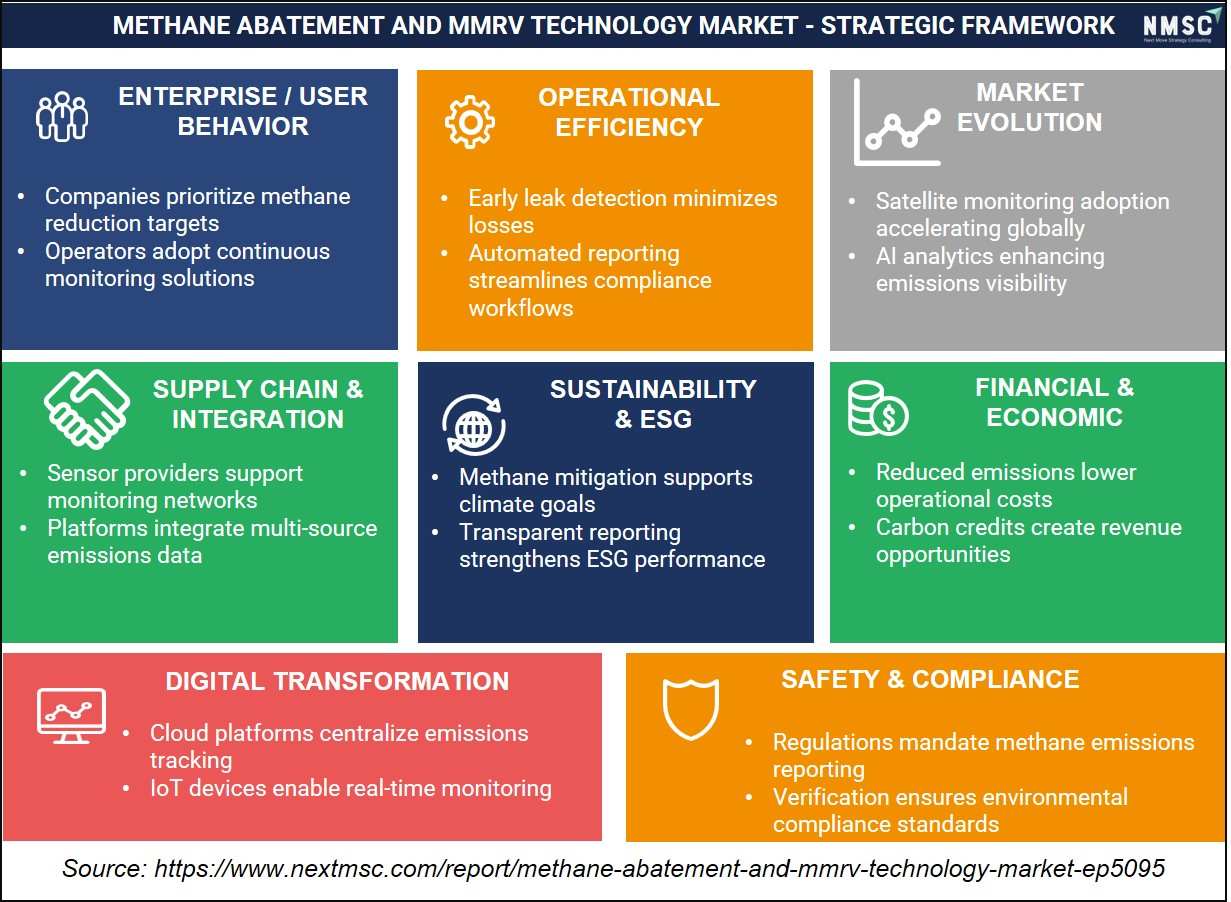
Based on NMSC’s evaluation, we found that the Methane Abatement and MMRV Technology market is advancing through stricter emissions reporting requirements, expanding monitoring capabilities, and increasing corporate decarbonization initiatives. Our assessment identifies that AI-enabled analytics, satellite-based observation systems, and integrated data platforms are improving operational efficiency and emissions transparency. Moreover, carbon credit opportunities, regulatory compliance mandates, and sustainability objectives are supporting long-term market expansion.
Competitive Landscape
Competitive Dynamics and M&A Landscape
|
Key Takeaways |
Details |
|
Market Structure |
Moderately fragmented; dominated by diversified industrial technology conglomerates (SLB, Honeywell, ABB, Baker Hughes, Emerson) alongside specialist MMRV technology pure-plays (GHGSat, Bridger Photonics, SeekOps, Project Canary, Kayrros) and agricultural solution providers (dsm-firmenich) |
|
Innovation Focus |
Satellite and aerial remote sensing integration, AI-powered quantification analytics, continuous monitoring platforms, biological feed additive scale-up, and low-cost sensor miniaturization for distributed deployment |
|
M&A Activity |
Consolidation is accelerating as large industrial technology companies acquire specialist MMRV analytics and satellite data firms; SLB's Emissions.AI acquisition and Baker Hughes's sensing technology investments reflect the sector's strategic M&A trend |
How Do Companies Compete in the Methane Abatement and MMRV Technology Market?
The Methane Abatement and MMRV Technology Market exhibits a moderately fragmented competitive structure, with large diversified industrial technology companies competing alongside specialist measurement and analytics pure-plays, agricultural technology providers, and emerging satellite and aerial platform companies. Our analysis shows that incumbent companies such as SLB, Honeywell, ABB, Baker Hughes, and Emerson leverage their existing relationships with upstream and midstream operators, broad service infrastructure, and established regulatory credibility to compete for large enterprise LDAR and abatement equipment contracts.
Which Kind of Companies Dominate the Methane Abatement and MMRV Technology Market?
The Methane Abatement and MMRV Technology Market is presently dominated by two archetypes. The first comprises large diversified industrial technology conglomerates, including SLB, Honeywell, ABB, Baker Hughes, and Emerson Electric, which offer broad hardware, services, and software portfolios integrated within upstream oil and gas operator supply chains. The second archetype includes specialist MMRV pure-plays such as GHGSat, Kayrros, Bridger Photonics, SeekOps, and Project Canary, which compete on the basis of measurement technology leadership, data platform sophistication, and regulatory acceptance of their quantification methodologies.
AI-Native Differentiation and Open Standards Drive Market Success in the Methane Abatement and MMRV Technology Market
AI-native platform differentiation is emerging as the critical competitive axis in the Methane Abatement and MMRV Technology Market, particularly for emissions data platform and quantification analytics providers. Companies that have built proprietary AI models for automated plume detection, source attribution, and emission rate quantification from satellite and aerial data are demonstrating superior detection sensitivity and lower cost per site measured. Open data standards, including the Oil and Gas Methane Partnership 2.0 framework and OGMP reporting templates, are also becoming a competitive differentiator, as operators increasingly require MMRV providers whose data outputs are compatible with recognized international reporting protocols.
Market Players to Opt for Merger and Acquisition Strategies to Expand Their Presence in the Methane Abatement and MMRV Technology Market
Mergers and acquisitions are expected to accelerate within the Methane Abatement and MMRV Technology Market as incumbent industrial technology companies seek to acquire specialist capabilities in satellite data analytics, continuous monitoring software, and biological methane reduction product development. NMSC's analysis indicates that the MMRV software and data analytics sub-segment is the primary M&A target category, as companies with proven regulatory-accepted quantification methodologies represent significant intellectual property value. Agricultural technology companies are also pursuing acquisitions of feed additive R&D platforms and on-farm monitoring analytics companies to build integrated agricultural methane management offerings across the market.
Who Are the Key Market Players in the Methane Abatement and MMRV Technology Market?
-
SLB
-
Honeywell International Inc.
-
ABB Ltd
-
Baker Hughes Company
-
Emerson Electric Co.
-
MSA Safety Incorporated
-
Drägerwerk AG & Co. KGaA
-
Teledyne FLIR LLC
-
John Zink Company, LLC
-
Zeeco, Inc.
-
Air Liquide S.A.
-
dsm-firmenich AG
-
GHGSat Inc.
-
Picarro, Inc.
-
Bridger Photonics, Inc.
-
Sensirion AG
-
Kayrros SAS
-
Qnergy Inc.
-
Project Canary
-
SeekOps Inc.
What Are the Latest Developments in the Methane Abatement and MMRV Technology Market?
|
Date |
Event |
|
March 2026 |
Honeywell launched the 4-Series NDIR Hydrocarbon Gas Sensor, an advanced infrared sensing solution designed to be integrated into fixed and portable gas detectors for highly accurate methane monitoring in harsh industrial environments. |
What Are the Investment Opportunities in the Methane Abatement and MMRV Technology Market?
Capital Inflows and Venture Activity
The Methane Abatement and MMRV Technology Market continues to attract increasing levels of private and institutional capital, supported by expanding regulatory mandates and growing demand for verified emissions reduction solutions. Our analysis indicates that investment activity has accelerated since 2023 following the implementation of the U.S. EPA methane fee framework, adoption of the EU Methane Regulation, and rising investor emphasis on high-integrity environmental reporting. Venture capital deployment remains particularly concentrated in satellite-based methane detection, drone-enabled leak detection and repair (LDAR) automation, AI-powered emissions analytics, and enteric methane reduction technologies. We observed that investors increasingly view methane quantification platforms as critical infrastructure supporting carbon markets, ESG disclosure requirements, and corporate decarbonization strategies.
Infrastructure Investment
Infrastructure investment represents a significant opportunity within the Methane Abatement and MMRV Technology Market, particularly across satellite constellation deployment, continuous emissions monitoring networks, and facility-level methane measurement systems. We found that operators across oil and gas, waste management, agriculture, and mining sectors are expanding investments in monitoring infrastructure to comply with emerging regulatory requirements and voluntary emissions reduction commitments. Additional capital is flowing toward biogas facilities, landfill gas projects, and upstream production basins where continuous monitoring and verification capabilities are becoming operational necessities. These investments are creating long-term demand for hardware, software, and managed MMRV services while strengthening the sector’s recurring revenue profile.
ESG and Sustainable Decarbonization Opportunities
Environmental, Social, and Governance (ESG) considerations are increasingly shaping investment decisions within the Methane Abatement and MMRV Technology Market. High-quality methane measurement and verification capabilities are becoming essential for credible sustainability reporting, carbon credit generation, and emissions reduction claims. Our assessment indicates that ESG-focused investors are allocating capital toward biological methane reduction technologies, feed additives, and advanced monitoring solutions that enable verified emissions reductions across agricultural and industrial operations. The convergence of agricultural methane credit programs, corporate Scope 3 reporting requirements, and net-zero commitments is creating attractive commercial opportunities for scalable methane mitigation technologies with measurable environmental outcomes.
Digital Transformation Enablement
Digital transformation is emerging as a major investment theme across the Methane Abatement and MMRV Technology Market as organizations increasingly require automated, auditable, and regulatory-compliant emissions management systems. We further analyzed that investment activity is shifting toward integrated emissions intelligence platforms capable of aggregating data from satellites, drones, fixed sensors, and operational systems. AI and machine learning technologies are improving methane quantification accuracy, emissions attribution, predictive maintenance, and regulatory reporting efficiency. Platforms capable of generating reporting outputs aligned with EPA GHGRP, EU Methane Regulation, and OGMP 2.0 requirements are expected to experience sustained demand as emissions reporting obligations become more rigorous globally.
Private Equity and Strategic M&A Activity
Private equity firms and strategic investors are increasingly targeting companies operating within the Methane Abatement and MMRV Technology Market, particularly those offering subscription-based software, managed monitoring services, and proprietary emissions datasets. Our findings suggest that recurring revenue models, strong regulatory tailwinds, and high customer retention rates are supporting premium valuation multiples across the sector. We assessed that the most attractive acquisition targets between 2026 and 2035 are likely to include orbital monitoring platforms, AI and machine learning analytics providers, biological methane reduction technology developers, and specialized carbon and ESG program service providers. NMSC's analysis indicates that orbital monitoring platforms (21.8% CAGR), AI and machine learning analytics (22.3% CAGR), biological methane reduction products (17.9% CAGR), and Carbon and ESG Program buyer segment services (19.4% CAGR) represent the highest-conviction investment themes within the market.
Key Benefits for Stakeholders
For Asset Operators
Gain a comprehensive quantitative framework for benchmarking MMRV technology options, assessing regulatory compliance pathways under EPA, EU Methane Regulation, and OGMP 2.0 frameworks, and prioritizing capital allocation for abatement equipment and monitoring infrastructure investments.
For MMRV Technology Vendors
Leverage detailed segmentation analysis, competitive landscape assessment, and regional regulatory dynamics to refine product positioning, target high-growth customer segments, and align commercial model strategies with operator procurement preferences.
For Investors and Financial Institutions
Access an authoritative market sizing and CAGR framework across all primary segments, buyer types, and geographies, enabling rigorous investment thesis development, portfolio assessment, and sector-specific capital allocation decisions.
For Regulators and Policy Bodies
Obtain structured market intelligence on technology readiness, adoption barriers, and regional deployment patterns to inform evidence-based MMRV standard-setting, regulatory compliance pathway design, and climate finance program structuring.
For Agricultural Sector Participants
Understand the commercial landscape for biological methane reduction products, on-farm monitoring systems, and methane credit verification frameworks that are defining the future of agricultural methane management globally.
Key Market Segments
By Offering Type
-
Monitoring and Measurement Hardware
-
Fixed Monitors
-
Portable Detectors
-
Optical Gas Imaging Systems
-
Handheld Optical Gas Imaging
-
Fixed Optical Gas Imaging
-
Aerial Optical Gas Imaging
-
-
Remote Sensing Hardware
-
Drone Payloads
-
Aircraft Sensors
-
Satellite Sensors
-
-
Analytical Instruments
-
Methane Analyzers
-
Gas Chromatographs
-
Flow Meters
-
-
Other Monitoring and Measurement Hardware
-
-
Data, Analytics and Digital MMRV
-
Remote Sensing Data
-
Satellite Data
-
Aerial Data
-
-
Emissions Data Platforms
-
Quantification Analytics
-
Reporting and Verification Software
-
Other Data, Analytics and Digital MMRV
-
-
Field Services
-
LDAR Surveys
-
Aerial Surveys
-
Quantification Campaigns
-
-
Verification and Assurance
-
Advisory and Program Management
-
Other Field Services
-
-
Abatement Equipment and Systems
-
Gas Capture and Recovery
-
Destruction and Oxidation
-
Flare Systems
-
Thermal Oxidizers
-
Catalytic Oxidizers
-
Other Destruction and Oxidation
-
-
Emissions Prevention Equipment
-
Pneumatics Replacement
-
Leak Prevention Systems
-
Other Emissions Prevention Equipment
-
-
Integrated Systems
-
Other Abatement Equipment and Systems
-
-
Biological Methane Reduction Products
-
Enteric Feed Additives
-
Seaweed Supplements
-
Manure Additives
-
Fermentation Additives
-
Other Biological Methane Reduction Products
-
By Technology
-
Infrared
-
Laser Spectroscopy
-
Hyperspectral Imaging
-
LiDAR
-
MEMS and MOS
-
Catalytic and Electrochemical
-
Acoustic
-
Mechanical Capture
-
Biological Inhibition
-
AI and Machine Learning
-
Other Technology
By Deployment Form
-
Fixed Site
-
Portable
-
Mobile
-
Aerial
-
Orbital
-
On Farm
-
Plant Integrated
-
Other Deployment Form
By Buyer Type
-
Asset Operators
-
Utilities
-
EPCs and OEMs
-
Regulators and Public Agencies
-
Carbon and ESG Programs
-
Other Buyer Type
By Commercial Model
-
Asset Sale
-
Subscription
-
Managed Service
-
Project and EPC
-
Lease and Rental
-
Other Commercial Model
By Sales Channel
-
Direct Enterprise
-
Distributor
-
Integrator and OEM Partner
-
Public Tender and Grant
-
Other Sales Channel
By End-User Industry
-
Upstream Oil and Gas
-
Midstream Oil and Gas
-
LNG and Refining
-
Waste and Landfill
-
Agriculture and Livestock
-
Coal Mining
-
Shipping
-
Industrial Utilities
-
Other End-User Industry
By Region
-
North America: U.S., Canada, and Mexico.
-
Europe: UK, Germany, France, Italy, Spain, Sweden, Denmark, Finland, the Netherlands, and the rest of Europe.
-
Asia Pacific: China, India, Japan, South Korea, Taiwan, Indonesia, Vietnam, Australia, Philippines, Malaysia and the rest of APAC.
-
Middle East & Africa (MEA): Saudi Arabia, UAE, Egypt, Israel, Turkey, Nigeria, South Africa, and the rest of MEA.
-
Latin America: Brazil, Argentina, Chile, Colombia, and the rest of LATAM.
Conclusion and Recommendations
Long-Term Outlook
The Methane Abatement and MMRV Technology Market is entering its most consequential growth decade, propelled by the convergence of mandatory regulatory frameworks across the U.S. and EU, the commercialization of satellite continuous monitoring, and the entry of agriculture as a major new demand segment. The market is forecast to grow from USD 5.5 billion in 2026 to USD 18.6 billion by 2035, at a CAGR of 14.6%. NMSC's analysis indicates that this growth reflects both expanding compliance-driven demand from oil and gas and coal operators and the structural emergence of voluntary and regulatory agricultural methane abatement as a commercially significant market segment by the mid-2030s.
Strategic Positioning Recommendations
MMRV technology vendors should prioritize continuous monitoring platform development, AI-driven quantification analytics capability, and regulatory acceptance of their measurement methodologies with EPA, EU, and OGMP 2.0 frameworks as foundational competitive investments. Companies with hardware portfolios should develop complementary subscription data services to capture recurring revenue and improve customer retention. Agricultural methane solution providers should invest in feed additive scale-up and on-farm monitoring platform development to position for the structural growth of the agricultural segment, which offers some of the highest CAGR opportunities within the Methane Abatement and MMRV Technology Market through 2035.
Investment Attractiveness
The Methane Abatement and MMRV Technology Market represents an exceptionally attractive long-term investment environment anchored by durable regulatory mandates, expanding voluntary market demand, and diversified sector exposure across oil and gas, agriculture, coal, waste, and industrial utilities. The highest-conviction investment themes include: orbital monitoring platforms at 21.8% CAGR, AI and Machine Learning analytics at 22.3% CAGR, biological methane reduction products at 17.9% CAGR, and Carbon and ESG Program buyer segment services at 19.4% CAGR. Investors should monitor consolidation activity in the MMRV data analytics subsector, where specialist platform acquisitions by large industrial technology companies are expected to accelerate through 2028.
Market Shifts and Key Risks
The most significant structural market shift underway is the transition from hardware-centric, survey-based LDAR programs to continuous data-driven MMRV architectures that integrate fixed sensors, aerial surveys, and satellite monitoring into unified emissions management platforms. This shift benefits recurring data platform and managed service providers at the expense of point-solution hardware vendors without complementary software and analytics capabilities. Key risks include regulatory uncertainty around methane fee implementation timelines, measurement methodology disputes affecting regulatory acceptance of new technologies, macroeconomic pressures on oil and gas capital expenditure programs, and the potential for agricultural methane regulatory stringency to develop more slowly than anticipated in key markets.
Growth Pathways
Organizations seeking to maximize value from the Methane Abatement and MMRV Technology Market should pursue a three-horizon strategy. In the near term (2025–2027), prioritize LDAR compliance technology deployment and EU Methane Regulation MMRV infrastructure investment to establish regulatory credibility and recurring customer relationships. In the mid-term (2027–2031), invest in AI-driven continuous monitoring platform development, agricultural methane product commercialization, and satellite data service expansion to capture accelerating growth across multiple end-user segments. In the long term (2031–2035), position for methane performance certificate market maturity, global agricultural MMRV standardization, and the integration of methane monitoring into broader GHG asset management and environmental commodity platforms.
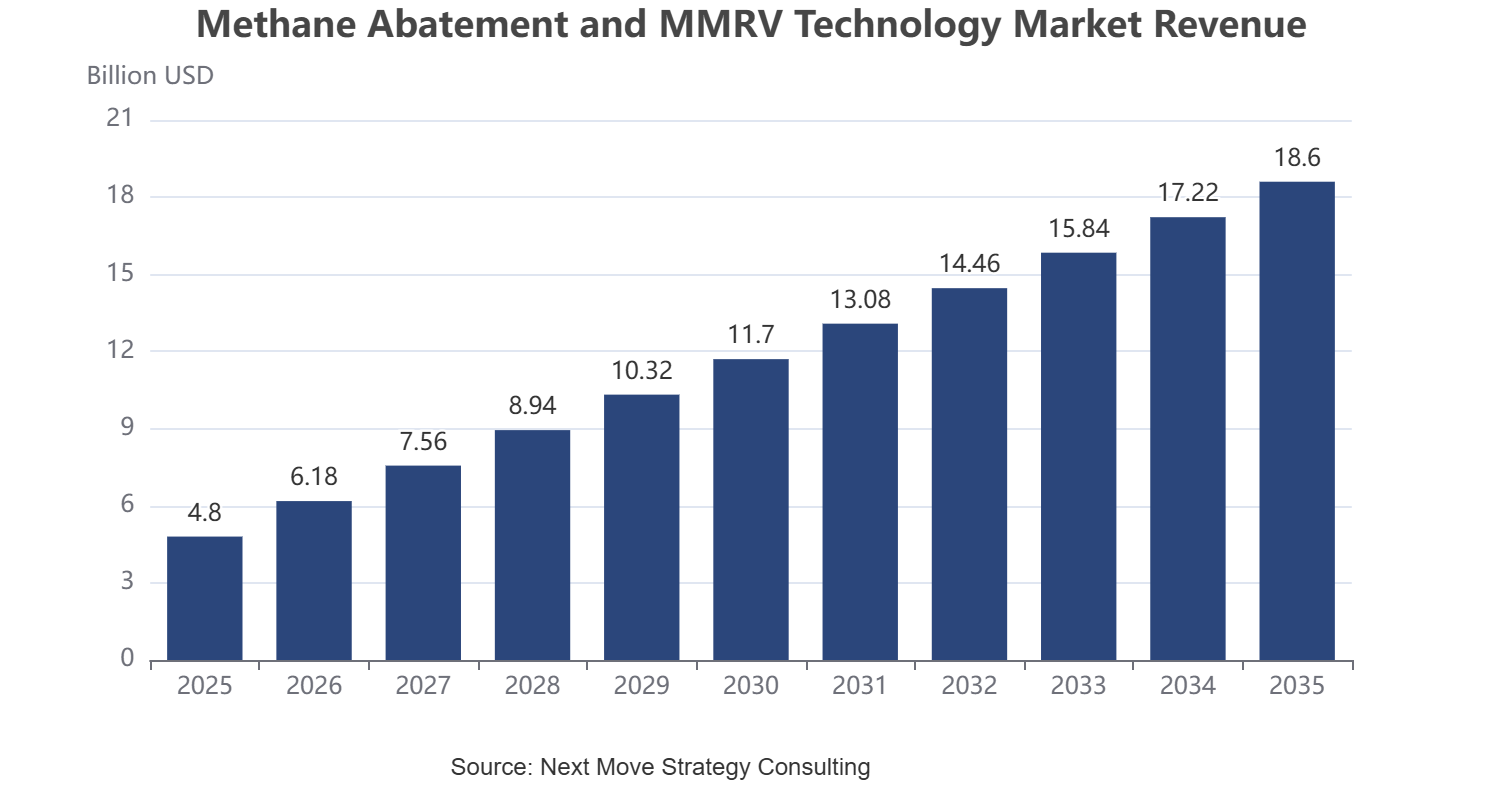
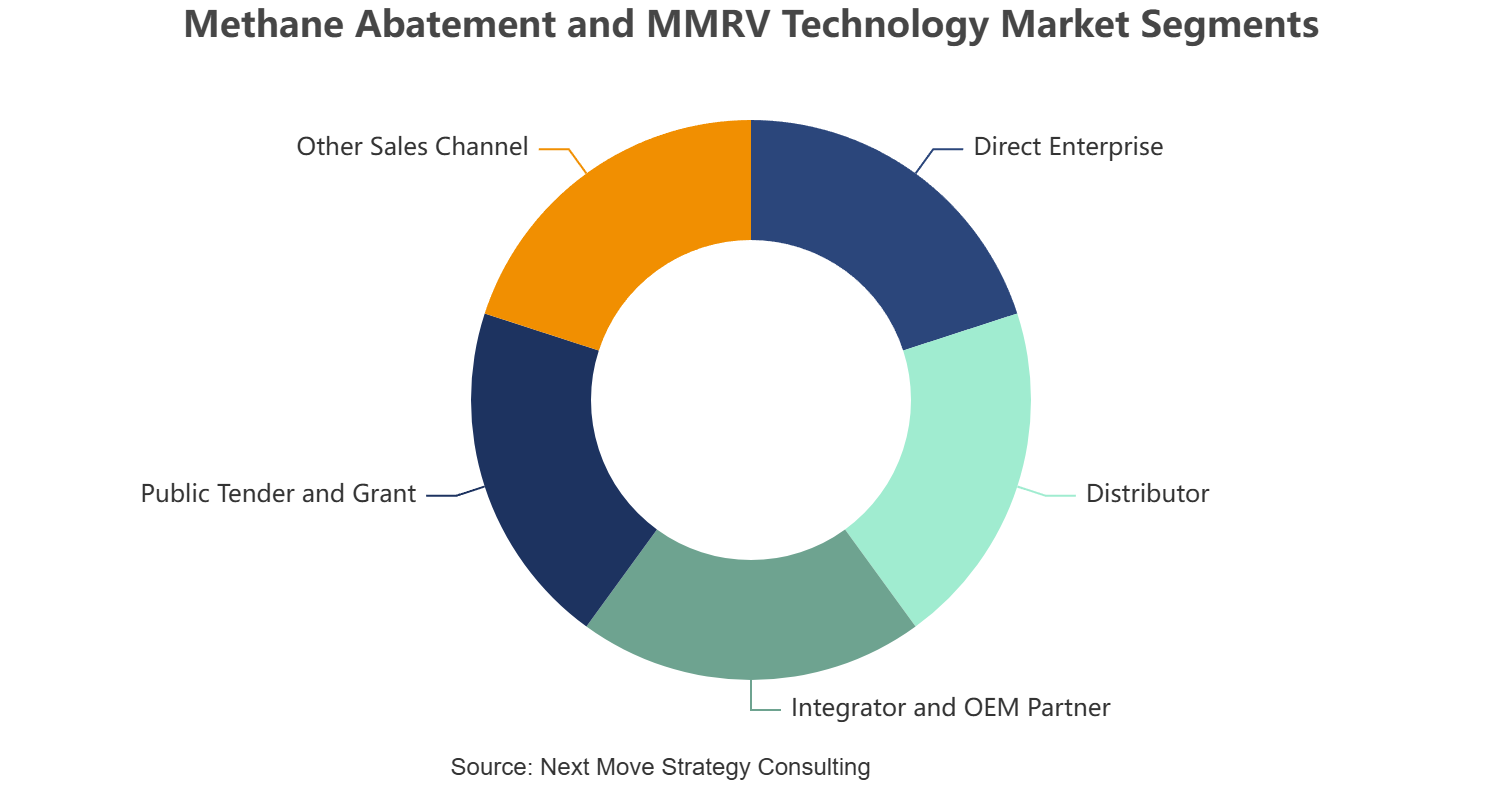
About the Author
 Saista Faiyaz
— Saista Faiyaz is Research Associate at Next Move Strategy Consulting, where she has covered consumer markets and healthcare technologies for 3 years. Her work includes primary interview review, secondary-source validation, market sizing, and structured analysis of company and industry data. She supports research by comparing evidence across sources, organizing findings into market narratives, and documenting assumptions used in analysis. Her scope includes cross-market benchmarking, and reports.
Saista Faiyaz
— Saista Faiyaz is Research Associate at Next Move Strategy Consulting, where she has covered consumer markets and healthcare technologies for 3 years. Her work includes primary interview review, secondary-source validation, market sizing, and structured analysis of company and industry data. She supports research by comparing evidence across sources, organizing findings into market narratives, and documenting assumptions used in analysis. Her scope includes cross-market benchmarking, and reports.
About the Reviewer
 Supradip Baul
— Supradip Baul is an accomplished business consultant and strategist with over a decade of rich experience in market intelligence, strategy, technology, and business transformation. His work has included rigorous qualitative and quantitative analysis across multiple industries, helping clients shape investment decisions and long-term roadmaps. Earlier in his career, he was associated with Gartner, where he contributed to industry-leading reports and market share analyses. He has worked with leading global companies and holds an MBA with a dual specialization in Marketing and Finance.
Supradip Baul
— Supradip Baul is an accomplished business consultant and strategist with over a decade of rich experience in market intelligence, strategy, technology, and business transformation. His work has included rigorous qualitative and quantitative analysis across multiple industries, helping clients shape investment decisions and long-term roadmaps. Earlier in his career, he was associated with Gartner, where he contributed to industry-leading reports and market share analyses. He has worked with leading global companies and holds an MBA with a dual specialization in Marketing and Finance.
At Next Move Strategy Consulting, we understand that insightful market research is the cornerstone of successful business decisions. That's why we employ a robust and multifaceted approach, combining various methodologies to deliver the most accurate and actionable data for our clients.

Research Landscape
We navigate the world of research with two primary approaches:
Qualitative Approach
Our qualitative research methodologies involve immersive techniques such as in-depth interviews, focus groups, and observational studies. By engaging directly with individuals and stakeholders, we uncover valuable insights that quantitative data alone may overlook.

Quantitative Research
In tandem with qualitative methodologies, NMSC leverages the power of Quantitative Research to provide a robust foundation of numerical insights. Through systematic data collection and analysis, we quantify patterns, preferences, and market trends, offering a comprehensive view of the business landscape.
Our quantitative research approach employs diverse tools, including surveys, experiments, and statistical modelling. These methodologies enable us to gather data from a large and representative sample, ensuring the statistical significance of our findings. By employing structured questionnaires and standardized data collection methods, we guarantee the reliability and validity of the information we present to our clients.
Quantitative research is particularly effective in measuring the prevalence of trends, assessing market size, and gauging the impact of various factors on consumer behavior. The numerical precision attained through this approach equips our clients with actionable insights, facilitating data-driven decision-making and strategy formulation.


Our Specialized Toolbox for Industry-Specific Market Research
We deploy a specialized arsenal of techniques tailored to meet your unique requirements. Here's a glimpse into our comprehensive toolbox:

Information Procurement
The stage entails acquiring market data or relevant information through various sources and methodologies.


Market Research Approach
We utilize both top-down and bottom-up approaches in market research analysis to achieve a comprehensive understanding of the market dynamics, leveraging the broad perspective of industry trends and macroeconomic factors alongside detailed insights from specific segments and individual companies.

Porters Five Forces Analysis
We conduct Porter's Five Forces analysis to evaluate the competitive landscape of an industry, providing us with insights into factors that affect profitability and strategic positioning.

SWOT Analysis

Forecasting
We utilize a forecasting model to predict future consumption by considering parameters like population, economics, regulations, market competition, drivers, constraints, technology, and pricing. We also employ statistical techniques such as multilinear regression, exponential smoothing, moving average, ARIMA, and Monte Carlo simulations for accurate predictions. In econometric forecasting, we analyzed short-term and long-term event impacts, attributing values based on regulatory frameworks, economic factors, and market events.





 Speak to Our Analyst