AI Pipeline Management Market Size, Share, Trends and Growth Analysis, By Offering (Software and Services), By Application (Leak Detection and Localization, Integrity and Corrosion Management, Predictive Maintenance and Asset Health, & Others), By Organization Size, By Deployment Model (Cloud, On Premises, Hybrid, & Edge), By Revenue Stream, By Sales Channel, By End User Industry (Oil and Gas, Water and Wastewater, & Others), and By Region — Global Industry Report and Forecast, 2026–2035
Industry: Energy & Power | Publishing Date: July 22, 2026 | Last Updated: September 30, 2026 | No of Pages: N/A | No. of Tables: N/A | No. of Figures: N/A | Format: PDF | Report Code: EP5299
What Is the AI Pipeline Management Market Size?
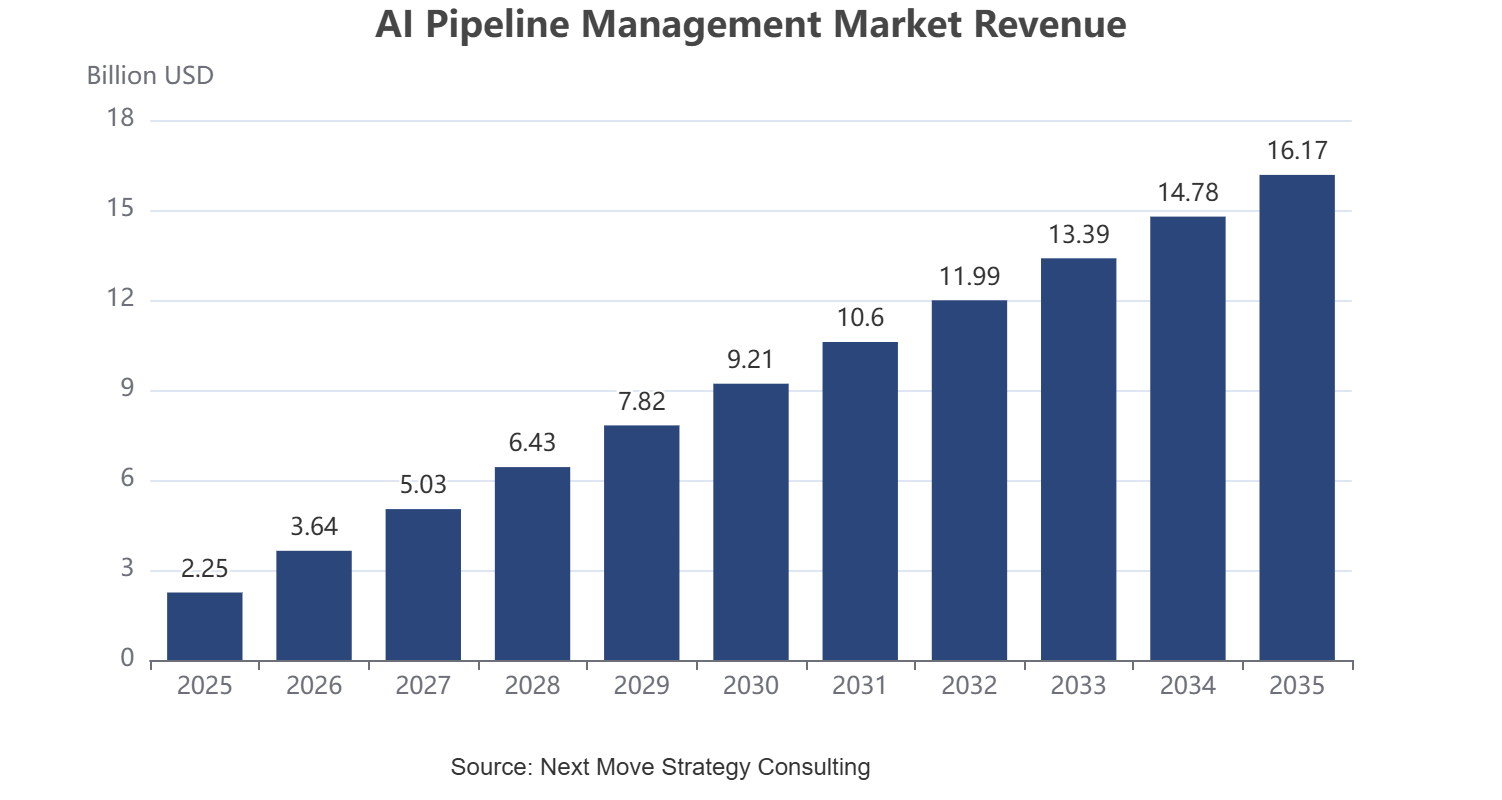
The AI Pipeline Management Market size was valued at USD 2.25 Billion in 2025 and is estimated at USD 2.74 Billion in 2026, forecast to reach USD 16.17 Billion by 2035, expanding at a 21.8% CAGR between 2026 and 2035. North America leads with approximately 36% share, while Software dominates all offerings with approximately 63% share.
We observed that growth is concentrated in predictive, AI-driven asset health monitoring, with cloud-deployed platform suites displacing legacy SCADA-only monitoring tools across oil and gas and utility pipeline networks through 2035.
|
Key Takeaways |
|
By Offering: Software held the largest share of approximately 63% (USD 1.42 Billion) in 2025; Software is also the fastest-growing sub-segment at 22.82% CAGR from 2026–2035. |
|
By Application: Predictive Maintenance and Asset Health held the largest share of approximately 27% (USD 0.60 Billion) in 2025; Operations Optimization and Simulation is the fastest-growing sub-segment at 23.77% CAGR from 2026–2035. |
|
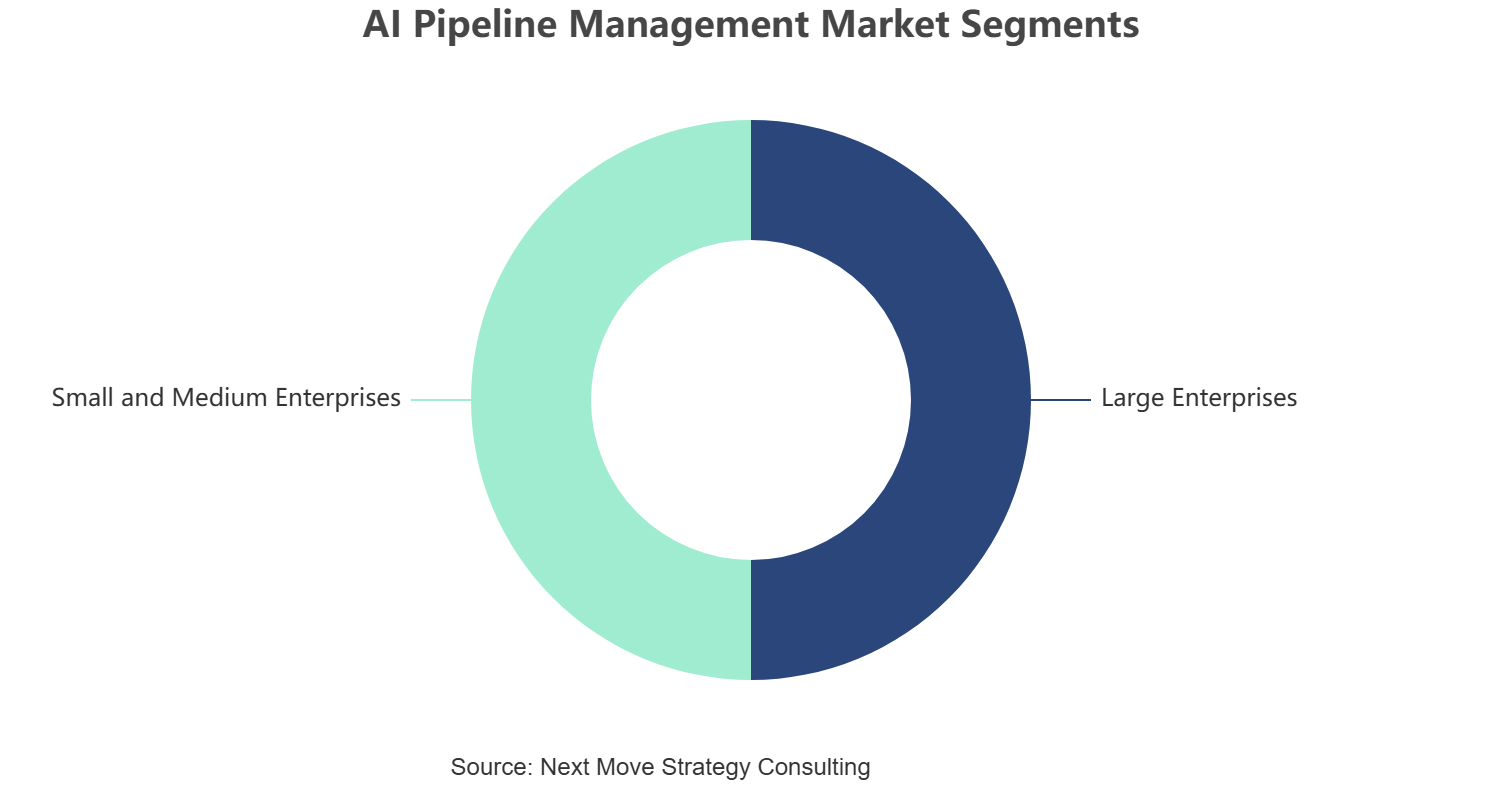
By Organization Size: Large Enterprises held the largest share of approximately 71% (USD 1.60 Billion) in 2025; Small and Medium Enterprises is the fastest-growing sub-segment at 24.06% CAGR from 2026–2035. |
|
By Deployment Model: Cloud held the largest share of approximately 52% (USD 1.17 Billion) in 2025 and is also the fastest-growing sub-segment at 24.26% CAGR from 2026–2035. |
|
By Revenue Stream: Subscription held the largest share of approximately 58% (USD 1.30 Billion) in 2025; Usage Based is the fastest-growing sub-segment at 28.85% CAGR from 2026–2035. |
|
By Sales Channel: Direct Enterprise held the largest share of approximately 54% (USD 1.22 Billion) in 2025; Cloud Marketplace is the fastest-growing sub-segment at 31.01% CAGR from 2026–2035. |
|
By End User Industry: Oil and Gas held the largest share of approximately 46% (USD 1.04 Billion) in 2025; Water and Wastewater is the fastest-growing sub-segment at 23.19% CAGR from 2026–2035. |
|
Dominant Region: North America dominated with approximately 36% revenue share (USD 0.81 Billion) in 2025. |
|
Fastest-Growing Region: Asia-Pacific is expected to register the highest CAGR of 24.81% during 2026–2035. |
|
Dominant Country: The U.S. led the market with approximately USD 0.50 Billion in 2025. |
|
Fastest-Growing Country: India is expected to register the highest CAGR of approximately 28.2% during 2026–2035. |
Market Opportunity: The AI Pipeline Management market is expected to create an absolute dollar opportunity of USD 13.43 Billion between 2026 and 2035, presenting significant investment potential across predictive asset health and cloud-native pipeline monitoring technologies.
According to NMSC analysis, oil and gas operators are increasingly consolidating leak detection, corrosion management, and predictive maintenance workflows onto a single AI platform rather than deploying point solutions, a shift that favors vendors with broad platform suite capability over narrow standalone software providers as enterprise-wide deployments scale through 2035.
Ecosystem Analysis of the AI Pipeline Management Market
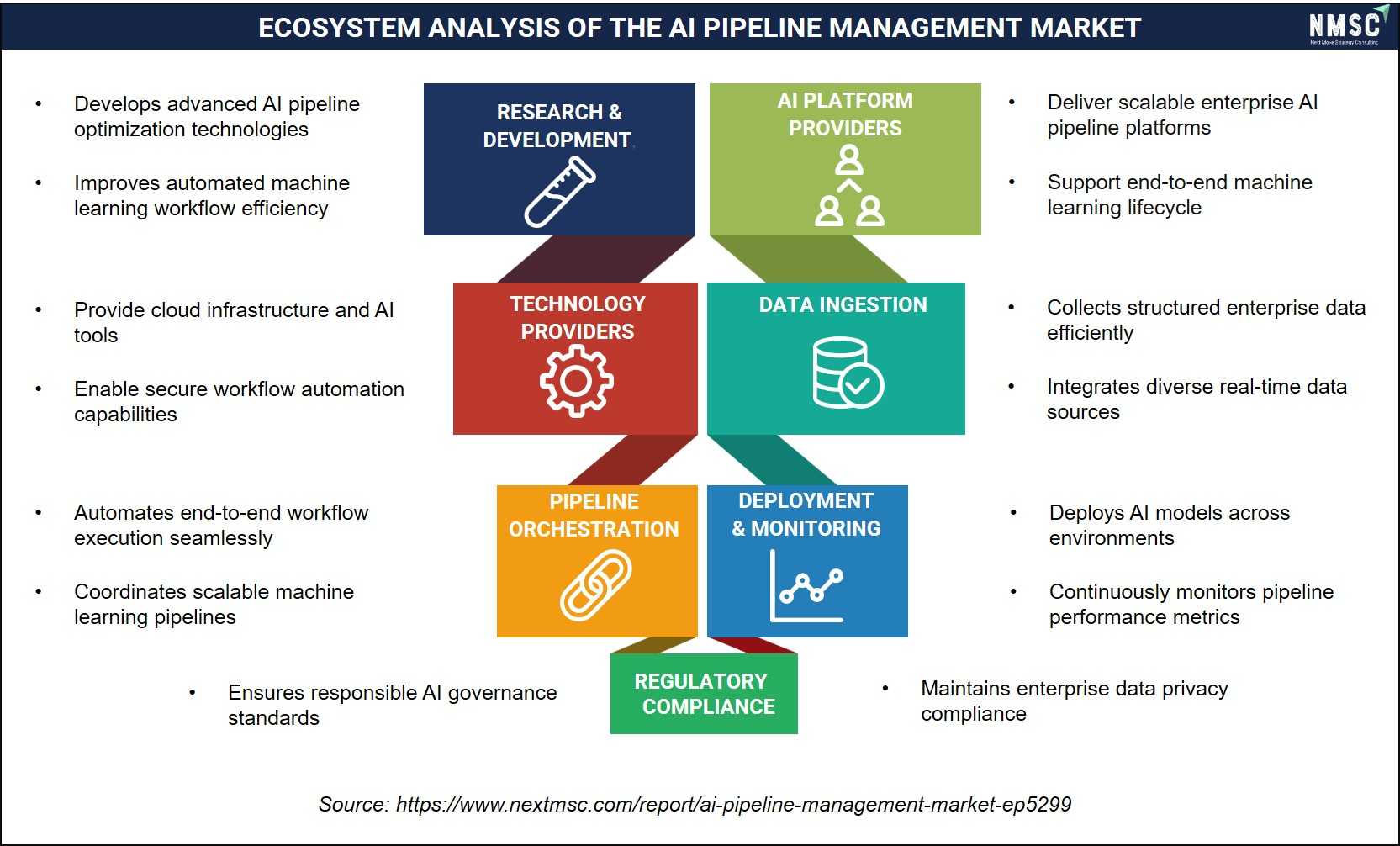
The above infographic presents an ecosystem analysis of the AI pipeline management market, covering research, technology providers, data ingestion, orchestration, deployment, and compliance. Advanced AI optimization technologies are improving automated workflows, supported by cloud and AI platform providers that enable secure automation and end-to-end lifecycle management. Further, enterprise and real-time data are collected and integrated, while pipeline orchestration coordinates scalable execution across environments. Continuous monitoring also ensures performance and reliability, with regulatory compliance maintaining data privacy and responsible AI governance. Looking ahead, we observed that these interconnected elements collectively shape the market's evolution across the sector.
What Does the AI Pipeline Management Market Encompass?
The market encompasses software and services that apply artificial intelligence to monitor, predict, and optimize the structural and operational health of oil, gas, water, and chemical pipeline networks. Our assessment indicates that the scope covers platform suites and standalone software supporting leak detection, integrity and corrosion management, predictive maintenance, and operations optimization, alongside consulting, integration, and managed services delivered to large enterprises and small and medium operators. This scope excludes broader digital twin platforms not specific to pipeline infrastructure.
Regulatory frameworks, including the U.S. Pipeline and Hazardous Materials Safety Administration's integrity management rules and the European Union's Methane Regulation increasingly shape software validation and emissions-monitoring requirements for pipeline operators. We observed that technology adoption is shifting from periodic inspection-based monitoring toward continuous, AI-driven anomaly detection integrated with existing SCADA infrastructure. NMSC's analysis indicates that this structural shift, combined with rising cloud and edge deployment adoption, is redefining vendor selection criteria across the pipeline management software value chain.
|
Parameter |
Details |
|
Market Size in 2025 |
USD 2.25 Billion |
|
Market Size in 2026 |
USD 2.74 Billion |
|
Revenue Forecast in 2035 |
USD 16.17 Billion |
|
Growth Rate |
CAGR of 21.8% from 2026 to 2035 |
|
Analysis Period |
2025–2035 |
|
Base Year Considered |
2025 |
|
Forecast Period |
2026–2035 |
|
Market Size Estimation |
USD Billion |
|
Companies Profiled |
20 |
|
Countries Covered |
38 |
|
Market Share |
Available for Top 10 Companies |
Key Emerging Trends
Based on research conducted by NMSC, we found that four structural trends are reshaping platform architecture, adoption strategy, and stakeholder engagement across the AI Pipeline Management market.
How Is Predictive Maintenance Transforming Pipeline Asset Management?
AI-driven predictive maintenance platforms are replacing calendar-based inspection schedules with continuous, sensor-fed anomaly detection. We observed that operators increasingly rely on machine learning models trained on historical failure data to flag at-risk pipeline segments before rupture. Cognite's Atlas AI deployment across Aker BP's offshore assets illustrates how agentic AI workflows are transforming maintenance planning across upstream operations.
Why Is Cloud-Native Deployment Accelerating Among Pipeline Operators?
Cloud-native platform suites are gaining share as operators seek to unify data from geographically dispersed pipeline assets into a single governed environment. We observed that Cognite's partnership with Snowflake to integrate industrial and IT data reflects this shift toward unified cloud data foundations. This trend is elevating platform suite offerings as the preferred architecture for operators managing multi-region pipeline portfolios.
How Is Agentic AI Reshaping Operations Optimization Workflows?
Agentic AI capable of autonomous workflow execution is emerging within operations optimization and simulation applications. Our findings suggest that TotalEnergies' three-year deployment of Cognite's industrial data and AI platform across its global upstream asset base reflects growing enterprise confidence in AI agents handling production and safety monitoring tasks. This trend is elevating the strategic role of platform vendors within enterprise digital transformation programs.
What Role Does Regulatory Pressure Play in Corrosion Management Adoption?
Expanding methane emissions and pipeline safety regulations are driving demand for AI-based integrity and corrosion management tools. Our analysis shows that operators are prioritizing software capable of continuous corrosion-rate modeling over periodic manual inspection to meet stricter compliance timelines. Companies such as Baker Hughes and SLB are scaling integrity management software lines, reflecting how compliance pressure is reshaping demand across the safety and compliance application segment.
Growth Drivers and Restraints
Growth Catalyst and Risk Assessment Matrix
|
Factors |
Type |
(+/-) % Impact on CAGR |
Geographic Relevance |
Impact Timeline |
|
Rising pipeline safety and emissions regulation |
Driver |
+3.4% |
North America, Europe |
2026-2035 |
|
Growth of AI-driven predictive maintenance adoption |
Driver |
+2.8% |
Global |
2026-2035 |
|
Expansion of cloud and edge deployment infrastructure |
Driver |
+2.1% |
Asia-Pacific, North America |
2026-2032 |
|
Aging pipeline infrastructure requiring digital monitoring |
Driver |
+1.6% |
North America, Europe |
2026-2035 |
|
Growth of water and wastewater network digitalization |
Driver |
+1.2% |
Global |
2026-2035 |
|
Increasing enterprise-wide industrial AI platform consolidation |
Driver |
+0.9% |
Global |
2026-2032 |
|
High integration cost with legacy SCADA systems |
Restraint |
-1.5% |
Global |
2026-2032 |
|
Data governance and cybersecurity concerns in industrial AI |
Restraint |
-1.0% |
North America, Europe |
2026-2035 |
|
Shortage of skilled AI and data engineering talent |
Restraint |
-0.7% |
Global |
2026-2030 |
What Is the Primary Growth Driver of the AI Pipeline Management Market?
Rising pipeline safety and emissions regulations are the primary drivers of the market. The U.S. Pipeline and Hazardous Materials Safety Administration continues to expand integrity management requirements for hazardous liquid and gas transmission pipelines. We observed that this regulatory pressure, reinforced by the European Union's Methane Regulation, continues to anchor baseline demand for AI-based leak detection and corrosion management platforms across regulated pipeline operators.
How Is Predictive Maintenance Technology Driving Market Growth?
Growing adoption of AI-driven predictive maintenance platforms is accelerating market expansion as operators shift from reactive to condition-based asset management. TotalEnergies' three-year global deployment of an industrial data and AI platform across its upstream assets illustrates an enterprise-scale commitment to this technology. Our assessment indicates that this adoption pattern is compressing sales cycles for platform suite vendors serving large, multi-asset pipeline operators.
What Is Restraining AI Pipeline Management Market Expansion?
High integration cost with legacy SCADA and operational technology systems restrains near-term adoption among smaller pipeline operators. The U.S. Government Accountability Office has documented recurring challenges in modernizing aging industrial control infrastructure without operational disruption. We found that this integration burden disproportionately affects small and medium enterprises with limited in-house data engineering capacity compared with large, well-resourced operators.
Segmentation Analysis
Segment Sizing: By Offering
|
Segment |
2025 (USD Billion) |
2035 (USD Billion) |
CAGR% (2026-2035) |
|
Software |
1.42 |
11.00 |
22.82% |
|
Services |
0.83 |
5.17 |
19.89% |
|
Total |
2.25 |
16.17 |
21.80% |
Which Offering Segment Dominates the AI Pipeline Management Industry?
Software led the market with USD 1.42 Billion in 2025, supported by rising enterprise adoption of platform suites over standalone tools. We observed that Software is also the fastest-growing offering, expanding at a 22.82% CAGR from 2026 to 2035, as operators prioritize scalable, cloud computing-native platforms capable of consolidating leak detection, integrity, and predictive maintenance functions.
Segment Sizing: By Application
|
Segment |
2025 (USD Billion) |
2035 (USD Billion) |
CAGR% (2026-2035) |
|
Leak Detection and Localization |
0.54 |
3.56 |
20.59% |
|
Integrity and Corrosion Management |
0.49 |
3.40 |
21.26% |
|
Predictive Maintenance and Asset Health |
0.60 |
4.84 |
23.21% |
|
Operations Optimization and Simulation |
0.32 |
2.59 |
23.77% |
|
Safety and Compliance |
0.23 |
1.46 |
20.63% |
|
Other Applications |
0.07 |
0.32 |
16.65% |
|
Total |
2.25 |
16.17 |
21.80% |
Which Application Segment Leads the Market?
Predictive Maintenance and Asset Health led the market with USD 0.60 Billion in 2025, supported by operators shifting from calendar-based inspection to condition-based monitoring. Operations Optimization and Simulation is the fastest-growing application, expanding at a 23.77% CAGR from 2026 to 2035, as agentic AI increasingly automates production and simulation workflows across upstream and midstream operations.
Segment Sizing: By End User Industry
|
Segment |
2025 (USD Billion) |
2035 (USD Billion) |
CAGR% (2026-2035) |
|
Oil and Gas |
1.04 |
6.79 |
20.58% |
|
Water and Wastewater |
0.38 |
3.07 |
23.19% |
|
Chemicals and Petrochemicals |
0.36 |
2.59 |
21.77% |
|
Energy and Utilities |
0.38 |
3.07 |
23.19% |
|
Other Industries |
0.09 |
0.65 |
21.82% |
|
Total |
2.25 |
16.17 |
21.80% |
Which End User Industry Leads the Market Demand?
Oil and Gas remained the leading end-user industry, valued at USD 1.04 Billion in 2025 on sustained upstream and midstream digitalization investment. Our findings suggest that Water and Wastewater is tied for the fastest-growing industry, registering a 23.19% CAGR from 2026 to 2035, as municipal utilities increasingly adopt anti-corrosion-linked integrity monitoring software to manage aging water distribution networks.
Growth Opportunities
We found that three forward-looking whitespace opportunities stand out for stakeholders' positioning within the market over the coming decade.
How Can Vendors Capture Demand From Water Utility Digitalization?
Expanding municipal water infrastructure modernization programs create a mechanism for AI platform vendors to secure long-term contracts with water and wastewater utilities beyond traditional oil and gas customers. Vendors offering configurable, lower-cost standalone software stand to benefit most, as utilities typically operate with smaller budgets and less complex asset portfolios than large oil and gas operators.
What Opportunity Does Edge Deployment Present for Remote Pipeline Assets?
Rising demand for real-time monitoring at remote, connectivity-constrained pipeline sites creates a mechanism for edge AI software vendors to displace cloud-only architectures. Operators of offshore and remote onshore pipeline segments stand to benefit from edge-deployed anomaly detection that functions independently of continuous cloud connectivity.
How Can System Integrators Unlock Legacy SCADA Modernization Contracts?
A large installed base of legacy SCADA-only pipeline monitoring systems creates a mechanism for system integrators to offer AI-augmentation retrofit services rather than full system replacement. Consulting and integration service providers stand to benefit most, capturing multi-year modernization contracts as operators prioritize incremental AI adoption over disruptive infrastructure overhauls.
Regional Outlook
|
Region |
2025 (USD Billion) |
2035 (USD Billion) |
CAGR% (2026-2035) |
Key Driver |
|
North America |
0.81 |
5.01 |
19.74% |
Pipeline integrity regulation |
|
Europe |
0.56 |
3.56 |
20.00% |
Methane emissions regulation |
|
Asia-Pacific |
0.63 |
5.66 |
24.81% |
Pipeline network expansion |
|
Middle East & Africa |
0.16 |
1.29 |
23.72% |
Oil and gas digitalization investment |
|
Latin America |
0.09 |
0.65 |
21.82% |
Growing midstream infrastructure investment |
|
Total |
2.25 |
16.17 |
21.80% |
— |
|
Source: www.nextmsc.com |
||||
North America
North America's AI pipeline management market reflects a mature regulatory environment anchored by the Pipeline and Hazardous Materials Safety Administration's integrity management rules. We observed that operators are prioritizing platform consolidation to meet expanding compliance reporting requirements. Technology adoption favors cloud-native platform suites, and the region's strategic outlook remains anchored to sustained aging-infrastructure modernization investment through 2035.
Europe
Europe's market is shaped by the European Union's Methane Regulation, which elevates emissions-monitoring and leak detection requirements across cross-border pipeline networks. Our assessment indicates that regional operators are advancing integrity and corrosion management software adoption to meet these mandates. The region's strategic outlook favors vendors with strong regulatory-compliance credentials serving multinational pipeline operators.
Asia-Pacific
Asia-Pacific's market benefits from rapidly expanding pipeline network construction supporting growing energy demand. We found that regional operators are adopting cloud and edge-deployed monitoring platforms faster than other regions, reflecting large-scale new-build infrastructure suited to AI-native design from inception. The region's strategic outlook remains the strongest globally, anchored by sustained energy infrastructure investment.
Middle East & Africa
The Middle East & Africa market is expanding steadily, supported by national oil company digitalization programs and growing gas export infrastructure investment. Our analysis shows that regional demand is concentrated among large state-owned operators adopting platform suites for both integrity management and production optimization. The region's strategic outlook depends on continued government-backed digital transformation programs through 2035.
Latin America
Latin America's AI pipeline management market is growing gradually, supported by expanding midstream infrastructure investment and national oil company modernization initiatives. We observed that Brazil's offshore production growth is creating incremental demand for integrity monitoring software. The region's strategic outlook favors vendors able to serve smaller-scale, budget-constrained operators across multiple national markets.
U.S.
Based on our estimates, the U.S. was valued at approximately USD 0.50 Billion in 2025 and is projected to reach USD 3.05 Billion by 2035 at a 19.7% CAGR. Demand structure favors platform suites serving large interstate pipeline operators, supported by strong regulatory influence from federal integrity management rules and rising technology penetration of predictive maintenance software across major operators.
Canada
The market in Canada was valued at approximately USD 0.16 Billion in 2025 and is projected to reach USD 0.95 Billion by 2035 at a 19.6% CAGR. Demand structure reflects growing oil sands and gas transmission monitoring investment, moderate regulatory influence from national pipeline safety standards, and rising competitive intensity as vendors expand coverage of remote northern pipeline corridors.
UK
As per our estimate, the UK was valued at approximately USD 0.13 Billion in 2025 and is projected to reach USD 0.82 Billion by 2035 at a 20.1% CAGR. Demand structure centers on North Sea offshore pipeline integrity monitoring, with strong regulatory influence from national safety and environmental standards and rising technology penetration of cloud-based leak detection platforms.
Germany
According to our analysis, the Germany market was valued at approximately USD 0.17 Billion in 2025 and is projected to reach USD 1.05 Billion by 2035 at a 19.9% CAGR. Demand structure reflects the country's extensive gas transmission network, high regulatory influence from European Union methane emissions standards, and strong competitive intensity among established industrial automation suppliers.
France
Based on our estimates, the France AI pipeline management market was valued at approximately USD 0.09 Billion in 2025 and is projected to reach USD 0.55 Billion by 2035 at a 19.8% CAGR. Demand structure favors integrity and corrosion management software among national energy operators, supported by government-backed emissions-reduction programs and growing technology penetration of AI-based compliance reporting tools.
China
The market in China was valued at approximately USD 0.29 Billion in 2025 and is projected to reach USD 2.68 Billion by 2035 at a 25.0% CAGR. Demand structure benefits from rapidly expanding national gas pipeline network construction, strong regulatory influence from national energy infrastructure safety standards, and the fastest technology penetration of cloud-native monitoring platforms among leading domestic energy operators.
India
As per our estimate, the India AI pipeline management market was valued at approximately USD 0.09 Billion in 2025 and is projected to reach USD 0.87 Billion by 2035 at a 28.2% CAGR, the fastest among all countries covered. Demand structure reflects rapidly expanding national gas grid infrastructure, growing regulatory influence from national pipeline safety programs, and rising adoption of AI-based monitoring among domestic and multinational operators such as Cairn Oil & Gas.
Japan
According to our analysis, the Japan AI pipeline management market was valued at approximately USD 0.08 Billion in 2025 and is projected to reach USD 0.68 Billion by 2035 at a 23.3% CAGR. Demand structure favors predictive maintenance software among established petrochemical refiners, supported by strong domestic industrial automation capability and steady technology penetration of AI-based asset health monitoring.
South Korea
Based on our estimates, the South Korea AI pipeline management market was valued at approximately USD 0.06 Billion in 2025 and is projected to reach USD 0.48 Billion by 2035 at a 22.9% CAGR. Demand structure benefits from strong domestic petrochemical processing capacity, high regulatory influence from national industrial safety standards, and rising strategic outlook tied to integrated refinery digitalization programs.
Australia
The market in Australia was valued at approximately USD 0.04 Billion in 2025 and is projected to reach USD 0.32 Billion by 2035 at a 23.1% CAGR. Demand structure reflects growing liquefied natural gas export infrastructure investment, with moderate regulatory influence from national pipeline safety codes and gradually rising technology penetration of cloud-based monitoring platforms.
UAE
As per our estimate, the UAE AI pipeline management market was valued at approximately USD 0.05 Billion in 2025 and is projected to reach USD 0.42 Billion by 2035 at a 24.0% CAGR. Demand structure reflects strong national oil company digitalization investment, growing regulatory influence from national energy diversification strategies, and rising technology penetration of AI-based production optimization platforms.
Saudi Arabia
According to our analysis, the Saudi Arabia AI pipeline management market was valued at approximately USD 0.05 Billion in 2025 and is projected to reach USD 0.44 Billion by 2035 at a 24.3% CAGR. Demand structure benefits from large-scale national gas expansion programs supporting Vision 2030 diversification targets, with strong regulatory influence and rising strategic outlook tied to state-backed digital transformation investment.
South Africa
Based on our estimates, the South Africa AI pipeline management market was valued at approximately USD 0.02 Billion in 2025 and is projected to reach USD 0.16 Billion by 2035 at a 22.0% CAGR. Demand structure remains concentrated in limited domestic gas transmission infrastructure, with moderate regulatory influence from national energy safety programs and gradually rising competitive intensity among regional integrators.
Brazil
The market in Brazil was valued at approximately USD 0.05 Billion in 2025 and is projected to reach USD 0.37 Billion by 2035 at a 22.1% CAGR. Demand structure reflects the country's expanding offshore production base, with growing regulatory influence from national environmental compliance programs and rising technology penetration of integrity monitoring software among domestic operators.
Argentina
As per our estimate, the Argentina AI pipeline management market was valued at approximately USD 0.02 Billion in 2025 and is projected to reach USD 0.12 Billion by 2035 at a 19.6% CAGR. Demand structure remains at an early stage, supported by gradually expanding shale gas transmission investment, limited regulatory influence from national incentive programs, and modest but rising competitive intensity among component suppliers.
Strategic Analysis of the AI Pipeline Management Industry
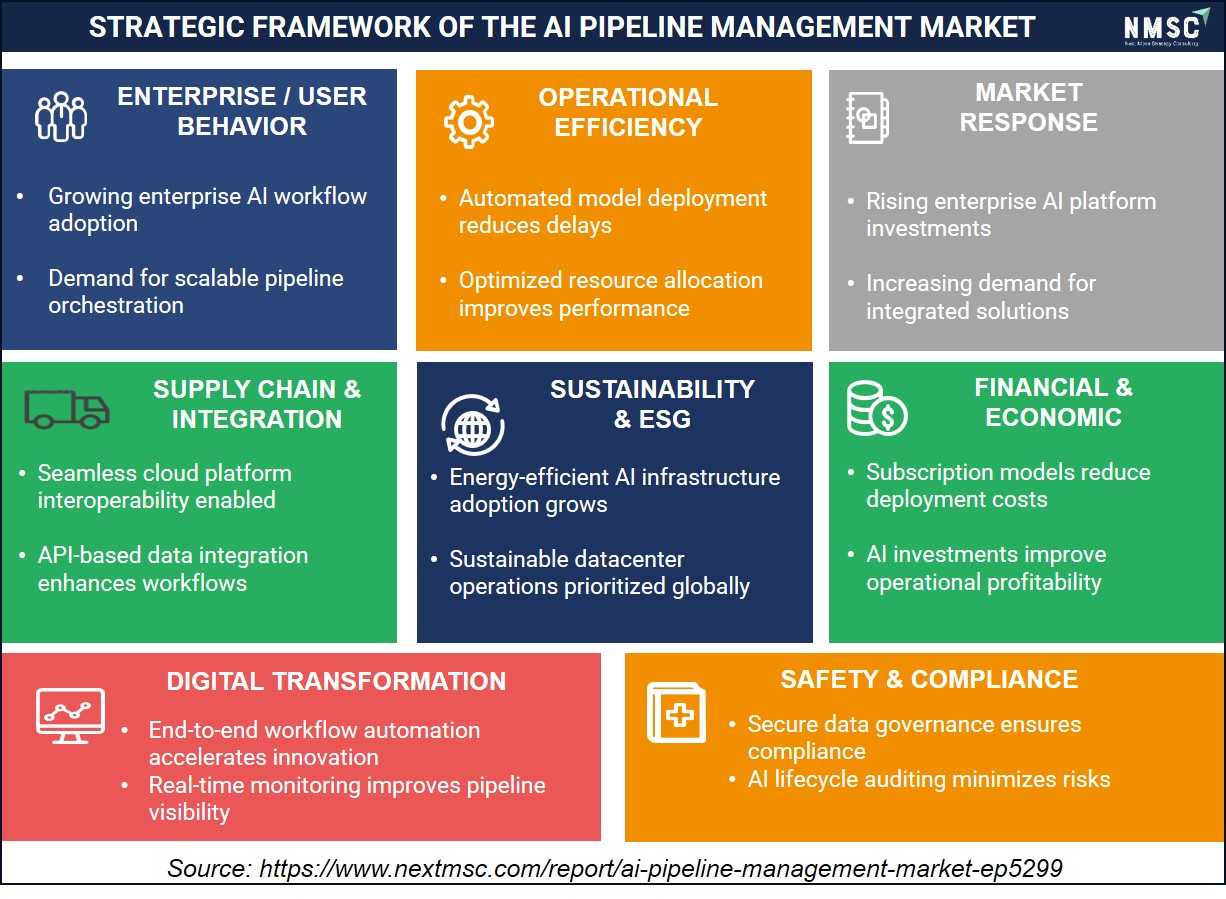
The above infographic presents a strategic framework of the AI pipeline management market, where growing enterprise adoption and demand for scalable orchestration are driving expansion. Cloud interoperability and API integration enhance workflows, while automated deployment and optimized resource allocation improve efficiency. Further, energy-efficient infrastructure supports sustainability, and subscription models lower deployment costs. End-to-end automation and real-time monitoring accelerate innovation, while secure data governance and AI auditing ensure compliance and minimize risks. Looking ahead, we observed that these interconnected elements collectively shape the market's evolution across the sector.
Competitive Landscape
We observed that the AI Pipeline Management market features a moderately consolidated competitive landscape, with established industrial automation and oilfield services groups competing alongside specialized industrial AI software vendors on platform breadth, domain expertise, and regional service reach.
|
Dimension |
Description |
|
Market Structure |
Moderately consolidated; leading industrial automation, oilfield services, and industrial AI software vendors profiled in this report collectively account for a significant share of branded platform revenue, while regional system integrators serve smaller operator deployments. |
|
Innovation Focus |
Agentic AI workflows, cloud-native data unification, and continuous predictive maintenance modeling dominate current innovation pipelines across leading vendors. |
|
M&A Activity |
Selective technology partnerships and platform integrations, exemplified by Cognite's expanded partnerships with Snowflake and its multi-year deployment agreement with TotalEnergies. |
How Do Companies Compete in the AI Pipeline Management Market?
Companies compete primarily on platform breadth, domain expertise in pipeline operations, and enterprise-scale deployment track record across the industry. Global automation groups such as Honeywell International and Siemens leverage broad industrial software portfolios to serve multinational operators, while specialized industrial AI vendors such as Cognite and C3.ai compete on data-unification depth and agentic AI capability for large-scale digital transformation programs.
Which Competitive Archetypes Dominate the AI Pipeline Management Industry?
Two archetypes dominate the market: diversified industrial automation and oilfield services groups offering integrated hardware-software-services portfolios, and specialized industrial AI software vendors focused purely on data platforms and analytics. Honeywell International and SLB exemplify the diversified archetype through combined instrumentation and software offerings, while Cognite and C3.ai exemplify the specialized archetype supplying platform capability to multiple hardware and services partners.
How Are Companies Differentiating Through Innovation in AI Pipeline Management?
Innovation and differentiation strategy increasingly center on agentic AI and unified industrial data foundations. Cognite's Atlas AI deployment with Aker BP and its Snowflake data-integration partnership both reflect efforts to secure differentiated positioning in large-scale upstream digital transformation programs. Our analysis shows that vendors unable to demonstrate enterprise-scale, multi-asset deployment references risk exclusion from major operator shortlists.
What M&A and Expansion Activity Is Shaping the AI Pipeline Management Market?
Technology partnerships and enterprise deployment agreements continue to reshape competitive positioning within the industry. Cognite's three-year platform deployment agreement with TotalEnergies and its strategic partnership with SLB illustrate how vendors pursue deepened enterprise relationships and expanded technology alliances rather than pursuing acquisitions, reflecting the market's current emphasis on platform integration over consolidation.
Key Market Players
Our assessment indicates that the following 20 companies are actively shaping platform innovation, deployment capability, and domain expertise within the AI Pipeline Management market.
-
Siemens AG
-
Emerson Electric Co.
-
ABB Ltd
-
Schneider Electric SE
-
SLB
-
Halliburton Company
-
GE Vernova Inc.
-
Rockwell Automation, Inc.
-
Accenture plc
-
Tata Consultancy Services Limited
-
Infosys Limited
-
Wipro Limited
-
Quorum Software, Inc.
-
Cognite AS
-
C3.ai, Inc.
-
Seeq Corporation
-
John Wood Group PLC
-
Bentley Systems, Incorporated
Latest Developments
We found that recent enterprise deployments and technology partnerships within the AI pipeline management supply chain are concentrated on industrial data unification and agentic AI expansion.
|
Date |
Event |
|
January 2025 |
SLB launched OptiSite, an AI-enabled solution suite designed to provide end-to-end oversight of production networks, including facilities, equipment, and pipelines. The platform combines digital twins with AI to deliver predictive and advisory insights covering process optimization, asset health, reliability, emissions control, and pipeline integrity, directly supporting more proactive management of energy infrastructure. |
Investment Opportunities
What Capital Inflows Are Supporting the AI Pipeline Management Market?
Industrial AI vendors are directing capital toward platform expansion and enterprise partnership development across North America, Europe, and Asia-Pacific. Cognite's expanded multi-year TotalEnergies deployment and its new Snowflake partnership illustrate sustained capital and resource commitments supporting large-scale industrial AI platform adoption within pipeline-intensive operators.
How Is Infrastructure Investment Shaping AI Pipeline Management Demand?
Government and national oil company infrastructure investment continues to expand the addressable base for AI-driven pipeline monitoring adoption. Our assessment indicates that new pipeline construction in Asia-Pacific and gas export expansion in the Middle East are creating multi-year procurement pipelines for vendors offering AI-native monitoring from project inception rather than retrofit deployment.
What ESG Considerations Are Influencing AI Pipeline Management Investment Decisions?
Environmental, social, and governance considerations are increasingly influencing capital allocation toward emissions-monitoring and leak-detection software. The European Union's Methane Regulation is encouraging operators to prioritize continuous, AI-based emissions detection over periodic manual surveys. We observed that investors are favoring vendors with documented emissions-reduction outcomes as sustainability-linked financing gains traction across the energy infrastructure sector.
Key Benefits for Stakeholders
How Does This Report Benefit Industry Leaders and Pipeline Operators?
Industry leaders and pipeline operators gain granular segmentation data across offering, application, and end-user industry axes, enabling informed platform selection decisions for new digital transformation initiatives. Our analysis, data, and forecasts help operators benchmark AI adoption strategies against verified 2025–2035 market trajectories and evolving regulatory compliance requirements.
How Does This Report Benefit Investors and Financial Analysts?
Investors and financial analysts gain a validated 2025 base-year market size, a fundamentals-supported 2026–2035 CAGR, and segment-level growth trajectories that support capital allocation and competitive benchmarking decisions. The report's strategic insights into vendor partnerships and enterprise deployment activity help analysts assess relative positioning across the AI pipeline management value chain.
How Does This Report Benefit Technology Vendors and Product Teams?
Technology vendors and product teams gain visibility into the fastest-growing sub-segments, including Cloud Marketplace sales, Usage-Based revenue, and Water and Wastewater end users, informing product roadmap and go-to-market prioritization aligned with documented buyer and application demand shifts through 2035.
Key Market Segments
By Offering
-
Software
-
Platform Suite
-
Standalone Software
-
Other Software
-
-
Services
-
Consulting and Advisory
-
System Integration and Implementation
-
Managed Services
-
Support and Maintenance
-
By Application
-
Leak Detection and Localization
-
Integrity and Corrosion Management
-
Predictive Maintenance and Asset Health
-
Operations Optimization and Simulation
-
Safety and Compliance
-
Other Applications
By Organization Size
-
Large Enterprises
-
Small and Medium Enterprises
By Deployment Model
-
Cloud
-
On Premises
-
Hybrid
-
Edge
By Revenue Stream
-
Subscription
-
Usage Based
-
Perpetual License
-
Support and Maintenance
-
Professional Services
By Sales Channel
-
Direct Enterprise
-
Partner Led
-
Cloud Marketplace
-
Self-Serve
By End User Industry
-
Oil and Gas
-
Upstream
-
Midstream
-
Downstream
-
-
Water and Wastewater
-
Chemicals and Petrochemicals
-
Energy and Utilities
-
Other Industries
By Region
-
North America: U.S., Canada, Mexico.
-
Europe: UK, Germany, France, Italy, Spain, Sweden, Denmark, Finland, Netherlands, Rest of Europe.
-
Asia-Pacific: China, India, Japan, South Korea, Taiwan, Indonesia, Vietnaml,, Australia, Philippines, Malaysia, Rest of APAC.
-
Middle East & Africa: Saudi Arabia, UAE, Egypt, Israel, Turkey, Nigeria, South Africa, Rest of MEA.
-
Latin America: Brazil, Argentina, Chile, Colombia, Rest of LATAM.
Conclusion and Recommendations
What Is the Long-Term Outlook for the AI Pipeline Management Market?
The AI Pipeline Management market is positioned for sustained rapid growth through 2035, underpinned by expanding pipeline safety regulations and enterprise-scale AI platform adoption. We expect Cloud deployment and Predictive Maintenance applications to gain structural share as operators prioritize continuous, condition-based monitoring, while Software and Oil and Gas retain their position as the largest revenue contributors across the forecast period.
What Strategic Positioning Should Manufacturers Pursue?
Vendors should prioritize platform-suite breadth and agentic AI capability to align with enterprise-wide operator digital transformation programs. Our assessment indicates that vendors investing in unified industrial data foundations, following the pattern established by Cognite's TotalEnergies and Aker BP deployments, are best positioned to capture large-scale predictive maintenance and operations optimization opportunities through 2035.
How Attractive Is the AI Pipeline Management Market for Investment?
The market presents an attractive investment case, supported by a validated USD 13.43 Billion absolute dollar opportunity between 2026 and 2035 and a fundamentals-backed 21.8% CAGR. Enterprise commitment to multi-year platform deployments, as demonstrated by TotalEnergies' three-year Cognite agreement, signals sustained operator and investor confidence in the segment's growth trajectory.
What Market Shifts and Key Risks Should Stakeholders Monitor?
Stakeholders should monitor high integration costs with legacy SCADA systems, which restrain adoption speed among smaller operators. We found that data governance and cybersecurity concerns tied to industrial AI deployment also pose a risk to enterprise rollout timelines, particularly for operators managing sensitive operational technology environments.
What Are the Key Growth Pathways Through 2035?
Key growth pathways include expanding water and wastewater utility-linked demand, scaling edge-deployed monitoring for remote pipeline assets, and deepening system integrator partnerships for legacy SCADA modernization. Our findings suggest that vendors combining platform breadth with domain-specific pipeline expertise are best positioned to capture a disproportionate share of the market's projected USD 16.17 Billion 2035 revenue base.
About the Author
 Mayurima Roy
— Mayurima Roy is Research Analyst at Next Move Strategy Consulting, where she has spent 4 years working across the firm's full industry coverage rather than a single fixed vertical. Her work centers on structured research, ongoing trend tracking, competitive assessment, and insight-led content development, translating complex market data into clear, decision-ready narratives that support informed client decision-making across diverse global industries, market sectors, and world regions every day.
Mayurima Roy
— Mayurima Roy is Research Analyst at Next Move Strategy Consulting, where she has spent 4 years working across the firm's full industry coverage rather than a single fixed vertical. Her work centers on structured research, ongoing trend tracking, competitive assessment, and insight-led content development, translating complex market data into clear, decision-ready narratives that support informed client decision-making across diverse global industries, market sectors, and world regions every day.
About the Reviewer
 Supradip Baul
— Supradip Baul is an accomplished business consultant and strategist with over a decade of rich experience in market intelligence, strategy, technology, and business transformation. His work has included rigorous qualitative and quantitative analysis across multiple industries, helping clients shape investment decisions and long-term roadmaps. Earlier in his career, he was associated with Gartner, where he contributed to industry-leading reports and market share analyses. He has worked with leading global companies and holds an MBA with a dual specialization in Marketing and Finance.
Supradip Baul
— Supradip Baul is an accomplished business consultant and strategist with over a decade of rich experience in market intelligence, strategy, technology, and business transformation. His work has included rigorous qualitative and quantitative analysis across multiple industries, helping clients shape investment decisions and long-term roadmaps. Earlier in his career, he was associated with Gartner, where he contributed to industry-leading reports and market share analyses. He has worked with leading global companies and holds an MBA with a dual specialization in Marketing and Finance.
At Next Move Strategy Consulting, we understand that insightful market research is the cornerstone of successful business decisions. That's why we employ a robust and multifaceted approach, combining various methodologies to deliver the most accurate and actionable data for our clients.

Research Landscape
We navigate the world of research with two primary approaches:
Qualitative Approach
Our qualitative research methodologies involve immersive techniques such as in-depth interviews, focus groups, and observational studies. By engaging directly with individuals and stakeholders, we uncover valuable insights that quantitative data alone may overlook.

Quantitative Research
In tandem with qualitative methodologies, NMSC leverages the power of Quantitative Research to provide a robust foundation of numerical insights. Through systematic data collection and analysis, we quantify patterns, preferences, and market trends, offering a comprehensive view of the business landscape.
Our quantitative research approach employs diverse tools, including surveys, experiments, and statistical modelling. These methodologies enable us to gather data from a large and representative sample, ensuring the statistical significance of our findings. By employing structured questionnaires and standardized data collection methods, we guarantee the reliability and validity of the information we present to our clients.
Quantitative research is particularly effective in measuring the prevalence of trends, assessing market size, and gauging the impact of various factors on consumer behavior. The numerical precision attained through this approach equips our clients with actionable insights, facilitating data-driven decision-making and strategy formulation.


Our Specialized Toolbox for Industry-Specific Market Research
We deploy a specialized arsenal of techniques tailored to meet your unique requirements. Here's a glimpse into our comprehensive toolbox:

Information Procurement
The stage entails acquiring market data or relevant information through various sources and methodologies.


Market Research Approach
We utilize both top-down and bottom-up approaches in market research analysis to achieve a comprehensive understanding of the market dynamics, leveraging the broad perspective of industry trends and macroeconomic factors alongside detailed insights from specific segments and individual companies.

Porters Five Forces Analysis
We conduct Porter's Five Forces analysis to evaluate the competitive landscape of an industry, providing us with insights into factors that affect profitability and strategic positioning.

SWOT Analysis

Forecasting
We utilize a forecasting model to predict future consumption by considering parameters like population, economics, regulations, market competition, drivers, constraints, technology, and pricing. We also employ statistical techniques such as multilinear regression, exponential smoothing, moving average, ARIMA, and Monte Carlo simulations for accurate predictions. In econometric forecasting, we analyzed short-term and long-term event impacts, attributing values based on regulatory frameworks, economic factors, and market events.





 Speak to Our Analyst