India Gas Detector Market By Product Form (Fixed/Stationary Systems, Portable Devices, Wearable/Personal Monitors), By Component (Hardware, Software, Services), By Gas Type (Combustible, Toxic, Oxygen, VOCs, Refrigerants & Others), By End-User Industry (Oil & Gas, Chemicals and Petrochemicals and Others), By Connectivity (Wired, Wireless), By Power (Hardwired, Battery, Energy Harvesting), By Sales Channel (Direct, Indirect) – India Analysis & Forecast, 2025–2035
Industry: Energy & Power | Publishing Date: July 4, 2026 | Last Updated: September 30, 2026 | No of Pages: N/A | No. of Tables: N/A | No. of Figures: N/A | Format: PDF | Report Code: EP4951
Industry Outlook
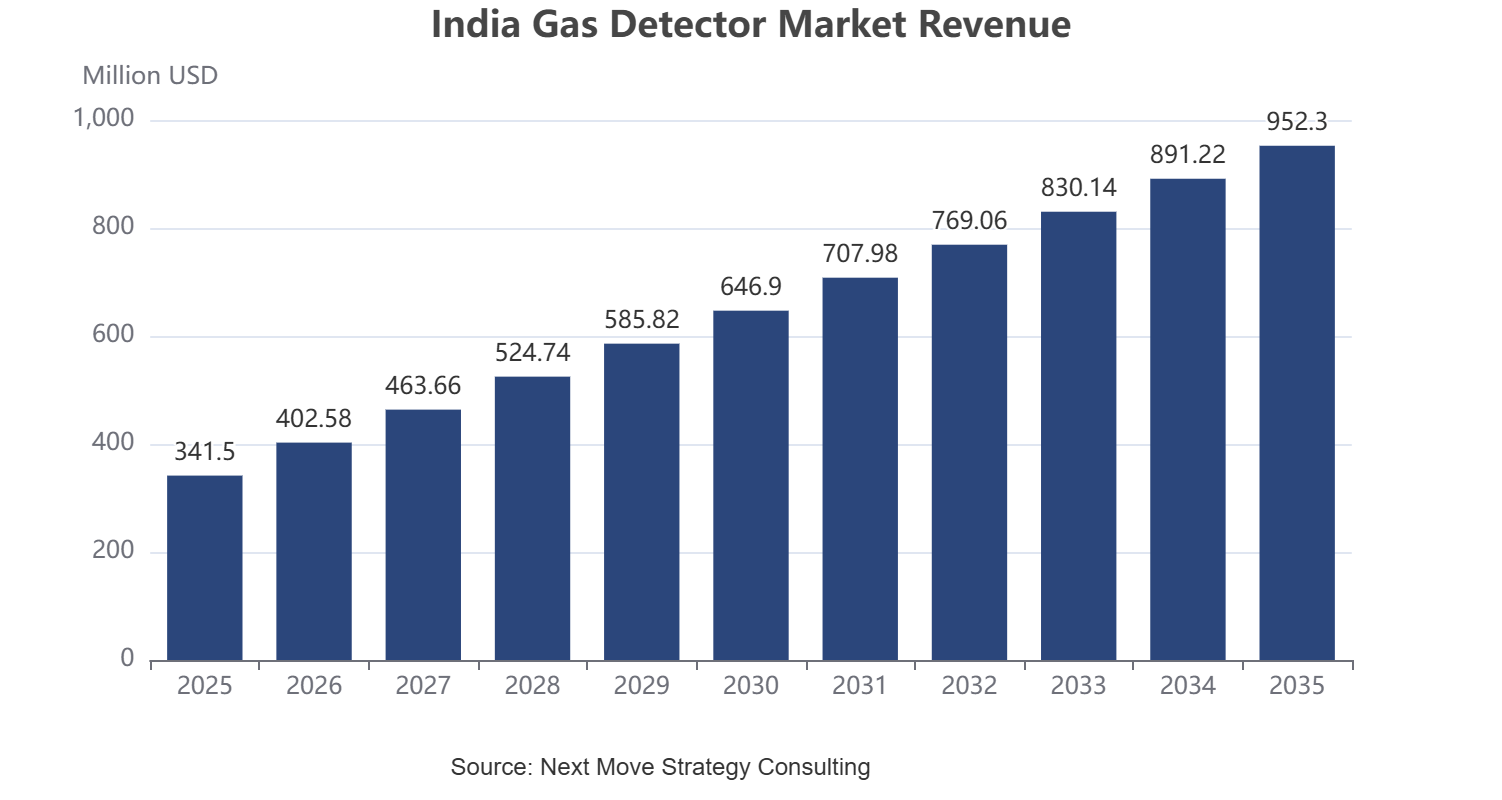
The India Gas Detector Market size was valued at USD 341.5 million in 2025 and is expected to be valued at USD 378.4 million by the end of 2026. The industry is projected to grow, hitting USD 952.3 million by 2035, with a CAGR of 10.80% between 2026 and 2035.
India Gas Detector Market Size & Forecast
|
Parameters |
Details |
|
Market Size in 2026 |
USD 378.4 million |
|
Revenue Forecast in 2035 |
USD 952.3 million |
|
Growth Rate |
CAGR of 10.80% from 2026 to 2035 |
|
Analysis Period |
2025–2035 |
|
Base Year Considered |
2025 |
|
Forecast Period |
2026–2035 |
|
Market Size Estimation |
Million (USD) |
|
Companies Profiled |
20 |
|
Market Share |
Available for 10 companies |
NMSC’s assessment indicates that the India gas detector market is undergoing a significant transformation driven by the rapid adoption of wireless and cloud-connected gas detection systems across oil & gas, mining, chemicals, and manufacturing industries. Additionally, industrial operators are increasingly focusing on real-time monitoring, centralized dashboards, and cloud-based analytics platforms to improve hazardous gas detection. This helps reduce emergency response time and enhances workplace safety in confined and high-risk environments. In parallel, integration of these systems with industrial automation and control networks is enhancing operational efficiency, while regulatory compliance requirements are further accelerating the shift toward continuous, connected monitoring solutions. Therefore, IoT-enabled and connected gas detection systems are becoming more widely embedded across industrial facilities, improving overall risk management and operational reliability in hazardous sectors.
In addition, demand for multi-gas portable detectors is rising steadily among contractors and mobile industrial workforces due to their flexibility, compact design, and ability to deliver real-time alerts in dynamic field conditions such as construction, mining, oilfield operations, and confined space entry. At the same time, our market analysis shows that rental and leasing models are expanding, particularly among project-based users and smaller contractors, as these solutions reduce upfront capital expenditure while ensuring access to certified and calibrated equipment. Certification-aligned gas detection systems are increasingly being preferred across industries, as standardized safety compliance requirements are shaping procurement decisions and ensuring uniform equipment quality. Overall, these evolving trends are collectively driving a more structured, technology-oriented, and flexible growth environment for the India gas detector market across diverse industrial safety applications.
What Are the Key Trends in the India Gas Detector Market?
Are Wireless and Cloud-Connected Systems Becoming Standard in the India Gas Detector Market?
Our market study indicates that wireless and cloud-connected gas detection systems are increasingly being adopted across the India gas detector market, especially in hazardous industries such as oil & gas, mining, chemicals, and manufacturing. In response, industrial operators are deploying these systems to improve real-time monitoring and strengthen workplace safety in confined spaces. Regulatory compliance requirements in India are further supporting the shift toward connected monitoring solutions for continuous gas leak detection. Cloud-based platforms are also enabling centralized data access, which enhances decision-making and reduces emergency response time. Alongside this, integration with industrial automation systems is improving operational efficiency across high-risk facilities. The adoption of wireless and cloud-enabled technologies is steadily expanding across industrial sites. In conclusion, this trend is strengthening safety infrastructure and driving technology-led transformation in the market.
Are Multi-Gas Portable Detectors Gaining Preference Among Contractors in The India Gas Detector Market?
Demand for multi-gas portable detectors is rising in the India gas detector market as contractors and mobile industrial workforces prioritize flexible and real-time gas monitoring in hazardous environments. Additionally, contractors in construction, mining, and oilfield operations are increasingly deploying compact devices for confined space entry and field inspections to improve worker safety. Our evaluation shows that this adoption is driven by stricter safety compliance requirements and the growing need for mobility across dynamic industrial sites in India. At the same time, these devices offer real-time alerts, multi-gas detection, and improved response capability, which enhances operational safety in unpredictable conditions. Adoption of portable multi-gas detectors is increasing steadily across high-risk sectors in India as safety practices become more structured. This, in turn, is strengthening preventive safety adoption and supporting broader risk management improvements in the market.
Is the Rental and Leasing Model for Gas Detectors Expanding in The India Gas Detector Market?
Our market observation suggests that rental and leasing-based procurement of gas detection equipment is gradually expanding in the India gas detector market, particularly among contractors managing short-duration industrial shutdowns and project-based operations. In addition, this model is gaining acceptance in mining and construction activities where temporary deployment of safety equipment is required without long-term capital investment. Equipment providers are offering calibrated multi-gas detectors on rental contracts to improve accessibility for smaller contractors operating in high-risk environments. As a result, this approach is reducing upfront costs while ensuring compliance with industrial safety requirements across India. It also supports faster deployment of safety systems during emergency maintenance activities and confined space inspections. Together, the growing preference for rental-based safety equipment is strengthening flexible procurement practices and improving accessibility to gas detection solutions across project-driven industrial operations in the India gas detector market.
Are Certification-Aligned Gas Detection Systems Becoming a Standard Preference in The India Gas Detector Market?
NMSC’s market analysis suggests that certification-aligned gas detection systems are becoming a key trend in the India gas detector market as industries increasingly prioritize standardized and compliant safety equipment. Moreover, end users across oil & gas, chemicals, and manufacturing sectors are showing stronger preference for detectors that comply with recognized industrial safety certifications and testing benchmarks. Manufacturers are responding by aligning product designs with regulatory standards to improve acceptance in industrial procurement processes. Accordingly, certified gas detection systems are increasingly being adopted as standard selection criteria in safety equipment procurement across India. It is also contributing to greater uniformity in equipment quality and deployment practices across hazardous industrial sites. In conclusion, the rising preference for certification-compliant systems is reinforcing standardized safety adoption and strengthening structured procurement patterns across the market.
PESTEL Analysis of the India Gas Detector Market
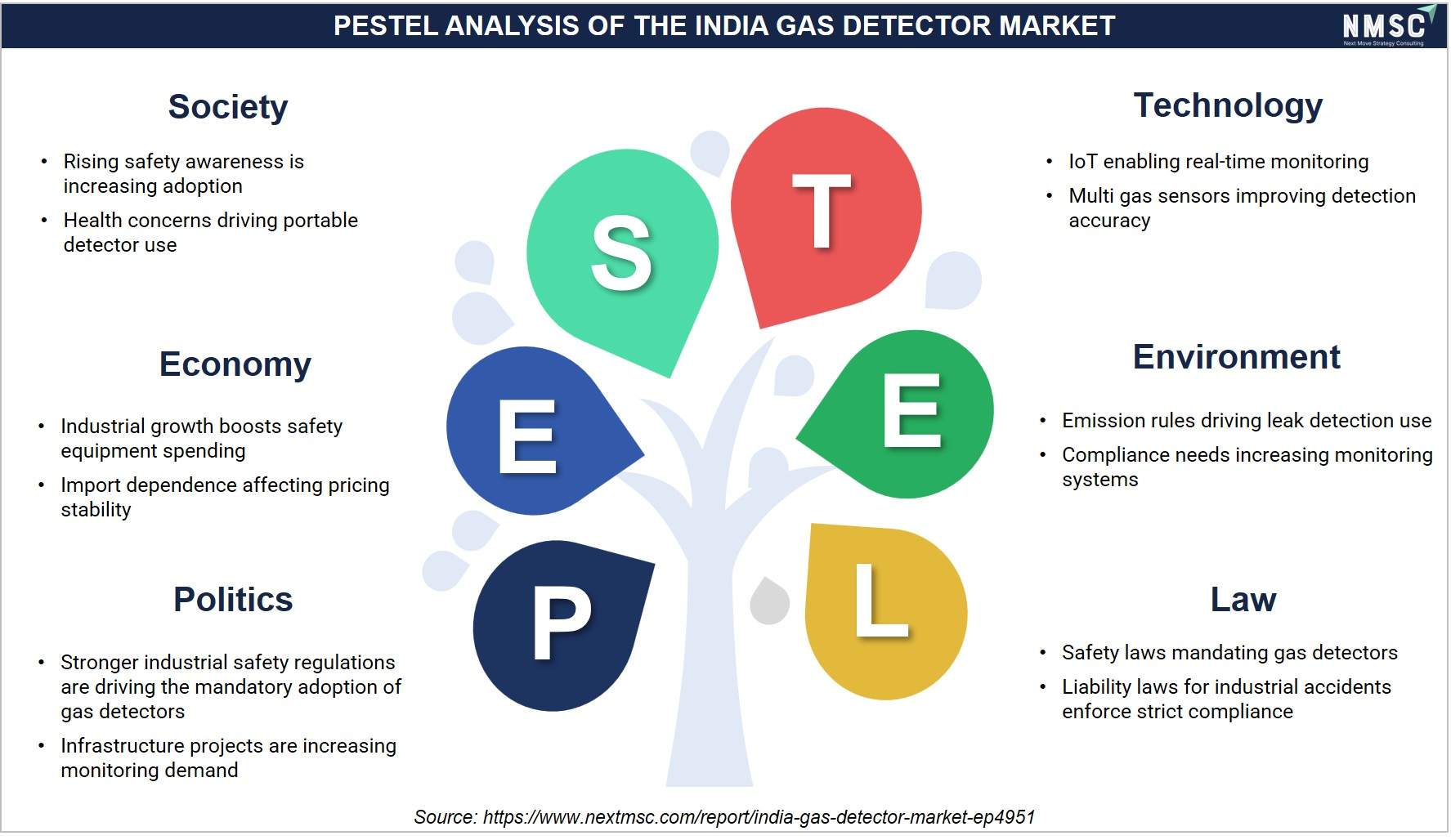
NMSC’s analysis indicates that the India gas detector market is shaped by strong regulatory and industrial dynamics. Politically, stricter safety norms and infrastructure expansion are driving mandatory deployment of monitoring systems. Economically, industrial growth is increasing investments in safety equipment, while import dependence affects pricing stability. Socially, rising workplace safety awareness is accelerating adoption, and concerns over exposure risks are further supporting demand. Technologically, IoT integration and multi-gas sensors are improving real-time detection efficiency. Environmentally, emission control requirements are boosting leak detection usage. Legally, compliance mandates and liability frameworks are reinforcing adoption, thereby strengthening consistent market expansion across industries.
What are the Key Market Drivers, Breakthroughs, and Investment Opportunities that will Shape the India Gas Detector Market in the Next Decade?
Growth Catalyst & Risk Assessment Matrix
|
Drivers / Restraints / Opportunity |
(+/-) % Impact on CAGR Forecast |
Geographic Relevance |
Impact Timeline |
|
Refinery modernization and city gas expansion are boosting gas detection deployment across oil & gas infrastructure |
+3.4% |
India (refineries, LNG, petrochemicals) |
Long term (4–8 years) |
|
Stricter industrial safety regulations are driving mandatory adoption of gas monitoring systems |
+3.1% |
India (manufacturing, mining, chemicals) |
Medium–long term (3–7 years) |
|
MSME working capital issues and delayed payments are restricting safety equipment investments |
−2.6% |
India (MSME industrial segment) |
Medium term (2–6 years) |
|
Government procurement and disaster response modernization are increasing demand for advanced gas detectors |
+2.9% |
India (public sector, emergency response) |
Long term (4–8 years) |
Based on NMSC’s evaluation, it is found that the India gas detector market is being shaped by a combination of strong growth drivers, a key restraint, and emerging opportunities across industrial and public safety ecosystems. On the growth side, refinery modernization and city gas distribution expansion are accelerating deployment of fixed and portable gas detection systems, supported by LNG investments, petrochemical capacity additions, and stricter safety integration across hydrocarbon facilities. Alongside this, tightening industrial safety regulations in manufacturing, mining, and chemical sectors are increasing mandatory adoption of continuous monitoring systems, driven by compliance requirements and hazardous exposure control. However, MSME working capital constraints and delayed payment cycles are limiting investments in safety equipment, as financial pressure restricts procurement of both initial systems and recurring maintenance needs. On the opportunity side, government procurement and disaster response modernization are creating new demand for advanced gas detectors, with agencies strengthening emergency preparedness through multi-gas monitoring deployments. Overall, sustained infrastructure growth, regulatory enforcement, financial limitations, and public-sector modernization collectively define the evolving trajectory of the market.
Growth Drivers:
How Are Expanding Refinery Modernization and City Gas Distribution Infrastructure Accelerating Industrial Gas Detection Deployment in India?
Based on research conducted by NMSC, it is observed that modernization and city gas distribution expansion are accelerating the adoption of industrial gas detection systems across India, as investments in LNG terminals, pipelines, petrochemical complexes, and fertilizer plants are expanding safety infrastructure and thereby increasing deployment of fixed and portable detectors. Regulatory focus on leak prevention, confined space monitoring, and hazardous gas exposure management is strengthening compliance-driven installations across hydrocarbon facilities. Additionally, EPC contractors and automation providers are integrating wireless gas detection systems in refinery upgrades and brownfield projects, improving connectivity between safety instrumentation, control systems, and operational monitoring networks. According to Ministry of Petroleum and Natural Gas, refinery capacity is around 248.9 MMTPA across 23 refineries, while the IEA states that India is expected to account for more than one-third of global oil demand growth through 2030. Overall, the India gas detector market is witnessing increased adoption of predictive maintenance, centralized alarm systems, and multi-gas monitoring solutions across refining and gas distribution infrastructure.
How Is Stricter Industrial Safety Regulation Driving Mandatory Gas Monitoring Adoption in Hazardous Workplaces in India?
Based on our market evaluation, we found that industrial safety enforcement across manufacturing, mining, chemicals, and confined operations in India is becoming more structured, with regulatory focus on toxic gas exposure prevention, confined space monitoring, and emergency response preparedness, thereby driving adoption of continuous gas detection systems in hazardous workplaces. In addition, industrial employers are facing stricter compliance expectations for exposure management, alarm integration, and routine inspections, leading to wider use of portable gas detectors in plant safety programs, thereby supporting growth in the India gas detector market. According to the Department of Chemicals & Petrochemicals (2025), India has 2,393 Major Accident Hazard units and 48 industrial safety training programs planned under Viksit Bharat@2047, reflecting stronger compliance frameworks. Simultaneously, procurement decisions are prioritising certified equipment capable of operating in dusty, humid, vibration-prone, and corrosive environments. Thus, the market is witnessing sustained adoption of advanced monitoring systems across hazardous industrial sectors, supported by stricter regulatory enforcement and evolving workplace safety standards across high-risk process industries in India.
Growth Inhibitor:
How Are MSME Working Capital Constraints and Delayed Payments Restricting Industrial Safety Equipment Investments in India?
MSME sector in India is facing persistent working capital constraints, and delayed payment cycles across industrial supply chains are significantly restraining adoption of industrial safety equipment such as gas detection systems, as small industrial operators prioritise production expenses over safety investments. Our industry assessment reveals that limited cash flow flexibility is creating procurement delays, and consequently, many MSMEs are unable to commit to upfront purchase costs as well as recurring expenses such as calibration, servicing, and component replacement, thereby slowing adoption in the India gas detector market. Additionally, a fragmented industrial structure and lower automation levels further restrict safety budgets compared to large enterprises, while financial uncertainty leads to the postponement of upgrades or installation of continuous monitoring systems even in hazardous environments requiring strict compliance. According to the Ministry of MSME (2026), approximately USD 97–98 billion remains locked in delayed payments to MSMEs, while 2,56,892 applications worth around USD 6.6 billion are pending under the MSME Samadhaan Portal. This persistent liquidity stress continues to constrain working capital availability, thereby limiting investment capacity in industrial safety equipment among small and medium-scale industrial operators. Therefore, adoption in the market is slowing among MSMEs due to sustained liquidity pressure and cost sensitivity.
Growth Opportunity:
How Are Government Procurement and Disaster Response Modernization Creating Opportunities for Advanced Gas Detection Systems in India?
Rising government procurement activities and disaster response modernization are creating new demand opportunities for advanced gas detection systems across India, as public agencies are increasingly focusing on hazardous gas monitoring, industrial accident preparedness, and emergency response efficiency. Moreover, investments by disaster management authorities and emergency response forces are expanding the use of portable and multi-gas detectors to strengthen real-time detection capabilities during industrial incidents. Our market assessment indicates that growth in chemical plants, refineries, oil and gas facilities, and mining operations is increasing the requirement for continuous gas monitoring systems, as these sectors operate under high-risk conditions involving toxic and combustible gases. According to National Disaster Response Force procurement data (2025), 145 Multi Gas Detectors were acquired under GeM bidding, while another tender in 2026 included procurement of 33 Multi Gas Detectors (IMS), reflecting sustained modernization efforts. Furthermore, public sector safety upgrades are supporting wider adoption of advanced monitoring technologies. Consequently, in the India gas detector market, government-led procurement and institutional safety programs are driving long-term growth opportunities across industrial and emergency response applications.
How is the India Gas Detector Market Segmented in this Report, and What are the Key Insights from the Segmentation Analysis?
Market Highlights & Strategic Insights - India Gas Detector Market:
|
Segments |
Key Takeaways |
|
Product Form |
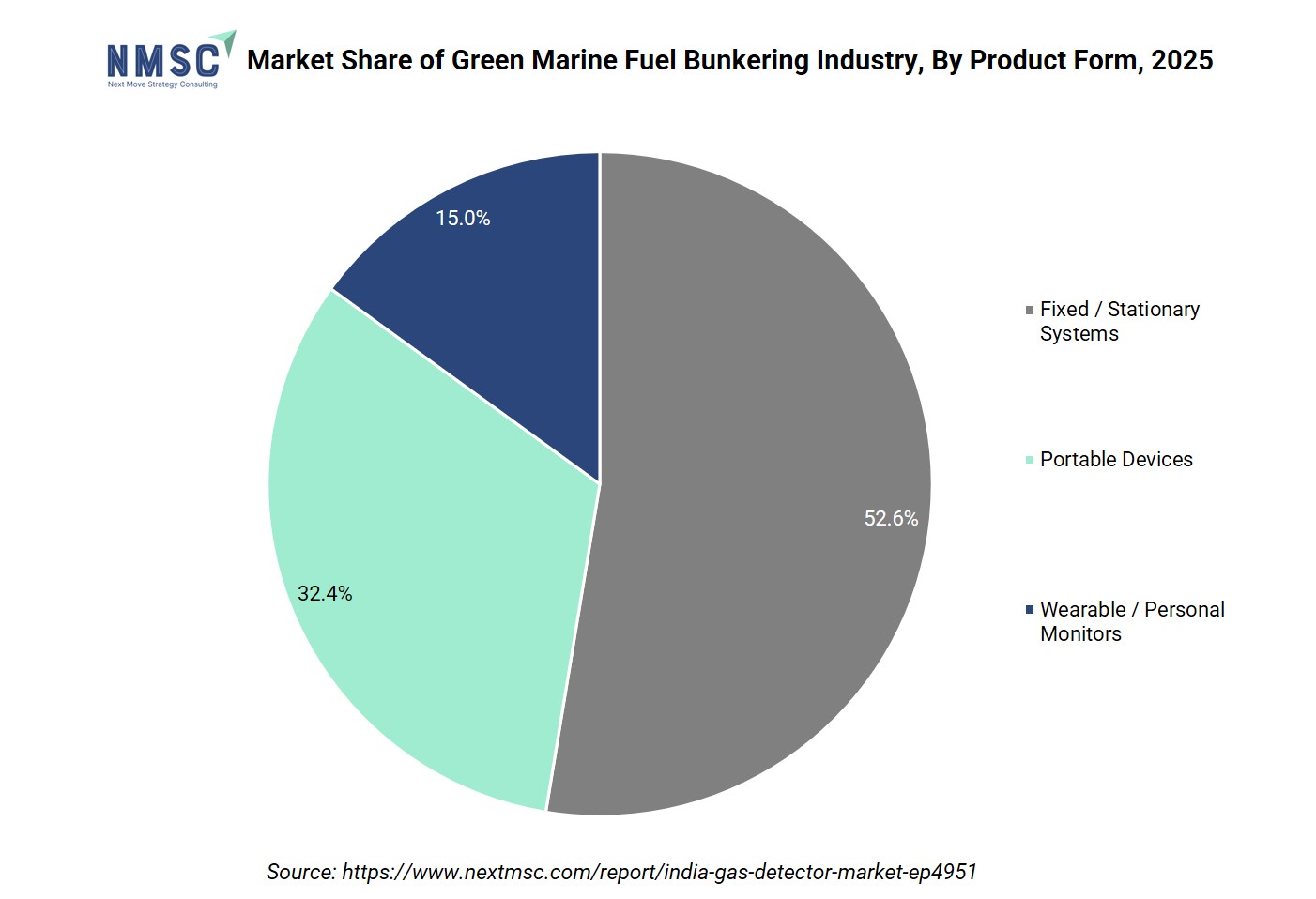
The Product Form segment includes Fixed / Stationary Systems, Portable Devices, and Wearable / Personal Monitors. Fixed / Stationary Systems dominate due to continuous monitoring capability across oil and gas, chemical, and industrial facilities where uninterrupted area-level safety is required. Portable devices remain widely used for inspection and maintenance activities, while wearable monitors are expanding in high-risk environments to support real-time personal exposure tracking and worker safety compliance. |
|
Component |
The Component segment includes Hardware, Software, and Services. Hardware dominates due to its core role in enabling gas detection infrastructure through sensors, detectors, and control units. Software is increasingly adopted for real-time monitoring, analytics, and centralized system control across multiple facilities. Services continue to grow steadily through installation, calibration, maintenance, and compliance support that ensure long-term operational reliability. |
|
Detection Technology |
The Detection Technology segment includes Electrochemical, Catalytic Bead (Pellistor), Infrared (NDIR), Photoionization (PID), Semiconductor (MOS), and Ultrasonic / Acoustic Leak Detection. Electrochemical technology dominates due to high accuracy in toxic gas detection and strong adoption in confined industrial environments. Infrared systems are expanding in hydrocarbon applications, while catalytic bead sensors remain common in flammable gas monitoring. Other technologies are gaining traction in specialized VOC and leak detection applications. |
|
Gas Type |
The Gas Type segment includes Combustible Gases, Toxic Gases, Oxygen, VOCs, and Refrigerants & Others. Combustible gases dominate due to widespread usage across oil and gas, petrochemical, and manufacturing sectors where explosion prevention is critical. Toxic gases are strongly monitored for occupational safety compliance, while oxygen detection supports confined space safety. VOC and refrigerant monitoring are expanding with environmental and HVAC applications. |
|
End-User Industry |
The End-User Industry segment includes Oil & Gas, Chemical / Petrochemical, Utilities & Power, Mining & Metals, Water / Wastewater, Manufacturing, Marine & Shipping, Environmental, and Building Infrastructure. Oil & Gas dominates due to high-risk operations and mandatory continuous gas monitoring requirements. Chemical and petrochemical industries follow closely due to hazardous process environments, while manufacturing and utilities show steady adoption. Other sectors contribute to diversified application demand across industrial safety frameworks. |
|
Connectivity |
The Connectivity segment includes Wired and Wireless systems. Wired systems dominate due to reliability and stable performance in fixed industrial installations. Wireless systems are expanding in modern facilities due to flexible deployment, remote monitoring capability, and integration with digital safety platforms across distributed industrial sites. |
|
Power Source |
The Power Source segment includes Hardwired, Battery, and Energy Harvesting systems. Hardwired systems dominate due to continuous operation requirements in industrial safety environments. Battery-powered devices are widely used in portable and wearable detectors, while energy harvesting solutions are emerging for low-maintenance and remote monitoring applications. |
|
Sales Channel |
The Sales Channel segment includes Direct (OEM / System Integrator) and Indirect channels. Indirect channels dominate due to strong distribution networks and accessibility across industrial and regional markets. Direct channels remain important for large-scale industrial deployments and customized system integration projects, while indirect channels ensure wider market penetration and after-sales support coverage. |
By Product Form
How Are Product Form Segments Shaping Deployment Patterns and Operational Safety Outcomes in the India Gas Detector Market?
Based on product form, the India gas detector market is segmented into Fixed / Stationary Systems, Portable Devices, and Wearable / Personal Monitors.
From our evaluation, we found that fixed and stationary gas detection systems dominate deployment across oil and gas installations, chemical processing units, and confined industrial environments due to their ability to provide uninterrupted area-wide monitoring combined with centralized alarm integration for enhanced safety control. On top of this, portable devices are witnessing rising utilization among field inspection teams and maintenance personnel as they offer operational flexibility and rapid deployment across dynamic and distributed work sites. Wearable and personal monitors are gradually expanding in adoption among workers in high-risk exposure zones, supported by their capability for real-time individual gas exposure tracking and compliance-focused safety assurance. Overall, deployment patterns across India’s gas detector market reflect a structured progression from fixed systems to portable and wearable solutions based on operational requirements.
By Component
How Are Component Segments Driving System Integration and Value Delivery in the India Gas Detector Market?
Based on component, the India Gas Detector Market is segmented into hardware, software, and services.
Our research shows that hardware remains the dominant component in the India gas detector market due to its foundational role in enabling core gas detection functionality across industrial safety applications in oil and gas, manufacturing, and confined operational environments. Alongside this, software adoption is expanding as industries transition toward connected monitoring ecosystems that enable real-time analytics, centralized visibility, and automated alert generation across distributed facilities, thereby improving decision responsiveness and operational coordination. Services are steadily gaining traction as organizations emphasize preventive maintenance schedules, regulatory compliance adherence, and long-term system reliability to minimize downtime and ensure consistent performance across installations. This results in the integration of hardware, software, and services, which is strengthening end-to-end system efficiency and lifecycle value across India’s gas detector market ecosystem.
By Detection Technology
How Is Detection Technology Segmentation Influencing Accuracy and Industrial Safety Deployment in the India Gas Detector Market?
Based on detection technology, the India gas detector market is segmented into Electrochemical, Catalytic Bead (Pellistor), Infrared (NDIR), Photoionization (PID), Semiconductor (MOS), and Ultrasonic / Acoustic Leak Detection technologies.
Our analysis indicates that electrochemical technology remains the dominant segment in the India gas detector market due to its high sensitivity and precise detection capability for toxic gases across confined industrial environments such as oil and gas, chemical processing, and manufacturing facilities. Furthermore, infrared (NDIR) systems are expanding their deployment in hydrocarbon-based applications as they offer stable and drift resistant performance for combustible gas monitoring under continuous operating conditions. Catalytic bead (pellistor) sensors continue to be widely adopted in conventional industrial safety setups where reliable flammable gas detection is required under cost efficient configurations. Moreover, photoionization (PID), semiconductor (MOS), and ultrasonic detection technologies are increasingly integrated into specialized safety frameworks supporting VOC monitoring leak detection and advanced hazard identification thereby strengthening overall industrial safety deployment across India’s gas detector market.
By Gas Type
How Is Gas Type Segmentation Influencing Detection Priorities and Industrial Safety Deployment in The India Gas Detector Market?
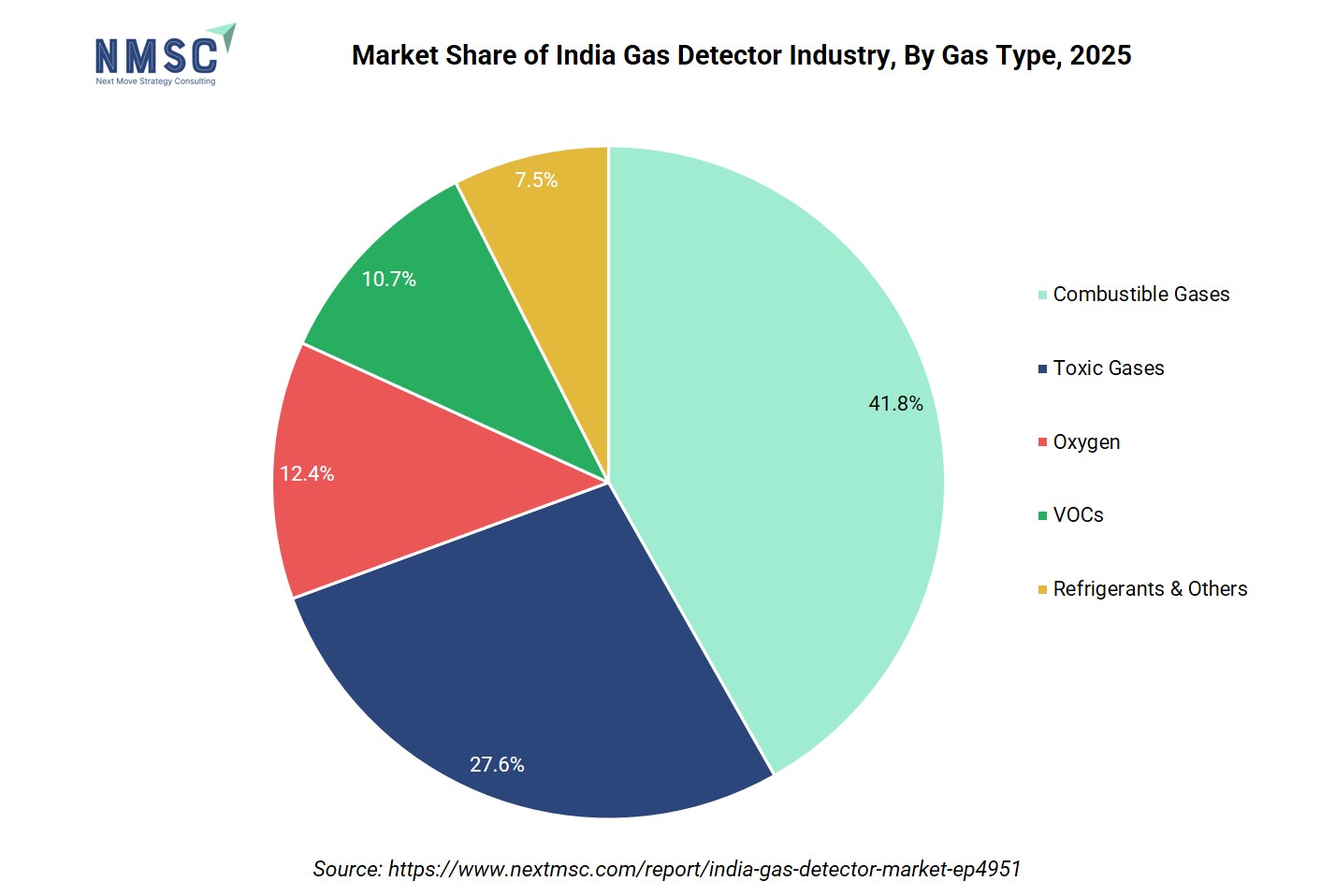
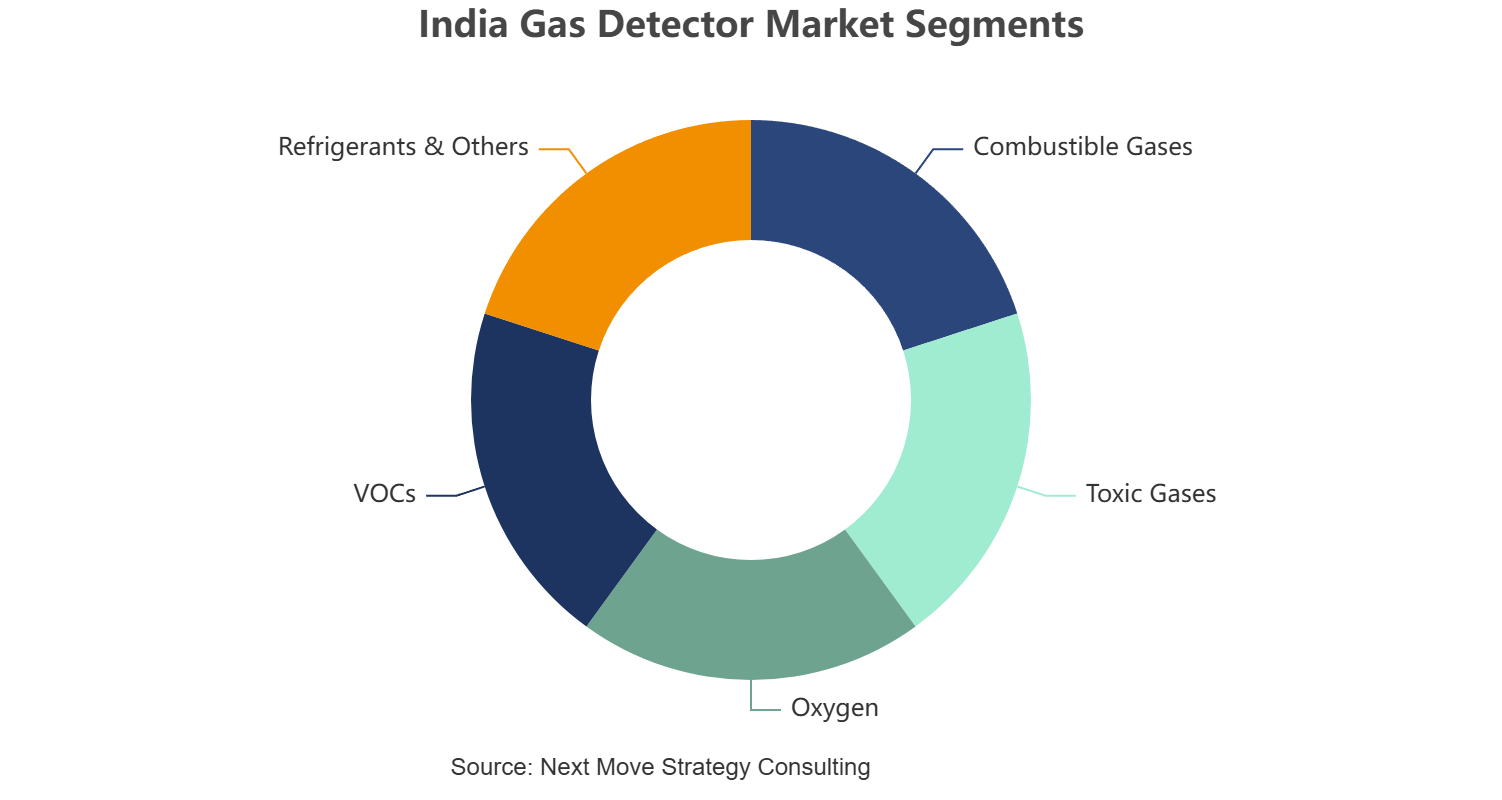
On the basis of gas type, the India Gas Detector Market is segmented into Combustible Gases, Toxic Gases, Oxygen, VOCs, and Refrigerants & Others.
We found that combustible gases remain the dominant segment in the India gas detector market due to extensive deployment across oil and gas, petrochemical, and manufacturing environments where explosion prevention is a core safety requirement. In parallel, toxic gases are witnessing strong adoption across chemical processing units and confined industrial spaces as regulatory pressure on occupational exposure limits is reinforcing continuous monitoring practices. Oxygen detection is consistently used in confined space operations to manage asphyxiation risks and ensure safe entry conditions in enclosed industrial environments. Meanwhile, VOC monitoring is expanding across industrial and environmental applications supported by stricter emission control frameworks. Likewise, refrigerants and other gases are gradually gaining relevance in HVAC systems and cold chain infrastructure, thereby widening application scope across India’s gas detector market ecosystem.
Supply Chain Structure of the India Gas Detector Market
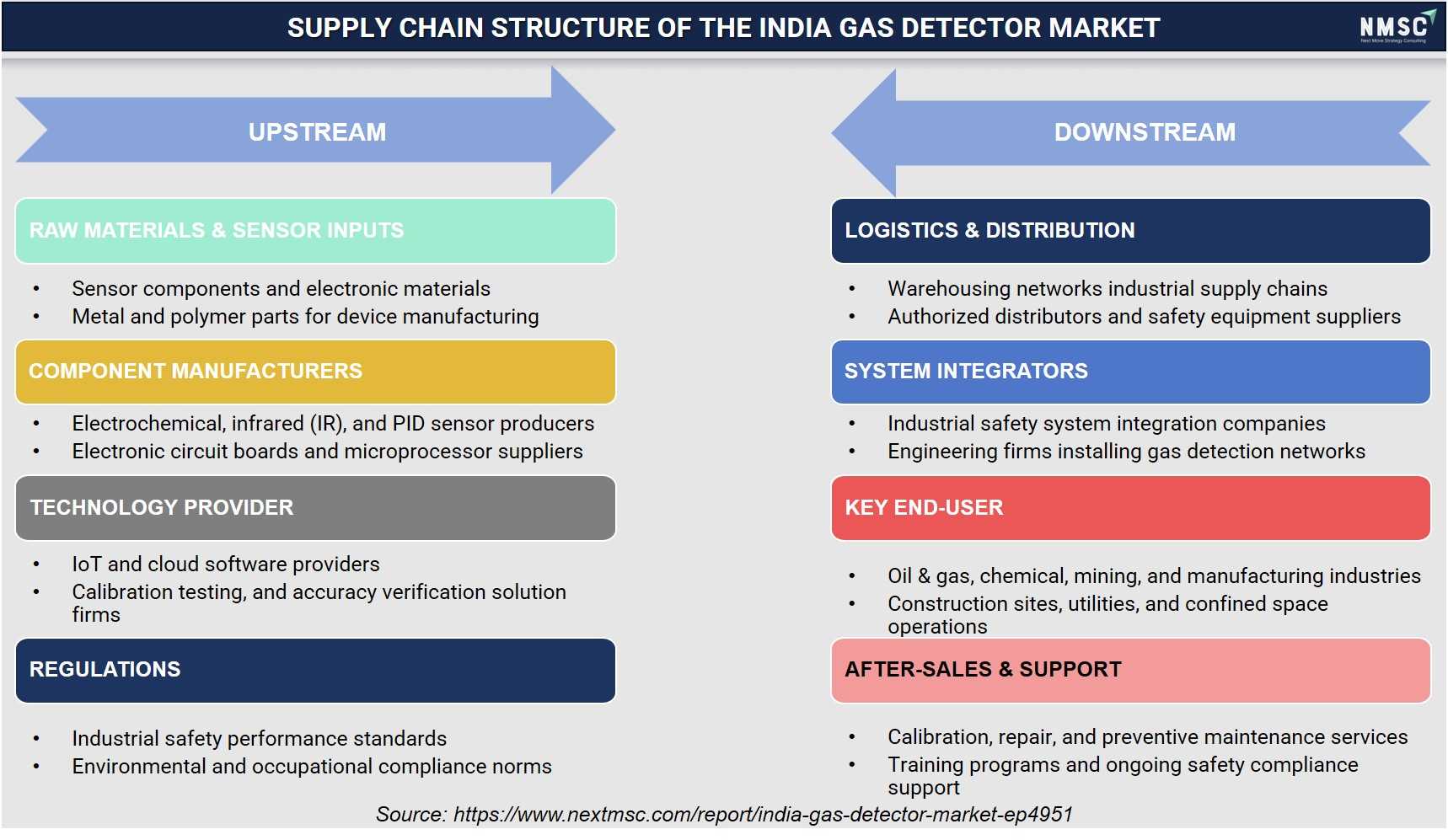
The supply chain structure of the India gas detector industry spans upstream and downstream activities, connecting materials, components, integration, and end-use deployment. Semiconductor materials, sensor technologies, and electronic components form the upstream base, while IoT platforms and calibration services enhance system functionality. Moreover, our assessment indicates that regulatory frameworks ensure compliance with industrial safety standards. Downstream, logistics networks, distributors, and system integrators enable deployment across oil & gas, chemical, mining, and construction sectors. Additionally, after-sales services support maintenance and training, and industry expertise ensures coordinated value chain efficiency and improved safety in hazardous environments.
Competitive Landscape
Competitive Dynamics & M&A Landscape:
|
Key Takeaways |
|
Our analysis indicates that the India Gas Detector Market is highly competitive, with global leaders such as Honeywell, Siemens, Emerson, and MSA Safety maintaining strong positions through integrated safety ecosystems that combine gas detection with automation, IoT connectivity, and industrial monitoring solutions. Specialized players like Dräger, RIKEN KEIKI, and Crowcon focus on portable and fixed detection systems designed for compliance-driven industrial applications. Overall, technological integration and system-level safety solutions remain key competitive differentiators across the market. |
|
Based on our industry assessment, we found that innovation-driven differentiation is a major competitive factor, with companies such as Blackline Safety focusing on wearable safety technologies, while Teledyne and Thermo Fisher emphasize advanced sensing accuracy and analytical precision. Additionally, firms like Ion Science, WIKA India, and ESP Safety strengthen their positioning through customized solutions and strong regional distribution networks. Consequently, product adaptability and application-specific design capabilities are increasingly influencing market competitiveness. |
|
Our market review suggests that merger and acquisition activity is strengthening market consolidation, as leading players expand capabilities and geographic reach through strategic acquisitions and partnerships. Companies are integrating advanced gas detection technologies with broader industrial safety ecosystems to enhance solution depth. Therefore, consolidation is improving technology integration, distribution efficiency, and overall market accessibility across industrial safety applications. |
Which Companies Dominate the India Gas Detector Market and How Do They Compete?
NMSC’s assessment indicates that the India Gas Detector Market is dominated by a mix of global safety technology leaders and specialized instrumentation firms competing through technology innovation, certification compliance, and application-specific solutions. Companies such as Honeywell International Inc., MSA Safety Incorporated, Drägerwerk AG & Co. KGaA, Siemens AG, and Emerson Electric Co. maintain strong positions through integrated safety ecosystems that combine gas detection with automation, control systems, and industrial IoT platforms. In addition, Teledyne Technologies Incorporated and Thermo Fisher Scientific Inc. focus on advanced sensing and high-precision analytical capabilities for critical monitoring applications. Meanwhile, RIKEN KEIKI Co., Ltd., New Cosmos Electric Co., Ltd., and Crowcon Detection Instruments Ltd. specialize in portable and fixed gas detection systems designed for industrial safety compliance. Furthermore, Blackline Safety Corp. emphasizes connected wearable devices and real-time monitoring solutions, while WIKA India and ESP Safety Inc. strengthen their presence through regional distribution and application-based customization. Overall, market competition is shaped by technological differentiation, adherence to safety certification standards, and the capability to deliver integrated, application-specific gas monitoring solutions across high-risk industries.
Market Dominated by India Gas Detector Giants and Specialists
The India Gas Detector Market is dominated by global industrial automation leaders and specialized gas detection manufacturers competing through technology integration, safety certification compliance, and product differentiation. Major players such as Honeywell International Inc., MSA Safety Incorporated, Drägerwerk AG & Co. KGaA, Siemens AG, and Emerson Electric Co. lead the market by offering integrated safety ecosystems that combine gas detection with industrial automation, IoT-enabled monitoring, and centralized control systems. Additionally, companies like Teledyne Technologies Incorporated, Thermo Fisher Scientific Inc., and Analytical Technology, Inc. strengthen their position through advanced sensing technologies and high-precision analytical monitoring solutions. We also observed that specialized firms such as RIKEN KEIKI Co., Ltd., New Cosmos Electric Co., Ltd., Crowcon Detection Instruments Ltd., and GfG Instrumentation, Inc. focus on portable and fixed systems designed for compliance-driven industrial applications. Furthermore, Blackline Safety Corp. emphasizes connected wearable safety solutions, while WIKA India, Ion Science Ltd., and ESP Safety Inc. expand their reach through regional customization and distribution networks. Accordingly, market competition is driven by innovation, reliability, and strict adherence to industrial safety standards across applications.
Innovation and Adaptability Drive Market Success
Innovation and adaptability are key drivers of success in the India Gas Detector Market, as manufacturers continuously enhance sensing technologies, connectivity features, and application-specific designs to meet evolving industrial safety requirements. Leading companies such as Honeywell International Inc., Siemens AG, Emerson Electric Co., and MSA Safety Incorporated are focusing on integrated platforms that combine gas detection with automation systems, IoT connectivity, and centralized monitoring for real-time hazard detection and response. Additionally, our industry research shows that Drägerwerk AG & Co. KGaA and Teledyne Technologies Incorporated are advancing precision sensing and analytical capabilities, improving detection accuracy in complex industrial environments. Blackline Safety Corp. is expanding wearable and connected safety devices to support mobile workforce protection, while RIKEN KEIKI Co., Ltd. and New Cosmos Electric Co., Ltd. emphasize compact, durable, and application-specific detector systems. On top of this, Ion Science Ltd., Crowcon Detection Instruments Ltd., and WIKA India are strengthening adaptability through customized solutions tailored to regional and industrial requirements. As a result, continuous innovation and operational flexibility remain central to competitive positioning across hazardous industries.
Market Players to Opt for Merger & Acquisition Strategies to Expand Their Presence
Merger and acquisition strategies are increasingly shaping competitive expansion in the India Gas Detector Market as global manufacturers focus on strengthening technology portfolios and expanding geographic presence. Our review of the industry highlights that companies such as Honeywell International Inc., Siemens AG, Emerson Electric Co., and MSA Safety Incorporated are integrating advanced gas detection capabilities with broader industrial automation and safety ecosystems, thereby enhancing solution depth across hazardous industries. Similarly, Teledyne Technologies Incorporated and Thermo Fisher Scientific Inc. are leveraging acquisitions to strengthen analytical sensing technologies and expand precision monitoring applications. Drägerwerk AG & Co. KGaA and Blackline Safety Corp. are reinforcing connected safety platforms by integrating wearable technologies with real-time monitoring systems. Beyond this, specialized manufacturers such as RIKEN KEIKI Co., Ltd., Crowcon Detection Instruments Ltd., and GfG Instrumentation, Inc. are engaging in strategic collaborations to improve product diversification and distribution reach. Consequently, consolidation is improving technology integration, strengthening distribution networks, and enhancing overall market accessibility across industrial safety applications.
List of Key India Gas Detector Companies
-
Honeywell International Inc.
-
MSA Safety Incorporated
-
Drägerwerk AG & Co. KGaA
-
Emerson Electric Co.
-
Siemens AG
-
Thermo Fisher Scientific Inc.
-
Teledyne Technologies Incorporated
-
RIKEN KEIKI Co., Ltd.
-
Crowcon Detection Instruments Ltd.
-
GfG Instrumentation, Inc.
-
Blackline Safety Corp.
-
New Cosmos Electric Co., Ltd.
-
Ion Science Ltd.
-
Gasmet Technologies Oy
-
Sensidyne, LP
-
Analytical Technology, Inc.
-
WIKA India
-
ESP Safety Inc.
-
Bacharach, Inc.
-
NevadaNano
What Are the Latest Key Industry Developments?
-
March 2026 – Honeywell launched the 4-Series NDIR hydrocarbon gas sensor to improve detection of flammable gases like methane and propane with higher reliability and longer life. The sensor targets industrial safety applications in oil & gas, petrochemicals, and mining. It reflects growing adoption of advanced gas detection technologies in India’s industrial safety market.
-
November 2025 – MSA Safety announced the ALTAIR io 6 multigas detector, a connected device for real-time monitoring of hazardous gases in industrial environments. It is designed for confined space safety across oil & gas, construction, and utilities sectors. The launch reflects increasing adoption of smart gas detection technologies relevant to India’s industrial safety market.
-
February 2025 – WIKA India showcased its industrial measurement and process solutions at SulGas 2025, highlighting technologies used in gas processing and refinery applications. The display included flow, temperature, and ultrasonic measurement systems supporting operational safety and efficiency in oil & gas facilities. The event reflects growing industrial instrumentation adoption in India’s gas processing and safety ecosystem.
Expert Insights
 “As new technologies like hydrogen integrate into our systems, we must be prepared to handle their safety implications. The expanding distribution networks and the involvement of smaller companies in the gas business present new challenges. The introduction of compressed biogas (CBG) also requires us to ensure safety protocols are in place.”
-Anil Jain, Chairperson, Petroleum and Natural Gas Regulatory Board
This statement reflects PNGRB’s growing emphasis on strengthening safety infrastructure and regulatory preparedness as India accelerates the adoption of hydrogen, compressed biogas (CBG), and expanding city gas distribution networks across the country.
Market Interpretation
The statement indicates that the rapid expansion of India’s gas-based energy ecosystem will significantly increase the importance of advanced gas detection and monitoring technologies across industrial, commercial, and utility applications. It suggests that the integration of hydrogen and compressed biogas into existing gas infrastructure introduces new operational and safety complexities that require highly reliable leak detection systems and continuous monitoring solutions. Moreover, our market intelligence suggests that the expansion of city gas distribution networks and the increasing participation of smaller gas operators are expected to accelerate demand for fixed and portable gas detectors, methane sensors, hydrogen leak detectors, and automated safety monitoring systems within the India Gas Detector Market. Consequently, regulatory authorities and industry participants are likely to place greater focus on preventive safety mechanisms, compliance-driven infrastructure upgrades, and real-time hazard detection capabilities. Therefore, the market is expected to evolve toward a more technology-driven and regulation-oriented safety ecosystem where industrial expansion, alternative fuel adoption, and operational risk management collectively shape long-term investment trends in gas detection solutions across India.
SWOT Analysis of the India Gas Detector Industry
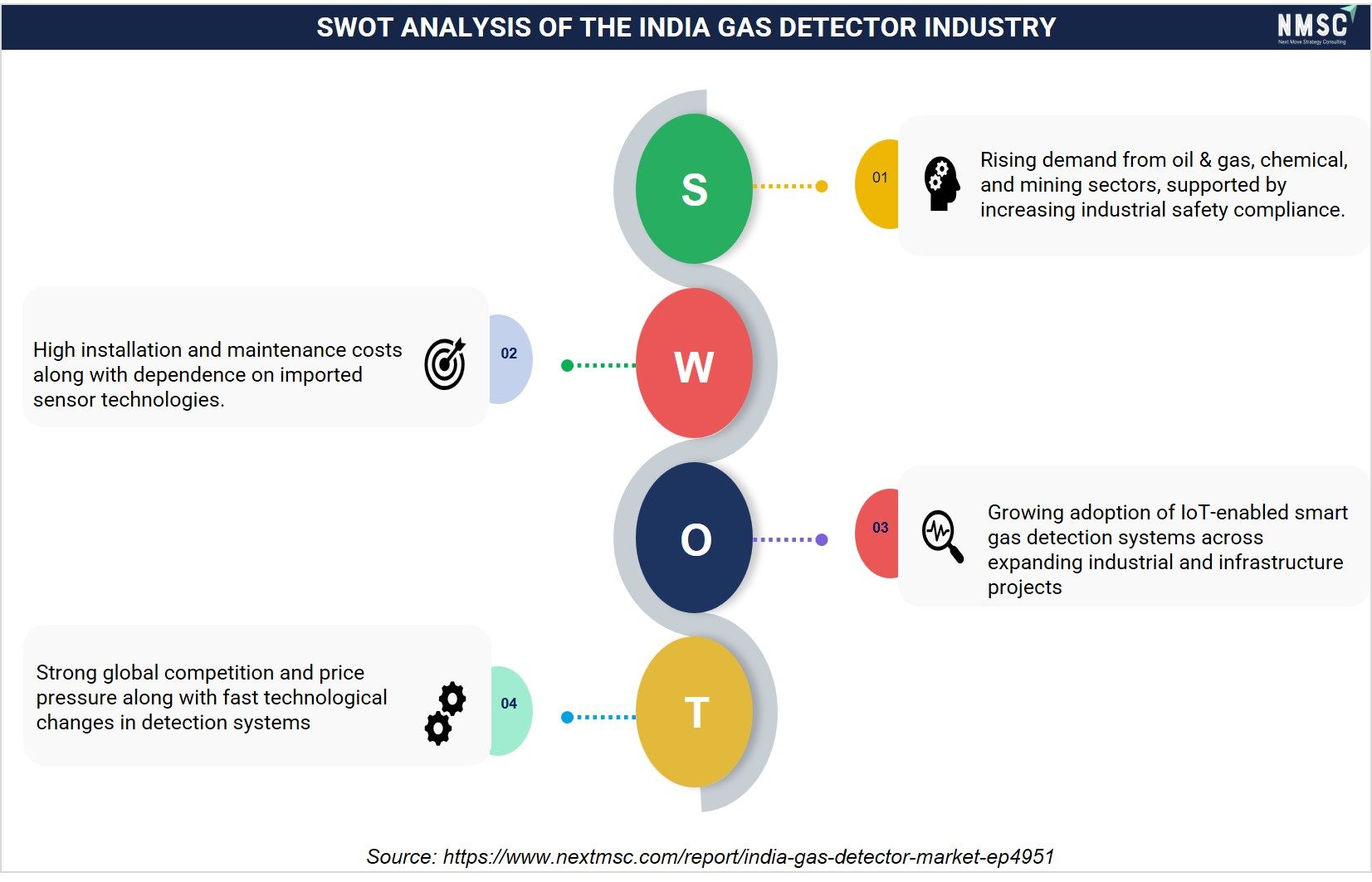
The India gas detector industry demonstrates strong expansion driven by industrial safety requirements across oil & gas, chemical, and mining sectors. However, our analysis shows that high installation costs and dependence on imported sensor technologies limit broader adoption in cost-sensitive segments. Increasing integration of IoT-based smart detection systems is creating new growth opportunities across industrial and infrastructure projects. Alongside this, intense global competition and rapid technological advancements continue to pressure market players. Industry expertise ensures better adoption strategies and improves safety monitoring efficiency across hazardous environments.
What Are the Key Factors Influencing Investment Analysis & Opportunities in the India Gas Detector Market?
Our analysis indicates that investment attractiveness in the market is being shaped by expanding industrial risk environments across oil and gas, chemicals, mining, and large-scale infrastructure projects, where continuous gas monitoring is becoming a core operational requirement. Increasing regulatory enforcement on workplace safety compliance is directly influencing capital allocation toward fixed and portable gas detection systems, particularly in high-hazard zones. On top of this, our strategic analysis of the market indicates that rising deployment of multi-gas detection platforms is improving return visibility for investors as end users shift toward integrated monitoring solutions rather than standalone devices. In addition, growing penetration of electrochemical and infrared sensing technologies is strengthening demand stability due to their higher accuracy and operational reliability in continuous monitoring applications. Consequently, long-term investment flows are increasingly aligning with safety-driven industrial modernization and technology-enabled compliance frameworks across market.
Furthermore, emerging investment opportunities in the India gas detector market are strongly linked to digital transformation and connected safety infrastructure adoption across industrial facilities. Our research demonstrates that integration of IoT-enabled gas detection systems with centralized monitoring platforms is creating new revenue streams in software-driven safety ecosystems and predictive maintenance services. Alongside this, expansion of urban infrastructure projects such as metro networks, tunnels, and smart buildings is generating sustained demand for advanced gas monitoring solutions in enclosed environments. The rising adoption of wearable and portable gas detectors is opening opportunities in workforce safety management across high-risk operational sites. Increasing focus on lifecycle services, including calibration, remote diagnostics, and system optimization is enhancing recurring revenue potential for solution providers. Therefore, technology convergence and service-oriented models are reshaping investment opportunities across India gas detector market landscape.
Key Benefits for Stakeholders:
Next Move Strategy Consulting (NMSC) provides a structured analysis of the India gas detector market, covering historical developments from 2020 to 2025 and offering forward-looking forecasts through 2035. Our study evaluates the India market, combining quantitative projections with qualitative insights into industrial safety requirements, regulatory compliance frameworks, technological advancements in gas sensing systems, and investment opportunities across key segments of the market. Furthermore, the analysis is structured to provide stakeholders with a clear understanding of demand evolution, technology adoption patterns, and regulatory factors influencing market expansion.
The India gas detector market creates value across industrial end users, including oil & gas operators, chemical and petrochemical plants, mining companies, utilities, and manufacturing facilities, along with ecosystem participants such as equipment manufacturers, system integrators, and industrial safety solution providers. Our industry analysis indicates that investors benefit from rising demand for fixed and portable gas detection systems and the expansion of IoT-enabled safety monitoring platforms. Moreover, increasing adoption of advanced sensing technologies such as electrochemical, infrared (NDIR), catalytic bead, photoionization (PID), semiconductor, and ultrasonic systems is supporting market growth in hazardous environments. Companies with strong technological capabilities, certified compliance solutions, and integrated automation offerings are strengthening competitiveness and operational efficiency across industrial safety applications.
The market further supports improved workplace safety, early hazard detection, and stronger compliance with occupational safety regulations across high-risk industries such as oil & gas, chemicals, mining, and confined operations. Market insights indicate that evolving industrial safety standards, digital monitoring systems, and automation-integrated gas detection solutions are accelerating adoption across facilities. Thus, these developments are strengthening real-time monitoring, improving predictive maintenance practices, and enhancing emergency response efficiency, while overall value creation is expanding through sensor innovation, connected safety ecosystems, and intelligent monitoring integration across hazardous industrial environments.
|
Parameters |
Details |
|
Customization Scope |
Free customization (equivalent to up to 80 analyst-working hours) after purchase. Addition or alteration to country, regional & segment scope. |
|
Pricing and Purchase Options |
Avail customized purchase options to meet your exact research needs. |
|
Approach |
In-depth primary and secondary research; proprietary databases; rigorous quality control and validation measures. |
|
Analytical Tools |
Porter's Five Forces, SWOT, value chain, and Harvey ball analysis to assess competitive intensity, stakeholder roles, and relative impact of key factors. |
Key Market Segments
By Product Form
-
Fixed / Stationary Systems
-
Point Detectors (single-location)
-
Open-Path Monitors (line-of-sight)
-
Area / Zone Monitors (ambient air)
-
-
Portable Devices
-
Handheld Multi-Gas Monitors
-
Transportable (Cart-Based) Analyzers
-
-
Wearable / Personal Monitors
-
Clip-On Personal Detectors
-
IoT-Enabled Smart Wearables
-
By Component
-
Hardware
-
Sensors / Detectors
-
Control Units
-
-
Software
-
Analytics Platforms
-
Mobile Apps
-
-
Services
-
Calibration
-
Maintenance
-
Training
-
By Detection Technology
-
Electrochemical
-
Catalytic Bead (Pellistor)
-
Infrared (NDIR)
-
Photoionization (PID)
-
Semiconductor (MOS)
-
Ultrasonic / Acoustic Leak Detection
By Gas Type
-
Combustible Gases
-
Toxic Gases
-
Oxygen
-
VOCs
-
Refrigerants & Others
By End-User Industry
-
Oil & Gas
-
Chemical / Petrochemical
-
Utilities & Power
-
Mining & Metals
-
Water / Wastewater
-
Manufacturing
-
Marine & Shipping
-
Environmental
-
Building Infrastructure
By Connectivity
-
Wired
-
Wireless
By Power Source
-
Hardwired
-
Battery
-
Energy Harvesting
By Sales Channel
-
Direct (OEM / System Integrator)
-
Indirect
-
Distributors / Dealers
-
E-commerce
-
Conclusion & Recommendations
Based on our evaluation, we found that the India gas detector market demonstrates a structurally expanding safety ecosystem driven by rising industrialization across oil and gas, chemicals, manufacturing, and infrastructure sectors. Increasing regulatory enforcement on occupational safety standards is directly strengthening the deployment of fixed and portable detection systems across high-risk environments. Furthermore, demand concentration remains higher in combustible and toxic gas monitoring as industrial facilities prioritize explosion prevention and exposure control. Technological advancements in electrochemical and infrared sensing systems are improving detection accuracy and operational reliability across continuous monitoring applications. Software-enabled monitoring platforms are also gaining structured adoption for real-time visibility and centralized safety coordination across multi-site operations. Accordingly, the market is transitioning toward integrated multi-technology safety frameworks, while long-term compliance obligations continue to reinforce steady adoption momentum across industries. Therefore, evolving industrial safety priorities and technology integration together are shaping a more connected and risk-responsive Market ecosystem.
Future growth in the India gas detector market can be strengthened through targeted expansion of wireless and IoT-enabled detection systems across distributed industrial facilities. Manufacturers should focus on enhancing multi-gas detection capabilities as industrial environments are increasingly exposed to complex gas mixtures requiring simultaneous monitoring. In addition, our evaluation shows that investment in advanced calibration technologies and low-maintenance sensor systems can improve lifecycle efficiency and reduce operational downtime across end-user industries. Portable and wearable detection solutions should be prioritized to strengthen worker-level safety compliance in high-risk zones. In parallel, service-driven models, including predictive maintenance and remote diagnostics, can further improve system reliability and operational continuity across installations. Integration of software-based analytics can support faster decision-making and hazard prediction. Consequently, technology advancement and service integration together will define competitive positioning in the evolving Market landscape.
About the Author
 Tushmi Dutta
— Tushmi Dutta is a focused researcher specializing in detailed analysis and insight-driven research across diverse business landscapes. She supports strategic initiatives through structured data interpretation, thorough validation, and clear communication of findings that aid informed decision-making. With a strong interest in writing, she enjoys presenting research insights in an engaging and accessible manner. Beyond work, she enjoys traveling, reading, painting, and continuously learning new skills that contribute to her creative and professional growth.
Tushmi Dutta
— Tushmi Dutta is a focused researcher specializing in detailed analysis and insight-driven research across diverse business landscapes. She supports strategic initiatives through structured data interpretation, thorough validation, and clear communication of findings that aid informed decision-making. With a strong interest in writing, she enjoys presenting research insights in an engaging and accessible manner. Beyond work, she enjoys traveling, reading, painting, and continuously learning new skills that contribute to her creative and professional growth.
About the Reviewer
 Supradip Baul
— Supradip Baul is an accomplished business consultant and strategist with over a decade of rich experience in market intelligence, strategy, technology, and business transformation. His work has included rigorous qualitative and quantitative analysis across multiple industries, helping clients shape investment decisions and long-term roadmaps. Earlier in his career, he was associated with Gartner, where he contributed to industry-leading reports and market share analyses. He has worked with leading global companies and holds an MBA with a dual specialization in Marketing and Finance.
Supradip Baul
— Supradip Baul is an accomplished business consultant and strategist with over a decade of rich experience in market intelligence, strategy, technology, and business transformation. His work has included rigorous qualitative and quantitative analysis across multiple industries, helping clients shape investment decisions and long-term roadmaps. Earlier in his career, he was associated with Gartner, where he contributed to industry-leading reports and market share analyses. He has worked with leading global companies and holds an MBA with a dual specialization in Marketing and Finance.
At Next Move Strategy Consulting, we understand that insightful market research is the cornerstone of successful business decisions. That's why we employ a robust and multifaceted approach, combining various methodologies to deliver the most accurate and actionable data for our clients.

Research Landscape
We navigate the world of research with two primary approaches:
Qualitative Approach
Our qualitative research methodologies involve immersive techniques such as in-depth interviews, focus groups, and observational studies. By engaging directly with individuals and stakeholders, we uncover valuable insights that quantitative data alone may overlook.

Quantitative Research
In tandem with qualitative methodologies, NMSC leverages the power of Quantitative Research to provide a robust foundation of numerical insights. Through systematic data collection and analysis, we quantify patterns, preferences, and market trends, offering a comprehensive view of the business landscape.
Our quantitative research approach employs diverse tools, including surveys, experiments, and statistical modelling. These methodologies enable us to gather data from a large and representative sample, ensuring the statistical significance of our findings. By employing structured questionnaires and standardized data collection methods, we guarantee the reliability and validity of the information we present to our clients.
Quantitative research is particularly effective in measuring the prevalence of trends, assessing market size, and gauging the impact of various factors on consumer behavior. The numerical precision attained through this approach equips our clients with actionable insights, facilitating data-driven decision-making and strategy formulation.


Our Specialized Toolbox for Industry-Specific Market Research
We deploy a specialized arsenal of techniques tailored to meet your unique requirements. Here's a glimpse into our comprehensive toolbox:

Information Procurement
The stage entails acquiring market data or relevant information through various sources and methodologies.


Market Research Approach
We utilize both top-down and bottom-up approaches in market research analysis to achieve a comprehensive understanding of the market dynamics, leveraging the broad perspective of industry trends and macroeconomic factors alongside detailed insights from specific segments and individual companies.

Porters Five Forces Analysis
We conduct Porter's Five Forces analysis to evaluate the competitive landscape of an industry, providing us with insights into factors that affect profitability and strategic positioning.

SWOT Analysis

Forecasting
We utilize a forecasting model to predict future consumption by considering parameters like population, economics, regulations, market competition, drivers, constraints, technology, and pricing. We also employ statistical techniques such as multilinear regression, exponential smoothing, moving average, ARIMA, and Monte Carlo simulations for accurate predictions. In econometric forecasting, we analyzed short-term and long-term event impacts, attributing values based on regulatory frameworks, economic factors, and market events.





 Speak to Our Analyst