AI-Powered Data Analysis in Audits Market Size, Share, Trends and Growth Analysis, By Application (Audit Analytics and Testing, Audit Management, Spend Audit, Financial Close and Audit Readiness, Log and Access Audit, Confirmation Analytics, and Other Audit Applications), By Deployment Model (SaaS, Private Cloud, On Premises, and Hybrid), By Organization Type, By Revenue Stream, By Sales Channel, By End User Industry, and Region — Global Industry Report and Forecast, 2026–2035
Industry: ICT & Media | Publishing Date: July 27, 2026 | Last Updated: September 30, 2026 | No of Pages: N/A | No. of Tables: N/A | No. of Figures: N/A | Format: PDF | Report Code: IC5419
What Is the AI-Powered Data Analysis in Audits Market Size?
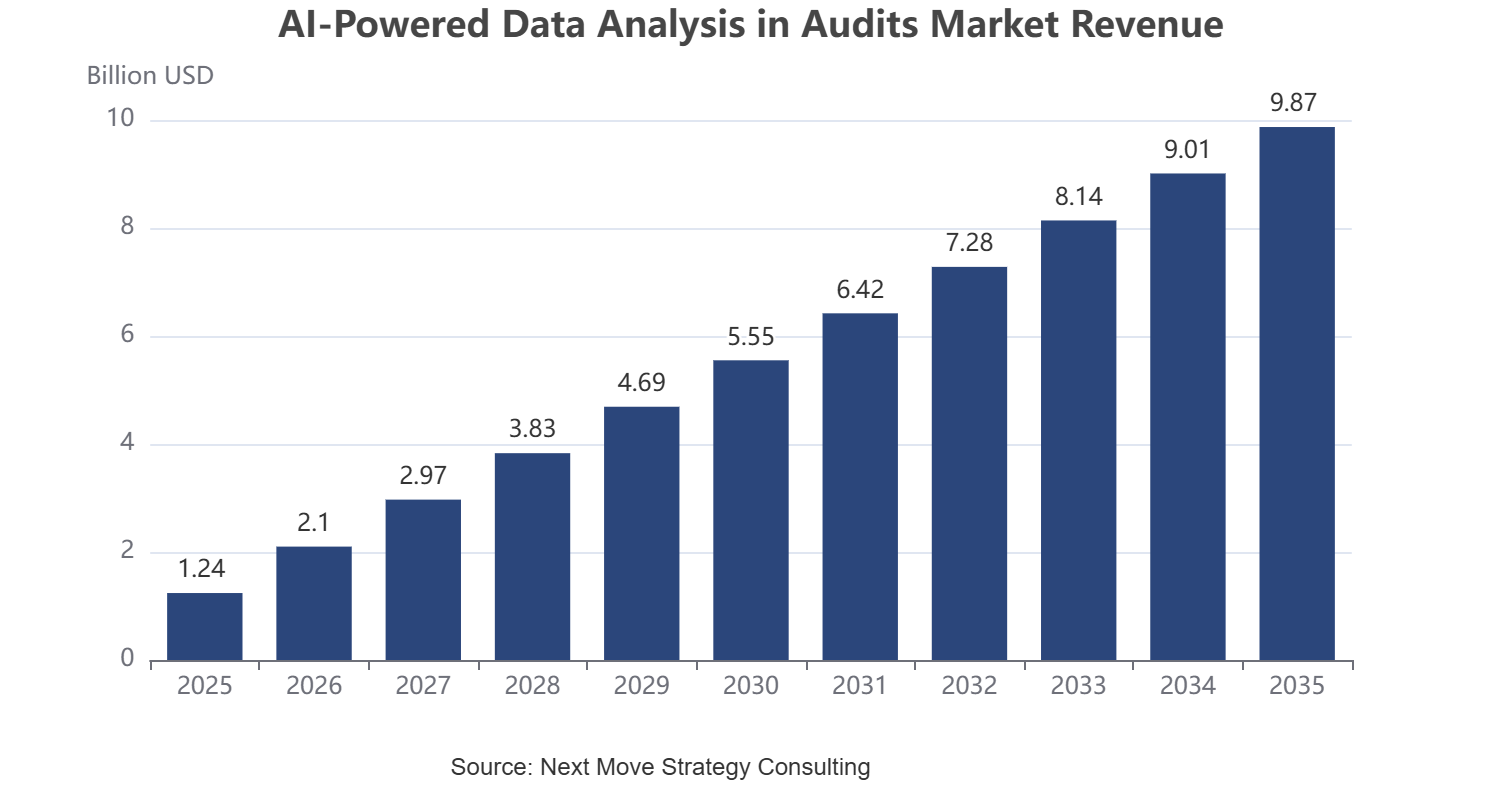
The global AI-Powered Data Analysis in Audits Market size was valued at USD 1.24 billion in 2025 and is estimated at USD 1.52 billion in 2026, forecast to reach USD 9.87 billion by 2035, expanding at a 23.1% CAGR between 2026 and 2035. North America leads with approximately 38% share, while audit analytics and testing dominates all other applications with approximately 34% share.
We observed that growth is broad based across every segmentation axis, with continuous controls monitoring and SaaS delivery driving the dominant structural shifts in audit technology adoption through 2035.
|
Key Takeaways |
|
By Application: Audit Analytics and Testing held the largest share of approximately 34% (USD 420.0 Million) in 2025; Confirmation Analytics is the fastest-growing sub-segment at 24.2% CAGR from 2026–2035. |
|
By Deployment Model: SaaS held the largest share of approximately 50% (USD 620.0 Million) in 2025; SaaS is also the fastest-growing sub-segment at 24.1% CAGR from 2026–2035. |
|
By Organization Type: External Audit Firms held the largest share of approximately 42% (USD 520.0 Million) in 2025; Government Audit Organizations is the fastest-growing sub-segment at 25.0% CAGR from 2026–2035. |
|
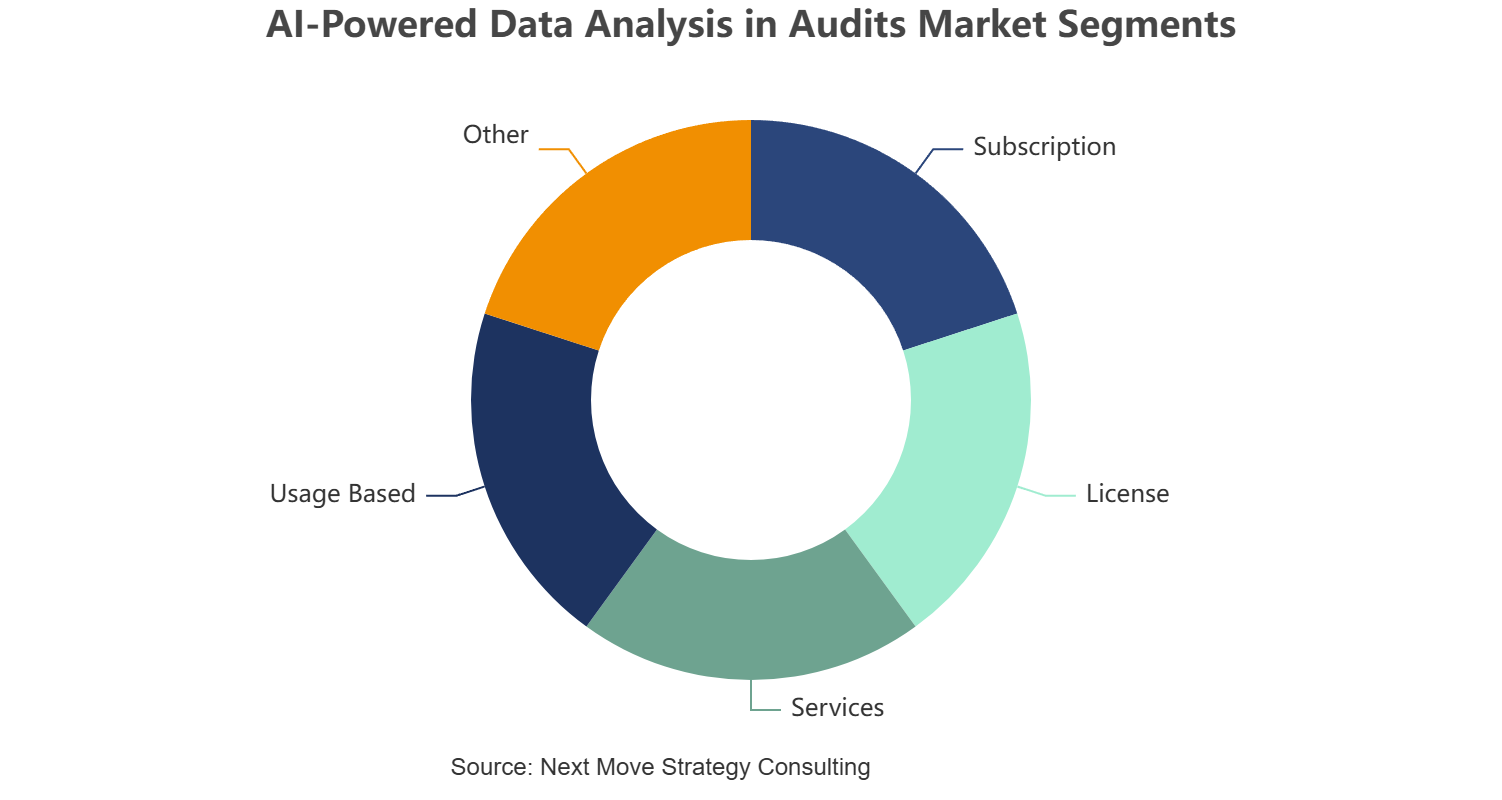
By Revenue Stream: Subscription held the largest share of approximately 52% (USD 650.0 Million) in 2025; Usage Based is the fastest-growing sub-segment at 26.5% CAGR from 2026–2035. |
|
By Sales Channel: Direct Sales held the largest share of approximately 56% (USD 700.0 Million) in 2025; Marketplace is the fastest-growing sub-segment at 27.0% CAGR from 2026–2035. |
|
By End User Industry: Financial Services held the largest share of approximately 37% (USD 460.0 Million) in 2025; Technology and Telecom is the fastest-growing sub-segment at 23.9% CAGR from 2026–2035. |
|
Dominant Region: North America dominated with approximately 38% revenue share (USD 470.0 Million) in 2025. |
|
Fastest-Growing Region: Asia-Pacific is expected to register the highest CAGR of 25.6% during 2026–2035. |
|
Dominant Country: U.S. led with approximately USD 366.6 Million in 2025. |
|
Fastest-Growing Country: China is the fastest-growing country at approximately 27.4% CAGR from 2026–2035. |
Market Opportunity: The AI-Powered Data Analysis in Audits Market is expected to create an absolute dollar opportunity of USD 8,350.0 Million between 2026 and 2035, presenting significant investment potential across the external audit, corporate audit, and government audit technology value chain.
According to Next Move Strategy Consulting analysis, external audit firms are increasingly embedding continuous controls monitoring directly into client engagements, a shift that favors vendors offering full population testing over sample-based legacy tools as regulatory scrutiny of audit quality intensifies through 2035.
What Does the AI-Powered Data Analysis in Audits Market Encompass?
The AI-Powered Data Analysis in Audits Market encompasses software and platforms that apply machine learning, natural language processing, and process mining to transaction testing, journal entry testing, and continuous controls monitoring. Its scope spans external audit firms, corporate audit functions, and government audit organizations that use these tools to move from sample-based testing toward full population analysis, improving audit quality, evidence traceability, and findings remediation across financial, operational, and compliance audits.
Regulatory bodies including the PCAOB and IAASB have expanded expectations for technology-enabled audit evidence, pushing audit committees toward platforms with defensible audit trails. Cloud-native deployment has become the default adoption path, with SaaS and private cloud models replacing on-premises installations as firms scale AI-Powered Data Analysis in Audits Market capabilities across multi-entity, multi-jurisdiction engagements while integrating with enterprise resource planning and general ledger systems.
|
Parameter |
Details |
|
Market Size in 2025 |
USD 1.24 Billion |
|
Market Size in 2026 |
USD 1.52 Billion |
|
Revenue Forecast in 2035 |
USD 9.87 Billion |
|
Growth Rate |
CAGR of 23.1% from 2026 to 2035 |
|
Analysis Period |
2025–2035 |
|
Base Year Considered |
2025 |
|
Forecast Period |
2026–2035 |
|
Market Size Estimation |
Revenue (USD Million) |
|
Companies Profiled |
20 |
|
Countries Covered |
33 |
|
Market Share |
Available for 10 companies |
Key Emerging Trends
We found that four structural trends are reshaping how audit teams evaluate and deploy analytics platforms across the AI-Powered Data Analysis in Audits Market.
How Is Continuous Controls Monitoring Transforming Audit Cycles?
Continuous controls monitoring is shifting audit work from periodic sampling to always-on transaction surveillance, letting audit teams flag anomalies as they occur rather than months later. This transformation improves stakeholder confidence in interim financial reporting and reduces year-end remediation workload. BlackLine, Inc. has expanded continuous monitoring modules within its financial close platform, illustrating how vendors are embedding real-time control testing directly into close and reconciliation workflows for corporate audit functions.
How Are Large Language Models Changing Evidence Review?
Large language model adoption is accelerating evidence collection and workpaper review, allowing auditors to summarize contracts, extract journal entry narratives, and flag inconsistent disclosures at a fraction of manual review time. Thomson Reuters Corporation has integrated generative AI capabilities into its audit workflow tools, reducing document review cycles and letting engagement teams redirect staff hours toward judgment-intensive risk areas rather than repetitive evidence tagging.
How Is Process Mining Expanding Audit Scope Coverage?
Process mining is expanding audit scope from financial statement testing into operational process assurance, reconstructing end-to-end transaction flows directly from system event logs. Celonis SE has broadened its process mining platform into compliance and audit use cases, enabling full population testing of procure-to-pay and order-to-cash cycles that were previously assessed through limited manual sampling by external audit firms.
How Is Embedded Audit Analytics Reshaping Vendor Competition?
Embedded audit analytics, delivered directly inside enterprise resource planning and governance platforms, is reshaping competition between standalone audit software vendors and platform incumbents. SAP SE has embedded audit and controls monitoring capabilities within its enterprise suite, pressuring point-solution vendors to differentiate through deeper analytics, industry-specific rule libraries, and faster time-to-value for corporate audit functions.
Pain Point Analysis of the AI-Powered Data Analysis in Audits Market
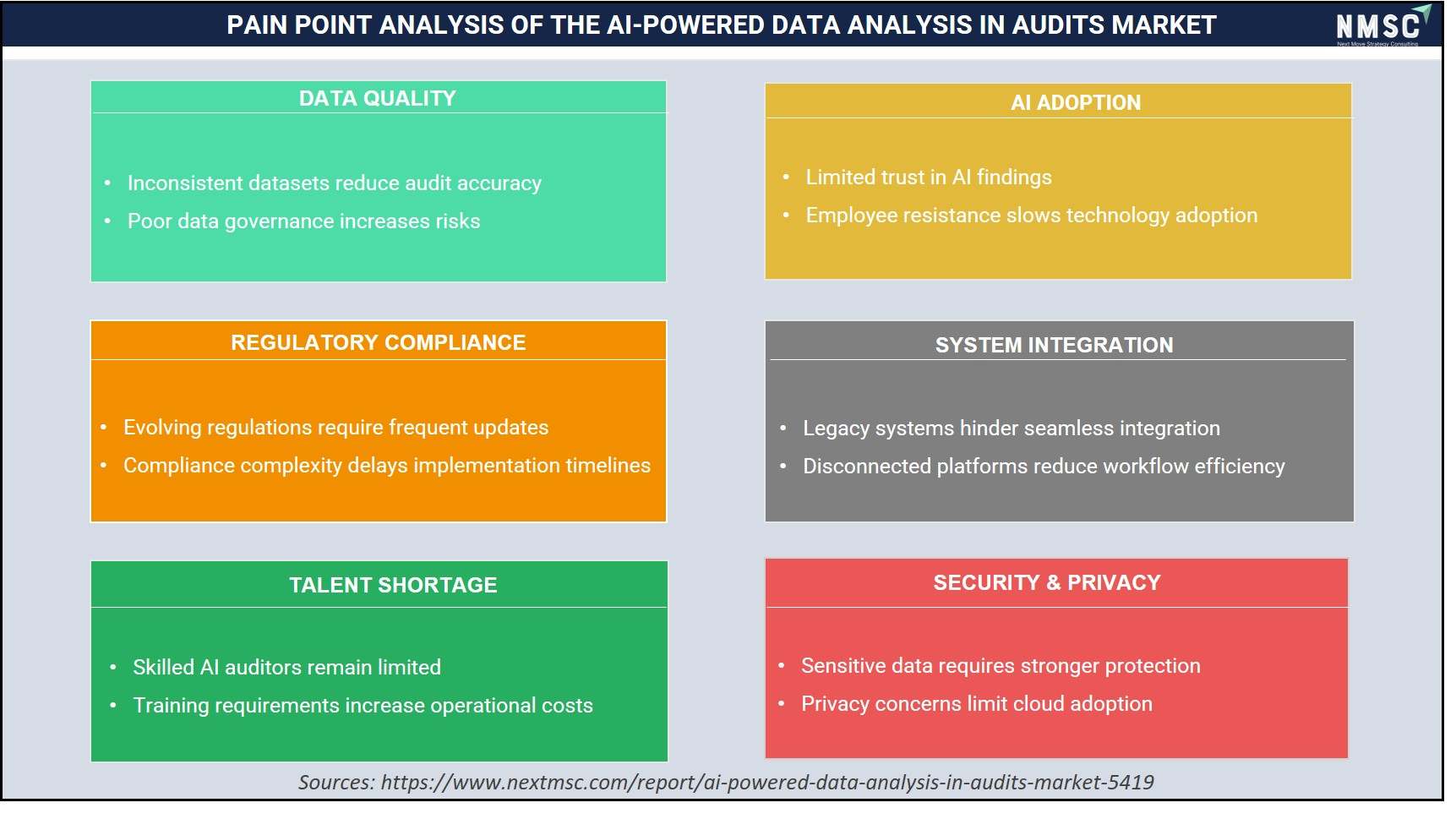
Our analysis indicates that the AI-Powered Data Analysis in Audits Market faces challenges related to inconsistent data quality, regulatory complexity, and limited organizational trust in AI-generated insights. Integration with legacy audit systems and disconnected platforms reduces workflow efficiency, while shortages of skilled AI audit professionals increase implementation costs. Additionally, evolving privacy regulations and concerns regarding sensitive financial data protection create compliance burdens, slowing adoption across audit firms and enterprise finance functions.
Growth Drivers & Restraints
|
Factors |
Type |
(+/-) % Impact on CAGR |
Geographic Relevance |
Impact Timeline |
|
Rising regulatory expectations for technology-enabled audit evidence |
Driver |
+3.8% |
Global |
2026–2035 |
|
Shift from sample-based testing to full population analytics |
Driver |
+3.2% |
North America, Europe |
2026–2035 |
|
Growing corporate audit function investment in continuous monitoring |
Driver |
+2.9% |
Global |
2026–2032 |
|
Expansion of SaaS delivery lowering adoption barriers for mid-market firms |
Driver |
+2.4% |
Asia-Pacific, LATAM |
2026–2035 |
|
Integration of generative AI into evidence review workflows |
Driver |
+2.1% |
North America, Europe |
2027–2035 |
|
Data privacy and cross-border data residency restrictions |
Restraint |
-1.9% |
Europe, MEA |
2026–2032 |
|
Shortage of audit staff skilled in analytics and process mining tools |
Restraint |
-1.6% |
Global |
2026–2030 |
|
Integration complexity with legacy general ledger and ERP systems |
Restraint |
-1.3% |
Global |
2026–2033 |
|
High upfront licensing cost for full population testing platforms |
Restraint |
-1.1% |
LATAM, MEA |
2026–2031 |
What Is the Primary Growth Driver?
The primary growth driver is regulatory pressure for technology-enabled audit evidence, which the PCAOB has reinforced through updated inspection standards emphasizing data-driven testing over sample-based procedures. Our analysis shows that audit committees are now asking engagement partners to justify sampling methodology, pushing external audit firms toward analytics platforms capable of testing full transaction populations rather than statistical subsets, directly expanding addressable demand for the AI-Powered Data Analysis in Audits Market.
How Is Full Population Testing Driving the Market Growth?
Full population testing is driving market growth because it eliminates sampling risk while shortening fieldwork timelines for large transaction volumes. Next Move Strategy Consulting's analysis indicates that corporate audit functions adopting full population testing report faster issue identification across procurement and payroll cycles. This capability is becoming a baseline procurement requirement in Big Four and mid-tier audit firm technology tenders, reinforcing platform-level competitive differentiation.
What Is Restraining the AI-Powered Data Analysis in Audits Market?
Data privacy and cross-border residency restrictions are restraining market growth, particularly across Europe where the General Data Protection Regulation limits how audit evidence containing personal data can be transferred to centralized analytics environments. This constraint slows SaaS adoption among multinational corporate audit functions that must maintain jurisdiction-specific data storage, adding implementation cost and timeline pressure relative to single-jurisdiction deployments.
Segmentation Analysis
Segment Sizing: By Application
|
Segment |
2025 (USD Million) |
2035 (USD Million) |
CAGR% (2026–2035) |
|
Audit Analytics and Testing |
420.0 |
3320.0 |
23.0% |
|
Audit Management |
270.0 |
2120.0 |
22.9% |
|
Spend Audit |
175.0 |
1380.0 |
23.0% |
|
Financial Close and Audit Readiness |
150.0 |
1190.0 |
23.1% |
|
Log and Access Audit |
120.0 |
970.0 |
23.3% |
|
Confirmation Analytics |
65.0 |
560.0 |
24.2% |
|
Other Audit Applications |
40.0 |
330.0 |
23.6% |
|
Total |
1240.0 |
9870.0 |
23.1% |
Which Application Segment Dominates the Market?
Audit Analytics and Testing dominates the application segment with USD 0.42 billion in 2025, rising to USD 3.32 billion by 2035, supported by widespread transaction testing and journal entry testing adoption across external audit engagements. Confirmation Analytics is the fastest-growing sub-segment at a 24.2% CAGR, as audit teams automate third-party confirmation workflows that were historically manual, paper-based, and prone to response delays across large multi-entity audit engagements.
Segment Sizing: By Deployment Model
|
Segment |
2025 (USD Million) |
2035 (USD Million) |
CAGR% (2026–2035) |
|
SaaS |
620.0 |
5300.0 |
24.1% |
|
Private Cloud |
280.0 |
2050.0 |
22.0% |
|
On Premises |
210.0 |
1420.0 |
20.9% |
|
Hybrid |
130.0 |
1100.0 |
23.9% |
|
Total |
1240.0 |
9870.0 |
23.1% |
Which Deployment Model Leads Adoption?
SaaS leads the deployment model segment with USD 0.62 billion in 2025 and remains the fastest-growing model at a 24.1% CAGR through 2035, as external audit firms and corporate audit functions prioritize rapid implementation over Cloud Computing Market infrastructure rather than maintaining on-premises servers. Private cloud retains relevance among government audit organizations with stricter data residency and sovereignty requirements limiting public cloud adoption.
Segment Sizing: By End User Industry
|
Segment |
2025 (USD Million) |
2035 (USD Million) |
CAGR% (2026–2035) |
|
Financial Services |
460.0 |
3650.0 |
23.1% |
|
Public Sector |
230.0 |
1830.0 |
23.1% |
|
Technology and Telecom |
165.0 |
1390.0 |
23.9% |
|
Manufacturing |
140.0 |
1120.0 |
23.2% |
|
Healthcare and Life Sciences |
105.0 |
870.0 |
23.7% |
|
Retail and Consumer |
75.0 |
610.0 |
23.4% |
|
Energy and Utilities |
45.0 |
290.0 |
20.3% |
|
Other Industries |
20.0 |
110.0 |
18.2% |
|
Total |
1240.0 |
9870.0 |
23.1% |
Which End User Industry Leads Demand?
Financial Services leads end user industry demand with USD 0.46 billion in 2025, reflecting stringent regulatory audit obligations under banking and securities oversight frameworks tied to the General Banking and Financial Services Market. Technology and Telecom is the fastest-growing vertical at a 23.9% CAGR, driven by rapid transaction volume growth and revenue recognition complexity that outpaces traditional manual audit testing capacity.
Growth Opportunities
Three forward-looking opportunities stand out for vendors and audit organizations positioning for the next decade of the AI-Powered Data Analysis in Audits Market.
How Can Vendors Capture Mid-Market Corporate Audit Functions?
Mid-market corporate audit functions remain underpenetrated relative to large enterprises, creating whitespace for vendors offering lower-cost SaaS tiers with pre-built industry rule libraries. Corporate audit teams stand to benefit most, gaining continuous monitoring capability without the implementation overhead historically reserved for large enterprise deployments.
What Opportunity Exists in Government Audit Modernization?
Government audit organizations are modernizing legacy testing processes under public sector transparency mandates, opening opportunity for vendors with public-sector compliant deployment models. Government audit organizations benefit through faster findings remediation and stronger public accountability reporting across procurement and grant disbursement audits.
How Can Process Mining Unlock Operational Audit Expansion?
Process mining vendors can expand beyond financial statement audit into operational and compliance audit scope by reconstructing procure-to-pay and order-to-cash flows directly from ERP event logs. External audit firms benefit by broadening service lines into operational assurance engagements beyond traditional financial statement audit work.
Regional Outlook
|
Region |
2025 (USD Million) |
2035 (USD Million) |
CAGR% (2026–2035) |
Key Driver |
|
North America |
470.0 |
3550.0 |
22.4% |
Regulatory audit mandates and Big Four analytics adoption |
|
Europe |
330.0 |
2500.0 |
22.4% |
IFRS/CSRD assurance requirements and process mining uptake |
|
Asia-Pacific |
300.0 |
2850.0 |
25.6% |
Statutory audit digitization and expanding corporate audit functions |
|
Middle East & Africa |
80.0 |
570.0 |
21.6% |
Government audit modernization programs |
|
Latin America |
60.0 |
400.0 |
20.7% |
Growing external audit firm technology spend |
|
Total |
1240.0 |
9870.0 |
23.1% |
— |
North America AI-Powered DataAnalysis in Audits Market
North America is the most mature market for AI-Powered Data Analysis in Audits, anchored by PCAOB inspection standards that push external audit firms toward defensible, technology-enabled evidence. Regulatory scrutiny of audit quality, deep enterprise cloud penetration, and concentrated Big Four and mid-tier firm technology budgets support sustained adoption. Strategic outlook favors vendors with pre-built compliance rule libraries suited to U.S. and Canadian regulatory frameworks through 2035.
Europe AI-Powered Data Analysis in Audits Market
Europe's market is shaped by Corporate Sustainability Reporting Directive assurance obligations that extend audit scope beyond financial statements into non-financial disclosures. Data residency requirements under GDPR moderate SaaS adoption pace relative to North America. Technology adoption is steady among external audit firms serving multinational clients, with regulatory influence expected to intensify assurance-related demand through the forecast period.
Asia-Pacific AI-Powered Data Analysis in Audits Market
Asia-Pacific is the fastest-growing regional market, propelled by expanding corporate audit functions and statutory audit digitization across China, India, and Japan. Adoption levels vary by market maturity, with government audit organizations increasingly prioritizing modernization. Competitive intensity is rising as global vendors establish regional delivery centers, supporting a strategic outlook favoring localized deployment and language-specific analytics capability.
Middle East & Africa AI-Powered Data Analysis in Audits Market
The Middle East & Africa market is developing steadily as government audit organizations modernize public sector oversight under national transparency initiatives. Regulatory influence remains uneven across the region, moderating technology penetration outside Gulf Cooperation Council markets. Strategic outlook favors vendors partnering locally to navigate procurement requirements within government audit modernization programs.
Latin America AI-Powered Data Analysis in Audits Market
Latin America shows growing external audit firm technology spend, particularly in Brazil and Argentina, as regional regulators tighten financial reporting oversight. Adoption levels trail North America and Europe due to budget constraints among smaller audit practices. Strategic outlook favors subscription-priced SaaS offerings that lower entry cost for mid-tier regional audit firms expanding analytics capability.
U.S. AI-Powered Data Analysis in Audits Market
Based on our estimates, the U.S. AI-Powered Data Analysis in Audits Market was valued at approximately USD 366.6 million in 2025 and is projected to reach USD 2769.0 million by 2035, growing at a 22.4% CAGR from 2026 to 2035. Demand is concentrated among external audit firms and corporate audit functions with rising technology adoption, moderate regulatory influence, and increasing competitive intensity among global and regional vendors, supporting a positive strategic outlook through the forecast period.
Canada AI-Powered Data Analysis in Audits Market
The market in Canada was valued at approximately USD 61.1 million in 2025 and projected to reach USD 461.5 million by 2035, growing at a 22.4% CAGR from 2026 to 2035. Demand is concentrated among external audit firms and corporate audit functions with rising technology adoption, moderate regulatory influence, and increasing competitive intensity among global and regional vendors, supporting a positive strategic outlook through the forecast period.
Mexico AI-Powered Data Analysis in Audits Market
As per our estimate, the Mexico AI-Powered Data Analysis in Audits Market was valued at approximately USD 42.3 million in 2025 and is projected to reach USD 319.5 million by 2035, growing at a 22.4% CAGR from 2026 to 2035. Demand is concentrated among external audit firms and corporate audit functions with rising technology adoption, moderate regulatory influence, and increasing competitive intensity among global and regional vendors, supporting a positive strategic outlook through the forecast period.
UK AI-Powered Data Analysis in Audits Market
According to our analysis, the UK AI-Powered Data Analysis in Audits Market was valued at approximately USD 95.0 million in 2025 and is projected to reach USD 700.0 million by 2035, growing at a 22.1% CAGR from 2026 to 2035. Demand is concentrated among external audit firms and corporate audit functions with rising technology adoption, moderate regulatory influence, and increasing competitive intensity among global and regional vendors, supporting a positive strategic outlook through the forecast period.
Germany AI-Powered Data Analysis in Audits Market
Based on our estimates, the Germany AI-Powered Data Analysis in Audits Market was valued at approximately USD 90.0 million in 2025 and is projected to reach USD 680.0 million by 2035, growing at a 22.4% CAGR from 2026 to 2035. Demand is concentrated among external audit firms and corporate audit functions with rising technology adoption, moderate regulatory influence, and increasing competitive intensity among global and regional vendors, supporting a positive strategic outlook through the forecast period.
France AI-Powered Data Analysis in Audits Market
The market in France was valued at approximately USD 65.0 million in 2025 and projected to reach USD 480.0 million by 2035, growing at a 22.0% CAGR from 2026 to 2035. Demand is concentrated among external audit firms and corporate audit functions with rising technology adoption, moderate regulatory influence, and increasing competitive intensity among global and regional vendors, supporting a positive strategic outlook through the forecast period.
China AI-Powered Data Analysis in Audits Market
As per our estimate, the China AI-Powered Data Analysis in Audits Market was valued at approximately USD 105.0 million in 2025 and is projected to reach USD 1080.0 million by 2035, growing at a 27.4% CAGR from 2026 to 2035. Demand is concentrated among external audit firms and corporate audit functions with rising technology adoption, moderate regulatory influence, and increasing competitive intensity among global and regional vendors, supporting a positive strategic outlook through the forecast period.
India AI-Powered Data Analysis in Audits Market
According to our analysis, the India AI-Powered Data Analysis in Audits Market was valued at approximately USD 55.0 million in 2025 and is projected to reach USD 560.0 million by 2035, growing at a 27.1% CAGR from 2026 to 2035. Demand is concentrated among external audit firms and corporate audit functions with rising technology adoption, moderate regulatory influence, and increasing competitive intensity among global and regional vendors, supporting a positive strategic outlook through the forecast period.
Japan AI-Powered Data Analysis in Audits Market
Based on our estimates, the Japan AI-Powered Data Analysis in Audits Market was valued at approximately USD 60.0 million in 2025 and is projected to reach USD 460.0 million by 2035, growing at a 22.9% CAGR from 2026 to 2035. Demand is concentrated among external audit firms and corporate audit functions with rising technology adoption, moderate regulatory influence, and increasing competitive intensity among global and regional vendors, supporting a positive strategic outlook through the forecast period.
South Korea AI-Powered Data Analysis in Audits Market
The market in South Korea was valued at approximately USD 35.0 million in 2025 and projected to reach USD 320.0 million by 2035, growing at a 24.8% CAGR from 2026 to 2035. Demand is concentrated among external audit firms and corporate audit functions with rising technology adoption, moderate regulatory influence, and increasing competitive intensity among global and regional vendors, supporting a positive strategic outlook through the forecast period.
Australia AI-Powered Data Analysis in Audits Market
As per our estimate, the Australia AI-Powered Data Analysis in Audits Market was valued at approximately USD 25.0 million in 2025 and is projected to reach USD 210.0 million by 2035, growing at a 23.9% CAGR from 2026 to 2035. Demand is concentrated among external audit firms and corporate audit functions with rising technology adoption, moderate regulatory influence, and increasing competitive intensity among global and regional vendors, supporting a positive strategic outlook through the forecast period.
UAE AI-Powered Data Analysis in Audits Market
According to our analysis, the UAE AI-Powered Data Analysis in Audits Market was valued at approximately USD 22.0 million in 2025 and is projected to reach USD 165.0 million by 2035, growing at a 22.3% CAGR from 2026 to 2035. Demand is concentrated among external audit firms and corporate audit functions with rising technology adoption, moderate regulatory influence, and increasing competitive intensity among global and regional vendors, supporting a positive strategic outlook through the forecast period.
Saudi Arabia AI-Powered Data Analysis in Audits Market
Based on our estimates, the Saudi Arabia AI-Powered Data Analysis in Audits Market was valued at approximately USD 20.0 million in 2025 and is projected to reach USD 150.0 million by 2035, growing at a 22.2% CAGR from 2026 to 2035. Demand is concentrated among external audit firms and corporate audit functions with rising technology adoption, moderate regulatory influence, and increasing competitive intensity among global and regional vendors, supporting a positive strategic outlook through the forecast period.
South Africa AI-Powered Data Analysis in Audits Market
The market in South Africa was valued at approximately USD 12.0 million in 2025 and projected to reach USD 88.0 million by 2035, growing at a 21.9% CAGR from 2026 to 2035. Demand is concentrated among external audit firms and corporate audit functions with rising technology adoption, moderate regulatory influence, and increasing competitive intensity among global and regional vendors, supporting a positive strategic outlook through the forecast period.
Brazil AI-Powered Data Analysis in Audits Market
As per our estimate, the Brazil AI-Powered Data Analysis in Audits Market was valued at approximately USD 34.0 million in 2025 and is projected to reach USD 225.0 million by 2035, growing at a 20.9% CAGR from 2026 to 2035. Demand is concentrated among external audit firms and corporate audit functions with rising technology adoption, moderate regulatory influence, and increasing competitive intensity among global and regional vendors, supporting a positive strategic outlook through the forecast period.
Argentina AI-Powered Data Analysis in Audits Market
According to our analysis, the Argentina AI-Powered Data Analysis in Audits Market was valued at approximately USD 11.0 million in 2025 and is projected to reach USD 72.0 million by 2035, growing at a 20.6% CAGR from 2026 to 2035. Demand is concentrated among external audit firms and corporate audit functions with rising technology adoption, moderate regulatory influence, and increasing competitive intensity among global and regional vendors, supporting a positive strategic outlook through the forecast period.
Porter's Five Forces Analysis of the AI-Powered Data Analysis in Audits Market
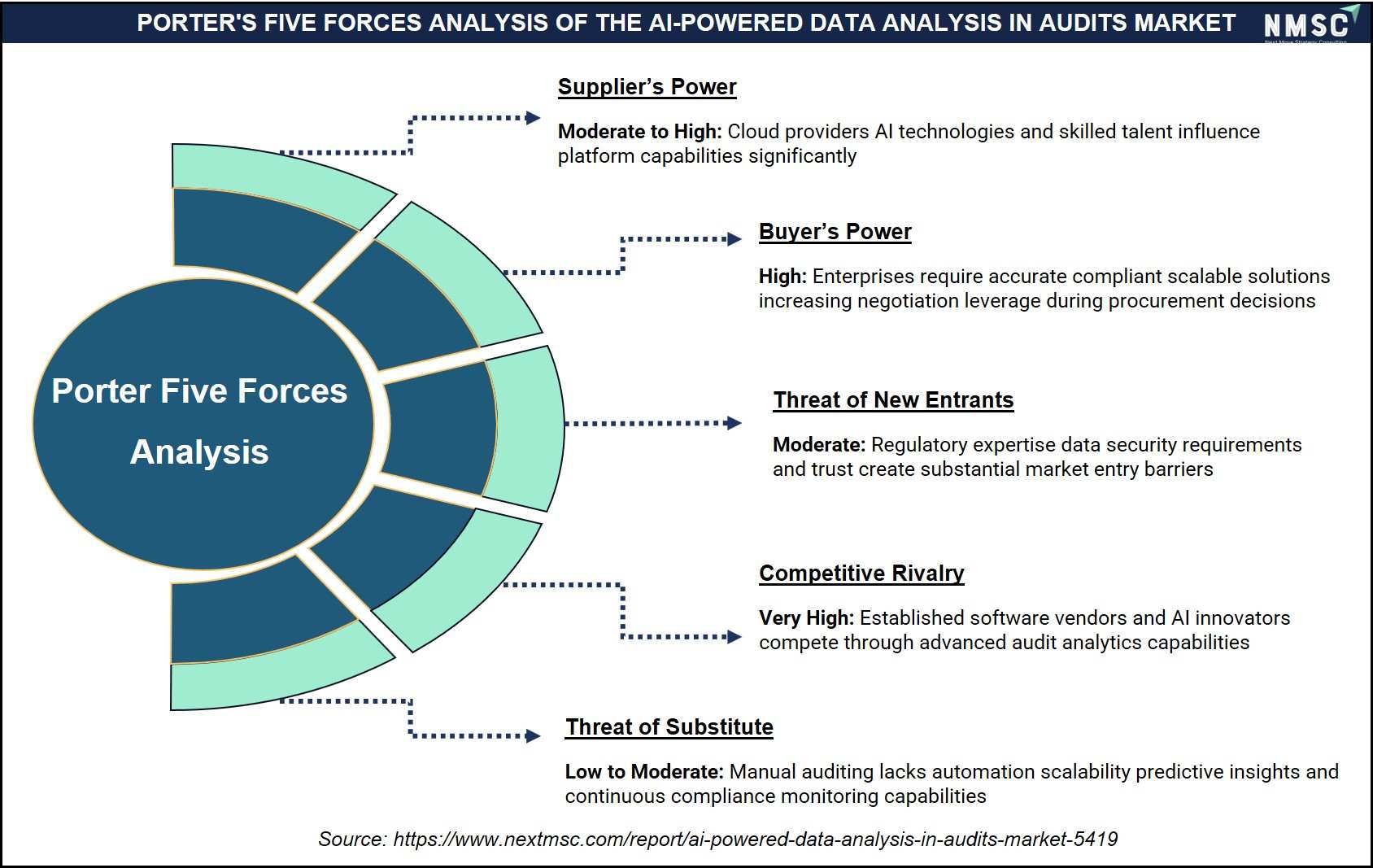
Our analysis indicates that the AI-Powered Data Analysis in Audits Market experiences moderate competitive rivalry due to increasing AI adoption by established audit software providers and emerging technology firms. Buyer bargaining power remains moderate as organizations evaluate solution performance, integration capabilities, and regulatory compliance. Supplier power is supported by specialized AI technology providers, while substitution threats remain limited because conventional auditing lacks advanced automation. High regulatory requirements and technical expertise create moderate barriers for new entrants.
Competitive Landscape
We observed that competition in the AI-Powered Data Analysis in Audits Market is concentrated among specialized audit analytics vendors and diversified enterprise software providers extending into audit use cases.
|
Dimension |
Details |
|
Market Structure |
Moderately fragmented, with specialized vendors competing alongside diversified enterprise platform providers |
|
Innovation Focus |
Continuous controls monitoring, generative AI evidence review, and process mining integration |
|
M&A Activity |
Selective acquisitions of niche analytics and process mining vendors by larger governance and risk platforms |
How Do Companies Compete in the AI-Powered Data Analysis in Audits Market?
Companies compete primarily on breadth of audit coverage, ranging from transaction-level testing to full population continuous monitoring, alongside integration depth with client ERP and general ledger systems. Vendors also differentiate on industry-specific rule libraries, cloud deployment flexibility, and speed of implementation, since audit engagement timelines leave limited room for lengthy onboarding cycles among external audit firms and corporate audit functions.
Which Vendor Archetypes Dominate the Market?
Two archetypes dominate: specialized audit analytics vendors such as MindBridge Analytics Inc. and DataSnipper B.V. built specifically for auditor workflows, and diversified governance, risk, and enterprise platform vendors such as SAP SE and ServiceNow, Inc. embedding audit capability within broader Governance Risk and Compliance (GRC) Platform Market suites. Archetype choice depends on whether buyers prioritize audit-specific depth or platform-wide consolidation.
What Innovation and Differentiation Strategies Are Vendors Pursuing?
Vendors are pursuing differentiation through generative AI-assisted evidence summarization, no-code rule configuration for non-technical auditors, and expanded process mining coverage of operational transaction cycles. Inflo Software Ltd. and DataSnipper B.V. have focused innovation on evidence collection efficiency, while larger platform vendors emphasize breadth across financial close, risk, and audit modules within a single environment.
How Active Is M&A in the Competitive Landscape?
M&A activity remains selective rather than consolidating, with larger governance and risk platform vendors acquiring niche analytics and process mining capabilities to close product gaps rather than pursuing scale acquisitions of direct competitors. This pattern reflects a market still expanding organically, where geographic expansion and partner-channel growth outweigh outright competitor acquisition as the primary strategic lever through 2035.
Key Market Players
Our assessment indicates that the following companies represent the validated set of leading participants shaping the AI-Powered Data Analysis in Audits Market through platform innovation, geographic reach, and audit-specific analytics depth.
-
Optro, Inc.
-
Wolters Kluwer N.V.
-
CaseWare International Inc.
-
Thomson Reuters Corporation
-
BlackLine, Inc.
-
MindBridge Analytics Inc.
-
DataSnipper B.V.
-
AppZen, Inc.
-
Inflo Software Ltd.
-
ServiceNow, Inc.
-
IBM Corporation
-
SAP SE
-
Oracle Corporation
-
MetricStream Inc.
-
Ideagen plc
-
Oversight Systems, Inc.
-
Arbutus Software Inc.
-
Celonis SE
Latest Developments
|
Date |
Event |
|
June 2026 |
lackLine expanded its Agentic Financial Operations Platform with new governance and observability capabilities, introducing a centralized Finance Control Console designed to monitor, audit, and secure AI-driven financial processes at scale. |
|
June 2026 |
MindBridge expanded its AI-powered audit and assurance platform with major new capabilities designed for full-population financial analysis, including advanced subledger analysis, transaction-level risk scoring, and a Monetary Flow Dashboard to help global audit teams assess complex financial data faster. |
|
March 2026 |
Workiva unveiled its next-generation Governance, Risk, and Compliance (GRC) platform at the Institute of International Auditors Great Audit Minds conference, integrating advanced AI-driven testing automation, controls management, and audit workflows to help lean teams move toward real-time assurance. |
Expert Insights
 “AI won't replace auditors and accountants; it will redefine what they do. The profession's value will increasingly come from judgement, interpretation and strategic insight. Firms that invest in both AI and their people will be best placed to seize that opportunity.”
— David Marquis, Chief Executive Officer, Caseware
Statement made while discussing IDC's global study, The Future of Audit and Accounting in the AI Era, highlighting how AI and advanced data analytics are reshaping audit workflows and professional roles.
Market Interpretation
The statement reflects the rapid transformation of audit functions through AI-powered data analysis. Rather than replacing auditors, artificial intelligence is automating repetitive analytical tasks, enabling professionals to focus on risk assessment, judgment, and strategic decision-making. Consequently, organizations are increasingly investing in AI-driven audit analytics platforms that enhance anomaly detection, improve audit quality, accelerate reporting, and support continuous auditing. This shift is expected to drive sustained growth in the AI-powered data analysis in audits market as firms modernize audit processes and strengthen compliance capabilities.
Investment Opportunities
How Are Capital Inflows Shaping the Market?
Capital inflows are concentrated in specialized audit analytics vendors expanding continuous monitoring and process mining capability, with growth-stage funding rounds supporting product breadth rather than geographic expansion alone. Investors are prioritizing vendors demonstrating recurring subscription revenue growth over one-time license models, consistent with the broader SaaS shift documented across the deployment model segmentation.
What Infrastructure Investment Is Required for Scale?
Scaling full population testing requires investment in cloud data processing infrastructure capable of ingesting large transaction volumes from client ERP systems without latency that would delay audit fieldwork. Vendors are also investing in secure, jurisdiction-specific data residency infrastructure to meet European and government audit organization requirements without fragmenting core product architecture.
What ESG Considerations Apply to Market Participants?
Environmental, Social, and Governance considerations increasingly intersect with this market as the Corporate Sustainability Reporting Directive extends assurance requirements to non-financial disclosures, creating adjacent demand for audit analytics vendors capable of testing sustainability data alongside financial transactions, reinforcing governance-focused product roadmaps among leading platform providers.
Key Benefits for Stakeholders
How Does This Report Benefit Audit and Industry Leaders?
Audit and industry leaders gain a structured view of segmentation, competitive positioning, and regional demand patterns that supports technology procurement and vendor evaluation decisions. The report's forecasts and driver analysis help audit leaders benchmark internal analytics maturity against sector-wide adoption trends through 2035.
How Does This Report Benefit Investors and Financial Analysts?
Investors and financial analysts benefit from consolidated market sizing, CAGR, and competitive landscape data that supports valuation and due diligence on audit technology vendors. Regional and segment-level forecasts help identify where capital deployment aligns with the fastest-growing sub-segments and geographies.
How Does This Report Benefit Technology Vendors and Product Teams?
Technology vendors and product teams gain insight into segment-level growth rates and competitive differentiation strategies that inform roadmap prioritization. Findings on regulatory drivers and regional adoption patterns support go-to-market sequencing across deployment models and end user industries.
Key Market Segments
By Application
-
Audit Analytics and Testing
-
Transaction Testing
-
Journal Entry Testing
-
Full Population Testing
-
Continuous Controls Monitoring
-
Process Mining
-
-
Audit Management
-
Planning and Scoping
-
Evidence Collection
-
Workpapers
-
Findings and Remediation
-
-
Spend Audit
-
Expense Audit
-
Invoice Audit
-
Payment Audit
-
-
Financial Close and Audit Readiness
-
Reconciliations
-
Close Analytics
-
Certifications
-
-
Log and Access Audit
-
Audit Logs
-
Access Reviews
-
Database Activity
-
-
Confirmation Analytics
-
Other Audit Applications
By Deployment Model
-
SaaS
-
Private Cloud
-
On Premises
- Hybrid
By Organization Type
-
External Audit Firms
-
Corporate Audit Functions
-
Government Audit Organizations
-
Other Organizations
By Revenue Stream
- Subscription
- License
- Services
- Usage Based
- Other
By Sales Channel
-
Direct Sales
-
Partners
-
Marketplace
-
Embedded OEM
-
Other
By End User Industry
-
Financial Services
-
Public Sector
-
Manufacturing
-
Technology and Telecom
-
Healthcare and Life Sciences
-
Retail and Consumer
-
Energy and Utilities
-
Other Industries
By Region
-
North America: U.S., Canada, Mexico
-
Europe: UK, Germany, France, Italy, Spain, Sweden, Denmark, Finland, Netherlands, Rest of Europe
-
Asia-Pacific: China, India, Japan, South Korea, Taiwan, Indonesia,Vietnam, Australia, Philippines, Malaysia, Rest of APAC
-
Middle East & Africa: Saudi Arabia, UAE, Egypt, Israel, Turkey, Nigeria, South Africa, Rest of MEA
-
Latin America: Brazil, Argentina, Chile, Colombia, Rest of LATAM
Conclusion & Recommendations
What Is the Long-Term Outlook for the Market?
The long-term outlook remains strongly positive, with the market expanding from USD 1.52 billion in 2026 to USD 9.87 billion by 2035 at a 23.1% CAGR, driven by sustained regulatory pressure for technology-enabled audit evidence. Adoption is expected to broaden beyond early-mover external audit firms into mid-market corporate audit functions and government audit organizations over the forecast period.
What Strategic Positioning Should Vendors Pursue?
Vendors should prioritize deep ERP and general ledger integration alongside industry-specific rule libraries to shorten implementation timelines. Strategic positioning around full population testing and continuous controls monitoring capability will differentiate offerings as audit committees increasingly scrutinize sampling methodology across external and corporate audit engagements.
How Attractive Is the Market for Investment?
Investment attractiveness is high given consistent double-digit CAGR across nearly every segmentation axis and region, with SaaS delivery and Financial Services demand providing durable recurring revenue foundations. Asia-Pacific's 25.6% regional CAGR presents the strongest relative growth opportunity for vendors and investors prioritizing geographic expansion.
What Market Shifts and Key Risks Should Stakeholders Monitor?
Stakeholders should monitor data privacy and cross-border residency restrictions that could slow SaaS adoption in Europe, alongside the ongoing shortage of analytics-skilled audit staff that constrains implementation capacity. Consolidation among governance, risk, and compliance platform vendors could also reshape competitive dynamics for standalone audit analytics providers.
What Are the Primary Growth Pathways Through 2035?
Primary growth pathways include expansion into mid-market corporate audit functions, deeper penetration of government audit modernization programs, and broadening process mining into operational and compliance audit scope beyond traditional financial statement testing, positioning the AI-Powered Data Analysis in Audits Market for sustained double-digit growth through 2035.
About the Author
 Saista Faiyaz
— Saista Faiyaz is Research Associate at Next Move Strategy Consulting, where she has covered consumer markets and healthcare technologies for 3 years. Her work includes primary interview review, secondary-source validation, market sizing, and structured analysis of company and industry data. She supports research by comparing evidence across sources, organizing findings into market narratives, and documenting assumptions used in analysis. Her scope includes cross-market benchmarking, and reports.
Saista Faiyaz
— Saista Faiyaz is Research Associate at Next Move Strategy Consulting, where she has covered consumer markets and healthcare technologies for 3 years. Her work includes primary interview review, secondary-source validation, market sizing, and structured analysis of company and industry data. She supports research by comparing evidence across sources, organizing findings into market narratives, and documenting assumptions used in analysis. Her scope includes cross-market benchmarking, and reports.
About the Reviewer
 Supradip Baul
— Supradip Baul is an accomplished business consultant and strategist with over a decade of rich experience in market intelligence, strategy, technology, and business transformation. His work has included rigorous qualitative and quantitative analysis across multiple industries, helping clients shape investment decisions and long-term roadmaps. Earlier in his career, he was associated with Gartner, where he contributed to industry-leading reports and market share analyses. He has worked with leading global companies and holds an MBA with a dual specialization in Marketing and Finance.
Supradip Baul
— Supradip Baul is an accomplished business consultant and strategist with over a decade of rich experience in market intelligence, strategy, technology, and business transformation. His work has included rigorous qualitative and quantitative analysis across multiple industries, helping clients shape investment decisions and long-term roadmaps. Earlier in his career, he was associated with Gartner, where he contributed to industry-leading reports and market share analyses. He has worked with leading global companies and holds an MBA with a dual specialization in Marketing and Finance.
At Next Move Strategy Consulting, we understand that insightful market research is the cornerstone of successful business decisions. That's why we employ a robust and multifaceted approach, combining various methodologies to deliver the most accurate and actionable data for our clients.

Research Landscape
We navigate the world of research with two primary approaches:
Qualitative Approach
Our qualitative research methodologies involve immersive techniques such as in-depth interviews, focus groups, and observational studies. By engaging directly with individuals and stakeholders, we uncover valuable insights that quantitative data alone may overlook.

Quantitative Research
In tandem with qualitative methodologies, NMSC leverages the power of Quantitative Research to provide a robust foundation of numerical insights. Through systematic data collection and analysis, we quantify patterns, preferences, and market trends, offering a comprehensive view of the business landscape.
Our quantitative research approach employs diverse tools, including surveys, experiments, and statistical modelling. These methodologies enable us to gather data from a large and representative sample, ensuring the statistical significance of our findings. By employing structured questionnaires and standardized data collection methods, we guarantee the reliability and validity of the information we present to our clients.
Quantitative research is particularly effective in measuring the prevalence of trends, assessing market size, and gauging the impact of various factors on consumer behavior. The numerical precision attained through this approach equips our clients with actionable insights, facilitating data-driven decision-making and strategy formulation.


Our Specialized Toolbox for Industry-Specific Market Research
We deploy a specialized arsenal of techniques tailored to meet your unique requirements. Here's a glimpse into our comprehensive toolbox:

Information Procurement
The stage entails acquiring market data or relevant information through various sources and methodologies.


Market Research Approach
We utilize both top-down and bottom-up approaches in market research analysis to achieve a comprehensive understanding of the market dynamics, leveraging the broad perspective of industry trends and macroeconomic factors alongside detailed insights from specific segments and individual companies.

Porters Five Forces Analysis
We conduct Porter's Five Forces analysis to evaluate the competitive landscape of an industry, providing us with insights into factors that affect profitability and strategic positioning.

SWOT Analysis

Forecasting
We utilize a forecasting model to predict future consumption by considering parameters like population, economics, regulations, market competition, drivers, constraints, technology, and pricing. We also employ statistical techniques such as multilinear regression, exponential smoothing, moving average, ARIMA, and Monte Carlo simulations for accurate predictions. In econometric forecasting, we analyzed short-term and long-term event impacts, attributing values based on regulatory frameworks, economic factors, and market events.





 Speak to Our Analyst