
AI-Powered Learning Platforms Market Size, Share, Trends and Growth Analysis, By Component (Platform/Software, Services), By Deployment Mode (Cloud-based, On-premise), By End User (K-12 Education, Higher Education, Corporate/Enterprise Learning, Government & Public Sector), By Region, and Segment Forecasts, 2026-2035
Industry: ICT & Media | Publishing Date: August 3, 2026 | Last Updated: September 3, 2026 | No of Pages: N/A | No. of Tables: N/A | No. of Figures: N/A | Format: PDF | Report Code: IC5525
What Is the AI-Powered Learning Platforms Market Size?
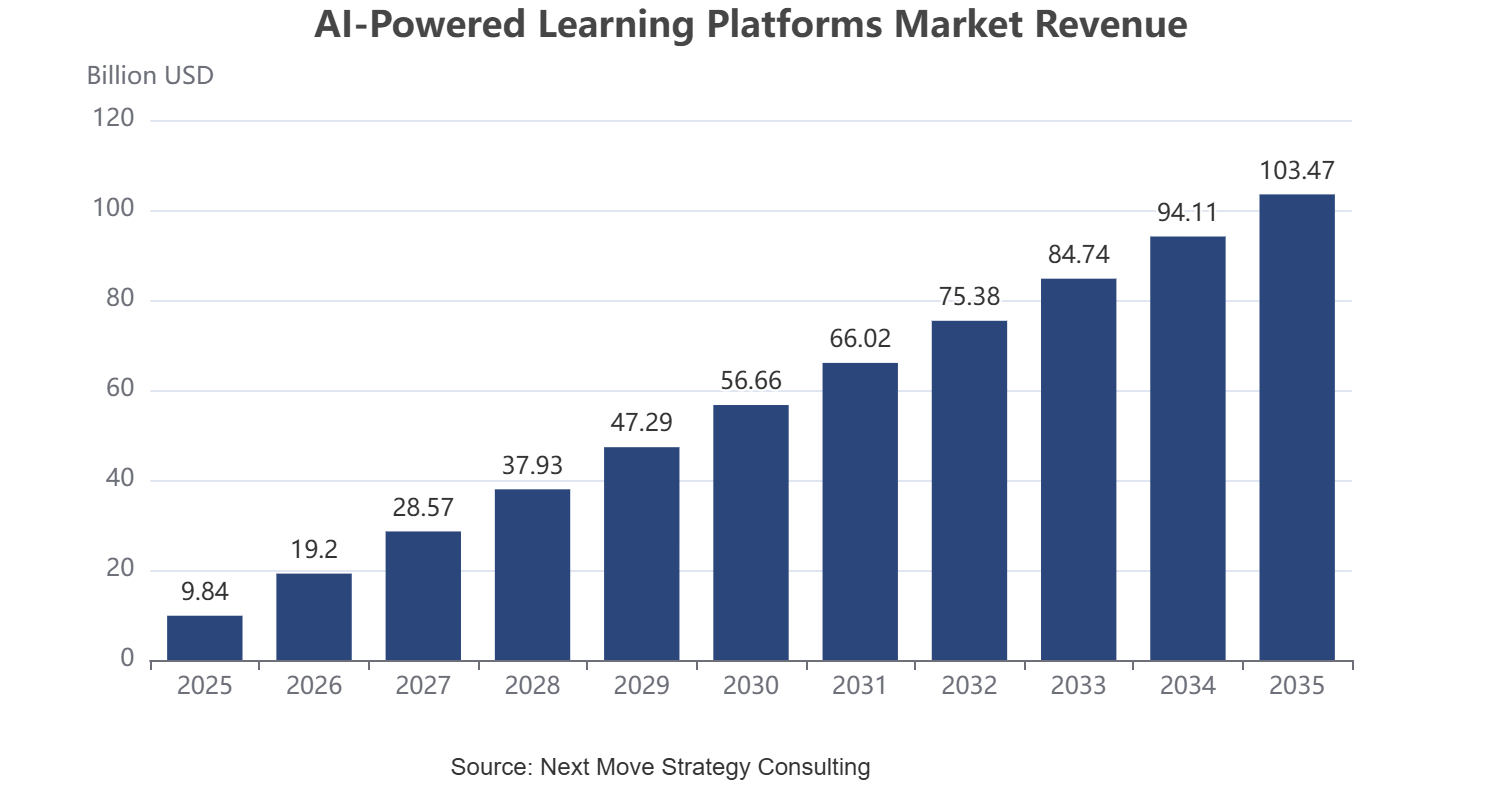
The global AI-powered learning platforms market was valued at USD 9.84 billion in 2025 and is estimated at USD 12.86 billion in 2026, projected to reach USD 103.47 billion by 2035, expanding at a CAGR of 25.97% between 2026 and 2035, with North America holding approximately 38.6% share and Platform/Software solutions accounting for nearly 66% of 2025 revenue.
We observed that demand is broadening across K-12, higher education, and corporate learning environments as institutions integrate adaptive content engines, automated assessment tools, and intelligent tutoring systems into daily instruction and workforce upskilling programs.
|
Key Takeaways |
|
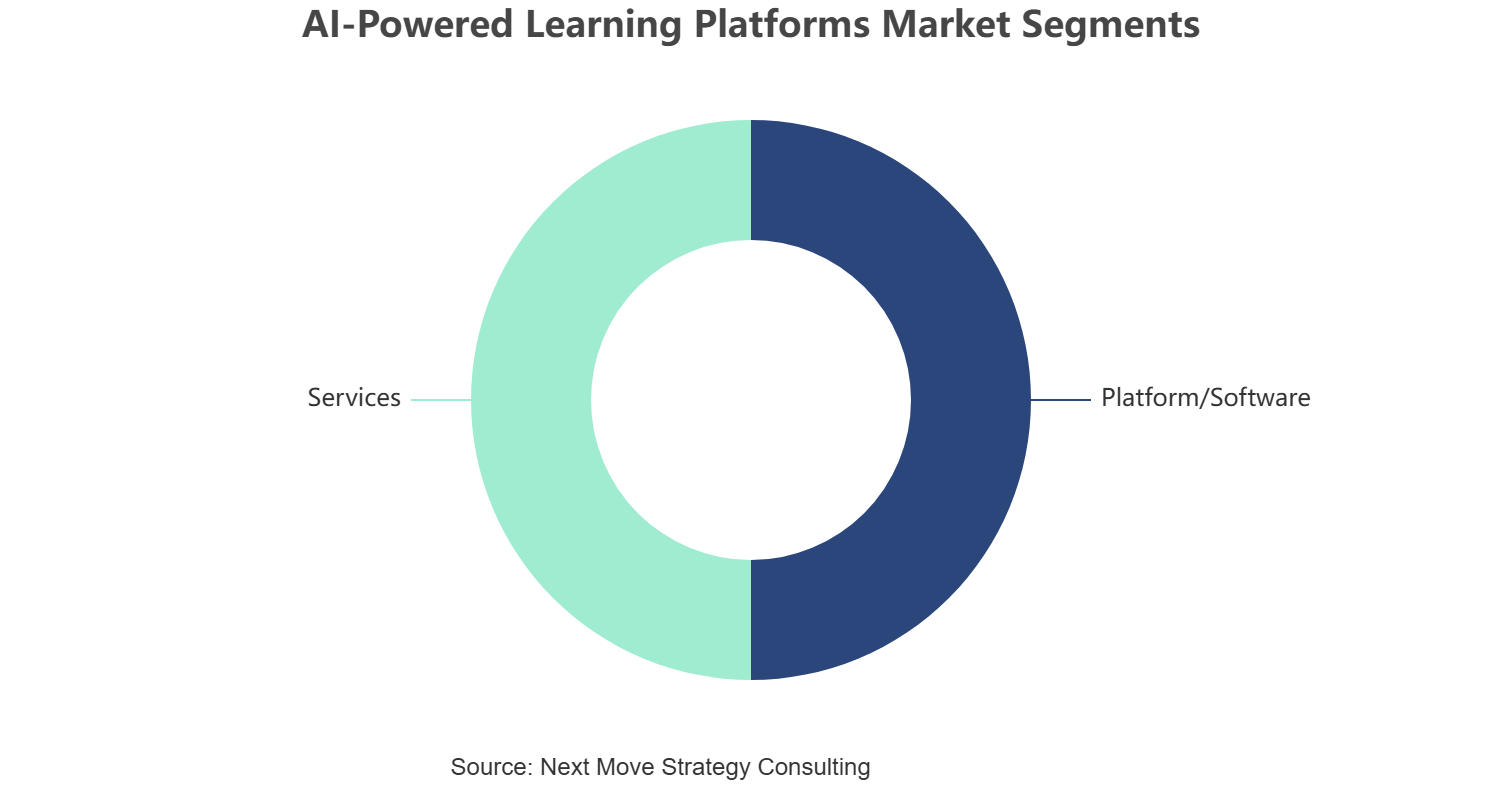
By Component: Platform/Software held the largest share of approximately 66% (USD 6.50 Billion) in 2025; Services is the fastest-growing sub-segment at 27.2% CAGR from 2026–2035. |
|
By Deployment Mode: Cloud-based held the largest share of approximately 78% (USD 7.68 Billion) in 2025; Cloud-based is also the fastest-growing sub-segment at 27.1% CAGR from 2026–2035. |
|
By End User: Corporate/Enterprise Learning held the largest share of approximately 31% (USD 3.10 Billion) in 2025; Corporate/Enterprise Learning is also the fastest-growing sub-segment at 28.5% CAGR from 2026–2035. |
|
Dominant Region: North America dominated with approximately 38.6% revenue share (USD 3.80 Billion) in 2025. |
|
Fastest-Growing Region: Asia-Pacific is expected to register the highest CAGR of 30.5% during 2026–2035. |
|
Dominant Country: U.S. led with approximately USD 3.23 Billion in 2025. |
|
Fastest-Growing Country: India is the fastest-growing country at approximately 33.9% CAGR from 2026–2035. |
Market Opportunity: The AI-powered learning platforms market is expected to create an absolute dollar opportunity of USD 90.61 billion between 2026 and 2035, positioning adaptive and AI-driven education technology as a priority allocation for institutional and enterprise learning budgets.
According to Next Move Strategy Consulting analysis, enterprise learning and development functions are becoming the fastest-adopting buyer segment as organizations link AI-driven skills platforms directly to workforce productivity and retention metrics.
AI-Powered Learning Platforms Market Overview
The AI-powered learning platforms market encompasses software and services that apply machine learning, natural language processing, and adaptive algorithms to personalize content delivery, automate assessment, and support intelligent tutoring across K-12, higher education, corporate, and government training environments. Our analysis shows that the market has evolved from static e-learning management systems toward dynamic, data-driven platforms capable of real-time learner profiling and content sequencing.
Regulatory frameworks addressing student data privacy, including the U.S. Family Educational Rights and Privacy Act and the European Union's General Data Protection Regulation, shape platform architecture and data governance requirements. We found that technology adoption trends, including generative AI content authoring and voice-enabled tutoring, are accelerating platform differentiation among established edtech vendors and enterprise software providers entering the education technology space.
|
Parameter |
Details |
|
Market Size in 2025 |
USD 9.84 Billion |
|
Market Size in 2026 |
USD 12.86 Billion |
|
Revenue Forecast in 2035 |
USD 103.47 Billion |
|
Growth Rate |
CAGR of 25.97% from 2026 to 2035 |
|
Analysis Period |
2025–2035 |
|
Base Year Considered |
2025 |
|
Forecast Period |
2026–2035 |
|
Market Size Estimation |
Revenue (USD Billion) |
|
Companies Profiled |
20 |
|
Countries Covered |
38 |
|
Market Share |
Available for Top 10 Companies |
Key Emerging Trends
Based on research conducted by Next Move Strategy Consulting, we found that four structural trends are reshaping how institutions and enterprises select and deploy AI-powered learning platforms.
How Is Generative AI Transforming Content Authoring in Learning Platforms?
Generative AI tools are transforming course content creation by automating quiz generation, video summarization, and multilingual translation of instructional material. We observed that vendors including Coursera, Inc. have integrated generative AI coaching features into flagship platforms, reducing content development timelines for instructors. This transformation is reshaping instructional design workflows and stakeholder expectations around content freshness.
Why Is Adaptive Learning Adoption Accelerating Across K-12 Systems?
Adaptive learning adoption is accelerating as school districts seek measurable remediation tools following pandemic-era learning loss. Our assessment indicates that state education agencies are increasingly funding platform licenses through federal Title I allocations, directly impacting stakeholder purchasing cycles and vendor procurement timelines across public school systems nationwide.
How Are Enterprises Adopting AI Tutors for Workforce Upskilling?
Enterprises are deploying AI tutors to deliver just-in-time skills coaching tied to internal mobility programs. Our findings suggest that corporate learning and development teams increasingly favor platforms offering skills-gap analytics, with Docebo Inc. reporting expanded enterprise contract volumes tied to AI-driven learning path recommendations for technical roles.
What Role Does Voice and Multimodal AI Play in Learning Platform Evolution?
Voice-enabled and multimodal AI interfaces are emerging within language-learning and accessibility-focused platforms, enabling conversational practice and real-time pronunciation feedback. We noticed that Duolingo, Inc. has expanded voice-interaction features, reflecting broader stakeholder demand for immersive, low-friction learning experiences across mobile-first user bases.
Ecosystem Analysis of the AI-Powered Learning Platforms Market
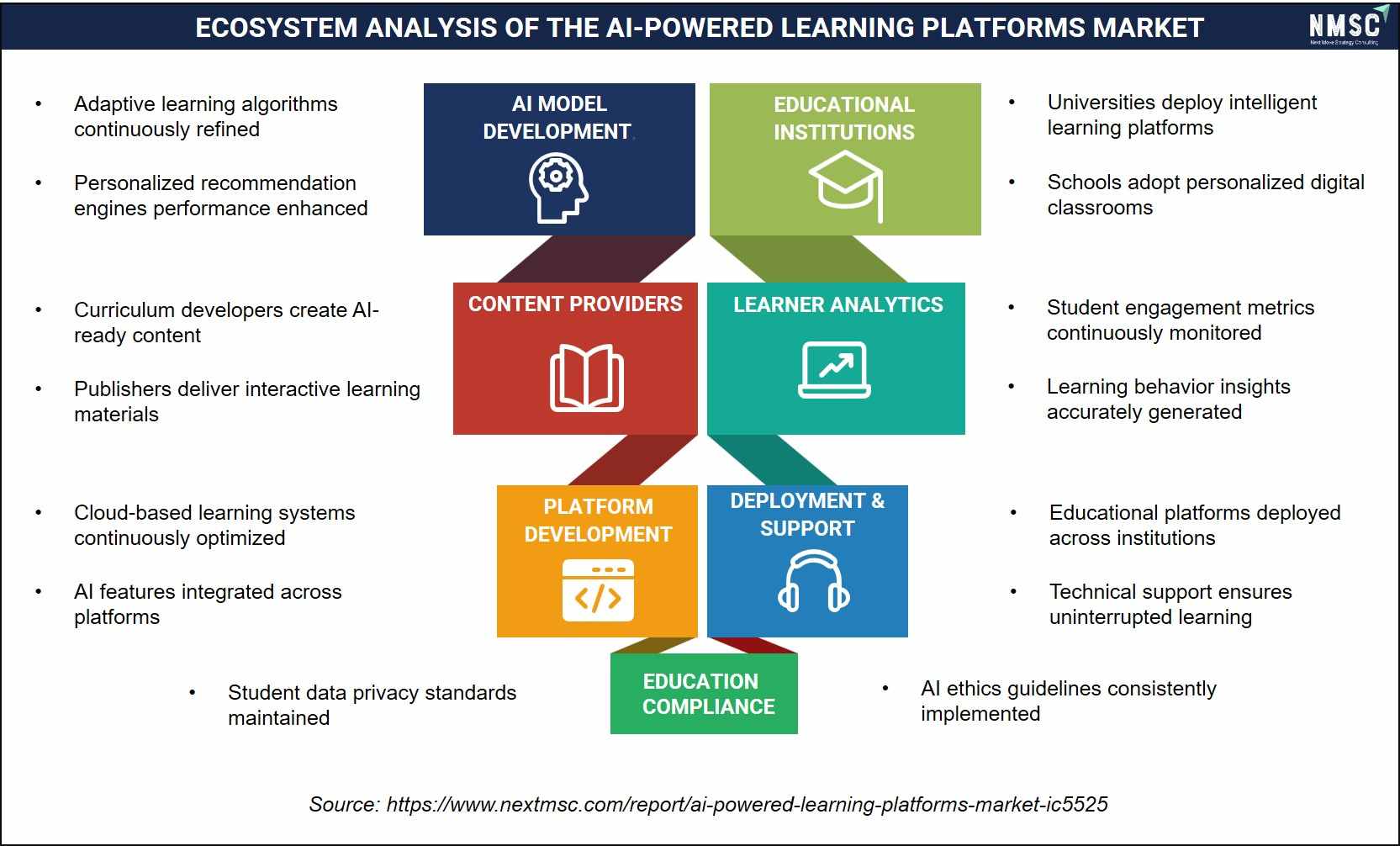
Based on our ecosystem assessment, we identified that the AI-powered learning platforms market comprises AI model developers, educational institutions, content providers, learner analytics solutions, platform developers, deployment and support providers, and education compliance authorities. Furthermore, our analysis indicates that AI-driven content personalization, learner performance analytics, scalable platform development, technical support services, and regulatory compliance improve learning outcomes, strengthen institutional adoption, and enhance the overall digital education ecosystem.
Growth Drivers and Restraints
Growth Catalyst and Risk Assessment Matrix
|
Factors |
Type |
(+/-) % Impact on CAGR |
Geographic Relevance |
Impact Timeline |
|
Rising enterprise reskilling spend |
Driver |
+4.8% |
Global |
2026–2035 |
|
K-12 adaptive learning funding programs |
Driver |
+3.6% |
North America, Europe |
2026–2032 |
|
Generative AI content authoring adoption |
Driver |
+3.2% |
Global |
2026–2035 |
|
Government digital education initiatives |
Driver |
+2.9% |
Asia-Pacific, MEA |
2026–2033 |
|
Rising smartphone and broadband penetration |
Driver |
+2.4% |
Asia-Pacific, Latin America |
2026–2035 |
|
Student data privacy compliance costs |
Restraint |
-2.1% |
North America, Europe |
2026–2030 |
|
Digital infrastructure gaps in emerging markets |
Restraint |
-1.8% |
Middle East & Africa, Latin America |
2026–2031 |
|
Educator resistance to AI-driven grading |
Restraint |
-1.5% |
Global |
2026–2029 |
|
High platform integration and switching costs |
Restraint |
-1.3% |
Global |
2026–2030 |
What Is the Primary Growth Driver of the AI-Powered Learning Platforms Market?
Rising enterprise reskilling expenditure is the primary driver of the market, as organizations respond to accelerating skills obsolescence. The U.S. Bureau of Labor Statistics reports that occupational skill requirements are shifting rapidly across technical roles, prompting employers to fund AI-driven internal learning platforms as a cost-efficient alternative to external training programs.
How Is Government Digital Education Policy Driving Market Growth?
Government-backed digital education initiatives are driving market growth as public education ministries fund national learning platform deployments. India's Ministry of Education has expanded digital learning infrastructure under national education policy programs, industry-derived estimate indicating meaningful platform procurement growth across public school systems in the region.
What Is Restraining AI-Powered Learning Platforms Market Expansion?
Data privacy compliance costs are restraining market expansion, particularly across jurisdictions enforcing strict student-data protection statutes. The European Union's General Data Protection Regulation requires extensive data governance controls, and industry-derived estimates indicate that compliance overhead disproportionately affects smaller platform vendors competing for institutional contracts.
Segmentation Analysis
Segment Sizing: By Component
|
Segment |
2025 (USD) |
2035 (USD) |
CAGR% (2026–2035) |
|
Platform/Software |
USD 6.50 Billion |
USD 65.50 Billion |
25.5% |
|
Services |
USD 3.34 Billion |
USD 37.97 Billion |
27.2% |
|
Total |
USD 9.84 Billion |
USD 103.47 Billion |
25.97% |
Which Component Segment Dominates the AI-Powered Learning Platforms Market?
Platform/Software led the market, valued at USD 6.50 billion in 2025 and projected to reach USD 65.50 billion by 2035, supported by widespread licensing of adaptive engines and analytics dashboards. Services, comprising implementation, training, and support, is the fastest-growing sub-segment at a CAGR of 27.2% as institutions increasingly require ongoing integration support for AI-driven modules within legacy learning management systems.
Segment Sizing: By Deployment Mode
|
Segment |
2025 (USD) |
2035 (USD) |
CAGR% (2026–2035) |
|
Cloud-based |
USD 7.68 Billion |
USD 86.91 Billion |
27.1% |
|
On-premise |
USD 2.16 Billion |
USD 16.56 Billion |
21.7% |
|
Total |
USD 9.84 Billion |
USD 103.47 Billion |
25.97% |
Why Does Cloud-Based Deployment Lead the Market?
Cloud-based deployment dominated the market, reaching USD 7.68 billion in 2025 due to lower upfront infrastructure costs and faster feature rollout cycles. On-premise deployment persists among government and defense-affiliated training programs requiring data residency control, though its share is gradually narrowing as institutions migrate toward managed cloud environments.
Segment Sizing: By End User
|
Segment |
2025 (USD) |
2035 (USD) |
CAGR% (2026–2035) |
|
K-12 Education |
USD 3.05 Billion |
USD 28.50 Billion |
24.4% |
|
Higher Education |
USD 2.85 Billion |
USD 25.90 Billion |
24.1% |
|
Corporate/Enterprise Learning |
USD 3.10 Billion |
USD 38.60 Billion |
28.5% |
|
Government & Public Sector |
USD 0.84 Billion |
USD 10.47 Billion |
28.4% |
|
Total |
USD 9.84 Billion |
USD 103.47 Billion |
25.97% |
Which End User Segment Is Growing Fastest?
Corporate/Enterprise Learning is the fastest-growing end-user segment, expanding at a CAGR of 28.5% between 2026 and 2035, driven by employer-funded reskilling programs. K-12 Education remains a foundational demand base, while Government & Public Sector adoption is accelerating from a smaller base as ministries digitize public training infrastructure.
Growth Opportunities
Our analysis shows that three forward-looking opportunities stand out for stakeholders positioning within the AI-powered learning platforms market.
How Can Skills-Based Micro-Credentialing Unlock Value for Higher Education?
AI-driven micro-credentialing systems that map learner progress to industry-recognized skills badges present a whitespace opportunity for higher education institutions seeking to demonstrate employability outcomes to prospective students and accreditation bodies.
Where Does Multilingual AI Tutoring Create Demand in Emerging Markets?
Multilingual AI tutoring tailored to regional languages creates an underpenetrated opportunity across Asia-Pacific and Latin American markets, where localized content remains scarce relative to English-language platform offerings for K-12 and vocational learners.
How Can Predictive Analytics Benefit Corporate Learning Teams?
Predictive analytics that flag skills-gap risk before performance decline creates an opportunity for corporate learning and development teams to justify platform investment through measurable workforce productivity outcomes tied to enterprise learning budgets.
Regional Outlook
Geographic Performance Snapshot
|
Region |
2025 (USD) |
2035 (USD) |
CAGR% (2026–2035) |
Key Driver |
|
North America |
USD 3.80 Billion |
USD 34.20 Billion |
23.9% |
Enterprise reskilling demand |
|
Europe |
USD 2.30 Billion |
USD 20.10 Billion |
23.5% |
Regulatory-driven digital education mandates |
|
Asia-Pacific |
USD 2.55 Billion |
USD 36.50 Billion |
30.5% |
Government digital education programs |
|
Middle East & Africa |
USD 0.62 Billion |
USD 6.80 Billion |
26.7% |
National education modernization plans |
|
Latin America |
USD 0.57 Billion |
USD 5.87 Billion |
25.9% |
Rising internet and device penetration |
|
Total |
USD 9.84 Billion |
USD 103.47 Billion |
25.97% |
|
North America AI-Powered Learning Platforms Market Outlook
North America leads the market with a mature enterprise learning ecosystem and established vendor base spanning Microsoft Corporation and Alphabet Inc. Regulatory emphasis on student data privacy under the Family Educational Rights and Privacy Act shapes platform governance, while employer-funded reskilling programs continue to anchor demand across the region.
Europe AI-Powered Learning Platforms Market Outlook
Europe's market reflects a regulation-intensive landscape shaped by the General Data Protection Regulation, requiring rigorous data governance across platform vendors. Strategic outlook favors vendors demonstrating compliance-ready architecture, with Pearson plc maintaining a strong regional institutional footprint across the United Kingdom and continental Europe.
Asia-Pacific AI-Powered Learning Platforms Market Outlook
Asia-Pacific is the fastest-growing region, propelled by expanding government digital education programs in China and India alongside rising smartphone penetration. Technology adoption is accelerating among K-12 and vocational training providers as regional governments prioritize digital skills development within national education strategies.
Middle East & Africa AI-Powered Learning Platforms Market Outlook
The market in Middle East & Africa is expanding as Gulf Cooperation Council economies diversify into knowledge-based sectors and fund national education modernization plans. Regulatory support for digital transformation initiatives in Saudi Arabia and the United Arab Emirates is accelerating institutional platform adoption across the region.
Latin America AI-Powered Learning Platforms Market Outlook
Latin America's market is supported by growing device and broadband penetration alongside expanding vocational training demand in Brazil and Argentina. Strategic outlook favors platforms offering Portuguese and Spanish-language content localization to serve the region's expanding digital learner base.
U.S. AI-Powered Learning Platforms Market
Based on our engagements, the U.S. market was valued at approximately USD 3.23 billion in 2025 and is projected to reach USD 29.07 billion by 2035, expanding at a CAGR of 23.9%. Demand structure reflects strong corporate learning adoption, high technology penetration, and competitive intensity among established enterprise software vendors, supported by a favorable regulatory environment for cloud-based platform deployment.
Canada AI-Powered Learning Platforms Market
Through our analysis, Canada's market reached roughly USD 0.57 billion in 2025 and is forecast to hit USD 5.13 billion by 2035 at a CAGR of 23.8%. Adoption levels are rising within provincial K-12 systems, supported by federal digital skills funding and growing competitive intensity among regional and multinational platform vendors.
UK AI-Powered Learning Platforms Market
From our assessment, the UK market stood at about USD 0.55 billion in 2025, advancing toward USD 4.60 billion by 2035 at a CAGR of 22.9%. Regulatory influence from data protection statutes shapes vendor selection, while higher education institutions show strong demand structure for adaptive assessment tools amid rising technology penetration.
Germany AI-Powered Learning Platforms Market
According to evaluation, Germany's market was valued near USD 0.50 billion in 2025 and is set to reach USD 4.40 billion by 2035, growing at a CAGR of 23.7%. Strategic outlook favors vendors offering compliance-ready architecture, with vocational training providers showing strong adoption levels amid rising competitive intensity.
France AI-Powered Learning Platforms Market
Based on our engagements, France's market reached approximately USD 0.40 billion in 2025, projected to climb to USD 3.50 billion by 2035 at a CAGR of 23.6%. Demand structure reflects growing higher education adoption of AI-driven assessment tools, supported by national digital education strategy funding and moderate competitive intensity.
China AI-Powered Learning Platforms Market
Through our analysis, China's market was valued at approximately USD 0.85 billion in 2025 and is projected to reach USD 13.80 billion by 2035 at a CAGR of 32.5%. Adoption levels are accelerating rapidly across K-12 systems, supported by strong government digital education funding and intense competitive activity among domestic platform vendors.
India AI-Powered Learning Platforms Market
From our assessment, India's market stood at roughly USD 0.62 billion in 2025, advancing toward USD 11.20 billion by 2035 at a CAGR of 33.9%, the fastest among covered countries. Demand structure reflects rapid smartphone-driven adoption, strong government digital education policy support, and rising competitive intensity among domestic and multinational vendors.
Japan AI-Powered Learning Platforms Market
According to evaluation, Japan's market reached approximately USD 0.35 billion in 2025 and is forecast to reach USD 3.60 billion by 2035 at a CAGR of 25.7%. Technology penetration remains high, with corporate learning adoption supported by workforce reskilling initiatives amid an aging labor force and moderate regulatory influence.
South Korea AI-Powered Learning Platforms Market
Based on our engagements, South Korea's market was valued at about USD 0.22 billion in 2025, projected to reach USD 2.60 billion by 2035 at a CAGR of 27.6%. Strong broadband infrastructure and strategic outlook favoring AI-integrated public education programs support rising adoption levels across K-12 and higher education segments.
Australia AI-Powered Learning Platforms Market
Through our analysis, Australia's market reached roughly USD 0.18 billion in 2025 and is expected to reach USD 1.95 billion by 2035 at a CAGR of 26.2%. Demand structure reflects growing higher education adoption, supported by favorable regulatory environment and moderate competitive intensity among regional vendors.
UAE AI-Powered Learning Platforms Market
From our assessment, the UAE market stood at approximately USD 0.10 billion in 2025, advancing toward USD 1.10 billion by 2035 at a CAGR of 26.8%. Strategic outlook favors platforms aligned with national digital transformation goals, supported by strong government funding and rising technology penetration across public education institutions.
Saudi Arabia AI-Powered Learning Platforms Market
According to evaluation, Saudi Arabia's market reached approximately USD 0.14 billion in 2025 and is projected to reach USD 1.55 billion by 2035 at a CAGR of 27.0%. Demand structure is shaped by Vision 2030 education modernization funding, supporting rising adoption levels across public K-12 and vocational training programs.
South Africa AI-Powered Learning Platforms Market
Based on our engagements, South Africa's market was valued at about USD 0.07 billion in 2025, advancing toward USD 0.68 billion by 2035 at a CAGR of 25.2%. Adoption levels remain constrained by infrastructure gaps, though rising mobile penetration and government digital literacy programs support gradual demand structure growth.
Brazil AI-Powered Learning Platforms Market
Through our analysis, Brazil's market reached approximately USD 0.32 billion in 2025 and is forecast to reach USD 3.10 billion by 2035 at a CAGR of 24.9%. Demand structure reflects growing vocational training adoption, supported by expanding broadband access and moderate competitive intensity among regional edtech vendors.
Argentina AI-Powered Learning Platforms Market
From our assessment, Argentina's market stood at roughly USD 0.09 billion in 2025, advancing toward USD 0.78 billion by 2035 at a CAGR of 23.1%. Technology penetration is rising steadily, with higher education institutions showing increasing adoption of AI-driven assessment platforms amid a stabilizing regulatory environment.
Porter's Five Forces Analysis of the AI-Powered Learning Platforms Market
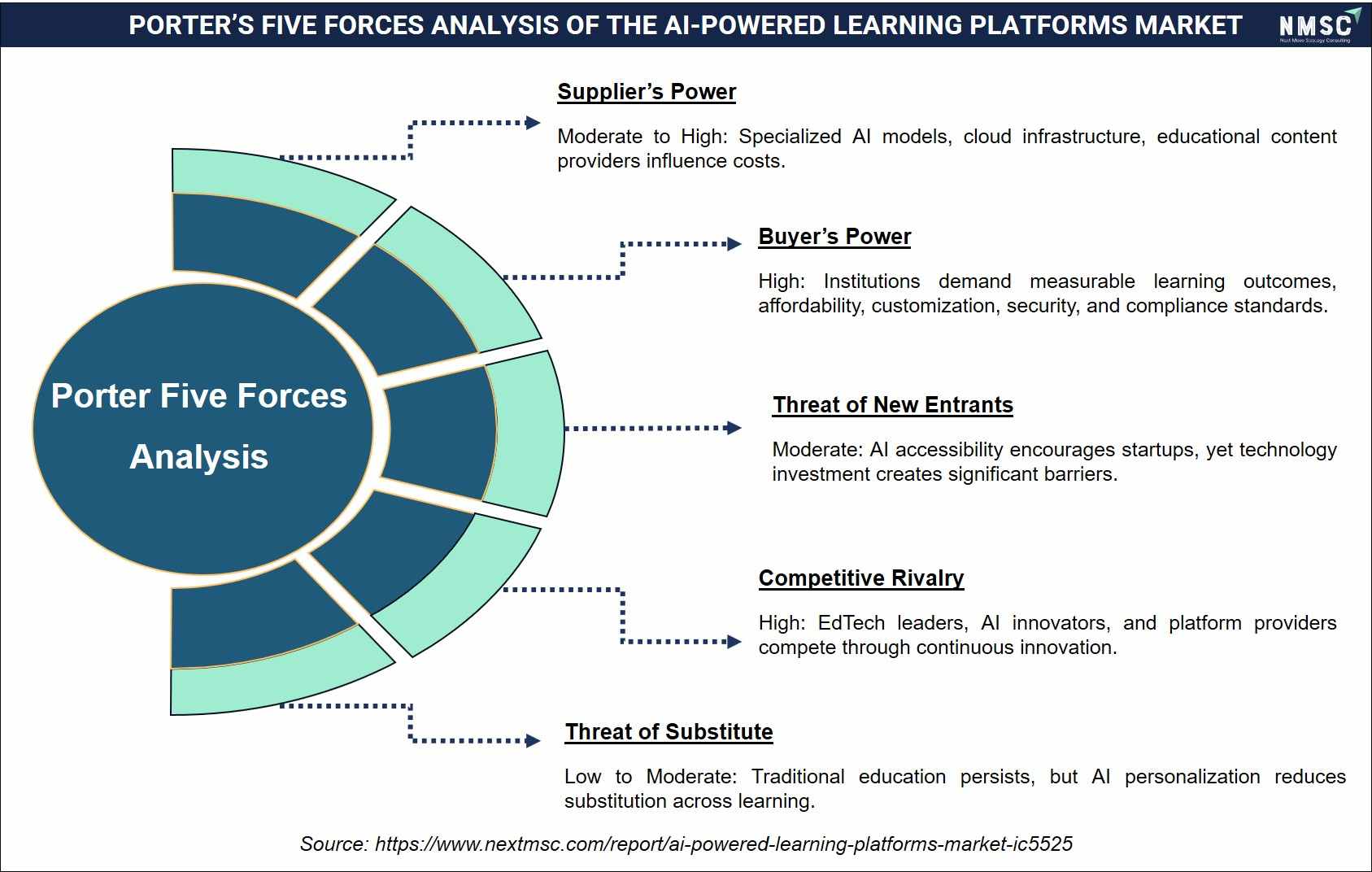
Based on our Porter's Five Forces assessment, we identified that competitive rivalry is high due to numerous AI-enabled learning platform providers competing through content quality, adaptive learning capabilities, and pricing strategies. The threat of new entrants remains moderate because technological advancements lower development barriers, although brand credibility and educational partnerships remain essential. Buyer bargaining power is high owing to abundant platform choices, while supplier bargaining power is moderate because AI infrastructure, cloud providers, and content creators are widely available. The threat of substitutes is moderate as traditional classroom education and conventional e-learning platforms continue to provide alternative learning methods.
Competitive Landscape
We found that the competitive landscape is moderately fragmented, with global technology conglomerates competing alongside specialized edtech vendors across distinct end-user verticals.
|
Dimension |
Details |
|
Market Structure |
Moderately fragmented, with 20 profiled vendors spanning enterprise software and specialized edtech providers |
|
Innovation Focus |
Generative AI content authoring, adaptive assessment engines, and predictive skills-gap analytics |
|
M&A Activity |
Selective acquisitions of adaptive learning and content-authoring startups by larger enterprise software vendors |
How Do Companies Compete in the AI-Powered Learning Platforms Market?
Companies compete primarily on adaptive algorithm accuracy, integration breadth with existing learning management systems, and depth of analytics dashboards offered to institutional buyers. Pricing strategies increasingly favor tiered subscription models tied to active learner counts rather than flat institutional licensing fees.
Which Competitive Archetypes Dominate the Market?
Three archetypes dominate: diversified technology conglomerates such as Microsoft Corporation offering embedded learning modules, pure-play edtech vendors such as Coursera, Inc. focused on content breadth, and enterprise learning specialists such as Cornerstone OnDemand, Inc. emphasizing workforce analytics integration.
What Innovation and Differentiation Strategies Are Vendors Pursuing?
Vendors are differentiating through proprietary adaptive algorithms, expanded generative AI authoring tools, and skills-taxonomy partnerships with industry certification bodies, aiming to strengthen defensibility against commoditized large language model integrations offered by smaller entrants.
What M&A Activity Is Shaping the Competitive Landscape?
M&A activity has concentrated on acquisitions of adaptive-content and assessment-analytics startups by larger platform vendors seeking to accelerate proprietary AI capability development rather than build such functionality internally, reflecting broader industry consolidation trends.
Key Market Players
We found that the following companies represent the leading providers of AI-powered learning platforms based on market-specific revenue and scale of operations as of 2026.
-
Duolingo, Inc.
-
2U, Inc.
-
Chegg, Inc.
-
Pearson plc
-
John Wiley & Sons, Inc.
-
Instructure Holdings, Inc.
-
D2L Corporation
-
Docebo Inc.
-
Cornerstone OnDemand, Inc.
-
Age of Learning, Inc.
-
Yixue Group
-
Microsoft Corporation
-
Alphabet Inc.
-
Amazon.com, Inc.
-
IBM Corporation
-
Adobe Inc.
-
Udemy, Inc.
-
Skillsoft Corp.
-
PowerSchool Holdings, Inc.
Latest Developments
We observed the following recent developments shaping vendor positioning and platform capability within the market.
|
Date |
Event |
|
July 2026 |
Instructure Holdings, Inc. announced the launch of Instructure Foundry, a dedicated internal venture structure to accelerate emerging EdTech product innovations. Alongside Foundry, the company introduced Project Athena, an AI-native study coach designed to provide contextual, real-time learning support within the Canvas ecosystem. |
|
May 2026 |
D2L Corporation hosted its inaugural D2L Launch Week, showcasing major product updates across its D2L Brightspace platform. The releases expanded D2L Lumi with AI-driven idea generation, quiz creation, and personalized learning intervention insights, while introducing enhanced communication tools to streamline administrative workflows for educational institutions and organizations. |
|
April 2026 |
Docebo Inc. unveiled Docebo AgentHub at Docebo Inspire 2026, marking its evolution into a unified enterprise platform combining learning, skills intelligence, and enterprise knowledge. The release also introduced the Docebo MCP (Model Context Protocol) Server, enabling secure integration with major large language models, including Claude, Microsoft Copilot, and ChatGPT, to deliver course recommendations and track learner certifications within enterprise workflows. |
Expert Insights
 “AI is rapidly reshaping the global education landscape. If deployed safely and strategically, AI can help adapt learning to the needs of each student, enabling an innovative, scalable personalized learning experience that is vital for both student engagement and the effectiveness of educators.”
— Saadia Zahidi, Managing Director, World Economic Forum
Statement made during the World Economic Forum's announcement on the transformative role of artificial intelligence in education, highlighting its potential to deliver scalable, personalized learning experiences while enhancing teaching effectiveness.
Market Interpretation
The statement underscores the transformative role of artificial intelligence in modern education by enabling personalized, adaptive, and scalable learning experiences. As educational institutions and enterprises increasingly adopt AI-powered learning platforms to improve learner engagement, optimize instructional delivery, and support individualized learning pathways, demand for intelligent educational technologies is expected to accelerate. This trend is anticipated to drive sustained growth in the global AI-Powered Learning Platforms Market.
Investment Opportunities
What Capital Inflows Are Supporting Market Expansion?
Venture capital and enterprise software investment continue to flow into adaptive learning and generative AI content-authoring startups. Our findings suggest that investor interest is concentrated on platforms demonstrating measurable learner outcome improvements alongside recurring subscription revenue models.
How Is Infrastructure Investment Shaping Platform Scalability?
Cloud infrastructure investment by hyperscale providers, including Amazon.com, Inc. and Microsoft Corporation, underpins platform scalability for institutional deployments. This infrastructure investment supports lower latency adaptive content delivery across geographically distributed learner populations.
What ESG Considerations Are Relevant to Market Investment?
Environmental, Social, and Governance considerations increasingly influence institutional procurement, with buyers evaluating vendor data governance practices and digital equity commitments. Government funding programs in several regions now require ESG disclosure as a condition of platform procurement contracts.
Key Benefits for Stakeholders
How Does This Report Benefit Enterprise and Institutional Leaders?
Enterprise and institutional leaders gain access to detailed segmentation, regional forecasts, and competitive benchmarking that support platform procurement and budget allocation decisions across K-12, higher education, and corporate learning environments.
How Does This Report Benefit Investors and Financial Analysts?
Investors and financial analysts benefit from validated market sizing, CAGR forecasts, and company-level competitive positioning that inform capital allocation decisions across the AI-powered learning platforms value chain.
How Does This Report Benefit Technology Vendors and Product Teams?
Technology vendors and product teams gain insight into emerging trends, growth opportunities, and regional demand patterns that inform product roadmap prioritization and go-to-market strategy across covered geographies.
Key Market Segments
By Component
-
Platform/Software
-
Services
By Deployment Mode
-
Cloud-based
-
On-premise
By End User
-
K-12 Education
-
Higher Education
-
Corporate/Enterprise Learning
-
Government & Public Sector
By Region
-
North America: U.S., Canada, Mexico
-
Europe: UK, Germany, France, Italy, Spain, Sweden, Denmark, Finland, Netherlands, Rest of Europe
-
Asia-Pacific: China, India, Japan, South Korea, Taiwan, Indonesia, Vietnam, Australia, Philippines, Malaysia, Rest of APAC
-
Middle East & Africa: Saudi Arabia, UAE, Egypt, Israel, Turkey, Nigeria, South Africa, Rest of MEA
-
Latin America: Brazil, Argentina, Chile, Colombia, Rest of LATAM
Conclusion and Recommendations
What Is the Long-Term Outlook for the Market?
The long-term outlook remains strongly positive, with the market projected to expand from USD 12.86 billion in 2026 to USD 103.47 billion by 2035 as institutional and enterprise buyers deepen reliance on AI-driven personalization across learning environments.
What Strategic Positioning Should Vendors Pursue?
Vendors should prioritize compliance-ready data architecture and measurable learner-outcome analytics to differentiate against commoditized generative AI integrations, while pursuing strategic partnerships with industry certification bodies to strengthen enterprise credibility.
How Attractive Is the Market for Investment?
Investment attractiveness remains high given sustained double-digit CAGR expectations and expanding enterprise reskilling budgets, though investors should weigh regulatory compliance costs and competitive intensity among well-capitalized technology conglomerates.
What Market Shifts and Key Risks Should Stakeholders Monitor?
Stakeholders should monitor tightening data privacy regulation, generative AI commoditization pressure, and potential public education funding volatility, each of which could affect procurement timelines across covered geographies.
What Are the Primary Growth Pathways for Market Participants?
Primary growth pathways include expansion into underpenetrated multilingual markets, deeper enterprise skills-analytics integration, and strategic acquisition of adaptive-content startups to accelerate proprietary AI capability development.
About the Author

About the Reviewer

At Next Move Strategy Consulting, we understand that insightful market research is the cornerstone of successful business decisions. That's why we employ a robust and multifaceted approach, combining various methodologies to deliver the most accurate and actionable data for our clients.

Research Landscape
We navigate the world of research with two primary approaches:
Qualitative Approach
Our qualitative research methodologies involve immersive techniques such as in-depth interviews, focus groups, and observational studies. By engaging directly with individuals and stakeholders, we uncover valuable insights that quantitative data alone may overlook.

Quantitative Research
In tandem with qualitative methodologies, NMSC leverages the power of Quantitative Research to provide a robust foundation of numerical insights. Through systematic data collection and analysis, we quantify patterns, preferences, and market trends, offering a comprehensive view of the business landscape.
Our quantitative research approach employs diverse tools, including surveys, experiments, and statistical modelling. These methodologies enable us to gather data from a large and representative sample, ensuring the statistical significance of our findings. By employing structured questionnaires and standardized data collection methods, we guarantee the reliability and validity of the information we present to our clients.
Quantitative research is particularly effective in measuring the prevalence of trends, assessing market size, and gauging the impact of various factors on consumer behavior. The numerical precision attained through this approach equips our clients with actionable insights, facilitating data-driven decision-making and strategy formulation.


Our Specialized Toolbox for Industry-Specific Market Research
We deploy a specialized arsenal of techniques tailored to meet your unique requirements. Here's a glimpse into our comprehensive toolbox:

Information Procurement
The stage entails acquiring market data or relevant information through various sources and methodologies.


Market Research Approach
We utilize both top-down and bottom-up approaches in market research analysis to achieve a comprehensive understanding of the market dynamics, leveraging the broad perspective of industry trends and macroeconomic factors alongside detailed insights from specific segments and individual companies.

Porters Five Forces Analysis
We conduct Porter's Five Forces analysis to evaluate the competitive landscape of an industry, providing us with insights into factors that affect profitability and strategic positioning.

SWOT Analysis

Forecasting
We utilize a forecasting model to predict future consumption by considering parameters like population, economics, regulations, market competition, drivers, constraints, technology, and pricing. We also employ statistical techniques such as multilinear regression, exponential smoothing, moving average, ARIMA, and Monte Carlo simulations for accurate predictions. In econometric forecasting, we analyzed short-term and long-term event impacts, attributing values based on regulatory frameworks, economic factors, and market events.





 Speak to Our Analyst