AI Transparency Technology Market Global Industry Analysis and Forecast (2026–2035)

Revenue climbs from USD 2.40 Billion in 2025 to USD 20.80 Billion by 2035, a 23.8% CAGR over 2026–2035, as EU Article 50 duties, India labelling rules and agent governance needs lift demand, with North America leading regional spend.

Download Free Sample PDF
Base Year (2025)
$2.40 Billion
Forecast (2035)
$20.80 Billion
CAGR (2026-2035)
23.8%
Top Region
North America

What Is the AI Transparency Technology Market Size?

The global AI Transparency Technology Market reached USD 2.40 Billion in 2025 and is estimated at USD 3.05 Billion in 2026, rising to USD 20.80 Billion by 2035 at a 23.8% CAGR from 2026–2035. North America holds about 40% share in 2025, while AI governance and documentation platforms account for roughly 32% of offering revenue.

We observed that buyers now treat explainability, documentation and content provenance as one budget line tied to regulatory deadlines rather than separate research projects.

AI Transparency Technology Market Global Industry Analysis and Forecast (2026–2035) Revenue Forecast

Values in USD Billion

2025 $2.40 Billion
2025
2026 $3.05 Billion
2026
2027 $3.78 Billion
2027
2028 $4.67 Billion
2028
2029 $5.79 Billion
2029
2030 $7.16 Billion
2030
2031 $8.87 Billion
2031
2032 $10.98 Billion
2032
2033 $13.59 Billion
2033
2034 $16.83 Billion
2034
2035 $20.80 Billion
2035

Key Takeaways

By Offering: AI governance and documentation platforms held the largest share, expanding from USD 0.77 Billion in 2025 to USD 6.87 Billion by 2035; Content provenance and watermarking tools is the fastest growing at 30.3% CAGR from 2026–2035.

By Application: Regulatory compliance and audit reporting held the largest share, expanding from USD 0.81 Billion in 2025 to USD 7.49 Billion by 2035; Content authentication and disclosure is the fastest growing at 29.2% CAGR from 2026–2035.

By End User: BFSI held the largest share, expanding from USD 0.74 Billion in 2025 to USD 5.82 Billion by 2035; Healthcare and life sciences is the fastest growing at 24.5% CAGR from 2026–2035.

Dominant Region: North America led with USD 0.96 Billion in 2025, about 40% of global revenue, and is projected to reach USD 6.86 Billion by 2035.

Fastest-Growing Region: Middle East & Africa is the fastest growing at 26.2% CAGR from 2026–2035, rising from USD 0.14 Billion in 2025 to USD 1.46 Billion by 2035.

Dominant Country: The U.S. led with USD 0.78 Billion in 2025 and is projected to reach USD 5.28 Billion by 2035.

Fastest-Growing Country: India is the fastest growing at 34.5% CAGR from 2026–2035, rising from USD 0.05 Billion in 2025 to USD 1.01 Billion by 2035.

The AI Transparency Technology market offers an absolute investment opportunity of approximately USD 17.75 Billion between 2026 and 2035; an incremental pool tied to mandatory disclosure.

According to NMSC analysis, the market is moving from voluntary model documentation toward machine verifiable evidence, because regulators in Europe and India now expect labels and provenance metadata that software can read and audit. Vendors that connect explainability, monitoring and content provenance in one workflow are better placed to win multi-year contracts, since compliance teams prefer a single audit trail across models, agents and generated media. This shift lengthens contract duration and raises the share of recurring subscription revenue.

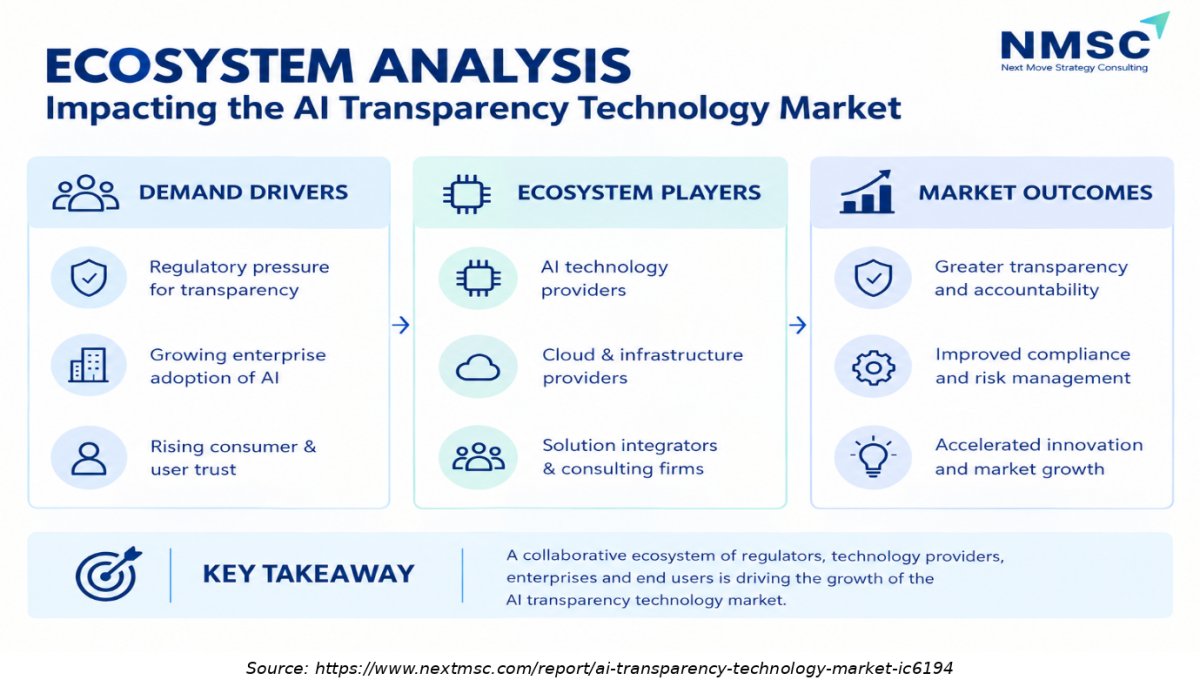
Ecosystem Analysis Impacting the AI Transparency Technology Market

The infographic on Ecosystem Analysis Impacting the AI Transparency Technology Market highlights the key stakeholders and technologies shaping the market, including AI developers, regulatory bodies, and transparency tools. It emphasizes the importance of explainable AI, ethical practices, data governance, and accountability in building trust in AI systems. These elements help organizations improve transparency, ensure responsible AI adoption, and strengthen user confidence.

What Does the AI Transparency Technology Market Encompass?

The AI Transparency Technology Market covers software, platforms and services that make artificial intelligence systems explainable, documented, monitored and verifiable. It spans explainability and interpretability tools, model monitoring and observability tools, AI governance and documentation platforms, and content provenance and watermarking tools. Buyers include banks, hospitals, media groups, public agencies and technology vendors that must show how automated decisions are made and how synthetic content is labelled. The scope excludes general model development platforms and generic cybersecurity products.
Regulatory developments are creating demand for specific AI transparency capabilities, particularly content marking, detection, disclosure and provenance verification. Article 50 of the EU AI Act applies from 2 August 2026 to the transparency obligations within its scope. The European Commission published its Code of Practice on marking and labelling AI-generated content in June 2026. India notified labelling rules for synthetic media in February 2026. Technology adoption is moving toward cryptographic content credentials, invisible watermarks and agent level audit trails, supported by model cards and transparency notes from large vendors.

Market Drivers & Dynamics

Interactive Dataset
EU AI Act Article 50 transparency duties driver +4.5% Europe and global providers 2026–2030
Mandatory labelling and provenance rules in India and other Asia-Pacific jurisdictions driver +3.2% Asia-Pacific 2026–2031
Enterprise rollout of autonomous AI agents that require audit trails driver +3.8% North America, Europe 2026–2033
Interoperability of C2PA credentials and invisible watermarks driver +2.9% North America, Europe 2026–2030
Marketplace and platform distribution of governance tools driver +1.4% Global 2026–2029
Lack of agreed explainability metrics for large language models restraint −2.6% Global 2026–2031
Watermark removal and spoofing risks restraint −1.8% Global 2026–2030
Postponed high risk obligations under the EU AI Omnibus restraint −1.2% Europe 2026–2027
Overlap with existing GRC and MLOps budgets restraint −1.5% North America 2026–2029
Source: Next Move Strategy Consulting

Growth Drivers

What Is the Primary Growth Driver in the AI Transparency Technology Market?

Regulation is the primary driver. The European Commission states that Article 50 transparency duties for marking and labelling AI generated content apply from 2 August 2026, and it confirmed the Code of Practice as an adequate voluntary tool for demonstrating compliance. Providers must therefore deploy machine readable marking and detection, and deployers must label deepfakes. These duties convert AI governance from a policy topic into a budgeted compliance workflow, lifting demand across the AI Transparency Technology Market.

How Is Synthetic Media Regulation Driving the AI Transparency Technology Market Growth?

India notified amendments to its IT Rules on 10 February 2026, effective 20 February 2026, requiring prominent labels on synthetically generated audio and visual content. Significant social media intermediaries, defined as platforms with more than 5 million registered users, must collect user declarations and verify them with technical measures. We found that comparable obligations in Europe create a shared technical requirement for provenance metadata, which favours vendors with interoperable detection services.

Growth Inhibitors

What Is Restraining the AI Transparency Technology Market?

Technical immaturity is the main restraint. Explainability methods for large language models lack agreed metrics, so buyers struggle to compare tools, and watermarks can be degraded or removed, which limits legal reliance on a single signal. The EU Digital Omnibus on AI also postponed obligations for high-risk systems to December 2027, which delays part of the demand wave. Based on research conducted by NMSC, we found that these factors trim about 7.1 percentage points from cumulative growth impact across the matrix.

What Are the Growth Opportunities?

Can Provenance as a Service Become a Standard Layer for Media and Advertising?

Publishers and advertisers need a quick way to check whether images, video and audio carry watermarks or signed credentials before publication. Providers offering content-detection APIs, such as Google's AI Content Detection API, can integrate verification capabilities into publishing and media workflows. Usage-based pricing is a potential commercial model and should not be presented as confirmed without published pricing evidence. Content provenance and watermarking tools, projected at USD 4.99 Billion by 2035, are the main beneficiary segment.

Can Compliance Ready Governance Capture Regulated Industry Budgets?

Banks, insurers and hospitals face overlapping obligations, so governance, risk and compliance platforms that map controls to the EU AI Act, NIST and ISO standards can displace spreadsheets. Certain EU AI Act requirements for high-risk AI systems apply from 2 December 2027, while requirements for high-risk systems covered by product legislation apply from 2 August 2028. These timelines provide different preparation periods for affected organizations and technology vendors. AI governance and documentation platforms and the BFSI and healthcare segments gain most from this shift.

Can India and the Gulf Become the Next Volume Markets for Disclosure Tooling?

India labelling rules, in force since February 2026, and national AI programmes across the Gulf create demand for detection and disclosure software among local platforms and government agencies. Vendors that localise language support and offer cloud hosted verification can win early contracts. The content authentication and disclosure application and the Asia-Pacific and Middle East & Africa regions benefit most, with India projected at 34.5% CAGR from 2026–2035.

Segmentation Analysis

2025 (USD Billion)
2035 (USD Billion)
Explainability and interpretability tools 2025: $0.72 Billion | 2035: $3.74 Billion
Explainabili
Model monitoring and observability tools 2025: $0.62 Billion | 2035: $5.20 Billion
Model monito
AI governance and documentation platforms 2025: $0.77 Billion | 2035: $6.87 Billion
AI governanc
Content provenance and watermarking tools 2025: $0.29 Billion | 2035: $4.99 Billion
Content prov
Explainability and interpretability tools $0.72 Billion $3.74 Billion 17.9%
Model monitoring and observability tools $0.62 Billion $5.20 Billion 23.3%
AI governance and documentation platforms $0.77 Billion $6.87 Billion 24.6%
Content provenance and watermarking tools $0.29 Billion $4.99 Billion 30.3%

Which Offering Segment Leads the AI Transparency Technology Market?

AI governance and documentation platforms lead the AI Transparency Technology Market with USD 0.77 Billion in 2025 and are projected to reach USD 6.87 Billion by 2035, because regulators and auditors ask for a single record of datasets, models, controls and approvals. Content provenance and watermarking tools are the fastest growing at 30.3% CAGR from 2026–2035, supported by Article 50 marking duties and platform labelling rules. Explainability tools grow more slowly as buyers fold them into broader platforms.
2025 (USD Billion)
2035 (USD Billion)
Regulatory c
Bias and ris
Content auth
Model debugg
Segment Item 2025 (USD Billion) 2035 (USD Billion) CAGR
Regulatory compliance and audit reporting $10.0 USD Billion $40.0 USD Billion 25.0%
Bias and risk management $17.1 USD Billion $51.1 USD Billion 11.0%
Content authentication and disclosure $24.2 USD Billion $62.2 USD Billion 25.0%
Model debugging and performance assurance $31.3 USD Billion $73.3 USD Billion 11.0%

Segment-wise data is locked

Unlock complete segment-wise numbers for By Application.

Unlock Full Data
2025 (USD Billion)
2035 (USD Billion)
BFSI
Healthcare a
IT
telecom and
Government a
Segment Item 2025 (USD Billion) 2035 (USD Billion) CAGR
BFSI $10.0 USD Billion $40.0 USD Billion 27.0%
Healthcare and life sciences $17.1 USD Billion $51.1 USD Billion 9.0%
IT $24.2 USD Billion $62.2 USD Billion 19.0%
telecom and media $31.3 USD Billion $73.3 USD Billion 17.0%
Government and public sector $38.4 USD Billion $84.4 USD Billion 18.0%

Segment-wise data is locked

Unlock complete segment-wise numbers for By End User.

Unlock Full Data

Growth Opportunities

We observed that three whitespace areas can generate disproportionate revenue through 2035.

Can Provenance as a Service Become a Standard Layer for Media and Advertising?

Publishers and advertisers need a quick way to check whether images, video and audio carry watermarks or signed credentials before publication. Providers offering content-detection APIs, such as Google's AI Content Detection API, can integrate verification capabilities into publishing and media workflows. Usage-based pricing is a potential commercial model and should not be presented as confirmed without published pricing evidence. Content provenance and watermarking tools, projected at USD 4.99 Billion by 2035, are the main beneficiary segment.

Can Compliance Ready Governance Capture Regulated Industry Budgets?

Banks, insurers and hospitals face overlapping obligations, so governance, risk and compliance platforms that map controls to the EU AI Act, NIST and ISO standards can displace spreadsheets. Certain EU AI Act requirements for high-risk AI systems apply from 2 December 2027, while requirements for high-risk systems covered by product legislation apply from 2 August 2028. These timelines provide different preparation periods for affected organizations and technology vendors. AI governance and documentation platforms and the BFSI and healthcare segments gain most from this shift.

Can India and the Gulf Become the Next Volume Markets for Disclosure Tooling?

India labelling rules, in force since February 2026, and national AI programmes across the Gulf create demand for detection and disclosure software among local platforms and government agencies. Vendors that localise language support and offer cloud hosted verification can win early contracts. The content authentication and disclosure application and the Asia-Pacific and Middle East & Africa regions benefit most, with India projected at 34.5% CAGR from 2026–2035.

Regional Outlook

2025 (USD Billion)
2035 (USD Billion)
North Americ
Europe
Asia-Pacific
Middle East
Latin Americ
Region 2025 (USD Billion) 2035 (USD Billion) CAGR (%)
North America $10.0 USD Billion $40.0 USD Billion 9.0%
Europe $17.1 USD Billion $51.1 USD Billion 27.0%
Asia-Pacific $24.2 USD Billion $62.2 USD Billion 25.0%
Middle East & Africa $31.3 USD Billion $73.3 USD Billion 23.0%
Latin America $38.4 USD Billion $84.4 USD Billion 12.0%

Regional data is locked

Unlock complete regional numbers for this market.

Unlock Full Data

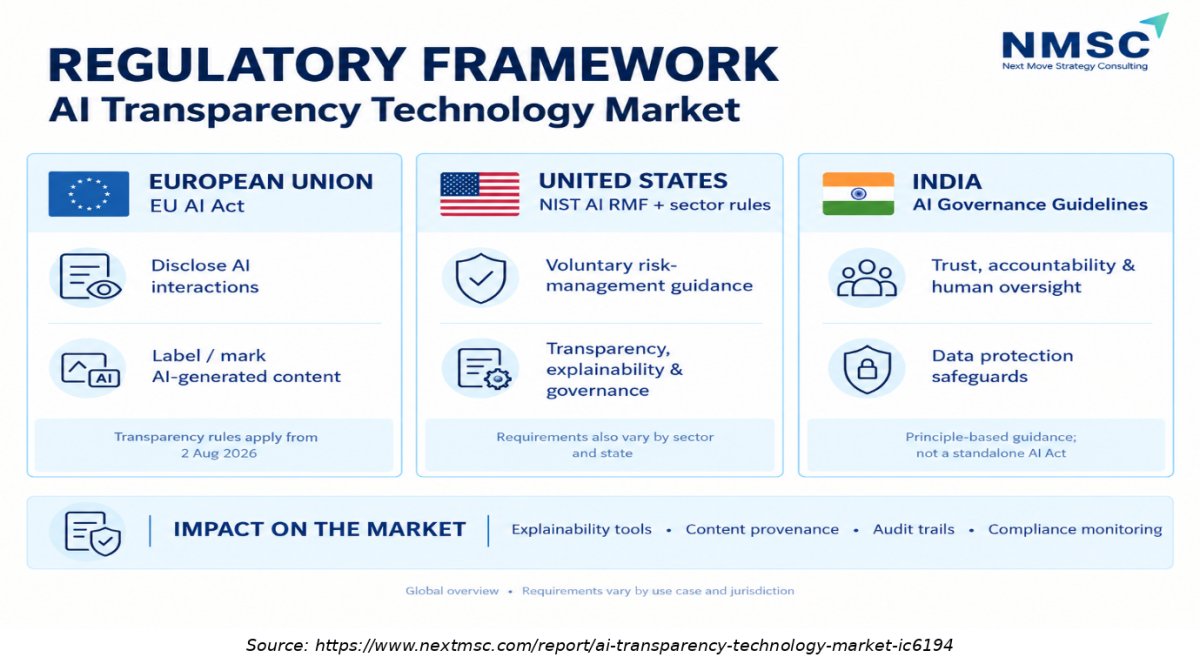
Regulatory Framework of AI Transparency Technology Market
The infographic on Regulatory Framework of the AI Transparency Technology Market highlights the laws, policies, and standards guiding transparent and responsible AI development. It focuses on data privacy, algorithmic accountability, explainability, and ethical AI practices. These regulatory measures help organizations build trustworthy AI systems, ensure compliance, and strengthen public confidence in AI technologies. The framework can also be tailored to specific regional regulations for greater relevance.
Competitive Landscape

Our findings suggest that competition is shifting from standalone explainability toolkits to integrated control planes that cover models, agents and generated media.

How Do Companies Compete in the AI Transparency Technology Market?

Competition runs along three lines in the AI Transparency Technology Market. Hyperscale’s bundle model documentation, safety evaluation and content credentials with cloud services, which lowers the entry price for existing customers. Enterprise software vendors such as IBM and ServiceNow position governance as a cross-vendor control layer, while specialists like Credo AI and Fiddler AI sell depth in risk controls and observability. Subscription pricing by model, agent or monitored volume is common, and vendors expand geographically through marketplaces and partners.

Which Vendor Archetypes Dominate?

Three archetypes dominate. Platform providers, including Microsoft Corporation, Alphabet Inc. and Amazon.com, Inc., differentiate on integration and scale. Enterprise governance suites, led by International Business Machines Corporation and ServiceNow, Inc., differentiate on workflow, audit evidence and multi-vendor coverage. Specialists such as Credo.AI Corp. and Fiddler AI differentiate on policy controls, evaluation and runtime monitoring, while Adobe Inc. differentiates on creator facing content credentials.

How Do Vendors Differentiate Through Innovation?

Innovation focuses on runtime enforcement, automated evidence and interoperable provenance. Fiddler AI describes a neutral control plane for compound AI systems, and Credo AI added an agent registry with trace level policy enforcement. Vendors also test explainers and detectors on synthetic data to cover rare failure cases without exposing customer records. Google and Adobe invest in watermark and credential detection, which raises technical barriers for smaller entrants.

What Is the Pattern of M&A Activity?

Consolidation follows capability gaps rather than scale. ServiceNow's acquisition of Veza strengthens its identity-security and access-governance capabilities. Any claim that Veza's capabilities have been integrated into AI Control Tower specifically for AI agent risk should be supported by direct product-integration evidence. Fiddler AI closed a Series C round of USD 0.03 Billion in January 2026, bringing total funding to USD 0.10 Billion, which signals investor appetite for independent control planes. We expect further tie ups between governance specialists, security vendors and cloud marketplaces as agent oversight becomes a standard requirement.

Key Market Players

NMSC's analysis indicates that eight companies met our validation criteria through official company sources, and they are listed in ranked order of breadth of deployed transparency tooling.

Microsoft Corporation Alphabet Inc. International Business Machines Corporation Amazon.com, Inc. Adobe Inc. ServiceNow, Inc. Credo.AI Corp. Fiddler AI

Latest Developments

We found that regulatory milestones and agent governance launches dominated announcements during 2026.

Date Event
October 2026 IBM expanded watsonx. governance AI Asset Discovery to identify AI agents and related knowledge bases across Google Cloud Gemini Enterprise Agent Platform, AWS Bedrock Agent Core, Azure AI Foundry, and watsonx Orchestrate
May 2026 In its I/O 2026 keynote, Google announced expanded verification capabilities for SynthID and Content Credentials across Google Search and Chrome. These capabilities are intended to help users assess content provenance and potential AI generation or modification
March 2026 Credo AI launched a free AI Governance Insights Hub, a continuously updated knowledge graph linking AI regulations, risk scenarios, and governance controls
February 2026 Credo AI previewed GAIA, an AI assistant within its governance platform that drafts use-case metadata and questionnaire responses, recommends relevant risk scenarios, and maps risks to mitigating controls
May 2025 Microsoft announced the public preview of Azure AI Foundry Observability, a unified layer for governance, evaluation, tracing, and monitoring across the AI application lifecycle. Separately, Credo AI introduced Credo AI Agent Governor to govern autonomous AI agents.
April 2025 Adobe launched the public beta of its free Content Authenticity app, allowing creators to attach secure Content Credentials to digital work

Expert Insights

Ania Kaci

Ania Kaci

Senior Principal and Responsible AI Leader | Schneider Electric

"“We worked on what we call our system cards. We think of them as detailed ID cards for each AI system.”"

Analyst Interpretation

The statement illustrates the role of structured AI documentation in improving transparency. System cards can organize information about a model’s intended purpose, capabilities, limitations, data flows, and oversight arrangements. These practices support the development of AI transparency tools that help organizations document, evaluate, and communicate how their systems operate throughout the AI lifecycle.

Investment Opportunities

Where Are Capital Inflows Concentrating?

Venture funding concentrates in control planes for agents and in observability platforms. Fiddler AI closed a Series C round of USD 0.03 Billion in January 2026 and reports total funding of USD 0.10 Billion, with strategic investors from technology, advertising and consulting participating. That mix signals that buyers see transparency tooling as core infrastructure rather than an optional add on. We found that capital favours vendors with regulated industry references and demonstrable audit outcomes.

How Is Infrastructure Investment Evolving?

Hyperscale’s and enterprise software groups are investing in detection services, evaluation pipelines and AI agent observability at the infrastructure layer. Google launched an AI Content Detection API on its Gemini Enterprise Agent Platform in 2026, and ServiceNow integrated AI Control Tower with the NVIDIA Enterprise AI Factory validated design. These investments embed transparency functions in the cloud and data centre stack, which reduces integration effort for customers and creates durable platform revenue for providers.

What ESG Considerations Shape Investment Decisions?

Investors treat transparency as evidence of governance quality, because undisclosed model behaviour and unlabelled synthetic media create legal and reputational exposure. Digital ethics commitments increasingly appear in board reporting, and labelling duties protect consumers from deception. Energy use from continuous monitoring is modest compared with model training, although large scale detection adds compute demand. Funds therefore prefer vendors that publish documentation, support audits and avoid opaque scoring.

Key Benefits for Stakeholders

How Does This Report Help Enterprise and Industry Leaders?

Enterprise leaders gain a segment level view of where transparency spend is heading, from USD 3.05 Billion in 2026 to USD 20.80 Billion by 2035. The analysis of offerings, applications and end user industries helps chief risk, data and compliance officers sequence purchases around the Article 50 and India labelling deadlines. Regional and country insights also show which jurisdictions will demand local hosting, language support and evidence formats.

How Does This Report Help Investors and Financial Analysts?

Investors receive a reconciled forecast with a 23.8% CAGR over 2026–2035, an absolute opportunity of USD 17.75 Billion, and segment growth rates that separate regulation driven demand from discretionary spend. The competitive analysis and validated company set help screen platform leaders and specialists. The growth matrix quantifies drivers and restraints, which supports scenario work on valuation and exit timing.

How Does This Report Help Technology Vendors and Product Teams?

Vendors can use the segmentation to prioritise roadmaps, for example by pairing content credentials with watermark detection or by adding agent traces to existing monitoring products. The regional outlook identifies where partner ecosystems and marketplaces matter most. Product teams also gain a view of documentation formats that buyers request, including model cards, transparency notes and audit ready evidence packs.

Key Market Segments Evaluated

By Offering

  • Explainability and interpretability tools
  • Model monitoring and observability tools
  • AI governance and documentation platforms
  • Content provenance and watermarking tools

By Application

  • Regulatory compliance and audit reporting
  • Bias and risk management
  • Content authentication and disclosure
  • Model debugging and performance assurance

By End User

  • BFSI
  • Healthcare and life sciences
  • IT, telecom and media
  • Government and public sector
  • Retail and manufacturing

By Region

  • North America 
    • U.S.
    • Canada
    • Mexico.
  • Europe 
    • UK
    • Germany
    • France
    • Italy
    • Spain
    • Sweden
    • Denmark
    • Finland
    • Netherlands
    • Rest of Europe.
  • Asia-Pacific 
    • China
    • India
    • Japan
    • South Korea
    • Taiwan
    • Indonesia
    • Vietnam
    • Australia
    • Philippines
    • Malaysia
    • Rest of APAC.
  • Middle East & Africa 
    • Saudi Arabia
    • UAE
    • Egypt
    • Israel
    • Turkey
    • Nigeria
    • South Africa
    • Rest of MEA.
  • Latin America 
    • Brazil
    • Argentina
    • Chile
    • Colombia
    • Rest of LATAM.

Conclusion & Recommendations

The outlook is one of sustained expansion, with revenue rising from USD 3.05 Billion in 2026 to USD 20.80 Billion by 2035. Growth moves from a regulation led start toward a broader operating requirement, as agents, synthetic media and automated decisions spread across industries. We observed that spending shifts from pilots to multi-year platform contracts once compliance owners need continuous evidence.

What Strategic Positioning Recommendations Does NMSC Offer?

Vendors should connect explainability, monitoring, documentation and provenance in one evidence layer and publish interoperable interfaces. Platform providers should prioritise detection services and credential support, while specialists should focus on regulated industries and agent governance. Buyers should consolidate overlapping tools and require exportable audit records, because switching costs rise once governance data is embedded in workflows.

What Defines Investment Attractiveness in the AI Transparency Technology Market?

Investment attractiveness rests on regulation backed demand, recurring revenue and a USD 17.75 Billion incremental opportunity between 2026 and 2035. Content provenance and watermarking tools offer the highest growth at 30.3%, while governance platforms offer the largest base. Investors should favour companies with regulated industry references, cloud marketplace access and credible roadmaps for agent oversight.

What Are the Market Shifts and Key Risks in the AI Transparency Technology Market?

The main shift is from model level explanations to system level evidence that spans agents and generated media. Key risks include immature explainability metrics for large language models, watermark robustness limits and uneven enforcement across jurisdictions. The postponement of high-risk obligations in Europe to December 2027 may also smooth demand, so vendors should model slower adoption in compliance heavy segments.

What Are the Primary Growth Pathways Through 2035?

Three pathways stand out. Provenance as a service can lift content provenance and watermarking tools to USD 4.99 Billion by 2035. Compliance ready governance for banks and hospitals can scale platform revenue, and disclosure tooling in India and the Gulf can open new volume markets. Together these pathways support the forecast without relying on a single technology or region.

FAQs

Sources & References

1.

European Commission, Code of Practice on Transparency of AI-Generated Content (FAQ)

digital-strategy.ec.europa.eu
2.

European Commission, Signing the Code of Practice on Transparency of AI-Generated Content

digital-strategy.ec.europa.eu
3.

European Commission, Launch of work on a code of practice on marking and labelling AI-generated content

digital-strategy.ec.europa.eu
4.

European Commission, First Draft Code of Practice on Transparency of AI-Generated Content

digital-strategy.ec.europa.eu
5.

Ministry of Electronics and Information Technology, Government of India, IT Amendment Rules 2026 (Gazette notification)

meity.gov.in
6.

IBM, Governing assets with watsonx. governance

ibm.com
7.

Microsoft Learn, Transparency Note for Foundry risk and safety evaluations

learn.microsoft.com
8.

Google, SynthID Detector, a new portal to help identify AI-generated content

blog.google
9.

Amazon Web Services, Introducing AWS AI Service Cards

aws.amazon.com
10.

Adobe, Adobe Content Authenticity web app announcement

news.adobe.com
11.

ServiceNow Newsroom, ServiceNow expands AI Control Tower

newsroom.servicenow.com
12.

Fiddler AI via Business Wire, Fiddler Raises $30M Series C

businesswire.com
13.

Credo AI, company blog

credo.ai

About the Author

Mayurima Roy

Mayurima Roy

Mayurima Roy is Research Analyst at Next Move Strategy Consulting, where she has spent 4 years working across the firm's full industry coverage rather than a single fixed vertical. Her work centers on structured research, ongoing trend tracking, competitive assessment, and insight-led content development, translating complex market data into clear, decision-ready narratives that support informed client decision-making across diverse global industries, market sectors, and world regions every day.

About the Reviewer

Supradip Baul

Supradip Baul

Supradip Baul is an accomplished business consultant and strategist with over a decade of rich experience in market intelligence, strategy, technology, and business transformation. His work has included rigorous qualitative and quantitative analysis across multiple industries, helping clients shape investment decisions and long-term roadmaps. Earlier in his career, he was associated with Gartner, where he contributed to industry-leading reports and market share analyses. He has worked with leading global companies and holds an MBA with a dual specialization in Marketing and Finance.

Download Free Sample

Henri Knyphausen

HENRI KNYPHAUSEN

Partner at Singulier [Ex-BCG]

Singulier

I recently engaged NEXTMSC.com for a commercial due diligence project within the intralogistics sector, and I am pleased to provide a reference based on my experience. In utilizing NEXTMSC.com's services, I found their report to offer valuable insights into market dynamics and key industry players. The initial report provided a solid foundation for our analysis. However, as we were investigating a smaller target in the market, and I had specific customization requests requiring additional research. These requests included detailed information on product portfolios of various players and sub-market sizes, both inclusive and exclusive of certain product categories. NEXTMSC.com demonstrated commendable responsiveness and agility in accommodating these customization requests. Within a timeframe of 1-2 weeks, they delivered a revised report that met our specific needs. Furthermore, they were receptive to my follow-up inquiries, ensuring clarity and understanding of the data provided. The final deliverable significantly contributed to our due diligence efforts. One of NEXTMSC.com's notable strengths lies in their qualitative research capabilities. However, for future engagements, I would recommend the inclusion of a quantified market model in Excel format. Such a model would offer the ability to conduct in-depth analyses and explore various market segments, including country-specific data and subcomponent breakdowns. Based on my positive experience, I would not hesitate to work with NEXTMSC.com again. Their responsiveness, willingness to accommodate customization requests, and commitment to delivering actionable insights make them a reliable partner for commercial research projects.

Gaurav Jaiswal

GAURAV JAISWAL

Founder & CEO

Yano Charge Private Limited

The EV Charging market research report provided by the NextMSC was exceptionally detailed and insightful. It offered a comprehensive analysis that proved to be a game-changer for our strategic planning. Truly a testament to the NextMSC’s expertise and thoroughness in EV market landscape & analysis.

Kevin Coker

KEVIN COKER

Founder, CEO and Board Diector

Proxima Clinical Research

I have been using Next MSC reports for product positioning in a new geography for a long time. They have by far the best reports I have found and the price is reasonable too!

Mohit Agarwal

MOHIT AGARWAL

Chief Manager

DryChem India Pvt. Ltd.

Next Move Strategy Consulting is an amazing team of consultants. We required a market study report for our investors on top priority and the team went above and beyond our expectations to deliver the same with ample supporting data within a short time span enabling us to secure the investments and keep our project timeline maintained. Their professionalism, attention to detail, and timely delivery of actionable recommendations have left a lasting impression on our organization.

Nishant Awate

NISHANT AWATE

Business Development Global Sales

Zehnder Group Deutschland GmbH

Our experience working with Next Move Strategy Consulting was positive. The team was responsive, professional, and open to incorporating our specific requirements throughout the project. The India AHU market study was comprehensive and well structured, covering market value and volume forecasts, product and application segments, and key industry trends. The inclusion of both AHU and residential MVHR market insights made the study particularly relevant for our strategic market assessment. Overall, the report provides a solid foundation for evaluating market potential, identifying priority segments, and supporting business-development decisions in India.

Custom Market Research Services

We will customize the research for you if the listed report does not fully match your requirements.

Get 30% Free Customization

Select License

This website uses cookies to ensure you get the best experience on our website. Learn more

✖