AI Upsell Cross-Sell Market Size, Share, Trends and Growth Analysis, By Solution Category (Recommendation Engine, Customer Intelligence, Revenue Intelligence, Customer Engagement, and AI Agent), By AI Technology (Predictive AI, Generative AI, and Recommendation AI), By Deployment Model, By Application, By Commercial Model, By Buyer Size, By End User, and Region — Global Industry Report and Forecast, 2026–2035
Industry: ICT & Media | Publishing Date: July 22, 2026 | Last Updated: September 30, 2026 | No of Pages: N/A | No. of Tables: N/A | No. of Figures: N/A | Format: PDF | Report Code: IC5319
What Is the AI Upsell Cross-Sell Market Size?
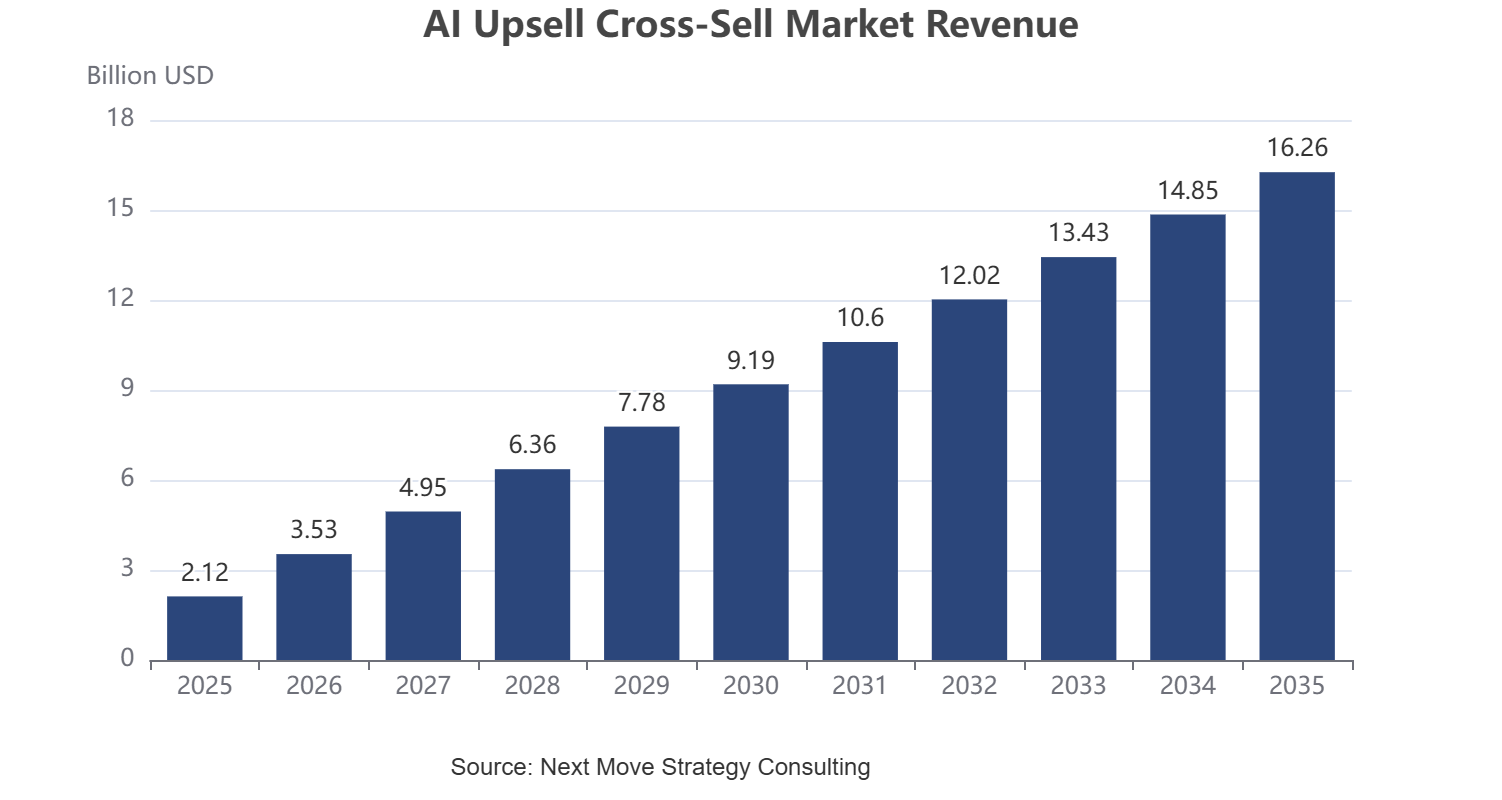
The AI Upsell Cross-Sell Market size was valued at USD 2.12 billion in 2025 and is estimated at USD 2.60 billion in 2026, forecast to reach USD 16.26 billion by 2035, expanding at a 22.6% CAGR between 2026 and 2035. North America leads with approximately a 46% share, while Recommendation Engine solutions dominate with approximately a 40% share.
We observed that growth is broad-based across every segmentation axis, with AI Agent solutions and Technology Software buyers driving the fastest structural shifts as generative and agentic AI move into core revenue workflows through 2035.
|
Key Takeaways |
|
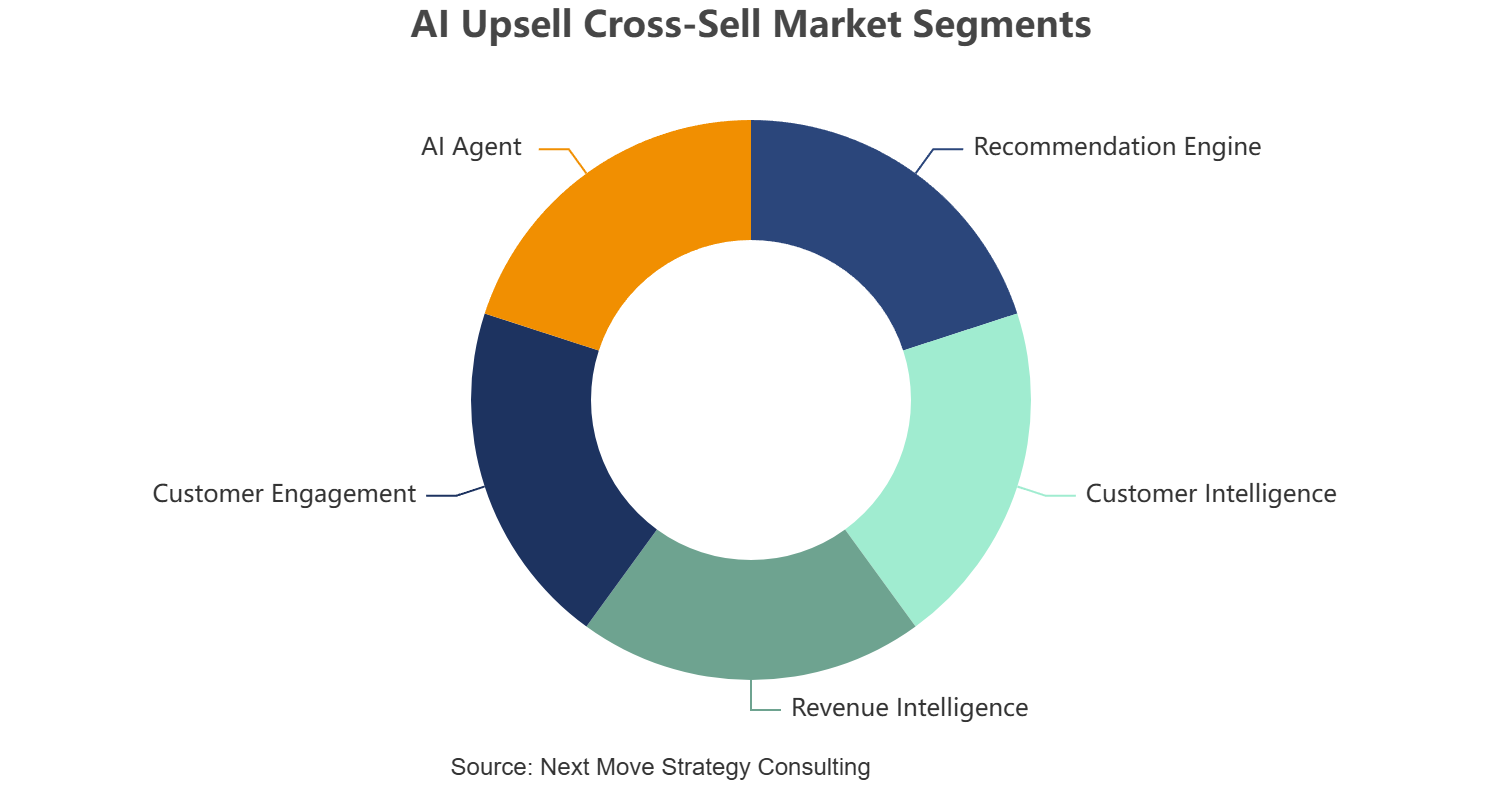
By Solution Category: Recommendation Engine held the largest share of approximately 40% (USD 0.85 billion) in 2025; AI Agent is the fastest-growing sub-segment at 36.7% CAGR from 2026–2035. |
|
By AI Technology: Recommendation AI held the largest share of approximately 45% (USD 0.95 billion) in 2025; Generative AI is the fastest-growing sub-segment at 27.2% CAGR from 2026–2035. |
|
By Deployment Model: Cloud Deployment held the largest share of approximately 78% (USD 1.65 billion) in 2025; Hybrid Deployment is the fastest-growing sub-segment at 27.0% CAGR from 2026–2035. |
|
By Application: Commerce Upsell Cross-sell held the largest share of approximately 42% (USD 0.89 billion) in 2025; Customer Success Expansion is the fastest-growing sub-segment at 26.1% CAGR from 2026–2035. |
|
By Commercial Model: Subscription held the largest share of approximately 72% (USD 1.53 billion) in 2025; Services is the fastest-growing sub-segment at 28.2% CAGR from 2026–2035. |
|
By Buyer Size: Enterprise held the largest share of approximately 55% (USD 1.17 billion) in 2025; SMB is the fastest-growing sub-segment at 27.6% CAGR from 2026–2035. |
|
By End User: Retail E-commerce held the largest share of approximately 30% (USD 0.64 billion) in 2025; Technology Software is the fastest-growing sub-segment at 25.5% CAGR from 2026–2035. |
|
Dominant Region: North America dominated with approximately 46% revenue share (USD 0.98 billion) in 2025. |
|
Fastest-Growing Region: Asia-Pacific is expected to register the highest CAGR of 27.2% during 2026–2035. |
|
Dominant Country: U.S. led with approximately USD 0.80 billion in 2025. |
|
Fastest-Growing Country: India is the fastest-growing country at approximately 31.5% CAGR from 2026–2035. |
Market Opportunity: The AI upsell cross-sell market is expected to create an absolute dollar opportunity of USD 13.66 billion between 2026 and 2035, presenting significant investment potential across agentic AI and revenue intelligence value chains.
According to NMSC analysis, vendors are increasingly bundling recommendation, revenue intelligence, and conversational AI agent capabilities into unified platforms rather than point solutions, a shift that is compressing enterprise buying cycles and broadening adoption beyond dedicated revenue operations teams through 2035.
What Does the AI Upsell Cross-Sell Market Encompass?
The AI upsell cross-sell market encompasses software platforms that apply predictive, generative, and recommendation artificial intelligence to identify, prioritize, and execute revenue expansion opportunities across existing customer relationships. Our assessment indicates that the scope spans recommendation engines, customer and revenue intelligence platforms, engagement automation tools, and autonomous AI agents deployed across commerce, sales, customer success, and marketing workflows. The category has evolved from rules-based product recommendation widgets into autonomous, context-aware agents capable of executing multi-step expansion workflows independently.
Data privacy regulations such as the EU General Data Protection Regulation and the California Consumer Privacy Act shape how vendors process customer behavioral data for personalization, while enterprise AI governance frameworks increasingly require explainability for automated recommendations. We observed that technology adoption is shifting rapidly from assistive copilots toward autonomous agents that execute personalized offer generation and complete expansion workflows without human intervention. NMSC's analysis indicates that this agentic shift is redefining vendor competitive positioning across the market.
|
Field |
Details |
|
Market Size in 2025 |
USD 2.12 Billion |
|
Market Size in 2026 |
USD 2.60 Billion |
|
Revenue Forecast in 2035 |
USD 16.26 Billion |
|
Growth Rate |
CAGR of 22.6% from 2026 to 2035 |
|
Analysis Period |
2025–2035 |
|
Base Year Considered |
2025 |
|
Forecast Period |
2026–2035 |
|
Market Size Estimation |
USD Billion |
|
Companies Profiled |
20 |
|
Countries Covered |
38 |
|
Market Share |
Available for Top 10 Companies |
Key Emerging Trends
Based on research conducted by NMSC, we found that four structural trends are reshaping product design, buyer expectations, and vendor strategy across the industry.
How Are Autonomous AI Agents Transforming Revenue Expansion Workflows?
Autonomous AI agents are shifting from suggestion-only copilots to systems that execute complete expansion workflows independently. We observed that Salesforce's Agentforce 360 platform, which reached general availability in October 2025, connects AI agents directly to customer data to identify and act on upsell and cross-sell opportunities without requiring human approval at every step. Enterprises adopting agentic architectures report measurable reductions in manual opportunity triage across sales and customer success teams.
Why Is Generative AI Reshaping Personalized Offer Creation?
Generative AI is enabling real-time, individualized offer and content generation at a scale that rules-based personalization engines could not achieve. Salesforce's Agentforce Commerce update, unveiled at NRF 2026, uses generative AI to create personalized upsell offers across email, SMS, and WhatsApp channels through two-way customer conversations. This capability is compressing the time between customer intent signals and personalized offer delivery across commerce and subscription businesses.
How Is Conversational Commerce Changing Cross-Sell Execution?
Conversational, two-way AI communication is replacing static, one-directional recommendation displays as the primary cross-sell execution channel. We found that Salesforce reported AI-assisted retail traffic increased 119% year-over-year during the 2025 holiday season, with AI-referred traffic converting at markedly higher rates than traditional channels. This shift is pushing vendors to embed upsell and cross-sell logic directly into conversational and agentic commerce interfaces rather than standalone recommendation widgets.
What Role Does Usage-Based AI Pricing Play in Market Expansion?
Vendors are increasingly shifting from per-seat licensing toward consumption-based pricing tied to AI agent activity, lowering adoption barriers for smaller buyers. HubSpot's Breeze AI credit model, which charges based on agent usage rather than user seats, illustrates how usage-based subscription pricing is broadening access to AI-driven upsell and cross-sell capability among SMB and mid-market customers previously priced out of enterprise-grade platforms.
Growth Drivers and Restraints
Growth Catalyst and Risk Assessment Matrix
|
Factors |
Type |
(+/−) % Impact on CAGR |
Geographic Relevance |
Impact Timeline |
|
Enterprise shift toward autonomous, agentic AI revenue workflows |
Driver |
+5.8% |
Global |
2026-2035 |
|
Rising enterprise AI adoption and CIO investment budgets |
Driver |
+4.2% |
North America, Europe |
2026-2035 |
|
Expansion of generative AI into personalized offer creation |
Driver |
+3.6% |
Global |
2026-2032 |
|
Growing SaaS usage-based pricing lowering adoption barriers |
Driver |
+2.4% |
North America, Asia-Pacific |
2026-2033 |
|
Increasing enterprise focus on existing-customer revenue growth |
Driver |
+2.1% |
Global |
2026-2035 |
|
Vendor platform consolidation bundling upsell and cross-sell tools |
Driver |
+1.5% |
North America, Europe |
2027-2035 |
|
Data privacy and AI governance compliance complexity |
Restraint |
-2.8% |
Europe, North America |
2026-2032 |
|
Enterprise hesitancy toward fully autonomous agent deployment |
Restraint |
-2.2% |
Global |
2026-2030 |
|
High integration cost with legacy CRM and commerce systems |
Restraint |
-1.6% |
Global |
2026-2035 |
|
Fragmented vendor landscape increasing buyer evaluation complexity |
Restraint |
-1.1% |
North America, Europe |
2026-2031 |
What Is the Primary Growth Driver of the AI Upsell Cross-Sell Industry?
Enterprise adoption of autonomous, agentic AI revenue workflows is the primary driver of the market. Salesforce disclosed that AI adoption among CIOs increased 282% year over year heading into 2026, reflecting a rapid enterprise shift from assistive AI tools toward autonomous agents capable of executing revenue-generating actions. We observed that this shift is anchoring baseline platform investment decisions across sales, customer success, and commerce organizations.
How Is Generative AI Driving Market Growth?
Generative AI adoption is accelerating market growth by enabling real-time personalized offer and content generation at a scale not achievable with earlier rules-based recommendation systems. Salesforce's Agentforce Commerce data shows AI-referred shopping traffic converting at eight times the rate of social channels. NMSC's analysis indicates that this conversion advantage is compressing enterprise return-on-investment timelines and accelerating budget approval for generative AI-driven upsell and cross-sell platforms.
What Is Restraining AI Upsell Cross-Sell Market Expansion?
Data privacy and AI governance compliance requirements restrain broader market penetration, particularly across regulated European and North American enterprises. The European Commission's data protection framework requires explainability and consent management for automated personalization decisions. We found that enterprise hesitancy toward granting AI agents full autonomous decision-making authority, especially over pricing and discounting actions, further constrains deployment scope across risk-sensitive industries such as financial services and healthcare.
Segmentation Analysis
Segment Sizing: By Solution Category
|
Segment |
2025 (USD) |
2035 (USD) |
CAGR% (2026–2035) |
|
Recommendation Engine |
USD 0.85 Billion |
USD 4.83 Billion |
19.0% |
|
Customer Intelligence |
USD 0.47 Billion |
USD 2.89 Billion |
20.0% |
|
Revenue Intelligence |
USD 0.32 Billion |
USD 2.52 Billion |
23.0% |
|
Customer Engagement |
USD 0.32 Billion |
USD 2.14 Billion |
21.0% |
|
AI Agent |
USD 0.17 Billion |
USD 3.88 Billion |
36.7% |
|
Total |
USD 2.12 Billion |
USD 16.26 Billion |
22.6% |
Which Solution Category Dominates the AI Upsell Cross-Sell Market?
Recommendation Engine solutions led the market with USD 0.85 billion in 2025, reflecting their maturity as the earliest-adopted upsell and cross-sell technology across commerce and SaaS platforms. Our findings suggest that AI Agent solutions are the fastest-growing solution category, registering a 36.7% CAGR from 2026 to 2035, as enterprises shift budget from assistive recommendation tools toward autonomous agents capable of executing complete expansion workflows.
Segment Sizing: By AI Technology
|
Segment |
2025 (USD) |
2035 (USD) |
CAGR% (2026–2035) |
|
Predictive AI |
USD 0.74 Billion |
USD 5.66 Billion |
22.5% |
|
Generative AI |
USD 0.42 Billion |
USD 4.69 Billion |
27.2% |
|
Recommendation AI |
USD 0.95 Billion |
USD 5.91 Billion |
20.0% |
|
Total |
USD 2.12 Billion |
USD 16.26 Billion |
22.6% |
Which AI Technology Leads the AI Upsell Cross-Sell Market?
Recommendation AI led the market with USD 0.95 billion in 2025, underpinned by its long-standing use in collaborative filtering and contextual product recommendation systems. We found that Generative AI is the fastest-growing technology segment at a 27.2% CAGR from 2026 to 2035, as enterprises deploy large language models to generate personalized offers and sales conversations dynamically rather than surfacing pre-computed recommendations.
Segment Sizing: By Application
|
Segment |
2025 (USD) |
2035 (USD) |
CAGR% (2026–2035) |
|
Commerce Upsell Cross-sell |
USD 0.89 Billion |
USD 6.10 Billion |
21.2% |
|
Sales Expansion |
USD 0.53 Billion |
USD 3.55 Billion |
20.9% |
|
Customer Success Expansion |
USD 0.36 Billion |
USD 3.65 Billion |
26.1% |
|
Marketing Personalization |
USD 0.34 Billion |
USD 2.96 Billion |
24.2% |
|
Total |
USD 2.12 Billion |
USD 16.26 Billion |
22.6% |
Which Application Segment Leads AI Upsell Cross-Sell Market Demand?
Commerce Upsell Cross-sell remained the leading application, valued at USD 0.89 billion in 2025, as e-commerce and subscription businesses were the earliest large-scale adopters of AI-driven recommendation technology. Our analysis shows that Customer Success Expansion is the fastest-growing application, expanding at a 26.1% CAGR from 2026 to 2035, as SaaS vendors increasingly deploy AI to identify adoption-based expansion and renewal opportunities within existing accounts.
Consumer Behavior Analysis of the AI Upsell Cross-Sell Industry
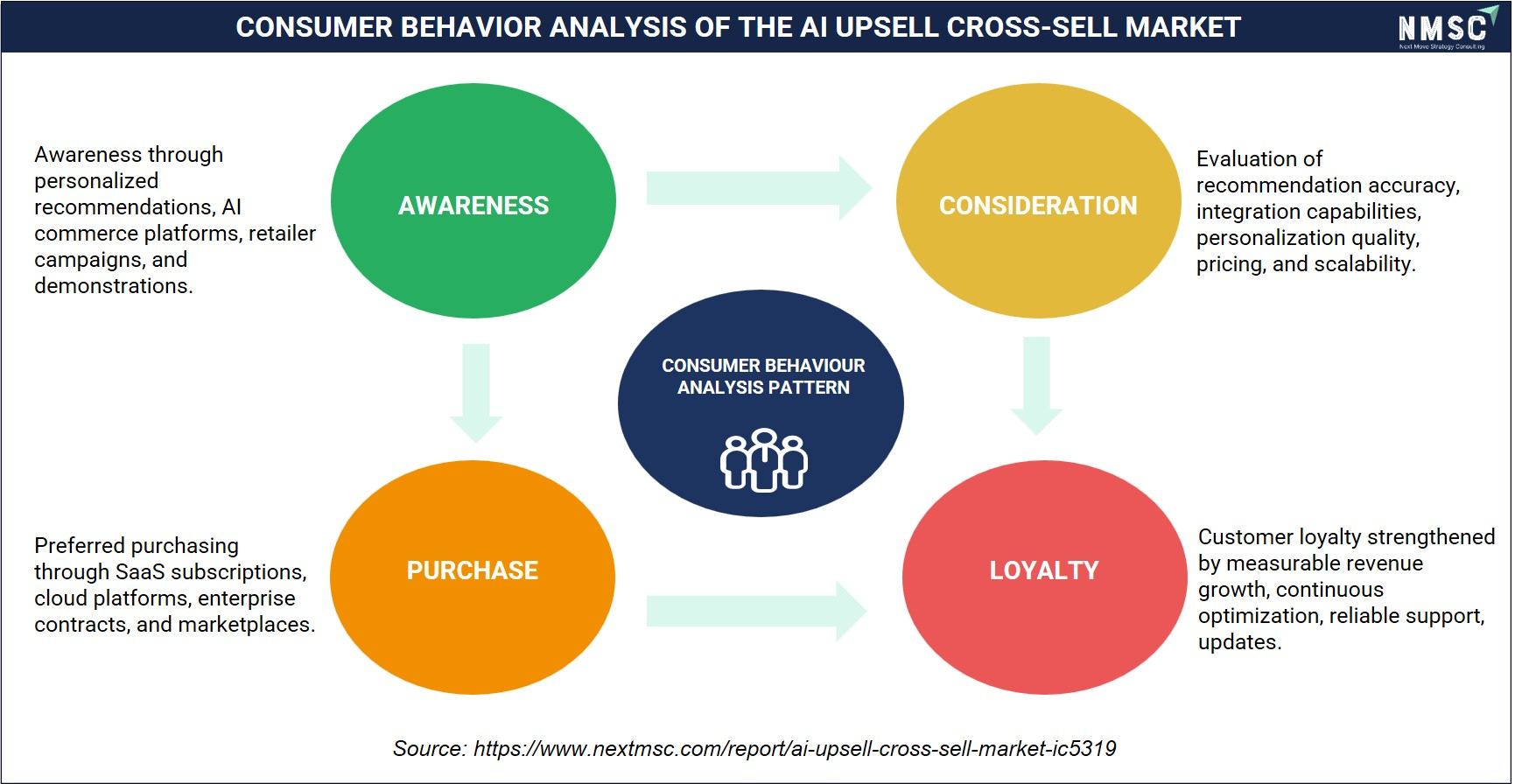
The above infographic presents a consumer behavior analysis of the AI upsell cross-sell market, mapping the journey from awareness to loyalty. Awareness is driven by personalized recommendations, AI commerce platforms, and retailer campaigns, leading businesses to evaluate accuracy, integration, scalability, and pricing. Preferred purchasing channels include SaaS subscriptions, cloud platforms, and enterprise contracts, while loyalty is reinforced by measurable revenue growth, continuous optimization, and reliable support. Looking ahead, we observed that these behavioral patterns collectively shape enterprise adoption and long-term platform engagement across the market.
Growth Opportunities
Our analysis shows that three forward-looking opportunities stand out for stakeholders positioning within the AI upsell cross-sell market over the 2026-2035 forecast period.
How Can Autonomous AI Agents Unlock Value for Customer Success Teams?
Autonomous customer success AI agents present a whitespace opportunity as SaaS vendors seek to scale expansion motions without proportionally scaling headcount. Vendors that build agents capable of independently identifying adoption-based expansion and renewal signals can capture recurring platform revenue, benefiting the Customer Success Expansion application segment as usage-based commercial models make expansion revenue increasingly central to SaaS growth strategy.
Where Does Usage-Based Pricing Create New Demand Among SMB Buyers?
Consumption-based, credit-style pricing models create an underpenetrated opportunity among SMB and lower mid-market buyers historically priced out of enterprise-grade AI platforms. Vendors that scale usage-based commercial models can capture new logo revenue while smaller buyers access agentic capability without large upfront licensing commitments, benefiting the SMB buyer size segment as adoption accelerates through 2035.
How Can Generative AI Personalization Benefit Retail and Commerce Platforms?
Generative AI-powered, conversational offer creation presents an opportunity for commerce platforms seeking to differentiate cross-sell execution beyond static recommendation widgets. Vendors that scale real-time, channel-native offer generation can capture share from platforms reliant on legacy rules-based personalization, benefiting the Retail E-commerce end-user segment as conversational and agentic commerce channels expand across email, SMS, and messaging platforms.
Regional Outlook
Geographic Performance Snapshot
|
Region |
2025 (USD) |
2035 (USD) |
CAGR% (2026–2035) |
Key Driver |
|
North America |
USD 0.98 Billion |
USD 6.45 Billion |
20.8% |
Concentration of leading AI and SaaS vendors |
|
Europe |
USD 0.57 Billion |
USD 3.85 Billion |
21.0% |
Enterprise digital transformation and AI governance maturity |
|
Asia-Pacific |
USD 0.38 Billion |
USD 4.22 Billion |
27.2% |
Rapid SaaS and e-commerce platform expansion |
|
Middle East & Africa |
USD 0.11 Billion |
USD 0.84 Billion |
23.0% |
Digital economy diversification investment |
|
Latin America |
USD 0.09 Billion |
USD 0.90 Billion |
26.6% |
Growing regional SaaS and e-commerce adoption |
|
Total |
USD 2.12 Billion |
USD 16.26 Billion |
22.6% |
– |
North America
North America leads the AI upsell cross-sell market, anchored by the concentration of leading CRM, commerce, and AI platform vendors headquartered in the region. We observed that enterprise AI adoption among CIOs has accelerated sharply, with agentic revenue workflows moving from pilot programs into production deployment across sales and customer success organizations. Technology adoption remains most advanced in the region, with usage-based pricing models expanding access among mid-market and SMB buyers.
Europe
Europe's AI upsell cross-sell market reflects a regulation-intensive landscape shaped by data protection and AI governance requirements. Our findings suggest that enterprises in the region prioritize explainable, auditable recommendation and agent systems to meet compliance obligations under the EU's data protection framework. Technology adoption favors vendors demonstrating strong governance capability, with demand concentrated among large enterprises undergoing broader digital transformation programs.
Asia-Pacific
Asia-Pacific is the fastest-growing region, propelled by rapid SaaS platform proliferation and expanding e-commerce personalization adoption across China and India. We found that regulatory frameworks remain less harmonized than in Europe, giving vendors flexibility to scale generative and agentic AI capability quickly. Technology adoption is accelerating as regional technology companies expand AI-native product offerings to serve both domestic and export-oriented customer bases.
Middle East & Africa
The AI upsell cross-sell market in Middle East & Africa is expanding as Gulf Cooperation Council economies invest in digital economy diversification programs. Our analysis shows that Saudi Arabia and the UAE are attracting enterprise software investment tied to national digital transformation strategies. Regulatory influence remains moderate, while technology adoption is gradually shifting toward cloud-native AI platforms as regional enterprises modernize legacy customer relationship management infrastructure.
Latin America
Latin America's AI upsell cross-sell market is supported by expanding regional SaaS platform adoption and growing e-commerce penetration in Brazil and Argentina. We observed that regulatory frameworks are less stringent than in North America or Europe, though multinational software vendors operating locally are introducing AI-driven expansion tools to regional enterprise customers. Technology adoption remains concentrated among larger enterprises, with competitive intensity increasing as global vendors expand regional sales presence.
U.S.
Based on our estimates, the U.S. market was valued at approximately USD 0.80 billion in 2025 and is projected to reach USD 5.20 billion by 2035, growing at a 20.6% CAGR. Demand is anchored by concentrated enterprise software vendor headquarters presence and aggressive CIO-level AI investment. Technology penetration favors agentic AI platforms, and competitive intensity remains high among established CRM and commerce vendors serving national enterprise accounts.
Canada
The market in Canada reached roughly USD 0.18 billion in 2025 and is forecast to hit USD 1.25 billion by 2035 at a 21.7% CAGR. Demand structure mirrors U.S. enterprise adoption patterns at a smaller scale, with financial services and technology sector buyers leading adoption. Technology penetration is rising as regional cloud infrastructure investment expands, with competitive intensity moderate given reliance on U.S.-headquartered platform vendors.
UK
As per our estimate, the UK market stood at about USD 0.155 billion in 2025, advancing toward USD 1.02 billion by 2035 at a 20.7% CAGR. Demand is driven by enterprise digital transformation investment concentrated in financial services and retail sectors. Regulatory influence is significant given UK data protection requirements, technology penetration favors governance-capable AI platforms, and competitive intensity remains steady among domestic and U.S. vendors.
Germany
According to our analysis, Germany's market was valued near USD 0.145 billion in 2025 and is set to reach USD 0.95 billion by 2035, expanding at a 20.7% CAGR. Demand structure benefits from a strong industrial and manufacturing enterprise base modernizing customer engagement systems. Germany's regulatory influence remains high given strict data protection enforcement, while technology penetration favors on-premise and hybrid deployment models among leading manufacturers.
France
Based on our estimates, France's market reached approximately USD 0.098 billion in 2025, projected to climb to USD 0.62 billion by 2035 at a 20.3% CAGR. Demand is supported by enterprise cloud adoption incentives and growing retail sector AI investment. Regulatory influence from national data protection enforcement is notable, and competitive intensity remains moderate among domestic and European software suppliers.
China
The market in China stood at roughly USD 0.135 billion in 2025 and is forecast to reach USD 1.35 billion by 2035, registering a 25.9% CAGR. Demand is fueled by expanding domestic e-commerce and SaaS platform investment. Regulatory influence is increasing gradually around data governance, technology penetration is accelerating through domestic AI model development, and competitive intensity remains elevated among numerous regional technology suppliers.
India
As per our estimate, India's market was valued at about USD 0.055 billion in 2025, projected to reach USD 0.85 billion by 2035 at a 31.5% CAGR, the fastest among covered countries. Demand structure reflects rapid enterprise SaaS adoption and a large, growing technology services sector. Regulatory influence remains developing, while technology penetration is rising quickly as global vendors expand delivery and support centers to serve India's growing enterprise customer base.
Japan
According to our analysis, Japan's market reached close to USD 0.075 billion in 2025 and is expected to hit USD 0.62 billion by 2035, growing at a 23.5% CAGR. Demand is supported by enterprise interest in AI-driven customer retention amid demographic-driven labor constraints. Regulatory influence is well established, technology penetration is advancing steadily, and competitive intensity remains high among long-standing domestic and international enterprise software vendors.
South Korea
Based on our estimates, South Korea's market stood at approximately USD 0.042 billion in 2025, forecast to reach USD 0.35 billion by 2035 at a 23.6% CAGR. Demand structure benefits from a technology-forward enterprise base and strong e-commerce sector investment. Technology penetration is high, with domestic platforms expanding AI-native capability, and competitive intensity remains pronounced amid rapid product innovation cycles.
Australia
The market in Australia reached about USD 0.048 billion in 2025 and is projected to reach USD 0.38 billion by 2035, expanding at a 23.0% CAGR. Demand is supported by growing enterprise cloud migration and financial services sector AI investment. Regulatory influence stems from national privacy standards, while technology penetration favors cloud deployment amid moderate competitive intensity among regional and international vendors.
UAE
As per our estimate, the UAE market was valued near USD 0.020 billion in 2025, projected to reach USD 0.16 billion by 2035 at a 23.1% CAGR. Demand structure is shaped by the UAE's digital economy diversification strategy and growing enterprise cloud adoption. Regulatory influence remains moderate, technology penetration is improving through international vendor expansion, and competitive intensity is rising as distributors expand regional enterprise portfolios.
Saudi Arabia
According to our analysis, Saudi Arabia's market reached roughly USD 0.024 billion in 2025 and is expected to hit USD 0.19 billion by 2035, growing at a 23.0% CAGR. Demand is fueled by Vision 2030-linked digital transformation investment across retail and financial services sectors. Regulatory influence remains moderate, technology penetration is gradually increasing, and competitive intensity is rising among regional distributors serving expanding enterprise accounts.
South Africa
Based on our estimates, South Africa's market was valued at about USD 0.014 billion in 2025 and is forecast to reach USD 0.10 billion by 2035 at a 21.7% CAGR. Demand structure reflects growing interest in customer retention technology amid competitive banking and telecommunications sectors. Regulatory influence remains limited, technology penetration is concentrated among larger enterprises, and competitive intensity is moderate among specialized regional integrators.
Brazil
The market in Brazil reached roughly USD 0.038 billion in 2025 and is forecast to hit USD 0.42 billion by 2035 at a 27.2% CAGR. Demand structure benefits from expanding regional e-commerce platforms and growing enterprise SaaS adoption. Regulatory influence remains developing, technology penetration favors cloud deployment among larger enterprises, and competitive intensity is moderate among international software distributors.
Argentina
As per our estimate, Argentina's market stood at about USD 0.016 billion in 2025, advancing toward USD 0.17 billion by 2035 at a 26.7% CAGR. Demand is supported by growing enterprise digitalization activity in urban centers and rising interest in customer retention technology. Regulatory influence remains limited, technology penetration is concentrated among larger enterprises, and competitive intensity is moderate amid a small base of specialized vendors.
Strategic Analysis of the AI Upsell Cross-Sell Industry
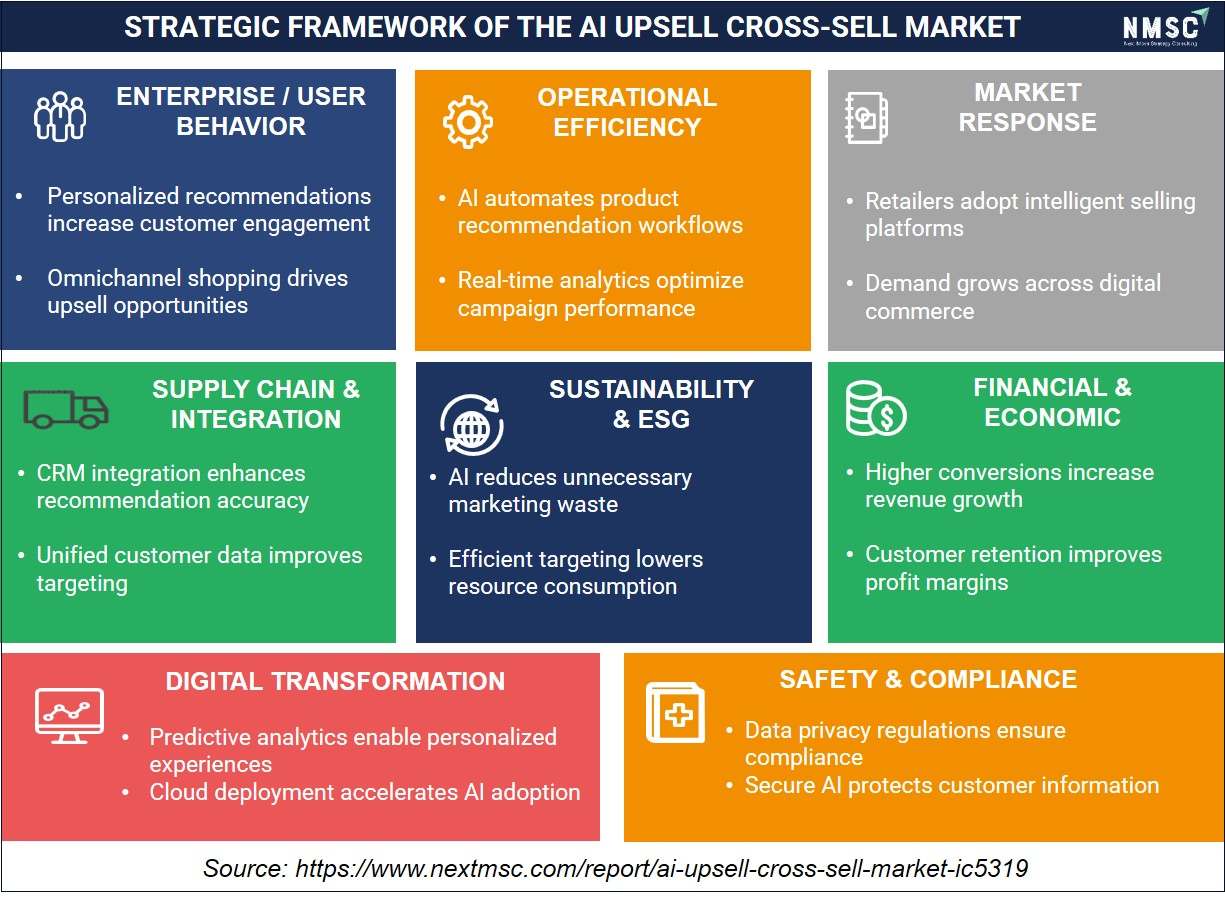
The above infographic presents a strategic framework of the AI upsell cross-sell market, where personalized recommendations and omnichannel shopping are driving customer engagement. At the same time, AI automation and real-time analytics are optimizing campaign performance, while CRM integration is enhancing recommendation accuracy through unified customer data. AI is also reducing marketing waste and supporting sustainability, while higher conversions are improving revenue and profit margins. Looking ahead, we observed that predictive analytics and cloud deployment are accelerating adoption, with data privacy regulations ensuring compliance and customer protection.
Competitive Landscape
We observed that the AI upsell cross-sell market features a mix of diversified enterprise software giants, specialized revenue and customer intelligence vendors, and venture-backed AI-native entrants competing across platform breadth, agentic capability, and pricing innovation.
|
Field |
Details |
|
Market Structure |
Moderately consolidated among diversified CRM and enterprise software platforms, with fragmented competition among specialized revenue intelligence and customer success vendors. |
|
Innovation Focus |
Autonomous AI agents, generative offer creation, and usage-based pricing models dominate current innovation pipelines across leading suppliers. |
|
M&A Activity |
Selective acquisitions and platform bundling, exemplified by Salesforce's Bluebirds acquisition to strengthen prospecting and expansion signal detection within Agentforce Sales. |
How Do Companies Compete in the AI Upsell Cross-Sell Market?
Companies compete primarily on platform breadth, agentic AI capability, and depth of native CRM or commerce data integration across the industry. Diversified enterprise software vendors such as Salesforce and Microsoft leverage unified customer data platforms to embed upsell and cross-sell intelligence natively, while specialized vendors such as Gainsight and Gong.io compete on workflow-specific depth for customer success and sales conversation intelligence use cases.
Which Competitive Archetypes Dominate the AI Upsell Cross-Sell Market?
Two archetypes dominate the market: diversified CRM and enterprise software platforms offering embedded upsell and cross-sell capability across broader suites, and specialized point-solution vendors with deep workflow-specific intelligence. Salesforce and HubSpot exemplify the diversified archetype through unified Smart CRM and Agentforce architectures, while Gainsight and ChurnZero exemplify the specialized archetype through purpose-built customer success expansion and retention intelligence.
How Are Companies Differentiating Through Innovation in AI Upsell Cross-Sell Platforms?
Innovation and differentiation strategy increasingly center on autonomous agent capability and consumption-based pricing. Salesforce's Agentforce 360 and HubSpot's Breeze AI credit model both address adoption barriers, whether workflow autonomy or upfront licensing cost. Our analysis shows that vendors unable to pair agentic capability with accessible, usage-based pricing risk losing share to competitors offering bundled platform and consumption-based commercial models.
What M&A and Expansion Activity Is Shaping the AI Upsell Cross-Sell Market?
Acquisitions, platform bundling, and capacity expansion continue to shape competitive positioning within the industry. Salesforce's 2025 acquisition of prospecting platform Bluebirds strengthened its Agentforce Sales expansion signal detection capability, while HubSpot's continued Breeze suite expansion across its Smart CRM illustrates how established vendors are consolidating point-solution functionality into unified agentic platforms to defend enterprise account share.
Key Market Players
Our assessment indicates that the following 20 companies are actively shaping product innovation, pricing models, and platform strategy within the global AI upsell cross-sell market.
-
Salesforce, Inc.
-
Microsoft Corporation
-
Adobe Inc.
-
Google LLC
-
HubSpot, Inc.
-
Braze, Inc.
-
Gainsight, Inc.
-
Gong.io Inc.
-
Clari Inc.
-
Salesloft, Inc.
-
Rokt Pte Ltd
-
Zoho Corporation Pvt. Ltd.
-
Pendo.io, Inc.
-
Amplitude, Inc.
-
SugarCRM Inc.
-
ChurnZero, Inc.
-
People.ai, Inc.
-
Medallia, Inc.
Latest Developments
We found that recent platform launches and pricing model shifts within the AI upsell cross-sell market are concentrated on autonomous agent capability and consumption-based commercial structures that lower adoption barriers.
|
Date |
Event |
|
November 2025 |
Salesforce unveiled new Agentforce Commerce capabilities that use AI-powered recommendations to personalize digital storefront experiences and increase customer lifetime value. The company reported that AI-powered recommendations on Pandora's digital storefront were driving higher orders, traffic, and average order value, demonstrating the use of AI to identify and encourage additional purchase opportunities. |
Investment Opportunities
What Capital Inflows Are Targeting the AI Upsell Cross-Sell Market?
Capital inflows into the AI upsell cross-sell market are increasingly directed toward autonomous agent platforms and revenue intelligence vendors demonstrating measurable expansion revenue outcomes. Venture investors continue to fund specialized platforms such as Gong.io and Clari alongside enterprise CIO budget reallocation toward agentic AI. We observed that investors favor companies demonstrating validated enterprise deployment scale, viewing production agent usage as a proxy for durable platform retention.
How Is Infrastructure Investment Supporting AI Upsell Cross-Sell Platforms?
Infrastructure investment is expanding compute and data-platform capacity to support autonomous agent workloads at enterprise scale. Salesforce's Data 360 unified data layer illustrates how vendors are investing in the data infrastructure required to ground agent decisions in accurate customer context, while HubSpot's Data Hub expansion reflects similar infrastructure investment to support credit-based agent monetization across its Smart CRM.
What ESG Considerations Are Shaping AI Upsell Cross-Sell Investment Decisions?
Environmental, social, and governance considerations increasingly shape investment decisions, with AI explainability and data governance as key criteria alongside energy consumption tied to large language model usage. The European Commission's data protection framework continues to inform investor governance disclosures for AI vendors. We found that investors increasingly favor vendors demonstrating transparent, auditable AI decision-making, treating governance capability as a differentiator alongside growth metrics.
Key Benefits for Stakeholders
How Does This Report Benefit Enterprise and Industry Leaders?
Enterprise and industry leaders gain access to validated segmentation, competitive benchmarking, and regional demand forecasts that support platform investment and vendor selection decisions across the AI upsell cross-sell industry. Our analysis shows that detailed solution-category, AI-technology, and end-user breakdowns help enterprises align procurement planning with the fastest-growing capability areas, including autonomous AI agents and generative offer creation.
How Does This Report Benefit Investors and Financial Analysts?
Investors and financial analysts benefit from consistent, single-point market size and CAGR estimates that support valuation and capital-allocation decisions across the enterprise software market supply chain. We observed that the report's regional and segment-level growth differentials help identify which vendors and technology categories are best positioned to capture above-market growth in AI Agent and Technology Software categories through 2035.
How Does This Report Benefit Technology Vendors and Product Teams?
Technology vendors and product teams gain insight into emerging design requirements, including autonomous agent architecture, generative personalization, and usage-based pricing models, that are reshaping the industry. Our findings suggest that this analysis helps R&D teams prioritize development roadmaps around agentic workflow autonomy and consumption-based monetization increasingly required by enterprise buyer evaluation criteria.
Key Market Segments
By Solution Category
-
Recommendation Engine
-
Product Recommendation
-
Offer Recommendation
-
Next Best Action
-
-
Customer Intelligence
-
Customer Propensity Analysis
-
Customer Behavior Analysis
-
Customer Value Analysis
-
-
Revenue Intelligence
-
Sales Opportunity Intelligence
-
Account Expansion Intelligence
-
Revenue Growth Intelligence
-
-
Customer Engagement
-
Personalized Offer Management
-
Campaign Optimization
-
Conversational Upsell Assistance
-
-
AI Agent
-
Sales AI Agent
-
Customer Success AI Agent
-
Commerce AI Agent
-
By AI Technology
-
Predictive AI
-
Propensity Modelling
-
Purchase Prediction
-
Customer Lifetime Value Prediction
-
Churn Prediction
-
-
Generative AI
-
Personalized Content Generation
-
Offer Generation
-
Sales Conversation Generation
-
-
Recommendation AI
-
Collaborative Filtering
-
Content-Based Recommendation
-
Contextual Recommendation
-
Real-Time Recommendation
-
By Deployment Model
-
Cloud Deployment
-
Multi-Tenant SaaS
-
Single Tenant Cloud
-
-
On-Premise Deployment
-
Enterprise Software Deployment
-
Private Infrastructure Deployment
-
-
Hybrid Deployment
-
Cloud Processing Private Data
-
Cloud Hosting Private Models
-
By Application
-
Commerce Upsell Cross-sell
-
Product Recommendation
-
Cart Expansion
-
Post Purchase Offer
-
-
Sales Expansion
-
Account Expansion
-
Opportunity Prioritization
-
Sales Recommendation
-
-
Customer Success Expansion
-
Customer Growth Management
-
Adoption-Based Expansion
-
Renewal Expansion
-
-
Marketing Personalization
-
Offer Personalization
-
Campaign Optimization
-
Audience Recommendation
-
By Commercial Model
-
Subscription
-
Annual Subscription
-
Monthly Subscription
-
Usage-Based Subscription
-
-
License
-
Perpetual License
-
Enterprise License
-
-
Services
-
Implementation Services
-
Integration Services
-
Customization Services
-
By Buyer Size
-
Enterprise
-
Large Enterprise
-
Global Enterprise
-
-
Mid-Market
-
Upper Mid-Market
-
Lower Mid-Market
-
-
SMB
-
Small Business
-
Micro Business
-
By End User
-
Retail E-commerce
-
Online Retail
-
Physical Retail
-
Omnichannel Retail
-
-
Technology Software
-
SaaS Provider
-
Digital Platform
-
Software Company
-
-
Financial Services
-
Banking
-
Insurance
-
Wealth Management
-
-
Telecommunications
-
Mobile Services
-
Broadband Services
-
Communication Services
-
-
Healthcare Life Sciences
-
Healthcare Provider
-
Pharmaceutical Company
-
Medical Technology Company
-
-
Travel Hospitality
-
Airline
-
Hotel
-
Travel Platform
-
-
Manufacturing Industrial
-
Industrial Equipment
-
Automotive
-
Consumer Goods
-
By Region
-
North America: U.S., Canada, Mexico
-
Europe: UK, Germany, France, Italy, Spain, Sweden, Denmark, Finland, Netherlands, Rest of Europe
-
Asia-Pacific: China, India, Japan, South Korea, Taiwan, Indonesia, Vietnam,Australia, Philippines, Malaysia, Rest of APAC
-
Middle East & Africa: Saudi Arabia, UAE, Egypt, Israel, Turkey, Nigeria, South Africa, Rest of MEA
-
Latin America: Brazil, Argentina, Chile, Colombia, Rest of LATAM
Conclusion and Recommendations
What Is the Long-Term Outlook for the AI Upsell Cross-Sell Market?
The long-term outlook for the market remains strongly positive, with global revenue projected to grow more than sevenfold from USD 2.12 billion in 2025 to USD 16.26 billion by 2035 at a 22.6% CAGR. We observed that sustained enterprise AI investment, agentic workflow adoption, and usage-based pricing innovation will continue underpinning demand across commerce, sales, and customer success applications through the forecast period.
What Strategic Positioning Should AI Upsell Cross-Sell Suppliers Pursue?
Suppliers should prioritize autonomous agent architecture while expanding usage-based pricing models to capture SMB and mid-market demand. Our assessment indicates that vendors investing early in generative AI-powered personalization and cross-workflow data unification will be best positioned to capture premium enterprise share within the AI upsell cross-sell market.
How Attractive Is the AI Upsell Cross-Sell Market for New Investment?
The AI upsell cross-sell industry presents a highly attractive investment case, supported by a USD 13.66 billion absolute dollar opportunity between 2026 and 2035 and above-average growth in Asia-Pacific and AI Agent product categories. We found that investment attractiveness is highest for platforms combining validated enterprise deployment scale with usage-based commercial models, positioning them to serve both cost-sensitive and premium enterprise segments simultaneously.
What Market Shifts and Key Risks Should Stakeholders Monitor?
Stakeholders should monitor AI governance regulatory developments, enterprise autonomy hesitancy, and competitive pressure from platform bundling as key risks to the AI upsell cross-sell market. Our analysis shows that vendors unable to demonstrate explainable, auditable agent decision-making risk losing enterprise share to competitors with established governance credentials, particularly within Europe's compliance-sensitive regulatory environment.
What Are the Key Growth Pathways for the AI Upsell Cross-Sell Market?
Key growth pathways include expanding autonomous agent capability, scaling usage-based pricing platforms, and deepening penetration into Technology Software and Customer Success Expansion categories. NMSC's analysis indicates that suppliers pursuing these pathways while maintaining governance and explainability credentials will be best positioned to capture the AI upsell cross-sell market's projected growth through 2035.
About the Author
 Mayurima Roy
— Mayurima Roy is Research Analyst at Next Move Strategy Consulting, where she has spent 4 years working across the firm's full industry coverage rather than a single fixed vertical. Her work centers on structured research, ongoing trend tracking, competitive assessment, and insight-led content development, translating complex market data into clear, decision-ready narratives that support informed client decision-making across diverse global industries, market sectors, and world regions every day.
Mayurima Roy
— Mayurima Roy is Research Analyst at Next Move Strategy Consulting, where she has spent 4 years working across the firm's full industry coverage rather than a single fixed vertical. Her work centers on structured research, ongoing trend tracking, competitive assessment, and insight-led content development, translating complex market data into clear, decision-ready narratives that support informed client decision-making across diverse global industries, market sectors, and world regions every day.
About the Reviewer
 Supradip Baul
— Supradip Baul is an accomplished business consultant and strategist with over a decade of rich experience in market intelligence, strategy, technology, and business transformation. His work has included rigorous qualitative and quantitative analysis across multiple industries, helping clients shape investment decisions and long-term roadmaps. Earlier in his career, he was associated with Gartner, where he contributed to industry-leading reports and market share analyses. He has worked with leading global companies and holds an MBA with a dual specialization in Marketing and Finance.
Supradip Baul
— Supradip Baul is an accomplished business consultant and strategist with over a decade of rich experience in market intelligence, strategy, technology, and business transformation. His work has included rigorous qualitative and quantitative analysis across multiple industries, helping clients shape investment decisions and long-term roadmaps. Earlier in his career, he was associated with Gartner, where he contributed to industry-leading reports and market share analyses. He has worked with leading global companies and holds an MBA with a dual specialization in Marketing and Finance.
At Next Move Strategy Consulting, we understand that insightful market research is the cornerstone of successful business decisions. That's why we employ a robust and multifaceted approach, combining various methodologies to deliver the most accurate and actionable data for our clients.

Research Landscape
We navigate the world of research with two primary approaches:
Qualitative Approach
Our qualitative research methodologies involve immersive techniques such as in-depth interviews, focus groups, and observational studies. By engaging directly with individuals and stakeholders, we uncover valuable insights that quantitative data alone may overlook.

Quantitative Research
In tandem with qualitative methodologies, NMSC leverages the power of Quantitative Research to provide a robust foundation of numerical insights. Through systematic data collection and analysis, we quantify patterns, preferences, and market trends, offering a comprehensive view of the business landscape.
Our quantitative research approach employs diverse tools, including surveys, experiments, and statistical modelling. These methodologies enable us to gather data from a large and representative sample, ensuring the statistical significance of our findings. By employing structured questionnaires and standardized data collection methods, we guarantee the reliability and validity of the information we present to our clients.
Quantitative research is particularly effective in measuring the prevalence of trends, assessing market size, and gauging the impact of various factors on consumer behavior. The numerical precision attained through this approach equips our clients with actionable insights, facilitating data-driven decision-making and strategy formulation.


Our Specialized Toolbox for Industry-Specific Market Research
We deploy a specialized arsenal of techniques tailored to meet your unique requirements. Here's a glimpse into our comprehensive toolbox:

Information Procurement
The stage entails acquiring market data or relevant information through various sources and methodologies.


Market Research Approach
We utilize both top-down and bottom-up approaches in market research analysis to achieve a comprehensive understanding of the market dynamics, leveraging the broad perspective of industry trends and macroeconomic factors alongside detailed insights from specific segments and individual companies.

Porters Five Forces Analysis
We conduct Porter's Five Forces analysis to evaluate the competitive landscape of an industry, providing us with insights into factors that affect profitability and strategic positioning.

SWOT Analysis

Forecasting
We utilize a forecasting model to predict future consumption by considering parameters like population, economics, regulations, market competition, drivers, constraints, technology, and pricing. We also employ statistical techniques such as multilinear regression, exponential smoothing, moving average, ARIMA, and Monte Carlo simulations for accurate predictions. In econometric forecasting, we analyzed short-term and long-term event impacts, attributing values based on regulatory frameworks, economic factors, and market events.





 Speak to Our Analyst