
AI Vehicle Inspection System Market Size, Share, Trends and Growth Analysis, By Application (Insurance, Fleet and Mobility, Automotive Retail, Auctions and Remarketing, Automotive Manufacturing, Government and Compliance, and Other Applications), By Capture Mode, By Inspection Scope, By Vehicle Class, By Deployment Model, By Revenue Stream, By Sales Channel, and Region -- Global Industry Report and Forecast, 2026--2035
Industry: Automotive & Transportation | Publishing Date: July 20, 2026 | Last Updated: September 30, 2026 | No of Pages: N/A | No. of Tables: N/A | No. of Figures: N/A | Format: PDF | Report Code: AT5258
What Is the AI Vehicle Inspection System Market Size?
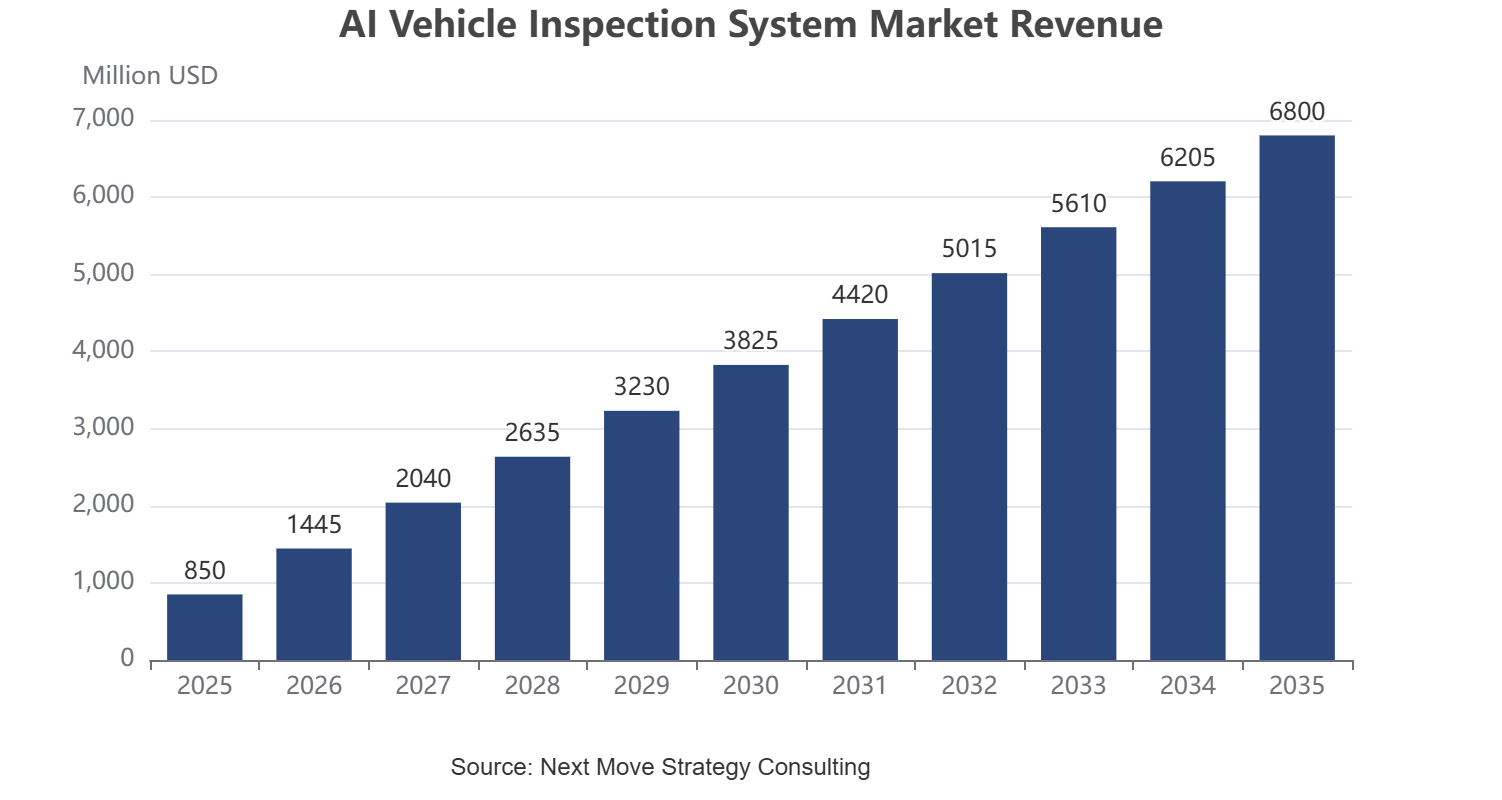
The global AI Vehicle Inspection System Market size was valued at USD 850 Million in 2025 and is estimated at USD 1.05 Billion in 2026, forecast to reach USD 6.80 Billion by 2035, expanding at a 23.1% CAGR between 2026 and 2035. North America leads with approximately 42% share, while under application, Insurance dominates with approximately 34% share.
We observed that growth is broad-based across every segmentation axis, with API based inspection and heavy commercial vehicle adoption emerging as the dominant structural shifts reshaping deployment strategy and platform design through 2035.
|
Key Takeaways |
|
By Application: Insurance held the largest share of approximately 34% (USD 289 Million) in 2025; Auctions and Remarketing is the fastest-growing sub-segment at 28.6% CAGR from 2026-2035. |
|
By Capture Mode: Guided Mobile Photo held the largest share of approximately 35% (USD 298 Million) in 2025; API Based Inspection is the fastest-growing sub-segment at 42.5% CAGR from 2026-2035. |
|
By Inspection Scope: Exterior Inspection held the largest share of approximately 40% (USD 340 Million) in 2025; Full Vehicle Inspection is the fastest-growing sub-segment at 32.0% CAGR from 2026-2035. |
|
By Vehicle Class: Passenger Cars held the largest share of approximately 62% (USD 527 Million) in 2025; Specialty Vehicles is the fastest-growing sub-segment at 31.8% CAGR from 2026-2035. |
|
By Deployment Model: Cloud Based held the largest share of approximately 58% (USD 493 Million) in 2025; Hybrid Deployment is the fastest-growing sub-segment at 27.0% CAGR from 2026-2035. |
|
By Revenue Stream: Software held the largest share of approximately 48% (USD 408 Million) in 2025; Services is the fastest-growing sub-segment at 26.0% CAGR from 2026-2035. |
|
By Sales Channel: Direct Sales held the largest share of approximately 52% (USD 442 Million) in 2025; OEM Partnerships is the fastest-growing sub-segment at 29.0% CAGR from 2026-2035. |
|
Dominant Region: North America dominated with approximately 42% revenue share (USD 357 Million) in 2025. |
|
Fastest-Growing Region: Asia-Pacific is expected to register the highest CAGR of 31.4% during 2026-2035. |
|
Dominant Country: U.S. led with approximately USD 293 Million in 2025. |
|
Fastest-Growing Country: India is the fastest-growing country at approximately 34.0% CAGR from 2026-2035. |
Market Opportunity: The AI Vehicle Inspection System Market is set to generate an absolute dollar opportunity of USD 5.75 Billion, positioning API based inspection and remarketing condition-grading platforms as a compelling area for capital allocation.
According to NMSC analysis, the shift from single-purpose scanners toward API integrated inspection layers is redefining procurement criteria for dealership and fleet operators, as interoperability with existing appraisal, DMS, and claims software increasingly determines vendor selection.
What Does the AI Vehicle Inspection System Market Encompass?
The AI Vehicle Inspection System Market encompasses hardware scanners, mobile capture applications, and cloud software that apply computer vision and machine learning to automatically detect vehicle damage, verify condition, and validate quality across the vehicle lifecycle. Our assessment indicates that the scope spans drive through scanners, guided mobile photo capture, fixed camera systems, handheld devices, and API based inspection layers deployed across insurance claims, fleet and rental operations, dealership and used vehicle retail, auctions and remarketing, and original equipment manufacturing quality control. The category has evolved from manual, subjective visual checks into standardized, image-based condition scoring driven by rising claims volumes and dealership digitization.
Regulatory frameworks such as the U.S. National Association of Insurance Commissioners' AI Model Bulletin, adopted by 23 states and Washington, D.C. by late 2025, and the European Union's General Data Protection Regulation shape governance and data-handling requirements for AI-driven claims and underwriting inspection. We observed that technology adoption is shifting toward API based inspection that embeds condition intelligence directly into appraisal, dealer management, and claims platforms rather than operating as a standalone tool. NMSC's analysis indicates that this structural shift, combined with expanding OEM quality-control deployments, is redefining sourcing criteria across the AI Vehicle Inspection System Market.
|
Parameters |
Details |
|
Market Size in 2025 |
USD 850 Million |
|
Market Size in 2026 |
USD 1050 Million |
|
Revenue Forecast in 2035 |
USD 6800 Million |
|
Growth Rate |
CAGR of 23.1% from 2026 to 2035 |
|
Analysis Period |
2025-2035 |
|
Base Year Considered |
2025 |
|
Forecast Period |
2026-2035 |
|
Market Size Estimation |
USD Million |
|
Companies Profiled |
20 |
|
Countries Covered |
33 |
|
Market Share |
Available for Top 10 Companies |
Key Emerging Trends
Based on research conducted by NMSC, we found that four structural trends are reshaping product development, platform strategy, and stakeholder engagement across the AI Vehicle Inspection System Market.
How Is API Based Inspection Transforming Dealership Workflows?
API based inspection is replacing standalone scanning tools with condition intelligence embedded directly into appraisal, inventory, and pricing systems. We observed that UVeye's 2025 partnership with Cox Automotive's vAuto integrates inspection data directly into dealer appraisal and inventory tools, with more than 125 dealers already using the combined solution. Dealerships are adopting this model to reduce cycle time, while platform integrators redesign workflows around real-time condition data rather than isolated inspection reports.
Why Is Heavy Commercial Vehicle Inspection Gaining Adoption?
Fleet operators are extending AI inspection beyond passenger cars into heavy-duty trucks and buses to meet compliance and safety requirements. Our findings suggest that UVeye's 2025 expansion into Class 6-8 trucks and buses, engineered to support CVSA-aligned inspection points across the U.S. and UK, reflects growing commercial fleet demand for automated, standardized safety documentation across large vehicle classes.
How Is Agentic AI Reshaping Insurance Claims Inspection?
Agentic AI is advancing claims inspection from static photo assessment toward autonomous, multi-step FNOL triage and settlement recommendation. We observed that the U.S. National Association of Insurance Commissioners reported early 2025 pilot use of agentic systems in claims processing and fraud detection, prompting expanded regulatory oversight through the NAIC's AI Model Bulletin, adopted by 23 states by late 2025.
What Role Does Seaport and Logistics Inspection Play in Market Expansion?
Seaport and logistics hub inspection is emerging as a high-value deployment category for AI vehicle inspection systems. Our analysis shows that UVeye's August 2025 partnership with Jaguar Land Rover installed automated inspection technology at three major U.S. seaport facilities, detecting damage as small as 20 millimeters upon vehicle arrival, expanding the addressable use case beyond dealership and insurance applications into import quality assurance.
Growth Drivers and Restraints
Growth Catalyst and Risk Assessment Matrix
|
Factors |
(+/-) % Impact on CAGR |
Geographic Relevance |
Impact Timeline |
|
Rising insurance claims volumes and touchless processing demand |
+2.6% |
Global |
2026-2035 |
|
Dealership digitization and API integrated appraisal platforms |
+2.2% |
North America, Europe |
2026-2035 |
|
OEM quality control automation on production lines |
+1.8% |
Asia-Pacific, Europe |
2026-2035 |
|
Expansion of used vehicle marketplaces and remarketing platforms |
+2.0% |
Global |
2026-2035 |
|
Fleet and rental operator adoption for damage liability reduction |
+1.6% |
North America, Asia-Pacific |
2026-2035 |
|
Regulatory roadworthiness digitization in emerging markets |
+1.3% |
Asia-Pacific, Latin America |
2026-2035 |
|
Data privacy and AI governance compliance costs |
-1.5% |
Global |
2026-2035 |
|
High upfront capital cost of fixed scanner infrastructure |
-1.0% |
Latin America, Middle East & Africa |
2026-2032 |
|
Integration complexity with legacy dealer and claims systems |
-0.7% |
Global |
2026-2032 |
What Is the Primary Growth Driver of the AI Vehicle Inspection System Market?
Rising insurance claims volumes combined with demand for touchless, faster claims processing is the primary driver of the AI Vehicle Inspection System Market. The U.S. National Association of Insurance Commissioners reported that 88% of surveyed auto insurers had current or planned AI use as of 2025, sustaining demand for automated damage detection and repair estimation tools. We observed that this regulatory-tracked adoption trend continues to anchor baseline demand for claims inspection technology across developed insurance markets.
How Is Dealership Digitization Driving Market Growth?
Dealership digitization is accelerating AI Vehicle Inspection System Market growth as retail and used vehicle platforms integrate condition intelligence into appraisal and inventory systems. Official company disclosures confirm that UVeye's inspection systems are installed at hundreds of dealership sites globally, with its 2025 partnership with Cox Automotive's vAuto already supporting over 850 automated vehicle acquisitions. Our assessment indicates that this API integrated model is compressing adoption timelines across trade-in and reconditioning workflows.
What Is Restraining AI Vehicle Inspection System Market Expansion?
Data privacy and AI governance compliance costs restrain broader adoption across the AI Vehicle Inspection System Market, particularly for insurance underwriting and claims applications. The U.S. National Association of Insurance Commissioners confirms that 23 states and Washington, D.C. had adopted its AI Model Bulletin by late 2025, requiring documented governance and audit procedures. We found that smaller vendors face particular exposure, as compliance overhead raises the cost of market entry relative to larger, established providers.
Segmentation Analysis
Segment Sizing: By Application
|
Segment |
2025 (USD) |
2035 (USD) |
CAGR% (2026-2035) |
|
Insurance |
USD 289 Million |
USD 2.04 Billion |
24.3% |
|
Fleet and Mobility |
USD 170 Million |
USD 1.22 Billion |
24.5% |
|
Automotive Retail |
USD 187 Million |
USD 1.77 Billion |
28.4% |
|
Auctions and Remarketing |
USD 85 Million |
USD 816 Million |
28.6% |
|
Automotive Manufacturing |
USD 68 Million |
USD 612 Million |
27.6% |
|
Government and Compliance |
USD 34 Million |
USD 204 Million |
22.0% |
|
Other Applications |
USD 17 Million |
USD 136 Million |
26.0% |
|
Total |
USD 850 Million |
USD 6.80 Billion |
23.1% |
Which Application Segment Dominates the AI Vehicle Inspection System Market?
Insurance, encompassing claims and underwriting inspection, led the AI Vehicle Inspection System Market with USD 289 Million in 2025, supported by high claims volumes and rapid adoption of touchless FNOL assessment. We observed that Auctions and Remarketing is the fastest-growing application, expanding at a 28.6% CAGR from 2026 to 2035, as remarketing platforms increasingly rely on standardized, AI-driven condition grading to support transparent wholesale transactions.
Segment Sizing: By Capture Mode
|
Segment |
2025 (USD) |
2035 (USD) |
CAGR% (2026-2035) |
|
Guided Mobile Photo |
USD 298 Million |
USD 2.18 Billion |
24.7% |
|
Drive Through Scanner |
USD 255 Million |
USD 1.77 Billion |
24.0% |
|
Fixed Camera System |
USD 170 Million |
USD 1.22 Billion |
24.5% |
|
Handheld Device |
USD 85 Million |
USD 612 Million |
24.5% |
|
API Based Inspection |
USD 42 Million |
USD 1.02 Billion |
42.5% |
|
Total |
USD 850 Million |
USD 6.80 Billion |
23.1% |
Which Capture Mode Leads AI Vehicle Inspection System Market Demand?
Guided Mobile Photo remained the leading capture mode, valued at USD 298 Million in 2025 on widespread smartphone-based inspection adoption across insurance and retail applications. Our findings suggest that API Based Inspection is the fastest-growing capture mode, registering a 42.5% CAGR from 2026 to 2035, as dealership and insurer platforms increasingly embed inspection data directly into existing appraisal and claims software.
Segment Sizing: By Vehicle Class
|
Segment |
2025 (USD) |
2035 (USD) |
CAGR% (2026-2035) |
|
Passenger Cars |
USD 527 Million |
USD 3.74 Billion |
24.3% |
|
Light Commercial Vehicles |
USD 170 Million |
USD 1.43 Billion |
26.7% |
|
Heavy Commercial Vehicles |
USD 102 Million |
USD 1.09 Billion |
30.1% |
|
Two Wheelers |
USD 34 Million |
USD 340 Million |
29.2% |
|
Specialty Vehicles |
USD 17 Million |
USD 204 Million |
31.8% |
|
Total |
USD 850 Million |
USD 6.80 Billion |
23.1% |
Which Vehicle Class Drives AI Vehicle Inspection System Market Growth?
Passenger Cars remained the leading vehicle class, valued at USD 527 Million in 2025 on broad adoption across insurance, retail, and fleet applications. Our assessment indicates that Specialty Vehicles is the fastest-growing vehicle class, expanding at a 31.8% CAGR from 2026 to 2035, as niche fleet and government compliance use cases extend AI inspection beyond mainstream passenger and commercial categories.
Growth Opportunities
We identified three forward-looking whitespace opportunities within the AI Vehicle Inspection System Market.
What Opportunity Exists in API Integrated Inspection Middleware?
API integrated inspection middleware that embeds condition intelligence directly into dealer management, appraisal, and claims software represents a significant whitespace opportunity, benefiting automotive retail platforms and insurance claims processors seeking to reduce integration friction.
What Opportunity Exists in Heavy Commercial Vehicle Inspection?
Heavy commercial vehicle and fleet safety inspection represents a substantial opportunity, benefiting fleet operators and inspection vendors as regulatory safety requirements and compliance digitization accelerate demand for automated Class 6-8 truck and bus inspection.
What Opportunity Exists in Seaport and Import Quality Assurance?
Seaport and import vehicle quality assurance represents a growing opportunity, benefiting original equipment manufacturers and logistics providers as brands seek automated, time-stamped inspection to verify vehicle condition before reaching dealership networks.
Consumer Behavior Analysis of the AI Vehicle Inspection System Market
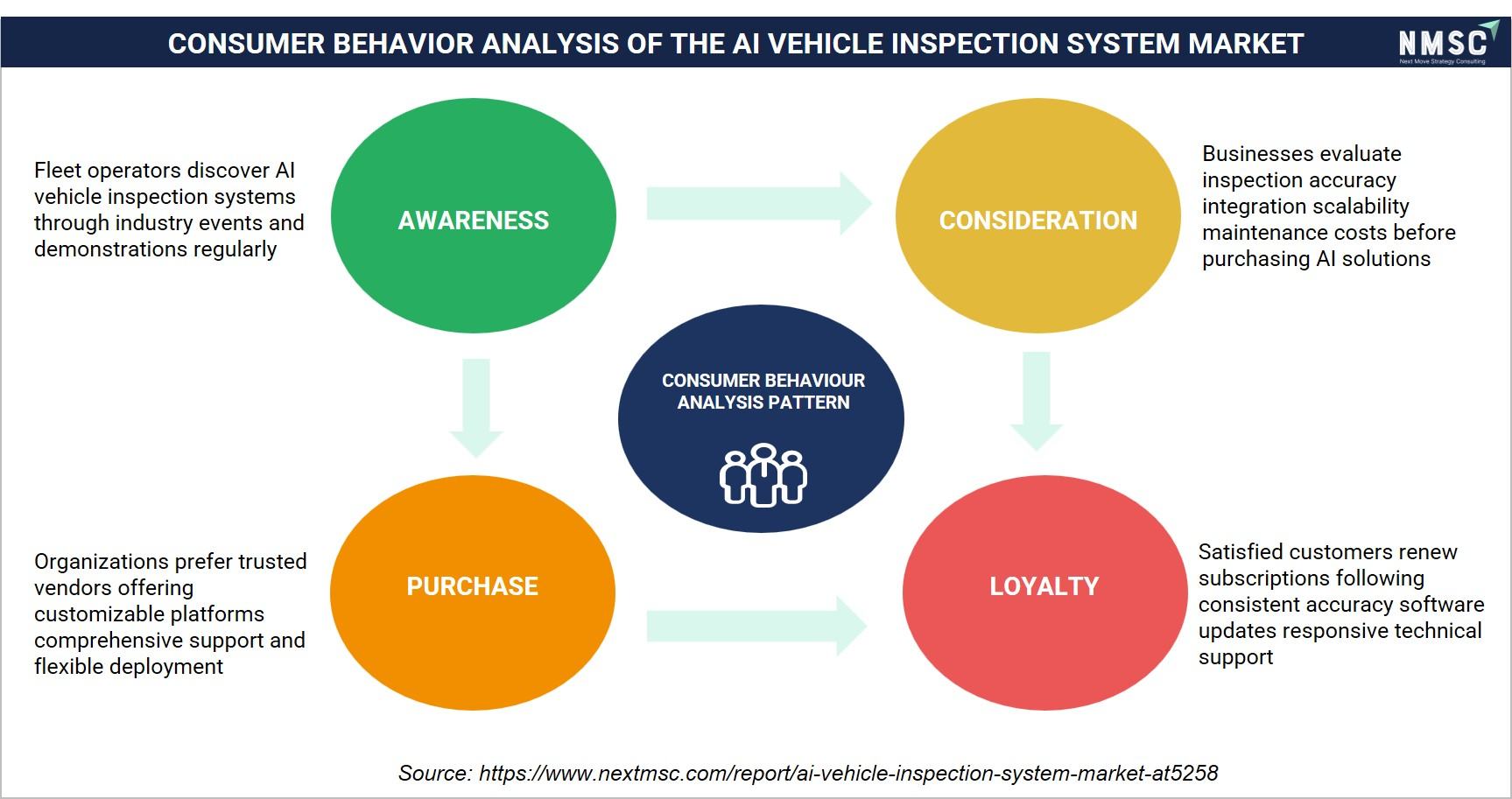
Consumer behavior in the AI Vehicle Inspection System Market is driven by demand for accurate, scalable, and cost-efficient inspection solutions. Organizations evaluate AI platforms based on detection accuracy, integration capabilities, deployment flexibility, and vendor reliability. Long-term customer loyalty is strengthened through continuous software enhancements, responsive technical support, and consistent operational performance across automotive and insurance applications.
Regional Outlook
Geographic Performance Snapshot
|
Region |
2025 (USD) |
2035 (USD) |
CAGR% (2026-2035) |
Key Driver |
|
North America |
USD 357 Million |
USD 2.31 Billion |
23.1% |
Dealership and fleet AI inspection adoption led by UVeye and OEM partnerships |
|
Europe |
USD 221 Million |
USD 1.50 Billion |
23.7% |
GDPR-aligned claims automation and regulatory roadworthiness digitization |
|
Asia-Pacific |
USD 187 Million |
USD 2.18 Billion |
31.4% |
Rapid used-vehicle platform growth and expanding manufacturing QA adoption |
|
Middle East & Africa |
USD 43 Million |
USD 408 Million |
28.4% |
Smart city logistics hubs and auction digitization |
|
Latin America |
USD 42 Million |
USD 408 Million |
28.7% |
Expanding used-car marketplaces and fleet digitization |
|
Total |
USD 850 Million |
USD 6.80 Billion |
23.1% |
- |
North America Outlook
North America remains the most mature AI Vehicle Inspection System Market, anchored by dense dealership networks, insurer claims automation, and expanding OEM seaport deployments led by providers such as UVeye. Regulatory oversight from the National Association of Insurance Commissioners shapes AI governance standards for claims inspection, while fleet operators expand adoption to reduce damage liability disputes. We observed that technology adoption concentrates on API based inspection integrated into dealer and insurer software, with strategic outlook favoring continued platform consolidation through 2035.
Europe Outlook
Europe's AI Vehicle Inspection System Market reflects a regulation-led adoption pattern shaped by the General Data Protection Regulation and expanding roadworthiness digitization requirements across member states. Our findings suggest that collision repair centers and used vehicle certification platforms are driving adoption of guided mobile photo and fixed camera systems. Technology adoption favors privacy-compliant cloud deployment, with strategic outlook centered on interoperable claims and dealership integration across major markets.
Asia-Pacific Outlook
Asia-Pacific is the fastest-growing regional market, supported by rapid used-vehicle marketplace expansion and growing OEM manufacturing quality-control automation across China and India. We observed that competitive intensity is elevated as regional platforms bundle inspection capabilities at lower price points to serve high-volume dealership and auction networks. Strategic outlook favors continued share gains as e-commerce vehicle platforms expand smart inspection penetration beyond premium urban markets.
Middle East & Africa Outlook
The Middle East & Africa AI Vehicle Inspection System Market is shaped by smart city logistics investment and growing auction and remarketing digitization across the Gulf Cooperation Council states. Our assessment indicates that regulatory influence remains comparatively light relative to Europe and North America, allowing faster deployment of fixed camera systems at logistics hubs. Technology adoption skews toward auction intake and fleet inspection, with strategic outlook favoring continued infrastructure-linked growth through 2035.
Latin America Outlook
Latin America's AI Vehicle Inspection System Market is expanding as used-vehicle marketplaces and fleet digitization widen adoption of guided mobile photo inspection. We observed that Brazil's growing e-commerce vehicle platforms are accelerating direct-to-consumer condition reporting adoption. Regulatory influence remains moderate, technology adoption concentrates on automotive retail applications, and strategic outlook favors continued share gains as regional manufacturing partnerships lower device costs.
U.S. AI Vehicle Inspection System Market Outlook
Based on our engagements, U.S. was valued at approximately USD 293 Million in 2025 and is projected to reach approximately USD 1.80 Billion by 2035, expanding at a 22.4% CAGR from 2026 to 2035. sustained investment in API integrated dealership inspection and insurer claims automation, reinforced by UVeye's expanding OEM and seaport deployments, keeps demand structure concentrated among insurance and automotive retail applications, shaping a competitive landscape defined by increasing platform interoperability and rising demand for objective, AI-driven vehicle condition data.
Canada AI Vehicle Inspection System Market Outlook
Through our analysis, Canada was valued at approximately USD 43 Million in 2025 and is projected to reach approximately USD 347 Million by 2035, expanding at a 26.1% CAGR from 2026 to 2035. steady adoption of fleet and rental inspection systems supported by cold-climate damage documentation needs and expanding dealership network digitization, shaping a competitive landscape defined by increasing platform interoperability and rising demand for objective, AI-driven vehicle condition data.
UK AI Vehicle Inspection System Market Outlook
From our assessment, UK was valued at approximately USD 62 Million in 2025 and is projected to reach approximately USD 389 Million by 2035, expanding at a 22.7% CAGR from 2026 to 2035. GDPR-aligned claims automation and growing used vehicle certification platforms are reinforcing demand for guided mobile photo inspection, shaping a competitive landscape defined by increasing platform interoperability and rising demand for objective, AI-driven vehicle condition data.
Germany AI Vehicle Inspection System Market Outlook
According to evaluation, Germany was valued at approximately USD 53 Million in 2025 and is projected to reach approximately USD 329 Million by 2035, expanding at a 22.5% CAGR from 2026 to 2035. strict data-protection enforcement and OEM manufacturing quality standards are steering adoption toward end of line inspection and collision repair validation, shaping a competitive landscape defined by increasing platform interoperability and rising demand for objective, AI-driven vehicle condition data.
France AI Vehicle Inspection System Market Outlook
Based on our engagements, France was valued at approximately USD 35 Million in 2025 and is projected to reach approximately USD 209 Million by 2035, expanding at a 21.8% CAGR from 2026 to 2035. moderate but steady uptake of automotive retail inspection, tempered by cautious consumer sentiment toward automated condition scoring, shaping a competitive landscape defined by increasing platform interoperability and rising demand for objective, AI-driven vehicle condition data.
China AI Vehicle Inspection System Market Outlook
Through our analysis, China was valued at approximately USD 64 Million in 2025 and is projected to reach approximately USD 696 Million by 2035, expanding at a 30.5% CAGR from 2026 to 2035. dense domestic manufacturing capacity and expanding used-vehicle platforms are accelerating penetration of AI inspection across auctions and dealerships, shaping a competitive landscape defined by increasing platform interoperability and rising demand for objective, AI-driven vehicle condition data.
India AI Vehicle Inspection System Market Outlook
From our assessment, India was valued at approximately USD 37 Million in 2025 and is projected to reach approximately USD 522 Million by 2035, expanding at a 34.0% CAGR from 2026 to 2035. rapid growth in organized used-car retail and rising fleet digitization are driving the fastest regional technology penetration among urban dealership networks, shaping a competitive landscape defined by increasing platform interoperability and rising demand for objective, AI-driven vehicle condition data.
Japan AI Vehicle Inspection System Market Outlook
According to evaluation, Japan was valued at approximately USD 30 Million in 2025 and is projected to reach approximately USD 305 Million by 2035, expanding at a 29.5% CAGR from 2026 to 2035. strong OEM quality-control standards are accelerating adoption of in-process and end of line inspection systems across manufacturing plants, shaping a competitive landscape defined by increasing platform interoperability and rising demand for objective, AI-driven vehicle condition data.
South Korea AI Vehicle Inspection System Market Outlook
Based on our engagements, South Korea was valued at approximately USD 22 Million in 2025 and is projected to reach approximately USD 261 Million by 2035, expanding at a 31.4% CAGR from 2026 to 2035. dense dealership networks and strong digital infrastructure are supporting rapid uptake of automotive retail and fleet inspection systems, shaping a competitive landscape defined by increasing platform interoperability and rising demand for objective, AI-driven vehicle condition data.
Australia AI Vehicle Inspection System Market Outlook
Through our analysis, Australia was valued at approximately USD 15 Million in 2025 and is projected to reach approximately USD 174 Million by 2035, expanding at a 31.3% CAGR from 2026 to 2035. growing fleet and rental operations are lifting demand for AI-driven damage monitoring and turnaround inspection systems, shaping a competitive landscape defined by increasing platform interoperability and rising demand for objective, AI-driven vehicle condition data.
UAE AI Vehicle Inspection System Market Outlook
From our assessment, UAE was valued at approximately USD 13 Million in 2025 and is projected to reach approximately USD 114 Million by 2035, expanding at a 27.4% CAGR from 2026 to 2035. large-scale logistics hub and auction digitization is driving fast adoption of fixed camera inspection systems at transport handover points, shaping a competitive landscape defined by increasing platform interoperability and rising demand for objective, AI-driven vehicle condition data.
Saudi Arabia AI Vehicle Inspection System Market Outlook
According to evaluation, Saudi Arabia was valued at approximately USD 11 Million in 2025 and is projected to reach approximately USD 98 Million by 2035, expanding at a 27.3% CAGR from 2026 to 2035. government-backed logistics and mobility investments are accelerating deployment of integrated inspection systems across fleet operations, shaping a competitive landscape defined by increasing platform interoperability and rising demand for objective, AI-driven vehicle condition data.
South Africa AI Vehicle Inspection System Market Outlook
Based on our engagements, South Africa was valued at approximately USD 6 Million in 2025 and is projected to reach approximately USD 49 Million by 2035, expanding at a 26.3% CAGR from 2026 to 2035. moderate but rising adoption of automotive retail inspection, reflecting expanding used-vehicle marketplace activity, shaping a competitive landscape defined by increasing platform interoperability and rising demand for objective, AI-driven vehicle condition data.
Brazil AI Vehicle Inspection System Market Outlook
Through our analysis, Brazil was valued at approximately USD 23 Million in 2025 and is projected to reach approximately USD 212 Million by 2035, expanding at a 27.9% CAGR from 2026 to 2035. expanding e-commerce vehicle platforms and rising fleet digitization are driving broad adoption of guided mobile photo inspection, shaping a competitive landscape defined by increasing platform interoperability and rising demand for objective, AI-driven vehicle condition data.
Argentina AI Vehicle Inspection System Market Outlook
From our assessment, Argentina was valued at approximately USD 8 Million in 2025 and is projected to reach approximately USD 65 Million by 2035, expanding at a 27.1% CAGR from 2026 to 2035. gradual recovery in consumer spending is supporting incremental adoption of automotive retail inspection, concentrated in major urban centers, shaping a competitive landscape defined by increasing platform interoperability and rising demand for objective, AI-driven vehicle condition data.
Supply Chain Structure of the AI Vehicle Inspection System Market
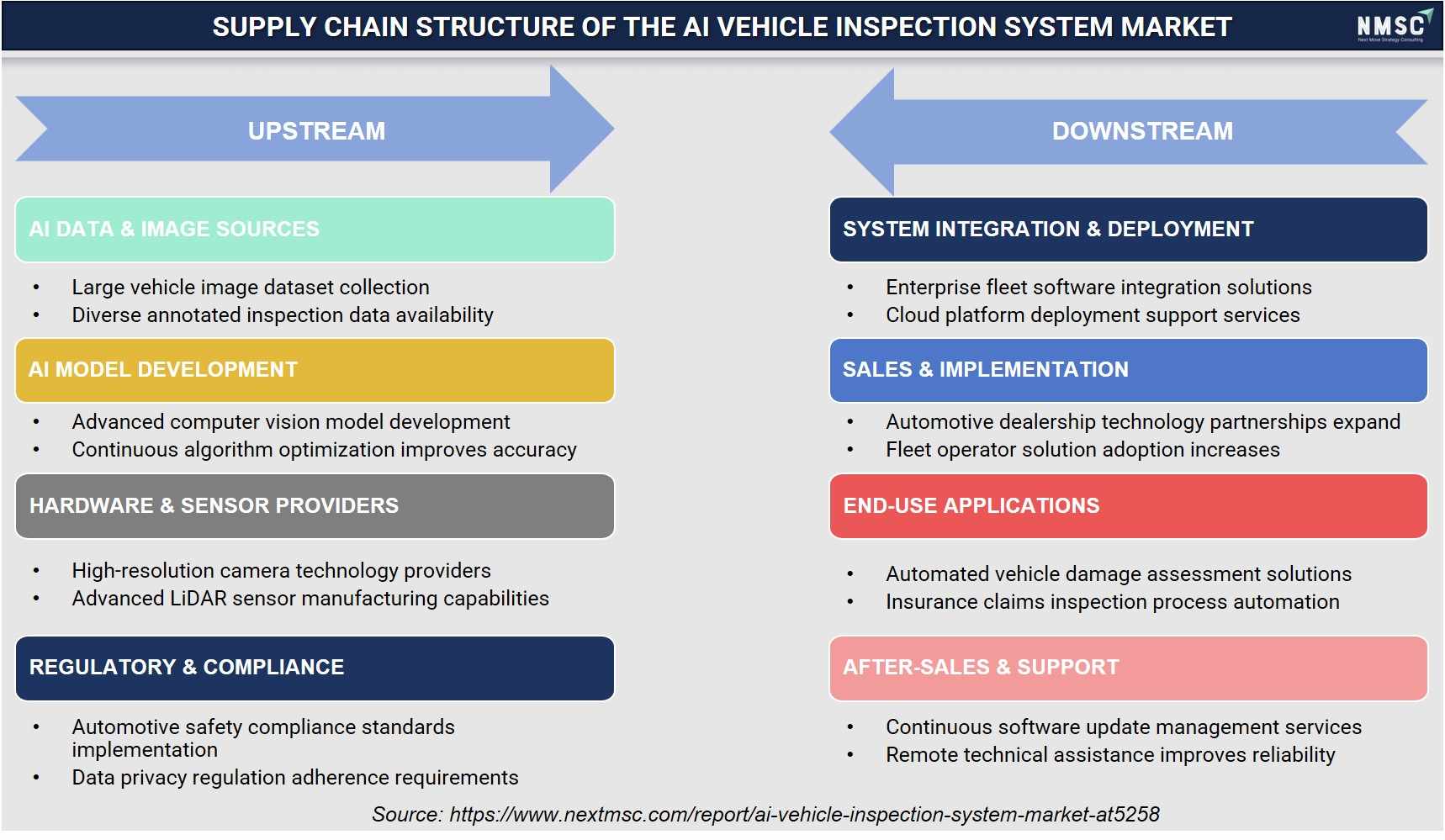
The supply chain of the AI Vehicle Inspection System Market encompasses AI data providers, computer vision developers, hardware manufacturers, system integrators, and deployment partners that collectively enable scalable inspection solutions. Strong collaboration across technology, automotive, and cloud ecosystems enhances solution accuracy, operational efficiency, regulatory compliance, and seamless deployment, supporting widespread adoption across insurance, fleet management, and automotive sectors.
Competitive Landscape
We observed that the competitive landscape of the AI Vehicle Inspection System Market is shaped by specialized computer vision providers, insurance-focused claims automation vendors, and dealership-oriented inspection platforms competing across hardware, software, and services revenue models.
|
Dimension |
Description |
|
Market Structure |
Moderately fragmented among specialized AI inspection vendors, with select providers such as Solera and UVeye achieving multi-application scale |
|
Innovation Focus |
API based inspection integration, agentic claims automation, and expansion into heavy commercial vehicle and seaport use cases |
|
M&A Activity |
Selective acquisitions and platform partnerships linking inspection vendors with dealership, auction, and claims software providers |
How Do Companies Compete in the AI Vehicle Inspection System Market?
Companies compete primarily on inspection accuracy, integration depth with existing dealer and insurer systems, and breadth of application coverage rather than hardware specifications alone. We observed that Solera Holdings leverages its scale across insurance and collision repair software, while UVeye competes through drive-through scanner accuracy and OEM seaport partnerships. Specialized vendors such as Tractable and Ravin AI compete on claims-specific computer vision precision.
Which Competitive Archetypes Dominate the AI Vehicle Inspection System Market?
Three competitive archetypes dominate the AI Vehicle Inspection System Market: integrated software providers that embed inspection into broader claims or dealer management platforms, hardware-led scanner specialists that compete on physical accuracy, and mobile-first capture providers that prioritize deployment flexibility. Our findings suggest that integrated software providers increasingly set baseline expectations, compelling hardware specialists to pursue API partnerships to remain embedded within dominant dealer and insurer workflows.
What Innovation and Differentiation Strategies Define the Market?
Innovation strategy increasingly centers on API based inspection integration, agentic claims triage, and expansion into heavy commercial vehicle and seaport quality assurance. Our analysis shows that UVeye's 2025 expansion into Class 6-8 truck and bus inspection and its Jaguar Land Rover seaport deployment reflect a broader industry shift toward extending AI inspection across the full vehicle lifecycle rather than a single touchpoint.
How Active Is M&A Activity Across the AI Vehicle Inspection System Market?
M&A and partnership activity remains selective but steady, concentrated on integrating inspection vendors with dealership, auction, and claims software ecosystems rather than large-scale consolidation. We observed that UVeye's 2025 partnership with Cox Automotive's vAuto and its $191 million funding round reflect continued capital inflows supporting geographic and application expansion through channel partnerships rather than cross-border acquisitions.
Key Market Players
We compiled the following validated set of key market players based on AI inspection capability depth, application breadth, and deployment scale within the AI Vehicle Inspection System Market.
-
Solera Holdings, LLC
-
UVeye Ltd.
-
Tractable Ltd.
-
ControlExpert GmbH
-
ProovStation SAS
-
DeGould Limited
-
Claim Genius Inc.
-
Ravin AI Ltd.
-
PAVE Computer Vision Inc.
-
Inspektlabs Technologies Pvt. Ltd.
-
Tchek SAS
-
Bdeo Technologies S.L.
-
Monk AI SAS
-
Spyne AI Private Limited
-
CamCom Technologies Pvt. Ltd.
-
FocalX ApS
-
WeProov SAS
-
Click-Ins Ltd.
-
DriveX Mobility Private Limited
-
Trueclaim AI Private Limited
Latest Developments
We tracked the following recent developments shaping the AI Vehicle Inspection System Market.
|
Date |
Event |
|
February 2026 |
UVeye and Cox Automotive's vAuto launched AI-powered retail service lane vehicle inspection integrated into dealer appraisal and inventory tools |
|
October 2025 |
UVeye expanded its automated inspection platform to heavy-duty Class 6-8 trucks and buses across the U.S. and UK |
|
August 2025 |
UVeye partnered with Jaguar Land Rover North America to install automated AI vehicle inspection technology at three major U.S. seaport facilities |
|
January 2025 |
UVeye secured USD 191 million in funding, led by Toyota's Woven Capital, to expand global deployment of AI-powered vehicle inspection systems |
Expert Insights
 “AI is reshaping how dealers source, appraise, and merchandise vehicles by putting real-time condition data at the center of every decision. By harnessing AI and predictive insights, dealers can act faster in the service lane, identify acquisition opportunities earlier, and work to improve the overall customer experience with more transparent, data-driven processes.”
— Derek Hansen, Senior Vice President of Dealer, Lender and Inventory
Statement made during the announcement of the Cox Automotive and UVeye partnership, highlighting how AI-powered vehicle inspection and predictive analytics are transforming dealership operations, vehicle appraisal, inventory acquisition, and customer experience.
Market Interpretation
The statement highlights the growing integration of AI-powered vehicle inspection systems into dealership operations, where real-time vehicle condition data is becoming a critical asset for decision-making. By combining AI-driven inspections with predictive analytics, dealerships can accelerate vehicle appraisals, improve inventory sourcing, optimize service workflows, and enhance transparency throughout the vehicle lifecycle. The insight reflects a broader market trend toward digital inspection ecosystems that improve operational efficiency, support data-driven vehicle valuation, and strengthen customer trust, driving increased adoption of AI vehicle inspection solutions across the automotive retail industry.
Investment Opportunities
Where Are Capital Inflows Concentrated in the AI Vehicle Inspection System Market?
Capital inflows are concentrated in API based inspection middleware, claims automation software, and heavy commercial vehicle inspection platforms. We observed that UVeye's USD 191 million funding round in January 2025, led by Toyota's Woven Capital, reflects continued investor confidence in scaling AI-driven inspection infrastructure across dealership, fleet, and OEM applications.
What Infrastructure Investment Is Required to Support Market Growth?
Sustained growth requires continued investment in drive-through scanner hardware, cloud computer vision infrastructure, and API integration layers connecting inspection data to dealer management and claims systems. Our findings suggest that manufacturers are prioritizing modular deployment models capable of supporting both fixed installations and mobile capture to serve varied dealership, auction, and fleet site requirements.
How Do ESG Considerations Shape Investment in the Market?
Environmental, Social, and Governance considerations increasingly influence investment decisions, particularly around AI governance transparency required under the NAIC's AI Model Bulletin, adopted by 23 states by late 2025. Our analysis shows that fair and explainable claims decisioning has become a material governance consideration for institutional investors evaluating insurance-focused inspection vendors.
Key Benefits for Stakeholders
How Does This Report Benefit Industry Leaders?
Industry leaders gain access to granular segmentation, competitive benchmarking, and regional demand analysis that support product roadmap and go-to-market prioritization. Our forecasts and segment-level CAGR data help inspection technology vendors identify which capture modes and applications warrant near-term investment relative to slower-growing categories.
How Does This Report Benefit Investors and Financial Analysts?
Investors and financial analysts gain a consolidated, source-verified view of market sizing, growth drivers, and competitive structure that supports valuation and due diligence work. The report's regional and segment-level forecasts help analysts assess which sub-segments and geographies offer the most attractive risk-adjusted growth profiles across the 2026-2035 forecast window.
How Does This Report Benefit Technology Vendors and Product Teams?
Technology vendors and product teams benefit from detailed trend and driver analysis that clarifies which capture modes, deployment models, and applications are gaining adoption momentum. This supports more informed roadmap decisions around API integration, agentic claims automation, and heavy commercial vehicle inspection capabilities.
Key Market Segments
By Application
-
Insurance
-
Claims Inspection
-
FNOL Assessment
-
Damage Detection
-
Repair Estimation
-
Total Loss Assessment
-
Post Repair Validation
-
-
Underwriting Inspection
-
New Policy Inspection
-
Renewal Inspection
-
Risk Assessment
-
-
-
Fleet And Mobility
-
Fleet Management
-
Vehicle Intake
-
Vehicle Return
-
Maintenance Inspection
-
Damage Monitoring
-
-
Rental Operations
-
Check In Inspection
-
Check Out Inspection
-
Turnaround Inspection
-
-
Mobility Services
-
Ride Hail Inspection
-
Car Share Inspection
-
-
-
Automotive Retail
-
Dealerships
-
Trade In Inspection
-
Service Lane Inspection
-
Retail Listing Inspection
-
Reconditioning Inspection
-
-
Used Vehicle Platforms
-
Vehicle Certification
-
Condition Reporting
-
-
Collision Repair Centers
-
Pre Repair Inspection
-
Repair Validation
-
Delivery Inspection
-
-
-
Auctions And Remarketing
-
Auction Intake Inspection
-
Vehicle Grading
-
Condition Reporting
-
Transport Handover Inspection
-
-
Automotive Manufacturing
-
Incoming Quality Inspection
-
Parts Inspection
-
Component Verification
-
-
In Process Inspection
-
Assembly Inspection
-
Paint Inspection
-
Surface Defect Inspection
-
-
End Of Line Inspection
-
Final Quality Inspection
-
Delivery Readiness Inspection
-
-
-
Government And Compliance
-
Roadworthiness Inspection
-
Safety Inspection
-
Regulatory Compliance Inspection
-
-
Other Applications
-
Salvage Inspection
-
Specialty Vehicle Inspection
-
Commercial Equipment Inspection
-
By Capture Mode
-
Drive Through Scanner
-
Guided Mobile Photo
-
Fixed Camera System
-
Handheld Device
-
API Based Inspection
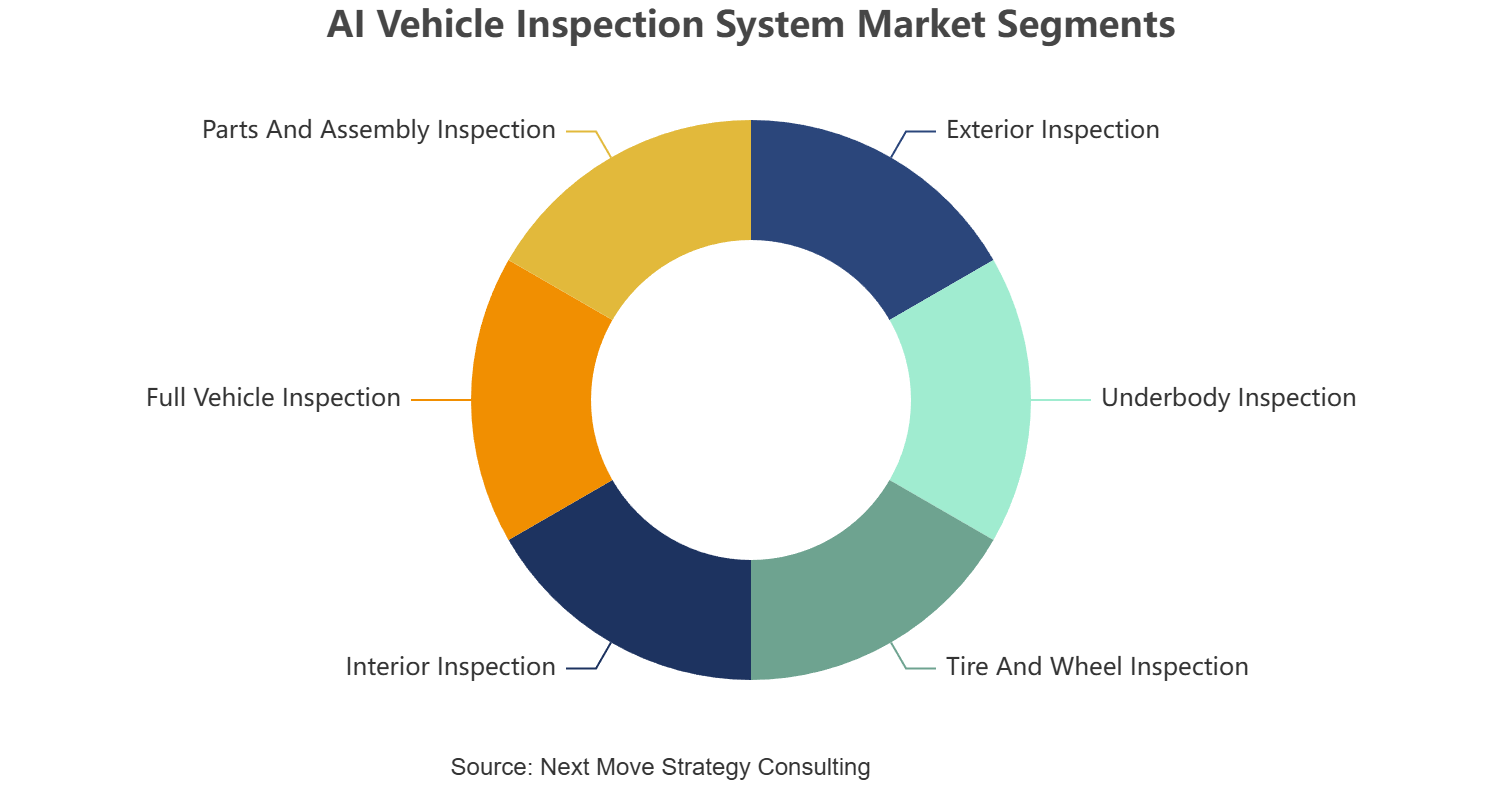
By Inspection Scope
-
Exterior Inspection
-
Underbody Inspection
-
Tire And Wheel Inspection
-
Interior Inspection
-
Full Vehicle Inspection
-
Parts And Assembly Inspection
By Vehicle Class
-
Passenger Cars
-
Light Commercial Vehicles
-
Heavy Commercial Vehicles
-
Two Wheelers
-
Specialty Vehicles
By Deployment Model
-
On Premise
-
Cloud Based
-
Hybrid Deployment
By Revenue Stream
-
Hardware
-
Software
-
Services
By Sales Channel
-
Direct Sales
-
Channel Partners
-
OEM Partnerships
By Region
-
North America: U.S., Canada, Mexico.
-
Europe: UK, Germany, France, Italy, Spain, Sweden, Denmark, Finland, Netherlands, Rest of Europe.
-
Asia-Pacific: China, India, Japan, South Korea, Taiwan, Indonesia, Vietnam, Australia, Philippines, Malaysia, Rest of APAC.
-
Middle East & Africa: Saudi Arabia, UAE, Egypt, Israel, Turkey, Nigeria, South Africa, Rest of MEA.
-
Latin America: Brazil, Argentina, Chile, Colombia, Rest of LATAM.
Conclusion and Recommendations
What Is the Long-Term Outlook for the AI Vehicle Inspection System Market?
The long-term outlook remains strongly positive, with the market forecast to expand from USD 850 Million in 2025 to USD 6.80 Billion by 2035 at a 23.1% CAGR. We observed that this trajectory is underpinned by rising claims volumes, dealership digitization, and expanding OEM quality-control automation across developed and emerging economies alike.
What Strategic Positioning Should Companies Pursue?
Companies should prioritize API integration with dealer, insurer, and fleet management systems, along with expansion into heavy commercial vehicle and seaport use cases, to remain competitive. Our assessment indicates that vendors combining strong platform partnerships with differentiated computer vision accuracy are best positioned to capture share as the market matures.
How Attractive Is the Market for New Investment?
Investment attractiveness remains high given the market's double-digit CAGR, expanding services revenue models, and broadening application base across insurance, retail, and manufacturing use cases. We found that capital is increasingly favoring integration and software layers over standalone hardware, reflecting a maturing competitive landscape.
What Are the Key Market Shifts and Risks?
Key shifts include the migration from standalone scanning tools to API embedded inspection and growing extension into heavy commercial vehicle categories. Principal risks include AI governance compliance costs, integration complexity with legacy dealer and claims systems, and high upfront capital costs for fixed scanner infrastructure in price-sensitive regions.
What Are the Primary Growth Pathways Through 2035?
Primary growth pathways include expansion of API based inspection integrated into appraisal and claims software, growing OEM seaport and manufacturing deployments, and continued adoption across auctions and remarketing platforms. Our analysis shows that these pathways collectively support sustained double-digit growth across both mature and emerging regional markets through 2035.
About the Author
 Mihul Sharma
— Mihul Sharma is Research Associate at Next Move Strategy Consulting, where he has covered technology, industrial, and healthcare markets for 3 years. His work applies structured business research, market analysis, and secondary-source review to assess market trends, competitive developments, and growth opportunities. He supports report development by fully synthesizing industry data, company information, and market signals into concise findings for strategy and investment-focused research teams.
Mihul Sharma
— Mihul Sharma is Research Associate at Next Move Strategy Consulting, where he has covered technology, industrial, and healthcare markets for 3 years. His work applies structured business research, market analysis, and secondary-source review to assess market trends, competitive developments, and growth opportunities. He supports report development by fully synthesizing industry data, company information, and market signals into concise findings for strategy and investment-focused research teams.
About the Reviewer
 Supradip Baul
— Supradip Baul is an accomplished business consultant and strategist with over a decade of rich experience in market intelligence, strategy, technology, and business transformation. His work has included rigorous qualitative and quantitative analysis across multiple industries, helping clients shape investment decisions and long-term roadmaps. Earlier in his career, he was associated with Gartner, where he contributed to industry-leading reports and market share analyses. He has worked with leading global companies and holds an MBA with a dual specialization in Marketing and Finance.
Supradip Baul
— Supradip Baul is an accomplished business consultant and strategist with over a decade of rich experience in market intelligence, strategy, technology, and business transformation. His work has included rigorous qualitative and quantitative analysis across multiple industries, helping clients shape investment decisions and long-term roadmaps. Earlier in his career, he was associated with Gartner, where he contributed to industry-leading reports and market share analyses. He has worked with leading global companies and holds an MBA with a dual specialization in Marketing and Finance.
At Next Move Strategy Consulting, we understand that insightful market research is the cornerstone of successful business decisions. That's why we employ a robust and multifaceted approach, combining various methodologies to deliver the most accurate and actionable data for our clients.

Research Landscape
We navigate the world of research with two primary approaches:
Qualitative Approach
Our qualitative research methodologies involve immersive techniques such as in-depth interviews, focus groups, and observational studies. By engaging directly with individuals and stakeholders, we uncover valuable insights that quantitative data alone may overlook.

Quantitative Research
In tandem with qualitative methodologies, NMSC leverages the power of Quantitative Research to provide a robust foundation of numerical insights. Through systematic data collection and analysis, we quantify patterns, preferences, and market trends, offering a comprehensive view of the business landscape.
Our quantitative research approach employs diverse tools, including surveys, experiments, and statistical modelling. These methodologies enable us to gather data from a large and representative sample, ensuring the statistical significance of our findings. By employing structured questionnaires and standardized data collection methods, we guarantee the reliability and validity of the information we present to our clients.
Quantitative research is particularly effective in measuring the prevalence of trends, assessing market size, and gauging the impact of various factors on consumer behavior. The numerical precision attained through this approach equips our clients with actionable insights, facilitating data-driven decision-making and strategy formulation.


Our Specialized Toolbox for Industry-Specific Market Research
We deploy a specialized arsenal of techniques tailored to meet your unique requirements. Here's a glimpse into our comprehensive toolbox:

Information Procurement
The stage entails acquiring market data or relevant information through various sources and methodologies.


Market Research Approach
We utilize both top-down and bottom-up approaches in market research analysis to achieve a comprehensive understanding of the market dynamics, leveraging the broad perspective of industry trends and macroeconomic factors alongside detailed insights from specific segments and individual companies.

Porters Five Forces Analysis
We conduct Porter's Five Forces analysis to evaluate the competitive landscape of an industry, providing us with insights into factors that affect profitability and strategic positioning.

SWOT Analysis

Forecasting
We utilize a forecasting model to predict future consumption by considering parameters like population, economics, regulations, market competition, drivers, constraints, technology, and pricing. We also employ statistical techniques such as multilinear regression, exponential smoothing, moving average, ARIMA, and Monte Carlo simulations for accurate predictions. In econometric forecasting, we analyzed short-term and long-term event impacts, attributing values based on regulatory frameworks, economic factors, and market events.





 Speak to Our Analyst