Air Brake System Market Size, Share, Growth & Forecast By Revenue Stream (OEM Fit, Aftermarket, and Services), By Product Category (Air Supply and Treatment {Air Compressor, Air Dryer, Air Reservoir, and Governor}, Hoses Pipes and Fittings, Electronic Control, Integrated System, and Other Components), By Vehicle Type (Truck, Bus, Trailer, Rail, and Specialty Vehicles), and By Technology (Pneumatic and Electro-Pneumatic) — Global Opportunity Analysis 2025–2035
Industry: Automotive & Transportation | Publishing Date: July 10, 2026 | Last Updated: September 30, 2026 | No of Pages: N/A | No. of Tables: N/A | No. of Figures: N/A | Format: PDF | Report Code: AT5074
What Is the Air Brake System Market Size?
The global Air Brake System Market was valued at USD 5.21 billion in 2025 and is expected to reach USD 5.40 billion in 2026. Rising commercial vehicle production volumes, tightening vehicle safety regulations, and accelerating electro-pneumatic technology adoption are projected to propel the market to USD 7.82 billion by 2035, advancing at a CAGR of 4.1% from 2026 to 2035. Key growth drivers include global fleet expansion for freight transport, mandated anti-lock braking systems (ABS) fitment across emerging economies, electrification of commercial vehicle platforms, and growing aftermarket demand driven by large in-service vehicle fleets worldwide.
|
Parameters |
Details |
|
Market Size in 2025 |
USD 5.21 Billion |
|
Market Size in 2026 |
USD 5.40 Billion |
|
Revenue Forecast in 2035 |
USD 7.82 Billion |
|
Growth Rate |
CAGR of 4.1% from 2026 to 2035 |
|
Analysis Period |
2025–2035 |
|
Base Year Considered |
2025 |
|
Forecast Period |
2026–2035 |
|
Market Size Estimation |
Billion (USD) |
|
Companies Profiled |
20 |
|
Countries Covered |
33 |
|
Market Share |
Top 10 |
Air Brake System Market Overview
What Is the Air Brake System Market?
The Air Brake System Market encompasses the design, manufacture, distribution, and servicing of pneumatic and electro-pneumatic braking systems used across commercial vehicles, rail platforms, and specialty transport equipment. These systems utilize compressed air as the operating medium to actuate foundation brakes, enabling reliable and powerful braking performance across heavy-duty vehicle applications. The market serves original equipment manufacturers (OEMs) as well as a large global aftermarket spanning replacement parts, remanufactured units, diagnostics, calibration services, and technical training programs.
How Has the Air Brake System Market Evolved?
The Air Brake System Market has undergone significant structural evolution over the past three decades. Early pneumatic systems relied entirely on mechanical control architectures. The integration of electronic control units transformed the market through the widespread adoption of Anti-Lock Braking Systems (ABS) and Electronic Braking Systems (EBS). Through NMSC's assessment, we found that the current phase is defined by the emergence of electro-pneumatic actuation, integrated stability control modules, and smart air management systems designed to complement the electrification of heavy commercial vehicle powertrains worldwide.
How Do Regulations Influence the Air Brake System Market?
Regulatory frameworks are the most powerful structural driver of the Air Brake System Market. The United Nations Economic Commission for Europe (UNECE) Regulation No. 13 governs air braking system performance standards across commercial vehicles. In the United States, the Federal Motor Carrier Safety Administration (FMCSA) mandates ABS fitment on all new air-braked commercial vehicles over 10,000 lbs gross vehicle weight. India's Ministry of Road Transport and Highways (MoRTH) has progressively expanded ABS mandates across heavy commercial vehicle categories, compelling OEM upgrades across a large and rapidly growing vehicle market.
How Is Technology Adoption Expanding Across the Air Brake System Market?
Technology adoption across the Air Brake System Market is accelerating as fleet operators prioritize fuel efficiency, safety compliance, and reduced total cost of ownership. Electro-pneumatic systems featuring electronic control of air pressure enable faster brake response times and precise modulation across axle groups. Our analysis shows that electronic braking system (EBS) adoption is expanding from premium European truck platforms to mid-range commercial vehicle segments globally. Additionally, trailer brake management systems and integrated stability control units are becoming standard equipment across regulated markets, elevating the content value per vehicle in air braking system configurations.
|
Key Takeaways |
|
By revenue stream, OEM Fit held the largest share of the Air Brake System Market at USD 2.11 billion in 2025, driven by high commercial vehicle production volumes across Asia-Pacific and North America. The Aftermarket segment, encompassing Replacement Parts, Kits, Remanufactured Units, and Services, is collectively the fastest-growing revenue stream, projected to advance from USD 3.10 billion in 2025 to USD 4.90 billion by 2035 at a CAGR of 4.7%, supported by a large aging global fleet and growing demand for certified brake servicing. |
|
By product category, Foundation Brake components, including Drum Brakes, Disc Brakes, Calipers, Rotors, and Pads and Shoes, held the largest product share at USD 1.8 billion in 2025. The Electronic Control segment, comprising ABS, EBS, Stability Control, and Trailer Control systems, is the fastest-growing product category at a CAGR of 6.8% from 2026 to 2035, reflecting the rapid electrification of commercial vehicle braking architectures globally. |
|
By vehicle type, the Truck segment dominated the Air Brake System Market with USD 2.4 billion in 2025, representing approximately 46% of total market revenue. The Rail segment is experiencing steady growth driven by global urban transit expansion and freight rail modernization programs, while the Specialty vehicle segment is emerging as a niche high-growth category for mining and construction equipment brake systems. |
|
By technology, Pneumatic systems commanded the largest share of the Air Brake System Market at USD 3.81 billion in 2025, as they remain the established standard across heavy commercial vehicle categories globally. The Electro-Pneumatic segment is the fastest-growing technology at a CAGR of 6.2% from 2026 to 2035, propelled by EV truck platform development, autonomous driving sensor integration, and the mandatory rollout of advanced safety features across regulated markets. |
|
North America held the largest regional share in the Air Brake System Market at USD 1.71 billion in 2025 and is projected to reach USD 2.32 billion by 2035, growing at a CAGR of 3.2%, supported by the world's largest heavy-duty truck fleet, stringent FMCSA safety regulations, and a mature brake system supplier ecosystem. |
|
Asia-Pacific is the fastest-growing major region in the Air Brake System Market, forecast to expand from USD 1.5 billion in 2025 to USD 2.6 billion by 2035 at a CAGR of 5.8%, driven by commercial vehicle production growth in China and India, expanding ABS mandates, and fleet modernization initiatives. |
|
The United States is the single largest country market in the Air Brake System Market, accounting for over 73% of North American revenue in 2025, underpinned by a large Class 8 truck fleet, strong OEM presence, and comprehensive brake safety regulations. |
|
India is the fastest-growing national market in the Air Brake System Market, expected to register a CAGR of 7.2% from 2026 to 2035, fueled by rising truck and bus production, mandatory ABS implementation across commercial vehicles, and ongoing infrastructure development programs. |
Key Emerging Trends in the Air Brake System Market
How Is the Transition to Electric and Hydrogen Commercial Vehicles Reshaping Air Brake System Demand?
The accelerating shift toward battery-electric and hydrogen fuel-cell commercial vehicles is fundamentally reshaping Air Brake System architecture requirements. Electro-pneumatic systems are being redesigned to operate without traditional engine-driven compressors, instead relying on electrically powered air compressors compatible with zero-emission powertrains. Based on NMSC's research, we found that OEMs including Daimler Truck, Volvo Trucks, and Paccar are integrating purpose-built electro-pneumatic brake systems in their electric truck platforms. This transition is driving significant R&D investment among Tier 1 brake system suppliers and expanding the value content of electronic brake management systems across new vehicle platforms.
How Are Electronic Braking Systems Transforming Safety Standards Across the Air Brake System Market?
Electronic Braking Systems (EBS) are rapidly transitioning from premium European truck options to global regulatory requirements across the Air Brake System Market. EBS integrates anti-lock braking, electronic load sensing, and trailer brake coordination into a unified control architecture, enabling significantly shorter stopping distances compared to conventional pneumatic systems. From our research, we found that the European Union's updated General Safety Regulation, which entered application in 2024, mandates advanced emergency braking and electronic braking system features on new heavy commercial vehicles sold in EU markets, compelling OEMs globally to adopt EBS-compatible air brake architectures.
What Role Is Predictive Maintenance and Telematics Playing in the Evolution of Air Brake System Services?
Through our market assessment, we observed that the integration of telematics and IoT-enabled diagnostics is transforming the aftermarket services segment of the Air Brake System Market. Air pressure monitoring sensors, brake wear indicators, and connected diagnostic modules enable fleet operators to implement predictive maintenance programs that reduce unplanned downtime and brake-related road failures. Major brake system suppliers including Knorr-Bremse and ZF Friedrichshafen are embedding connectivity modules within their air brake components, generating recurring revenue from software-enabled service contracts. This shift is expanding the addressable market for diagnostics, calibration, and technical support services within the broader Air Brake System ecosystem.
How Is the Growing Focus on Disc Brakes for Commercial Vehicles Impacting the Air Brake System Market?
The progressive adoption of air disc brakes across heavy commercial vehicle platforms is creating a structural shift in foundation brake segment composition within the Air Brake System Market. Air disc brakes offer superior fade resistance, more consistent stopping performance under heavy loads, and lower maintenance frequency compared to drum brake alternatives. Our assessment indicates that European commercial vehicle markets already exhibit high disc brake penetration above 80% for tractor units, while North America and Asia-Pacific represent significant conversion opportunities. Knorr-Bremse and ZF are expanding production capacity for air disc brake calipers and rotors in response to this structural demand trend.
What Are the Key Market Drivers, Breakthroughs, and Investment Opportunities that Will Shape the Air Brake System Market Industry in the Next Decade?
|
Drivers / Trends / Restraints |
(+/-) % Impact on CAGR Forecast |
Geographic Relevance |
Impact Timeline |
|
Global Commercial Vehicle Production Growth |
+0.9% |
Asia-Pacific, North America |
2025–2030 |
|
Regulatory ABS/EBS Mandates Expansion |
+0.8% |
India, Southeast Asia, MEA |
2025–2030 |
|
Electric Commercial Vehicle Platform Adoption |
+0.7% |
Europe, North America, China |
2026–2035 |
|
Aftermarket Fleet Servicing Demand |
+0.6% |
Global (all regions) |
2025–2035 |
|
Disc Brake Conversion in Commercial Vehicles |
+0.5% |
North America, APAC |
2026–2033 |
|
Telematics and Predictive Maintenance Integration |
+0.4% |
Europe, North America |
2025–2035 |
|
Supply Chain Disruptions and Raw Material Costs |
-0.6% |
Global |
Ongoing |
|
EV Powertrain Transition Complexity |
-0.4% |
Europe, North America |
2025–2030 |
|
Rail and Urban Transit Infrastructure Investment |
+0.3% |
India, Middle East, Europe |
2026–2035 |
What Are the Growth Drivers of the Air Brake System Market?
How Is the Expansion of Global Commercial Vehicle Fleets Driving Air Brake System Market Growth?
The sustained expansion of heavy commercial vehicle production across Asia-Pacific, North America, and emerging markets is the primary structural driver of the Air Brake System Market. Commercial trucks, buses, and trailers are mandated to carry air brake systems in most regulated jurisdictions globally, creating a direct and proportional link between vehicle production volumes and brake system demand. From our assessment, we noticed that the Society of Indian Automobile Manufacturers (SIAM) reports continued year-over-year growth in medium and heavy commercial vehicle production in India, directly expanding the OEM fitment opportunity for air brake system suppliers operating in that market.
How Are Expanding ABS and EBS Regulatory Mandates Creating Structural Demand in the Air Brake System Market?
Regulatory mandates requiring Anti-Lock Braking System and Electronic Braking System fitment represent a high-impact growth catalyst for the Air Brake System Market, particularly in developing vehicle markets where electronic braking penetration remains low. India's Ministry of Road Transport and Highways has progressively mandated ABS across heavy commercial vehicle categories, creating a sustained OEM content upgrade opportunity. The United Nations Economic Commission for Europe (UNECE) working group on automated vehicles is further expanding electronic braking requirements across international vehicle safety standards, compelling global OEMs to invest in advanced air brake architectures with integrated electronic control modules.
How Is the Aftermarket Opportunity Supporting Long-Term Revenue Generation in the Air Brake System Market?
A large and aging global commercial vehicle fleet creates a structurally significant aftermarket opportunity within the Air Brake System Market. Brake chambers, slack adjusters, air compressors, dryers, and foundation brake components are subject to regular wear cycles, generating recurring replacement demand. NMSC's analysis indicates that the North American aftermarket for commercial vehicle air brake components is among the most mature and value-rich globally, supported by the Federal Motor Carrier Safety Administration's mandated brake inspection and maintenance requirements under 49 CFR Part 393. Independent repair shops, truck dealers, and fleet maintenance operations collectively drive consistent aftermarket brake parts procurement across the service life of in-operation vehicles.
What Are the Growth Inhibitors of the Air Brake System Market?
How Do Supply Chain Volatility and Raw Material Cost Pressures Constrain Air Brake System Market Expansion?
The Air Brake System Market faces structural cost pressures from raw material price volatility, particularly for steel, aluminum, and specialty alloys used in brake chambers, compressors, and disc brake components. Supply chain disruptions affecting casting, forging, and precision machining supply chains have increased component lead times and manufacturing costs for Tier 1 brake system suppliers. Our findings suggest that the U.S. Department of Commerce's industrial competitiveness reports have highlighted material input cost volatility as a consistent challenge for heavy-duty automotive component manufacturers, directly affecting brake system supplier margin performance and constraining pricing flexibility in competitive OEM procurement environments.
How Does the Complexity of Electro-Pneumatic System Integration Limit Market Penetration Among Smaller OEMs?
The integration of electro-pneumatic braking systems with EV powertrain architectures presents significant engineering complexity for smaller commercial vehicle OEMs and regional manufacturers operating with limited R&D budgets. Unlike conventional pneumatic systems that interface with diesel engine air supplies, electro-pneumatic systems require dedicated electric compressors, high-voltage wiring integration, and software-defined brake management capable of interfacing with regenerative braking systems. Based on our evaluation, we noticed that this complexity extends vehicle development timelines, increases system integration costs, and creates barrier to rapid adoption among bus and truck manufacturers in developing markets not yet mandated to deploy electronic braking architectures.
What Are the Growth Opportunities in the Air Brake System Market?
How Does the Electrification of Commercial Vehicle Platforms Create a Product Innovation Opportunity in the Air Brake System Market?
The global transition to battery-electric and hydrogen-powered commercial vehicles is creating a significant product innovation and replacement cycle opportunity within the Air Brake System Market. Electro-pneumatic brake systems engineered specifically for zero-emission vehicles require electric air compressors, intelligent brake energy recovery coordination with regenerative braking systems, and software-defined brake blending algorithms. Our analysis shows that Knorr-Bremse's dedicated e-compressor product line and ZF's integrated braking and stability systems for EV platforms represent early commercialization of this opportunity. Governments in Europe and the United States are providing fleet electrification incentives through programs managed by the U.S. Department of Energy and EU Alternative Fuels Infrastructure Regulation, accelerating the deployment of electric commercial vehicles and the associated next-generation brake system demand.
How Is Urban Transit and Rail Infrastructure Investment Expanding the Air Brake System Market Addressable Market?
Expanding urban rail transit investments across India, Southeast Asia, the Middle East, and Latin America are creating significant new demand for air brake systems in rail and specialty vehicle segments within the Air Brake System Market. Rail-specific air brake systems, including Wabtec Corporation's extensive freight and transit braking portfolio, are integral to both new rolling stock delivery and modernization of existing fleets. India's National Rail Plan targets significant expansion of freight and passenger rail capacity through 2051, while the UAE, Saudi Arabia, and Egypt are investing heavily in metro and rapid transit systems. These infrastructure programs create long-duration, government-backed demand for rail air braking systems, compressors, and related maintenance services.
How Does the Growth of Remanufacturing and Circular Economy Models Create a Market Opportunity in the Air Brake System Industry?
Remanufactured air brake components represent a growing opportunity segment within the Air Brake System Market, driven by fleet operators seeking to reduce maintenance costs while meeting performance and safety standards. Remanufactured brake chambers, slack adjusters, and compressor units offer cost advantages of 20 to 40 percent compared to new OEM parts, making them attractive for independent fleet operators and smaller transport companies. Based on our market evaluation, we noticed that the U.S. Environmental Protection Agency's Safer Choice program and the European Commission's Circular Economy Action Plan are creating regulatory frameworks that actively support certified remanufacturing as a sustainable industrial practice, expanding the policy environment favorable to growth of the Remanufactured Units sub-segment within the Air Brake System Market aftermarket.
SWOT Analysis of the Air Brake System Market
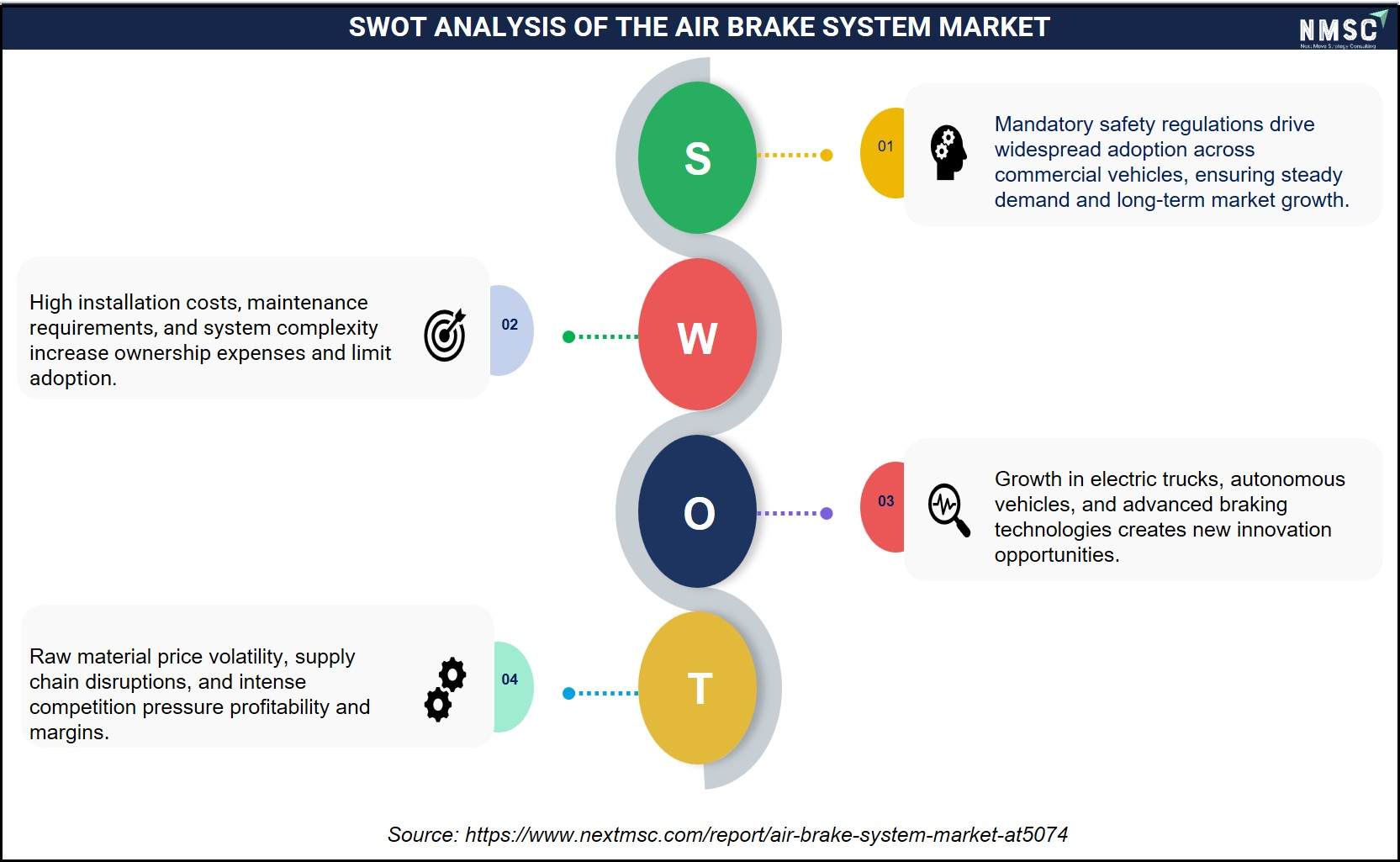
Based on NMSC's assessment, the Air Brake System market benefits from stringent vehicle safety regulations that ensure consistent demand across commercial transportation sectors. However, high installation and maintenance costs may constrain adoption. Meanwhile, advancements in electric and autonomous vehicles create new growth avenues. Nevertheless, raw material price volatility, supply chain disruptions, and competitive pressures remain key challenges influencing market profitability and long-term expansion.
How Is the Air Brake System Market Segmented in This Report, and What Are the Key Insights from the Segmentation Analysis?
How Does Revenue Stream Segmentation Reveal Commercial Composition Across the Air Brake System Market?
|
Revenue Stream Segment |
2025 (USD Bn) |
2035 (USD Bn) |
CAGR (%) |
|
OEM Fit |
2.11 |
2.92 |
3.3% |
|
Aftermarket - Replacement Parts |
1.4 |
1.80 |
2.5% |
|
Aftermarket - Kits |
0.6 |
0.75 |
2.3% |
|
Aftermarket - Remanufactured Units |
0.5 |
0.65 |
2.7% |
|
Services - Diagnostics and Calibration |
0.3 |
0.75 |
9.6% |
|
Services - Technical Support |
0.2 |
0.50 |
9.6% |
|
Services - Training |
0.1 |
0.45 |
16.2% |
Based on NMSC's analysis of commercial vehicle procurement and fleet servicing trends, we observed that the Air Brake System Market is segmented by revenue stream into OEM Fit and Aftermarket, which encompasses Replacement Parts, Kits, and Remanufactured Units, as well as Services comprising Diagnostics and Calibration, Technical Support, and Training. The OEM Fit segment currently dominates due to sustained heavy commercial vehicle production volumes across Asia-Pacific and North America, with OEM procurement volumes directly tied to truck and bus build rates. The Aftermarket segment, encompassing Replacement Parts, Kits, Remanufactured Units, and Services, is collectively the fastest-growing revenue stream, projected to advance from USD 3.10 billion in 2025 to USD 4.90 billion by 2035 at a CAGR of 4.7%, supported by a large aging global fleet and growing demand for certified brake servicing.
How Does Product Category Segmentation Reflect the Technical Architecture of the Air Brake System Market?
|
Product Category Segment |
2025 (USD Bn) |
2035 (USD Bn) |
CAGR (%) |
|
Air Supply and Treatment |
1.1 |
1.5 |
3.2% |
|
Control and Actuation |
1.0 |
1.5 |
4.1% |
|
Foundation Brake |
1.8 |
2.5 |
3.4% |
|
Electronic Control |
0.8 |
1.6 |
6.8% |
|
Hoses, Pipes and Fittings |
0.3 |
0.4 |
2.9% |
|
Integrated System |
0.2 |
0.3 |
4.1% |
|
Other Components |
0.01 |
0.02 |
7.2% |
Through NMSC's assessment, we found that the Air Brake System Market is segmented by product category into Air Supply and Treatment (Air Compressor, Air Dryer, Air Reservoir, Governor), Control and Actuation (Valve, Brake Chamber, Actuator, Slack Adjuster), Foundation Brake (Drum Brake, Disc Brake, Caliper, Rotor, Pads and Shoes), Electronic Control (ABS, EBS, Stability Control, Trailer Control), Hoses, Pipes and Fittings, and Integrated Systems. The Foundation Brake segment commands the largest revenue share due to its high-replacement-frequency consumable components, particularly pads, shoes, and rotors. The Electronic Control segment is the fastest-growing product category as ABS and EBS mandates expand globally, driving OEM content value increases per vehicle. Within Air Supply and Treatment, air compressors and dryers are experiencing technology transitions driven by EV platform adaptation requirements.
How Does Vehicle Type Segmentation Define Market Demand Concentration in the Air Brake System Market?
|
Vehicle Type Segment |
2025 (USD Bn) |
2035 (USD Bn) |
CAGR (%) |
|
Truck |
2.4 |
3.4 |
3.5% |
|
Bus |
0.9 |
1.4 |
4.5% |
|
Trailer |
0.7 |
1.0 |
3.6% |
|
Rail |
0.6 |
1.1 |
6.2% |
|
Specialty |
0.61 |
0.92 |
4.2% |
Our analysis of commercial vehicle production and fleet utilization patterns indicates that the Air Brake System Market is segmented by vehicle type into Truck, Bus, Trailer, Rail, and Specialty categories. The Truck segment dominates with nearly 46% of total market revenue in 2025, driven by heavy freight transport demand across all global regions and the near-universal regulatory mandate for air braking on Class 7 and Class 8 vehicles. The Bus segment is growing at above-average rates as urban transit expansion programs in developing markets drive new bus deliveries with mandatory ABS and EBS equipment. Rail is emerging as one of the fastest-growing vehicle type sub-segments due to government-backed infrastructure investment programs in India, the Middle East, and Southeast Asia. Specialty vehicles, including mining haul trucks, construction equipment, and airport ground support vehicles, represent a niche but consistently growing application category.
How Does Technology Segmentation Capture the Pneumatic-to-Electro-Pneumatic Transition in the Air Brake System Market?
|
Technology Segment |
2025 (USD Bn) |
2035 (USD Bn) |
CAGR (%) |
|
Pneumatic |
3.81 |
5.02 |
2.8% |
|
Electro-Pneumatic |
1.4 |
2.8 |
6.2% |
In our observation, the Air Brake System Market is segmented by technology into Pneumatic and Electro-Pneumatic systems. Pneumatic braking systems currently command approximately 73% of total market revenue due to their established role as the standard architecture across global heavy commercial vehicle fleets, with low replacement cycle risk and extensive aftermarket supply chain depth. The Electro-Pneumatic segment is growing at more than twice the rate of conventional pneumatic systems, reflecting the structural transition underway across European, North American, and increasingly Asian commercial vehicle platforms toward electronic brake control architectures. NMSC's analysis indicates that electro-pneumatic adoption is being accelerated by both safety regulation compliance requirements and the integration demands of battery-electric commercial vehicle development programs at leading OEMs globally.
Regional Outlook
Geographic Performance Snapshot
|
Region |
2025 (USD Bn) |
2035 (USD Bn) |
CAGR (%) |
Key Driver |
|
North America |
1.71 |
2.32 |
3.2% |
FMCSA mandates, large heavy truck fleet |
|
Europe |
1.4 |
2.0 |
3.6% |
EBS/GSR regulation, EV truck adoption |
|
Asia-Pacific |
1.5 |
2.6 |
5.8% |
India/China CV production, ABS mandates |
|
Middle East & Africa |
0.4 |
0.6 |
4.1% |
Rail infrastructure, fleet modernization |
|
Latin America |
0.2 |
0.3 |
4.1% |
Brazil trucking growth, CONTRAN safety rules |
North America Air Brake System Market
North America is the largest regional market in the Air Brake System Market, contributing USD 1.71 billion in 2025 and forecast to reach USD 2.32 billion by 2035 at a CAGR of 3.2%. The region benefits from the world's largest Class 8 heavy truck fleet, rigorous FMCSA brake performance and maintenance regulations, and a mature Tier 1 brake supplier ecosystem anchored by major global manufacturers. The U.S. market alone absorbs a disproportionate share of global disc brake conversion activity. Canada and Mexico contribute incremental growth driven by cross-border freight transport volume and progressive vehicle safety standard harmonization with the United States under shared North American trade frameworks.
U.S. Air Brake System Market
Based on our engagements with fleet operators and OEM procurement teams, the United States represents approximately 73% of North American Air Brake System Market revenue. The U.S. market is characterized by the highest concentration of Class 8 truck OEM assembly plants, a dense network of Tier 1 brake suppliers, and an established independent aftermarket servicing infrastructure. FMCSA regulations under 49 CFR Parts 393 and 396 mandate rigorous brake performance standards and regular inspection cycles for commercial vehicles in interstate commerce, creating sustained and recurring demand for replacement brake components, diagnostic services, and calibration support across the national fleet.
Canada Air Brake System Market
Through our analysis, Canada's Air Brake System Market is driven by a large interprovincial heavy freight transport sector and compliance with Transport Canada's Motor Vehicle Safety Regulations that align closely with U.S. Federal Motor Vehicle Safety Standards. The energy sector in Alberta and British Columbia generates high demand for heavy-duty specialty vehicle brake systems in oilsands and forestry equipment applications. Canadian fleet operators are increasingly investing in premium EBS-equipped European truck platforms, gradually shifting the product mix toward higher-value electronic braking components within the Canadian Air Brake System Market segment.
Mexico Air Brake System Market
From our assessment, Mexico is the fastest-growing market within North America in the Air Brake System Market, driven by expanding nearshoring logistics infrastructure and cross-border freight volumes with the United States. Mexican commercial vehicle regulation under the Secretariat of Infrastructure, Communications and Transportation is progressively aligning with North American safety standards. The growth of manufacturing clusters in Monterrey, Guadalajara, and Mexico City is expanding bus and truck fleet demand. Additionally, aftermarket brake component demand is growing rapidly as Mexico's aging commercial vehicle fleet requires increased maintenance and replacement parts investment.
Europe Air Brake System Market
Europe is the second-largest region in the Air Brake System Market, generating USD 1.4 billion in 2025 and forecast to reach USD 2.0 billion by 2035 at a CAGR of 3.6%. Europe is the global center of air brake technology innovation, hosting the headquarters of Knorr-Bremse AG and ZF Friedrichshafen AG. The European Union's General Safety Regulation (EU) 2019/2144, which mandates advanced emergency braking systems and enhanced brake performance for new commercial vehicles, is a primary structural demand driver. Europe's progressive transition to electric truck platforms led by Daimler, Volvo, and DAF is accelerating the adoption of electro-pneumatic braking architectures across the region.
UK Air Brake System Market
Based on our engagements with fleet operators across the UK logistics sector, the United Kingdom's Air Brake System Market is shaped by DVSA (Driver and Vehicle Standards Agency) regulatory enforcement and a large HGV fleet serving domestic and European export logistics networks. Post-Brexit, the UK maintains UNECE-aligned vehicle safety standards while managing independent regulatory flexibility. The UK's Road to Zero Strategy and zero-emission HGV mandate targets are accelerating electric truck adoption, creating near-term demand for electro-pneumatic braking system upgrades within the national commercial vehicle fleet.
Germany Air Brake System Market
According to evaluation, Germany is the largest and most strategically important individual country market for air brake systems in Europe, hosting the global headquarters of Knorr-Bremse AG and ZF Friedrichshafen AG, two of the world's dominant commercial vehicle brake system suppliers. German truck OEMs including Daimler Truck and MAN are leading adopters of advanced EBS and stability control systems. The Federal Motor Transport Authority (KBA) enforces comprehensive brake performance type-approval requirements. Germany's Bundesregierung climate targets for commercial transport decarbonization are driving investment in electro-pneumatic systems compatible with the electric truck platforms being developed by domestic OEMs.
France Air Brake System Market
Through our analysis, France is the third-largest European Air Brake System Market, characterized by strong government-backed commercial vehicle fleet renewal programs. France's ADEME (Agency for Ecological Transition) provides incentives for fleet operators transitioning to low-emission vehicles, indirectly driving demand for advanced electro-pneumatic brake systems. French bus operators, particularly for urban transit networks in Paris, Lyon, and Marseille, are among the leading adopters of electric bus platforms with integrated EBS architectures. Michelin and Renault Trucks represent key industrial stakeholders influencing brake system procurement and technology standards in the French market.
Italy Air Brake System Market
In our assessment, Italy is a mid-tier European Air Brake System Market, with significant demand arising from its commercial transport and logistics sector serving domestic and trans-European freight corridors. Italian commercial vehicle manufacturer IVECO incorporates air braking systems across its Daily, Eurocargo, and S-WAY truck platforms. Italy's Ministero delle Infrastrutture e dei Trasporti enforces EU commercial vehicle safety regulations including brake performance type-approval requirements. The PNRR infrastructure investment program is expanding Italian freight logistics capacity, supporting incremental demand for new commercial vehicle platforms equipped with advanced air brake systems.
Spain Air Brake System Market
Based on our evaluation, Spain demonstrates steady growth in the Air Brake System Market, driven by its extensive road freight transport sector and growing logistics investment as a regional distribution hub within Southern Europe. Spain's Dirección General de Tráfico enforces EU commercial vehicle brake standards. The Spanish government's transport strategy under the Plan de Transporte Sostenible is promoting fleet renewal toward lower emission commercial vehicles, creating replacement-driven demand for advanced brake systems. Spanish fleet operators are progressively investing in EBS-equipped European truck brands as regulatory compliance requirements tighten.
Sweden Air Brake System Market
Sweden occupies a uniquely influential position in the Air Brake System Market relative to its geographic size, as home to Volvo Trucks and Scania, two of the world's leading commercial vehicle OEMs. Both manufacturers are global leaders in EBS adoption and are actively driving electro-pneumatic braking technology integration across their electric and hybrid truck platforms. Sweden's Transportstyrelsen enforces UNECE commercial vehicle brake regulations with rigorous inspection regimes. The Swedish government's ambitious commercial transport electrification targets are creating a concentrated domestic testbed for next-generation air brake and electro-pneumatic system deployment.
Denmark Air Brake System Market
Through our analysis, Denmark is an advanced commercial transport economy within the Air Brake System Market, characterized by high logistics density across its domestic and European freight networks. Danish fleet operators have among the highest rates of advanced safety system adoption in commercial vehicles within the Nordic region. Denmark's Road Safety Commission enforces rigorous brake performance requirements aligned with UNECE standards. The Danish government's green transport strategy actively incentivizes the adoption of low-emission commercial vehicles, creating demand for electro-pneumatic brake systems compatible with CNG, LNG, and battery-electric truck platforms operated by Danish carriers.
Finland Air Brake System Market
Finland's Air Brake System Market is characterized by demanding climatic operating conditions, including extreme cold winters that impose rigorous performance requirements on air brake system components, particularly air dryers and compressors. Finnish commercial vehicle operators prioritize high-performance brake system reliability across challenging road and temperature conditions. The Finnish Transport and Communications Agency (Traficom) enforces EU commercial vehicle brake safety standards. Finland's significant forestry and mining sectors generate demand for heavy-duty specialty vehicle brake systems designed for off-road and harsh environment applications.
Netherlands Air Brake System Market
From our assessment, the Netherlands is a significant European Air Brake System Market hub, driven by its position as Europe's largest port logistics complex anchored by the Port of Rotterdam. Dutch logistics carriers operate some of Europe's highest truck-per-capita fleets across cross-border European supply chains. The Netherlands Vehicle Authority (RDW) enforces stringent EU commercial vehicle brake compliance requirements. Dutch fleet operators are among the early adopters of hydrogen and electric truck platforms developed by OEMs including DAF, Volvo, and Daimler, creating progressive demand for electro-pneumatic brake system upgrades within the national heavy transport fleet.
Rest of Europe Air Brake System Market
The Rest of Europe, comprising Poland, Belgium, Switzerland, Austria, Czech Republic, Portugal, and other European nations, collectively represents a significant and growing portion of the European Air Brake System Market. Poland is Central Europe's largest commercial vehicle market and a growing production base for truck assembly operations serving pan-European freight logistics networks. Belgium, as headquarters for the European Commission, hosts regulatory policy activity that directly shapes commercial vehicle brake standards across the EU single market. Switzerland enforces UNECE-aligned brake regulations across its significant cross-alpine freight transport sector.
Asia-Pacific Air Brake System Market
Asia-Pacific is the fastest-growing major region in the Air Brake System Market, advancing from USD 1.5 billion in 2025 to USD 2.6 billion by 2035 at a CAGR of 5.8%. India and China together account for the majority of regional growth, driven by expanding commercial vehicle production volumes, progressive ABS mandate implementation, and large-scale urban bus fleet expansion. Japan, South Korea, Taiwan, and Australia represent mature regional markets with high brake system content per vehicle. Southeast Asia is an emerging growth cluster as commercial vehicle safety regulations converge toward international standards across Thailand, Vietnam, and Indonesia.
China Air Brake System Market
Based on our engagements with air brake system distributors and OEM procurement teams, China is the largest single Air Brake System Market in Asia-Pacific, driven by the world's largest commercial vehicle production volume. China's Ministry of Industry and Information Technology (MIIT) mandates ABS fitment across heavy commercial vehicles under GB standards. Chinese OEMs including FAW, Dongfeng, and SINOTRUK are primary volume customers for domestically manufactured and imported air brake components. Domestic suppliers including SORL Auto Parts and Shandong Toget Brake System serve the high-volume domestic market, while Knorr-Bremse and ZF maintain premium OEM positions across leading Chinese truck manufacturers.
India Air Brake System Market
Through our analysis, India is the fastest-growing national Air Brake System Market, advancing at a CAGR of 7.2% from 2026 to 2035. India's Ministry of Road Transport and Highways (MoRTH) has mandated ABS fitment across all newly manufactured heavy commercial vehicles, creating a structural OEM content upgrade opportunity for air brake system suppliers. India's rapidly expanding commercial vehicle production, led by Tata Motors, Mahindra, and Ashok Leyland, is supported by Brakes India Private Limited as a key domestic Tier 1 supplier. The National Infrastructure Pipeline program is driving bus fleet expansion for state transport undertakings, adding incremental brake system demand across the bus vehicle type segment.
Japan Air Brake System Market
In our evaluation, Japan is the second-largest Asia-Pacific market for air brake systems, supported by mature heavy-duty truck OEMs including Hino Motors, Isuzu, and UD Trucks. Japan's Ministry of Land, Infrastructure, Transport and Tourism (MLIT) enforces rigorous brake safety performance standards through vehicle type-approval processes. Nabtesco Corporation and Akebono Brake Industry are key Japanese Tier 1 brake system suppliers serving both domestic and export markets. Japan's Society of Automotive Engineers (JSAE) is actively engaged in standardizing electro-pneumatic brake system interfaces for next-generation fuel-cell and battery-electric heavy trucks.
South Korea Air Brake System Market
From our assessment, South Korea demonstrates consistent growth in the Air Brake System Market, supported by Hyundai Motor Group's commercial vehicle operations through the Hyundai and Kia truck brands, as well as Daewoo Bus Corporation's significant bus production volumes. Korean Ministry of Land, Infrastructure and Transport standards mandate ABS compliance across heavy commercial vehicles. TBK Co., Ltd. and other regional suppliers serve both OEM and aftermarket channels within the Korean market. South Korea's significant shipbuilding and heavy industrial sectors generate demand for specialty vehicle air brake systems used in port logistics and construction equipment applications.
Taiwan Air Brake System Market
Taiwan's Air Brake System Market is concentrated in bus manufacturing and specialty transport equipment, with key demand arising from public transit fleet procurement managed by operators in Taipei, Kaohsiung, and Taichung. Taiwan's Ministry of Transportation and Communications enforces brake performance standards aligned with international vehicle safety regulations. Taiwan's strong manufacturing base in precision components supports a domestic supply chain for brake system sub-components. The island's geographic and infrastructure characteristics create specific requirements for high-performance air brake systems capable of sustained operation across hilly and urban road environments.
Indonesia Air Brake System Market
Indonesia is among the most rapidly growing Air Brake System Markets in Southeast Asia, driven by expanding commercial vehicle fleet growth across its major inter-island logistics networks and growing bus transit demand in Java and Sumatra. Indonesia's Ministry of Transportation regulates commercial vehicle safety standards, with progressive implementation of ABS requirements for new heavy vehicles. International OEMs including Mitsubishi Fuso, Hino, and Isuzu dominate the Indonesian commercial vehicle market and source air brake systems from their respective Tier 1 supplier networks. Domestic distribution and aftermarket servicing demand is expanding alongside fleet growth.
Vietnam Air Brake System Market
Vietnam is an emerging and rapidly growing Air Brake System Market within Southeast Asia, driven by accelerating commercial vehicle demand as Vietnam's manufacturing export sector expands and freight logistics infrastructure develops. Vietnam's Ministry of Transport is progressively strengthening commercial vehicle safety regulations, including brake performance requirements for newly registered heavy vehicles. International OEM brands including Thaco (Kia, Peugeot, Mazda commercial vehicles), Hino, and Isuzu serve the Vietnamese market with air brake-equipped platforms. Vietnam's rapidly growing bus manufacturing sector, supported by Thaco and VinFast, is expanding bus brake system demand across public transit fleet programs.
Australia Air Brake System Market
Based on our engagements with Australian fleet management operators, the Australian Air Brake System Market is one of the most mature in the Asia-Pacific region, characterized by stringent compliance requirements under the National Heavy Vehicle Regulator (NHVR) and the Australian Design Rules (ADR) for commercial vehicle brake performance. Australia's extensive outback road freight network and long-haul B-double and road train configurations impose demanding requirements on air brake system durability and performance. All major global brake system suppliers including Knorr-Bremse and ZF maintain Australian aftermarket distribution networks serving the national heavy vehicle fleet.
Philippines Air Brake System Market
Through our analysis, the Philippines is a developing Air Brake System Market experiencing consistent growth driven by expanding urban bus transit demand and commercial freight vehicle fleet growth across Luzon, Visayas, and Mindanao. The Land Transportation Office (LTO) and the Department of Transportation oversee commercial vehicle safety regulations. Philippine bus manufacturers and importers source air brake systems from Japanese and Korean OEM platforms. The government's Public Utility Vehicle Modernization Program (PUVMP) is mandating replacement of aging jeepneys and buses with modern vehicles equipped with compliant safety systems including advanced braking capabilities.
Malaysia Air Brake System Market
Malaysia is a mid-tier and growing Air Brake System Market in Southeast Asia, characterized by a significant commercial transport sector serving cross-border logistics with Thailand, Singapore, and Indonesia. The Road Transport Department (JPJ) enforces commercial vehicle safety standards under Malaysian road transport legislation. International OEM brands including Hino, Mitsubishi Fuso, and MAN serve Malaysian fleet operators with air brake-equipped commercial vehicles. Malaysia's rapidly growing e-commerce logistics sector is driving incremental commercial vehicle fleet additions, expanding brake system demand across both OEM and aftermarket channels in the national market.
Rest of Asia-Pacific Air Brake System Market
The Rest of Asia-Pacific, comprising Thailand, Bangladesh, Sri Lanka, Pakistan, New Zealand, and smaller Pacific economies, collectively contributes a growing segment of the regional Air Brake System Market. Thailand is a significant automotive manufacturing hub and home to major Japanese OEM assembly plants for Hino and Isuzu commercial vehicles, generating domestic production demand for air brake systems. New Zealand enforces brake standards aligned with Australian ADR requirements, creating a harmonized trans-Tasman brake system market. Bangladesh and Pakistan represent large emerging markets for basic commercial vehicle air brake components driven by growing freight transport sectors.
Middle East and Africa Air Brake System Market
The Middle East and Africa is the third-fastest-growing region in the Air Brake System Market, advancing from USD 0.4 billion in 2025 to USD 0.6 billion by 2035 at a CAGR of 4.1%. Gulf Cooperation Council (GCC) infrastructure investment programs and large-scale commercial fleet procurement are the primary growth engines, supplemented by South Africa's mature automotive manufacturing sector, Nigeria's growing commercial transport market, and significant rail infrastructure investment programs across the region. Government-led fleet modernization programs and progressive commercial vehicle safety regulation implementation are creating durable structural demand for advanced air brake systems.
Saudi Arabia Air Brake System Market
Based on our engagements with commercial fleet operators, Saudi Arabia is the largest Air Brake System Market in the Middle East and Africa, driven by Vision 2030 infrastructure programs, large-scale commercial vehicle fleet operations in the logistics and energy sectors, and significant new rail transit development. The Saudi Standards, Metrology and Quality Organization (SASO) enforces vehicle safety standards for commercial vehicles imported and operated in the Kingdom. Saudi Aramco's large vehicle fleet and NEOM project logistics operations represent significant institutional buyers of advanced commercial vehicle brake systems including EBS-equipped platforms.
UAE Air Brake System Market
Through our analysis, the UAE is the second-largest Air Brake System Market in the MEA region, characterized by its high-intensity logistics activity at Dubai Ports World, Jebel Ali Free Zone, and Abu Dhabi ports. The Federal Authority for Land Transport regulates commercial vehicle safety compliance in the UAE. Dubai's Roads and Transport Authority manages a large public transit bus fleet requiring high-performance air brake system procurement and maintenance services. The UAE's ambitious metro and tram rail expansion programs in Dubai and Abu Dhabi are creating additional demand for rail-specific air brake system components and services.
Egypt Air Brake System Market
In our assessment, Egypt is an emerging Air Brake System Market in the MEA region, driven by one of Africa's largest commercial vehicle fleets serving domestic and regional freight transport. Egypt's National Organization for Traffic Safety and Ministry of Transport regulate commercial vehicle safety standards. Egypt's major infrastructure programs including the New Administrative Capital, the expanded Suez Canal Zone, and National Road Network Enhancement project are generating significant commercial logistics vehicle procurement volumes. Egyptian National Railways' fleet modernization program is additionally expanding rail-specific air brake system demand within the domestic market.
Israel Air Brake System Market
From our assessment, Israel's Air Brake System Market is a specialized segment within the MEA region, characterized by rigorous vehicle safety standards enforced by the Ministry of Transport and Road Safety and a small but technologically sophisticated commercial vehicle fleet. Israeli defense logistics and construction sectors generate demand for specialty vehicle air brake systems. Israel's active transport technology startup ecosystem contributes to advanced diagnostics and telematics development for brake system condition monitoring, which is being integrated by global brake system suppliers as a premium service offering in the Israeli and broader MEA market.
Turkey Air Brake System Market
Through our evaluation, Turkey is a strategically significant Air Brake System Market within the MEA region, combining a substantial domestic commercial vehicle manufacturing base with a large freight transport fleet serving European and Middle Eastern trade corridors. Turkish commercial vehicle OEM Ford Trucks and BMC produce air brake-equipped heavy trucks for both domestic and export markets. The Directorate General of Land Transport regulates commercial vehicle safety. Vaden Otomotiv Sanayi, a Turkish company specializing in commercial vehicle brake components and systems, serves both domestic OEM and export markets across Europe, Africa, and the Middle East.
Nigeria Air Brake System Market
Nigeria is Sub-Saharan Africa's largest Air Brake System Market, driven by its extensive inter-city commercial road transport network serving West Africa's most populous and economically significant nation. Nigeria's Federal Road Safety Corps (FRSC) regulates commercial vehicle roadworthiness including brake system compliance. The growing logistics demands of Nigerian e-commerce platforms and Fast-Moving Consumer Goods distribution networks are expanding commercial vehicle fleet sizes. Aftermarket brake component demand is particularly strong in Nigeria due to the country's aging commercial vehicle fleet and growing informal transportation sector requiring regular brake maintenance and replacement parts servicing.
South Africa Air Brake System Market
South Africa is the most mature Air Brake System Market in Sub-Saharan Africa, supported by a well-established commercial vehicle manufacturing sector and extensive domestic and cross-border freight transport networks. The National Regulator for Compulsory Specifications (NRCS) enforces vehicle brake safety standards aligned with UNECE regulations. South Africa's mining, agricultural, and logistics sectors generate sustained demand for heavy-duty air brake systems across truck, trailer, and specialty vehicle segments. The country's mature aftermarket network, supported by leading global brake system suppliers, ensures consistent availability of replacement brake components and servicing infrastructure for the national commercial vehicle fleet.
Rest of MEA Air Brake System Market
The Rest of MEA Air Brake System Market, comprising Kuwait, Qatar, Bahrain, Oman, Jordan, Kenya, Ethiopia, Tanzania, and other Sub-Saharan African nations, collectively represents a developing but commercially important segment. GCC nations including Qatar, Oman, and Kuwait maintain large vehicle fleets supporting construction and energy sector logistics under ongoing infrastructure programs. East African nations including Kenya, Ethiopia, and Tanzania are experiencing significant commercial vehicle fleet growth driven by expanding intra-African trade routes under the African Continental Free Trade Area (AfCFTA) framework, creating incremental demand for air brake system components and aftermarket servicing.
Latin America Air Brake System Market
Latin America's Air Brake System Market contributed USD 0.2 billion in 2025 and is forecast to reach USD 0.3 billion by 2035 at a CAGR of 4.1%. Brazil is the dominant market, underpinned by its status as Latin America's largest commercial vehicle production base, while Argentina, Chile, and Colombia represent progressively important secondary markets. CONTRAN (National Traffic Council) in Brazil and equivalent transport safety bodies across the region are progressively implementing advanced commercial vehicle brake safety requirements, driving OEM content value increases and aftermarket replacement demand.
Brazil Air Brake System Market
Based on our engagements with commercial vehicle fleet operators in the Brazilian market, Brazil is the dominant Air Brake System Market in Latin America, accounting for the majority of regional revenue. Brazil's CONTRAN Resolution No. 739 and DENATRAN technical standards mandate brake performance requirements for commercial vehicles, while INMETRO oversees type-approval certification for brake components. Brazilian commercial vehicle OEMs including Volkswagen Caminhoes, Mercedes-Benz Caminhoes, Ford Trucks, and Volvo Trucks Brasil generate significant OEM fitment demand for air brake systems. Brazil's vast road freight network linking agricultural production regions to export ports creates sustained and high-intensity commercial vehicle utilization driving aftermarket brake demand.
Argentina Air Brake System Market
Through our analysis, Argentina is the second-largest Air Brake System Market in Latin America, supported by a significant agricultural commodity transport sector relying on heavy truck fleets for grain and oilseed logistics. Argentina's Secretariat of Transport regulates commercial vehicle safety standards. Economic volatility has historically created demand for aftermarket remanufactured brake components as fleet operators seek cost-effective maintenance solutions. International OEM brands including Mercedes-Benz, Iveco, and Scania maintain market presence in Argentina with air brake-equipped commercial vehicle platforms serving the domestic freight market.
Chile Air Brake System Market
From our assessment, Chile is a mid-sized and consistently growing Air Brake System Market within Latin America, driven by its mineral extraction and export logistics sector, which relies on a large fleet of heavy mining trucks operating in extreme high-altitude and arid operating conditions. Chile's Subsecretaría de Transportes enforces commercial vehicle safety regulations. Mining operations in the Atacama Desert and Andean regions impose particularly demanding performance requirements on air brake system components, particularly compressors, air dryers, and foundation brakes operating in extreme thermal and altitude conditions requiring specialized product specifications.
Colombia Air Brake System Market
Colombia is an emerging and growing Air Brake System Market within Latin America, supported by its expanding road freight transport network connecting major commercial centers including Bogota, Medellin, Cali, and Cartagena. Colombia's Ministerio de Transporte regulates commercial vehicle safety compliance. Colombia's agricultural commodity logistics sector and growing consumer goods distribution networks are expanding commercial truck fleet demand. The Government of Colombia's 4G and 5G road concession infrastructure programs are expanding national road capacity, supporting incremental commercial vehicle fleet growth and associated air brake system procurement across OEM and aftermarket channels.
Rest of Latin America Air Brake System Market
The Rest of Latin America, comprising Peru, Venezuela, Ecuador, Bolivia, Uruguay, Paraguay, Central America, and the Caribbean, collectively represents an emerging Air Brake System Market segment. Peru's mining sector logistics operations generate specialized demand for heavy-duty air brake systems in mining trucks. Central American nations are expanding their commercial vehicle fleets in support of growing cross-regional logistics networks under CAFTA-DR trade frameworks. Aftermarket brake component demand across the Rest of Latin America is driven by large aging commercial vehicle fleets requiring consistent replacement parts servicing as formal vehicle inspection and maintenance programs expand across national transport regulatory frameworks.
Supply Chain Structure of the Air Brake System Market
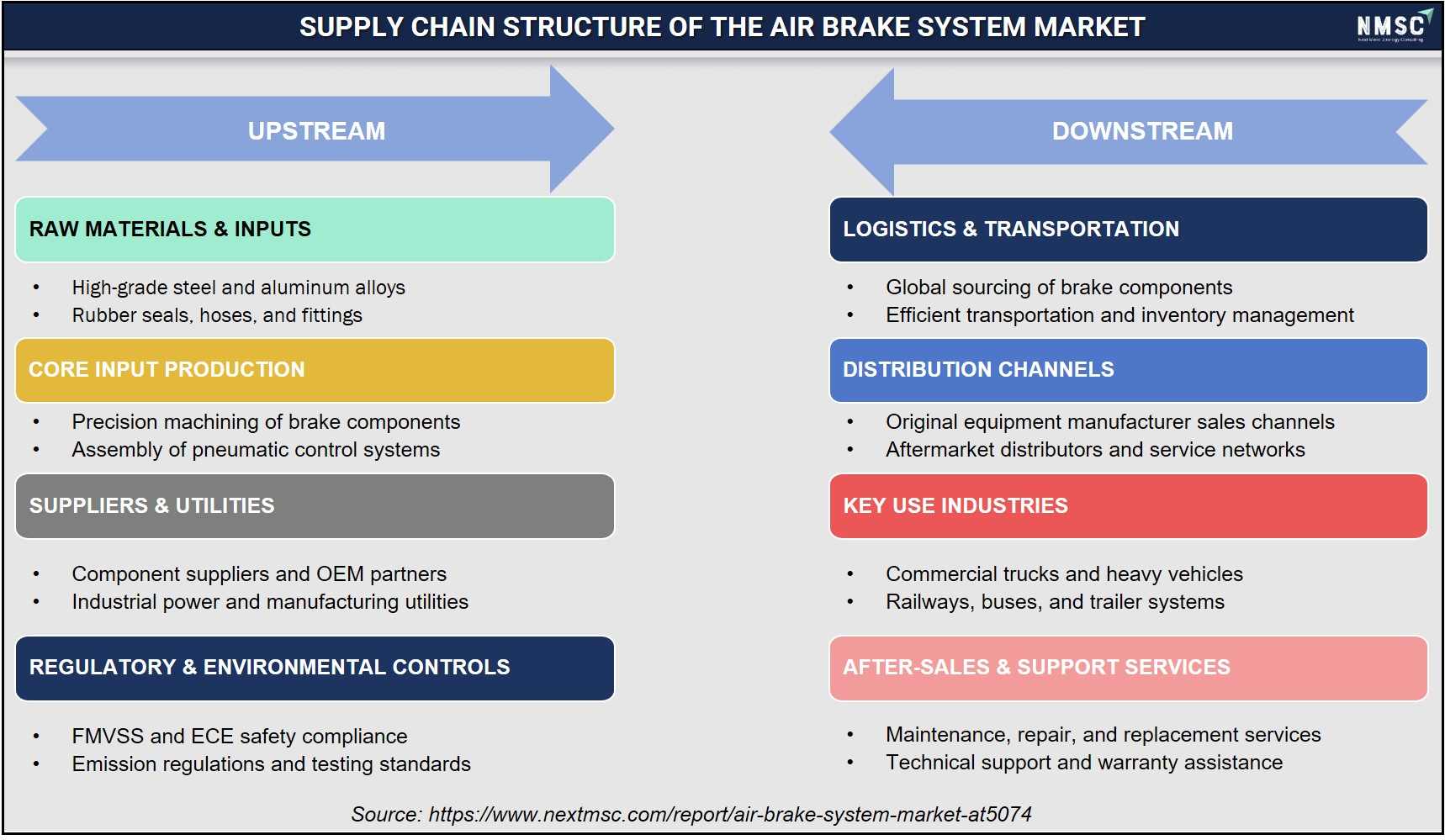
Based on NMSC's assessment, we found that the Air Brake System market operates through a well-established supply chain that begins with specialized raw materials and precision component manufacturing and extends to OEM distribution, aftermarket services, and end-use transportation sectors. Furthermore, strong supplier networks, regulatory compliance requirements, and efficient logistics systems support product reliability. Consequently, growing commercial vehicle demand continues to reinforce supply chain efficiency and long-term market stability.
Competitive Landscape
Competitive Dynamics and M&A Landscape
|
Key Takeaways |
Details |
|
Market Structure |
The Air Brake System Market features multi-tiered competition among global Tier 1 system integrators (Knorr-Bremse, ZF Friedrichshafen), diversified industrial conglomerates (Cummins, Wabtec, SAF-HOLLAND), regional specialists (Nabtesco, BPW, Vaden Otomotiv), and domestic volume suppliers in Asia (SORL, Shandong Toget, Zhejiang Gongzheng), each serving distinct vehicle types and geographies. |
|
Innovation Focus |
Innovation in the Air Brake System Market centers on electro-pneumatic system integration with EV powertrains, AI-enabled brake wear prediction and predictive maintenance platforms, advanced air disc brake architecture for Class 8 applications, and EBS module miniaturization and cost reduction for expanding adoption across emerging market commercial vehicle segments. |
|
M&A Activity |
ZF Friedrichshafen's integration of WABCO Holdings (completed 2020) created one of the world's largest commercial vehicle braking and stability system portfolios. Knorr-Bremse continues to pursue bolt-on acquisitions in rail and commercial vehicle brake technology, while private equity consolidation among regional brake component distributors is reshaping aftermarket channel dynamics across North America and Europe. |
How Do Companies Compete in the Air Brake System Market?
The Air Brake System Market is characterized by structured multi-tiered competition across global system integrators, diversified industrial suppliers, and regional component specialists. Global leaders Knorr-Bremse AG and ZF Friedrichshafen AG compete on the breadth of their integrated brake system portfolios spanning pneumatic, electro-pneumatic, ABS, EBS, and stability control architectures across commercial vehicle and rail segments. Mid-tier competitors including Wabtec Corporation, SAF-HOLLAND, Nabtesco, and BPW differentiate on application specialization in rail braking, trailer systems, and axle-integrated brake solutions. Asian volume suppliers including SORL Auto Parts, Shandong Toget, Zhejiang Gongzheng, and Brakes India serve domestic OEM markets with cost-competitive component offerings at scale.
Which Kind of Companies Dominate the Air Brake System Market?
Three distinct categories of companies dominate the Air Brake System Market. First, global Tier 1 brake system integrators including Knorr-Bremse AG and ZF Friedrichshafen AG deliver complete pneumatic and electro-pneumatic brake system architectures to heavy commercial vehicle OEMs and rail manufacturers worldwide. Second, diversified industrial suppliers including Cummins Inc. (air compressors), Wabtec Corporation (rail brake systems), and SAF-HOLLAND SE (axle and brake systems for trailers) serve specialized vehicle type segments with application-specific brake component solutions. Third, regional and domestic volume manufacturers including SORL Auto Parts, Brakes India, Akebono, Nabtesco, TBK, Vaden Otomotiv, and Cojali serve geographically defined OEM and aftermarket channels with competitive pricing and local supply chain proximity.
AI-Native Differentiation and Open Standards Drive Market Success in the Air Brake System Market
Innovation leadership within the Air Brake System Market is increasingly determined by software-defined brake management capability, data connectivity, and systems integration expertise rather than purely mechanical component manufacturing. Knorr-Bremse's iCOM ecosystem and ZF's commercial vehicle safety platform represent early examples of connected brake system offerings that generate recurring service revenue beyond hardware supply. NMSC's analysis indicates that suppliers integrating telematics, predictive brake wear analytics, and electronic diagnostic tools within their air brake system portfolios are capturing premium pricing, extended service contracts, and deeper OEM relationships that strengthen competitive positioning and customer retention across the forecast period.
Market Players to Opt for Merger for Acquisition Strategies to Expand Their Presence in the Air Brake System Market
Mergers and acquisitions are reshaping the competitive landscape of the Air Brake System Market. ZF Friedrichshafen's acquisition of WABCO Holdings created the largest integrated commercial vehicle braking and safety system portfolio globally. Knorr-Bremse has pursued a sustained acquisition strategy targeting rail brake technology companies and commercial vehicle electronic system specialists. Indian Head Industries, TSE Brakes, and Hendrickson Holdings maintain focused aftermarket and niche OEM positions that make them attractive targets for larger Tier 1 suppliers seeking to expand North American market presence and aftermarket service capabilities. Consolidation among aftermarket brake component distributors and remanufacturers is expected to continue through the forecast period as fleet operators demand consolidated supply chain partnerships.
Who Are the Key Market Players in the Air Brake System Market?
-
Knorr-Bremse AG
-
ZF Friedrichshafen AG
-
Cummins Inc.
-
Wabtec Corporation
-
SAF-HOLLAND SE
-
Nabtesco Corporation
-
BPW Bergische Achsen KG
-
Brakes India Private Limited
-
SORL Auto Parts, Inc.
-
Akebono Brake Industry Co., Ltd.
-
TBK Co., Ltd.
-
Hendrickson Holdings, L.L.C.
-
TSE Brakes, Inc.
-
VIE Science and Technology Co., Ltd.
-
Indian Head Industries, Inc.
-
Vaden Otomotiv Sanayi ve Ticaret A.Ş.
-
Cojali S.L.
-
Sealco Commercial Vehicle Products, LLC
-
Shandong Toget Brake System Co., Ltd.
-
Zhejiang Gongzheng Auto Parts Factory Co., Ltd.
What Are the Latest Developments in the Air Brake System Market Industry?
|
Date |
Event |
|
May 2026 |
Knorr-Bremse AG officially completed its acquisition of Netherlands-based TRAVIS Road Services International B.V. for a mid-double-digit million-euro sum. This transaction integrates TRAVIS's digital commercial vehicle platform into Knorr-Bremse's Commercial Vehicle Systems (CVS) aftermarket ecosystem to network repair, maintenance, and fleet diagnostics data. |
|
March 2026 |
SAF-HOLLAND SE launched its integrated HOLLAND SmartSTO system, an automated air-release fifth-wheel and connection-line stowage architecture. Developed by combining SAF-HOLLAND's mechanical fifth-wheel hardware with recently integrated Haldex advanced air and braking technologies, the system safeguards pneumatic gladhands and prevents uncoupling damage. |
|
February 2026 |
Wabtec Corporation finalized its acquisition of Sweden-based Dellner Couplers, a prominent manufacturer of safety-critical train connection systems and transit components, expanding its global transit rail infrastructure portfolio. |
Expert Insights
"The conventional braking system is still needed to bring the truck to a complete stop, but this double layer of safety is an excellent aid to more efficient driving. It also means that the hardware undergoes less strain to extend the braking system's life in the long run."
— Uzair Jilani, Lead Engineer, Drive and Brake Systems, Tevva
Statement made while discussing regenerative braking and advanced braking technologies in commercial vehicles, highlighting the role of integrated braking systems in improving vehicle efficiency, safety, and component longevity.
Market Interpretation
The comment highlights the increasing importance of advanced and integrated braking technologies within the air brake market. While conventional air braking systems remain essential for ensuring complete vehicle stopping capability, the incorporation of supplementary braking solutions such as regenerative braking and electronic brake controls enhances operational efficiency and vehicle safety. The reduced mechanical stress on braking components supports longer service life, lower maintenance costs, and improved fleet economics. As commercial vehicle manufacturers and fleet operators prioritize safety, durability, and total cost of ownership, demand for technologically advanced air brake systems is expected to strengthen across the global heavy-duty truck and bus segments.
What Are the Investment Opportunities in the Air Brake System Market?
Capital Inflows and Venture Activity
The Air Brake System Market is attracting targeted capital inflows from both strategic industrial investors and private equity firms focused on commercial vehicle safety technology. Knorr-Bremse's consistent investment in electro-pneumatic system R&D and ZF Friedrichshafen's integration of WABCO's brake platform reflect strategic capital allocation toward next-generation architecture development. Our findings suggest that venture capital activity in connected brake diagnostics, brake-as-a-service platform startups, and AI-driven fleet safety analytics is expanding, particularly in North America and Germany, where regulatory pressure and OEM innovation demand are highest. These investments are seeding the next generation of software-enabled brake system service offerings across the commercial vehicle safety ecosystem.
Infrastructure Investments
Government infrastructure investment programs are creating durable structural demand for air brake systems across both commercial vehicle and rail platforms within the Air Brake System Market. India's National Infrastructure Pipeline, covering over USD 1.4 trillion in planned transport infrastructure investment through 2025, is driving large-scale procurement of new commercial vehicles and rail rolling stock equipped with advanced air brake systems. The U.S. Infrastructure Investment and Jobs Act (IIJA) directs significant capital toward rail transit modernization and freight rail expansion programs managed by the Federal Transit Administration and Federal Railroad Administration, both of which mandate brake system performance compliance for federally funded rolling stock procurement.
ESG Considerations
Environmental, Social, and Governance considerations are becoming an increasingly relevant factor in Air Brake System Market investment decisions. The adoption of electro-pneumatic brake systems on zero-emission commercial vehicle platforms directly contributes to fleet decarbonization goals, as these systems eliminate energy losses associated with conventional engine-driven air compressors. Our assessment indicates that brake system suppliers demonstrating product lifecycle carbon footprint reductions, recyclable material content, and energy-efficient component designs are gaining preference in sustainability-conscious OEM procurement evaluations in European and North American markets, where ESG-linked fleet investment criteria are increasingly formally incorporated into commercial vehicle procurement frameworks.
Digital Transformation
Digital transformation is creating a structurally new service revenue layer within the Air Brake System Market, where connected diagnostics, remote monitoring, and predictive maintenance software are generating subscription-based revenue alongside traditional hardware supply. Fleet management platforms integrating brake system health monitoring enable proactive component replacement before failure, reducing total maintenance costs and improving vehicle uptime for fleet operators. Based on our market evaluation, we noticed that Knorr-Bremse's iCOM ecosystem and BPW's idem telematics system represent commercial demonstrations of this digital value layer. The U.S. Department of Transportation's Intelligent Transportation Systems (ITS) program actively supports connected vehicle safety data standards that facilitate brake system telematics integration within fleet management ecosystems.
Private Equity and Strategic M&A Activity
Private equity firms are deploying capital across the Air Brake System Market value chain, targeting aftermarket parts distributors, remanufacturing operations, and niche brake system technology companies with defensible market positions. Strategic acquirers including ZF and Knorr-Bremse are expected to pursue further bolt-on acquisitions in electronic brake management software, trailer brake control systems, and rail braking technology through the forecast period. Our assessment indicates that investors should monitor consolidation activity among North American aftermarket brake distributors, Asian brake component manufacturers targeting export market expansion, and European electro-pneumatic system startups addressing EV truck platform requirements as structurally attractive M&A themes within the Air Brake System Market through 2028.
Key Benefits for Stakeholders
For OEMs and Vehicle Manufacturers
Original equipment manufacturers and commercial vehicle producers gain comprehensive, vendor-neutral market intelligence on Air Brake System Market composition, technology evolution, and competitive dynamics. Quantitative segment-level revenue forecasts through 2035 support strategic sourcing decisions, supplier qualification frameworks, and product roadmap alignment for next-generation vehicle platform development. Our competitive landscape analysis enables OEM procurement teams to benchmark Tier 1 brake system supplier innovation pipelines, pricing model evolution, and electro-pneumatic technology readiness across their respective supply networks.
For Investors and Financial Analysts
Investors and financial analysts access a structured, data-rich assessment of the Air Brake System Market growth trajectory, segment-level CAGR analysis, and M&A competitive dynamics across the global brake system ecosystem. The geographic performance snapshot enables precise regional allocation modeling across North America, Europe, Asia-Pacific, MEA, and Latin America. Detailed competitive landscape coverage of all 20 profiled companies, combined with latest industry development tracking, provides an early-signal framework for identifying acquisition targets, growth leaders, and technology transition beneficiaries within the global Air Brake System Market through 2035.
For Brake System Suppliers and Tier 1 Manufacturers
Air brake system suppliers and Tier 1 manufacturers gain actionable intelligence on white-space opportunities, fastest-growing sub-segments, and technology investment priorities across the market forecast period. Segmentation analysis across revenue streams, product categories, vehicle types, and technology architectures reveals underserved areas including electro-pneumatic system supply for EV platforms and diagnostics and training service monetization. Regional outlook sections identify geographic expansion priorities with regulatory maturity and market growth context enabling focused go-to-market investment decisions.
For Government and Regulatory Bodies
Government agencies and regulatory bodies gain structured analysis of how commercial vehicle brake safety mandates, vehicle type-approval standards, and fleet modernization policies are influencing the Air Brake System Market structure and competitive dynamics. Country-level insights provide policymakers with evidence-based perspectives on how regulatory design choices affect brake technology adoption rates, commercial vehicle safety performance outcomes, and domestic brake system manufacturing competitiveness within national automotive and transport industrial ecosystems.
Key Market Segments
By Product Category
-
Air Supply and Treatment
-
Air Compressor
-
Air Dryer
-
Air Reservoir
-
Governor
-
-
Control and Actuation
-
Valve
-
Brake Chamber
-
Actuator
-
Slack Adjuster
-
-
Hoses, Pipes and Fittings
-
Foundation Brake
-
Drum Brake
-
Disc Brake
-
Caliper
-
Rotor
-
Pads and Shoes
-
-
Electronic Control
-
ABS
-
EBS
-
Stability Control
-
Trailer Control
-
-
Integrated System
-
Other Components
By Vehicle Type
-
Truck
-
Bus
-
Trailer
-
Rail
-
Specialty
By Technology
-
Pneumatic
-
Electro-Pneumatic
By Revenue Stream
-
OEM Fit
-
Aftermarket
-
Replacement Parts
-
Kits
-
Remanufactured Units
-
-
Services
-
Diagnostics and Calibration
-
Technical Support
-
Training
-
By Region
-
North America: U.S., Canada, and Mexico.
-
Europe: UK, Germany, France, Italy, Spain, Sweden, Denmark, Finland, the Netherlands, and the rest of Europe.
-
Asia Pacific: China, India, Japan, South Korea, Taiwan, Indonesia, Vietnam, Australia, Philippines, Malaysia and the rest of APAC.
-
Middle East & Africa (MEA): Saudi Arabia, UAE, Egypt, Israel, Turkey, Nigeria, South Africa, and the rest of MEA.
-
Latin America: Brazil, Argentina, Chile, Colombia, and the rest of LATAM.
Conclusion and Recommendations
Long-Term Outlook
The Air Brake System Market is entering a structurally significant growth decade, driven by continued commercial vehicle production growth, expanding ABS and EBS regulatory mandates across emerging markets, and the technological transition toward electro-pneumatic systems compatible with zero-emission commercial vehicle platforms. The market is forecast to grow from USD 5.4 billion in 2026 to USD 7.8 billion by 2035 at a CAGR of 4.1%. NMSC's analysis indicates that this growth reflects both the expanding global heavy vehicle fleet and the increasing electronic content per vehicle driven by safety regulations and fleet operator demand for connected brake management capabilities.
Strategic Positioning Recommendations
Brake system suppliers should prioritize electro-pneumatic system development programs tailored to battery-electric and hydrogen fuel-cell commercial vehicle architectures in anticipation of OEM platform transition timelines across Europe, North America, and China. Investment in software-defined brake management, connected diagnostics, and predictive maintenance capabilities is essential for capturing premium service revenue and strengthening OEM account relationships. Suppliers without established electro-pneumatic system portfolios risk structural market share erosion as EV truck platform adoption accelerates across the forecast period within the Air Brake System Market.
Investment Attractiveness
The Air Brake System Market represents a moderately attractive investment environment characterized by defensive revenue fundamentals, recurring aftermarket demand, and a structural technology upgrade cycle tied to commercial vehicle electrification. The highest-conviction investment themes include electro-pneumatic system supply for EV truck OEM programs, diagnostic and telematics service platforms within aftermarket channels, and brake system market expansion in India and Southeast Asia at CAGR rates meaningfully above the global market average. Investors should monitor ZF Friedrichshafen and Knorr-Bremse's electro-pneumatic product release timelines as leading indicators of market technology transition inflection points.
Market Shifts and Key Risks
The most significant market shift underway is the migration from purely mechanical pneumatic brake architectures toward software-enabled electro-pneumatic systems requiring both hardware manufacturing competency and electronic system integration capabilities. This transition benefits global Tier 1 integrators at the expense of pure-play mechanical component manufacturers. Key risks for the Air Brake System Market include supply chain disruptions to castings and forgings used in brake component manufacturing, macroeconomic pressures affecting commercial vehicle production volumes, and the pace of EV truck adoption, which determines the speed of electro-pneumatic system demand acceleration across major OEM supply programs.
Growth Pathways
Organizations seeking to maximize value from the Air Brake System Market should pursue a three-horizon strategic approach. In the near term through 2027, prioritize ABS and EBS aftermarket expansion in India, Southeast Asia, and Africa, where mandatory fitment rollout is creating immediate replacement demand cycles. In the mid-term from 2027 to 2031, invest in electro-pneumatic system certification for major European, North American, and Chinese EV truck OEM platforms. In the long term from 2031 to 2035, position for integrated brake-safety-chassis electronic systems as autonomous driving technology integration expands the value and complexity of commercial vehicle braking architectures globally.
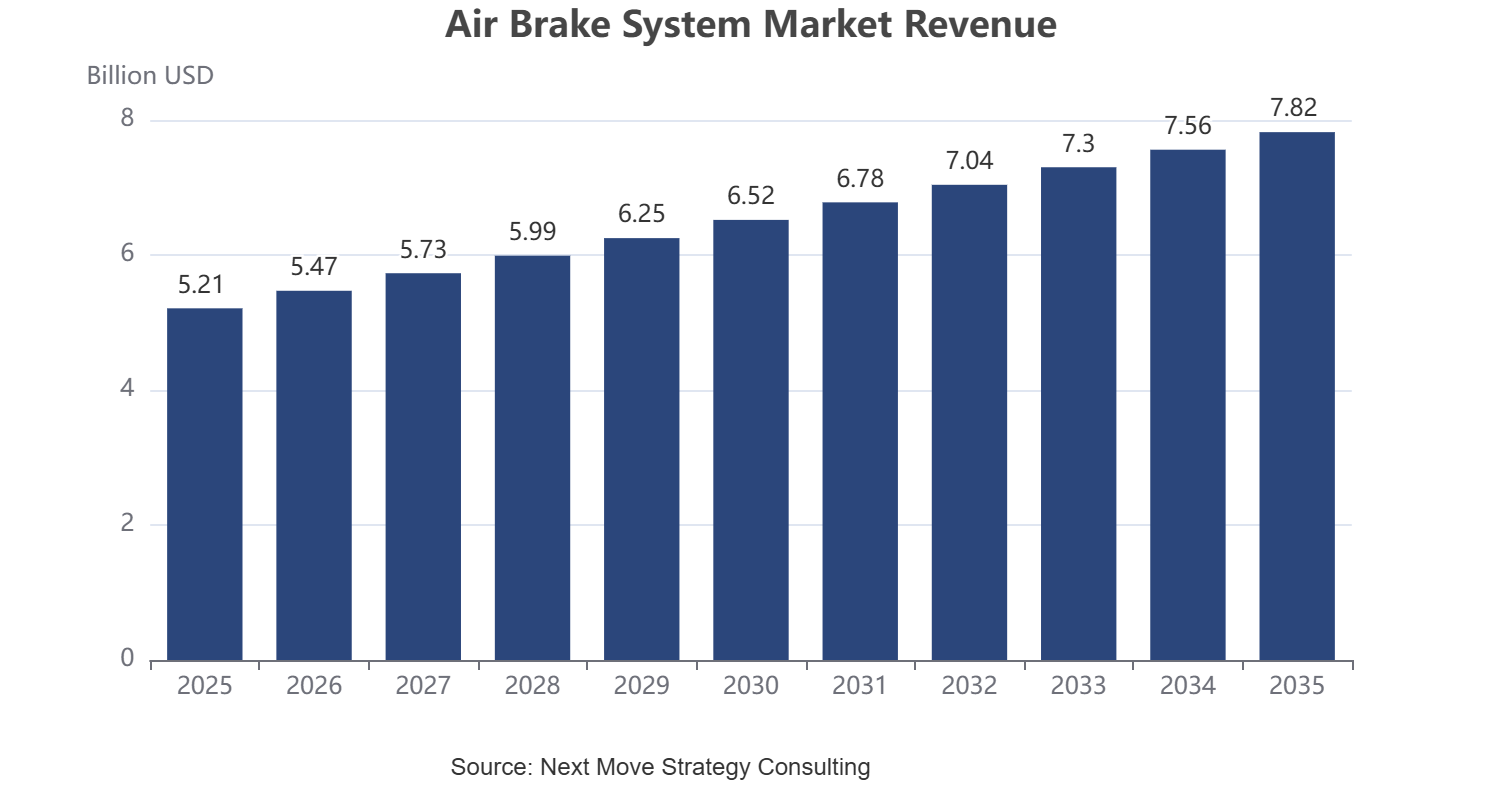
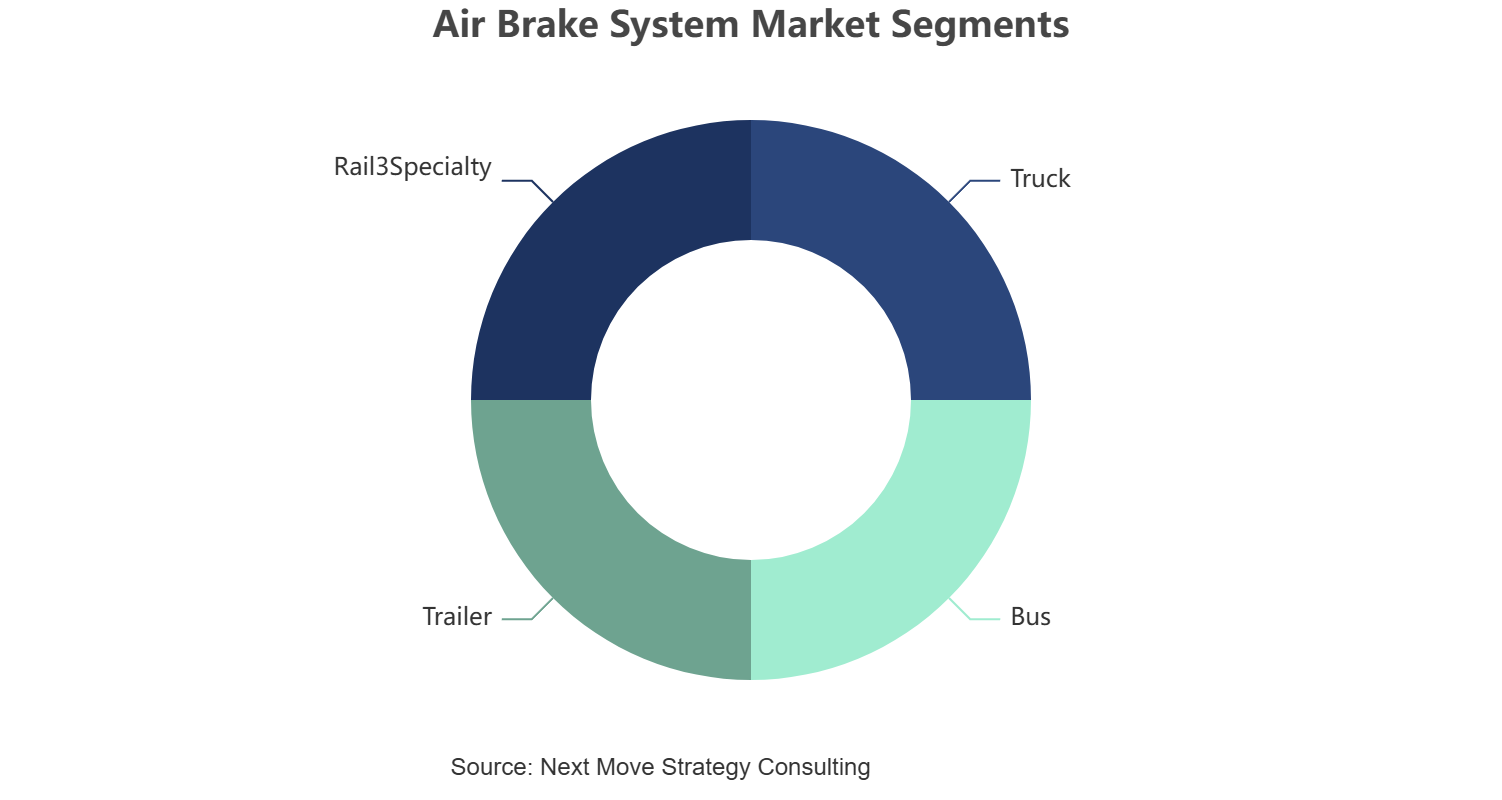
About the Author
 Saista Faiyaz
— Saista Faiyaz is Research Associate at Next Move Strategy Consulting, where she has covered consumer markets and healthcare technologies for 3 years. Her work includes primary interview review, secondary-source validation, market sizing, and structured analysis of company and industry data. She supports research by comparing evidence across sources, organizing findings into market narratives, and documenting assumptions used in analysis. Her scope includes cross-market benchmarking, and reports.
Saista Faiyaz
— Saista Faiyaz is Research Associate at Next Move Strategy Consulting, where she has covered consumer markets and healthcare technologies for 3 years. Her work includes primary interview review, secondary-source validation, market sizing, and structured analysis of company and industry data. She supports research by comparing evidence across sources, organizing findings into market narratives, and documenting assumptions used in analysis. Her scope includes cross-market benchmarking, and reports.
About the Reviewer
 Supradip Baul
— Supradip Baul is an accomplished business consultant and strategist with over a decade of rich experience in market intelligence, strategy, technology, and business transformation. His work has included rigorous qualitative and quantitative analysis across multiple industries, helping clients shape investment decisions and long-term roadmaps. Earlier in his career, he was associated with Gartner, where he contributed to industry-leading reports and market share analyses. He has worked with leading global companies and holds an MBA with a dual specialization in Marketing and Finance.
Supradip Baul
— Supradip Baul is an accomplished business consultant and strategist with over a decade of rich experience in market intelligence, strategy, technology, and business transformation. His work has included rigorous qualitative and quantitative analysis across multiple industries, helping clients shape investment decisions and long-term roadmaps. Earlier in his career, he was associated with Gartner, where he contributed to industry-leading reports and market share analyses. He has worked with leading global companies and holds an MBA with a dual specialization in Marketing and Finance.
At Next Move Strategy Consulting, we understand that insightful market research is the cornerstone of successful business decisions. That's why we employ a robust and multifaceted approach, combining various methodologies to deliver the most accurate and actionable data for our clients.

Research Landscape
We navigate the world of research with two primary approaches:
Qualitative Approach
Our qualitative research methodologies involve immersive techniques such as in-depth interviews, focus groups, and observational studies. By engaging directly with individuals and stakeholders, we uncover valuable insights that quantitative data alone may overlook.

Quantitative Research
In tandem with qualitative methodologies, NMSC leverages the power of Quantitative Research to provide a robust foundation of numerical insights. Through systematic data collection and analysis, we quantify patterns, preferences, and market trends, offering a comprehensive view of the business landscape.
Our quantitative research approach employs diverse tools, including surveys, experiments, and statistical modelling. These methodologies enable us to gather data from a large and representative sample, ensuring the statistical significance of our findings. By employing structured questionnaires and standardized data collection methods, we guarantee the reliability and validity of the information we present to our clients.
Quantitative research is particularly effective in measuring the prevalence of trends, assessing market size, and gauging the impact of various factors on consumer behavior. The numerical precision attained through this approach equips our clients with actionable insights, facilitating data-driven decision-making and strategy formulation.


Our Specialized Toolbox for Industry-Specific Market Research
We deploy a specialized arsenal of techniques tailored to meet your unique requirements. Here's a glimpse into our comprehensive toolbox:

Information Procurement
The stage entails acquiring market data or relevant information through various sources and methodologies.


Market Research Approach
We utilize both top-down and bottom-up approaches in market research analysis to achieve a comprehensive understanding of the market dynamics, leveraging the broad perspective of industry trends and macroeconomic factors alongside detailed insights from specific segments and individual companies.

Porters Five Forces Analysis
We conduct Porter's Five Forces analysis to evaluate the competitive landscape of an industry, providing us with insights into factors that affect profitability and strategic positioning.

SWOT Analysis

Forecasting
We utilize a forecasting model to predict future consumption by considering parameters like population, economics, regulations, market competition, drivers, constraints, technology, and pricing. We also employ statistical techniques such as multilinear regression, exponential smoothing, moving average, ARIMA, and Monte Carlo simulations for accurate predictions. In econometric forecasting, we analyzed short-term and long-term event impacts, attributing values based on regulatory frameworks, economic factors, and market events.





 Speak to Our Analyst