Air Traffic Management Market Size, Share, Growth & Forecast by Offering Type (Hardware: Communication, Navigation, Surveillance, Controller Workstations, Recording and Display; Software: Automation, Flight Data, Surveillance, Tower, Simulation; Services: Integration, Consulting and Training, Data and Analytics), Operational Scope (Tower, Approach, En Route, Oceanic, Surface, Remote Tower), Deployment Model (Ground Based, Cloud Hosted, Satellite Based, Hybrid) — Global Analysis 2026–2035
Industry: Aerospace & Defense | Publishing Date: June 12, 2026 | Last Updated: September 30, 2026 | No of Pages: N/A | No. of Tables: N/A | No. of Figures: N/A | Format: PDF | Report Code: AD4646
What Is the Air Traffic Management Market Size?
The global Air Traffic Management Market size was valued at USD 9.8 billion in 2025 and is expected to reach USD 10.5 billion in 2026. Accelerating air traffic volume recovery, rising investments in next-generation airspace technologies, and government-mandated modernization of aging radar and communication infrastructure are projected to propel the market to USD 20.1 billion by 2035, advancing at a CAGR of 7.5% from 2026 to 2035. Key growth drivers include the global rollout of performance-based navigation (PBN) systems, expanding adoption of cloud-hosted ATM platforms, increasing military airspace integration requirements, and the rapid commercial scale-up of remote tower technology across regional and smaller airports worldwide.
|
Parameters |
Details |
|
Market Size in 2025 |
USD 9.8 Billion |
|
Market Size in 2026 |
USD 10.5 Billion |
|
Revenue Forecast in 2035 |
USD 20.1 Billion |
|
Growth Rate |
CAGR of 7.5% from 2026 to 2035 |
|
Analysis Period |
2025–2035 |
|
Base Year Considered |
2025 |
|
Forecast Period |
2026–2035 |
|
Market Size Estimation |
USD Billion |
|
Companies Profiled |
20 |
|
Countries Covered |
33 |
|
Market Share |
Top 10 |
Industry Outlook
What Is the Air Traffic Management Market?
The air traffic management market encompasses the full ecosystem of hardware, software, and services that enable the safe, efficient, and orderly flow of aircraft through national and international airspace. ATM systems provide real-time situational awareness, separation assurance, route management, and ground movement control across tower, approach, en-route, oceanic, and surface operational domains. The market serves a wide base of buyers including civil air navigation service providers (ANSPs), military organizations, airport operators, airlines, and government aviation authorities.
How Has the Air Traffic Management Market Evolved?
The air traffic management market has undergone three distinct transformation phases. The first era focused on primary radar and VHF radio infrastructure built during the mid-20th century to manage growing commercial aviation. The second phase introduced digital surveillance through secondary surveillance radar (SSR), Mode-S transponders, and ADS-B, enabling more precise tracking with lower infrastructure costs. NMSC's analysis indicates that the current phase centers on data-driven, IP-networked ATM architectures, incorporating cloud hosting, machine learning-based conflict detection, and satellite-based surveillance to support higher traffic densities while maintaining safety margins mandated by regulatory bodies globally.
How Do Regulations Influence the Air Traffic Management Market?
Regulatory frameworks are the most powerful structural force shaping the air traffic management market. The International Civil Aviation Organization (ICAO) Aviation System Block Upgrades (ASBU) program defines a globally harmonized roadmap for ATM modernization across all member states, covering communications, navigation, surveillance, and information management. In Europe, the SESAR Joint Undertaking coordinates deployment of the Single European Sky ATM Research program. In the United States, the FAA's NextGen program mandates ADS-B equipage and performance-based navigation standards. Our assessment indicates that regulatory compliance timelines are the primary procurement trigger across both civil and military segments globally.
How Is Technology Adoption Expanding Across the Air Traffic Management Market?
Technology adoption in the air traffic management market is accelerating as ANSPs and airport operators migrate legacy systems to open, networked, and increasingly cloud-compatible platforms. ADS-B, MLAT, and space-based ADS-B via Aireon are replacing aging primary radar at lower lifecycle costs. Remote tower systems are being deployed at regional airports to reduce staffing costs while maintaining safety standards. From our research, we found that automation software embedding machine learning for conflict prediction, sequencing, and flow management is gaining traction among large ANSPs in Europe, North America, and Asia-Pacific as they prepare for future traffic volumes.
Ecosystem Analysis of the Air Traffic Management Market
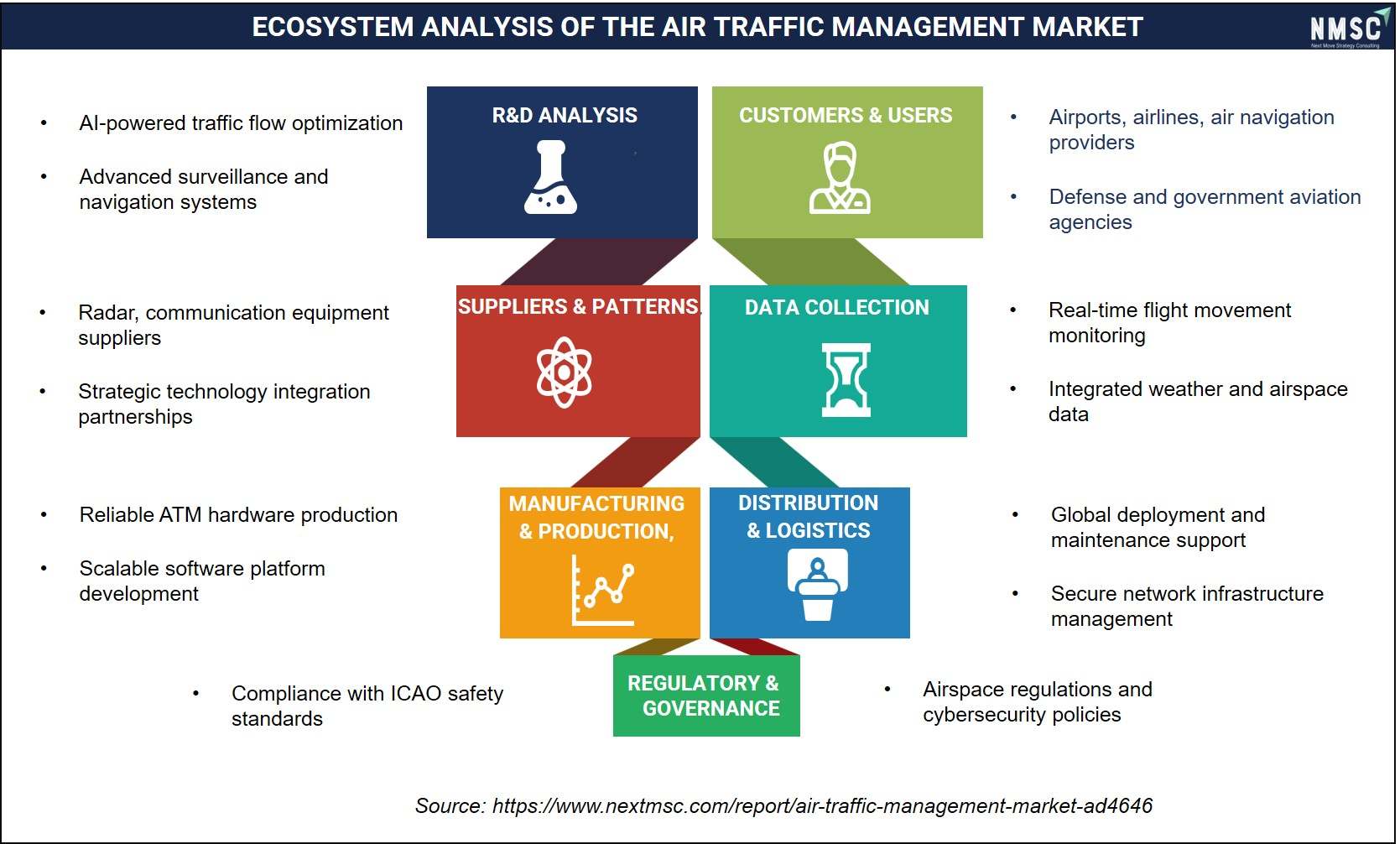
The infographic maps the ecosystem of the air traffic management market, highlighting R&D analysis, key customer segments including airports, airlines, air navigation service providers, and defense agencies. It also covers suppliers and partners, data collection, manufacturing and production, distribution and logistics, as well as regulatory and governance frameworks shaping ATM operations.
|
Key Takeaways |
|
By offering type, Hardware accounted for the largest share of the Air Traffic Management Market at USD 4.1 billion in 2025, led by surveillance hardware deployments including ADS-B ground stations, SSR arrays, and MLAT sensor networks. Services is the fastest-growing primary offering at a CAGR of 8.3% from 2026 to 2035, advancing from USD 3.1 billion in 2025 to USD 6.9 billion by 2035, driven by the shift toward managed operations and outcome-based ATM service delivery. |
|
Within hardware, Surveillance Hardware is the dominant sub-segment at USD 1.5 billion in 2025, underpinned by mandatory ADS-B equipage mandates from the FAA and ICAO. Within software, Automation Software is the largest sub-segment, generating USD 0.95 billion in 2025, while Simulation Software is the fastest-growing software sub-category as ANSPs invest in digital twin environments for training and system validation. |
|
By operational scope, en route operations hold the largest share of the Air Traffic Management Market at USD 2.9 billion in 2025, reflecting the scale of traffic management centers operated by major ANSPs globally. Remote Tower is the fastest-growing operational segment at a CAGR of 14.2% from 2026 to 2035, as Scandinavian and European ANSPs expand commercial deployments and technology costs continue to decline. |
|
By buyer type, Civil ANSPs represent the dominant buyer segment at USD 5.8 billion in 2025, accounting for approximately 59% of total Air Traffic Management Market revenue, reflecting the centrality of national ANSPs as the primary infrastructure owners and operators. Airlines are the fastest-growing buyer segment at a CAGR of 9.1% from 2026 to 2035 as they invest in trajectory management, collaborative decision-making, and airspace connectivity tools. |
|
By commercial model, Project-based procurement dominates the Air Traffic Management Market at USD 4.2 billion in 2025, reflecting the large capital expenditure nature of legacy ATM infrastructure rollouts. Subscription and Managed Service commercial models are the fastest-growing at a combined CAGR exceeding 11.5% from 2026 to 2035, as ANSPs adopt as-a-service delivery frameworks that reduce upfront capital commitments. |
|
By deployment model, Ground-Based systems remain dominant at USD 7.6 billion in 2025, accounting for approximately 78% of market revenue. Cloud Hosted deployment is the fastest-growing model at a CAGR of 15.8% from 2026 to 2035, advancing from USD 0.7 billion in 2025 to USD 2.9 billion by 2035, as ATM vendors develop certified cloud-native applications for non-safety-critical ATM functions. |
|
North America holds the largest regional share of the Air Traffic Management Market at USD 3.2 billion in 2025, forecast to reach USD 5.8 billion by 2035 at a CAGR of 6.1%, underpinned by the FAA's NextGen modernization program, military airspace investments, and the world's largest air traffic management infrastructure by traffic volume. Asia-Pacific is the fastest-growing major region at a CAGR of 9.2% from 2026 to 2035, driven by rapid traffic recovery and new airport construction in China, India, Indonesia, and Vietnam. |
|
The United States is the single largest country market in the Air Traffic Management Market, representing approximately 76% of North American revenue in 2025, driven by FAA-mandated ATM modernization, the largest volume of controlled airspace globally, and the presence of major defense ATM system procurements. India is the fastest-growing country in Asia-Pacific within the industry at a CAGR of 11.4%, propelled by Airports Authority of India-led infrastructure expansion and the government's UDAN regional air connectivity scheme. |
|
Middle East & Africa is the fastest-growing region in the Air Traffic Management Market, driven by significant investments in airport expansion, airspace modernization, and smart aviation infrastructure. The region is witnessing increasing air passenger traffic, the emergence of global aviation hubs, and government-led initiatives to enhance air navigation efficiency and safety. These developments are accelerating the adoption of advanced air traffic management solutions across the Middle East and Africa. |
|
India is the fastest-growing country in this sector, supported by strong growth in domestic and international air travel, ongoing airport expansion projects, and increasing investments in air traffic control infrastructure. The modernization of air navigation systems and the growing need to manage higher aircraft movements continue to drive demand for advanced air traffic management technologies. |
Key Emerging Trends in the Air Traffic Management Market
How Is Space-Based ADS-B Transforming the Air Traffic Management Market?
Space-based ADS-B, commercially deployed by Aireon LLC via the Iridium satellite constellation, is fundamentally reshaping the air traffic management market by providing global aircraft surveillance coverage across oceanic, polar, and remote regions where ground-based radar is economically infeasible. NATS, Nav Canada, IAA, ENAV, and Naviair adopted this capability, enabling 15-minute oceanic separation to be reduced to 6.8 nautical miles. NMSC's analysis indicates that ANSPs are now actively evaluating space-based ADS-B as a cost-effective complement or replacement for secondary surveillance radar, transforming the surveillance infrastructure investment calculus for both en-route and oceanic operational segments.
How Is Artificial Intelligence Reshaping ATM Automation in the Air Traffic Management Market?
Artificial intelligence and machine learning are transitioning from research concepts to operational components within the air traffic management market. SESAR Joint Undertaking's SESAR 3 program explicitly targets AI-enabled conflict detection, automated sequencing, and demand-capacity balancing across European airspace. Thales has deployed AI-assisted sector capacity prediction at DSNA in France, while Indra's SACTA system incorporates machine learning for traffic flow optimization at ENAIRE. Our assessment indicates that AI adoption is most advanced in non-safety-critical ATM functions, including flow management, trajectory prediction, and arrival sequencing, where regulatory certification barriers are comparatively lower.
What Role Is Remote Tower Technology Playing in the Air Traffic Management Market?
Remote tower technology is among the most commercially significant emerging segments within the air traffic management market, enabling air traffic services to be provided from a centralized facility rather than a physical airport tower. LFV in Sweden operates the world's first certified operational remote tower at Sundsvall-Timra Airport, subsequently extending the model to Ornskoldsvik Airport. Frequentis and Saab have deployed operational remote tower systems across Scandinavian, UK, and Australian airports. Our findings suggest that the economics are compelling for airports handling fewer than 50,000 movements annually, where co-located staffing costs represent an outsized operational burden.
How Is Cloud Adoption Accelerating Platform Innovation in the Air Traffic Management Market?
Cloud-hosted ATM solutions are transitioning from pilot programs to early commercial deployments within the air traffic management market, particularly for non-safety-critical applications including aeronautical information management, network flow management, and meteorological data integration. EUROCONTROL's Network Manager operations increasingly rely on cloud-integrated data processing. Aireon's satellite data platform is natively cloud-hosted. Our analysis shows that the principal challenge remains regulatory certification of cloud-hosted safety-critical ATM applications under EASA, FAA, and national aviation authority frameworks, a barrier several vendors including Frequentis and Thales are actively working to address through certified cloud deployments.
What Are the Key Market Drivers, Breakthroughs, and Investment Opportunities that Will Shape the Air Traffic Management Market Industry in the Next Decade?
The air traffic management market is being shaped by a complex interplay of regulatory mandates, infrastructure modernization requirements, traffic volume growth, and technology convergence. NMSC's research identifies accelerating government ATM investment programs, the commercial scale-up of remote tower and space-based surveillance, and the integration of AI and cloud-hosted platforms as the primary growth catalysts. Simultaneously, high certification complexity and long procurement cycles represent structural restraints. The following matrix maps the directional CAGR impact, geographic relevance, and timeline of key market forces.
|
Drivers / Trends / Restraints |
(+/-) % Impact on CAGR Forecast |
Geographic Relevance |
Impact Timeline |
|
ICAO ASBU Mandate-Driven Modernization |
+1.8% |
Global |
2025–2032 |
|
Air Traffic Volume Recovery and Growth |
+1.4% |
Asia-Pacific, Middle East, Latin America |
2025–2030 |
|
Remote Tower Commercial Scale-Up |
+0.9% |
Europe, Australia, North America |
2025–2035 |
|
Space-Based ADS-B Adoption |
+0.8% |
Global (Oceanic, Remote Regions) |
2025–2030 |
|
Cloud-Hosted ATM Platform Deployment |
+0.7% |
Europe, North America |
2026–2035 |
|
AI Integration in Flow Management |
+0.6% |
Europe, North America, APAC |
2026–2035 |
|
Military ATM Modernization Programs |
+0.5% |
North America, Middle East, Europe |
2025–2033 |
|
Subscription and Managed Service Shift |
+0.4% |
Global |
2026–2035 |
|
High Certification Cost for Cloud ATM |
-1.0% |
Global |
Ongoing |
|
Procurement Cycle Length and Budget Constraints |
-0.7% |
MEA, Latin America, Smaller ANSPs |
Ongoing |
|
Fragmented Regulatory Standards |
-0.5% |
Asia-Pacific, MEA |
Ongoing |
What Are the Growth Drivers of the Air Traffic Management Market?
How Is the ICAO Aviation System Block Upgrade Program Driving the Air Traffic Management Market?
The ICAO Aviation System Block Upgrades (ASBU) program establishes a structured, time-phased framework compelling member states to upgrade communications, navigation, surveillance, and information management capabilities across their airspace. ICAO's 193 contracting states are obligated to file ASBU implementation plans, creating government-mandated demand across all segments of the air traffic management market. FAA data confirms that over 90% of U.S. instrument flight rule operations now rely on ADS-B surveillance, reflecting successful ASBU-aligned mandate execution. ASBU Block 1 and Block 2 obligations create durable multi-year procurement pipelines for ATM vendors serving government and civil ANSP buyers worldwide.
How Is Recovering and Growing Global Air Traffic Volume Stimulating the Air Traffic Management Market?
Global air traffic volume is a fundamental demand driver for the air traffic management market, as rising flight movements require expanded capacity, improved separation standards, and additional controller workstations and automation tooling. ICAO's 2024 Global Air Navigation Plan projects world passenger traffic to more than double by 2041, with Asia-Pacific forecast as the primary growth engine. The FAA's Air Traffic Activity System recorded over 45,000 daily instrument flight operations across U.S. airspace in 2024. Traffic volume growth directly drives ANSPs to invest in sector redesign, simulation, automation software, and surveillance infrastructure to maintain safety and efficiency standards.
How Are Military ATM Modernization Budgets Expanding the Air Traffic Management Market?
Military airspace management is a structurally distinct and growing demand vertical within the air traffic management market. The U.S. Department of Defense manages over 4,000 restricted airspace areas, military operating areas, and special use airspace designations that require dedicated ATM systems, radar, and communications infrastructure. The U.S. DoD's FY2025 budget included significant allocations for tactical data link upgrades and airspace control element modernization. NATO Standardization Agreements (STANAGs) governing military airspace interoperability drive coordinated investment across member states. Military ATM procurement cycles are typically longer but yield higher contract values and stronger multi-year maintenance revenue for vendors.
What Are the Growth Inhibitors of the Air Traffic Management Market?
How Does the Complexity of ATM Safety Certification Constrain Air Traffic Management Market Growth?
Safety certification requirements represent the most significant structural constraint on growth within the air traffic management market, particularly for cloud-hosted and AI-assisted ATM applications. EASA and the FAA require ATM systems to meet stringent software assurance levels under DO-178C, DO-254, and EUROCAE standards, with certification processes that can span three to seven years and cost hundreds of millions of dollars. Our assessment indicates that this barrier limits new entrant competition and slows technology refresh cycles, as ANSPs are reluctant to introduce unproven platforms that may disrupt operational continuity. Certification complexity also delays the commercial deployment of cloud-native ATM solutions beyond non-safety-critical functions.
How Do Prolonged Procurement Cycles and Budget Constraints Limit Air Traffic Management Market Expansion?
Government and ANSP procurement processes are inherently long-cycle, often spanning five to ten years from requirements definition to system acceptance, which limits the air traffic management market's ability to respond rapidly to technology innovation cycles. The U.S. Government Accountability Office has documented repeated schedule and cost overruns in FAA NextGen program components, reflecting the challenge of deploying complex, safety-critical ATM upgrades within projected timelines and budgets. Smaller ANSPs in developing economies often lack sufficient capital budgets to fund comprehensive system replacements, relying on bilateral aid programs, development bank financing, or phased procurement strategies that extend market access timelines for vendors.
What Are the Growth Opportunities in the Air Traffic Management Market?
How Does the Commercial Expansion of Advanced Air Mobility Create a New Opportunity in the Air Traffic Management Market?
Advanced Air Mobility (AAM), encompassing urban air mobility vehicles, electric vertical takeoff and landing aircraft, and unmanned aircraft systems operating in low-altitude airspace, represents a structurally significant growth opportunity for the air traffic management market. The FAA's UAS Integration Pilot Program and the U-Space regulation framework established by EASA are creating new regulatory environments that require purpose-built ATM solutions including UTM (UAS Traffic Management) and vertiport surface management systems. ICAO's Circular 350 on the Integration of UAS in Non-Segregated Airspace highlights the global scale of this emerging requirement.
How Is the Managed Services Model Creating a New Revenue Layer in the Air Traffic Management Market?
The transition from capital-expenditure-based ATM system procurement to managed service and subscription commercial models is creating a durable new revenue layer within the air traffic management market. ANSPs in smaller markets, including several African and Pacific Island states, have transitioned to ANSP-as-a-service arrangements where vendors including Frequentis and NATS Holdings manage end-to-end ATM operations. The Airports Council International (ACI World) has documented increasing interest among airport operators in outsourcing tower services to managed service providers. This commercial model shift expands the total addressable market for established vendors while creating recurring, predictable revenue streams with higher lifetime value.
How Does Digital Airport and Smart City Infrastructure Drive Investment Opportunities in the Air Traffic Management Market?
Digital airport programs and smart city aviation hub investments are creating significant capital deployment opportunities within the air traffic management market. Saudi Arabia's NEOM project includes a dedicated airspace management infrastructure requirement for autonomous and advanced air mobility operations. Singapore's Changi Airport Group's digital twin program integrates ATM surface management data with airport operational databases. The European Commission's Digital European Sky initiative under the Single European Sky legislative framework explicitly links ATM investment to digital airport transformation. Our assessment indicates that airports investing in smart operations require tightly integrated ATM, A-CDM, and surface management platforms as a foundational technology layer.
How Is the Air Traffic Management Market Segmented in This Report, and What Are the Key Insights from the Segmentation Analysis?
Which Offering Type Drives the Largest Share of the Air Traffic Management Market Revenue?
|
Offering Type Segment |
2025 (USD Bn) |
2035 (USD Bn) |
CAGR (%) |
|
Hardware |
4.1 |
7.3 |
5.9% |
|
Software |
2.6 |
5.9 |
8.5% |
|
Services |
3.1 |
6.9 |
8.3% |
From our research, we found that the market is segmented by offering type into Hardware, Software, and Services, each serving distinct functions as analyzed in this air traffic management market report. Hardware remains the largest segment at USD 4.1 billion in 2025, led by Surveillance Hardware including ADS-B ground stations, secondary surveillance radars, and MLAT sensor networks mandated by ICAO and national aviation authorities. Communication Hardware encompassing VHF/UHF radio systems, VoIP switching, and data link transceivers represents the second-largest hardware sub-segment. Navigation Hardware, covering DME, ILS, and VOR infrastructure, is incrementally replaced by GNSS augmentation systems in several advanced markets. Services are advancing at a CAGR of 8.3%, driven by integration services, managed operations, and data and analytics contracts, while software grows at 8.5% as automation and flight data platforms see accelerated procurement.
How Do Different Operational Domains Shape Revenue Distribution in the Air Traffic Management Market?
|
Operational Scope Segment |
2025 (USD Bn) |
2035 (USD Bn) |
CAGR (%) |
|
Tower |
2.1 |
3.6 |
5.5% |
|
Approach |
1.6 |
2.8 |
5.7% |
|
En Route |
2.9 |
5.1 |
5.8% |
|
Oceanic |
0.8 |
1.7 |
7.8% |
|
Surface |
1.3 |
2.7 |
7.6% |
|
Remote Tower |
1.1 |
4.2 |
14.2% |
Based on NMSC's analysis of ATM infrastructure investment patterns, the air traffic management market by operational scope includes Tower, Approach, En Route, Oceanic, Surface, and Remote Tower segments. En Route is the largest operational scope at USD 2.9 billion in 2025, driven by the scale and complexity of area control centers operated by major ANSPs in the United States, Europe, and China. Tower operations represent the second-largest segment, reflecting the sheer number of controlled airport towers globally. Remote Tower is the fastest-growing scope at a CAGR of 14.2%, with operational deployments accelerating across Scandinavia, the UK, Australia, and several U.S. and Canadian regional airports. Surface management is witnessing growing investment as large hub airports adopt A-SMGCS systems to improve ground movement efficiency and runway capacity.
Which Buyer Categories Are Shaping Procurement Dynamics in the Air Traffic Management Market?
|
Buyer Type Segment |
2025 (USD Bn) |
2035 (USD Bn) |
CAGR (%) |
|
Civil ANSP |
5.8 |
10.5 |
6.1% |
|
Military |
1.8 |
3.4 |
6.6% |
|
Airport Operator |
1.1 |
2.6 |
8.9% |
|
Airline |
0.6 |
1.5 |
9.1% |
|
Government |
0.4 |
1.6 |
14.8% |
|
Other |
0.1 |
0.5 |
17.5% |
Through NMSC's assessment, we found that the air traffic management market by buyer type encompasses Civil ANSPs, Military organizations, Airport Operators, Airlines, Governments, and other buyers. Civil ANSPs dominate at USD 5.8 billion in 2025, as national air navigation service providers represent the primary owners and operators of ATM infrastructure globally, including NATS (UK), DSNA (France), DFS (Germany), FAA (U.S.), NAV Canada, and Airports Authority of India. Military buyers represent a structurally distinct and growing segment at USD 1.8 billion in 2025, driven by defense ATM system modernization and airspace integration programs. Airport Operators and Airlines are the fastest-growing buyer segments as digital airport programs and airline trajectory management investments expand beyond traditional ANSP-centric procurement.
How Are Commercial Models Evolving Across the Air Traffic Management Market?
|
Commercial Model Segment |
2025 (USD Bn) |
2035 (USD Bn) |
CAGR (%) |
|
Project |
4.2 |
6.8 |
4.9% |
|
License |
1.3 |
2.4 |
6.3% |
|
Subscription |
1.1 |
3.6 |
12.6% |
|
Managed Service |
1.6 |
4.6 |
11.1% |
|
Maintenance Contract |
1.4 |
2.4 |
5.5% |
|
Other |
0.2 |
0.3 |
4.1% |
Our analysis of ATM procurement trends reveals that the air traffic management market by commercial model is segmented into Project, License, Subscription, Managed Service, Maintenance Contract, and other models. Project-based procurement remains dominant at USD 4.2 billion in 2025, reflecting the large-scale, capital-intensive nature of infrastructure replacement programs initiated under national ATM modernization plans. Maintenance Contract revenue at USD 1.4 billion in 2025 reflects the installed base of legacy systems requiring ongoing technical support from original equipment manufacturers. Subscription and Managed Service models are the fastest-growing, collectively advancing at CAGRs exceeding 11%, as vendors including Frequentis, Thales, and Indra develop as-a-service offerings that lower adoption barriers for smaller ANSPs and airport operators globally.
How Do Deployment Models Influence Technology Investment Decisions in the Air Traffic Management Market?
|
Deployment Model Segment |
2025 (USD Bn) |
2035 (USD Bn) |
CAGR (%) |
|
Ground Based |
7.6 |
12.6 |
5.2% |
|
Cloud Hosted |
0.7 |
2.9 |
15.8% |
|
Satellite Based |
0.8 |
2.1 |
10.1% |
|
Hybrid |
0.7 |
2.5 |
13.6% |
Based on our market evaluation, we noticed that the air traffic management market by deployment model is segmented into Ground Based, Cloud Hosted, Satellite Based, and Hybrid architectures. Ground Based systems remain overwhelmingly dominant at USD 7.6 billion in 2025, as existing regulatory certification frameworks are built around deterministic, physically located infrastructure meeting defined performance requirements. Satellite Based deployment at USD 0.8 billion in 2025 is primarily driven by Aireon's space-based ADS-B and Inmarsat's LDACS datalink programs. Cloud Hosted is the fastest-growing deployment model at a CAGR of 15.8%, driven by vendors building certified cloud-native ATM applications for aeronautical information management, network flow management, and remote tower video processing. Hybrid architectures combining ground, cloud, and satellite layers are gaining adoption among advanced ANSPs planning next-generation airspace architectures.
Regional Outlook
Geographic Performance Snapshot
|
Region |
2025 (USD Bn) |
2035 (USD Bn) |
CAGR (%) |
Key Driver |
|
North America |
3.2 |
5.8 |
6.1% |
FAA NextGen, military ATM investment |
|
Europe |
2.9 |
5.4 |
6.4% |
SESAR deployment, Single European Sky |
|
Asia-Pacific |
2.2 |
5.2 |
9.2% |
New airport construction, traffic growth |
|
Middle East & Africa |
0.9 |
2.3 |
9.8% |
Vision 2030, new airport buildout |
|
Latin America |
0.6 |
1.4 |
8.8% |
Airport modernization, traffic recovery |
North America Air Traffic Management Market
North America holds the largest air traffic management market share at USD 3.2 billion in 2025, forecast to reach USD 5.8 billion by 2035 at a CAGR of 6.1%. The region benefits from the most complex and highest-volume airspace globally, managed by the FAA and Nav Canada. The FAA's NextGen program, the Department of Defense's airspace modernization investments, and the strong presence of leading ATM vendors including L3Harris, Leidos, and Honeywell underpin market maturity. High regulatory stringency under FAA standards creates a demanding but stable procurement environment characterized by long contract cycles and premium system requirements.
United States Air Traffic Management Market
Based on our engagements with the U.S. aviation ecosystem, the United States represents approximately 76% of North American market revenue, driven by the world's largest and most complex national airspace system managed by the FAA, which handles over 45,000 flight operations daily. The FAA's NextGen program has deployed ADS-B nationwide, with over 900 ADS-B ground stations installed across the continental U.S. and Alaska. Defense ATM investments via the U.S. Department of Defense further expand total procurement volume. Leidos, L3Harris, and Harris support major FAA system modernization contracts. air traffic management market demand structure remains concentrated in En Route, Approach, and Surface management upgrades.
Canada Air Traffic Management Market
Through our analysis, Canada's air traffic management market is anchored by Nav Canada, one of the world's largest civil ANSPs by airspace volume, managing over 18 million square kilometers including significant oceanic airspace over the North Atlantic. Nav Canada co-developed and operationally deployed Aireon's space-based ADS-B service, making Canada a global leader in next-generation surveillance technology. Government influence is significant through Transport Canada's aviation safety regulations. Technology penetration is high, with ADS-B, MLAT, and CPDLC data link broadly deployed. Competitive intensity is moderate given Nav Canada's centralized procurement model.
Mexico Air Traffic Management Market
From our assessment, Mexico's air traffic management market is at a modernization inflection point, driven by SENEAM's ongoing infrastructure upgrade program and the inauguration of Felipe Angeles International Airport requiring comprehensive ATM system deployment. Mexico's civil aviation authority, AFAC, applies ICAO standards, and ASBU compliance is a formal obligation. Technology adoption remains below North American peers, creating upgrade opportunity for international ATM vendors. Government priorities under the national infrastructure investment plan and increasing traffic at Mexico City, Cancun, and Guadalajara airports are the primary market drivers for the forecast period.
Europe Air Traffic Management Market
Europe is the second-largest region in the air traffic management market at USD 2.9 billion in 2025, forecast to reach USD 5.4 billion by 2035 at a CAGR of 6.4%. The region is shaped by the Single European Sky legislative framework and the SESAR Joint Undertaking's coordinated technology deployment program, which represents the most comprehensive civil ATM modernization effort globally. Europe's dense airspace and high regulatory standards create premium demand for advanced ATM systems. Leading ATM vendors including Thales, Indra, Leonardo, Frequentis, and Saab have strong established positions across European ANSP procurement frameworks.
United Kingdom Air Traffic Management Market
Based on our engagements, the United Kingdom air traffic management market is anchored by NATS Holdings, which manages one of Europe's busiest airspace systems and serves as a global ATM solutions exporter. Post-Brexit, the UK has maintained alignment with EASA technical standards while pursuing independent bilateral agreements. NATS is a global pioneer in remote tower, space-based ADS-B, and managed ATM services, including international contracts in Bahrain and Hong Kong. Government influence is exercised through the Civil Aviation Authority. Technology penetration is among the highest globally, with NATS deploying advanced automation, AI-assisted sector management, and real-time data sharing with EUROCONTROL.
Germany Air Traffic Management Market
According to evaluation, Germany's air traffic management market is driven by DFS Deutsche Flugsicherung, one of Europe's largest ANSPs by traffic complexity. DFS manages some of Europe's highest-volume airspace corridors and is an active participant in SESAR deployment programs. Government regulation is exercised through the Federal Aviation Office (Luftfahrt-Bundesamt). Technology penetration is high, with DMAN, AMAN, and PBN capabilities broadly deployed across major airports. Thales and Indra have significant installed base positions with DFS. Germany's airport expansion and the growing importance of drone traffic management are creating new investment requirements within the broader ATM ecosystem.
France Air Traffic Management Market
Through our analysis, France's air traffic management market is shaped by DSNA, the Direction des Services de la Navigation Aérienne, which manages one of Europe's most complex en-route airspace systems serving transatlantic and intra-European traffic. DSNA has been an active SESAR pilot program participant and has deployed AI-assisted sector capacity tools developed in partnership with Thales. EASA regulations apply in full, with DSNA subject to performance scheme targets under the SES Performance Regulation. Thales holds a dominant domestic position as both a prime ATM systems integrator and technology developer. Cloud-hosted aeronautical information management is an emerging procurement focus.
Italy Air Traffic Management Market
From our assessment, Italy's air traffic management market is led by ENAV, one of Europe's largest listed ANSPs and a significant technology innovator within the SESAR Joint Undertaking. ENAV has invested in D-Flight, Italy's U-space service provider for drone traffic management, positioning itself for AAM-driven ATM demand. Leonardo holds a strong domestic position as an ATM systems integrator. Regulatory oversight is provided by ENAC under EASA standards. Italy's geographic position as a major North-South and East-West traffic corridor ensures sustained ATM investment. ENAV's international consulting and technology services business extends the market's commercial reach beyond Italy's borders.
Spain Air Traffic Management Market
Based on our engagements, Spain's air traffic management market is anchored by ENAIRE, the Spanish ANSP managing one of Europe's largest airspace volumes by geographic area. Spain is a significant SESAR program participant, with Indra holding a major domestic role as the primary ATM systems provider. AENA, as the airport operator, represents a distinct buyer for surface management and airport ATM systems. Government regulation is applied by AESA under EASA frameworks. Spain's Mediterranean tourism airports create high seasonal traffic peaks that drive investment in arrival and departure manager systems. Indra's domestic strength provides a competitive anchor for the local market.
Sweden Air Traffic Management Market
Through our analysis, Sweden's air traffic management market is shaped by LFV, the Swedish Civil Aviation Administration, which operates the world's first commercial remote tower service. LFV's Sundsvall-Timra and Ornskoldsvik remote tower deployments with Saab and Frequentis technology have established Sweden as the global reference market for this technology. Government policy strongly supports digitalization of public sector services. Technology penetration is among the highest globally for remote tower and advanced automation. Competitive intensity is moderate, with Saab and Frequentis as primary domestic champions. The Swedish model is actively studied and replicated in UK, Norway, Australia, and North America.
Denmark Air Traffic Management Market
According to evaluation, Denmark's air traffic management market is served by Naviair, one of the early adopters of Aireon's space-based ADS-B surveillance through the North Atlantic collaboration with NATS and Nav Canada. Naviair manages airspace over Denmark and the Faroe Islands and Greenland. Denmark's high digital economy maturity translates into early technology adoption within the ATM sector. Government regulation is provided by the Danish Transport Authority under EASA standards. Naviair's participation in SESAR programs supports ongoing investment. Competitive landscape is shaped by established European ATM vendors including Thales, Frequentis, and Saab.
Finland Air Traffic Management Market
From our assessment, Finland's air traffic management market is led by Fintraffic, the state-owned traffic management organization that consolidates aviation, road, rail, and maritime traffic management under a single entity, representing a unique organizational model in global ATM governance. Fintraffic Aviation manages Helsinki-Vantaa and Finland's regional airports. Government ownership and regulatory oversight are exercised through the Finnish Transport and Communications Agency (Traficom). Technology adoption is high, with PBN, CPDLC, and advanced ATC automation deployed across Finnish airspace. The consolidated traffic management model creates potential for cross-modal data integration that could influence future ATM platform investments.
Netherlands Air Traffic Management Market
Based on our engagements, the Netherlands air traffic management market is shaped by LVNL (Luchtverkeersleiding Nederland), which manages one of Europe's busiest airspace systems centered on Amsterdam Schiphol Airport, a major European hub. LVNL is an active SESAR participant and has deployed advanced arrival management, surface management, and A-CDM systems. Government oversight is exercised by the Human Environment and Transport Inspectorate under EASA standards. Technology penetration is high, reflecting Schiphol's global status as a premium aviation hub. The competitive landscape includes Thales and Frequentis, which maintain strong installed base positions within LVNL's procurement framework.
Rest of Europe Air Traffic Management Market
The Rest of Europe, encompassing Poland, Belgium, Switzerland, Austria, Portugal, Czech Republic, Norway, Ireland, and other European nations, collectively represents a material and growing portion of the European air traffic management market. HungaroControl has been a pioneer in remote tower technology deployment. Austro Control has invested in advanced PBN implementation. Norway's Avinor has partnered with Indra and Frequentis for ATM system upgrades. Switzerland's Skyguide is a significant SESAR contributor. Belgium's skeyes manages one of Europe's most complex transit airspace environments. Collectively, these markets generate diverse ATM procurement across all offering types.
Asia-Pacific Air Traffic Management Market
Asia-Pacific is the fastest-growing major region in the air traffic management market at USD 2.2 billion in 2025, forecast to advance to USD 5.2 billion by 2035 at a CAGR of 9.2%. The region's growth is propelled by rapid air traffic recovery exceeding pre-2020 levels in markets including India, Vietnam, and Indonesia, combined with extensive new airport construction programs in China and the Middle East. Government-led aviation infrastructure investment programs and ICAO ASBU compliance obligations across member states create sustained multi-year procurement demand. Leading global ATM vendors are competing with regional players including NEC Corporation, SITA, and domestically positioned suppliers across Asia.
China Air Traffic Management Market
Based on our engagements, China's air traffic management market is one of the most significant and complex globally, managed by the Civil Aviation Administration of China (CAAC) and Air Traffic Management Bureau (ATMB). China is executing the largest national ATM modernization program in the world by capital expenditure, encompassing new en-route control centers, ADS-B nationwide rollout, and advanced FANS/CPDLC oceanic data link deployment. Government ownership of airspace and investment decision-making is concentrated within the CAAC and PLA Air Force. Domestic suppliers including Caac Xi'an Flight School and CETCA (China Electronics Technology Aviation) compete alongside international vendors under localization preferences.
India Air Traffic Management Market
Through our analysis, India's air traffic management market is driven by Airports Authority of India (AAI), which manages en-route and airport ATM services across 137 airports. AAI is executing a comprehensive ATM modernization program under the GAGAN SBAS navigation program, nationwide ADS-B deployment, and the UDAN regional connectivity scheme which is catalyzing new airport openings requiring ATM system installations. DGCA applies ICAO standards and is progressively aligning with ASBU implementation. Technology penetration is accelerating rapidly, with Thales and Indra holding key system integration positions. India is the fastest-growing country in Asia-Pacific at a CAGR of 11.4%, driven by traffic growth and airport infrastructure expansion.
Japan Air Traffic Management Market
According to evaluation, Japan's air traffic management market is led by JCAB (Japan Civil Aviation Bureau) and operated through JATS (Japan Air Traffic Service), managing one of Asia's most mature and technology-advanced airspace systems. Japan has been an early adopter of ADS-B, CPDLC, and PBN, with the Tokyo TRACON one of Asia's most complex terminal control facilities. NEC Corporation has a strong domestic position as an ATM systems integrator for Japanese government procurement. Regulatory standards are applied by MLIT through JCAB. Technology penetration is high, and incremental modernization of aging infrastructure represents the primary near-term market opportunity. Japan's AAM regulation framework is in development under the Cabinet Office.
South Korea Air Traffic Management Market
From our assessment, South Korea's air traffic management market is anchored by the Korea Airports Corporation (KAC) and the Ministry of Land, Infrastructure, and Transport (MOLIT), which governs civil aviation. NAVIKOREA (Korea Air Traffic Services) manages en-route operations. South Korea is investing in ATM modernization aligned with ICAO ASBU timelines and deploying ADS-B across its airspace. Incheon International Airport, one of Asia's busiest cargo and transit hubs, drives significant surface management and advanced AMAN/DMAN investment. Government policy supports next-generation ATM adoption, including UAM airspace integration planning. Technology penetration is high, supported by South Korea's advanced ICT industry and government-directed modernization timelines.
Taiwan Air Traffic Management Market
Based on our engagements, Taiwan's air traffic management market is managed by the Civil Aeronautics Administration (CAA) under the Ministry of Transportation and Communications. Taiwan's airspace management is shaped by high traffic density within a compact geographic area, requiring advanced sequencing, approach management, and ADS-B surveillance infrastructure. The CAA has been modernizing ATM systems at Taoyuan, Songshan, and Kaohsiung airports under ICAO ASBU guidelines. Regulatory influence from the CAA drives procurement decisions. International vendors including Thales and Indra have established positions in Taiwan. Technology adoption is progressively advancing, with surface management and advanced ATC automation representing priority investment areas.
Indonesia Air Traffic Management Market
Through our analysis, Indonesia's air traffic management market is managed by AirNav Indonesia, the state-owned ANSP established in 2012 to professionalize ATM service delivery across one of the world's largest archipelagic airspace systems spanning over 5.4 million square kilometers. AirNav Indonesia is executing ADS-B deployment and en-route center modernization programs aligned with ICAO ASBU obligations. Government investment is supported by the Ministry of Transportation. Technology penetration is below regional peers, creating significant upgrade opportunity. Competitive intensity includes international vendors alongside regional suppliers. Indonesia's rapid air traffic growth and extensive new airport development under the Jokowi-era infrastructure program create durable multi-year ATM procurement demand.
Vietnam Air Traffic Management Market
According to evaluation, Vietnam's air traffic management market is managed by the Vietnam Air Traffic Management Corporation (VATM), under the Civil Aviation Authority of Vietnam (CAAV). Vietnam has experienced among the fastest air traffic growth rates in Asia, with Noi Bai and Tan Son Nhat airports consistently approaching capacity limits that are driving ANSP investment. VATM is implementing ADS-B, CPDLC, and RNAV/RNP navigation capabilities aligned with ICAO ASBU timelines. Government investment in Long Thanh International Airport will require comprehensive ATM system deployment. Technology adoption is accelerating, with Thales and Indra competing for key system contracts in this high-growth emerging market.
Australia Air Traffic Management Market
From our assessment, Australia's air traffic management market is one of the most mature in the Asia-Pacific region, managed by Airservices Australia, a government-owned ANSP providing both ATM and aviation rescue and fire-fighting services. Airservices Australia manages one of the world's largest geographic airspace areas and was an early adopter of ADS-B for continental surveillance coverage. The Civil Aviation Safety Authority (CASA) applies ICAO standards. Technology penetration is high, with advanced AMAN, surface management, and remote tower programs underway at regional airports. Competitive intensity is moderate, with Thales, Raytheon (RTX), and Frequentis holding major installed base positions. ESG considerations are influencing ATM infrastructure energy efficiency planning.
Philippines Air Traffic Management Market
Based on our engagements, the Philippines air traffic management market is managed by the Civil Aviation Authority of the Philippines (CAAP), which oversees ATM services across a complex multi-island airspace system. The Philippines is implementing ADS-B and MLAT surveillance under ICAO ASBU alignment, with Ninoy Aquino International Airport modernization as a priority investment. Government influence is exercised through the Department of Transportation. Technology adoption is below Asia-Pacific regional averages, creating opportunity for system upgrades. Traffic growth driven by tourism and economic development is a key demand driver. International ATM vendors are actively competing for upgrade and modernization contracts across Philippine airport infrastructure.
Malaysia Air Traffic Management Market
Through our analysis, Malaysia's air traffic management market is managed by the Department of Civil Aviation (DCA) and Malaysia Airports Holdings Berhad (MAHB), with ATM services provided under a unique public-private governance structure. Kuala Lumpur International Airport (KLIA) is one of Southeast Asia's major hub airports, requiring advanced arrival management, surface management, and aeronautical information services. Government investment is aligned with ICAO ASBU standards. Technology penetration is moderate to high at major airports, with upgrade potential at secondary airports. International vendors including Thales, Indra, and Frequentis have established positions within Malaysian ATM procurement frameworks.
Rest of Asia-Pacific Air Traffic Management Market
The Rest of Asia-Pacific, comprising Singapore, Thailand, New Zealand, Bangladesh, Sri Lanka, Pakistan, and smaller Pacific Island nations, collectively represents a growing segment of regional ATM investment. Singapore's CAAS and Civil Aviation Authority manage one of the world's most efficient airspace systems, serving Changi Airport, consistently ranked among global aviation leaders. Thailand's Aeronautical Radio of Thailand (AEROTHAI) is modernizing en-route and approach ATM infrastructure. New Zealand's Airways NZ has been an active remote tower pioneer. These markets collectively generate procurement across surveillance, automation software, and managed ATM services.
Middle East and Africa Air Traffic Management Market
Middle East and Africa is the fastest-growing region in the air traffic management market at a CAGR of 9.8% from 2026 to 2035, advancing from USD 0.9 billion in 2025 to USD 2.3 billion by 2035. Vision-driven national aviation expansion programs in Saudi Arabia, UAE, Egypt, and the broader Gulf Cooperation Council are the primary growth engines. New airport construction at NEOM, King Salman International Airport in Riyadh, Al Maktoum International Airport in Dubai, and New Sinai Airport in Egypt will require comprehensive ATM system deployments. Established ATM vendors including Thales, Indra, Frequentis, and Leonardo are competing intensively for major MEA project contracts.
Saudi Arabia Air Traffic Management Market
Based on our engagements, Saudi Arabia's air traffic management market is entering one of the most significant expansion phases in its history, driven by Vision 2030's ambition to develop Saudi Arabia as a global aviation hub handling 300 million passengers annually by 2030. GACA (General Authority of Civil Aviation) governs civil aviation investment. ATCSAUDI, the ATM subsidiary, manages en-route and approach services. New airports including King Salman International Airport in Riyadh and NEOM's Sindalah and Sharma airports require advanced ATM system installations. Government investment scale is among the largest per-capita in the world for aviation infrastructure. International ATM vendors are actively competing for landmark project contracts.
UAE Air Traffic Management Market
Through our analysis, the UAE air traffic management market is one of the most technology-advanced in the MEA region, managed by the General Civil Aviation Authority (GCAA) across a complex dual-hub airspace serving Dubai International Airport and Abu Dhabi International Airport. The expansion of Al Maktoum International Airport in Dubai South toward eventual 260 million passenger capacity creates one of the largest single ATM infrastructure opportunities globally. ADAC and Dubai Airports drive airport operator procurement. The UAE's strategic position as a connecting hub generates extremely complex sequencing and flow management requirements. International vendors including Thales, Indra, and Frequentis have established strong positions.
Egypt Air Traffic Management Market
According to evaluation, Egypt's air traffic management market is managed by the Egyptian Holding Company for Airports and Air Navigation (EHCAAN) and NANSC (National Air Navigation Services Company), which oversees ATM services across Egypt's extensive airspace bridging African and Middle Eastern traffic flows. Government investment in new airport development including New Administrative Capital Airport and new Red Sea tourism airports drives ATM procurement. ICAO ASBU compliance is an obligation under Egypt's national aviation plan. Technology adoption is progressive, with ADS-B and advanced ATC systems being deployed at major airports. International vendors including Thales and Indra compete for major Egyptian ATM contracts.
Israel Air Traffic Management Market
From our assessment, Israel's air traffic management market is managed by the Israel Airports Authority (IAA), which oversees airspace management through one of the world's most complex military-civil airspace integration environments. The IAA manages Ben Gurion International Airport, Israel's primary hub, and operates under both ICAO standards and significant military coordination requirements with the Israel Defense Forces. Technology penetration is high, with advanced radar, ADS-B, and automation systems deployed. Government influence is pervasive given the dual-use nature of Israeli airspace. Israel's defense-oriented technology industry creates unique domestic capabilities relevant to ATM system development and radar technology.
Turkey Air Traffic Management Market
Based on our engagements, Turkey's air traffic management market is one of the MEA region's most significant by traffic volume, managed by DHMI (Devlet Hava Meydanlari Isletmesi), the state-owned ATM and airport infrastructure authority. Turkey's geographic position at the intersection of European, Middle Eastern, and Central Asian traffic corridors generates extremely high en-route traffic loads, making it one of Europe's busiest airspace systems by overflights. Istanbul Airport, which opened in 2019, required comprehensive ATM system deployment and represents a major investment in advanced approach and surface management infrastructure. DHMI's procurement decisions are made under government oversight through the Ministry of Transport.
Nigeria Air Traffic Management Market
Through our analysis, Nigeria's air traffic management market is managed by the Nigerian Airspace Management Agency (NAMA), which oversees ATM services across Nigeria's extensive airspace, one of Africa's busiest by traffic volume. NAMA is implementing an ATM modernization program including ADS-B deployment and en-route center upgrades aligned with ICAO ASBU requirements. Government investment is constrained by fiscal pressures, with donor-assisted programs and multilateral development bank financing playing important roles. Technology adoption is below regional peers, creating significant upgrade opportunity. Competitive intensity includes Thales and Frequentis alongside regional systems integrators. Nigeria's growing aviation market and expanding middle class are long-term demand drivers.
South Africa Air Traffic Management Market
According to evaluation, South Africa's air traffic management market is managed by ATNS (Air Traffic and Navigation Services), a state-owned entity providing ATM services at OR Tambo, Cape Town, and other major South African airports. ATNS is a global benchmark in African ATM performance and actively exports consulting and capacity-building services across the continent. The South African Civil Aviation Authority (SACAA) applies ICAO standards. Technology penetration is among the highest in Africa, with ADS-B, CPDLC, and advanced automation deployed. ATNS has invested in remote tower capabilities at smaller airports. South Africa serves as a gateway hub for sub-Saharan ATM technology adoption and vendor market development.
Rest of Middle East and Africa Air Traffic Management Market
The Rest of MEA, comprising Kuwait, Qatar, Bahrain, Oman, Jordan, Kenya, Ethiopia, Tanzania, Mozambique, and other African and Gulf nations, collectively represents a growing and underserved portion of the air traffic management market. Qatar's ANS is expanding ATM infrastructure post-FIFA 2022. Bahrain has contracted NATS for ATM managed services. Kenya's KCAA and Ethiopian Airlines' home base management are driving East African ATM investment. Gulf state ANSP modernization is creating premium procurement opportunities. Collectively, these markets generate growing demand for surveillance hardware, automation software, and ATM consulting services across the forecast period.
Latin America Air Traffic Management Market
Latin America is an emerging growth region in the air traffic management market at USD 0.6 billion in 2025, forecast to reach USD 1.4 billion by 2035 at a CAGR of 8.8%. The region's growth is driven by air traffic volume recovery in Brazil, Mexico, Colombia, and Chile post-pandemic, combined with government-led airport modernization programs. ICAO ASBU compliance obligations are creating structured procurement timelines. Development bank financing from the Inter-American Development Bank (IDB) and World Bank is supporting ATM infrastructure upgrades in smaller ANSP markets. International ATM vendors including Thales, Indra, and Frequentis are active across the region.
Brazil Air Traffic Management Market
Based on our engagements, Brazil's air traffic management market is the region's largest, managed by DECEA (Department of Airspace Control) under the Brazilian Air Force (FAB), which oversees one of the world's largest geographic airspace systems at 22 million square kilometers. DECEA has been implementing a comprehensive ATM modernization program including ADS-B nationwide deployment, new ACC modernization, and CPDLC oceanic data link implementation for ATLANTICO FIR. Regulatory oversight combines civil and military governance through the ANAC and FAB. Technology adoption is advancing, with Indra holding a significant installed base position within Brazilian ATM infrastructure. Infraero and private airport concessionaries represent additional procurement channels.
Argentina Air Traffic Management Market
Through our analysis, Argentina's air traffic management market is managed by EANA (Empresa Argentina de Navegación Aérea), established in 2007 as the civil ATM authority separating from the Argentine Air Force. EANA manages Buenos Aires's busy Ezeiza FIR and multiple ACC centers. Government oversight through ANAC drives regulatory compliance. Technology adoption has progressed with ADS-B deployment at major airports and PBN implementation aligned with ICAO ASBU standards. Economic constraints have periodically delayed capital investment programs, but traffic recovery post-2022 is creating renewed procurement opportunities. International vendors compete alongside regional integrators for Argentine ATM upgrade contracts.
Chile Air Traffic Management Market
According to evaluation, Chile's air traffic management market is managed by the DGAC (Directorate General of Civil Aeronautics), which operates one of Latin America's most technically advanced ATM systems given Chile's geographic position as a gateway to Antarctica and Southern Pacific oceanic traffic. DGAC has implemented ADS-B, MLAT, and advanced automation across major airports including Santiago's Arturo Merino Benitez Airport. Technology penetration is among the highest in Latin America, with Chile serving as a regional reference for ATM modernization best practices. Government investment consistency and regulatory stability support vendor confidence in the Chilean procurement market.
Colombia Air Traffic Management Market
From our assessment, Colombia's air traffic management market is managed by the Aerocivil (Civil Aeronautics of Colombia), which oversees ATM services across one of Latin America's most complex airspace environments given Colombia's position as a major transit corridor. Aerocivil is implementing ATM upgrades including ADS-B deployment and ACC modernization under ICAO ASBU alignment. Government investment is supported by national aviation infrastructure funding. Technology adoption is progressive, particularly at El Dorado International Airport in Bogota, one of the region's highest-altitude major airports with complex approach management requirements. International vendors including Indra maintain strong regional market positions in Colombia.
Rest of Latin America Air Traffic Management Market
The Rest of Latin America, comprising Peru, Ecuador, Venezuela, Panama, Costa Rica, Dominican Republic, Jamaica, and other Caribbean and Central American states, collectively represents a growing segment of regional ATM investment. Panama's Tocumen Airport, as a major transit hub, drives surface management and AMAN investment. Peru's CORPAC is executing ASBU-aligned modernization. Ecuador's DGAC is deploying ADS-B. Caribbean island states present unique ATM challenges given oceanic airspace requirements. Development bank financing and ICAO technical cooperation programs are primary investment enablers. International vendors leverage regional presence to serve multiple smaller markets through shared service delivery models.
Strategic Framework Analysis of the Air Traffic Management Market
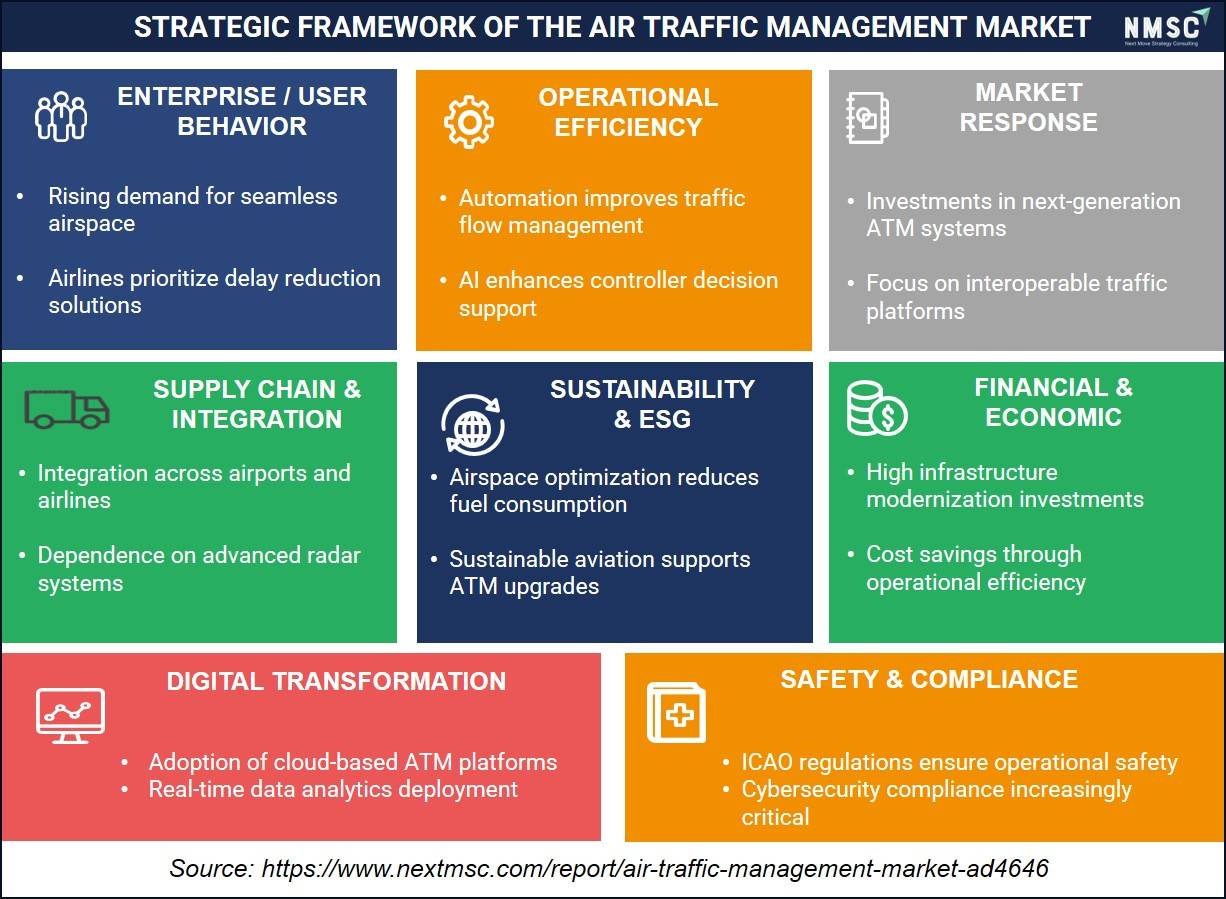
The infographic highlights rising enterprise demand for seamless airspace and delay reduction, operational efficiency through automation and AI-enabled decision support, and market response via next-generation system investments. It also covers supply chain integration across airports and radar systems, sustainability benefits from reduced fuel consumption, financial aspects of infrastructure modernization, digital transformation through cloud-based platforms and real-time analytics, plus strong emphasis on ICAO safety regulations and cybersecurity compliance.
Competitive Landscape
Competitive Dynamics and M&A Landscape
|
Key Takeaways |
Details |
|
Market Structure |
The Air Traffic Management Market is an oligopoly dominated by five to six global systems integrators, Thales, RTX (Raytheon), Indra, Leonardo, Leidos, and L3Harris, which collectively hold the majority of installed base positions across major ANSPs. A second tier of specialized vendors including Frequentis, Saab, Honeywell, and NEC addresses specific sub-segments. |
|
Innovation Focus |
Active R&D investment is concentrated in AI-assisted automation, remote tower video processing, space-based ADS-B integration, cloud-hosted ATM platform certification, and UTM/AAM airspace integration. SESAR JU co-funds innovation projects across European vendors. |
|
M&A Activity |
The ATM sector has seen targeted acquisitions, including Harris Corporation merging with L3 Technologies to form L3Harris in 2019, and Leidos' ongoing integration of acquired engineering services businesses. Frequentis acquired Noracon, and smaller consolidation of niche ATM software vendors is ongoing globally. |
How Do Companies Compete in the Air Traffic Management Market?
Competition in the air traffic management market is structured around long-term system integration contracts with civil ANSPs, military aviation authorities, and airport operators. Market structure is characterized by a small number of global prime contractors competing for high-value, multi-decade relationship contracts that include initial system supply, training, and long-term maintenance. Our analysis shows that competitive advantage in the Air Traffic Management industry is built on incumbent installed base positions, which create high switching costs and renewal probabilities. Innovation focus is shifting toward open architecture platforms, AI-assisted automation, and cloud-compatible system designs that can evolve without full system replacement. Geographic expansion strategies are deployed through local partnerships, joint ventures, and government-to-government cooperation frameworks.
Which Kind of Companies Dominate the Air Traffic Management Market?
The air traffic management market is dominated by large defense and aerospace systems integrators that leverage dual-use technology development across civil and military airspace management. Thales, with its TopSky ATM platform, holds the broadest global installation base across civil ANSPs. RTX Corporation, through its Raytheon business, is the primary U.S. defense ATM supplier. Indra Sistemas commands a dominant position across Iberian, Latin American, and Middle Eastern ANSP markets through its SACTA and ERA systems. Leonardo provides ATM solutions integrated with its radar and defense systems, particularly across Italian, Middle Eastern, and African markets. These incumbents benefit from regulatory certification investments that represent significant barriers to new entrant competition.
AI-Native Differentiation and Open Standards Drive Market Success in the Air Traffic Management Market
NMSC's analysis indicates that vendors achieving the strongest competitive position in the air traffic management market are those that have successfully integrated AI-assisted automation within safety-certified ATM platforms, adopted open architecture standards enabling interoperability with third-party systems, and built cloud-compatible product lines that support hybrid deployment. Frequentis and Thales are leading the open architecture transition through adoption of SWIM (System Wide Information Management) standards. Indra's SACTA NextGen platform incorporates machine learning modules for traffic flow prediction. Saab's remote tower systems leverage AI-assisted video processing for situational awareness enhancement.
Market Players to Opt for Merger and Acquisition Strategies to Expand Their Presence in the Air Traffic Management Market
Merger and acquisition activity in the air traffic management market is concentrated around capability acquisition in remote tower, UTM, cloud-hosted ATM, and data analytics sub-segments. NMSC's assessment indicates that established prime contractors are likely to target acquisitions of specialist remote tower software companies, UTM platform vendors, and AI algorithm developers to accelerate product portfolio expansion without the lengthy organic development and certification timelines. Geographic expansion through acquisitions of regional ATM systems integrators in high-growth Asia-Pacific, MEA, and Latin American markets is also an observed strategic pattern. Smaller ATM software vendors with certified products in specialized domains represent the most attractive acquisition targets over the 2025–2028 period.
Who Are the Key Market Players in the Air Traffic Management Market?
-
Thales S.A.
-
RTX Corporation
-
Indra Sistemas, S.A.
-
Leonardo S.p.A.
-
Leidos Holdings, Inc.
-
L3Harris Technologies, Inc.
-
Frequentis AG
-
Saab AB
-
Honeywell International Inc.
-
NEC Corporation
-
SITA
-
ADB SAFEGATE B.V.
-
Rohde & Schwarz GmbH & Co. KG
-
Aireon LLC
-
Adacel Technologies Limited
-
ERA a.s.
-
Intelcan Technosystems Inc.
-
Searidge Technologies Inc.
-
SkySoft-ATM SA
-
EIZO Corporation
What Are the Latest Developments in the Air Traffic Management Industry?
|
Date |
Event |
|
December 2025 |
Saudi Air Navigation Services (SANS) and Frequentis extended their partnership through at least 2028 to enhance voice communication systems at major control centers in Jeddah and Riyadh |
|
September 2025 |
Frequentis and Sweden’s LFV announced a nationwide UAS Traffic Management system. The development is strategically relevant because it pushes ATM beyond manned aviation into drone integration, giving Sweden a scalable digital platform for low-altitude airspace management, public-safety coordination, and future U-space operations |
|
May 2025 |
Thales reported the successful deployment of its Green Flag Orchestrator in Brest and Reims, France. Strategically, this is important because it targets sustainable ATM by improving flight-path optimization and operational efficiency, which can reduce fuel burn, emissions, and coordination overhead for civil aviation operations |
|
May 2025 |
Frequentis launched its Unified Aeronautical Communications solution at Airspace World 2025. This is strategically significant because it consolidates voice and automation into one interface, improving controller usability, safety, and efficiency while reflecting the industry’s shift toward integrated, digital-first ATM operating environments |
|
February 2025 |
Thales and Sopra Steria announced a strategic partnership to accelerate digital transformation across the Air Traffic Management ecosystem |
Expert Insights
 “Modernizing the air traffic control system is an urgent priority because traffic volumes are growing beyond the capacity of current systems.”
- Dave Marinick, President of Engines and Power Systems at Honeywell Aerospace
Statement made in Honeywell Aerospace's discussion on the future of aviation safety and the need for next-generation air traffic control infrastructure.
Market Interpretation
The statement highlights one of the most significant drivers shaping the Air Traffic Management (ATM) market, which is the rapid growth in global air traffic and the increasing strain on legacy air traffic control infrastructure. As passenger volumes, flight frequencies, and airspace complexity continue to increase, aviation authorities and air navigation service providers are accelerating investments in digital ATM platforms, automation, artificial intelligence, advanced surveillance technologies, and next-generation communication systems. The growing gap between traffic demand and existing system capacity is driving modernization programs worldwide, creating substantial opportunities for ATM technology providers while reinforcing the industry's focus on safety, operational efficiency, and airspace optimization.
What Are the Investment Opportunities in the Air Traffic Management Market?
Capital Inflows and Venture Activity
The air traffic management market is attracting capital from both government infrastructure programs and private investment in ATM-adjacent technology companies. The FAA's FY2025 budget included approximately USD 3.6 billion in air traffic organization operational and capital investment, as disclosed in the FAA's congressional budget justification. The European Commission's Connecting Europe Facility co-funds SESAR deployment projects across member states, with EUR 1.7 billion committed across the 2021–2027 Multi-Annual Financial Framework. Private investment is flowing into remote tower technology companies, UTM platforms, and AI-powered traffic flow management startups, supported by aerospace-focused venture and private equity funds.
Infrastructure Investment
Infrastructure investment in the air traffic management market spans ground-based radar, satellite surveillance integration, data center modernization, and voice communication system replacement. Saudi Arabia's General Authority of Civil Aviation is investing across multi-billion dollar airport programs that include ATM as a core system component. UAE's Al Maktoum airport expansion requires comprehensive new ATM infrastructure deployment. China's Civil Aviation Administration FY2025 five-year plan allocates substantial capital to new area control center construction and en-route navigation aid modernization. These government-directed infrastructure programs represent the largest single-contract revenue opportunities within the sector forecast period.
ESG Considerations in the Air Traffic Management Market
Environmental, Social, and Governance considerations are becoming materially relevant to ATM investment decisions, as more efficient ATM directly reduces aviation's environmental footprint. ICAO's Carbon Offsetting and Reduction Scheme for International Aviation (CORSIA) creates regulatory pressure to minimize flight inefficiencies attributable to airspace constraints. The SESAR JU has quantified that optimized ATM can reduce European aviation CO2 emissions by up to 10% through more direct routing, optimized climb and descent profiles, and reduced holding patterns. Vendors demonstrating measurable environmental performance improvements through advanced ATM solutions are gaining competitive preference in sustainability-conscious European ANSP procurement processes.
Digital Transformation Enablement in the Air Traffic Management Market
ATM platforms are increasingly positioned as the digital backbone of broader airport and airspace digital transformation programs. SWIM, the ICAO-mandated System Wide Information Management standard, enables ATM data to be shared in real time with airlines, airports, and meteorological services, creating new data monetization and service integration opportunities. Airports adopting A-CDM programs require deep ATM data integration. Airlines investing in trajectory-based operations require high-fidelity ATM data feeds. Our analysis shows that vendors building open API ATM data platforms aligned with SWIM standards are capturing new commercial relationships beyond traditional ANSP procurement, including airline, airport operator, and data service provider buyer channels.
Private Equity and Strategic M&A Activity
Private equity interest in the air traffic management market is focused on managed ATM services, specialist remote tower companies, and defense ATM support services with stable government revenue streams. Strategic M&A is accelerating as large prime contractors seek to fill portfolio gaps in remote tower, UTM, cloud-hosted ATM, and AI-enabled automation sub-segments through acquisition rather than organic development. The long certification timelines for ATM products make acquired, already-certified technology more valuable than greenfield development. NMSC's assessment suggests monitoring Searidge Technologies, SkySoft-ATM, and Adacel as representative targets with certified product portfolios that could attract strategic acquirer interest over the 2025–2028 period.
Key Benefits for Stakeholders
For Civil ANSPs and Airport Operators
Civil ANSPs and airport operators gain comprehensive, vendor-neutral intelligence on the air traffic management market, including quantitative sizing across all offering types, operational scopes, commercial models, and deployment architectures. This research supports multi-year technology roadmap planning, vendor evaluation, and build-versus-buy analysis for ATM system components. Competitive landscape analysis enables procurement teams to benchmark vendor capabilities, pricing models, and delivery track records against global peers with analytical rigor and research integrity.
For Investors and Financial Analysts
Investors and financial analysts gain a structured, data-rich assessment of the air traffic management market's growth trajectory, segment-level revenue forecasts through 2035, competitive dynamics, and M&A pipeline. CAGR analysis by segment, deployment model, and buyer type enables precise portfolio construction and valuation modeling. Detailed profiling of all 20 covered companies, combined with latest development tracking, provides an early-signal framework for identifying acquisition targets, emerging sub-segment leaders, and at-risk incumbents within the global ATM industry.
For ATM System Vendors and Technology Providers
ATM vendors and technology providers gain actionable intelligence on white-space opportunities, competitive positioning gaps, and the fastest-growing sub-segments within the air traffic management market. Operational scope analysis reveals underserved areas including remote tower, oceanic surveillance, and surface management. Regional outlook sections identify geographic expansion priorities with regulatory, maturity, and competitive context. Commercial model analysis enables vendors to refine go-to-market strategies between project, subscription, and managed service delivery frameworks for different buyer types and markets.
For Government Agencies and Regulatory Bodies
Government agencies and regulatory bodies gain structured analysis of how national aviation regulatory frameworks, ICAO ASBU mandates, and SESAR deployment obligations are shaping air traffic management market investment and competitive dynamics at the country level. Country-level insights provide policymakers with evidence-based perspectives on how regulatory design choices affect ATM infrastructure investment attraction, technology adoption timelines, and national airspace capacity development. The deployment model analysis offers direct relevance to national cloud-hosting certification strategy development for civil ATM systems.
Air Traffic Management Market Key Segments
By Offering Type
-
Hardware
-
Communication Hardware
-
Navigation Hardware
-
Surveillance Hardware
-
Controller Workstations
-
Recording and Display
-
Other Hardware
-
-
Software
-
Automation Software
-
Flight Data Software
-
Surveillance Software
-
Tower Software
-
Simulation Software
-
Other Software
-
-
Services
-
Integration Services
-
Maintenance and Support
-
Managed Operations
-
Consulting and Training
-
Data and Analytics
-
Other Services
-
By Operational Scope
-
Tower
-
Approach
-
En Route
-
Oceanic
-
Surface
-
Remote Tower
By Buyer Type
-
Civil ANSP
-
Military
-
Airport Operator
-
Airline
-
Government
-
Other
By Commercial Model
-
Project
-
License
-
Subscription
-
Managed Service
-
Maintenance Contract
-
Other
By Deployment Model
-
Ground Based
-
Cloud Hosted
-
Satellite Based
-
Hybrid
By Region
-
North America: U.S., Canada, and Mexico.
-
Europe: UK, Germany, France, Italy, Spain, Sweden, Denmark, Finland, the Netherlands, and the rest of Europe.
-
Asia Pacific: China, India, Japan, South Korea, Taiwan, Indonesia, Vietnam, Australia, Philippines, Malaysia and the rest of APAC.
-
Middle East & Africa (MEA): Saudi Arabia, UAE, Egypt, Israel, Turkey, Nigeria, South Africa, and the rest of MEA.
-
Latin America: Brazil, Argentina, Chile, Colombia, and the rest of LATAM.
Conclusion and Recommendations
Long-Term Outlook
The air traffic management market is entering its most technology-intensive growth decade, driven by the convergence of traffic volume growth, mandatory ICAO ASBU compliance timelines, remote tower commercialization, and the integration of AI, cloud, and satellite-based capabilities into safety-certified ATM platforms. The market is forecast to grow from USD 10.5 billion in 2026 to USD 20.1 billion by 2035 at a CAGR of 7.5%. This growth reflects both rising infrastructure investment by major ANSPs in Europe, Asia-Pacific, and the Middle East, and the expanding commercial scope of ATM solutions toward managed services, subscription delivery, and as-a-service operational models.
Strategic Positioning Recommendations
ATM system vendors should prioritize investment in open-architecture, SWIM-compliant platform development that enables modular upgrades without full system replacement, a key procurement preference emerging across European and Asia-Pacific ANSPs. Remote tower product portfolios represent a structurally attractive growth investment, with declining technology costs and expanding regulatory acceptance creating a rapidly growing addressable market. Subscription and managed service commercial model capabilities are non-negotiable for vendors seeking to capture share in smaller ANSP markets that lack capital budgets for large system replacement programs. Cloud certification readiness for non-safety-critical ATM functions should be treated as a two-to-three-year strategic investment horizon.
Investment Attractiveness
The air traffic management market represents an attractive investment environment characterized by government-mandated procurement cycles that create durable multi-year revenue visibility, high switching costs following system deployment that support incumbent renewal rates, and structural secular growth driven by global aviation expansion and airspace modernization obligations. The highest-conviction investment themes include Remote Tower (CAGR of 14.2%), Cloud Hosted deployment (CAGR of 15.8%), Subscription commercial model (CAGR of 12.6%), and Asia-Pacific regional growth (CAGR of 9.2%). Investors should monitor Frequentis AG, listed on the Vienna Stock Exchange, and Saab AB as pure-play ATM-relevant public equities, alongside ATM content within L3Harris, Leidos, Thales, and Leonardo.
Market Shifts and Key Risks
The most consequential market shift underway is the transition from monolithic, proprietary ATM systems toward open, modular, cloud-compatible platforms that enable component-level upgrades aligned with technology refresh cycles. This shift benefits vendors with open architecture strategies at the expense of proprietary incumbent systems. Key risks for the air traffic management market include regulatory certification delays for cloud-hosted and AI-assisted ATM applications, which could defer investment timelines; macroeconomic pressures reducing government aviation infrastructure budgets in emerging markets; and geopolitical tensions affecting cross-border airspace management cooperation and international ATM contract eligibility for non-domestic vendors.
Growth Pathways
Organizations seeking to maximize value from the air traffic management market should pursue a three-horizon strategy. In the near term from 2025 to 2027, prioritize ADS-B and MLAT surveillance infrastructure upgrades to establish ICAO ASBU compliance baselines and win foundational infrastructure contracts. In the mid-term from 2027 to 2031, invest in remote tower commercialization, AI-assisted automation, and subscription delivery capabilities to capture the fastest-growing market sub-segments. In the long term from 2031 to 2035, position for UTM and advanced air mobility integration, cloud-certified safety ATM applications, and satellite-based navigation augmentation as the next structural investment wave within the ATM market.


About the Author
 Mayurima Roy
— Mayurima Roy is Research Analyst at Next Move Strategy Consulting, where she has spent 4 years working across the firm's full industry coverage rather than a single fixed vertical. Her work centers on structured research, ongoing trend tracking, competitive assessment, and insight-led content development, translating complex market data into clear, decision-ready narratives that support informed client decision-making across diverse global industries, market sectors, and world regions every day.
Mayurima Roy
— Mayurima Roy is Research Analyst at Next Move Strategy Consulting, where she has spent 4 years working across the firm's full industry coverage rather than a single fixed vertical. Her work centers on structured research, ongoing trend tracking, competitive assessment, and insight-led content development, translating complex market data into clear, decision-ready narratives that support informed client decision-making across diverse global industries, market sectors, and world regions every day.
About the Reviewer
 Supradip Baul
— Supradip Baul is an accomplished business consultant and strategist with over a decade of rich experience in market intelligence, strategy, technology, and business transformation. His work has included rigorous qualitative and quantitative analysis across multiple industries, helping clients shape investment decisions and long-term roadmaps. Earlier in his career, he was associated with Gartner, where he contributed to industry-leading reports and market share analyses. He has worked with leading global companies and holds an MBA with a dual specialization in Marketing and Finance.
Supradip Baul
— Supradip Baul is an accomplished business consultant and strategist with over a decade of rich experience in market intelligence, strategy, technology, and business transformation. His work has included rigorous qualitative and quantitative analysis across multiple industries, helping clients shape investment decisions and long-term roadmaps. Earlier in his career, he was associated with Gartner, where he contributed to industry-leading reports and market share analyses. He has worked with leading global companies and holds an MBA with a dual specialization in Marketing and Finance.
At Next Move Strategy Consulting, we understand that insightful market research is the cornerstone of successful business decisions. That's why we employ a robust and multifaceted approach, combining various methodologies to deliver the most accurate and actionable data for our clients.

Research Landscape
We navigate the world of research with two primary approaches:
Qualitative Approach
Our qualitative research methodologies involve immersive techniques such as in-depth interviews, focus groups, and observational studies. By engaging directly with individuals and stakeholders, we uncover valuable insights that quantitative data alone may overlook.

Quantitative Research
In tandem with qualitative methodologies, NMSC leverages the power of Quantitative Research to provide a robust foundation of numerical insights. Through systematic data collection and analysis, we quantify patterns, preferences, and market trends, offering a comprehensive view of the business landscape.
Our quantitative research approach employs diverse tools, including surveys, experiments, and statistical modelling. These methodologies enable us to gather data from a large and representative sample, ensuring the statistical significance of our findings. By employing structured questionnaires and standardized data collection methods, we guarantee the reliability and validity of the information we present to our clients.
Quantitative research is particularly effective in measuring the prevalence of trends, assessing market size, and gauging the impact of various factors on consumer behavior. The numerical precision attained through this approach equips our clients with actionable insights, facilitating data-driven decision-making and strategy formulation.


Our Specialized Toolbox for Industry-Specific Market Research
We deploy a specialized arsenal of techniques tailored to meet your unique requirements. Here's a glimpse into our comprehensive toolbox:

Information Procurement
The stage entails acquiring market data or relevant information through various sources and methodologies.


Market Research Approach
We utilize both top-down and bottom-up approaches in market research analysis to achieve a comprehensive understanding of the market dynamics, leveraging the broad perspective of industry trends and macroeconomic factors alongside detailed insights from specific segments and individual companies.

Porters Five Forces Analysis
We conduct Porter's Five Forces analysis to evaluate the competitive landscape of an industry, providing us with insights into factors that affect profitability and strategic positioning.

SWOT Analysis

Forecasting
We utilize a forecasting model to predict future consumption by considering parameters like population, economics, regulations, market competition, drivers, constraints, technology, and pricing. We also employ statistical techniques such as multilinear regression, exponential smoothing, moving average, ARIMA, and Monte Carlo simulations for accurate predictions. In econometric forecasting, we analyzed short-term and long-term event impacts, attributing values based on regulatory frameworks, economic factors, and market events.





 Speak to Our Analyst