Antibody-Drug Conjugates (ADC) Market Analysis and Forecast (2026–2035)

Demand for targeted oncology conjugates is lifting revenue from USD 17.24 Billion in 2025 to USD 203.32 Billion by 2035, a 30.23% CAGR over 2026–2035, as earlier line approvals, TROP2 and HER2 franchises and Chinese innovation keep North America ahead while Asia-Pacific accelerates.

Download Free Sample PDF
Base Year (2025)
$17.24 Billion
Forecast (2035)
$203.32 Billion
CAGR (2026-2035)
30.2%
Top Region
North America

What Is the Antibody-Drug Conjugates (ADC) Market Size?

The global Antibody-Drug Conjugates (ADC) Market was valued at USD 17.24 Billion in 2025 and is estimated at USD 18.87 Billion in 2026. It is forecast to reach USD 203.32 Billion by 2035, growing at a 30.23% CAGR from 2026–2035. North America leads with about 53% share, and microtubule inhibitor payloads lead with about 47%.

Our analysis shows that conjugated oncology therapeutics are shifting toward topoisomerase payloads, TROP2 and HER2 franchises, and earlier lines of care, as summarized below.

Antibody-Drug Conjugates (ADC) Market Analysis and Forecast (2026–2035) Revenue Forecast

Values in USD Billion

2025 $17.24 Billion
2025
2026 $18.87 Billion
2026
2027 $24.57 Billion
2027
2028 $32.00 Billion
2028
2029 $41.68 Billion
2029
2030 $54.28 Billion
2030
2031 $70.68 Billion
2031
2032 $92.05 Billion
2032
2033 $119.88 Billion
2033
2034 $156.12 Billion
2034
2035 $203.32 Billion
2035

Key Takeaways

By Payload: Microtubule inhibitor payloads are identified as the largest segment in the supplied estimates, while novel mechanism payloads are projected to grow rapidly. Segment revenues and growth rates require reconciliation against the underlying model., expanding from USD 8.70 Billion in 2025 to USD 60.00 Billion by 2035; novel mechanism payloads are the fastest growing at 45.9% CAGR from 2026–2035.

By Target: HER2 held the largest share, expanding from USD 7.50 Billion in 2025 to USD 62.00 Billion by 2035; emerging solid tumor targets are the fastest growing at 48.1% CAGR from 2026–2035.

By Application: Breast cancer held the largest share, expanding from USD 7.45 Billion in 2025 to USD 65.00 Billion by 2035; lung cancer is the fastest growing at 48.8% CAGR from 2026–2035.

Dominant Region: North America, expanding from USD 9.30 Billion in 2025 to USD 78.00 Billion by 2035.

Fastest-Growing Region: Asia-Pacific at 39.5% CAGR from 2026–2035, rising from USD 3.20 Billion in 2025 to USD 75.00 Billion by 2035.

Dominant Country: U.S., expanding from USD 8.50 Billion in 2025 to USD 70.00 Billion by 2035.

Fastest-Growing Country: China at 44.9% CAGR from 2026–2035, rising from USD 1.55 Billion in 2025 to USD 52.00 Billion by 2035.

The forecast implies a substantial increase in annual market revenue over the 2026–2035 period. The calculated revenue opportunity should be derived from the validated 2035 forecast less the validated 2026 baseline. The result should be presented as a modeled estimate rather than a guaranteed commercial outcome.

According to NMSC analysis, payload innovation rather than antibody sourcing now decides commercial leadership, because topoisomerase I conjugates are projected to supply over half of 2035 revenue. This view draws on company disclosed sales, regulatory approval timelines, treated patient volumes and the depth of late-stage clinical programs, and it holds across our regional scenarios.

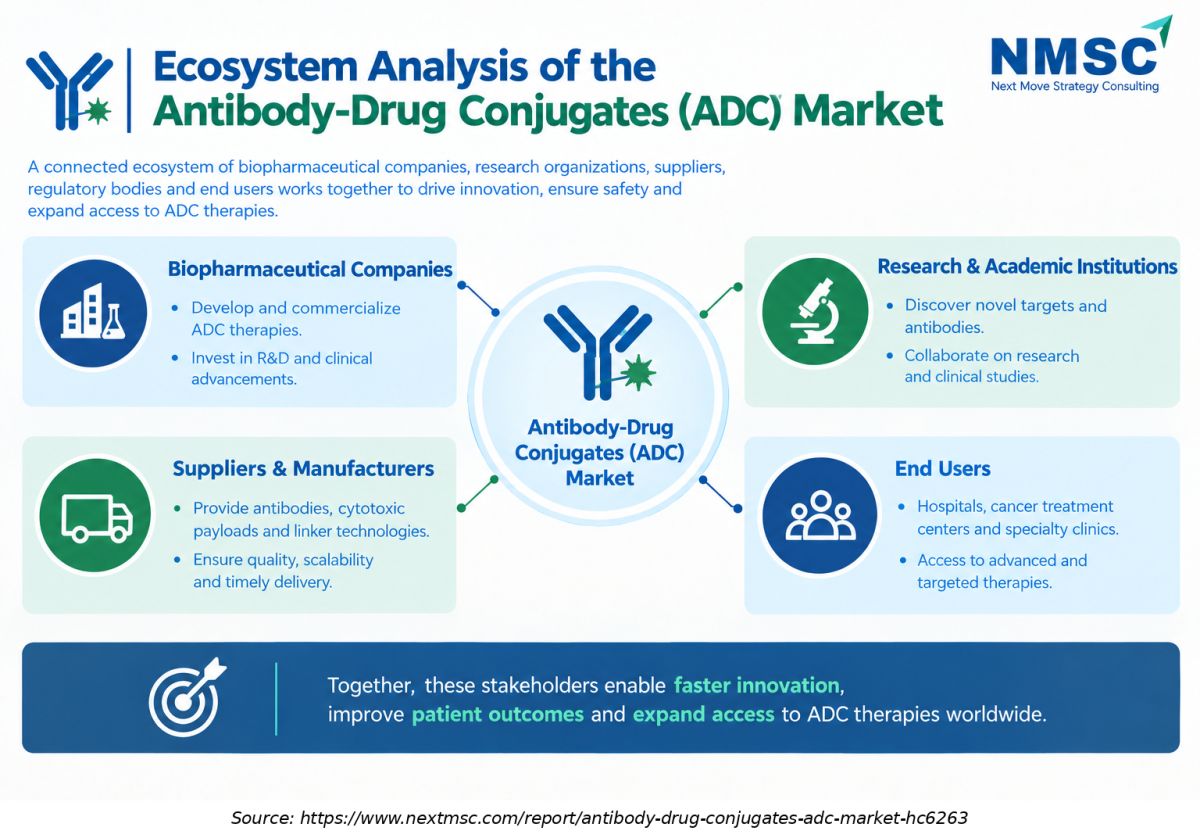
Ecosystem Analysis of the Antibody-Drug Conjugates (ADC) Market

The Antibody-Drug Conjugates (ADC) Market ecosystem includes biopharmaceutical developers, antibody and payload suppliers, linker technology providers, contract development and manufacturing organizations, research institutions, regulators, healthcare providers, and patients. Collaboration across these participants supports research, clinical development, manufacturing quality, regulatory compliance, and access to approved therapies

What Does the Antibody-Drug Conjugates (ADC) Market Encompass?

The Antibody-Drug Conjugates (ADC) Market comprises cancer therapeutics that link a monoclonal antibody or antibody-based targeting component to a cytotoxic payload through a chemical linker. Unconjugated antibodies, radioligand therapies, and cell therapies should be excluded unless explicitly included in the approved scope.

ADC development has expanded across multiple solid tumors and hematologic malignancies. Regulatory agencies assess product-specific evidence on safety, efficacy, dosing, and manufacturing quality. Advances in conjugation chemistry and production processes may support product development, but their commercial impact depends on clinical outcomes and regulatory approval. Regulatory agencies, including the U.S. FDA, EMA and China's NMPA, evaluate ADCs based on product-specific safety, efficacy and manufacturing quality. Advances in site-specific conjugation and manufacturing processes are also influencing ADC development.

Market Drivers & Dynamics

Interactive Dataset
Label expansion of HER2 and TROP2 ADCs into early-stage disease driver +6.5% North America, Europe 2026–2032
Combination regimens with PD-1 inhibitors in first line settings driver +5.0% North America, Europe, Asia-Pacific 2026–2033
Chinese ADC approvals and cross border licensing driver +4.5% Asia-Pacific, Global 2026–2035
Next generation payloads, bispecific and dual payload formats driver +3.5% Global 2028–2035
Biomarker and companion diagnostic adoption driver +2.0% North America, Europe 2026–2030
Payload related toxicity and interstitial lung disease monitoring restraint −3.0% Global 2026–2031
Manufacturing complexity and contract capacity limits restraint −2.5% Global 2026–2030
Pricing pressure and reimbursement scrutiny restraint -2.0% North America, Europe 2027–2035
Source: Next Move Strategy Consulting

Growth Drivers

What Is the Primary Growth Driver of the Antibody-Drug Conjugates (ADC) Market?

Expanding regulatory approvals are the primary growth driver of the Antibody-Drug Conjugates (ADC) Market. On May 15, 2026, the FDA approved Enhertu for two separate indications in HER2 positive early-stage breast cancer, and in January 2025 the agency approved Datroway for HR positive, HER2 negative breast cancer. Each label expansion adds eligible patients and treatment duration. Our findings suggest that earlier stage approvals contribute the largest share of the forecast uplift after 2027.

How Is Clinical Pipeline Depth Driving the Antibody-Drug Conjugates (ADC) Market Growth?

ADC clinical development includes programs targeting HER2, TROP2, Nectin-4 and B7H3 across multiple cancer indications. We observed that late-stage readouts are arriving in parallel, so several launches can overlap within a three-year window. Pipeline diversification may support future market expansion by increasing the number of potential products and target indications, although commercial growth remains dependent on clinical outcomes and regulatory approvals.

Growth Inhibitors

What Is Restraining the Market?

ADC development and commercialization face challenges related to product-specific toxicity, manufacturing complexity, quality control, supply reliability, and reimbursement. Safety monitoring requirements vary by product and indication.

What Are the Growth Opportunities?

Can Earlier Line Treatment Unlock Curative Intent Revenue?

The expansion of ADCs into earlier treatment settings may increase the eligible patient population and alter treatment duration. The potential revenue impact varies by tumor type, approved indication, treatment regimen, and patient eligibility. Forecasts should not assume earlier-line adoption before the relevant clinical and regulatory evidence is available. Breast and bladder cancer already show this pattern, and lung and gastric programs follow. Large oncology franchises benefit most, since extended treatment duration compounds revenue per patient across the 2026–2035 horizon.

Is Biomarker Guided Patient Selection a Commercial Opportunity?

Biomarkers testing can help identify patients who may benefit from particular ADCs, depending on the product and indication. Precision selection also improves response rates, which strengthens payer acceptance and supports durable pricing for targeted products.

Why Does Emerging Market Access Matter for ADC Developers?

In the Antibody-Drug Conjugates (ADC) Market, Asia-Pacific and Latin America combine rising cancer incidence with expanding reimbursement coverage. Chinese approvals and local production lower prices, which widens access across Southeast Asia and the Middle East. Developers that license regional rights or build local fill finish capacity capture volume that high income markets cannot supply, and providers of biologics contract development benefit from the resulting demand.

Segmentation Analysis

2025 (USD Billion)
2035 (USD Billion)
Topoisomerase I inhibitor payloads 2025: $6.20 Billion | 2035: $105.00 Billion
Topoisomeras
Microtubule inhibitor payloads 2025: $8.70 Billion | 2035: $60.00 Billion
Microtubule
DNA damaging payloads 2025: $1.64 Billion | 2035: $9.32 Billion
DNA damaging
Novel mechanism payloads 2025: $0.70 Billion | 2035: $29.00 Billion
Novel mechan
Topoisomerase I inhibitor payloads $6.20 Billion $105.00 Billion 34.5%
Microtubule inhibitor payloads $8.70 Billion $60.00 Billion 23.8%
DNA damaging payloads $1.64 Billion $9.32 Billion 20.0%
Novel mechanism payloads $0.70 Billion $29.00 Billion 45.9%

Which Payload Class Leads and Which Grows Fastest?

Microtubule inhibitor payloads held the largest share of the Antibody-Drug Conjugates (ADC) Market at USD 8.80 Billion in 2026, supported by Padcev, Adcetris, Polivy and Kadcyla, which carry MMAE or DM1 payloads. Topoisomerase I inhibitor payloads are projected to expand from USD 7.30 Billion in 2026 to USD 105.00 Billion by 2035 and overtake the incumbent class. Novel mechanism payloads grow fastest at 45.9% CAGR as degrader and immune stimulating conjugates enter late-stage trials.

2025 (USD Billion)
2035 (USD Billion)
Category A
Category B
Category C
Category D
Segment Item 2025 (USD Billion) 2035 (USD Billion) CAGR
Category A $10.0 USD Billion $40.0 USD Billion 25.0%
Category B $17.1 USD Billion $51.1 USD Billion 11.0%
Category C $24.2 USD Billion $62.2 USD Billion 25.0%
Category D $31.3 USD Billion $73.3 USD Billion 11.0%

Segment-wise data is locked

Unlock complete segment-wise numbers for By Target.

Unlock Full Data
2025 (USD Billion)
2035 (USD Billion)
Category A
Category B
Category C
Category D
Segment Item 2025 (USD Billion) 2035 (USD Billion) CAGR
Category A $10.0 USD Billion $40.0 USD Billion 27.0%
Category B $17.1 USD Billion $51.1 USD Billion 9.0%
Category C $24.2 USD Billion $62.2 USD Billion 19.0%
Category D $31.3 USD Billion $73.3 USD Billion 17.0%

Segment-wise data is locked

Unlock complete segment-wise numbers for By Application.

Unlock Full Data

Growth Opportunities

Based on research conducted by NMSC, we found that three opportunities offer the clearest route to value creation over the forecast period.

Can Earlier Line Treatment Unlock Curative Intent Revenue?

The expansion of ADCs into earlier treatment settings may increase the eligible patient population and alter treatment duration. The potential revenue impact varies by tumor type, approved indication, treatment regimen, and patient eligibility. Forecasts should not assume earlier-line adoption before the relevant clinical and regulatory evidence is available. Breast and bladder cancer already show this pattern, and lung and gastric programs follow. Large oncology franchises benefit most, since extended treatment duration compounds revenue per patient across the 2026–2035 horizon.

Is Biomarker Guided Patient Selection a Commercial Opportunity?

Biomarkers testing can help identify patients who may benefit from particular ADCs, depending on the product and indication. Precision selection also improves response rates, which strengthens payer acceptance and supports durable pricing for targeted products.

Why Does Emerging Market Access Matter for ADC Developers?

In the Antibody-Drug Conjugates (ADC) Market, Asia-Pacific and Latin America combine rising cancer incidence with expanding reimbursement coverage. Chinese approvals and local production lower prices, which widens access across Southeast Asia and the Middle East. Developers that license regional rights or build local fill finish capacity capture volume that high income markets cannot supply, and providers of biologics contract development benefit from the resulting demand.

Regional Outlook

2025 (USD Billion)
2035 (USD Billion)
North Americ
Europe
Asia-Pacific
Middle East
Latin Americ
Region 2025 (USD Billion) 2035 (USD Billion) CAGR (%)
North America $10.0 USD Billion $40.0 USD Billion 9.0%
Europe $17.1 USD Billion $51.1 USD Billion 27.0%
Asia-Pacific $24.2 USD Billion $62.2 USD Billion 25.0%
Middle East & Africa $31.3 USD Billion $73.3 USD Billion 23.0%
Latin America $38.4 USD Billion $84.4 USD Billion 12.0%

Regional data is locked

Unlock complete regional numbers for this market.

Unlock Full Data

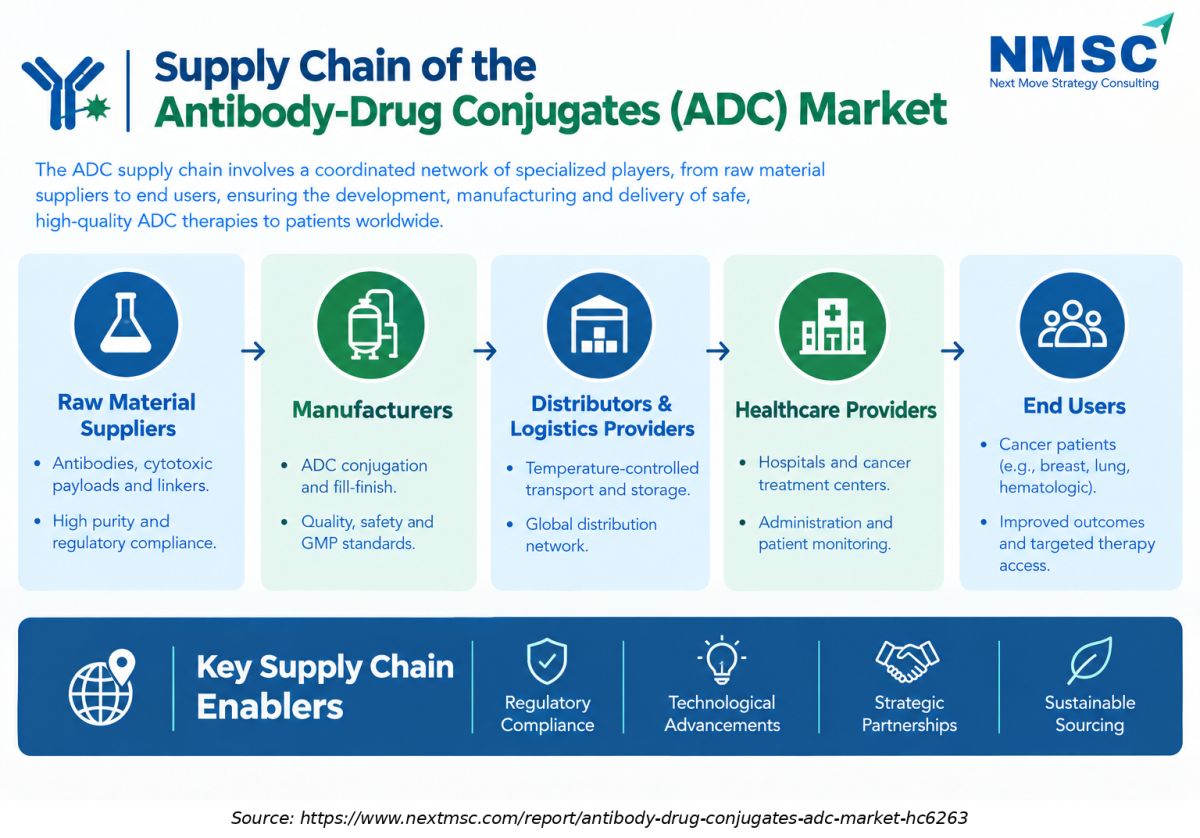
Supply Chain Structure of the Antibody-Drug Conjugates (ADC) Market
Supply Chain Structure of the Antibody-Drug Conjugates (ADC) Market

The infographic illustrates the Supply Chain Structure of the Antibody-Drug Conjugates (ADC) Market, covering the flow from raw material suppliers to manufacturers, distributors, healthcare providers, and end users. It highlights how high-quality antibodies and cytotoxic payloads, GMP-compliant manufacturing, temperature-controlled logistics, and regulatory compliance help ensure the safe and timely delivery of ADC therapies to patients.

Competitive Landscape

Our findings suggest that competition now centers on payload differentiation, target selection and manufacturing control rather than antibody sourcing.

How Do Companies Compete in the Antibody-Drug Conjugates (ADC) Market?

Companies in the Antibody-Drug Conjugates (ADC) Market compete on clinical differentiation, label breadth and supply reliability. Leading firms pair a validated target with an improved payload and then expand across tumor types through large Phase 3 programs. Pricing strategy reflects survival benefit, and geographic expansion proceeds through regional partnerships, especially in Asia-Pacific, where local approvals and reimbursement listings determine early share.

Which Company Archetypes Dominate the Industry?

Four archetypes shape the Antibody-Drug Conjugates (ADC) Market: integrated large pharmaceutical companies such as AstraZeneca, Pfizer and Roche; platform specialists such as Daiichi Sankyo with its DXd technology; Chinese originators such as Kelun-Biotech and Hengrui; and technology providers including Lonza that supply conjugation capability. The first group commands commercial scale, while the others differentiate through payload science and speed.

What Innovation and Differentiation Strategies Are Companies Pursuing?

Developers in the Antibody-Drug Conjugates (ADC) Market pursue new payload classes, bispecific antibodies and dual payload conjugates to overcome resistance. On April 7, 2026, Gilead Sciences announced its acquisition of Tubulis for USD 3.15 Billion upfront, with additional potential milestone payments. The transaction strengthens Gilead's ADC pipeline and adds next-generation linker-payload technologies. Companies also invest in biomarker strategy and subcutaneous formulations that improve convenience.

How Active Is M&A and Partnership Activity?

Dealmaking in the Antibody-Drug Conjugates (ADC) Market is intense because conjugation know how is scarce. Gilead announced its acquisition of Tubulis on April 7, 2026 for USD 3.15 Billion upfront. We observed that buyers increasingly target payload and linker technology rather than single assets.

Key Market Players

Based on research conducted by NMSC, we found that the following companies hold the strongest verified positions in approved and late-stage antibody drug conjugates. Chinese developers and global pharmaceutical leaders are both represented. They are listed in ranked order based on verified commercial and clinical scale, using official disclosures available in 2026.

AstraZeneca PLC Daiichi Sankyo Company, Limited Roche Holding AG Pfizer Inc. Gilead Sciences, Inc. AbbVie Inc. Merck & Co., Inc. Astellas Pharma Inc. Takeda Pharmaceutical Company Limited GSK plc Genmab A/S Sichuan Kelun-Biotech Biopharmaceutical Co., Ltd. RemeGen Co., Ltd. Jiangsu HengRui Pharmaceuticals Co., Ltd. Sichuan Baili Pharmaceutical Co., Ltd. Lepu Biopharma Co., Ltd.

Latest Developments

We found that regulatory milestones and strategic transactions in 2025 and 2026 are the clearest signals of where commercial momentum is moving.

Date Event
June 2026 The FDA expanded Trodelvy to first line treatment of unresectable locally advanced or metastatic triple negative breast cancer.
May 2026 The FDA approved Enhertu for two indications in HER2 positive early-stage breast cancer.

Investment Opportunities

Where Is Capital Flowing in the Antibody-Drug Conjugates (ADC) Market?

Capital inflows into the Antibody-Drug Conjugates (ADC) Market concentrate on payload platforms and late-stage assets. Major strategic transactions highlight growing interest in antibody-conjugate technologies. Gilead announced the acquisition of Tubulis for USD 3.15 Billion upfront, Johnson & Johnson agreed to acquire Firefly Bio for USD 1.00 Billion, and Pfizer announced an oncology collaboration with Innovent involving USD 0.65 Billion in upfront payments.. Our findings suggest that investors favor assets with differentiated linker payload science over me too constructs.
What Infrastructure Investment Supports ADC Growth?

Infrastructure spending focuses on conjugation suites, high potency handling and fill finish capacity. Specialist contract partners and bio production CMO and CRO services expand capacity as developers outsource complex steps. AstraZeneca announced a USD 50.00 Billion investment commitment in U.S. research, development and manufacturing. Although the investment is not exclusively ADC-focused, it may strengthen broader pharmaceutical development and production capabilities.

How Do ESG Considerations Shape Investment in the Market?

ESG factors in the Antibody-Drug Conjugates (ADC) Market center on patient access, safe handling of cytotoxic payloads and responsible clinical trial conduct. Developers that publish access programs for emerging markets and reduce solvent waste in conjugation chemistry gain preference from institutional investors. We found that regulators also reward transparent safety reporting, which lowers long term litigation and withdrawal risk.
Key Benefits for Stakeholders

How Does the Report Help Enterprise and Industry Leaders?

Enterprise leaders gain a segmented forecast of the Antibody-Drug Conjugates (ADC) Market that shows which payloads, targets and applications create value through 2035. The regional and country analysis supports portfolio allocation and launches sequencing, while the competitive assessment clarifies partnership and acquisition options. These insights help executives test the assumptions behind pipeline investment cases and decide where to build, buy or partner.

What Value Does the Report Offer Investors and Financial Analysts?

Investors in the Antibody-Drug Conjugates (ADC) Market receive a reconciled global market size of USD 18.87 Billion in 2026 and USD 203.32 Billion in 2035, with segment level growth rates that can anchor valuation models. The risk matrix quantifies drivers and restraints, and the developments table traces deal flow, which together help analysts judge timing and downside exposure.

How Do Technology Vendors and Product Teams Benefit?

Technology vendors and product teams learn where demand in the Antibody-Drug Conjugates (ADC) Market for conjugation platforms, linker payload systems and analytics is rising. The report shows that novel mechanism payloads and emerging targets grow fastest, which guides research priorities. Contract partners can also size capacity needs by region and plan facility investment against the forecast curve.

Key Market Segments Evaluated

By Payload

  • Topoisomerase I inhibitor payloads
  • Microtubule inhibitor payloads
  • DNA damaging payloads
  • Novel mechanism payloads

By Target

  • HER2
  • TROP2
  • Nectin-4
  • B cell antigens
  • Emerging solid tumor targets

By Application

  • Breast cancer
  • Lung cancer
  • Urothelial and bladder cancer
  • Hematologic malignancies
  • Other solid tumors

By Region

  • North America 
    • U.S.
    • Canada
    • Mexico
  • Europe 
    • UK
    • Germany
    • France
    • Italy
    • Spain
    • Sweden
    • Denmark
    • Finland
    • Netherlands
    • Rest of Europe
  • Asia-Pacific 
    • China
    • India
    • Japan
    • South Korea
    • Taiwan
    • Indonesia
    • Vietnam
    • Australia
    • Philippines
    • Malaysia
    • Rest of APAC
  • Middle East & Africa 
    • Saudi Arabia
    • UAE
    • Egypt
    • Israel
    • Turkey
    • Nigeria
    • South Africa
    • Rest of MEA
  • Latin America 
    • Brazil
    • Argentina
    • Chile
    • Colombia
    • Rest of LATAM

Conclusion & Recommendations

The outlook for the Antibody-Drug Conjugates (ADC) Market is strongly positive, with revenue climbing from USD 18.87 Billion in 2026 to USD 203.32 Billion in 2035. Growth is anchored by approvals in earlier disease stages, topoisomerase I payload leadership and the rise of Asia-Pacific. Our analysis shows that the rate of expansion will gradually moderate after 2030 as the base enlarges and competition intensifies.
What Strategic Positioning Recommendations Does NMSC Offer?

NMSC recommends that incumbents in the Antibody-Drug Conjugates (ADC) Market defend core franchises through label expansion and subcutaneous or convenient formats, while challengers differentiate with novel payloads and bispecific designs. Companies without platforms should partner early with technology specialists, and all developers should secure manufacturing capacity ahead of launches. Regional partnerships in China and Southeast Asia deserve priority.

How Does Investment Attractiveness Look for the Market?

Investment attractiveness is high but selective. Valuations for late-stage assets are elevated, and the best risk adjusted returns appear in payload technology, contract manufacturing and regional rights in fast growing markets. Our assessment indicates that diversified exposure across targets reduces the impact of any single safety setback or clinical failure.

What Are the Market Shifts and Key Risks to Watch?

Key shifts in the Antibody-Drug Conjugates (ADC) Market include the move of Asia-Pacific toward global leadership in innovation, the rise of bispecific formats and growing payer scrutiny of price. Main risks are safety signals such as interstitial lung disease, supply bottlenecks and competition from bispecific antibodies and radioligands. A restrictive change in reimbursement for premium oncology drugs would reduce the forecast trajectory.

What Are the Primary Growth Pathways Through 2035?

Three pathways stand out for the Antibody-Drug Conjugates (ADC) Market: label expansion into neoadjuvant and adjuvant settings, entry into lung and other solid tumors, and geographic extension into Asia-Pacific and Latin America. We found that combining these pathways with biomarker selection and new payload classes explains most of the USD 184.45 Billion opportunity between 2026 and 2035.

FAQs

Sources & References

1.

U.S. Food and Drug Administration

fda.gov
2.

Oncology Nursing Society, FDA approval updates for antibody drug conjugates

ons.org
3.

AstraZeneca PLC, Form 20-F FY2025 (SEC)

sec.gov
4.

AstraZeneca PLC, Form 6-K H1 2025 (SEC)

sec.gov
5.

AstraZeneca PLC, Form 6-K Q1 2025 (SEC)

sec.gov
6.

AstraZeneca PLC, Full Year 2025 results announcement

astrazeneca.com
7.

Daiichi Sankyo, FY2025 Q3 reference data

daiichisankyo.com
8.

Roche, Sales update first nine months 2025

roche.com
9.

Roche, Half year 2025 investor update

roche.com
10.

Pfizer, Q4 2025 earnings release

s206.q4cdn.com
11.

Gilead Sciences, Fourth quarter and full year 2025 results

investors.gilead.com
12.

Astellas Pharma, FY2025 Q3 financial results

astellas.com
13.

Takeda, FY2025 Q3 financial results

assets-dam.takeda.com
14.

Sichuan Kelun-Biotech, HKEXnews announcement of 6 February 2026

www1.hkexnews.hk

About the Author

Mayurima Roy

Mayurima Roy

Mayurima Roy is Research Analyst at Next Move Strategy Consulting, where she has spent 4 years working across the firm's full industry coverage rather than a single fixed vertical. Her work centers on structured research, ongoing trend tracking, competitive assessment, and insight-led content development, translating complex market data into clear, decision-ready narratives that support informed client decision-making across diverse global industries, market sectors, and world regions every day.

About the Reviewer

Supradip Baul

Supradip Baul

Supradip Baul is an accomplished business consultant and strategist with over a decade of rich experience in market intelligence, strategy, technology, and business transformation. His work has included rigorous qualitative and quantitative analysis across multiple industries, helping clients shape investment decisions and long-term roadmaps. Earlier in his career, he was associated with Gartner, where he contributed to industry-leading reports and market share analyses. He has worked with leading global companies and holds an MBA with a dual specialization in Marketing and Finance.

Download Free Sample

Gustaf Hummel Burstrom

GUSTAF HUMMEL BURSTROM

Founder

Revline Tools AB

Joseph and the team at Next Move Strategy Consulting have been excellent to work with, in supplying us with relevant market data and forecasts for our specific category. We had some special requirements and they were able to do a custom package to suit our needs. We would definitely recommend them to any other company needing market data and forecasts

Melanie Samko

MELANIE SAMKO

Director of Marketing

TOSOH BIOSCIENCE, INC.

The information provided by NMSC is incredibly valuable, thank you so much for such a excellent work. I really appreciate it. I will make sure to reference all of it, in my summary document.

Pratyush Kumar Das

PRATYUSH KUMAR DAS

Assistant Manager

Polycab India Limited

We would like to express our appreciation for the data and insights provided by nextmsc. We are very pleased with the quality and depth of the information, which has proven to be highly valuable and beneficial for our business decision-making.

Ross J Mckenzie

ROSS J MCKENZIE

Business Insight Manager

Staysure Group

“Next MSC have been incredibly helpful in providing detailed & robust information on our market, alongside quantifying growth by different segments. The process to procure was simple and easy, with sample reports and regular contact to ensure we had what we needed. Succinct detail on their sources & methodologies is also greatly received, allowing transparency in this respect helps build trust in the detail you pay for. Joseph in particular was fantastic, and helped ensure efficient provision of the insight pack – thank you NMSC!”.

Henri Knyphausen

HENRI KNYPHAUSEN

Partner at Singulier [Ex-BCG]

Singulier

I recently engaged NEXTMSC.com for a commercial due diligence project within the intralogistics sector, and I am pleased to provide a reference based on my experience. In utilizing NEXTMSC.com's services, I found their report to offer valuable insights into market dynamics and key industry players. The initial report provided a solid foundation for our analysis. However, as we were investigating a smaller target in the market, and I had specific customization requests requiring additional research. These requests included detailed information on product portfolios of various players and sub-market sizes, both inclusive and exclusive of certain product categories. NEXTMSC.com demonstrated commendable responsiveness and agility in accommodating these customization requests. Within a timeframe of 1-2 weeks, they delivered a revised report that met our specific needs. Furthermore, they were receptive to my follow-up inquiries, ensuring clarity and understanding of the data provided. The final deliverable significantly contributed to our due diligence efforts. One of NEXTMSC.com's notable strengths lies in their qualitative research capabilities. However, for future engagements, I would recommend the inclusion of a quantified market model in Excel format. Such a model would offer the ability to conduct in-depth analyses and explore various market segments, including country-specific data and subcomponent breakdowns. Based on my positive experience, I would not hesitate to work with NEXTMSC.com again. Their responsiveness, willingness to accommodate customization requests, and commitment to delivering actionable insights make them a reliable partner for commercial research projects.

Custom Market Research Services

We will customize the research for you if the listed report does not fully match your requirements.

Get 30% Free Customization

Select License

This website uses cookies to ensure you get the best experience on our website. Learn more

✖