Drug Safety Market Size, Share, Growth & Forecast by Offering Type (Drug Safety Software, Managed Services, Consulting and Implementation), Lifecycle Stage (Clinical, Post-marketing, Hybrid), Buyer Type (Sponsor, CRO, Service Provider, Public Sector), Deployment (SaaS, On-premise, Hybrid), Commercial Model (Subscription, FTE-Based, Project-Based, Usage-Based) — Global Analysis Forecast from 2025 to 2035
Industry: Healthcare | Publishing Date: July 14, 2026 | Last Updated: September 30, 2026 | No of Pages: N/A | No. of Tables: N/A | No. of Figures: N/A | Format: PDF | Report Code: HC5145
What Is the Drug Safety Market Size?
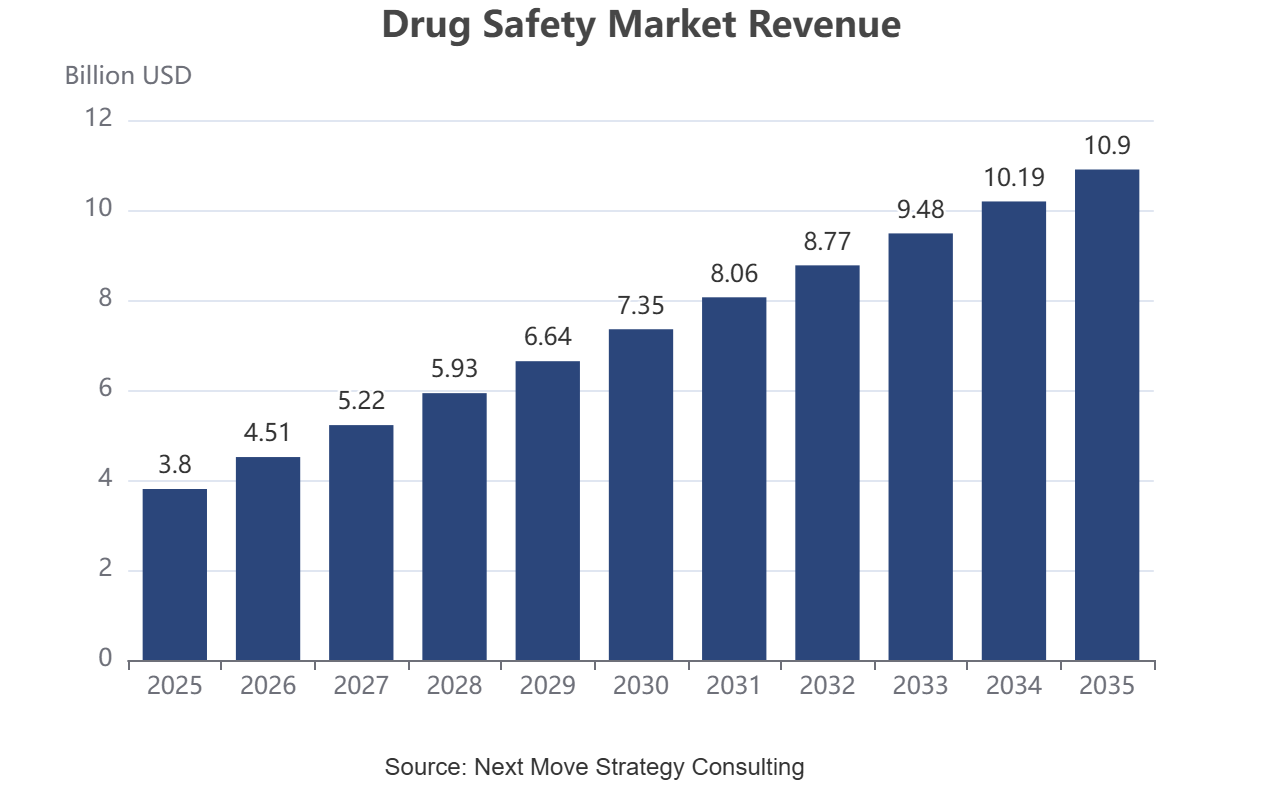
The global Drug Safety Market was valued at USD 3.8 billion in 2025 and is projected to reach USD 4.2 billion in 2026. Accelerating regulatory complexity, expanding pharmacovigilance obligations, and the sustained growth of clinical trial pipelines are projected to propel the market to USD 10.9 billion by 2035, advancing at a CAGR of 11.1% from 2026 to 2035. Key growth drivers include rising drug approval volumes, mandatory electronic Individual Case Safety Report (ICSR) submissions, expanding outsourcing of post-marketing surveillance, and rapid adoption of AI-powered signal detection platforms.
|
Parameters |
Details |
|
Market Size in 2025 |
USD 3.8 Billion |
|
Market Size in 2026 |
USD 4.2 Billion |
|
Revenue Forecast in 2035 |
USD 10.9 Billion |
|
Growth Rate |
CAGR of 11.1% from 2026 to 2035 |
|
Analysis Period |
2025–2035 |
|
Base Year Considered |
2025 |
|
Forecast Period |
2026–2035 |
|
Market Size Estimation |
USD Billion |
|
Companies Profiled |
20 |
|
Countries Covered |
33 |
|
Market Share |
Top 10 |
Drug Safety Market Overview
What Is the Drug Safety Market?
The Drug Safety Market encompasses the full spectrum of technology platforms, managed services, and consulting capabilities deployed to identify, evaluate, and report adverse drug reactions across the pharmaceutical and biotechnology product lifecycle. It spans clinical development through post-marketing surveillance, supporting sponsors, contract research organizations (CROs), and regulatory authorities in fulfilling pharmacovigilance obligations. NMSC's analysis indicates that the market includes safety database software, case management systems, signal detection platforms, aggregate reporting tools, and outsourced safety processing services delivered via SaaS, on-premise, and hybrid deployment models.
How Has the Drug Safety Market Evolved Structurally?
The Drug Safety Market has undergone three distinct transformation phases. The first phase, spanning the 1990s through 2010, focused on digitizing ICSR intake and standalone safety database deployment. The second phase (2010–2020) introduced cloud migration, modular case management platforms, and the global harmonization of ICSR formats under ICH E2B standards. Through NMSC's assessment, we found that the current phase is characterized by AI-native signal detection, automation of literature surveillance, and the emergence of end-to-end outsourced pharmacovigilance models as sponsors reduce internal safety infrastructure to lower operational cost and improve regulatory agility.
How Do Regulations Influence the Drug Safety Market?
Regulatory developments are the primary structural driver of demand in the Drug Safety Market. The European Medicines Agency's (EMA) mandatory EudraVigilance submission requirements, the U.S. Food and Drug Administration's (FDA) MedWatch and FAERS electronic submission mandates, and ICH E2E pharmacovigilance planning guidelines collectively compel sponsors to invest in compliant case management and reporting infrastructure. Based on our market evaluation, we noticed that the ICH E2B(R3) standard for electronic ICSR transmission, now enforced by regulators in the EU, U.S., Japan, and Canada, has substantially increased demand for modern, interoperable safety database platforms capable of generating R3-compliant XML transmissions.
How Is Technology Adoption Expanding Across the Drug Safety Market?
Technology adoption in the Drug Safety Market is accelerating as sponsors and CROs seek to replace legacy on-premise safety databases with SaaS-delivered, AI-augmented platforms. Natural language processing (NLP) for automated literature screening, machine learning-based duplicate detection, and robotic process automation (RPA) for ICSR intake are now standard capabilities demanded by enterprise buyers. From our research, we found that cloud-native pharmacovigilance platforms reduce per-case processing costs by automating triage and data entry workflows, enabling organizations to manage growing case volumes without proportional increases in headcount.
Key Takeaways
|
Key Takeaways |
|
By commercial model, Subscription-based pricing held the largest share at USD 1.60 billion in 2025 in the Drug Safety Market, driven by widespread adoption of cloud-based pharmacovigilance platforms, safety databases, and case management solutions. Meanwhile, FTE-Based services are projected to be the fastest-growing model, expanding at a CAGR of 11.9% through 2035 as outsourcing of pharmacovigilance operations accelerates. |
|
By offering type, Drug Safety Software accounted for the largest revenue share at USD 1.80 billion in 2025, supported by mandatory regulatory requirements for validated safety databases and case management systems. Consulting and Implementation Services are expected to register the highest growth rate at 12.2% CAGR, driven by system modernization, validation projects, and regulatory compliance initiatives. |
|
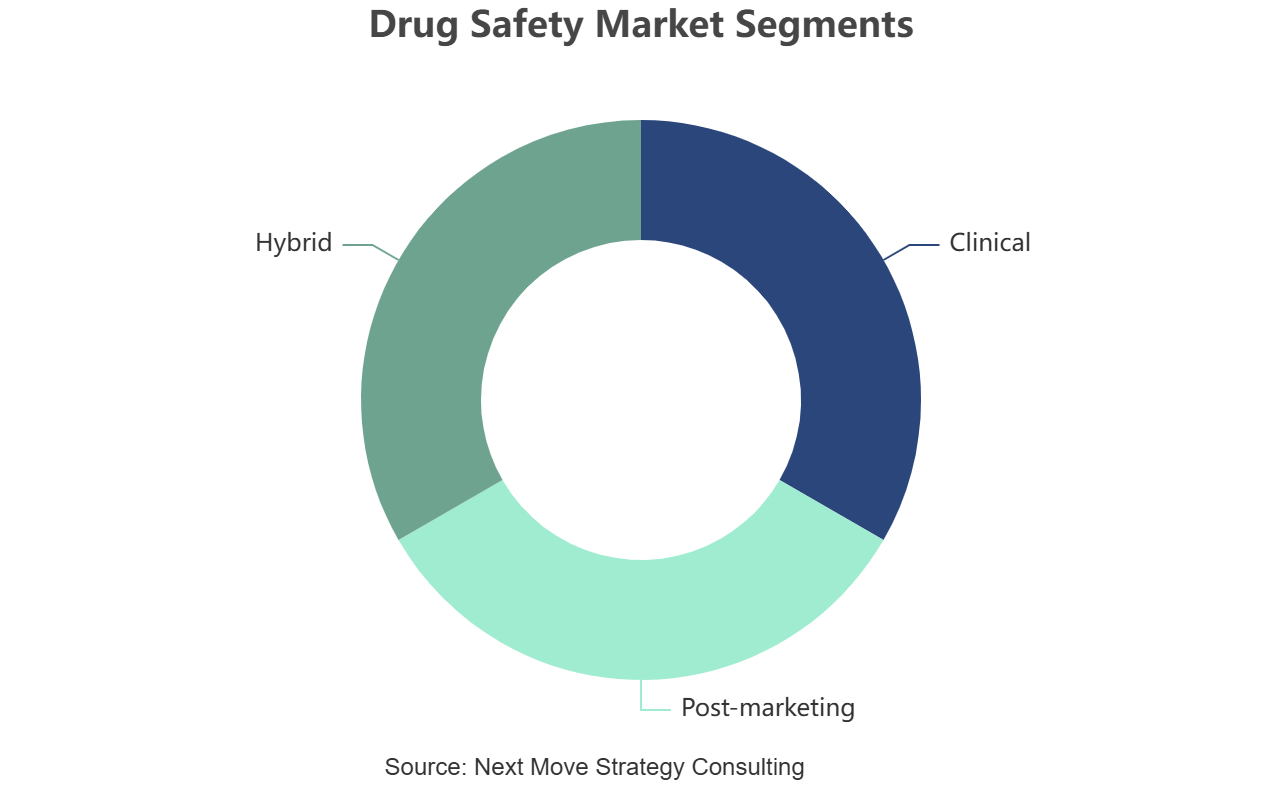
By lifecycle stage, the Post-marketing segment led the market with USD 2.30 billion in 2025 and is forecast to reach USD 6.14 billion by 2035, reflecting continuous adverse event monitoring obligations for approved products. Hybrid pharmacovigilance models are emerging as the fastest-growing segment, advancing at a 13.1% CAGR as pharmaceutical companies seek unified safety infrastructures across clinical and commercial operations. |
|
By buyer type, Sponsors (pharmaceutical, biotechnology, and medical device companies) held the largest market share at USD 2.00 billion in 2025, owing to their direct regulatory responsibility for pharmacovigilance compliance. CROs represent the fastest-growing buyer category, projected to expand at a 12.4% CAGR through 2035 as outsourcing demand continues to increase. |
|
By deployment mode, SaaS solutions dominated the Drug Safety Market with USD 2.09 billion in 2025, accounting for approximately 55% of total market revenue due to lower ownership costs and streamlined compliance updates. Hybrid deployment models are expected to witness the highest growth at a 14.8% CAGR, reflecting the industry's transition toward cloud-enabled yet compliance-sensitive infrastructures. |
|
North America held the largest regional share at USD 1.70 billion in 2025 and is projected to reach USD 4.50 billion by 2035 at a 10.2% CAGR, supported by strong FDA regulations, high pharmaceutical R&D spending, and extensive adoption of advanced pharmacovigilance technologies. |
|
Asia-Pacific is the fastest-growing regional market in the Drug Safety Market, expanding at a 13.5% CAGR through 2035, driven by regulatory harmonization, increasing clinical trial activity, expanding CRO operations, and rising pharmaceutical manufacturing investments across China, India, and Southeast Asia. |
|
The United States remains the largest national market, representing over 70% of North American revenue in 2025, supported by stringent FDA pharmacovigilance requirements, a high concentration of global pharmaceutical companies, and strong adoption of AI-enabled drug safety platforms. |
|
India is the fastest-growing country-level market within Asia-Pacific, projected to expand at a 15.2% CAGR through 2035, fueled by the expansion of the Pharmacovigilance Programme of India (PvPI), rapid growth of generic pharmaceutical exports, and increasing investment in outsourced pharmacovigilance service delivery centers. |
Key Emerging Trends in the Drug Safety Market
How Is AI-Powered Signal Detection Transforming the Drug Safety Market?
Artificial intelligence and machine learning are fundamentally reshaping signal detection capabilities within the Drug Safety Market. Algorithms based on disproportionality analysis, Bayesian data mining, and NLP-driven case narrative review are enabling safety teams to process higher case volumes with greater precision and reduced false-positive rates. Based on NMSC's research, we found that AI-native platforms such as those offered by IQVIA and ArisGlobal are integrating unsupervised learning models that surface statistically unexpected adverse event clusters across pharmacovigilance databases, allowing safety physicians to focus their review time on genuinely novel signals.
What Role Is SaaS Deployment Playing in Modernizing the Drug Safety Market?
Cloud-native SaaS platforms are displacing legacy on-premise safety database installations as the dominant deployment architecture in the Drug Safety Market. SaaS models eliminate the high total cost of infrastructure ownership, accelerate regulatory updates, and provide global multi-site access that supports distributed pharmacovigilance operations. From our market assessment, we observed that Veeva Vault Safety and Oracle Argus Safety Cloud have driven accelerated migration among mid-size and large pharmaceutical sponsors who require validated, 21 CFR Part 11-compliant environments without maintaining dedicated IT infrastructure.
How Is End-to-End Pharmacovigilance Outsourcing Reshaping the Drug Safety Market?
The Drug Safety Market is experiencing a structural shift toward comprehensive outsourcing models where sponsors transfer complete pharmacovigilance program management to specialist service providers. This trend extends beyond traditional ICSR processing to encompass benefit-risk management, signal oversight, aggregate report authoring, and regulatory authority interaction. NMSC's analysis indicates that multinational pharmaceutical companies are selecting integrated service providers capable of managing global submissions across ICH, EU, and FDA regulatory frameworks, creating demand for companies with both technology platform capabilities and medically qualified safety oversight teams.
How Is the ICH E2B(R3) Harmonization Initiative Driving Platform Modernization in the Drug Safety Market?
The global enforcement of ICH E2B(R3) electronic ICSR transmission standards is compelling every Drug Safety Market participant to upgrade or replace legacy safety database systems incapable of generating R3-compliant XML outputs. Regulatory authorities including the EMA, FDA, Health Canada, and Japan's PMDA have mandated R3 compliance, creating a structured replacement cycle within the installed base of pharmacovigilance software. Our findings suggest that this regulatory deadline-driven modernization wave has accelerated SaaS platform adoption, with vendors offering pre-validated E2B(R3) submission modules as a core product differentiator.
What Are the Key Market Drivers, Breakthroughs, and Investment Opportunities that Will Shape the Drug Safety Market in the Next Decade?
|
Drivers / Trends / Restraints |
(+/-) % Impact on CAGR Forecast |
Geographic Relevance |
Impact Timeline |
|
Rising Drug Approval Volumes |
+1.8% |
Global (led by North America, Europe) |
2025–2030 |
|
Mandatory Electronic ICSR Submission |
+1.5% |
EU, U.S., Japan, Canada |
2025–2028 |
|
Pharmacovigilance Outsourcing Trend |
+1.3% |
North America, Europe, APAC |
2025–2035 |
|
AI-Native Signal Detection Adoption |
+1.2% |
Global |
2026–2035 |
|
ICH E2B(R3) Enforcement Cycle |
+0.9% |
EU, U.S., Japan, Canada, APAC |
2025–2028 |
|
Literature Surveillance Automation |
+0.8% |
Global |
2026–2035 |
|
High Implementation and Validation Costs |
-1.1% |
SMB, Emerging Markets |
2025–2030 |
|
Shortage of Medically Qualified PV Professionals |
-0.8% |
All regions |
Ongoing |
|
Real-World Evidence Integration Opportunity |
+1.4% |
North America, Europe |
2026–2035 |
|
Emerging Market Regulatory Harmonization |
+1.1% |
APAC, Latin America, MEA |
2026–2035 |
What Are the Growth Drivers of the Drug Safety Market?
How Is the Global Expansion of Drug Approval Volumes Driving the Drug Safety Market?
Accelerating new molecular entity approvals and biosimilar market entries are creating structural long-term demand in the Drug Safety Market. Every approved product requires a dedicated pharmacovigilance system throughout its commercial lifecycle, generating sustained ICSR processing, signal detection, and aggregate reporting workloads. Based on NMSC's research, we found that the U.S. FDA's Center for Drug Evaluation and Research (CDER) approved 50 novel drugs in 2023, one of the highest annual approval volumes on record, and the European Medicines Agency granted 77 new marketing authorizations in 2023. Each new authorization initiates mandatory post-approval pharmacovigilance obligations, creating durable multi-year revenue for safety platform vendors and managed service providers within the Drug Safety Market.
How Do Mandatory Electronic ICSR Submission Requirements Fuel Drug Safety Market Growth?
Regulatory mandates for electronic Individual Case Safety Report submission are a direct and measurable demand driver for the Drug Safety Market. The FDA's requirement for Electronic Safety Reporting under 21 CFR Parts 310, 312, and 314 obligates all IND and NDA holders to submit ICSRs electronically via the FDA Electronic Submissions Gateway. The EMA's EudraVigilance system similarly requires marketing authorization holders to submit all ICSRs electronically in E2B(R3) format. Our assessment indicates that these mandatory digital submission requirements make validated safety database software and electronic gateway connectivity non-negotiable investments for any organization holding regulatory product approvals, underpinning baseline demand across the Drug Safety Market ecosystem.
How Is the Growing Trend Toward Pharmacovigilance Outsourcing Expanding the Drug Safety Market?
The pharmaceutical industry's sustained shift toward variable-cost outsourcing models is expanding the addressable market for managed services within the Drug Safety Market. Small and mid-size biotechnology companies increasingly prefer to outsource complete pharmacovigilance programs to specialist service providers rather than build internal safety departments. Based on our market evaluation, we noticed that large pharmaceutical companies are also rationalizing internal safety headcount by outsourcing high-volume ICSR processing to offshore delivery centers, retaining only medical oversight and strategy functions in-house. This structural trend is driving CRO and specialist pharmacovigilance service providers to scale their Drug Safety Market operations significantly.
What Are the Growth Inhibitors of the Drug Safety Market?
How Do High Validation and Implementation Costs Constrain Drug Safety Market Penetration?
The implementation of regulated pharmacovigilance platforms requires formal computer system validation (CSV) under 21 CFR Part 11 and EU Annex 11, creating substantial upfront cost and timeline barriers. Validation activities include Installation Qualification (IQ), Operational Qualification (OQ), and Performance Qualification (PQ) documentation, requiring significant resource investment from both the vendor and the sponsor organization. Through our market assessment, we observed that smaller biotechnology companies with limited clinical operations budgets frequently delay pharmacovigilance system investments, relying on manual processes or minimal viable configurations until regulatory timelines compel formal system deployment.
How Does the Shortage of Medically Qualified Pharmacovigilance Professionals Limit Drug Safety Market Growth?
The sustained global shortage of qualified pharmacovigilance physicians and safety scientists constrains capacity growth across the Drug Safety Market, particularly within managed services where medically qualified case review represents a non-automatable workflow bottleneck. The World Health Organization's Uppsala Monitoring Centre has documented the widening gap between pharmacovigilance expertise demand and available qualified workforce in national pharmacovigilance centers globally. Our findings suggest that while automation addresses data entry and triage workflows, regulatory authorities require medically qualified oversight for ICSR causality assessment and signal evaluation, maintaining a structural human capital dependency that limits how rapidly managed service capacity can scale.
What Are the Growth Opportunities in the Drug Safety Market?
How Does Real-World Evidence Integration Create a Structural Opportunity in the Drug Safety Market?
The integration of real-world evidence (RWE) into pharmacovigilance workflows represents one of the most significant near-term expansion opportunities in the Drug Safety Market. The FDA's Real-World Evidence Program, established under the 21st Century Cures Act, has created a regulatory framework for using electronic health record data, claims data, and patient registries to supplement traditional spontaneous adverse event reporting. Through NMSC's assessment, we found that safety platforms capable of ingesting and analyzing structured RWE datasets alongside traditional ICSRs provide sponsors with earlier signal detection and richer benefit-risk characterization, creating premium pricing opportunities for advanced analytics modules within the Drug Safety Market ecosystem.
How Does Regulatory Harmonization in Emerging Markets Expand the Drug Safety Market?
Progressive adoption of ICH pharmacovigilance guidelines across emerging markets in Asia-Pacific, Latin America, and the Middle East and Africa is creating new commercial territories within the Drug Safety Market. India's CDSCO has published comprehensive pharmacovigilance guidelines aligned with ICH E2E standards. Brazil's ANVISA and South Africa's SAHPRA have similarly implemented mandatory ICSR submission requirements. Based on our analysis, we found that these regulatory developments compel local manufacturers and multinational subsidiaries operating in these markets to invest in validated safety database infrastructure, creating greenfield opportunities for Drug Safety Market platform vendors and managed service providers with regional delivery capabilities.
How Does the Growth of Cell and Gene Therapy Pipelines Create New Demand in the Drug Safety Market?
The rapid expansion of advanced therapy medicinal product (ATMP) clinical and commercial pipelines is creating specialized pharmacovigilance demands that existing drug safety infrastructure must adapt to address. Cell and gene therapies require long-term follow-up studies, often spanning 15 years, and generate complex adverse event profiles that require specialized causality assessment. NMSC's analysis indicates that the FDA's REMS program and EMA's Risk Management Plan requirements for ATMPs are generating demand for specialized case management configurations and aggregate reporting capabilities within the Drug Safety Market, positioning specialized service providers for premium-priced engagements with ATMP developers.
How Is the Drug Safety Market Segmented in This Report, and What Are the Key Insights from the Segmentation Analysis?
How Do Different Offering Types Define the Commercial Structure of the Drug Safety Market?
|
Offering Type |
2025 (USD Bn) |
2035 (USD Bn) |
CAGR (%) |
|
Drug Safety Software |
1.80 |
4.70 |
10.1% |
|
Managed Services |
1.40 |
4.30 |
12.1% |
|
Consulting and Implementation |
0.60 |
1.90 |
12.2% |
Based on our analysis of enterprise pharmacovigilance procurement patterns, the Drug Safety Market is structured across three primary offering types: Drug Safety Software, Managed Services, and Consulting and Implementation. Drug Safety Software remains the largest segment, anchored by safety database platforms, case management systems, signal analytics tools, and document workflow solutions, with Safety Database and Case Management sub-segments jointly representing the majority of software revenue. Managed Services is the fastest-growing offering category, driven by the expansion of ICSR processing outsourcing, literature surveillance programs, and aggregate reporting support. Consulting and Implementation rounds out the market, capturing demand from sponsors undertaking system migrations, validation engagements, and operating model redesigns in response to regulatory mandates.
How Does Lifecycle Stage Segmentation Reflect Pharmacovigilance Demand Distribution in the Drug Safety Market?
|
Lifecycle Stage |
2025 (USD Bn) |
2035 (USD Bn) |
CAGR (%) |
|
Clinical |
0.98 |
2.98 |
11.8% |
|
Post-marketing |
2.30 |
6.14 |
10.3% |
|
Hybrid |
0.52 |
1.78 |
13.1% |
The Drug Safety Market is segmented by lifecycle stage into Clinical, Post-marketing, and Hybrid categories, reflecting the distinct pharmacovigilance obligations at each phase of drug development and commercialization. Post-marketing dominates due to the long commercial lifespans of approved products requiring continuous ICSR reporting, periodic aggregate reporting, and ongoing signal surveillance. Hybrid configurations that span both clinical and commercial safety operations are the fastest-growing lifecycle segment at a 13.1% CAGR, driven by large pharmaceutical organizations seeking unified pharmacovigilance infrastructure. Clinical stage demand is growing steadily as global clinical trial activity expands, driven by rising investment in oncology, rare disease, and ATMP development.
Which Buyer Types Are Driving Purchasing Decisions Across the Drug Safety Market?
|
Buyer Type |
2025 (USD Bn) |
2035 (USD Bn) |
CAGR (%) |
|
Sponsor |
2.00 |
5.23 |
10.1% |
|
CRO |
0.93 |
2.97 |
12.4% |
|
Service Provider |
0.57 |
1.74 |
11.8% |
|
Public Sector |
0.30 |
0.96 |
12.3% |
Sponsor organizations, encompassing pharmaceutical, biotechnology, and medical device companies holding regulatory approvals or active IND filings, represent the largest buyer type within the Drug Safety Market due to their direct regulatory obligation to maintain pharmacovigilance systems. CROs are the fastest-growing buyer type as the industry-wide outsourcing wave compels CROs to invest in scalable pharmacovigilance infrastructure capable of supporting multiple concurrent sponsor programs. Specialist Service Providers, including standalone pharmacovigilance service companies, are growing steadily as demand for expert outsourced safety management accelerates. Public Sector buyers, comprising national medicines agencies and academic health institutions, represent a smaller but consistently growing market segment as pharmacovigilance modernization programs receive government funding.
How Does Deployment Mode Shape Technology Investment Patterns in the Drug Safety Market?
|
Deployment |
2025 (USD Bn) |
2035 (USD Bn) |
CAGR (%) |
|
SaaS |
2.09 |
6.00 |
11.1% |
|
On-premise |
1.14 |
2.63 |
8.7% |
|
Hybrid |
0.57 |
2.27 |
14.8% |
SaaS deployment leads the Drug Safety Market, representing approximately 55% of 2025 revenue, driven by lower total cost of ownership, automatic regulatory compliance updates, and support for geographically distributed safety teams. On-premise deployment remains relevant among large pharmaceutical companies that have made substantial prior investments in validated installations, but its share is declining as platform vendors withdraw on-premise support for legacy versions. Hybrid deployment is the fastest-growing mode, combining cloud-native case processing interfaces with on-premise safety databases for organizations managing large historical data archives while adopting modern workflow capabilities. The Hybrid approach is particularly prevalent among global pharmaceutical companies undergoing multi-year technology transformation programs within the Drug Safety Market.
How Do Commercial Models Reflect Evolving Buyer Preferences in the Drug Safety Market?
|
Commercial Model |
2025 (USD Bn) |
2035 (USD Bn) |
CAGR (%) |
|
Subscription |
1.60 |
4.36 |
10.5% |
|
FTE-Based |
1.14 |
3.49 |
11.9% |
|
Project-Based |
0.68 |
1.96 |
11.2% |
|
Usage-Based |
0.38 |
1.09 |
11.1% |
Subscription is the dominant commercial model in the Drug Safety Market, underpinning platform software licensing for safety databases, case management systems, and signal analytics tools. The FTE-Based model is the fastest-growing commercial structure, reflecting the rapid expansion of managed service outsourcing contracts where sponsors purchase blocks of medically qualified pharmacovigilance capacity from service providers at defined FTE rates. Project-Based commercial models remain prevalent for system implementation, validation, and consulting engagements where defined scope and fixed-price delivery are preferred. Usage-Based pricing is gaining traction in newer SaaS platforms offering consumption-aligned case volume or API transaction pricing within the Drug Safety Market.
Regional Outlook
Geographic Performance Snapshot
|
Region |
2025 (USD Bn) |
2035 (USD Bn) |
CAGR (%) |
Key Driver |
|
North America |
1.70 |
4.50 |
10.2% |
FDA mandates, sponsor concentration |
|
Europe |
1.20 |
3.38 |
10.9% |
EMA EudraVigilance, GDPR compliance |
|
Asia-Pacific |
0.62 |
2.19 |
13.5% |
ICH harmonization, CRO expansion |
|
Middle East & Africa |
0.14 |
0.43 |
11.9% |
SFDA, SAHPRA regulatory build-out |
|
Latin America |
0.14 |
0.40 |
11.1% |
ANVISA harmonization, clinical growth |
North America Drug Safety Market
North America is the global epicenter of the Drug Safety Market, accounting for USD 1.70 billion in 2025 and forecast to reach USD 4.50 billion by 2035 at a CAGR of 10.2%. The region benefits from the world's highest concentration of pharmaceutical and biotechnology sponsors, a mature pharmacovigilance regulatory framework enforced by the FDA, and a deep base of CRO and specialist pharmacovigilance service providers. Strong technology adoption, the prevalence of large-scale outsourcing contracts, and ongoing investment in AI-augmented safety platforms underpin North America's sustained regional leadership across the Drug Safety Market.
U.S. Drug Safety Market
Based on our analysis, we found that the United States represents over 70% of North American Drug Safety Market revenue and is the world's single largest national pharmacovigilance market. The FDA's comprehensive reporting requirements under 21 CFR Parts 310, 312, and 314, combined with the post-market safety obligations enforced by CDER and CBER, create a mandatory compliance-driven demand base. The U.S. benefits from the headquarters of leading pharmacovigilance platform vendors including IQVIA, Veeva Systems, Oracle, and Certara, as well as major managed service providers with large-scale safety delivery centers. FDA's technology modernization investments further support platform adoption across the U.S. Drug Safety Market.
Canada Drug Safety Market
From our assessment, Canada represents approximately 15% of North American Drug Safety Market revenue. Health Canada's Marketed Health Products Directorate enforces mandatory adverse drug reaction reporting obligations for all Canadian market authorization holders. Canadian pharmaceutical operations are closely integrated with U.S. drug development programs, with many Canadian sponsors using the same validated pharmacovigilance platforms deployed by their U.S. parent organizations. The adoption of ICH E2B(R3) transmission standards by Health Canada has driven platform modernization investment among domestic generic and branded pharmaceutical companies operating within the Canadian Drug Safety Market.
Mexico Drug Safety Market
Through our analysis, Mexico is a growing contributor to North American Drug Safety Market activity, driven by expanding generic pharmaceutical manufacturing, increasing clinical trial site activity, and COFEPRIS's progressive pharmacovigilance regulatory framework. Mexico's Pharmacovigilance Center under COFEPRIS has strengthened adverse event reporting requirements for both domestic manufacturers and multinational subsidiaries. The growth of Mexico-based CRO operations and pharmaceutical manufacturing clusters in Jalisco and Mexico City is generating incremental demand for pharmacovigilance software and managed safety services within the Mexican Drug Safety Market.
Europe Drug Safety Market
Europe is the second-largest region in the Drug Safety Market, contributing USD 1.20 billion in 2025 and forecast to reach USD 3.38 billion by 2035 at a CAGR of 10.9%. The EMA's EudraVigilance system, mandatory PSUR submission requirements, Risk Management Plan obligations, and the Good Pharmacovigilance Practice (GVP) guidelines collectively constitute the world's most comprehensive regulatory pharmacovigilance framework, creating structured demand for compliant safety platforms and services. GDPR compliance requirements for adverse event data processing further increase investment in governed, privacy-by-design drug safety infrastructure across European Drug Safety Market participants.
UK Drug Safety Market
According to evaluation, the United Kingdom represents approximately 20% of European Drug Safety Market revenue. Post-Brexit, the UK Medicines and Healthcare products Regulatory Agency (MHRA) has established its own Yellow Card pharmacovigilance system and maintains UK-GDPR-aligned adverse event data processing requirements. The MHRA's active enforcement of GVP guidelines and mandatory ICSR submission timelines preserves the high compliance investment level among UK pharmaceutical and biotechnology sponsors. London's concentration of global pharmaceutical headquarters and CRO regional offices underpins the UK's position as Europe's largest individual Drug Safety Market.
Germany Drug Safety Market
Based on our market evaluation, Germany is Europe's second-largest Drug Safety Market, driven by a world-class pharmaceutical manufacturing sector that includes Bayer, Boehringer Ingelheim, Merck KGaA, and a dense ecosystem of generic manufacturers. The Federal Institute for Drugs and Medical Devices (BfArM) enforces stringent pharmacovigilance requirements that align with EMA GVP guidelines. Germany's industrial buyer base prioritizes validated, on-premise or hybrid deployments that comply with BDSG data protection requirements, creating demand for locally operated safety infrastructure within the German Drug Safety Market.
France Drug Safety Market
Through our analysis, France is Europe's third-largest Drug Safety Market, distinguished by strong presence of Sanofi and a network of academic medical centers and government research institutions with active clinical trial programs. The French National Agency for Medicines and Health Products Safety (ANSM) enforces GVP-compliant pharmacovigilance obligations. France's public sector pharmacovigilance infrastructure, including its 31 Regional Pharmacovigilance Centers, creates demand for interoperable drug safety reporting platforms. The CNIL's active GDPR enforcement drives investment in privacy-compliant adverse event data management across the French Drug Safety Market.
Italy Drug Safety Market
From our assessment, Italy is a mid-tier European contributor to the Drug Safety Market, with significant pharmaceutical manufacturing activity from Novartis Italia, Recordati, and the Menarini Group generating post-marketing pharmacovigilance workloads. The Italian Medicines Agency (AIFA) administers the national pharmacovigilance network and enforces ICSR submission requirements for all Italian market authorization holders. Italy's PNRR investments in health technology modernization are creating incremental demand for digital pharmacovigilance platform upgrades across hospital networks and academic medical centers operating in the Italian Drug Safety Market.
Spain Drug Safety Market
Based on our evaluation, Spain demonstrates growing momentum in the Drug Safety Market, driven by the Spanish Agency of Medicines and Medical Devices (AEMPS) pharmacovigilance requirements and expanding pharmaceutical manufacturing activity. Spain's FEDRA adverse drug reaction reporting database is integrated with the EudraVigilance network, requiring compliant electronic submission capabilities from all Spanish market authorization holders. Growing clinical trial activity, particularly in oncology and rare disease, is generating incremental clinical-stage pharmacovigilance demand across the Spanish Drug Safety Market.
Sweden Drug Safety Market
Through our analysis, Sweden contributes to the European Drug Safety Market through AstraZeneca's pharmacovigilance operations headquartered in Gothenburg and a cluster of innovative biotechnology companies. The Medical Products Agency (MPA) enforces GVP-compliant pharmacovigilance obligations. Sweden's advanced digital health infrastructure and high technology adoption rate support rapid deployment of SaaS-based pharmacovigilance platforms among Swedish sponsors and CROs. The Swedish Drug Safety Market benefits from a skilled workforce in clinical data management and pharmacovigilance sciences.
Denmark Drug Safety Market
Based on NMSC's research, Denmark participates in the European Drug Safety Market through the pharmacovigilance operations of Novo Nordisk and Leo Pharma, both headquartered in Copenhagen, alongside a vibrant life sciences ecosystem. The Danish Medicines Agency enforces EMA-aligned GVP guidelines. Denmark's strong pharmaceutical export sector and active clinical research environment support sustained investment in validated pharmacovigilance software and services, maintaining steady Drug Safety Market demand proportional to Denmark's significant share of European pharmaceutical output.
Finland Drug Safety Market
From our assessment, Finland is a smaller but stable participant in the European Drug Safety Market, with Orion Corporation representing the primary domestic pharmaceutical anchor. The Finnish Medicines Agency (FIMEA) supervises pharmacovigilance compliance under GVP guidelines. Finland's digital health innovation ecosystem and advanced technology infrastructure support adoption of cloud-native pharmacovigilance platforms among Finnish biotechnology companies. Increasing clinical trial site activity in Helsinki and broader Nordic CRO operations contribute to growing Drug Safety Market demand in Finland.
Netherlands Drug Safety Market
According to evaluation, the Netherlands is a significant European Drug Safety Market contributor, benefiting from the EMA's headquarters location in Amsterdam and a dense concentration of pharmaceutical, biotech, and CRO organizations. The Medicines Evaluation Board (CBG-MEB) enforces stringent GVP-compliant pharmacovigilance requirements. The Netherlands' position as a European logistics and life sciences hub, combined with the Autoriteit Persoonsgegevens's active GDPR enforcement, drives sustained investment in compliant drug safety platforms and privacy-governed adverse event data management.
Asia-Pacific Drug Safety Market
Asia-Pacific is the fastest-growing major region in the Drug Safety Market at a CAGR of 13.5% from 2026 to 2035, with a 2025 market value of USD 0.62 billion projected to reach USD 2.19 billion by 2035. Regional growth is driven by Japan's PMDA regulatory modernization, China's NMPA pharmacovigilance strengthening, India's CDSCO compliance expansion, and progressive ICH guideline adoption across South Korea, Australia, and Southeast Asia. The rapid expansion of Asia-Pacific-based CRO capacity and generic pharmaceutical manufacturing is generating both clinical and post-marketing Drug Safety Market demand across the region.
China Drug Safety Market
Through our analysis, China is the largest Asia-Pacific contributor to the Drug Safety Market and one of the fastest-growing globally. The National Medical Products Administration (NMPA) has substantially strengthened pharmacovigilance regulations since 2017, implementing GVP guidelines aligned with international standards and mandating electronic ADR reporting through the National ADR Monitoring Network. China's domestic pharmaceutical sector, the world's largest by volume, generates enormous ICSR processing workloads for local manufacturers and multinational subsidiaries. Growing domestic biotechnology innovation is further increasing clinical-stage Drug Safety Market demand in China.
India Drug Safety Market
Based on our analysis, India is the fastest-growing national market in Asia-Pacific within the Drug Safety Market at a CAGR of 15.2%. The CDSCO's pharmacovigilance program, including the Pharmacovigilance Programme of India (PvPI), has expanded mandatory reporting obligations for all licensed manufacturers. India's position as the world's largest generic pharmaceutical exporter creates post-marketing Drug Safety Market demand across all regulated markets. The rapid growth of India-based CRO and pharmacovigilance service delivery centers in Hyderabad, Bengaluru, and Mumbai is establishing India as a global hub for outsourced safety operations.
Japan Drug Safety Market
From our assessment, Japan is a mature and stable contributor to the Drug Safety Market. The Pharmaceuticals and Medical Devices Agency (PMDA) enforces comprehensive pharmacovigilance requirements that are among the most detailed globally, including Japanese-language ICSR processing and local aggregate report formats. Japan's adoption of ICH E2B(R3) electronic submission standards is driving platform modernization among domestic pharmaceutical companies. NMSC's analysis indicates that Japan's aging population and high pharmaceutical consumption rate sustain strong post-marketing Drug Safety Market demand from domestic and multinational sponsors.
South Korea Drug Safety Market
Through our market assessment, South Korea contributes to the Asia-Pacific Drug Safety Market through its active pharmaceutical manufacturing sector and the growing global presence of Samsung Biologics, Celltrion, and domestic generic manufacturers. The Ministry of Food and Drug Safety (MFDS) enforces pharmacovigilance regulations aligned with ICH guidelines. South Korea's expanding clinical trial site capacity, particularly in oncology and biosimilars, is generating incremental clinical-stage safety demand. Investment in digital health infrastructure supports adoption of SaaS-based pharmacovigilance platforms across the South Korean Drug Safety Market.
Taiwan Drug Safety Market
Based on our market evaluation, Taiwan is a growing participant in the Asia-Pacific Drug Safety Market, anchored by domestic pharmaceutical manufacturing and contract manufacturing operations serving global markets. The Taiwan Food and Drug Administration (TFDA) administers pharmacovigilance regulations requiring adverse drug reaction reporting. Taiwan's active biosimilar development pipeline and medical device manufacturing ecosystem generate both clinical and post-marketing Drug Safety Market demand. Growing alignment with ICH pharmacovigilance standards is driving platform modernization investments among Taiwanese pharmaceutical companies.
Indonesia Drug Safety Market
From our assessment, Indonesia represents an emerging contributor to the Asia-Pacific Drug Safety Market. The National Agency of Drug and Food Control (BPOM) has progressively strengthened pharmacovigilance reporting requirements. Indonesia's large domestic pharmaceutical market and growing generic manufacturing sector are creating early-stage but expanding Drug Safety Market demand. The government's digital health transformation agenda, including the electronic health data reporting system, supports modernization of adverse event capture and reporting infrastructure across Indonesian pharmaceutical and healthcare institutions.
Vietnam Drug Safety Market
According to evaluation, Vietnam is an early-stage Drug Safety Market participant with growing demand driven by pharmaceutical manufacturing expansion and rising clinical trial site activity. The Drug Administration of Vietnam (DAV) enforces adverse drug reaction reporting obligations for domestic and multinational manufacturers. Vietnam's integration into global pharmaceutical supply chains and increasing clinical trial investment by multinational sponsors are generating early-stage demand for pharmacovigilance software and services, positioning Vietnam as a growing contributor to the regional Drug Safety Market over the forecast period.
Australia Drug Safety Market
Based on our analysis, Australia is a mature contributor to the Asia-Pacific Drug Safety Market, with the Therapeutic Goods Administration (TGA) enforcing comprehensive pharmacovigilance requirements under the Australian Pharmacovigilance Guidance. Australia's Consumer Data Right framework and the TGA's active collaboration with the OECD Heads of Medicines Agencies support advanced pharmacovigilance practice. Strong clinical trial activity and a sophisticated pharmaceutical ecosystem ensure sustained Drug Safety Market investment in Australia, with SaaS-based safety platforms achieving high adoption among Australian sponsors and CRO offices.
Philippines Drug Safety Market
Through our analysis, the Philippines is an emerging Drug Safety Market participant with the Food and Drug Administration (FDA Philippines) implementing progressive adverse drug reaction reporting requirements. Growing pharmaceutical manufacturing and clinical research site capacity, particularly in Metro Manila and Cebu, are generating incremental demand for pharmacovigilance services. The Philippines' participation in ASEAN harmonized pharmaceutical regulations supports alignment with ICH standards, creating conditions for expanded Drug Safety Market demand across the Philippine pharmaceutical and healthcare sector.
Malaysia Drug Safety Market
From our assessment, Malaysia contributes to the Asia-Pacific Drug Safety Market through its pharmaceutical manufacturing sector and National Centre for Adverse Drug Reactions Monitoring. The National Pharmaceutical Regulatory Agency (NPRA) administers pharmacovigilance requirements aligned with ASEAN guidelines. Malaysia's healthcare digitization investments and strong life sciences manufacturing presence, particularly in Penang and Selangor, support growing adoption of pharmacovigilance software among local manufacturers and multinational production facilities in the Malaysian Drug Safety Market.
Middle East & Africa Drug Safety Market
The Middle East & Africa region represents USD 0.14 billion in the Drug Safety Market in 2025, forecast to reach USD 0.43 billion by 2035 at a CAGR of 11.9%. Saudi Arabia's Saudi Food and Drug Authority (SFDA) and the UAE's Ministry of Health and Prevention are advancing pharmacovigilance regulatory frameworks as part of national healthcare transformation programs. South Africa's SAHPRA and Egypt's Egyptian Drug Authority are similarly strengthening adverse event reporting mandates, creating expanding demand for drug safety infrastructure across the MEA Drug Safety Market.
Saudi Arabia Drug Safety Market
Based on our analysis, Saudi Arabia is the largest MEA contributor to the Drug Safety Market, driven by the SFDA's comprehensive pharmacovigilance program. Saudi Vision 2030 healthcare transformation investments are accelerating digitization of pharmacovigilance reporting and adverse event data management. The National Pharmacovigilance Center enforces mandatory ICSR reporting for all licensed pharmaceutical products. Growing domestic pharmaceutical manufacturing, hospital sector expansion, and clinical research activity are creating sustained demand for validated drug safety platforms and managed services within the Saudi Drug Safety Market.
UAE Drug Safety Market
From our assessment, the UAE is a growing Drug Safety Market participant, positioned as the GCC region's pharmaceutical and healthcare hub. The Ministry of Health and Prevention and Dubai Health Authority administer pharmacovigilance reporting requirements. Dubai's DAFZA and Abu Dhabi's life sciences zones host a growing concentration of pharmaceutical regional headquarters and CRO offices, generating demand for pharmacovigilance platform subscriptions and managed services. The UAE's digital health strategy and strong healthcare infrastructure investment support rapid Drug Safety Market technology adoption.
Egypt Drug Safety Market
Through our analysis, Egypt represents the largest North Africa contributor to the Drug Safety Market. The Egyptian Drug Authority administers adverse drug reaction monitoring requirements for Egypt's large domestic pharmaceutical market. Egypt's position as Africa's largest pharmaceutical manufacturer, combined with growing clinical trial site activity in Cairo and Alexandria, generates both post-marketing and clinical-stage pharmacovigilance demand. Regulatory modernization aligned with WHO pharmacovigilance standards is driving digital drug safety platform adoption across the Egyptian market.
Israel Drug Safety Market
Based on NMSC's research, Israel is a technologically advanced Drug Safety Market participant with a world-class pharmaceutical and biotechnology sector. Teva Pharmaceutical Industries, headquartered in Tel Aviv, represents the world's largest generic drug manufacturer and a major global pharmacovigilance platform user. The Israeli Ministry of Health enforces stringent pharmacovigilance requirements. Israel's strong medical informatics and AI research ecosystem is influencing the development of innovative safety signal detection approaches deployed within global Drug Safety Market platforms.
Turkey Drug Safety Market
From our assessment, Turkey is a growing MEA Drug Safety Market participant with the Turkish Medicines and Medical Devices Agency (TMMDA) enforcing pharmacovigilance regulations. Turkey's large domestic pharmaceutical manufacturing sector, serving both domestic and export markets, generates significant post-marketing safety workloads. EU candidacy alignment with European pharmacovigilance standards has driven platform modernization among Turkish pharmaceutical companies. Growing clinical trial activity positions Turkey as an expanding market for clinical-stage drug safety services within the MEA region.
Nigeria Drug Safety Market
According to evaluation, Nigeria is an early-stage Drug Safety Market participant with NAFDAC administering national pharmacovigilance under the WHO Programme for International Drug Monitoring. Nigeria's pharmaceutical sector is expanding through domestic manufacturing investment, and growing awareness of adverse event reporting obligations is creating early demand for pharmacovigilance services. The Nigeria Data Protection Bureau's regulatory framework influences adverse event data governance requirements, contributing to the incremental modernization of drug safety reporting infrastructure across the Nigerian market.
South Africa Drug Safety Market
Based on our market evaluation, South Africa is the most advanced Sub-Saharan Drug Safety Market participant. The South African Health Products Regulatory Authority (SAHPRA) enforces comprehensive pharmacovigilance requirements and participates in WHO global pharmacovigilance networks. South Africa's active clinical trial sector and domestic pharmaceutical manufacturing base generate consistent Drug Safety Market demand. POPIA compliance requirements for adverse event personal data management are driving investment in privacy-compliant pharmacovigilance data governance across South African sponsors and manufacturers.
Latin America Drug Safety Market
Latin America represents USD 0.14 billion in the Drug Safety Market in 2025 and is projected to reach USD 0.40 billion by 2035 at a CAGR of 11.1%. Brazil's ANVISA, Argentina's ANMAT, and Colombia's INVIMA are all strengthening pharmacovigilance reporting requirements and progressively adopting ICH-aligned standards. The region's growing clinical trial activity, expanding generic pharmaceutical manufacturing, and increasing multinational pharmaceutical commercial operations are generating demand for drug safety platforms and outsourced safety services across the Latin American Drug Safety Market.
Brazil Drug Safety Market
Based on our analysis, Brazil is the largest Latin American contributor to the Drug Safety Market. ANVISA's pharmacovigilance regulations mandate adverse event reporting for all regulated pharmaceutical products. Brazil's LGPD (Lei Geral de Proteção de Dados) creates compliance requirements for adverse event personal data processing, aligning Brazil with GDPR-equivalent data governance standards. Brazil's position as Latin America's largest clinical trial market and its growing domestic biosimilar sector generate increasing demand for both clinical and post-marketing drug safety infrastructure.
Argentina Drug Safety Market
Through our analysis, Argentina is the second-largest Latin American Drug Safety Market participant. ANMAT administers pharmacovigilance reporting requirements for Argentine market authorization holders. Argentina's active pharmaceutical manufacturing industry and growing biotechnology sector generate post-marketing safety workloads. The country's integration into international clinical trial networks is creating demand for ICH-aligned safety database solutions. ANMAT's progressive adoption of ICH pharmacovigilance standards supports platform standardization across the Argentine Drug Safety Market.
Chile Drug Safety Market
From our assessment, Chile is a stable Latin American Drug Safety Market contributor with the Institute of Public Health (ISP) enforcing adverse drug reaction reporting requirements. Chile's relatively advanced regulatory framework and strong healthcare infrastructure support adoption of modern pharmacovigilance platforms. Growing clinical trial activity and increasing pharmaceutical market activity from multinational and domestic companies are generating expanding demand for drug safety software and services. Chile's digital health modernization agenda supports SaaS-based pharmacovigilance adoption across the Chilean Drug Safety Market.
Colombia Drug Safety Market
Based on our analysis, Colombia is a growing Latin American Drug Safety Market participant. INVIMA's National Pharmacovigilance Program mandates adverse event reporting for licensed pharmaceutical products. Colombia's pharmaceutical sector is expanding through domestic manufacturing growth and increasing participation in multinational clinical trial programs. INVIMA's progressive alignment with ICH and Pan American Health Organization pharmacovigilance standards is driving platform modernization and expanding the addressable opportunity within the Colombian Drug Safety Market.
Ecosystem Analysis of the Drug Safety Market
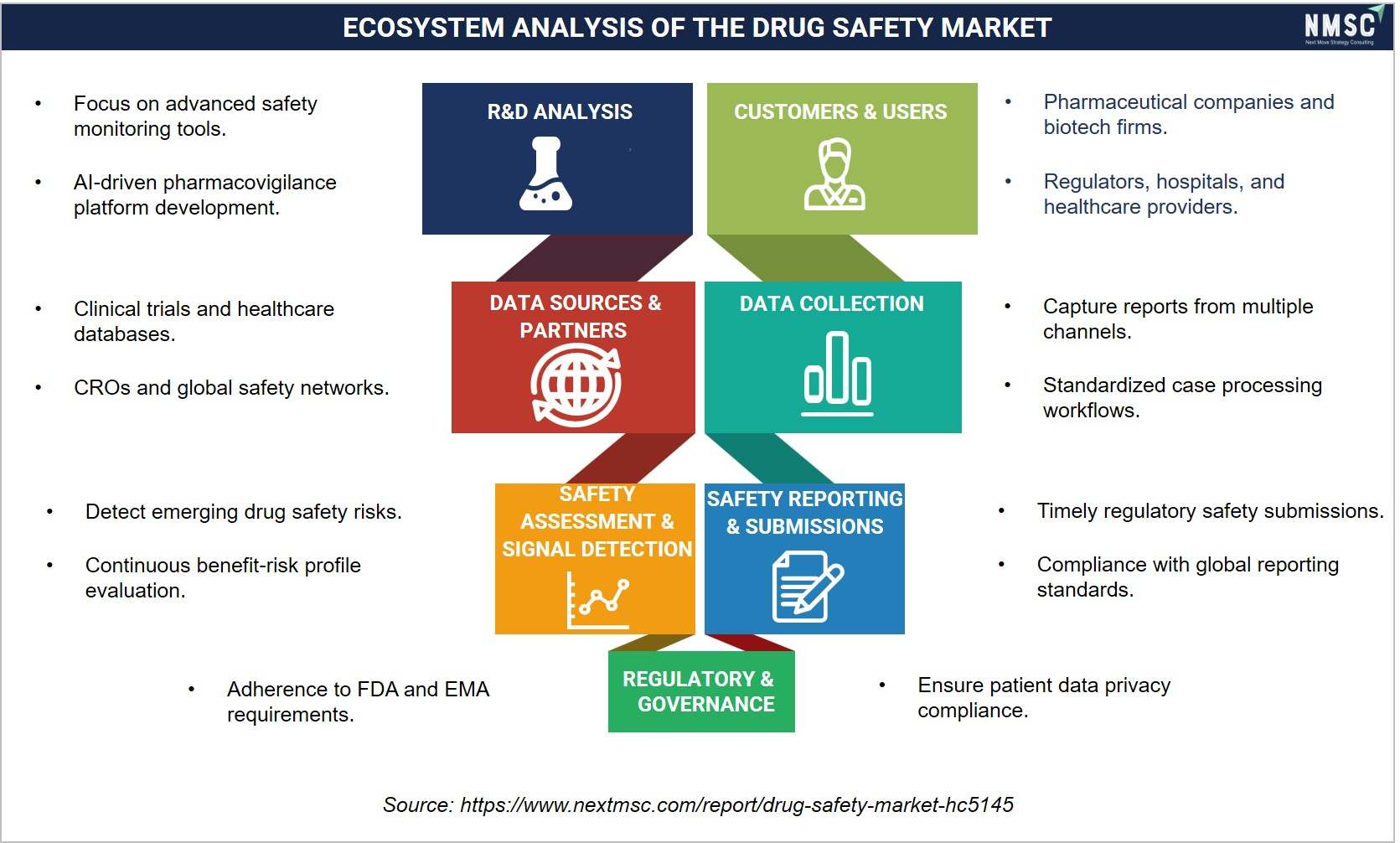
The infographic maps the ecosystem of the Drug Safety Market. It highlights R&D activities and data generation from clinical and real-world sources, data collection from pharmaceutical companies, healthcare providers, and regulatory databases, safety assessment and signal detection to identify potential adverse events, safety reporting and regulatory submissions to ensure compliance with global standards, and regulatory and governance frameworks that provide oversight, supporting patient safety, risk management, and informed decision-making across the pharmaceutical and healthcare industries.
Competitive Landscape
|
Competitive Dynamics & M&A Landscape |
|
|
Market Structure |
Moderately consolidated; top 5 players hold approximately 55–60% of total Drug Safety Market revenue. The software segment is dominated by Oracle (Argus Safety), IQVIA (Axway/LifeSphere), Veeva (Vault Safety), and ArisGlobal (LifeSphere), while managed services is led by IQVIA, Syneos Health, Parexel, and ICON plc. |
|
Innovation Focus |
AI-native signal detection, NLP-powered literature surveillance automation, cloud-native SaaS transformation of legacy safety databases, E2B(R3) compliance modernization, and real-world evidence integration into pharmacovigilance workflows are the primary innovation battlegrounds within the Drug Safety Market. |
|
M&A Activity |
IQVIA's strategic expansion of its Lifecycle Safety and pharmacovigilance platform capabilities, Veeva’s strategic SaaS platform expansion, ArisGlobal’s product portfolio consolidation, and Certara’s biosimulation-to-safety analytics integration represent key M&A and strategic positioning activities shaping Drug Safety Market competitive dynamics. |
How Do Companies Compete in the Drug Safety Market?
Competition in the Drug Safety Market is driven by regulatory compliance depth, technology modernization capability, geographic delivery scale, and the breadth of integrated service offerings. Leading vendors compete across four primary dimensions: platform functionality and validation status, managed service delivery capacity and medical expertise depth, global regulatory submission capabilities spanning FDA, EMA, PMDA, and emerging market authorities, and total cost of ownership for multi-year technology and service contracts. Our analysis shows that the competitive landscape increasingly favors integrated players capable of delivering both technology platforms and managed pharmacovigilance services under a single contractual framework.
Which Kind of Companies Dominate the Drug Safety Market?
The Drug Safety Market is dominated by three categories of organizations. First, full-service CROs with integrated pharmacovigilance divisions, including IQVIA, Parexel, ICON, and Syneos Health, which leverage their clinical development relationships to extend into long-term safety service contracts. Second, specialized pharmacovigilance software vendors, led by Oracle, Veeva Systems, and ArisGlobal, which provide validated safety database platforms under multi-year enterprise licenses. Third, technology services and consulting firms, including Cognizant, Wipro, TCS, and Accenture, which deliver implementation, managed service, and business process outsourcing capabilities for pharmacovigilance operations at scale.
AI-Native Differentiation and Open Standards Drive Market Success in the Drug Safety Market
NMSC's analysis indicates that vendors achieving the highest growth rates within the Drug Safety Market are those that have successfully embedded AI capabilities within validated pharmacovigilance workflows while maintaining full regulatory compliance. Signal detection algorithms, automated literature screening, NLP-based case narrative generation, and intelligent duplicate detection are becoming minimum competitive requirements for premium-tier software platforms. Open standards compliance, including ICH E2B(R3), HL7 FHIR for RWE integration, and MedDRA coding automation, further differentiates leading vendors from legacy installed-base competitors in the Drug Safety Market.
Market Players to Opt for Merger and Acquisition Strategies to Expand Their Presence in the Drug Safety Market
M&A activity in the Drug Safety Market is accelerating as large CROs and technology firms seek to acquire specialized pharmacovigilance capabilities, expand geographic delivery footprints, and consolidate fragmented point-solution vendors. Acquisitions targeting AI signal detection startups, specialized literature surveillance platforms, and regional pharmacovigilance service providers represent the primary inorganic growth strategy. Based on NMSC's research, we found that private equity-backed consolidation among standalone pharmacovigilance service providers is creating larger, more scalable managed service competitors that challenge established CRO drug safety divisions in competitive bid processes.
Who Are the Key Market Players in the Drug Safety Market?
-
IQVIA Holdings Inc.
-
Thermo Fisher Scientific Inc.
-
Oracle Corporation
-
ICON plc
-
Parexel International Corporation
-
Syneos Health, Inc.
-
Laboratory Corporation of America Holdings
-
Veeva Systems Inc.
-
ArisGlobal LLC
-
Cognizant Technology Solutions Corporation
-
Accenture plc
-
Wipro Limited
-
Tata Consultancy Services Limited
-
Genpact Limited
-
United BioSource LLC
-
Ergomed plc
-
Certara, Inc.
-
SAS Institute Inc.
-
Qinecsa Holdings Limited
-
Ennov SAS
What Are the Latest Developments in the Drug Safety Market?
|
Date |
Event |
|
May 2026 |
Parexel launched ParexelAI, and said it is already delivering a 20% reduction in safety literature screening and pharmacovigilance case processing. Parexel also noted that, through its recent acquisition of Vitrana, it can now offer a more integrated pharmacovigilance platform to accelerate patient safety and PV processes. |
|
Apr 2026 |
Qinecsa released HaloPV 6.2 to strengthen global pharmacovigilance compliance and platform stability. The update adds improvements across case intake and processing, aggregate reporting, terminology management, and regulatory submissions, including FDA E2B(R3) readiness. |
|
Dec 2025 |
Ennov launched Ennov 11.0, describing it as a smarter platform for Regulatory, Quality, Clinical, and Pharmacovigilance teams with built-in AI. The release was framed as a productivity upgrade for regulated life sciences workflows, including safety-related work. |
What Are the Investment Opportunities in the Drug Safety Market?
Capital Inflows and Private Equity Activity
The Drug Safety Market is attracting increasing private equity and strategic investment driven by its non-cyclical regulatory compliance demand, recurring managed service revenue models, and favorable industry outsourcing tailwinds. Permira’s USD 886 million acquisition of Ergomed in 2023 and multiple PE-backed consolidations among standalone pharmacovigilance service providers reflect the sector’s investment attractiveness. Our findings suggest that investors are particularly focused on platforms combining validated pharmacovigilance software with managed service delivery capabilities, as integrated offerings generate higher switching costs, longer contract durations, and superior revenue visibility compared to point-solution providers.
Infrastructure Investments in Delivery Center Expansion
Major managed service providers are investing in delivery center infrastructure expansion across India, Eastern Europe, and Latin America to build scalable pharmacovigilance capacity at lower per-FTE cost. These investments are driven by sponsor demand for both cost efficiency and geographic redundancy in safety operations. From our market assessment, we observed that IQVIA's Bengaluru expansion and multiple mid-tier provider build-outs in Poland, Romania, and Mexico reflect a structural transition toward offshore and nearshore delivery models. This capacity expansion creates long-term infrastructure assets that support recurring revenue growth within the Drug Safety Market.
ESG Considerations in Drug Safety Investment
ESG-aligned investment considerations are increasingly relevant to Drug Safety Market participants, as pharmacovigilance infrastructure directly enables patient safety monitoring and transparent benefit-risk management. Pharmaceutical companies with robust drug safety programs demonstrate governance quality that institutional investors and ESG-rating agencies assess positively. Our analysis shows that the integration of real-world evidence platforms into pharmacovigilance workflows also contributes to health equity objectives by broadening safety surveillance beyond clinical trial populations to reflect real-world patient diversity, creating alignment between drug safety investment and ESG patient outcome metrics.
Digital Transformation and AI Platform Investment
AI and digital transformation investment within the Drug Safety Market is creating high-return opportunities for vendors capable of delivering measurable cost reduction, capacity expansion, and regulatory compliance improvement simultaneously. NLP-powered literature surveillance automation reduces per-article screening costs by an estimated 70–80% compared to manual review, while machine learning-based ICSR triage reduces case-to-entry processing times. NMSC's analysis indicates that vendors with validated, regulatory-authority-accepted AI modules command 15–25% pricing premiums over standard platform licenses, creating attractive margin expansion pathways as AI capability adoption accelerates across the Drug Safety Market ecosystem.
Key Benefits for Stakeholders
For Pharmaceutical and Biotechnology Companies
Pharmaceutical and biotechnology companies gain comprehensive, vendor-neutral insights into the Drug Safety Market, including quantitative market sizing across pharmacovigilance services, software platforms, reporting solutions, and outsourcing models. This intelligence supports safety strategy development, regulatory compliance planning, and long-term investment decisions related to adverse event monitoring and risk management. Competitive landscape analysis enables organizations to benchmark service providers, evaluate technology adoption strategies, and optimize pharmacovigilance operations while maintaining compliance with evolving global safety regulations.
For Investors and Financial Analysts
Investors and financial analysts receive a structured, data-driven assessment of the Drug Safety Market’s growth trajectory, competitive environment, merger and acquisition activity, and segment-level revenue forecasts through 2035. CAGR analysis across service categories, end users, deployment models, and geographic regions supports informed valuation modeling and investment decision-making. Detailed profiles of leading market participants, combined with tracking of regulatory developments, strategic partnerships, and technology innovations, provide valuable insights for identifying high-growth opportunities, emerging market leaders, and potential acquisition targets within the global drug safety ecosystem.
For Drug Safety Service Providers and Technology Vendors
Drug safety service providers, pharmacovigilance outsourcing firms, and software vendors gain actionable intelligence on emerging opportunities, competitive positioning, and high-growth segments within the Drug Safety Market. Service-level analysis highlights demand trends in areas such as AI-enabled signal detection, real-world evidence integration, automation of adverse event reporting, and cloud-based pharmacovigilance platforms. Regional market assessments identify expansion opportunities while providing context on regulatory maturity and healthcare infrastructure development. Insights into customer requirements, pricing models, and procurement trends help vendors refine go-to-market strategies, strengthen product offerings, and optimize sales channels across pharmaceutical, biotechnology, and contract research organization (CRO) customers.
For Regulatory Authorities and Public Health Organizations
Regulatory agencies and public health organizations gain a structured analysis of how evolving pharmacovigilance requirements, patient safety initiatives, and global regulatory frameworks—including FDA pharmacovigilance guidelines, EMA Good Pharmacovigilance Practices (GVP), ICH standards, and regional drug safety regulations—are shaping the Drug Safety Market. Country-level and regional insights provide policymakers with evidence-based perspectives on the effectiveness of safety monitoring systems, adverse event reporting infrastructure, and risk management programs. The analysis supports informed decision-making related to regulatory modernization, patient safety enhancement, healthcare system resilience, and the adoption of advanced drug surveillance technologies.
Regulatory Framework Impacting the Drug Safety Market
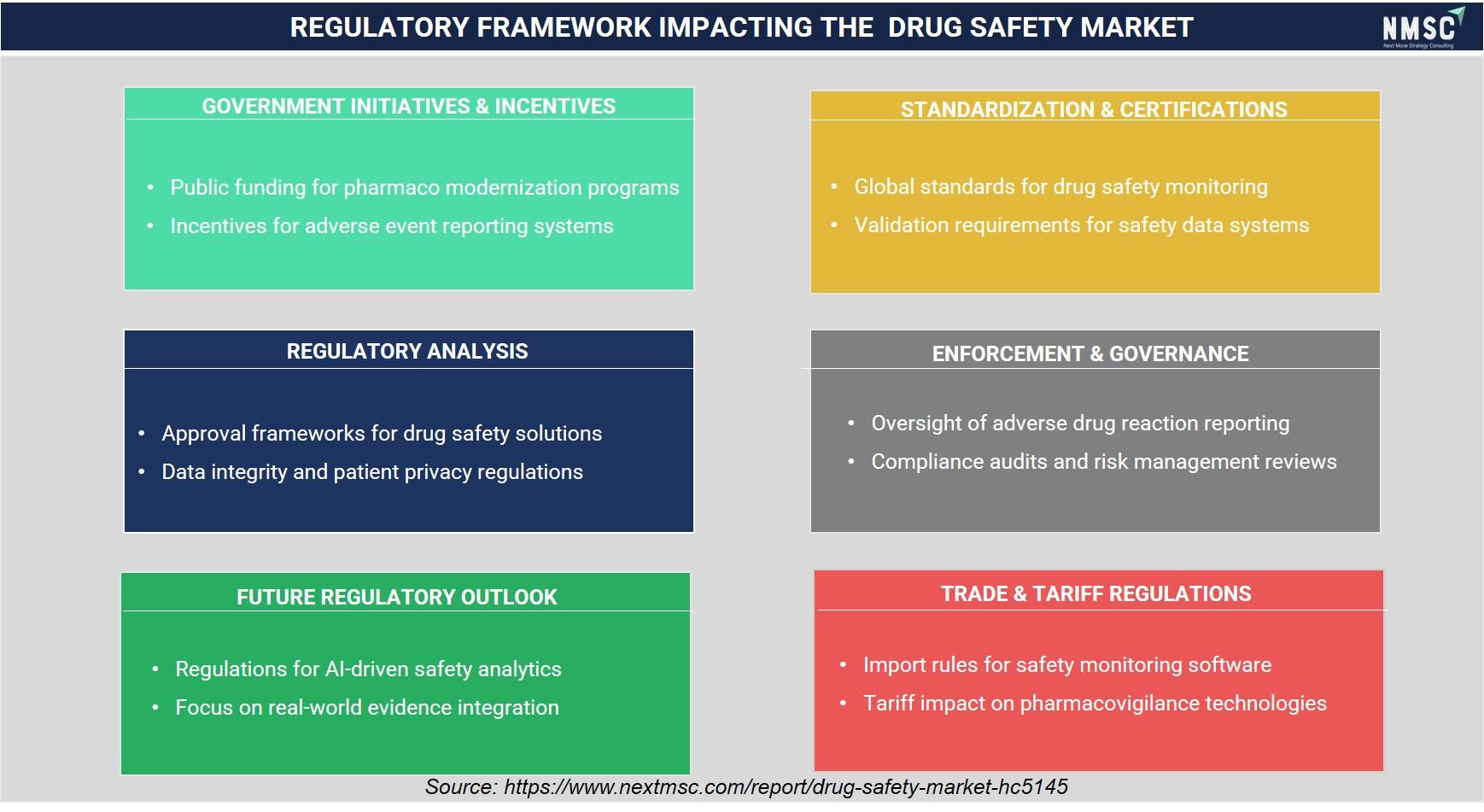
The regulatory framework plays a critical role in shaping the Drug Safety Market by establishing standards for pharmacovigilance, adverse event reporting, and patient safety monitoring. Government initiatives and funding programs support modernization of drug safety infrastructure, while global standards and certification requirements ensure consistency and reliability in safety data management. Regulatory authorities enforce compliance through audits, reporting mandates, and risk management reviews. Emerging regulations surrounding AI-driven safety analytics and real-world evidence integration are further transforming the market, while trade and import regulations influence the adoption and deployment of pharmacovigilance technologies across regions.
Key Market Segments
By Offering Type
-
Drug Safety Software
-
Safety Database
-
Clinical Safety Database
-
Post-marketing Safety Database
-
Hybrid Safety Database
-
-
Case Management
-
Intake
-
Triage
-
Duplicate Check
-
Submission Workflow
-
-
Signal and Analytics
-
Signal Detection
-
Signal Prioritization
-
Safety Analytics
-
Text Mining
-
-
Document and Reporting Workflow
-
Aggregate Reporting
-
Narrative Authoring
-
RMP, PSUR and DSUR Workflow
-
Quality Review
-
-
Integration and Automation
-
Data Exchange
-
Coding
-
Translation Automation
-
API and Interoperability
-
-
Other Software
-
-
Managed Services
-
Case Processing
-
ICSR Intake
-
Data Entry
-
Quality Control
-
Submission Support
-
-
Medical Review
-
Medical Assessment
-
Triage
-
Safety Oversight
-
-
Literature Surveillance
-
Search
-
Screening
-
Triage
-
Escalation
-
-
Signal Management
-
Detection Support
-
Review Support
-
Tracking
-
-
Aggregate Reporting
-
PSUR
-
DSUR
-
RMP Support
-
Narrative Support
-
-
Medical Information and Contact Center
-
Inquiry Handling
-
Adverse Event Capture
-
Follow-up
-
-
Other Managed Services
-
-
Consulting and Implementation
-
Implementation
-
Configuration
-
Validation
-
Migration
-
Go-live Support
-
-
Process Transformation
-
Operating Model Design
-
Automation Redesign
-
Outsourcing Transition
-
-
Compliance and Audit
-
SOP Design
-
Inspection Readiness
-
Audit Support
-
-
Training and Change Management
-
User Training
-
Change Management
-
Centre of Excellence Support
-
-
By Lifecycle Stage
-
Clinical
-
Post-marketing
-
Hybrid
By Buyer Type
-
Sponsor
-
CRO
-
Service Provider
-
Public Sector
By Deployment
-
SaaS
-
On-premise
-
Hybrid
By Commercial Model
-
Subscription
-
FTE-Based
-
Project-Based
-
Usage-Based
By Region
-
North America: U.S., Canada, and Mexico.
-
Europe: UK, Germany, France, Italy, Spain, Sweden, Denmark, Finland, the Netherlands, and the rest of Europe.
-
Asia Pacific: China, India, Japan, South Korea, Taiwan, Indonesia, Vietnam, Australia, Philippines, Malaysia and the rest of APAC.
-
Middle East & Africa (MEA): Saudi Arabia, UAE, Egypt, Israel, Turkey, Nigeria, South Africa, and the rest of MEA.
-
Latin America: Brazil, Argentina, Chile, Colombia, and the rest of LATAM.
Conclusion and Recommendations
Long-Term Outlook
The Drug Safety Market is entering a decade of sustained expansion driven by structural regulatory drivers, growing pharmaceutical pipeline complexity, and accelerating technology modernization. The market is forecast to grow from USD 4.2 billion in 2026 to USD 10.9 billion by 2035 at a CAGR of 11.1%. This growth reflects both the expanding volume of marketed products and clinical programs requiring pharmacovigilance support and the increasing willingness of sponsors to procure managed drug safety services rather than maintaining fully insourced safety departments.
Strategic Positioning Recommendations
Platform vendors should prioritize AI-native signal detection differentiation, validated cloud-native SaaS transformation, and E2B(R3) compliance modernization as core product investment themes. Managed service providers should invest in scalable offshore delivery infrastructure, medical oversight capacity, and geographic expansion into high-growth markets including India, Brazil, and Southeast Asia. Organizations that combine technology platform capabilities with managed service delivery under integrated contract frameworks will capture premium pricing and superior client retention within the Drug Safety Market.
Investment Attractiveness
The Drug Safety Market represents an attractive investment environment, offering non-cyclical demand driven by mandatory regulatory compliance, recurring revenue through multi-year platform subscriptions and managed service contracts, and strong secular growth from expanding global pharmaceutical pipelines. The highest-conviction investment themes include AI-powered signal analytics, managed pharmacovigilance outsourcing, Asia-Pacific regulatory compliance infrastructure, and integrated pharmacovigilance technology-services platforms. Private equity consolidation among standalone service providers is creating portfolio construction opportunities for investors with expertise in healthcare and life sciences services.
Market Shifts and Key Risks
The most significant structural shift underway is the migration from standalone safety database software licenses toward integrated SaaS platforms combining case management, signal detection, and aggregate reporting in unified cloud environments. This shift benefits modern platform vendors such as Veeva and ArisGlobal at the expense of legacy on-premise installed-base holders. Key risks for the Drug Safety Market include regulatory requirement changes that accelerate or complicate compliance investment cycles, workforce shortages of medically qualified pharmacovigilance professionals limiting managed service capacity growth, and pricing pressure from large sponsors using competitive bid processes to consolidate outsourcing spend.
Growth Pathways
Organizations seeking to maximize value from the Drug Safety Market should pursue a three-horizon strategy. In the near term (2025–2027), prioritize E2B(R3) compliance modernization, SaaS safety database deployment, and NLP-enabled literature surveillance automation. In the mid-term (2027–2031), invest in AI-native signal detection platform capabilities, real-world evidence integration, and outsourced pharmacovigilance model expansion to capture growing managed service demand. In the long term (2031–2035), position for advanced benefit-risk analytics, multi-regional regulatory harmonization support, and specialized ATMP pharmacovigilance capabilities as next-generation therapy classes dominate pharmaceutical pipelines.
About the Author
 Mihul Sharma
— Mihul Sharma is Research Associate at Next Move Strategy Consulting, where he has covered technology, industrial, and healthcare markets for 3 years. His work applies structured business research, market analysis, and secondary-source review to assess market trends, competitive developments, and growth opportunities. He supports report development by fully synthesizing industry data, company information, and market signals into concise findings for strategy and investment-focused research teams.
Mihul Sharma
— Mihul Sharma is Research Associate at Next Move Strategy Consulting, where he has covered technology, industrial, and healthcare markets for 3 years. His work applies structured business research, market analysis, and secondary-source review to assess market trends, competitive developments, and growth opportunities. He supports report development by fully synthesizing industry data, company information, and market signals into concise findings for strategy and investment-focused research teams.
About the Reviewer
 Supradip Baul
— Supradip Baul is an accomplished business consultant and strategist with over a decade of rich experience in market intelligence, strategy, technology, and business transformation. His work has included rigorous qualitative and quantitative analysis across multiple industries, helping clients shape investment decisions and long-term roadmaps. Earlier in his career, he was associated with Gartner, where he contributed to industry-leading reports and market share analyses. He has worked with leading global companies and holds an MBA with a dual specialization in Marketing and Finance.
Supradip Baul
— Supradip Baul is an accomplished business consultant and strategist with over a decade of rich experience in market intelligence, strategy, technology, and business transformation. His work has included rigorous qualitative and quantitative analysis across multiple industries, helping clients shape investment decisions and long-term roadmaps. Earlier in his career, he was associated with Gartner, where he contributed to industry-leading reports and market share analyses. He has worked with leading global companies and holds an MBA with a dual specialization in Marketing and Finance.
At Next Move Strategy Consulting, we understand that insightful market research is the cornerstone of successful business decisions. That's why we employ a robust and multifaceted approach, combining various methodologies to deliver the most accurate and actionable data for our clients.

Research Landscape
We navigate the world of research with two primary approaches:
Qualitative Approach
Our qualitative research methodologies involve immersive techniques such as in-depth interviews, focus groups, and observational studies. By engaging directly with individuals and stakeholders, we uncover valuable insights that quantitative data alone may overlook.

Quantitative Research
In tandem with qualitative methodologies, NMSC leverages the power of Quantitative Research to provide a robust foundation of numerical insights. Through systematic data collection and analysis, we quantify patterns, preferences, and market trends, offering a comprehensive view of the business landscape.
Our quantitative research approach employs diverse tools, including surveys, experiments, and statistical modelling. These methodologies enable us to gather data from a large and representative sample, ensuring the statistical significance of our findings. By employing structured questionnaires and standardized data collection methods, we guarantee the reliability and validity of the information we present to our clients.
Quantitative research is particularly effective in measuring the prevalence of trends, assessing market size, and gauging the impact of various factors on consumer behavior. The numerical precision attained through this approach equips our clients with actionable insights, facilitating data-driven decision-making and strategy formulation.


Our Specialized Toolbox for Industry-Specific Market Research
We deploy a specialized arsenal of techniques tailored to meet your unique requirements. Here's a glimpse into our comprehensive toolbox:

Information Procurement
The stage entails acquiring market data or relevant information through various sources and methodologies.


Market Research Approach
We utilize both top-down and bottom-up approaches in market research analysis to achieve a comprehensive understanding of the market dynamics, leveraging the broad perspective of industry trends and macroeconomic factors alongside detailed insights from specific segments and individual companies.

Porters Five Forces Analysis
We conduct Porter's Five Forces analysis to evaluate the competitive landscape of an industry, providing us with insights into factors that affect profitability and strategic positioning.

SWOT Analysis

Forecasting
We utilize a forecasting model to predict future consumption by considering parameters like population, economics, regulations, market competition, drivers, constraints, technology, and pricing. We also employ statistical techniques such as multilinear regression, exponential smoothing, moving average, ARIMA, and Monte Carlo simulations for accurate predictions. In econometric forecasting, we analyzed short-term and long-term event impacts, attributing values based on regulatory frameworks, economic factors, and market events.





 Speak to Our Analyst