Risk Evaluation and Mitigation Strategy (REMS) Market Size, Share, Growth & Forecast By Services and Software (Assessment, Technology & Platforms, Program Operations), By Program Structure (Medication Guide Only, ETASU, Shared System REMS), By Therapeutic Area (Oncology & Hematology, Neurology, Immunology, Others), By Buyer Type (Large Pharma, Mid-sized Pharma, Biotech), By Delivery Model, Stakeholder Focus, and Region — Global Analysis 2025–2035
Industry: Healthcare | Publishing Date: July 7, 2026 | Last Updated: September 30, 2026 | No of Pages: N/A | No. of Tables: N/A | No. of Figures: N/A | Format: PDF | Report Code: HC5012
What Is the Risk Evaluation and Mitigation Strategy (REMS) Market Size?
The global Risk Evaluation and Mitigation Strategy (REMS) Market was valued at USD 2.8 billion in 2025 and is projected to reach USD 3.1 billion in 2026. The market is forecast to expand to USD 7.6 billion by 2035, growing at a CAGR of 10.5% from 2026 to 2035. Key growth drivers include increasing FDA REMS program requirements for high-risk drugs, expansion of ETASU-based programs in oncology and CNS therapeutic areas, accelerating adoption of SaaS-based REMS platforms, and growing outsourcing by emerging biotech sponsors. The market reflects the pharmaceutical industry's increasing reliance on third-party REMS service providers and technology platforms for regulatory compliance and patient safety management.
|
Parameters |
Details |
|
Market Size in 2025 |
USD 2.8 Billion |
|
Market Size in 2026 |
USD 3.1 Billion |
|
Revenue Forecast in 2035 |
USD 7.6 Billion |
|
Growth Rate |
CAGR of 10.5% from 2026 to 2035 |
|
Analysis Period |
2025–2035 |
|
Base Year Considered |
2025 |
|
Forecast Period |
2026–2035 |
|
Market Size Estimation |
Billion USD |
|
Companies Profiled |
20 |
|
Countries Covered |
33 |
|
Market Share |
Top 10 |
Risk Evaluation and Mitigation Strategy (REMS) Market Overview
What Is the Risk Evaluation and Mitigation Strategy (REMS) Market?
The Risk Evaluation and Mitigation Strategy (REMS) Market encompasses the full spectrum of services, software platforms, and operational support programs designed to ensure that the benefits of certain high-risk drug products outweigh their risks. REMS programs are mandated by the U.S. Food and Drug Administration under the authority granted by the Food and Drug Administration Amendments Act of 2007 and are required for drugs with serious safety concerns. The market includes strategy consulting, regulatory submission support, program design, technology platform deployment, patient enrollment, pharmacy certification, and ongoing compliance monitoring services.
How Has the Risk Evaluation and Mitigation Strategy (REMS) Market Evolved?
The Risk Evaluation and Mitigation Strategy (REMS) Market has evolved through three distinct phases since the FDA formalized REMS requirements in 2008. The first phase focused on building foundational compliance programs and Medication Guide deployments for drugs such as isotretinoin and clozapine. The second phase, driven by the Opioid Crisis and the growth of targeted oncology therapies, expanded ETASU requirements and introduced shared REMS systems. The current phase is characterized by digital transformation, with SaaS REMS platforms, cloud-hosted enrollment portals, and real-time analytics dashboards replacing legacy paper-based processes.
How Do Regulations Influence the Risk Evaluation and Mitigation Strategy (REMS) Market?
Regulatory mandates from the FDA are the primary structural determinant of demand in the Risk Evaluation and Mitigation Strategy (REMS) Market. The FDA's authority under 21 U.S.C. Section 355-1 enables it to require REMS for any drug where it determines the benefits would not outweigh the risks without additional safeguards. The FDA's REMS database, as publicly maintained at accessdata.fda.gov, lists over 60 active REMS programs as of 2025. Each new approval with REMS requirements creates sustained demand for program design, technology deployment, and ongoing operations services across the market's value chain.
How Is Technology Adoption Expanding Across the Risk Evaluation and Mitigation Strategy (REMS) Market?
Technology adoption across the Risk Evaluation and Mitigation Strategy (REMS) Market is accelerating as sponsors and service providers migrate from fragmented, paper-based systems to integrated SaaS platforms. Cloud-native REMS technology platforms now offer end-to-end capabilities including patient enrollment, healthcare provider certification, pharmacy enrollment, dispensing controls, audit trails, and automated regulatory reporting. NMSC's analysis indicates that technology modernization is compressing program setup timelines and reducing per-patient compliance costs, making full-service outsourcing increasingly attractive for mid-size and emerging biotech sponsors.
|
Key Takeaways |
|
Program Operations leads the market with approximately USD 0.9 billion in 2025, supported by extensive certification, enrollment, and controlled distribution activities. |
|
Technology and Platforms is the fastest-growing segment, expanding at a CAGR of around 14.2%, driven by increasing adoption of SaaS REMS platforms and analytics dashboards. |
|
ETASU (Elements to Assure Safe Use) programs account for the largest share, reaching nearly USD 1.2 billion in 2025 due to the operational complexity of distribution and certification requirements. |
|
Shared System REMS is projected to grow at the highest rate as multi-sponsor infrastructure reduces implementation costs and improves regulatory efficiency. |
|
Oncology and Hematology represents the largest therapeutic area, generating approximately USD 0.9 billion in 2025, supported by the increasing use of high-risk targeted therapies. |
|
Rare and Orphan Diseases is the fastest-growing therapeutic segment, fueled by rising orphan drug approvals and expanding gene therapy REMS requirements. |
|
Large pharmaceutical companies hold the largest customer share, accounting for nearly 38% of the market due to broad REMS portfolios and established outsourcing partnerships. |
|
Emerging biotech companies are the fastest-growing buyer segment, reflecting the growing number of first-time REMS program implementations for innovative biologics and specialty medicines. |
|
North America dominates the global market with an estimated 82% revenue share in 2025, supported by the FDA regulatory framework and the concentration of major pharmaceutical companies. |
|
Asia-Pacific is expected to record the fastest regional growth as pharmaceutical manufacturers strengthen their U.S. market access strategies. |
|
The United States contributes approximately 78% of global REMS market revenue in 2025, maintaining its position as the largest and most mature market. |
|
India is emerging as a rapidly growing market, driven by the expansion of Indian generic and biosimilar manufacturers supplying products that require REMS compliance in the U.S. |
Key Emerging Trends in the Risk Evaluation and Mitigation Strategy (REMS) Market
How Is the Transition to SaaS-Based REMS Platforms Reshaping the Risk Evaluation and Mitigation Strategy (REMS) Market?
The transition from proprietary on-premise REMS technology to cloud-native SaaS platforms is the most structurally significant technology trend in the Risk Evaluation and Mitigation Strategy (REMS) Market. Platforms such as those offered by Veeva Systems and ConnectiveRx enable sponsors to deploy pre-validated, configurable enrollment portals, certification workflows, and dispensing controls without building bespoke systems. From our research, we found that SaaS adoption reduces initial program deployment timelines from 12 to 18 months down to 4 to 8 months, significantly improving sponsor economics, particularly for emerging biotech companies managing first-time REMS programs.
How Are ETASU Requirements for Oncology and CNS Drugs Driving Structural Growth in the Risk Evaluation and Mitigation Strategy (REMS) Market?
The growing number of FDA approvals for high-risk oncology and central nervous system drugs with Elements to Assure Safe Use requirements is creating durable, long-duration revenue streams within the Risk Evaluation and Mitigation Strategy (REMS) Market. Drugs including lenalidomide, thalidomide, clozapine, and newer CAR-T therapies each require multi-year ETASU programs involving healthcare provider training, pharmacy certification, dispensing controls, and ongoing patient monitoring. Our analysis shows that ETASU programs generate the highest per-program revenue across all REMS structures due to their operational complexity and continuous compliance monitoring obligations.
How Is the Shift Toward Shared REMS Systems Influencing the Risk Evaluation and Mitigation Strategy (REMS) Market Structure?
FDA's increasing preference for shared REMS systems, where multiple sponsors of the same drug or drug class operate under a single FDA-approved program, is reshaping competitive dynamics in the Risk Evaluation and Mitigation Strategy (REMS) Market. The REMS Integration Initiative announced by FDA aims to reduce sponsor fragmentation and improve patient access. Our assessment indicates that shared system structures reduce per-sponsor operational costs while concentrating program management revenue among a smaller number of specialized vendors, thereby elevating competitive barriers for smaller service providers and benefiting established REMS program operators.
How Is the Rise of Gene Therapy and Novel Biological Approvals Creating New Demand in the Risk Evaluation and Mitigation Strategy (REMS) Market?
The accelerating pipeline of gene therapies, cell therapies, and novel biologics requiring REMS programs is establishing a new high-value demand category within the Risk Evaluation and Mitigation Strategy (REMS) Market. Therapies such as Zolgensma (onasemnogene abeparvovec) and commercial CAR-T products require complex REMS programs with healthcare setting certification, patient registry obligations, and long-term outcome monitoring. Through NMSC's assessment, we found that gene therapy REMS programs command premium service fees due to their complexity, rare disease patient populations, and specialized distribution requirements, generating outsized per-program revenue for qualified service vendors.
What Are the Key Market Drivers, Breakthroughs, and Investment Opportunities that Will Shape the Risk Evaluation and Mitigation Strategy (REMS) Market Industry in the Next Decade?
|
Drivers/Trends/Restraints |
(+/-) % Impact on CAGR Forecast |
Geographic Relevance |
Impact Timeline |
|
Rising FDA REMS mandates for high-risk drug approvals |
+1.8% |
North America (Primary) |
2025–2030 |
|
Rapid SaaS REMS platform adoption replacing legacy systems |
+1.2% |
North America, Europe |
2025–2028 |
|
ETASU expansion in oncology and CNS therapeutic areas |
+1.0% |
Global (U.S. led) |
2026–2035 |
|
Growth of emerging biotech REMS outsourcing demand |
+0.9% |
North America, Europe |
2025–2032 |
|
Gene therapy and CAR-T REMS program complexity |
+0.8% |
U.S., Germany, UK |
2027–2035 |
|
FDA REMS Integration Initiative (Shared Systems) |
-0.4% |
North America |
2026–2030 |
|
High program design and compliance complexity |
-0.5% |
Global |
Ongoing |
|
Sponsor consolidation reducing total program count |
-0.3% |
North America |
2027–2035 |
What Are the Growth Drivers of the Risk Evaluation and Mitigation Strategy (REMS) Market?
How Are Rising FDA Drug Approvals with REMS Requirements Driving the Risk Evaluation and Mitigation Strategy (REMS) Market?
The U.S. FDA's continued approval of drugs with inherent safety risks requiring REMS programs is the primary structural driver of growth in the Risk Evaluation and Mitigation Strategy (REMS) Market. According to the FDA's REMS database maintained at accessdata.fda.gov, the agency had approved over 60 active REMS programs as of early 2025, and the number of new drug applications incorporating REMS requirements has grown consistently alongside the expansion of novel biologics, oncology therapies, and CNS medications in the pharmaceutical pipeline. Each FDA-mandated REMS program creates multi-year contractual demand for design, technology, and operations services, generating durable revenue streams for market participants.
How Is the Outsourcing Trend Among Emerging Biotech Companies Fueling Growth in the Risk Evaluation and Mitigation Strategy (REMS) Market?
The rapid expansion of the emerging biotech sector and its reliance on full-service outsourcing for first-time REMS program development is a key demand driver in the Risk Evaluation and Mitigation Strategy (REMS) Market. Emerging biotech companies, which frequently lack internal REMS infrastructure, regulatory expertise, and operational capabilities, increasingly partner with specialized CRO and REMS service vendors for end-to-end program management. According to data from the Biotechnology Innovation Organization, the number of FDA-approved products from smaller biotech companies has increased substantially over the past decade, with many requiring first-time REMS program build-outs that generate high-value, multi-year service engagements.
How Is the Increasing Complexity of REMS Programs in High-Risk Therapeutic Areas Sustaining Market Revenue?
The clinical complexity of drug products requiring REMS programs, particularly in oncology, hematology, and rare diseases, is sustaining premium fee structures and long program durations within the Risk Evaluation and Mitigation Strategy (REMS) Market. ETASU-based programs for drugs such as thalidomide analogs require ongoing prescriber and pharmacist certification, patient enrollment, pregnancy testing protocols, and real-time dispensing controls that generate sustained, high-intensity operational demand. Our findings suggest that therapeutic area expansion into rare and orphan diseases, supported by FDA's expedited approval pathways including Breakthrough Therapy and Accelerated Approval designations, will continue to increase the average complexity and per-program revenue of REMS engagements through 2035.
What Are the Growth Inhibitors of the Risk Evaluation and Mitigation Strategy (REMS) Market?
How Does the FDA REMS Integration Initiative Represent a Structural Constraint on Program Count and Revenue?
FDA's REMS Integration Initiative, which promotes shared REMS systems for drugs sharing the same active ingredient or risk profile, is designed to reduce burden on the healthcare system but simultaneously consolidates multiple independent programs into single shared structures. This consolidation reduces the total number of individual REMS programs in operation, which can constrain the overall volume of program design and setup engagements available to service vendors. From our assessment, we observed that while shared systems generate high per-vendor revenue for the administrator, they reduce the market opportunity for smaller REMS service providers who previously competed for individual sponsor program contracts.
How Does the High Cost and Complexity of REMS Program Design Limit Market Penetration Among Smaller Sponsors?
The substantial financial and operational investment required to design, submit, and operationalize a REMS program can discourage smaller pharmaceutical sponsors from developing novel drugs that might otherwise require REMS approval. Full-service REMS program implementation can involve extensive regulatory strategy work, multi-stakeholder system integration, FDA submission and negotiation, and phased operational deployment. According to publicly available FDA guidance documents at fda.gov, the agency acknowledges the burden REMS programs can place on sponsors and has taken steps to improve program templates and shared infrastructure, but the inherent complexity remains a deterrent for smaller companies with limited regulatory and operational resources.
Regulatory Framework Impacting the REMS Market
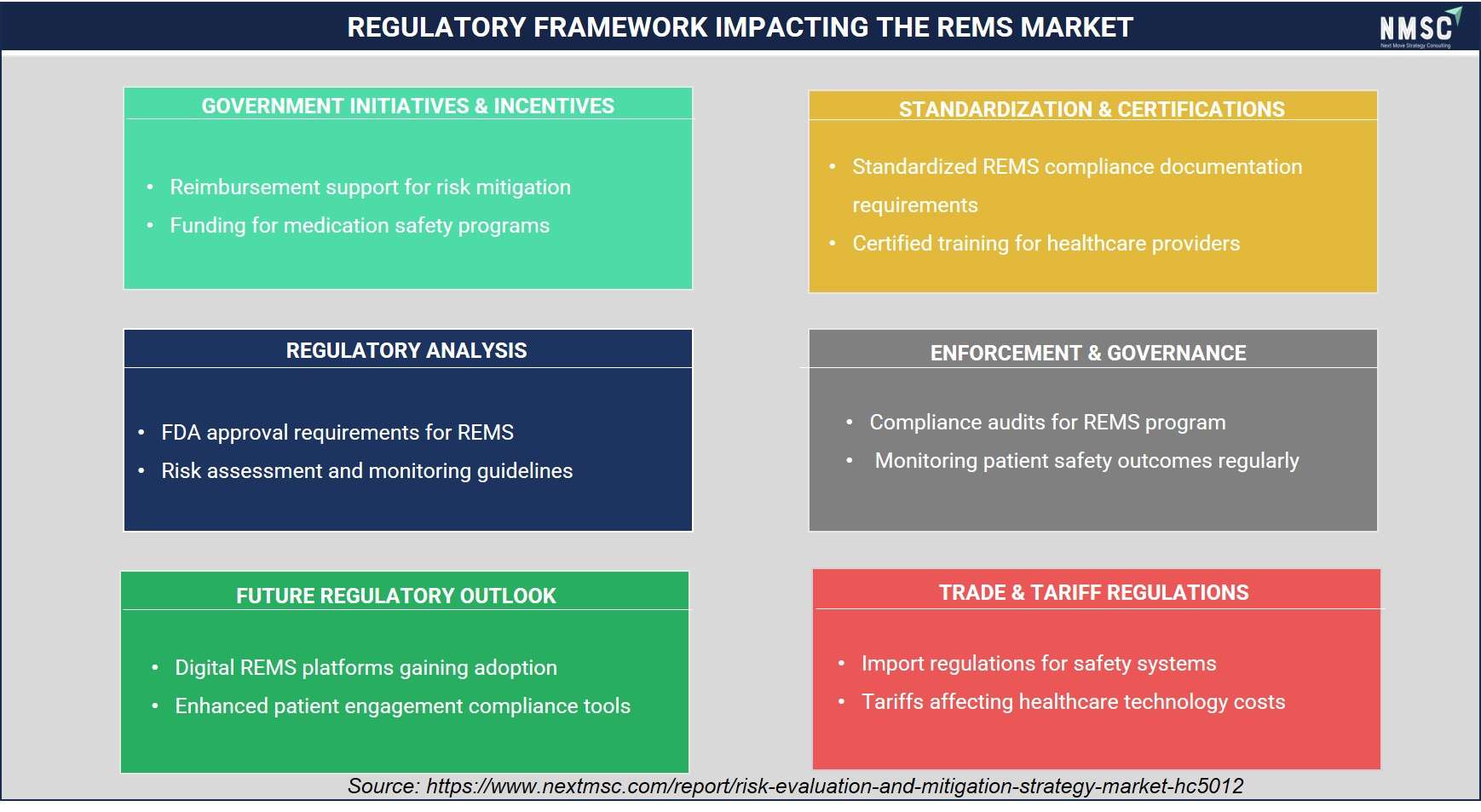
The regulatory framework for the REMS market is driven by government initiatives, standardized compliance requirements, and strict regulatory oversight to ensure medication safety. FDA guidelines mandate risk assessment, monitoring, and provider training, while compliance audits and patient safety tracking strengthen governance. Growing support for digital REMS platforms and advanced patient engagement tools is improving program efficiency. Additionally, trade regulations and healthcare technology costs influence the adoption and expansion of REMS solutions across global pharmaceutical markets.
What Are the Growth Opportunities in the Risk Evaluation and Mitigation Strategy (REMS) Market?
How Does the Expansion of Gene Therapy and Advanced Therapy Medicinal Products Create New Opportunities in the Risk Evaluation and Mitigation Strategy (REMS) Market?
The growing pipeline of gene therapies, cell therapies, and advanced therapy medicinal products subject to REMS requirements is establishing a high-value, structurally expanding opportunity within the Risk Evaluation and Mitigation Strategy (REMS) Market. The Alliance for Regenerative Medicine reported that the number of cell and gene therapy clinical trials globally has grown substantially over the past five years, with an increasing proportion moving toward FDA approval and potential REMS requirements. These programs, characterized by limited patient populations, specialized healthcare setting requirements, long-term outcome monitoring, and complex distribution controls, generate among the highest per-program service revenue in the REMS market.
How Is the Internationalization of Pharmaceutical Regulation Creating Opportunities for REMS-Adjacent Risk Management Markets?
International pharmaceutical regulators including the European Medicines Agency, Health Canada, and Japan's Pharmaceuticals and Medical Devices Agency have implemented risk management frameworks with structural similarities to the U.S. REMS system, creating opportunities for REMS service vendors to leverage their expertise in adjacent regulatory risk management markets. The EMA's Risk Management Plan requirements under the EU Pharmacovigilance Regulation create demand for similar services including benefit-risk assessment, distribution control design, and healthcare professional communication programs. Our analysis shows that established REMS vendors are well-positioned to expand into international risk management mandates, diversifying revenue beyond the U.S. regulatory market.
How Does the Growing Adoption of Digital Patient Engagement and Registry Platforms Present an Opportunity in the Risk Evaluation and Mitigation Strategy (REMS) Market?
The broader pharmaceutical industry's shift toward digital patient engagement, remote monitoring, and real-world evidence generation is creating a technology investment opportunity within the Risk Evaluation and Mitigation Strategy (REMS) Market. REMS program operators that integrate patient registry functions, digital consent workflows, mobile patient portals, and real-time data analytics dashboards are positioned to offer differentiated value to sponsors seeking dual-use REMS platforms that simultaneously satisfy FDA compliance obligations and generate commercial-grade real-world data. Based on NMSC's research, we found that vendors able to deliver integrated compliance plus evidence generation platforms will command premium pricing and longer contract durations in emerging REMS program structures.
PESTEL Analysis Of The Rems Market
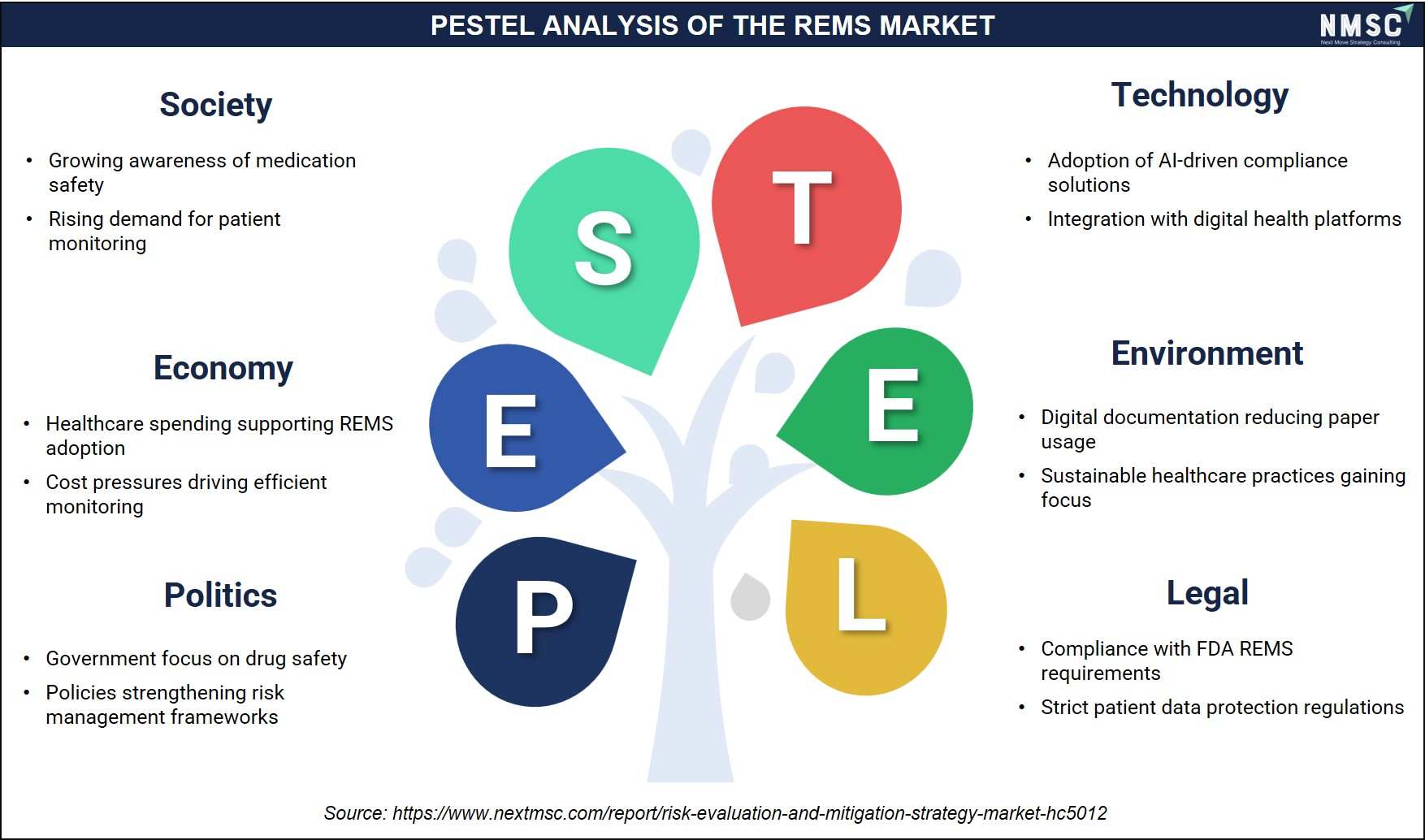
The PESTEL analysis highlights the key external factors shaping the REMS market. Political and legal regulations, particularly FDA safety requirements, drive the adoption of REMS programs. Economic factors influence healthcare spending and investment in compliance solutions, while social factors increase demand for patient safety and awareness. Technological advancements, including digital REMS platforms and AI-enabled monitoring, enhance operational efficiency. Environmental considerations support paperless compliance systems, collectively fostering innovation and long-term growth in the REMS market.
How Is the Risk Evaluation and Mitigation Strategy (REMS) Market Segmented in This Report, and What Are the Key Insights from the Segmentation Analysis?
How Do the Services and Software Segments Define the Commercial Structure of the Risk Evaluation and Mitigation Strategy (REMS) Market?
|
Segment |
2025 (USD Billion) |
2035 (USD Billion) |
CAGR (%) |
|
Strategy and Regulatory Planning |
0.42 |
1.05 |
9.6% |
|
Technology and Platforms |
0.52 |
1.82 |
14.2% |
|
Program Operations |
0.90 |
2.18 |
9.2% |
|
Monitoring and Reporting |
0.56 |
1.44 |
10.1% |
|
Transition and Remediation |
0.22 |
0.62 |
11.0% |
|
Other REMS Services |
0.18 |
0.49 |
10.7% |
The Services and Software segment of the Risk Evaluation and Mitigation Strategy (REMS) Market encompasses the full value chain from initial regulatory strategy through ongoing operational management. Strategy and Regulatory Planning, including Benefit Risk Assessment, Regulatory Strategy, FDA Meeting Support, REMS Document Authoring, ETASU Design, and Submission Support, supports early-stage program design and represents an essential first-dollar revenue opportunity for vendors engaged at drug approval. Technology and Platforms, the fastest-growing sub-segment advancing at a CAGR of 14.2%, includes SaaS REMS Platforms, Enrollment Portals, Data Integration, Analytics Dashboards, and Audit Trail and Validation capabilities. Program Operations, including Certification and Enrollment, Contact Center Operations, Distribution Controls, Training Delivery, and Registry Operations, represents the largest sub-segment by revenue due to the multi-year, high-touch nature of ongoing program management. Monitoring and Reporting, covering Compliance Monitoring, Safety Data Collection, Assessment Reporting, and Regulator Reporting, generates recurring revenue across the active program lifecycle.
How Do Differences in Program Structure Influence Service Intensity and Revenue in the Risk Evaluation and Mitigation Strategy (REMS) Market?
|
Segment |
2025 (USD Billion) |
2035 (USD Billion) |
CAGR (%) |
|
Medication Guide Only |
0.28 |
0.58 |
7.6% |
|
Communication Plan Only |
0.18 |
0.38 |
7.8% |
|
ETASU |
1.20 |
3.28 |
11.2% |
|
Shared System REMS |
0.82 |
2.48 |
11.7% |
|
Other REMS |
0.32 |
0.88 |
10.6% |
The Program Structure segment of the Risk Evaluation and Mitigation Strategy (REMS) Market is defined by the FDA-mandated program type, which directly determines operational complexity and per-program service revenue. The ETASU sub-segment dominates with approximately USD 1.2 billion in 2025, as its requirements for prescriber certification, pharmacy enrollment, patient monitoring, and distribution controls generate the highest operational service intensity of all program structures. Shared System REMS is the fastest growing sub-segment at a CAGR of 11.7%, reflecting FDA's increasing preference for multi-sponsor shared platforms as a mechanism to reduce patient access friction while maintaining safety oversight. Medication Guide Only and Communication Plan Only programs represent lower-complexity, lower-revenue structures primarily serving as compliance vehicles for well-characterized risk profiles, and while they represent the highest program count, their revenue contribution per program is materially lower than ETASU or Shared System structures.
Which Therapeutic Areas Generate the Highest REMS Market Revenue and Fastest Growth?
|
Segment |
2025 (USD Billion) |
2035 (USD Billion) |
CAGR (%) |
|
Oncology and Hematology |
0.90 |
2.42 |
10.4% |
|
CNS and Psychiatry |
0.62 |
1.58 |
9.8% |
|
Cardiovascular and Metabolic |
0.22 |
0.52 |
9.0% |
|
Infectious Disease |
0.18 |
0.44 |
9.4% |
|
Immunology and Inflammation |
0.32 |
0.88 |
10.7% |
|
Rare and Orphan Diseases |
0.38 |
1.18 |
12.0% |
|
Other Therapeutic Areas |
0.18 |
0.58 |
12.4% |
The Therapeutic Area segmentation of the Risk Evaluation and Mitigation Strategy (REMS) Market reflects the concentration of high-risk drug approvals in specific clinical categories. Oncology and Hematology leads with approximately USD 0.9 billion in 2025, driven by the high volume of targeted therapies, immunotherapies, and hematological treatments requiring ETASU-level controls including prescriber certification, dispense with documentation requirements, and pregnancy prevention protocols for teratogenic agents. CNS and Psychiatry represents the second-largest therapeutic area due to the long history of REMS requirements for drugs including clozapine, naloxone-containing products, and extended-release opioids. Rare and Orphan Diseases is the fastest-growing therapeutic area at a CAGR of 12.0%, driven by FDA's prioritization of expedited pathways for rare disease therapies, a growing pipeline of gene therapies, and the adoption of novel REMS structures tailored to small, specialized patient populations.
How Does Buyer Type Shape Procurement Strategies and Service Demand in the Risk Evaluation and Mitigation Strategy (REMS) Market?
|
Segment |
2025 (USD Billion) |
2035 (USD Billion) |
CAGR (%) |
|
Large Pharma |
1.06 |
2.54 |
9.2% |
|
Mid-Size Pharma |
0.62 |
1.54 |
9.5% |
|
Emerging Biotech |
0.68 |
2.08 |
11.8% |
|
Generic and Biosimilar Sponsors |
0.28 |
0.82 |
11.4% |
|
Government and Public Health |
0.16 |
0.62 |
14.5% |
The Buyer Type segmentation of the Risk Evaluation and Mitigation Strategy (REMS) Market reveals the diversity of sponsor profiles driving service demand across the value chain. Large Pharma remains the dominant buyer segment at approximately USD 1.1 billion in 2025, supported by established multi-program REMS portfolios, long-term vendor partnerships, and ongoing operational management needs across complex ETASU programs. Emerging Biotech is the fastest-growing buyer segment at a CAGR of 11.8%, driven by the record volume of FDA approvals for smaller biotech companies with novel targeted therapies and biologics that require first-time REMS program design and full-service outsourcing. Generic and Biosimilar Sponsors represent a growing segment as branded REMS drugs lose exclusivity and generic/biosimilar entrants are required to participate in shared REMS systems or develop equivalent programs, creating new service demand from sponsors with limited REMS experience.
How Do Different Delivery Models Shape Competitive Positioning in the Risk Evaluation and Mitigation Strategy (REMS) Market?
|
Segment |
2025 (USD Billion) |
2035 (USD Billion) |
CAGR (%) |
|
Full-Service Outsourcing |
1.12 |
2.82 |
9.7% |
|
Advisory and Consulting |
0.52 |
1.28 |
9.4% |
|
Software Only |
0.44 |
1.48 |
12.9% |
|
Hybrid |
0.72 |
2.02 |
10.8% |
The Delivery Model segmentation of the Risk Evaluation and Mitigation Strategy (REMS) Market captures the spectrum of service engagement structures through which sponsors access REMS capabilities. Full Service Outsourcing dominates at approximately USD 1.1 billion in 2025, as sponsors, particularly emerging biotech and mid-size pharma companies, prefer comprehensive vendor engagement covering strategy, technology, and program operations under a single contract. The Software Only model is the fastest-growing delivery structure at a CAGR of 12.9%, reflecting the market's shift toward SaaS-based REMS technology platforms that enable sponsors or their CRO partners to deploy pre-validated technology infrastructure without purchasing bundled operational services. The Hybrid delivery model, combining software platform access with selective advisory or operational services, is gaining traction among sophisticated sponsors who wish to retain strategic control while outsourcing specific program functions, generating a balanced revenue opportunity for vendors able to offer modular service structures.
How Does Stakeholder Focus Influence Program Design and Operational Complexity in the Risk Evaluation and Mitigation Strategy (REMS) Market?
|
Segment |
2025 (USD Billion) |
2035 (USD Billion) |
CAGR (%) |
|
Healthcare Provider |
0.66 |
1.68 |
9.8% |
|
Pharmacy |
0.58 |
1.42 |
9.4% |
|
Healthcare Setting |
0.36 |
1.08 |
11.6% |
|
Patient |
0.62 |
1.72 |
10.8% |
|
Multi Stakeholder |
0.58 |
1.70 |
11.4% |
The Stakeholder Focus segmentation of the Risk Evaluation and Mitigation Strategy (REMS) Market reflects the principal target audience of each REMS program, which determines program design requirements, contact center operations, and technology platform configuration. Healthcare Provider-focused programs dominate by revenue, as prescriber certification, training delivery, and ongoing compliance verification represent high-touch, recurring service activities across multiple therapeutic areas. The Healthcare Setting focus, which requires certification of hospitals or specialty clinics as approved dispensing or treatment locations, is the fastest-growing sub-segment at a CAGR of 11.6%, driven by the increasing adoption of cell and gene therapies requiring authorized treatment centers. Multi-Stakeholder programs, which require simultaneous management of healthcare provider, pharmacy, and patient enrollment workflows, generate the highest per-program operational complexity and are therefore among the most commercially attractive engagements for full-service REMS vendors.
Regional Outlook
Geographic Performance Snapshot
|
Region |
2025 (USD Billion) |
2035 (USD Billion) |
CAGR (%) |
|
North America |
2.30 |
6.20 |
10.4% |
|
Europe |
0.28 |
0.82 |
11.4% |
|
Asia-Pacific |
0.14 |
0.46 |
12.6% |
|
Middle East and Africa |
0.04 |
0.08 |
7.2% |
|
Latin America |
0.04 |
0.04 |
N/A – Emerging |
North America Risk Evaluation and Mitigation Strategy (REMS) Market
North America dominates the global Risk Evaluation and Mitigation Strategy (REMS) Market, accounting for approximately USD 2.3 billion in 2025 and forecast to reach USD 6.2 billion by 2035 at a CAGR of 10.4%. The region's dominance reflects the exclusive jurisdiction of the U.S. FDA to mandate REMS programs, concentrating virtually all global REMS compliance demand within the North American pharmaceutical regulatory ecosystem. The market is characterized by high competitive intensity among established REMS service providers, increasing adoption of SaaS platforms, and growing outsourcing demand from the expanding emerging biotech sector concentrated in Boston, San Francisco, and San Diego.
U.S. Risk Evaluation and Mitigation Strategy (REMS) Market
Based on our analysis, we found that the United States accounts for over 95% of North American Risk Evaluation and Mitigation Strategy (REMS) Market revenue, representing approximately USD 2.19 billion in 2025. The U.S. market is entirely driven by FDA REMS requirements, with the agency's REMS database confirming over 60 active programs across multiple therapeutic areas. The market is highly mature, with leading full-service vendors including IQVIA, Syneos Health, and PPD holding long-term operational contracts for major ETASU programs, while SaaS providers including Veeva Systems compete for technology platform mandates from newly approved drug sponsors requiring modern, configurable REMS infrastructure.
Canada Risk Evaluation and Mitigation Strategy (REMS) Market
Through our analysis, we assessed that Canada represents a small but structurally distinct segment within the North American Risk Evaluation and Mitigation Strategy (REMS) Market, contributing approximately USD 0.08 billion in 2025. Canada does not operate a formal REMS equivalent system under Health Canada, but Canadian affiliates of global pharmaceutical companies managing drugs with U.S. FDA REMS requirements engage Canadian REMS service partners for cross-border program coordination, HCP communication, and pharmacy enrollment alignment. Health Canada's Risk Management Plan framework provides some demand for analogous risk minimization services that draw on REMS service provider competencies.
Mexico Risk Evaluation and Mitigation Strategy (REMS) Market
According to evaluation of North American regulatory structures, Mexico represents an emerging and limited segment within the Risk Evaluation and Mitigation Strategy (REMS) Market at approximately USD 0.03 billion in 2025. Mexico's COFEPRIS (Federal Commission for Protection against Sanitary Risks) does not mandate REMS-equivalent programs, but Mexican affiliates of multinational pharmaceutical companies operating drugs with active U.S. REMS requirements occasionally engage service providers for regional patient communication and pharmacy training programs that support overarching U.S. compliance obligations. Market growth will depend on COFEPRIS regulatory evolution and the expansion of multinational drug launches into Mexico.
Europe Risk Evaluation and Mitigation Strategy (REMS) Market
Europe represents the second-largest regional market in the global Risk Evaluation and Mitigation Strategy (REMS) Market, valued at approximately USD 0.28 billion in 2025 and forecast to reach USD 0.82 billion by 2035 at a CAGR of 11.4%. The European market is driven not by FDA REMS requirements but by the European Medicines Agency's Risk Management Plan obligations under EU Regulation 726/2004 and EU Pharmacovigilance Regulation (EU) No 1235/2010, which require Additional Risk Minimization Measures (aRMMs) for high-risk drugs. European-facing REMS-adjacent services include healthcare professional educational programs, controlled distribution systems, and pregnancy prevention programs structurally analogous to ETASU requirements.
U.K. Risk Evaluation and Mitigation Strategy (REMS) Market
From our assessment, we found that the United Kingdom is the largest European market for Risk Evaluation and Mitigation Strategy (REMS) adjacent services, contributing approximately USD 0.07 billion in 2025. Post-Brexit, the MHRA operates independently from the EMA and maintains its own risk minimization requirements for high-risk products, creating demand for dedicated U.K. program management services. The U.K. market benefits from a concentration of global pharmaceutical company European headquarters in London, a sophisticated specialty pharmacy sector, and the MHRA's proactive approach to adopting controlled access programs for novel biologics and gene therapies.
Germany Risk Evaluation and Mitigation Strategy (REMS) Market
Based on our market evaluation, we noticed that Germany is the second-largest European market for REMS-adjacent risk minimization services, contributing approximately USD 0.05 billion in 2025. Germany's robust pharmaceutical manufacturing sector, home to global companies including Bayer, Merck KGaA, and Boehringer Ingelheim, generates demand for EMA RMP-aligned additional risk minimization measure programs. The German market is characterized by strong regulatory compliance culture, high physician prescription monitoring requirements, and a sophisticated hospital pharmacy sector that engages directly with controlled distribution programs for high-risk oncology and immunology products.
France Risk Evaluation and Mitigation Strategy (REMS) Market
Through our analysis, we noticed that France contributes approximately USD 0.04 billion in 2025 to the European Risk Evaluation and Mitigation Strategy (REMS) adjacent market, driven by ANSM (Agence nationale de sécurité du médicament) requirements for additional risk minimization measures on high-risk drug products. France's national healthcare system infrastructure, including its national pharmacy network and centralized prescribing oversight, supports the operationalization of controlled distribution programs analogous to REMS structures. Sanofi's global headquarters and the concentration of clinical research activity in France further sustain demand for risk management program services aligned with EMA RMP requirements.
Italy Risk Evaluation and Mitigation Strategy (REMS) Market
From our assessment, Italy contributes approximately USD 0.03 billion in 2025 to the European REMS-adjacent market, driven by AIFA (Agenzia Italiana del Farmaco) monitoring programs and EMA RMP additional risk minimization requirements for drugs distributed in Italy. The Italian market is characterized by the AIFA-managed monitoring registers, which function as enrollment and dispensing control mechanisms for high-risk products including biologics, immunosuppressants, and oncology therapies, creating sustained demand for technology platforms and operational services aligned with Italian registry management requirements.
Spain Risk Evaluation and Mitigation Strategy (REMS) Market
Based on our evaluation, Spain contributes approximately USD 0.02 billion in 2025 to the European Risk Evaluation and Mitigation Strategy (REMS) adjacent market. The Spanish Medicines Agency (AEMPS) manages risk minimization programs for high-risk drugs distributed in Spain, including educational materials, healthcare professional communications, and controlled access schemes analogous to REMS Communication Plan and ETASU structures. Spain's rapidly growing specialty pharmaceutical market, expanding biotech sector centered in Barcelona and Madrid, and increasing participation in multinational EMA approval submissions are expected to sustain gradual market growth through 2035.
Sweden Risk Evaluation and Mitigation Strategy (REMS) Market
Through our market assessment, we observed that Sweden is an advanced digital health market contributing approximately USD 0.015 billion in 2025 to the European REMS-adjacent landscape. The Swedish Medical Products Agency (MPA) applies EMA risk minimization frameworks to high-risk products distributed in Sweden, and Sweden's advanced digital health infrastructure and high electronic prescribing adoption rates support the implementation of digital patient monitoring programs and HCP educational interventions aligned with REMS service provider capabilities. Sweden is also an active participant in innovative EMA pilot programs for digital risk minimization tools.
Denmark Risk Evaluation and Mitigation Strategy (REMS) Market
According to evaluation of Nordic pharmaceutical regulatory structures, Denmark contributes approximately USD 0.012 billion in 2025 to the European REMS-adjacent services market. Denmark's Danish Medicines Agency (DKMA) applies EU risk management requirements to high-risk drug approvals distributed in Denmark, and the country's sophisticated digital health infrastructure, including its nationally integrated electronic health record system, supports advanced implementation of technology-enabled risk minimization programs. Denmark's active pharmaceutical innovation ecosystem, including Novo Nordisk and Leo Pharma, creates additional demand for risk management advisory services aligned with EMA RMP requirements.
Finland Risk Evaluation and Mitigation Strategy (REMS) Market
Based on our market evaluation, Finland contributes approximately USD 0.010 billion in 2025 to the European REMS-adjacent market. The Finnish Medicines Agency (Fimea) applies EMA's EU-wide risk management requirements across Finland's pharmaceutical distribution network, with particular emphasis on digitally delivered healthcare professional communication programs and controlled distribution for specialty products. Finland's advanced e-health infrastructure and the Finnish Institute for Health and Welfare's strong data governance capabilities support the implementation of technology-enabled risk minimization program components that parallel REMS service provider offerings.
Netherlands Risk Evaluation and Mitigation Strategy (REMS) Market
From our assessment, the Netherlands contributes approximately USD 0.02 billion in 2025 to the European Risk Evaluation and Mitigation Strategy (REMS) adjacent market. The Netherlands Medicines Evaluation Board (CBG) applies EMA risk management plan requirements and has been an active proponent of digital risk minimization tools within the EU regulatory framework. The Netherlands' position as a major European pharmaceutical distribution and logistics hub, combined with the presence of several multinational pharmaceutical headquarters including AkzoNobel's pharmaceutical division and Philips' health technology operations, supports demand for risk minimization program advisory and operational services.
Rest of Europe Risk Evaluation and Mitigation Strategy (REMS) Market
The Rest of Europe segment, encompassing Poland, Belgium, Switzerland, Austria, Portugal, Czech Republic, and other European nations, collectively contributes approximately USD 0.013 billion in 2025 to the Risk Evaluation and Mitigation Strategy (REMS) adjacent market. These markets are primarily served through EMA centralized approval pathways and national EMA-aligned risk management requirements, with pharmaceutical company regional affiliates engaging REMS service providers for localized program translation, HCP communication, and controlled access scheme administration. Switzerland, home to Novartis and Roche global headquarters, represents a notable demand center for risk management advisory services within this group.
Asia-Pacific Risk Evaluation and Mitigation Strategy (REMS) Market
Asia-Pacific is the fastest-growing region in the global Risk Evaluation and Mitigation Strategy (REMS) Market, advancing from approximately USD 0.14 billion in 2025 to USD 0.46 billion by 2035 at a CAGR of 12.6%. APAC growth is driven primarily by U.S. market access strategies of India-based and Japan-based pharmaceutical companies whose drug approvals in the United States require REMS compliance, as well as growing regional regulatory convergence with U.S. and EU risk management frameworks in markets including Japan, South Korea, and Australia. The region also generates demand through the Asia-Pacific operations of multinational pharmaceutical companies managing global REMS program implementations.
China Risk Evaluation and Mitigation Strategy (REMS) Market
From our assessment, China contributes approximately USD 0.020 billion in 2025 to the Asia-Pacific Risk Evaluation and Mitigation Strategy (REMS) Market through two primary demand channels. First, Chinese pharmaceutical companies pursuing U.S. FDA approval for drugs requiring REMS programs engage U.S.-based REMS service providers for program design and submission support. Second, the National Medical Products Administration (NMPA) has implemented conditional approval mechanisms and risk management requirements for certain high-risk products distributed in China, creating nascent domestic demand for risk minimization program services aligned with growing pharmaceutical innovation within China's domestic market.
India Risk Evaluation and Mitigation Strategy (REMS) Market
Through our analysis, India represents the fastest-growing national contributor to the Asia-Pacific Risk Evaluation and Mitigation Strategy (REMS) Market, contributing approximately USD 0.025 billion in 2025 and growing rapidly as Indian generic and biosimilar manufacturers increasingly seek U.S. FDA approval for products that enter shared REMS systems or require independent REMS program development. Indian companies including Sun Pharma, Dr. Reddy's Laboratories, and Cipla have products under active U.S. REMS programs, generating ongoing compliance management demand. Indian CROs and technology companies including Indegene and CitiusTech are also building REMS service capabilities, expanding the domestic REMS services market.
Japan Risk Evaluation and Mitigation Strategy (REMS) Market
Based on our analysis, Japan contributes approximately USD 0.028 billion in 2025 to the Asia-Pacific Risk Evaluation and Mitigation Strategy (REMS) Market. Japan's Pharmaceuticals and Medical Devices Agency (PMDA) operates risk management plan requirements under its regulatory framework that share structural elements with U.S. REMS and EMA RMP frameworks, including drug use result surveys, post-marketing surveillance requirements, and controlled distribution programs for high-risk products. Japanese pharmaceutical companies including Takeda, Astellas, and Eisai engage international REMS service providers for U.S. market REMS compliance across their global pharmaceutical portfolios.
South Korea Risk Evaluation and Mitigation Strategy (REMS) Market
According to evaluation of Asia-Pacific regulatory frameworks, South Korea contributes approximately USD 0.012 billion in 2025 to the REMS-adjacent market. The Ministry of Food and Drug Safety (MFDS) has implemented controlled distribution and risk management requirements for certain high-risk products in South Korea, drawing on international risk management frameworks. South Korean pharmaceutical companies including Celltrion and Samsung Biologics, which are increasingly pursuing U.S. and EU market approvals for biosimilars requiring REMS shared system participation, represent a growing source of demand for REMS service provider engagement.
Taiwan Risk Evaluation and Mitigation Strategy (REMS) Market
From our assessment, Taiwan contributes approximately USD 0.006 billion in 2025 to the Asia-Pacific Risk Evaluation and Mitigation Strategy (REMS) adjacent market. Taiwan's Food and Drug Administration has implemented risk management requirements for specific high-risk drugs distributed within Taiwan, and Taiwanese pharmaceutical and biotechnology companies pursuing U.S. market access for novel biological products may require REMS program development support from established service providers. Taiwan's growing contract pharmaceutical manufacturing sector and active biotech startup ecosystem supported by government-backed Life Science promotion programs are expected to sustain gradual market development.
Indonesia Risk Evaluation and Mitigation Strategy (REMS) Market
Based on NMSC's research, Indonesia contributes a nascent and limited amount to the Asia-Pacific Risk Evaluation and Mitigation Strategy (REMS) adjacent market at approximately USD 0.004 billion in 2025. Indonesia's BPOM (National Agency of Drug and Food Control) is developing its pharmaceutical regulatory framework and has not yet implemented formal REMS-equivalent requirements, but Indonesian affiliates of multinational pharmaceutical companies managing drugs with U.S. REMS requirements engage service providers for regional alignment activities. Indonesia's large population and expanding pharmaceutical market create potential for future demand as regulatory frameworks mature.
Vietnam Risk Evaluation and Mitigation Strategy (REMS) Market
Through our market assessment, Vietnam represents an emerging contributor to the Asia-Pacific REMS-adjacent market at approximately USD 0.003 billion in 2025. The Drug Administration of Vietnam (DAV) under the Ministry of Health is modernizing its pharmaceutical regulatory framework, and multinational pharmaceutical companies operating in Vietnam engage REMS service providers for regional program alignment activities for drugs with U.S. or EU risk management requirements. Vietnam's growing pharmaceutical manufacturing sector and increasing participation in multinational clinical trials supported by contract research organizations are expected to create gradual demand for risk management advisory services.
Australia Risk Evaluation and Mitigation Strategy (REMS) Market
Based on our market evaluation, Australia contributes approximately USD 0.018 billion in 2025 to the Asia-Pacific Risk Evaluation and Mitigation Strategy (REMS) adjacent market. The Therapeutic Goods Administration (TGA) operates risk management plan requirements under the Australian Register of Therapeutic Goods framework, including specific access programs and risk minimization requirements for high-risk products that parallel aspects of the U.S. REMS framework. Australian pharmaceutical companies and multinational affiliates engage risk management service providers for TGA-aligned program development, and Australia's highly regulated healthcare environment supports adoption of technology-enabled risk minimization tools.
Philippines Risk Evaluation and Mitigation Strategy (REMS) Market
From our assessment, Philippines contributes approximately USD 0.003 billion in 2025 to the Asia-Pacific REMS-adjacent market. The Philippine Food and Drug Administration (PhilFDA) manages pharmaceutical approvals under an evolving regulatory framework, and multinational pharmaceutical companies with Philippine affiliates engage REMS service providers for program translation and local distribution control activities aligned with parent company U.S. REMS obligations. The Philippines' active pharmaceutical contract manufacturing sector and its growing role as a hub for clinical operations in Southeast Asia are expected to generate incremental risk management service demand.
Malaysia Risk Evaluation and Mitigation Strategy (REMS) Market
According to evaluation of Southeast Asian pharmaceutical regulatory structures, Malaysia contributes approximately USD 0.005 billion in 2025 to the Asia-Pacific Risk Evaluation and Mitigation Strategy (REMS) adjacent market. Malaysia's National Pharmaceutical Regulatory Agency (NPRA) under the Ministry of Health has implemented risk management requirements for certain controlled substances and high-risk drugs, creating nascent demand for risk minimization program services. Malaysia's position as a regional pharmaceutical manufacturing hub and its alignment with WHO Good Manufacturing Practice standards are expected to support gradual regulatory convergence and increased demand for risk management advisory services.
Rest of Asia-Pacific Risk Evaluation and Mitigation Strategy (REMS) Market
The Rest of Asia-Pacific segment, encompassing Thailand, Singapore, Bangladesh, New Zealand, and other Asia-Pacific nations, contributes approximately USD 0.016 billion collectively in 2025 to the REMS-adjacent market. Singapore, as ASEAN's most advanced regulatory environment and home to several multinational pharmaceutical regional headquarters, represents a notable demand center for risk management program advisory services. Thailand's Food and Drug Administration and New Zealand's Medsafe are both developing enhanced risk management frameworks aligned with international standards, which are expected to generate incremental demand for REMS service provider engagement over the 2025 to 2035 period.
Middle East and Africa Risk Evaluation and Mitigation Strategy (REMS) Market
The Middle East and Africa region contributes approximately USD 0.04 billion in 2025 to the global Risk Evaluation and Mitigation Strategy (REMS) Market, growing at a CAGR of 7.2% through 2035. MEA market demand is primarily generated by the Middle Eastern affiliates of global pharmaceutical companies managing products with active U.S. REMS requirements, and by nascent regulatory risk management frameworks in the Gulf Cooperation Council countries. Saudi Arabia’s Vision 2030 healthcare modernization program and the UAE’s proactive pharmaceutical regulatory development are expected to sustain gradual growth in risk management service demand across the region.
Saudi Arabia Risk Evaluation and Mitigation Strategy (REMS) Market
Based on our market evaluation, Saudi Arabia represents the largest MEA market for Risk Evaluation and Mitigation Strategy (REMS) adjacent services, contributing approximately USD 0.010 billion in 2025. The Saudi Food and Drug Authority (SFDA) has implemented risk management requirements for certain high-risk pharmaceutical products under its National Drug Policy framework, creating demand for local program administration and HCP communication services. Saudi Arabia's Vision 2030 healthcare expansion program, which is increasing specialist physician capacity and hospital infrastructure, is expected to support growing adoption of specialty pharmaceuticals with risk management requirements over the forecast period.
UAE Risk Evaluation and Mitigation Strategy (REMS) Market
Through our analysis, the UAE contributes approximately USD 0.008 billion in 2025 to the MEA Risk Evaluation and Mitigation Strategy (REMS) adjacent market. The UAE Ministry of Health and Prevention has developed pharmaceutical risk management frameworks for high-risk products, and Dubai's position as a regional pharmaceutical distribution hub supports demand for controlled distribution and compliance monitoring services aligned with international REMS standards. The UAE's proactive approach to healthcare regulatory modernization and its ambition to become a regional healthcare hub under the UAE National Health Strategy 2030 are expected to sustain incremental growth in risk management service demand.
Egypt Risk Evaluation and Mitigation Strategy (REMS) Market
From our assessment, Egypt contributes approximately USD 0.004 billion in 2025 to the MEA Risk Evaluation and Mitigation Strategy (REMS) adjacent market. Egypt's Pharmaceutical Industry is one of the largest in Africa and the Middle East, and the Egyptian Drug Authority (EDA) has developed pharmaceutical risk management frameworks for certain high-risk products. The Egyptian government's Health Sector Reform Program and increasing access to specialty medications through the Universal Health Insurance system are expected to create growing demand for risk minimization program services aligned with international standards.
Israel Risk Evaluation and Mitigation Strategy (REMS) Market
Based on our analysis, Israel contributes approximately USD 0.006 billion in 2025 to the MEA Risk Evaluation and Mitigation Strategy (REMS) adjacent market and occupies a unique position as both a pharmaceutical consumer and a source of innovative drug development requiring REMS program management. Israel's Ministry of Health maintains robust pharmaceutical risk management requirements aligned with EU and U.S. standards, and Israeli biopharmaceutical companies developing novel therapies for U.S. market entry engage REMS service providers for FDA REMS program design and submission support, creating demand from both the consumer and originator sides of the market.
Turkey Risk Evaluation and Mitigation Strategy (REMS) Market
Through our evaluation, Turkey contributes approximately USD 0.003 billion in 2025 to the MEA Risk Evaluation and Mitigation Strategy (REMS) adjacent market. Turkey's Medicines and Medical Devices Agency (TITCK) has implemented risk management plan requirements for certain high-risk pharmaceutical products aligned with EMA standards, given Turkey's aspirational alignment with EU pharmaceutical regulatory frameworks. Multinational pharmaceutical companies with Turkish affiliates engage REMS service providers for regional program administration and HCP communication activities aligned with both EMA RMP and U.S. FDA REMS requirements for their respective drug portfolios.
Nigeria Risk Evaluation and Mitigation Strategy (REMS) Market
According to evaluation, Nigeria contributes approximately USD 0.002 billion to the MEA Risk Evaluation and Mitigation Strategy (REMS) adjacent market in 2025. Nigeria's National Agency for Food and Drug Administration and Control (NAFDAC) manages pharmaceutical approvals across Sub-Saharan Africa's largest economy, and the increasing access to specialty pharmaceuticals through Nigeria's growing private healthcare sector is creating nascent demand for risk management program administration services. Multinational pharmaceutical companies with Nigerian distribution operations engage service providers for localized controlled distribution activities for high-risk products.
South Africa Risk Evaluation and Mitigation Strategy (REMS) Market
From our assessment, South Africa is the most developed REMS-adjacent market in Sub-Saharan Africa, contributing approximately USD 0.003 billion in 2025. The South African Health Products Regulatory Authority (SAHPRA) has implemented pharmaceutical risk management requirements aligned with WHO international standards, and South Africa's advanced private healthcare sector supports the adoption of controlled distribution programs and HCP educational requirements for high-risk specialty products. South Africa's role as a pharmaceutical manufacturing and distribution hub for the African continent is expected to sustain incremental growth in risk management service demand through 2035.
Rest of MEA Risk Evaluation and Mitigation Strategy (REMS) Market
The Rest of MEA segment, encompassing Kuwait, Qatar, Bahrain, Oman, Jordan, Morocco, Kenya, Ghana, and other nations, collectively contributes approximately USD 0.004 billion in 2025 to the Risk Evaluation and Mitigation Strategy (REMS) adjacent market. The Gulf Cooperation Council countries, supported by modernizing pharmaceutical regulatory frameworks and expanding specialty healthcare infrastructure, represent the most commercially active sub-markets within this group. GCC countries are increasingly aligning their pharmaceutical regulatory requirements with EMA and U.S. FDA standards, which is expected to generate gradual growth in demand for risk management program advisory services over the forecast period.
Latin America Risk Evaluation and Mitigation Strategy (REMS) Market
Latin America contributes approximately USD 0.04 billion in 2025 to the global Risk Evaluation and Mitigation Strategy (REMS) Market, with growth expected to remain modest given the absence of FDA-equivalent REMS mandates in the region's national pharmaceutical regulatory frameworks. Demand is primarily generated by Latin American affiliates of multinational pharmaceutical companies managing U.S. FDA REMS requirements for products sold in the United States, and by the emerging alignment of regional regulatory agencies with international risk management standards.
Brazil Risk Evaluation and Mitigation Strategy (REMS) Market
Based on our analysis, Brazil represents the largest Latin American market for Risk Evaluation and Mitigation Strategy (REMS) adjacent services, contributing approximately USD 0.016 billion in 2025. Brazil's ANVISA (Agência Nacional de Vigilância Sanitária) has implemented risk management requirements for certain high-risk pharmaceuticals under its Resolution RDC framework, including controlled substance distribution monitoring and post-market safety surveillance obligations that share structural elements with REMS program requirements. Brazil's large pharmaceutical market, growing specialty drug sector, and increasing adoption of international regulatory standards are expected to sustain gradual growth in risk management service demand.
Argentina Risk Evaluation and Mitigation Strategy (REMS) Market
Through our assessment, Argentina contributes approximately USD 0.008 billion in 2025 to the Latin American REMS-adjacent market. Argentina's ANMAT (Administración Nacional de Medicamentos, Alimentos y Tecnología Médica) manages pharmaceutical approvals and post-marketing surveillance requirements, and multinational pharmaceutical companies with Argentine affiliates engage REMS service providers for regional program alignment activities. Argentina's sophisticated pharmaceutical manufacturing sector and its growing biopharmaceutical innovation ecosystem are expected to generate incremental demand for risk management advisory services through 2035.
Chile Risk Evaluation and Mitigation Strategy (REMS) Market
From our assessment, Chile contributes approximately USD 0.005 billion in 2025 to the Latin American Risk Evaluation and Mitigation Strategy (REMS) adjacent market. Chile's Instituto de Salud Pública manages pharmaceutical approvals under a progressively modernizing regulatory framework, and the country's advanced healthcare system infrastructure relative to regional peers supports the implementation of controlled distribution and HCP communication programs for specialty high-risk products. Chile's free trade agreements and progressive regulatory alignment with international pharmaceutical standards are expected to sustain incremental market growth.
Colombia Risk Evaluation and Mitigation Strategy (REMS) Market
According to evaluation, Colombia contributes approximately USD 0.005 billion in 2025 to the Latin American REMS-adjacent market. Colombia's INVIMA (Instituto Nacional de Vigilancia de Medicamentos y Alimentos) manages pharmaceutical risk management requirements and is modernizing its regulatory framework to align with international standards. Colombia's rapidly growing specialty pharmaceutical sector, expanding private healthcare system, and government-led digital health transformation initiatives are expected to generate gradual demand for risk management program services aligned with international REMS frameworks over the forecast period.
Rest of LATAM Risk Evaluation and Mitigation Strategy (REMS) Market
The Rest of Latin America segment, encompassing Peru, Ecuador, Uruguay, Bolivia, Paraguay, Costa Rica, Panama, and Caribbean nations, collectively contributes approximately USD 0.006 billion in 2025 to the Risk Evaluation and Mitigation Strategy (REMS) adjacent market. These markets are primarily served through the Latin American affiliates of multinational pharmaceutical companies whose U.S. market REMS obligations require regional program communication and limited controlled distribution activities. Costa Rica and Panama, as emerging regional pharmaceutical and healthcare hubs, represent the most commercially active sub-markets within this group for risk management advisory service demand.
Competitive Landscape
Competitive Dynamics and M&A Landscape
|
Key Takeaways |
Details |
|
Market Structure |
The REMS Market is characterized by competition among global CROs, pharmacovigilance specialists, regulatory consulting firms, and SaaS technology providers. Companies such as Syneos Health, United BioSource, IQVIA, ICON, and Veeva Systems compete through integrated regulatory expertise, ETASU program management, patient support services, and digital REMS platforms. |
|
Innovation Focus |
Innovation in the REMS Market is centered on cloud-based REMS platforms, automated enrollment and certification systems, digital patient engagement tools, advanced analytics, and integration with pharmacovigilance and regulatory information management solutions to improve compliance and operational efficiency. |
|
M&A Activity |
Strategic growth is being driven by acquisitions, privatizations, and technology partnerships. ICON strengthened its REMS capabilities through the PRA Health Sciences acquisition, while Syneos Health and Parexel expanded operations following privatization. EVERSANA continues to enhance technology-enabled REMS services post-merger, and Oracle and Veeva are investing in platform enhancements to support integrated REMS and safety management workflows. |
How Do Companies Compete in the Risk Evaluation and Mitigation Strategy (REMS) Market?
The Risk Evaluation and Mitigation Strategy (REMS) Market is characterized by multi-tiered competition among full-service contract research organizations (CROs), specialized REMS technology platform providers, and regulatory consulting firms. Full-service providers such as IQVIA, Syneos Health, ICON, and Parexel compete on integrated regulatory expertise, therapeutic area specialization, and end-to-end REMS program management capabilities. Technology vendors including Veeva Systems and ConnectiveRx differentiate through SaaS platform functionality, automation, interoperability, and digital patient engagement solutions. Specialized consulting firms and REMS service providers compete on regulatory strategy, compliance expertise, and flexible outsourcing models. Pricing structures range from project-based advisory fees and managed service contracts to per-patient, per-transaction, and subscription-based SaaS pricing models.
Which Kind of Companies Dominate the Risk Evaluation and Mitigation Strategy (REMS) Market?
Three distinct categories of companies dominate the Risk Evaluation and Mitigation Strategy (REMS) Market. First, global CROs including IQVIA, Syneos Health, ICON, and Parexel leverage broad clinical development and regulatory capabilities to deliver comprehensive REMS services. Second, technology platform specialists such as Veeva Systems, Oracle, and ConnectiveRx provide purpose-built software solutions for enrollment, certification, monitoring, and compliance management. At last, regulatory consulting and specialized pharmacovigilance service providers including United BioSource, ProPharma Group, and EVERSANA focus on REMS strategy, ETASU program implementation, and ongoing operational support for pharmaceutical sponsors.
Digital Platforms and Automation Drive Market Success in the Risk Evaluation and Mitigation Strategy (REMS) Market
Innovation across the Risk Evaluation and Mitigation Strategy (REMS) Market is concentrated in cloud-based REMS platforms, automated enrollment and certification workflows, advanced analytics dashboards, digital patient engagement technologies, and integration with pharmacovigilance and regulatory information management systems. Vendors that successfully combine automation with regulatory compliance capabilities are strengthening long-term customer relationships and improving operational efficiency. The adoption of interoperable digital architectures and data-driven compliance tools is enabling scalable REMS program management while reducing administrative burden for pharmaceutical sponsors and healthcare stakeholders.
Market Players to Opt for Merger and Acquisition Strategies to Expand Their Presence in the Risk Evaluation and Mitigation Strategy (REMS) Market
Mergers, acquisitions, and strategic partnerships are reshaping the competitive landscape of the Risk Evaluation and Mitigation Strategy (REMS) Market. ICON's acquisition of PRA Health Sciences expanded its regulatory and REMS service portfolio, while Syneos Health and Parexel have strengthened their market positions through privatization-backed growth initiatives. EVERSANA continues to enhance its technology-enabled REMS capabilities through strategic expansion, and Oracle and Veeva Systems are investing in integrated safety and regulatory platforms to support REMS program management. Private equity investment and continued consolidation among regulatory service providers are expected to accelerate market expansion during the 2025–2028 period.
Who Are the Key Market Players in the Risk Evaluation and Mitigation Strategy (REMS) Market?
-
Syneos Health, Inc.
-
United BioSource LLC
-
IQVIA Inc.
-
ICON plc
-
MMS Holdings Inc.
-
ProPharma Group Holdings LLC
-
PPD Development, L.P.
-
Parexel International Corporation
-
Medpace Holdings, Inc.
-
ConnectiveRx
-
HCL Technologies Limited
-
Indegene Limited
-
Cognizant Technology Solutions Corporation
-
EVERSANA Life Science Services, LLC
-
APCER Life Sciences, Inc.
-
Allucent, LLC
-
Soterius, Inc.
-
Oracle Corporation
-
CitiusTech Inc.
-
Veeva Systems Inc.
What Are the Latest Developments in the Risk Evaluation and Mitigation Strategy (REMS) Industry?
|
Date |
Event |
|
March 2025 |
Syneos Health highlighted its end-to-end REMS platform and AI-enabled REMS technologies at the REMS Industry Consortium 2025. The company emphasized that it provides every aspect of REMS requirements in-house and showcased AI applications for REMS. |
|
June 2024 |
FDA streamlined the REMS requirements for CAR-T cell therapies by reducing certain reporting obligations. This regulatory change is reshaping the REMS ecosystem and driving adoption of more efficient REMS management solutions. |
What Are the Investment Opportunities in the Risk Evaluation and Mitigation Strategy (REMS) Market?
Capital Inflows and Venture Activity
The Risk Evaluation and Mitigation Strategy (REMS) Market continues to attract private equity capital, with established platforms including ProPharma Group Holdings and Syneos Health backed by significant PE investment targeting consolidation of regulatory services capabilities. Venture capital investment in pharmaceutical technology platforms with REMS-applicable capabilities, including patient services, digital health, and compliance monitoring tools, has accelerated as investors recognize the recurring, FDA-mandate-driven revenue characteristics of REMS program operations. Our findings suggest that PE roll-up strategies targeting specialized REMS service boutiques and technology platform providers will be a key capital deployment theme through 2030.
Infrastructure Investments
Technology infrastructure investment in SaaS REMS platforms, cloud-hosted enrollment portals, and data integration capabilities represents the highest-return infrastructure investment opportunity in the Risk Evaluation and Mitigation Strategy (REMS) Market. Platform vendors that invest in pre-validated, configurable REMS technology infrastructure can serve a broad range of sponsor programs without proportional cost increases, generating scalable economics superior to pure service models. Our assessment indicates that investment in FDA Part 11-compliant audit trail capabilities, API-first data integration architectures, and analytics dashboard tooling represents the highest strategic priority for technology platform providers seeking to expand market share.
ESG Considerations
The Risk Evaluation and Mitigation Strategy (REMS) Market presents distinctive ESG investment characteristics rooted in its core patient safety mandate. REMS programs are among the pharmaceutical industry's most direct mechanisms for protecting vulnerable patient populations from serious drug risks, aligning inherently with the social dimension of ESG investing. Investors deploying capital into REMS service providers and technology platforms can highlight patient safety and outcomes improvement as core investment thesis components, which is increasingly relevant for healthcare-focused ESG mandates. Environmental considerations center on the shift from paper-based REMS program materials to digital delivery platforms, which reduces paper consumption and physical supply chain activity associated with traditional program operations.
Digital Transformation
The digital transformation of REMS program operations represents the most immediate and measurable investment opportunity in the Risk Evaluation and Mitigation Strategy (REMS) Market. The migration from legacy on-premise, paper-based, and manual contact center operations to cloud-native SaaS platforms with integrated enrollment, certification, dispensing controls, and compliance monitoring creates a multi-year technology upgrade cycle that will sustain investment in platform development, implementation services, and data analytics capabilities. Our analysis shows that vendors and investors who prioritize API integration, mobile-accessible enrollment portals, and real-time analytics dashboards will be positioned to capture the expanding SaaS platform revenue opportunity, which is forecast to grow at a CAGR of 14.2% through 2035.
Private Equity and Strategic M&A Activity
Private equity and strategic M&A activity in the Risk Evaluation and Mitigation Strategy (REMS) Market is concentrated in two primary transaction types: full-service CRO platform consolidation targeting REMS and regulatory services practices, and technology platform acquisitions targeting SaaS REMS and patient services capabilities. Strategic acquirers including IQVIA and Parexel have expanded REMS capabilities through acquisition of specialized REMS and patient services businesses, while PE sponsors including those backing ProPharma Group have pursued broader regulatory services roll-up strategies that include REMS advisory capabilities. Our assessment indicates that the market's recurring revenue characteristics, FDA mandate-driven demand, and fragmented mid-market service provider landscape make it an attractive target for both strategic and financial buyers through 2030.
Key Benefits for Stakeholders
For Pharmaceutical Sponsors and Biotech Companies
Pharmaceutical sponsors and biotech companies gain a comprehensive, data-rich assessment of the Risk Evaluation and Mitigation Strategy (REMS) Market, including quantitative market sizing across all service and software categories, program structure types, and therapeutic areas. Sponsors can benchmark their REMS program operations against industry standards, identify leading service vendors by program type and therapeutic area expertise, and evaluate build versus buy decisions for technology platform investment. The market intelligence supports strategic REMS outsourcing decisions, vendor selection processes, and budget planning for multi-year REMS program operations.
For Investors and Financial Analysts
Investors and financial analysts gain access to a structured, analytically rigorous assessment of the Risk Evaluation and Mitigation Strategy (REMS) Market's growth trajectory, competitive dynamics, M&A pipeline, and segment-level revenue forecast through 2035. The report supports investment thesis development for healthcare services PE transactions, provides CAGR and revenue projections for financial modeling, and identifies the highest-growth segments and buyer types for capital deployment targeting. The analysis supports due diligence processes for transactions involving REMS service providers, technology platform vendors, and adjacent pharmaceutical services businesses.
For REMS Service Vendors and Technology Platform Providers
REMS service vendors and technology platform providers gain actionable competitive intelligence on market positioning, white-space segment opportunities, buyer type demand profiles, and fastest-growing program structure categories in the Risk Evaluation and Mitigation Strategy (REMS) Market. Service providers can identify therapeutic area segments and delivery model configurations that offer above-average growth trajectories, and technology vendors can assess the addressable market for SaaS platform expansion relative to full-service outsourcing and advisory model revenue pools. The competitive landscape analysis supports market entry strategy, pricing model evaluation, and partnership and M&A opportunity assessment.
For Government and Regulatory Bodies
Government agencies including the FDA and international regulatory counterparts gain a structured analysis of how REMS program requirements, shared system initiatives, and technology modernization investments are influencing the commercial landscape of the Risk Evaluation and Mitigation Strategy (REMS) Market. The analysis provides context for regulatory policy development, particularly regarding the balance between program stringency, patient access, and sponsor operational burden, and supports assessment of how shared system expansion and SaaS platform adoption are reshaping REMS program compliance infrastructure across the pharmaceutical industry.
Key Market Segments
By Services and Software
-
Strategy and Regulatory Planning
-
Benefit Risk Assessment
-
Regulatory Strategy
-
FDA Meeting Support
-
Program Design and Submission
-
REMS Document Authoring
-
ETASU Design
-
Submission Support
-
-
Technology and Platforms
-
SaaS REMS Platforms
-
Enrollment Portals
-
Data Integration
-
Analytics Dashboards
-
Audit Trail and Validation
-
-
Program Operations
-
Certification and Enrollment
-
Contact Center Operations
-
Distribution Controls
-
Training Delivery
-
Registry Operations
-
-
Monitoring and Reporting
-
Compliance Monitoring
-
Safety Data Collection
-
Assessment Reporting
-
Regulator Reporting
-
-
Transition and Remediation
-
Shared System Administration
-
Vendor Transition
-
Program Migration
-
Corrective Actions
-
-
Other REMS Services
-
Ad Hoc Consulting
-
Legacy Support
-
By Program Structure
-
Medication Guide Only
-
Communication Plan Only
-
ETASU
-
Shared System REMS
-
Other REMS
By Therapeutic Area
-
Oncology and Hematology
-
Central Nervous System and Psychiatry
-
Cardiovascular and Metabolic
-
Infectious Disease
-
Immunology and Inflammation
-
Rare and Orphan Diseases
-
Other Therapeutic Areas
By Buyer Type
-
Large Pharma
-
Mid-Size Pharma
-
Emerging Biotech
-
Generic and Biosimilar Sponsors
-
Government and Public Health
By Delivery Model
-
Full Service Outsourcing
-
Advisory and Consulting
-
Software Only
-
Hybrid
By Stakeholder Focus
-
Healthcare Provider
-
Pharmacy
-
Healthcare Setting
-
Patient
-
Multi Stakeholder
By Region
-
North America: U.S., Canada, and Mexico.
-
Europe: UK, Germany, France, Italy, Spain, Sweden, Denmark, Finland, the Netherlands, and the rest of Europe.
-
Asia Pacific: China, India, Japan, South Korea, Taiwan, Indonesia, Vietnam , Australia, Philippines, Malaysia and the rest of APAC.
-
Middle East & Africa (MEA): Saudi Arabia, UAE, Egypt, Israel, Turkey, Nigeria, South Africa, and the rest of MEA.
-
Latin America: Brazil, Argentina, Chile, Colombia, and the rest of LATAM.
Conclusion and Recommendations
Long-Term Outlook
The Risk Evaluation and Mitigation Strategy (REMS) Market is entering a sustained growth phase driven by three converging structural forces: the expanding pipeline of high-risk drug approvals requiring REMS programs, the ongoing digital transformation of program operations from legacy systems to SaaS platforms, and the outsourcing-led growth of emerging biotech companies as the primary buyer segment. Through 2035, the market is forecast to grow at a CAGR of 10.5%, supported by durable FDA regulatory mandate-driven demand, increasing program complexity in high-growth therapeutic areas including rare diseases and gene therapy, and the technology upgrade cycle underway across the existing base of operational REMS programs.
Strategic Positioning Recommendations
Service providers should prioritize vertical specialization in highest-growth therapeutic areas including oncology, rare diseases, and gene therapy while developing configurable SaaS platform capabilities that support the Software Only and Hybrid delivery model segments, which are growing faster than the Full Service Outsourcing model. Technology platform vendors should invest in pre-validated enrollment portal frameworks, real-time analytics dashboards, and API-first integration architectures that reduce sponsor onboarding timelines and enable multi-program platform deployments. Organizations with established REMS advisory capabilities should evaluate strategic acquisitions of REMS technology boutiques to offer end-to-end integrated service plus software solutions that command premium contract values.
Investment Attractiveness
The Risk Evaluation and Mitigation Strategy (REMS) Market represents a commercially attractive investment target given its recurring, FDA mandate-driven revenue characteristics, multi-year contract durations, and the structural tailwinds from the expanding pipeline of high-risk drug approvals. The Software Only and Hybrid delivery model segments offer the highest growth rates and most scalable economics, while the Emerging Biotech buyer segment provides the largest untapped demand opportunity for new program design and technology platform engagements. Our analysis indicates that the market's fragmented mid-market service provider landscape presents compelling consolidation opportunities for PE-backed roll-up strategies targeting REMS advisory and operations boutiques.
Market Shifts and Key Risks
The most significant market shift underway is FDA's REMS Integration Initiative promoting shared system consolidation, which may reduce the total number of individual REMS program engagements available to service vendors while concentrating operational revenue among a smaller number of shared system administrators. Key risks include regulatory policy changes that reduce REMS program requirements for existing drug categories, pharmaceutical industry consolidation that reduces the number of independent sponsor entities managing REMS programs, and the potential for generic and biosimilar entry into high-value ETASU programs compressing per-program operational revenue through shared system participation.
Growth Pathways
Organizations seeking to maximize value from the Risk Evaluation and Mitigation Strategy (REMS) Market should pursue a three-horizon growth strategy. In the near term through 2027, prioritize technology platform modernization and SaaS deployment to capture the growing Software Only and Hybrid delivery model demand. In the mid-term from 2027 to 2031, expand service offerings into gene therapy and rare disease REMS programs, which offer the highest per-program revenue and longest program duration of any therapeutic area. Over the long term from 2031 to 2035, pursue international expansion into EMA Risk Management Plan aligned markets in Europe and emerging APAC regulatory frameworks, leveraging U.S. REMS expertise to capture adjacent risk minimization program market share.
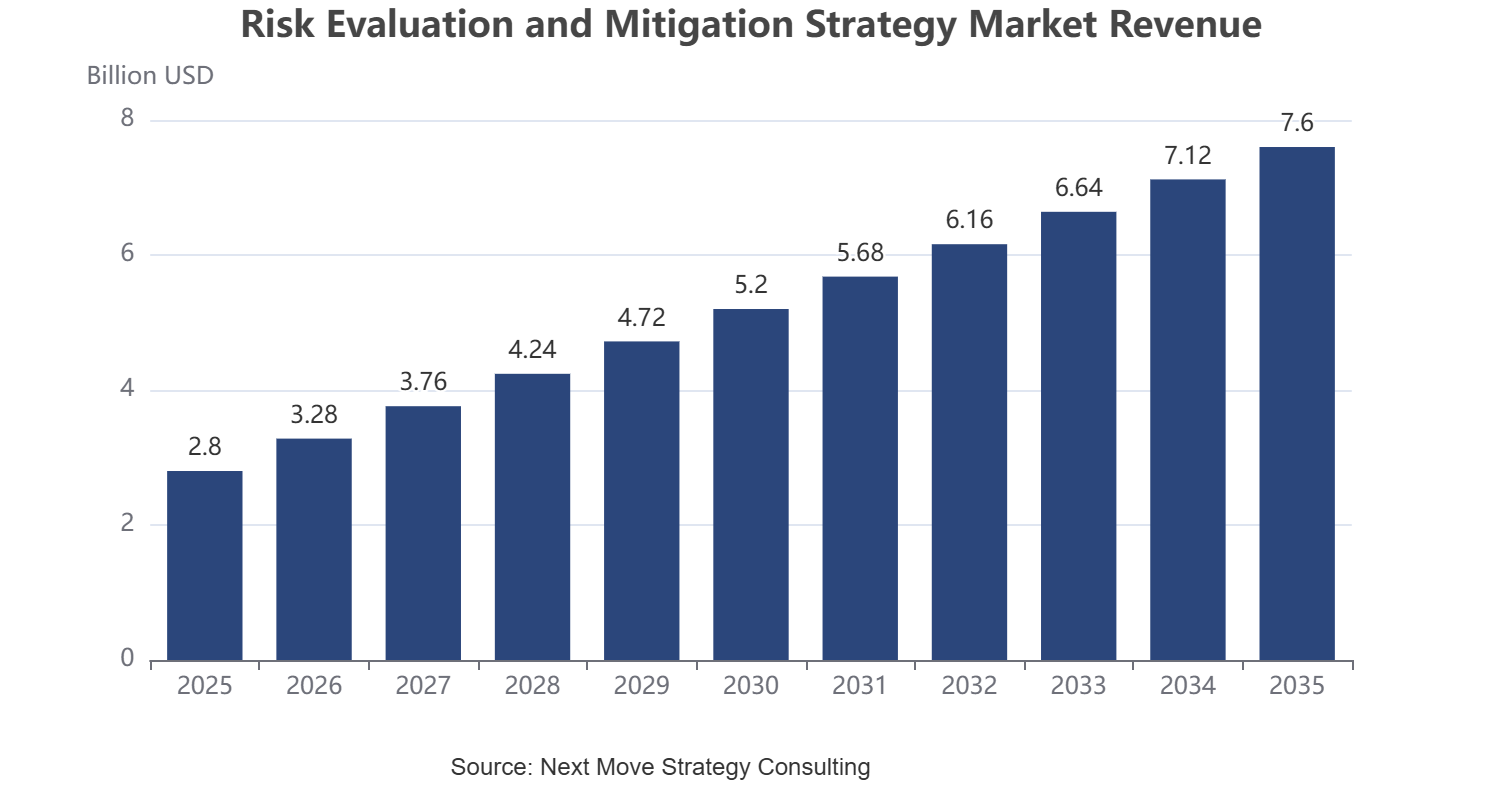
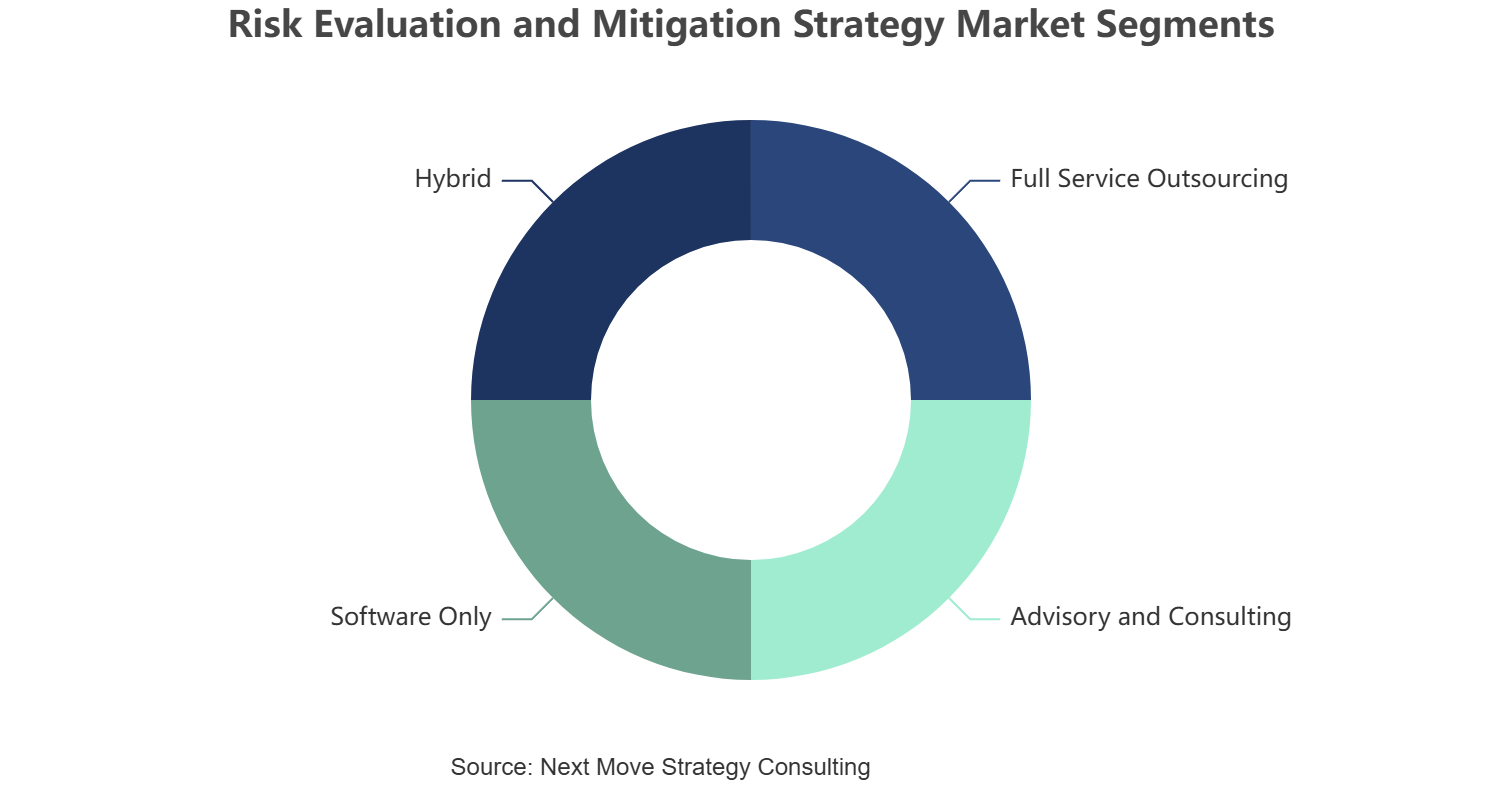
About the Author
 Liza Phukan
— Liza Phukan is Research Associate at Next Move Strategy Consulting, where she has covered emerging industries and market research across sectors for 3.5 years. Her work includes analyzing industry developments, validating market data, and developing structured business content from research findings. She uses secondary research and data-validation practices to turn complex market information into clear decision-useful market analysis for business audiences and support report development and B2B.
Liza Phukan
— Liza Phukan is Research Associate at Next Move Strategy Consulting, where she has covered emerging industries and market research across sectors for 3.5 years. Her work includes analyzing industry developments, validating market data, and developing structured business content from research findings. She uses secondary research and data-validation practices to turn complex market information into clear decision-useful market analysis for business audiences and support report development and B2B.
About the Reviewer
 Supradip Baul
— Supradip Baul is an accomplished business consultant and strategist with over a decade of rich experience in market intelligence, strategy, technology, and business transformation. His work has included rigorous qualitative and quantitative analysis across multiple industries, helping clients shape investment decisions and long-term roadmaps. Earlier in his career, he was associated with Gartner, where he contributed to industry-leading reports and market share analyses. He has worked with leading global companies and holds an MBA with a dual specialization in Marketing and Finance.
Supradip Baul
— Supradip Baul is an accomplished business consultant and strategist with over a decade of rich experience in market intelligence, strategy, technology, and business transformation. His work has included rigorous qualitative and quantitative analysis across multiple industries, helping clients shape investment decisions and long-term roadmaps. Earlier in his career, he was associated with Gartner, where he contributed to industry-leading reports and market share analyses. He has worked with leading global companies and holds an MBA with a dual specialization in Marketing and Finance.
At Next Move Strategy Consulting, we understand that insightful market research is the cornerstone of successful business decisions. That's why we employ a robust and multifaceted approach, combining various methodologies to deliver the most accurate and actionable data for our clients.

Research Landscape
We navigate the world of research with two primary approaches:
Qualitative Approach
Our qualitative research methodologies involve immersive techniques such as in-depth interviews, focus groups, and observational studies. By engaging directly with individuals and stakeholders, we uncover valuable insights that quantitative data alone may overlook.

Quantitative Research
In tandem with qualitative methodologies, NMSC leverages the power of Quantitative Research to provide a robust foundation of numerical insights. Through systematic data collection and analysis, we quantify patterns, preferences, and market trends, offering a comprehensive view of the business landscape.
Our quantitative research approach employs diverse tools, including surveys, experiments, and statistical modelling. These methodologies enable us to gather data from a large and representative sample, ensuring the statistical significance of our findings. By employing structured questionnaires and standardized data collection methods, we guarantee the reliability and validity of the information we present to our clients.
Quantitative research is particularly effective in measuring the prevalence of trends, assessing market size, and gauging the impact of various factors on consumer behavior. The numerical precision attained through this approach equips our clients with actionable insights, facilitating data-driven decision-making and strategy formulation.


Our Specialized Toolbox for Industry-Specific Market Research
We deploy a specialized arsenal of techniques tailored to meet your unique requirements. Here's a glimpse into our comprehensive toolbox:

Information Procurement
The stage entails acquiring market data or relevant information through various sources and methodologies.


Market Research Approach
We utilize both top-down and bottom-up approaches in market research analysis to achieve a comprehensive understanding of the market dynamics, leveraging the broad perspective of industry trends and macroeconomic factors alongside detailed insights from specific segments and individual companies.

Porters Five Forces Analysis
We conduct Porter's Five Forces analysis to evaluate the competitive landscape of an industry, providing us with insights into factors that affect profitability and strategic positioning.

SWOT Analysis

Forecasting
We utilize a forecasting model to predict future consumption by considering parameters like population, economics, regulations, market competition, drivers, constraints, technology, and pricing. We also employ statistical techniques such as multilinear regression, exponential smoothing, moving average, ARIMA, and Monte Carlo simulations for accurate predictions. In econometric forecasting, we analyzed short-term and long-term event impacts, attributing values based on regulatory frameworks, economic factors, and market events.





 Speak to Our Analyst