Argentina Travel Insurance Market By Age Group (Generation X, Millennials, & Others), By Income Level (Low, Middle, & High-Income), By Coverage Type (Medical & Health, Trip Protection Coverage, & Others), By Distributional Channel (Insurance Companies, Banks, & Others), By Underwriting (Standard Underwriting, Simplified Issue, & Others), By End-User (Leisure & Holiday, Pilgrimage & Religious Travelers, & Others) – Analysis & Forecast, 2026–2035
Industry: BFSI | Latest Edition: September 10, 2026 | No of Pages: 226 | No. of Tables: 101 | No. of Figures: 88 | Format: PDF | Report Code: BF4690
Argentina Travel Insurance Market Size & Forecast
|
Parameters |
Details |
|
Market Size in 2026 |
USD 29.2 million |
|
Revenue Forecast in 2035 |
USD 142.5 million |
|
Growth Rate |
CAGR of 15.8% from 2026 to 2035 |
|
Analysis Period |
2025–2035 |
|
Base Year Considered |
2025 |
|
Forecast Period |
2026–2035 |
|
Market Size Estimation |
Million (USD) |
|
Companies Profiled |
10 |
|
Market Share |
Available for 10 companies |
Industry Outlook
The Argentina Travel Insurance Market size was valued at USD 29.2 million in 2025 and is expected to reach USD 38 million by 2026. Looking ahead, the industry is projected to expand significantly, reaching USD 142.5 million by 2035, registering a CAGR of 15.8% from 2026 to 2035.
Ecosystem Analysis of the Argentina Travel Insurance Market:
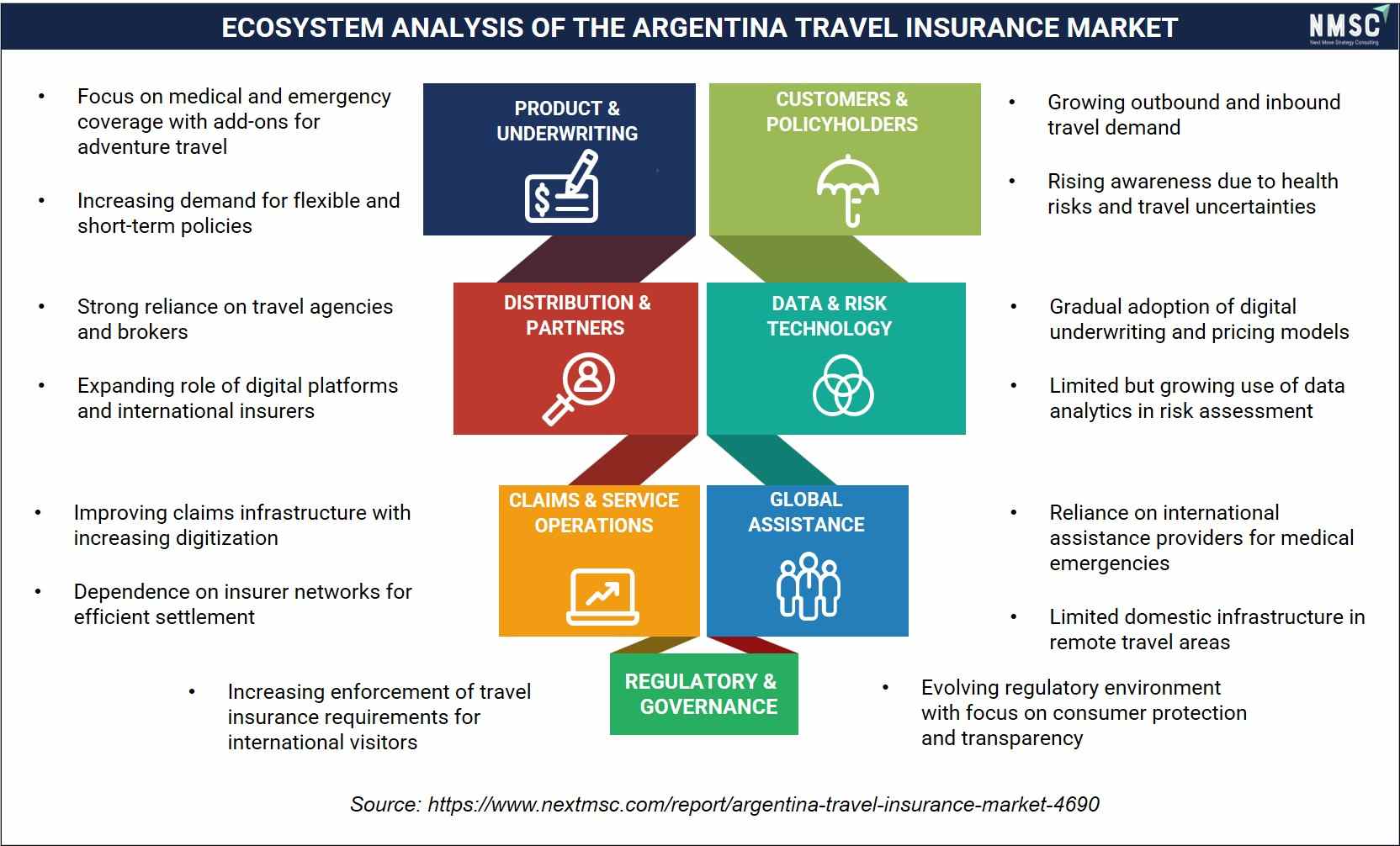
The infographic breaks down the Argentina travel insurance market into six interconnected layers, each building logically upon the next. The framework begins with product underwriting and customer segments, where demand is shaped by price-sensitive travelers seeking basic coverage. From there, distribution partners, primarily travel agencies and brokers, connect insurers with policyholders, though online channels are gradually gaining ground. Data analytics and risk technology then inform pricing decisions, while claims and service operations directly influence customer satisfaction and retention. Finally, the entire ecosystem operates under Argentina's evolving regulatory and governance framework, which continues to strengthen transparency and compliance requirements as the market matures. Together, these layers demonstrate how each component depends on the others for sustainable growth.
What are the Key Market Drivers, Breakthroughs, and Investment Opportunities that will Shape the Argentina Travel Insurance Market in the Next Decade?
Growth Catalyst & Risk Assessment Matrix
|
DRIVERS / TRENDS / RESTRAINTS |
(+/–) % IMPACT ON CAGR FORECAST |
GEOGRAPHIC RELEVANCE |
IMPACT TIMELINE |
|
Strong cultural and business travel ties with Europe driving consistent long-haul and visa-linked insurance demand |
+1.15% |
Argentina outbound corridors to Spain, Italy, and broader Europe |
Short to medium term (1–3 years) |
|
Rising outbound student mobility to North America and Europe driving mandatory long-duration insurance adoption |
+0.89% |
Argentina student travel corridors to U.S., Canada, the UK, and the EU |
Short to medium term (1–3 years) |
|
Adoption of USD-denominated insurance improving confidence and stability in international coverage purchases |
+0.61% |
High-income and frequent travelers across Argentina |
Medium term (2–4 years) |
|
Expansion of USD-based insurance accessibility enabling higher-value and long-duration policy uptake |
+0.46% |
Urban and globally mobile traveler segments |
Medium to long term (2–5 years) |
|
Severe currency instability reducing outbound travel frequency and limiting overall insurance demand |
-0.82% |
Middle- and upper-middle-income travelers across Argentina |
Medium term (2–4 years) |
The travel insurance market in Argentina is shaped by a mix of strong outbound mobility links, rising education-driven migration, and significant macroeconomic instability. We observed that cultural and business ties with Europe, particularly Spain and Italy, continue to drive steady international travel flows, while student mobility toward North America and Europe is gradually expanding the insured traveler base. At the same time, severe currency volatility is acting as a major structural constraint, reducing overall outbound travel frequency and influencing how consumers approach travel-related spending. In response to these conditions, USD-denominated travel insurance products are gaining relevance as they help shield consumers from local currency depreciation risks. Based on our analysis, we noticed that the market is evolving in a dual direction, expanding structurally in high-value travel segments while remaining constrained in mass adoption due to affordability pressures. Overall, future growth depends on financial stabilization dynamics, flexible pricing models, and currency-hedged insurance offerings.
Growth Drivers:
How are strong cultural and Business Travel Ties with Europe Supporting the Argentina Travel Insurance Market?
NMSC analysis indicates that strong cultural and business travel ties between Argentina and Europe, particularly Spain and Italy, are playing a key role in supporting travel insurance demand. A large portion of outbound travel is driven by family connections, heritage-based tourism, academic exchange, and corporate engagements, all of which contribute to consistent international mobility. These long-haul trips require comprehensive travel insurance coverage, especially when visa compliance or formal documentation is involved. We also observed that travelers in this segment tend to opt for broader protection, including medical coverage, trip interruption, and baggage loss, due to higher travel costs and longer stay durations. Further, established diaspora networks further reinforce repeat travel behaviour, indirectly stabilizing insurance demand over time. Additionally, travel agencies and visa support services bundle insurance into travel planning processes, improving adoption rates. Overall, this driver is supporting steady baseline demand while gradually encouraging more value-oriented insurance uptake.
How is Rising Outbound Student Mobility to North America and Europe Driving Market Growth?
Rising outbound student mobility from Argentina to North America and Europe is emerging as an important growth driver for the Argentina travel insurance market. The increasing enrollment in international universities and exchange programs is expanding the base of long-duration travelers who require continuous insurance coverage. These students typically seek protection for medical emergencies, hospitalization, and travel disruptions over extended periods, making them a structurally valuable segment for insurers. We observed that universities and visa authorities mandate insurance coverage as part of admission or visa approval processes, ensuring a consistent level of penetration. From our perspective, this segment is particularly important because it introduces early exposure to insurance products among younger consumers, potentially influencing long-term adoption behaviour. In addition, families purchase higher-coverage plans due to concern over healthcare costs abroad. Overall, student mobility is steadily contributing to deeper and more stable insurance demand, particularly in long-duration policy categories.
How is USD-Denominated Travel Insurance Helping Consumers Manage Currency Volatility Risks?
Our market evaluation indicates that USD-denominated travel insurance products are becoming increasingly relevant in Argentina due to persistent currency instability. Frequent depreciation of the local currency significantly affects consumers’ purchasing power, making foreign travel-related expenses more unpredictable. In this context, USD-linked insurance products provide a level of cost stability and protection against exchange rate fluctuations. Further, travelers perceive these products as more reliable for international trips, especially when dealing with medical coverage and high-value claims settled in foreign currencies. This currency-hedged structure is particularly attractive for long-haul travelers and high-income segments who are more exposed to international spending. It also helps insurers position their offerings as financially predictable products rather than volatile local-currency expenses. Overall, USD-denominated policies are gradually improving consumer confidence and supporting more consistent insurance uptake despite macroeconomic volatility.
Growth Inhibitor:
How is Severe Currency Instability Reducing International Travel Frequency in Argentina?
Through our market research, we observed that severe currency instability is a major restraint on Argentina travel insurance market, primarily by reducing overall international travel frequency. Frequent devaluation of the local currency makes overseas travel significantly more expensive in real terms, discouraging discretionary travel spending among middle-income households. This directly limits the addressable base for travel insurance adoption, as fewer trips naturally translate into fewer policy purchases. We also observed that consumers delay or cancel travel plans due to uncertainty around exchange rates and total trip costs. Even when travel demand exists, financial unpredictability leads to shorter trips or lower-cost destinations, which reduces the perceived need for comprehensive insurance coverage. Additionally, inflationary pressures further constrain disposable income, pushing insurance into a non-essential category for many travelers. Overall, currency volatility is not only reducing travel volume but also weakening consistent growth in travel insurance penetration across broader consumer segments.
Growth Opportunity:
How is Expanding USD-Based Insurance Accessibility Creating New Growth Opportunities in the Argentina Travel Insurance Market?
The expansion of USD-based travel insurance products is creating a meaningful growth opportunity in Argentina’s market by addressing currency risk concerns directly. Consumers increasingly prefer pricing structures that are decoupled from local currency fluctuations, as this provides greater predictability in international travel budgeting. We found that USD-linked products are gaining traction among frequent travelers, students abroad, and higher-income groups who are more exposed to foreign currency expenses. This model is particularly effective in improving consumer trust during periods of macroeconomic instability, as it reduces uncertainty around future insurance value and claim settlements. It also enables insurers to design more stable pricing frameworks that are less impacted by domestic inflation cycles. Overall, USD-based offerings are gradually expanding market confidence and supporting higher willingness to purchase comprehensive coverage, especially for long-duration and high-value international travel segments.
How is the Argentina Travel Insurance Industry segmented in this report, and what are the key insights from the segmentation analysis?
By Traveler Structure Insights
How Does Traveler Structure Influence Travel Insurance Adoption in Argentina in 2025?
Based on traveler structure, the Argentina travel insurance market is segmented into solo travelers, couple travelers, family travelers, and group travelers.
Solo travelers are increasingly inclined toward affordable, flexible policies that prioritize medical coverage and trip adaptability, reflecting rising independent and budget-conscious travel patterns. On the other hand, couple travelers typically seek balanced plans combining convenience and enhanced protection, particularly for long-haul leisure trips. Family travelers demonstrate stronger demand for comprehensive coverage, including dependents, cancellations, and health-related risks, driven by safety considerations and higher trip value. Through our market assessment, we observed that group travelers, spanning corporate travel and organized tours, prefer standardized, cost-efficient insurance solutions arranged via agencies, supported by Argentina’s growing outbound travel recovery and structured booking channels in 2025.
By End-User Insights
How Do End-User Segments Shape Travel Insurance Demand in the Argentina Travel Insurance Market in 2025?
Based on end-user, the Argentina travel insurance market is segmented into leisure & holiday travelers, business travelers, education/student travelers, pilgrimage & religious travelers, adventure & sports travelers, medical tourism travelers, and family & group travelers.
Leisure and holiday travellers form the core demand base, typically favouring flexible, trip-specific coverage aligned with seasonal and discretionary travel patterns, which naturally extends to the needs of business travellers, who prioritise higher coverage limits and multi-trip efficiency due to frequent and time-sensitive journeys. This progression continues with education and student travelers, where longer stays and visa-linked requirements drive demand for comprehensive, duration-based policies with strong medical protection. In parallel, more specialized segments such as adventure and sports travelers, along with medical tourism travelers, require tailored plans addressing high-risk activities and treatment-related contingencies. Pilgrimage travel introduces a seasonal, group-oriented dynamic, which closely aligns with family and group travelers seeking bundled, cost-efficient coverage. This interconnected structure is steadily encouraging insurers to refine product customisation and digital distribution strategies in Argentina in 2025.
Competitive Landscape
Based on our competitive study, we found that the Argentina travel insurance market is characterised by a moderately fragmented and evolving competitive structure, supported by the presence of global insurers alongside regional providers and assistance service companies. Market demand is driven by outbound travel to North America and Europe, increasing awareness of healthcare costs abroad, and the need for financial protection against trip disruptions. At the same time, economic volatility and currency fluctuations influence purchasing behaviour, encouraging demand for flexible and cost-effective travel insurance solutions. The gradual expansion of digital distribution channels and partnerships with travel agencies and financial institutions is further improving accessibility across the market.
Strategic Developments:
-
February 2026 - MAPFRE’s Latam Insurtech Journey 2026 report identified Argentina as the fourth-largest insurtech hub in Latin America.
Key Players of the Argentina Travel Insurance Market:
-
MAPFRE S.A.
-
The Cigna Group
-
Allianz Partners SAS
-
Zurich Insurance Group AG
-
Chubb Limited
-
World Nomads Group Pty Ltd
-
Berkshire Hathaway Specialty Insurance Company
-
AIG Travel Guard
-
AXA Assistance SAS
We observed that competitive intensity is increasingly shaped by product flexibility, digital accessibility, and international assistance capabilities rather than price-led positioning alone. Key players of the Argentina travel insurance market, such as Assicurazioni Generali S.p.A., MAPFRE S.A., The Cigna Group, Allianz Partners SAS, Zurich Insurance Group AG, Chubb Limited, and others are strengthening their presence through broader distribution networks, enhanced claims management systems, and tailored coverage offerings for outbound travellers. NMSC evaluation indicates that insurers with strong global partnerships, efficient service delivery, and adaptable product structures are better positioned to navigate market volatility and capture evolving demand. Overall, the competitive landscape is gradually progressing toward a more service-driven and digitally integrated structure in the Argentina travel insurance market.
Strategic Framework Analysis of the Argentina Travel Insurance Market:
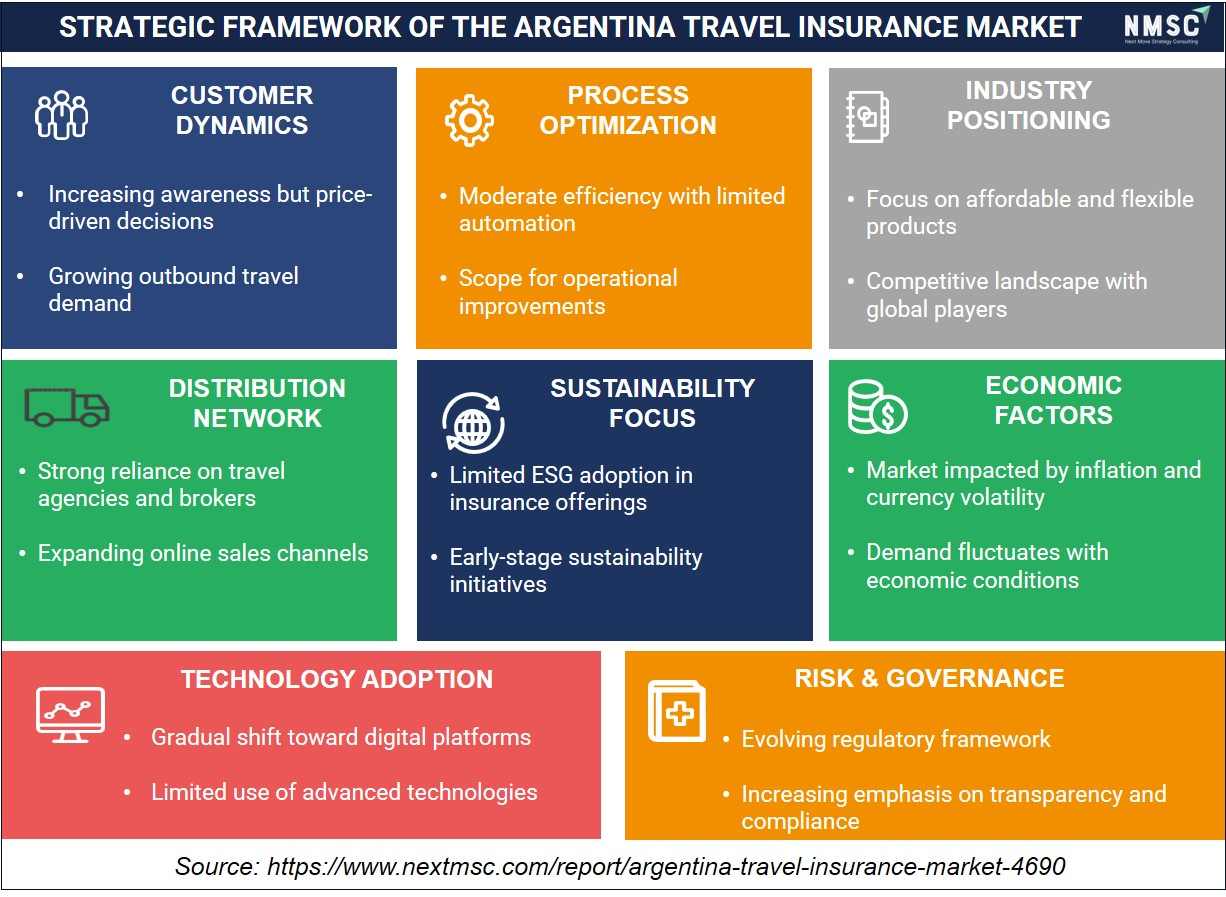
This infographic organizes the Argentina travel insurance market into strategic pillars that collectively define its competitive landscape. Beginning with customer dynamics, we noticed that awareness of travel insurance is gradually increasing, yet purchasing decisions remain heavily driven by price rather than coverage depth. As a result, the industry has positioned itself around affordable and flexible products, even as global players compete for market share. Turning to distribution, the market still relies strongly on travel agencies and brokers, although online sales channels are slowly expanding. Meanwhile, technology adoption remains gradual, with limited use of advanced tools, which means process optimization still offers significant room for improvement. Economically, persistent inflation and currency volatility directly impact travel spending, causing demand to fluctuate with broader economic conditions. Finally, while ESG adoption remains limited, the regulatory framework is evolving with increasing emphasis on transparency and compliance.
Argentina Travel Insurance Market Key Segments
By Age Group
-
Generation Z (18–24 years)
-
Millennials (25–40 years)
-
Generation X (41–56 years)
-
Baby Boomers (57–75 years)
-
Senior Travelers (Above 75 years)
By Income Level
-
Low-Income Travelers
-
Middle-Income Travelers
-
High-Income Travelers
By Traveler Structure
-
Solo Travelers
-
Couple Travelers
-
Family Travelers
-
Group Travelers
By Coverage Type
-
Medical & Health Coverage
-
Emergency Medical Treatment
-
Hospitalization
-
Medical Evacuation & Repatriation
-
-
Trip Protection Coverage
-
Trip Cancellation
-
Trip Interruption
-
Trip Delay
-
Missed Connections
-
-
Asset & Document Protection Coverage
-
Baggage & Personal Belongings
-
Loss of Travel Documents
-
-
Personal Accident Coverage
-
Accidental Death & Dismemberment (AD&D)
-
Permanent / Temporary Disability
-
-
Liability Coverage
-
Personal Liability
-
Legal Expenses Abroad
-
By Days Of Coverage
-
Single-Trip Insurance
-
Short Duration (1–7 days)
-
Medium Duration (8–30 days)
-
Long Duration (31–90 days)
-
Extended Duration (91–180 days)
-
Multi-Trip Insurance
-
Annual Multi-Trip
-
Frequent Business Travel Plans
By Geographic Scope
-
Domestic Travel
-
International Travel
By Distributional Channel
-
Direct Sales by Insurance Companies
-
Bancassurance (Banks & NBFCs)
-
Airline & Travel Booking Platforms
-
Online Insurance Aggregators & Comparison Websites
-
Travel Agents & Tour Operators
By Sales Model
-
Standalone Travel Insurance
-
Bundled Travel Insurance
By Underwriting
-
Standard Underwriting
-
Simplified Issue
-
Fully Underwritten
-
Guaranteed Issue
By Pricing Mechanism
-
Age-Based Pricing
-
Destination-Based Pricing
-
Duration-Based Pricing
-
Risk-Based Pricing
By Policy Delivery Mode
-
Online
-
Offline
-
Hybrid
By Value Tier
-
Basic/Economy Plans
-
Standard Plans
-
Premium Plans
-
Elite/Platinum Plans
By End-User
-
Leisure & Holiday Travelers
-
Business Travelers
-
Education / Student Travelers
-
Pilgrimage & Religious Travelers
-
Adventure & Sports Travelers
-
Medical Tourism Travelers
-
Family & Group Travelers
Key Benefits for Stakeholders:
Next Move Strategy Consulting (NMSC) presents a comprehensive analysis of the Argentina travel insurance market trends, covering historical trends from 2020 through 2025 and offering detailed forecasts through 2035. Our study examines the market at regional and country levels, providing quantitative projections and insights into key growth drivers, challenges, and investment opportunities across all major travel insurance segments.
The Argentina travel insurance market delivers aligned benefits for investors, customers, and policymakers as international travel demand and digital distribution gradually strengthen. Investors benefit from improving penetration of online channels and more stable premium generation, supporting revenue visibility despite a volatile economic environment. Customers gain greater access to affordable travel protection, helping mitigate financial risks during overseas trips, with increasingly streamlined digital purchase and claims experiences. Moreover, policymakers benefit from stronger regulatory alignment with international travel requirements and enhanced consumer protection frameworks, which together foster greater trust and encourage participation in the formal insurance ecosystem.
|
Parameters |
Details |
|
Customization Scope |
Free customization (equivalent to up to 80 analyst-working hours) after purchase. |
|
Pricing and Purchase Options |
Avail customized purchase options to meet your exact research needs. |
|
Approach |
In-depth primary and secondary research; proprietary databases; rigorous quality control and validation measures. |
|
Analytical Tools |
Porter's Five Forces, SWOT, value chain, and Harvey ball analysis to assess competitive intensity, stakeholder roles, and relative impact of key factors. |


About the Author
 Mayurima Roy
— Mayurima Roy is Research Analyst at Next Move Strategy Consulting, where she has spent 4 years working across the firm's full industry coverage rather than a single fixed vertical. Her work centers on structured research, ongoing trend tracking, competitive assessment, and insight-led content development, translating complex market data into clear, decision-ready narratives that support informed client decision-making across diverse global industries, market sectors, and world regions every day.
Mayurima Roy
— Mayurima Roy is Research Analyst at Next Move Strategy Consulting, where she has spent 4 years working across the firm's full industry coverage rather than a single fixed vertical. Her work centers on structured research, ongoing trend tracking, competitive assessment, and insight-led content development, translating complex market data into clear, decision-ready narratives that support informed client decision-making across diverse global industries, market sectors, and world regions every day.
About the Reviewer
 Supradip Baul
— Supradip Baul is an accomplished business consultant and strategist with over a decade of rich experience in market intelligence, strategy, technology, and business transformation. His work has included rigorous qualitative and quantitative analysis across multiple industries, helping clients shape investment decisions and long-term roadmaps. Earlier in his career, he was associated with Gartner, where he contributed to industry-leading reports and market share analyses. He has worked with leading global companies and holds an MBA with a dual specialization in Marketing and Finance.
Supradip Baul
— Supradip Baul is an accomplished business consultant and strategist with over a decade of rich experience in market intelligence, strategy, technology, and business transformation. His work has included rigorous qualitative and quantitative analysis across multiple industries, helping clients shape investment decisions and long-term roadmaps. Earlier in his career, he was associated with Gartner, where he contributed to industry-leading reports and market share analyses. He has worked with leading global companies and holds an MBA with a dual specialization in Marketing and Finance.
At Next Move Strategy Consulting, we understand that insightful market research is the cornerstone of successful business decisions. That's why we employ a robust and multifaceted approach, combining various methodologies to deliver the most accurate and actionable data for our clients.

Research Landscape
We navigate the world of research with two primary approaches:
Qualitative Approach
Our qualitative research methodologies involve immersive techniques such as in-depth interviews, focus groups, and observational studies. By engaging directly with individuals and stakeholders, we uncover valuable insights that quantitative data alone may overlook.

Quantitative Research
In tandem with qualitative methodologies, NMSC leverages the power of Quantitative Research to provide a robust foundation of numerical insights. Through systematic data collection and analysis, we quantify patterns, preferences, and market trends, offering a comprehensive view of the business landscape.
Our quantitative research approach employs diverse tools, including surveys, experiments, and statistical modelling. These methodologies enable us to gather data from a large and representative sample, ensuring the statistical significance of our findings. By employing structured questionnaires and standardized data collection methods, we guarantee the reliability and validity of the information we present to our clients.
Quantitative research is particularly effective in measuring the prevalence of trends, assessing market size, and gauging the impact of various factors on consumer behavior. The numerical precision attained through this approach equips our clients with actionable insights, facilitating data-driven decision-making and strategy formulation.


Our Specialized Toolbox for Industry-Specific Market Research
We deploy a specialized arsenal of techniques tailored to meet your unique requirements. Here's a glimpse into our comprehensive toolbox:

Information Procurement
The stage entails acquiring market data or relevant information through various sources and methodologies.


Market Research Approach
We utilize both top-down and bottom-up approaches in market research analysis to achieve a comprehensive understanding of the market dynamics, leveraging the broad perspective of industry trends and macroeconomic factors alongside detailed insights from specific segments and individual companies.

Porters Five Forces Analysis
We conduct Porter's Five Forces analysis to evaluate the competitive landscape of an industry, providing us with insights into factors that affect profitability and strategic positioning.

SWOT Analysis

Forecasting
We utilize a forecasting model to predict future consumption by considering parameters like population, economics, regulations, market competition, drivers, constraints, technology, and pricing. We also employ statistical techniques such as multilinear regression, exponential smoothing, moving average, ARIMA, and Monte Carlo simulations for accurate predictions. In econometric forecasting, we analyzed short-term and long-term event impacts, attributing values based on regulatory frameworks, economic factors, and market events.





 Speak to Our Analyst