Artificial Intelligence (AI) Bots Market Global Industry Analysis and Forecast (2026-2035)

Artificial Intelligence (AI) Bots market size is estimated at USD 22.87 billion in 2026, projected to reach USD 188.38 billion by 2035, growing at a CAGR of 26.40% from 2026 to 2035. Key drivers include rising autonomous agent adoption, expanding enterprise customer experience automation, and growing agentic AI platform investment, with North America leading the market and Asia-Pacific registering the fastest growth.

Download Free Sample PDF
Base Year (2025)
$16.48 Billion
Forecast (2035)
$188.38 Billion
CAGR (2026-2035)
26.4%
Top Region
North America

What is the Artificial Intelligence (AI) Bots Market Size?

The global Artificial Intelligence (AI) Bots market size was valued at USD 16.48 billion in 2025 and is estimated at USD 22.87 billion in 2026, forecast to reach USD 188.38 billion by 2035, expanding at a 26.40% CAGR between 2026 and 2035. North America leads with approximately 44% share, while AI Bot Applications dominate all other offerings with approximately 72% share.

Market growth is broad-based across every segmentation axis, with autonomous agents and AI bot platforms driving the most pronounced structural shifts through 2035.

Artificial Intelligence (AI) Bots Market Global Industry Analysis and Forecast (2026-2035) Revenue Forecast

Values in USD Billion

2025 $16.48 Billion
2025
2026 $22.87 Billion
2026
2027 $28.91 Billion
2027
2028 $36.54 Billion
2028
2029 $46.19 Billion
2029
2030 $58.38 Billion
2030
2031 $73.79 Billion
2031
2032 $93.27 Billion
2032
2033 $117.90 Billion
2033
2034 $149.02 Billion
2034
2035 $188.38 Billion
2035

Key Takeaways

By Offering: AI Bot Applications held the largest share of approximately 72% (USD 11.87 Billion) in 2025; AI Bot Platforms is the fastest-growing sub-segment at 34.8% CAGR from 2026–2035.

By Modality: Text Bots held the largest share of approximately 62% (USD 10.22 Billion) in 2025; Multimodal Bots is the fastest-growing sub-segment at 32.4% CAGR from 2026–2035.

By Autonomy: Conversational Bots held the largest share of approximately 58% (USD 9.56 Billion) in 2025; Autonomous Agents is the fastest-growing sub-segment at 45.8% CAGR from 2026–2035.

By Deployment: Cloud held the largest share of approximately 76% (USD 12.52 Billion) in 2025; Hybrid is the fastest-growing sub-segment at 28.9% CAGR from 2026–2035.

By Commercial Model: Subscription held the largest share of approximately 54% (USD 8.90 Billion) in 2025; Usage-Based is the fastest-growing sub-segment at 29.6% CAGR from 2026–2035.

By Access Channel: Web held the largest share of approximately 38% (USD 6.26 Billion) in 2025; Embedded is the fastest-growing sub-segment at 30.1% CAGR from 2026–2035.

By Buyer Type: Customer Experience held the largest share of approximately 42% (USD 6.92 Billion) in 2025; Technology is the fastest-growing sub-segment at 27.8% CAGR from 2026–2035.

By End-User Industry: BFSI held the largest share of approximately 19% (USD 3.13 Billion) in 2025; IT and Software is the fastest-growing sub-segment at 34.6% CAGR from 2026–2035.

Dominant Region: North America dominated with approximately 44% revenue share (USD 7.25 Billion) in 2025.

Fastest-Growing Region: Asia-Pacific is expected to register the highest CAGR of 34.4% during 2026–2035.

Dominant Country: U.S. led with approximately USD 5.80 Billion in 2025.

Fastest-Growing Country: India is the fastest-growing country at approximately 39.8% CAGR from 2026–2035.

Market Opportunity: The Artificial Intelligence (AI) Bots market is expected to create an absolute dollar opportunity of USD 165.51 billion between 2026 and 2035, presenting significant investment potential across autonomous agents and AI bot platform categories.

According to NMSC analysis, enterprises are increasingly consolidating bot procurement around unified agentic platforms that combine customer experience, employee experience, and personal productivity capabilities, a shift that favors platform-based vendors over single-use-case point solutions as autonomous agent adoption accelerates through 2035.

What Does the Artificial Intelligence (AI) Bots Market Encompass?

The Artificial Intelligence (AI) Bots market encompasses software applications and platforms that use natural language processing, machine learning, and generative AI to automate conversational, task-based, and autonomous interactions across customer-facing and internal enterprise workflows. Our assessment indicates that the scope spans customer experience, employee experience, and personal productivity bot applications alongside development, runtime, management, and integration platforms sold across cloud, on-premises, and hybrid deployment models worldwide. The category has evolved from scripted, rule-based chatbots into increasingly autonomous, generative AI-powered agents capable of multi-step task execution without constant human supervision.
We observed that data privacy and AI governance regulations increasingly shape bot deployment practices, while enterprise software vendors inform integration standards across collaboration and contact center platforms. NMSC's analysis indicates that technology adoption is shifting toward autonomous agents and multimodal interaction capabilities that extend bot functionality beyond text-based conversation, a structural shift redefining sourcing criteria across the Artificial Intelligence (AI) Bots market.

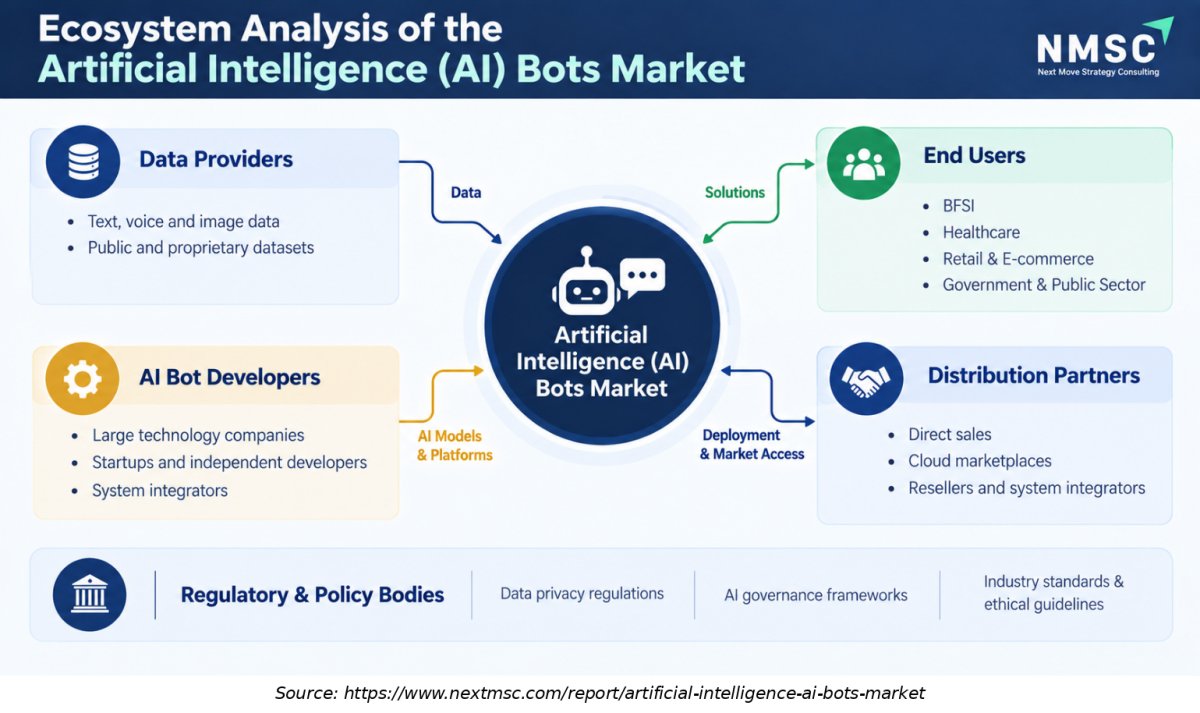
Ecosystem Analysis of the Artificial Intelligence (AI) Bots Market

This infographic presents the AI bots market ecosystem, highlighting the roles of data providers, AI bot developers, end users, and distribution partners. It illustrates how data, AI models, bot platforms, solutions, and deployment channels interact to support the development, delivery, and adoption of AI-powered bots across industries.

Market Drivers & Dynamics

Interactive Dataset
Rising autonomous agent and agentic AI adoption driver +5.8% Global 2026–2035
Expanding enterprise customer experience automation investment driver +4.2% North America, Europe 2026–2032
Growing generative AI foundation model capability improvements driver +3.6% Global 2026–2032
Rising IT and software sector bot platform integration driver +2.9% North America, Asia-Pacific 2026–2032
Expanding contact center and enterprise collaboration bot deployment driver +2.3% Global 2026–2035
Growing digital adoption across emerging Asia-Pacific economies driver +1.8% Asia-Pacific 2026–2035
Data privacy and AI governance compliance complexity restraint −1.6% Europe, North America 2026–2032
Enterprise concerns regarding autonomous agent reliability and operational oversight. restraint −1.2% Global 2026–2032
Integration complexity with legacy enterprise systems restraint −0.8% Global 2026–2035
Source: Next Move Strategy Consulting

Growth Drivers

What Is the Primary Growth Driver of the Artificial Intelligence (AI) Bots Market?

Rising autonomous agent and agentic AI adoption is the primary driver of the market. The U.S. National Institute of Standards and Technology continues to publish AI risk management guidance that informs enterprise frameworks for deploying increasingly autonomous AI systems. We observed that this adoption trajectory, reinforced by expanding customer experience automation investment, continues to anchor demand for AI bots across developed and emerging enterprise markets alike.

How Is Generative AI Capability Driving Artificial Intelligence (AI) Bots Market Growth?

Growing generative AI foundation model capability improvements are accelerating growth in increasingly sophisticated bot categories. The U.S. Federal Trade Commission continues to monitor AI-powered consumer-facing automation practices as generative AI capabilities expand across customer service and sales applications. Our assessment indicates that this capability trajectory is compressing deployment timelines for advanced conversational and autonomous bot categories across enterprise customers.

Growth Inhibitors

What Is Restraining Artificial Intelligence (AI) Bots Market Expansion?

Data privacy and AI governance compliance complexity restrains market expansion, particularly among enterprises operating across multiple regulatory jurisdictions. National data protection authorities have issued public guidance requiring transparency around automated decision-making systems, including conversational and autonomous bots. We found that enterprises lacking dedicated AI governance frameworks face particular exposure, as compliance gaps can delay deployment timelines compared with organizations holding established AI oversight processes.

What Are the Growth Opportunities?

How Can Vertical-Specific Autonomous Agents Unlock Value for Regulated Industries?

Vertical-specific autonomous agents present a whitespace opportunity for vendors serving BFSI and healthcare enterprises navigating strict regulatory oversight requirements. Providers that commercialize compliance-aware autonomous agents stand to capture long-term enterprise contracts as regulated industries seek automation that integrates built-in governance controls.

Where Does Embedded Access Channel Integration Create New Demand?

Embedded access channel integration represents an underpenetrated opportunity for vendors targeting enterprise software providers seeking to natively embed bot capabilities within their own applications. Providers that package white-label, embeddable bot infrastructure can secure long-term technology partnership agreements, benefiting from recurring platform licensing revenue.

How Can Usage-Based Pricing Models Benefit Mid-Market Enterprise Buyers?

Usage-based commercial models create an opportunity for vendors serving mid-market enterprises seeking to align bot spending directly with measurable business outcomes. Early movers that offer per-outcome and per-action pricing structures can differentiate ahead of broader enterprise budget scrutiny of AI automation investment through 2035.

Segmentation Analysis

2025 (USD Billion)
2035 (USD Billion)
AI Bot Applications 2025: $11.87 Billion | 2035: $120.56 Billion
AI Bot Appli
AI Bot Platforms 2025: $4.61 Billion | 2035: $67.82 Billion
AI Bot Platf
AI Bot Applications $11.87 Billion $120.56 Billion 29.0%
AI Bot Platforms $4.61 Billion $67.82 Billion 34.8%

Which Offering Dominates the Artificial Intelligence (AI) Bots Market?

AI Bot Applications led the market with USD 11.87 billion in 2025, supported by widespread enterprise deployment of customer experience, employee experience, and personal productivity bots. We observed that AI Bot Platforms is the fastest-growing offering, expanding at a 34.8% CAGR from 2026 to 2035, as enterprises increasingly invest in development, runtime, management, and integration infrastructure to build and operate bots at scale.

2025 (USD Billion)
2035 (USD Billion)
Category A
Category B
Category C
Category D
Segment Item 2025 (USD Billion) 2035 (USD Billion) CAGR
Category A $10.0 USD Billion $40.0 USD Billion 25.0%
Category B $17.1 USD Billion $51.1 USD Billion 11.0%
Category C $24.2 USD Billion $62.2 USD Billion 25.0%
Category D $31.3 USD Billion $73.3 USD Billion 11.0%

Segment-wise data is locked

Unlock complete segment-wise numbers for By Modality.

Unlock Full Data
2025 (USD Billion)
2035 (USD Billion)
Category A
Category B
Category C
Category D
Segment Item 2025 (USD Billion) 2035 (USD Billion) CAGR
Category A $10.0 USD Billion $40.0 USD Billion 27.0%
Category B $17.1 USD Billion $51.1 USD Billion 9.0%
Category C $24.2 USD Billion $62.2 USD Billion 19.0%
Category D $31.3 USD Billion $73.3 USD Billion 17.0%

Segment-wise data is locked

Unlock complete segment-wise numbers for By Autonomy.

Unlock Full Data
2025 (USD Billion)
2035 (USD Billion)
Category A
Category B
Category C
Category D
Segment Item 2025 (USD Billion) 2035 (USD Billion) CAGR
Category A $10.0 USD Billion $40.0 USD Billion 14.0%
Category B $17.1 USD Billion $51.1 USD Billion 24.0%
Category C $24.2 USD Billion $62.2 USD Billion 22.0%
Category D $31.3 USD Billion $73.3 USD Billion 12.0%

Segment-wise data is locked

Unlock complete segment-wise numbers for By Deployment.

Unlock Full Data
2025 (USD Billion)
2035 (USD Billion)
Category A
Category B
Category C
Category D
Segment Item 2025 (USD Billion) 2035 (USD Billion) CAGR
Category A $10.0 USD Billion $40.0 USD Billion 24.0%
Category B $17.1 USD Billion $51.1 USD Billion 22.0%
Category C $24.2 USD Billion $62.2 USD Billion 20.0%
Category D $31.3 USD Billion $73.3 USD Billion 22.0%

Segment-wise data is locked

Unlock complete segment-wise numbers for By Commercial Model.

Unlock Full Data
2025 (USD Billion)
2035 (USD Billion)
Category A
Category B
Category C
Category D
Segment Item 2025 (USD Billion) 2035 (USD Billion) CAGR
Category A $10.0 USD Billion $40.0 USD Billion 23.0%
Category B $17.1 USD Billion $51.1 USD Billion 9.0%
Category C $24.2 USD Billion $62.2 USD Billion 19.0%
Category D $31.3 USD Billion $73.3 USD Billion 13.0%

Segment-wise data is locked

Unlock complete segment-wise numbers for By Access Channel.

Unlock Full Data
2025 (USD Billion)
2035 (USD Billion)
Category A
Category B
Category C
Category D
Segment Item 2025 (USD Billion) 2035 (USD Billion) CAGR
Category A $10.0 USD Billion $40.0 USD Billion 21.0%
Category B $17.1 USD Billion $51.1 USD Billion 23.0%
Category C $24.2 USD Billion $62.2 USD Billion 25.0%
Category D $31.3 USD Billion $73.3 USD Billion 15.0%

Segment-wise data is locked

Unlock complete segment-wise numbers for By Buyer Type.

Unlock Full Data
2025 (USD Billion)
2035 (USD Billion)
Category A
Category B
Category C
Category D
Segment Item 2025 (USD Billion) 2035 (USD Billion) CAGR
Category A $10.0 USD Billion $40.0 USD Billion 9.0%
Category B $17.1 USD Billion $51.1 USD Billion 23.0%
Category C $24.2 USD Billion $62.2 USD Billion 9.0%
Category D $31.3 USD Billion $73.3 USD Billion 23.0%

Segment-wise data is locked

Unlock complete segment-wise numbers for By End-User Industry.

Unlock Full Data

Growth Opportunities

Three forward-looking whitespace opportunities stand out for suppliers positioning ahead of 2035 demand across the Artificial Intelligence (AI) Bots market.

How Can Vertical-Specific Autonomous Agents Unlock Value for Regulated Industries?

Vertical-specific autonomous agents present a whitespace opportunity for vendors serving BFSI and healthcare enterprises navigating strict regulatory oversight requirements. Providers that commercialize compliance-aware autonomous agents stand to capture long-term enterprise contracts as regulated industries seek automation that integrates built-in governance controls.

Where Does Embedded Access Channel Integration Create New Demand?

Embedded access channel integration represents an underpenetrated opportunity for vendors targeting enterprise software providers seeking to natively embed bot capabilities within their own applications. Providers that package white-label, embeddable bot infrastructure can secure long-term technology partnership agreements, benefiting from recurring platform licensing revenue.

How Can Usage-Based Pricing Models Benefit Mid-Market Enterprise Buyers?

Usage-based commercial models create an opportunity for vendors serving mid-market enterprises seeking to align bot spending directly with measurable business outcomes. Early movers that offer per-outcome and per-action pricing structures can differentiate ahead of broader enterprise budget scrutiny of AI automation investment through 2035.

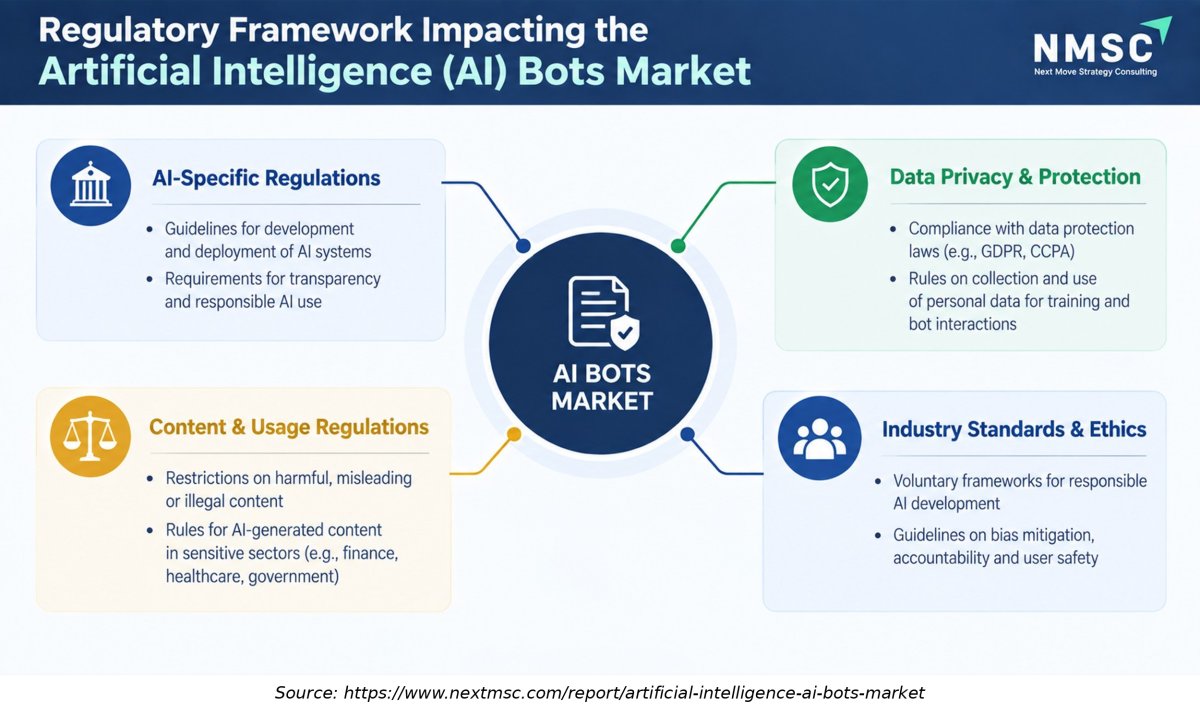
Regulatory Framework Impacting the Artificial Intelligence (AI) Bots Market

This infographic outlines the key regulatory factors shaping the AI bots market, including AI-specific regulations, data privacy and protection, content and usage requirements, and industry standards and ethics. It highlights how regulatory requirements influence AI bot development, data usage, deployment, transparency, responsible adoption, and compliance across different applications.

Regional Outlook

2025 (USD Billion)
2035 (USD Billion)
North Americ
Europe
Asia-Pacific
Middle East
Latin Americ
Region 2025 (USD Billion) 2035 (USD Billion) CAGR (%)
North America $10.0 USD Billion $40.0 USD Billion 9.0%
Europe $17.1 USD Billion $51.1 USD Billion 27.0%
Asia-Pacific $24.2 USD Billion $62.2 USD Billion 25.0%
Middle East & Africa $31.3 USD Billion $73.3 USD Billion 23.0%
Latin America $38.4 USD Billion $84.4 USD Billion 12.0%

Regional data is locked

Unlock complete regional numbers for this market.

Unlock Full Data

Competitive Landscape

We observed that the Artificial Intelligence (AI) Bots market features a highly dynamic competitive landscape, with established enterprise software and hyperscale cloud majors competing alongside specialized conversational AI and agentic platform vendors on model capability, platform breadth, and enterprise integration scale.

Dimension Description
Dimension Assessment
Market Structure The market is highly dynamic and moderately fragmented. Leading companies profiled account for a substantial share of industry revenue, while numerous specialized bot vendors serve niche vertical and use-case demands.
Innovation Focus Autonomous agent capability, agentic platform consolidation, and multimodal interaction dominate current innovation pipelines across leading vendors.
M&A Activity Selective consolidation through platform acquisition and capability integration, exemplified by continued enterprise software vendor investment in conversational AI and agentic platform providers.

How Do Companies Compete in the Artificial Intelligence (AI) Bots Market?

Companies compete primarily on foundation model capability, platform breadth, and enterprise integration scale across the Industry. Established vendors such as Microsoft Corporation and Alphabet Inc. leverage proprietary foundation model development to serve mature global enterprise markets, while specialized vendors such as Kore.ai and Yellow.ai compete on vertical-specific conversational AI expertise and rapid deployment capability.

Which Competitive Archetypes Dominate the Artificial Intelligence (AI) Bots Industry?

Two archetypes dominate the Industry: established enterprise software and hyperscale cloud majors with proprietary foundation model and platform infrastructure, and specialized conversational AI vendors offering purpose-built bots for specific industries and use cases. Microsoft Corporation and OpenAI exemplify the foundation model archetype, while Kore.ai and Intercom exemplify the specialized vertical application archetype.

How Are Companies Differentiating Through Innovation in Artificial Intelligence (AI) Bots?

Innovation and differentiation strategy increasingly center on autonomous agent capability and multimodal interaction. ServiceNow's unified employee experience bot platform and SoundHound AI's voice-enabled multimodal bots both demonstrate how vendors differentiate through capability breadth and interaction richness. Our analysis shows that vendors unable to demonstrate credible autonomous agent capability risk exclusion from enterprise automation procurement shortlists.

What M&A and Expansion Activity Is Shaping the Artificial Intelligence (AI) Bots Market?

Strategic acquisitions, platform integration, and geographic expansion continue to consolidate capabilities within the Industry. Salesforce's continued integration of conversational AI capabilities within its customer relationship management platform and NICE Ltd.'s ongoing expansion of its contact center automation portfolio illustrate how established vendors pursue rapid capability scaling through consolidated platform ownership.

Key Market Players

Our assessment indicates that the following 20 companies are actively shaping foundation model innovation, platform integration, and geographic expansion within the global Artificial Intelligence (AI) Bots market.

Microsoft Corporation OpenAI, L.L.C. Salesforce, Inc. Alphabet Inc. Amazon.com, Inc. International Business Machines Corporation ServiceNow, Inc. SAP SE Oracle Corporation NICE Ltd. Genesys Cloud Services, Inc. Zendesk, Inc. Five9, Inc. Freshworks Inc. Intercom, Inc. SoundHound AI, Inc. Kore.ai, Inc. Gupshup Technology India Private Limited Yellow.ai LivePerson, Inc.

Latest Developments

We found that recent developments within the Artificial Intelligence (AI) Bots market are concentrated on autonomous agent launches and platform integration upgrades, reflecting the industry's broader agentic AI transition.

Date Event
September 2026 Amazon Web Services and OpenAI introduced Amazon Bedrock Managed Agents in preview, built on a customized OpenAI Agents API and integrated with AWS infrastructure, identity, permissions, governance, and CloudTrail. The offering supports persistent sessions, tool use, code execution, and MCP connectivity, strengthening enterprise-grade infrastructure for deployable AI agents.
September 2026 Freshworks introduced its September 2026 Freddy AI updates, featuring natural-language workflow creation in Freddy AI Agent Studio, a Freddy AI Agent for Email, improved file/image comprehension, and filtered knowledge retrieval. These enhancements expand agent capabilities, simplify configuration, and support broader autonomous service workflows within enterprise environments.

Expert Insights

Steve Lucas

Steve Lucas

CEO | Boomi

"“AI agents are revolutionizing industries by automating repetitive tasks, analyzing vast datasets, and offering personalized customer service.”"

Analyst Interpretation

The statement directly highlights three major application areas for AI bots and agents: repetitive-task automation, data analysis, and personalized customer service. These use cases demonstrate the expanding role of AI bots beyond basic conversational interactions toward autonomous enterprise applications, supporting demand for AI bot platforms, workflow automation, and intelligent customer-service solutions.

Market Interpretation:

The statement directly highlights three major application areas for AI bots and agents: repetitive-task automation, data analysis, and personalized customer service. These use cases demonstrate the expanding role of AI bots beyond basic conversational interactions toward autonomous enterprise applications, supporting demand for AI bot platforms, workflow automation, and intelligent customer-service solutions.

What Capital Inflows Are Targeting the Artificial Intelligence (AI) Bots Market?

What Capital Inflows Are Targeting the Artificial Intelligence (AI) Bots Market?

Capital inflows into the Artificial Intelligence (AI) Bots market are increasingly directed toward autonomous agent development and agentic platform infrastructure. We observed that strategic investors continue to fund foundation model and platform development, as seen in continued enterprise investment in OpenAI's agent-building capabilities. Investors favor vendors demonstrating validated autonomous task completion credentials, viewing enterprise retention rates as a proxy for long-term market access.

How Is Infrastructure Investment Supporting Artificial Intelligence (AI) Bots Deployment?

Infrastructure investment is expanding global cloud compute capacity to serve rising generative AI and autonomous agent workload demand. Our findings suggest that hyperscale cloud providers are scaling regional data center footprints to improve latency and model inference performance for enterprise bot deployments across North America, Europe, and Asia-Pacific.

What ESG Considerations Are Shaping Artificial Intelligence (AI) Bots Investment Decisions?

Environmental, social, and governance considerations are increasingly central to investment decisions across the Industry, with AI model energy efficiency and responsible AI governance as key criteria. We found that investors increasingly favor vendors demonstrating measurable improvements in compute efficiency for bot workloads, treating it as a governance indicator alongside data privacy compliance.

How Does This Report Benefit Enterprise and Industry Leaders?

How Does This Report Benefit Enterprise and Industry Leaders?

Enterprise and industry leaders gain access to validated segmentation, competitive benchmarking, and regional demand forecasts that support sourcing and vendor-selection decisions across the Artificial Intelligence (AI) Bots Industry. Our analysis shows that detailed offering, autonomy, and end-user industry breakdowns help procurement teams align specifications with automation requirements while identifying underserved commercial model and access channel segments for portfolio expansion.

How Does This Report Benefit Investors and Financial Analysts?

Investors and financial analysts benefit from consistent, single-point market size and CAGR estimates that support valuation and capital-allocation decisions across the Artificial Intelligence (AI) Bots supply chain. We observed that the report's regional and segment-level growth differentials help identify which vendors are best positioned to capture above-market growth in autonomous agent and Asia-Pacific categories through 2035.

How Does This Report Benefit Technology Vendors and Product Teams?

Technology vendors and product teams gain insight into emerging design requirements, including autonomous agent orchestration and multimodal interaction capability, that are reshaping the Industry. Our findings suggest that this analysis helps R&D teams prioritize development roadmaps around agentic platform architecture increasingly required by enterprise automation procurement processes.

Key Market Segments Evaluated

By Offering

  • AI Bot Applications 
    • Customer Experience Bots
      • Customer Service Bots
      • Sales Bots
      • Marketing Bots
      • Commerce Bots
      • Booking Bots
      • Other Customer Experience Bots
    • Employee Experience Bots
      • IT Service Bots
      • HR Bots
      • Finance Bots
      • Operations Bots
      • Knowledge Bots
      • Other Employee Experience Bots
    • Personal Productivity Bots
      • Productivity Bots
      • Research Bots
      • Writing Bots
      • Other Personal Productivity Bots
  • AI Bot Platforms 
    • Development Platforms
    • Runtime Platforms
    • Management Platforms
    • Integration Platforms

By Modality

  • Text Bots 
    • Web Chat
    • In-App Chat
    • Messaging
    • Email
  • Voice Bots
  • Multimodal Bots

By Autonomy

  • Conversational Bots
  • Task Bots
  • Autonomous Agents

By Deployment

  • Cloud
  • On-Premises
  • Hybrid

By Commercial Model

  • Subscription 
    • Per-User Subscription
    • Per-Bot Subscription
    • Platform Subscription
  • Usage-Based 
    • Per-Conversation
    • Per-Interaction
    • Per-Outcome
    • Per-Action
    • Consumption-Based
  • Contracted License 
    • Annual Contract
    • Multi-Year Contract

By Access Channel

  • Web
  • Mobile
  • Contact Center
  • Enterprise Collaboration
  • Embedded

By Buyer Type

  • Customer Experience
  • Employee Experience
  • Technology
  • Business Management
  • Government

By End-User Industry

  • BFSI
  • Retail and E-Commerce
  • Healthcare and Life Sciences
  • Telecommunications
  • IT and Software
  • Travel and Hospitality
  • Automotive
  • Manufacturing
  • Media and Entertainment
  • Government and Public Sector
  • Education
  • Energy and Utilities
  • Professional Services
  • Other Industries

By Region

  • North America 
    • U.S.
    • Canada
    • Mexico.
  • Europe 
    • UK
    • Germany
    • France
    • Italy
    • Spain
    • Sweden
    • Denmark
    • Finland
    • Netherlands
    • Rest of Europe.
  • Asia-Pacific 
    • China
    • India
    • Japan
    • South Korea
    • Taiwan
    • Indonesia
    • Vietnam
    • Australia
    • Philippines
    • Malaysia
    • Rest of APAC.
  • Middle East & Africa 
    • Saudi Arabia
    • UAE
    • Egypt
    • Israel
    • Turkey
    • Nigeria
    • South Africa
    • Rest of MEA.
  • Latin America 
    • Brazil
    • Argentina
    • Chile
    • Colombia
    • Rest of LATAM.

Conclusion & Recommendations

The long-term outlook for the Artificial Intelligence (AI) Bots market remains highly positive, supported by a USD 165.51 billion absolute dollar opportunity between 2026 and 2035 and sustained autonomous agent adoption momentum. NMSC's analysis indicates that vendors combining agentic platform capability with multimodal interaction will be best positioned to capture the market's projected growth from USD 22.87 billion in 2026 to USD 188.38 billion by 2035.

What Strategic Positioning Should Suppliers Pursue in the Artificial Intelligence (AI) Bots Market?

Suppliers should prioritize autonomous agent and agentic platform capability to secure long-term access to enterprise automation procurement channels. Our assessment indicates that vendors investing early in multimodal interaction and usage-based commercial models, alongside expanded embedded access channel integration, will be best positioned to capture premium pricing within the Artificial Intelligence (AI) Bots market as autonomy demand intensifies.

How Attractive Is the Artificial Intelligence (AI) Bots Market for New Investment?

The Artificial Intelligence (AI) Bots Industry presents a highly attractive investment case, supported by a USD 165.51 billion absolute dollar opportunity between 2026 and 2035 and above-average growth in Asia-Pacific and autonomous agent categories. We found that investment attractiveness is highest for vendors combining validated autonomous capability with scaled global cloud infrastructure, positioning them to serve both mature North American and emerging Asia-Pacific segments simultaneously.

What Market Shifts and Key Risks Should Stakeholders Monitor?

Stakeholders should monitor AI governance compliance burden, enterprise reliability concerns over autonomous agents, and competitive pressure from bundled hyperscale cloud bot services as key risks to the Artificial Intelligence (AI) Bots market. Our analysis shows that vendors unable to demonstrate reliable autonomous task execution risk losing market access to competitors with proven, well-governed agentic platforms, particularly within increasingly scrutinized enterprise markets.

What Are the Key Growth Pathways for the Artificial Intelligence (AI) Bots Market?

Key growth pathways include expanding autonomous agent and agentic platform portfolios, scaling multimodal interaction capability for customer experience applications, and deepening penetration into Asia-Pacific enterprise software markets. NMSC's analysis indicates that vendors pursuing these pathways while maintaining reliability in standard conversational bot offerings will be best positioned to capture the Artificial Intelligence (AI) Bots market's projected growth through 2035.

Delivered Customizations

We have successfully delivered the following deep-dive customizations:

Client Request Customization Delivered Value Adds
Market Size and Segment Opportunity Assessment
  • Global TAM, SAM, and VAM sizing for AI bots by offering, deployment, and end-user industry, 2026-2035.
  • Shows which offering and industry segments hold the largest serviceable opportunity, guiding market entry and investment priorities.
Historical Bot Revenue and Deployment Analysis
  • Historical AI bot revenue across offerings, modalities, and commercial models, with deployment trends by region.
  • Identifies fastest-growing offerings and commercial models, supporting product roadmap and go-to-market timing.
Vendor Offering Share Analysis
  • Company-level share of AI bot revenue by offering and modality, based on disclosed segment data from listed vendors.
  • Benchmarks competitive positioning by offering and modality, informing partnership, acquisition, and portfolio decisions.
Autonomy Level Adoption Mapping by Industry
  • Adoption mapping of assistive, semi-autonomous, and agentic bots across end-user industries and deployment models.
  • Pinpoints industries ready for higher-autonomy bots, prioritizing customer targeting and application-level investment.
Bot Pricing and Commercial Model Benchmarking
  • Benchmarking of per-seat, per-conversation, usage-based, and subscription pricing across published vendor price lists.
  • Supports pricing strategy and margin optimization by showing how competitors monetize bot capabilities.
Channel and Modality Deployment Readiness Assessment
  • Assessment of text, voice, and multimodal bot adoption across access channels, with regulatory transparency requirements for each.
  • Highlights channels and modalities that can scale with lower compliance risk, guiding localization and channel partnership choices.

FAQs

About the Author

Liza Phukan

Liza Phukan

Liza Phukan is Research Associate at Next Move Strategy Consulting, where she has covered emerging industries and market research across sectors for 3.5 years. Her work includes analyzing industry developments, validating market data, and developing structured business content from research findings. She uses secondary research and data-validation practices to turn complex market information into clear decision-useful market analysis for business audiences and support report development and B2B.

About the Reviewer

Supradip Baul

Supradip Baul

Supradip Baul is an accomplished business consultant and strategist with over a decade of rich experience in market intelligence, strategy, technology, and business transformation. His work has included rigorous qualitative and quantitative analysis across multiple industries, helping clients shape investment decisions and long-term roadmaps. Earlier in his career, he was associated with Gartner, where he contributed to industry-leading reports and market share analyses. He has worked with leading global companies and holds an MBA with a dual specialization in Marketing and Finance.

Download Free Sample

Rishabh Jogani

RISHABH JOGANI

Strategy Analyst

Accenture Japan

We are incredibly impressed with the market report on the real estate market in India provided by Next Move Strategy Consulting. The report was thorough, insightful, and well-structured, offering deep analysis and actionable recommendations. It not only captured the current trends and dynamics but also provided a forward-looking perspective that has been invaluable for our strategic planning. Their team demonstrated exceptional professionalism, attention to detail, and a profound understanding of the industry. The data-driven insights and clarity of presentation exceeded our expectations, making complex market trends easy to understand. We highly recommend Next Move Strategy Consulting to anyone looking for reliable and comprehensive market research services. Their expertise has given us the confidence to navigate the complexities of the Indian real estate market with clarity and foresight.

Kishu Kanda

KISHU KANDA

Strategy Analyst

Accenture

We purchased the AI Consumer Market Report from this company. Not only did they customize the report to meet our specific requirements, but they also showed great flexibility in accommodating our budget. The report we received fully met our expectations. Additionally, they provided prompt and thorough responses to both our pre-purchase and follow-up questions. We look forward to working with this company again in the future.

Henri Knyphausen

HENRI KNYPHAUSEN

Partner at Singulier [Ex-BCG]

Singulier

I recently engaged NEXTMSC.com for a commercial due diligence project within the intralogistics sector, and I am pleased to provide a reference based on my experience. In utilizing NEXTMSC.com's services, I found their report to offer valuable insights into market dynamics and key industry players. The initial report provided a solid foundation for our analysis. However, as we were investigating a smaller target in the market, and I had specific customization requests requiring additional research. These requests included detailed information on product portfolios of various players and sub-market sizes, both inclusive and exclusive of certain product categories. NEXTMSC.com demonstrated commendable responsiveness and agility in accommodating these customization requests. Within a timeframe of 1-2 weeks, they delivered a revised report that met our specific needs. Furthermore, they were receptive to my follow-up inquiries, ensuring clarity and understanding of the data provided. The final deliverable significantly contributed to our due diligence efforts. One of NEXTMSC.com's notable strengths lies in their qualitative research capabilities. However, for future engagements, I would recommend the inclusion of a quantified market model in Excel format. Such a model would offer the ability to conduct in-depth analyses and explore various market segments, including country-specific data and subcomponent breakdowns. Based on my positive experience, I would not hesitate to work with NEXTMSC.com again. Their responsiveness, willingness to accommodate customization requests, and commitment to delivering actionable insights make them a reliable partner for commercial research projects.

Nishant Awate

NISHANT AWATE

Business Development Global Sales

Zehnder Group Deutschland GmbH

Our experience working with Next Move Strategy Consulting was positive. The team was responsive, professional, and open to incorporating our specific requirements throughout the project. The India AHU market study was comprehensive and well structured, covering market value and volume forecasts, product and application segments, and key industry trends. The inclusion of both AHU and residential MVHR market insights made the study particularly relevant for our strategic market assessment. Overall, the report provides a solid foundation for evaluating market potential, identifying priority segments, and supporting business-development decisions in India.

Ross J Mckenzie

ROSS J MCKENZIE

Business Insight Manager

Staysure Group

“Next MSC have been incredibly helpful in providing detailed & robust information on our market, alongside quantifying growth by different segments. The process to procure was simple and easy, with sample reports and regular contact to ensure we had what we needed. Succinct detail on their sources & methodologies is also greatly received, allowing transparency in this respect helps build trust in the detail you pay for. Joseph in particular was fantastic, and helped ensure efficient provision of the insight pack – thank you NMSC!”.

Custom Market Research Services

We will customize the research for you if the listed report does not fully match your requirements.

Get 30% Free Customization

Select License

This website uses cookies to ensure you get the best experience on our website. Learn more

✖