Signals Intelligence Market Size, Share, Trends and Growth Analysis, By Offering (Hardware, Software, and Services), By Intelligence Type (Communications Intelligence, Electronic Intelligence, Foreign Instrumentation Signals Intelligence, Multi-INT SIGINT, and Other SIGINT), By Platform (Airborne, Ground, Naval, Space, and Cyber and Network), By Sales Channel, By Application, By End User, and Region — Global Industry Report and Forecast, 2026–2035
Industry: Aerospace & Defense | Publishing Date: July 23, 2026 | Last Updated: September 30, 2026 | No of Pages: N/A | No. of Tables: N/A | No. of Figures: N/A | Format: PDF | Report Code: AD5362
What Is the Signals Intelligence Market Size?
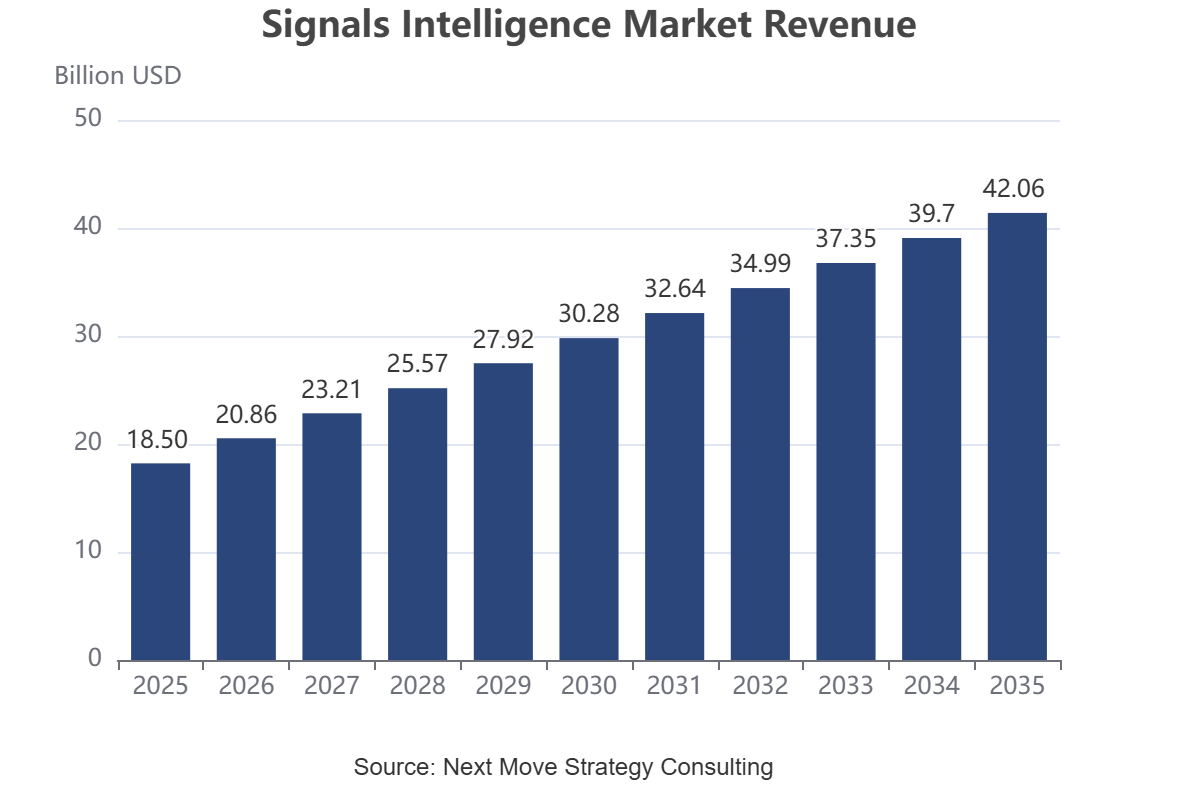
The global signals intelligence market size was valued at USD 18.50 billion in 2025 and is estimated at USD 19.85 billion in 2026, forecast to reach USD 42.06 billion by 2035, expanding at a 9.0% CAGR between 2026 and 2035. North America leads with approximately 38% share, while hardware dominates all other offerings with approximately 45% share.
We observed that growth is broad-based across every segmentation axis, with software-defined signal processing and space-based collection driving the dominant structural shifts through 2035.
|
Key Takeaways |
|
By Offering: Hardware held the largest share of approximately 45% (USD 8.33 Billion) in 2025; Software is the fastest-growing sub-segment at 11.4% CAGR from 2026–2035. |
|
By Intelligence Type: Communications Intelligence held the largest share of approximately 34% (USD 6.29 Billion) in 2025; Multi-INT SIGINT is the fastest-growing sub-segment at 13.7% CAGR from 2026–2035. |
|
By Platform: Airborne held the largest share of approximately 36% (USD 6.66 Billion) in 2025; Space is the fastest-growing sub-segment at 13.7% CAGR from 2026–2035. |
|
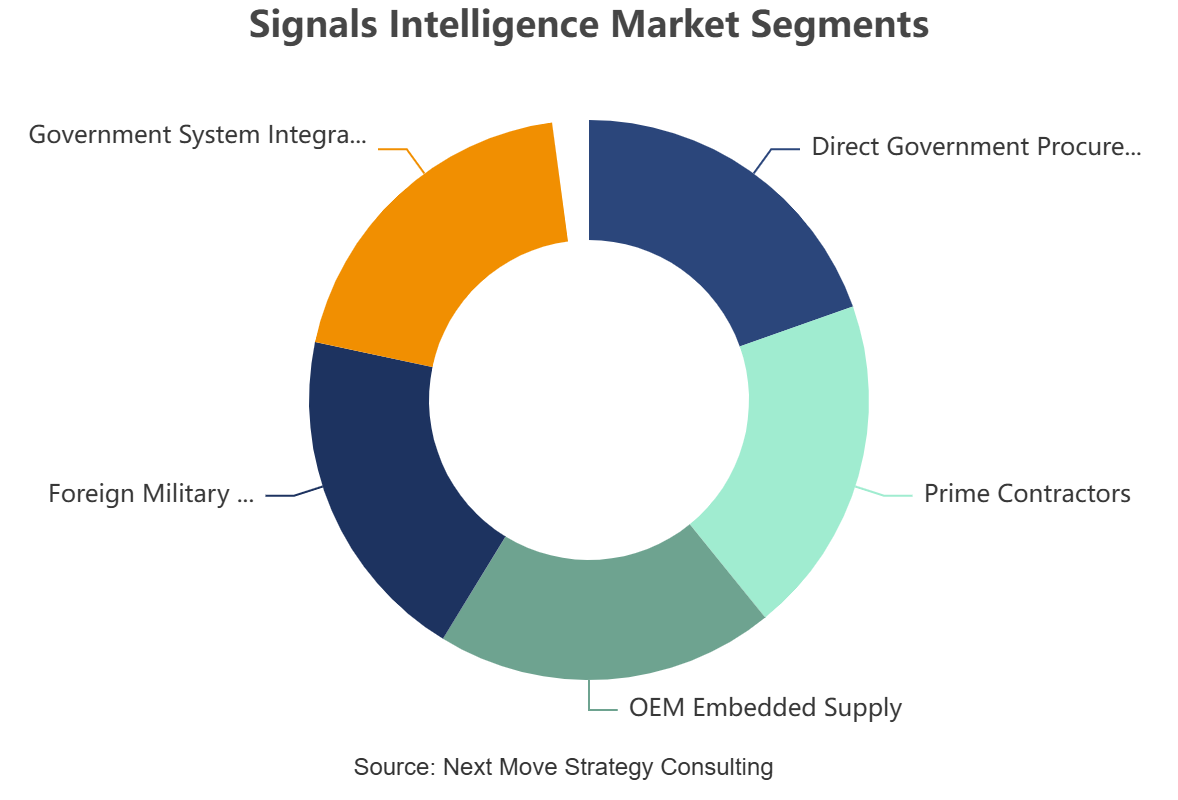
By Sales Channel: Direct Government Procurement held the largest share of approximately 48% (USD 8.88 Billion) in 2025; Government System Integrators is the fastest-growing sub-segment at 10.8% CAGR from 2026–2035. |
|
By Application: Strategic Intelligence held the largest share of approximately 26% (USD 4.81 Billion) in 2025; Cyber Intelligence is the fastest-growing sub-segment at 13.0% CAGR from 2026–2035. |
|
By End User: Defense Forces held the largest share of approximately 58% (USD 10.73 Billion) in 2025; Intelligence Agencies is the fastest-growing sub-segment at 10.5% CAGR from 2026–2035. |
|
Dominant Region: North America dominated with approximately 38% revenue share (USD 7.03 Billion) in 2025. |
|
Fastest-Growing Region: Asia-Pacific is expected to register the highest CAGR of 12.1% during 2026–2035. |
|
Dominant Country: U.S. led with approximately USD 5.42 billion in 2025. |
|
Fastest-Growing Country: India is the fastest-growing country at approximately 14.8% CAGR from 2026–2035. |
Market Opportunity: The signals intelligence market is expected to create an absolute dollar opportunity of USD 22.21 billion between 2026 and 2035, presenting significant investment potential across the airborne, naval, space, and cyber collection value chain.
According to Next Move Strategy Consulting analysis, defense agencies are increasingly consolidating multi-INT collection programs with fewer, software-defined vendors to shorten sensor-to-decision timelines, a shift that favors diversified prime contractors over single-domain specialists as budget scrutiny intensifies through 2035.
What Does the Signals Intelligence Market Encompass?
The signals intelligence market encompasses hardware, software, and services used to intercept, geolocate, process, and disseminate electromagnetic emissions for defense, intelligence, and homeland security missions. It spans collection systems and subsystems, signal processing and data fusion software, and integration, operations, and modernization services delivered across airborne, ground, naval, space, and cyber and network platforms. Our assessment indicates that the market has evolved from single-domain collection toward networked multi-INT architectures that fuse communications, electronic, and foreign instrumentation signals into a unified operating picture.
Export-control regimes, national security classification frameworks, and allied interoperability standards shape procurement cycles and vendor qualification requirements across this market. Our findings suggest that rising adoption of software-defined radios, artificial intelligence-assisted signal detection, and small-satellite constellations is compressing detection-to-geolocation timelines and expanding tactical-edge deployment, prompting defense forces and intelligence agencies to prioritize open-architecture systems over legacy proprietary platforms.
|
Parameters |
Details |
|
Market Size in 2025 |
USD 18.50 Billion |
|
Market Size in 2026 |
USD 19.85 Billion |
|
Revenue Forecast in 2035 |
USD 42.06 Billion |
|
Growth Rate |
CAGR of 9.0% from 2026 to 2035 |
|
Analysis Period |
2025–2035 |
|
Base Year Considered |
2025 |
|
Forecast Period |
2026–2035 |
|
Market Size Estimation |
Revenue (USD Billion) |
|
Companies Profiled |
20 |
|
Countries Covered |
33 |
|
Market Share |
Available for Top 10 Companies |
Key Emerging Trends
Next Move Strategy Consulting's analysis indicates that the signals intelligence market is undergoing rapid technology transformation across collection, processing, and delivery.
How Is AI-Assisted Signal Detection Transforming Collection Workflows?
Artificial intelligence and machine-learning classifiers are replacing manual spectrum monitoring, enabling automated emitter identification and anomaly flagging at scale. This transformation reduces analyst workload and accelerates the intelligence cycle from collection to actionable reporting. Stakeholders including intelligence agencies and defense forces benefit from faster threat characterization. Northrop Grumman Corporation has expanded AI-enabled signal-processing capabilities within its electronic warfare and SIGINT portfolios.
Why Are Small-Satellite SIGINT Constellations Gaining Adoption?
Proliferated small-satellite constellations are lowering the cost of persistent radio-frequency geolocation and enabling near-continuous global coverage. This shift benefits space domain awareness and maritime surveillance missions that previously relied on episodic airborne collection. Adoption is expanding among commercial-hosted-payload operators serving government customers. HawkEye 360, Inc. operates a commercial radio-frequency geolocation satellite constellation supporting this trend.
How Is Software-Defined Architecture Reshaping Hardware Procurement?
Open, software-defined radio architectures are decoupling signal-processing capability from fixed hardware, allowing rapid capability upgrades through software refreshes rather than platform replacement. This transformation benefits system integrators and modernization programs seeking extended platform lifecycles. Defense forces increasingly mandate open-architecture compliance in new procurements. Mercury Systems, Inc. supplies open, modular processing subsystems aligned with this shift.
What Role Does Multi-INT Data Fusion Play in Mission Management?
Data fusion software that combines communications, electronic, and foreign instrumentation signals into a single operating picture is becoming central to mission management. This transformation benefits joint commands and coast guard operators coordinating cross-domain surveillance. Fusion platforms shorten the path from raw intercept to decision-quality intelligence. Leidos Holdings, Inc. develops multi-INT fusion and mission management software for government customers.
Regulatory Framework Impacting the Signals Intelligence Market:
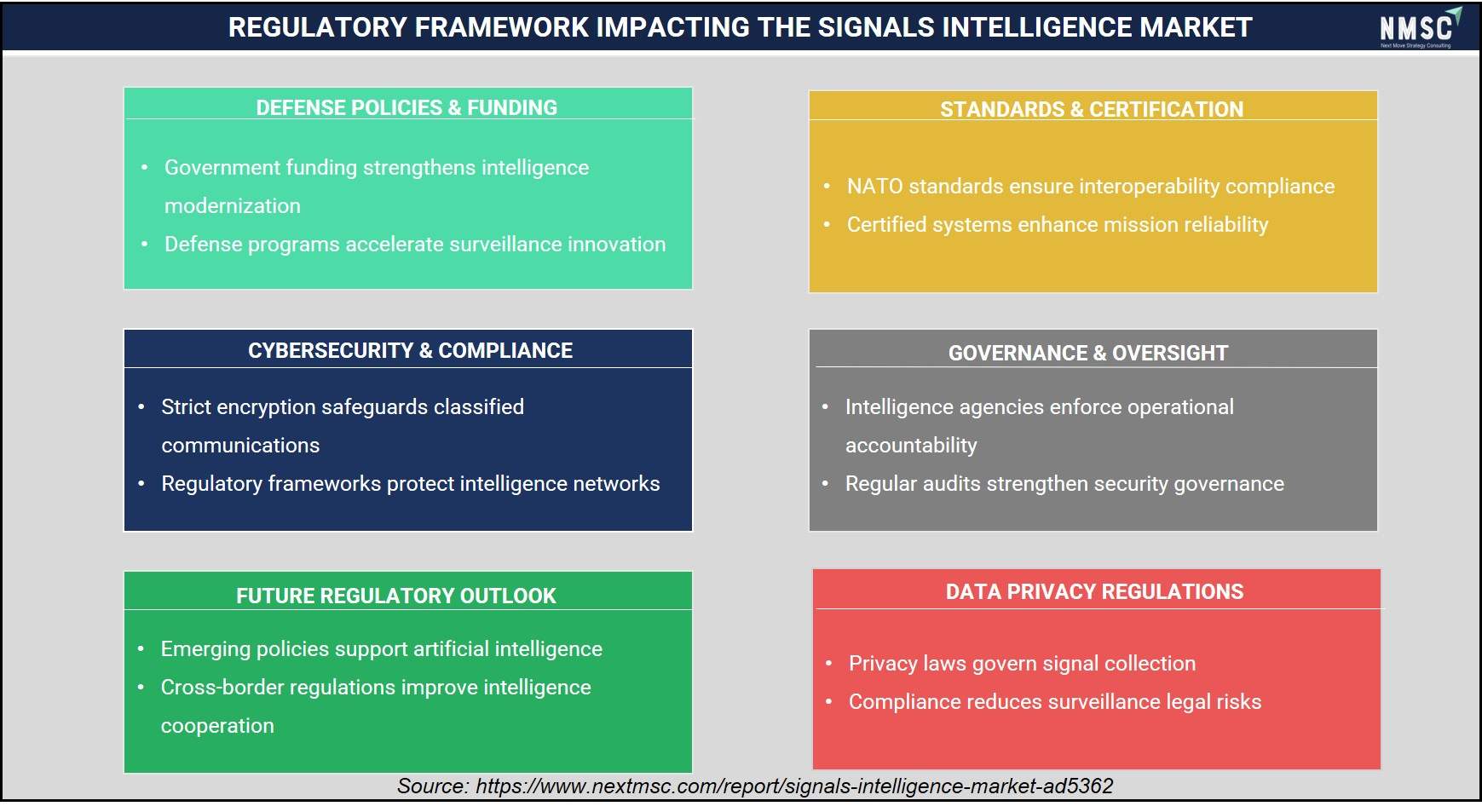
Based on research conducted by NMSC, we found that the Signals Intelligence Market operates within a rigorous regulatory environment shaped by defense funding, cybersecurity mandates, interoperability standards, and data privacy requirements. Moreover, governance frameworks, operational audits, and certification programs improve accountability and mission reliability. As regulatory policies evolve to support AI adoption and international intelligence cooperation, organizations are better positioned to strengthen security, compliance, and surveillance capabilities while minimizing legal and operational risks.
Growth Drivers & Restraints
|
Factors |
Type |
(+/-) % Impact on CAGR |
Geographic Relevance |
Impact Timeline |
|
Rising defense modernization budgets |
Driver |
+2.1% |
Global |
2026–2035 |
|
Proliferation of small-satellite SIGINT constellations |
Driver |
+1.6% |
North America, Europe |
2026–2032 |
|
Adoption of AI-assisted signal processing |
Driver |
+1.4% |
Global |
2026–2035 |
|
Expansion of multi-domain and joint operations doctrine |
Driver |
+1.1% |
North America, Asia-Pacific |
2027–2035 |
|
Growing demand for tactical-edge, man-portable SIGINT |
Driver |
+0.9% |
Middle East & Africa, Asia-Pacific |
2026–2033 |
|
Increasing foreign military sales approvals |
Driver |
+0.8% |
Asia-Pacific, Middle East & Africa |
2026–2035 |
|
Export-control and classification-driven procurement delays |
Restraint |
-1.2% |
Global |
2026–2035 |
|
High integration and lifecycle sustainment costs |
Restraint |
-0.9% |
Latin America, Africa |
2026–2032 |
|
Shortage of cleared systems-integration talent |
Restraint |
-0.6% |
North America, Europe |
2026–2030 |
What Is the Primary Growth Driver?
Rising defense modernization budgets remain the primary growth driver, as national governments prioritize recapitalization of aging collection platforms. We observed that U.S. Department of Defense budget requests have consistently allocated funding toward intelligence, surveillance, and reconnaissance modernization lines, supporting sustained procurement of signals intelligence hardware and software across allied defense establishments.
How Is Small-Satellite Proliferation Driving Market Growth?
During our market evaluation, we noticed that declining launch costs are enabling government and commercial operators to field dedicated small-satellite SIGINT constellations at a fraction of legacy program costs, expanding persistent coverage. This trend complements broader space-based sensing investment tracked in the 5G From Space Market, where similar smallsat economics are reshaping space-domain business models.
What Is Restraining the Signals Intelligence Market?
Export-control regimes and multi-tier security classification requirements restrain market growth by extending procurement and vendor-qualification timelines. Our analysis shows that International Traffic in Arms Regulations compliance and equivalent allied frameworks add multi-month review cycles to cross-border signals intelligence transactions, disproportionately affecting smaller government system integrators relative to established prime contractors.
Segmentation Analysis
Segment Sizing: By Offering
|
Segment |
2025 (USD) |
2035 (USD) |
CAGR% (2026–2035) |
|
Hardware |
USD 8.33 Billion |
USD 16.82 Billion |
8.1% |
|
Software |
USD 5.55 Billion |
USD 14.72 Billion |
11.4% |
|
Services |
USD 4.62 Billion |
USD 10.52 Billion |
9.6% |
|
Total |
USD 18.50 Billion |
USD 42.06 Billion |
9.0% |
Which Offering Segment Dominates the Signals Intelligence Market?
Hardware dominates the offering segmentation with approximately 45% share in 2025, reflecting continued procurement of collection systems, subsystems, and components across airborne, ground, and naval platforms. We found that software is the fastest-growing offering at an 11.4% CAGR, driven by demand for AI-assisted detection, geolocation, and data fusion capability layered onto existing hardware fleets, extending platform relevance without full recapitalization.
Segment Sizing: By Intelligence Type
|
Segment |
2025 (USD) |
2035 (USD) |
CAGR% (2026–2035) |
|
Communications Intelligence |
USD 6.29 Billion |
USD 12.62 Billion |
8.0% |
|
Electronic Intelligence |
USD 5.36 Billion |
USD 10.94 Billion |
8.2% |
|
Foreign Instrumentation Signals Intelligence |
USD 2.22 Billion |
USD 4.21 Billion |
7.4% |
|
Multi-INT SIGINT |
USD 3.70 Billion |
USD 11.78 Billion |
13.7% |
|
Other SIGINT |
USD 0.93 Billion |
USD 2.51 Billion |
11.8% |
|
Total |
USD 18.50 Billion |
USD 42.06 Billion |
9.0% |
Which Intelligence Type Leads Market Demand?
Communications Intelligence leads intelligence-type demand with approximately 34% share in 2025, supported by sustained requirements for voice, data, and network intercept across defense and homeland security missions. Our assessment indicates that multi-INT SIGINT is the fastest-growing category at a 13.7% CAGR, as agencies increasingly favor fused communications, electronic, and foreign instrumentation collection over single-discipline systems to support joint and coalition operations.
Segment Sizing: By Platform
|
Segment |
2025 (USD) |
2035 (USD) |
CAGR% (2026–2035) |
|
Airborne |
USD 6.66 Billion |
USD 13.46 Billion |
8.1% |
|
Ground |
USD 4.07 Billion |
USD 8.41 Billion |
8.4% |
|
Naval |
USD 3.70 Billion |
USD 7.57 Billion |
8.3% |
|
Space |
USD 2.77 Billion |
USD 8.83 Billion |
13.7% |
|
Cyber and Network |
USD 1.30 Billion |
USD 3.79 Billion |
12.7% |
|
Total |
USD 18.50 Billion |
USD 42.06 Billion |
9.0% |
Which Platform Segment Is Expanding Fastest?
Airborne platforms retain the largest share at approximately 36% in 2025, reflecting the operational maturity of manned and unmanned aircraft-based collection. Based on research conducted by Next Move Strategy Consulting, we found that space platforms are expanding fastest at a 13.7% CAGR, as dedicated satellites and hosted payloads extend persistent, globally distributed signals collection beyond the reach of airborne and ground assets.
Growth Opportunities
Three forward-looking whitespace opportunities stand out for stakeholders positioning ahead of the 2026–2035 forecast window.
Where Does Hosted-Payload Commercialization Create Whitespace?
Commercial satellite operators offering hosted signals intelligence payloads create a capital-light entry path for government agencies to expand space-based collection without dedicated constellations. This mechanism benefits intelligence agencies and space force commands seeking rapid capacity expansion at lower upfront cost than dedicated satellite programs.
How Does Managed Mission Services Open New Revenue Pools?
Managed mission services, where contractors operate collection and processing infrastructure on behalf of government customers, create recurring revenue pools distinct from traditional hardware sales. This mechanism benefits systems integrators and technology vendors able to shift toward outcome-based service contracts as agencies seek to reduce organic staffing burdens.
Where Does Foreign Military Sales Expansion Create Opportunity?
Expanding foreign military sales approvals for allied nations create whitespace for prime contractors and government system integrators to extend established platforms into new geographies. This mechanism benefits defense forces in Asia-Pacific and Middle East & Africa markets modernizing SIGINT fleets through government-to-government sales channels.
Regional Outlook
|
Region |
2025 (USD) |
2035 (USD) |
CAGR% (2026–2035) |
Key Driver |
|
North America |
USD 7.03 Billion |
USD 14.30 Billion |
8.2% |
Sustained modernization funding across national SIGINT programs |
|
Europe |
USD 4.44 Billion |
USD 9.25 Billion |
8.5% |
Coordinated NATO signals-intelligence interoperability mandates |
|
Asia-Pacific |
USD 4.07 Billion |
USD 11.36 Billion |
12.1% |
Expanding maritime and airborne SIGINT recapitalization programs |
|
Middle East & Africa |
USD 2.04 Billion |
USD 5.05 Billion |
10.6% |
Border and maritime surveillance modernization investment |
|
Latin America |
USD 0.93 Billion |
USD 2.10 Billion |
9.6% |
Gradual fleet and ground-station SIGINT upgrades |
|
Total |
USD 18.51 Billion |
USD 42.06 Billion |
9.0% |
— |
North America Signals Intelligence Market
North America holds the most mature signals intelligence market, anchored by sustained U.S. and Canadian defense modernization funding and established prime-contractor supply chains. Regulatory export-control frameworks shape vendor qualification, while technology adoption favors AI-assisted processing and software-defined architectures. Strategic outlook remains stable, with growth driven by recapitalization rather than new-program expansion through 2035.
Europe Signals Intelligence Market
Europe's signals intelligence market reflects growing NATO interoperability requirements and coordinated national modernization programs across the region. Regulatory alignment around allied data-sharing standards supports cross-border collaboration, while adoption of multi-INT fusion software is accelerating. Strategic outlook favors vendors offering interoperable, export-compliant systems across member states through the forecast period.
Asia-Pacific Signals Intelligence Market
Asia-Pacific is the fastest-growing signals intelligence region, driven by expanding maritime surveillance and airborne recapitalization programs across multiple national defense establishments. Regulatory environments vary by country, requiring localized compliance strategies, while technology adoption is shifting toward space-based and unmanned collection platforms. Strategic outlook favors vendors with established government-to-government sales relationships.
Middle East & Africa Signals Intelligence Market
The Middle East & Africa signals intelligence market is shaped by border and maritime surveillance modernization amid heightened regional security priorities. Regulatory procurement processes increasingly favor government-to-government foreign military sales channels, while technology adoption is concentrated in ground and naval platforms. Strategic outlook favors prime contractors with established regional integration partnerships through 2035.
Latin America Signals Intelligence Market
Latin America's signals intelligence market remains comparatively nascent, with gradual fleet and ground-station modernization constrained by budget cycles. Regulatory frameworks are less harmonized across the region, requiring country-specific compliance approaches, while technology adoption favors incremental upgrades over new-platform acquisition. Strategic outlook favors vendors offering flexible financing and modernization packages through the forecast period.
U.S. Signals Intelligence Market
Based on our estimates, the U.S. signals intelligence market was valued at approximately USD 5.42 billion in 2025 and is projected to reach approximately USD 10.90 billion by 2035, expanding at approximately 8.1% CAGR from 2026 to 2035. Demand is anchored in defense and intelligence-agency procurement, with regulatory export-control compliance and steady technology adoption shaping competitive intensity. Strategic outlook favors vendors with established local integration and sustainment support.
Canada Signals Intelligence Market
The Canada signals intelligence market was valued at approximately USD 0.98 billion in 2025 and is projected to reach approximately USD 2.05 billion by 2035, expanding at approximately 8.6% CAGR from 2026 to 2035. Demand is anchored in defense and intelligence-agency procurement, with regulatory export-control compliance and steady technology adoption shaping competitive intensity. Strategic outlook favors vendors with established local integration and sustainment support.
UK Signals Intelligence Market
As per our estimate, the UK signals intelligence market was valued at approximately USD 1.05 billion in 2025 and is projected to reach approximately USD 2.15 billion by 2035, expanding at approximately 8.3% CAGR from 2026 to 2035. Demand is anchored in defense and intelligence-agency procurement, with regulatory export-control compliance and steady technology adoption shaping competitive intensity. Strategic outlook favors vendors with established local integration and sustainment support.
Germany Signals Intelligence Market
According to our analysis, the Germany signals intelligence market was valued at approximately USD 0.92 billion in 2025 and is projected to reach approximately USD 1.95 billion by 2035, expanding at approximately 8.7% CAGR from 2026 to 2035. Demand is anchored in defense and intelligence-agency procurement, with regulatory export-control compliance and steady technology adoption shaping competitive intensity. Strategic outlook favors vendors with established local integration and sustainment support.
France Signals Intelligence Market
Based on our estimates, the France signals intelligence market was valued at approximately USD 0.88 billion in 2025 and is projected to reach approximately USD 1.82 billion by 2035, expanding at approximately 8.4% CAGR from 2026 to 2035. Demand is anchored in defense and intelligence-agency procurement, with regulatory export-control compliance and steady technology adoption shaping competitive intensity. Strategic outlook favors vendors with established local integration and sustainment support.
China Signals Intelligence Market
The China signals intelligence market was valued at approximately USD 1.35 billion in 2025 and is projected to reach approximately USD 4.05 billion by 2035, expanding at approximately 13.0% CAGR from 2026 to 2035. Demand is anchored in defense and intelligence-agency procurement, with regulatory export-control compliance and steady technology adoption shaping competitive intensity. Strategic outlook favors vendors with established local integration and sustainment support.
India Signals Intelligence Market
As per our estimate, the India signals intelligence market was valued at approximately USD 0.68 billion in 2025 and is projected to reach approximately USD 2.35 billion by 2035, expanding at approximately 14.8% CAGR from 2026 to 2035. Demand is anchored in defense and intelligence-agency procurement, with regulatory export-control compliance and steady technology adoption shaping competitive intensity. Strategic outlook favors vendors with established local integration and sustainment support.
Japan Signals Intelligence Market
According to our analysis, the Japan signals intelligence market was valued at approximately USD 0.72 billion in 2025 and is projected to reach approximately USD 1.68 billion by 2035, expanding at approximately 9.9% CAGR from 2026 to 2035. Demand is anchored in defense and intelligence-agency procurement, with regulatory export-control compliance and steady technology adoption shaping competitive intensity. Strategic outlook favors vendors with established local integration and sustainment support.
South Korea Signals Intelligence Market
Based on our estimates, the South Korea signals intelligence market was valued at approximately USD 0.48 billion in 2025 and is projected to reach approximately USD 1.28 billion by 2035, expanding at approximately 11.5% CAGR from 2026 to 2035. Demand is anchored in defense and intelligence-agency procurement, with regulatory export-control compliance and steady technology adoption shaping competitive intensity. Strategic outlook favors vendors with established local integration and sustainment support.
Australia Signals Intelligence Market
The Australia signals intelligence market was valued at approximately USD 0.42 billion in 2025 and is projected to reach approximately USD 1.05 billion by 2035, expanding at approximately 10.7% CAGR from 2026 to 2035. Demand is anchored in defense and intelligence-agency procurement, with regulatory export-control compliance and steady technology adoption shaping competitive intensity. Strategic outlook favors vendors with established local integration and sustainment support.
UAE Signals Intelligence Market
As per our estimate, the UAE signals intelligence market was valued at approximately USD 0.52 billion in 2025 and is projected to reach approximately USD 1.42 billion by 2035, expanding at approximately 11.8% CAGR from 2026 to 2035. Demand is anchored in defense and intelligence-agency procurement, with regulatory export-control compliance and steady technology adoption shaping competitive intensity. Strategic outlook favors vendors with established local integration and sustainment support.
Saudi Arabia Signals Intelligence Market
According to our analysis, the Saudi Arabia signals intelligence market was valued at approximately USD 0.48 billion in 2025 and is projected to reach approximately USD 1.28 billion by 2035, expanding at approximately 11.5% CAGR from 2026 to 2035. Demand is anchored in defense and intelligence-agency procurement, with regulatory export-control compliance and steady technology adoption shaping competitive intensity. Strategic outlook favors vendors with established local integration and sustainment support.
South Africa Signals Intelligence Market
Based on our estimates, the South Africa signals intelligence market was valued at approximately USD 0.16 billion in 2025 and is projected to reach approximately USD 0.38 billion by 2035, expanding at approximately 10.1% CAGR from 2026 to 2035. Demand is anchored in defense and intelligence-agency procurement, with regulatory export-control compliance and steady technology adoption shaping competitive intensity. Strategic outlook favors vendors with established local integration and sustainment support.
Brazil Signals Intelligence Market
The Brazil signals intelligence market was valued at approximately USD 0.42 billion in 2025 and is projected to reach approximately USD 0.98 billion by 2035, expanding at approximately 9.9% CAGR from 2026 to 2035. Demand is anchored in defense and intelligence-agency procurement, with regulatory export-control compliance and steady technology adoption shaping competitive intensity. Strategic outlook favors vendors with established local integration and sustainment support.
Argentina Signals Intelligence Market
As per our estimate, the Argentina signals intelligence market was valued at approximately USD 0.14 billion in 2025 and is projected to reach approximately USD 0.32 billion by 2035, expanding at approximately 9.6% CAGR from 2026 to 2035. Demand is anchored in defense and intelligence-agency procurement, with regulatory export-control compliance and steady technology adoption shaping competitive intensity. Strategic outlook favors vendors with established local integration and sustainment support.
Strategic Framework of the Signals Intelligence Market:
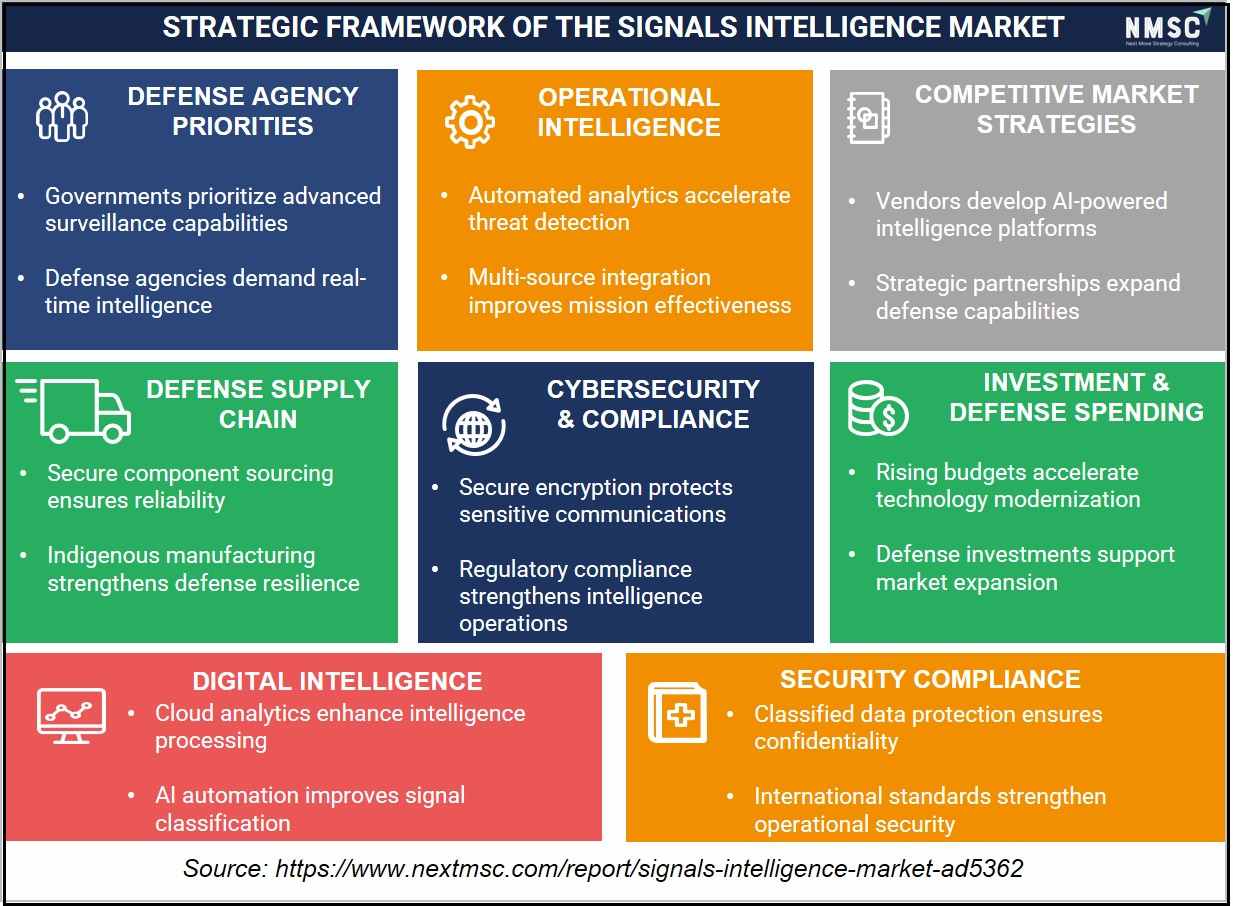
From our research, we found that the Signals Intelligence Market is advancing through AI-driven analytics, automated threat detection, and secure intelligence platforms that strengthen mission effectiveness. Furthermore, defense agencies prioritize real-time surveillance, while resilient supply chains, cybersecurity compliance, and cloud-based intelligence processing enhance operational reliability. Consequently, increasing defense investments, strategic collaborations, and classified data protection frameworks support continuous modernization and reinforce long-term growth across global intelligence operations.
Competitive Landscape
Our analysis shows that the competitive landscape is anchored by established defense primes alongside specialized signals intelligence and space-sensing vendors.
|
Category |
Assessment |
|
Market Structure |
Moderately consolidated; a small set of global defense primes hold the majority of large-platform contracts, while specialized vendors compete in software, subsystems, and space-sensing niches |
|
Innovation Focus |
AI-assisted signal detection, software-defined radio architectures, multi-INT data fusion, and small-satellite SIGINT constellations |
|
M&A Activity |
Selective bolt-on acquisitions of software, subsystem, and space-sensing specialists by larger integrators to broaden multi-domain SIGINT portfolios |
How Do Companies Compete in the Signals Intelligence Industry?
Companies compete on platform breadth, security-clearance depth, and the ability to integrate hardware, software, and services into unified multi-domain SIGINT solutions. Government evaluators weigh past-performance records and export-compliance track records heavily, favoring vendors that can demonstrate interoperability across allied defense customers alongside domestic programs.
Which Competitive Archetypes Dominate the Industry?
Full-spectrum defense primes with airborne, naval, and space platform breadth dominate large program awards, while specialized subsystem and software vendors compete on technical differentiation within narrower niches. Commercial space-sensing operators represent an emerging archetype, winning hosted-payload and data-as-a-service contracts that bypass traditional platform procurement cycles entirely.
What Innovation and Differentiation Strategies Are Companies Pursuing?
Vendors are differentiating through open, software-defined architectures that reduce lifecycle upgrade costs, and through AI-assisted processing that shortens detection-to-geolocation timelines. Industry participants increasingly market modular subsystems designed for rapid integration across multiple platform types, reducing customer dependence on single-vendor proprietary systems.
How Active Is M&A in the Signals Intelligence Market?
M&A activity remains selective, concentrated on bolt-on acquisitions that add software, subsystem, or space-sensing capability to established platform primes. Industry consolidation trends favor integrators seeking to broaden multi-INT fusion offerings rather than large-scale platform-to-platform mergers, reflecting the fragmented, specialization-driven nature of the supplier base.
Key Market Players
Our findings suggest that competitive positioning across the signals intelligence market is concentrated among the following twenty companies, ranked by overall platform breadth and program presence.
-
Northrop Grumman Corporation
-
RTX Corporation
-
L3Harris Technologies, Inc.
-
BAE Systems plc
-
General Dynamics Corporation
-
Thales S.A.
-
Elbit Systems Ltd.
-
Leonardo S.p.A.
-
Saab AB
-
HENSOLDT AG
-
Israel Aerospace Industries Ltd.
-
Airbus SE
-
Rohde & Schwarz GmbH & Co. KG
-
CACI International Inc.
-
Leidos Holdings, Inc.
-
Science Applications International Corporation
-
Sierra Nevada Corporation
-
Mercury Systems, Inc.
-
HawkEye 360, Inc.
Latest Developments
We observed several publicly disclosed developments shaping vendor positioning across the signals intelligence market.
|
Date |
Event |
|
December 2025 |
Airbus Defence and Space and Indra were selected by the Spanish Ministry of Defence to conduct an 18-month definition study for Spain's future Signals Intelligence (SIGINT) aircraft. The program will define a national SIGINT platform and mission system integration for three aircraft dedicated to the Spanish Air and Space Force. |
|
August 2025 |
L3Harris completed a USD 100 million expansion of its satellite integration and test facility in Palm Bay, Florida, United States. The enlarged manufacturing site will accelerate production of next-generation missile-warning and tracking satellites supporting U.S. defense missions and advanced space-based sensing capabilities. |
|
August 2025 |
HawkEye 360 announced integration of its RF-based signals intelligence data with Lockheed Martin systems during Exercise Talisman Sabre 2025 in Australia. The collaboration enables operational military platforms to fuse commercial RF intelligence with tactical data, improving geolocation accuracy and situational awareness for allied forces. |
Expert Insights
 "We use artificial intelligence primarily with our signals intelligence mission. Now, how do we look at it for our cybersecurity mission? How do we look at it differently for our cybersecurity mission?"
— Gen. Paul M. Nakasone, Commander, U.S. Cyber Command; Director, National Security Agency (NSA); Chief, Central Security Service (CSS)
Statement made during the 2023 Billington CyberSecurity Summit, where Gen. Paul M. Nakasone discussed the National Security Agency's integration of artificial intelligence into signals intelligence (SIGINT) operations and its expanding role in strengthening cybersecurity capabilities.
Market Interpretation
The statement underscores the growing convergence of artificial intelligence and signals intelligence as defense organizations seek to enhance intelligence collection, signal processing, and threat analysis. AI-powered capabilities are enabling faster interpretation of vast volumes of communications and electronic signals while improving decision-making across intelligence operations. Consequently, governments are increasing investments in AI-enabled SIGINT platforms to strengthen national security, modernize intelligence infrastructure, and address increasingly complex cyber and electronic warfare threats.
Investment Opportunities
Where Are Capital Inflows Concentrated?
Capital inflows are concentrated in software-defined processing, AI-assisted detection, and small-satellite SIGINT ventures attracting government and strategic-investor funding. Our analysis shows that defense-focused investors increasingly favor companies offering dual-use technology with both government and adjacent commercial applications, broadening the addressable capital base beyond traditional defense budgets.
How Significant Is Infrastructure Investment in This Market?
Infrastructure investment is significant, with funding directed toward ground stations, secure data-processing facilities, cloud-enabled intelligence platforms, high-performance computing infrastructure, and satellite communication networks that support real-time signals collection and analysis. Our analysis indicates that governments prioritize modernization of intelligence infrastructure to improve interoperability, processing capacity, and mission readiness, while private-sector investment focuses on scalable software platforms and AI-enabled analytics that complement existing defense infrastructure.
What ESG Considerations Apply to Signals Intelligence Investment?
Environmental, social, and governance considerations center on responsible-use governance, data-handling transparency, and workforce security-clearance practices rather than traditional environmental metrics. Investors increasingly evaluate vendor compliance with export-control and human-rights-aligned end-use disclosures as part of governance due diligence for defense and intelligence technology investments.
Key Benefits for Stakeholders
How Does This Report Benefit Defense and Industry Leaders?
Defense and industry leaders gain access to reconciled market sizing, segmentation, and competitive benchmarking that supports platform investment prioritization. The report's forecasts and regional analysis help program leaders align capability roadmaps with anticipated demand shifts across offering, intelligence type, and platform categories through 2035.
How Does This Report Benefit Investors and Financial Analysts?
Investors and financial analysts gain a reconciled view of market size, growth trajectory, and competitive positioning to support capital-allocation decisions. The report's regional and country-level forecasts help analysts identify where defense modernization spending is expected to translate into the strongest revenue growth for signals intelligence vendors.
How Does This Report Benefit Technology Vendors and Product Teams?
Technology vendors and product teams gain segmentation-level demand signals that inform roadmap prioritization across hardware, software, and services offerings. The report's emerging-trends and growth-opportunity analysis helps product teams align development investment with the fastest-growing sub-segments identified across intelligence type and platform categories.
Key Market Segments
By Offering
-
Hardware
-
Collection Systems
-
Subsystems And Components
-
-
Software
-
Signal Processing Software
-
Detection And Geolocation Software
-
Data Fusion Software
-
Mission Management Software
-
Database Management Software
-
Other Software
-
-
Services
-
Systems Integration And Engineering
-
Installation And Commissioning
-
Operations And Maintenance
-
Modernization And Upgrades
-
Training And Technical Support
-
Managed Mission Services
-
By Intelligence Type
-
Communications Intelligence
-
Electronic Intelligence
-
Foreign Instrumentation Signals Intelligence
-
Multi-INT SIGINT
-
Other SIGINT
By Platform
-
Airborne
-
Manned Aircraft
-
Unmanned Aircraft
-
Aerostat
-
- Ground
-
Fixed Sites
-
Mobile Tactical
-
Man-Portable
-
Naval
-
Surface Ships
-
Submarines
-
Unmanned Maritime
-
-
Space
-
Dedicated Satellites
-
Hosted Payloads
-
-
Cyber And Network
-
Wired Networks
-
Wireless Networks
-
By Sales Channel
-
Direct Government Procurement
-
Prime Contractors
-
OEM Embedded Supply
-
Foreign Military Sales
-
Government System Integrators
By Application
-
Strategic Intelligence
-
Operational Intelligence
-
Tactical Intelligence
-
Electronic Warfare Support
-
Border Surveillance
-
Maritime Surveillance
-
Space Domain Awareness
-
Cyber Intelligence
By End User
-
Defense Forces
-
Army
-
Navy
-
Air Force
-
Space Force
-
Joint Commands
-
-
Intelligence Agencies
-
Homeland Security
-
Law Enforcement
-
Coast Guard
-
Other Government Agencies
By Region
-
North America: U.S., Canada, Mexico
-
Europe: UK, Germany, France, Italy, Spain, Sweden, Denmark, Finland, Netherlands, Rest of Europe
-
Asia-Pacific: China, India, Japan, South Korea, Taiwan, Indonesia, Vietnam,Australia, Philippines, Malaysia, Rest of APAC
-
Middle East & Africa: Saudi Arabia, UAE, Egypt, Israel, Turkey, Nigeria, South Africa, Rest of MEA
-
Latin America: Brazil, Argentina, Chile, Colombia, Rest of LATAM
Conclusion & Recommendations
What Is the Long-Term Outlook for the Signals Intelligence Market?
The long-term outlook remains favorable, with the market projected to more than double from USD 18.50 billion in 2025 to USD 42.06 billion by 2035. Our analysis shows that sustained defense modernization funding, expanding space-based collection, and rising multi-INT fusion adoption underpin durable double-digit growth in the fastest-expanding sub-segments through the forecast period.
What Strategic Positioning Do We Recommend?
We recommend that vendors prioritize open, software-defined architectures and multi-INT fusion capability to align with evolving procurement preferences. Companies without space-platform presence should evaluate hosted-payload partnerships to capture space-based collection growth without the capital burden of dedicated satellite programs.
How Attractive Is the Market for Investment?
Investment attractiveness is high in software, data fusion, and space-based collection sub-segments, where CAGR exceeds the market average. Our findings suggest that investors should weigh export-control complexity against the durability of government demand, which historically shows lower cyclicality than commercial technology end markets.
What Market Shifts and Key Risks Should Stakeholders Monitor?
Stakeholders should monitor shifting defense budget priorities, evolving export-control policy, and the pace of AI-assisted processing adoption. Based on research conducted by Next Move Strategy Consulting, we found that program delays tied to classification and vendor-qualification reviews represent the most consistent near-term risk to forecast realization.
What Are the Primary Growth Pathways Through 2035?
Primary growth pathways include space-based collection expansion, AI-assisted multi-INT fusion, and foreign military sales into Asia-Pacific and Middle East & Africa markets. We observed that vendors combining platform breadth with software-defined modernization services are best positioned to capture disproportionate share of the USD 22.21 billion opportunity created between 2026 and 2035.
About the Author
 Saista Faiyaz
— Saista Faiyaz is Research Associate at Next Move Strategy Consulting, where she has covered consumer markets and healthcare technologies for 3 years. Her work includes primary interview review, secondary-source validation, market sizing, and structured analysis of company and industry data. She supports research by comparing evidence across sources, organizing findings into market narratives, and documenting assumptions used in analysis. Her scope includes cross-market benchmarking, and reports.
Saista Faiyaz
— Saista Faiyaz is Research Associate at Next Move Strategy Consulting, where she has covered consumer markets and healthcare technologies for 3 years. Her work includes primary interview review, secondary-source validation, market sizing, and structured analysis of company and industry data. She supports research by comparing evidence across sources, organizing findings into market narratives, and documenting assumptions used in analysis. Her scope includes cross-market benchmarking, and reports.
About the Reviewer
 Supradip Baul
— Supradip Baul is an accomplished business consultant and strategist with over a decade of rich experience in market intelligence, strategy, technology, and business transformation. His work has included rigorous qualitative and quantitative analysis across multiple industries, helping clients shape investment decisions and long-term roadmaps. Earlier in his career, he was associated with Gartner, where he contributed to industry-leading reports and market share analyses. He has worked with leading global companies and holds an MBA with a dual specialization in Marketing and Finance.
Supradip Baul
— Supradip Baul is an accomplished business consultant and strategist with over a decade of rich experience in market intelligence, strategy, technology, and business transformation. His work has included rigorous qualitative and quantitative analysis across multiple industries, helping clients shape investment decisions and long-term roadmaps. Earlier in his career, he was associated with Gartner, where he contributed to industry-leading reports and market share analyses. He has worked with leading global companies and holds an MBA with a dual specialization in Marketing and Finance.
At Next Move Strategy Consulting, we understand that insightful market research is the cornerstone of successful business decisions. That's why we employ a robust and multifaceted approach, combining various methodologies to deliver the most accurate and actionable data for our clients.

Research Landscape
We navigate the world of research with two primary approaches:
Qualitative Approach
Our qualitative research methodologies involve immersive techniques such as in-depth interviews, focus groups, and observational studies. By engaging directly with individuals and stakeholders, we uncover valuable insights that quantitative data alone may overlook.

Quantitative Research
In tandem with qualitative methodologies, NMSC leverages the power of Quantitative Research to provide a robust foundation of numerical insights. Through systematic data collection and analysis, we quantify patterns, preferences, and market trends, offering a comprehensive view of the business landscape.
Our quantitative research approach employs diverse tools, including surveys, experiments, and statistical modelling. These methodologies enable us to gather data from a large and representative sample, ensuring the statistical significance of our findings. By employing structured questionnaires and standardized data collection methods, we guarantee the reliability and validity of the information we present to our clients.
Quantitative research is particularly effective in measuring the prevalence of trends, assessing market size, and gauging the impact of various factors on consumer behavior. The numerical precision attained through this approach equips our clients with actionable insights, facilitating data-driven decision-making and strategy formulation.


Our Specialized Toolbox for Industry-Specific Market Research
We deploy a specialized arsenal of techniques tailored to meet your unique requirements. Here's a glimpse into our comprehensive toolbox:

Information Procurement
The stage entails acquiring market data or relevant information through various sources and methodologies.


Market Research Approach
We utilize both top-down and bottom-up approaches in market research analysis to achieve a comprehensive understanding of the market dynamics, leveraging the broad perspective of industry trends and macroeconomic factors alongside detailed insights from specific segments and individual companies.

Porters Five Forces Analysis
We conduct Porter's Five Forces analysis to evaluate the competitive landscape of an industry, providing us with insights into factors that affect profitability and strategic positioning.

SWOT Analysis

Forecasting
We utilize a forecasting model to predict future consumption by considering parameters like population, economics, regulations, market competition, drivers, constraints, technology, and pricing. We also employ statistical techniques such as multilinear regression, exponential smoothing, moving average, ARIMA, and Monte Carlo simulations for accurate predictions. In econometric forecasting, we analyzed short-term and long-term event impacts, attributing values based on regulatory frameworks, economic factors, and market events.





 Speak to Our Analyst