
AI Food Sorting Market, AI Food Sorting Market Size, AI Food Sorting Market Share, Food Sorting Industry, AI Sorting Technology, Hyperspectral Food Sorting, Food Defect Detection, Food Sorting Market Report, Food Sorting Market Trends, Food Sorting Market Growth, Machine Learning Food Sorting, AI Robotic Sorting
Industry: ICT & Media | Publishing Date: July 14, 2026 | Last Updated: September 30, 2026 | No of Pages: N/A | No. of Tables: N/A | No. of Figures: N/A | Format: PDF | Report Code: IC5128
What Is the AI Food Sorting Market Size?
The global AI Food Sorting Market size was valued at USD 2.85 Billion in 2025 and is estimated at USD 3.35 Billion in 2026, forecast to reach USD 17.20 Billion by 2035, expanding at a 19.9% CAGR between 2026 and 2035. North America leads with approximately 36% share, while under offering, Hardware dominates with approximately 58% share.
We observed that growth is broad based across every segmentation axis, with computer vision adoption and integrated production line deployment driving the dominant structural shifts through 2035.
|
Key Takeaways |
|
By Offering: Hardware held the largest share of approximately 58% (USD 1.65 Billion) in 2025; Software is the fastest-growing sub-segment at 24.5% CAGR from 2026–2035. |
|
By Technology: Computer Vision held the largest share of approximately 32% (USD 912 Million) in 2025; AI Robotics is the fastest-growing sub-segment at 31.0% CAGR from 2026–2035. |
|
By Food Category: Fruits held the largest share of approximately 22% (USD 627 Million) in 2025; Seafood is the fastest-growing sub-segment at 24.8% CAGR from 2026–2035. |
|
By Sorting Function: Defect Detection and Removal held the largest share of approximately 40% (USD 1.14 Billion) in 2025; Foreign Material Detection and Removal is the fastest-growing sub-segment at 23.6% CAGR from 2026–2035. |
|
By End User: Fruit and Vegetable Processors held the largest share of approximately 29% (USD 827 Million) in 2025; Pet Food Manufacturers is the fastest-growing sub-segment at 25.9% CAGR from 2026–2035. |
|
By Deployment Type: Integrated Production Line Sorting Systems held the largest share of approximately 52% (USD 1.48 Billion) in 2025; Cloud-Connected Sorting Systems is the fastest-growing sub-segment at 26.5% CAGR from 2026–2035. |
|
Dominant Region: North America dominated with approximately 36% revenue share (USD 1.03 Billion) in 2025. |
|
Fastest-Growing Region: Asia-Pacific is expected to register the highest CAGR of 22.9% during 2026–2035. |
|
Dominant Country: U.S. led with approximately USD 720 Million in 2025. |
|
Fastest-Growing Country: India is the fastest-growing country at approximately 26.4% CAGR from 2026–2035. |
Between 2026 and 2035, the AI Food Sorting Market is set to generate an absolute dollar opportunity of USD 13.85 Billion, positioning computer vision and AI robotic sorting platforms as a compelling area for capital allocation.
According to Next Move Strategy Consulting analysis, sustained investment in hyperspectral and multispectral imaging systems is reshaping procurement criteria for food processors, as contamination detection accuracy increasingly determines vendor shortlisting across fruit, vegetable, and protein processing lines.
What does the AI Food Sorting Market Encompass?
The market encompasses hardware, software, and service solutions that apply computer vision, machine learning, and sensor-based imaging to detect defects, foreign material, and quality attributes in food products. Our assessment indicates that the scope spans optical, X-ray, and AI robotic sorting systems deployed across fruit, vegetable, grain, protein, and processed food production lines, serving processors, manufacturers, and packagers seeking to automate quality control and reduce manual inspection labor.
The market has evolved from basic color sorting toward hyperspectral and deep learning enabled platforms capable of detecting internal defects and subsurface contamination. Regulatory frameworks such as the U.S. Food Safety Modernization Act and the European Union's General Food Law Regulation (EC) No 178/2002 shape food safety inspection requirements, while national food safety authorities increasingly reference automated sorting as a preventive control measure. We observed that technology adoption is accelerating as processors integrate cloud-connected analytics and predictive maintenance software into existing production lines, a shift that Next Move Strategy Consulting's analysis indicates is redefining capital planning across the AI Food Sorting Market.
|
Parameter |
Details |
|
Market Size in 2025 |
USD 2.85 Billion |
|
Market Size in 2026 |
USD 3.35 Billion |
|
Revenue Forecast in 2035 |
USD 17.20 Billion |
|
Growth Rate |
CAGR of 19.9% from 2026 to 2035 |
|
Analysis Period |
2025–2035 |
|
Base Year Considered |
2025 |
|
Forecast Period |
2026–2035 |
|
Market Size Estimation |
Revenue (USD Billion) |
|
Companies Profiled |
20 |
|
Countries Covered |
38 |
|
Market Share |
Available for Top 10 Companies |
Key Emerging Trends
Based on research conducted by Next Move Strategy Consulting, we found that four structural trends are reshaping product development, sourcing, and stakeholder engagement across the AI Food Sorting Market.
How Is Deep Learning Transforming Defect Detection Accuracy?
Deep learning models trained on large annotated image libraries are replacing rule based color sorting algorithms across fruit and vegetable lines. We observed that TOMRA Systems ASA's Halo spectral imaging platform, expanded in 2025, applies neural network classification to detect internal bruising and pit fragments previously missed by conventional optical sensors. Processors are adopting these models to cut manual inspection labor, while integrators retrain algorithms continuously as new defect patterns emerge across seasonal harvests.
Why Are Hyperspectral and Multispectral Systems Gaining Adoption?
Hyperspectral and multispectral imaging systems are gaining share as processors seek to detect chemical and moisture based defects invisible to standard RGB cameras. Our findings suggest that grain, nut, and seafood processors increasingly specify hyperspectral units to identify mold, rancidity, and species substitution risks. Manufacturers such as Buhler AG and Sesotec GmbH are expanding hyperspectral portfolios, positioning these formats as a premium, higher accuracy category within the broader market segmentation structure.
How Is AI Robotics Reshaping Sorting Line Automation?
AI robotic sorting arms combining machine vision with pick and place mechanisms are automating tasks once performed manually on grading lines. We observed that robotic sorting cells increasingly pair with cloud connected analytics to route defective units without slowing throughput. This trend is elevating demand for sensor fusion architectures among meat and seafood processors, while integrators redesign lines to accommodate collaborative robotic sorting alongside existing optical inspection stations.
What Role Does Predictive Maintenance Software Play in Sorting Line Uptime?
Predictive maintenance software is emerging as a response to costly unplanned downtime on high throughput sorting lines. Our analysis shows that processors in grain and potato segments are piloting sensor based monitoring paired with cloud dashboards to flag component wear before failure. This direction reflects continuous line health monitoring engineered for repeat use across processed food and ready meal applications, reducing unscheduled stoppages industry wide.
Pain Point Analysis of the AI Food Sorting Market
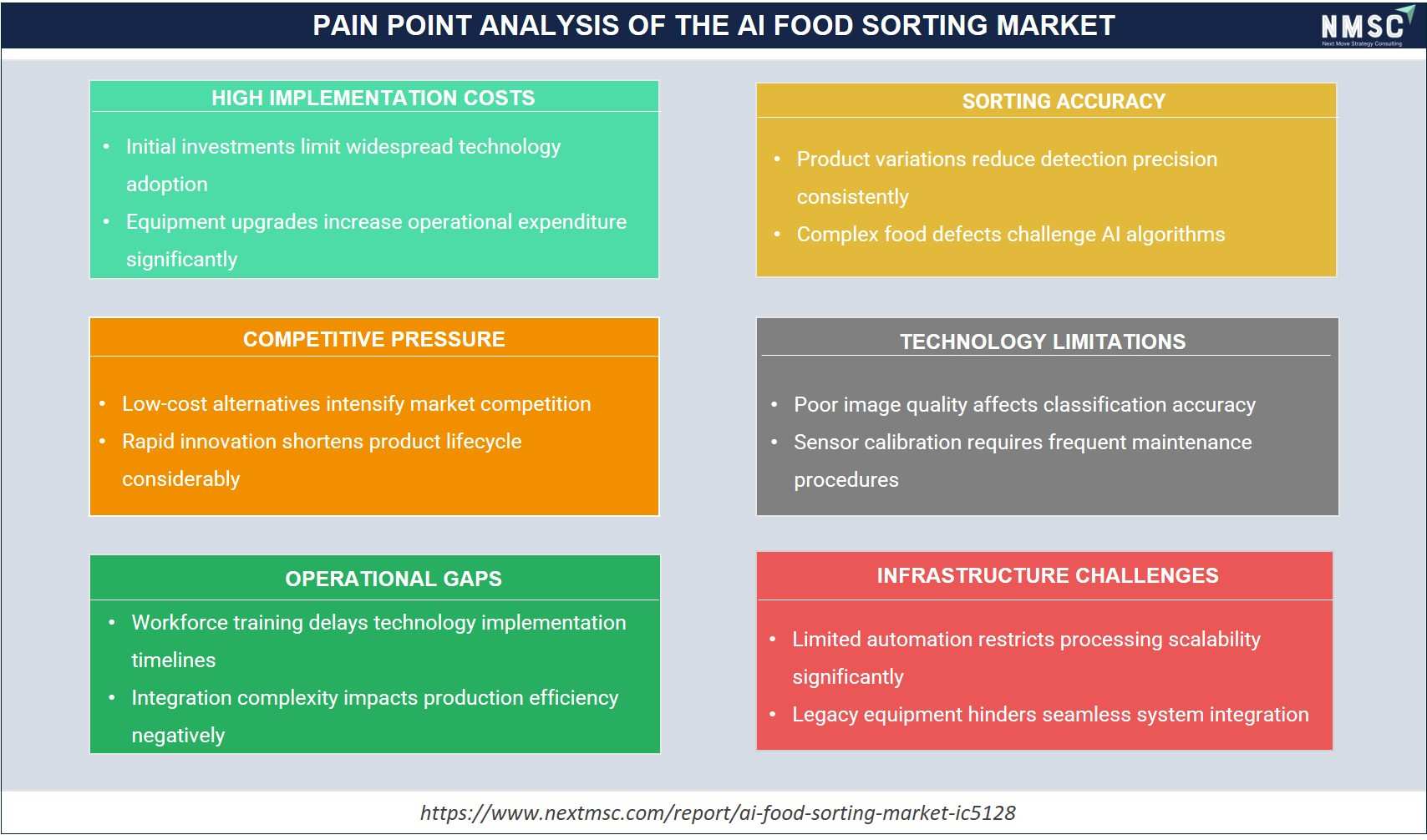
The pain point analysis identifies the primary challenges affecting AI food sorting system adoption and operational performance. Our assessment indicates that high implementation costs and equipment upgrades limit adoption, particularly among small and medium-sized processors. Variations in food appearance and complex defects reduce sorting accuracy, while image quality and sensor calibration affect detection performance. Integration with legacy production systems and workforce training requirements increase deployment complexity. Additionally, competitive pricing pressure and rapid technological advancements shorten product lifecycles and require continuous innovation.
Growth Drivers and Restraints
|
Factors |
Type |
(+/-) % Impact on CAGR |
Geographic Relevance |
Impact Timeline |
|
Rising global food safety and traceability regulation |
Driver |
+3.2% |
Global |
2026-2035 |
|
Labor shortages in food processing facilities |
Driver |
+2.6% |
North America, Europe |
2026-2035 |
|
Adoption of deep learning and computer vision platforms |
Driver |
+2.9% |
Global |
2026-2035 |
|
Expansion of organized food processing in Asia-Pacific |
Driver |
+2.1% |
Asia-Pacific |
2026-2035 |
|
Rising demand for contamination-free packaged food |
Driver |
+1.8% |
Global |
2026-2032 |
|
Government incentives for automation in agri-processing |
Driver |
+1.2% |
Asia-Pacific, Europe |
2026-2035 |
|
High capital cost of hyperspectral and X-ray systems |
Restraint |
-1.6% |
Global |
2026-2035 |
|
Shortage of skilled technicians for AI system calibration |
Restraint |
-1.1% |
North America, Europe |
2026-2032 |
|
Integration complexity with legacy production lines |
Restraint |
-0.9% |
Global |
2028-2035 |
What Is the Primary Growth Driver of the AI Food Sorting Market?
Rising global food safety and traceability regulation is the primary driver of the AI Food Sorting Market. The U.S. Food and Drug Administration's Food Safety Modernization Act requires preventive controls across processing facilities, sustaining demand for automated contaminant detection. We observed that this regulatory pressure, reinforced by mandatory recall reduction targets, continues to anchor baseline consumption of X-ray and optical sorting systems across developed and emerging food processing economies alike.
How Is Labor Automation Driving AI Food Sorting Market Growth?
Persistent labor shortages in food processing facilities are accelerating market growth toward fully automated grading lines. The U.S. Bureau of Labor Statistics reports sustained vacancy rates in food manufacturing occupations, pushing processors toward AI robotic sorting to maintain throughput. Our assessment indicates that this labor pressure, combined with rising wage costs, is compressing payback periods for AI sorting investment across North America and Europe.
What Is Restraining AI Food Sorting Market Expansion?
High capital cost of hyperspectral and X-ray sorting systems restrains adoption among small and mid sized processors across the AI Food Sorting Market. The U.S. Small Business Administration notes that limited access to capital constrains equipment upgrades among smaller manufacturers. We found that these processors face particular exposure, as limited scale reduces their ability to justify large upfront investment compared with larger, vertically integrated food processing groups.
Segmentation Analysis
Segment Sizing: By Offering
|
Segment |
2025 (USD) |
2035 (USD) |
CAGR% (2026-2035) |
|
Hardware |
USD 1.65 Billion |
USD 8.95 Billion |
18.5% |
|
Software |
USD 741 Million |
USD 5.35 Billion |
24.5% |
|
Services |
USD 456 Million |
USD 2.90 Billion |
22.7% |
|
Total |
USD 2.85 Billion |
USD 17.20 Billion |
19.9% |
Which Offering Segment Dominates the AI Food Sorting Market?
Hardware, encompassing optical, X-ray, and AI robotic sorting systems, led the AI Food Sorting Market with USD 1.65 Billion in 2025, supported by the physical equipment investment required to establish automated grading lines. We observed that Software is the fastest-growing offering, expanding at a 24.5% CAGR from 2026 to 2035, as processors increasingly license AI model and quality analytics platforms to extend the capability of existing hardware without full line replacement.
Segment Sizing: By Technology
|
Segment |
2025 (USD) |
2035 (USD) |
CAGR% (2026-2035) |
|
Computer Vision |
USD 912 Million |
USD 4.45 Billion |
19.3% |
|
Machine Learning |
USD 513 Million |
USD 3.30 Billion |
23.0% |
|
Deep Learning |
USD 399 Million |
USD 2.60 Billion |
23.8% |
|
Hyperspectral Imaging |
USD 228 Million |
USD 1.40 Billion |
22.3% |
|
Multispectral Imaging |
USD 171 Million |
USD 1.00 Billion |
21.4% |
|
Near Infrared Imaging |
USD 200 Million |
USD 1.10 Billion |
20.6% |
|
Laser Imaging |
USD 114 Million |
USD 650 Million |
21.2% |
|
X-Ray Imaging |
USD 143 Million |
USD 850 Million |
21.9% |
|
Sensor Fusion |
USD 86 Million |
USD 850 Million |
29.1% |
|
AI Robotics |
USD 86 Million |
USD 1.00 Billion |
31.0% |
|
Total |
USD 2.85 Billion |
USD 17.20 Billion |
19.9% |
Which Technology Segment Leads AI Food Sorting Market Demand?
Computer Vision remained the leading technology within the AI Food Sorting Market, valued at USD 912 Million in 2025 on its established role as the baseline detection layer across nearly all sorting platforms. Our findings suggest that AI Robotics is the fastest-growing technology, registering a 31.0% CAGR from 2026 to 2035, as processors pair vision guided robotic arms with sorting lines to automate physical removal of defective and contaminated units.
Segment Sizing: By Deployment Type
|
Segment |
2025 (USD) |
2035 (USD) |
CAGR% (2026-2035) |
|
Standalone Sorting Systems |
USD 941 Million |
USD 4.30 Billion |
16.5% |
|
Integrated Production Line Sorting Systems |
USD 1.48 Billion |
USD 7.74 Billion |
18.0% |
|
Cloud-Connected Sorting Systems |
USD 428 Million |
USD 5.16 Billion |
26.5% |
|
Total |
USD 2.85 Billion |
USD 17.20 Billion |
19.9% |
Which Deployment Type Leads the AI Food Sorting Market?
Integrated Production Line Sorting Systems led the AI Food Sorting Market with USD 1.48 Billion in 2025, reflecting processor preference for embedding sorting directly within continuous grading and packaging lines. We observed that Cloud-Connected Sorting Systems are the fastest-growing deployment type, expanding at a 26.5% CAGR from 2026 to 2035, as multi facility processors adopt centralized analytics to benchmark sorting performance across plants in real time.
Growth Opportunities
Three forward looking opportunities stand out as processors and technology vendors position for the next phase of AI Food Sorting Market expansion.
How Can Retrofit Kits Unlock Legacy Line Automation?
Modular retrofit kits that add computer vision and X-ray inspection to existing conveyor lines create a lower cost entry point for mid sized processors unable to justify full line replacement, benefiting hardware vendors and grain and potato processors seeking incremental automation.
What Opportunity Does Species and Origin Verification Present?
Hyperspectral based species and origin verification addresses food fraud concerns in seafood and meat supply chains, creating a premium software analytics opportunity for vendors serving seafood processors and premium branded meat manufacturers seeking traceability differentiation.
How Does Subscription Based AI Model Licensing Expand Vendor Revenue?
Subscription based licensing of continuously retrained AI defect detection models creates recurring revenue for software vendors while allowing processed food and ready meal manufacturers to access updated detection capability without capital reinvestment in new hardware.
Regional Outlook
|
Region |
2025 (USD) |
2035 (USD) |
CAGR% (2026-2035) |
Key Driver |
|
North America |
USD 1.03 Billion |
USD 5.16 Billion |
16.8% |
Food safety regulation and labor shortages |
|
Europe |
USD 770 Million |
USD 3.78 Billion |
17.5% |
EU food law compliance and sustainability mandates |
|
Asia-Pacific |
USD 741 Million |
USD 5.85 Billion |
22.9% |
Processing capacity expansion and automation incentives |
|
Middle East & Africa |
USD 171 Million |
USD 1.38 Billion |
21.0% |
Food import quality assurance investment |
|
Latin America |
USD 143 Million |
USD 1.03 Billion |
20.5% |
Export driven fruit and protein processing growth |
|
Total |
USD 2.85 Billion |
USD 17.20 Billion |
19.9% |
|
North America AI Food Sorting Market
North America leads the AI Food Sorting industry with an established base of large scale food processors and strict FDA preventive control requirements. We observed that mature adoption of X-ray and optical sorting is now extending toward AI robotic and cloud connected platforms. Labor shortages continue to push processors toward automation, while regulatory scrutiny of recalls sustains steady capital allocation toward contamination detection technology across the region.
Europe AI Food Sorting Market
Europe's AI Food Sorting industry is shaped by the EU General Food Law and national food safety authority inspection standards. Our assessment indicates that processors are prioritizing hyperspectral and multispectral systems to meet stringent contaminant thresholds. Sustainability mandates are also encouraging waste reduction through precision grading, reinforcing steady technology adoption across German, French, and UK processing facilities amid a mature but still expanding regulatory landscape.
Asia-Pacific AI Food Sorting Market
Asia-Pacific is the fastest-growing AI Food Sorting industry region, registering a 22.9% CAGR from 2026 to 2035. We found that rapid expansion of organized food processing capacity in China and India, combined with government automation incentives, is driving strong hardware and software uptake. Rising export quality requirements are accelerating adoption of optical and AI robotic sorting across fruit, seafood, and grain processing facilities throughout the region.
Middle East & Africa AI Food Sorting Market
The Middle East & Africa AI Food Sorting industry remains an emerging opportunity anchored by food import quality assurance requirements. Our findings suggest that Gulf Cooperation Council food safety authorities are tightening inspection standards for imported produce and protein, prompting processors and importers to adopt optical sorting. South Africa's fruit export sector is also investing in grading automation to meet destination market compliance thresholds across Europe and Asia.
Latin America AI Food Sorting Market
Latin America's AI Food Sorting industry is driven by export oriented fruit, coffee, and protein processing industries in Brazil and Argentina. We observed that processors are adopting optical and near infrared sorting to meet international buyer quality specifications. Regulatory harmonization with destination markets, combined with rising foreign direct investment in processing infrastructure, is expected to sustain above average regional growth through the forecast period.
U.S. AI Food Sorting Market
Based on our engagements, the U.S. AI Food Sorting industry was valued at approximately USD 720 Million in 2025 and is projected to approach USD 3.60 Billion by 2035, at a CAGR near 17.4%. Demand is anchored by FDA preventive control requirements and large scale processed food manufacturing. Adoption of AI robotic sorting is accelerating as labor costs rise, while competitive intensity among domestic and international vendors continues to strengthen deployment.
Canada AI Food Sorting Market
Through our analysis, the Canada AI Food Sorting industry stood at approximately USD 158 Million in 2025 and is forecast to reach USD 690 Million by 2035, growing at roughly 15.9% CAGR. The Canadian Food Inspection Agency's quality standards support steady demand, while grain and potato processors in the prairie provinces increasingly deploy optical sorting. Technology penetration remains concentrated among larger cooperatives with capacity for automation investment.
UK AI Food Sorting Market
From our assessment, the UK AI Food Sorting industry was valued at approximately USD 141 Million in 2025 and is expected to reach USD 660 Million by 2035, at roughly 16.5% CAGR. Post Brexit food standards enforcement by the Food Standards Agency sustains demand for contaminant detection. Adoption is concentrated among large bakery and ready meal manufacturers, with regulatory pressure and retailer quality mandates driving strategic technology upgrades.
Germany AI Food Sorting Market
According to evaluation, the Germany AI Food Sorting industry reached approximately USD 231 Million in 2025 and is projected to hit USD 1.10 Billion by 2035, expanding at roughly 16.9% CAGR. Germany's strong food processing machinery base, led by domestic equipment suppliers, supports high technology penetration. Strict national food safety inspection standards and export orientation continue to drive strategic automation investment across German processors.
France AI Food Sorting Market
Based on our engagements, the France AI Food Sorting industry was valued at approximately USD 116 Million in 2025 and is forecast to reach USD 540 Million by 2035, at roughly 16.6% CAGR. French food safety enforcement under national health authority oversight supports steady adoption. Fruit, dairy, and bakery processors are the primary adopters, with regulatory and retailer quality mandates driving continued but moderate paced technology penetration nationally.
China AI Food Sorting Market
Through our analysis, the China AI Food Sorting industry stood at approximately USD 296 Million in 2025 and is expected to reach USD 2.75 Billion by 2035, growing at roughly 24.9% CAGR. Rapid expansion of large scale processing facilities and government backed agricultural automation incentives are accelerating adoption. Domestic optical sorting manufacturers are scaling production, intensifying competition and improving affordability for mid sized processors across the country.
India AI Food Sorting Market
From our assessment, the India AI Food Sorting industry was valued at approximately USD 141 Million in 2025 and is projected to reach USD 1.55 Billion by 2035, the fastest-growing country at roughly 26.4% CAGR. Export quality requirements for spices, rice, and produce are driving adoption, while government food processing modernization schemes are subsidizing automation investment among small and mid sized processing units nationwide.
Japan AI Food Sorting Market
According to evaluation, the Japan AI Food Sorting industry reached approximately USD 104 Million in 2025 and is forecast to hit USD 470 Million by 2035, at roughly 16.3% CAGR. An aging workforce is pushing processors toward AI robotic sorting to offset labor scarcity. High technology penetration among seafood and rice processors reflects Japan's established precision manufacturing base and strong domestic equipment supplier ecosystem.
South Korea AI Food Sorting Market
Based on our engagements, the South Korea AI Food Sorting industry was valued at approximately USD 74 Million in 2025 and is expected to reach USD 350 Million by 2035, at roughly 16.9% CAGR. Government smart farm and processing digitization initiatives support adoption. Kimchi, seafood, and produce processors are early adopters, leveraging domestic robotics and machine vision suppliers to strengthen automated grading capability.
Australia AI Food Sorting Market
Through our analysis, the Australia AI Food Sorting industry stood at approximately USD 67 Million in 2025 and is projected to reach USD 290 Million by 2035, growing at roughly 15.8% CAGR. Export driven fruit, grain, and meat processing sustains steady demand. Biosecurity and quarantine inspection standards enforced by national authorities reinforce reliance on optical and X-ray sorting across major processing hubs.
UAE AI Food Sorting Market
From our assessment, the UAE AI Food Sorting Market was valued at approximately USD 39 Million in 2025 and is forecast to reach USD 330 Million by 2035, at roughly 23.8% CAGR. Food import reliance and re-export processing hubs drive demand for quality verification technology. Government food security strategies are encouraging investment in automated inspection across free zone processing and logistics facilities.
Saudi Arabia AI Food Sorting Market
According to evaluation, the Saudi Arabia AI Food Sorting Market reached approximately USD 34 Million in 2025 and is expected to hit USD 270 Million by 2035, at roughly 22.9% CAGR. Vision 2030 food security and localization initiatives are driving investment in domestic processing capacity. Date, dairy, and grain processors are increasingly specifying optical sorting to meet national food safety authority standards.
South Africa AI Food Sorting Market
Based on our engagements, the South Africa AI Food Sorting Market was valued at approximately USD 30 Million in 2025 and is projected to reach USD 220 Million by 2035, at roughly 21.6% CAGR. The country's citrus and fruit export sector drives demand for optical grading to meet European and Asian buyer specifications, supported by established agricultural processing infrastructure across the Western Cape region.
Brazil AI Food Sorting Market
Through our analysis, the Brazil AI Food Sorting Market stood at approximately USD 76 Million in 2025 and is expected to reach USD 560 Million by 2035, growing at roughly 21.9% CAGR. Large scale coffee, protein, and fruit export processing drives adoption of optical and near infrared sorting. Foreign direct investment in processing infrastructure continues to expand technology penetration among major Brazilian export processors.
Argentina AI Food Sorting Market
From our assessment, the Argentina AI Food Sorting Market was valued at approximately USD 31 Million in 2025 and is forecast to reach USD 210 Million by 2035, at roughly 21.0% CAGR. Grain and beef export processing sustains steady demand for automated grading. Currency volatility moderates capital investment pace, though international buyer quality requirements continue to support gradual technology adoption among larger exporters.
Strategic Framework of the AI Food Sorting Market
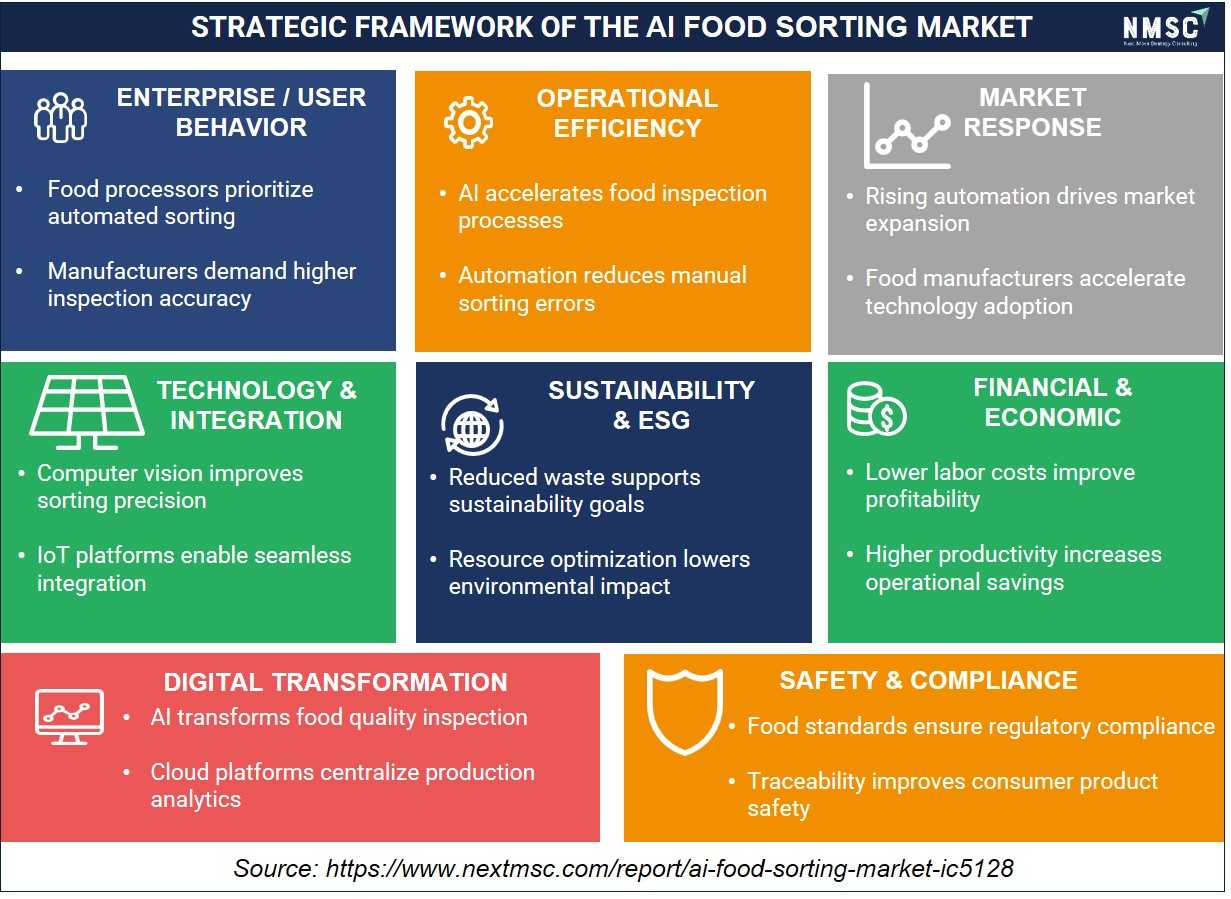
The strategic framework evaluates the key factors shaping growth and competitiveness in the AI Food Sorting Market. Our assessment indicates that food manufacturers increasingly adopt AI-powered sorting to improve inspection accuracy, processing efficiency, and product quality. Computer vision, IoT connectivity, and cloud-based analytics enhance automation and production visibility while supporting seamless integration. AI-driven sorting reduces food waste, optimizes resource utilization, and strengthens sustainability initiatives. Compliance with food safety regulations and traceability requirements, combined with lower labor costs and higher productivity, continues to accelerate market adoption.
Competitive Landscape
We observed that the AI Food Sorting Market remains moderately consolidated, with established optical sorting specialists competing against emerging AI-native software entrants across hardware, software, and services tiers.
|
Dimension |
Assessment |
|
Market Structure |
Moderately consolidated, led by TOMRA Systems ASA and Buhler AG alongside regional specialists |
|
Innovation Focus |
Deep learning defect detection, hyperspectral imaging, and AI robotic sorting integration |
|
M&A Activity |
Selective acquisitions targeting software analytics and robotics capability |
How Do Companies Compete in the AI Food Sorting Market?
Companies compete primarily on sorting accuracy, throughput speed, and total cost of ownership across the AI Food Sorting Market. Our analysis shows that established players differentiate through proprietary spectral imaging algorithms and global service networks, while newer entrants compete on software flexibility and faster deployment timelines. Pricing strategies increasingly bundle hardware with subscription based software to lock in long term service revenue relationships with processors.
Which Competitive Archetypes Dominate the AI Food Sorting Market?
Two archetypes dominate the AI Food Sorting Market: full stack equipment manufacturers offering integrated hardware and software, and specialized software vendors licensing AI detection models onto third party hardware. TOMRA Systems ASA and Buhler AG exemplify the first archetype through vertically integrated portfolios, while smaller technology firms pursue the second by embedding algorithms into existing processor infrastructure without requiring hardware replacement.
What Innovation and Differentiation Strategies Define Competition?
Innovation centers on expanding spectral range, reducing false rejection rates, and enabling cloud connected fleet analytics across multi plant operations. We observed that leading vendors are investing in proprietary training datasets to improve deep learning accuracy for niche defect categories. Differentiation increasingly rests on data network effects, as vendors with larger installed bases accumulate more training data to refine detection models faster than smaller competitors.
What M&A Activity Is Shaping the AI Food Sorting Market?
Mergers and acquisitions in the AI Food Sorting Market target software analytics and robotics capability gaps within established hardware portfolios. Our findings suggest that larger equipment manufacturers are acquiring smaller AI software firms to accelerate deep learning capability rather than build internally. This consolidation trend is expected to continue as processors increasingly demand integrated hardware software solutions from single accountable vendors across geographic markets.
Key Market Players
Our assessment indicates that the following companies represent the most active and validated participants shaping the competitive structure of the AI Food Sorting Market.
-
Buhler AG
-
Duravant LLC
-
Satake Corporation
-
UNITEC S.p.A.
-
Hefei Meyer Optoelectronic Technology Inc.
-
Sesotec GmbH
-
Aweta G&P B.V.
-
MAF RODA AGROBOTIC
-
GREEFA
-
Raytec Vision S.p.A.
-
Jiangxi Reemoon Technology Holdings Co., Ltd.
-
Anhui Taiho Intelligent Technology Co., Ltd.
-
Sorma Group S.p.A.
-
Shibuya Seiki Co., Ltd.
-
Newtec A/S
-
Ellips B.V.
-
Binder+Co AG
-
Optimum Sorting Inc.
-
Allgaier Process Technology GmbH
Latest Developments
We observed several notable product launches and strategic moves across the AI Food Sorting Market during 2025 and 2026, reflecting accelerating investment in AI-driven detection capability.
|
Date |
Event |
|
March 2026 |
Celebrating three decades of its AUTOSORT™ system, TOMRA unveiled new deep learning and AI-powered solutions. Key highlights included their GAINnext™ technology, which uses advanced deep learning to handle complex sorting tasks—such as distinguishing food-grade plastics—and the launch of TOMRA Local Control, a software platform allowing operators to manage entire plant sorting lines from a single, remote interface |
|
May 2026 |
At Interpack 2026, Bühler introduced several major upgrades across its portfolio, integrating advanced AI and self-learning controls. The new solutions focus on "predictive, self-learning controls" that allow equipment—such as their cocoa roasters and chocolate refiners—to maintain consistent quality without requiring deep machine-side expertise from operators |
|
June 2026 |
Bühler announced the acquisition of endeco GmbH and its subsidiary, endeco Protein and Food, effective January 1, 2026. This acquisition is a strategic move to strengthen Bühler's position in the protein processing sector, an area where AI-driven sorting and quality control are increasingly vital for precision ingredient separation |
Investment Opportunities
How Are Capital Inflows Shaping the AI Food Sorting Market?
Capital inflows into the AI Food Sorting Market are concentrated in software analytics and AI robotics startups seeking to complement established hardware vendors. We observed that venture and strategic investors are prioritizing companies with proprietary training datasets, as data scale increasingly determines detection accuracy advantages. This capital concentration is expected to accelerate consolidation as larger vendors seek to acquire specialized AI capability rather than build it internally.
What Infrastructure Investment Is Required for Market Expansion?
Infrastructure investment across the AI Food Sorting Market centers on upgrading legacy conveyor and grading lines to accommodate sensor integration and cloud connectivity. Our findings suggest that processors in Asia-Pacific are directing the largest share of new capital toward greenfield facilities designed with automation built in from inception, while North American and European processors favor incremental retrofit investment across existing infrastructure.
What ESG Considerations Influence AI Food Sorting Investment?
Environmental, Social, and Governance considerations increasingly influence AI Food Sorting Market investment as automated sorting reduces food waste and improves resource efficiency. Our analysis shows that investors are prioritizing vendors whose technology demonstrably reduces landfill bound food waste, aligning with corporate sustainability disclosure requirements. Labor safety improvements from reduced manual sorting exposure also factor into ESG focused investment evaluation criteria across the sector.
Key Benefits for Stakeholders
How Does This Report Benefit Food Processing Industry Leaders?
Industry leaders gain access to detailed segmentation, regional sizing, and competitive benchmarking that supports capital allocation decisions across sorting technology investment. Our analysis provides forecast data enabling processors to prioritize automation investment by technology type and deployment model, while competitive landscape insights help leadership teams evaluate vendor selection criteria aligned with plant specific defect detection and throughput requirements.
How Does This Report Benefit Investors and Financial Analysts?
Investors and financial analysts gain quantified market sizing, growth trajectories, and segment level CAGR data supporting valuation and due diligence across the AI Food Sorting Market. Our forecasts identify the fastest-growing sub-segments and regions, enabling analysts to evaluate capital allocation opportunities and assess competitive positioning of target companies against documented market share and growth benchmarks.
How Does This Report Benefit Technology Vendors and Product Teams?
Technology vendors and product teams gain insight into emerging trends, unmet segmentation needs, and competitive differentiation strategies shaping the AI Food Sorting Market. Our analysis of growth opportunities and regional adoption patterns helps product teams prioritize feature development and go to market sequencing, while competitive landscape data supports positioning decisions relative to established hardware and emerging software focused competitors.
Key Market Segments
By Offering
-
Hardware
-
Optical Sorting Systems
-
Color Sorting Systems
-
Near Infrared Sorting Systems
-
Multispectral Sorting Systems
-
Hyperspectral Sorting Systems
-
Laser Sorting Systems
-
Combined Optical Sorting Systems
-
-
X-Ray Sorting Systems
-
AI Robotic Sorting Systems
-
Other Sensor-Based Sorting Systems
-
-
Software
-
Sorting Control Software
-
AI Model and Algorithm Software
-
Quality Analytics Software
-
Production Optimization Software
-
Predictive Maintenance Software
-
-
Services
-
Installation and Integration Services
-
Maintenance and Support Services
-
Training Services
-
Consulting Services
-
Software Upgrade Services
-
By Technology
-
Computer Vision
-
Machine Learning
-
Deep Learning
-
Hyperspectral Imaging
-
Multispectral Imaging
-
Near Infrared Imaging
-
Laser Imaging
-
X-Ray Imaging
-
Sensor Fusion
-
AI Robotics
By Food Category
-
Fruits
-
Fresh Fruits
-
Frozen Fruits
-
Dried Fruits
-
-
Vegetables
-
Fresh Vegetables
-
Frozen Vegetables
-
Dried Vegetables
-
-
Nuts
-
Seeds
-
Grains
-
Cereals
-
Pulses and Legumes
-
Potatoes
-
Meat
-
Seafood
-
Dairy Products
-
Bakery Products
-
Confectionery Products
-
Processed Foods
-
Ready Meals
-
Pet Food
-
Other Food Products
By Sorting Function
-
Defect Detection and Removal
-
Color Defect Detection
-
Shape Defect Detection
-
Size Defect Detection
-
Surface Defect Detection
-
Internal Defect Detection
-
-
Foreign Material Detection and Removal
-
Metal Contaminants
-
Glass Contaminants
-
Plastic Contaminants
-
Stone Contaminants
-
Organic Contaminants
-
-
Grading and Classification
-
Quality Grading
-
Size Grading
-
Color Grading
-
Premium Grade Classification
-
-
Yield Optimization
By End User
-
Fruit and Vegetable Processors
-
Grain and Cereal Processors
-
Nut and Seed Processors
-
Potato Processors
-
Meat Processors
-
Seafood Processors
-
Dairy Processors
-
Bakery and Confectionery Manufacturers
-
Processed Food Manufacturers
-
Pet Food Manufacturers
By Deployment Type
-
Standalone Sorting Systems
-
Integrated Production Line Sorting Systems
-
Cloud-Connected Sorting Systems
By Region
-
North America: U.S., Canada, Mexico.
-
Europe: UK, Germany, France, Italy, Spain, Sweden, Denmark, Finland, Netherlands, Rest of Europe.
-
Asia-Pacific: China, India, Japan, South Korea, Taiwan, Indonesia, Vietnam, Australia, Philippines, Malaysia, Rest of APAC.
-
Middle East & Africa: Saudi Arabia, UAE, Egypt, Israel, Turkey, Nigeria, South Africa, Rest of MEA.
-
Latin America: Brazil, Argentina, Chile, Colombia, Rest of LATAM.
Conclusion and Recommendations
What Is the Long-Term Outlook for the AI Food Sorting Market?
The long-term outlook for the AI Food Sorting Market remains strongly positive, with the market projected to expand from USD 3.35 Billion in 2026 to USD 17.20 Billion by 2035 at a 19.9% CAGR. We observed that structural drivers including food safety regulation, labor shortages, and deep learning maturation are unlikely to reverse, positioning the market for sustained double digit growth across hardware, software, and services offerings through the full forecast period.
What Strategic Positioning Should Vendors Pursue?
Vendors should pursue integrated hardware software positioning, bundling sorting equipment with subscription based AI analytics to build recurring revenue streams. Our assessment indicates that companies investing in proprietary training datasets and cloud connected fleet management will strengthen defensibility against new entrants. Strategic partnerships with regional integrators can accelerate market entry in Asia-Pacific and Latin America without requiring full local manufacturing investment.
How Attractive Is the AI Food Sorting Market for Investment?
The AI Food Sorting Market presents strong investment attractiveness, supported by a USD 13.85 Billion absolute dollar opportunity between 2026 and 2035. Our findings suggest that software and services segments offer superior margin profiles compared with hardware, given lower capital intensity and recurring revenue characteristics, making these sub-segments particularly attractive for growth focused investors seeking exposure to food technology automation.
What Market Shifts and Key Risks Should Stakeholders Monitor?
Stakeholders should monitor the shift toward cloud connected and AI robotic architectures, which is reshaping vendor competitive positioning. Key risks include high capital costs limiting adoption among smaller processors and integration complexity with legacy production lines. Our analysis shows that resin and component supply chain disruptions could also affect hardware delivery timelines, warranting close monitoring by processors planning large scale automation rollouts.
What Are the Primary Growth Pathways Through 2035?
Primary growth pathways include retrofit kit expansion for legacy lines, subscription based AI model licensing, and species and origin verification services addressing food fraud concerns. Next Move Strategy Consulting's analysis indicates that vendors capturing early positions in these pathways, particularly within Asia-Pacific's rapidly expanding processing base, are best positioned to compound share gains as the AI Food Sorting Market scales toward its 2035 forecast.
About the Author
 Saista Faiyaz
— Saista Faiyaz is Research Associate at Next Move Strategy Consulting, where she has covered consumer markets and healthcare technologies for 3 years. Her work includes primary interview review, secondary-source validation, market sizing, and structured analysis of company and industry data. She supports research by comparing evidence across sources, organizing findings into market narratives, and documenting assumptions used in analysis. Her scope includes cross-market benchmarking, and reports.
Saista Faiyaz
— Saista Faiyaz is Research Associate at Next Move Strategy Consulting, where she has covered consumer markets and healthcare technologies for 3 years. Her work includes primary interview review, secondary-source validation, market sizing, and structured analysis of company and industry data. She supports research by comparing evidence across sources, organizing findings into market narratives, and documenting assumptions used in analysis. Her scope includes cross-market benchmarking, and reports.
About the Reviewer
 Supradip Baul
— Supradip Baul is an accomplished business consultant and strategist with over a decade of rich experience in market intelligence, strategy, technology, and business transformation. His work has included rigorous qualitative and quantitative analysis across multiple industries, helping clients shape investment decisions and long-term roadmaps. Earlier in his career, he was associated with Gartner, where he contributed to industry-leading reports and market share analyses. He has worked with leading global companies and holds an MBA with a dual specialization in Marketing and Finance.
Supradip Baul
— Supradip Baul is an accomplished business consultant and strategist with over a decade of rich experience in market intelligence, strategy, technology, and business transformation. His work has included rigorous qualitative and quantitative analysis across multiple industries, helping clients shape investment decisions and long-term roadmaps. Earlier in his career, he was associated with Gartner, where he contributed to industry-leading reports and market share analyses. He has worked with leading global companies and holds an MBA with a dual specialization in Marketing and Finance.
At Next Move Strategy Consulting, we understand that insightful market research is the cornerstone of successful business decisions. That's why we employ a robust and multifaceted approach, combining various methodologies to deliver the most accurate and actionable data for our clients.

Research Landscape
We navigate the world of research with two primary approaches:
Qualitative Approach
Our qualitative research methodologies involve immersive techniques such as in-depth interviews, focus groups, and observational studies. By engaging directly with individuals and stakeholders, we uncover valuable insights that quantitative data alone may overlook.

Quantitative Research
In tandem with qualitative methodologies, NMSC leverages the power of Quantitative Research to provide a robust foundation of numerical insights. Through systematic data collection and analysis, we quantify patterns, preferences, and market trends, offering a comprehensive view of the business landscape.
Our quantitative research approach employs diverse tools, including surveys, experiments, and statistical modelling. These methodologies enable us to gather data from a large and representative sample, ensuring the statistical significance of our findings. By employing structured questionnaires and standardized data collection methods, we guarantee the reliability and validity of the information we present to our clients.
Quantitative research is particularly effective in measuring the prevalence of trends, assessing market size, and gauging the impact of various factors on consumer behavior. The numerical precision attained through this approach equips our clients with actionable insights, facilitating data-driven decision-making and strategy formulation.


Our Specialized Toolbox for Industry-Specific Market Research
We deploy a specialized arsenal of techniques tailored to meet your unique requirements. Here's a glimpse into our comprehensive toolbox:

Information Procurement
The stage entails acquiring market data or relevant information through various sources and methodologies.


Market Research Approach
We utilize both top-down and bottom-up approaches in market research analysis to achieve a comprehensive understanding of the market dynamics, leveraging the broad perspective of industry trends and macroeconomic factors alongside detailed insights from specific segments and individual companies.

Porters Five Forces Analysis
We conduct Porter's Five Forces analysis to evaluate the competitive landscape of an industry, providing us with insights into factors that affect profitability and strategic positioning.

SWOT Analysis

Forecasting
We utilize a forecasting model to predict future consumption by considering parameters like population, economics, regulations, market competition, drivers, constraints, technology, and pricing. We also employ statistical techniques such as multilinear regression, exponential smoothing, moving average, ARIMA, and Monte Carlo simulations for accurate predictions. In econometric forecasting, we analyzed short-term and long-term event impacts, attributing values based on regulatory frameworks, economic factors, and market events.





 Speak to Our Analyst