AutoML Market Global Industry Analysis and Forecast (2026-2035)

AutoML Market size was USD 4.3 billion in 2026, projected to reach USD 56.0 billion by 2035, growing at a CAGR of 33.0% from 2026 to 2035. Key drivers include enterprise demand for democratized machine learning, integration of generative AI into AutoML pipelines, and rising cloud-native AI platform adoption, with North America leading the market.

Download Free Sample PDF
Base Year (2025)
$3.20 Billion
Forecast (2035)
$56.00 Billion
CAGR (2026-2035)
33.0%
Top Region
North America

What Is the AutoML Market Size?

The global AutoML market size was valued at USD 3.2 billion in 2025 and is estimated at USD 4.3 billion in 2026, forecast to reach USD 56.0 billion by 2035, expanding at a 33.0% CAGR between 2026 and 2035. North America leads with approximately 44% share, while the software platform component dominates all other components with approximately 78% share.

We observed that growth is broad-based across every segmentation axis, with natural language processing applications and manufacturing end users emerging as the dominant structural shifts reshaping the AutoML market through 2035.

AutoML Market Global Industry Analysis and Forecast (2026-2035) Revenue Forecast

Values in USD Billion

2025 $3.20 Billion
2025
2026 $4.26 Billion
2026
2027 $5.66 Billion
2027
2028 $7.53 Billion
2028
2029 $10.01 Billion
2029
2030 $13.32 Billion
2030
2031 $17.71 Billion
2031
2032 $23.56 Billion
2032
2033 $31.33 Billion
2033
2034 $41.67 Billion
2034
2035 $56.00 Billion
2035

Key Takeaways

By Component: Software Platform held the largest share of approximately 78% (USD 2.50 billion) in 2025; Software Platform also registered the fastest growth at 33.8% CAGR from 2026–2035.

By Deployment Mode: Cloud held the largest share of approximately 68% (USD 2.18 billion) in 2025; Cloud is the fastest-growing sub-segment at 34.2% CAGR from 2026–2035.

By Application: Predictive Analytics held the largest share of approximately 32% (USD 1.02 billion) in 2025; Natural Language Processing is the fastest-growing sub-segment at 40.1% CAGR from 2026–2035.

By Organization Size: Large Enterprises held the largest share of approximately 64% (USD 2.05 billion) in 2025; Small and Medium Enterprises is the fastest-growing sub-segment at 35.6% CAGR from 2026–2035.

By End User Industry: BFSI held the largest share of approximately 26% (USD 0.83 billion) in 2025; Manufacturing is the fastest-growing sub-segment at 35.2% CAGR from 2026–2035.

Dominant Region: North America dominated with approximately 44% revenue share (USD 1.41 billion) in 2025.

Fastest-Growing Region: Middle East & Africa is expected to register the highest CAGR of 38.7% during 2026–2035.

Dominant Country: U.S. led with approximately USD 1.06 billion in 2025.

Fastest-Growing Country: UAE is the fastest-growing country at approximately 40.3% CAGR from 2026–2035.

Market Opportunity: The AutoML market is expected to create an absolute dollar opportunity of USD 51.7 billion between 2026 and 2035, presenting significant investment potential across the cloud-native, generative AI-integrated automated machine learning value chain.

According to NMSC analysis, we found that enterprises are increasingly embedding automated machine learning capability directly within existing cloud data platforms rather than purchasing standalone AutoML tools, a shift that favors vendors who combine data storage, governance, and automated model-building in a single environment over point-solution specialists as procurement consolidates through 2035.

What Does the AutoML Market Encompass?

The AutoML market encompasses software platforms and services that automate data preparation, feature engineering, model selection, hyperparameter tuning, and deployment for machine learning workflows without requiring extensive manual data science expertise. Our assessment indicates that the scope spans cloud and on-premise platforms serving large enterprises and small and medium enterprises across predictive analytics, computer vision, and natural language processing applications. The category has evolved from narrow, single-model automation tools into comprehensive platforms embedding generative AI, governance, and monitoring capabilities across the full model lifecycle.

Regulatory frameworks such as the European Union's Artificial Intelligence Act increasingly shape model documentation, transparency, and risk-classification requirements for automated systems deployed in regulated industries. We observed that technology adoption is shifting toward embedding large language models directly into AutoML pipelines for automated feature engineering and natural language-driven model building. NMSC's analysis indicates that this structural shift, combined with rising demand for governed, auditable automation, is redefining vendor selection criteria across the AutoML market.

Market Drivers & Dynamics

Interactive Dataset
Enterprise demand for democratized machine learning without specialized talent driver +4.8% Global 2026-2035
Integration of generative AI and large language models into AutoML pipelines driver +3.9% Global 2026-2035
Rising cloud-native AI platform adoption among mid-market enterprises driver +2.6% North America, Europe 2026-2035
Growing demand for automated fraud detection in financial services driver +2.1% Global 2026-2032
Expanding government AI adoption and digital transformation initiatives driver +1.7% Asia-Pacific, Middle East 2026-2035
Rising need for automated demand forecasting in supply chain planning driver +1.3% North America, Asia-Pacific 2026-2032
Data privacy and AI governance compliance requirements restraint -2.0% North America, Europe 2026-2035
Shortage of skilled personnel to validate automated model outputs restraint -1.4% Global 2026-2032
Model explainability concerns in regulated industries restraint -0.9% North America, Europe 2028-2035
Commoditization of basic AutoML features within cloud platforms restraint -0.6% Global 2026-2032
Source: Next Move Strategy Consulting

Growth Drivers

What Is the Primary Growth Driver of the AutoML Market?

Enterprise demand for democratized machine learning without specialized data science talent is the primary driver of the market. The U.S. Bureau of Labor Statistics projects employment of data scientists to grow substantially faster than the average for all occupations through the coming decade, reflecting a persistent talent gap that automated tooling directly addresses. We observed that this structural talent shortage, combined with rising enterprise appetite for predictive analytics, continues to anchor baseline AutoML platform adoption across industries.

How Is Generative AI Integration Driving AutoML Market Growth?

Integration of large language models into AutoML pipelines is accelerating market growth by extending automation beyond structured data into natural language and unstructured-text use cases. Dataiku reported reaching USD 342.5 million in annual recurring revenue by September 2025, up from USD 300 million at the end of 2024, reflecting sustained enterprise investment in governed AI platforms. Our assessment indicates that this revenue trajectory, combined with expanding generative AI capability, is compressing enterprise procurement cycles for unified AutoML and AI governance platforms.

Growth Inhibitors

What Is Restraining AutoML Market Expansion?

Data privacy and AI governance compliance requirements restrain the pace of AutoML adoption across regulated industries. The European Union's Artificial Intelligence Act imposes documentation, transparency, and risk-classification obligations on automated systems deployed within its jurisdiction, according to the European Commission's official disclosures. We found that this regulatory complexity disproportionately affects vendors serving global enterprises with varying jurisdictional requirements, slowing adoption among cautious buyers even as compliant platforms seek to differentiate through built-in governance tooling.

What Are the Growth Opportunities?

How Can Vertical-Specific AutoML Unlock Value for Regulated Industries?

Vertical-specific AutoML platforms present a whitespace opportunity for vendors serving healthcare and financial services buyers seeking pre-built compliance and explainability capability. Vendors that commercialize industry-tuned automated pipelines stand to capture premium pricing as regulated buyers prioritize built-in governance over generic, horizontal automation tools requiring extensive customization.

Where Does Small and Medium Enterprise Adoption Create New Demand?

Small and medium enterprises seeking predictive analytics without dedicated data science teams represent an underpenetrated opportunity for vendors offering simplified, consumption-priced AutoML products. Vendors that develop low-cost, self-service platforms can secure recurring subscription revenue as smaller organizations increasingly adopt automation tools previously accessible only to large enterprises with dedicated technical staff.

How Can Sovereign AI Infrastructure Programs Benefit AutoML Vendors?

National sovereign AI infrastructure programs across the Middle East and Asia-Pacific represent an underpenetrated opportunity for vendors offering on-premises and air-gapped AutoML deployment. Early movers that build dedicated government and public-sector deployment options can differentiate with customers pursuing data-localization mandates tied to national digital transformation initiatives.

Segmentation Analysis

2025 (USD Billion)
2035 (USD Billion)
Software Platform 2025: $2.50 Billion | 2035: $45.92 Billion
Software Pla
Services 2025: $0.70 Billion | 2035: $10.08 Billion
Services
Software Platform $2.50 Billion $45.92 Billion 33.8%
Services $0.70 Billion $10.08 Billion 30.5%

Which Component Dominates the AutoML Market?

Software Platform led the market with USD 2.50 billion in 2025, supported by broad enterprise adoption of automated data preparation, model training, and deployment functionality within a single environment. We observed that Software Platform is also the fastest-growing component, expanding at a 33.8% CAGR from 2026 to 2035, as vendors continue layering generative AI and governance capabilities directly into core platform offerings rather than through separate service engagements.

2025 (USD Billion)
2035 (USD Billion)
Cloud
On-Premise
Hybrid
Segment Item 2025 (USD Billion) 2035 (USD Billion) CAGR
Cloud $10.0 USD Billion $40.0 USD Billion 24.0%
On-Premise $17.1 USD Billion $51.1 USD Billion 26.0%
Hybrid $24.2 USD Billion $62.2 USD Billion 12.0%

Segment-wise data is locked

Unlock complete segment-wise numbers for By Deployment Mode.

Unlock Full Data
2025 (USD Billion)
2035 (USD Billion)
Predictive A
Fraud Detect
Customer Ana
Computer Vis
Natural Lang
Segment Item 2025 (USD Billion) 2035 (USD Billion) CAGR
Predictive Analytics $10.0 USD Billion $40.0 USD Billion 15.0%
Fraud Detection and Risk Management $17.1 USD Billion $51.1 USD Billion 21.0%
Customer Analytics and Personalization $24.2 USD Billion $62.2 USD Billion 11.0%
Computer Vision $31.3 USD Billion $73.3 USD Billion 21.0%
Natural Language Processing $38.4 USD Billion $84.4 USD Billion 14.0%

Segment-wise data is locked

Unlock complete segment-wise numbers for By Application.

Unlock Full Data

Which Application Leads AutoML Market Demand?

Predictive Analytics remained the leading application within the market, valued at USD 1.02 billion in 2025 on sustained enterprise demand for automated forecasting and classification models across sales, operations, and risk functions. Our findings suggest that Natural Language Processing is the fastest-growing application, registering a 40.1% CAGR from 2026 to 2035, as large language model integration extends automated pipelines into document processing, summarization, and conversational analytics use cases.

2025 (USD Billion)
2035 (USD Billion)
Large Enterp
Small and Me
Segment Item 2025 (USD Billion) 2035 (USD Billion) CAGR
Large Enterprises $10.0 USD Billion $40.0 USD Billion 19.0%
Small and Medium Enterprises $17.1 USD Billion $51.1 USD Billion 21.0%

Segment-wise data is locked

Unlock complete segment-wise numbers for By Organization Size.

Unlock Full Data
2025 (USD Billion)
2035 (USD Billion)
BFSI
Healthcare a
Retail and E
IT and Telec
Manufacturin
Segment Item 2025 (USD Billion) 2035 (USD Billion) CAGR
BFSI $10.0 USD Billion $40.0 USD Billion 13.0%
Healthcare and Life Sciences $17.1 USD Billion $51.1 USD Billion 11.0%
Retail and E-commerce $24.2 USD Billion $62.2 USD Billion 17.0%
IT and Telecommunications $31.3 USD Billion $73.3 USD Billion 23.0%
Manufacturing $38.4 USD Billion $84.4 USD Billion 24.0%

Segment-wise data is locked

Unlock complete segment-wise numbers for By End User Industry.

Unlock Full Data

Which End User Industry Is Most Significant in the AutoML Market?

BFSI remained the dominant end user industry across the market, reaching USD 0.83 billion in 2025 due to sustained demand for automated fraud detection, credit scoring, and risk-modeling capability. Based on research conducted by NMSC, we found that Manufacturing represents the fastest-growing end user industry at a 35.2% CAGR from 2026 to 2035, reflecting rising adoption of automated predictive maintenance and quality-control modeling across production environments.

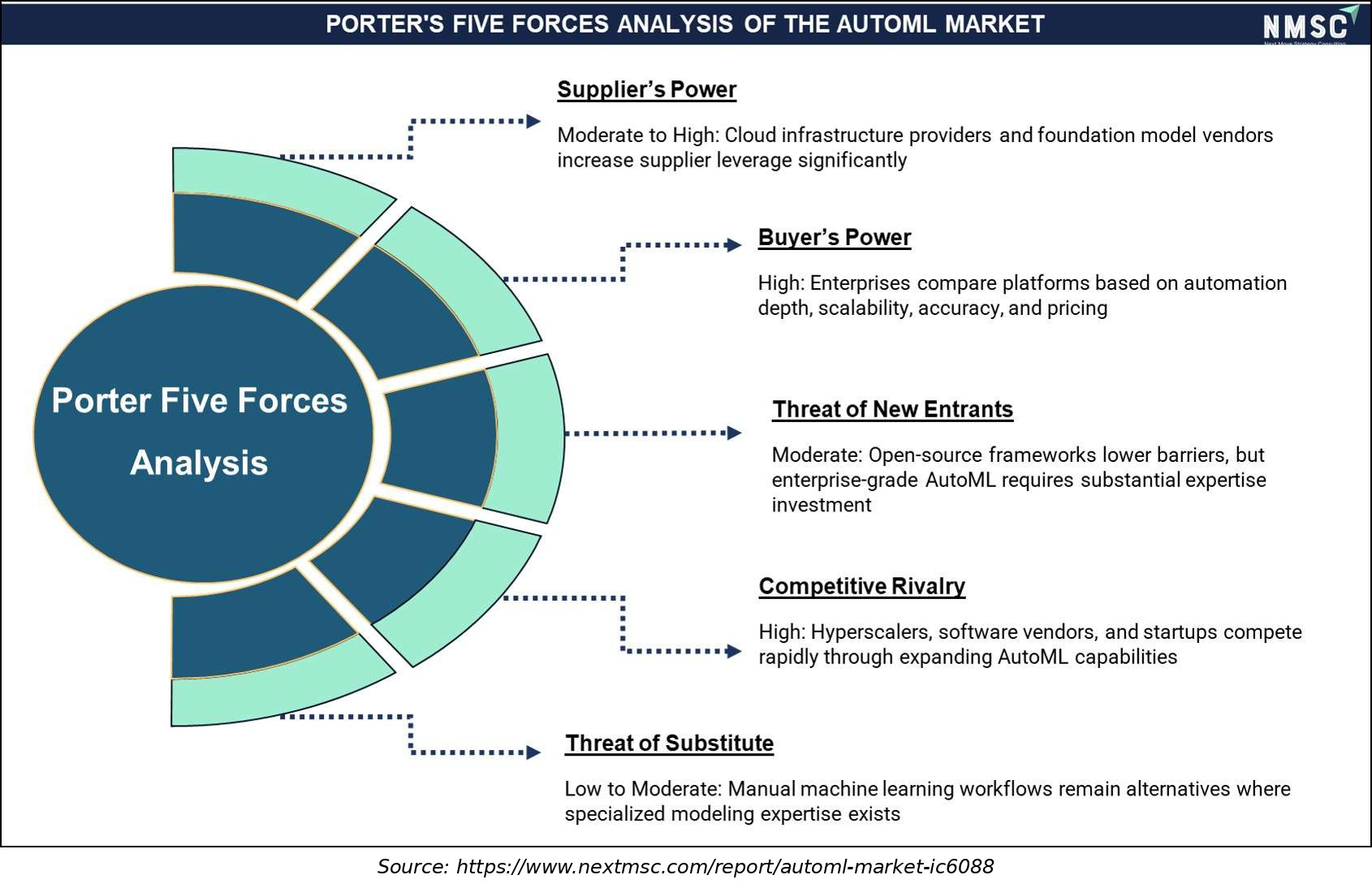
Porter’s Five Forces Analysis of the AutoML Market

The AutoML market is shaped by five competitive forces: competitive rivalry, the bargaining power of buyers and suppliers, the threat of new entrants, and the availability of substitutes. Demand for faster model development and reduced coding complexity is driving adoption, while growing competition from AI platforms, cloud providers, and open-source tools continues to influence market positioning and pricing.

Growth Opportunities

Our analysis shows that three forward-looking opportunities stand out for stakeholders positioning within the AutoML market over the 2026-2035 forecast period.

How Can Vertical-Specific AutoML Unlock Value for Regulated Industries?

Vertical-specific AutoML platforms present a whitespace opportunity for vendors serving healthcare and financial services buyers seeking pre-built compliance and explainability capability. Vendors that commercialize industry-tuned automated pipelines stand to capture premium pricing as regulated buyers prioritize built-in governance over generic, horizontal automation tools requiring extensive customization.

Where Does Small and Medium Enterprise Adoption Create New Demand?

Small and medium enterprises seeking predictive analytics without dedicated data science teams represent an underpenetrated opportunity for vendors offering simplified, consumption-priced AutoML products. Vendors that develop low-cost, self-service platforms can secure recurring subscription revenue as smaller organizations increasingly adopt automation tools previously accessible only to large enterprises with dedicated technical staff.

How Can Sovereign AI Infrastructure Programs Benefit AutoML Vendors?

National sovereign AI infrastructure programs across the Middle East and Asia-Pacific represent an underpenetrated opportunity for vendors offering on-premises and air-gapped AutoML deployment. Early movers that build dedicated government and public-sector deployment options can differentiate with customers pursuing data-localization mandates tied to national digital transformation initiatives.

Regional Outlook

2025 (USD Billion)
2035 (USD Billion)
North Americ
Europe
Asia-Pacific
Middle East
Latin Americ
Region 2025 (USD Billion) 2035 (USD Billion) CAGR (%)
North America $10.0 USD Billion $40.0 USD Billion 9.0%
Europe $17.1 USD Billion $51.1 USD Billion 27.0%
Asia-Pacific $24.2 USD Billion $62.2 USD Billion 25.0%
Middle East & Africa $31.3 USD Billion $73.3 USD Billion 23.0%
Latin America $38.4 USD Billion $84.4 USD Billion 12.0%

Regional data is locked

Unlock complete regional numbers for this market.

Unlock Full Data

Competitive Landscape

We observed that competitive dynamics within the AutoML market are increasingly shaped by generative AI integration depth, governance capability, and platform bundling rather than pricing alone. Key Takeaways

Dimension Description
Market Structure Fragmented across hyperscale cloud providers, specialized AutoML vendors, and emerging data-platform entrants, with consolidation accelerating through feature bundling.
Innovation Focus Generative AI integration, automated governance and drift monitoring, and unified data-to-model platform workflows replacing standalone point tools.
M&A Activity Platform-led capability expansion through ingredient-technology acquisitions and strategic partnerships rather than large-scale specialist consolidation.

How Do Companies Compete in the AutoML Market?

Companies compete primarily on breadth of automated capability, governance depth, and integration with existing enterprise data infrastructure rather than price alone. Our analysis shows that Dataiku's growth to USD 342.5 million in annual recurring revenue by September 2025 illustrates how governed, multi-model platforms are capturing enterprise budgets previously directed toward narrower MLOps point tools. Providers increasingly differentiate through deployment flexibility, industry-specific templates, and depth of generative AI integration.

Which Competitive Archetypes Dominate the AutoML Market?

Three competitive archetypes dominate the market: hyperscale cloud providers offering AutoML as one layer within a broader cloud AI stack, specialized independent platforms built for governed enterprise automation, and data-platform vendors bundling automated modeling directly into lakehouse infrastructure. We found that independent vendors such as Dataiku and H2O.ai differentiate through deployment flexibility and vertical depth, while Databricks and Snowflake differentiate through native integration with existing enterprise data pipelines.

How Are Companies Differentiating Through Innovation in AutoML?

Providers are differentiating through generative AI integration, automated governance tooling, and sovereign deployment options. We observed that H2O.ai's Enterprise h2oGPTe offering emphasizes on-premises and air-gapped installation for regulated industries, while Domino Data Lab has added governance automation and evidence-collection features to compete on compliance requirements. Competing vendors are similarly embedding drift monitoring and automatic retraining triggers to differentiate on operational reliability rather than model accuracy alone.

What M&A and Partnership Activity Is Shaping the AutoML Market?

Partnership and capability-expansion activity is concentrated on integrating generative AI and governance technology into existing automated modeling platforms rather than large-scale specialist acquisitions. Our findings suggest that Altair Engineering's earlier acquisition of RapidMiner continues to inform its combined AI Studio platform strategy, illustrating how established engineering software vendors are absorbing AutoML capability rather than competing as standalone entrants. This trend signals growing strategic interest in AutoML as an embedded capability within broader enterprise software portfolios.

Key Market Players

Our assessment indicates that the following 20 companies are actively shaping platform innovation, generative AI integration, and governance capability within the global AutoML market.

Alphabet Inc. Microsoft Corporation Amazon.com, Inc. International Business Machines Corporation Databricks, Inc. Dataiku SAS DataRobot, Inc. SAS Institute Inc. Oracle Corporation Salesforce, Inc. Altair Engineering Inc. H2O.ai, Inc. Domino Data Lab, Inc. C3.ai, Inc. Snowflake Inc. Alteryx, Inc. TIBCO Software Inc. MathWorks, Inc. KNIME AG BigML, Inc.

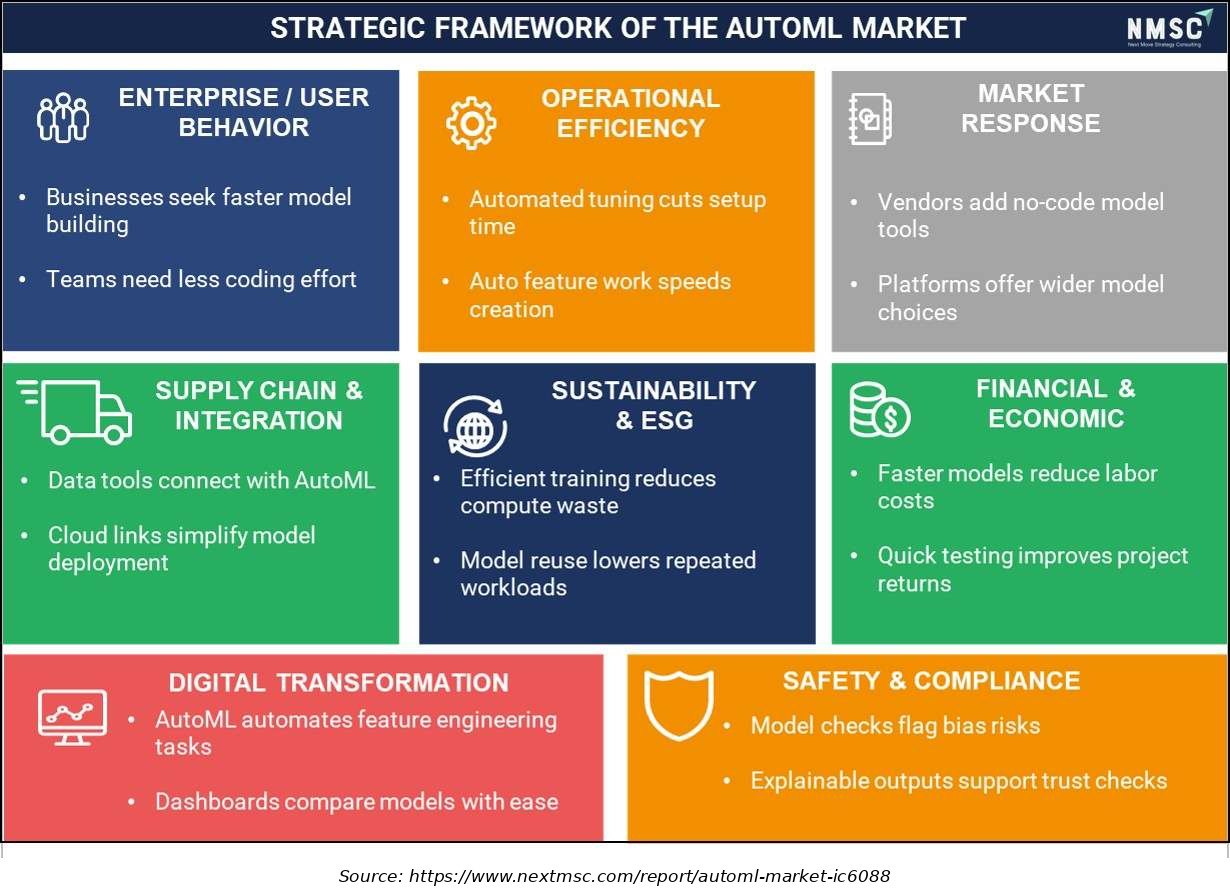
Strategic Framework of the AutoML Market

Strategic Framework of the AutoML Market
The AutoML market is supported by a broader ecosystem focused on automation, operational efficiency, model accessibility, and governance. Key value drivers include simplified model development, automated feature engineering, scalable cloud deployment, and integration with enterprise data systems. Long-term market growth will depend on responsible AI practices, explainability, security, interoperability, and measurable business outcomes.

Latest Developments

We found that recent corporate developments within the AutoML market are concentrated on generative AI integration, governance expansion, and capital market activity.

Date Event
August 2026 H2O.ai announced that its H2O-3 open-source distribution will retain its core AutoML capabilities while enterprise production features such as Kubernetes deployment, Hadoop, Sparkling Water and MOJO runtime move into H2O-3 Secure. The change separates community experimentation from supported, security-focused enterprise deployments.
June 2026 Dataiku released DSS 14.7, adding experimental Python 3.13 support for Visual Machine Learning and support for Deep Neural Network AutoML prediction models with Python 3.12. The release also introduced several time-series forecasting enhancements, including external features for Torch-based DeepAR models and multiple custom train/test splits.
June 2026 Oracle’s latest Machine Learning documentation states that OML AutoML UI will be desupported from January 15, 2027, with customers encouraged to migrate to Data Science Agent. The agent automates data profiling, transformation, model training, evaluation and inference through conversational workflows.
May 2026 Amazon SageMaker AI introduced an agentic experience that automates much of the model-customization lifecycle, including data preparation, experiment design, model selection, evaluation and deployment. Users interact with coding agents through natural language, reducing manual effort across iterative machine-learning development workflows.
May 2026 Databricks’ 2026 AutoML platform continues to automate data preparation, distributed model training and hyperparameter tuning across multiple algorithms, while generating trial notebooks for reproducibility. The latest API documentation supports classification, regression and forecasting through low-code interfaces and Python APIs.

Investment Opportunities

What Capital Inflows Are Targeting the AutoML Market?

Capital inflows into the AutoML market are increasingly directed toward generative AI integration and governance technology rather than core automated modeling alone. Dataiku's engagement of Morgan Stanley and Citigroup in October 2025 to prepare for a potential public listing illustrates growing investor appetite for governed, enterprise-scale automation platforms. We observed that investors favor vendors demonstrating durable annual recurring revenue growth and multi-cloud governance capability, viewing these as proxies for long-term enterprise retention.

How Is Infrastructure Investment Supporting AutoML Platform Expansion?

Infrastructure investment is expanding cloud compute capacity and generative AI processing capability to support real-time automated model training at scale. Our findings suggest that hyperscale cloud providers are investing heavily in AI-optimized infrastructure that directly benefits embedded AutoML services, enabling faster training cycles and broader concurrent model deployment for enterprise customers managing large model portfolios.

What ESG Considerations Are Shaping AutoML Investment Decisions?

Environmental, social, and governance considerations are increasingly central to investment decisions across the industry, with model transparency and responsible AI deployment as key criteria. The European Union's Artificial Intelligence Act increasingly informs institutional investment standards for automated systems deployed in regulated sectors. We found that investors increasingly favor vendors with transparent model-governance disclosures, treating explainability and bias-testing capability as a governance indicator alongside financial performance.

Key Benefits for Stakeholders

How Does This Report Benefit Enterprise and Industry Leaders?

Enterprise and industry leaders gain access to validated segmentation, competitive benchmarking, and regional demand forecasts that support platform procurement and deployment decisions across the AutoML industry. Our analysis shows that detailed component, application, and end-user industry breakdowns help technology teams align sourcing strategy with automation priorities while identifying underserved segments for capability expansion.

How Does This Report Benefit Investors and Financial Analysts?

Investors and financial analysts benefit from consistent, single-point market size and CAGR estimates that support valuation and capital-allocation decisions across the AutoML supply chain. We observed that the report's regional and segment-level growth differentials help identify which vendors are best positioned to capture above-market growth in natural language processing and manufacturing categories through 2035.

How Does This Report Benefit Technology Vendors and Product Teams?

Technology vendors and product teams gain insight into emerging platform requirements, including generative AI integration, automated governance, and sovereign deployment options, that are reshaping the industry. Our findings suggest that this analysis helps product roadmap teams prioritize development around explainability and multi-cloud orchestration capability increasingly required by enterprise procurement processes.

Key Market Segments Evaluated

By Component

  • Software Platform
  • Services

By Deployment Mode

  • Cloud
  • On-Premise
  • Hybrid

By Application

  • Predictive Analytics
  • Fraud Detection and Risk Management
  • Customer Analytics and Personalization
  • Computer Vision
  • Natural Language Processing
  • Time Series Forecasting
  • Other Applications

By Organization Size

  • Large Enterprises
  • Small and Medium Enterprises

By End User Industry

  • BFSI
  • Healthcare and Life Sciences
  • Retail and E-commerce
  • IT and Telecommunications
  • Manufacturing
  • Media and Entertainment
  • Government and Public Sector
  • Other Industries

Conclusion & Recommendations

The long-term outlook for the AutoML market remains strongly positive, with revenue projected to grow from USD 3.2 billion in 2025 to USD 56.0 billion by 2035 at a 33.0% CAGR. We observed that this trajectory is anchored by structural data-science talent shortages and expanding generative AI integration rather than short-lived enterprise pilot spending, suggesting the current growth cycle rests on durable demand extending well beyond early adopter deployments.

What Strategic Positioning Should AutoML Providers Pursue?

Providers should pursue strategic positioning around generative AI depth, governance capability, and multi-cloud deployment flexibility rather than competing on core automation features alone. Our assessment indicates that providers combining automated modeling with strong governance tooling and vertical-specific templates are best positioned to retain enterprise customers as procurement increasingly favors integrated, auditable platforms over narrow point solutions.

How Attractive Is the AutoML Market for New Investment?

The AutoML market presents high investment attractiveness given its 33.0% forecast CAGR and durable structural demand tied to persistent data-science talent shortages. We found that investment attractiveness is strongest in natural language processing and manufacturing categories, which are growing faster than the broader predictive analytics segment, alongside emerging-market opportunities backed by sovereign AI infrastructure investment in the Middle East and Asia-Pacific.

What Market Shifts and Key Risks Should Stakeholders Monitor?

Stakeholders should monitor data privacy compliance costs, talent shortages affecting model validation, and commoditization of basic AutoML features within broader cloud platforms as key risks shaping the market. The European Union's Artificial Intelligence Act illustrates how regulatory scrutiny, rather than technology alone, increasingly determines the pace of institutional AutoML adoption across regulated industries.

What Are the Key Growth Pathways for the AutoML Market?

Key growth pathways include generative AI pipeline integration, vertical-specific governance expansion, and sovereign deployment options for government and regulated-industry customers. Our analysis shows that providers expanding explainability tooling and multi-cloud orchestration capability alongside core automated modeling are best positioned to capture recurring, higher-margin revenue as enterprise procurement matures beyond initial pilot deployments.

FAQs

About the Author

Mihul Sharma

Mihul Sharma

Mihul Sharma is Research Associate at Next Move Strategy Consulting, where he has covered technology, industrial, and healthcare markets for 3 years. His work applies structured business research, market analysis, and secondary-source review to assess market trends, competitive developments, and growth opportunities. He supports report development by fully synthesizing industry data, company information, and market signals into concise findings for strategy and investment-focused research teams.

About the Reviewer

Supradip Baul

Supradip Baul

Supradip Baul is an accomplished business consultant and strategist with over a decade of rich experience in market intelligence, strategy, technology, and business transformation. His work has included rigorous qualitative and quantitative analysis across multiple industries, helping clients shape investment decisions and long-term roadmaps. Earlier in his career, he was associated with Gartner, where he contributed to industry-leading reports and market share analyses. He has worked with leading global companies and holds an MBA with a dual specialization in Marketing and Finance.

Download Free Sample

Pratyush Kumar Das

PRATYUSH KUMAR DAS

Assistant Manager

Polycab India Limited

We would like to express our appreciation for the data and insights provided by nextmsc. We are very pleased with the quality and depth of the information, which has proven to be highly valuable and beneficial for our business decision-making.

Kevin Coker

KEVIN COKER

Founder, CEO and Board Diector

Proxima Clinical Research

I have been using Next MSC reports for product positioning in a new geography for a long time. They have by far the best reports I have found and the price is reasonable too!

Rishabh Jogani

RISHABH JOGANI

Strategy Analyst

Accenture Japan

We are incredibly impressed with the market report on the real estate market in India provided by Next Move Strategy Consulting. The report was thorough, insightful, and well-structured, offering deep analysis and actionable recommendations. It not only captured the current trends and dynamics but also provided a forward-looking perspective that has been invaluable for our strategic planning. Their team demonstrated exceptional professionalism, attention to detail, and a profound understanding of the industry. The data-driven insights and clarity of presentation exceeded our expectations, making complex market trends easy to understand. We highly recommend Next Move Strategy Consulting to anyone looking for reliable and comprehensive market research services. Their expertise has given us the confidence to navigate the complexities of the Indian real estate market with clarity and foresight.

Gaurav Jaiswal

GAURAV JAISWAL

Founder & CEO

Yano Charge Private Limited

The EV Charging market research report provided by the NextMSC was exceptionally detailed and insightful. It offered a comprehensive analysis that proved to be a game-changer for our strategic planning. Truly a testament to the NextMSC’s expertise and thoroughness in EV market landscape & analysis.

Ross J Mckenzie

ROSS J MCKENZIE

Business Insight Manager

Staysure Group

“Next MSC have been incredibly helpful in providing detailed & robust information on our market, alongside quantifying growth by different segments. The process to procure was simple and easy, with sample reports and regular contact to ensure we had what we needed. Succinct detail on their sources & methodologies is also greatly received, allowing transparency in this respect helps build trust in the detail you pay for. Joseph in particular was fantastic, and helped ensure efficient provision of the insight pack – thank you NMSC!”.

Custom Market Research Services

We will customize the research for you if the listed report does not fully match your requirements.

Get 30% Free Customization

Select License

This website uses cookies to ensure you get the best experience on our website. Learn more

✖