AI Worker Safety Market Size, Share, Trends and Growth Analysis, By Offering (Software, Hardware, and Services), By Deployment Mode (Cloud, On-Premises, Edge, and Hybrid), By Technology (Computer Vision, Wearable AI, Sensor Fusion, Predictive Analytics, Natural Language Processing, Digital Twin, Generative AI, and Other Technologies), By Revenue Model, By Distribution Channel , By Application , By End User and Region – Global Industry Report and Forecast, 2026–2035.
Industry: ICT & Media | Publishing Date: July 17, 2026 | Last Updated: September 30, 2026 | No of Pages: N/A | No. of Tables: N/A | No. of Figures: N/A | Format: PDF | Report Code: IC5212
What Is the AI Worker Safety Industry Size?
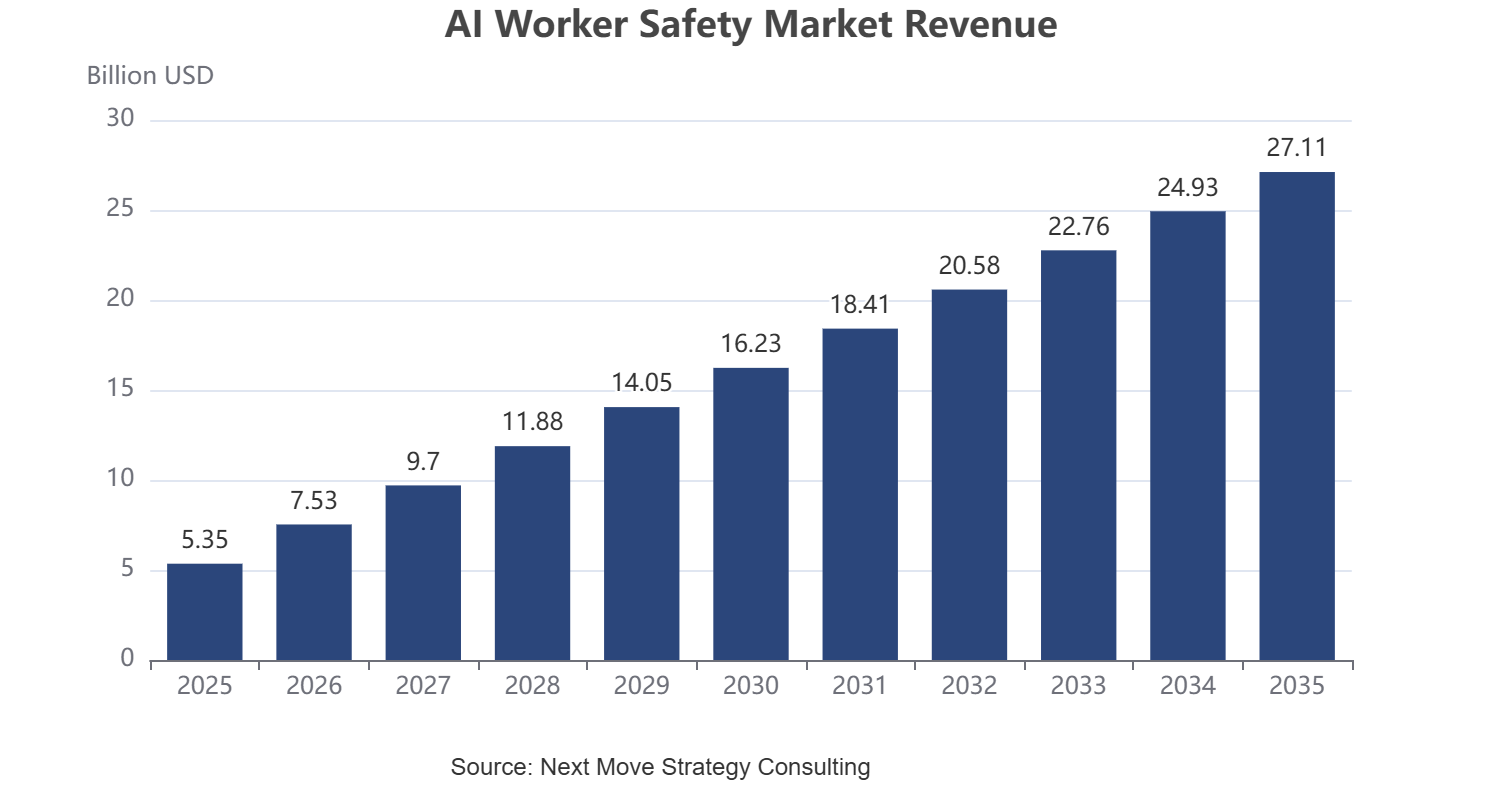
The global AI worker safety Industry size was valued at USD 5.35 billion in 2025 and is estimated at USD 6.35 billion in 2026, forecast to reach USD 27.11 billion by 2035, expanding at a CAGR of 17.5% between 2026 and 2035. North America leads with approximately 40% share, while software dominates all other offerings with approximately 46% share.
We observed that growth is broad-based across every segmentation axis, with computer vision-based PPE detection and connected worker platform adoption driving the dominant structural shifts through 2035.
|
Key Takeaways |
|
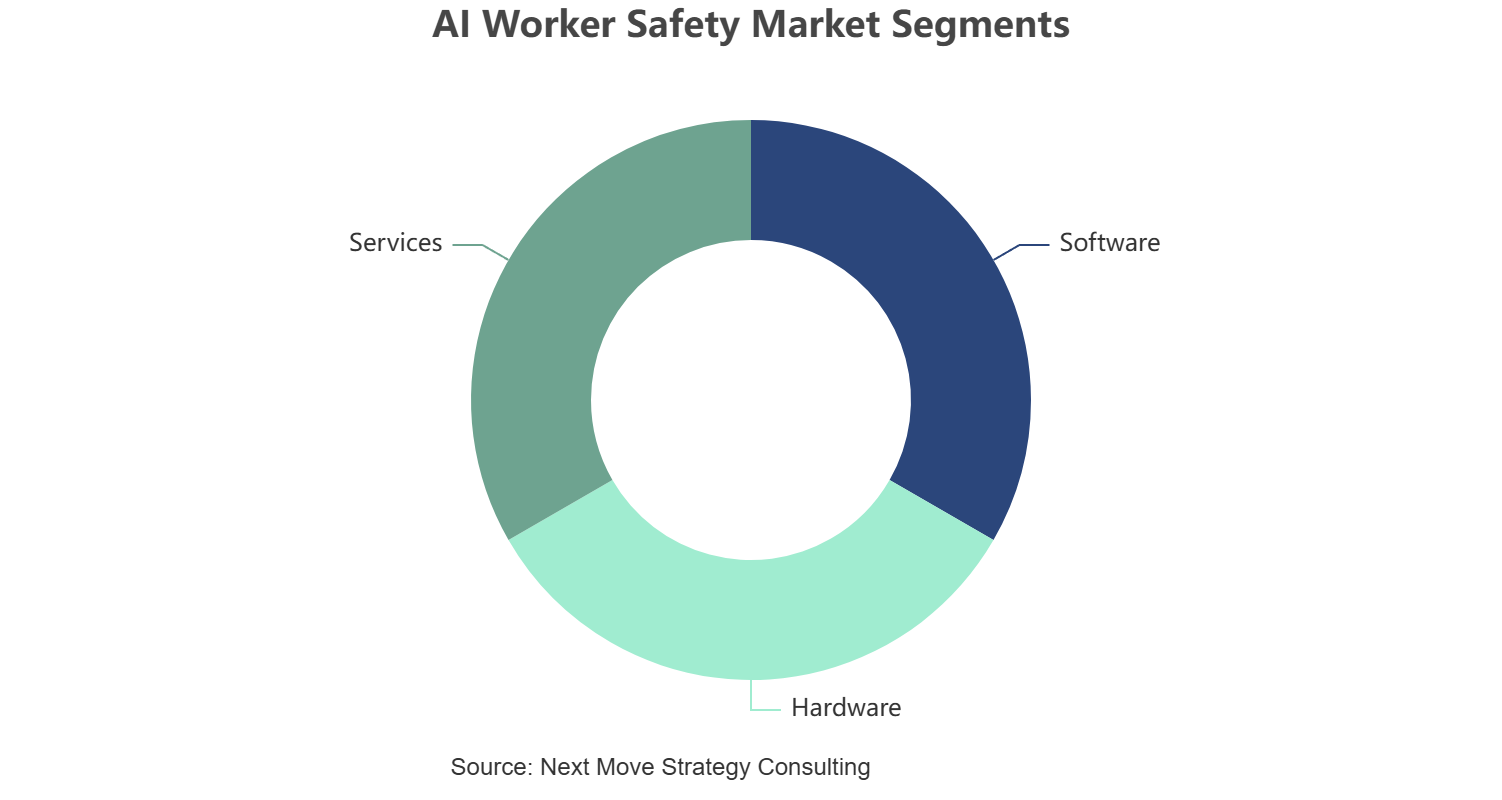
By Offering: Software held the largest share of approximately 46% (USD 2.46 billion) in 2025; Services is the fastest-growing sub-segment at 21.1% CAGR from 2026–2035. |
|
By Deployment Mode: Cloud held the largest share of approximately 58% (USD 3.10 billion) in 2025; Edge is the fastest-growing sub-segment at 22.9% CAGR from 2026–2035. |
|
By Technology: Computer Vision held the largest share of approximately 34% (USD 1.82 billion) in 2025; Generative AI is the fastest-growing sub-segment at 29.3% CAGR from 2026–2035. |
|
By Revenue Model: Subscription held the largest share of approximately 52% (USD 2.78 billion) in 2025; Managed Services is the fastest-growing sub-segment at 20.8% CAGR from 2026–2035. |
|
By Distribution Channel: Direct Sales held the largest share of approximately 48% (USD 2.57 billion) in 2025; Digital Marketplace is the fastest-growing sub-segment at 22.1% CAGR from 2026–2035. |
|
By Application: PPE Compliance held the largest share of approximately 22% (USD 1.18 billion) in 2025; Ergonomics Monitoring is the fastest-growing sub-segment at 24.9% CAGR from 2026–2035. |
|
By End User: Manufacturing held the largest share of approximately 24% (USD 1.28 billion) in 2025; Construction is the fastest-growing sub-segment at 20.7% CAGR from 2026–2035. |
|
Dominant Region: North America dominated with approximately 40% revenue share (USD 2.14 billion) in 2025. |
|
Fastest-Growing Region: Asia-Pacific is expected to register the highest CAGR of 20.3% during 2026–2035. |
|
Dominant Country: U.S. led with approximately USD 1.75 billion in 2025. |
|
Fastest-Growing Country: India is the fastest-growing country at approximately 24.8% CAGR from 2026–2035. |
Market Opportunity: The AI worker safety market is expected to create an absolute dollar opportunity of USD 20.76 billion between 2026 and 2035, presenting significant investment potential across the computer vision and connected worker technology value chain.
According to NMSC analysis, enterprises are increasingly consolidating video analytics, wearable monitoring, and EHS compliance software into unified safety platforms rather than deploying point solutions, a shift that favors vendors with proven multi-application capability over single-use-case providers as regulatory enforcement and insurance-linked incentives intensify through 2035.
What Does the AI Worker Safety Market Encompass?
The AI worker safety market encompasses software, hardware, and services that apply artificial intelligence to detect hazards, monitor compliance, and protect workers across manufacturing, construction, logistics, oil and gas, and mining environments. Our assessment indicates that the scope spans video analytics, connected worker platforms, fleet safety software, and EHS software, paired with cameras, wearables, gas detection devices, and smart PPE deployed across cloud, on-premises, edge, and hybrid architectures to enterprises worldwide.
Regulatory frameworks such as the U.S. Occupational Safety and Health Administration's enforcement standards and the European Union's workplace safety directives shape adoption of continuous compliance monitoring technology, while rising insurance premium incentives accelerate enterprise investment. We observed that technology adoption is shifting toward computer vision systems that integrate with existing camera infrastructure to enable rapid deployment without major hardware overhauls. NMSC's analysis indicates that this structural shift, combined with expanding connected wearable adoption, is redefining procurement criteria across the AI worker safety market.
|
Parameter |
Details |
|
Market Size in 2025 |
USD 5.35 Billion |
|
Market Size in 2026 |
USD 6.35 Billion |
|
Revenue Forecast in 2035 |
USD 27.11 Billion |
|
Growth Rate |
CAGR of 17.5% from 2026 to 2035 |
|
Analysis Period |
2025–2035 |
|
Base Year Considered |
2025 |
|
Forecast Period |
2026–2035 |
|
Market Size Estimation |
Revenue (USD Billion) |
|
Companies Profiled |
20 |
|
Countries Covered |
33 |
|
Market Share |
Available for Top 10 Companies |
Key Emerging Trends
Based on research conducted by NMSC, we found that four structural trends are reshaping product development, enterprise adoption, and stakeholder engagement across the industry.
How Is Venture Investment Accelerating Computer Vision Safety Platform Development?
Venture investment is accelerating product development among specialized computer vision safety platforms competing for enterprise EHS budgets. We observed that Voxel Labs Inc. secured USD 36 million in Series B funding in January 2025, while Protex AI Limited closed its own Series B round the same month and viAct Limited raised USD 7.3 million in Series A funding in April 2025. Enterprises are adopting these platforms to gain 24/7 automated hazard detection using existing camera infrastructure without major capital investment in new hardware.
Why Are Fleet Safety Platforms Expanding Into Frontline Worker Protection?
Fleet safety platforms are expanding beyond vehicle telematics into dedicated frontline worker protection as enterprises seek unified physical operations safety coverage. Our findings suggest that Samsara Inc. launched a new connected wearable and AI-powered worker safety features, including one-click SOS alerts and fall detection, as part of a major platform expansion announced in September 2025. Organizations increasingly favor vendors capable of covering both in-vehicle and outside-the-vehicle worker safety within a single connected operations platform.
How Is Edge AI Processing Reshaping Real-Time Hazard Detection?
Edge AI processing is reshaping real-time hazard detection as facilities seek lower latency and reduced data transmission costs compared with cloud-only architectures. We observed that computer vision vendors increasingly combine on-site edge processing with cloud analytics to deliver privacy-preserving, real-time alerts without transmitting sensitive video footage to external servers. This trend is elevating demand for edge-capable deployment among organizations with strict data sovereignty requirements in regulated industries.
What Role Does Generative AI Play in Worker Safety Innovation?
Generative AI is emerging as a tool for synthesizing training data and generating context-aware safety guidance beyond simple object detection. Our analysis shows that safety platform vendors are combining live video streams with permit data, sensor inputs, and generative AI to understand why a situation is risky rather than simply flagging what is happening. This direction is exemplified by vendors developing AI-generated, site-specific micro-training modules that respond to individual violations in real time.
Growth Drivers and Restraints
Growth Catalyst and Risk Assessment Matrix
|
Factors |
Type |
(+/-) % Impact on CAGR |
Geographic Relevance |
Impact Timeline |
|
Intensifying regulatory enforcement and rising violation penalties |
Driver |
+3.2% |
North America, Europe |
2026-2035 |
|
Expanding computer vision deployment using existing camera infrastructure |
Driver |
+2.6% |
Global |
2026-2035 |
|
Growing insurance premium incentives for verified safety monitoring |
Driver |
+2.0% |
North America, Europe |
2026-2035 |
|
Rising construction and infrastructure investment requiring safety compliance |
Driver |
+1.6% |
Asia-Pacific, North America |
2026-2035 |
|
Expanding connected wearable adoption for lone worker protection |
Driver |
+1.3% |
Global |
2026-2035 |
|
Growing venture capital investment in specialized safety AI startups |
Driver |
+1.0% |
North America, Europe |
2026-2032 |
|
Data privacy and worker surveillance concerns limiting adoption |
Restraint |
-1.6% |
Europe, North America |
2026-2035 |
|
High implementation costs for enterprise-scale multi-site deployment |
Restraint |
-1.1% |
Global |
2026-2032 |
|
Alert fatigue from false positives reducing safety team trust |
Restraint |
-0.7% |
Global |
2028-2035 |
What Is the Primary Growth Driver of the AI Worker Safety Market?
Intensifying regulatory enforcement and rising violation penalties are the primary driver of the market. The U.S. Occupational Safety and Health Administration raised maximum penalties for willful or repeated violations to more than USD 165,000 per violation as of January 2025, reinforcing the financial case for proactive compliance monitoring. We observed that this enforcement pressure, combined with expanding insurance premium incentives, continues to anchor baseline consumption of computer vision and connected worker technology across developed and emerging industrial markets alike.
How Is Fleet Safety Platform Expansion Driving AI Worker Safety Market Growth?
Fleet safety platforms expanding into frontline worker protection are accelerating enterprise adoption of unified physical operations safety technology. NMSC's analysis indicates that this platform consolidation, combined with Samsara Inc.'s September 2025 launch of dedicated worker safety features alongside its existing fleet telematics offering, is compressing adoption timelines for connected worker monitoring across logistics, construction, and utilities operators managing both vehicle and on-foot workforce safety.
What Is Restraining AI Worker Safety Market Expansion?
Data privacy and worker surveillance concerns restrain adoption speed across the industry, particularly in Europe where labor representatives and works councils scrutinize continuous video monitoring deployments. We found that vendors face particular exposure in unionized environments, as concerns over facial recognition and biometric data collection reduce willingness to approve enterprise-wide computer vision rollouts compared with facilities lacking organized labor representation.
PESTEL Analysis of the AI Worker Safety Market
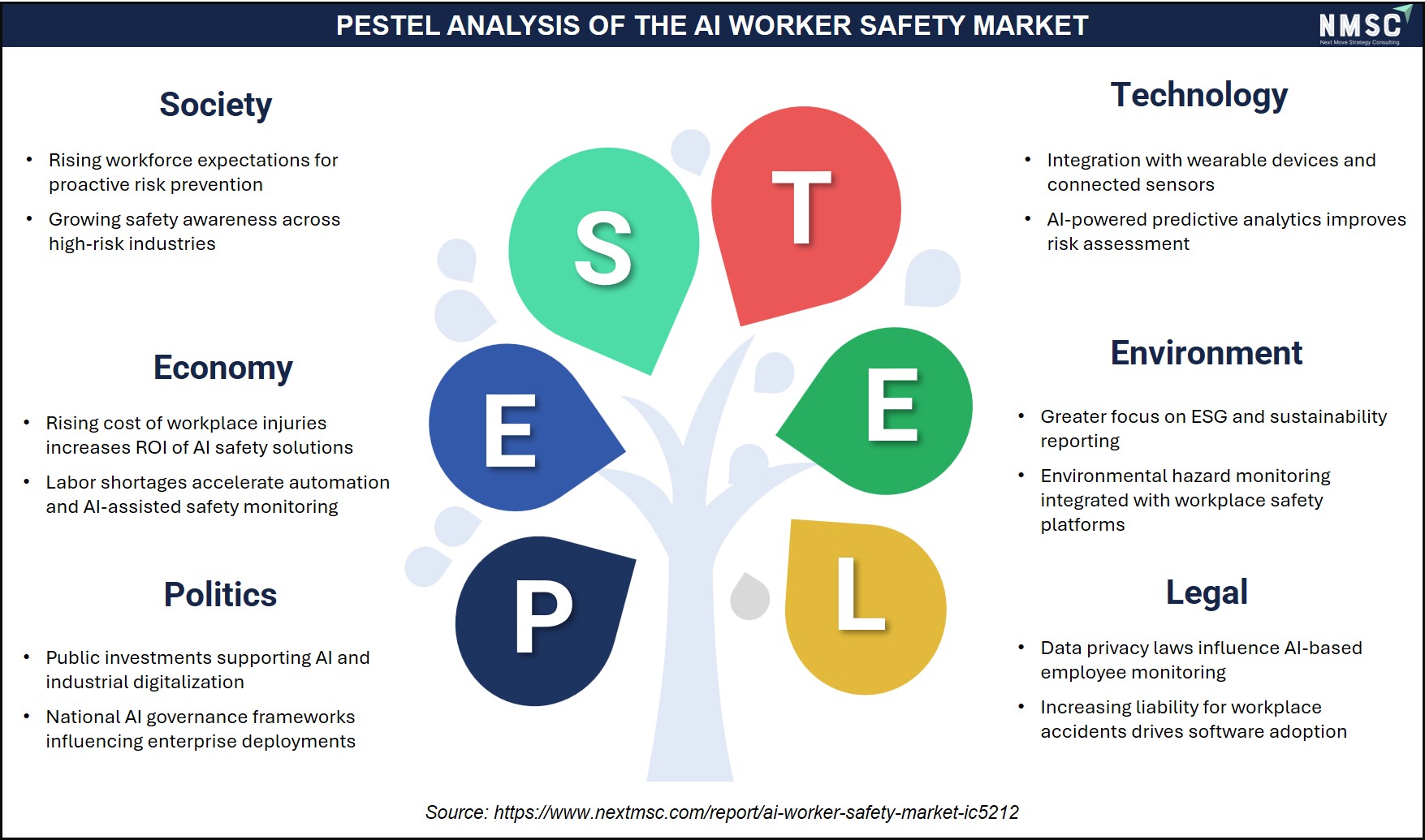
The AI Worker Safety Market is shaped by supportive government policies, increasing workplace safety investments, evolving workforce expectations, rapid AI and IoT advancements, growing ESG priorities, and stricter regulatory compliance. Together, these political, economic, social, technological, environmental, and legal factors are accelerating the adoption of AI-driven workplace safety platforms across industries while fostering sustainable and responsible innovation.
Segmentation Analysis
Segment Sizing: By Offering
|
Segment |
2025 (USD) |
2035 (USD) |
CAGR% (2026–2035) |
|
Software |
USD 2.46 Billion |
USD 12.12 Billion |
17.1% |
|
Hardware |
USD 1.82 Billion |
USD 7.86 Billion |
15.4% |
|
Services |
USD 1.07 Billion |
USD 7.13 Billion |
21.1% |
|
Total |
USD 5.35 Billion |
USD 27.11 Billion |
17.5% |
Which Offering Dominates the AI Worker Safety Market?
Software led the market with USD 2.46 billion in 2025, supported by its central role delivering video analytics, connected worker platforms, and EHS compliance management across enterprise safety programs. We observed that Services is the fastest-growing offering, expanding at a 21.1% CAGR from 2026 to 2035, as enterprises increasingly require implementation, integration, and managed monitoring support to scale multi-site deployments across complex industrial environments.
Segment Sizing: By Technology
|
Segment |
2025 (USD) |
2035 (USD) |
CAGR% (2026–2035) |
|
Computer Vision |
USD 1.82 Billion |
USD 8.27 Billion |
16.1% |
|
Wearable AI |
USD 0.96 Billion |
USD 4.60 Billion |
16.8% |
|
Sensor Fusion |
USD 0.75 Billion |
USD 3.76 Billion |
17.4% |
|
Predictive Analytics |
USD 0.69 Billion |
USD 3.21 Billion |
16.4% |
|
Digital Twin |
USD 0.43 Billion |
USD 2.28 Billion |
18.1% |
|
Natural Language Processing |
USD 0.27 Billion |
USD 1.13 Billion |
15.0% |
|
Generative AI |
USD 0.27 Billion |
USD 3.24 Billion |
29.3% |
|
Other Technologies |
USD 0.16 Billion |
USD 0.62 Billion |
14.0% |
|
Total |
USD 5.35 Billion |
USD 27.11 Billion |
17.5% |
Which Technology Leads AI Worker Safety Market Demand?
Computer Vision remained the leading technology within the market, valued at USD 1.82 billion in 2025 on its ability to integrate with existing camera infrastructure for real-time PPE and unsafe behavior detection. Our findings suggest that Generative AI is the fastest-growing technology, registering a 29.3% CAGR from 2026 to 2035, as vendors apply large language and generative models to synthesize training data and deliver context-aware, site-specific safety guidance.
Segment Sizing: By End User
|
Segment |
2025 (USD) |
2035 (USD) |
CAGR% (2026–2035) |
|
Manufacturing |
USD 1.28 Billion |
USD 6.08 Billion |
16.7% |
|
Construction |
USD 1.07 Billion |
USD 6.89 Billion |
20.7% |
|
Logistics and Warehousing |
USD 0.75 Billion |
USD 3.85 Billion |
17.7% |
|
Oil and Gas |
USD 0.64 Billion |
USD 2.88 Billion |
16.0% |
|
Mining |
USD 0.48 Billion |
USD 2.04 Billion |
15.2% |
|
Utilities and Energy |
USD 0.43 Billion |
USD 1.98 Billion |
16.3% |
|
Transportation |
USD 0.32 Billion |
USD 1.56 Billion |
17.0% |
|
Healthcare |
USD 0.22 Billion |
USD 1.18 Billion |
18.3% |
|
Public Safety |
USD 0.11 Billion |
USD 0.45 Billion |
14.8% |
|
Other Industries |
USD 0.05 Billion |
USD 0.20 Billion |
14.3% |
|
Total |
USD 5.35 Billion |
USD 27.11 Billion |
17.5% |
Which End User Is Most Widely Adopting AI Worker Safety Solutions?
Manufacturing remained the dominant end user, reaching USD 1.28 billion in 2025 due to its complex multi-stage hazard profile and long-standing investment in facility-wide camera infrastructure. Based on research conducted by NMSC, we found that Construction is the fastest-growing end user at a 20.7% CAGR from 2026 to 2035, reflecting tightening OSHA enforcement, expanding infrastructure investment, and rising insurance premium incentives for verified jobsite safety monitoring.
Growth Opportunities
Our analysis shows that three forward-looking opportunities stand out for stakeholders positioning within the AI worker safety market over the 2026-2035 forecast period.
How Can Edge-Native Platforms Unlock Value for Data-Sensitive Facilities?
Edge-native computer vision platforms present a whitespace opportunity for facilities in pharmaceutical, defense, and other data-sensitive industries requiring on-premises video processing. Vendors that commercialize privacy-preserving, edge-capable architectures stand to capture premium pricing as organizations with strict data sovereignty requirements seek alternatives to cloud-dependent safety monitoring platforms.
Where Do Unified Fleet and Frontline Safety Platforms Create New Demand?
Logistics and utilities operators managing both vehicle fleets and on-foot workforce represent an underpenetrated opportunity for unified physical operations safety platforms. Vendors that develop integrated fleet telematics and connected worker monitoring can secure expanded contracts with operators seeking single-vendor coverage, benefiting from cross-sell revenue as customers consolidate previously fragmented safety technology budgets.
How Can Ergonomics Monitoring Benefit Manufacturing and Logistics Operators?
Manufacturing and logistics operators facing rising musculoskeletal injury costs create an opportunity for suppliers offering AI-driven ergonomics monitoring that identifies repetitive strain risk in real time. Early movers that validate ergonomics detection accuracy across diverse task types can differentiate with operators pursuing injury cost reduction beyond traditional PPE compliance and behavior monitoring use cases.
Regional Outlook
Geographic Performance Snapshot
|
Region |
2025 (USD) |
2035 (USD) |
CAGR% (2026–2035) |
Key Driver |
|
North America |
USD 2.14 Billion |
USD 9.64 Billion |
16.0% |
OSHA enforcement intensity and insurance-linked safety technology incentives |
|
Europe |
USD 1.39 Billion |
USD 6.61 Billion |
16.7% |
EU workplace safety directives and data privacy-compliant deployment demand |
|
Asia-Pacific |
USD 1.18 Billion |
USD 7.38 Billion |
20.3% |
Expanding manufacturing and construction investment across the region |
|
Middle East & Africa |
USD 0.37 Billion |
USD 2.10 Billion |
19.0% |
Gulf infrastructure investment and workplace safety modernization programs |
|
Latin America |
USD 0.27 Billion |
USD 1.38 Billion |
17.6% |
Growing industrial safety investment and regulatory modernization |
|
Total |
USD 5.35 Billion |
USD 27.11 Billion |
17.5% |
— |
North America AI Worker Safety Market Outlook
North America leads the AI worker safety market with intensifying OSHA enforcement and a dense concentration of computer vision safety vendors driving continuous product innovation. We observed that Samsara Inc.'s expansion into dedicated worker safety features alongside its fleet telematics platform sustains regional demand for unified physical operations safety technology. Technology adoption remains advanced, with insurance premium incentives driving demand across the region's large manufacturing and logistics sectors.
Europe AI Worker Safety Market Outlook
Europe's AI worker safety market reflects a maturing but privacy-intensive landscape shaped by EU workplace safety directives and stringent data protection requirements. Our findings suggest that operators across Germany, France, and the UK favor modular, privacy-compliant deployments that prioritize data sovereignty over broad cloud-based monitoring. Technology adoption favors edge-capable computer vision among the region's unionized industrial workforce.
Asia-Pacific AI Worker Safety Market Outlook
Asia-Pacific is the fastest-growing AI worker safety market region, propelled by expanding manufacturing and construction investment across China and India. We found that regulatory frameworks remain less harmonized than in North America, giving vendors flexibility to scale cloud-based offerings rapidly. Technology adoption is accelerating as regional manufacturers, including several India-based industrial operators, expand computer vision safety pilots.
Middle East & Africa AI Worker Safety Market Outlook
The AI worker safety market in Middle East & Africa is expanding as Gulf Cooperation Council economies invest in infrastructure development and workplace safety modernization programs. Our analysis shows that Saudi Arabia and the UAE are attracting safety technology investment linked to flagship construction and energy sector projects. Regulatory influence remains developing, while technology adoption is gradually shifting toward cloud-based video analytics platforms.
Latin America AI Worker Safety Market Outlook
Latin America's AI worker safety market is supported by growing industrial safety investment in Brazil and Argentina and gradual regulatory modernization. We observed that regulatory frameworks are less stringent than in North America or Europe, though multinational operators are introducing computer vision and connected worker platforms locally. Technology adoption remains centered on cloud deployment, with competitive intensity increasing as global vendors partner with regional distributors.
U.S. AI Worker Safety Market
Based on our estimates, the U.S. market was valued at approximately USD 1.75 billion in 2025 and is projected to reach USD 7.62 billion by 2035, growing at a 15.5% CAGR. Demand is anchored by intensifying OSHA enforcement and a dense concentration of computer vision and connected worker technology vendors. Technology penetration favors cloud-based deployment, and competitive intensity remains high among established suppliers serving manufacturing, construction, and logistics operators.
Canada AI Worker Safety Market
The market in Canada reached roughly USD 278 million in 2025 and is forecast to hit USD 1.28 billion by 2035 at a 16.2% CAGR. Demand structure mirrors U.S. regulatory enforcement and technology adoption patterns, while provincial safety authority guidance shapes procurement expectations. Technology penetration is rising as national operators request computer vision and wearable monitoring, with competitive intensity moderate given reliance on cross-border vendor partnerships.
UK AI Worker Safety Market
As per our estimate, the UK market stood at about USD 222 million in 2025, advancing toward USD 1.02 billion by 2035 at a 16.2% CAGR. Demand is driven by construction and manufacturing operators navigating the UK's Building Safety Act and workplace safety enforcement. Regulatory influence is significant, technology penetration favors edge-capable systems, and competitive intensity remains steady among domestic and European suppliers.
Germany AI Worker Safety Market
According to our analysis, Germany's market was valued near USD 361 million in 2025 and is set to reach USD 1.79 billion by 2035, expanding at a 17.2% CAGR. Demand structure benefits from a strong domestic industrial base and stringent workplace safety compliance culture. Germany's Berufsgenossenschaft safety framework drives regulatory influence, while technology penetration favors privacy-compliant, edge-based deployment among leading manufacturers.
France AI Worker Safety Market
Based on our estimates, France's market reached approximately USD 195 million in 2025, projected to climb to USD 913 million by 2035 at a 16.5% CAGR. Demand is supported by France's concentration of industrial and construction operators requiring compliance documentation. Regulatory influence from French workplace safety legislation is notable, and competitive intensity remains high given the concentration of safety technology vendors headquartered domestically.
China AI Worker Safety Market
The market in China stood at roughly USD 330 million in 2025 and is forecast to reach USD 1.99 billion by 2035, registering a 19.8% CAGR. Demand is fueled by the world's largest manufacturing base and expanding construction sector safety modernization. Regulatory influence is increasing gradually, technology penetration is accelerating through large manufacturer pilots, and competitive intensity remains elevated among domestic and international vendors.
India AI Worker Safety Market
As per our estimate, India's market was valued at about USD 236 million in 2025, projected to reach USD 2.06 billion by 2035 at a 24.8% CAGR, the fastest among covered countries. Demand structure reflects rapidly expanding manufacturing and construction investment alongside growing corporate safety compliance commitments. Regulatory influence remains developing, while technology penetration is rising quickly as domestic and multinational vendors localize AI worker safety offerings.
Japan AI Worker Safety Market
According to our analysis, Japan's market reached close to USD 142 million in 2025 and is expected to hit USD 701 million by 2035, growing at a 17.2% CAGR. Demand is supported by Japan's established manufacturing heritage and aging workforce safety concerns. Regulatory influence is well established, technology penetration is advanced, and competitive intensity remains high among long-standing domestic and international suppliers.
South Korea AI Worker Safety Market
Based on our estimates, South Korea's market stood at approximately USD 118 million in 2025, forecast to reach USD 680 million by 2035 at a 19.2% CAGR. Demand structure benefits from the country's advanced manufacturing infrastructure and expanding construction sector. Technology penetration is high, with domestic operators adopting computer vision and wearable systems, and competitive intensity remains pronounced amid rapid innovation cycles.
Australia AI Worker Safety Market
The AI worker safety market in Australia reached about USD 71 million in 2025 and is projected to reach USD 378 million by 2035, expanding at an 18.2% CAGR. Demand is supported by a well-established mining sector and growing construction industry safety investment. Regulatory influence stems from Safe Work Australia's harmonized workplace health and safety legislation, while technology penetration favors cloud-based platforms amid moderate competitive intensity.
UAE AI Worker Safety Market
As per our estimate, the UAE market was valued near USD 81 million in 2025, projected to reach USD 470 million by 2035 at a 19.2% CAGR. Demand structure is shaped by the UAE's role as a regional construction and logistics hub. Regulatory influence remains moderate, technology penetration is improving through flagship infrastructure projects, and competitive intensity is rising as vendors expand Gulf portfolios.
Saudi Arabia AI Worker Safety Market
According to our analysis, Saudi Arabia's market reached roughly USD 96 million in 2025 and is expected to hit USD 582 million by 2035, growing at a 19.8% CAGR. Demand is driven by Vision 2030-linked infrastructure expansion and rising workplace safety modernization investment. Regulatory influence is developing under national labor guidelines, and technology penetration is advancing as state-linked construction and energy operators scale adoption.
South Africa AI Worker Safety Market
Based on our estimates, South Africa's market stood at about USD 44 million in 2025, forecast to reach USD 220 million by 2035 at a 17.2% CAGR. Demand structure reflects a developing mining and industrial sector serving regional Southern African markets. Regulatory influence remains moderate, technology penetration is gradually improving, and competitive intensity is limited given reliance on imported safety technology platforms.
Brazil AI Worker Safety Market
The market in Brazil reached approximately USD 130 million in 2025 and is projected to reach USD 692 million by 2035, registering an 18.2% CAGR. Demand is underpinned by Brazil's large manufacturing and mining sectors facing rising safety compliance requirements. Regulatory influence stems from national occupational safety policy, technology penetration favors cloud-based platforms, and competitive intensity remains moderate among regional distributors.
Argentina AI Worker Safety Market
As per our estimate, Argentina's market was valued near USD 41 million in 2025, projected to reach USD 194 million by 2035 at a 16.8% CAGR. Demand structure is supported by steady industrial and construction sector investment despite macroeconomic volatility. Regulatory influence remains limited, technology penetration is modest, and competitive intensity is centered on a small number of regional distributors serving domestic operators.
Regulatory Framework Impacting the AI Worker Safety Market
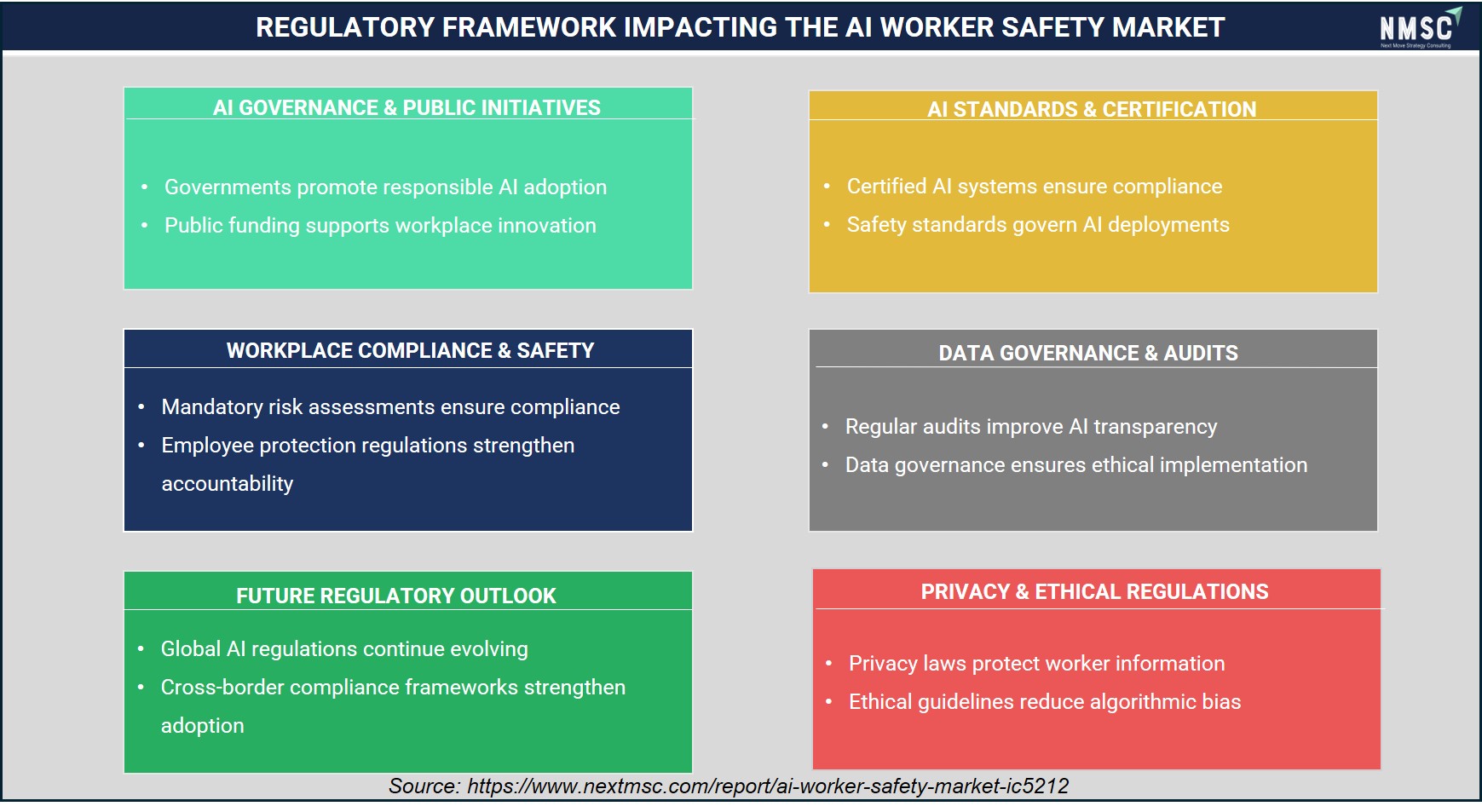
The regulatory landscape for the AI Worker Safety Market is evolving through AI governance policies, workplace safety regulations, data privacy laws, and certification standards. Governments and regulatory bodies are promoting responsible AI adoption while strengthening compliance, transparency, and ethical AI deployment. These frameworks encourage innovation, enhance worker protection, and build trust in AI-powered workplace safety solutions.
Competitive Landscape
We observed that the AI worker safety market features a highly fragmented competitive landscape, with large industrial and fleet technology incumbents competing alongside a wave of specialized, venture-backed computer vision safety startups.
|
Key Takeaways |
|
Market Structure: Highly fragmented; large industrial safety and fleet technology incumbents compete alongside numerous venture-backed computer vision safety startups, several having recently closed significant funding rounds. |
|
Innovation Focus: Computer vision hazard detection, connected wearable protection, and generative AI-driven training and guidance dominate current innovation pipelines across leading suppliers. |
|
M&A Activity: Active capital inflows exemplified by Voxel Labs Inc.'s USD 36 million Series B round and Protex AI Limited's own Series B close, both in January 2025, reflecting sustained investor confidence in specialized safety AI. |
How Do Companies Compete in the AI Worker Safety Market?
Companies compete primarily on detection accuracy, deployment speed, and platform breadth across the industry. Large incumbents such as Honeywell International Inc. and Motorola Solutions, Inc. leverage established industrial hardware relationships to embed AI capabilities natively, while specialized vendors such as Intenseye Inc. and Voxel Labs Inc. compete on computer vision detection accuracy and rapid deployment supplied directly to enterprise safety teams.
Which Competitive Archetypes Dominate the AI Worker Safety Market?
Two archetypes dominate the market: large diversified industrial and fleet technology incumbents offering safety capabilities across broader operations platforms, and specialized computer vision safety startups focused on dedicated hazard detection. Samsara Inc. and Motorola Solutions, Inc. exemplify the diversified archetype through integrated fleet and communications platforms, while Intenseye Inc. and Protex AI Limited exemplify the specialized archetype through purpose-built computer vision safety software.
How Are Companies Differentiating Through Innovation in AI Worker Safety?
Innovation and differentiation strategy increasingly center on deployment speed and predictive risk detection. Samsara's expansion into dedicated worker safety features and the rapid deployment timelines emphasized by specialized computer vision vendors both apply differentiated approaches to reduce time-to-value for enterprise customers. Our analysis shows that vendors unable to demonstrate credible detection accuracy and fast deployment risk exclusion from EHS request-for-proposal shortlists as procurement teams tighten evidentiary requirements.
What M&A and Expansion Activity Is Shaping the AI Worker Safety Market?
Capital inflows and platform expansion continue to shape competitive dynamics within the industry. Voxel Labs Inc.'s USD 36 million Series B round, Protex AI Limited's Series B close, and viAct Limited's USD 7.3 million Series A round, all completed in the first half of 2025, illustrate sustained investor confidence in specialized safety AI, while Samsara Inc.'s September 2025 worker safety platform expansion demonstrates how fleet technology incumbents are broadening into adjacent safety categories.
Key Market Players
Our assessment indicates that the following 20 companies are actively shaping product innovation, capital investment, and platform expansion strategy within the global AI worker safety market.
-
Motorola Solutions, Inc.
-
Siemens AG
-
Samsara Inc.
-
Motive Technologies, Inc.
-
MSA Safety Incorporated
-
Drägerwerk AG & Co. KGaA
-
Blackline Safety Corp.
-
Cority Software Inc.
-
Sphera Solutions, Inc.
-
VelocityEHS Holdings, Inc.
-
Benchmark Gensuite LLC
-
Intelex Technologies ULC
-
Enablon
-
EcoOnline AS
-
Intenseye Inc.
-
Voxel Labs Inc.
-
Protex AI Limited
-
viAct Limited
Latest Developments
We found that recent funding rounds and product launches within the AI worker safety market are concentrated on specialized computer vision platforms and fleet safety platform expansion.
|
Date |
Event |
|
July 2026 |
EcoOnline launched EcoOne, a connected intelligence layer that brings safety and sustainability data into one real-time view, with AI-powered capabilities designed to uncover insights, understand risk, and act faster. |
|
November 2025 |
Samsara expanded its AI-powered safety platform with new tools including Automated Coaching and Worker Safety capabilities to help operations teams reduce risk. |
Investment Opportunities
What Capital Inflows Are Targeting the AI Worker Safety Market?
Capital inflows into the AI worker safety market are increasingly directed toward specialized computer vision platforms and connected worker technology. Venture investors continue to fund category-specific vendors, as seen in Voxel Labs Inc.'s USD 36 million Series B round and Protex AI Limited's own Series B close, both completed in January 2025. We observed that investors favor companies demonstrating credible detection accuracy and enterprise deployment scale, viewing rapid time-to-value as a proxy for long-term customer retention.
How Is Infrastructure Investment Supporting AI Worker Safety Deployment?
Infrastructure investment is expanding cloud and edge computing capacity across vendors to support real-time hazard detection at enterprise scale. Our findings suggest that vendors are investing in hybrid edge-cloud architectures to improve latency and data sovereignty compliance, supporting the deployment speed and privacy requirements demanded by large, multi-site industrial customers.
What ESG Considerations Are Shaping AI Worker Safety Investment Decisions?
Environmental, social, and governance considerations are central to investment decisions across the industry, with worker protection and data privacy as key criteria. Occupational safety regulatory agencies continue to inform enterprise disclosure standards around workplace injury prevention performance. We found that investors increasingly favor vendors demonstrating measurable injury reduction outcomes alongside transparent data governance, treating both as governance indicators alongside worker privacy compliance.
Key Benefits for Stakeholders
How Does This Report Benefit Enterprise and Industry Leaders?
Enterprise and industry leaders gain access to validated segmentation, competitive benchmarking, and regional demand forecasts that support procurement and product-portfolio decisions across the AI worker safety industry. Our analysis shows that detailed technology, application, and end user breakdowns help safety and operations teams align vendor specifications with regulatory and deployment requirements while identifying underserved industry segments for portfolio expansion.
How Does This Report Benefit Investors and Financial Analysts?
Investors and financial analysts benefit from consistent, single-point market size and CAGR estimates that support valuation and capital-allocation decisions across the AI worker safety market supply chain. We observed that the report's regional and segment-level growth differentials help identify which vendors and technology categories are best positioned to capture above-market growth in Generative AI and Construction categories through 2035.
How Does This Report Benefit Technology Vendors and Product Teams?
Technology vendors and product teams gain insight into emerging design requirements, including edge-native processing, generative AI-driven training, and unified fleet and frontline safety coverage, that are reshaping the industry. Our findings suggest that this analysis helps research and development teams prioritize roadmaps around deployment speed and detection accuracy increasingly required by enterprise request-for-proposal processes.
Key Market Segments
By Offering
-
Software
-
Video Analytics
-
PPE Detection
-
Unsafe Behavior Detection
-
Area Monitoring
-
Incident Detection
-
-
Connected Worker Platform
-
Lone Worker Monitoring
-
Worker Location Monitoring
-
Workforce Safety Analytics
-
-
Fleet Safety Software
-
Driver Monitoring
-
Vehicle Risk Analytics
-
Telematics Analytics
-
-
EHS Software
-
Incident Management
-
Compliance Management
-
Risk Management
-
-
Simulation and Training Software
-
Virtual Reality Training
-
Digital Twin Simulation
-
-
Other Software
-
-
Hardware
-
Cameras
-
Fixed Cameras
-
Thermal Cameras
-
Mobile Cameras
-
-
Wearables
-
Smart Wristbands
-
Smart Armbands
-
Smart Badges
-
-
Gas Detection Devices
-
Personal Gas Detectors
-
Area Gas Detectors
-
-
Smart PPE
-
Connected Hardhats
-
Connected Vests
-
Connected Respiratory Protection
-
-
Other Hardware
-
-
Services
-
Implementation Services
-
Integration Services
-
Managed Monitoring Services
-
Training Services
-
Consulting Services
-
Support Services
-
By Deployment Mode
-
Cloud
-
Public Cloud
-
Private Cloud
-
-
On Premises
-
Edge
-
Hybrid
By Technology
-
Computer Vision
-
Wearable AI
-
Sensor Fusion
-
Predictive Analytics
-
Natural Language Processing
-
Digital Twin
-
Generative AI
-
Other Technologies
By Revenue Model
-
Subscription
-
User Based Subscription
-
Device Based Subscription
-
Site Based Subscription
-
Usage Based Subscription
-
-
Perpetual License
-
Device Sale
-
Hardware Lease
-
Professional Services
-
Managed Services
-
Other Revenue Models
By Distribution Channel
-
Direct Sales
-
Value Added Resellers
-
System Integrators
-
OEM Partners
-
Digital Marketplace
By Application
-
PPE Compliance
-
Unsafe Behavior Monitoring
-
Proximity Monitoring
-
Area Access Control
-
Fall Detection
-
Lone Worker Protection
-
Fatigue Detection
-
Ergonomics Monitoring
-
Environmental Exposure Monitoring
-
Driver Safety
-
Incident Reporting and Compliance
-
Emergency Response
-
Other Use Cases
By End User
-
Manufacturing
-
Discrete Manufacturing
-
Process Manufacturing
-
-
Construction
-
Building Construction
-
Infrastructure Construction
-
-
Logistics and Warehousing
-
Oil and Gas
-
Upstream
-
Midstream
-
Downstream
-
-
Mining
-
Surface Mining
-
Underground Mining
-
-
Utilities and Energy
-
Power Generation
-
Water Utilities
-
Renewable Energy
-
-
Healthcare
-
Transportation
-
Public Safety
-
Other Industries
By Region
-
North America: U.S., Canada, Mexico
-
Europe: UK, Germany, France, Italy, Spain, Sweden, Denmark, Finland, Netherlands, Rest of Europe
-
Asia-Pacific: China, India, Japan, South Korea, Taiwan, Indonesia, Vietnam, Australia, Philippines, Malaysia, Rest of APAC
-
Middle East & Africa: Saudi Arabia, UAE, Egypt, Israel, Turkey, Nigeria, South Africa, Rest of MEA
-
Latin America: Brazil, Argentina, Chile, Colombia, Rest of LATAM
Conclusion and Recommendations
What Is the Long-Term Outlook for the AI Worker Safety Market?
The long-term outlook for the market remains strongly positive, with global revenue projected to expand more than fivefold from USD 5.35 billion in 2025 to USD 27.11 billion by 2035 at a 17.5% CAGR. We observed that sustained regulatory enforcement, expanding computer vision adoption, and growing venture investment in specialized safety AI will continue underpinning demand across manufacturing, construction, and logistics end-use segments through the forecast period.
What Strategic Positioning Should AI Worker Safety Vendors Pursue?
Vendors should prioritize detection accuracy and rapid deployment capability while pursuing edge-native, privacy-compliant architectures to secure long-term enterprise contracts. NMSC's assessment indicates that companies investing early in generative AI-driven training and unified fleet-plus-frontline safety coverage will be best positioned to capture premium positioning within the AI worker safety market.
How Attractive Is the AI Worker Safety Market for New Investment?
The AI worker safety industry presents a highly attractive investment case, supported by a USD 20.76 billion absolute dollar opportunity between 2026 and 2035 and above-average growth in Asia-Pacific and Generative AI categories. We found that investment attractiveness is highest for vendors combining detection accuracy with scalable, multi-application platforms, positioning them to serve both specialized point-solution and comprehensive enterprise safety program budgets simultaneously.
What Market Shifts and Key Risks Should Stakeholders Monitor?
Stakeholders should monitor data privacy and worker surveillance concerns, high implementation costs for multi-site deployment, and alert fatigue from false positives as key risks to the AI worker safety market. Our analysis shows that vendors unable to demonstrate credible privacy governance risk losing procurement consideration to competitors with proven, transparent data handling practices, particularly in unionized European markets.
What Are the Key Growth Pathways for the AI Worker Safety Market?
Key growth pathways include expanding generative AI-driven safety training, scaling edge-native computer vision deployment, and deepening penetration into construction and Asia-Pacific manufacturing segments. NMSC's analysis indicates that vendors pursuing these pathways while maintaining detection accuracy and deployment speed discipline will be best positioned to capture the AI worker safety market's projected growth through 2035.
About the Author
 Mihul Sharma
— Mihul Sharma is Research Associate at Next Move Strategy Consulting, where he has covered technology, industrial, and healthcare markets for 3 years. His work applies structured business research, market analysis, and secondary-source review to assess market trends, competitive developments, and growth opportunities. He supports report development by fully synthesizing industry data, company information, and market signals into concise findings for strategy and investment-focused research teams.
Mihul Sharma
— Mihul Sharma is Research Associate at Next Move Strategy Consulting, where he has covered technology, industrial, and healthcare markets for 3 years. His work applies structured business research, market analysis, and secondary-source review to assess market trends, competitive developments, and growth opportunities. He supports report development by fully synthesizing industry data, company information, and market signals into concise findings for strategy and investment-focused research teams.
About the Reviewer
 Supradip Baul
— Supradip Baul is an accomplished business consultant and strategist with over a decade of rich experience in market intelligence, strategy, technology, and business transformation. His work has included rigorous qualitative and quantitative analysis across multiple industries, helping clients shape investment decisions and long-term roadmaps. Earlier in his career, he was associated with Gartner, where he contributed to industry-leading reports and market share analyses. He has worked with leading global companies and holds an MBA with a dual specialization in Marketing and Finance.
Supradip Baul
— Supradip Baul is an accomplished business consultant and strategist with over a decade of rich experience in market intelligence, strategy, technology, and business transformation. His work has included rigorous qualitative and quantitative analysis across multiple industries, helping clients shape investment decisions and long-term roadmaps. Earlier in his career, he was associated with Gartner, where he contributed to industry-leading reports and market share analyses. He has worked with leading global companies and holds an MBA with a dual specialization in Marketing and Finance.
At Next Move Strategy Consulting, we understand that insightful market research is the cornerstone of successful business decisions. That's why we employ a robust and multifaceted approach, combining various methodologies to deliver the most accurate and actionable data for our clients.

Research Landscape
We navigate the world of research with two primary approaches:
Qualitative Approach
Our qualitative research methodologies involve immersive techniques such as in-depth interviews, focus groups, and observational studies. By engaging directly with individuals and stakeholders, we uncover valuable insights that quantitative data alone may overlook.

Quantitative Research
In tandem with qualitative methodologies, NMSC leverages the power of Quantitative Research to provide a robust foundation of numerical insights. Through systematic data collection and analysis, we quantify patterns, preferences, and market trends, offering a comprehensive view of the business landscape.
Our quantitative research approach employs diverse tools, including surveys, experiments, and statistical modelling. These methodologies enable us to gather data from a large and representative sample, ensuring the statistical significance of our findings. By employing structured questionnaires and standardized data collection methods, we guarantee the reliability and validity of the information we present to our clients.
Quantitative research is particularly effective in measuring the prevalence of trends, assessing market size, and gauging the impact of various factors on consumer behavior. The numerical precision attained through this approach equips our clients with actionable insights, facilitating data-driven decision-making and strategy formulation.


Our Specialized Toolbox for Industry-Specific Market Research
We deploy a specialized arsenal of techniques tailored to meet your unique requirements. Here's a glimpse into our comprehensive toolbox:

Information Procurement
The stage entails acquiring market data or relevant information through various sources and methodologies.


Market Research Approach
We utilize both top-down and bottom-up approaches in market research analysis to achieve a comprehensive understanding of the market dynamics, leveraging the broad perspective of industry trends and macroeconomic factors alongside detailed insights from specific segments and individual companies.

Porters Five Forces Analysis
We conduct Porter's Five Forces analysis to evaluate the competitive landscape of an industry, providing us with insights into factors that affect profitability and strategic positioning.

SWOT Analysis

Forecasting
We utilize a forecasting model to predict future consumption by considering parameters like population, economics, regulations, market competition, drivers, constraints, technology, and pricing. We also employ statistical techniques such as multilinear regression, exponential smoothing, moving average, ARIMA, and Monte Carlo simulations for accurate predictions. In econometric forecasting, we analyzed short-term and long-term event impacts, attributing values based on regulatory frameworks, economic factors, and market events.





 Speak to Our Analyst