Baby Laundry Detergent Market Size, Share, Trends and Growth Analysis, By Product Type (Liquid Detergent, Powder Detergent, Detergent Pods and Tablets, and Detergent Sheets and Strips), By Formulation (Conventional Formulation, Plant-based and Organic Formulation, and Fragrance-Free Formulation), By Distribution Channel, By Packaging Type, By End User (Newborn Care, Infant Care, and Toddler Care), and Region — Global Industry Report and Forecast, 2026–2035
Industry: Retail and Consumer | Publishing Date: August 4, 2026 | Last Updated: August 4, 2026 | No of Pages: N/A | No. of Tables: N/A | No. of Figures: N/A | Format: PDF | Report Code: RC5548
What Is the Baby Laundry Detergent Market Size?
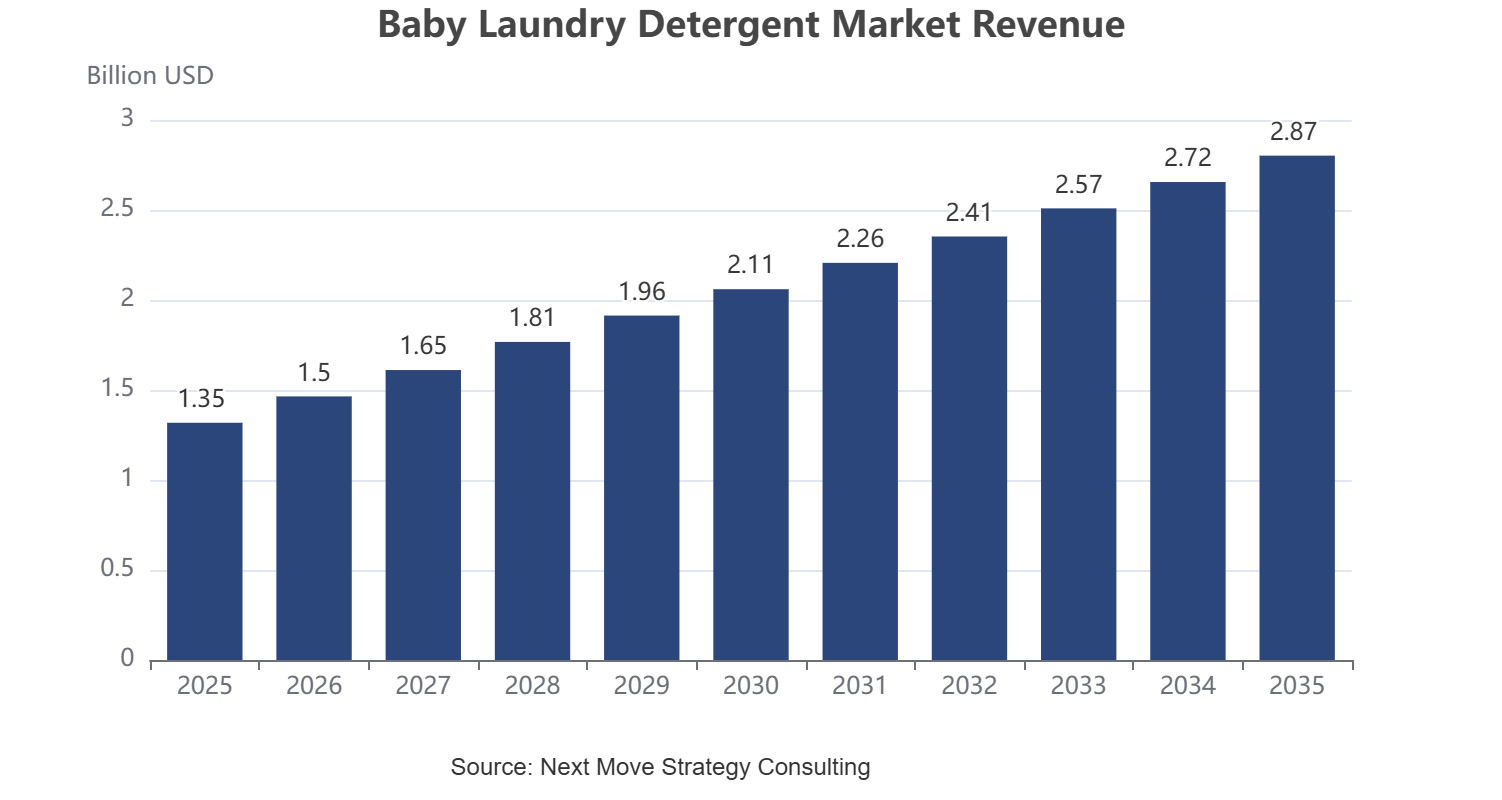
The global baby laundry detergent market size was valued at USD 1.35 billion in 2025 and is estimated at USD 1.46 billion in 2026, forecast to reach USD 2.87 billion by 2035, expanding at a 7.8% CAGR between 2026 and 2035. North America leads with approximately a 36% share, while Liquid Detergent dominates all other product categories with approximately a 58% share.
We observed that growth is concentrated in plant-based formulations and online retail distribution, with detergent sheets and strips gaining the most pronounced structural momentum through 2035.
|
Key Takeaways |
|
By Product Type: Liquid Detergent held the largest share of approximately 58% (USD 0.78 Billion) in 2025; Detergent Sheets and Strips is the fastest-growing sub-segment at 15.6% CAGR from 2026–2035. |
|
By Formulation: Conventional Formulation held the largest share of approximately 46% (USD 0.62 Billion) in 2025; Plant-Based and Organic Formulation is the fastest-growing sub-segment at 11.3% CAGR from 2026–2035. |
|
By Distribution Channel: Supermarkets and Hypermarkets held the largest share of approximately 42% (USD 0.57 Billion) in 2025; Online Retail is the fastest-growing sub-segment at 12.2% CAGR from 2026–2035. |
|
By Packaging Type: Bottles held the largest share of approximately 54% (USD 0.73 Billion) in 2025; Boxes and Cartons is the fastest-growing sub-segment at 9.9% CAGR from 2026–2035. |
|
By End User: Newborn Care (0-6 Months) held the largest share of approximately 44% (USD 0.59 Billion) in 2025; Toddler Care (2-4 Years) is the fastest-growing sub-segment at 8.3% CAGR from 2026–2035. |
|
Dominant Region: North America dominated with approximately 36% revenue share (USD 0.49 Billion) in 2025. |
|
Fastest-Growing Region: Asia-Pacific is expected to register the highest CAGR of 11.1% during 2026–2035. |
|
Dominant Country: The U.S. led with approximately USD 0.40 Billion in 2025. |
|
Fastest-Growing Country: India is the fastest-growing country at approximately 16.2% CAGR from 2026–2035. |
Market Opportunity: The baby laundry detergent market is expected to create an absolute dollar opportunity of USD 1.41 billion between 2026 and 2035, presenting significant investment potential across the plant-based formulation, online retail, and specialty baby care value chain.
According to NMSC analysis, parents are increasingly consolidating baby laundry purchases with brands offering dermatologically tested, fragrance-free formulations validated for newborn skin sensitivity, a shift that favors specialized baby care manufacturers over general-purpose detergent brands as pediatric skin-safety awareness expands through 2035.
What Does the Baby Laundry Detergent Market Encompass?
The baby laundry detergent market encompasses liquid, powder, pod, and sheet-format cleaning products formulated specifically for infant and toddler clothing, designed with hypoallergenic, dermatologically tested ingredients that meet stricter skin-safety standards than general fabric care products. Our assessment indicates that the scope spans conventional, plant-based, and fragrance-free formulations distributed through supermarkets, pharmacies, online retail, and specialty baby stores to caregivers of newborns, infants, and toddlers across 38 countries covered in this report.
The category has evolved from fragrance-forward, conventional surfactant formulations into plant-based and fragrance-free products responding to rising parental scrutiny of ingredient lists, driven by pediatric dermatology guidance and social media-amplified ingredient awareness. Regulatory frameworks such as the U.S. Consumer Product Safety Commission's labeling requirements and the European Union's Cosmetics Regulation shape ingredient disclosure and safety-testing obligations across developed markets. We observed that technology adoption is shifting toward concentrated, low-waste formats such as detergent sheets and strips that reduce packaging volume, a trend NMSC's analysis indicates is reshaping retail shelf and e-commerce packaging strategy across the market.
|
Parameter |
Details |
|
Market Size in 2025 |
USD 1.35 Billion |
|
Market Size in 2026 |
USD 1.46 Billion |
|
Revenue Forecast in 2035 |
USD 2.87 Billion |
|
Growth Rate |
CAGR of 7.8% from 2026 to 2035 |
|
Analysis Period |
2025–2035 |
|
Base Year Considered |
2025 |
|
Forecast Period |
2026–2035 |
|
Market Size Estimation |
USD Billion |
|
Companies Profiled |
18 |
|
Countries Covered |
38 |
|
Market Share |
Available for Top 10 Companies |
Key Emerging Trends
Based on research conducted by NMSC, we found that four structural trends are reshaping product formulation, distribution, and stakeholder engagement across the baby laundry detergent industry.
How Is Plant-Based Formulation Transforming Product Development?
Plant-based and organic formulations are transforming product development as manufacturers reformulate baby detergent lines to reduce synthetic surfactant and fragrance content. We observed that The Honest Company, Inc. continues to market its baby laundry detergent as plant-based and hypoallergenic, positioning ingredient transparency as a core brand differentiator on its official product pages. Manufacturers are adopting plant-based formulation to meet rising parental demand for ingredient-disclosed, dermatologically tested products.
Why Is Detergent Sheet Format Gaining Adoption Among Parents?
Concentrated detergent sheet and strip formats are gaining adoption as parents and retailers seek reduced-packaging, travel-friendly laundry solutions. Our findings suggest that Tru Earth Environmental Products Inc. has expanded distribution of its eco-strip laundry format through direct-to-consumer and retail channels, citing reduced plastic packaging as a core value proposition on its official website. Parents are adopting sheet-format detergents to simplify dosing and reduce storage space compared with liquid bottles.
How Is Direct-to-Consumer Distribution Reshaping Brand Building?
Direct-to-consumer and subscription-based distribution is reshaping how specialty baby detergent brands build customer relationships outside traditional retail. We observed that Dapple Baby Inc. markets its plant-based baby detergent directly through its own e-commerce site alongside retail partnerships, using subscription replenishment to build recurring revenue. Brands are adopting direct online sales to capture higher margins and first-party customer data compared with wholesale-only retail distribution.
What Role Does Retailer Private Label Expansion Play in Category Competition?
Retailer private label expansion is reshaping competitive dynamics as major retailers introduce store-brand baby detergent lines positioned against established national brands. We found that Church & Dwight Co., Inc. continues to expand its baby care portfolio through its official corporate disclosures, reflecting how established household products manufacturers defend category share against emerging specialty and private label competitors. Retailers are adopting expanded private label baby detergent assortments to capture price-sensitive segments of the category.
Growth Drivers and Restraints
Growth Catalyst and Risk Assessment Matrix
|
Factors |
Type |
(+/-) % Impact on CAGR |
Geographic Relevance |
Impact Timeline |
|
Rising parental awareness of infant skin sensitivity and allergens |
Driver |
+2.1% |
North America, Europe |
2026–2035 |
|
Expanding plant-based and fragrance-free product innovation |
Driver |
+1.8% |
Global |
2026–2035 |
|
Growth of e-commerce and subscription-based baby care distribution |
Driver |
+1.5% |
North America, Asia-Pacific |
2026–2035 |
|
Rising birth rates and baby care spending in emerging Asia-Pacific markets |
Driver |
+1.3% |
Asia-Pacific |
2026–2035 |
|
Expanding dermatologist and pediatrician product endorsement channels |
Driver |
+0.9% |
North America, Europe |
2026–2032 |
|
Declining birth rates in mature developed markets |
Restraint |
-1.1% |
Europe, North America, Japan |
2026–2035 |
|
Price sensitivity and private label substitution |
Restraint |
-0.7% |
Latin America, Middle East & Africa |
2026–2032 |
|
Raw material cost volatility for plant-derived surfactants |
Restraint |
-0.5% |
Global |
2026–2030 |
What Is the Primary Growth Driver of the Baby Laundry Detergent Market?
Rising parental awareness of infant skin sensitivity and allergens is the primary driver of the market. The U.S. Consumer Product Safety Commission continues to enforce labeling requirements that inform parents of ingredient content in household products marketed for infant use. We observed that this regulatory transparency, combined with rising pediatric dermatology guidance on infant skin care, continues to anchor baseline consumption of dermatologically tested detergent formulations across developed markets.
How Is E-Commerce Distribution Driving Market Growth?
Expanding e-commerce and subscription-based distribution is accelerating growth toward specialty and direct-to-consumer baby detergent brands across North America and Asia-Pacific. We observed that specialty brands including Puracy LLC and Dapple Baby Inc. continue to expand online replenishment subscription programs through their official e-commerce platforms. Our assessment indicates that this distribution shift, combined with rising digital-native parent purchasing behavior, continues to sustain demand growth across the market.
What Is Restraining Baby Laundry Detergent Market Expansion?
Declining birth rates in mature developed markets restrain long-term volume growth across the category, as national statistical agencies in several European countries and Japan report sustained fertility-rate declines below replacement level. We found that this demographic pressure limits the addressable newborn and infant population in historically high-value markets. Manufacturers face particular exposure in these markets, as declining birth cohorts reduce the customer base available for premium, dermatologically tested product positioning.
Segmentation Analysis
Segment Sizing: By Product Type
|
Segment |
2025 (USD) |
2035 (USD) |
CAGR% (2026–2035) |
|
Liquid Detergent |
USD 0.78 Billion |
USD 1.49 Billion |
6.5% |
|
Powder Detergent |
USD 0.30 Billion |
USD 0.46 Billion |
4.1% |
|
Detergent Pods and Tablets |
USD 0.16 Billion |
USD 0.49 Billion |
12.1% |
|
Detergent Sheets and Strips |
USD 0.11 Billion |
USD 0.43 Billion |
15.6% |
|
Total |
USD 1.35 Billion |
USD 2.87 Billion |
7.8% |
Which Product Type Dominates the Baby Laundry Detergent Market?
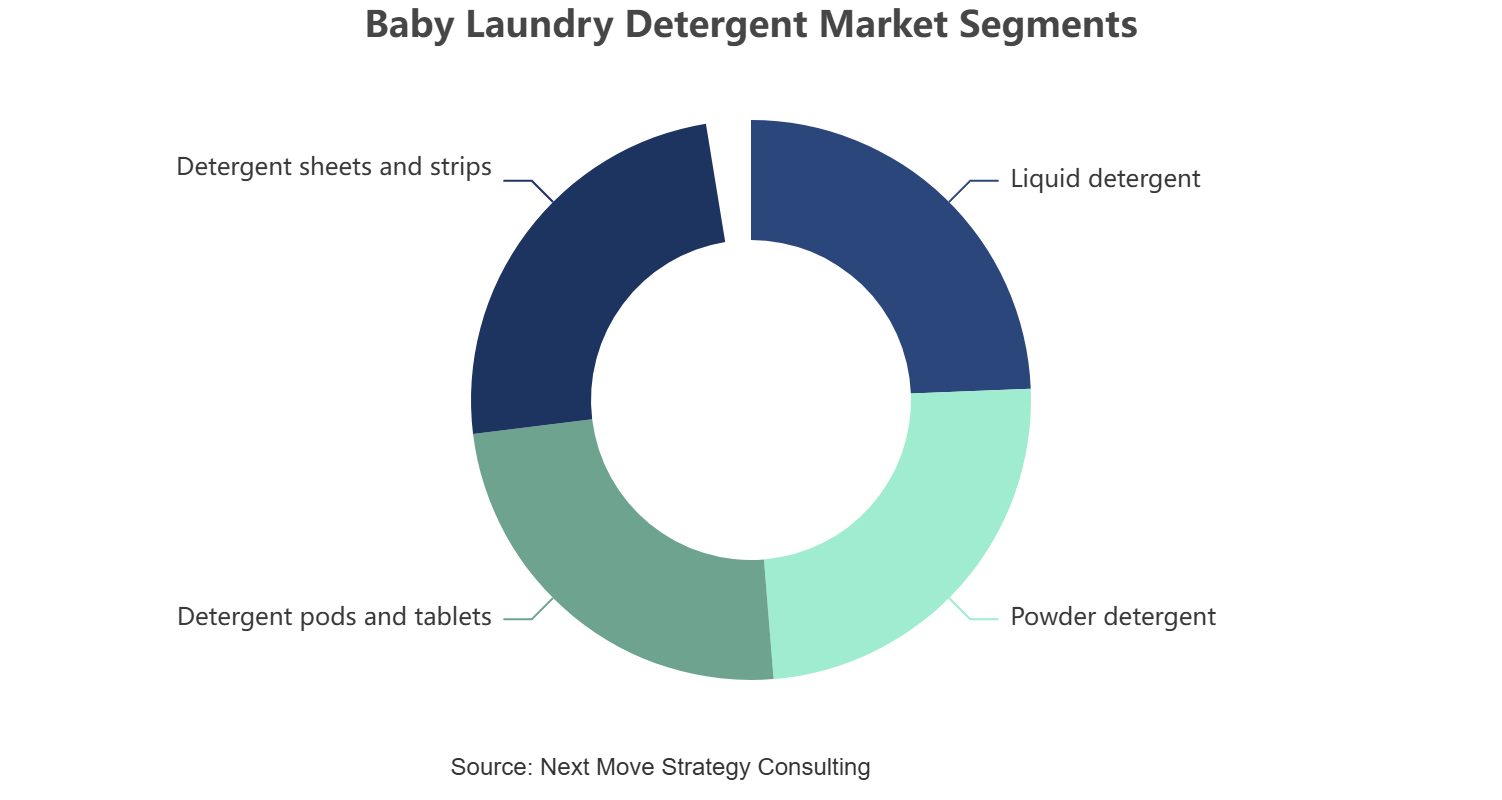
Liquid Detergent led the market with USD 0.78 billion in 2025, supported by parental familiarity with dosing and broad retail availability across supermarkets and pharmacies. We observed that Detergent Sheets and Strips is the fastest-growing product category, expanding at a 15.6% CAGR from 2026 to 2035, as parents increasingly adopt concentrated, low-packaging formats for their reduced storage footprint and travel convenience.
Segment Sizing: By Formulation
|
Segment |
2025 (USD) |
2035 (USD) |
CAGR% (2026–2035) |
|
Conventional Formulation |
USD 0.62 Billion |
USD 0.98 Billion |
4.2% |
|
Plant-based and Organic Formulation |
USD 0.49 Billion |
USD 1.38 Billion |
11.3% |
|
Fragrance Free Formulation |
USD 0.24 Billion |
USD 0.52 Billion |
7.8% |
|
Total |
USD 1.35 Billion |
USD 2.87 Billion |
7.8% |
Which Formulation Leads Baby Laundry Detergent Market Demand?
Conventional Formulation remained the largest formulation category within the market, reaching USD 0.62 billion in 2025 on the strength of established brand trust and lower price points across mass retail channels. Our findings suggest that Plant-Based and Organic Formulation is the fastest-growing formulation, registering an 11.3% CAGR from 2026 to 2035, as parents increasingly seek organic personal care ingredient credentials for products in direct contact with infant skin.
Segment Sizing: By Distribution Channel
|
Segment |
2025 (USD) |
2035 (USD) |
CAGR% (2026–2035) |
|
Supermarkets and Hypermarkets |
USD 0.57 Billion |
USD 0.95 Billion |
4.9% |
|
Online Retail |
USD 0.38 Billion |
USD 1.15 Billion |
12.2% |
|
Pharmacies and Drug Stores |
USD 0.26 Billion |
USD 0.46 Billion |
5.8% |
|
Specialty Baby Stores |
USD 0.15 Billion |
USD 0.32 Billion |
7.8% |
|
Total |
USD 1.35 Billion |
USD 2.87 Billion |
7.8% |
Which Distribution Channel Leads Baby Laundry Detergent Market Sales?
Supermarkets and Hypermarkets remained the leading distribution channel within the market, valued at USD 0.57 billion in 2025 on sustained parental preference for in-store product comparison and immediate availability. Based on research conducted by NMSC, we found that Online Retail is the fastest-growing distribution channel, registering a 12.2% CAGR from 2026 to 2035, as subscription replenishment programs and digital-native parent purchasing behavior continue to expand e-commerce category share.
Supply Chain Analysis of the Baby Laundry Detergent Industry
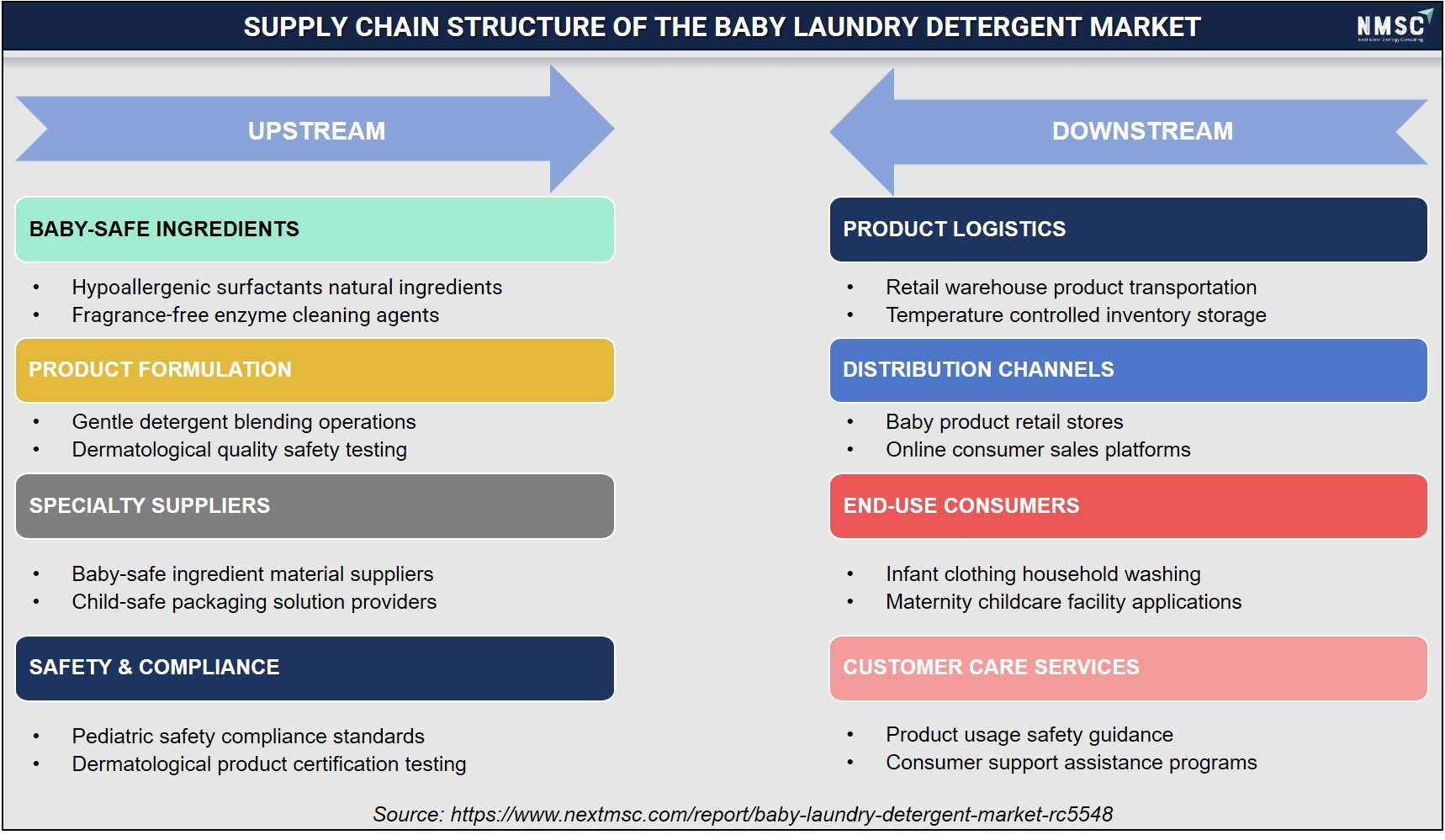
The above infographic presents the supply chain structure of the baby laundry detergent market, segmented into upstream and downstream activities. Upstream begins with hypoallergenic surfactants, natural ingredients, and fragrance-free enzymes, which move into gentle blending operations and dermatological safety testing. Specialty suppliers provide baby-safe materials and child-safe packaging, while compliance with pediatric safety standards and dermatological certifications ensures product quality. Moving downstream, temperature-controlled logistics and retail distribution channels support product delivery through baby product stores and online platforms. End users include households and childcare facilities. Looking ahead, we observed that customer care services, including usage guidance and consumer support, ensure brand trust and satisfaction across the market.
Growth Opportunities
Our analysis shows that three forward-looking opportunities stand out for stakeholders positioning within the baby laundry detergent market over the 2026-2035 forecast period.
How Can Dermatologist-Endorsed Formulations Unlock Premium Positioning?
Dermatologist-endorsed, clinically tested formulations present a whitespace opportunity for vendors serving parents of infants with diagnosed skin sensitivities and eczema. Suppliers that secure pediatric dermatology partnerships and publish clinical testing data stand to capture premium price positioning as parents increasingly treat detergent selection as a skin-health decision rather than a general household purchase.
Where Do Concentrated Low-Waste Formats Create New Demand?
Concentrated, low-waste packaging formats represent an underpenetrated opportunity for vendors offering sheet, strip, and tablet products that reduce shipping weight and plastic content. Brands expanding these formats can capture share from bottle-format incumbents as e-commerce-native parents prioritize shipping-efficient, reduced-packaging products aligned with sustainability preferences.
How Can Emerging Market Brands Benefit from Rising Birth Rates?
Brands expanding into Asia-Pacific and Middle Eastern markets stand to benefit from higher birth rates and rising disposable income among urban middle-class parents compared with mature Western markets. Early movers that localize formulation and packaging for these markets can differentiate with regional retailers pursuing category expansion beyond established Western baby care brands.
Regional Outlook
Geographic Performance Snapshot
|
Region |
2025 (USD) |
2035 (USD) |
CAGR% (2026–2035) |
Key Driver |
|
North America |
USD 0.49 Billion |
USD 0.89 Billion |
6.0% |
Established specialty baby care brand base and high category awareness |
|
Europe |
USD 0.32 Billion |
USD 0.57 Billion |
5.6% |
EU Cosmetics Regulation compliance and declining birth rate headwinds |
|
Asia-Pacific |
USD 0.39 Billion |
USD 1.09 Billion |
11.1% |
Rising birth rates and expanding middle-class baby care spending |
|
Middle East & Africa |
USD 0.08 Billion |
USD 0.17 Billion |
7.8% |
Growing urban household formation and retail modernization |
|
Latin America |
USD 0.07 Billion |
USD 0.14 Billion |
7.8% |
Expanding modern retail penetration and rising baby care awareness |
|
Total |
USD 1.35 Billion |
USD 2.87 Billion |
7.8% |
-- |
North America
North America leads the baby laundry detergent market with an established specialty baby care brand base and high consumer awareness of ingredient safety. We observed that U.S. Consumer Product Safety Commission labeling requirements sustain demand for transparently formulated products. Technology adoption remains advanced, with direct-to-consumer subscription models driving demand for specialty and plant-based brands across the region's affluent parent demographic.
Europe
Europe's market reflects a regulation-intensive landscape shaped by the European Union's Cosmetics Regulation and declining birth rates across several member states. Our findings suggest that manufacturers across the UK, Germany, and France are accelerating ingredient-disclosure investment to satisfy safety-labeling obligations even as demographic headwinds constrain volume growth. Technology adoption favors fragrance-free and plant-based formulations supported by strong regional regulatory infrastructure.
Asia-Pacific
Asia-Pacific is the fastest-growing region, propelled by rising birth rates and expanding middle-class baby care spending across China and India. We found that regulatory frameworks remain less harmonized than in Europe, giving manufacturers flexibility to scale distribution rapidly. Technology adoption is accelerating as regional manufacturers integrate plant-based formulation into export-oriented product lines.
Middle East & Africa
The baby laundry detergent market in the Middle East & Africa is expanding as Gulf Cooperation Council economies see growing urban household formation and modern retail expansion. Our analysis shows that Saudi Arabia and the UAE are driving demand for internationally branded baby care products through expanding hypermarket and pharmacy chains. Regulatory influence remains moderate, while technology adoption is gradually shifting toward imported plant-based formulations.
Latin America
Latin America's market is supported by expanding modern retail penetration and rising baby care awareness in Brazil and Argentina. We observed that regulatory frameworks are less stringent than in North America or Europe, though multinational household products manufacturers operating locally are introducing baby-specific detergent lines. Technology adoption remains centered on conventional formulations, with competitive intensity increasing as regional distributors partner with global baby care brands.
U.S.
Based on our estimates, the U.S. market was valued at approximately USD 0.40 Billion in 2025, projected to reach USD 0.71 Billion by 2035 at a 5.7% CAGR. Demand is anchored by high specialty baby care brand awareness and established e-commerce subscription adoption. Technology penetration favors plant-based and fragrance-free formulations, and competitive intensity remains high among established household products majors and specialty direct-to-consumer brands.
Canada
The market in Canada reached approximately USD 0.06 Billion in 2025 and is projected to reach USD 0.12 Billion by 2035, registering a 7.0% CAGR. Demand structure mirrors U.S. brand-awareness patterns, while Health Canada consumer product safety guidance shapes labeling requirements. Technology penetration is rising as parents request validated hypoallergenic formulations, with competitive intensity moderate given reliance on cross-border brand distribution from U.S.-based manufacturers.
UK
As per our estimate, the UK market was valued at about USD 0.06 Billion in 2025, projected to reach USD 0.11 Billion by 2035 at a 5.0% CAGR. Demand is driven by strong retail pharmacy distribution and post-Brexit domestic consumer safety regulation. Regulatory influence from UK-specific product safety standards is notable, technology penetration favors fragrance-free formulations, and competitive intensity remains steady among domestic and European household products vendors.
Germany
According to our analysis, the Germany market reached close to USD 0.06 Billion in 2025 and is expected to hit USD 0.10 Billion by 2035, growing at a 5.0% CAGR. Demand structure benefits from Germany's strong eco-conscious consumer base and EU Cosmetics Regulation compliance requirements. Regulatory influence is well established under German and European Union standards, while technology penetration favors plant-based formulations among leading household products vendors including Werner & Mertz Group.
France
Based on our estimates, the France market was valued at approximately USD 0.05 Billion in 2025, projected to reach USD 0.07 Billion by 2035 at a 4.8% CAGR. Demand is supported by France's established pharmacy-channel baby care distribution and strong dermatological product credibility culture. Regulatory influence from French and EU standards is notable, and competitive intensity remains high given the concentration of premium baby care vendors serving pharmacy channels domestically.
China
The market in China reached approximately USD 0.13 Billion in 2025 and is projected to reach USD 0.34 Billion by 2035, registering a 10.3% CAGR. Demand is fueled by rising birth rates following policy easing and a dense base of regional household products developers serving urban middle-class parents. Regulatory influence is increasing gradually, technology penetration is accelerating through domestic plant-based product development, and competitive intensity remains elevated among numerous China-based vendors.
India
As per our estimate, the India market was valued at about USD 0.06 Billion in 2025, projected to reach USD 0.26 Billion by 2035 at a 16.2% CAGR. Demand structure reflects rising urban birth rates and expanding organized retail penetration for baby care products. Regulatory influence remains developing, while technology penetration is rising quickly as global and domestic vendors localize formulations to serve India's expanding baby care market, the fastest-growing country in this report.
Japan
According to our analysis, the Japan market reached close to USD 0.07 Billion in 2025 and is expected to hit USD 0.15 Billion by 2035, growing at a 8.7% CAGR. Demand is supported by Japan's mature baby care product culture and stringent quality expectations despite a declining birth rate. Regulatory influence is well established, technology penetration is advanced, and competitive intensity remains high among long-standing domestic household products vendors including Kao Corporation and Pigeon Corporation.
South Korea
Based on our estimates, the South Korea market was valued at approximately USD 0.04 Billion in 2025, projected to reach USD 0.10 Billion by 2035 at a 9.8% CAGR. Demand structure benefits from the country's high per-capita baby care spending and premium product culture. Technology penetration is high, with domestic and multinational vendors supplying premium plant-based baby detergent, and competitive intensity remains pronounced amid rapid product-innovation cycles.
Australia
The market in Australia reached approximately USD 0.03 Billion in 2025 and is projected to reach USD 0.07 Billion by 2035, registering a 9.2% CAGR. Demand is supported by strong consumer awareness of ingredient safety and growing enterprise retail distribution of specialty baby care brands. Regulatory influence stems from Australia's consumer product safety frameworks, while technology penetration favors imported plant-based formulations amid moderate competitive intensity.
Saudi Arabia
As per our estimate, the Saudi Arabia market was valued at about USD 0.02 Billion in 2025, projected to reach USD 0.05 Billion by 2035 at an 8.3% CAGR. Demand structure is shaped by expanding urban household formation and rising modern retail penetration across hypermarket chains. Regulatory influence remains developing under national consumer product guidelines, technology penetration is advancing as international brands expand distribution, and competitive intensity is rising among regional distributors.
UAE
According to our analysis, the UAE market reached close to USD 0.02 Billion in 2025 and is expected to hit USD 0.04 Billion by 2035, growing at a 7.2% CAGR. Demand is driven by the UAE's role as a regional baby care product distribution hub and high expatriate consumer purchasing power. Regulatory influence remains moderate, technology penetration is improving through imported plant-based formulations, and competitive intensity is rising as distributors expand product portfolios to serve Gulf markets.
South Africa
Based on our estimates, the South Africa market was valued at approximately USD 0.01 Billion in 2025, projected to reach USD 0.02 Billion by 2035 at a 7.8% CAGR. Demand structure reflects a developing baby care retail base serving regional Southern African markets. Regulatory influence remains moderate, technology penetration is gradually improving, and competitive intensity is limited given reliance on imported baby laundry detergent products from Europe and North America.
Brazil
The market in Brazil reached approximately USD 0.03 Billion in 2025 and is projected to reach USD 0.07 Billion by 2035, registering a 7.3% CAGR. Demand is underpinned by Brazil's large domestic consumer base and expanding modern retail penetration for baby care categories. Regulatory influence stems from national consumer protection standards, technology penetration favors conventional formulations transitioning toward plant-based options, and competitive intensity remains moderate among regional distributors and multinational vendors.
Argentina
As per our estimate, the Argentina market was valued at about USD 0.01 Billion in 2025, projected to reach USD 0.02 Billion by 2035 at an 8.6% CAGR. Demand structure is supported by steady baby care consumption despite macroeconomic volatility. Regulatory influence remains limited, technology penetration is modest, and competitive intensity is centered on a small number of regional distributors serving domestic retail and pharmacy channels.
Competitive Landscape
We observed that the baby laundry detergent market features a moderately fragmented competitive landscape, with diversified household products majors competing alongside specialized natural and plant-based baby care brands across the industry.
Key Takeaways
|
Dimension |
Description |
|
Market Structure |
Moderately fragmented; the profiled companies collectively account for a significant share of global baby laundry detergent market revenue, with diversified household products majors dominating mass retail while specialized direct-to-consumer brands compete in the premium plant-based segment. |
|
Innovation Focus |
Plant-based reformulation, concentrated low-waste packaging formats, and fragrance-free product lines dominate current innovation pipelines across leading vendors. |
|
M&A Activity |
Selective brand acquisition and portfolio consolidation, as diversified household products groups acquire specialty natural baby care brands to broaden premium product portfolios. |
How Do Companies Compete in the Baby Laundry Detergent Market?
Companies compete primarily on ingredient transparency, dermatological validation, and retail distribution breadth across the industry. Diversified household products majors such as Procter & Gamble Co. and Unilever PLC leverage established mass retail relationships to serve price-sensitive segments, while specialized brands such as The Honest Company, Inc. and Puracy LLC compete on plant-based ingredient credentials and direct-to-consumer brand loyalty.
Which Competitive Archetypes Dominate the Market?
Two archetypes dominate the market: diversified household products majors offering mass-market baby detergent lines within broader fabric care portfolios, and specialized natural and plant-based baby care brands focused exclusively on infant-specific formulation. Henkel AG & Co. KGaA and Church & Dwight Co., Inc. exemplify the diversified archetype, while Dapple Baby Inc. and Nellie's Clean Inc. exemplify the specialized archetype serving ingredient-conscious parents directly.
How Are Companies Differentiating Through Innovation in Baby Laundry Detergent?
Innovation and differentiation strategy increasingly center on plant-based reformulation and low-waste packaging design. The Honest Company, Inc.'s plant-based, hypoallergenic detergent line and Tru Earth Environmental Products Inc.'s concentrated eco-strip format both target reduced environmental footprint alongside skin-safety credentials. Our analysis shows that vendors unable to demonstrate dermatological testing and ingredient transparency risk exclusion from premium retail and pharmacy-channel shortlists in North America and Europe.
What M&A and Expansion Activity Is Shaping the Baby Laundry Detergent Market?
Brand acquisitions and portfolio consolidation continue to reshape the competitive landscape within the industry. Diversified household products groups continue to expand baby care sub-brand portfolios through internal product development and selective acquisition of specialty natural brands, illustrating how established players pursue premium category positioning alongside their core mass-market detergent businesses to defend shelf space against emerging direct-to-consumer competitors.
Key Market Players
Our assessment indicates that the following 18 companies are actively shaping product innovation, formulation strategy, and distribution expansion within the global baby laundry detergent market.
-
Procter & Gamble Co.
-
Unilever PLC
-
Henkel AG & Co. KGaA
-
Church & Dwight Co., Inc.
-
The Honest Company, Inc.
-
Kao Corporation
-
Reckitt Benckiser Group plc
-
The Clorox Company
-
Pigeon Corporation
-
Artsana S.p.A.
-
Attitude Living Inc.
-
Dapple Baby Inc.
-
Puracy LLC
-
Nellie's Clean Inc.
-
Tru Earth Environmental Products Inc.
-
Cotton Babies Inc.
-
Biovert Inc.
-
Werner & Mertz Group
Latest Developments
We found that the Baby Laundry Detergent Market continues to advance as manufacturers focus on developing gentle, hypoallergenic, and dermatologist-tested formulations that cater to infants' sensitive skin. Growing consumer preference for plant-based ingredients, fragrance-free products, biodegradable formulations, and sustainable packaging is encouraging continuous product innovation across the industry. Companies are also expanding clean-label offerings and investing in environmentally responsible manufacturing practices to address evolving consumer expectations for safe, effective, and eco-friendly baby laundry care solutions.
Consumer Behavior Analysis of the Baby Laundry Detergent Industry
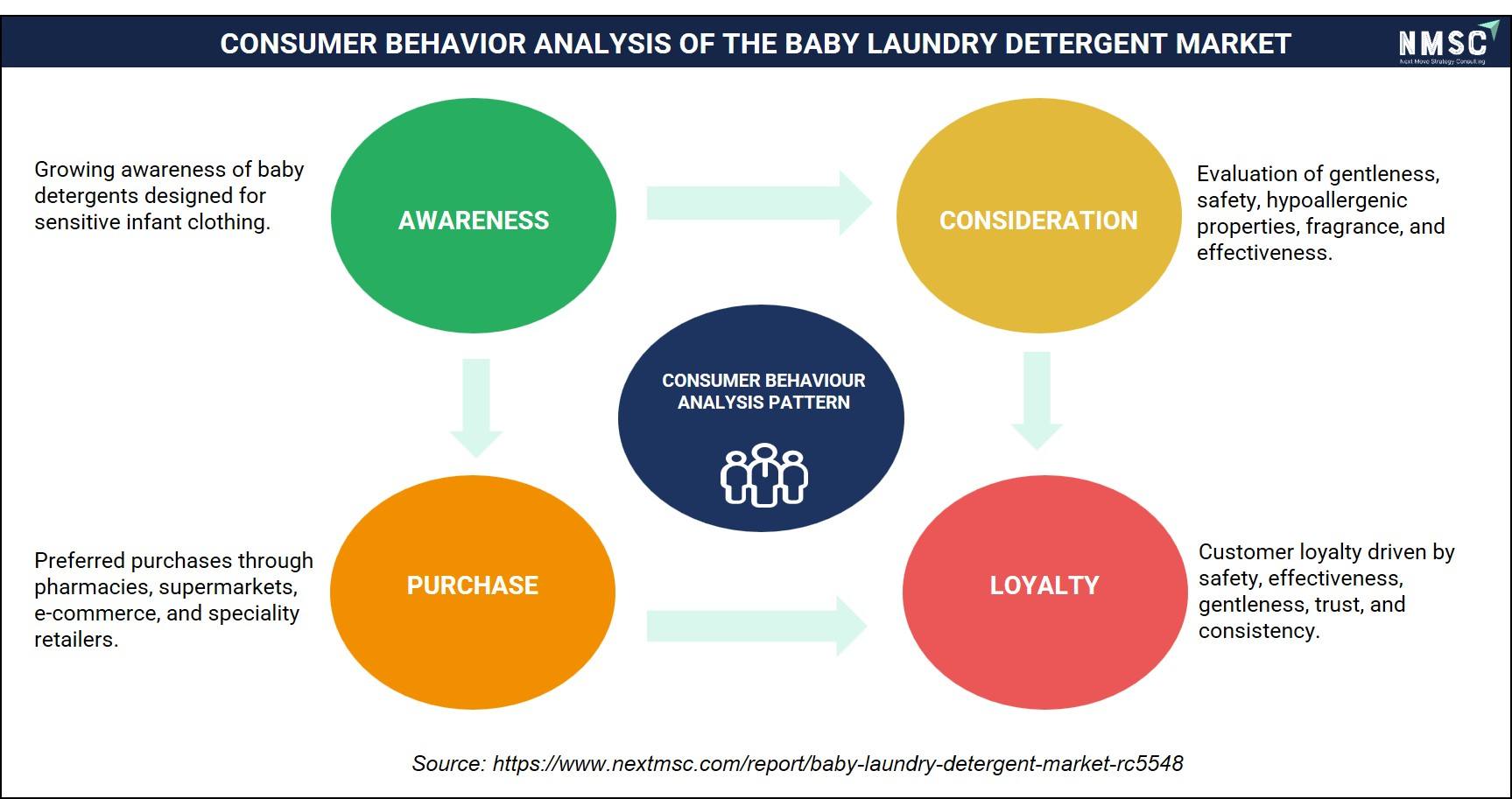
The above infographic presents a consumer behavior analysis of the baby detergent market, mapping the journey from awareness to loyalty. Awareness is driven by growing concern for infant skin sensitivity, leading parents to evaluate safety, gentleness, and effectiveness before making purchases through pharmacies, supermarkets, e-commerce platforms, and specialty retailers. Looking ahead, we observed that loyalty is reinforced by consistent product quality, trust, and proven performance, ensuring sustained brand preference and repeat purchases across the market.
Investment Opportunities
What Capital Inflows Are Targeting the Baby Laundry Detergent Market?
Capital inflows into the baby laundry detergent market are increasingly directed toward specialty plant-based brand expansion and direct-to-consumer subscription infrastructure. We observed that specialty brands including Puracy LLC and Dapple Baby Inc. continue to invest in e-commerce subscription platforms to build recurring revenue outside traditional retail. Investors favor brands demonstrating validated ingredient-safety credentials, viewing dermatological testing data as a proxy for long-term premium brand retention.
How Is Infrastructure Investment Supporting Baby Laundry Detergent Deployment?
Infrastructure investment is expanding low-waste manufacturing capacity for concentrated sheet and strip formats across North America and Europe to serve rising sustainability-conscious demand. Our findings suggest that manufacturers are investing in household cleaner production line upgrades to support reduced-packaging formats, supporting the shipping-efficiency requirements increasingly demanded by e-commerce distribution channels.
What ESG Considerations Are Shaping Baby Laundry Detergent Investment Decisions?
Environmental, social, and governance considerations are central to investment decisions across the industry, with biodegradable formulation and reduced plastic packaging as key sustainability criteria. Manufacturers increasingly disclose ingredient biodegradability and packaging recyclability data through official corporate sustainability reports. We found that investors increasingly favor brands with transparent environmental impact disclosures and validated dermatological safety data, treating both as governance indicators alongside standard labor and manufacturing compliance.
Key Benefits for Stakeholders
How Does This Report Benefit Enterprise and Industry Leaders?
Enterprise and industry leaders gain access to validated segmentation, competitive benchmarking, and regional demand forecasts that support sourcing and product-portfolio decisions across the baby laundry detergent industry. Our analysis shows that detailed product type, formulation, and distribution channel breakdowns help brand teams align product development with ingredient-transparency requirements while identifying underserved regional segments for portfolio expansion.
How Does This Report Benefit Investors and Financial Analysts?
Investors and financial analysts benefit from consistent, single-point market size and CAGR estimates that support valuation and capital-allocation decisions across the baby laundry detergent market supply chain. We observed that the report's regional and segment-level growth differentials help identify which brands and distributors are best positioned to capture above-market growth in Asia-Pacific and plant-based formulation categories through 2035.
How Does This Report Benefit Technology Vendors and Product Teams?
Technology and product development teams gain insight into emerging formulation requirements, including plant-based ingredient sourcing, concentrated low-waste packaging, and fragrance-free formulation, that are reshaping the industry. Our findings suggest that this analysis helps product teams prioritize development roadmaps around dermatological validation and sustainability credentials increasingly required by premium retail and pharmacy-channel procurement processes.
Key Market Segments
By Product Type
-
Liquid detergent
-
Powder detergent
-
Detergent pods and tablets
-
Detergent sheets and strips
By Formulation
-
Conventional formulation
-
Plant-based and organic formulation
-
Fragrance-free formulation
By Distribution Channel
-
Supermarkets and hypermarkets
-
Online retail
-
Pharmacies and drug stores
-
Specialty baby stores
By Packaging Type
-
Bottles
-
Pouches
-
Boxes and cartons
By End User
-
Newborn care (0-6 months)
-
Infant care (6-24 months)
-
Toddler care (2-4 years)
By Region
-
North America: U.S., Canada, Mexico
-
Europe: UK, Germany, France, Italy, Spain, Sweden, Denmark, Finland, Netherlands, Rest of Europe
-
Asia-Pacific: China, India, Japan, South Korea, Taiwan, Indonesia, Vietnam, Australia,Philippines, Malaysia, Rest of APAC
-
Middle East & Africa: Saudi Arabia, UAE, Egypt, Israel, Turkey, Nigeria, South Africa, Rest of MEA
-
Latin America: Brazil, Argentina, Chile, Colombia, Rest of LATAM
Conclusion and Recommendations
What Is the Long-Term Outlook for the Baby Laundry Detergent Market?
The long-term outlook for the market remains steadily positive, with global revenue projected to expand from USD 1.35 billion in 2025 to USD 2.87 billion by 2035 at a 7.8% CAGR. We observed that sustained ingredient-transparency demand, plant-based reformulation, and e-commerce distribution expansion will continue underpinning growth across product type and formulation categories through the forecast period.
What Strategic Positioning Should Baby Laundry Detergent Vendors Pursue?
Vendors should prioritize plant-based reformulation while pursuing dermatological validation to secure long-term premium retail and pharmacy-channel positioning. Our assessment indicates that vendors investing early in concentrated low-waste packaging formats and direct-to-consumer subscription infrastructure will be best positioned to capture premium pricing within the baby laundry detergent market.
How Attractive Is the Market for New Investment?
The baby laundry detergent industry presents a steady investment case, supported by a USD 1.41 billion absolute dollar opportunity between 2026 and 2035 and above-average growth in Asia-Pacific and plant-based formulation categories. We found that investment attractiveness is highest for vendors combining validated ingredient-safety credentials with scalable e-commerce distribution, positioning them to serve both price-sensitive mass retail and premium specialty segments simultaneously.
What Market Shifts and Key Risks Should Stakeholders Monitor?
Stakeholders should monitor declining birth rates in mature developed markets, private label price competition, and raw material cost volatility for plant-derived surfactants as key risks to the baby laundry detergent market. Our analysis shows that vendors unable to differentiate beyond price risk losing shelf space to private label competitors, particularly within Europe's demographically constrained and increasingly price-sensitive retail environment.
What Are the Key Growth Pathways for the Baby Laundry Detergent Market?
Key growth pathways include expanding plant-based and fragrance-free product portfolios, scaling concentrated low-waste packaging formats, and deepening penetration into Asia-Pacific and online retail channels. NMSC's analysis indicates that vendors pursuing these pathways while maintaining cost competitiveness in conventional formulation categories will be best positioned to capture the market's projected growth through 2035.
About the Author
 Mayurima Roy
— Mayurima Roy is Research Analyst at Next Move Strategy Consulting, where she has spent 4 years working across the firm's full industry coverage rather than a single fixed vertical. Her work centers on structured research, ongoing trend tracking, competitive assessment, and insight-led content development, translating complex market data into clear, decision-ready narratives that support informed client decision-making across diverse global industries, market sectors, and world regions every day.
Mayurima Roy
— Mayurima Roy is Research Analyst at Next Move Strategy Consulting, where she has spent 4 years working across the firm's full industry coverage rather than a single fixed vertical. Her work centers on structured research, ongoing trend tracking, competitive assessment, and insight-led content development, translating complex market data into clear, decision-ready narratives that support informed client decision-making across diverse global industries, market sectors, and world regions every day.
About the Reviewer
 Supradip Baul
— Supradip Baul is an accomplished business consultant and strategist with over a decade of rich experience in market intelligence, strategy, technology, and business transformation. His work has included rigorous qualitative and quantitative analysis across multiple industries, helping clients shape investment decisions and long-term roadmaps. Earlier in his career, he was associated with Gartner, where he contributed to industry-leading reports and market share analyses. He has worked with leading global companies and holds an MBA with a dual specialization in Marketing and Finance.
Supradip Baul
— Supradip Baul is an accomplished business consultant and strategist with over a decade of rich experience in market intelligence, strategy, technology, and business transformation. His work has included rigorous qualitative and quantitative analysis across multiple industries, helping clients shape investment decisions and long-term roadmaps. Earlier in his career, he was associated with Gartner, where he contributed to industry-leading reports and market share analyses. He has worked with leading global companies and holds an MBA with a dual specialization in Marketing and Finance.
At Next Move Strategy Consulting, we understand that insightful market research is the cornerstone of successful business decisions. That's why we employ a robust and multifaceted approach, combining various methodologies to deliver the most accurate and actionable data for our clients.

Research Landscape
We navigate the world of research with two primary approaches:
Qualitative Approach
Our qualitative research methodologies involve immersive techniques such as in-depth interviews, focus groups, and observational studies. By engaging directly with individuals and stakeholders, we uncover valuable insights that quantitative data alone may overlook.

Quantitative Research
In tandem with qualitative methodologies, NMSC leverages the power of Quantitative Research to provide a robust foundation of numerical insights. Through systematic data collection and analysis, we quantify patterns, preferences, and market trends, offering a comprehensive view of the business landscape.
Our quantitative research approach employs diverse tools, including surveys, experiments, and statistical modelling. These methodologies enable us to gather data from a large and representative sample, ensuring the statistical significance of our findings. By employing structured questionnaires and standardized data collection methods, we guarantee the reliability and validity of the information we present to our clients.
Quantitative research is particularly effective in measuring the prevalence of trends, assessing market size, and gauging the impact of various factors on consumer behavior. The numerical precision attained through this approach equips our clients with actionable insights, facilitating data-driven decision-making and strategy formulation.


Our Specialized Toolbox for Industry-Specific Market Research
We deploy a specialized arsenal of techniques tailored to meet your unique requirements. Here's a glimpse into our comprehensive toolbox:

Information Procurement
The stage entails acquiring market data or relevant information through various sources and methodologies.


Market Research Approach
We utilize both top-down and bottom-up approaches in market research analysis to achieve a comprehensive understanding of the market dynamics, leveraging the broad perspective of industry trends and macroeconomic factors alongside detailed insights from specific segments and individual companies.

Porters Five Forces Analysis
We conduct Porter's Five Forces analysis to evaluate the competitive landscape of an industry, providing us with insights into factors that affect profitability and strategic positioning.

SWOT Analysis

Forecasting
We utilize a forecasting model to predict future consumption by considering parameters like population, economics, regulations, market competition, drivers, constraints, technology, and pricing. We also employ statistical techniques such as multilinear regression, exponential smoothing, moving average, ARIMA, and Monte Carlo simulations for accurate predictions. In econometric forecasting, we analyzed short-term and long-term event impacts, attributing values based on regulatory frameworks, economic factors, and market events.





 Speak to Our Analyst