Core Banking Replacement Market Size, Share, Growth & Forecast by Software (Full Core Platform: New Core Deployment, Core Replacement; and Others), Buyer Type (Retail Bank, Commercial Bank, Universal Bank, and Others), Deployment Model (SaaS, Public Cloud, Private Cloud, Hybrid, On-Premise), Revenue Stream (Subscription, Perpetual License, Maintenance, Professional Services, and others), and Sales Channel (Direct, SI Partner, OEM, Marketplace) — Global Analysis 2025–2035
Industry: BFSI | Publishing Date: July 7, 2026 | Last Updated: September 30, 2026 | No of Pages: N/A | No. of Tables: N/A | No. of Figures: N/A | Format: PDF | Report Code: BF4993
What Is the Core Banking Replacement Market Size?
The global Core Banking Replacement Market was valued at USD 12.8 billion in 2025 and is projected to reach USD 14.6 billion in 2026. Sustained regulatory pressure to modernize legacy banking infrastructure, accelerating cloud adoption among financial institutions, and rising demand for real-time payment capabilities are expected to propel the market to USD 47.6 billion by 2035, advancing at a CAGR of 14.1% from 2026 to 2035. Key growth drivers include the obsolescence of COBOL-based legacy core systems, proliferation of cloud-native and SaaS-delivered core banking platforms, stringent regulatory requirements from central banks across major economies, and increased competition from digital-only banks compelling traditional institutions to undertake full or modular core banking replacement programs.
|
Parameters |
Details |
|
Market Size in 2025 |
USD 12.8 Billion |
|
Market Size in 2026 |
USD 14.6 Billion |
|
Revenue Forecast in 2035 |
USD 47.6 Billion |
|
Growth Rate |
CAGR of 14.1% from 2026 to 2035 |
|
Analysis Period |
2025–2035 |
|
Base Year Considered |
2025 |
|
Forecast Period |
2026–2035 |
|
Market Size Estimation |
Billion USD |
|
Companies Profiled |
20 |
|
Countries Covered |
33 |
|
Market Share |
Top 10 |
Core Banking Replacement Market Overview
What Is the Core Banking Replacement Market?
Core banking replacement refers to the end-to-end or modular substitution of a financial institution's foundational transaction processing systems, including deposits, loans, payments, and general ledger functions, with modern cloud-native, API-driven, or SaaS-delivered platforms. NMSC's analysis indicates that the market encompasses full core platform replacements as well as targeted modular core deployments across retail, commercial, universal, digital, and community banks. The Core Banking Replacement Market spans software licensing, professional services, implementation, data migration, managed services, and ongoing support engagements across all geographies.
How Has the Core Banking Replacement Market Evolved?
The Core Banking Replacement Market has progressed through three distinct transformation phases. The first phase, dominant through the early 2000s, was characterized by customized monolithic on-premise platforms built on mainframe architectures. The second phase introduced vendor-packaged core banking software with modular functionality and reduced customization needs. From our research, we found that the current and accelerating phase is defined by cloud-native, API-first SaaS architectures enabling real-time processing, open banking integration, and continuous delivery of regulatory and product updates without costly upgrade cycles, fundamentally reshaping the commercial and operational model for core system procurement.
How Do Regulations Influence the Core Banking Replacement Market?
Regulatory frameworks have emerged as one of the most powerful structural drivers of the Core Banking Replacement Market. Central bank mandates for real-time gross settlement, instant payment rails, and ISO 20022 compliance are forcing financial institutions to retire legacy cores that cannot support these requirements. The European Banking Authority's ICT risk guidelines, the UK's Operational Resilience Policy Statement, the U.S. Federal Reserve's FedNow Service, and the Reserve Bank of India's NACH and UPI frameworks collectively create sustained regulatory demand for modern core banking infrastructure that legacy systems cannot accommodate without full replacement.
How Is Technology Adoption Expanding Across the Core Banking Replacement Market?
Technology adoption in the Core Banking Replacement Market is accelerating as cloud-native, microservices-based, and SaaS-delivered platforms demonstrate proven scalability at tier-one banking institutions. Our findings suggest that composable banking architectures, enabling modular replacement of individual core banking functions rather than big-bang replacement, are lowering adoption barriers for risk-averse incumbent banks. Open banking standards including PSD2 in Europe and Open Banking in Australia are further compelling legacy replacement as institutions need API-ready cores capable of real-time third-party integration, driving sustained multi-year investment across the replacement landscape.
|
Key Takeaways |
|
By software, Full Core Platform held the largest share in the Core Banking Replacement Market at USD 7.6 billion in 2025, driven by large-scale transformation programs undertaken by tier-1 and tier-2 banks seeking end-to-end modernization. Modular Core Platforms are the fastest-growing software segment at a CAGR of 16.2% from 2026 to 2035, supported by increasing demand for phased modernization strategies and composable banking architectures. |
|
By services, Implementation Services generated the highest revenue at USD 3.8 billion in 2025, reflecting the complexity of core banking transformation projects and the extensive deployment requirements associated with replacement initiatives. Support & Training Services represent the fastest-growing service segment at a CAGR of 16.4% from 2026 to 2035, driven by increasing adoption of cloud-native platforms, continuous software upgrades, and growing requirements for workforce enablement and change management. |
|
By buyer type, Universal Banks accounted for the largest market share in 2025, supported by large-scale modernization investments aimed at replacing legacy core infrastructure across multiple banking lines. Other Financial Institutions are the fastest-growing buyer category at a CAGR of 18.6% from 2026 to 2035, reflecting increasing adoption of modern core banking platforms among specialized financial institutions seeking greater operational efficiency and digital service delivery capabilities. |
|
By deployment model, SaaS deployment held the dominant market share in 2025, reflecting growing preference for cloud-native banking platforms that offer scalability, faster implementation timelines, and reduced infrastructure management requirements. SaaS deployment is also the fastest-growing deployment model at a CAGR of 16.1% from 2026 to 2035, supported by accelerating cloud adoption across the global banking sector. |
|
By revenue stream, Professional Services represented the largest revenue contribution in 2025 at USD 4.2 billion, reflecting the extensive consulting, implementation, migration, and integration activities associated with core banking replacement projects. Usage-Based Revenue Models are the fastest-growing revenue stream at a CAGR of 28.5% from 2026 to 2035, driven by increasing adoption of cloud-native, consumption-based banking platforms and API-driven service architectures. |
|
By project type, Phased Replacement generated the largest market share in 2025 at USD 5.9 billion, as financial institutions increasingly prefer lower-risk modernization approaches that minimize operational disruption. Core Consolidation is the fastest-growing project type at a CAGR of 15.3% from 2026 to 2035, driven by post-merger integration activities, operating cost optimization initiatives, and efforts to simplify technology landscapes. |
|
North America held the largest regional share in the Core Banking Replacement Market at USD 4.2 billion in 2025, projected to reach approximately USD 14.9 billion by 2035 at a CAGR of 13.5%, supported by high technology spending, extensive legacy system replacement activity, and strong adoption of digital banking transformation initiatives. |
|
Asia-Pacific is the fastest-growing region in the Core Banking Replacement Market at a CAGR of 15.8% from 2026 to 2035, driven by rapid banking sector digitization, expanding financial inclusion programs, increasing cloud adoption, and growing investments in modern banking infrastructure across emerging economies. |
|
The United States is the largest country market in the Core Banking Replacement Market, supported by a large installed base of legacy banking platforms, substantial IT modernization budgets, and strong demand for cloud-native banking technologies. |
|
India is the fastest-growing country market within Asia-Pacific, advancing at a CAGR of 17.2%, driven by rapid digital banking adoption, regulatory support for financial modernization, expansion of fintech ecosystems, and increasing investments in next-generation banking infrastructure. |
Key Emerging Trends in the Core Banking Replacement Market
How Is the Shift to Cloud-Native Architectures Reshaping Core Banking Replacement?
Cloud-native core banking architectures based on microservices, containerization, and API-first design are becoming the dominant paradigm in the Core Banking Replacement Market. Platforms such as Thought Machine's Vault and Mambu's cloud banking platform demonstrate that financial institutions can achieve continuous deployment cycles, elastic scalability, and real-time processing without mainframe dependency. Through NMSC's assessment, we found that tier-one institutions including JP Morgan Chase and Standard Chartered have publicly committed to cloud-native core strategies, validating this architectural shift as a mainstream transformation pathway for banks of all sizes.
How Are Composable Banking Frameworks Driving Modular Core Adoption?
Composable banking is emerging as a core transformation strategy that allows financial institutions to replace individual banking functions, such as deposits, lending, or payments, without disrupting the entire core system. This approach directly expands the addressable market for modular core vendors in the Core Banking Replacement Market. Our analysis shows that institutions using composable architectures can reduce time-to-market for new products from months to days by assembling pre-built banking capabilities through open APIs. The Banking Industry Architecture Network (BIAN) provides standardized API frameworks that enable interoperability across composable core modules.
What Role Is Real-Time Payments Infrastructure Playing in Accelerating Core Replacement?
The global buildout of real-time payment rails, including FedNow in the United States, the Faster Payments Service in the United Kingdom, UPI in India, and the Eurosystem's TIPS network, is forcing financial institutions to retire legacy batch-processing cores that cannot support 24/7 real-time transaction settlement. Based on our market evaluation, we noticed that banks with batch-oriented cores face regulatory and competitive pressure to replace or augment their systems to participate in real-time payment ecosystems, directly contributing to accelerating investment in Core Banking Replacement programs globally across both developed and emerging markets.
How Is Open Banking Regulation Creating a New Wave of Core Banking Replacement Demand?
Open banking mandates across Europe (PSD2), the United Kingdom, Australia (Consumer Data Right), Brazil (Open Finance), and Canada (proposed open banking framework) require financial institutions to expose customer data and transaction functionality through secure APIs. Our assessment indicates that legacy core banking systems with proprietary, closed architectures are technically incapable of supporting PSD2-compliant APIs without expensive middleware layers, making core replacement the more commercially viable long-term solution. API-ready modern cores that natively support open banking standards are commanding premium positioning among banks evaluating platform replacement vendors.
Ecosystem Analysis of the Core Banking Replacement Market
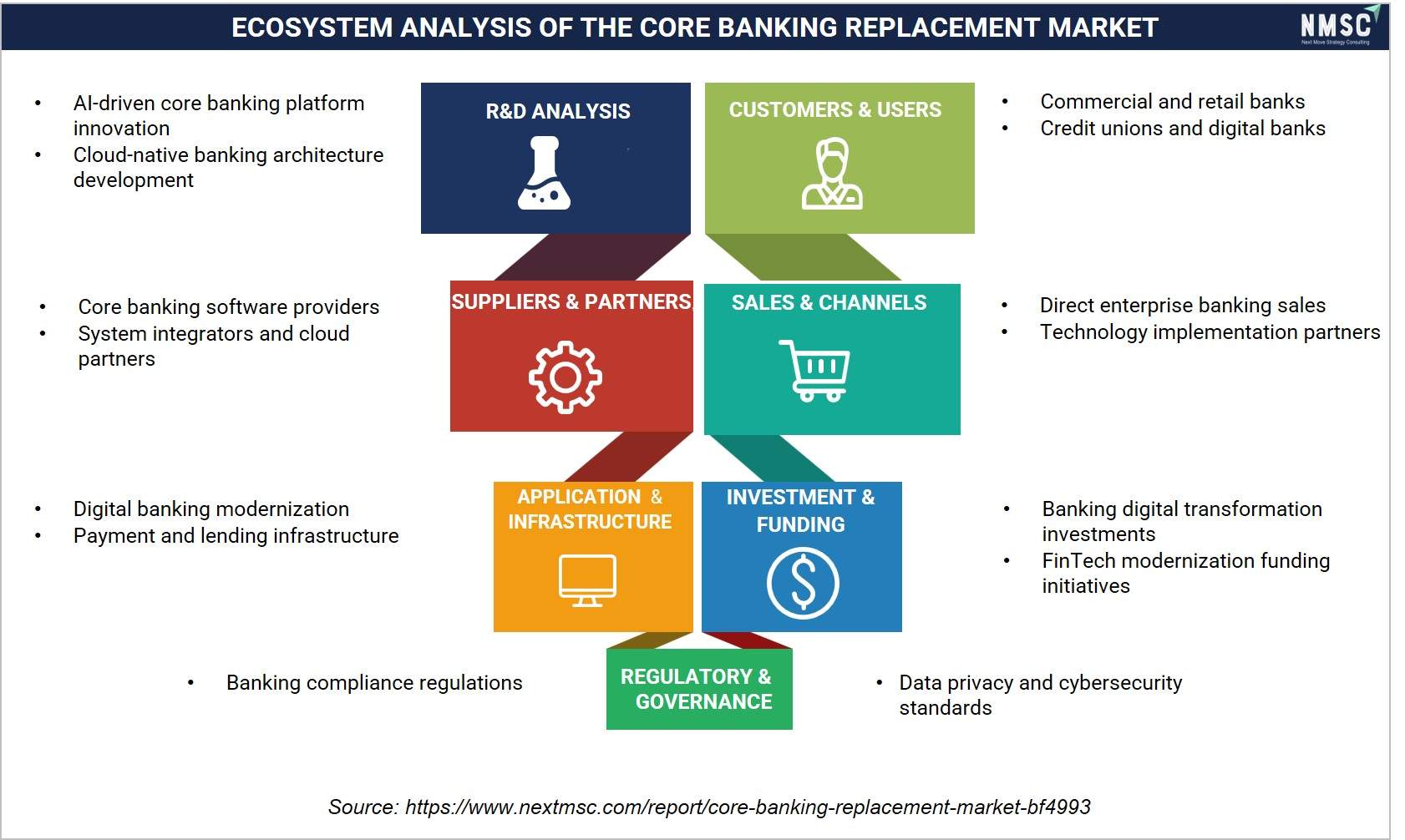
Based on our comprehensive assessment, we found that the Core Banking Replacement Market is supported by a broad ecosystem of banking software providers, cloud infrastructure vendors, system integrators, consulting firms, financial institutions, and regulatory authorities. Advanced cloud-native architectures, API frameworks, and digital banking platforms accelerate modernization initiatives. Our analysis indicates that strategic investments and regulatory compliance requirements continue to drive market transformation.
What Are the Key Market Drivers, Breakthroughs, and Investment Opportunities that Will Shape the Core Banking Replacement Market in the Next Decade?
|
Drivers / Trends / Restraints |
(+/-) % Impact on CAGR Forecast |
Geographic Relevance |
Impact Timeline |
|
Legacy System Obsolescence and Technical Debt |
+2.6% |
Global (led by North America, Europe) |
2025–2032 |
|
Regulatory Mandates for Real-Time Payments and ISO 20022 |
+2.1% |
Europe, Asia-Pacific, North America |
2025–2030 |
|
Digital Banking Expansion and Neobank Competition |
+1.8% |
Global (all regions) |
2026–2035 |
|
SaaS and Cloud-Native Platform Maturity |
+1.6% |
North America, Europe, APAC |
2025–2030 |
|
Open Banking API Mandates |
+1.3% |
Europe, UK, Australia, Brazil |
2025–2028 |
|
High Implementation Risk and Project Complexity |
-1.4% |
All regions |
Ongoing |
|
Data Migration Challenges and Regulatory Constraints |
-0.9% |
North America, Europe |
2025–2028 |
|
Budget Constraints at Community and Smaller Banks |
-0.6% |
North America, MEA, LATAM |
2025–2030 |
|
Core Consolidation Post-Merger Activity |
+1.4% |
North America, Europe |
2026–2032 |
|
Embedded Finance and BaaS Platform Growth |
+1.2% |
Global |
2026–2035 |
What Are the Growth Drivers of the Core Banking Replacement Market?
How Is the Obsolescence of Legacy Core Banking Systems Driving Replacement Demand?
The most powerful structural driver in the Core Banking Replacement Market is the widespread obsolescence of COBOL-based mainframe and early client-server core banking systems deployed between the 1970s and 1990s. According to the U.S. Government Accountability Office (GAO), the U.S. federal government alone operates over 600 million lines of COBOL code across critical financial systems, with many banking institutions relying on similarly aged architectures. Maintenance costs for legacy cores now consume an estimated 70–80% of IT budgets at large incumbent banks (industry-derived estimate), leaving limited resources for innovation and creating urgent commercial justification for full or modular Core Banking Replacement programs.
How Are Regulatory Mandates for Real-Time Payments and ISO 20022 Migration Fueling Core Banking Replacement?
The mandated global migration to ISO 20022 financial messaging standards, with the SWIFT network requiring full compliance by November 2025 and central banks in over 70 countries mandating real-time payment participation, is creating powerful regulatory demand for Core Banking Replacement investments. Legacy batch-processing cores based on MT messaging standards cannot natively support ISO 20022 rich data requirements without expensive middleware. The U.S. Federal Reserve's FedNow Service, launched in 2023 and expanding participation through 2025, requires participating institutions to possess modern API-ready cores capable of instant payment processing, directly supporting Core Banking Replacement program investment decisions.
How Is the Growth of Digital-Only Banks Pressuring Incumbents to Accelerate Core Banking Replacement?
The rapid expansion of digital-only and neobank competitors, which launch on cloud-native cores without legacy constraints, is intensifying competitive pressure on incumbent financial institutions to modernize their own core banking infrastructure. According to the Financial Stability Board (FSB), over 400 digital banks and neobanks are now operating globally, with many achieving profitability using core banking platforms that allow product launch in days rather than months. Our analysis shows that this competitive pressure is compelling tier-one and community banks to evaluate and initiate Core Banking Replacement programs to close the speed and agility gap created by challenger bank architectures.
What Are the Growth Inhibitors of the Core Banking Replacement Market?
How Does Implementation Risk and Project Complexity Constrain Core Banking Replacement Adoption?
Core banking replacement projects are among the most complex and risk-intensive IT programs in the financial services industry, frequently cited as factors constraining market growth velocity. High-profile project failures, including TSB Bank's 2018 core migration failure in the United Kingdom (which resulted in over USD 300 million in remediation costs and regulatory fines), have made bank boards and regulators cautious about large-scale replacement programs. Our assessment indicates that this risk aversion extends procurement timelines, increases demand for phased replacement approaches, and constrains the frequency of big-bang replacement projects, moderating overall market growth rates particularly among risk-averse community banks.
How Do Data Migration Challenges Limit the Speed of Core Banking Replacement Programs?
Data migration complexity is one of the most frequently cited practical inhibitors of Core Banking Replacement projects. Financial institutions with decades of customer and transaction records stored in proprietary legacy database formats face significant challenges in cleansing, transforming, and migrating historical data to modern cores without compromising data integrity or regulatory compliance. The Bank for International Settlements (BIS) has documented that data quality, legacy data governance, and migration verification requirements add material cost and time to core replacement programs. These challenges are particularly acute for universal and commercial banks with multi-product, multi-currency data estates that require complete migration to maintain regulatory reporting continuity.
What Are the Growth Opportunities in the Core Banking Replacement Market?
How Does the Expansion of Banking-as-a-Service Create New Opportunities in the Core Banking Replacement Market?
The rise of Banking-as-a-Service (BaaS) and embedded finance is creating a structurally new demand category within the Core Banking Replacement Market. Banks seeking to operate as regulated banking infrastructure providers for fintech companies and non-financial brands require API-first, cloud-native cores capable of multi-tenancy, white-label product delivery, and programmatic account provisioning. Our findings suggest that modern core banking vendors including Thought Machine, Mambu, and 10x Banking are explicitly positioning their platforms to support BaaS architectures, opening a market segment that did not exist under legacy core banking paradigms and creating incremental revenue opportunity for both vendors and replacement-ready banks.
How Do Post-Merger Core Consolidation Programs Present a Durable Market Opportunity?
Banking sector consolidation, including domestic mergers, cross-border acquisitions, and community bank consolidation in the United States, consistently generates core consolidation programs that represent significant Core Banking Replacement Market opportunity. When two institutions merge, operating dual core banking systems is operationally costly and architecturally unsustainable. The Federal Deposit Insurance Corporation (FDIC) reported 134 U.S. bank merger and acquisition transactions in 2024, each of which creates a potential core consolidation program. Our analysis shows that this sustained M&A activity in banking creates durable, recurring demand for core consolidation projects, supporting stable market growth independent of greenfield replacement investment cycles.
How Does the Rise of Islamic Banking and Microfinance Create Emerging Segment Opportunities?
Islamic banking institutions, which must operate under Shariah-compliant financial principles including prohibition of interest-bearing products, require specialized core banking platforms that natively support profit-sharing, Murabaha, Ijara, and Sukuk product structures. Standard legacy cores are not built for Shariah-compliant product architecture. According to the Islamic Financial Services Board (IFSB), global Islamic banking assets exceeded USD 2.8 trillion in 2023, with GCC, Southeast Asia, and South Asia representing fast-growing geographies. This creates a specialized and growing demand segment within the Core Banking Replacement Market for Shariah-compliant modern core banking platforms, with vendors such as Path Solutions and Temenos Islamic Banking gaining strategic traction.
How Is the Core Banking Replacement Market Segmented in This Report, and What Are the Key Insights from the Segmentation Analysis?
How Does Software Type Segmentation Reveal the Structural Composition of the Core Banking Replacement Market?
|
Software Segment |
2025 (USD Bn) |
2035 (USD Bn) |
CAGR (%) |
|
Full Core Platform |
7.6 |
27.1 |
13.6% |
|
— New Core Deployment |
3.1 |
11.4 |
13.9% |
|
— Core Replacement |
4.5 |
15.7 |
13.3% |
|
Modular Core |
5.2 |
20.5 |
16.2% |
|
— Deposits |
0.9 |
3.4 |
14.2% |
|
— Lending |
1.1 |
4.2 |
14.4% |
|
— Payments |
1.2 |
5.0 |
15.3% |
|
— Treasury |
0.5 |
1.9 |
14.3% |
|
— General Ledger |
0.4 |
1.5 |
14.1% |
|
— Product Factory |
0.4 |
1.7 |
15.6% |
|
— APIs and Integration |
0.5 |
2.1 |
15.4% |
|
— Other Modules |
0.2 |
0.7 |
13.3% |
Based on our market analysis of software investment trends across global financial institutions, the Core Banking Replacement Market is segmented into Full Core Platform and Modular Core software categories. The Full Core Platform segment continues to dominate due to the large scale of replacement programs at tier-one and tier-two banks that require comprehensive system migration. Within this segment, Core Replacement sub-projects represent the majority of investment as institutions retire operational legacy platforms rather than deploying entirely new systems. The Modular Core segment is the fastest-growing area, with Payments, APIs and Integration, and Product Factory modules leading adoption as banks pursue composable banking strategies to achieve faster product velocity without full core replacement.
How Do Professional Services Shape Revenue Distribution in the Core Banking Replacement Market?
|
Services Segment |
2025 (USD Bn) |
2035 (USD Bn) |
CAGR (%) |
|
Consulting |
1.6 |
5.4 |
12.9% |
|
Implementation |
3.8 |
13.2 |
13.3% |
|
Data Migration |
1.4 |
5.3 |
15.8% |
|
Integration |
1.8 |
6.4 |
13.5% |
|
Managed Services |
2.1 |
7.8 |
15.4% |
|
Support and Training |
2.1 |
9.5 |
16.4% |
Through NMSC's assessment, the Core Banking Replacement Market's services dimension is segmented into Consulting, Implementation, Data Migration, Integration, Managed Services, and Support and Training categories. Implementation services hold the largest share due to the complexity and duration of core replacement programs, which typically span two to five years at large institutions and require deep vendor-side and third-party systems integrator resources. Data Migration and Managed Services are the fastest-growing service categories, reflecting growing bank preference for outcome-based and post-go-live operational support engagements. Support and Training commands the highest CAGR among services, driven by long-term platform subscription models that embed ongoing vendor support and product update delivery.
Which Buyer Types Are Driving Purchasing Decisions in the Core Banking Replacement Market?
|
Buyer Type |
2025 (USD Bn) |
2035 (USD Bn) |
CAGR (%) |
|
Retail Bank |
2.1 |
7.2 |
13.1% |
|
Commercial Bank |
1.9 |
6.8 |
13.6% |
|
Universal Bank |
3.4 |
12.0 |
13.5% |
|
Community Bank |
1.2 |
4.1 |
13.1% |
|
Credit Union |
0.7 |
2.4 |
13.2% |
|
Digital Bank |
1.2 |
5.8 |
17.9% |
|
Private Bank |
0.8 |
2.7 |
13.0% |
|
Islamic Bank |
0.6 |
2.4 |
14.9% |
|
Microfinance Institution |
0.5 |
2.0 |
15.4% |
|
Other Financial Institutions |
0.4 |
2.2 |
18.6% |
Our market assessment indicates that the Core Banking Replacement Market is shaped by a diverse buyer landscape spanning retail, commercial, universal, community, credit union, digital, private, Islamic, and microfinance institution segments. Universal Banks represent the largest buyer category due to the scale and complexity of their replacement programs, which frequently involve multi-geography, multi-currency, and multi-product migrations. Digital Banks are the fastest-growing buyer segment, as new entrant institutions adopt modern cloud-native cores at inception and established banks create separately chartered digital subsidiaries on fresh platforms. Islamic Banks and Microfinance Institutions are emerging as high-growth buyer categories, driven by specialized product requirements and geographic expansion in high-growth markets.
How Does Deployment Model Preference Shape Commercial Dynamics in the Core Banking Replacement Market?
|
Deployment Model |
2025 (USD Bn) |
2035 (USD Bn) |
CAGR (%) |
|
SaaS |
5.2 |
22.8 |
16.1% |
|
Public Cloud |
2.1 |
7.8 |
14.0% |
|
Private Cloud |
1.8 |
5.8 |
12.5% |
|
Hybrid |
2.1 |
8.0 |
14.3% |
|
On-Premise |
1.6 |
3.2 |
7.2% |
The Core Banking Replacement Market is segmented into SaaS, Public Cloud, Private Cloud, Hybrid, and On-Premise deployment models. SaaS is both the dominant and fastest-growing deployment category, driven by vendor platforms that deliver continuous software updates, reduced implementation complexity, and subscription-based pricing that aligns with bank preference for operational expenditure models over large capital investments. Hybrid deployment is the second-most-adopted model among large incumbent banks that require private cloud security for core ledger data while leveraging public cloud for front-office, analytics, and API gateway functions. On-Premise deployment is declining as a share of new contracts, though it remains relevant in jurisdictions with strict data residency regulations.
How Do Revenue Stream Structures Reflect the Commercial Evolution of Core Banking Replacement Vendors?
|
Revenue Stream |
2025 (USD Bn) |
2035 (USD Bn) |
CAGR (%) |
|
Subscription |
2.8 |
12.2 |
16.8% |
|
Perpetual License |
1.8 |
3.6 |
7.3% |
|
Maintenance |
2.1 |
5.4 |
9.9% |
|
Professional Services |
4.2 |
14.8 |
13.5% |
|
Managed Services |
1.2 |
5.8 |
17.3% |
|
Hosting |
0.4 |
2.2 |
18.6% |
|
Usage Based |
0.3 |
3.6 |
28.5% |
NMSC's analysis of the Core Banking Replacement Market's revenue architecture reveals a clear commercial transition from perpetual license and maintenance revenue models toward subscription, managed services, hosting, and usage-based models. Professional Services remain the largest absolute revenue stream due to the extensive implementation and integration work required in replacement programs. Subscription revenue is the fastest-growing model, driven by SaaS platform adoption where banks pay recurring annual license fees tied to the number of accounts or transactions processed. Usage-based pricing is the highest-growth revenue model emerging among cloud-native vendors that charge based on transaction volumes or compute consumption, creating aligned incentive structures with bank growth trajectories.
How Does Project Type Classification Inform Investment Planning in the Core Banking Replacement Market?
|
Project Type |
2025 (USD Bn) |
2035 (USD Bn) |
CAGR (%) |
|
Big Bang Replacement |
2.6 |
8.2 |
12.2% |
|
Phased Replacement |
5.9 |
21.2 |
13.6% |
|
Replatforming |
2.4 |
9.8 |
15.1% |
|
Core Consolidation |
1.9 |
8.4 |
15.3% |
Based on our evaluation of core banking transformation programs globally, the Core Banking Replacement Market is characterized by four primary project types: Big Bang Replacement, Phased Replacement, Replatforming, and Core Consolidation. Phased Replacement is the dominant project approach, as financial institutions seek to manage implementation risk through staged migration of customer portfolios, product lines, and geographic markets to new platforms. Core Consolidation is the fastest-growing project type, driven by sustained banking M&A activity that creates post-merger requirement to rationalize multiple core platforms onto a single modern architecture. Replatforming, where institutions retain existing application logic while migrating to modern cloud infrastructure, is gaining traction as a lower-risk entry point into Core Banking Replacement programs.
How Are Sales Channel Strategies Evolving in the Core Banking Replacement Market?
|
Sales Channel |
2025 (USD Bn) |
2035 (USD Bn) |
CAGR (%) |
|
Direct |
6.8 |
23.4 |
13.2% |
|
SI Partner |
4.2 |
15.6 |
14.1% |
|
OEM |
0.9 |
3.4 |
14.3% |
|
Marketplace |
0.9 |
5.2 |
19.3% |
Our analysis of go-to-market strategies in the Core Banking Replacement Market reveals that Direct sales continues to dominate due to the high-touch, relationship-intensive nature of core banking replacement procurement, where engagements typically involve multi-year negotiations, proof-of-concept deployments, and board-level sign-off. Systems Integrator (SI) Partners including Accenture, Deloitte, Capgemini, and Wipro represent the second-largest channel, providing implementation capability that core banking vendors rely upon to scale delivery capacity globally. The Marketplace channel is the fastest-growing sales avenue, as cloud hyperscaler marketplaces including AWS Marketplace and Microsoft Azure Marketplace enable financial institutions to procure and provision core banking platform trials and licenses through existing cloud spend agreements.
Regional Outlook
Geographic Performance Snapshot
|
Region |
2025 (USD Bn) |
2035 (USD Bn) |
CAGR (%) |
Key Driver |
|
North America |
4.2 |
14.8 |
13.5% |
Legacy bank modernization, FedNow participation |
|
Europe |
3.6 |
13.2 |
13.9% |
PSD2 compliance, ECB ISO 20022 migration |
|
Asia-Pacific |
3.0 |
12.5 |
15.8% |
Digital banking growth, RBI modernization |
|
Middle East & Africa |
1.0 |
4.1 |
15.2% |
Vision 2030, Islamic banking expansion |
|
Latin America |
1.0 |
3.0 |
11.6% |
Open finance regulation, digital bank growth |
North America Core Banking Replacement Market
North America holds the largest regional share in the Core Banking Replacement Market, contributing USD 4.2 billion in 2025 and projected to reach USD 14.8 billion by 2035 at a CAGR of 13.5%. The region's market maturity reflects decades of accumulated legacy core system debt at major U.S. and Canadian banks, combined with regulatory pressure from the U.S. Federal Reserve's FedNow instant payment service and the Office of the Comptroller of the Currency's (OCC) technology risk guidelines. Strategic investments in digital banking software transformation across Bank of America, JPMorgan Chase, and Wells Fargo are driving significant replacement activity.
U.S. Core Banking Replacement Market
Based on our engagements with financial technology stakeholders across the United States, the U.S. Core Banking Replacement Market is the single largest national market, accounting for approximately USD 3.0 billion in 2025. The Federal Reserve's FedNow Service, launched in July 2023 and progressively expanding participation, requires banks to operate API-ready cores capable of 24/7 real-time transaction processing. The OCC's guidelines on model risk management and operational resilience are additionally compelling technology upgrade cycles. Community banks and credit unions represent a growing sub-segment, with the Independent Community Bankers of America (ICBA) noting technology modernization as a top strategic priority.
Canada Core Banking Replacement Market
Through our analysis, Canada's Core Banking Replacement Market generated approximately USD 0.8 billion in 2025. Canada's major chartered banks, including RBC, TD, Scotiabank, BMO, and CIBC, are investing in multi-year core modernization programs to support open banking frameworks under the federal government's proposed Consumer-Driven Banking Act. The Financial Consumer Agency of Canada (FCAC) is advancing open banking policy implementation, creating regulatory drivers for API-capable modern core platforms. Canada's close integration with U.S. payment systems also requires ISO 20022-compliant cores to maintain cross-border payment processing capability.
Mexico Core Banking Replacement Market
From our assessment, Mexico's Core Banking Replacement Market is growing at a CAGR of 14.8%, driven by the Comisión Nacional Bancaria y de Valores (CNBV) modernization framework and Banco de México's digital payment infrastructure investments. Mexico's SPEI real-time payment system and the fintech law (Ley Fintech) enacted in 2018 are compelling traditional banks to replace legacy cores that cannot natively support API-driven interoperability. Rising digital banking competition from platforms such as Mercado Pago and Nu México is further pressuring incumbent institutions to accelerate core modernization investment.
Europe Core Banking Replacement Market
Europe is the second-largest region in the Core Banking Replacement Market, contributing USD 3.6 billion in 2025 and forecast to reach USD 13.2 billion by 2035 at a CAGR of 13.9%. Europe's regulatory environment is simultaneously the strongest driver and most complex compliance challenge in the Core Banking Replacement Market. PSD2 and the forthcoming PSD3, the EU's Digital Operational Resilience Act (DORA), which becomes enforceable in January 2025, and the ECB's TARGET2 to T2 migration requiring ISO 20022 compliance are creating multi-regulatory demand for modern core platforms that can support real-time payments, open banking APIs, and robust operational resilience frameworks.
UK Core Banking Replacement Market
Based on our engagements, the United Kingdom represents Europe's largest Core Banking Replacement market, generating approximately USD 1.0 billion in 2025. The UK's Faster Payments Service, the New Payments Architecture (NPA) program under Pay.UK, and the Financial Conduct Authority's (FCA) operational resilience requirements are driving sustained replacement investment. Post-Brexit regulatory divergence has allowed the UK to move independently on open banking implementation, with the Open Banking Implementation Entity (OBIE) reporting over 7 million active open banking users, driving API-ready core adoption across challenger and traditional banks.
Germany Core Banking Replacement Market
Through our analysis, Germany's Core Banking Replacement Market is developing around regulatory compliance and Mittelstand banking digitalization requirements. Deutsche Bundesbank's TARGET2 migration and DORA compliance obligations are primary investment drivers. Germany's cooperative banking sector, including the Volksbanken Raiffeisenbanken network with over 700 member institutions, represents a significant collective addressable market for standardized core banking replacement programs. Regulatory technology obligations under the German Banking Act (KWG) and MaRisk IT risk guidelines are further compelling legacy replacement at mid-tier institutions.
France Core Banking Replacement Market
From our assessment, France's Core Banking Replacement Market benefits from strong regulatory alignment with ECB payment modernization mandates and French prudential authority (ACPR) operational resilience guidance. BNP Paribas and Société Générale are among Europe's most active investors in core banking modernization programs. France's public banking infrastructure, including Banque de France's oversight of the TARGET2 migration, provides institutional support for real-time payment infrastructure that requires modern core platforms.
Italy Core Banking Replacement Market
According to evaluation, Italy's Core Banking Replacement Market is shaped by the Italian banking sector's ongoing NPL resolution programs and consolidation among regional cooperative banks (Banche di Credito Cooperativo). Banca d'Italia's digital transformation directives and participation in the ECB's T2 migration program are primary regulatory drivers. UniCredit and Intesa Sanpaolo are leading core modernization investments among Italy's tier-one institutions, while community bank federation programs are exploring collective replacement platforms.
Spain Core Banking Replacement Market
Based on our engagements, Spain's Core Banking Replacement Market is supported by the advanced digital banking capabilities of BBVA and Santander, both of which have invested heavily in cloud-native core strategies. Banco de España's oversight of PSD2 compliance and the ECB's DORA requirements are key regulatory drivers. Spain's banking sector has experienced significant consolidation over the past decade, creating post-merger core consolidation programs that add to organic replacement demand. Spain is also a source market for core banking platform investments in Latin America, where Spanish banks operate extensive subsidiary networks.
Sweden Core Banking Replacement Market
Through our analysis, Sweden is among Europe's most technologically advanced banking markets, with high rates of mobile banking adoption and established Swish real-time payment infrastructure. Sweden's Riksbank digital currency (e-krona) research program and Finansinspektionen's operational resilience requirements are driving financial institutions to invest in modern cores capable of digital currency integration. Nordea and Swedbank represent key enterprise buyers in the Core Banking Replacement Market across the Nordic region.
Denmark Core Banking Replacement Market
From our assessment, Denmark's Core Banking Replacement Market reflects the country's high digital banking penetration and Nationalbanken's progressive payment system modernization programs. The Danish MobilePay ecosystem, one of Europe's most adopted real-time payment platforms, requires bank cores to support instant payment integration. Danish banking institutions are also subject to DORA requirements and ECB payment infrastructure migration mandates, creating regulatory alignment with European core replacement investment cycles.
Finland Core Banking Replacement Market
According to evaluation, Finland's Core Banking Replacement Market benefits from Finland's leading position in digital banking adoption and Nordea's headquarters presence driving regional core modernization investment. The Finnish Financial Supervisory Authority (Finanssivalvonta) regulatory framework aligns with ECB and EBA guidelines. Finland's banking sector is highly concentrated, with a small number of major institutions driving core replacement investment through strategic technology transformation programs.
Netherlands Core Banking Replacement Market
Based on our engagements, the Netherlands represents a key Core Banking Replacement market in Europe, anchored by ING Group's globally recognized cloud-native banking platform strategy and ABN AMRO's digital transformation programs. The Netherlands Bank (DNB) regulatory framework and ECB payment infrastructure requirements drive compliance-led replacement investment. The Dutch open banking ecosystem, among the most developed in Europe, compels core systems to natively support PSD2 and PSD3 API mandates, creating structured demand for modern core platforms.
Rest of Europe Core Banking Replacement Market
Through our analysis, the Rest of Europe sub-region, encompassing Switzerland, Poland, Belgium, Austria, Portugal, and other European markets, collectively represents growing Core Banking Replacement demand. Switzerland's systemically important banks including UBS and Credit Suisse (post-acquisition by UBS) are investing in core consolidation programs. Poland's dynamic banking sector, with one of Europe's highest rates of mobile banking adoption, is driving core modernization to support real-time payment infrastructure.
Asia-Pacific Core Banking Replacement Market
Asia-Pacific is the fastest-growing region in the Core Banking Replacement Market, generating USD 3.0 billion in 2025 and projected to reach USD 12.5 billion by 2035 at a CAGR of 15.8%. The region's growth is driven by regulatory modernization programs across India, Australia, and Southeast Asia; rising competition from digital banking entrants; and the large number of financial institutions in China, India, and Southeast Asia that require modern core systems to support expanding banking populations and real-time payment participation.
China Core Banking Replacement Market
Based on our engagements, China's Core Banking Replacement Market is shaped by the People's Bank of China's (PBOC) digital payment infrastructure ambitions and the domestic technology localization mandate that is driving Chinese banks to replace foreign core banking systems with domestically developed platforms. China's state-owned commercial banks, including ICBC, Bank of China, China Construction Bank, and Agricultural Bank of China, are investing in large-scale core modernization programs aligned with the PBOC's payment system modernization roadmap. Digital yuan (e-CNY) integration requirements further accelerate core banking replacement investment.
India Core Banking Replacement Market
Through our analysis, India is the fastest-growing national Core Banking Replacement market, advancing at a CAGR of 17.2%. The Reserve Bank of India (RBI) has mandated operational resilience frameworks under its IT Governance guidelines, and India's NPCI infrastructure, including UPI with over 13 billion monthly transactions, requires modern API-ready bank cores. The RBI's new bank license framework for small finance banks and payments banks is generating greenfield core deployment demand. India's microfinance sector, among the world's largest with over 60 million borrowers, is also transitioning to modern core platforms.
Japan Core Banking Replacement Market
From our assessment, Japan's Core Banking Replacement Market is characterized by significant legacy system debt at major city banks and regional banks. Japan's Financial Services Agency (FSA) has explicitly identified IT system risk and legacy core obsolescence as systemic financial stability concerns. MUFG, SMBC Group, and Mizuho Financial Group are investing in multi-year core modernization programs. Mizuho's well-documented system outages between 2021 and 2023, which drew FSA regulatory sanctions, have elevated core replacement urgency across the Japanese banking sector.
South Korea Core Banking Replacement Market
According to evaluation, South Korea's Core Banking Replacement Market benefits from the Financial Services Commission's (FSC) digital finance innovation framework and the entry of internet-only banks including KakaoBank and K Bank, which compete with traditional institutions on cloud-native platforms. Korean commercial banks including KB Financial, Shinhan, and Hana are investing in core modernization to maintain competitive parity with digital entrants. South Korea's advanced payment infrastructure and high mobile banking penetration create supportive conditions for modern core banking adoption.
Taiwan Core Banking Replacement Market
Based on our engagements, Taiwan's Core Banking Replacement Market is growing due to the Financial Supervisory Commission's (FSC) digital bank licensing framework and open banking regulation. Taiwan's three licensed digital banks, LINE Bank, Next Bank, and RAKUTEN Bank Taiwan, compete on cloud-native cores against incumbent institutions. Traditional Taiwanese banks including Fubon Financial, Cathay Financial, and CTBC are investing in core modernization programs to support open API compliance and digital banking channel integration.
Indonesia Core Banking Replacement Market
Through our analysis, Indonesia's Core Banking Replacement Market is expanding rapidly, driven by Bank Indonesia's (BI) payment system modernization roadmap and the OJK (Otoritas Jasa Keuangan) digital financial services framework. Indonesia's large unbanked and underbanked population is fueling demand for digital banking infrastructure that requires modern cloud-native cores. The launch of BI-FAST, Indonesia's real-time retail payment system, in 2021 and its expanding adoption across hundreds of participating banks is accelerating core replacement investment.
Vietnam Core Banking Replacement Market
From our assessment, Vietnam's Core Banking Replacement Market is growing at a high rate as the State Bank of Vietnam (SBV) advances its digital transformation strategy and cashless payment promotion programs. Vietnam's rapidly expanding banking sector, with several new commercial bank licenses and high smartphone penetration, is creating greenfield core banking deployment demand. International core banking vendors are actively targeting Vietnam as an emerging high-growth market, with Temenos and Oracle Financial Services among active participants.
Australia Core Banking Replacement Market
According to evaluation, Australia's Core Banking Replacement Market is one of Asia-Pacific's most mature, driven by the Australian Prudential Regulation Authority's (APRA) Operational Resilience Standard and the Consumer Data Right (CDR) open banking framework. Australia's Big Four banks (ANZ, CBA, NAB, Westpac) are each running multi-year core modernization programs. CBA's decade-long transformation to a SAP-based core, completed in 2014, demonstrated that large-scale replacement is achievable, and subsequent investments in cloud-native layering are validating continued modernization trajectories.
Philippines Core Banking Replacement Market
Based on our engagements, the Philippines Core Banking Replacement Market is supported by Bangko Sentral ng Pilipinas' (BSP) Digital Payments Transformation Roadmap, targeting 50% of retail payment volumes in digital form by 2023 (subsequently extended). The BSP has issued digital bank licenses to six institutions, including Tonik Digital Bank and Maya Bank, driving modern core platform adoption. Philippines' large diaspora economy and associated remittance flows also create demand for real-time cross-border payment capabilities requiring API-ready core systems.
Malaysia Core Banking Replacement Market
Through our analysis, Malaysia's Core Banking Replacement Market is driven by Bank Negara Malaysia's (BNM) Financial Sector Blueprint 2022–2026, which explicitly emphasizes financial sector digitalization and technology resilience. Malaysia's five digital bank licenses issued in 2022 to consortiums including Grab-Singtel and Boost-RHB are generating greenfield cloud-native core deployments. Malaysian Islamic banking institutions, which represent over 30% of the banking sector, are creating specialized demand for Shariah-compliant modern core platforms.
Rest of APAC Core Banking Replacement Market
From our assessment, the Rest of Asia-Pacific sub-region, encompassing Singapore, Thailand, New Zealand, Sri Lanka, Bangladesh, and other markets, collectively represents significant and growing Core Banking Replacement demand. Singapore's Monetary Authority of Singapore (MAS) digital banking framework and its reputation as a fintech hub are driving regional core banking technology investment. Thailand's digital banking transformation program and New Zealand's open banking API framework further contribute to sustained regional market growth.
Middle East and Africa Core Banking Replacement Market
The Middle East and Africa region is a high-growth market in the Core Banking Replacement landscape, generating USD 1.0 billion in 2025 and projected to reach USD 4.1 billion by 2035 at a CAGR of 15.2%. The region's growth is driven by Saudi Arabia's Vision 2030 financial sector transformation program, UAE's digital economy strategy, the expansion of Islamic banking across GCC and North Africa, and increasing investment in banking infrastructure across Sub-Saharan Africa.
Saudi Arabia Core Banking Replacement Market
Based on our engagements, Saudi Arabia's Core Banking Replacement Market is one of the fastest-growing in the MEA region, anchored by Saudi Vision 2030 financial sector objectives and the Saudi Central Bank's (SAMA) fintech regulations and real-time payment infrastructure (SARIE). Saudi banks including Al Rajhi Bank, National Commercial Bank (now SNB), and Riyad Bank are investing in large-scale core modernization programs. Saudi Arabia's significant Islamic banking sector requires Shariah-compliant modern core platforms, creating specialized demand within the broader replacement market.
UAE Core Banking Replacement Market
Through our analysis, the UAE's Core Banking Replacement Market benefits from the Central Bank of UAE's (CBUAE) comprehensive digital banking regulations and the UAE's position as the financial hub of the Middle East. The launch of Wio Bank and Zand Bank as digital-only institutions on cloud-native cores validates the UAE's commitment to next-generation banking infrastructure. ADGM and DIFC financial free zones are attracting international core banking vendors, expanding the competitive ecosystem for UAE and regional banking institutions evaluating replacement options.
Egypt Core Banking Replacement Market
From our assessment, Egypt's Core Banking Replacement Market is gaining momentum under the Central Bank of Egypt's (CBE) Financial Inclusion Strategy and Egypt Vision 2030 digitalization objectives. Egypt's Instant Payment Network (IPN) and the CBE's digital banking licensing framework are creating regulatory incentives for modern core adoption. Egypt's large population and growing formal banking penetration rate, increasing from approximately 33% in 2017 to over 56% in 2022 according to CBE data, represent a significant addressable market for core banking modernization.
Israel Core Banking Replacement Market
According to evaluation, Israel's Core Banking Replacement Market reflects the country's advanced fintech ecosystem and the Bank of Israel's open banking regulatory developments. Israel's digital banking licensing framework and high technology adoption rates create favorable conditions for core banking platform modernization. Israeli banks including Bank Hapoalim, Bank Leumi, and Mizrahi Tefahot are investing in digital transformation programs that include core banking modernization components.
Turkey Core Banking Replacement Market
Based on our engagements, Turkey's Core Banking Replacement Market is developing around the Banking Regulation and Supervision Agency's (BDDK) digital banking framework and Turkey's nationally developed instant payment system (FAST). Turkish banks including Ziraat Bank, İş Bankası, Garanti BBVA, and Akbank are among the region's most sophisticated technology buyers. Turkey's dynamic fintech sector and growing digital banking penetration are driving investment in modern core infrastructure.
Nigeria Core Banking Replacement Market
Through our analysis, Nigeria's Core Banking Replacement Market represents Sub-Saharan Africa's largest opportunity, driven by the Central Bank of Nigeria's (CBN) Payments Vision 2025 and financial inclusion mandates. Nigeria's NIP real-time payment system processes billions of transactions annually, requiring banks to operate modern API-capable cores. The CBN's digital banking license framework, issued to players including OPay and Moniepoint, is driving modern core adoption. Nigeria's large unbanked population of over 38 million adults represents a structural driver for banking infrastructure investment.
South Africa Core Banking Replacement Market
From our assessment, South Africa's Core Banking Replacement Market is anchored by the South African Reserve Bank's (SARB) Modernisation of the National Payment System program and the Financial Sector Conduct Authority's (FSCA) digital transformation guidelines. South Africa's Big Four banks (Standard Bank, FirstRand, Absa, and Nedbank) are actively investing in core modernization programs. South Africa's PayShap real-time payment rail, launched in 2023, is a direct catalyst for core banking replacement investment.
Rest of MEA Core Banking Replacement Market
According to evaluation, the Rest of MEA sub-region, encompassing Kuwait, Qatar, Bahrain, Oman, Jordan, Kenya, Ethiopia, Tanzania, and Ghana, collectively represents emerging Core Banking Replacement opportunity. GCC markets benefit from Islamic banking expansion and sovereign wealth fund-backed digital transformation programs. East African markets, including Kenya's mobile money ecosystem and Ghana's universal banking digitalization, are creating demand for modern core platforms optimized for mobile-first financial service delivery.
Latin America Core Banking Replacement Market
Latin America is a developing but strategically important region in the Core Banking Replacement Market, generating USD 1.0 billion in 2025 and forecast to reach USD 3.0 billion by 2035 at a CAGR of 11.6%. Brazil's open finance regulatory framework, Chile's Fintech Law, Colombia's digital banking expansion, and Argentina's payment modernization programs are collectively driving core replacement investment across the region. Spanish banking groups operating subsidiaries across Latin America are key drivers of standardized core platform adoption.
Brazil Core Banking Replacement Market
Based on our engagements, Brazil's Core Banking Replacement Market is the largest in Latin America, driven by the Banco Central do Brasil's Open Finance framework, which is among the world's most comprehensive. Brazil's Pix instant payment system, launched in November 2020 and processing over 50 billion transactions by 2024 according to Banco Central do Brasil data, requires participating financial institutions to operate modern API-enabled core platforms. Brazil's large number of fintechs and digital financial institutions, led by Nubank with over 90 million customers, create competitive pressure on incumbent banks to modernize.
Argentina Core Banking Replacement Market
Through our analysis, Argentina's Core Banking Replacement Market operates under complex macroeconomic conditions but benefits from the Banco Central de la República Argentina's (BCRA) payment modernization programs and the growth of digital payment adoption. Argentina's Transferencias 3.0 real-time payment system and expanding digital wallet ecosystem are driving financial institutions to upgrade core platforms capable of supporting high-frequency transaction processing and multi-currency account management.
Chile Core Banking Replacement Market
From our assessment, Chile's Core Banking Replacement Market is gaining momentum through the Comisión para el Mercado Financiero (CMF) Fintech Law enacted in 2023, which establishes open finance and API sharing mandates similar to European PSD2 frameworks. Chile's well-developed banking sector and high smartphone penetration create favorable conditions for digital banking platform adoption. Banco de Chile, BancoEstado, and Santander Chile are among the key enterprise buyers in the Chilean core banking replacement landscape.
Colombia Core Banking Replacement Market
According to evaluation, Colombia's Core Banking Replacement Market is supported by the Superintendencia Financiera de Colombia's (SFC) digital transformation guidelines and Colombia's Banca de las Oportunidades financial inclusion program, which aims to extend banking services to underserved populations. Colombia's growing fintech sector and expanding digital banking licenses are creating greenfield demand for modern core banking platforms, while established banks are investing in phased replacement programs to support open finance compliance.
Rest of LATAM Core Banking Replacement Market
Based on our engagements, the Rest of Latin America sub-region, encompassing Peru, Ecuador, Uruguay, Venezuela, Panama, and Central American markets, collectively represents early-stage but growing Core Banking Replacement demand. Peru's Superintendencia de Banca, Seguros y AFP's (SBS) digital banking framework and Uruguay's payment system modernization program are examples of regulatory catalysts driving core replacement consideration across the sub-region. Spanish banking group subsidiaries operating across these markets provide pathways for standardized core platform adoption.
Pain Point Analysis of the Core Banking Replacement Market
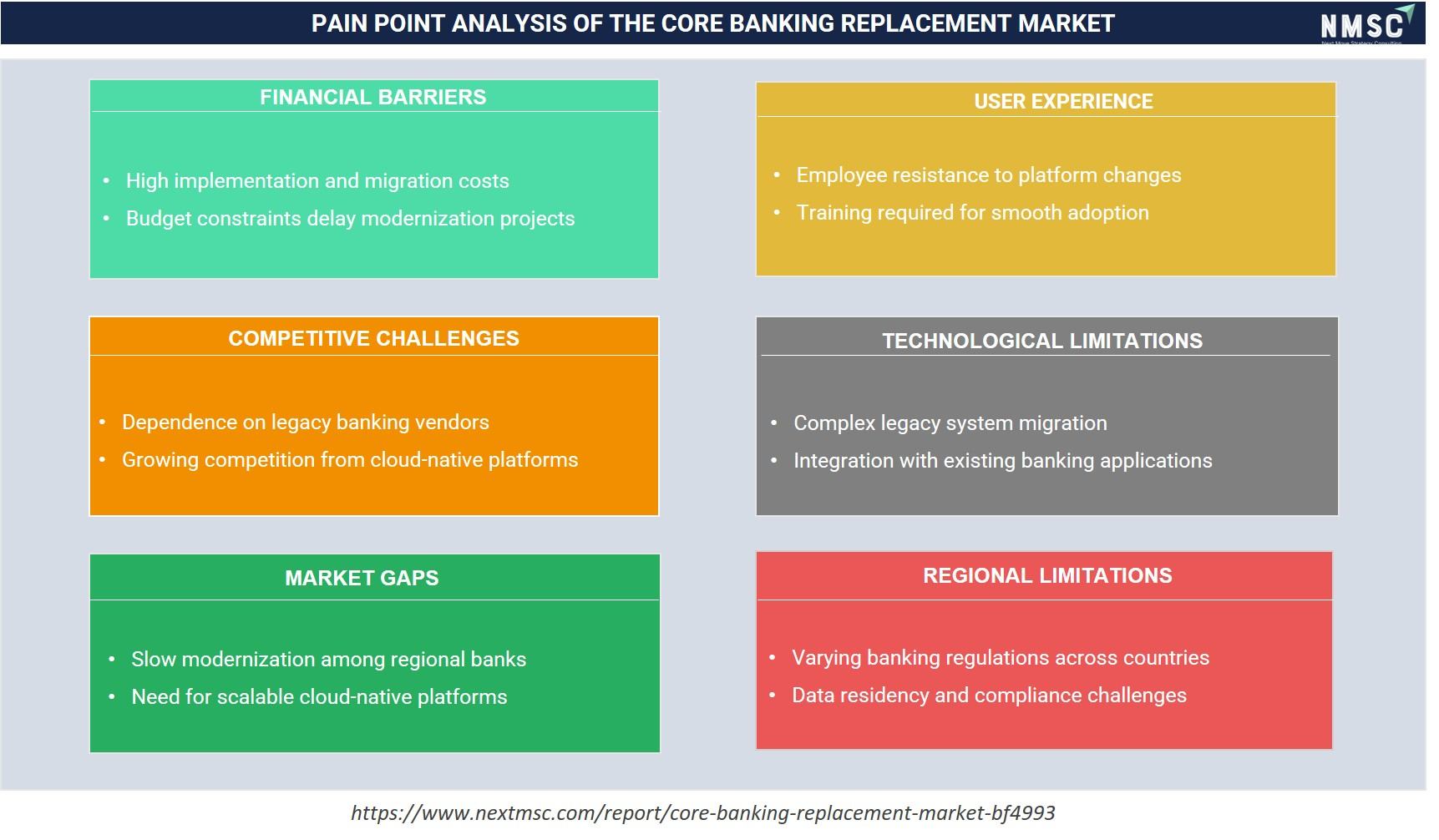
Based on our comprehensive assessment, we found that the Core Banking Replacement Market faces significant challenges related to migration costs, legacy system complexity, and organizational change management. Financial institutions must balance modernization goals with operational continuity and regulatory compliance. Our analysis indicates that cloud-native adoption gaps, integration difficulties, varying regional regulations, and employee training requirements continue to influence implementation timelines and success.
Competitive Landscape
Competitive Dynamics and M&A Landscape
|
Key Takeaways |
Details |
|
Market Structure |
The Core Banking Replacement industry is characterized by tiered competition among global platform vendors (Temenos, FIS, Fiserv, Oracle Financial Services), cloud-native challengers (Thought Machine, Mambu, 10x Banking), and regional specialists (Intellect Design, Azentio, Profile Software), each competing on platform architecture, regulatory coverage, and implementation ecosystem strength. |
|
Innovation Focus |
Innovation in the Core Banking Replacement Market is concentrated in API-first microservices architectures, SaaS delivery models, low-code product configuration capabilities, real-time processing engines, cloud-native multi-tenancy, and built-in regulatory compliance frameworks supporting ISO 20022, DORA, and PSD3 requirements. |
|
M&A Activity |
The Core Banking Replacement Market has experienced significant M&A activity including Finastra's ownership transition, FIS's ongoing portfolio optimization, and regional vendor consolidation across Asia-Pacific and MEA. Private equity investment in cloud-native core banking challengers is accelerating, with Mambu, Thought Machine, and 10x Banking receiving substantial growth capital rounds between 2021 and 2024. |
How Do Companies Compete in the Core Banking Replacement Market?
The Core Banking Replacement Market features multi-dimensional competition across platform architecture, regulatory coverage, geographic footprint, implementation ecosystem, and pricing flexibility. Global tier-one vendors including Temenos, FIS, Oracle Financial Services, and Fiserv compete on breadth of banking product coverage, global regulatory compliance libraries, and established implementation partner networks. Cloud-native challengers including Thought Machine, Mambu, and 10x Banking differentiate on architectural modernity, speed of deployment, and subscription-based commercial models that appeal to digital banks and innovation-focused incumbents. Regional specialists including Intellect Design Arena, Azentio, and Profile Software compete on domain expertise and regulatory depth in specific geographies.
Which Kind of Companies Dominate the Core Banking Replacement Market?
Three distinct categories of companies shape competitive dynamics in the Core Banking Replacement Market. First, global banking technology conglomerates including FIS, Fiserv, Oracle Financial Services, and Finastra dominate through broad product portfolios, established implementation ecosystems, and long-standing tier-one bank relationships. Second, cloud-native platform specialists including Thought Machine, Mambu, and 10x Banking are capturing the fastest-growing market segments by offering modern SaaS and API-first architectures. Third, regional and domain-specialist vendors including Intellect Design Arena, EdgeVerve, Avaloq, and Sopra Banking Software compete effectively in specific geographies or financial institution types, including Islamic banking and private banking segments.
AI-Native Differentiation and Open Standards Drive Market Success in the Core Banking Replacement Market
Innovation in the Core Banking Replacement Market increasingly centers on AI-native capabilities embedded within core banking platforms, including intelligent product configuration, automated regulatory reporting, AI-driven fraud detection at the core level, and machine learning-powered credit decisioning integrated directly with core lending modules. Open banking standard compatibility, including BIAN service domain frameworks, FHIR-like data standards for financial services, and native ISO 20022 messaging, is becoming a baseline competitive requirement rather than a differentiator. Vendors investing in developer-friendly API documentation, sandbox environments, and marketplace ecosystems for third-party module integration are gaining structural competitive advantages.
Market Players to Opt for Merger and Acquisition Strategies to Expand Their Presence in the Core Banking Replacement Market
Mergers and acquisitions are a primary competitive strategy in the Core Banking Replacement Market. FIS completed its acquisition of SunGard in 2015 and Worldpay in 2019, creating one of the world's largest financial technology groups before subsequently separating Worldpay in 2023. Finastra, formed from the merger of Misys and D+H in 2017, represents one of the largest purpose-built banking software M&A transactions. Private equity activity is intensifying, with Vista Equity Partners and other sponsors evaluating core banking software assets. Cloud-native challengers including Mambu and Thought Machine are positioned as potential acquisition targets for global banking technology platforms seeking architectural modernization of their portfolios.
Who Are the Key Market Players in the Core Banking Replacement Market?
-
Fidelity National Information Services, Inc.
-
Temenos AG
-
Fiserv, Inc.
-
Oracle Financial Services Software Limited
-
Jack Henry & Associates, Inc.
-
Finastra Group Holdings Limited
-
EdgeVerve Systems Limited
-
Tata Consultancy Services Limited
-
CGI Inc.
-
Sopra Banking Software
-
Intellect Design Arena Limited
-
Avaloq Group AG
-
Mambu B.V.
-
Thought Machine Group Limited
-
10x Banking Technology Limited
-
Nymbus, Inc.
-
Azentio Software Private Limited
-
Computer Services, Inc.
-
Profile Software S.A.
-
Stichting Administratiekantoor Ohpen
What Are the Latest Developments in the Core Banking Replacement Industry?
|
Date |
Event |
|
May 2026 |
Temenos AG announced that Reliance Bank (UK) has selected its SaaS-based core banking platform to replace legacy systems. The partnership emphasizes the trend of specialized ethical banks moving to cloud-native, pre-configured “Model Banks” to reduce customization risks and accelerate digital transformation. |
|
February 2026 |
Mambu B.V. announced a major expansion of its payments hub, responding to a sevenfold increase in processed payment volumes over the past year. By integrating direct connectivity to global clearing and settlement systems (such as SEPA STEP2), Mambu is enabling fintechs and challenger banks to bypass traditional “sponsor banks” and manage liquidity directly within their core stack. |
Expert Insights
 "2025 saw institutional experimentation across AI, partnerships and other modernization efforts and as banks – with technical debt and older core banking systems – progress to match their modern counterparts, 2026 will ramp up in speed."
— Will Moroney, Chief Revenue Officer, Temenos
Statement made while discussing how 2026 could become a year of accelerated implementation for core banking modernization, driven by increasing efforts to address technical debt and replace aging banking infrastructure.
Market Interpretation
The comment highlights the increasing urgency among financial institutions to modernize and replace legacy core banking systems. Banks are accelerating transformation initiatives to overcome technical debt, improve operational agility, and support evolving digital banking requirements. Modern core banking platforms enable real-time processing, enhanced integration capabilities, improved scalability, and greater flexibility for launching new products and services. As financial institutions seek to align with modern banking standards and customer expectations, investments in cloud-native and next-generation core banking solutions are increasing, supporting the growth of the Core Banking Replacement Market.
What Are the Investment Opportunities in the Core Banking Replacement Market?
Capital Inflows and Venture Activity
The Core Banking Replacement Market continues to attract substantial private capital, with cloud-native core banking challengers receiving significant venture and growth equity investment. Thought Machine has raised over USD 563 million in total funding from investors including Lloyds Banking Group, Visa, and JPMorgan Chase, validating commercial confidence in cloud-native core architectures. Mambu B.V. raised USD 235 million in Series E funding in 2021, reaching a valuation exceeding USD 5 billion. According to the National Venture Capital Association (NVCA), fintech infrastructure and core banking technology platforms represent a consistently high-priority investment category among financial technology-focused venture funds globally.
Infrastructure Investment
Core banking replacement programs represent among the largest single IT infrastructure investments undertaken by financial institutions, typically ranging from USD 50 million to over USD 1 billion for tier-one bank implementations (industry-derived estimate). Hyperscaler infrastructure investment in financial services cloud regions directly supports Core Banking Replacement Market growth. Microsoft's dedicated financial services cloud offering and AWS's banking and capital markets framework provide compliance-ready infrastructure for regulated core banking workloads. The European Investment Bank's support for digital transformation programs in EU member states further provides funding pathways for smaller banking institutions pursuing core replacement.
ESG and Sustainable Banking Infrastructure
Environmental, Social, and Governance considerations are increasingly influencing Core Banking Replacement investment decisions. Cloud-native SaaS cores, hosted on hyperscaler infrastructure with renewable energy commitments, offer lower energy consumption than bank-operated on-premise mainframe environments. Microsoft's commitment to carbon negativity by 2030 and AWS's The Climate Pledge targeting net-zero carbon by 2040 are directly relevant to bank sustainability reporting under TCFD and EU Taxonomy frameworks. Banks can cite core modernization to cloud infrastructure as contributing to Scope 2 emission reduction programs, creating alignment between technology investment and ESG reporting obligations.
Digital Transformation Enablement
Core banking replacement programs serve as the foundation for broader bank digital transformation initiatives, making them structurally integral to multi-year technology investment cycles. Banks that complete core replacement unlock the ability to launch embedded finance products, participate in open banking ecosystems, deploy AI-driven personalization, and integrate with real-time payment infrastructure without legacy system constraints. The World Bank Group's Financial Inclusion initiatives explicitly reference core banking modernization as a prerequisite for extending formal financial services to underserved populations, creating development finance investment rationale aligned with commercial Core Banking Replacement Market growth.
Private Equity and Strategic M&A Activity
Private equity investment in the Core Banking Replacement Market is intensifying as firms identify profitable platform-based software businesses with high switching costs, recurring subscription revenue, and long-term bank relationships. Vista Equity Partners and Thoma Bravo have historically been active acquirers of banking technology platforms. Strategic M&A is expected to accelerate as tier-one vendors seek to acquire cloud-native architecture capabilities and geographic coverage through targeted acquisitions of specialist platform vendors. Our assessment indicates that investors should monitor consolidation activity around Islamic banking core specialists, BaaS platform vendors, and AI-native banking infrastructure providers as high-value M&A targets in the 2025–2028 investment window.
Key Benefits for Stakeholders
For Enterprise Buyers (Financial Institutions)
Financial institutions gain comprehensive, vendor-neutral intelligence on the Core Banking Replacement Market trends, including quantitative sizing across all software categories, deployment models, buyer types, and project approaches. This intelligence supports platform selection, vendor evaluation, and multi-year technology investment planning. Our competitive landscape analysis enables procurement teams to benchmark vendor capabilities, architectural maturity, regulatory coverage, and commercial models across the full spectrum of global and regional core banking platform providers.
For Investors and Financial Analysts
Investors and financial analysts access a structured assessment of the Core Banking Replacement Market's growth trajectory, segment-level revenue forecasts through 2035, M&A activity pipeline, and competitive dynamics across twenty profiled companies. CAGR analysis by software type, services category, buyer type, deployment model, and geography enables precise market sizing and portfolio construction. Company profile intelligence combined with latest development tracking provides early-signal visibility on emerging leaders, acquisition targets, and at-risk incumbents across the global banking technology landscape.
For Core Banking Platform Vendors
Core banking platform vendors and software providers gain actionable intelligence on white-space opportunities, competitive positioning gaps, and fastest-growing market segments within the Core Banking Replacement Market. Segmentation analysis reveals underserved buyer categories including Islamic banks, microfinance institutions, and digital bank subsidiaries of incumbents. Regional outlook sections provide geographic expansion priority guidance with regulatory and market maturity context. Revenue stream and sales channel analysis enables vendors to optimize go-to-market strategy, pricing model evolution, and SI partner ecosystem development.
For Government and Regulatory Bodies
Government agencies and regulatory bodies gain structured analysis of how national payment system modernization mandates, open banking frameworks, operational resilience requirements, and digital banking licensing programs are influencing the Core Banking Replacement Market's structure and investment dynamics. Country-level insights provide policymakers with evidence-based perspectives on how regulatory design choices influence banking technology investment attraction, digital economy competitiveness, and financial inclusion program effectiveness across developed and developing market contexts.
Core Banking Replacement Market Key Segments
By Software
-
Full Core Platform
-
New Core Deployment
-
Core Replacement
-
-
Modular Core
-
Deposits
-
Lending
-
Payments
-
Treasury
-
General Ledger
-
Product Factory
-
APIs and Integration
-
Other Modules
-
By Services
-
Consulting
-
Implementation
-
Data Migration
-
Integration
-
Managed Services
-
Support and Training
By Buyer Type
-
Retail Bank
-
Commercial Bank
-
Universal Bank
-
Community Bank
-
Credit Union
-
Digital Bank
-
Private Bank
-
Islamic Bank
-
Microfinance Institution
-
Other Financial Institutions
By Deployment Model
-
SaaS
-
Public Cloud
-
Private Cloud
-
Hybrid
-
On-Premise
By Revenue Stream
-
Subscription
-
Perpetual License
-
Maintenance
-
Professional Services
-
Managed Services
-
Hosting
-
Usage Based
By Project Type
-
Big Bang Replacement
-
Phased Replacement
-
Replatforming
-
Core Consolidation
By Sales Channel
-
Direct
-
SI Partner
-
OEM
-
Marketplace
By Region
-
North America: U.S., Canada, Mexico
-
Europe: UK, Germany, France, Italy, Spain, Sweden, Denmark, Finland, Netherlands, Rest of Europe
-
Asia-Pacific: China, India, Japan, South Korea, Taiwan, Indonesia, Vietnam, Australia, Philippines, Malaysia, Rest of APAC
-
Middle East & Africa: Saudi Arabia, UAE, Egypt, Israel, Turkey, Nigeria, South Africa, Rest of MEA
-
Latin America: Brazil, Argentina, Chile, Colombia, Rest of LATAM
Conclusion and Recommendations
Long-Term Outlook
The Core Banking Replacement Market is entering a sustained decade-long expansion phase, driven by regulatory modernization mandates, intensifying competition from digital banking entrants, and the growing maturity of cloud-native SaaS core banking platforms. The market is forecast to grow from USD 12.8 billion in 2025 to USD 47.6 billion by 2035. We further analysed that this growth reflects structurally durable demand that remains largely independent of short-term economic cycles, as real-time payments participation, ISO 20022 migration, open banking readiness, and digital transformation requirements increasingly become mandatory strategic priorities for financial institutions globally.
Strategic Positioning Recommendations
Vendors operating in the Core Banking Replacement Market should prioritize differentiation across architectural modernization, regulatory compliance breadth, and commercial flexibility. Organizations that deliver cloud-native, API-first, and microservices-based platforms while supporting evolving regulatory frameworks such as ISO 20022, DORA, PSD3, and regional compliance mandates will strengthen their competitive position. Vendors should also expand system integrator partnerships, strengthen hyperscaler ecosystem relationships, and enhance marketplace presence to accelerate customer acquisition and implementation scalability across both developed and emerging banking markets.
Investment Attractiveness
The Core Banking Replacement Market represents a highly attractive investment environment supported by recurring software revenues, long implementation lifecycles, and mission-critical technology adoption. We assessed that the most attractive investment opportunities include cloud-native core banking platforms, Banking-as-a-Service infrastructure providers, digital banking enablement platforms, and specialized vendors focused on Islamic banking and microfinance institutions. Investors should prioritize businesses demonstrating strong subscription revenue growth, low customer attrition, expanding partner ecosystems, and proven success in large-scale modernization projects. Strategic acquirers should evaluate cloud-native banking technology providers as both architectural modernization assets and geographic expansion vehicles.
Market Shifts and Key Risks
The most significant market shift underway is the migration from monolithic legacy core banking systems toward modular, cloud-native, API-driven banking architectures. This transition increasingly benefits vendors capable of supporting composable banking models and rapid product innovation. Key risks for the Core Banking Replacement Market include implementation failure risk associated with large-scale transformation programs, complex legacy data migration requirements, integration challenges across heterogeneous banking environments, and regulatory divergence across jurisdictions. Market participants should closely monitor consolidation activity, hyperscaler partnership developments, evolving open banking standards, and regulatory modernization initiatives as leading indicators of competitive market shifts.
Growth Pathways
Organizations seeking to maximize value within the Core Banking Replacement Market should adopt a phased modernization strategy. In the near term (2025–2027), financial institutions should focus on API enablement, regulatory modernization readiness, and digital channel integration. In the mid-term (2027–2031), banks should expand cloud-native core deployments, product factory modernization, and real-time banking capabilities to improve operational agility. In the long term (2031–2035), institutions should position for AI-driven banking operations, embedded finance ecosystems, and fully composable banking architectures. Asia-Pacific represents the strongest regional growth pathway due to regulatory modernization programs, expanding digital banking ecosystems, and large underpenetrated banking populations, while the Middle East and Africa offer high-growth opportunities supported by Islamic banking expansion and government-led digital transformation initiatives. North America and Europe are expected to generate the highest absolute revenue growth through large-scale tier-one banking modernization programs and ongoing compliance-driven technology investments.
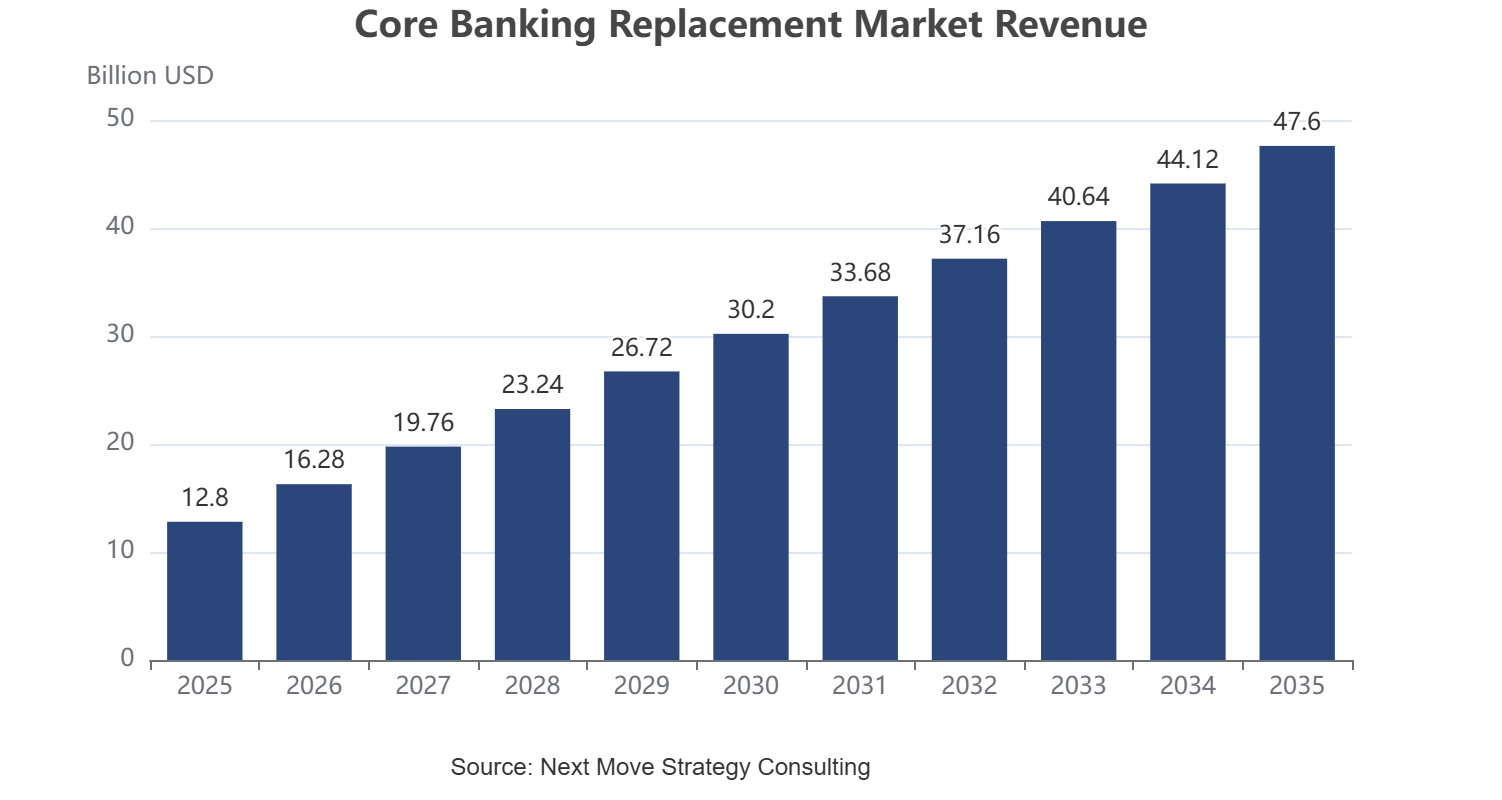
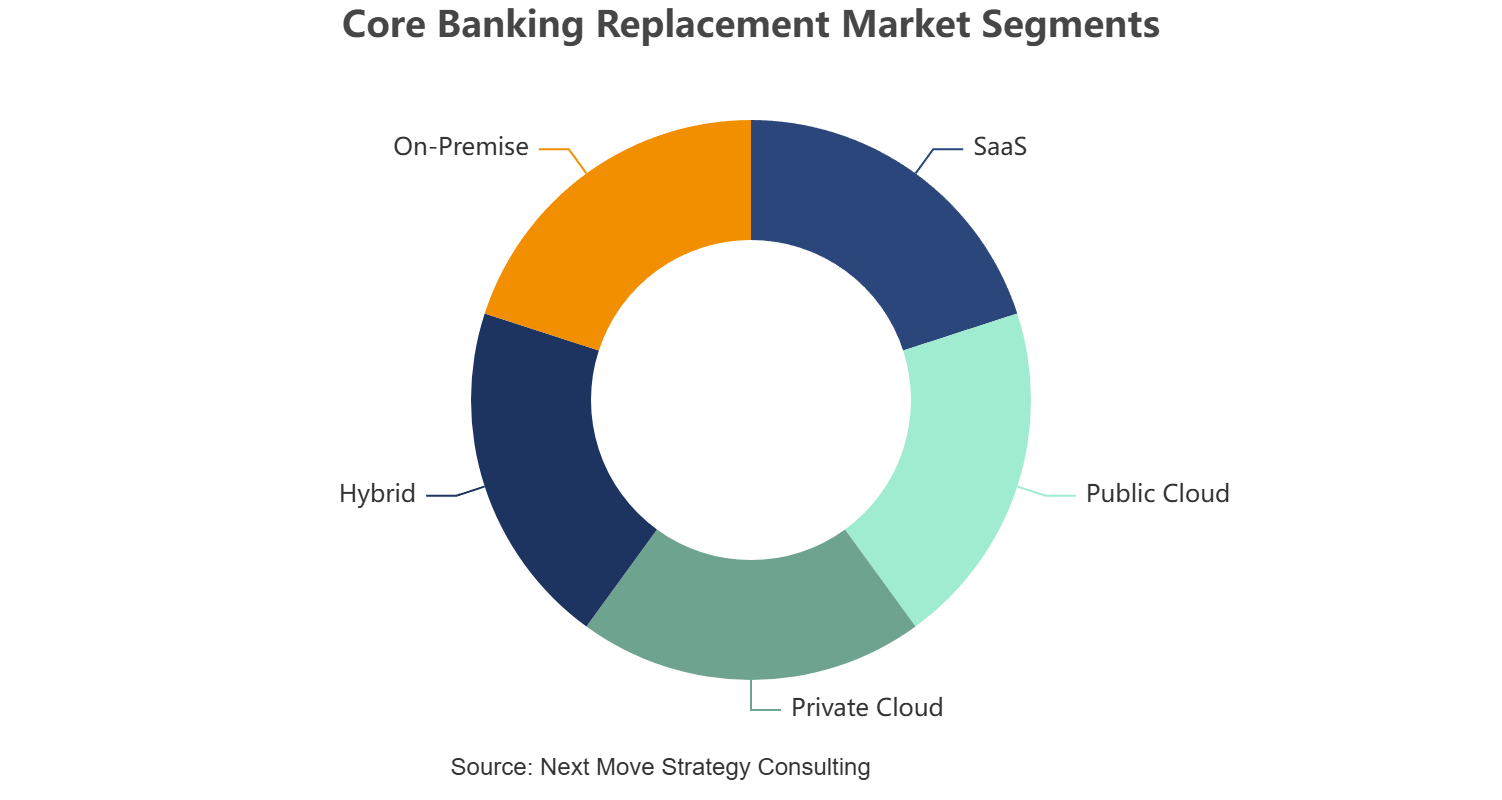
About the Author
 Saista Faiyaz
— Saista Faiyaz is Research Associate at Next Move Strategy Consulting, where she has covered consumer markets and healthcare technologies for 3 years. Her work includes primary interview review, secondary-source validation, market sizing, and structured analysis of company and industry data. She supports research by comparing evidence across sources, organizing findings into market narratives, and documenting assumptions used in analysis. Her scope includes cross-market benchmarking, and reports.
Saista Faiyaz
— Saista Faiyaz is Research Associate at Next Move Strategy Consulting, where she has covered consumer markets and healthcare technologies for 3 years. Her work includes primary interview review, secondary-source validation, market sizing, and structured analysis of company and industry data. She supports research by comparing evidence across sources, organizing findings into market narratives, and documenting assumptions used in analysis. Her scope includes cross-market benchmarking, and reports.
About the Reviewer
 Supradip Baul
— Supradip Baul is an accomplished business consultant and strategist with over a decade of rich experience in market intelligence, strategy, technology, and business transformation. His work has included rigorous qualitative and quantitative analysis across multiple industries, helping clients shape investment decisions and long-term roadmaps. Earlier in his career, he was associated with Gartner, where he contributed to industry-leading reports and market share analyses. He has worked with leading global companies and holds an MBA with a dual specialization in Marketing and Finance.
Supradip Baul
— Supradip Baul is an accomplished business consultant and strategist with over a decade of rich experience in market intelligence, strategy, technology, and business transformation. His work has included rigorous qualitative and quantitative analysis across multiple industries, helping clients shape investment decisions and long-term roadmaps. Earlier in his career, he was associated with Gartner, where he contributed to industry-leading reports and market share analyses. He has worked with leading global companies and holds an MBA with a dual specialization in Marketing and Finance.
At Next Move Strategy Consulting, we understand that insightful market research is the cornerstone of successful business decisions. That's why we employ a robust and multifaceted approach, combining various methodologies to deliver the most accurate and actionable data for our clients.

Research Landscape
We navigate the world of research with two primary approaches:
Qualitative Approach
Our qualitative research methodologies involve immersive techniques such as in-depth interviews, focus groups, and observational studies. By engaging directly with individuals and stakeholders, we uncover valuable insights that quantitative data alone may overlook.

Quantitative Research
In tandem with qualitative methodologies, NMSC leverages the power of Quantitative Research to provide a robust foundation of numerical insights. Through systematic data collection and analysis, we quantify patterns, preferences, and market trends, offering a comprehensive view of the business landscape.
Our quantitative research approach employs diverse tools, including surveys, experiments, and statistical modelling. These methodologies enable us to gather data from a large and representative sample, ensuring the statistical significance of our findings. By employing structured questionnaires and standardized data collection methods, we guarantee the reliability and validity of the information we present to our clients.
Quantitative research is particularly effective in measuring the prevalence of trends, assessing market size, and gauging the impact of various factors on consumer behavior. The numerical precision attained through this approach equips our clients with actionable insights, facilitating data-driven decision-making and strategy formulation.


Our Specialized Toolbox for Industry-Specific Market Research
We deploy a specialized arsenal of techniques tailored to meet your unique requirements. Here's a glimpse into our comprehensive toolbox:

Information Procurement
The stage entails acquiring market data or relevant information through various sources and methodologies.


Market Research Approach
We utilize both top-down and bottom-up approaches in market research analysis to achieve a comprehensive understanding of the market dynamics, leveraging the broad perspective of industry trends and macroeconomic factors alongside detailed insights from specific segments and individual companies.

Porters Five Forces Analysis
We conduct Porter's Five Forces analysis to evaluate the competitive landscape of an industry, providing us with insights into factors that affect profitability and strategic positioning.

SWOT Analysis

Forecasting
We utilize a forecasting model to predict future consumption by considering parameters like population, economics, regulations, market competition, drivers, constraints, technology, and pricing. We also employ statistical techniques such as multilinear regression, exponential smoothing, moving average, ARIMA, and Monte Carlo simulations for accurate predictions. In econometric forecasting, we analyzed short-term and long-term event impacts, attributing values based on regulatory frameworks, economic factors, and market events.





 Speak to Our Analyst