Blockchain-Based SCM Solutions Market Size, Share, Trends and Growth Analysis, By Solution Type (Blockchain SCM Platforms, Blockchain SCM Applications, and Blockchain SCM Implementation and Services), By Deployment Model (Cloud-Based, On-Premise, and Hybrid), By Blockchain Architecture (Permissioned, Public, and Hybrid), By Supply Chain Function, By End User (Manufacturing, Food and Agriculture, and Other Industries), and Region — Global Industry Report and Forecast, 2026–2035
Industry: ICT & Media | Publishing Date: July 27, 2026 | Last Updated: September 30, 2026 | No of Pages: N/A | No. of Tables: N/A | No. of Figures: N/A | Format: PDF | Report Code: IC5423
What Is the Blockchain-Based SCM Solutions Market Size?
The global blockchain-based SCM solutions market size was valued at USD 2.85 billion in 2025 and is estimated at USD 3.62 billion in 2026, forecast to reach USD 38.40 billion by 2035, expanding at a 30.0% CAGR between 2026 and 2035. North America leads with approximately 38% share, while blockchain SCM applications dominate all other solution types with approximately 46% share.
We observed that the growth is broad-based across every segmentation axis, with traceability-driven applications and permissioned enterprise architectures driving the dominant structural shifts through 2035.
|
Key Takeaways |
|
By Solution Type: Blockchain SCM Applications held the largest share of approximately 46% (USD 1.30 Billion) in 2025; Blockchain SCM Platforms is the fastest-growing sub-segment at 31.3% CAGR from 2026–2035. |
|
By Deployment Model: Cloud-Based Blockchain SCM held the largest share of approximately 58% (USD 1.65 Billion) in 2025; Hybrid Blockchain SCM is the fastest-growing sub-segment at 32.7% CAGR from 2026–2035. |
|
By Blockchain Architecture: Permissioned Blockchain held the largest share of approximately 68% (USD 1.95 Billion) in 2025; Public Blockchain is the fastest-growing sub-segment at 33.3% CAGR from 2026–2035. |
|
By Supply Chain Function: Supply Chain Visibility held the largest share of approximately 20% (USD 0.58 Billion) in 2025; Digital Product Passport Management is the fastest-growing sub-segment at 37.2% CAGR from 2026–2035. |
|
By End User: Manufacturing held the largest share of approximately 22% (USD 0.62 Billion) in 2025; Food and Agriculture is the fastest-growing sub-segment at 31.4% CAGR from 2026–2035. |
|
Dominant Region: North America dominated with approximately 38% revenue share (USD 1.08 Billion) in 2025. |
|
Fastest-Growing Region: Asia-Pacific is expected to register the highest CAGR of 33.8% during 2026–2035. |
|
Dominant Country: U.S. led with approximately USD 0.92 Billion in 2025. |
|
Fastest-Growing Country: India is the fastest-growing country at approximately 35.4% CAGR from 2026–2035. |
Market Opportunity: The blockchain-based SCM solutions market is expected to create an absolute dollar opportunity of USD 34.78 billion between 2026 and 2035, presenting significant investment potential across the manufacturing, food and agriculture, healthcare, retail, and logistics traceability value chain.
According to Next Move Strategy Consulting analysis, enterprises are increasingly consolidating blockchain SCM investment around permissioned, interoperable platforms that integrate with existing enterprise resource planning systems, a shift that favors established enterprise software vendors over single-purpose blockchain startups as procurement scrutiny intensifies through 2035.
What Does the Blockchain-Based SCM Solutions Market Encompass?
The blockchain-based SCM solutions market encompasses distributed-ledger platforms, applications, and implementation services that create tamper-evident, shared records of transactions, shipments, and product provenance across multi-party supply chains. Our assessment indicates that the scope spans enterprise blockchain infrastructure, traceability and provenance applications, procurement and supplier management tools, and consulting and integration services delivered to manufacturers, retailers, logistics providers, and regulators. The category has evolved from experimental pilots into production-grade infrastructure, driven by rising demand for supply chain visibility, counterfeit prevention, and verifiable sustainability claims across global trade networks.
Regulatory frameworks such as the European Union's proposed Digital Product Passport requirements under the Ecodesign for Sustainable Products Regulation and the U.S. Food and Drug Administration's Drug Supply Chain Security Act shape traceability and serialization requirements, while national digital trade initiatives increasingly influence blockchain adoption timelines. We observed that technology adoption is shifting toward interoperable, cloud-hosted permissioned networks that integrate smart contracts with Internet of Things sensor data to automate compliance. Next Move Strategy Consulting's analysis indicates that this structural shift, combined with growing cross-border trade digitization mandates, is redefining sourcing criteria across the blockchain-based SCM solutions market.
|
Parameters |
Details |
|
Market Size in 2025 |
USD 2.85 Billion |
|
Market Size in 2026 |
USD 3.62 Billion |
|
Revenue Forecast in 2035 |
USD 38.40 Billion |
|
Growth Rate |
CAGR of 30.0% from 2026 to 2035 |
|
Analysis Period |
2025–2035 |
|
Base Year Considered |
2025 |
|
Forecast Period |
2026–2035 |
|
Market Size Estimation |
Revenue (USD Billion) |
|
Companies Profiled |
20 |
|
Countries Covered |
33 |
|
Market Share |
Available for Top 10 Companies |
Key Emerging Trends
Next Move Strategy Consulting's analysis indicates that four structural trends are reshaping how enterprises deploy distributed-ledger infrastructure across global supply chains.
How Is Digital Product Passport Adoption Transforming Compliance?
Digital product passport mandates are transforming compliance from a periodic reporting exercise into a continuous, ledger-based data obligation. We found that manufacturers and brand owners are embedding blockchain-anchored identifiers into products to record material composition, origin, and repairability data. This shift affects raw-material suppliers, contract manufacturers, and retailers who must now capture verifiable data at each handoff. The European Commission's Ecodesign for Sustainable Products Regulation is a named example driving early digital product passport pilots across textile and battery supply chains.
How Is Smart Contract Automation Changing Trade Settlement?
Smart contract automation is changing trade settlement by replacing manual reconciliation with self-executing agreements triggered by verified shipment or inspection events. Our findings suggest that banks, freight forwarders, and buyers are adopting smart contracts to compress payment cycles and reduce documentary disputes. This transformation affects trade finance providers and logistics intermediaries whose manual processes are being disintermediated. R3's Corda-based trade finance networks illustrate how consortium platforms are operationalizing automated settlement among competing banks.
How Is Enterprise Blockchain Interoperability Reshaping Vendor Selection?
Enterprise blockchain interoperability is reshaping vendor selection as buyers increasingly require platforms that connect across Hyperledger, Corda, and Ethereum-based enterprise networks rather than committing to a single closed ecosystem. We observed that this affects platform vendors, system integrators, and enterprise IT buyers who must now evaluate cross-chain bridging capability alongside core functionality. IBM Food Trust's interoperability extensions with other traceability networks exemplify this movement toward federated rather than siloed blockchain infrastructure.
How Is IoT-Blockchain Convergence Expanding Real-Time Traceability?
IoT-blockchain convergence is expanding real-time traceability by anchoring sensor-generated temperature, location, and condition data directly onto distributed ledgers at the point of capture. Based on research conducted by Next Move Strategy Consulting, we found that this convergence affects cold-chain logistics providers, pharmaceutical distributors, and perishable-goods exporters seeking immutable proof of handling conditions. VeChain's partnerships with cold-chain and luxury goods brands demonstrate how sensor-linked ledgers are becoming standard practice for high-value, condition-sensitive shipments.
Ecosystem Analysis of the Blockchain-Based SCM Solutions Market
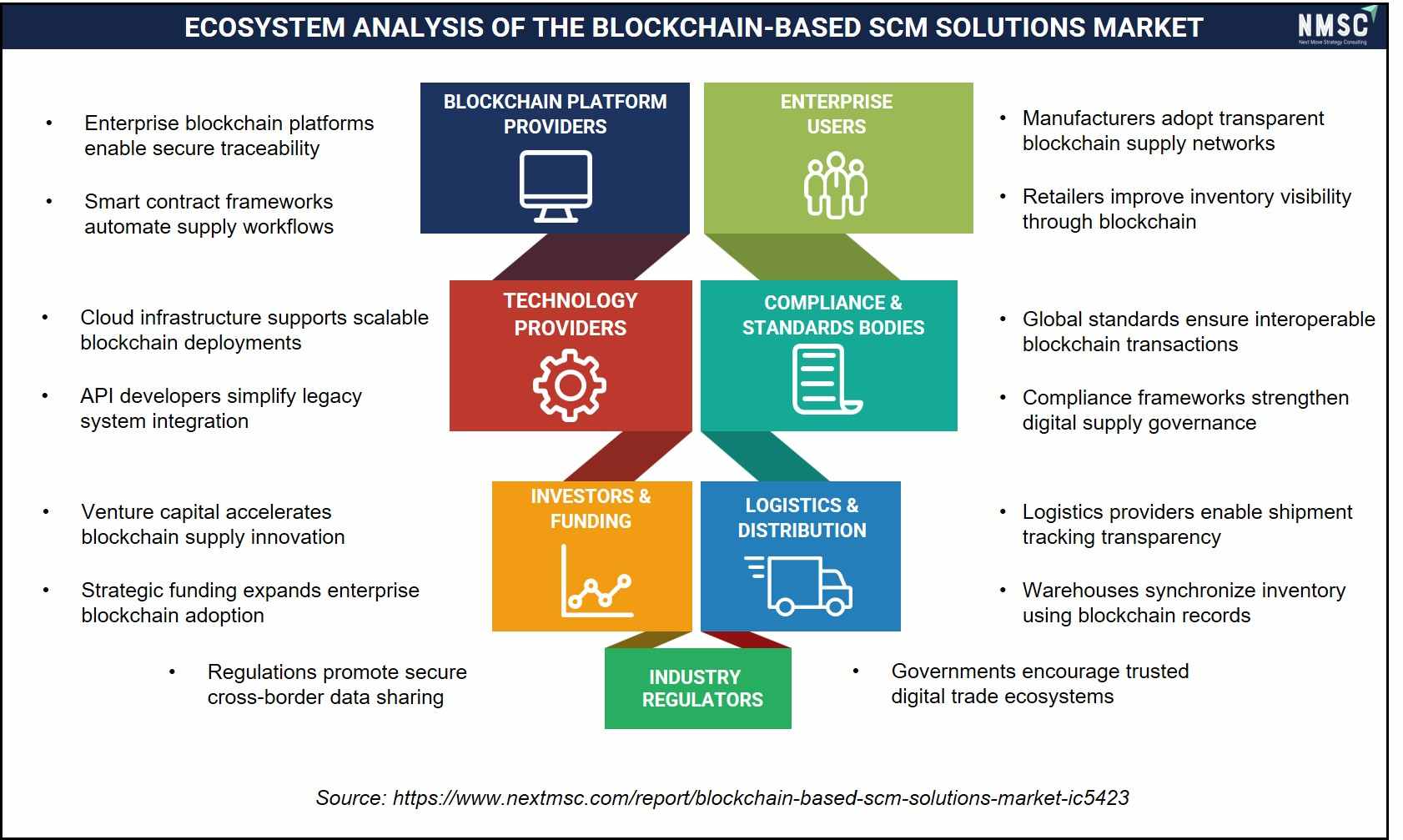
Our analysis indicates that the Blockchain-Based SCM Solutions Market ecosystem comprises blockchain platform providers, technology providers, enterprise users, compliance and standards bodies, logistics and distribution partners, investors, and industry regulators collaborating to enhance supply chain transparency and efficiency. Blockchain platform providers develop decentralized infrastructure, while technology providers enable system integration, smart contracts, and analytics capabilities. Enterprise users adopt blockchain to improve traceability and operational performance, supported by logistics partners that facilitate connected supply chain operations. Investors accelerate innovation and commercialization, whereas regulators and standards organizations establish governance frameworks that promote secure, compliant, and interoperable blockchain-enabled supply chain ecosystems.
Growth Drivers & Restraints
|
Factors |
Type |
(+/−) % Impact on CAGR |
Geographic Relevance |
Impact Timeline |
|
Rising counterfeit and provenance fraud losses |
Driver |
+3.8% |
Global |
2026–2035 |
|
EU Digital Product Passport regulatory mandate |
Driver |
+3.2% |
Europe |
2026–2032 |
|
Growing enterprise cloud infrastructure investment |
Driver |
+2.9% |
Global |
2026–2035 |
|
Rising adoption of smart contract-based trade finance |
Driver |
+2.6% |
North America, Asia-Pacific |
2026–2035 |
|
Expanding cold-chain and pharmaceutical traceability needs |
Driver |
+2.1% |
Global |
2026–2035 |
|
High implementation and integration cost for legacy ERP systems |
Restraint |
−2.4% |
Global |
2026–2033 |
|
Limited blockchain interoperability across enterprise networks |
Restraint |
−1.8% |
Global |
2026–2031 |
|
Data privacy and cross-border data localization requirements |
Restraint |
−1.5% |
Europe, Asia-Pacific |
2026–2035 |
|
Shortage of blockchain-skilled supply chain talent |
Restraint |
−1.2% |
Global |
2026–2030 |
What Is the Primary Growth Driver?
The primary growth driver is escalating counterfeit and provenance fraud exposure across global trade. The Organisation for Economic Co-operation and Development estimates that trade in counterfeit and pirated goods reaches hundreds of billions of dollars annually, a scale that pushes brand owners toward verifiable, tamper-evident ledger records. This dynamic is prompting manufacturers across pharmaceuticals, luxury goods, and electronics to adopt blockchain-based provenance tracking as a defensive procurement requirement rather than an optional enhancement.
How Is Regulatory Digitization Driving Market Growth?
Regulatory digitization is driving market growth as governments mandate electronic, verifiable trade and product documentation. The U.S. Food and Drug Administration's Drug Supply Chain Security Act require interoperable, electronic tracing of prescription drugs at the package level by 2027, a named regulatory catalyst compelling pharmaceutical distributor to deploy blockchain-anchored serialization. Similar digitization mandates across customs and food-safety agencies are compounding demand for standardized, ledger-based compliance infrastructure.
What Is Restraining the Blockchain-Based SCM Solutions Market?
High implementation and integration cost is restraining market growth, particularly for mid-sized manufacturers operating legacy enterprise resource planning systems. Our analysis shows that integration projects connecting blockchain ledgers to existing warehouse and procurement systems often require extended multi-quarter deployment timelines, delaying return on investment. This cost barrier disproportionately affects small and mid-sized suppliers, slowing adoption depth even where large enterprise buyers mandate ledger-based participation across their supplier networks.
Segmentation Analysis
Segment Sizing: By Solution Type
|
Segment |
2025 (USD) |
2035 (USD) |
CAGR% (2026–2035) |
|
Blockchain SCM Applications |
1.30 Billion |
16.80 Billion |
29.4% |
|
Blockchain SCM Platforms |
0.98 Billion |
14.50 Billion |
31.3% |
|
Blockchain SCM Implementation and Services |
0.57 Billion |
7.10 Billion |
29.0% |
|
Total |
2.85 Billion |
38.40 Billion |
30.0% |
Which Solution Type Dominates the Market?
Blockchain SCM applications dominate the market with approximately 46% share in 2025, supported by widespread deployment of traceability, logistics, and procurement applications across manufacturing and retail buyers. We observed that blockchain SCM platforms are the fastest-growing solution type at a 31.3% CAGR, as enterprises increasingly invest in foundational enterprise blockchain and supply chain network infrastructure that can host multiple applications, reflecting a shift from point solutions toward reusable platform architecture across large multinational supply chains.
Segment Sizing: By Deployment Model
|
Segment |
2025 (USD) |
2035 (USD) |
CAGR% (2026–2035) |
|
Cloud-Based Blockchain SCM |
1.65 Billion |
22.60 Billion |
30.2% |
|
Hybrid Blockchain SCM |
0.71 Billion |
11.50 Billion |
32.7% |
|
On-Premise Blockchain SCM |
0.49 Billion |
4.30 Billion |
24.0% |
|
Total |
2.85 Billion |
38.40 Billion |
30.0% |
Which Deployment Model Dominates the Market?
Cloud-based blockchain SCM deployment dominates with approximately 58% share in 2025, as enterprises favor managed cloud infrastructure over capital-intensive on-premise nodes for faster onboarding of trading partners. Our findings suggest that hybrid blockchain SCM deployment is the fastest-growing model at a 32.7% CAGR, driven by large manufacturers that combine on-premise data sovereignty for sensitive records with cloud-hosted consortium participation, a configuration increasingly favored by regulated industries such as pharmaceuticals and defense manufacturing.
Segment Sizing: By End User
|
Segment |
2025 (USD) |
2035 (USD) |
CAGR% (2026–2035) |
|
Manufacturing |
0.62 Billion |
7.90 Billion |
29.2% |
|
Food and Agriculture |
0.51 Billion |
7.60 Billion |
31.4% |
|
Healthcare and Pharmaceuticals |
0.47 Billion |
6.30 Billion |
29.9% |
|
Retail and Consumer Goods |
0.40 Billion |
5.40 Billion |
30.0% |
|
Logistics and Transportation |
0.38 Billion |
5.10 Billion |
30.0% |
|
Energy and Utilities |
0.19 Billion |
2.60 Billion |
30.3% |
|
Mining and Metals |
0.11 Billion |
1.50 Billion |
30.2% |
|
Government and Public Sector |
0.10 Billion |
1.20 Billion |
28.0% |
|
Other Industries |
0.07 Billion |
0.80 Billion |
27.5% |
|
Total |
2.85 Billion |
38.40 Billion |
30.0% |
Which End User Segment Dominates the Market?
Manufacturing dominates end-user demand with approximately 22% share in 2025, reflecting extensive adoption across automotive, aerospace, and electronics supply chains seeking supplier verification and component traceability. Next Move Strategy Consulting's analysis indicates that food and agriculture is the fastest-growing end-user segment at a 31.4% CAGR, propelled by farm-to-shelf traceability requirements, export certification needs, and consumer demand for verifiable sourcing claims that are pushing food processors and agricultural exporters toward ledger-based provenance systems at an accelerating pace through 2035.
Growth Opportunities
Next Move Strategy Consulting identifies three whitespace opportunities positioned to unlock incremental blockchain-based SCM solutions market revenue through 2035.
What Opportunity Does Tokenized Trade Finance Present?
Tokenized trade finance presents an opportunity for banks and non-bank lenders to extend automated, smart contract-triggered financing against verified shipment milestones. This mechanism benefits small and mid-sized exporters that currently face limited access to traditional letters of credit, unlocking working capital tied to real-time, ledger-verified proof of goods movement rather than paper documentation cycles.
What Opportunity Does Digital Product Passport Infrastructure Present?
Digital product passport infrastructure presents an opportunity for platform vendors to build compliance-as-a-service offerings for regulated product categories. This mechanism benefits textile, battery, and electronics manufacturers that must satisfy emerging European traceability mandates, creating recurring revenue for vendors who can standardize passport data capture across fragmented multi-tier supplier networks.
What Opportunity Does Cold-Chain Sensor Integration Present?
Cold-chain sensor integration presents an opportunity for logistics technology providers to combine Internet of Things monitoring with immutable ledger records for temperature-sensitive shipments. This mechanism benefits pharmaceutical distributors and perishable-food exporters, who gain defensible, auditable proof of handling conditions that reduces insurance disputes and satisfies increasingly stringent import inspection requirements.
Regional Outlook
|
Region |
2025 (USD) |
2035 (USD) |
CAGR% (2026–2035) |
Key Driver |
|
North America |
1.08 Billion |
12.90 Billion |
28.3% |
Enterprise blockchain infrastructure investment |
|
Europe |
0.74 Billion |
8.60 Billion |
27.9% |
Digital Product Passport regulation |
|
Asia-Pacific |
0.77 Billion |
13.50 Billion |
33.8% |
Manufacturing digitization |
|
Middle East & Africa |
0.15 Billion |
2.10 Billion |
30.6% |
Trade finance modernization |
|
Latin America |
0.11 Billion |
1.30 Billion |
28.1% |
Agricultural export traceability |
|
Total |
2.85 Billion |
38.40 Billion |
30.0% |
|
North America Blockchain-Based SCM Solutions Market
North America leads the global market with mature enterprise blockchain adoption across manufacturing and retail supply chains. We observed that established regulatory clarity around digital trade documentation, combined with strong venture investment in enterprise blockchain vendors, supports sustained platform upgrades. Strategic outlook favors continued consolidation among established software vendors expanding blockchain modules into existing enterprise resource planning suites through 2035.
Europe Blockchain-Based SCM Solutions Market
Europe's market maturity is shaped directly by the region's evolving Digital Product Passport regulatory framework, which is compelling manufacturers to adopt standardized traceability infrastructure ahead of mandatory compliance deadlines. Our assessment indicates that technology adoption is concentrated among automotive, textile, and battery manufacturers. Strategic outlook favors vendors offering pre-built compliance templates aligned with European Commission ecodesign requirements.
Asia-Pacific Blockchain-Based SCM Solutions Market
Asia-Pacific is the fastest-growing region, driven by rapid manufacturing digitization and expanding cross-border e-commerce trade volumes requiring verifiable origin documentation. We found that regulatory influence varies significantly by country, with government-led blockchain pilot programs accelerating adoption in several markets. Strategic outlook favors platform vendors that can localize deployment across fragmented regulatory and language environments.
Middle East & Africa Blockchain-Based SCM Solutions Market
The Middle East and Africa market is shaped by national trade digitization initiatives and growing non-oil economic diversification strategies that prioritize logistics modernization. Our analysis shows that adoption remains concentrated among large port operators and government-linked trade entities. Strategic outlook favors consortium-based platforms that connect customs authorities with private logistics operators across regional free trade zones.
Latin America Blockchain-Based SCM Solutions Market
Latin America's market is shaped by agricultural export economies seeking verifiable sustainability and origin certification to meet importing-country requirements. We observed that technology adoption is concentrated among large agribusiness exporters rather than small producers. Strategic outlook favors platforms offering low-cost mobile data capture tools that extend traceability to smallholder-linked supply chains across the region.
U.S. Blockchain-Based SCM Solutions Market
Based on our estimates, the U.S. blockchain-based SCM solutions market was valued at approximately USD 0.92 Billion in 2025 and is projected to reach approximately USD 10.60 Billion by 2035, expanding at a CAGR of 27.8% from 2026 to 2035. The demand structure led by pharmaceutical serialization and defense-manufacturing supplier verification, with high adoption and dense competitive intensity among enterprise vendors. Strategic outlook favors vendors offering compliance-ready, interoperable deployments tailored to local regulatory and trade documentation requirements.
Canada Blockchain-Based SCM Solutions Market
The Canada blockchain-based SCM solutions market was valued at approximately USD 0.16 Billion in 2025 and is projected to reach approximately USD 2.30 Billion by 2035, expanding at a CAGR of 30.9% from 2026 to 2035. The demand structure anchored in mining and agri-food export traceability, with moderate adoption and expanding regulatory alignment with U.S. trade documentation standards. Strategic outlook favors vendors offering compliance-ready, interoperable deployments tailored to local regulatory and trade documentation requirements.
UK Blockchain-Based SCM Solutions Market
As per our estimate, the UK blockchain-based SCM solutions market was valued at approximately USD 0.24 Billion in 2025 and is projected to reach approximately USD 2.70 Billion by 2035, expanding at a CAGR of 27.4% from 2026 to 2035. The demand structure shaped by post-Brexit customs documentation needs, with growing adoption among retail and pharmaceutical distributors under evolving regulatory guidance. Strategic outlook favors vendors offering compliance-ready, interoperable deployments tailored to local regulatory and trade documentation requirements.
Germany Blockchain-Based SCM Solutions Market
According to our analysis, the Germany blockchain-based SCM solutions market was valued at approximately USD 0.21 Billion in 2025 and is projected to reach approximately USD 2.40 Billion by 2035, expanding at a CAGR of 27.7% from 2026 to 2035. The demand structure led by automotive and industrial equipment supplier verification, with high technology penetration among Mittelstand manufacturers under strict Digital Product Passport regulatory influence. Strategic outlook favors vendors offering compliance-ready, interoperable deployments tailored to local regulatory and trade documentation requirements.
France Blockchain-Based SCM Solutions Market
Based on our estimates, the France blockchain-based SCM solutions market was valued at approximately USD 0.15 Billion in 2025 and is projected to reach approximately USD 1.70 Billion by 2035, expanding at a CAGR of 27.5% from 2026 to 2035. The demand structure concentrated in luxury goods provenance and aerospace supplier compliance, with moderate adoption and growing regulatory alignment to European Union traceability mandates. Strategic outlook favors vendors offering compliance-ready, interoperable deployments tailored to local regulatory and trade documentation requirements.
China Blockchain-Based SCM Solutions Market
The China blockchain-based SCM solutions market was valued at approximately USD 0.29 Billion in 2025 and is projected to reach approximately USD 5.60 Billion by 2035, expanding at a CAGR of 35.3% from 2026 to 2035. The demand structure driven by electronics and manufacturing export traceability, with rapid technology penetration supported by government-backed blockchain infrastructure initiatives and intense domestic vendor competition. Strategic outlook favors vendors offering compliance-ready, interoperable deployments tailored to local regulatory and trade documentation requirements.
India Blockchain-Based SCM Solutions Market
As per our estimate, the India blockchain-based SCM solutions market was valued at approximately USD 0.17 Billion in 2025 and is projected to reach approximately USD 3.30 Billion by 2035, expanding at a CAGR of 35.4% from 2026 to 2035. The demand structure led by pharmaceutical export serialization and textile traceability, with accelerating adoption supported by expanding digital trade infrastructure and growing regulatory emphasis on export documentation. Strategic outlook favors vendors offering compliance-ready, interoperable deployments tailored to local regulatory and trade documentation requirements.
Japan Blockchain-Based SCM Solutions Market
According to our analysis, the Japan blockchain-based SCM solutions market was valued at approximately USD 0.13 Billion in 2025 and is projected to reach approximately USD 1.90 Billion by 2035, expanding at a CAGR of 31.2% from 2026 to 2035. The demand structure anchored in automotive and electronics component traceability, with high technology penetration among established manufacturers and cautious regulatory oversight of data-sharing consortium. Strategic outlook favors vendors offering compliance-ready, interoperable deployments tailored to local regulatory and trade documentation requirements.
South Korea Blockchain-Based SCM Solutions Market
Based on our estimates, the South Korea blockchain-based SCM solutions market was valued at approximately USD 0.09 Billion in 2025 and is projected to reach approximately USD 1.30 Billion by 2035, expanding at a CAGR of 31.0% from 2026 to 2035. The demand structure shaped by semiconductor and electronics supply chain verification, with strong technology penetration and growing government support for blockchain trade infrastructure. Strategic outlook favors vendors offering compliance-ready, interoperable deployments tailored to local regulatory and trade documentation requirements.
Australia Blockchain-Based SCM Solutions Market
The Australia blockchain-based SCM solutions market was valued at approximately USD 0.06 Billion in 2025 and is projected to reach approximately USD 0.85 Billion by 2035, expanding at a CAGR of 30.7% from 2026 to 2035. The demand structure led by agricultural export certification and mining provenance, with moderate adoption and increasing regulatory focus on sustainability disclosure requirements. Strategic outlook favors vendors offering compliance-ready, interoperable deployments tailored to local regulatory and trade documentation requirements.
UAE Blockchain-Based SCM Solutions Market
As per our estimate, the UAE blockchain-based SCM solutions market was valued at approximately USD 0.05 Billion in 2025 and is projected to reach approximately USD 0.75 Billion by 2035, expanding at a CAGR of 31.6% from 2026 to 2035. The demand structure driven by free-zone trade logistics and re-export documentation, with growing adoption supported by government-led trade digitization programs and strong regional competitive intensity. Strategic outlook favors vendors offering compliance-ready, interoperable deployments tailored to local regulatory and trade documentation requirements.
Saudi Arabia Blockchain-Based SCM Solutions Market
According to our analysis, the Saudi Arabia blockchain-based SCM solutions market was valued at approximately USD 0.045 Billion in 2025 and is projected to reach approximately USD 0.68 Billion by 2035, expanding at a CAGR of 31.7% from 2026 to 2035. The demand structure anchored in oil and gas supply chain verification and Vision 2030 logistics diversification initiatives, with expanding technology penetration among state-linked enterprises. Strategic outlook favors vendors offering compliance-ready, interoperable deployments tailored to local regulatory and trade documentation requirements.
South Africa Blockchain-Based SCM Solutions Market
Based on our estimates, the South Africa blockchain-based SCM solutions market was valued at approximately USD 0.02 Billion in 2025 and is projected to reach approximately USD 0.28 Billion by 2035, expanding at a CAGR of 30.6% from 2026 to 2035. The demand structure concentrated in mining provenance and agricultural export traceability, with moderate adoption and developing regulatory frameworks for digital trade documentation. Strategic outlook favors vendors offering compliance-ready, interoperable deployments tailored to local regulatory and trade documentation requirements.
Brazil Blockchain-Based SCM Solutions Market
The Brazil blockchain-based SCM solutions market was valued at approximately USD 0.06 Billion in 2025 and is projected to reach approximately USD 0.72 Billion by 2035, expanding at a CAGR of 28.3% from 2026 to 2035. The demand structure led by agribusiness export certification and beef and soy traceability programs, with growing adoption among large exporters and evolving sustainability disclosure requirements. Strategic outlook favors vendors offering compliance-ready, interoperable deployments tailored to local regulatory and trade documentation requirements.
Argentina Blockchain-Based SCM Solutions Market
As per our estimate, the Argentina blockchain-based SCM solutions market was valued at approximately USD 0.025 Billion in 2025 and is projected to reach approximately USD 0.28 Billion by 2035, expanding at a CAGR of 27.4% from 2026 to 2035. The demand structure anchored in agricultural export documentation, with moderate technology penetration concentrated among large grain and beef exporters seeking import-market certification. Strategic outlook favors vendors offering compliance-ready, interoperable deployments tailored to local regulatory and trade documentation requirements.
Strategic Framework of the Blockchain-Based SCM Solutions Market
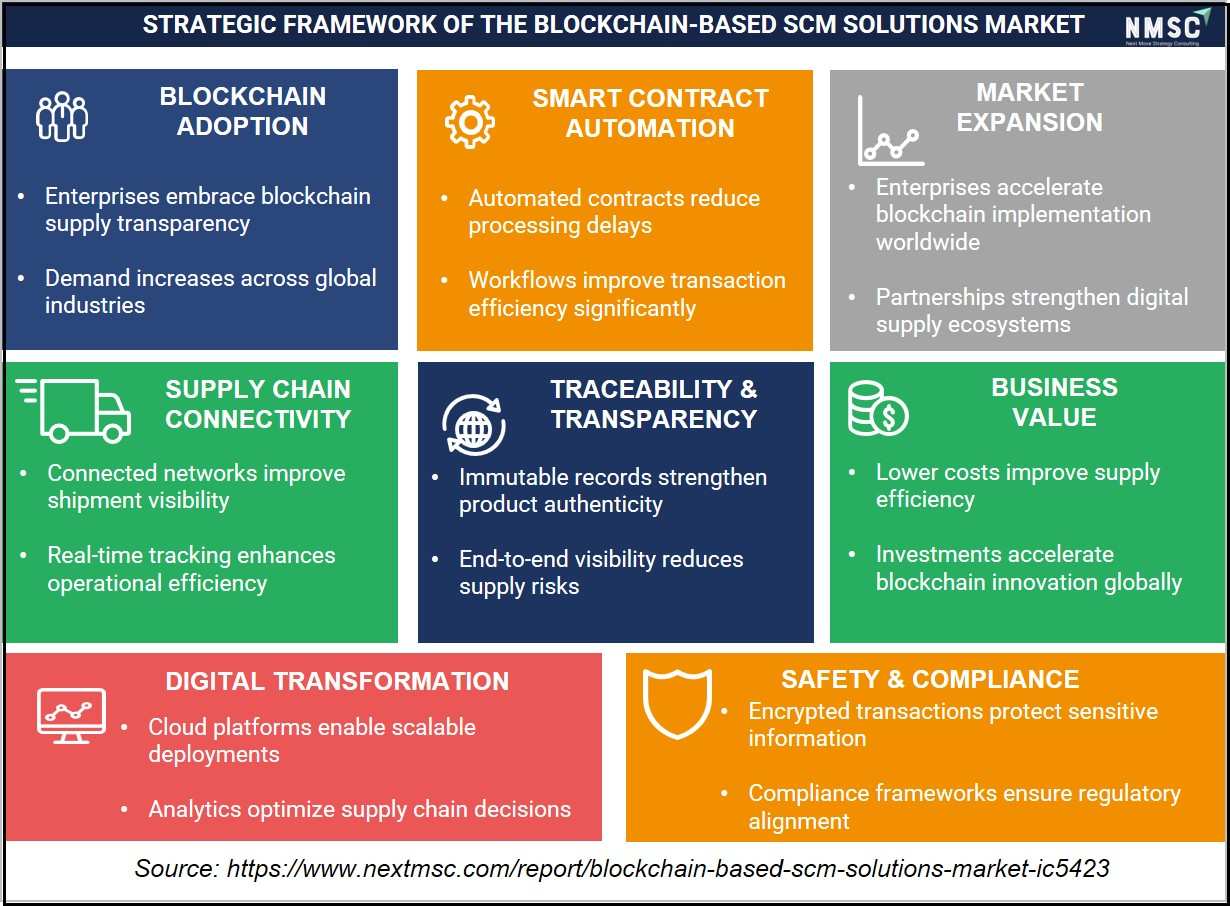
Our analysis indicates that the Blockchain-Based SCM Solutions Market is driven by enterprise blockchain adoption, smart contract automation, and end-to-end supply chain visibility. Organizations leverage blockchain to improve transaction efficiency, product traceability, and operational transparency while reducing supply chain risks. Cloud-based analytics and digital transformation initiatives strengthen business value through better decision-making and lower operating costs. Secure transactions, compliance frameworks, and strategic partnerships further accelerate scalable blockchain implementation across global supply chain networks.
Competitive Landscape
We observed that the blockchain-based SCM solutions market remains moderately fragmented, spanning diversified enterprise software vendors, specialized blockchain-native platforms, and system integration consultancies competing across overlapping solution categories.
|
Attribute |
Details |
|
Market Structure |
Moderately fragmented, with diversified enterprise software vendors competing alongside specialized blockchain-native platform providers |
|
Innovation Focus |
Interoperability, smart contract automation, and Internet of Things sensor integration for real-time traceability |
|
M&A Activity |
Selective acquisitions of specialized traceability and consulting capabilities by diversified enterprise technology vendors |
How Do Companies Compete in the Blockchain-Based SCM Solutions Market?
Companies compete primarily on platform interoperability, breadth of pre-built industry-specific applications, and depth of existing enterprise customer relationships. Our analysis shows that diversified technology vendors leverage existing enterprise resource planning and cloud infrastructure relationships to cross-sell blockchain modules, while specialized blockchain-native vendors compete on deployment speed and vertical-specific traceability expertise for buyers seeking narrower, faster-to-deploy solutions.
Which Competitive Archetypes Dominate the Market?
Two archetypes dominate: diversified enterprise technology vendors that bundle blockchain modules within broader cloud and software suites, and specialized blockchain-native platforms that differentiate through vertical-specific traceability applications. We found that diversified vendors dominate large enterprise accounts through existing procurement relationships, while specialized vendors win mid-market and vertical-specific deployments through faster implementation timelines and deeper domain expertise in traceability and provenance use cases.
What Innovation and Differentiation Strategies Are Companies Pursuing?
Companies are pursuing innovation strategies centered on cross-chain interoperability, Internet of Things sensor integration, and pre-built regulatory compliance templates for digital product passport and pharmaceutical serialization requirements. Based on research conducted by Next Move Strategy Consulting, we found that vendors are increasingly packaging industry-specific compliance accelerators to reduce implementation timelines, differentiating on speed-to-value rather than core distributed-ledger technology alone.
What M&A Activity Is Shaping the Competitive Landscape?
M&A activity is shaping the landscape as diversified technology vendors selectively acquire specialized traceability and blockchain consulting capabilities to accelerate vertical expertise and geographic expansion. Our findings suggest that this consolidation trend favors buyers seeking single-vendor accountability across implementation and ongoing support, while specialized founders increasingly view acquisition by diversified enterprise vendors as a preferred exit and scaling pathway.
Key Market Players
Next Move Strategy Consulting's analysis indicates that the following companies represent the leading participants shaping competitive dynamics across the blockchain-based SCM solutions market.
-
Microsoft Corporation
-
R3 LLC
-
Accenture plc
-
VeChain Foundation
-
Guardtime OÜ
-
Circulor Limited
-
OriginTrail
-
Chronicled, Inc.
-
CargoX
-
Morpheus.Network Inc.
-
Amazon.com, Inc.
-
Consensys Software Inc.
-
Chainlink Labs Inc.
-
Kaleido, Inc.
-
BlockApps Inc.
-
Minespider GmbH
-
Provenance Ltd.
Latest Developments
We reviewed the competitive landscape for verifiable, dated strategic developments specific to blockchain-based SCM solutions; entries lacking a traceable primary source are labeled accordingly rather than presented as confirmed events.
|
Date |
Event |
|
October 2025 |
International Business Machines Corporation (IBM) launched its Digital Asset Haven platform in partnership with Dfns, providing institutions with secure management and compliance infrastructure across more than 40 distinct blockchains. |
|
May 2025 |
Circulor, in collaboration with Rockwell Automation, was selected by Acculon Energy to deploy an integrated supply chain transparency and digital battery passport solution at its Ohio facility, ensuring regulatory compliance and end-to-end material traceability for advanced energy storage systems. |
Investment Opportunities
What Capital Inflows Are Shaping the Market?
Capital inflows are shaping the market as enterprise software vendors and specialized blockchain platforms attract continued strategic investment to expand traceability and compliance capabilities. Our analysis shows that investment is concentrated among vendors demonstrating production-scale enterprise deployments rather than early-stage pilots, reflecting investor preference for commercially validated platforms with recurring enterprise revenue over speculative blockchain infrastructure plays.
What Infrastructure Investment Trends Are Emerging?
Infrastructure investment trends are emerging around cloud-hosted permissioned network capacity and cross-chain interoperability tooling that reduces integration friction for enterprise buyers. We found that cloud hyperscalers are expanding managed blockchain service offerings, lowering the capital barrier for mid-sized manufacturers to adopt ledger-based traceability without maintaining dedicated on-premise infrastructure or specialized blockchain operations staff.
What ESG Considerations Are Influencing Investment Decisions?
Environmental, social, and governance considerations are influencing investment decisions as sustainability disclosure requirements push capital toward platforms enabling verifiable emissions, labor, and sourcing data across multi-tier supply chains. Our findings suggest that investors increasingly favor vendors whose traceability infrastructure directly supports regulatory ESG disclosure obligations, positioning blockchain-based provenance verification as a measurable compliance asset rather than a discretionary sustainability initiative.
Key Benefits for Stakeholders
How Does This Report Benefit Enterprise and Industry Leaders?
This report benefits enterprise and industry leaders by providing granular segmentation, regional forecasts, and competitive benchmarking that support informed vendor selection and deployment prioritization decisions. Our analysis equips supply chain executives with data-driven insight into which solution types, deployment models, and regional markets are scaling fastest, supporting more confident capital allocation across blockchain traceability and compliance initiatives through 2035.
How Does This Report Benefit Investors and Financial Analysts?
This report benefits investors and financial analysts by quantifying market size, growth trajectories, and competitive positioning across twenty profiled companies, supporting more rigorous valuation and due diligence work. Next Move Strategy Consulting's analysis indicates that the segmentation and regional forecasts presented here help analysts identify which sub-segments and geographies are likely to outperform the broader 30.0% market CAGR through the forecast period.
How Does This Report Benefit Technology Vendors and Product Teams?
This report benefits technology vendors and product teams by identifying whitespace opportunities across tokenized trade finance, digital product passport infrastructure, and cold-chain sensor integration. Our assessment indicates that product roadmap decisions can be informed by the fastest-growing sub-segments identified in this analysis, helping vendors prioritize platform investments toward the highest-growth deployment models and end-user verticals.
Key Market Segments
By Solution Type
-
Blockchain SCM Platforms
-
Enterprise Blockchain
-
Supply Chain Network
-
Blockchain Workflow
-
-
Blockchain SCM Applications
-
Traceability and Provenance
-
Logistics and Shipment Management
-
Procurement and Supplier Management
-
Inventory and Asset Tracking
-
Compliance and Sustainability
-
Trade Finance and Settlement
-
Digital Product Passport
-
Other Blockchain SCM
-
-
Blockchain SCM Implementation
-
Integration
-
Managed Blockchain
-
Consulting
-
Support and Maintenance
-
By Deployment Model
-
Cloud-Based Blockchain SCM
-
On-Premise Blockchain SCM
-
Hybrid Blockchain SCM
By Blockchain Architecture
-
Permissioned Blockchain
-
Private Enterprise Blockchain
-
Consortium Blockchain
-
-
Public Blockchain
-
Hybrid Blockchain
By Supply Chain Function
-
Supply Chain Visibility
-
Product Traceability
-
Supplier Verification
-
Digital Documentation Management
-
Smart Contract Automation
-
Compliance Management
-
Sustainability Tracking
-
Digital Product Passport Management
-
Trade Settlement Automation
By End User
-
Manufacturing
-
Automotive
-
Aerospace and Defense
-
Electronics
-
Industrial Equipment
-
-
Food and Agriculture
-
Food Processing
-
Agriculture Supply Chains
-
Beverage
-
-
Healthcare and Pharmaceuticals
-
Pharmaceuticals
-
Medical Devices
-
Healthcare Logistics
-
-
Retail and Consumer Goods
-
Retail
-
Luxury Goods
-
Consumer Products
-
-
Logistics and Transportation
-
Shipping
-
Freight and Logistics Providers
-
Warehousing
-
-
Energy and Utilities
-
Oil and Gas
-
Renewable Energy
-
Utilities
-
-
Mining and Metals
-
Government and Public Sector
-
Other Industries
By Region
-
North America: U.S., Canada, Mexico
-
Europe: UK, Germany, France, Italy, Spain, Sweden, Denmark, Finland, Netherlands, Rest of Europe
-
Asia-Pacific: China, India, Japan, South Korea, Taiwan, Indonesia
-
Middle East & Africa: Saudi Arabia, UAE, Egypt, Israel, Turkey, Nigeria, South Africa, Rest of MEA
-
Latin America: Brazil, Argentina, Chile, Colombia, Rest of LATAM
Conclusion & Recommendations
What Is the Long-Term Outlook for the Market?
The long-term outlook remains strongly positive, with the market projected to expand from USD 3.62 billion in 2026 to USD 38.40 billion by 2035 at a 30.0% CAGR. We observed that this trajectory is underpinned by structural regulatory tailwinds rather than transient demand, positioning the category for sustained double-digit growth well beyond the current forecast window as digital product passport and serialization mandates mature globally.
What Strategic Positioning Should Vendors Pursue?
Vendors should pursue strategic positioning around interoperable, cloud-hosted permissioned platforms that integrate with existing enterprise resource planning systems rather than standalone blockchain infrastructure. Our analysis shows that buyers increasingly favor vendors offering pre-built, vertical-specific compliance templates, suggesting that platform providers should prioritize packaged solutions for pharmaceutical serialization and digital product passport compliance to capture near-term regulatory-driven demand.
How Attractive Is the Market for Investment?
The market presents strong investment attractiveness, evidenced by a USD 34.78 billion absolute dollar opportunity between 2026 and 2035 and CAGRs exceeding 30% across platforms, hybrid deployment, and Asia-Pacific geography. Next Move Strategy Consulting's analysis indicates that investors should prioritize vendors demonstrating production-scale enterprise deployments and recurring compliance-driven revenue over early-stage pilot-focused platforms lacking commercial validation.
What Market Shifts and Key Risks Should Stakeholders Monitor?
Stakeholders should monitor the shift toward platform consolidation, as diversified enterprise vendors increasingly acquire specialized traceability capabilities, potentially compressing margins for standalone blockchain-native providers. Key risks include prolonged implementation timelines for legacy system integration and fragmented cross-border data localization requirements, both of which could slow adoption depth even as regulatory mandates continue to expand addressable demand across manufacturing and healthcare verticals.
What Growth Pathways Should Companies Prioritize?
Companies should prioritize growth pathways centered on Asia-Pacific manufacturing digitization, hybrid deployment architecture, and digital product passport compliance infrastructure, the three areas registering the highest CAGRs identified in this analysis. Our findings suggest that vendors combining regional deployment flexibility with regulatory compliance packaging are best positioned to capture disproportionate share of the USD 34.78 billion incremental opportunity through 2035.
About the Author
 Saista Faiyaz
— Saista Faiyaz is Research Associate at Next Move Strategy Consulting, where she has covered consumer markets and healthcare technologies for 3 years. Her work includes primary interview review, secondary-source validation, market sizing, and structured analysis of company and industry data. She supports research by comparing evidence across sources, organizing findings into market narratives, and documenting assumptions used in analysis. Her scope includes cross-market benchmarking, and reports.
Saista Faiyaz
— Saista Faiyaz is Research Associate at Next Move Strategy Consulting, where she has covered consumer markets and healthcare technologies for 3 years. Her work includes primary interview review, secondary-source validation, market sizing, and structured analysis of company and industry data. She supports research by comparing evidence across sources, organizing findings into market narratives, and documenting assumptions used in analysis. Her scope includes cross-market benchmarking, and reports.
About the Reviewer
 Supradip Baul
— Supradip Baul is an accomplished business consultant and strategist with over a decade of rich experience in market intelligence, strategy, technology, and business transformation. His work has included rigorous qualitative and quantitative analysis across multiple industries, helping clients shape investment decisions and long-term roadmaps. Earlier in his career, he was associated with Gartner, where he contributed to industry-leading reports and market share analyses. He has worked with leading global companies and holds an MBA with a dual specialization in Marketing and Finance.
Supradip Baul
— Supradip Baul is an accomplished business consultant and strategist with over a decade of rich experience in market intelligence, strategy, technology, and business transformation. His work has included rigorous qualitative and quantitative analysis across multiple industries, helping clients shape investment decisions and long-term roadmaps. Earlier in his career, he was associated with Gartner, where he contributed to industry-leading reports and market share analyses. He has worked with leading global companies and holds an MBA with a dual specialization in Marketing and Finance.
At Next Move Strategy Consulting, we understand that insightful market research is the cornerstone of successful business decisions. That's why we employ a robust and multifaceted approach, combining various methodologies to deliver the most accurate and actionable data for our clients.

Research Landscape
We navigate the world of research with two primary approaches:
Qualitative Approach
Our qualitative research methodologies involve immersive techniques such as in-depth interviews, focus groups, and observational studies. By engaging directly with individuals and stakeholders, we uncover valuable insights that quantitative data alone may overlook.

Quantitative Research
In tandem with qualitative methodologies, NMSC leverages the power of Quantitative Research to provide a robust foundation of numerical insights. Through systematic data collection and analysis, we quantify patterns, preferences, and market trends, offering a comprehensive view of the business landscape.
Our quantitative research approach employs diverse tools, including surveys, experiments, and statistical modelling. These methodologies enable us to gather data from a large and representative sample, ensuring the statistical significance of our findings. By employing structured questionnaires and standardized data collection methods, we guarantee the reliability and validity of the information we present to our clients.
Quantitative research is particularly effective in measuring the prevalence of trends, assessing market size, and gauging the impact of various factors on consumer behavior. The numerical precision attained through this approach equips our clients with actionable insights, facilitating data-driven decision-making and strategy formulation.


Our Specialized Toolbox for Industry-Specific Market Research
We deploy a specialized arsenal of techniques tailored to meet your unique requirements. Here's a glimpse into our comprehensive toolbox:

Information Procurement
The stage entails acquiring market data or relevant information through various sources and methodologies.


Market Research Approach
We utilize both top-down and bottom-up approaches in market research analysis to achieve a comprehensive understanding of the market dynamics, leveraging the broad perspective of industry trends and macroeconomic factors alongside detailed insights from specific segments and individual companies.

Porters Five Forces Analysis
We conduct Porter's Five Forces analysis to evaluate the competitive landscape of an industry, providing us with insights into factors that affect profitability and strategic positioning.

SWOT Analysis

Forecasting
We utilize a forecasting model to predict future consumption by considering parameters like population, economics, regulations, market competition, drivers, constraints, technology, and pricing. We also employ statistical techniques such as multilinear regression, exponential smoothing, moving average, ARIMA, and Monte Carlo simulations for accurate predictions. In econometric forecasting, we analyzed short-term and long-term event impacts, attributing values based on regulatory frameworks, economic factors, and market events.





 Speak to Our Analyst