Brazil Industrial Robotics Market

The Brazil Industrial Robotics Market was valued at USD 1.11 billion in 2025, projected to reach USD 3.00 billion by 2035 at a 10.41% CAGR from 2026 to 2035.

Download Free Sample PDF
Base Year (2025)
$1.11 Billion
Forecast (2035)
$3.00 Billion
CAGR (2026-2035)
10.4%
Top Region

Market Size & Forecast

Global Revenue Forecast

Values in USD Billion

2025 $1.11 Billion
2025
2026 $1.23 Billion
2026
2027 $1.35 Billion
2027
2028 $1.49 Billion
2028
2029 $1.65 Billion
2029
2030 $1.82 Billion
2030
2031 $2.01 Billion
2031
2032 $2.22 Billion
2032
2033 $2.45 Billion
2033
2034 $2.71 Billion
2034
2035 $3.00 Billion
2035

Market Overview

What Is the Brazil Industrial Robotics Market Size?

The Brazil industrial robotics market size was valued at USD 1.11 billion in 2025 and is estimated at USD 1.23 billion in 2026, forecast to reach USD 3.00 billion by 2035, expanding at a 10.41% CAGR between 2026 and 2035. Articulated robots dominate the market by robot type, reflecting sustained deployment across automotive welding and assembly lines.

In unit terms, deployed robot volume is estimated at 16 thousand units in 2025 and 18 thousand units in 2026, rising to 49 thousand units by 2035 at an 11.91% CAGR between 2026 and 2035, a faster expansion rate than the value CAGR that reflects falling average unit prices as collaborative and lower-payload robots gain share.

We observed that market growth is supported by major automaker capacity expansion under Brazil's Mover program, sustained investment from Stellantis and General Motors, and continuous adoption of collaborative and mobile robotics across automotive, food and beverage, and logistics operations through 2035.

What Does the Brazil Industrial Robotics Market Encompass?

The Brazil industrial robotics market encompasses articulated, SCARA, Cartesian and gantry, Delta, collaborative, and mobile robotic systems deployed across handling, welding, assembly, dispensing, and inspection operations. Our assessment indicates that the market includes hardware components such as robot arms, controllers, end effectors, and vision systems, alongside programming software and system integration services delivered by both multinational manufacturers and domestic integrators serving Brazil's automotive, food processing, and logistics manufacturing base.

Brazil's Ministério do Desenvolvimento , Indústria, Comércio e Serviços and the Norma Regulamentadora 12 workplace safety standard administered under the Ministério do TrabalhoeEmprego shape industrial policy and machinery safety compliance affecting robotic deployment. We observed that manufacturers are increasingly investing in collaborative robotics and vision-guided automation to support electrified vehicle production ramp-up. NMSC's analysis indicates that Mover program tax incentives and BNDES-backed financing continue to reshape technology adoption and integration demand across Brazilian manufacturing regions.

Key Takeaways

By Robot Type: Articulated Robots is the dominant segment, while Collaborative Robots is the fastest-growing segment.

By Offering: Hardware is the dominant segment, while Software is the fastest-growing segment.

By Application: Handling is the dominant segment, while Inspection and Quality Control is the fastest-growing segment.

By Mounting Type: Floor Mounted is the dominant segment, while Rail Mounted is the fastest-growing segment.

By Mobility: Stationary Robots is the dominant segment, while Mobile Robots is the fastest-growing segment.

By Payload Capacity: Medium Payload 20 kg to 100 kg is the dominant segment, while Low Payload Up to 20 kg is the fastest-growing segment.

By End User: Automotive Industry is the dominant segment, while Logistics and Warehousing is the fastest-growing segment.

Market Opportunity: The Brazil industrial robotics market is expected to create an absolute dollar opportunity of USD 1.77 billion between 2026 and 2035, presenting significant investment potential across collaborative robotics, autonomous mobile robots, and automotive welding automation segments.

According to NMSC's analysis, companies are increasingly investing in localized system integration capacity and automotive-line automation expertise, strengthening their competitive position in the Brazil industrial robotics market through 2035.

Ecosystem Analysis

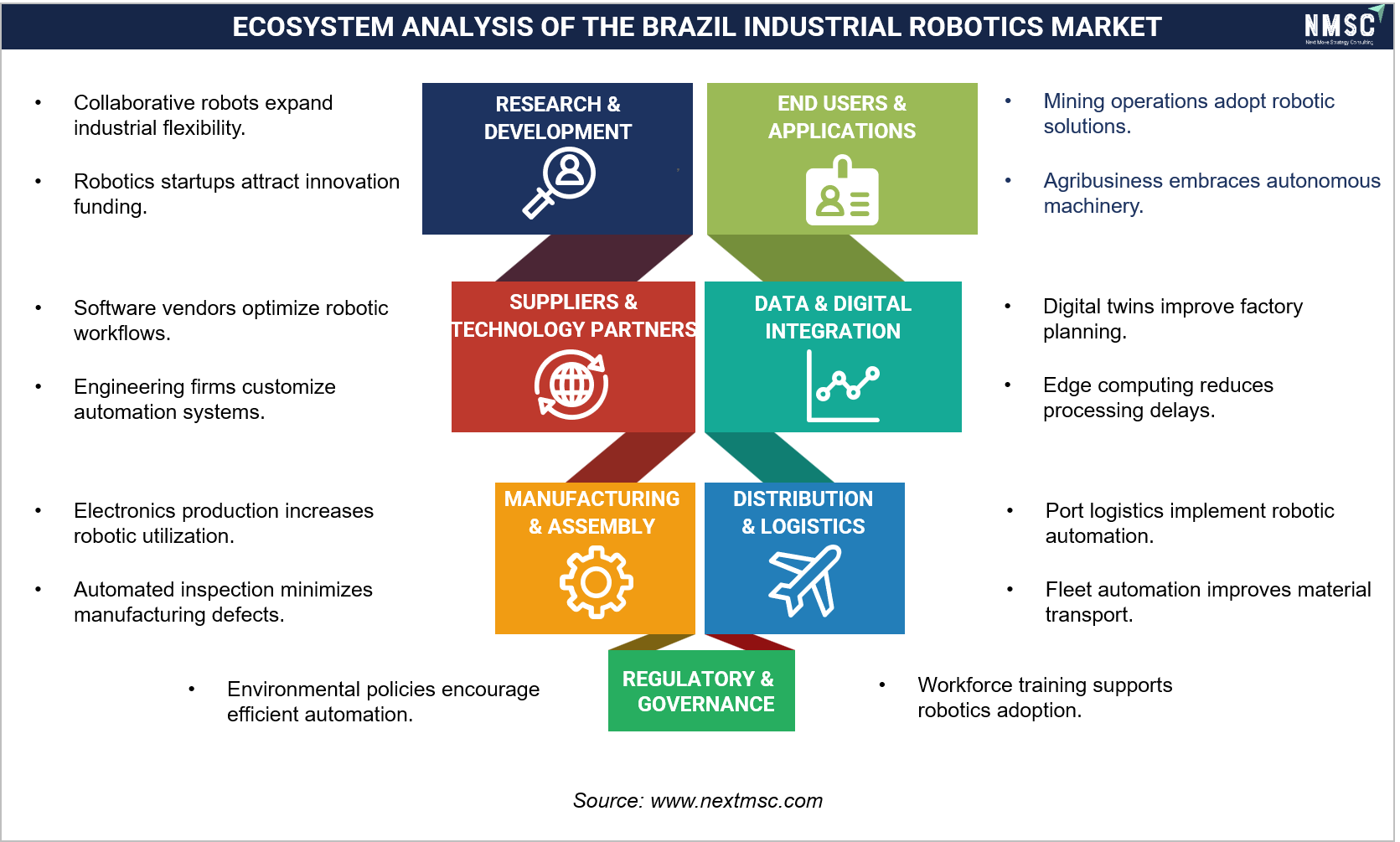
The Brazil Industrial Robotics Market ecosystem is built on coordinated value chains across technology developers, component manufacturers, software integrators, investors, and end users to scale commercial adoption.

Ecosystem Analysis of the Brazil Industrial Robotics Market

Market Drivers & Dynamics

Interactive Dataset
Major automaker capacity expansion increasing demand for welding, handling, and assembly robots driver +3.05% Brazil (strongest in Minas Gerais, São Paulo, and Rio Grande do Sul) 2026–2032
Federal Mover program tax incentives encouraging automakers to invest in sustainable, automated production lines driver +2.35% Brazil (nationwide; strongest among automakers investing in electrification) 2026–2031
Below-average robot density relative to global peers creating catch-up automation investment opportunity driver +1.95% Brazil (nationwide) 2026–2033
Growing e-commerce and warehouse automation demand across major distribution hubs driver +1.55% Brazil (strongest in São Paulo and Rio de Janeiro) 2027–2033
BNDES-backed financing programs supporting manufacturing digitalization and automation adoption driver +1.28% Brazil (nationwide) 2026–2031
High import tariffs and currency volatility increasing landed cost of imported robotic hardware restraint –1.85% Brazil (nationwide; strongest for hardware imports) 2026–2030
Shortage of qualified robotics integration and maintenance technicians restraint –1.52% Brazil (nationwide; strongest outside São Paulo and Minas Gerais industrial hubs) 2026–2031
High upfront capital costs limiting adoption among small and mid-sized manufacturers restraint –1.24% Brazil (nationwide; strongest among small and mid-sized enterprises) 2026–2030
Source: Next Move Strategy Consulting

Growth Drivers and Restraints

What Is the Primary Growth Driver of the Brazil Industrial Robotics Market?

Major automaker capacity expansion is the primary growth driver of the Brazil industrial robotics market . Stellantis announced a planned USD 6 billion investment in Brazil between 2025 and 2030, while General Motors committed an additional billion-dollar investment toward automation and product development on top of its prior 2024 . We observed that these commitments are directly increasing procurement of articulated and collaborative robots for welding and handling operations across Brazilian automotive plants.

How Is Robot Density Catch-Up Driving Brazil Industrial Robotics Market Growth?

Brazil's comparatively low industrial robot density is encouraging manufacturers to accelerate automation investment. According to the International Federation of Robotics, Brazil's robot density remains below 50 units per 10,000 manufacturing workers, compared with a global average of 141 units. Our assessment indicates that this gap is prompting both multinational and domestic manufacturers to expand automated production capacity to remain competitive with global peers.

What Is Restraining Brazil Industrial Robotics Market Expansion?

What Is Restraining Brazil Industrial Robotics Market Expansion?

High import tariffs, currency volatility, and a shortage of qualified integration technicians continue to restrain market expansion, particularly among small and mid-sized manufacturers. We found that dependence on imported robotic hardware exposes buyers to landed cost fluctuation, complicating capital budgeting. These constraints slow automation adoption outside established industrial regions despite strong underlying demand for productivity improvement.

Segmentation Analysis

Key Market Segments Evaluated

By Robot Type

  • Articulated Robots
  • SCARA Robots
  • Cartesian and Gantry Robots
  • Delta Robots
  • Collaborative Robots
  • Autonomous Mobile Robots (AMRs)
  • Automated Guided Vehicles (AGVs)
  • Other Robots

By Offering

  • Robot Arms
  • Controllers
  • End Effectors and Grippers
  • Sensors and Vision Systems
  • Control and Programming Software
  • Simulation and Offline Programming Software
  • Fleet Management Software
  • System Integration and Installation
  • Maintenance and Support
  • Training and Consulting

By Application

  • Pick and Place
  • Machine Tending
  • Palletizing and Depalletizing
  • Assembly and Disassembly
  • Dispensing
  • Painting
  • Adhesive and Sealant Application
  • Cutting and Machining
  • Grinding and Polishing
  • Cleanroom Operations

By Mounting Type

  • Floor Mounted
  • Wall-Mounted
  • Ceiling Mounted
  • Rail Mounted

By Mobility

  • Stationary Robots
  • Mobile Robots

By Payload Capacity

  • Low Payload Up to 20 kg
  • Medium Payload 20 kg to 100 kg
  • High Payload 100 kg to 500 kg
  • Heavy Duty Payload Over 500 kg

By End User

  • Automotive Industry
  • Electrical and Electronics Industry
  • Metals and Machinery Industry
  • Food and Beverages Industry
  • Pharmaceuticals and Medical Devices Industry
  • Plastics Rubber and Chemicals Industry
  • Logistics and Warehousing
  • Other Industries

How Is the Brazil Industrial Robotics Market Segmented by Robot Type?

2025 (USD Billion)
2035 (USD Billion)
Articulated
SCARA Robots
Cartesian an
Delta Robots
Collaborativ
Segment Item 2025 (USD Billion) 2035 (USD Billion) CAGR
Articulated Robots $10.0 USD Billion $40.0 USD Billion 26.0%
SCARA Robots $17.1 USD Billion $51.1 USD Billion 20.0%
Cartesian and Gantry Robots $24.2 USD Billion $62.2 USD Billion 14.0%
Delta Robots $31.3 USD Billion $73.3 USD Billion 12.0%
Collaborative Robots $38.4 USD Billion $84.4 USD Billion 19.0%

Segment-wise data not detailed in this view

Unlock complete segment-wise numbers for By Robot Type.

Unlock Full Data

Articulated robots dominate the market, reflecting their versatility across welding, handling, and assembly applications in automotive and metals manufacturing. Their multi-axis flexibility supports the complex motion paths required on high-volume vehicle assembly lines. Collaborative robots represent the fastest-growing segment as manufacturers seek lower-cost, flexible automation deployable without extensive safety infrastructure. SCARA and Delta robots continue supporting high-speed assembly and packaging tasks, while autonomous mobile robots and automated guided vehicles are expanding steadily within intralogistics operations across Brazilian manufacturing facilities.

2025 (USD Billion)
2035 (USD Billion)
Robot Arms
Controllers
End Effector
Sensors and
Control and
Segment Item 2025 (USD Billion) 2035 (USD Billion) CAGR
Robot Arms $10.0 USD Billion $40.0 USD Billion 15.0%
Controllers $17.1 USD Billion $51.1 USD Billion 9.0%
End Effectors and Grippers $24.2 USD Billion $62.2 USD Billion 19.0%
Sensors and Vision Systems $31.3 USD Billion $73.3 USD Billion 21.0%
Control and Programming Software $38.4 USD Billion $84.4 USD Billion 26.0%

Segment-wise data not detailed in this view

Unlock complete segment-wise numbers for By Offering.

Unlock Full Data

2025 (USD Billion)
2035 (USD Billion)
Pick and Pla
Machine Tend
Palletizing
Assembly and
Dispensing
Segment Item 2025 (USD Billion) 2035 (USD Billion) CAGR
Pick and Place $10.0 USD Billion $40.0 USD Billion 18.0%
Machine Tending $17.1 USD Billion $51.1 USD Billion 16.0%
Palletizing and Depalletizing $24.2 USD Billion $62.2 USD Billion 22.0%
Assembly and Disassembly $31.3 USD Billion $73.3 USD Billion 12.0%
Dispensing $38.4 USD Billion $84.4 USD Billion 19.0%

Segment-wise data not detailed in this view

Unlock complete segment-wise numbers for By Application.

Unlock Full Data

2025 (USD Billion)
2035 (USD Billion)
Floor Mounte
Wall-Mounted
Ceiling Moun
Rail Mounted
Segment Item 2025 (USD Billion) 2035 (USD Billion) CAGR
Floor Mounted $10.0 USD Billion $40.0 USD Billion 20.0%
Wall-Mounted $17.1 USD Billion $51.1 USD Billion 22.0%
Ceiling Mounted $24.2 USD Billion $62.2 USD Billion 20.0%
Rail Mounted $31.3 USD Billion $73.3 USD Billion 14.0%

Segment-wise data not detailed in this view

Unlock complete segment-wise numbers for By Mounting Type.

Unlock Full Data

2025 (USD Billion)
2035 (USD Billion)
Stationary R
Mobile Robot
Segment Item 2025 (USD Billion) 2035 (USD Billion) CAGR
Stationary Robots $10.0 USD Billion $40.0 USD Billion 22.0%
Mobile Robots $17.1 USD Billion $51.1 USD Billion 16.0%

Segment-wise data not detailed in this view

Unlock complete segment-wise numbers for By Mobility.

Unlock Full Data

2025 (USD Billion)
2035 (USD Billion)
Low Payload
Medium Paylo
High Payload
Heavy Duty P
Segment Item 2025 (USD Billion) 2035 (USD Billion) CAGR
Low Payload Up to 20 kg $10.0 USD Billion $40.0 USD Billion 20.0%
Medium Payload 20 kg to 100 kg $17.1 USD Billion $51.1 USD Billion 22.0%
High Payload 100 kg to 500 kg $24.2 USD Billion $62.2 USD Billion 16.0%
Heavy Duty Payload Over 500 kg $31.3 USD Billion $73.3 USD Billion 22.0%

Segment-wise data not detailed in this view

Unlock complete segment-wise numbers for By Payload Capacity.

Unlock Full Data

How Is the Brazil Industrial Robotics Market Segmented by End User?

2025 (USD Billion)
2035 (USD Billion)
Automotive I
Electrical a
Metals and M
Food and Bev
Pharmaceutic
Segment Item 2025 (USD Billion) 2035 (USD Billion) CAGR
Automotive Industry $10.0 USD Billion $40.0 USD Billion 26.0%
Electrical and Electronics Industry $17.1 USD Billion $51.1 USD Billion 16.0%
Metals and Machinery Industry $24.2 USD Billion $62.2 USD Billion 18.0%
Food and Beverages Industry $31.3 USD Billion $73.3 USD Billion 8.0%
Pharmaceuticals and Medical Devices Industry $38.4 USD Billion $84.4 USD Billion 23.0%

Segment-wise data not detailed in this view

Unlock complete segment-wise numbers for By End User.

Unlock Full Data

The automotive industry dominates the market, driven by Brazil's position as Latin America's largest vehicle and component manufacturing base requiring high-precision welding, handling, and assembly automation. Logistics and warehousing is the fastest-growing end user, supported by expanding e-commerce fulfillment capacity and rising demand for autonomous mobile robots. Food and beverages, metals and machinery, and pharmaceuticals continue to broaden robotics adoption as automation extends beyond traditional automotive applications nationwide.

Competitive Landscape

How Do Companies Compete in the Brazil Industrial Robotics Market?

Companies compete primarily through automation reliability, integration support, and total cost of ownership. Leading manufacturers such as ABB Ltda., FANUC Brasil Ltda., and KUKA Roboter do Brasil Ltda. leverage extensive service networks and established automotive relationships to maintain market leadership, while providers including Yaskawa Elétrico do Brasil Ltda. and Kawasaki Heavy Industries Ltd. differentiate through application-specific engineering and rapid deployment capabilities across metals and electronics manufacturing.

Which Competitive Archetypes Dominate the Brazil Industrial Robotics Market?

Two primary competitive archetypes characterize the market. The first comprises diversified multinational robotics manufacturers offering comprehensive portfolios across articulated, SCARA, and Cartesian systems, including ABB Ltda., FANUC Brasil Ltda., KUKA Roboter do Brasil Ltda., Yaskawa Elétrico do Brasil Ltda., and Comau do Brasil Indústria e Comércio Ltda. The second includes collaborative and intralogistics-focused providers such as Universal Robots Brasil Ltda. and Dematic Sistemas eEquipamentos de Movimentação de Materiais Ltda., which focus on flexible deployment and warehouse automation for a broader manufacturer base.

How Are Companies Differentiating Through Innovation in Brazil Industrial Robotics?

Innovation strategies increasingly focus on collaborative robotics, vision-guided quality control, and cloud-connected fleet management software. Companies are investing in application-specific end effectors and simplified programming interfaces to reduce integration complexity for first-time automation adopters. Our analysis indicates that manufacturers combining hardware reliability with software-enabled fleet visibility are strengthening competitive positioning across Brazil's expanding industrial base.

What M&A and Expansion Activity Is Shaping the Brazil Industrial Robotics Market?

Strategic capacity investments, distribution partnerships, and technical training investments continue to shape competition across the market. Stellantis and General Motors are directing multi-billion-dollar investment commitments toward automation and product development in Brazil, encouraging robot manufacturers and integrators to strengthen service footprints near automotive manufacturing clusters and improve deployment support.

Key Market Players

ABB Ltda. FANUC Brasil Ltda. KUKA Roboter do Brasil Ltda. Yaskawa Elétrico do Brasil Ltda. Stäubli Brasil Ltda. Comau do Brasil Indústria e Comércio Ltda. Universal Robots Brasil Ltda. Dematic Sistemas eEquipamentos de Movimentação de Materiais Ltda. Omron Eletrônica do Brasil Ltda. Epson do Brasil Indústria e Comércio Ltda. DENSO do Brasil Ltda. Kawasaki Heavy Industries Ltd. Nachi Brasil Ltda. Hyundai Robotics Co., Ltd. Yamaha Motor do Brasil Ltda.
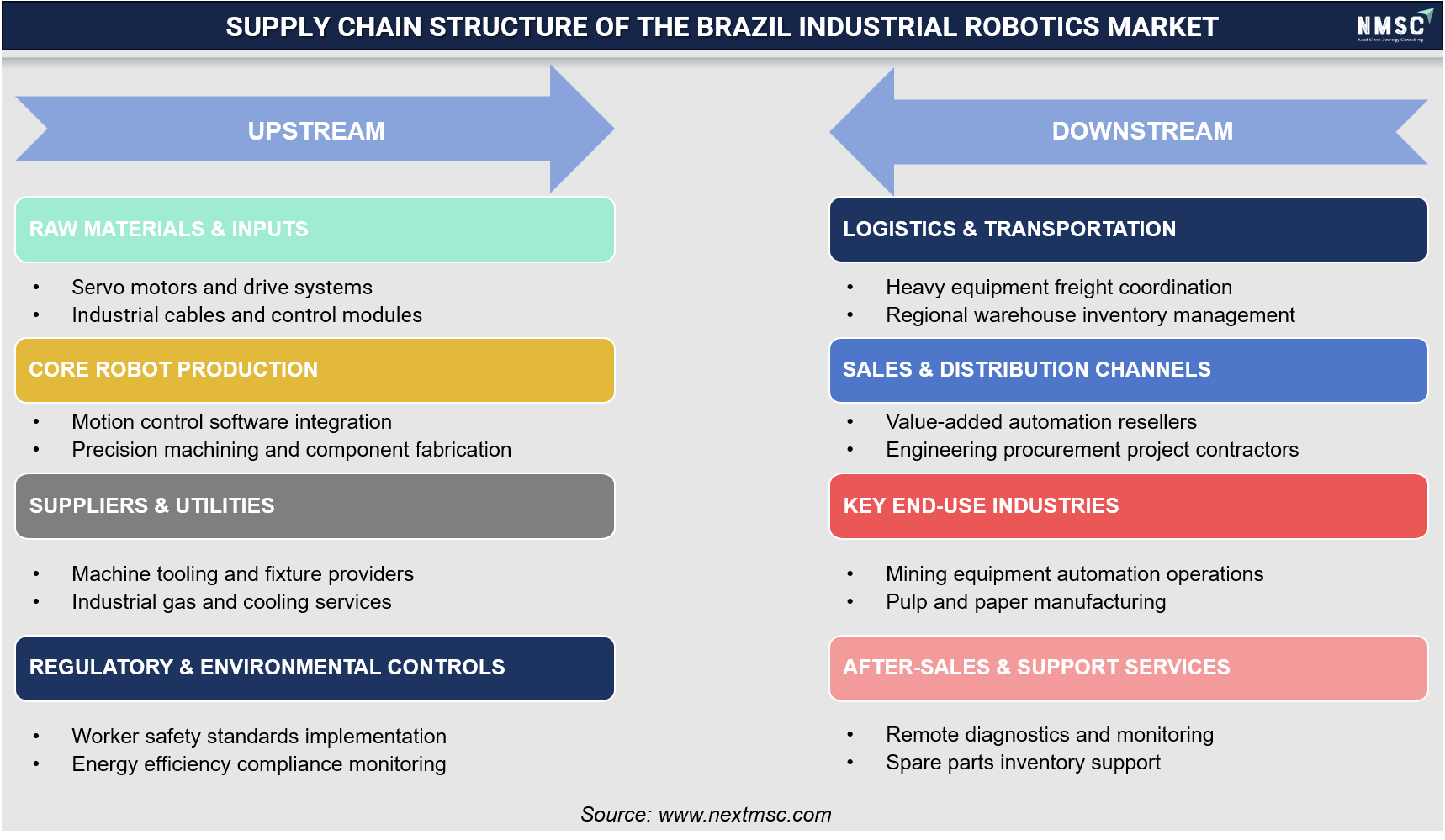
Supply Chain Structure of the Brazil Industrial Robotics Market

Investment Opportunities

What Capital Inflows Are Targeting the Brazil Industrial Robotics Market?

Capital inflows into the Brazil industrial robotics market are increasingly directed toward automotive manufacturing capacity, system integration services, and collaborative robotics deployment. Leading global manufacturers continue investing in Brazilian operations, supported by Stellantis's planned USD 6 billion investment and General Motors' additional R$3.5 billion commitment. We observed that investors favor companies demonstrating strong service coverage, established automotive relationships, and scalable integration capabilities as indicators of long-term growth potential.

How Is Infrastructure Investment Supporting the Brazil Industrial Robotics Market?

Infrastructure investment is expanding manufacturing capacity, technician training facilities, and regional service networks across Brazil's industrial regions. Our findings suggest that BNDES-backed financing programs are supporting local warehousing, spare-parts logistics, and integration workshops to reduce deployment lead times. These investments strengthen manufacturers' ability to support rapidly expanding automotive and food processing production requirements nationwide.

What ESG Considerations Are Shaping Investment Decisions in the Brazil Industrial Robotics Market?

Environmental, social, and governance considerations are becoming integral to investment decisions, with workplace safety compliance, energy-efficient automation, and workforce reskilling emerging as key priorities. We found that investors increasingly favor companies demonstrating measurable progress in safety compliance under Brazil's Norma Regulamentadora 12 machinery safety framework and structured technician training programs supporting long-term operational resilience.

Key Benefits for Stakeholders

How Does This Report Benefit Enterprise and Industry Leaders?

Enterprise and industry leaders gain access to validated market segmentation, competitive benchmarking, and technology adoption analysis that support strategic planning and automation investment decisions across the Brazil industrial robotics market. Our analysis shows that detailed assessments of robot type, application, and end-user trends help companies identify high-growth opportunities and strengthen long-term manufacturing competitiveness.

How Does This Report Benefit Investors and Financial Analysts?

Investors and financial analysts benefit from consistent market size estimates, growth forecasts, and competitive assessments supporting investment evaluation across the Brazil industrial robotics market. We observed that the report's detailed analysis of collaborative robotics, system integration services, and automaker-driven demand enables stakeholders to identify companies with the strongest long-term growth potential through 2035.

How Does This Report Benefit Technology Vendors and Product Teams?

Technology vendors and product development teams gain valuable insights into emerging innovation trends, including collaborative robotics, vision-guided inspection, and fleet management software transforming Brazil's industrial automation landscape. Our findings suggest that this analysis helps research and development teams prioritize product pipelines and align offerings with evolving manufacturer requirements.

Conclusion & Recommendations

The long-term outlook for the Brazil industrial robotics market remains positive, supported by sustained automaker capacity investment, Mover program policy backing, and continued adoption of collaborative and vision-guided automation. We observed that growing deployment of autonomous mobile robots and fleet management software will continue driving market expansion across automotive, food and beverage, and logistics segments throughout the forecast period.

What Strategic Positioning Should Robotics Companies Pursue?

Manufacturers should prioritize investments in collaborative robotics, local system integration capacity, and technician training programs while strengthening service coverage near automotive manufacturing clusters. Our assessment indicates that companies expanding flexible financing models and application-specific automation solutions will be well positioned to capture growing demand from small and mid-sized manufacturers.

How Attractive Is the Brazil Industrial Robotics Market for New Investment?

The market presents an attractive investment opportunity, supported by strong automaker-driven manufacturing growth and rising automation adoption across multiple end-user industries. We found that investment potential is particularly strong for companies focused on collaborative robotics, integration services, and fleet management software capable of capitalizing on Brazil's expanding industrial base.

What Market Shifts and Key Risks Should Stakeholders Monitor?

Stakeholders should closely monitor currency and tariff volatility affecting imported hardware costs, persistent shortages of qualified integration technicians, and shifting government funding allocation patterns. Our analysis shows that companies unable to expand local service capacity or manage component cost exposure may face increasing competitive pressure within the market.

What Are the Key Growth Pathways for the Brazil Industrial Robotics Market?

Key growth pathways include expanding collaborative robotics adoption among small and mid-sized manufacturers, accelerating system integration service capacity, and strengthening fleet management software offerings for intralogistics automation. NMSC's analysis indicates that companies combining local service depth with flexible financing models will be best positioned to capture the market's projected growth through 2035.

About the Author

Author

Mihul Sharma is a research professional with 1 year of experience in business research and market analysis. He has developed a solid foundation in research methodologies, data analysis, and market intelligence, enabling him to identify meaningful insights that support strategic business decisions. With a keen analytical mindset and a commitment to continuous learning, Mihul approaches every project with curiosity, attention to detail, and a results-oriented perspective. He is passionate about expanding his expertise, staying updated with industry trends, and contributing to impactful research initiatives. Beyond work, Mihul enjoys reading about emerging business trends, exploring new technologies, and travelling to discover different cultures and perspectives.

About the Reviewer

Reviewer

Supradip Baul is an accomplished business consultant and strategist with over a decade of rich experience in market intelligence, strategy, technology, and business transformation. His work has included rigorous qualitative and quantitative analysis across multiple industries, helping clients shape investment decisions and long-term roadmaps. Earlier in his career, he was associated with Gartner, where he contributed to industry-leading reports and market share analyses. He has worked with leading global companies and holds an MBA with a dual specialization in Marketing and Finance.

Download Free Sample

FAQs

Amos Chang

AMOS CHANG

Strategy Consultant

Kardex Group

I have bought the intralogistics market reports from NMSC two times so far. Joseph and his team are always very helpful and flexible in responding to any customization requirements on the report. Their expertise in market reports really helps us steer the day-to-day business. I will definitely recommend and come back myself whenever there is a need.

Semih Kavaklioglu

SEMIH KAVAKLIOGLU

Co-Founder & Sales Manager

Decortie

I work a lot in the marketing industry and I know that research is an essential part of any campaign. I have used Market research reports for my own products and I found them to be very informative and well-researched. The team here produces insightful reports for a good price

Henri Knyphausen

HENRI KNYPHAUSEN

Partner at Singulier [Ex-BCG]

Singulier

I recently engaged NEXTMSC.com for a commercial due diligence project within the intralogistics sector, and I am pleased to provide a reference based on my experience. In utilizing NEXTMSC.com's services, I found their report to offer valuable insights into market dynamics and key industry players. The initial report provided a solid foundation for our analysis. However, as we were investigating a smaller target in the market, and I had specific customization requests requiring additional research. These requests included detailed information on product portfolios of various players and sub-market sizes, both inclusive and exclusive of certain product categories. NEXTMSC.com demonstrated commendable responsiveness and agility in accommodating these customization requests. Within a timeframe of 1-2 weeks, they delivered a revised report that met our specific needs. Furthermore, they were receptive to my follow-up inquiries, ensuring clarity and understanding of the data provided. The final deliverable significantly contributed to our due diligence efforts. One of NEXTMSC.com's notable strengths lies in their qualitative research capabilities. However, for future engagements, I would recommend the inclusion of a quantified market model in Excel format. Such a model would offer the ability to conduct in-depth analyses and explore various market segments, including country-specific data and subcomponent breakdowns. Based on my positive experience, I would not hesitate to work with NEXTMSC.com again. Their responsiveness, willingness to accommodate customization requests, and commitment to delivering actionable insights make them a reliable partner for commercial research projects.

Diana Trejo

DIANA TREJO

Assistant Manager

Sumitomo Corporation de Mexico, S.A. de C.V.

Recently, we purchased a report on the Mexico Data Center Market from Next Move Strategy Consulting. The service has been excellent, with support that is always timely and thoroughly professional. The information provided is interesting, highly useful, and delivered with clarity. I would highly recommend NextMSC for anyone seeking insightful and dependable analysis.

Gaurav Jaiswal

GAURAV JAISWAL

Founder & CEO

Yano Charge Private Limited

The EV Charging market research report provided by the NextMSC was exceptionally detailed and insightful. It offered a comprehensive analysis that proved to be a game-changer for our strategic planning. Truly a testament to the NextMSC’s expertise and thoroughness in EV market landscape & analysis.

Custom Market Research Services

We will customize the research for you if the listed report does not fully match your requirements.

Get 30% Free Customization

Select License

This website uses cookies to ensure you get the best experience on our website. Learn more