
France Industrial Robotics Market

France Industrial Robotics Market was valued at USD 1.16 billion in 2025 and is projected to reach USD 3.88 billion by 2035, at a 12.81% CAGR through 2035.

Download Free Sample PDF
Base Year (2025)
$1.16 Billion
Forecast (2035)
$3.88 Billion
CAGR (2026-2035)
12.8%
Top Region

What Is the France Industrial Robotics Market Size?

The France industrial robotics Industry size was valued at USD 1.16 billion in 2025 and is estimated at USD 1.31 billion in 2026, forecast to reach USD 3.88 billion by 2035, expanding at a 12.81% CAGR between 2026 and 2035. Articulated robots dominate the market by robot type, driven by high-precision automotive and manufacturing deployments.

In unit terms, deployed robot volume in the France market is estimated at 16 thousand units in 2025 and 18 thousand units in 2026, rising to 60 thousand units by 2035 at a 14.35% CAGR between 2026 and 2035. The robust growth in deployment reflects accelerating automation across France’s manufacturing and industrial sectors, driven by increasing adoption of collaborative robots, smart factory initiatives, and investments in advanced production technologies.

We observed that market growth is supported by rising adoption of collaborative robots, government-backed industrial modernization programs, and increasing automation investment across automotive, electronics, and logistics sectors in France through 2035.

France Industrial Robotics Market Revenue Forecast

Values in USD Billion

2025 $1.16 Billion
2025
2026 $1.31 Billion
2026
2027 $1.48 Billion
2027
2028 $1.67 Billion
2028
2029 $1.88 Billion
2029
2030 $2.12 Billion
2030
2031 $2.39 Billion
2031
2032 $2.70 Billion
2032
2033 $3.05 Billion
2033
2034 $3.44 Billion
2034
2035 $3.88 Billion
2035

Key Takeaways

By Robot Type: Articulated Robots is the dominant segment, while Collaborative Robots is the fastest-growing segment.

By Offering: Hardware is the dominant segment, while Software is the fastest-growing segment.

By Application: Handling is the dominant segment, while Inspection and Quality Control is the fastest-growing segment.

By Mounting Type: Floor Mounted is the dominant segment, while Rail Mounted is the fastest-growing segment.

By Mobility: Stationary Robots is the dominant segment, while Mobile Robots is the fastest-growing segment.

By Payload Capacity: Medium Payload 20 kg to 100 kg is the dominant segment, while Low Payload Up to 20 kg is the fastest-growing segment.

By End User: Automotive Industry is the dominant segment, while Electrical and Electronics Industry is the fastest-growing segment.

Market Opportunity: The France Industrial Robotics sector is expected to create an absolute dollar opportunity of USD 2.57 billion between 2026 and 2035, presenting significant investment potential across collaborative robotics, autonomous mobile robots, and software-driven automation segments.

According to NMSC's analysis, growing labor cost pressures and reshoring initiatives are accelerating robot density gains across French manufacturing plants, positioning automation providers to capture sustained demand in the France industrial robotics market through 2035.

Strategic Framework of the France Industrial Robotics Market:

Through our market assessment, we observed that the France industrial robotics market is advancing through AI-powered automation, collaborative robotics, and digital manufacturing technologies that enhance production efficiency. Moreover, rising investments, strong local system integrators, and cloud-enabled connectivity support wider industrial deployment. Consequently, sustainability initiatives, cybersecurity compliance, and increasing demand for customized robotic solutions strengthen operational resilience, improve competitiveness, and accelerate long-term automation adoption across French manufacturing industries.

What does the France Industrial Robotics Market Encompass?

The France Industrial Robotics Market encompasses hardware, software, and services deployed to automate manufacturing, handling, and logistics operations across French industry. Our assessment indicates that the market spans articulated, SCARA, cartesian, delta, collaborative , and mobile robot platforms integrated with controllers, end effectors, vision systems, and fleet management software. These solutions are deployed by automotive, electronics, metals, food and beverage, pharmaceutical, and logistics companies through system integrators, original equipment manufacturers, and direct robot suppliers operating across France's industrial base.

France's industrial modernization strategy, including the France 2030 investment plan, actively promotes robotics adoption, digital manufacturing, and factory automation among small and mid-sized enterprises. We observed that occupational safety standards enforced by the Ministry of Labour and machinery directives aligned with European Union regulations shape robot design, guarding, and collaborative operation requirements. NMSC's analysis indicates that rising integration of artificial intelligence, machine vision, and cloud-connected fleet management is transforming robot programming, predictive maintenance, and production flexibility across French manufacturing facilities.

Market Drivers & Dynamics

Interactive Dataset
Rising labor costs and workforce shortages driving automation adoption in manufacturing driver +3.42% France (nationwide; strongest in Île-de-France and Auvergne-Rhône-Alpes) Medium to Long term (2–6 years)
France 2030 investment plan supporting factory modernization and robotics deployment driver +2.87% France (nationwide; strongest in major industrial regions) Long term (3–8 years)
Growing electric vehicle and battery manufacturing expanding automotive robot demand driver +2.15% France (strongest in Hauts-de-France and Nouvelle-Aquitaine) Medium term (2–5 years)
Increasing adoption of collaborative robots among small and mid-sized enterprises driver +1.68% France (nationwide) Medium term (2–5 years)
Expanding e-commerce logistics driving autonomous mobile robot deployment driver +1.34% France (strongest in logistics hubs near Paris and Lyon) Short to Medium term (1–4 years)
High upfront capital costs limiting robotics adoption among small manufacturers restraint −1.79% France (nationwide; strongest among SMEs) Short to Medium term (1–4 years)
Shortage of skilled robotics integration and maintenance technicians restraint −1.46% France (nationwide) Medium term (2–5 years)
Source: Next Move Strategy Consulting

Growth Drivers

What Is the Primary Growth Driver of the France Industrial Robotics Market?

Rising labor costs and persistent workforce shortages in manufacturing are the primary growth driver of the France Industrial Robotics Ecosystem . Industry-derived estimates, given the absence of a single publicly verifiable dataset, indicate that unfilled production roles across French manufacturing continue to encourage automation adoption. We observed that automotive, electronics, and food processing companies are prioritizing articulated and collaborative robot deployments to maintain output while addressing recruitment challenges across French industrial regions.

How Is Electric Vehicle Manufacturing Driving Market Growth?

Expanding electric vehicle and battery manufacturing investment is accelerating robot adoption across the France Industrial Robotics Market. Government-backed gigafactory projects in Hauts-de-France and Nouvelle-Aquitaine, supported through France's national investment strategy, are prompting automotive suppliers to deploy welding, assembly, and material handling robots across new production lines. We observed that this expansion is reinforcing demand for medium and high-payload robots, an industry-derived estimate given the absence of a publicly verifiable installation count specific to these facilities, while strengthening France's position within the European automotive supply chain.

Growth Inhibitors

What Is Restraining France Industrial Robotics Market Expansion?

High upfront capital costs and integration complexity continue to France industrial robotics market restrain market expansion, particularly among small and mid-sized French manufacturers. We found that limited in-house engineering capacity and a shortage of qualified robotics integration technicians increase deployment timelines and total cost of ownership for smaller enterprises. Our analysis shows that these constraints slow automation adoption outside large automotive and electronics manufacturers, limiting near-term robot density growth across smaller production facilities in France.

What Are the Growth Opportunities?

How Can Collaborative Robot Financing Models Unlock Small Manufacturer Adoption?

Robot-as-a-service and flexible financing models present a significant opportunity to expand collaborative robot adoption among small and mid-sized French manufacturers constrained by high upfront capital costs. Providers offering leasing arrangements, subscription-based software, and bundled integration services can lower adoption barriers and accelerate deployment across food, pharmaceutical, and metal fabrication segments. Companies developing these models are positioned to capture demand from manufacturers previously unable to justify traditional capital expenditure on automation.

Where Do Autonomous Mobile Robots Create New Intralogistics Demand?

Rising e-commerce fulfillment and warehouse automation needs create substantial opportunities for autonomous mobile robot and automated guided vehicle providers across French logistics and warehousing operations. Companies investing in fleet management software, multi-robot coordination, and warehouse execution system integration can capture demand from third-party logistics providers and retailers expanding distribution capacity. This opportunity is reinforced by growing adoption of flexible, reconfigurable material transport systems across French distribution centers .

How Can AI-Enabled Vision and Inspection Systems Benefit Electronics and Pharmaceutical Manufacturers?

Growing demand for defect detection, cleanroom compatibility, and regulatory-compliant quality control creates opportunities for vision and inspection system providers serving French electronics and pharmaceutical manufacturers. Companies integrating artificial intelligence-enabled cameras and sensors with robotic inspection cells can help manufacturers meet strict quality standards while reducing manual inspection labor . This opportunity particularly benefits suppliers offering validated, traceable inspection systems suited to regulated production environments.

Segmentation Analysis

2025 (USD Billion)
2035 (USD Billion)
Articulated
SCARA Robots
Cartesian an
Delta Robots
Collaborativ
Segment Item 2025 (USD Billion) 2035 (USD Billion) CAGR
Articulated Robots $10.0 USD Billion $40.0 USD Billion 14.0%
SCARA Robots $17.1 USD Billion $51.1 USD Billion 8.0%
Cartesian and Gantry Robots $24.2 USD Billion $62.2 USD Billion 14.0%
Delta Robots $31.3 USD Billion $73.3 USD Billion 20.0%
Collaborative Robots $38.4 USD Billion $84.4 USD Billion 27.0%

Segment-wise data not detailed in this view

Unlock complete segment-wise numbers for By Robot Type.

Unlock Full Data

How Is the France Industrial Robotics Market Segmented by Robot Type?

Based on robot type, the France Industrial Robotics Market is segmented into articulated robots, SCARA robots, cartesian and gantry robots, delta robots, collaborative robots, autonomous mobile robots, automated guided vehicles, and other robots. Each robot type addresses distinct application requirements across French manufacturing environments. Articulated robots provide multi-axis flexibility suited to welding, material handling, and assembly, while SCARA and cartesian robots support high-speed, repetitive tasks in electronics and packaging. Delta robots serve high-speed pick and place applications, whereas mobile platforms extend automation beyond fixed workstations into intralogistics and transport.

Articulated robots dominate the France Industrial Robotics Market, supported by extensive deployment across automotive welding, assembly, and material handling lines where multi-axis reach and payload versatility are essential. We observed that collaborative robots represent the fastest-growing robot type, driven by rising adoption among small and mid-sized manufacturers seeking flexible automation without extensive safety infrastructure. This shift reflects broader industry trends toward mixed human-robot production environments and simplified programming that lowers barriers to automation across French industrial facilities.

2025 (USD Billion)
2035 (USD Billion)
Hardware
Robot Arms
Controllers
End Effector
Sensors and
Segment Item 2025 (USD Billion) 2035 (USD Billion) CAGR
Hardware $10.0 USD Billion $40.0 USD Billion 25.0%
Robot Arms $17.1 USD Billion $51.1 USD Billion 11.0%
Controllers $24.2 USD Billion $62.2 USD Billion 25.0%
End Effectors and Grippers $31.3 USD Billion $73.3 USD Billion 11.0%
Sensors and Vision Systems $38.4 USD Billion $84.4 USD Billion 16.0%

Segment-wise data is locked

Unlock complete segment-wise numbers for By Offering.

Unlock Full Data
2025 (USD Billion)
2035 (USD Billion)
Handling
Pick and Pla
Machine Tend
Palletizing
Welding and
Segment Item 2025 (USD Billion) 2035 (USD Billion) CAGR
Handling $10.0 USD Billion $40.0 USD Billion 27.0%
Pick and Place $17.1 USD Billion $51.1 USD Billion 9.0%
Machine Tending $24.2 USD Billion $62.2 USD Billion 19.0%
Palletizing and Depalletizing $31.3 USD Billion $73.3 USD Billion 17.0%
Welding and Soldering $38.4 USD Billion $84.4 USD Billion 18.0%

Segment-wise data is locked

Unlock complete segment-wise numbers for By Application.

Unlock Full Data
2025 (USD Billion)
2035 (USD Billion)
Floor Mounte
Wall-Mounted
Ceiling Moun
Rail Mounted
Segment Item 2025 (USD Billion) 2035 (USD Billion) CAGR
Floor Mounted $10.0 USD Billion $40.0 USD Billion 14.0%
Wall-Mounted $17.1 USD Billion $51.1 USD Billion 24.0%
Ceiling Mounted $24.2 USD Billion $62.2 USD Billion 22.0%
Rail Mounted $31.3 USD Billion $73.3 USD Billion 12.0%

Segment-wise data is locked

Unlock complete segment-wise numbers for By Mounting Type.

Unlock Full Data
2025 (USD Billion)
2035 (USD Billion)
Stationary R
Mobile Robot
Segment Item 2025 (USD Billion) 2035 (USD Billion) CAGR
Stationary Robots $10.0 USD Billion $40.0 USD Billion 24.0%
Mobile Robots $17.1 USD Billion $51.1 USD Billion 22.0%

Segment-wise data is locked

Unlock complete segment-wise numbers for By Mobility.

Unlock Full Data
2025 (USD Billion)
2035 (USD Billion)
Low Payload
Medium Paylo
High Payload
Heavy Duty P
Segment Item 2025 (USD Billion) 2035 (USD Billion) CAGR
Low Payload Up to 20 kg $10.0 USD Billion $40.0 USD Billion 23.0%
Medium Payload 20 kg to 100 kg $17.1 USD Billion $51.1 USD Billion 9.0%
High Payload 100 kg to 500 kg $24.2 USD Billion $62.2 USD Billion 19.0%
Heavy Duty Payload Over 500 kg $31.3 USD Billion $73.3 USD Billion 13.0%

Segment-wise data is locked

Unlock complete segment-wise numbers for By Payload Capacity.

Unlock Full Data
2025 (USD Billion)
2035 (USD Billion)
Automotive I
Electrical a
Metals and M
Food and Bev
Pharmaceutic
Segment Item 2025 (USD Billion) 2035 (USD Billion) CAGR
Automotive Industry $10.0 USD Billion $40.0 USD Billion 21.0%
Electrical and Electronics Industry $17.1 USD Billion $51.1 USD Billion 23.0%
Metals and Machinery Industry $24.2 USD Billion $62.2 USD Billion 25.0%
Food and Beverages Industry $31.3 USD Billion $73.3 USD Billion 15.0%
Pharmaceuticals and Medical Devices Industry $38.4 USD Billion $84.4 USD Billion 16.0%

Segment-wise data is locked

Unlock complete segment-wise numbers for By End User.

Unlock Full Data

How Is the France Industrial Robotics Market Segmented by End User?

Based on end user, the France Industrial Robotics sector is segmented into automotive, electrical and electronics, metals and machinery, food and beverages, pharmaceuticals and medical devices, plastics rubber and chemicals, logistics and warehousing, and other industries. Each end-use industry applies robotics differently depending on production complexity and regulatory requirements. Automotive manufacturers rely heavily on welding and assembly robots, while electronics producers prioritize precision handling and inspection. Food and pharmaceutical companies increasingly adopt robots for hygienic handling and packaging under strict quality and safety standards.

The automotive industry remains the dominant end user within the France Industrial Robotics Market, reflecting the sector's long-standing reliance on welding, assembly, and material handling automation across vehicle and component production. Our analysis indicates that the electrical and electronics industry is the fastest-growing end user, supported by rising semiconductor, battery, and consumer electronics manufacturing investment across France. This growth reflects increasing demand for precision handling, inspection, and cleanroom-compatible robots capable of supporting sensitive electronics assembly and quality control processes.

Growth Opportunities

Our analysis shows that three forward-looking opportunities stand out for stakeholders operating in the France Industrial Robotics Industry over the 2026–2035 forecast period.

How Can Collaborative Robot Financing Models Unlock Small Manufacturer Adoption?

Robot-as-a-service and flexible financing models present a significant opportunity to expand collaborative robot adoption among small and mid-sized French manufacturers constrained by high upfront capital costs. Providers offering leasing arrangements, subscription-based software, and bundled integration services can lower adoption barriers and accelerate deployment across food, pharmaceutical, and metal fabrication segments. Companies developing these models are positioned to capture demand from manufacturers previously unable to justify traditional capital expenditure on automation.

Where Do Autonomous Mobile Robots Create New Intralogistics Demand?

Rising e-commerce fulfillment and warehouse automation needs create substantial opportunities for autonomous mobile robot and automated guided vehicle providers across French logistics and warehousing operations. Companies investing in fleet management software, multi-robot coordination, and warehouse execution system integration can capture demand from third-party logistics providers and retailers expanding distribution capacity. This opportunity is reinforced by growing adoption of flexible, reconfigurable material transport systems across French distribution centers .

How Can AI-Enabled Vision and Inspection Systems Benefit Electronics and Pharmaceutical Manufacturers?

Growing demand for defect detection, cleanroom compatibility, and regulatory-compliant quality control creates opportunities for vision and inspection system providers serving French electronics and pharmaceutical manufacturers. Companies integrating artificial intelligence-enabled cameras and sensors with robotic inspection cells can help manufacturers meet strict quality standards while reducing manual inspection labor . This opportunity particularly benefits suppliers offering validated, traceable inspection systems suited to regulated production environments.

Competitive Landscape

We observed that the France Industrial Robotics Market features a highly competitive landscape, with global industrial automation leaders competing alongside specialized robotics manufacturers and system integrators.

Dimension Description
Market Structure Highly competitive with the presence of global industrial automation leaders alongside specialized collaborative robot and mobile robotics manufacturers. Large multinational suppliers account for a significant share of the France Industrial Robotics Market, while niche cobot and AMR specialists continue to expand through targeted product innovation and system integration partnerships.
Innovation Focus Collaborative robotics, artificial intelligence-enabled vision systems, fleet management software, and simulation-based programming dominate current product development strategies across leading robot manufacturers and integrators.
M&A Activity Strategic acquisitions, distribution partnerships, and system integrator alliances continue to shape the competitive landscape as companies strengthen their presence in high-growth segments such as collaborative robotics, mobile automation, and vision-guided handling.

How Do Companies Compete in the France Industrial Robotics Market?

Companies compete primarily through robot performance, software integration capabilities, service network breadth, and total cost of ownership. Leading manufacturers such as ABB France SAS, FANUC France SAS, and KUKA Automatisme + Robotique SAS leverage extensive product portfolios, established distribution networks, and strong system integration capabilities to maintain market leadership. Meanwhile, specialized providers including Stäubli Robotics SAS and Franka Robotics GmbH differentiate themselves through collaborative robot innovation, precision engineering, and application-specific programming flexibility across French manufacturing segments.

Which Competitive Archetypes Dominate the France Industrial Robotics Market?

Two primary competitive archetypes characterize the market. The first comprises diversified multinational automation suppliers offering comprehensive robot portfolios spanning articulated, SCARA, and collaborative platforms, supported by extensive service networks. Companies such as ABB France SAS, FANUC France SAS, Yaskawa France SAS, and Mitsubishi Electric Europe B.V. French Branch represent this category. The second includes specialized collaborative and mobile robotics providers such as Franka Robotics GmbH, Mecalux France SAS, and John Bean Technologies France SAS, which focus on application-specific automation, intralogistics, and food processing solutions.

How Are Companies Differentiating Through Innovation in France Industrial Robotics?

Innovation strategies increasingly focus on collaborative robot safety features, artificial intelligence-enabled vision integration, simulation software, and fleet management platforms for mobile robots. Companies are investing in easier programming interfaces, modular end effectors, and cloud-connected diagnostics to reduce commissioning time and improve uptime. Our analysis indicates that manufacturers capable of combining hardware reliability with software-driven flexibility are strengthening their competitive positioning across the France Industrial Robotics Market's automotive, electronics, and logistics segments.

What M&A and Expansion Activity Is Shaping the France Industrial Robotics Market?

Strategic acquisitions, distribution agreements, and system integrator partnerships continue to shape competition across the market. Leading companies are strengthening their positions through acquisitions of software and vision technology providers, expanding service and training centers , and enhancing local system integration capabilities across France. These initiatives enable manufacturers to broaden their automation offerings, enter high-growth segments such as mobile robotics and cobots , and respond more effectively to evolving customer requirements across French industry.

Key Market Players

Our assessment indicates that the following 15 companies are actively shaping product innovation, service expansion, and competitive dynamics within the France Industrial Robotics Market.

ABB France SAS Omron Electronics SAS KUKA Automatisme + Robotique SAS FANUC France SAS Teradyne SAS Kawasaki Robotics France SAS Yaskawa France SAS Stäubli Robotics SAS Mitsubishi Electric Europe B.V. French Branch Comau France SAS DENSO Robotics Europe S.A. NACHI Europe GmbH John Bean Technologies France SAS Mecalux France SAS Franka Robotics GmbH

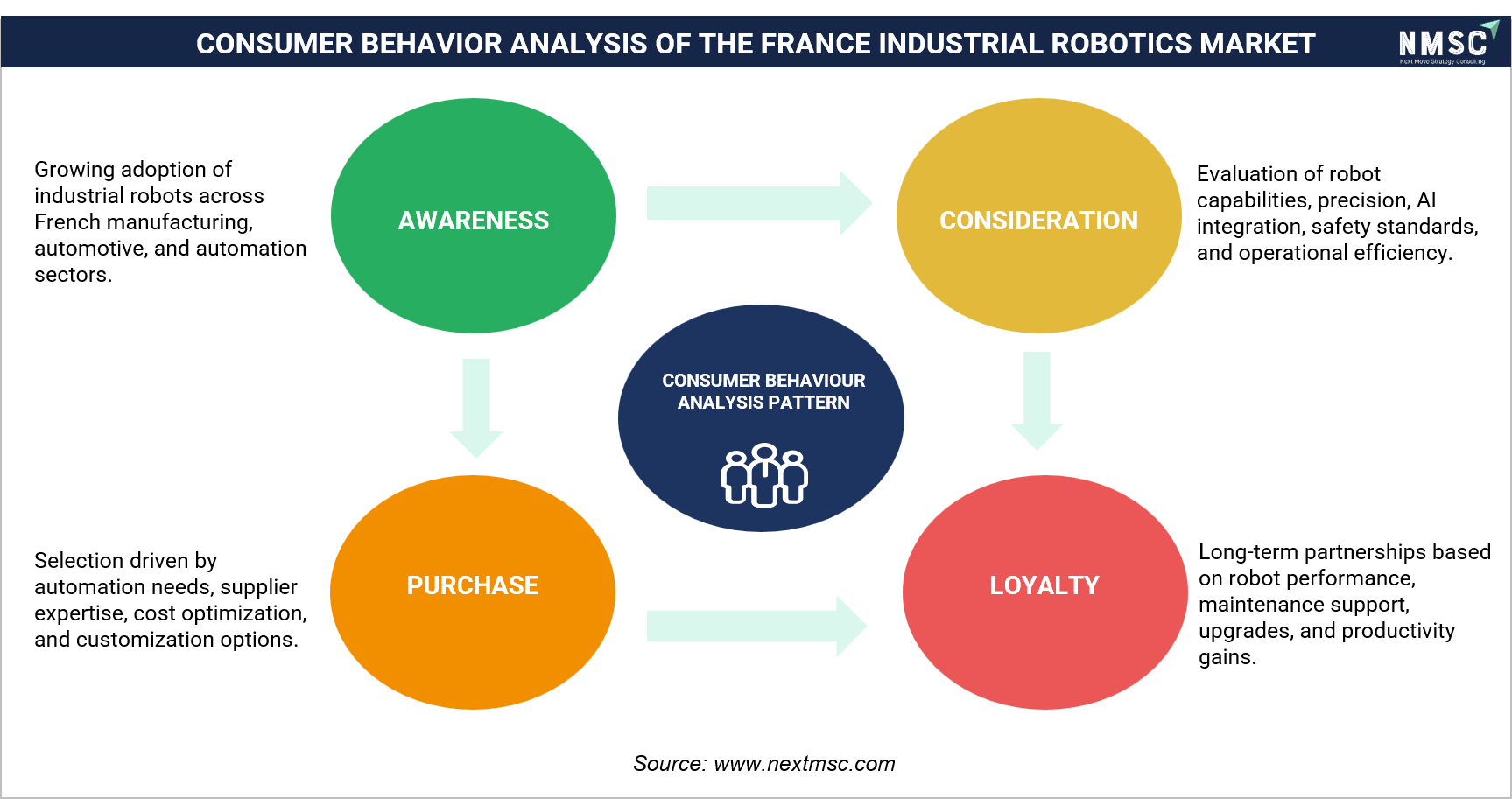
Consumer Behavior Analysis of the France Industrial Robotics Market :

Consumer Behavior Analysis of the France Industrial Robotics Market :

Our analysis shows that purchasing decisions in France industrial robotics market follow a structured journey from awareness and technical evaluation to procurement and long-term supplier loyalty. Furthermore, manufacturers prioritize precision, AI integration, safety compliance, operational efficiency, and customization before investing. As a result, reliable maintenance services, continuous upgrades, and strong supplier expertise foster lasting partnerships while supporting productivity improvements and sustained adoption of advanced industrial robotics solutions.

Investment Opportunities

What Capital Inflows Are Targeting the France Industrial Robotics Market?

Capital inflows into the France Industrial Robotics Market are increasingly directed toward collaborative robotics, mobile automation, and AI-enabled vision software. Leading global robot manufacturers continue to invest in local system integration capacity, service centers , and application engineering to support French automotive, electronics, and logistics customers. We observed that investors favor companies demonstrating strong software integration capabilities, established service networks, and diversified end-user exposure, viewing these attributes as key indicators of long-term market growth across France.

How Is Infrastructure Investment Supporting the France Industrial Robotics Market?

Infrastructure investment is expanding robot manufacturing, system integration, and training facilities across French industrial regions. Our findings suggest that companies are investing in local application engineering centers , demonstration facilities, and technician training programs to support faster commissioning and after-sales service. In addition, manufacturers are strengthening partnerships with automotive and logistics operators to enhance market penetration while responding more effectively to evolving automation requirements across France.

What ESG Considerations Are Shaping Investment Decisions in the France Industrial Robotics Market?

Environmental, social, and governance considerations are increasingly integral to investment decisions across the France Industrial Robotics Market, with energy-efficient robot design, workplace safety, and workforce reskilling emerging as key priorities. We found that investors increasingly favor companies demonstrating measurable progress in reducing robot energy consumption, improving human-robot collaboration safety, and supporting technician retraining programs. These initiatives strengthen brand reputation while supporting long-term value creation across France's evolving industrial automation sector.

Key Benefits for Stakeholders

How Does This Report Benefit Enterprise and Industry Leaders?

Enterprise and industry leaders gain access to validated segmentation, competitive benchmarking, and technology adoption analysis that support strategic planning, capital allocation, and automation roadmap development across the France Industrial Robotics Market. Our analysis shows that detailed assessments of robot type, offering, application, and end-user trends help manufacturers and integrators identify high-growth opportunities, strengthen market positioning, and develop effective long-term automation strategies.

How Does This Report Benefit Investors and Financial Analysts?

Investors and financial analysts benefit from consistent market size estimates, growth forecasts, and competitive assessments that support investment evaluation and capital allocation decisions across the France Industrial Robotics Market. We observed that the report's detailed analysis of collaborative robotics, mobile automation, and software segments enables stakeholders to identify companies and market categories with the strongest long-term growth potential through 2035.

How Does This Report Benefit Technology Vendors and Product Teams?

Technology vendors and product development teams gain valuable insights into emerging innovation trends, including AI-enabled vision, fleet management software, and simulation-based programming that are transforming French industrial automation. Our findings suggest that this analysis helps research and development teams prioritize future product pipelines, accelerate innovation initiatives, and align product offerings with evolving customer expectations across the France Industrial Robotics Market.

Key Market Segments Evaluated

By Robot Type

  • Articulated Robots
  • SCARA Robots
  • Cartesian and Gantry Robots
  • Delta Robots
  • Collaborative Robots
  • Autonomous Mobile Robots (AMRs)
  • Automated Guided Vehicles (AGVs)
  • Other Robots

By Offering

  • Hardware
  • Robot Arms
  • Controllers
  • End Effectors and Grippers
  • Sensors and Vision Systems
  • Software
  • Control and Programming Software
  • Simulation and Offline Programming Software
  • Fleet Management Software
  • Services
  • System Integration and Installation
  • Maintenance and Support
  • Training and Consulting

By Application

  • Handling
  • Pick and Place
  • Machine Tending
  • Palletizing and Depalletizing
  • Welding and Soldering
  • Assembly and Disassembly
  • Dispensing
  • Painting
  • Adhesive and Sealant Application
  • Processing
  • Cutting and Machining
  • Grinding and Polishing
  • Cleanroom Operations
  • Inspection and Quality Control
  • Packaging and Labeling
  • Intralogistics and Transport

By Mounting Type

  • Floor Mounted
  • Wall-Mounted
  • Ceiling Mounted
  • Rail Mounted

By Mobility

  • Stationary Robots
  • Mobile Robots

By Payload Capacity

  • Low Payload Up to 20 kg
  • Medium Payload 20 kg to 100 kg
  • High Payload 100 kg to 500 kg
  • Heavy Duty Payload Over 500 kg

By End User

  • Automotive Industry
  • Electrical and Electronics Industry
  • Metals and Machinery Industry
  • Food and Beverages Industry
  • Pharmaceuticals and Medical Devices Industry
  • Plastics Rubber and Chemicals Industry
  • Logistics and Warehousing
  • Other Industries

Conclusion & Recommendations

The long-term outlook for the France Industrial Robotics Market remains positive, supported by sustained labor cost pressures, expanding electric vehicle manufacturing, and continued government-backed industrial modernization initiatives. We observed that growing adoption of collaborative robots, autonomous mobile robots, and AI-enabled vision systems will continue to drive market expansion across automotive, electronics, and logistics segments throughout the forecast period.

What Strategic Positioning Should Robotics Companies Pursue?

Manufacturers should prioritize investments in collaborative robotics, simulation software, and local system integration capabilities while strengthening service networks across French industrial regions. Our assessment indicates that companies expanding flexible financing models, application-specific automation solutions, and AI-enabled vision offerings will be well positioned to capture demand from small and mid-sized manufacturers within the France Industrial Robotics Market.

How Attractive Is the France Industrial Robotics Market for New Investment?

The France Industrial Robotics Market presents an attractive investment opportunity, supported by rising automation spending, expanding electric vehicle and battery manufacturing, and continued innovation in collaborative and mobile robotics. We found that investment potential is particularly strong for companies focused on AI-enabled vision, fleet management software, and flexible financing models, enabling them to capitalize on evolving customer preferences and long-term market growth.

What Market Shifts and Key Risks Should Stakeholders Monitor?

Stakeholders should closely monitor evolving automation technology standards, shortages of qualified robotics integration technicians, and fluctuations in component and semiconductor supply chains. Our analysis shows that companies unable to continuously innovate, expand service capacity, or address integration cost barriers may face increasing competitive pressure within the France Industrial Robotics Market.

What Are the Key Growth Pathways for the France Industrial Robotics Market?

Key growth pathways include expanding collaborative and mobile robot portfolios, accelerating innovation in AI-enabled vision and simulation software, strengthening flexible financing models, and enhancing local system integration capabilities. NMSC's analysis indicates that companies successfully combining hardware reliability, software-driven flexibility, and strong service networks will be best positioned to capture the France Industrial Robotics Market's projected growth through 2035.

FAQs

About the Author

Mayurima Roy

Mayurima Roy

Mayurima Roy is Research Analyst at Next Move Strategy Consulting, where she has spent 4 years working across the firm's full industry coverage rather than a single fixed vertical. Her work centers on structured research, ongoing trend tracking, competitive assessment, and insight-led content development, translating complex market data into clear, decision-ready narratives that support informed client decision-making across diverse global industries, market sectors, and world regions every day.

About the Reviewer

Supradip Baul

Supradip Baul

Supradip Baul is an accomplished business consultant and strategist with over a decade of rich experience in market intelligence, strategy, technology, and business transformation. His work has included rigorous qualitative and quantitative analysis across multiple industries, helping clients shape investment decisions and long-term roadmaps. Earlier in his career, he was associated with Gartner, where he contributed to industry-leading reports and market share analyses. He has worked with leading global companies and holds an MBA with a dual specialization in Marketing and Finance.

Henri Knyphausen

HENRI KNYPHAUSEN

Partner at Singulier [Ex-BCG]

Singulier

I recently engaged NEXTMSC.com for a commercial due diligence project within the intralogistics sector, and I am pleased to provide a reference based on my experience. In utilizing NEXTMSC.com's services, I found their report to offer valuable insights into market dynamics and key industry players. The initial report provided a solid foundation for our analysis. However, as we were investigating a smaller target in the market, and I had specific customization requests requiring additional research. These requests included detailed information on product portfolios of various players and sub-market sizes, both inclusive and exclusive of certain product categories. NEXTMSC.com demonstrated commendable responsiveness and agility in accommodating these customization requests. Within a timeframe of 1-2 weeks, they delivered a revised report that met our specific needs. Furthermore, they were receptive to my follow-up inquiries, ensuring clarity and understanding of the data provided. The final deliverable significantly contributed to our due diligence efforts. One of NEXTMSC.com's notable strengths lies in their qualitative research capabilities. However, for future engagements, I would recommend the inclusion of a quantified market model in Excel format. Such a model would offer the ability to conduct in-depth analyses and explore various market segments, including country-specific data and subcomponent breakdowns. Based on my positive experience, I would not hesitate to work with NEXTMSC.com again. Their responsiveness, willingness to accommodate customization requests, and commitment to delivering actionable insights make them a reliable partner for commercial research projects.


Nishant Awate

NISHANT AWATE

Business Development Global Sales

Zehnder Group Deutschland GmbH

Our experience working with Next Move Strategy Consulting was positive. The team was responsive, professional, and open to incorporating our specific requirements throughout the project. The India AHU market study was comprehensive and well structured, covering market value and volume forecasts, product and application segments, and key industry trends. The inclusion of both AHU and residential MVHR market insights made the study particularly relevant for our strategic market assessment. Overall, the report provides a solid foundation for evaluating market potential, identifying priority segments, and supporting business-development decisions in India.

Rishabh Jogani

RISHABH JOGANI

Strategy Analyst

Accenture Japan

We are incredibly impressed with the market report on the real estate market in India provided by Next Move Strategy Consulting. The report was thorough, insightful, and well-structured, offering deep analysis and actionable recommendations. It not only captured the current trends and dynamics but also provided a forward-looking perspective that has been invaluable for our strategic planning. Their team demonstrated exceptional professionalism, attention to detail, and a profound understanding of the industry. The data-driven insights and clarity of presentation exceeded our expectations, making complex market trends easy to understand. We highly recommend Next Move Strategy Consulting to anyone looking for reliable and comprehensive market research services. Their expertise has given us the confidence to navigate the complexities of the Indian real estate market with clarity and foresight.

Kishu Kanda

KISHU KANDA

Strategy Analyst

Accenture

We purchased the AI Consumer Market Report from this company. Not only did they customize the report to meet our specific requirements, but they also showed great flexibility in accommodating our budget. The report we received fully met our expectations. Additionally, they provided prompt and thorough responses to both our pre-purchase and follow-up questions. We look forward to working with this company again in the future.

Robert Sean Trevino

ROBERT SEAN TREVINO

Sr. Director, Head of Strategic Insights & Analytics

Foundation Medicine

I realized that it was a reliable source of information. These days, there are many people who are looking for authentic data, and this is one of the only sources that can offer them with what they need;

Custom Market Research Services

We will customize the research for you if the listed report does not fully match your requirements.

Get 30% Free Customization

Select License

This website uses cookies to ensure you get the best experience on our website. Learn more

✖