Nigeria Industrial Robotics Market Size, Share, Trends and Growth Analysis, By Robot Type (Articulated Robots, SCARA Robots, Cartesian and Gantry Robots, Delta Robots, Collaborative Robots, Autonomous Mobile Robots (AMRs), Automated Guided Vehicles (AGVs), and Other Robots), By Offering (Hardware, Software, and Services), By Application (Handling, Welding and Soldering), By Mounting Type, By Mobility, By Payload Capacity, By End User – Opportunity Analysis & Industry Forecast, 2025–2035
Industry: Construction & Manufacturing | Latest Edition: September 30, 2026 | No of Pages: 268 | No. of Tables: 144 | No. of Figures: 130 | Format: PDF | Report Code: CM5944
What Is the Nigeria Industrial Robotics Market Size?
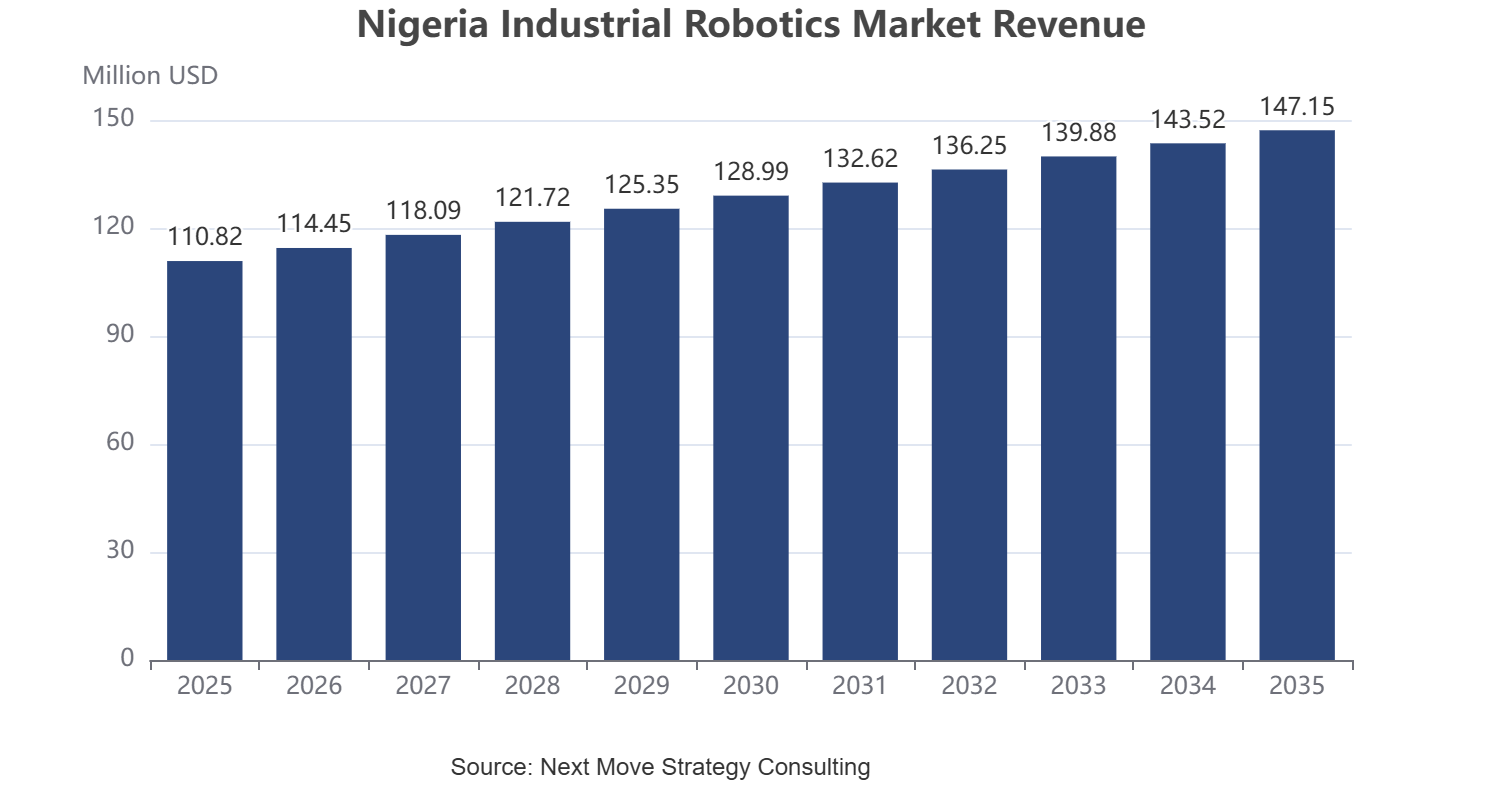
The Nigeria Industrial Robotics Market size was valued at USD 110.82 million in 2025 and is estimated at USD 115.40 million in 2026, forecast to reach USD 147.15 million by 2035, expanding at a 2.74% CAGR between 2026 and 2035. Articulated robots dominate the market by robot type, reflecting steady deployment across food and beverage and cement processing lines.
In unit terms, deployed robot volume is estimated at 2 thousand units in 2025 and 2 thousand units in 2026, rising to 3 thousand units by 2035 at a 4.14% CAGR between 2026 and 2035, a faster expansion rate than the value CAGR that reflects growing deployment of lower-cost collaborative robots relative to larger industrial systems.
We observed that market growth is supported by gradual manufacturing modernization, rising government investment in local precision manufacturing capability, and growing demand for packaging and handling automation among Nigeria’s food, beverage, and consumer goods producers through 2035.
Key Takeaways
|
Key Takeaways |
|
By Robot Type: Articulated Robots is the dominant segment, while Collaborative Robots is the fastest-growing segment. |
|
By Offering: Hardware is the dominant segment, while Services is the fastest-growing segment. |
|
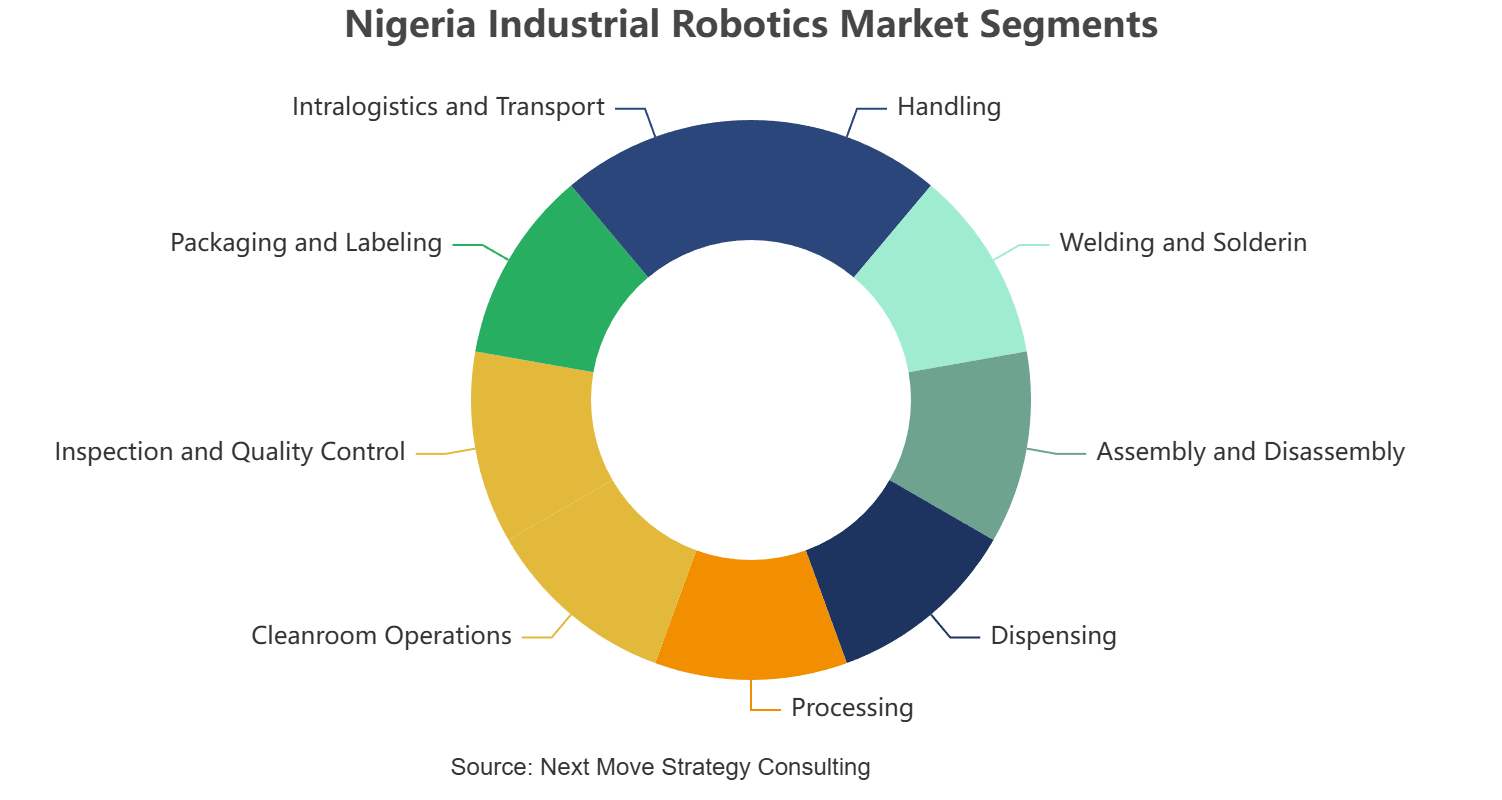
By Application: Handling is the dominant segment, while Inspection and Quality Control is the fastest-growing segment. |
|
By Mounting Type: Floor Mounted is the dominant segment, while Wall-Mounted is the fastest-growing segment. |
|
By Mobility: Stationary Robots is the dominant segment, while Mobile Robots is the fastest-growing segment. |
|
By Payload Capacity: Medium Payload 20 kg to 100 kg is the dominant segment, while Low Payload Up to 20 kg is the fastest-growing segment. |
|
By End User: Automotive Industry is the dominant segment, while Food and Beverages Industry is the fastest-growing segment. |
Market Opportunity: The Nigeria industrial robotics market is expected to create an absolute dollar opportunity of USD 31.75 million between 2026 and 2035, presenting measured investment potential across collaborative robotics, packaging automation, and local system integration services.
According to NMSC’s analysis, companies are increasingly investing in local system integration and technician training capacity to support first-time automation adopters, strengthening their competitive position in the Nigeria industrial robotics market through 2035.
SWOT Analysis of the Nigeria Industrial Robotics Industry:
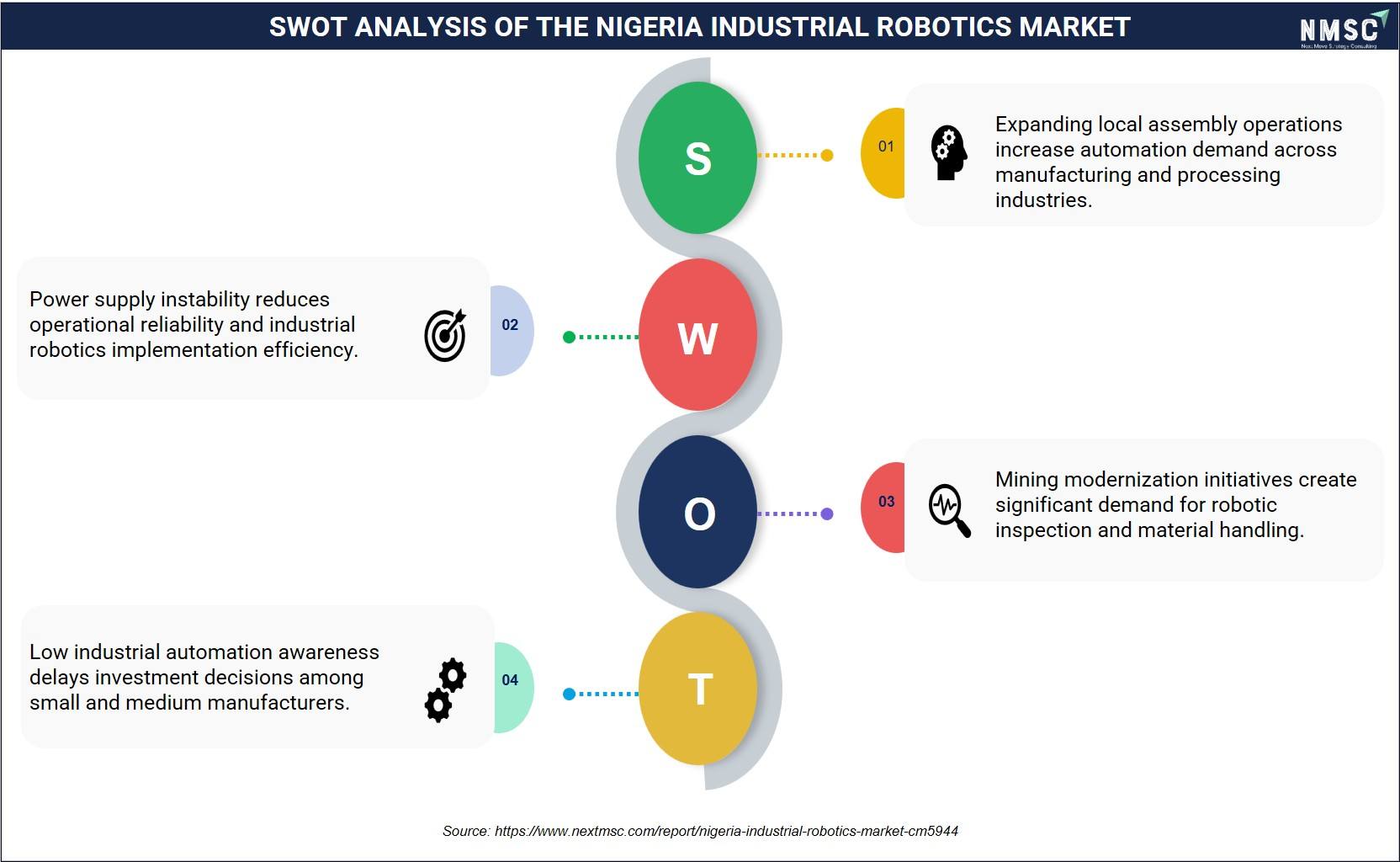
Based on NMSC’s research, we found that the Nigeria Industrial Robotics Industry is supported by expanding local assembly activities and mining modernization initiatives, creating new opportunities for automation adoption. Moreover, industrial transformation is encouraging demand across manufacturing sectors. However, unstable power infrastructure and limited awareness of advanced robotics continue to restrict implementation. Therefore, overcoming these operational barriers will be essential to strengthen investment confidence and accelerate sustainable market growth.
What Does the Nigeria Industrial Robotics Market Encompass?
The Nigeria industrial robotics market report encompasses articulated, SCARA, Cartesian and gantry, delta, collaborative, and mobile robotic systems deployed across handling, welding, assembly, dispensing, processing, and packaging operations. Our assessment indicates that the market includes hardware components such as robot arms, controllers, end effectors, and vision systems, alongside programming software and system integration services delivered by multinational manufacturers and local integrators serving Nigeria’s food and beverage, cement, and plastics and chemicals manufacturing base.
Nigeria’s National Agency for Science and Engineering Infrastructure and the Manufacturers Association of Nigeria shape industrial policy, local capability development, and standards awareness affecting robotic deployment nationwide. We observed that manufacturers are gradually investing in handling and packaging automation to improve production consistency and reduce reliance on manual labor in high-volume processing lines. NMSC’s analysis indicates that government-backed precision manufacturing initiatives continue to lay early-stage groundwork for broader robotics adoption across the Nigeria industrial robotics market.
|
Parameters |
Details |
|
Market Size in 2025 |
USD 110.82 Million |
|
Market Size in 2026 |
USD 115.40 Million |
|
Revenue Forecast in 2035 |
USD 147.15 Million |
|
Growth Rate |
CAGR of 2.74% from 2026 to 2035 |
|
Market Volume in 2025 |
2 Thousand Units |
|
Market Volume in 2026 |
2 Thousand Units |
|
Volume Forecast in 2035 |
3 Thousand Units |
|
Volume Growth Rate |
CAGR of 4.14% from 2026 to 2035 |
|
Analysis Period |
2025–2035 |
|
Base Year Considered |
2025 |
|
Forecast Period |
2026–2035 |
|
Market Size Estimation |
Revenue (USD Million) |
|
Companies Profiled |
10 |
|
Market Share |
Available for Top 10 Companies |
Key Emerging Trends
Based on research conducted by NMSC, we found that four structural trends are reshaping robot deployment, local capability building, and competitive dynamics across the Nigeria industrial robotics market.
How Is Government-Backed Precision Manufacturing Infrastructure Supporting Robotics Adoption?
The National Agency for Science and Engineering Infrastructure is expanding local precision manufacturing capability through its Centre of Excellence for Precision Manufacturing in Abuja, established under the Federal Government’s Renewed Hope Agenda. We observed that this facility addresses Nigeria’s historical dependence on imported precision-engineered components. This trend is gradually building domestic technical capacity that supports future robotics integration and maintenance across Nigerian manufacturing facilities.
Why Is Packaging Automation Gaining Priority Among Food and Beverage Producers?
Nigeria’s food, beverage, and consumer goods manufacturers are increasingly prioritizing handling and packaging automation to improve production consistency and meet rising domestic demand. Our findings suggest that producers are adopting articulated and SCARA robots for palletizing and labeling tasks to reduce dependency on manual processes. This trend is expanding automation adoption within Nigeria’s largest manufacturing subsector beyond its traditional reliance on labor-intensive production lines.
How Is Local Capacity Development Shaping Technical Education for Automation?
Nigerian academic and industry stakeholders are calling for expanded technical and vocational education covering robotics and computer-aided manufacturing to support Industry 4.0 readiness. We observed that recommendations presented at engineering forums call for updated technical college curricula incorporating robotics and CAD/CAM training by the third quarter of 2026. This trend is gradually building the skilled workforce needed to support long-term robotics deployment across Nigerian industry.
What Role Do Multinational Automation Suppliers Play in Market Development?
Global automation and robotics suppliers continue to expand their presence in Nigeria through local distribution and technical support arrangements serving oil and gas, cement, and manufacturing customers. Our analysis indicates that these suppliers are forging partnerships with local entities to accelerate technology adoption and build industrial competence. This trend is reinforcing access to internationally proven robotics technology within Nigeria’s developing industrial automation ecosystem.
Growth Drivers and Restraints
Growth Catalyst and Risk Assessment Matrix
|
Factors |
Type |
(+/−) % Impact On CAGR Forecast |
Geographic Relevance |
Impact Timeline |
|
Gradual manufacturing modernization among food, beverage, and cement producers increasing demand for handling and packaging automation |
Driver |
+1.05% |
Nigeria (strongest in Lagos and Ogun industrial clusters) |
2026–2032 |
|
Government-backed precision manufacturing infrastructure development supporting local technical capability |
Driver |
+0.75% |
Nigeria (strongest in Abuja and surrounding industrial zones) |
2026–2033 |
|
Expanding petrochemical and plastics processing capacity increasing demand for processing and dispensing automation |
Driver |
+0.60% |
Nigeria (strongest near Lagos and Niger Delta refining hubs) |
2026–2031 |
|
Growing multinational automation supplier presence improving access to proven robotics technology and technical support |
Driver |
+0.45% |
Nigeria (nationwide) |
2026–2030 |
|
Rising collaborative robot affordability lowering entry barriers for small and mid-sized manufacturers |
Driver |
+0.38% |
Nigeria (nationwide) |
2026–2034 |
|
Limited domestic technical workforce and integration expertise constraining deployment pace and after-sales support |
Restraint |
−0.85% |
Nigeria (nationwide; strongest outside Lagos and Abuja) |
2026–2030 |
|
High import costs and currency volatility increasing the landed cost of robotic hardware and spare parts |
Restraint |
−0.68% |
Nigeria (nationwide) |
2026–2029 |
|
Unreliable power supply infrastructure raising operational costs for automated production facilities |
Restraint |
−0.52% |
Nigeria (nationwide; strongest outside major industrial hubs) |
2026–2031 |
What Is the Primary Growth Driver of the Nigeria Industrial Robotics Market?
Gradual manufacturing modernization among Nigeria’s food, beverage, and cement producers is the primary growth driver of the market. According to the Manufacturers Association of Nigeria, which represents more than 2,500 manufacturing companies across the country, members continue to prioritize productivity improvements and standards compliance to remain competitive. We observed that producers are prioritizing handling and packaging automation investments to improve production consistency and meet rising domestic consumer demand.
How Is Government Infrastructure Investment Driving Nigeria Industrial Robotics Market Growth?
Government-backed precision manufacturing infrastructure development is gradually supporting industrial robotics adoption across Nigeria. Our assessment indicates that the National Agency for Science and Engineering Infrastructure operates advanced manufacturing centres offering CNC machining, metrology, and testing facilities on a fee-for-service basis, allowing manufacturers to access precision engineering capability without major capital expenditure. This infrastructure is reinforcing early-stage technical capacity needed to support broader robotics integration across Nigerian industry.
What Is Restraining Nigeria Industrial Robotics Market Expansion?
Limited domestic technical workforce and integration expertise, combined with high import costs and currency volatility, continue to restrain market expansion across Nigeria. We found that unreliable power supply infrastructure further raises operational costs for automated production facilities outside major industrial hubs. These constraints slow automation adoption despite growing underlying demand for productivity improvement among Nigerian manufacturers.
Segmentation Analysis
By Robot Type Insights
How Is the Nigeria Industrial Robotics Market Segmented by Robot Type?
Based on robot type, the market is segmented into articulated robots, SCARA robots, Cartesian and gantry robots, delta robots, collaborative robots, autonomous mobile robots (AMRs), automated guided vehicles (AGVs), and other robots.
Articulated robots dominate the market, reflecting their versatility across handling, palletizing, and packaging applications in food, beverage, and cement processing facilities, where multi-axis flexibility supports varied production tasks. Collaborative robots represent the fastest-growing segment as manufacturers seek lower-cost, easier-to-deploy automation that requires less specialized integration expertise than traditional caged systems. SCARA and Cartesian robots continue supporting packaging and assembly tasks, while autonomous mobile robots remain a nascent category gradually gaining interest within Nigeria’s logistics and warehousing operations.
By End User Insights
How Is the Nigeria Industrial Robotics Market Segmented by End User?
Based on end user, the market is segmented into automotive, electrical and electronics, metals and machinery, food and beverages, pharmaceuticals and medical devices, plastics rubber and chemicals, logistics and warehousing, and other industries.
The food and beverages industry dominates the market, reflecting its position as Nigeria’s largest manufacturing subsector and its reliance on handling, palletizing, and packaging automation to meet rising domestic consumption. The plastics rubber and chemicals industry is the fastest-growing end user, supported by expanding petrochemical processing capacity and rising demand for processing and dispensing automation. Metals and machinery and pharmaceuticals continue to gradually broaden robotics adoption as automation extends across Nigeria’s developing industrial base.
Growth Opportunities
Our analysis shows that three forward-looking opportunities stand out for stakeholders operating in the Nigeria industrial robotics market over the 2026–2035 forecast period.
How Can Collaborative Robot Affordability Unlock New Growth Opportunities?
Declining collaborative robot prices present a significant opportunity for providers targeting small and mid-sized Nigerian manufacturers constrained by capital budgets and technical expertise. Companies offering simplified, lower-cost cobot deployment can accelerate automation adoption across food processing and general packaging segments previously priced out of robotics investment.
Where Does Local System Integration Capacity Create New Demand?
Limited domestic integration expertise creates substantial opportunity for companies that expand technician training pipelines and local service coverage. Providers that build regional support networks, including partnerships with government-backed precision manufacturing centres, can capture higher-value integration contracts as manufacturers seek reliable after-sales support for automation investments.
How Can Packaging Automation Benefit from Rising Consumer Goods Demand?
Growing domestic consumption of food, beverage, and consumer goods products is creating sustained demand for packaging and labeling automation. Companies that offer application-specific robotic packaging solutions tailored to Nigerian production volumes can capture demand from producers seeking to improve consistency and scale output to meet expanding domestic markets.
Competitive Landscape
We observed that the Nigeria industrial robotics market features a developing competitive landscape, with global automation manufacturers supplying the market through local distribution partners and system integrators across the industry.
Key Takeaways
|
Dimension |
Description |
|
Market Structure |
Developing and import-dependent, with global manufacturers supplying the market through local distribution and integration partners serving food and beverage, cement, and petrochemical processing facilities. |
|
Innovation Focus |
Handling and packaging automation, collaborative robotics, and local technical training programs dominate current market development priorities among leading suppliers. |
|
M&A Ac
|
Distribution partnerships and local capability-building initiatives, including engagement with government-backed precision manufacturing infrastructure, continue to shape competitive positioning across Nigeria. |
How Do Companies Compete in the Nigeria Industrial Robotics Market?
Companies compete primarily through distribution reach, after-sales technical support, and total cost of ownership given Nigeria’s import-dependent supply chain. Leading manufacturers such as ABB Nigeria Limited, FANUC Corporation, and OMRON Corporation leverage established distribution networks and multinational service capabilities to maintain market presence, while suppliers including YASKAWA Electric Corporation and KUKA AG differentiate through application engineering support for food, beverage, and processing customers.
Which Competitive Archetypes Dominate the Nigeria Industrial Robotics Market?
Two primary competitive archetypes characterize the market. The first comprises diversified global automation manufacturers offering broad industrial robot and control system portfolios, including ABB Nigeria Limited, FANUC Corporation, Siemens AG, and Schneider Electric SE. The second includes collaborative and specialty robotics suppliers such as Universal Robots A/S and Mitsubishi Electric Corporation, which focus on lower-cost, application-specific automation for smaller Nigerian manufacturers entering automation for the first time.
How Are Companies Differentiating Through Innovation in the Nigeria Industrial Robotics Industry?
Innovation strategies increasingly focus on collaborative robotics, simplified programming interfaces, and local technical training to reduce integration complexity for first-time automation adopters. Companies are investing in distributor training programs and remote technical support to address Nigeria’s limited domestic integration workforce. Our analysis indicates that suppliers combining reliable hardware with accessible local support are strengthening competitive positioning across Nigeria’s developing industrial base.
What M&A and Expansion Activity Is Shaping the Nigeria Industrial Robotics Market?
Distribution partnerships and local capability-building initiatives continue to shape competition across the market, including supplier engagement with government-backed precision manufacturing infrastructure. Leading companies are strengthening local distributor networks and technical training programs, enabling faster deployment support and closer alignment with expanding food and beverage, cement, and petrochemical processing requirements across Nigeria.
Key Market Players
Our assessment indicates that the following 10 companies are actively shaping product distribution, technical support, and competitive dynamics within the Nigeria industrial robotics industry.
-
FANUC Corporation
-
OMRON Corporation
-
YASKAWA Electric Corporation
-
Honeywell International Inc.
-
KUKA AG
-
Mitsubishi Electric Corporation
-
Schneider Electric SE
-
Siemens AG
Consumer Behavior Analysis of the Nigeria Industrial Robotics Industry:
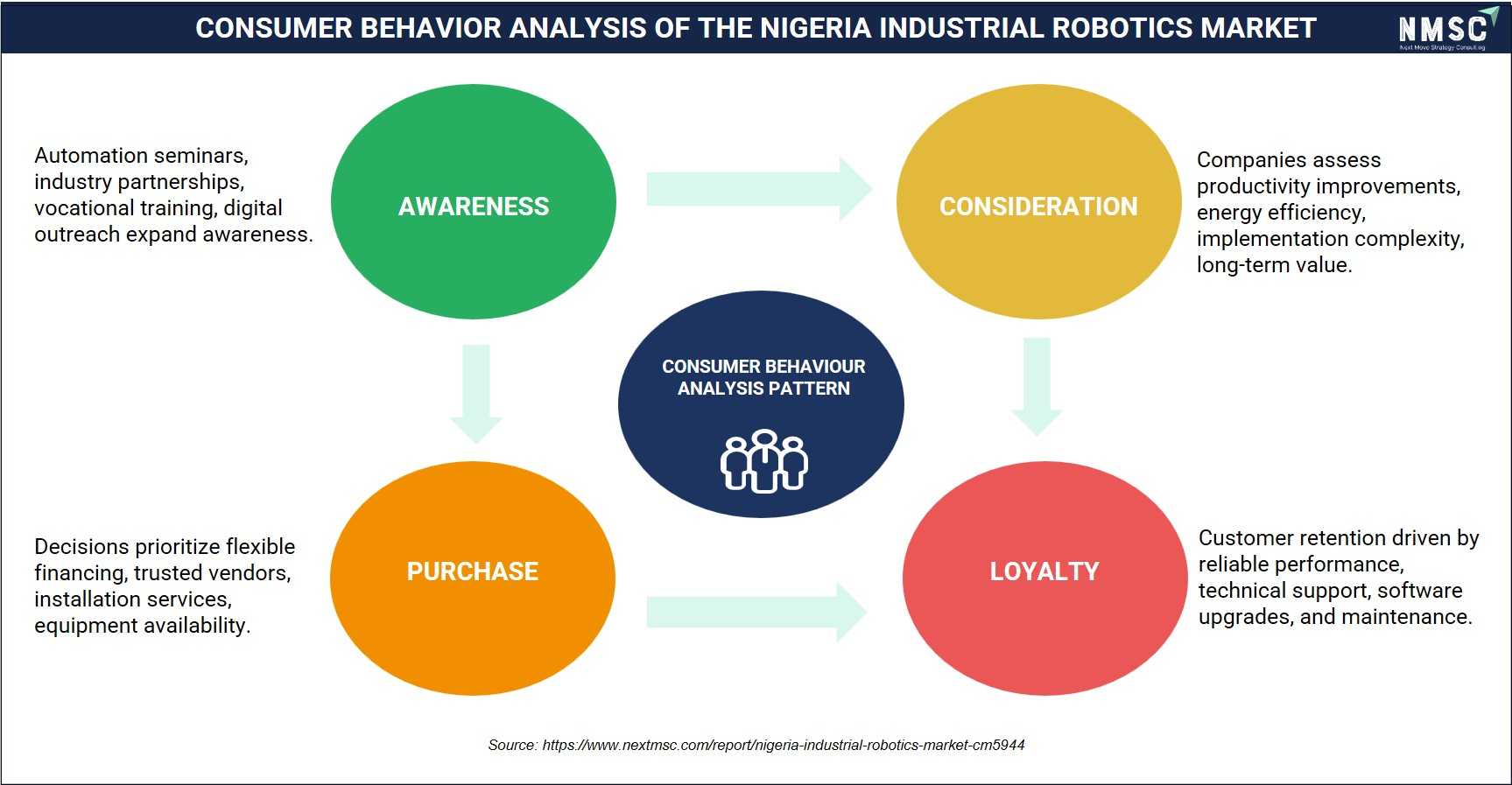
Our assessment indicates that purchasing decisions in the Nigeria Industrial Robotics Industry are shaped by awareness programs, industry collaborations, and practical evaluations of productivity, energy efficiency, and long-term operational value. Additionally, buyers prefer trusted vendors offering flexible financing, installation expertise, and dependable equipment availability. Consequently, reliable performance, responsive technical support, regular software upgrades, and comprehensive maintenance services play a vital role in improving customer satisfaction and encouraging long-term loyalty.
Investment Opportunities
What Capital Inflows Are Targeting the Nigeria Industrial Robotics Market?
Capital inflows into the market remain concentrated in government-backed precision manufacturing infrastructure and multinational supplier distribution expansion. Federal initiatives under the Renewed Hope Agenda continue to channel investment toward local manufacturing capability development. We observed that investors favor companies demonstrating established distribution networks, reliable after-sales technical support, and application expertise across Nigeria’s food, beverage, and petrochemical processing sectors as indicators of long-term growth potential.
How Is Infrastructure Investment Supporting the Nigeria Industrial Robotics Market?
Infrastructure investment is gradually expanding precision manufacturing capacity, technical training facilities, and local distribution networks across Nigeria’s industrial regions. Our findings suggest that government-backed centres offering shared CNC machining, metrology, and testing capabilities are helping local manufacturers access precision engineering resources without major capital expenditure. These investments strengthen the technical foundation needed to support broader robotics deployment across Nigerian manufacturing facilities.
What ESG Considerations Are Shaping Investment Decisions in the Nigeria Industrial Robotics Market?
Environmental, social, and governance considerations are gradually gaining relevance in Nigeria’s industrial robotics market, with workforce upskilling, energy reliability, and local capacity building emerging as key priorities. We found that government-backed technical education initiatives calling for expanded robotics and CAD/CAM curricula reflect growing emphasis on workforce development. Investors increasingly favor companies demonstrating measurable commitment to local technical training and sustainable operational practices amid Nigeria’s developing industrial automation ecosystem.
Key Benefits for Stakeholders
How Does This Report Benefit Enterprise and Industry Leaders?
Enterprise and industry leaders gain access to validated market segmentation, competitive benchmarking, and technology adoption analysis that support strategic planning and automation investment decisions across the Nigeria industrial robotics market. Our analysis shows that detailed assessments of robot type, application, and end-user trends help companies identify emerging opportunities and strengthen long-term manufacturing competitiveness.
How Does This Report Benefit Investors and Financial Analysts?
Investors and financial analysts benefit from consistent market size estimates, growth forecasts, and competitive assessments supporting investment evaluation across the Nigeria industrial robotics market. We observed that the report’s detailed analysis of packaging automation, collaborative robotics, and government-backed infrastructure initiatives enables stakeholders to identify companies positioned for long-term growth through 2035.
How Does This Report Benefit Technology Vendors and Product Teams?
Technology vendors and product development teams gain valuable insights into emerging adoption trends, including collaborative robotics, packaging automation, and local technical capability development shaping Nigeria’s industrial automation landscape. Our findings suggest that this analysis helps research and development teams prioritize distribution strategies and align offerings with evolving manufacturer requirements in a developing market.
Key Market Segments
By Robot Type
-
Articulated Robots
-
SCARA Robots
-
Cartesian and Gantry Robots
-
Delta Robots
-
Collaborative Robots
-
Autonomous Mobile Robots (AMRs)
-
Automated Guided Vehicles (AGVs)
-
Other Robots
By Offering
-
Hardware
-
Robot Arms
-
Controllers
-
End Effectors and Grippers
-
Sensors and Vision Systems
-
-
Software
-
Control and Programming Software
-
Simulation and Offline Programming Software
-
Fleet Management Software
-
-
Services
-
System Integration and Installation
-
Maintenance and Support
-
Training and Consulting
-
By Application
-
Handling
-
Pick and Place
-
Machine Tending
-
Palletizing and Depalletizing
-
Welding and Soldering
-
Assembly and Disassembly
-
-
Dispensing
-
Painting
-
Adhesive and Sealant Application
-
-
Processing
-
Cutting and Machining
-
Grinding and Polishing
-
Cleanroom Operations
-
-
Inspection and Quality Control
-
Packaging and Labeling
-
Intralogistics and Transport
By Mounting Type
-
Floor Mounted
-
Wall-Mounted
-
Ceiling Mounted
-
Rail Mounted
By Mobility
-
Stationary Robots
-
Mobile Robots
By Payload Capacity
-
Low Payload Up to 20 kg
-
Medium Payload 20 kg to 100 kg
-
High Payload 100 kg to 500 kg
-
Heavy Duty Payload Over 500 kg
By End User
-
Automotive Industry
-
Electrical and Electronics Industry
-
Metals and Machinery Industry
-
Food and Beverages Industry
-
Pharmaceuticals and Medical Devices Industry
-
Plastics Rubber and Chemicals Industry
-
Logistics and Warehousing
-
Other Industries
Conclusion and Recommendations
What Is the Long-Term Outlook for the Nigeria Industrial Robotics Market?
The long-term outlook for the Nigeria industrial robotics market remains steady, supported by gradual manufacturing modernization, government-backed precision manufacturing infrastructure, and rising packaging automation demand. We observed that continued growth in food, beverage, and petrochemical processing will drive market expansion from USD 115.40 million in 2026 to USD 147.15 million by 2035 across handling, packaging, and processing applications.
What Strategic Positioning Should Robotics Companies Pursue?
Manufacturers should prioritize investments in local distribution networks, technician training programs, and application-specific packaging automation while strengthening after-sales support capacity. Our assessment indicates that companies expanding collaborative robot affordability and local integration partnerships will be well positioned to capture growing demand from first-time automation adopters across Nigeria.
How Attractive Is the Nigeria Industrial Robotics Market for New Investment?
The Nigeria industrial robotics market presents a measured investment opportunity, supported by a projected 2.74% CAGR between 2026 and 2035, gradual manufacturing modernization, and government-backed technical infrastructure development. We found that investment potential is particularly relevant for companies focused on collaborative robotics, packaging automation, and local system integration services capable of addressing Nigeria’s developing industrial base.
What Market Shifts and Key Risks Should Stakeholders Monitor?
Stakeholders should closely monitor limited domestic technical workforce availability, high import costs and currency volatility, and unreliable power supply infrastructure affecting automated production facilities. Our analysis shows that companies unable to expand local technical support capacity or manage import cost exposure may face increasing competitive pressure within the Nigeria industrial robotics market.
What Are the Key Growth Pathways for the Nigeria Industrial Robotics Market?
Key growth pathways include expanding collaborative robot affordability for small and mid-sized manufacturers, strengthening local system integration and technical training capacity, and deepening packaging automation adoption among food and beverage producers. NMSC’s analysis indicates that companies combining reliable distribution networks with local technical support will be best positioned to capture the market’s projected growth through 2035.
About the Author
 Mihul Sharma
— Mihul Sharma is Research Associate at Next Move Strategy Consulting, where he has covered technology, industrial, and healthcare markets for 3 years. His work applies structured business research, market analysis, and secondary-source review to assess market trends, competitive developments, and growth opportunities. He supports report development by fully synthesizing industry data, company information, and market signals into concise findings for strategy and investment-focused research teams.
Mihul Sharma
— Mihul Sharma is Research Associate at Next Move Strategy Consulting, where he has covered technology, industrial, and healthcare markets for 3 years. His work applies structured business research, market analysis, and secondary-source review to assess market trends, competitive developments, and growth opportunities. He supports report development by fully synthesizing industry data, company information, and market signals into concise findings for strategy and investment-focused research teams.
About the Reviewer
 Supradip Baul
— Supradip Baul is an accomplished business consultant and strategist with over a decade of rich experience in market intelligence, strategy, technology, and business transformation. His work has included rigorous qualitative and quantitative analysis across multiple industries, helping clients shape investment decisions and long-term roadmaps. Earlier in his career, he was associated with Gartner, where he contributed to industry-leading reports and market share analyses. He has worked with leading global companies and holds an MBA with a dual specialization in Marketing and Finance.
Supradip Baul
— Supradip Baul is an accomplished business consultant and strategist with over a decade of rich experience in market intelligence, strategy, technology, and business transformation. His work has included rigorous qualitative and quantitative analysis across multiple industries, helping clients shape investment decisions and long-term roadmaps. Earlier in his career, he was associated with Gartner, where he contributed to industry-leading reports and market share analyses. He has worked with leading global companies and holds an MBA with a dual specialization in Marketing and Finance.
At Next Move Strategy Consulting, we understand that insightful market research is the cornerstone of successful business decisions. That's why we employ a robust and multifaceted approach, combining various methodologies to deliver the most accurate and actionable data for our clients.

Research Landscape
We navigate the world of research with two primary approaches:
Qualitative Approach
Our qualitative research methodologies involve immersive techniques such as in-depth interviews, focus groups, and observational studies. By engaging directly with individuals and stakeholders, we uncover valuable insights that quantitative data alone may overlook.

Quantitative Research
In tandem with qualitative methodologies, NMSC leverages the power of Quantitative Research to provide a robust foundation of numerical insights. Through systematic data collection and analysis, we quantify patterns, preferences, and market trends, offering a comprehensive view of the business landscape.
Our quantitative research approach employs diverse tools, including surveys, experiments, and statistical modelling. These methodologies enable us to gather data from a large and representative sample, ensuring the statistical significance of our findings. By employing structured questionnaires and standardized data collection methods, we guarantee the reliability and validity of the information we present to our clients.
Quantitative research is particularly effective in measuring the prevalence of trends, assessing market size, and gauging the impact of various factors on consumer behavior. The numerical precision attained through this approach equips our clients with actionable insights, facilitating data-driven decision-making and strategy formulation.


Our Specialized Toolbox for Industry-Specific Market Research
We deploy a specialized arsenal of techniques tailored to meet your unique requirements. Here's a glimpse into our comprehensive toolbox:

Information Procurement
The stage entails acquiring market data or relevant information through various sources and methodologies.


Market Research Approach
We utilize both top-down and bottom-up approaches in market research analysis to achieve a comprehensive understanding of the market dynamics, leveraging the broad perspective of industry trends and macroeconomic factors alongside detailed insights from specific segments and individual companies.

Porters Five Forces Analysis
We conduct Porter's Five Forces analysis to evaluate the competitive landscape of an industry, providing us with insights into factors that affect profitability and strategic positioning.

SWOT Analysis

Forecasting
We utilize a forecasting model to predict future consumption by considering parameters like population, economics, regulations, market competition, drivers, constraints, technology, and pricing. We also employ statistical techniques such as multilinear regression, exponential smoothing, moving average, ARIMA, and Monte Carlo simulations for accurate predictions. In econometric forecasting, we analyzed short-term and long-term event impacts, attributing values based on regulatory frameworks, economic factors, and market events.





 Speak to Our Analyst