Carbon Fiber Wheels Market Global Industry Analysis and Forecast (2026-2035)

Carbon Fiber Wheels Market size was USD 947.2 million in 2026, projected to reach USD 2,778.3 million by 2035, growing at a CAGR of 12.7% from 2026 to 2035. Key drivers include rising electric bicycle adoption, expanding automotive OEM lightweighting demand, and growing motorsport technology transfer, with Europe leading the market.

Download Free Sample PDF
Base Year (2025)
$840.5 Million
Forecast (2035)
$2,778.3 Million
CAGR (2026-2035)
12.7%
Top Region
Europe

What Is the Carbon Fiber Wheels Market Size?

The global carbon fiber wheels market size was valued at USD 840.5 million in 2025 and is estimated at USD 947.2 million in 2026, forecast to reach USD 2,778.3 million by 2035, expanding at a 12.7% CAGR between 2026 and 2035. Europe leads with approximately a 34% share, while Bicycles dominate all other vehicle categories with approximately a 39% share.

We observed that growth is broad-based across every segmentation axis, with electric bicycle adoption and motorsport lightweighting demand driving the dominant structural shifts through 2035.

Carbon Fiber Wheels Market Global Industry Analysis and Forecast (2026-2035) Revenue Forecast

Values in USD Million

2025 $840.5 Million
2025
2026 $947.2 Million
2026
2027 $1,067.5 Million
2027
2028 $1,203.1 Million
2028
2029 $1,355.9 Million
2029
2030 $1,528.0 Million
2030
2031 $1,722.1 Million
2031
2032 $1,940.8 Million
2032
2033 $2,187.3 Million
2033
2034 $2,465.1 Million
2034
2035 $2,778.3 Million
2035

Key Takeaways

By Vehicle Category: Bicycles held the largest share of approximately 39% (USD 327.8 million) in 2025; Industrial Mobility is the fastest-growing sub-segment at 15.5% CAGR from 2026–2035.

By Product Configuration: Complete Wheel held the largest share of approximately 52% (USD 437.1 million) in 2025; Rim is the fastest-growing sub-segment at 13.6% CAGR from 2026–2035.

By Construction: Full Carbon Wheel held the largest share of approximately 61% (USD 512.7 million) in 2025; Full Carbon Wheel is also the fastest-growing sub-segment at 13.5% CAGR from 2026–2035.

By Price Tier: Mid-range held the largest share of approximately 36% (USD 302.6 million) in 2025; Ultra-Premium is the fastest-growing sub-segment at 16.2% CAGR from 2026–2035.

By Sales Channel: Original Equipment Manufacturer held the largest share of approximately 42% (USD 353.0 million) in 2025; Direct to Consumer is the fastest-growing sub-segment at 15.7% CAGR from 2026–2035.

By End User: OEMs held the largest share of approximately 38% (USD 319.4 million) in 2025; Individual Consumers is the fastest-growing sub-segment at 16.2% CAGR from 2026–2035.

Dominant Region: Europe dominated with approximately 34% revenue share (USD 285.8 million) in 2025.

Fastest-Growing Region: Asia-Pacific is expected to register the highest CAGR of 16.0% during 2026–2035.

Dominant Country: The U.S. led with approximately USD 224.7 million in 2025.

Fastest-Growing Country: India is the fastest-growing country at approximately 19.5% CAGR from 2026–2035.

What Does the Carbon Fiber Wheels Market Encompass?

The carbon fiber wheels market encompasses complete wheels, wheelsets, and rims manufactured from carbon fiber composite materials for automotive, motorcycle, bicycle, wheelchair, and industrial mobility applications requiring reduced rotational mass and enhanced stiffness. Our assessment indicates that the scope spans full carbon, carbon hybrid, and carbon rim construction types supplied to OEMs, aftermarket dealers, professional racing teams, and individual consumers across entry, mid-range, premium, and ultra-premium price tiers.
Regulatory frameworks such as UNECE wheel strength and fatigue testing standards shape automotive-grade carbon wheel certification, while international cycling federation equipment regulations increasingly influence competitive bicycle wheel specifications. We observed that technology adoption is shifting toward automated layup and resin transfer molding processes that improve manufacturing consistency, a structural change that NMSC's analysis indicates is redefining production priorities across the carbonfiberin sports equipment value chain.

Market Drivers & Dynamics

Interactive Dataset
Rising electric bicycle adoption requiring weight-offsetting components driver +2.8% Europe, North America, Asia-Pacific 2026–2035
Expanding automotive OEM carbon wheel specification for performance vehicles driver +2.2% North America, Europe 2026–2033
Growing motorsport participation and technology transfer to consumer products driver +1.6% Global 2026–2034
Rising direct-to-consumer distribution and digital fulfillment adoption driver +1.3% Global 2026–2032
Expanding cycling infrastructure investment across Asia-Pacific economies driver +1.1% Asia-Pacific 2026–2035
Growing industrial mobility and mobile robotics wheel demand driver +0.8% Global 2026–2035
High production costs limiting entry-tier price competitiveness restraint −1.4% Global 2026–2035
Competition from advanced alloy and forged aluminum wheels restraint −1.0% Global 2026–2032
Limited repair infrastructure for damaged carbon fiber wheels restraint −0.6% Global 2026–2033
Volatile carbon fiber precursor and resin material pricing restraint −0.4% Global 2028–2035
Source: Next Move Strategy Consulting

Growth Drivers

What Is the Primary Growth Driver of the Carbon Fiber Wheels Market?

Rising electric bicycle adoption requiring weight-offsetting components is the primary driver of the market. The U.S. Department of Transportation continues to track sustained growth in electric bicycle registrations and usage across urban and recreational segments, reflecting expanding consumer demand that supports carbon wheel specification to counterbalance battery and motor weight. We observed that this e-bike adoption trend, reinforced by growing electric-assist mountain and gravel bicycle categories, continues to anchor consistent demand for lightweight carbon wheelsets across bicycle manufacturers globally.

How Is Automotive Lightweighting Driving Market Growth?

Expanding automotive OEM specification of carbon fiber wheels for performance and luxury vehicle platforms is accelerating production capacity investment among established manufacturers. Carbon Revolution's continued supply relationships with global automotive manufacturers reflect the pace at which OEMs are contracting unsprung mass reduction technology for both combustion and electric vehicle applications. Our assessment indicates that this demand-side pressure is compressing production capacity constraints across automotive-grade carbon wheel suppliers.

Growth Inhibitors

What Is Restraining Carbon Fiber Wheels Market Expansion?

High production costs limiting entry-tier price competitiveness restrain broader adoption, particularly among cost-sensitive consumers who continue to specify aluminum alloy wheels for standard performance requirements. Competition from advanced forged aluminum wheel technology further pressures carbon wheel pricing in mid-range application segments where weight savings offer diminishing marginal value. We found that limited repair infrastructure for damaged carbon fiber wheels further complicates total cost of ownership calculations for fleet and consumer buyers evaluating carbon wheel investment.

Segmentation Analysis

2025 (USD Million)
2035 (USD Million)
Automotive 2025: $302.6 Million | 2035: $916.8 Million
Automotive
Motorcycles 2025: $109.3 Million | 2035: $389.0 Million
Motorcycles
Bicycles 2025: $327.8 Million | 2035: $1,111.3 Million
Bicycles
Wheelchairs 2025: $42.0 Million | 2035: $166.7 Million
Wheelchairs
Industrial Mobility 2025: $33.6 Million | 2035: $138.9 Million
Industrial M
Other Vehicle Categories 2025: $25.2 Million | 2035: $55.6 Million
Other Vehicl
Automotive $302.6 Million $916.8 Million 11.6%
Motorcycles $109.3 Million $389.0 Million 13.6%
Bicycles $327.8 Million $1,111.3 Million 13.0%
Wheelchairs $42.0 Million $166.7 Million 15.0%
Industrial Mobility $33.6 Million $138.9 Million 15.5%
Other Vehicle Categories $25.2 Million $55.6 Million 7.7%

Which Vehicle Category Segment Dominates the Carbon Fiber Wheels Market?

Bicycles led the market with USD 327.8 million in 2025, supported by established consumer demand for lightweight performance wheels across road, gravel, and mountain bike categories. Our findings suggest that Industrial Mobility is the fastest-growing segment, registering a 15.5% CAGR from 2026 to 2035, as material handling equipment and mobile robotics manufacturers increasingly specify carbon wheels to reduce operating energy consumption and improve payload efficiency.

2025 (USD Million)
2035 (USD Million)
Complete Whe
Wheelset
Rim
Segment Item 2025 (USD Million) 2035 (USD Million) CAGR
Complete Wheel $10.0 USD Million $40.0 USD Million 25.0%
Wheelset $17.1 USD Million $51.1 USD Million 11.0%
Rim $24.2 USD Million $62.2 USD Million 25.0%

Segment-wise data is locked

Unlock complete segment-wise numbers for By Product Configuration.

Unlock Full Data
2025 (USD Million)
2035 (USD Million)
Full Carbon
Carbon Hybri
Carbon Rim
Segment Item 2025 (USD Million) 2035 (USD Million) CAGR
Full Carbon Wheel $10.0 USD Million $40.0 USD Million 27.0%
Carbon Hybrid Wheel $17.1 USD Million $51.1 USD Million 9.0%
Carbon Rim $24.2 USD Million $62.2 USD Million 19.0%

Segment-wise data is locked

Unlock complete segment-wise numbers for By Construction.

Unlock Full Data

Which Construction Segment Leads Carbon Fiber Wheels Market Demand?

Full Carbon Wheel construction remained the leading segment within the market, valued at USD 512.7 million in 2025 on sustained demand for maximum weight reduction across premium automotive and bicycle applications. Based on research conducted by NMSC, we found that full carbon wheels are also the fastest-growing construction segment, registering a 13.5% CAGR from 2026 to 2035, as manufacturing process improvements make full carbon construction increasingly cost-competitive against hybrid alternatives.

2025 (USD Million)
2035 (USD Million)
Entry
Mid-Range
Premium
Ultra-Premiu
Segment Item 2025 (USD Million) 2035 (USD Million) CAGR
Entry $10.0 USD Million $40.0 USD Million 14.0%
Mid-Range $17.1 USD Million $51.1 USD Million 24.0%
Premium $24.2 USD Million $62.2 USD Million 22.0%
Ultra-Premium $31.3 USD Million $73.3 USD Million 12.0%

Segment-wise data is locked

Unlock complete segment-wise numbers for By Price Tier.

Unlock Full Data

Which Price Tier Segment Is Most Significant in the Carbon Fiber Wheels Market?

Mid-range wheels remained the dominant price tier across the market, reaching USD 302.6 million in 2025 as this segment balances accessible pricing with meaningful performance improvements over aluminum alternatives. Our analysis shows that Ultra-Premium is the fastest-growing price tier at a 16.2% CAGR from 2026 to 2035, reflecting growing demand for competition-grade wheels among professional racing teams and performance-focused individual consumers willing to pay for marginal weight and stiffness gains.

2025 (USD Million)
2035 (USD Million)
Original Equ
Aftermarket
Direct to Co
Custom Build
Segment Item 2025 (USD Million) 2035 (USD Million) CAGR
Original Equipment Manufacturer $10.0 USD Million $40.0 USD Million 24.0%
Aftermarket Distributor $17.1 USD Million $51.1 USD Million 22.0%
Direct to Consumer $24.2 USD Million $62.2 USD Million 20.0%
Custom Builder $31.3 USD Million $73.3 USD Million 22.0%

Segment-wise data is locked

Unlock complete segment-wise numbers for By Sales Channel.

Unlock Full Data
2025 (USD Million)
2035 (USD Million)
OEMs
Aftermarket
Fleet Operat
Professional
Individual C
Segment Item 2025 (USD Million) 2035 (USD Million) CAGR
OEMs $10.0 USD Million $40.0 USD Million 23.0%
Aftermarket Dealers and Retailers $17.1 USD Million $51.1 USD Million 9.0%
Fleet Operators $24.2 USD Million $62.2 USD Million 19.0%
Professional Racing Teams $31.3 USD Million $73.3 USD Million 13.0%
Individual Consumers $38.4 USD Million $84.4 USD Million 10.0%

Segment-wise data is locked

Unlock complete segment-wise numbers for By End User.

Unlock Full Data

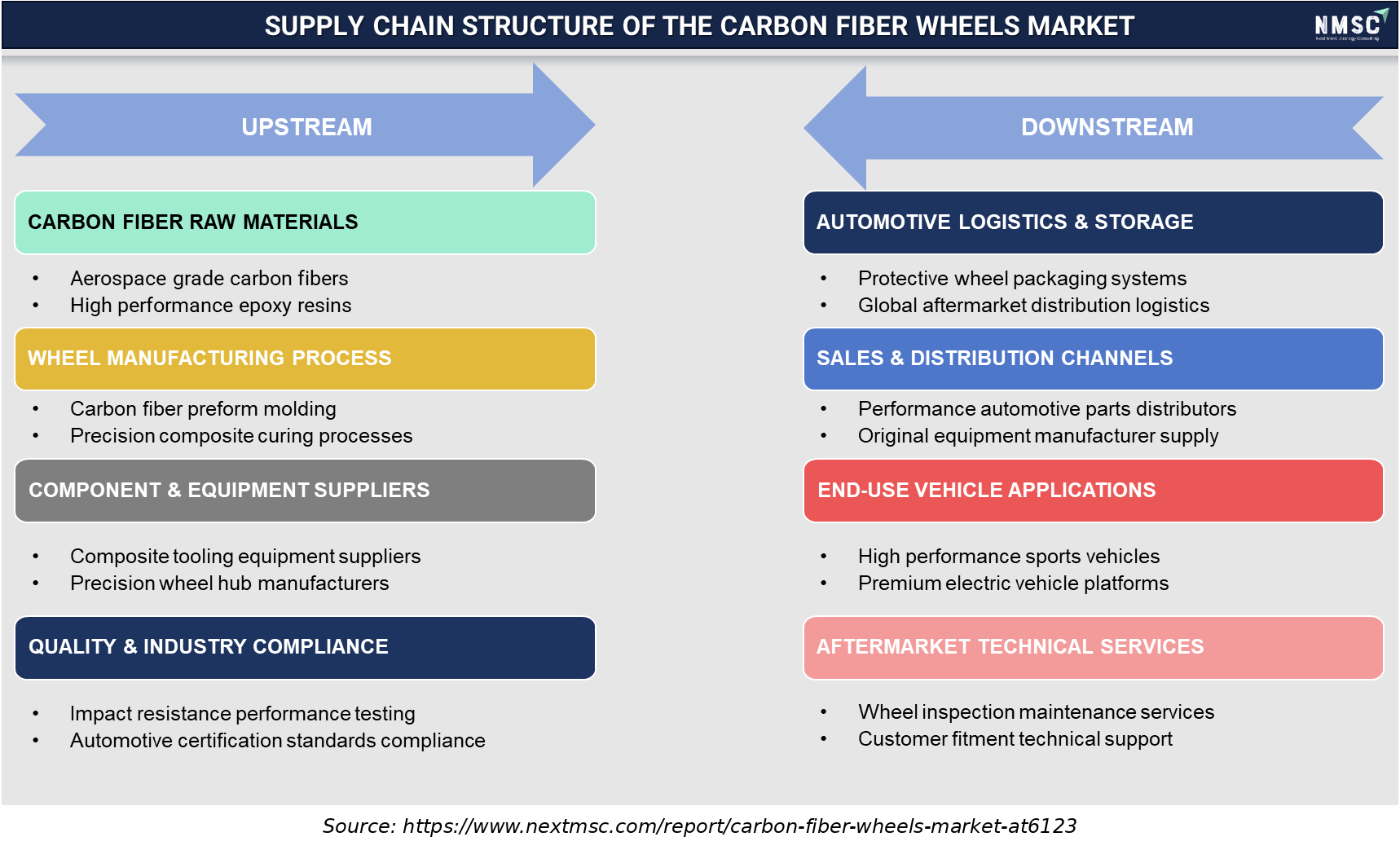
Supply Chain Analysis of the Carbon Fiber Wheels Industry

Supply Chain Analysis of the Carbon Fiber Wheels Industry
The above infographic presents the supply chain structure of the carbon fiber wheels market, beginning with aerospace-grade carbon fibers and epoxy resins that are molded through precision composite processes. These production activities are supported by tooling suppliers and hub manufacturers, while compliance with impact testing and automotive certification standards ensures quality and safety throughout the manufacturing phase. Moving downstream, protective packaging and global logistics networks enable distribution through performance parts distributors and OEM channels to sports and premium electric vehicles. Looking ahead, we observed that inspection maintenance and fitment support continue to play a vital role in sustaining customer satisfaction and ensuring long-term product performance across the aftermarket sector.

Growth Opportunities

Our analysis shows that three forward-looking opportunities stand out for stakeholders positioning within the carbon fiber wheels market over the 2026–2035 forecast period.

How Can Manufacturers Capture Electric Bicycle Wheel Demand?

Electric bicycle wheel specifications represent a whitespace opportunity for manufacturers developing carbon wheelsets engineered for higher load capacity and motor integration compatibility. Manufacturers that commercialize e-bike-specific carbon wheel platforms stand to capture recurring OEM procurement as electric bicycle production volumes scale across European and North American manufacturers through 2035.

Where Does Industrial Mobility Create New Carbon Wheel Demand?

Industrial mobility applications, including material handling equipment and mobile robotics, represent an underpenetrated opportunity for manufacturers developing durable, high-cycle carbon wheels optimized for continuous operational use. Companies that qualify carbon wheel designs for warehouse automation and logistics equipment can secure long-term supply agreements with industrial equipment manufacturers scaling energy-efficient mobility platforms.

How Can Direct-to-Consumer Platforms Expand Margin Capture?

Direct-to-consumer sales platforms create a sustained opportunity for manufacturers seeking higher margin capture and closer customer relationships outside traditional dealer networks. Early movers that build robust digital fulfillment and fitting support capabilities can differentiate with individual consumers and custom builders seeking personalized wheel specifications without traditional retail intermediation.

Regional Outlook

2025 (USD Million)
2035 (USD Million)
North Americ
Europe
Asia-Pacific
Middle East
Latin Americ
Region 2025 (USD Million) 2035 (USD Million) CAGR (%)
North America $10.0 USD Million $40.0 USD Million 9.0%
Europe $17.1 USD Million $51.1 USD Million 27.0%
Asia-Pacific $24.2 USD Million $62.2 USD Million 25.0%
Middle East & Africa $31.3 USD Million $73.3 USD Million 23.0%
Latin America $38.4 USD Million $84.4 USD Million 12.0%

Regional data is locked

Unlock complete regional numbers for this market.

Unlock Full Data

Competitive Landscape

We observed that the carbon fiber wheels market features a fragmented competitive landscape, with specialized automotive and bicycle wheel manufacturers competing alongside diversified component companies on manufacturing precision, weight optimization, and brand positioning within performance segments.

Dimension Description
Market Structure Fragmented; the top companies profiled in this report collectively account for a meaningful share of global carbon fiber wheels market revenue, while numerous specialized regional manufacturers serve niche vehicle category segments.

Innovation Focus Automated layup manufacturing, electric bicycle-specific wheel platforms, and direct-to-consumer digital fulfillment dominate current innovation pipelines across leading manufacturers.

Strategic Activity Selective capability partnerships and distribution expansion, with manufacturers continuing to scale production capacity and geographic reach to serve growing automotive OEM and electric bicycle demand.

How Do Companies Compete in the Carbon Fiber Wheels Market?

Companies compete primarily on manufacturing precision, weight optimization, and brand positioning within performance segments across the industry. Automotive-focused manufacturers such as Carbon Revolution PLC and HRE Performance Wheels LLC leverage proprietary manufacturing processes and OEM supply relationships to serve performance and luxury vehicle customers, while bicycle-focused manufacturers such as ENVE Composites LLC and DT Swiss AG compete through application-specific engineering and established cycling brand recognition.

Which Competitive Archetypes Dominate the Market?

Two archetypes dominate the market: automotive-focused manufacturers offering OEM-qualified structural wheels, and bicycle-focused manufacturers offering application-specific performance wheelsets. Carbon Revolution PLC exemplifies the automotive archetype through its dedicated OEM automotive wheel manufacturing capability, while Giant Manufacturing Co., Ltd. and Specialized Bicycle Components, Inc. exemplify the bicycle archetype through vertically integrated design, manufacturing, and brand distribution across global cycling markets.

How Are Companies Differentiating Through Innovation in Carbon Fiber Wheels?

Innovation and differentiation strategy increasingly center on automated manufacturing processes and application-specific wheel platforms for electric bicycles and industrial mobility. Specialized Bicycle Components' continued electric bicycle wheel integration and Carbon Revolution's automotive-grade production capacity expansion both illustrate how manufacturers extend platform relevance through category-specific engineering. Our analysis shows that manufacturers unable to demonstrate consistent manufacturing quality and application-specific performance risk losing specification wins with OEM customers.

What M&A and Expansion Activity Is Shaping the Carbon Fiber Wheels Market?

Production capacity expansion and distribution partnership activity continue to reshape competitive positioning within the industry. Carbon Revolution's continued scaling of automotive-grade manufacturing capacity reflects sustained OEM demand, while bicycle wheel manufacturers such as Princeton CarbonWorks LLC and Winspace Bicycle Technology Co., Ltd. expand direct-to-consumer and regional distribution capability to serve growing individual consumer demand without large-scale acquisition-driven consolidation.

Key Market Players

Our assessment indicates that the following 20 companies are actively shaping manufacturing innovation, capacity expansion, and distribution strategy within the global carbon fiber wheels market.

Carbon Revolution PLC Giant Manufacturing Co., Ltd. SRAM LLC DT Swiss AG Specialized Bicycle Components, Inc. ENVE Composites LLC Dymag Technologies Limited thyssenkrupp Carbon Components GmbH Blackstone Tek (Pty) Ltd Mavic Group SAS Hayes Performance Systems, Inc. HRE Performance Wheels LLC Bucci Composites S.p.A. Santa Cruz Bicycles, Inc. Rotobox d.o.o. Princeton CarbonWorks LLC Xiamen Elite Wheels Technology Co., Ltd. Xiamen Light Bicycle Co., Ltd. Winspace Bicycle Technology Co., Ltd. Industry Nine LLC

Latest Developments

We found that recent activity within the carbon fiber wheels market is concentrated on electric bicycle wheel integration, automotive production capacity expansion, and premium product line development, reflecting the industry's response to accelerating demand across vehicle categories.

Date Event
May 2025 Carbon Revolution announced that it would supply its one-piece carbon-fiber wheels for the 2025 Lamborghini Temerario, marking its first OEM carbon-fiber wheel program with Volkswagen Group and its sixth global OEM customer.
May 2025 Dymag, Borbet and Advanced International Multitech (AIM) formed a strategic partnership to accelerate development and industrial-scale production of carbon-hybrid and composite wheels for automotive and motorcycle applications.

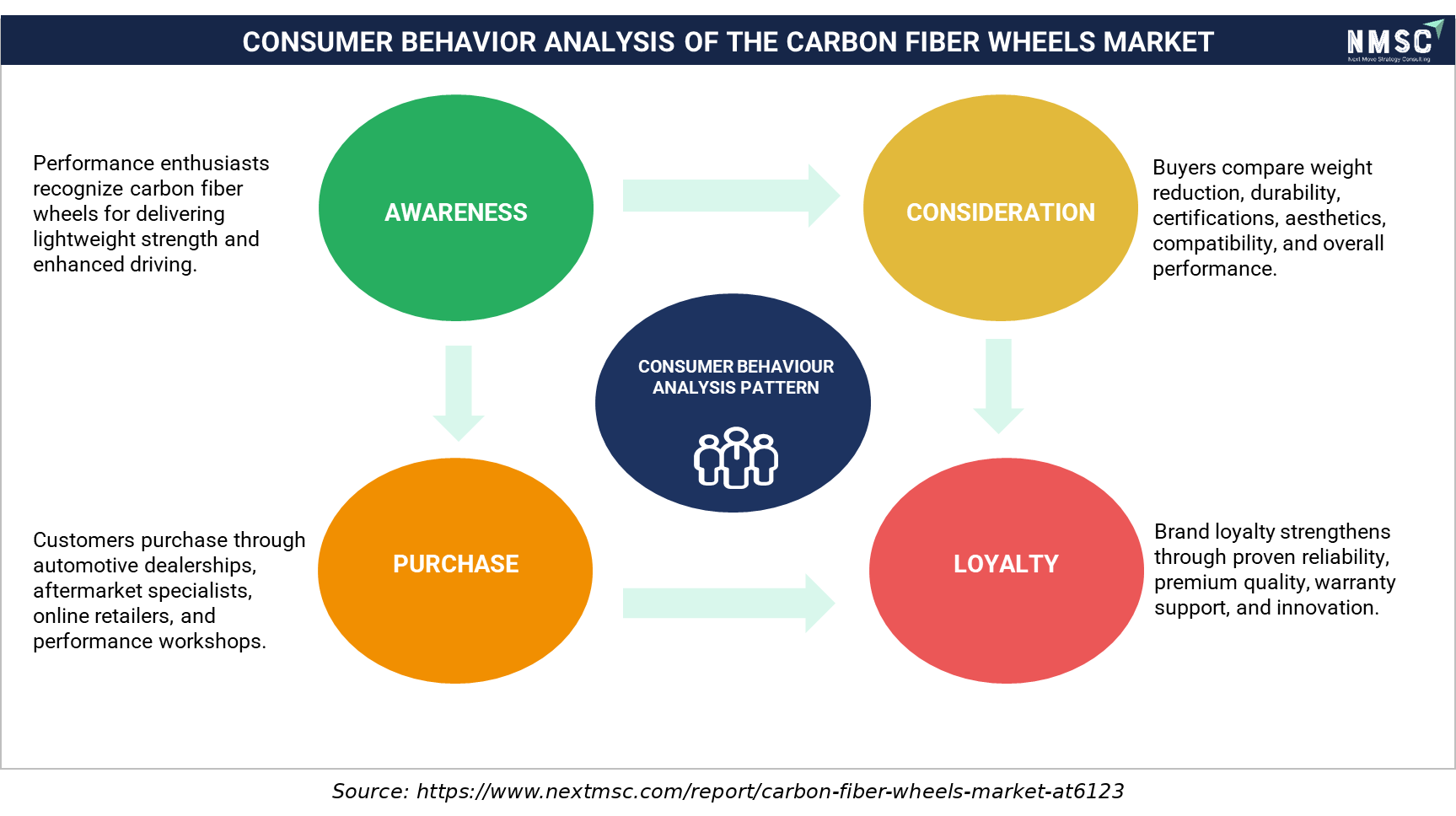
Consumer Behaviour Analysis of the Carbon Fiber Wheels Industry

Consumer Behaviour Analysis of the Carbon Fiber Wheels Industry

The above infographic presents a consumer behavior analysis of the carbon fiber wheels market, mapping the journey from awareness to loyalty. Performance enthusiasts discover these wheels through automotive channels, leading them to evaluate weight reduction, durability, compatibility, and overall performance before purchasing from dealerships or specialists. Once satisfied with reliability and quality, brand loyalty is reinforced through warranty support and ongoing innovation. Looking ahead, we observed that product performance and trust remain central to sustaining long-term customer engagement across the market.

Investment Opportunities

What Capital Inflows Are Fueling Carbon Fiber Wheels Market Development?

Capital investment is flowing into automotive-grade manufacturing capacity and electric bicycle wheel platform development, exemplified by Carbon Revolution's continued scaling of dedicated OEM production capability. Our findings suggest that this capital inflow is validating carbon fiber wheels as a durable, performance-differentiated component category rather than a niche aftermarket product, attracting continued manufacturer investment in production capacity and application engineering.

How Is Infrastructure Investment Shaping Market Expansion?

Manufacturing infrastructure investment, including automated layup and resin transfer molding capacity expansion, is shaping how producers scale consistent-quality carbon wheel supply globally. We observed that this infrastructure investment reflects sustained commitment to reducing per-unit production costs while maintaining the precision required for premium automotive and competitive cycling applications.

What ESG Considerations Influence Carbon Fiber Wheels Market Investment?

Environmental, social, and governance considerations increasingly influence carbon wheel investment as manufacturers explore lower-carbon-footprint precursor materials and end-of-life recycling pathways for composite components. Our analysis shows that lightweight wheel technology supporting vehicle efficiency and reduced energy consumption aligns with emissions-reduction goals, strengthening the investment case for manufacturers with demonstrated sustainability development initiatives.

Key Benefits for Stakeholders

How Does This Report Benefit Industry Leaders?

This report equips automotive and cycling component industry leaders with segmented revenue forecasts, vehicle category adoption trends, and competitive benchmarking needed to prioritize product development across construction and price tier segments. Our findings suggest that leaders can use the segmentation analysis and regional outlook to align product roadmaps with the fastest-growing vehicle category, construction, and price tier segments identified in this report.

How Does This Report Benefit Investors and Financial Analysts?

Investors and financial analysts gain a data-driven view of market sizing, CAGR trajectories, and company-level competitive positioning to evaluate capital allocation across the carbon fiber wheels value chain. We found that the investment opportunities and competitive landscape sections provide the forecast granularity needed to assess manufacturer capacity expansion and distribution partnership opportunities.

How Does This Report Benefit Technology Vendors and Product Teams?

Technology vendors and product teams benefit from detailed segmentation across vehicle category, construction, and price tier axes that clarify where manufacturing and engineering development investment will generate the strongest returns. Our assessment indicates that the growth opportunities and emerging trends sections help product teams prioritize electric bicycle and industrial mobility roadmaps ahead of competitors.

Key Market Segments Evaluated

By Vehicle Category

  • Automotive
  • Motorcycles
  • Bicycles
  • Wheelchairs
  • Industrial Mobility
  • Other Vehicle Categories

By Product Configuration

  • Complete Wheel
  • Wheelset
  • Rim

By Construction

  • Full Carbon Wheel
  • Carbon Hybrid Wheel
  • Carbon Rim

By Price Tier

  • Entry
  • Mid-range
  • Premium
  • Ultra-Premium

By Sales Channel

  • Original Equipment Manufacturer
  • Aftermarket Distributor
  • Direct to Consumer
  • Custom Builder

By End User

  • OEMs
  • Aftermarket Dealers and Retailers
  • Fleet Operators
  • Professional Racing Teams
  • Individual Consumers

Conclusion & Recommendations

The long-term outlook remains strongly positive, with the market projected to expand from USD 947.2 million in 2026 to USD 2,778.3 million by 2035 at a 12.7% CAGR. We observed that sustained electric bicycle adoption and automotive lightweighting demand provide durable, structural tailwinds that extend well beyond the current forecast window, supporting continued manufacturer investment across automotive, motorcycle, and bicycle wheel segments.

What Strategic Positioning Should Suppliers Pursue?

Suppliers should prioritize application-specific manufacturing capability that reduces OEM qualification complexity across automotive, bicycle, and industrial mobility categories. Our assessment indicates that manufacturers combining proven production quality with expanding direct-to-consumer distribution will be best positioned to win recurring procurement, particularly as OEM customers consolidate supplier relationships to simplify long-term component sourcing.

How Attractive Is the Carbon Fiber Wheels Industry for New Investment?

The carbon fiber wheels industry presents an attractive investment case, supported by a USD 1,831.1 million absolute dollar opportunity between 2026 and 2035 and above-average growth in Asia-Pacific and Industrial Mobility application categories. We found that investment attractiveness is highest for manufacturers combining automotive OEM qualification with expanding electric bicycle platform capability, positioning them to serve both established performance customers and emerging industrial mobility programs simultaneously.

What Market Shifts and Key Risks Should Stakeholders Monitor?

Stakeholders should monitor production cost pressure, competition from advanced alloy wheels, and limited repair infrastructure as key risks to the carbon fiber wheels market. Our analysis shows that manufacturers unable to demonstrate consistent manufacturing quality and cost-competitive pricing risk losing specification wins, particularly as OEM customers increasingly evaluate total cost of ownership across wheel material alternatives.

What Are the Key Growth Pathways for the Carbon Fiber Wheels Market?

Key growth pathways include expanding electric bicycle wheel platforms, scaling automotive OEM production capacity, and deepening penetration into industrial mobility and direct-to-consumer distribution channels. NMSC's analysis indicates that manufacturers pursuing these pathways while maintaining cost competitiveness in core mid-range price tier categories will be best positioned to capture the carbon fiber wheels market's projected growth through 2035.

FAQs

About the Author

Mayurima Roy

Mayurima Roy

Mayurima Roy is Research Analyst at Next Move Strategy Consulting, where she has spent 4 years working across the firm's full industry coverage rather than a single fixed vertical. Her work centers on structured research, ongoing trend tracking, competitive assessment, and insight-led content development, translating complex market data into clear, decision-ready narratives that support informed client decision-making across diverse global industries, market sectors, and world regions every day.

About the Reviewer

Supradip Baul

Supradip Baul

Supradip Baul is an accomplished business consultant and strategist with over a decade of rich experience in market intelligence, strategy, technology, and business transformation. His work has included rigorous qualitative and quantitative analysis across multiple industries, helping clients shape investment decisions and long-term roadmaps. Earlier in his career, he was associated with Gartner, where he contributed to industry-leading reports and market share analyses. He has worked with leading global companies and holds an MBA with a dual specialization in Marketing and Finance.

Download Free Sample

Gaurav Jaiswal

GAURAV JAISWAL

Founder & CEO

Yano Charge Private Limited

The EV Charging market research report provided by the NextMSC was exceptionally detailed and insightful. It offered a comprehensive analysis that proved to be a game-changer for our strategic planning. Truly a testament to the NextMSC’s expertise and thoroughness in EV market landscape & analysis.

Nishant Awate

NISHANT AWATE

Business Development Global Sales

Zehnder Group Deutschland GmbH

Our experience working with Next Move Strategy Consulting was positive. The team was responsive, professional, and open to incorporating our specific requirements throughout the project. The India AHU market study was comprehensive and well structured, covering market value and volume forecasts, product and application segments, and key industry trends. The inclusion of both AHU and residential MVHR market insights made the study particularly relevant for our strategic market assessment. Overall, the report provides a solid foundation for evaluating market potential, identifying priority segments, and supporting business-development decisions in India.

Robert Sean Trevino

ROBERT SEAN TREVINO

Sr. Director, Head of Strategic Insights & Analytics

Foundation Medicine

I realized that it was a reliable source of information. These days, there are many people who are looking for authentic data, and this is one of the only sources that can offer them with what they need;

Semih Kavaklioglu

SEMIH KAVAKLIOGLU

Co-Founder & Sales Manager

Decortie

I work a lot in the marketing industry and I know that research is an essential part of any campaign. I have used Market research reports for my own products and I found them to be very informative and well-researched. The team here produces insightful reports for a good price

Kishu Kanda

KISHU KANDA

Strategy Analyst

Accenture

We purchased the AI Consumer Market Report from this company. Not only did they customize the report to meet our specific requirements, but they also showed great flexibility in accommodating our budget. The report we received fully met our expectations. Additionally, they provided prompt and thorough responses to both our pre-purchase and follow-up questions. We look forward to working with this company again in the future.

Custom Market Research Services

We will customize the research for you if the listed report does not fully match your requirements.

Get 30% Free Customization

Select License

This website uses cookies to ensure you get the best experience on our website. Learn more

✖