Carbon Wheels Market By Material Type (Prepreg, Forged, & Other ), By Manufacturing (Autoclave, RTM, & Others), By Fibre (PAN-based, Pitch-based), By Functional Performance (Lightweight, Aerodynamic, & Others), By Brake Compatibility (Rim, Disc), By Price Tier (Premium, Mid-Tier, Value), By Rim Size (Small, Medium, Large, Oversized), By Application (Automotive, Specialty, & Others), and By End User (OEMs, Tier One, & Others) – Global Opportunity Analysis and Industry Forecast, 2025–2035
Industry: Automotive & Transportation | Publishing Date: January 12, 2026 | Last Updated: September 30, 2026 | No of Pages: N/A | No. of Tables: N/A | No. of Figures: N/A | Format: PDF | Report Code: AT3940
Industry Outlook
The global Carbon Wheels Market size was valued at USD 1.11 billion in 2025 and is expected to reach USD 2.81 billion by 2035, registering a CAGR of 9.70% from 2026 to 2035.
The carbon wheels market is growing steadily, driven by rising demand for lightweight, high-fibre wheels that offer superior strength-to-weight ratios, improved aerodynamics, and enhanced handling, making them a preferred choice among performance-focused consumers and professional athletes. In the automotive sector, the shift toward electric vehicles and premium sports models is further accelerating adoption, as carbon wheels contribute to range extension, reduced unsprung mass, and better braking response. Advancements in carbon fibre composites, resin systems, and manufacturing techniques, such as automated layup and precision moulding, are boosting product durability, consistency, and cost efficiency. By combining performance, aesthetics, and cutting-edge materials engineering, the market is meeting evolving mobility and sporting demands while driving innovation and premiumization in high-end wheel technologies.
What Are the Key Trends in the Carbon Wheels Industry?
How is EV Adoption Changing Demand for Carbon Wheels in Premium Segments?
The surge in global EV sales is concentrating OEM attention on premium EV launches and halo models, where even marginal gains in range and efficiency hold commercial significance. Carbon wheels materially reduce unsprung mass and lower rolling resistance, both of which contribute to incremental, but valuable, range improvements in high-end electric platforms. Market analysis indicates that performance-oriented EV OEMs are increasingly specifying advanced composite wheels to enhance handling, protect real-world range, and deliver visual differentiation. For suppliers, the strategic pathway is prioritising validated pack-level range impact studies, rolling-resistance and thermal-performance data, and pilot OE programs with EV platforms where measurable range payback strengthens the adoption case.
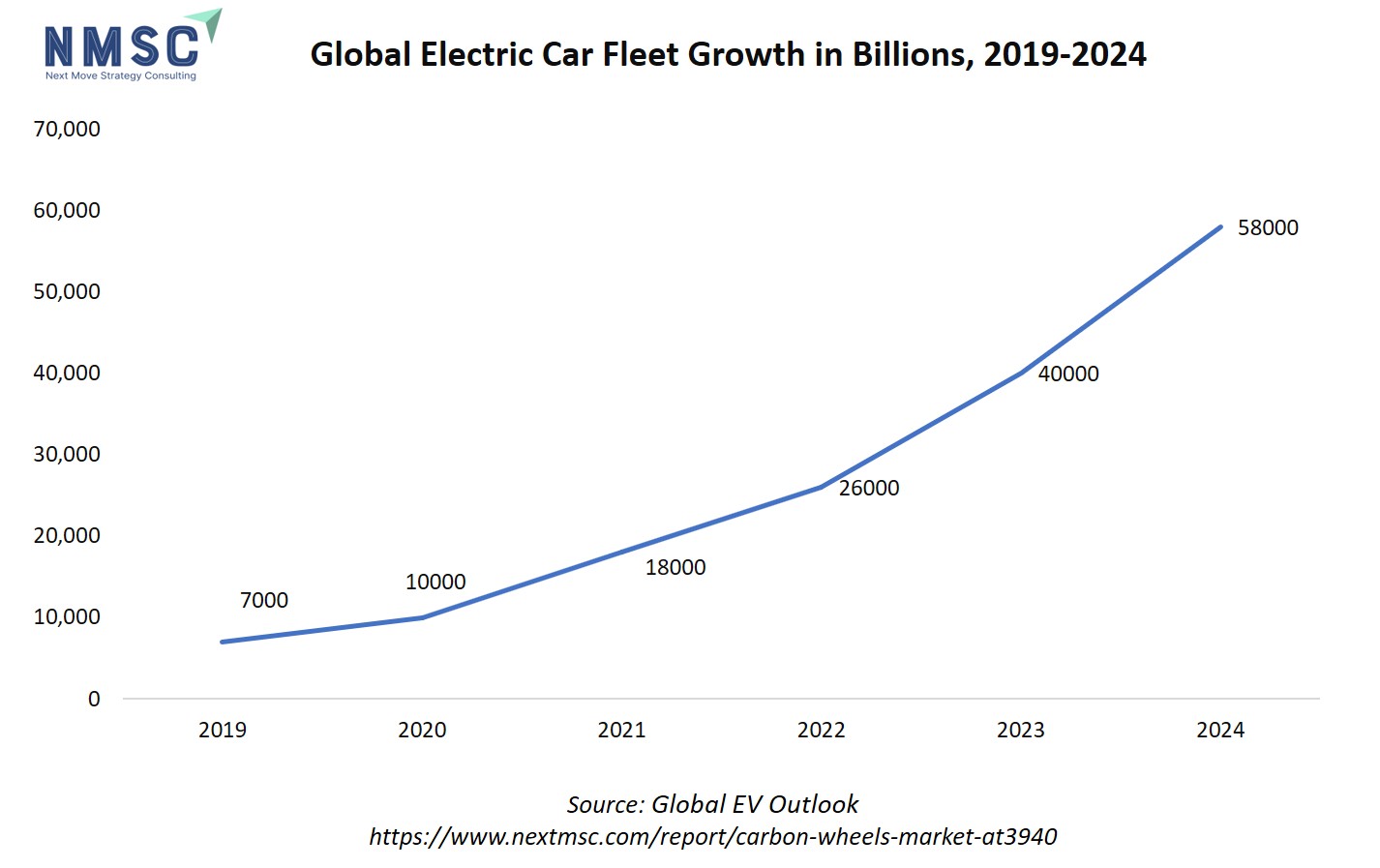
The chart demonstrates exponential growth in the global electric car fleet, from 7,000 units in 2019 to 58,000 units in 2024, highlighting the accelerating worldwide adoption of EVs. This surge is driving automakers and consumers to increasingly seek advanced, lightweight technologies to maximise vehicle range and performance. For the carbon wheels market, the rise in electric vehicles significantly boosts demand for carbon fibre wheels, which offer reduced weight, improved efficiency, and enhanced handling. As EV manufacturers prioritise energy efficiency and premium features, carbon wheels are set to become a critical differentiator and enabler for next-generation electric mobility solutions.
How are Hybrid Carbon Wheel Solutions Accelerating OEM Adoption?
Hybrid carbon wheels, such as carbon rims with metal centres or magnesium hubs, are emerging as a pragmatic bridge between cost and performance, gaining traction in motorsport and limited OEM programs. Recent product developments show suppliers pairing carbon composite rims with cast/forged centres to reduce manufacturing cost while retaining weight advantages. This hybrid route shortens qualification lead times versus full carbon monobloc wheels and allows OEMs to meet durability and crash requirements more quickly. Manufacturers are scaling hybrid production lines and testing for regulatory crash compliance to position hybrid products as an OEM-friendly compromise.
How is Industrialisation & Scale-Up Reshaping the Supplier Landscape?
Industrialisation and large-scale manufacturing are transforming the carbon-wheels supplier landscape from a niche, craft-driven segment into a more consolidated, capital-intensive, and OEM-oriented industry. As production volumes rise, suppliers adopt automation, robotics, digital quality control, and automotive-grade certification to meet OEM requirements for consistency, traceability, and safety. This shift increases CAPEX needs, favouring well-funded players and encouraging consolidation, long-term OEM partnerships, and vertical integration across materials, prepreg, and tooling. Regionalisation of manufacturing is accelerating as automakers seek localised, lower-risk supply chains, while sustainability expectations push suppliers to adopt low-carbon processes and recycling capabilities. Overall, scale-up is raising entry barriers, redefining supplier roles as Tier-1 integrators, and reshaping competitive dynamics across the value chain.
What Are the Key Market Drivers, Breakthroughs, and Investment Opportunities That Will Shape the Carbon Wheels Industry in the Next Decade?
The carbon wheels market is propelled by structural trends, such as EV proliferation, higher vehicle weight and range sensitivity. OEM desire for product differentiation, and premium aftermarket demand. Industry participants who move from prototyping to repeatable, certified production lines capture the earliest OEM programs. Carbon Revolution’s OEM ramp highlights both commercial potential and scale risk. Investors are watching unit economics and OEM offtake as primary de-risking signals.
However, barriers remain significant with high per-unit cost versus established aluminium forging/flow-formed alternatives, part validation for crash/regulatory standards, and the need to industrialise composites processes to giga wheel/annual volumes. Thus, near-term opportunity exists in hybrid solutions, aftermarket premium segments, and manufacturing services, such as prepreg, layup automation, and curing.
Growth Drivers:
How does Motorsport Performance Pull Accelerate Technology Transfer Into Production Vehicles?
Based on evolving motorsport engineering requirements, carbon wheels are increasingly critical for achieving lower rotational inertia, sharper steering response and superior thermal stability under extreme loads. As sanctioning bodies broaden allowable composite materials, race teams validate carbon-wheel architectures in environments significantly more demanding than road conditions. This creates a high-credibility validation pipeline that accelerates the transfer of race-proven designs into track-focused and premium production vehicles. Motorsport datasets also reduce OEM validation timelines by offering empirical proof of stiffness, durability and heat-management performance. Suppliers are expanding motorsport collaborations to function as accelerated R&D channels, using race-validated performance metrics to secure halo-model contracts and build OEM confidence in long-term durability.
How does Automotive Electrification and Lightweighting Accelerate Demand for Carbon Wheels?
Based on OEM electrification strategies and increasingly stringent efficiency and CO₂-compliance regulations, carbon wheels are emerging as a high-leverage lightweighting solution for next-generation EV platforms. Reducing carbon fibre composites directly improves energy efficiency, braking stability and real-world range, making carbon wheels materially relevant to 2026–2030 model cycles. As EV architectures consolidate around efficiency-first design principles, any component that increases range without major redesign becomes strategically valuable. Carbon wheels deliver measurable efficiency gains while supporting premium positioning in high-margin EV trims. Suppliers are quantifying model-specific range improvements, homologation compliance advantages and lifecycle efficiency benefits to position carbon wheels as both a performance upgrade and a regulatory enabler for OEMs.
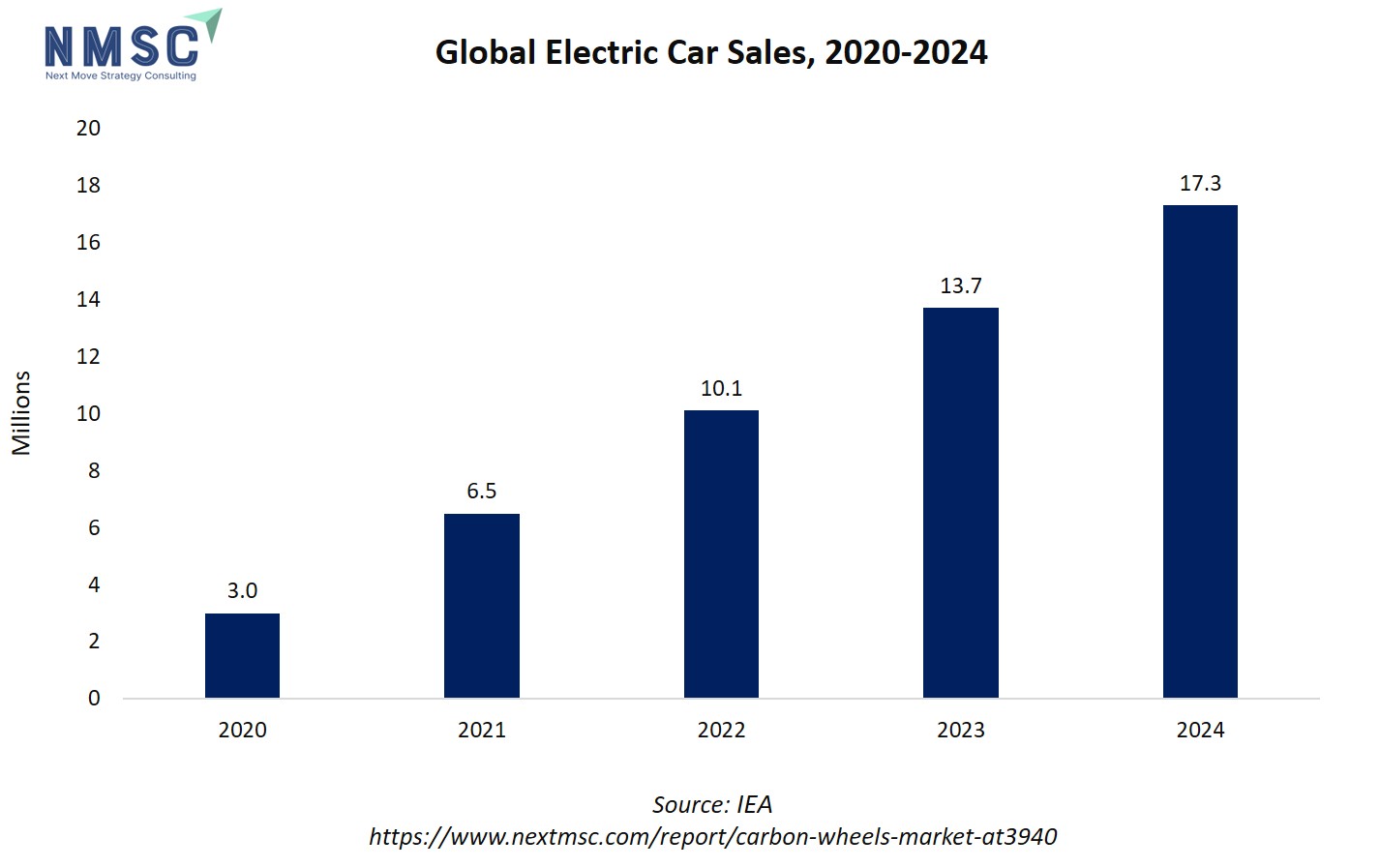
The chart highlights the rapid rise of global electric car sales between 2020 and 2024, increasing from 3 million to 17.3 million units. This sharp growth reflects not only strong policy support and consumer demand but also a push for greater efficiency, performance, and sustainability in vehicle design. For the market, the boom in electric car sales fuels demand for lightweight, high-strength materials, as automakers seek to extend range and boost acceleration. Carbon fibre wheels, by reducing unsprung mass and improving energy efficiency, are thus poised to capture increased carbon wheels market share as EV adoption accelerates globally.
Growth Inhibitors:
Why does Manufacturing Scale and Cost Constrain Market Growth?
Manufacturing scale and cost continue to constrain carbon wheels market growth because carbon wheels rely on expensive raw carbon fibre, energy-intensive prepreg processing, autoclave or RTM curing, and precision machining steps that still exhibit lower yields than aluminum wheel production. Fiscal 2024 disclosures from leading manufacturers show that even rapid revenue growth is offset by high operating losses driven by throughput bottlenecks and labour-intensive workflows. Until yields improve and cycle times fall, carbon wheels will remain limited to niche performance trims or OEM-subsidised halo programs. Actionable mitigation includes investing in automation, integrating upstream material supply, and adopting hybrid architectures that reduce carbon content while preserving performance credibility.
Where Should Investors Allocate Capital in the Carbon Wheels Value Chain?
The most attractive near-term investment opportunities lie in manufacturing enablers that address yield, throughput, and durability constraints across the carbon wheel supply chain. Equipment categories such as automated prepreg handling, next-generation curing technologies, hybrid hub machining systems, and advanced bonding or coating materials offer lower technical risk and immediate operational value to wheel producers. Adjacent materials suppliers, carbon tow, resin systems, and inspection or metrology providers also represent compelling, less capital-intensive entries. Investors prioritises companies with OEM LOIs, validated pilot runs, or contracted tooling programs, while structuring staged funding tied to manufacturing milestones to manage scale-up risk and maximise return potential.
How is the Carbon Wheels Market Segmented in This Report, and What Are the Key Insights from the Segmentation Analysis?
By Material Type Insights
Are Prepreg Carbon Fibre and Forged Carbon the Dominant Subsegments in 2025?
Based on material type, the market is segmented into prepreg carbon fibre, forged carbon fibre, hybrid composites, filament wound carbon fibre wheels, and other composite materials.
Based on current supplier capabilities and OEM program choices, prepreg carbon fibre and forged carbon continue to dominate the material landscape in 2025. Prepreg carbon fibre maintains a clear lead because its autoclave-cured layups deliver high fibre-volume fractions, tight tolerances, and predictable mechanical performance, making it suitable for mission-critical OEM platforms requiring repeatability and crash-validated stiffness. Forged carbon extends adoption where shorter cycle times, aesthetic surfaces, and lower tooling costs are beneficial, especially in limited-series vehicles or customised applications. Meanwhile, hybrid composite architectures, typically carbon-fibre rims combined with aluminium or magnesium hubs, are accelerating due to improved manufacturability, faster certification cycles, and cost-performance optimisation desired by EV and performance-focused OEMs.
By Application Insights
Are Automotive Premium and Performance Segments Driving the Majority of Demand?
Based on application, the carbon wheels market includes automotive, two wheelers, aerospace, and specialty and emerging platforms.
Premium and performance automotive programs remain the strongest demand drivers for carbon-fibre wheels in 2025, reflecting their ability to justify higher component costs in exchange for acceleration gains, NVH improvements, and EV-range benefits. OEMs in this segment actively adopt lightweight wheels as part of broader efficiency and handling strategies, as seen in programs such as the Range Rover Sport SV and performance variants of the Corvette lineup. Two-wheelers, including motorcycles and high-end bicycles, contribute meaningful but smaller volumes, primarily tied to racing and enthusiast markets. Aerospace opportunities technically exist, but stringent certification, cyclic loading requirements, and cost constraints continue to slow adoption relative to automotive use cases.
By End User Insights
Are OEMs Still Dominating Early Commercialisation Over the Aftermarket?
Based on end user, the market is categorised into original equipment manufacturers, tier one system suppliers, motorsport and racing teams, and aftermarket.
OEMs continue to dominate early commercialisation because they offer predictable order volumes, structured validation cycles, and the ability to absorb premium pricing when carbon wheels deliver a clear performance narrative. Their engineering resources and platform-level integration also accelerate supplier scale-up, shaping long-term manufacturing investments. This pattern is illustrated by suppliers such as Carbon Revolution, whose major growth phases were tied directly to OEM programs spanning luxury SUVs to American performance cars. Although the aftermarket remains valuable, particularly for high-net-worth enthusiasts seeking exclusivity and customisation, its fragmented demand, variable certification pathways, and smaller lot sizes make it a secondary channel compared with OEM-driven scale expansion.
Regional Outlook
The carbon wheels market is geographically studied across North America, Europe, Asia Pacific, the Middle East & Africa, and Latin America and each region is further studied across countries.
Carbon Wheels Market in North America
North America remains one of the most active carbon-wheel regions, supported by a mature aftermarket, performance-vehicle culture, and bespoke OEM programmes concentrated in the United States. Demand is reinforced by U.S. performance marques and emerging halo EV platforms that integrate lightweight wheels for range, acceleration, and NVH advantages. Supplier R&D capabilities, spanning materials engineering, resin formulation, and high-precision machining, strengthen the innovation pipeline, enabling Tier-1 suppliers to validate wheels across diverse vehicle platforms. The ecosystem also benefits from motorsport influence and a high concentration of engineering talent, which collectively accelerate pilot deployments, niche launches, and technology maturation across performance automotive applications.
Carbon Wheels Market in the United States
The United States exhibits a robust aftermarket appetite for carbon wheels, supported by enthusiast culture, track-focused communities, and high-performance tuning brands. OEM participation remains selective but strategic, with pilot programmes emerging in response to EV platform launches that prioritise weight reduction for range optimisation. This dynamic creates a mixed pathway; strong short-term aftermarket pull combined with medium-term OEM opportunities tied to premium and performance trims. EV adoption further shapes demand, as manufacturers look for components that increase efficiency without compromising styling or durability. The U.S., therefore, acts as both a commercial testbed and a scale-up node for future OEM carbon-wheel integration.
Carbon Wheels Market in Canada
Canada operates mainly as a materials processing, composites engineering, and tier-supplier hub rather than a major OEM carbon-wheel adopter. While the country supports advanced materials R&D, including resins, prepregs, and structural composites, the domestic automotive manufacturing base remains smaller and less performance-oriented than that of the U.S. As a result, Canada plays an upstream role in the broader value chain, supplying intermediate materials and engineering services that feed U.S. and European programmes. OEM wheel initiatives remain limited, and demand is largely aftermarket-driven and niche. Nevertheless, its composites ecosystem provides strategic support to North American carbon-wheel innovation.
Carbon Wheels Market in Europe
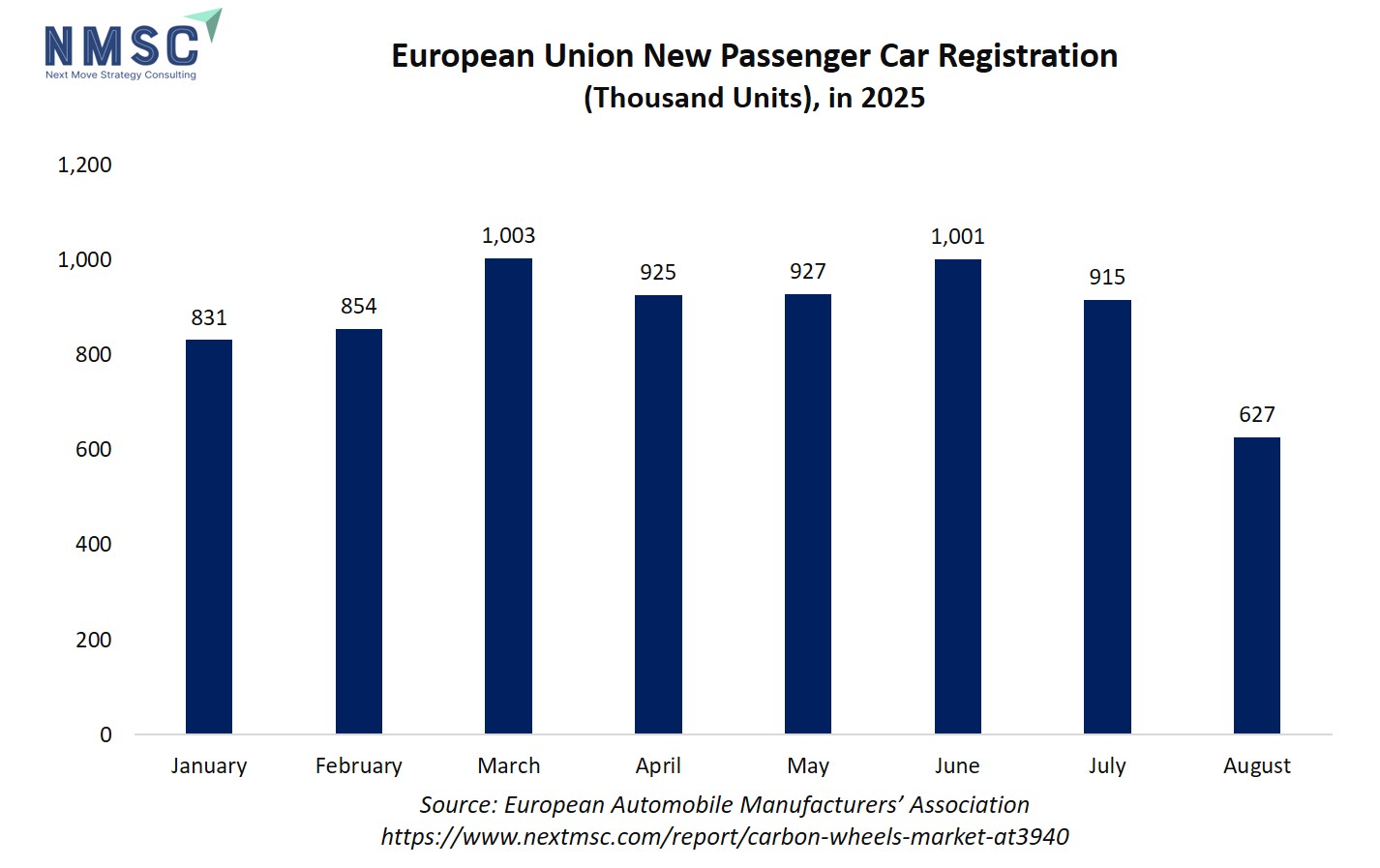
Europe stands out as a global centre for motorsport engineering, premium automotive brands, and advanced wheel suppliers. The region benefits from a technically rigorous environment shaped by Porsche, BMW, Mercedes-AMG, and other performance OEMs that actively explore lightweight wheel technologies. Hybrid carbon-aluminium architectures are particularly popular due to their favourable balance of weight, manufacturability, and homologation efficiency. Motorsport applications, supported by engineering clusters in Germany and the UK, act as early technology validators. This combination of OEM demand, motorsport culture, and supplier know-how enables Europe to sustain high engagement in both prototype programmes and commercial carbon-wheel deployments.
Carbon Wheels Market in the United Kingdom
The United Kingdom benefits from a rich motorsport heritage and a dense network of specialist engineering firms that service track customers, boutique OEM upgrades, and performance aftermarket communities. Suppliers such as DYMAG operate at the centre of this ecosystem, delivering hybrid and full-carbon solutions that cater to both track-day users and premium automakers seeking incremental performance enhancements. The UK’s engineering capabilities, particularly in composite layup, wheel testing, and lightweight structural design, position it as a niche but influential player. Demand remains concentrated in motorsport-adjacent applications, which serve as proving grounds for wider OEM commercialisation.
Carbon Wheels Market in Germany
Germany’s strong automotive manufacturing base anchors regional demand for carbon-wheel solutions, particularly within high-performance segments led by Porsche, BMW M, and Mercedes-AMG. The country’s engineering-intensive culture creates strict validation and homologation requirements, prompting suppliers to invest heavily in fatigue testing, impact validation, and process control. Motorsport programmes further reinforce the technology pipeline, acting as early adopters of hybrid and full-carbon designs. As OEMs continue to deploy lightweight components in performance and electrified models, Germany remains an essential market where supplier credibility and technical certification determine long-term commercial success.
Carbon Wheels Market in France
France maintains a strong composites pedigree through its aerospace sector, which influences its involvement in the carbon-wheel industry. While automotive applications exist, they remain modest due to certification intensity and the limited size of local performance-vehicle production. Aerospace expertise provides upstream benefits, particularly in resin systems, structural validation, and fatigue modelling, but direct adoption in wheels progresses cautiously because safety testing is stringent and OEM programmes are less frequent than in Germany or Italy. As a result, France plays a complementary role, contributing materials and engineering know-how rather than driving large-scale automotive demand.
Carbon Wheels Market in Italy
Italy’s established performance-car ecosystem, centred around brands, design houses, and motorsport engineering, creates favourable conditions for niche carbon-wheel adoption. Luxury automakers and bespoke tuning workshops increasingly integrate lightweight wheels for aesthetic differentiation and dynamic performance. Italian suppliers and design studios also play key roles in prototyping and limited-edition manufacturing, leveraging strong craftsmanship and composites expertise. While the carbon wheels market size is smaller compared with Germany, Italy’s influence on design trends and premium vehicle styling ensures steady participation in specialised wheel programmes, especially for supercars and customised performance builds.
Carbon Wheels Market in Spain
Spain is gradually strengthening its role in the carbon-wheel value chain, primarily through aftermarket demand and connections to motorsport suppliers. OEM adoption remains limited due to the country’s manufacturing orientation toward mass-market vehicles rather than high-performance or premium models. However, Spain contributes through machining, small-batch composites work, and distribution channels that service track-day users and performance enthusiasts. Its role is therefore complementary, not yet a major OEM hub but increasingly relevant for selective motorsport supply relationships and regional aftermarket consumption.
Carbon Wheels Market in the Nordics
Nordic countries maintain small absolute market volumes but benefit from high EV penetration and consumer interest in efficiency-enhancing technologies. Lightweight carbon wheels align well with the region’s emphasis on sustainability, performance, and advanced engineering. While domestic manufacturing is limited, import-driven aftermarket demand exists among EV owners and performance-vehicle buyers seeking improved acceleration and extended driving range. The region also supports pilot deployments and early trials for EV platforms, although commercial scale remains constrained. Overall, the Nordics act as demand niches rather than production centres.
Carbon Wheels Market in the Asia-Pacific
The Asia-Pacific region displays diverse adoption patterns influenced by manufacturing footprints, composite materials expertise, and EV policy rollouts. China remains the world’s largest automotive production hub, with the potential to scale hybrid carbon wheels rapidly if localisation and IP considerations align. Japan and South Korea leverage deep composite knowledge and automotive engineering to support Tier-1 innovation pipelines. Australia hosts Carbon Revolution’s manufacturing base, anchoring regional production capacity. EV incentives and national industrial policies significantly shape demand trajectories, creating a heterogeneous but strategically important region for long-term growth in carbon-wheel technologies.
Carbon Wheels Market in China
China’s extensive automotive manufacturing infrastructure and fast-growing EV sector position it well to adopt hybrid carbon-wheel solutions at scale. Local suppliers rapidly industrialise machining, resin transfer moulding, and hybrid rim–hub architectures if supported by partnerships with global technology holders. However, IP protection, supplier qualification, and OEM trust remain critical barriers. Demand is driven by performance EVs and premium domestic brands seeking differentiation. If localisation challenges are resolved, China could become one of the largest volume markets for carbon wheels in the next five years, especially for hybrid composites.
Carbon Wheels Market in Japan
Japan leverages decades of leadership in carbon-fibre production, resin chemistry, and precision manufacturing, making it a strong contributor to upstream materials and Tier-1 engineering for carbon wheels. Domestic OEMs adopt the technology more selectively, reflecting conservative validation timelines and a focus on reliability. Nevertheless, Japan’s materials ecosystem, including high-grade carbon fibre and advanced prepregs, supports global innovation and supplier development. Its influence is therefore more technological than volumetric, with contributions centred on materials excellence, fatigue research, and integration testing.
Carbon Wheels Market in India
India remains at an early stage of carbon-wheel adoption due to strong price sensitivity and a higher concentration of mass-market vehicles. However, niche demand exists among high-performance motorcycle enthusiasts, luxury-car owners, and custom-build communities. Aftermarket suppliers import small volumes, serving track-day users and premium tuning studios. Despite its current scale limitations, rising disposable incomes and a growing performance-vehicle culture could gradually expand demand. Still, manufacturing is minimal, and significant growth depends on affordability improvements and the expansion of India’s premium automotive segment.
Carbon Wheels Market in South Korea
South Korea benefits from significant Tier-1 automotive capabilities, advanced materials firms, and a strong EV manufacturing base. These strengths enable the country to support hybrid carbon-wheel development, particularly for premium trims within domestic OEM portfolios. Materials suppliers contribute resin systems, carbon prepregs, and advanced machining, while OEMs focus on durability, thermal stability, and certification. Although commercial rollouts remain selective, Korea’s engineering depth and EV leadership position it as a promising market for mid-term expansion of carbon-wheel technologies.
Carbon Wheels Market in Taiwan
Taiwan’s precision manufacturing ecosystem makes it well-suited for hub machining, aluminium components, and hybrid rim-hub assembly processes. While domestic demand for carbon wheels remains modest, Taiwan contributes strongly to machining quality, supplier reliability, and component consistency within the global supply chain. Its experience in high-tolerance production for bicycles and automotive components provides a transferable skill base. As hybrid wheels become more common globally, Taiwan’s role as a precision-component supplier is expected to grow, even if large-scale local adoption remains limited.
Carbon Wheels Market in Indonesia
Indonesia’s role in the carbon wheels market is rooted in upstream raw-materials supply, including fibres and energy-intensive materials used in composites. Advanced manufacturing, however, remains limited due to technology gaps, skill constraints, and the capital-intensive nature of wheel production. Demand is mostly aftermarket-driven, and local performance-vehicle markets are relatively small. Over the long term, Indonesia strengthens its position through raw-material partnerships, but large-scale carbon-wheel manufacturing is unlikely without substantial capability development.
Carbon Wheels Market in Australia
Australia plays a pivotal strategic role due to Carbon Revolution’s advanced manufacturing footprint, which positions the country as a global production and R&D hub. The company’s automated moulding processes, composite curing technologies, and OEM programme collaborations give Australia disproportionate influence relative to its vehicle market size. Local engineering talent, government support, and proximity to Asia contribute to continued investment. While domestic demand is limited, Australia’s manufacturing base enables scalable global supply for premium automotive and EV platforms across North America, Europe, and Asia.
Carbon Wheels Market in Latin America
Latin America participates in the carbon-wheel industry primarily through raw-materials supply and small aftermarket segments rather than OEM programmes. Local automotive production focuses heavily on cost-efficient models, limiting the integration of premium lightweight components. Enthusiast and track-day communities in countries like Brazil and Mexico generate some aftermarket activity, but volumes remain limited. The region’s long-term potential depends on economic growth and the expansion of premium vehicle ownership, but near-term adoption remains modest.
Carbon Wheels Market in the Middle East & Africa
The Middle East and Africa remain early-stage markets for carbon wheels, with demand concentrated in luxury-vehicle owners, high-net-worth individuals, and performance-tuning communities. The region’s strong presence of luxury SUVs and supercars creates an aftermarket niche, but limited manufacturing capacity and high import costs constrain widespread adoption. Select Gulf markets demonstrate higher consumption due to motorsport interest and discretionary income. However, the region-wide scale remains low, and growth is expected to remain incremental and aftermarket-focused.
Competitive Landscape
Which Companies Dominate the Carbon Wheels Industry and How do they Compete?
The competitive landscape is led by Carbon Revolution, DYMAG, HRE, Vossen, and a cluster of specialist composites firms. Carbon Revolution represents the Tier-1 pathway, demonstrating that OEM contracts are commercially viable but capital-intensive due to automation, curing capacity, and certification testing. DYMAG dominates hybrid solutions and motorsport programmes, while HRE and Vossen focus on premium aftermarket buyers and selective OEM collaborations. Competitive advantage is defined along three axes, proprietary rim geometries and fibre-architecture IP, manufacturability at scale with acceptable cost curves, and the ability to meet stringent OEM certification and homologation requirements. Smaller specialists succeed through rapid design iteration, bespoke fitments, and high-margin low-volume production.
Market Dominated by Carbon Wheels Giants and Specialists
Competition is consolidating around two poles: scaled specialists targeting OEM volumes and niche players focused on motorsport and premium aftermarket buyers. Scaled firms such as Carbon Revolution benefit from industrialised production lines, tighter process control, and demonstrated ability to meet OEM durability, impact, and lifecycle requirements, capabilities that make them attractive for long-term platform contracts. Boutique players like HRE, DYMAG, and Vossen leverage agility, faster design cycles, and aesthetic customisation to serve high-margin, low-volume segments. Regional OEM clusters in Germany, the U.S., and Japan reinforce supplier proximity advantages, shaping partnership patterns and influencing the pace of certification and homologation.
Innovation and Adaptability Drive Market Success
Leading suppliers differentiate through materials innovation, manufacturing flexibility, and certification readiness. Material advances, such as next-generation prepreg systems, improved resin chemistries, and hybrid carbon-metal architectures, enhance stiffness, thermal performance, and manufacturability. On the process side, firms adopting RTM, out-of-autoclave curing, and automation-supported metrology gain yield and cost advantages. Carbon Revolution’s industrial ramp and DYMAG’s hybrid magnesium-carbon solutions exemplify how product and process innovation converge. Across the market, strategic OEM co-development programs shape roadmaps, reducing qualification friction and accelerating adoption for EV, motorsport, and high-performance vehicle platforms.
Market Players to Opt for Merger & Acquisition Strategies to Expand their Presence
Companies increasingly pursue acquisitions and partnerships to secure raw materials, scale manufacturing, and broaden geographic reach. DYMAG’s alliances with Borbet and AIM showcase how hybrid carbon wheel solutions are industrialised through shared capabilities. Carbon Revolution’s OEM programs and its investment in Mega-Line automation illustrate a vertically integrated approach designed to enhance throughput and unit economics. Smaller firms seek acquisition by larger wheel manufacturers or automotive suppliers, aiming to accelerate entry into carbon composites. Public funding and industrial grants that reduce capex burdens further encourage consolidation, enabling suppliers to expand capacity and meet upcoming EV platform demand.
List of Key Carbon Wheels Companies
-
Mark and Allen group
-
DYMAG
-
BUCCI COMPOSITES
-
BST
-
JEC
-
CARBON REVOLUTION OPERATIONS PTY LTD.
-
CHIBKO
-
Carbon Fibre Gear a DPIT Media company
-
Vossen
-
Vision Composite Products
-
Rotobox d.o.o.,
-
LITESPEED RACING.
-
Weds Co.,Ltd
What Are The Latest Key Industry Developments?
-
December 2024- Carbon Revolution Operations Pty Ltd. secured USD 25 million financing from Orion Infrastructure Capital in late 2024 to support increased production capacity and launch new OEM programs.
What Are The Key Factors Influencing Investment Analysis & Opportunities In The Carbon Wheels Market?
Investment attractiveness in the market is primarily shaped by OEM offtake commitments, validated pilot-line metrics, and demonstrable progress in yield, cycle time, and scrap reduction. Capital in 2024–2025 increasingly concentrates on firms that pair strong IP with credible industrialisation roadmaps, yet valuation multiples remain highly execution-sensitive, as reflected in Carbon Revolution’s public-market volatility despite revenue growth momentum. The most attractive deployment zones include hybrid carbon, metal assembly lines, prepreg and resin suppliers, automated layup and curing technologies, and advanced metrology systems that materially raise manufacturing yields. Investors should adopt tranche-based financing, tied to clear milestones such as pilot stability, module validation, and OEM qualification, to reduce downside risk while enabling follow-on capital as technical and commercial proof points accumulate.
Key Benefits for Stakeholders:
Next Move Strategy Consulting (NMSC) presents a comprehensive analysis of the Carbon wheels market, covering historical trends from 2020 through 2025 and offering detailed forecasts through 2035. Our study examines the market at regional and country levels, providing quantitative projections and insights into key growth drivers, challenges, and investment opportunities across all major carbon wheels segments.
Stakeholders benefit unevenly but strategically across the carbon wheels value chain. Investors gain exposure to a high-value niche where validated OEM programs, strong IP, and scalable manufacturing unlock premium margins and potential M&A exits, equipment and material enablers offer lower-risk pathways with stable recurring demand. OEMs secure range, efficiency, and performance improvements, particularly critical for EV and halo performance models, while aftermarket firms monetise customisation, exclusivity, and design differentiation. Materials suppliers profit from steady prepreg and resin consumption, and equipment providers capture demand for automation and curing technologies. End consumers benefit through enhanced handling, aesthetics, and marginal EV-range gains, aligning industry incentives with broader lightweighting and efficiency targets.
Report Scope
|
Parameters |
Details |
|
Market Size in 2026 |
USD 1.22 Billion |
|
Revenue Forecast in 2035 |
USD 2.81 Billion |
|
Growth Rate |
CAGR of 9.70% from 2026 to 2035 |
|
Analysis Period |
2025–2035 |
|
Base Year Considered |
2025 |
|
Forecast Period |
2026–2035 |
|
Market Size Estimation |
Billion (USD) |
|
Growth Factors |
|
|
Companies Profiled |
15 |
|
Countries Covered |
33 |
|
Market Share |
Available for 10 companies |
|
Customization Scope |
Free customization (equivalent to up to 80 analyst-working hours) after purchase. Addition or alteration to country, regional & segment scope. |
|
Pricing and Purchase Options |
Avail customized purchase options to meet your exact research needs. |
|
Approach |
In-depth primary and secondary research; proprietary databases; rigorous quality control and validation measures. |
|
Analytical Tools |
Porter's Five Forces, SWOT, value chain, and Harvey ball analysis to assess competitive intensity, stakeholder roles, and relative impact of key factors. |
Carbon Wheels Market Key Segments
By Material Type
-
Prepreg Carbon Fibre
-
Forged Carbon Fibre
-
Hybrid Composites
-
Filament Wound Carbon Fibre Wheels
-
Other Composite Materials
By Manufacturing Process
-
Autoclave Cured Wheels
-
Resin Transfer Molded Wheels
-
Compression Molded Wheels
-
Vacuum Assisted Resin Infusion Wheels
-
Post Processed and Coated Wheels
By Fibre
-
PAN-based
-
Pitch-based
By Functional Performance
-
Lightweight Performance Wheels
-
Aerodynamic Optimized
-
Load bearing and Heavy-Duty Wheels
-
Durability Optimized
By Brake Compatibility
-
Rim-brake
-
Disc brake
By Price Tier
-
Premium
-
Mid-tier
-
Value / Entry
By Rim Size
-
Small diameter wheels
-
Medium diameter wheels
-
Large diameter wheels
-
Oversized and specialty wheels
By Application
-
Automotive
-
Passenger Cars
-
Premium Vehicles
-
Commercial Vehicles
-
-
Two Wheelers
-
Motorcycles
-
Bicycles / E-bikes
-
-
Aerospace
-
Specialty and Emerging Platforms
By End User
-
Original Equipment Manufacturer (OEM)
-
Tier One System Suppliers
-
Motorsport and Racing Teams
-
Aftermarket
Geographical Breakdown
-
North America: U.S., Canada, and Mexico.
-
Europe: UK, Germany, France, Italy, Spain, Sweden, Denmark, Finland, the Netherlands, and rest of Europe.
-
Asia Pacific: China, India, Japan, South Korea, Taiwan, Indonesia, Vietnam, Australia, Philippines, Malaysia and rest of APAC.
-
Middle East & Africa (MEA): Saudi Arabia, UAE, Egypt, Israel, Turkey, Nigeria, South Africa, and rest of MEA.
-
Latin America: Brazil, Argentina, Chile, Colombia, and rest of LATAM
Conclusion & Recommendations
Our report equips stakeholders, industry participants, investors, and consultants with actionable intelligence to capitalise on carbon wheels’ transformative potential. By combining robust data-driven analysis with strategic frameworks, NMSC’s carbon wheels market report serves as an indispensable resource for navigating the evolving landscape. The carbon wheels market is transitioning from bespoke, low-volume speciality work to selective OEM industrialisation driven by EV halo models and performance vehicle demand. Suppliers that balance materials innovation with scalable, automated manufacturing and hybrid architectures will bridge cost gaps and accelerate OEM adoption. Investors should favour manufacturing enablers and firms with validated OEM commitments, while OEMs should pilot hybrid solutions that reduce certification friction. Short-term growth will be concentrated in premium automotive and motorsport. Long-term mainstream adoption requires material cost declines and higher yield production.
For executives and investors, the key to capitalising on these trends lies in identifying high-potential segments, investing in R&D for innovative carbon wheels solutions, and fostering strategic partnerships to expand market reach. Securing OEM pilot contracts tied to clear production milestones and validated range/handling benefits. Additionally, prioritising hybrid architectures as a commercial scaling pathway while pursuing incremental cost reduction.


About the Author
 Ridip Gogoi
— Ridip Gogoi is a Research Associate at Next Move Strategy Consulting, where he supports cross-vertical market research and analysis across multiple industry sectors, with four years of experience. His work includes market analysis, data validation, secondary research, and insight development, helping structure evidence into clear findings for business and strategy decisions. He contributes to research quality checks and reporting, with a focus on consistency, source review, and clarity accuracy.
Ridip Gogoi
— Ridip Gogoi is a Research Associate at Next Move Strategy Consulting, where he supports cross-vertical market research and analysis across multiple industry sectors, with four years of experience. His work includes market analysis, data validation, secondary research, and insight development, helping structure evidence into clear findings for business and strategy decisions. He contributes to research quality checks and reporting, with a focus on consistency, source review, and clarity accuracy.
About the Reviewer
 Supradip Baul
— Supradip Baul is an accomplished business consultant and strategist with over a decade of rich experience in market intelligence, strategy, technology, and business transformation. His work has included rigorous qualitative and quantitative analysis across multiple industries, helping clients shape investment decisions and long-term roadmaps. Earlier in his career, he was associated with Gartner, where he contributed to industry-leading reports and market share analyses. He has worked with leading global companies and holds an MBA with a dual specialization in Marketing and Finance.
Supradip Baul
— Supradip Baul is an accomplished business consultant and strategist with over a decade of rich experience in market intelligence, strategy, technology, and business transformation. His work has included rigorous qualitative and quantitative analysis across multiple industries, helping clients shape investment decisions and long-term roadmaps. Earlier in his career, he was associated with Gartner, where he contributed to industry-leading reports and market share analyses. He has worked with leading global companies and holds an MBA with a dual specialization in Marketing and Finance.
At Next Move Strategy Consulting, we understand that insightful market research is the cornerstone of successful business decisions. That's why we employ a robust and multifaceted approach, combining various methodologies to deliver the most accurate and actionable data for our clients.

Research Landscape
We navigate the world of research with two primary approaches:
Qualitative Approach
Our qualitative research methodologies involve immersive techniques such as in-depth interviews, focus groups, and observational studies. By engaging directly with individuals and stakeholders, we uncover valuable insights that quantitative data alone may overlook.

Quantitative Research
In tandem with qualitative methodologies, NMSC leverages the power of Quantitative Research to provide a robust foundation of numerical insights. Through systematic data collection and analysis, we quantify patterns, preferences, and market trends, offering a comprehensive view of the business landscape.
Our quantitative research approach employs diverse tools, including surveys, experiments, and statistical modelling. These methodologies enable us to gather data from a large and representative sample, ensuring the statistical significance of our findings. By employing structured questionnaires and standardized data collection methods, we guarantee the reliability and validity of the information we present to our clients.
Quantitative research is particularly effective in measuring the prevalence of trends, assessing market size, and gauging the impact of various factors on consumer behavior. The numerical precision attained through this approach equips our clients with actionable insights, facilitating data-driven decision-making and strategy formulation.


Our Specialized Toolbox for Industry-Specific Market Research
We deploy a specialized arsenal of techniques tailored to meet your unique requirements. Here's a glimpse into our comprehensive toolbox:

Information Procurement
The stage entails acquiring market data or relevant information through various sources and methodologies.


Market Research Approach
We utilize both top-down and bottom-up approaches in market research analysis to achieve a comprehensive understanding of the market dynamics, leveraging the broad perspective of industry trends and macroeconomic factors alongside detailed insights from specific segments and individual companies.

Porters Five Forces Analysis
We conduct Porter's Five Forces analysis to evaluate the competitive landscape of an industry, providing us with insights into factors that affect profitability and strategic positioning.

SWOT Analysis

Forecasting
We utilize a forecasting model to predict future consumption by considering parameters like population, economics, regulations, market competition, drivers, constraints, technology, and pricing. We also employ statistical techniques such as multilinear regression, exponential smoothing, moving average, ARIMA, and Monte Carlo simulations for accurate predictions. In econometric forecasting, we analyzed short-term and long-term event impacts, attributing values based on regulatory frameworks, economic factors, and market events.





 Speak to Our Analyst