Central Bank Digital Currencies (CBDC) Market Global Industry Analysis and Forecast (2026–2035)

The Central Bank Digital Currencies (CBDC) Market is estimated at USD 410.00 Million in 2025, rising to USD 1,960.00 Million by 2035 at a 16.4% CAGR from 2026 to 2035, led by Asia-Pacific and driven by stablecoin competition, euro area legislation and wholesale testing.

Download Free Sample PDF
Base Year (2025)
$410.0 Million
Forecast (2035)
$1,960.0 Million
CAGR (2026-2035)
16.4%
Top Region
Asia-Pacific

What Is the Central Bank Digital Currencies (CBDC) Market Size?

The global Central Bank Digital Currencies (CBDC) Market was valued at USD 410.00 Million in 2025 and is estimated at USD 498.00 Million in 2026. It is forecast to reach USD 1,960.00 Million by 2035, growing at a CAGR of 16.4% from 2026 to 2035. Asia-Pacific held about 38% share in 2025, and Retail CBDC led with roughly 62%.

We observed that program breadth far exceeds commercial depth. As of May 2026, 146 countries and currency unions, covering over 98% of global GDP, are exploring a CBDC, up from 87 in May 2022, yet only three jurisdictions have fully launched while 41 run pilots. The BIS's 2024 survey, published in August 2025, found that 91% (85 of 93) surveyed central banks were exploring a retail CBDC, a wholesale CBDC, or both. Vendor revenue therefore tracks procurement milestones rather than population coverage.

Our assessment indicates that revenue is concentrated in retail programs, while growth is shifting toward wholesale and cross border platforms.

Central Bank Digital Currencies (CBDC) Market Global Industry Analysis and Forecast (2026–2035) Revenue Forecast

Values in USD Million

2025 $410.0 Million
2025
2026 $498.0 Million
2026
2027 $579.7 Million
2027
2028 $674.7 Million
2028
2029 $785.4 Million
2029
2030 $914.2 Million
2030
2031 $1,064.1 Million
2031
2032 $1,238.6 Million
2032
2033 $1,441.8 Million
2033
2034 $1,678.2 Million
2034
2035 $1,960.0 Million
2035

Key Takeaways

By Component: Platform and infrastructure software held the largest share, expanding from USD 160.00 Million in 2025 to USD 705.60 Million by 2035; Wallet and secure element solutions is the fastest growing at 19.4% CAGR from 2026–2035.

By CBDC Type: Retail CBDC held the largest share, expanding from USD 254.20 Million in 2025 to USD 1,019.20 Million by 2035; Cross border CBDC platforms is the fastest growing at 20.9% CAGR from 2026–2035.

By Ledger Architecture: Centralized ledger held the largest share, expanding from USD 180.40 Million in 2025 to USD 705.60 Million by 2035; Hybrid ledger is the fastest growing at 24.5% CAGR from 2026–2035.

Dominant Region: Asia-Pacific, expanding from USD 155.80 Million in 2025 to USD 627.20 Million by 2035.

Fastest-Growing Region: Middle East & Africa at 19.5% CAGR from 2026–2035.

Dominant Country: China, expanding from USD 52.00 Million in 2025 to USD 160.00 Million by 2035.

Fastest-Growing Country: UAE at 20.3% CAGR from 2026–2035.

The market presents an absolute opportunity of approximately USD 1,462.00 Million between 2026 and 2035, which signals that suppliers of secure issuance, offline wallets and settlement integration can capture outsized value.

According to NMSC analysis, the conversion of pilots into production programs, rather than new announcements, is the most important swing factor for vendor revenue through the forecast period.

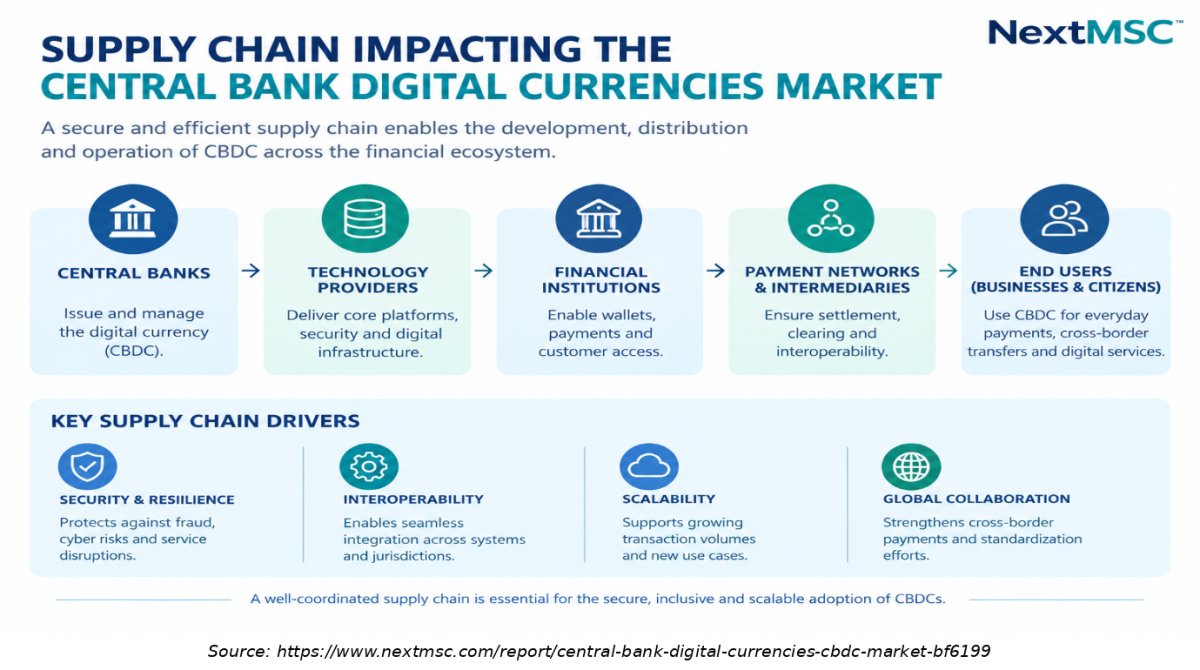
Supply Chain Impacting the Central Bank Digital Currencies (CBDC) Market

Supply Chain Impacting the Central Bank Digital Currencies (CBDC) Market
The infographic illustrates the CBDC supply chain, beginning with central banks and technology providers, followed by financial institutions, payment networks, intermediaries, and end users. It explains how these participants contribute to digital currency issuance, platform development, payment processing, and consumer access. Security, interoperability, scalability, and international collaboration are highlighted as key enablers of a reliable and efficient CBDC ecosystem

What Does the Central Bank Digital Currencies (CBDC) Market Encompass?

The Central Bank Digital Currencies (CBDC) Market covers the platforms, secure wallets, integration services and managed services that central banks and their intermediaries procure to issue and operate digital forms of sovereign money. It spans retail CBDC for households and merchants, wholesale CBDC for settlement between financial institutions, and cross border platforms that connect several currencies. Revenue excludes private stablecoins, commercial bank tokenized deposits and central bank internal staff costs.

The regulatory environment varies sharply by jurisdiction. The European Union is advancing digital euro legislation through trilogue negotiations, China has moved the e-CNY to interest bearing digital deposit money from 1 January 2026, and Russia launched the digital ruble on 31 August 2026. In contrast, a January 2025 U.S. executive order prohibits federal agencies from establishing, issuing or promoting a CBDC, which keeps American demand focused on research and wholesale tokenization.

Market Drivers & Dynamics

Interactive Dataset
Stablecoin and cryptoasset competition accelerating central bank programs driver +2.4% Global, Europe, Asia-Pacific 2026–2030
Euro area legislation and 2027 pilot procurement driver +1.9% Europe 2026–2029
Interest bearing e-CNY and bank wallet integration driver +1.6% China, Asia-Pacific 2026–2028
Wholesale and cross border settlement testing driver +2.1% Europe, Global 2026–2030
Offline payment and financial inclusion requirements driver +1.2% Middle East & Africa, Asia-Pacific 2026–2032
U.S. federal prohibition on CBDC activity restraint −1.8% North America 2025–2035
Concerns over bank disintermediation and privacy restraint −1.5% Europe, Global 2026–2029
Only three full launches, extending procurement cycles restraint −1.1% Global 2026–2030
Source: Next Move Strategy Consulting

Growth Drivers

What Is the Primary Growth Driver in the Central Bank Digital Currencies (CBDC) Market?

Competitive pressure from stablecoins and other cryptoassets is the primary growth driver. The BIS's 2024 survey of 93 central banks, published in August 2025, found that more than one in three jurisdictions had accelerated CBDC work in response to developments in stablecoins and other cryptoassets, while 91% of respondents were exploring a retail CBDC, a wholesale CBDC, or both. We estimate that this policy urgency adds about 2.4 percentage points to the market CAGR, because it converts research budgets into funded pilots, procurement frameworks and supplier contracts.

How Is Euro Area Legislation Driving Central Bank Digital Currencies (CBDC) Market Growth?

The digital euro is a significant potential source of CBDC infrastructure procurement in Europe, supported by legislative work, planned pilot testing and the Eurosystem's estimated development and operating expenditure. The European Central Bank estimates development costs of about €1.3 billion to first issuance, of which about €265 million is external, and annual operating costs near €320 million from 2029. The Council of the EU agreed its position in December 2025, the European Parliament adopted its position in July 2026, and trilogue negotiations are underway. A pilot with 36 payment service providers is planned for the second half of 2027.

Growth Inhibitors

What Is Restraining the Central Bank Digital Currencies (CBDC) Market?

Political resistance and thin retail uptake restrain growth. The January 2025 U.S. executive order prohibits federal agencies, subject to the order's stated legal exception, from taking action to establish, issue or promote CBDCs. This materially constrains domestic federal CBDC activity, but should not be interpreted as proof that all private-sector research, overseas supplier activity or tokenised-settlement work has ceased. The Atlantic Council's May 2026 tracker listed the Bahamas, Jamaica and Nigeria as jurisdictions with fully launched CBDCs at that time. However, the Bank of Russia announced the launch of the digital ruble on 31 August 2026, with major banks and retailers making their processing infrastructure available from 1 September 2026. Update the current launch count using a consistent definition of launch and rollout. Bank concerns over deposit outflows and privacy debates add design constraints and lengthen approval cycles.

What Are the Growth Opportunities?

Can Offline Wallet and Secure Element Suppliers Capture Outsized Growth?

Offline capable wallets are required in the digital euro design and in programs targeting users with limited connectivity. Suppliers of secure elements, smartphone wallets and smart card form factors can bundle hardware, software and certification into multi-year contracts. Wallet and secure element solutions is forecast to grow from USD 119.52 Million in 2026 to USD 588.00 Million in 2035, the highest growth among components.

Does Cross Border Settlement Create a Distinct Platform Revenue Pool?

The Atlantic Council's May 2026 tracker identified 13 cross-border wholesale CBDC projects. Separately, Project Agorá conducted real-value testing in July 2026 to assess a shared platform for wholesale cross-border payments using tokenised reserves and deposits.. Platforms that connect multiple central bank ledgers, handle currency conversion and enforce compliance rules can earn recurring fees per connected institution. We forecast Cross border CBDC platforms to grow from USD 74.70 Million in 2026 to USD 411.60 Million in 2035 at 20.9% CAGR.

Can Middle East and African Programs Convert Pilots into Managed Service Contracts?

Nigeria is already live, and the UAE central bank selected R3, G42 Cloud and Clifford Chance to support Phase 1 of its CBDC strategy. Smaller central banks often lack operating staff, which creates demand for managed cloud hosting, monitoring and wallet support. Middle East & Africa is the fastest growing region at 19.5% CAGR from 2026 to 2035, led by service intensive programs.

Segmentation Analysis

2025 (USD Million)
2035 (USD Million)
Platform and infrastructure software 2025: $160.0 Million | 2035: $705.6 Million
Platform and
Wallet and secure element solutions 2025: $98.4 Million | 2035: $588.0 Million
Wallet and s
Integration, consulting and managed services 2025: $151.6 Million | 2035: $666.4 Million
Integration,
Platform and infrastructure software $160.0 Million $705.6 Million 15.4%
Wallet and secure element solutions $98.4 Million $588.0 Million 19.4%
Integration, consulting and managed services $151.6 Million $666.4 Million 15.3%

Which Component Segment Leads the Market and Which Is Growing Fastest?

Platform and infrastructure software leads with about 39% of 2025 revenue, at USD 160.00 Million, because every program must first procure issuance, ledger and distribution layers. Wallet and secure element solutions is the fastest growing component at 19.4% CAGR from 2026 to 2035, reflecting offline payment requirements and hardware backed security needs. Integration, consulting and managed services grows at 15.3% as central banks outsource operations during pilots and early production phases.

2025 (USD Million)
2035 (USD Million)
Retail CBDC
Wholesale CB
Cross border
Segment Item 2025 (USD Million) 2035 (USD Million) CAGR
Retail CBDC $10.0 USD Million $40.0 USD Million 25.0%
Wholesale CBDC $17.1 USD Million $51.1 USD Million 11.0%
Cross border CBDC platforms $24.2 USD Million $62.2 USD Million 25.0%

Segment-wise data is locked

Unlock complete segment-wise numbers for By CBDC Type.

Unlock Full Data
2025 (USD Million)
2035 (USD Million)
Distributed
Centralized
Hybrid ledge
Segment Item 2025 (USD Million) 2035 (USD Million) CAGR
Distributed ledger $10.0 USD Million $40.0 USD Million 27.0%
Centralized ledger $17.1 USD Million $51.1 USD Million 9.0%
Hybrid ledger $24.2 USD Million $62.2 USD Million 19.0%

Segment-wise data is locked

Unlock complete segment-wise numbers for By Ledger Architecture.

Unlock Full Data
2025 (USD Million)
2035 (USD Million)
North Americ
Canada
Mexico
Europe: UK
Germany
Segment Item 2025 (USD Million) 2035 (USD Million) CAGR
North America: U.S. $10.0 USD Million $40.0 USD Million 14.0%
Canada $17.1 USD Million $51.1 USD Million 24.0%
Mexico $24.2 USD Million $62.2 USD Million 22.0%
Europe: UK $31.3 USD Million $73.3 USD Million 12.0%
Germany $38.4 USD Million $84.4 USD Million 27.0%

Segment-wise data is locked

Unlock complete segment-wise numbers for By Region.

Unlock Full Data

Growth Opportunities

Our analysis shows that three whitespace opportunities are positioned to generate disproportionate revenue through 2035.

Can Offline Wallet and Secure Element Suppliers Capture Outsized Growth?

Offline capable wallets are required in the digital euro design and in programs targeting users with limited connectivity. Suppliers of secure elements, smartphone wallets and smart card form factors can bundle hardware, software and certification into multi-year contracts. Wallet and secure element solutions is forecast to grow from USD 119.52 Million in 2026 to USD 588.00 Million in 2035, the highest growth among components.

Does Cross Border Settlement Create a Distinct Platform Revenue Pool?

The Atlantic Council's May 2026 tracker identified 13 cross-border wholesale CBDC projects. Separately, Project Agorá conducted real-value testing in July 2026 to assess a shared platform for wholesale cross-border payments using tokenised reserves and deposits.. Platforms that connect multiple central bank ledgers, handle currency conversion and enforce compliance rules can earn recurring fees per connected institution. We forecast Cross border CBDC platforms to grow from USD 74.70 Million in 2026 to USD 411.60 Million in 2035 at 20.9% CAGR.

Can Middle East and African Programs Convert Pilots into Managed Service Contracts?

Nigeria is already live, and the UAE central bank selected R3, G42 Cloud and Clifford Chance to support Phase 1 of its CBDC strategy. Smaller central banks often lack operating staff, which creates demand for managed cloud hosting, monitoring and wallet support. Middle East & Africa is the fastest growing region at 19.5% CAGR from 2026 to 2035, led by service intensive programs.

Regional Outlook

2025 (USD Million)
2035 (USD Million)
Asia-Pacific
Europe
Middle East
Latin Americ
North Americ
Region 2025 (USD Million) 2035 (USD Million) CAGR (%)
Asia-Pacific $10.0 USD Million $40.0 USD Million 9.0%
Europe $17.1 USD Million $51.1 USD Million 27.0%
Middle East & Africa $24.2 USD Million $62.2 USD Million 25.0%
Latin America $31.3 USD Million $73.3 USD Million 23.0%
North America $38.4 USD Million $84.4 USD Million 12.0%

Regional data is locked

Unlock complete regional numbers for this market.

Unlock Full Data

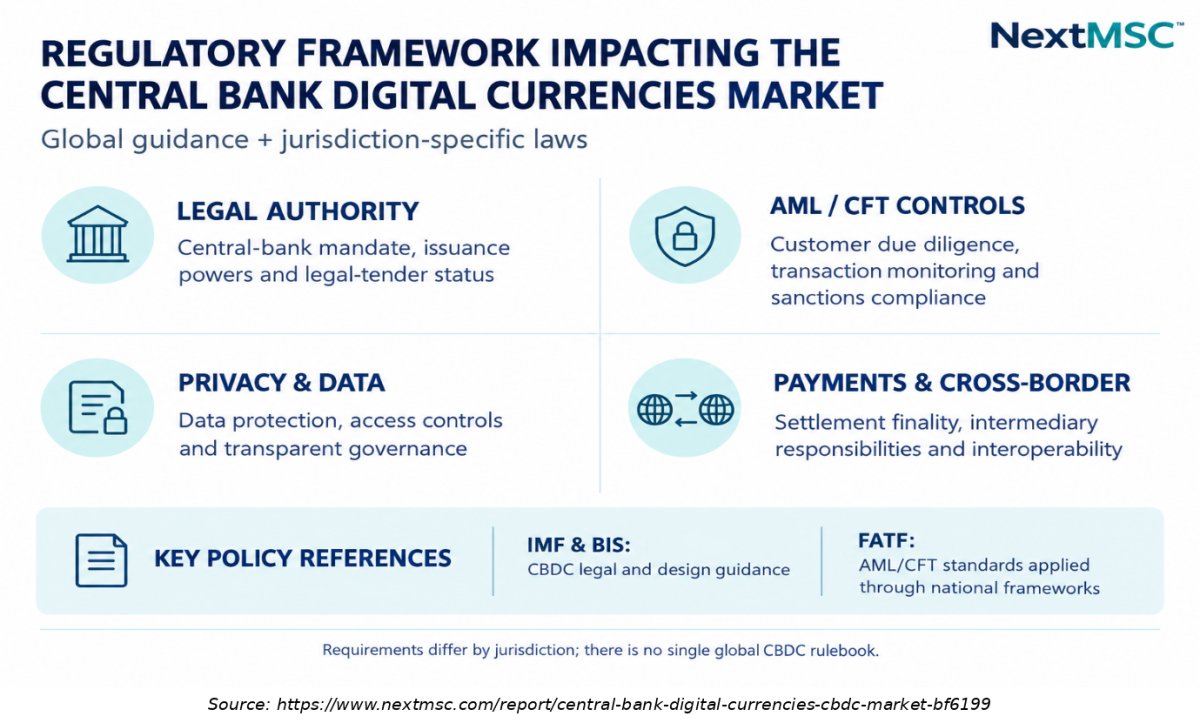
Regulatory Framework Impacting the Central Bank Digital Currencies (CBDC) Market

The infographic highlights the key regulatory considerations shaping the Central Bank Digital Currencies Market, including legal authority, anti-money laundering and counter-terrorist financing (AML/CFT) controls, data privacy, and cross-border payment interoperability. It also identifies the roles of the International Monetary Fund (IMF), Bank for International Settlements (BIS), and Financial Action Task Force (FATF) in providing policy guidance and standards. Regulatory requirements vary across jurisdictions, influencing CBDC design, implementation, and adoption

Competitive Landscape

Our assessment indicates that the competitive landscape is program driven, with security hardware, payment network and enterprise technology suppliers competing for central bank frameworks.

How Do Companies Compete in the Central Bank Digital Currencies (CBDC) Market?

Companies compete on security certification, offline capability, interoperability with existing payment systems and the ability to deliver within central bank governance models. Procurement is typically run as tenders or framework agreements, as in the 2025 offline solution award by the European Central Bank, so credibility with procurement teams often outweighs price. Pricing is project based during pilots and shifts toward recurring licensing and managed service fees once programs enter production.

Which Competitive Archetypes Dominate the Market?

Three archetypes dominate. Secure hardware and wallet specialists, led by Giesecke Devrient and IDEMIA, differentiate through certified offline credentials. Payment networks, including Mastercard and Visa, differentiate through testing platforms and interoperability with existing card and account rails. Ledger and enterprise technology providers, including IBM, R3, Ripple and Soramitsu, differentiate through platform architecture and public sector delivery experience, while Huawei and Nexi add device level and acquiring capabilities.

What Innovation and Differentiation Strategies Are Companies Pursuing?

We observed that suppliers invest in offline payments, privacy preserving transaction designs, programmable payment features and tools that test interoperability between central bank ledgers. Visa published a CBDC payments module proof of concept, Mastercard launched a CBDC testing platform in 2020, and IDEMIA markets a secure offline CBDC wallet. Investments increasingly target hybrid architectures that let central banks keep control of issuance while using shared settlement infrastructure.

What M&A and Partnership Activity Is Shaping the Market?

Our findings suggest that partnerships matter more than acquisitions. The ECB's October 2025 digital euro framework agreements included Giesecke+Devrient and equensWorldline for the offline solution. Separately, Project Agorá is a BIS- and Institute of International Finance-convened collaboration involving central banks and more than 40 private-sector financial institutions. R3 joined G42 Cloud and Clifford Chance for the UAE central bank program, and Ripple worked with the Royal Monetary Authority of Bhutan on a CBDC pilot announced in 2021. Consortia of this type are likely to remain the dominant deal structure.

Key Market Players

Based on research conducted by NMSC, the following 10 companies represent the validated leading participants in the Central Bank Digital Currencies (CBDC) Market.

Giesecke+Devrient GmbH IDEMIA Group Mastercard Incorporated Visa Inc. International Business Machines Corporation R3 Nexi S.p.A. Huawei Technologies Co., Ltd. Ripple Labs Inc. Soramitsu Co., Ltd.

Latest Developments

During our market evaluation, we noticed that 2025–2026 milestones are concentrated in Europe, with parallel activity in China, Russia and wholesale settlement.

Date Event
Aug 2025 BIS Paper 159 reports that 91% of 93 surveyed central banks are exploring a retail CBDC, a wholesale CBDC or both.
Jan 2026 China moves the e-CNY to interest bearing digital deposit money with deposit insurance and reserve requirement treatment.
31 Aug 2026 The Bank of Russia launches the digital ruble, with major banks and large retailers offering it from 1 September 2026.
21 Sep 2026 The Eurosystem launches Pontes, which links distributed ledger platforms to central bank money, with full implementation by mid-2028.

Investment Opportunities

Where Are Capital Inflows Concentrating in the Market?

Capital is concentrating in government funded programs rather than venture backed products. The European Central Bank puts development costs to first digital euro issuance at about €1.3 billion, with about €265 million procured externally, and expects annual operating costs of about €320 million from 2029. Suppliers holding framework agreements gain multiyear visibility, while payment networks and ledger providers invest in testing platforms to secure positions in future tenders.

How Is Infrastructure Investment Shaping Market Capacity?

Infrastructure spending is moving toward resilient settlement cores, offline capable devices and interlinking services. Pontes, launched on 21 September 2026 with full implementation by mid-2028, and the Appia blueprint targeted for 2028 show a staged build out of wholesale infrastructure. Hosting, cyber security tooling and hardware security modules are the main capacity constraints for smaller central banks.

What ESG Considerations Are Influencing Market Investment?

Environmental, Social and Governance considerations center on financial inclusion, privacy and operational resilience. Offline wallets and feature phone access, such as the digital rupee on feature phones, extend access to users with limited connectivity. Governance debates focus on data protection, holding limits and the balance between central bank money and commercial bank deposits. Energy efficiency also matters, because central banks prefer ledger designs with limited energy use over proof of work networks.

Key Benefits for Stakeholders

How Does This Report Benefit Central Banks and Public Sector Leaders?

Central bank program leads and finance ministry officials gain a segment level view of where procurement money flows across components, CBDC types and ledger architectures. The report benchmarks 37 countries, compares retail, wholesale and cross border program designs, and shows how offline capability and hybrid ledgers shape supplier selection, which supports budgeting, tender design and vendor assessment.

How Does This Report Benefit Investors and Financial Analysts?

Investors and financial analysts gain a reconciled sizing model that moves from USD 410.00 Million in 2025 to USD 1,960.00 Million by 2035, with segment and region CAGRs calculated on a consistent 2026–2035 basis. The report identifies Hybrid ledger and Cross border CBDC platforms as the highest growth pockets and flags legislative timing and U.S. policy as the main swing factors for revenue.

How Does This Report Benefit Technology Vendors and Payment Providers?

Technology vendors and payment providers gain visibility into which components, regions and countries offer the best entry points, from secure offline wallets to managed services. The competitive analysis maps procurement archetypes and partnership structures, while the discussion of fraud detection and security requirements helps product teams align roadmaps with central bank expectations.

Key Market Segments Evaluated

By Component

  • Platform and infrastructure software
  • Wallet and secure element solutions
  • Integration, consulting and managed services

By CBDC Type

  • Retail CBDC
  • Wholesale CBDC
  • Cross border CBDC platforms

By Ledger Architecture

  • Distributed ledger
  • Centralized ledger
  • Hybrid ledger

By Region

  • North America 
    • U.S.
    • Canada
    • Mexico
  • Europe 
    • UK
    • Germany
    • France
    • Italy
    • Spain
    • Sweden
    • Denmark
    • Finland
    • Netherlands
    • Rest of Europe
  • Asia-Pacific 
    • China
    • India
    • Japan
    • South Korea
    • Taiwan
    • Indonesia
    • Vietnam
    • Australia
    • Philippines
    • Malaysia
    • Rest of APAC
  • Middle East & Africa 
    • Saudi Arabia
    • UAE
    • Egypt
    • Israel
    • Turkey
    • Nigeria
    • South Africa
    • Rest of MEA
  • Latin America 
    • Brazil
    • Argentina
    • Chile
    • Colombia
    • Rest of LATAM

Conclusion & Recommendations

The long-term outlook is strongly positive, with revenue rising from USD 498.00 Million in 2026 to USD 1,960.00 Million by 2035 at a 16.4% CAGR. Growth rests on policy urgency, euro area legislation, wholesale settlement testing and offline payment requirements. Because only three jurisdictions have fully launched, most revenue growth depends on programs converting from pilot to production.

What Strategic Positioning Recommendations Does NMSC Offer?

Suppliers should prioritize certified offline wallets and secure elements, interoperability between central bank ledgers, and managed service offerings for smaller central banks. Positioning inside consortia that win framework agreements is more effective than competing on price in isolated tenders. Payment networks and ledger providers should invest in hybrid architecture tooling, which grows fastest at 24.5% CAGR from 2026 to 2035.

What Is the Investment Attractiveness of the Central Bank Digital Currencies (CBDC) Market?

Investment attractiveness is moderate to high, supported by the USD 1,462.00 Million absolute growth opportunity between 2026 and 2035 and by public sector funding commitments in Europe, China and Russia. Revenue is concentrated in government tenders, so returns depend on winning frameworks. Investors should Favor suppliers with diversified program exposure across Europe, Asia-Pacific and Middle East & Africa.

What Are the Market Shifts and Key Risks in the Central Bank Digital Currencies (CBDC) Market?

Key shifts include the move from retail experiments to wholesale and cross border settlement, the redesign of the e-CNY as interest bearing deposit money, and rising demand for offline capability. The main risks are legislative delay in Europe, the U.S. federal prohibition, bank resistance over disintermediation, and the possibility that regulated stablecoins and tokenized deposits meet needs that retail CBDC was meant to serve.

What Are the Primary Growth Pathways Through 2035?

Primary growth pathways include Wallet and secure element solutions rising to USD 588.00 Million by 2035, Cross border CBDC platforms expanding at 20.9% CAGR, and Hybrid ledger reaching USD 607.60 Million. Europe contributes the largest regional increase as the digital euro moves from pilot to issuance, while Middle East & Africa adds the fastest rate at 19.5% CAGR from 2026 to 2035.

FAQs

Sources & References

1.

Bank for International Settlements, BIS Paper 159

bis.org
2.

Bank for International Settlements, Project Agorá press release (27 May 2026)

bis.org/press/p260527.htm
3.

Atlantic Council, CBDC Tracker

atlanticcouncil.org/cbdctracker
4.

European Central Bank, press release on the digital euro next phase (30 Oct 2025)

ecb.europa.eu
5.

European Central Bank, digital euro progress

ecb.europa.eu
6.

European Central Bank, speech by Piero Cipollone, Money in the digital age (6 Oct 2026)

ecb.europa.eu
7.

Capgemini, ECB framework agreement for the digital euro offline solution

capgemini.com
8.

Gansu Provincial Government, e-CNY digital deposit money update

ydyl.gansu.gov.cn
9.

Bank of Russia, digital ruble launch

cbr.ru/eng/press/event
10.

Bank of Russia, digital ruble implementation

cbr.ru/eng/press/event
11.

Bank of England, digital pound design phase progress update (4 Mar 2026)

bankofengland.co.uk
12.

The White House, fact sheet on executive order for digital financial technology (23 Jan 2025)

whitehouse.gov
13.

Reserve Bank of India, press release on the e₹-R retail pilot (29 Nov 2022)

rbi.org.in
14.

R3, CBUAE selects R3, G42 Cloud and Clifford Chance

r3.com
15.

Giesecke Devrient, retail CBDC

gi-de.com
16.

IDEMIA, secure offline CBDC wallet

idemia.com
17.

Mastercard, CBDC testing platform (9 Sep 2020)

mastercard.com
18.

Visa, CBDC payments module whitepaper

usa.visa.com
19.

IBM, Newsroom

newsroom.ibm.com
20.

Soramitsu, Bakong with the National Bank of Cambodia

soramitsu.co.jp/cambodia-bakong
21.

Ripple, Bhutan CBDC pilot (23 Sep 2021)

ripple.com
22.

Huawei, consumer products

consumer.huawei.com
23.

Nexi Group

nexigroup.com

About the Author

Mayurima Roy

Mayurima Roy

Mayurima Roy is Research Analyst at Next Move Strategy Consulting, where she has spent 4 years working across the firm's full industry coverage rather than a single fixed vertical. Her work centers on structured research, ongoing trend tracking, competitive assessment, and insight-led content development, translating complex market data into clear, decision-ready narratives that support informed client decision-making across diverse global industries, market sectors, and world regions every day.

About the Reviewer

Supradip Baul

Supradip Baul

Supradip Baul is an accomplished business consultant and strategist with over a decade of rich experience in market intelligence, strategy, technology, and business transformation. His work has included rigorous qualitative and quantitative analysis across multiple industries, helping clients shape investment decisions and long-term roadmaps. Earlier in his career, he was associated with Gartner, where he contributed to industry-leading reports and market share analyses. He has worked with leading global companies and holds an MBA with a dual specialization in Marketing and Finance.

Download Free Sample

Ross J Mckenzie

ROSS J MCKENZIE

Business Insight Manager

Staysure Group

“Next MSC have been incredibly helpful in providing detailed & robust information on our market, alongside quantifying growth by different segments. The process to procure was simple and easy, with sample reports and regular contact to ensure we had what we needed. Succinct detail on their sources & methodologies is also greatly received, allowing transparency in this respect helps build trust in the detail you pay for. Joseph in particular was fantastic, and helped ensure efficient provision of the insight pack – thank you NMSC!”.

Kishu Kanda

KISHU KANDA

Strategy Analyst

Accenture

We purchased the AI Consumer Market Report from this company. Not only did they customize the report to meet our specific requirements, but they also showed great flexibility in accommodating our budget. The report we received fully met our expectations. Additionally, they provided prompt and thorough responses to both our pre-purchase and follow-up questions. We look forward to working with this company again in the future.

Gaurav Jaiswal

GAURAV JAISWAL

Founder & CEO

Yano Charge Private Limited

The EV Charging market research report provided by the NextMSC was exceptionally detailed and insightful. It offered a comprehensive analysis that proved to be a game-changer for our strategic planning. Truly a testament to the NextMSC’s expertise and thoroughness in EV market landscape & analysis.

Robert Sean Trevino

ROBERT SEAN TREVINO

Sr. Director, Head of Strategic Insights & Analytics

Foundation Medicine

I realized that it was a reliable source of information. These days, there are many people who are looking for authentic data, and this is one of the only sources that can offer them with what they need;

Semih Kavaklioglu

SEMIH KAVAKLIOGLU

Co-Founder & Sales Manager

Decortie

I work a lot in the marketing industry and I know that research is an essential part of any campaign. I have used Market research reports for my own products and I found them to be very informative and well-researched. The team here produces insightful reports for a good price

Custom Market Research Services

We will customize the research for you if the listed report does not fully match your requirements.

Get 30% Free Customization

Select License

This website uses cookies to ensure you get the best experience on our website. Learn more

✖