Cloud-Based ITSM Market Global Industry Analysis and Forecast (2026-2035)

Cloud-Based ITSM Market size was USD 13.05 Billion in 2026, projected to reach USD 50.40 Billion by 2035, growing at a CAGR of 16.2% from 2026 to 2035. Key drivers include AI-enabled incident automation adoption, rising enterprise multi-cloud and hybrid IT complexity, and migration from legacy on-premise service desks, with North America leading the market.

Download Free Sample PDF
Base Year (2025)
$11.20 Billion
Forecast (2035)
$50.40 Billion
CAGR (2026-2035)
16.2%
Top Region
North America

What Is the Cloud-Based ITSM Market Size?

The global Cloud-Based ITSM Market size was valued at USD 11.20 Billion in 2025 and is estimated at USD 13.05 Billion in 2026, forecast to reach USD 50.40 Billion by 2035, expanding at a 16.2% CAGR between 2026 and 2035. North America leads with approximately 41% share, while Solutions dominates all other component categories with approximately 74% share.

We observed that growth is broad-based across every segmentation axis, with AI-enabled incident automation and low-code workflow customization driving the dominant structural shifts through 2035.

Cloud-Based ITSM Market Global Industry Analysis and Forecast (2026-2035) Revenue Forecast

Values in USD Billion

2025 $11.20 Billion
2025
2026 $13.05 Billion
2026
2027 $15.16 Billion
2027
2028 $17.62 Billion
2028
2029 $20.48 Billion
2029
2030 $23.79 Billion
2030
2031 $27.65 Billion
2031
2032 $32.13 Billion
2032
2033 $37.33 Billion
2033
2034 $43.38 Billion
2034
2035 $50.40 Billion
2035

Key Takeaways

By Component: Solutions held the largest share of approximately 74% (USD 8.29 billion) in 2025; Services is the fastest-growing sub-segment at 19.5% CAGR from 2026–2035.

By Deployment Model: Public Cloud held the largest share of approximately 62% (USD 6.94 billion) in 2025; Hybrid Cloud is the fastest-growing sub-segment at 18.5% CAGR from 2026–2035.

By Organization Size: Large Enterprises held the largest share of approximately 66% (USD 7.39 billion) in 2025; Small and Medium Enterprises is the fastest-growing sub-segment at 17.4% CAGR from 2026–2035.

By Application: Incident Management held the largest share of approximately 24% (USD 2.69 billion) in 2025; AI-Enabled Service Operations is the fastest-growing sub-segment at approximately 24.0% CAGR from 2026–2035.

By Industry Vertical: IT and Telecommunications held the largest share of approximately 26% (USD 2.91 billion) in 2025; Healthcare is the fastest-growing sub-segment at approximately 19.5% CAGR from 2026–2035.

Dominant Region: North America dominated with approximately 41% revenue share (USD 4.59 billion) in 2025.

Fastest-Growing Region: Asia-Pacific is expected to register the highest CAGR of 20.0% during 2026–2035.

Dominant Country: U.S. led with approximately USD 3.83 billion in 2025.

Fastest-Growing Country: India is the fastest-growing country at approximately 23.5% CAGR from 2026–2035.

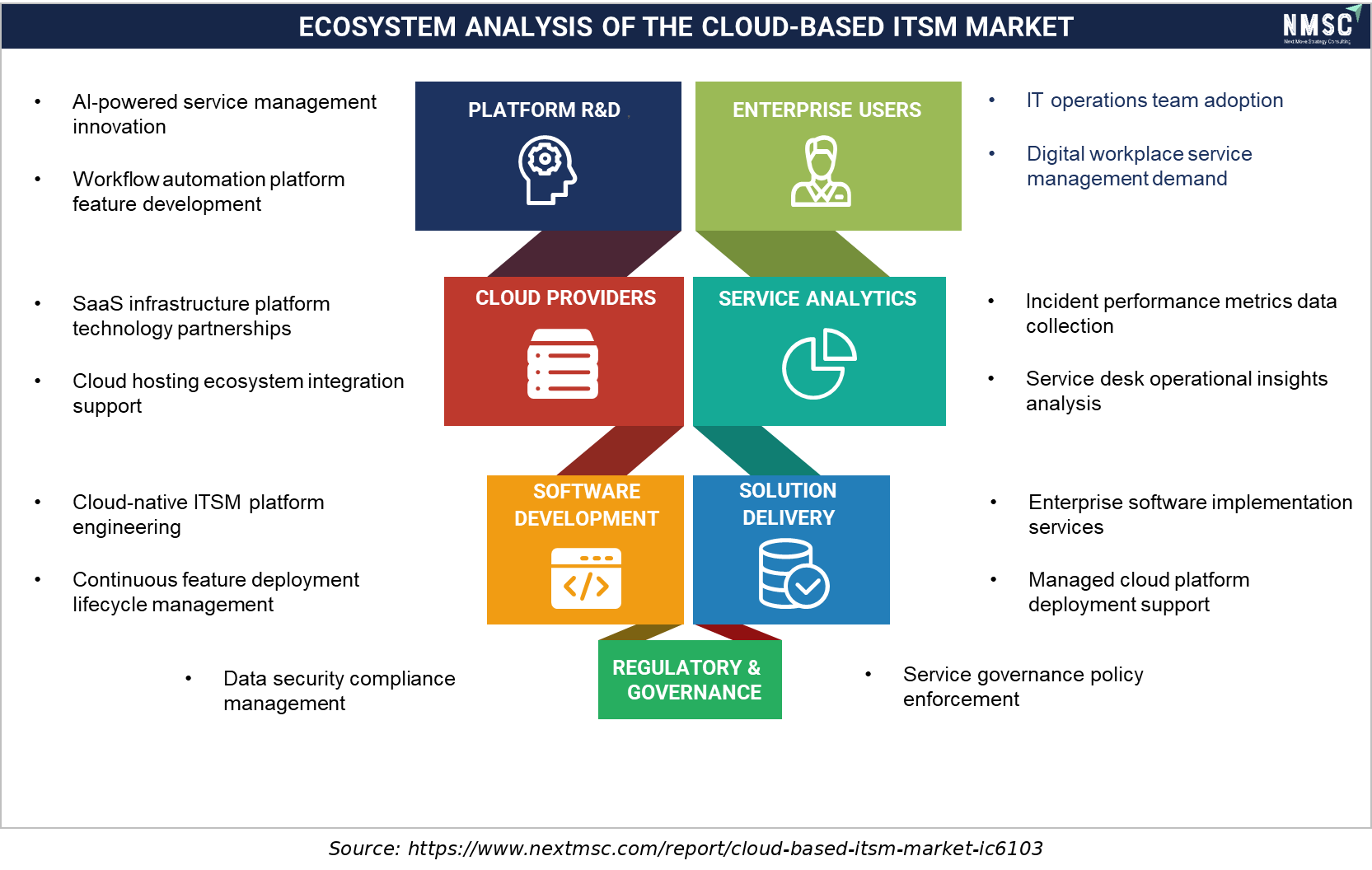
Ecosystem Analysis of the Cloud-Based ITSM Industry

The above infographic presents an ecosystem analysis of the cloud-based ITSM market, highlighting the interconnected roles of platform R&D, cloud providers, software development, and enterprise adoption. AI-powered automation and SaaS infrastructure are driving service innovation, while continuous deployment and data security compliance ensure operational reliability. IT teams are leveraging these platforms for incident management and workflow optimization, with analytics delivering actionable insights. Looking ahead, we observed that managed deployment and governance enforcement will remain critical for aligning service delivery with evolving enterprise demands and regulatory requirements.

What Does the Cloud-Based ITSM Market Encompass?

The Cloud-Based ITSM Market encompasses software delivered via subscription or SaaS models that helps IT organizations manage incident resolution, change management, asset tracking, and service request fulfillment through centralized, cloud-hosted platforms. Our assessment indicates that the scope spans core ITSM solutions and supporting implementation, integration, and managed services procured by enterprises across IT and telecommunications, BFSI, healthcare, manufacturing, and retail sectors seeking to replace on-premises service desk infrastructure with scalable, continuously updated cloud alternatives.
Regulatory frameworks such as evolving data residency requirements across the European Union and sector-specific compliance mandates in healthcare and financial services are reshaping cloud ITSM deployment architecture. We observed that technology adoption is shifting rapidly toward AI-enabled, generative AI automation of tier-one incident triage and low-code workflow customization. NMSC's analysis indicates that this structural shift, combined with expanding hybrid and multi-cloud IT estates, is redefining vendor selection criteria across the market.

Market Drivers & Dynamics

Interactive Dataset
AI-enabled incident automation adoption driver +4.6% North America, Europe 2026-2035
Enterprise multi-cloud and hybrid IT complexity growth driver +3.8% Global 2026-2035
Migration from legacy on-premise service desks driver +3.1% Global 2026-2032
Low-code workflow customization adoption driver +2.4% North America, Europe 2026-2032
Rising enterprise IT spending on digital service delivery driver +1.9% Asia-Pacific, North America 2026-2035
Hyperscale cloud marketplace distribution partnerships driver +1.4% Global 2026-2032
Data security and privacy concerns for cloud-hosted IT data restraint -1.6% Global 2026-2035
Vendor lock-in risk in consolidated platform adoption restraint -1.1% Global 2026-2032
High switching costs for legacy ITSM migration restraint -0.9% North America, Europe 2026-2030
Limited IT budget among small and medium enterprises restraint -0.7% Latin America, Middle East & Africa 2026-2032
Source: Next Move Strategy Consulting

Growth Drivers

What Is the Primary Growth Driver of the Cloud-Based ITSM Market?

AI-enabled incident automation is the primary driver of the market. ServiceNow's fiscal year 2024 revenue grew 22% year-over-year to exceed USD 10 billion, with AI-powered capabilities embedded directly into incident triage and resolution workflows. We observed that this AI-driven momentum, combined with expanding enterprise digital service delivery budgets, continues to anchor baseline demand for cloud-hosted ITSM platforms capable of autonomous, predictive issue resolution.

How Is Multi-Cloud Complexity Driving Cloud ITSM Market Growth?

Multi-cloud and hybrid IT complexity is accelerating market growth as enterprises seek unified visibility across fragmented infrastructure. IBM reported that its hybrid-cloud software revenue rose 12% in the first quarter of 2025, confirming commercial traction for consolidated management platforms. Our assessment indicates that this transition is compressing enterprise adoption timelines as organizations prioritize cross-cloud dependency mapping and automated discovery over maintaining separate, siloed monitoring tools.

Growth Inhibitors

What Is Restraining Cloud-Based ITSM Market Expansion?

Data security and privacy concerns for cloud-hosted IT operations data restrain the pace of migration from on-premises service desks, particularly for regulated industries handling sensitive incident and configuration data. Enterprises evaluating cloud ITSM providers must satisfy compliance reporting requirements for cross-border data flows under evolving European Union data residency frameworks. We found that cloud security certification requirements add meaningful procurement cycle time for vendors targeting healthcare and financial services buyers specifically.

Segmentation Analysis

2025 (USD Billion)
2035 (USD Billion)
Solutions 2025: $8.29 Billion | 2035: $35.28 Billion
Solutions
Services 2025: $2.91 Billion | 2035: $15.12 Billion
Services
Solutions $8.29 Billion $35.28 Billion 15.6%
Services $2.91 Billion $15.12 Billion 19.5%

Which Component Segment Dominates the Cloud-Based ITSM Market?

Solutions, comprising core incident, change, asset, and knowledge management software modules, led the market with USD 8.2880 billion in 2025, reflecting enterprises' primary spend on the underlying cloud platform itself over supporting professional services. We observed that Services is the fastest-growing component, expanding at a 19.5% CAGR from 2026 to 2035, as enterprises increasingly engage implementation and managed service providers to accelerate migration from legacy on-premises service desks.

2025 (USD Billion)
2035 (USD Billion)
Public Cloud
Private Clou
Hybrid Cloud
Segment Item 2025 (USD Billion) 2035 (USD Billion) CAGR
Public Cloud $10.0 USD Billion $40.0 USD Billion 18.0%
Private Cloud $17.1 USD Billion $51.1 USD Billion 24.0%
Hybrid Cloud $24.2 USD Billion $62.2 USD Billion 26.0%

Segment-wise data is locked

Unlock complete segment-wise numbers for By Deployment Model.

Unlock Full Data
2025 (USD Billion)
2035 (USD Billion)
Large Enterp
Small and Me
Segment Item 2025 (USD Billion) 2035 (USD Billion) CAGR
Large Enterprises $10.0 USD Billion $40.0 USD Billion 10.0%
Small and Medium Enterprises $17.1 USD Billion $51.1 USD Billion 24.0%

Segment-wise data is locked

Unlock complete segment-wise numbers for By Organization Size.

Unlock Full Data

Which Organization Size Segment Leads Cloud ITSM Market Demand?

Large Enterprises remained the leading organization size segment within the market, valued at USD 7.3920 billion in 2025, as complex, multi-department IT operations require sophisticated incident and change management workflows. Our findings suggest that Small and Medium Enterprises is the fastest-growing segment, registering a 17.4% CAGR from 2026 to 2035, as vendors including Freshworks and SysAid expand cost-effective, rapidly deployable cloud ITSM packages tailored to smaller IT teams with limited implementation budgets.

2025 (USD Billion)
2035 (USD Billion)
Incident Man
Change and R
Asset and Co
Service Requ
Knowledge Ma
Segment Item 2025 (USD Billion) 2035 (USD Billion) CAGR
Incident Management $10.0 USD Billion $40.0 USD Billion 18.0%
Change and Release Management $17.1 USD Billion $51.1 USD Billion 16.0%
Asset and Configuration Management $24.2 USD Billion $62.2 USD Billion 22.0%
Service Request Management $31.3 USD Billion $73.3 USD Billion 12.0%
Knowledge Management $38.4 USD Billion $84.4 USD Billion 19.0%

Segment-wise data is locked

Unlock complete segment-wise numbers for By Application.

Unlock Full Data
2025 (USD Billion)
2035 (USD Billion)
IT and Telec
BFSI
Healthcare
Manufacturin
Retail
Segment Item 2025 (USD Billion) 2035 (USD Billion) CAGR
IT and Telecommunications $10.0 USD Billion $40.0 USD Billion 16.0%
BFSI $17.1 USD Billion $51.1 USD Billion 10.0%
Healthcare $24.2 USD Billion $62.2 USD Billion 8.0%
Manufacturing $31.3 USD Billion $73.3 USD Billion 22.0%
Retail $38.4 USD Billion $84.4 USD Billion 9.0%

Segment-wise data is locked

Unlock complete segment-wise numbers for By Industry Vertical.

Unlock Full Data

Which Industry Vertical Is Most Widely Served in Cloud ITSM?

IT and Telecommunications remained the dominant industry vertical across the market, reaching USD 2.9120 billion in 2025 due to the sector's early adoption of cloud-native infrastructure and internal IT operations sophistication. Based on research conducted by NMSC, we found that Healthcare is the fastest-growing vertical at a 17.7% CAGR from 2026 to 2035, reflecting accelerating digital health infrastructure investment and rising compliance-driven demand for auditable, cloud-hosted service management workflows.

Growth Opportunities

Our analysis shows that three forward-looking opportunities stand out for stakeholders positioning within the Cloud-Based ITSM Market over the 2026-2035 forecast period.

How Can AI Copilots Unlock Value for Mid-Market IT Teams?

AI-powered copilots embedded directly into service desk workflows present a whitespace opportunity to bring enterprise-grade automation within reach of mid-market IT teams previously limited by headcount. Vendors that package predictive incident triage into accessible, usage-based pricing tiers stand to capture recurring subscription revenue across the Small and Medium Enterprises segment as automation becomes table stakes rather than a premium feature.

Where Does Healthcare Compliance Create New Cloud ITSM Demand?

Healthcare providers navigating expanding digital health infrastructure represent an underpenetrated opportunity for cloud ITSM platforms with built-in compliance management and auditable change-tracking capabilities. Vendors that combine sector-specific compliance templates with standard incident and asset management can capture long-term contracts with the Healthcare vertical as regulatory scrutiny of IT change management intensifies.

How Can Multi-Cloud Dependency Mapping Benefit Large Enterprises?

Large enterprises managing workloads across multiple hyperscale providers represent an opportunity for vendors offering automated cross-cloud dependency mapping and unified incident correlation. Early movers that secure validated, real-time discovery across hybrid estates can differentiate with the Large Enterprises segment pursuing consolidated visibility over previously siloed, provider-specific monitoring tools through the forecast period.

Regional Outlook

2025 (USD Billion)
2035 (USD Billion)
North Americ
Europe
Asia-Pacific
Middle East
Latin Americ
Region 2025 (USD Billion) 2035 (USD Billion) CAGR (%)
North America $10.0 USD Billion $40.0 USD Billion 9.0%
Europe $17.1 USD Billion $51.1 USD Billion 27.0%
Asia-Pacific $24.2 USD Billion $62.2 USD Billion 25.0%
Middle East & Africa $31.3 USD Billion $73.3 USD Billion 23.0%
Latin America $38.4 USD Billion $84.4 USD Billion 12.0%

Regional data is locked

Unlock complete regional numbers for this market.

Unlock Full Data

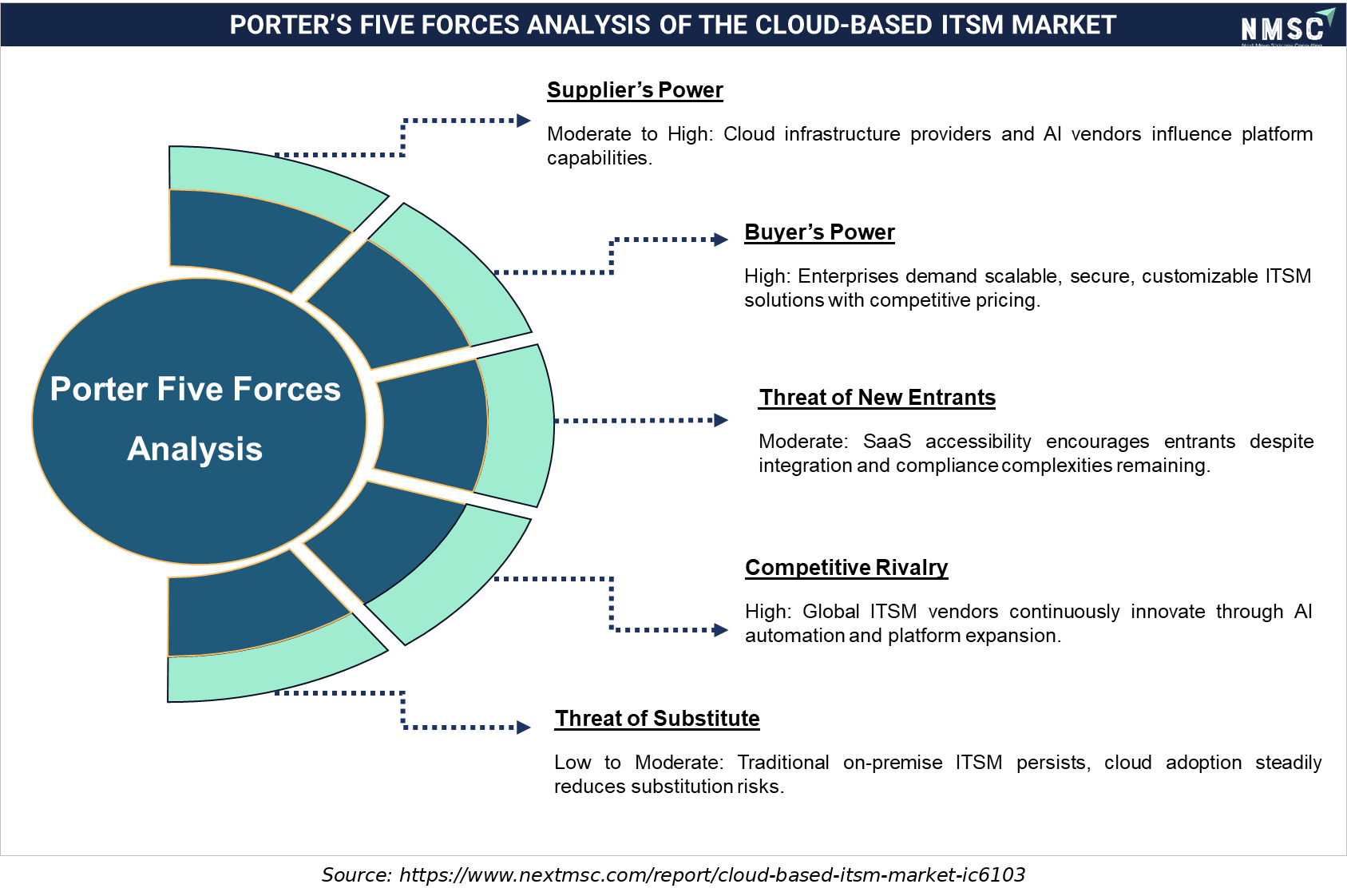
Porter’s Five Forces Analysis of the Cloud-Based ITSM Industry

The above infographic presents a Porter's Five Forces analysis of the cloud-based ITSM market, wherein supplier power remains moderate to high due to reliance on cloud infrastructure providers and AI vendors that shape platform capabilities. At the same time, buyer power is high, as enterprises demand scalable, secure, and customizable solutions with competitive pricing. The threat of new entrants is moderate, constrained by the need for advanced technology and customer trust. Competitive rivalry is intense among global ITSM vendors competing through innovation and platform expansion. Looking ahead, we observed that the threat of substitutes stays low to moderate, as traditional on-premise options still exist, though ongoing cloud adoption is steadily reducing such substitution risks.

Competitive Landscape

We observed that the Cloud-Based ITSM Market features a moderately consolidated competitive landscape, with a dominant platform leader competing alongside diversified enterprise software providers and specialized mid-market vendors on breadth of AI capability.

How Do Companies Compete in the Cloud-Based ITSM Market?

Companies compete primarily on AI capability depth, installed base scale, and platform breadth across the industry. ServiceNow leverages its Now Platform's broad workflow coverage and embedded AI to serve large enterprise buyers, while diversified providers such as IBM and Microsoft cross-sell ITSM modules into existing infrastructure relationships, and specialized vendors including Freshworks compete on rapid deployment for mid-market IT teams.

Which Competitive Archetypes Dominate the Cloud-Based ITSM Market?

Two archetypes dominate the market: the horizontal platform leader offering AI-native, end-to-end IT service workflows, and diversified enterprise software providers cross-selling ITSM into broader infrastructure footprints. ServiceNow exemplifies the platform leader archetype through its unified Now Platform and embedded Now Assist AI capabilities, while IBM and Microsoft exemplify the cross-sell archetype through ITSM modules bundled with hybrid-cloud and productivity software.

How Are Companies Differentiating Through Innovation in Cloud ITSM?

Innovation and differentiation strategy increasingly center on AI-powered automation and low-code extensibility. ServiceNow's Creator Now low-code platform crossed USD 1 billion in associated revenue by 2025, while Atlassian differentiates through integrated DevOps toolchains that connect Jira Service Management directly to software delivery pipelines. Our analysis shows that vendors unable to demonstrate credible AI automation roadmaps risk losing differentiation against more AI-forward competitors.

What M&A and Expansion Activity Is Shaping the Cloud-Based ITSM Market?

Partnerships and geographic expansion continue to shape competitive positioning within the industry. ServiceNow's expanded Google Cloud partnership, announced in January 2025, illustrates how platform leaders pursue hyperscale marketplace distribution to accelerate enterprise procurement, while Atlassian's August 2024 Seoul cloud region launch demonstrates how vendors expand regional data residency compliance to capture Asia-Pacific enterprise demand.

Key Market Players

Our assessment indicates that the following 20 companies are actively shaping product innovation, platform expansion, and AI capability development within the global Cloud-Based ITSM Market.

ServiceNow, Inc. International Business Machines Corporation Broadcom Inc. Atlassian Corporation Ivanti, Inc. BMC Software, Inc. Microsoft Corporation Salesforce, Inc. FreshworksInc. Zoho Corporation Pvt. Ltd. SAP SE Oracle Corporation SysAid Technologies Ltd. InvGate Inc. EasyVista, Inc. TOPdesk B.V. SolarWinds Corporation Alemba Limited Halo Service Solutions Ltd. Giva, Inc.

Latest Developments

We found that recent product launches and partnership announcements within the Cloud-Based ITSM Market are concentrated on AI capability expansion and hyperscale cloud distribution, reflecting the industry's broader modernization transition.

Date Event
January 2025 ServiceNow expanded its partnership with Google Cloud to offer its IT Service Management, Customer Relationship Management, and Security Incident Response solutions on Google Cloud Marketplace and Google Distributed Cloud.
March 2025 ServiceNow introduced its Yokohama platform release, adding thousands of preconfigured AI agents across IT, customer service, HR, CRM, and other enterprise workflows.
March 2025 ServiceNow introduced AI agents for the telecommunications industry, built on its AI platform to automate customer service and network operations workflows.

Investment Opportunities

What Capital Inflows Are Targeting the Cloud-Based ITSM Market?

Capital inflows into the Cloud-Based ITSM Market are increasingly directed toward AI capability development and platform consolidation. ServiceNow's remaining performance obligations grew substantially in recent quarters, reflecting sustained enterprise commitment to multi-year subscription contracts. We observed that investors favor vendors demonstrating validated AI-driven productivity gains over unverified automation claims, treating renewal rate and net revenue retention as key indicators of platform stickiness.

How Is Infrastructure Investment Supporting Cloud ITSM Expansion?

Infrastructure investment is expanding cloud ITSM deployment capacity through hyperscale partnerships and regional data center expansion. Our findings suggest that ServiceNow's expanded Google Cloud partnership and Atlassian's dedicated Seoul cloud region both reflect targeted infrastructure investment to meet data residency requirements and reduce latency for regional enterprise customers. This scale of infrastructure investment continues to lower barriers for enterprise migration from legacy on-premise service desks.

What ESG Considerations Are Shaping Cloud ITSM Investment Decisions?

Environmental, social, and governance considerations in the Cloud-Based ITSM Market center on data governance transparency and workforce transition support amid AI-driven automation. ServiceNow has publicly committed to workforce training initiatives, including plans to train millions of people through dedicated workforce development programs as AI automation reshapes IT operations roles. We found that investors increasingly favor vendors demonstrating responsible AI deployment practices alongside productivity gains.

Key Benefits for Stakeholders

How Does This Report Benefit Enterprise and Industry Leaders?

Enterprise and industry leaders gain access to validated segmentation, competitive benchmarking, and regional demand forecasts that support sourcing and platform-selection decisions across the Cloud-Based ITSM industry. Our analysis shows that detailed component, organization size, and industry vertical breakdowns help IT procurement teams align vendor selection with AI automation requirements and compliance obligations while identifying underserved buyer segments for portfolio expansion.

How Does This Report Benefit Investors and Financial Analysts?

Investors and financial analysts benefit from consistent, single-point market size and CAGR estimates that support valuation and capital-allocation decisions across the Cloud-Based ITSM supply chain. We observed that the report's regional and segment-level growth differentials help identify which vendors and geographies are best positioned to capture above-market growth in Services and Asia-Pacific categories through 2035.

How Does This Report Benefit Technology Vendors and Product Teams?

Technology vendors and product teams gain insight into emerging design requirements, including AI-powered incident triage, low-code workflow architecture, and multi-cloud dependency mapping, that are reshaping the industry. Our findings suggest that this analysis helps R&D teams prioritize development roadmaps around validated AI productivity outcomes increasingly required by enterprise IT procurement processes.

Key Market Segments Evaluated

By Component

  • Solutions
  • Services

By Deployment Model

  • Public Cloud
  • Private Cloud
  • Hybrid Cloud

By Organization Size

  • Large Enterprises
  • Small and Medium Enterprises

By Application

  • Incident Management
  • Change and Release Management
  • Asset and Configuration Management
  • Service Request Management
  • Knowledge Management
  • AI-Enabled Service Operations
  • Other Applications

By Industry Vertical

  • IT and Telecommunications
  • BFSI
  • Healthcare
  • Manufacturing
  • Retail
  • Government and Public Sector
  • Other Verticals

Conclusion & Recommendations

The long-term outlook for the market remains strongly positive, with global revenue projected to expand more than fourfold from USD 11.20 Billion in 2025 to USD 50.40 Billion by 2035 at a 16.2% CAGR. We observed that AI-enabled incident automation, expanding multi-cloud complexity, and rising enterprise digital service delivery investment will continue underpinning demand across Solutions and Services categories through the forecast period.

What Strategic Positioning Should Cloud ITSM Vendors Pursue?

Vendors should prioritize AI-native platform architecture and low-code extensibility to secure long-term enterprise contracts. Our assessment indicates that providers investing early in validated, measurable AI productivity outcomes and hyperscale cloud marketplace distribution will be best positioned to capture premium pricing within the Cloud-Based ITSM Market as basic service desk functionality becomes increasingly commoditized.

How Attractive Is the Cloud-Based ITSM Market for New Investment?

The Cloud-Based ITSM industry presents a highly attractive investment case, supported by a USD 37.35 Billion absolute dollar opportunity between 2026 and 2035 and above-average growth in Asia-Pacific and Services categories. We found that investment attractiveness is highest for vendors combining validated AI capability with strong net revenue retention, positioning them to serve both large enterprise and small and medium enterprise buyer segments simultaneously.

What Market Shifts and Key Risks Should Stakeholders Monitor?

Stakeholders should monitor data security and privacy concerns, vendor lock-in risk, and high switching costs from legacy platforms as key risks to the Cloud-Based ITSM Market. Our analysis shows that vendors unable to demonstrate validated AI productivity outcomes and transparent data governance risk losing contract share to competitors with stronger compliance credentials as enterprise buyer scrutiny intensifies.

What Are the Key Growth Pathways for the Cloud-Based ITSM Market?

Key growth pathways include expanding AI-powered incident automation portfolios, scaling low-code workflow platforms, and deepening penetration into Asia-Pacific and healthcare vertical categories. NMSC's analysis indicates that vendors pursuing these pathways while maintaining validated, measurable AI performance claims will be best positioned to capture the Cloud-Based ITSM Market's projected growth through 2035.

FAQs

About the Author

Mayurima Roy

Mayurima Roy

Mayurima Roy is Research Analyst at Next Move Strategy Consulting, where she has spent 4 years working across the firm's full industry coverage rather than a single fixed vertical. Her work centers on structured research, ongoing trend tracking, competitive assessment, and insight-led content development, translating complex market data into clear, decision-ready narratives that support informed client decision-making across diverse global industries, market sectors, and world regions every day.

About the Reviewer

Supradip Baul

Supradip Baul

Supradip Baul is an accomplished business consultant and strategist with over a decade of rich experience in market intelligence, strategy, technology, and business transformation. His work has included rigorous qualitative and quantitative analysis across multiple industries, helping clients shape investment decisions and long-term roadmaps. Earlier in his career, he was associated with Gartner, where he contributed to industry-leading reports and market share analyses. He has worked with leading global companies and holds an MBA with a dual specialization in Marketing and Finance.

Download Free Sample

Henri Knyphausen

HENRI KNYPHAUSEN

Partner at Singulier [Ex-BCG]

Singulier

I recently engaged NEXTMSC.com for a commercial due diligence project within the intralogistics sector, and I am pleased to provide a reference based on my experience. In utilizing NEXTMSC.com's services, I found their report to offer valuable insights into market dynamics and key industry players. The initial report provided a solid foundation for our analysis. However, as we were investigating a smaller target in the market, and I had specific customization requests requiring additional research. These requests included detailed information on product portfolios of various players and sub-market sizes, both inclusive and exclusive of certain product categories. NEXTMSC.com demonstrated commendable responsiveness and agility in accommodating these customization requests. Within a timeframe of 1-2 weeks, they delivered a revised report that met our specific needs. Furthermore, they were receptive to my follow-up inquiries, ensuring clarity and understanding of the data provided. The final deliverable significantly contributed to our due diligence efforts. One of NEXTMSC.com's notable strengths lies in their qualitative research capabilities. However, for future engagements, I would recommend the inclusion of a quantified market model in Excel format. Such a model would offer the ability to conduct in-depth analyses and explore various market segments, including country-specific data and subcomponent breakdowns. Based on my positive experience, I would not hesitate to work with NEXTMSC.com again. Their responsiveness, willingness to accommodate customization requests, and commitment to delivering actionable insights make them a reliable partner for commercial research projects.


Diana Trejo

DIANA TREJO

Assistant Manager

Sumitomo Corporation de Mexico, S.A. de C.V.

Recently, we purchased a report on the Mexico Data Center Market from Next Move Strategy Consulting. The service has been excellent, with support that is always timely and thoroughly professional. The information provided is interesting, highly useful, and delivered with clarity. I would highly recommend NextMSC for anyone seeking insightful and dependable analysis.

Nishant Awate

NISHANT AWATE

Business Development Global Sales

Zehnder Group Deutschland GmbH

Our experience working with Next Move Strategy Consulting was positive. The team was responsive, professional, and open to incorporating our specific requirements throughout the project. The India AHU market study was comprehensive and well structured, covering market value and volume forecasts, product and application segments, and key industry trends. The inclusion of both AHU and residential MVHR market insights made the study particularly relevant for our strategic market assessment. Overall, the report provides a solid foundation for evaluating market potential, identifying priority segments, and supporting business-development decisions in India.

Semih Kavaklioglu

SEMIH KAVAKLIOGLU

Co-Founder & Sales Manager

Decortie

I work a lot in the marketing industry and I know that research is an essential part of any campaign. I have used Market research reports for my own products and I found them to be very informative and well-researched. The team here produces insightful reports for a good price

Kishu Kanda

KISHU KANDA

Strategy Analyst

Accenture

We purchased the AI Consumer Market Report from this company. Not only did they customize the report to meet our specific requirements, but they also showed great flexibility in accommodating our budget. The report we received fully met our expectations. Additionally, they provided prompt and thorough responses to both our pre-purchase and follow-up questions. We look forward to working with this company again in the future.

Custom Market Research Services

We will customize the research for you if the listed report does not fully match your requirements.

Get 30% Free Customization

Select License

This website uses cookies to ensure you get the best experience on our website. Learn more

✖