Cloud Storage Market Size, Share, Growth & Forecast by Offering (Cloud Storage Services: Object Storage, Block Storage, File Storage, Data Protection; Cloud Storage Software: SDS, Gateway, Hybrid Platform, Management Software), Deployment (Public, Private, Hybrid, Edge), Commercial Model (Consumption), Buyer Segment (Enterprise, SMB, Consumer, Public Sector, Service Provider), Channel (Direct, Partner, Marketplace, OEM), End Use Industry — Global Analysis 2026–2035
Industry: ICT & Media | Publishing Date: July 9, 2026 | Last Updated: September 30, 2026 | No of Pages: N/A | No. of Tables: N/A | No. of Figures: N/A | Format: PDF | Report Code: IC5071
What Is the Cloud Storage Market Size?
The global Cloud Storage Market was valued at USD 137.6 billion in 2025 and is expected to reach USD 159.9 billion in 2026. Driven by escalating enterprise data volumes, accelerating digital transformation, and the proliferation of AI workloads requiring scalable storage infrastructure, the market is projected to expand to USD 618.4 billion by 2035, advancing at a CAGR of 16.2% from 2026 to 2035. Key growth drivers include the mass migration of enterprise workloads to the cloud, rising adoption of hybrid and multi-cloud architectures, increasing regulatory requirements for data protection and disaster recovery, and the deployment of AI and machine learning applications across all major industry verticals.
|
Parameters |
Details |
|
Market Size in 2025 |
USD 137.6 Billion |
|
Market Size in 2026 |
USD 159.9 Billion |
|
Revenue Forecast in 2035 |
USD 618.4 Billion |
|
Growth Rate |
CAGR of 16.2% from 2026 to 2035 |
|
Analysis Period |
2025–2035 |
|
Base Year Considered |
2025 |
|
Forecast Period |
2026–2035 |
|
Market Size Estimation |
Billion USD |
|
Companies Profiled |
20 |
|
Countries Covered |
33 |
|
Market Share |
Top 10 |
Cloud Storage Market Overview
What Is the Cloud Storage Market?
The Cloud Storage Market encompasses the delivery of scalable, on-demand storage infrastructure and software services through public, private, hybrid, and edge cloud environments. It includes cloud storage services such as object storage, block storage, and file storage, as well as data protection services covering backup, recovery, disaster recovery, and sync-and-share solutions. Cloud storage software including software-defined storage, cloud storage gateways, hybrid storage platforms, and storage management tools also constitute core components of this expanding market ecosystem.
How Has the Cloud Storage Market Evolved?
The Cloud Storage Market has undergone several transformative phases since the early adoption of public cloud object storage in the mid-2000s. The first phase centered on basic file hosting and backup services for consumers and SMBs. The second phase introduced enterprise-grade services with SLA guarantees, high-availability architectures, and the convergence of block and file storage with cloud platforms. NMSC's analysis indicates that the current phase is defined by AI-native storage optimization, intelligent data tiering, autonomous data lifecycle management, and integration of storage services within broader cloud platform ecosystems serving global enterprise buyers.
How Do Regulations Influence the Cloud Storage Market?
Regulatory frameworks have become increasingly significant structural factors shaping the Cloud Storage Market trends globally. Data protection mandates such as the EU's General Data Protection Regulation, the California Consumer Privacy Act, India's Digital Personal Data Protection Act, and Saudi Arabia's National Data Management Office guidelines are compelling organizations to invest in storage solutions with robust access controls, data residency compliance, encryption, and audit trail capabilities. These requirements are accelerating the shift toward sovereign and hybrid cloud storage architectures that maintain data within jurisdictionally specified boundaries.
How Is Technology Adoption Expanding Across the Cloud Storage Market?
Technology adoption across the Cloud Storage Market is accelerating as organizations implement multi-cloud and hybrid storage strategies that balance cost, performance, and compliance requirements. Consumption-based pricing models are lowering adoption barriers for SMBs, while large enterprises are deploying intelligent storage tiering, AI-driven data management, and cloud storage gateways that bridge on-premises infrastructure with cloud-native architectures. From our research, we found that the integration of NVMe-based high-performance block storage and cloud-native file systems is enabling enterprises to run latency-sensitive workloads directly on cloud infrastructure.
Key Takeaways |
|
By offering, Cloud Storage Services dominate the Cloud Storage Market with an estimated USD 98.4 billion in 2025, driven by enterprise demand for scalable object storage, high-performance block storage, and integrated data protection capabilities. Object storage is the largest sub-segment within Cloud Storage Services, projected to exceed USD 58.2 billion in 2025, anchored by hyperscaler-grade public cloud deployments across every major industry vertical. |
|
Cloud Storage Software is the fastest-growing primary offering segment in the Cloud Storage Market at a CAGR of 18.4% from 2026 to 2035, advancing from USD 39.2 billion in 2025 to an estimated USD 206.8 billion by 2035, fueled by rising enterprise investment in software-defined storage, hybrid storage platforms, and AI-driven storage management solutions. |
|
By deployment, Public Cloud leads the Cloud Storage Market with an estimated USD 87.4 billion in 2025, representing approximately 63.5% of total market revenue, driven by hyperscaler scale, consumption-based pricing flexibility, and broad support for AI and analytics workloads globally. |
|
Hybrid Cloud is the fastest-growing deployment mode in the Cloud Storage Market at a CAGR of 18.8% from 2026 to 2035, advancing from USD 27.6 billion in 2025 to USD 147.2 billion by 2035, as enterprises seek to balance cloud elasticity with on-premises governance and legacy system integration. |
|
By commercial model, Subscription-based pricing leads the Cloud Storage Market with an estimated USD 56.8 billion in 2025, preferred by enterprise and SMB buyers for predictable cost management and guaranteed service levels across storage deployments. |
|
Consumption-based pricing is the fastest-growing commercial model in the Cloud Storage Market at a CAGR of 18.2% from 2026 to 2035, driven by hyperscaler ecosystems offering granular pay-per-use billing that aligns storage expenditure directly with actual data workload requirements. |
|
By buyer segment, Enterprises account for the largest share of the Cloud Storage Market at an estimated USD 72.8 billion in 2025, underpinned by large-scale data infrastructure investments and complex, multi-petabyte storage requirements across distributed enterprise environments. |
|
The Service Provider buyer segment is the fastest-growing segment in the Cloud Storage Market at a CAGR of 17.9% from 2026 to 2035, as telecommunications firms, managed service providers, and cloud-native service companies expand their storage-as-a-service offerings to enterprise and SMB clients. |
|
By channel, Direct Sales leads the Cloud Storage Market at an estimated USD 62.4 billion in 2025, reflecting enterprise buyer preference for customized procurement, dedicated support, and long-term vendor relationship management across complex, multi-cloud storage environments. |
|
The Marketplace channel is the fastest-growing distribution channel in the Cloud Storage Market at a CAGR of 19.4% from 2026 to 2035, as AWS Marketplace, Azure Marketplace, and Google Cloud Marketplace enable frictionless procurement of cloud storage services through existing cloud committed spend agreements. |
|
By end-use industry, IT and Telecommunications is the dominant vertical in the Cloud Storage Market at an estimated USD 36.2 billion in 2025, driven by the sector's role as both a consumer and provider of cloud storage infrastructure and managed storage services globally. |
|
Healthcare and Life Sciences is the fastest-growing end-use vertical in the Cloud Storage Market at a CAGR of 19.2% from 2026 to 2035, advancing from USD 12.4 billion in 2025 to USD 68.6 billion by 2035, propelled by the digitization of medical imaging, genomic data storage, electronic health records, and AI-powered diagnostic platforms. |
|
North America is the dominant region in the Cloud Storage Market, contributing an estimated USD 58.6 billion in 2025, forecast to reach USD 226.4 billion by 2035 at a CAGR of 14.5%, anchored by the headquarters of all major cloud hyperscalers and the highest enterprise cloud spending globally. |
|
Asia-Pacific is the fastest-growing major region in the Cloud Storage Market at a CAGR of 18.6% from 2026 to 2035, advancing from USD 31.4 billion in 2025 to USD 164.2 billion by 2035, propelled by India's cloud-first digital infrastructure programs, China's national cloud storage ecosystem, and rapid enterprise digitization across Southeast Asia. |
|
The United States is the largest single national market in the Cloud Storage Market, representing over 78% of North American revenue in 2025, supported by the world's highest concentration of hyperscaler data centers, enterprise cloud budgets, and AI workload deployment activity. |
|
India is the fastest-growing national market within Asia-Pacific in the Cloud Storage Market at a CAGR of 22.4% from 2026 to 2035, driven by the Digital India program, expanding cloud data center investments from Amazon, Microsoft, and Google, and surging enterprise and government demand for scalable cloud storage solutions. |
Key Emerging Trends in the Cloud Storage Market
How Is AI-Driven Intelligent Storage Tiering Transforming the Cloud Storage Market?
AI-driven intelligent storage tiering is fundamentally reshaping how enterprises manage data across the Cloud Storage Market. Machine learning algorithms now automatically classify data by access frequency, performance requirements, and cost sensitivity, moving it between high-performance block storage, standard object storage, and archive tiers in real time. Based on NMSC's research, we found that Amazon S3 Intelligent-Tiering has saved enterprise customers significant cost by autonomously migrating infrequently accessed data to lower-cost storage classes. This automation reduces manual management overhead, improves storage cost efficiency, and enables organizations to maintain performance SLAs while optimizing total cloud expenditure.
How Is the Rise of Multi-Cloud Storage Architectures Reshaping the Cloud Storage Market?
Multi-cloud storage adoption is reshaping procurement patterns and vendor relationships across the Cloud Storage Market. Enterprises increasingly distribute workloads across AWS, Azure, Google Cloud, and private cloud environments to reduce vendor dependency, optimize geographic data placement, and leverage best-in-class storage services from different providers. Through our market assessment, we observed that multi-cloud object storage compatibility layers, including S3-compatible APIs supported by providers such as Wasabi Technologies and Backblaze, are enabling seamless data portability without proprietary lock-in. This trend is intensifying competition among storage providers on price, performance, and interoperability.
What Role Is Edge Storage Playing in the Evolution of the Cloud Storage Market?
Edge storage is emerging as a structurally important deployment layer within the Cloud Storage Market as organizations generate increasing volumes of data from IoT sensors, autonomous systems, and distributed operational environments that require low-latency local processing before centralized cloud synchronization. Manufacturing, logistics, healthcare, and retail industries are deploying edge storage nodes that cache and pre-process data locally before replicating insights to central cloud storage repositories. Our analysis shows that this hybrid edge-to-cloud model is creating new demand for cloud storage gateway solutions that intelligently manage data movement between distributed edge locations and centralized cloud environments.
How Is Immutable Object Storage and Compliance-Grade Data Retention Driving Growth in the Cloud Storage Market?
Immutable object storage, which prevents data modification or deletion for defined retention periods, is experiencing accelerating demand across the Cloud Storage Market driven by regulatory mandates in financial services, healthcare, and government sectors. Regulations including U.S. SEC Rule 17a-4, HIPAA, and EU GDPR require organizations to retain certain records in tamper-proof formats for defined periods. NMSC's analysis indicates that AWS S3 Object Lock and Azure Blob Storage immutability policies have become foundational compliance tools. Enterprise adoption of Write-Once-Read-Many storage policies is creating durable, recurring storage revenue for cloud providers and compelling on-premises operators to migrate compliance workloads to managed cloud storage services.
Swot Analysis of the Cloud Storage Market
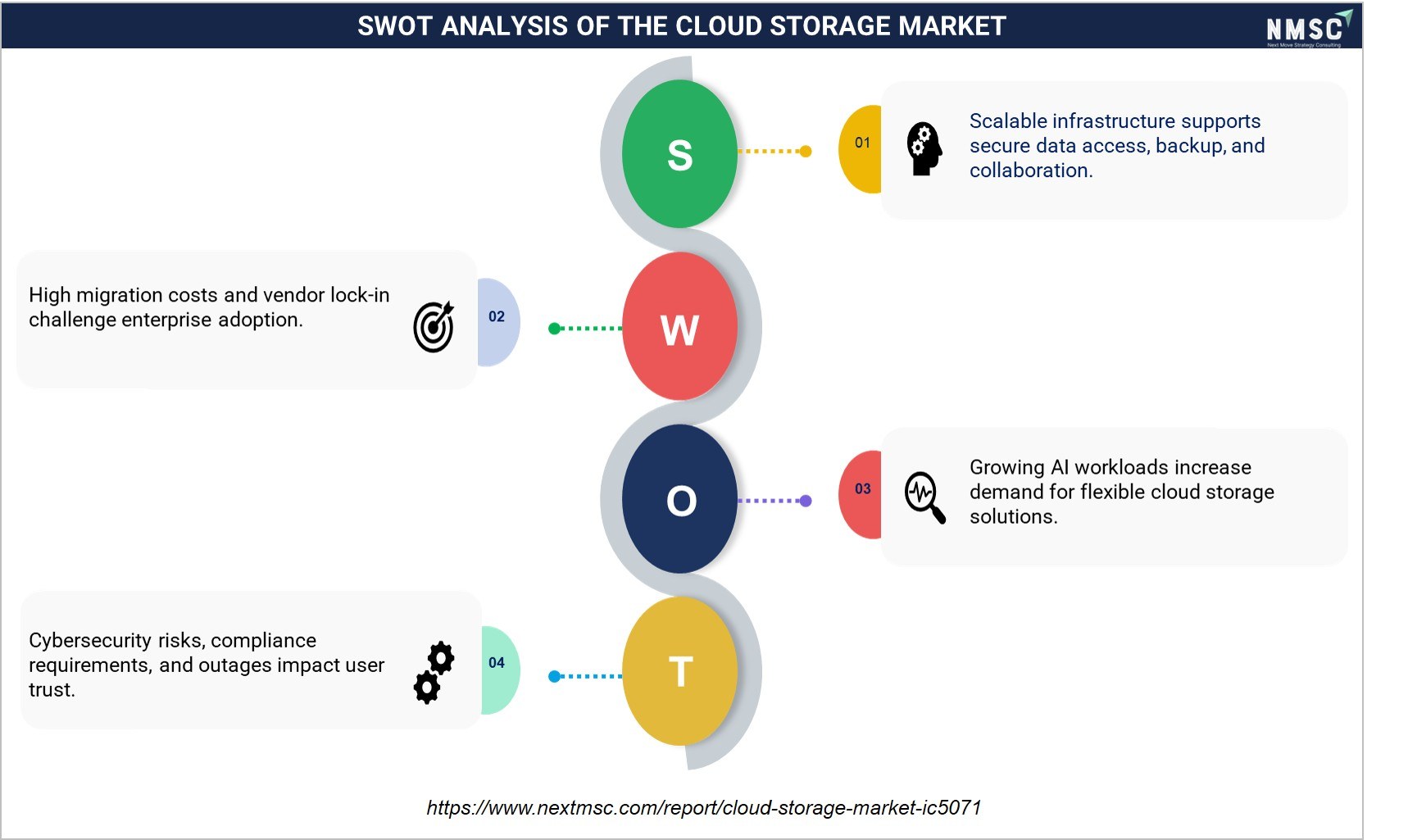
The SWOT analysis highlights the key factors influencing the Cloud Storage Market. Strengths include scalable infrastructure, secure data access, backup capabilities, and enhanced collaboration. Weaknesses involve high migration costs and vendor lock-in concerns that can limit enterprise adoption. Opportunities are driven by the rapid growth of AI, big data, and digital transformation initiatives, increasing demand for flexible and scalable storage solutions. Threats include cybersecurity risks, regulatory compliance challenges, and service outages, which may affect customer trust and operational continuity.
What Are the Key Market Drivers, Breakthroughs, and Investment Opportunities that Will Shape the Cloud Storage Industry in the Next Decade?
|
Drivers / Trends / Restraints |
(+/-) % Impact on CAGR Forecast |
Geographic Relevance |
Impact Timeline |
|
Exponential Growth in Unstructured Data Volume |
+2.4% |
Global (led by North America, APAC) |
2025–2035 |
|
Enterprise Migration to Cloud-Native Architectures |
+2.0% |
North America, Europe, ANZ |
2025–2030 |
|
Proliferation of AI and ML Workloads Requiring Scalable Storage |
+1.8% |
Global (all regions) |
2026–2035 |
|
Rising Demand for Data Protection and Disaster Recovery |
+1.5% |
North America, Europe, APAC |
2025–2030 |
|
Edge Computing and IoT-Driven Data Generation |
+1.2% |
APAC, North America, MEA |
2026–2035 |
|
Sovereign Cloud and Data Residency Mandates |
+0.8% |
Europe, MEA, Southeast Asia |
2026–2035 |
|
Multi-Cloud Adoption Driving Storage Complexity |
+0.6% |
North America, Europe |
2025–2032 |
|
Data Privacy Regulation and Compliance Overhead |
-1.0% |
Europe, APAC, North America |
Ongoing |
|
Cloud Storage Cost Optimization Pressure on Vendors |
-0.8% |
Global (all regions) |
2025–2028 |
|
Security Concerns and Ransomware Threats |
-0.7% |
All regions |
Ongoing |
What Are the Growth Drivers of the Cloud Storage Market?
How Is Exponential Data Growth Driving Demand in the Cloud Storage Market?
The unprecedented surge in global data creation is the most fundamental driver of Cloud Storage Market expansion. Enterprises, governments, and consumers collectively generate vast quantities of unstructured data including video, audio, sensor telemetry, log files, and genomic datasets that require scalable and cost-efficient storage infrastructure. The U.S. Bureau of Labor Statistics documents the rapid expansion of data-intensive industries, while the National Science Foundation has funded research confirming that scientific data volumes are doubling approximately every two years. Based on NMSC's research, we found that enterprises are increasingly unable to accommodate this growth within traditional on-premises storage hardware, making cloud storage adoption an operational necessity rather than an optional modernization initiative.
How Is Enterprise Digital Transformation Fueling Cloud Storage Market Growth?
Enterprise digital transformation programs are generating sustained, multi-year demand for cloud storage infrastructure worldwide. Organizations migrating legacy ERP systems, deploying SaaS applications, and modernizing customer-facing digital channels all require scalable storage backends that can accommodate variable workloads and geographically distributed access patterns. The U.S. Government's Federal Cloud Computing Strategy mandates cloud adoption across federal agencies, creating a significant public sector demand driver for compliant cloud storage solutions. Through NMSC's assessment, we found that private sector digital transformation budgets have consistently included cloud storage infrastructure as a foundational investment priority, with direct sales cycles increasingly driven by CDO and CISO-led procurement initiatives.
How Are AI and Machine Learning Workloads Accelerating Cloud Storage Market Demand?
AI and machine learning model training requires access to massive, high-throughput storage infrastructure capable of delivering training datasets at scale to compute clusters without I/O bottlenecks. Large language model training, computer vision model development, and generative AI applications all depend on petabyte-scale storage environments. The National Institute of Standards and Technology has documented the critical role of data infrastructure in AI system performance and reliability. Our findings suggest that cloud storage providers offering NVMe-optimized, GPU-adjacent storage services with high-bandwidth data delivery capabilities are capturing premium pricing from AI-focused enterprise buyers across North America, Europe, and Asia-Pacific, creating a high-value sub-market within the broader Cloud Storage Market.
What Are the Growth Inhibitors of the Cloud Storage Market?
How Do Data Privacy Regulations and Compliance Complexity Constrain Cloud Storage Market Growth?
The increasingly fragmented global data privacy regulatory landscape creates meaningful compliance overhead for both cloud storage providers and enterprise buyers, constraining adoption velocity in certain market segments. Organizations operating across multiple jurisdictions must navigate conflicting data residency requirements, cross-border transfer restrictions, and inconsistent regulatory interpretations of encryption standards and access controls. The European Commission's enforcement of GDPR, combined with the EU Data Act and the Network and Information Security Directive NIS2, imposes significant technical and operational compliance requirements on cloud storage architectures deployed within European markets. Our assessment indicates that procurement cycles for cloud storage services in regulated industries are extended by an average of three to six months due to compliance due diligence requirements.
How Do Cloud Storage Cost and Egress Fee Concerns Limit Market Penetration?
Cloud storage total cost of ownership concerns, particularly the high egress fees charged by major cloud providers for data retrieval and transfer, represent a structural constraint on the Cloud Storage Market especially for cost-sensitive SMB and mid-market buyers. Organizations that store large volumes of frequently accessed data on public cloud platforms can encounter unexpectedly high retrieval costs that undermine anticipated cost savings compared to on-premises alternatives. The U.S. Federal Trade Commission has documented concerns about cloud egress fee practices and their potential to restrict market competition and create customer lock-in. Our observation indicates that these pricing dynamics are accelerating interest in alternative storage providers such as Cloudflare R2, Backblaze B2, and Wasabi Technologies, which compete on egress-free or low-egress pricing models to address enterprise cost concerns.
Porter's Five Forces Analysis of the Cloud Storage Market
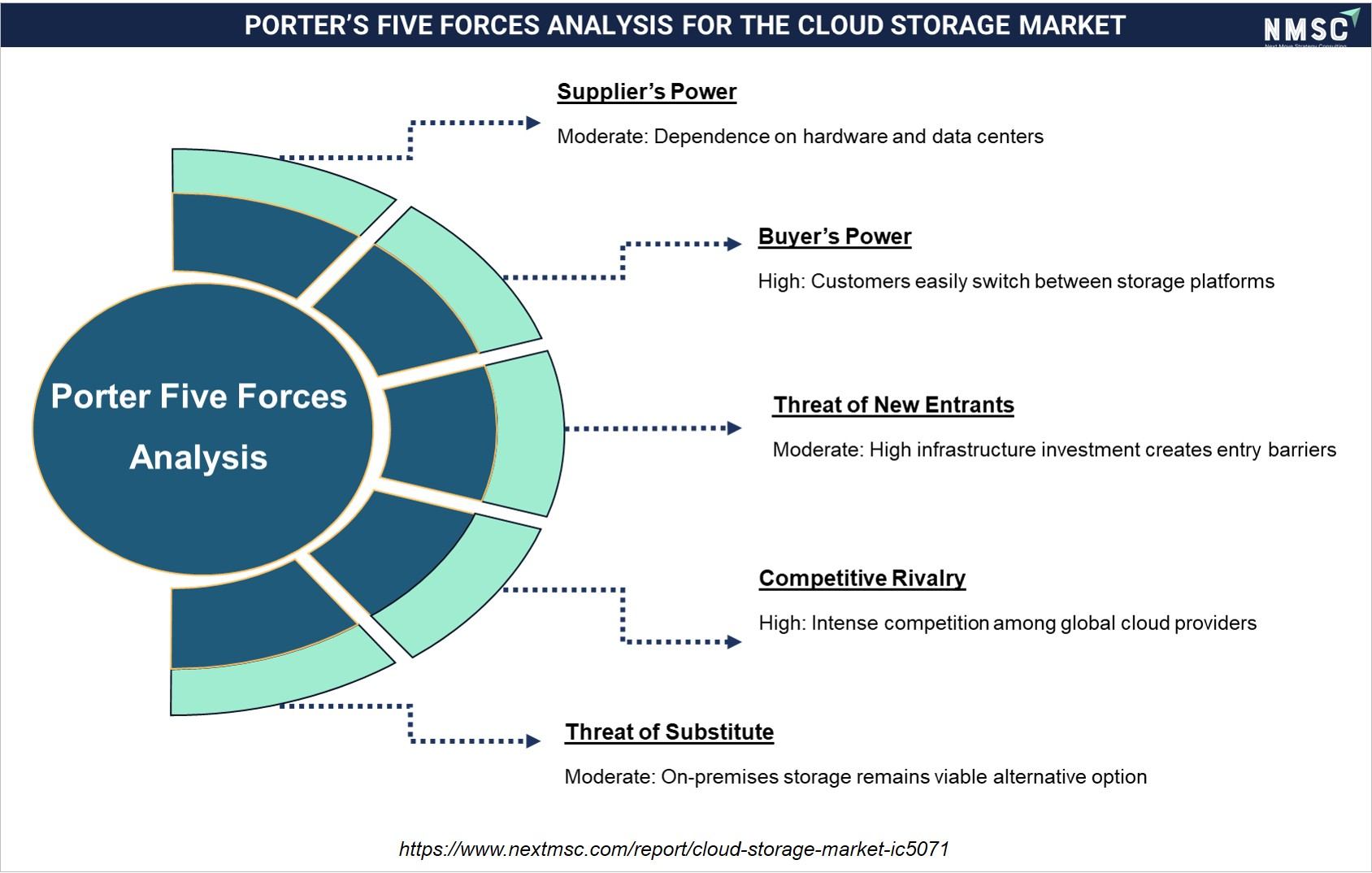
The Porter's Five Forces framework evaluates the competitive dynamics shaping the Cloud Storage Market. The market experiences high competitive rivalry due to the presence of major cloud providers competing on pricing, scalability, security, and innovation. The bargaining power of buyers is moderate to high, as customers can choose among multiple vendors. The threat of new entrants is moderate because of significant infrastructure and technology investment requirements. The threat of substitutes is low to moderate, while the bargaining power of suppliers remains moderate due to dependence on hardware, networking, and data center technologies.
What Are the Growth Opportunities in the Cloud Storage Market?
How Does the Healthcare and Life Sciences Sector Create Structural Opportunities in the Cloud Storage Market?
The digitization of healthcare data, including medical imaging archives, electronic health records, genomic sequencing outputs, and clinical trial datasets, is generating one of the most structurally significant demand opportunities within the Cloud Storage Market. Medical imaging files including CT scans, MRI images, and digital pathology slides create storage requirements that are growing at accelerating rates as diagnostic imaging adoption expands globally. The U.S. Department of Health and Human Services has implemented HIPAA Security Rule requirements that mandate secure storage and access controls for protected health information, compelling healthcare organizations to invest in compliant cloud storage platforms with robust encryption, audit logging, and role-based access management capabilities.
How Do Emerging Market Cloud Infrastructure Programs Create Opportunity for the Cloud Storage Market?
Government-led digital infrastructure investment programs across Asia-Pacific, Middle East, Africa, and Latin America are creating substantial new market opportunities for cloud storage providers expanding their global footprints. India's Digital India program, coordinated by the Ministry of Electronics and Information Technology, has catalyzed multi-billion-dollar hyperscaler data center investments that directly enable cloud storage service expansion. Saudi Arabia's Vision 2030 Digital Transformation Program, administered by the Saudi Authority for Data and Artificial Intelligence, is driving enterprise and government cloud storage adoption across the Gulf Cooperation Council region. Through our market evaluation, we observed that these government-backed programs are reducing market entry barriers for cloud storage providers and creating long-term, recurring revenue opportunities in previously underpenetrated geographic markets.
How Does the Rise of Sovereign Cloud Storage Create a Premium Market Opportunity?
Sovereign cloud storage requirements are creating a premium, high-margin market opportunity within the broader Cloud Storage Market as governments and regulated enterprises demand storage infrastructure that maintains strict data residency, operational sovereignty, and national security compliance. The European Union's GAIA-X initiative, Germany's national cloud strategy, and France's Trusted Cloud label program are defining technical and governance standards for sovereign cloud storage deployments. Our analysis shows that vendors capable of offering certified sovereign cloud storage with in-country data processing, local support teams, and government-approved encryption schemes command significant pricing premiums over standard public cloud storage alternatives. This sub-market is forecast to grow at above-average rates throughout the 2026 to 2035 forecast period.
How Is the Cloud Storage Market Segmented in This Report, and What Are the Key Insights from the Segmentation Analysis?
How Do Cloud Storage Services and Software Offerings Define the Structural Composition of the Cloud Storage Market?
|
Offering Segment |
2025 (USD Bn) |
2035 (USD Bn) |
CAGR (%) |
|
Cloud Storage Services |
98.4 |
380.6 |
14.5% |
|
Object Storage |
58.2 |
220.4 |
14.2% |
|
Standard Object Storage |
42.6 |
154.8 |
13.7% |
|
Archive Storage |
15.6 |
65.6 |
15.5% |
|
Block Storage |
22.4 |
89.2 |
14.8% |
|
General Purpose Block Storage |
14.8 |
57.4 |
14.5% |
|
High Performance Block Storage |
7.6 |
31.8 |
15.4% |
|
File Storage |
10.2 |
38.8 |
14.3% |
|
General Purpose File Storage |
6.8 |
24.6 |
13.6% |
|
High Performance File Storage |
3.4 |
14.2 |
15.4% |
|
Data Protection Services |
7.6 |
32.2 |
15.6% |
|
Backup and Recovery |
4.4 |
18.2 |
15.2% |
|
Disaster Recovery |
3.2 |
14.0 |
15.9% |
|
Sync and Share |
— |
— |
— |
|
Enterprise Sync and Share |
— |
— |
— |
|
Consumer Sync and Share |
— |
— |
— |
|
Cloud Storage Software |
39.2 |
237.8 |
19.7% |
|
Software Defined Storage |
14.6 |
94.2 |
20.5% |
|
Cloud Storage Gateway |
8.4 |
48.6 |
19.2% |
|
Hybrid Storage Platform |
9.2 |
58.4 |
20.3% |
|
Storage Management Software |
5.4 |
28.4 |
18.2% |
|
Other Cloud Storage Software |
1.6 |
8.2 |
17.8% |
Based on NMSC's research, we found that the Cloud Storage Market is segmented into Cloud Storage Services and Cloud Storage Software, with services representing the dominant offering category at an estimated USD 98.4 billion in 2025. Within Cloud Storage Services, object storage maintains the largest share due to its scalability, cost efficiency, and suitability for storing unstructured data including media files, backups, log archives, and AI training datasets at petabyte scale. Block storage supports high-performance transactional workloads, with high-performance block storage emerging as a fast-growing sub-segment driven by AI and database workloads. Cloud Storage Software, encompassing software-defined storage, hybrid storage platforms, gateways, and management solutions, is the fastest-growing primary offering segment as enterprises invest in intelligent infrastructure that bridges on-premises and cloud storage environments. Data protection services, including backup and recovery and disaster recovery, are expanding steadily as regulatory mandates and ransomware threats compel enterprise investment in resilient storage architectures.
How Does Deployment Mode Shape Revenue Distribution Across the Cloud Storage Market?
|
Deployment Segment |
2025 (USD Bn) |
2035 (USD Bn) |
CAGR (%) |
|
Public Cloud |
87.4 |
368.8 |
15.5% |
|
Private Cloud |
14.8 |
54.6 |
13.9% |
|
Hybrid Cloud |
27.6 |
147.2 |
18.8% |
|
Edge |
7.8 |
47.8 |
19.8% |
Our assessment indicates that the Cloud Storage Market is segmented into Public Cloud, Private Cloud, Hybrid Cloud, and Edge deployment modes. Public Cloud retains the dominant position due to hyperscaler infrastructure scale, consumption-based pricing flexibility, global availability, and deep integration with AI, analytics, and application development platforms. Private Cloud continues to serve enterprises in highly regulated industries that require absolute control over data governance, access management, and infrastructure security. Hybrid Cloud is the fastest-growing major deployment mode at a CAGR of 18.8%, as organizations deploy integrated storage architectures that combine the cost efficiency of public cloud capacity with the control and low latency of private cloud environments for sensitive workloads. Edge deployment is the highest-growth sub-segment at a CAGR of 19.8%, driven by IoT data generation, autonomous systems, and latency-sensitive industrial applications that require local storage processing before synchronization with central cloud repositories.
How Do Commercial Models Reflect the Pricing Evolution of the Cloud Storage Market?
|
Commercial Model Segment |
2025 (USD Bn) |
2035 (USD Bn) |
CAGR (%) |
|
Consumption Based |
48.6 |
224.4 |
16.6% |
|
Subscription Based |
56.8 |
240.8 |
15.5% |
|
Perpetual License |
12.4 |
32.6 |
10.2% |
|
Managed Services |
19.8 |
120.6 |
19.8% |
Through our market assessment, we observed that the Cloud Storage Market features four primary commercial models encompassing consumption-based, subscription-based, perpetual license, and managed service pricing structures. Subscription-based pricing leads in absolute revenue at USD 56.8 billion in 2025, preferred by enterprise and SMB buyers for budget predictability and guaranteed storage capacity allocations. Consumption-based pricing is growing at above-average rates as hyperscaler billing granularity improves and enterprises align storage expenditure directly with actual workload requirements. Managed Services represents the fastest-growing commercial model at a CAGR of 19.8%, driven by enterprise demand for fully outsourced storage operations including monitoring, optimization, migration, and compliance management. Perpetual licensing is declining as a share of total revenue as cloud-native pricing models increasingly displace legacy on-premises licensing structures throughout the forecast period.
Which Buyer Segments Are Driving Procurement Activity Across the Cloud Storage Market?
|
Buyer Segment |
2025 (USD Bn) |
2035 (USD Bn) |
CAGR (%) |
|
Enterprise |
72.8 |
298.6 |
15.2% |
|
Small and Medium Businesses |
22.4 |
112.8 |
17.5% |
|
Consumer |
14.6 |
48.4 |
12.8% |
|
Public Sector |
18.2 |
82.6 |
16.4% |
|
Service Provider |
9.6 |
76 |
22.9% |
Based on our market evaluation, we noticed that the Cloud Storage Market is segmented across Enterprise, Small and Medium Business, Consumer, Public Sector, and Service Provider buyer segments. Enterprises represent the largest buyer cohort at an estimated USD 72.8 billion in 2025, driven by complex, multi-petabyte storage requirements across distributed enterprise environments and ongoing cloud infrastructure modernization programs. SMBs are growing at above-average rates as consumption-based pricing eliminates capital expenditure barriers and simplified management interfaces lower operational complexity. Public Sector demand is expanding steadily across government agencies and educational institutions as national cloud strategies mandate cloud-first data infrastructure policies. The Service Provider segment is the fastest-growing buyer category at a CAGR of 22.9%, as telecommunications firms, managed service providers, and cloud-native service companies integrate cloud storage into their own service portfolios and resell managed storage capabilities to downstream enterprise clients.
How Are Distribution Channels Reshaping Go-to-Market Strategies in the Cloud Storage Market?
|
Channel Segment |
2025 (USD Bn) |
2035 (USD Bn) |
CAGR (%) |
|
Direct Sales |
62.4 |
228.6 |
13.8% |
|
Partner Network |
34.8 |
162.4 |
16.7% |
|
Marketplace |
18.6 |
128.4 |
21.2% |
|
Original Equipment Manufacturer |
21.8 |
99 |
16.3% |
Our findings suggest that the Cloud Storage Market distributes through Direct Sales, Partner Network, Marketplace, and OEM channels, with Direct Sales maintaining the largest revenue share at an estimated USD 62.4 billion in 2025. Enterprise procurement of cloud storage infrastructure typically occurs through direct engagement with cloud service providers and storage vendors, enabling customized service agreements, dedicated account support, and volume-based pricing negotiations. Partner Networks, including managed service providers and systems integrators, represent the second-largest channel and are growing steadily as enterprises delegate storage management responsibilities to trusted technology partners. Marketplace distribution through hyperscaler platforms is the fastest-growing channel at a CAGR of 21.2%, enabling frictionless cloud storage procurement through existing cloud committed spend and AWS, Azure, and Google Cloud partner marketplace ecosystems. OEM channels remain important for embedded storage software distributed through hardware and technology platform partnerships.
Which Industry Verticals Generate the Highest Revenue Demand in the Cloud Storage Market?
|
End Use Industry Segment |
2025 (USD Bn) |
2035 (USD Bn) |
CAGR (%) |
|
IT and Telecommunications |
36.2 |
140.6 |
14.6% |
|
BFSI |
24.8 |
108.4 |
15.9% |
|
Healthcare and Life Sciences |
12.4 |
68.6 |
18.7% |
|
Media and Entertainment |
16.4
|
68.8 |
15.5% |
|
Retail and E-commerce |
14.6 |
64.2 |
15.9% |
|
Manufacturing |
11.2 |
54.8 |
17.2% |
|
Public Sector and Education |
14.4 |
66.4 |
16.5% |
|
Other Industries |
7.6 |
46.6 |
19.8% |
Based on NMSC's research, we found that the Cloud Storage Market is segmented across IT and Telecommunications, BFSI, Healthcare and Life Sciences, Media and Entertainment, Retail and E-commerce, Manufacturing, Public Sector and Education, and Other Industries. IT and Telecommunications is the dominant vertical at an estimated USD 36.2 billion in 2025, as technology companies and telecom operators both consume and resell cloud storage infrastructure at scale. BFSI remains a large and growing buyer segment driven by transaction data archival, regulatory record retention, fraud analytics, and risk management workloads. Healthcare and Life Sciences is the fastest-growing major vertical at a CAGR of 18.7%, propelled by medical imaging storage, genomic data repositories, and clinical AI model infrastructure. Media and Entertainment demands high-throughput object storage for content production, post-production, and streaming distribution workflows. Manufacturing is growing rapidly as industrial IoT deployments generate sensor and telemetry data requiring scalable cloud storage with edge synchronization capabilities throughout the forecast period.
Regional Outlook
Geographic Performance Snapshot
|
Region |
2025 (USD Bn) |
2035 (USD Bn) |
CAGR (%) |
Key Driver |
|
North America |
58.6 |
226.4 |
14.5% |
Hyperscaler HQ, enterprise AI cloud spend |
|
Europe |
28.4 |
116.8 |
15.2% |
GDPR compliance, sovereign cloud adoption |
|
Asia-Pacific |
31.4 |
164.2 |
18.0% |
Digital India, industrial China cloud expansion |
|
Middle East & Africa |
8.6 |
52.4 |
19.8% |
Vision 2030, national cloud programs |
|
Latin America |
10.6 |
58.6 |
18.7% |
Cloud-first fintech, hyperscaler investment |
North America Cloud Storage Market
North America is the global leader in the Cloud Storage Market, accounting for an estimated USD 58.6 billion in 2025 and forecast to reach USD 226.4 billion by 2035 at a CAGR of 14.5%. The region benefits from the headquarters of all major cloud hyperscalers, a mature enterprise cloud procurement ecosystem, the world's highest concentration of AI research and deployment activity, and deeply embedded digital infrastructure across every major industry sector. Regulatory drivers including HIPAA, SEC data retention mandates, and FedRAMP cloud compliance standards are creating sustained, compliance-driven demand for certified cloud storage solutions among healthcare, financial services, and government sector buyers.
United States Cloud Storage Market
Based on our analysis, we found that the United States represents over 78% of North American Cloud Storage Market revenue, making it the world's single largest national cloud storage economy. The U.S. market is anchored by the headquarters and primary data center operations of Amazon Web Services, Microsoft Azure, Google Cloud, and major cloud storage specialists. The U.S. Federal Cloud Computing Strategy and subsequent M-19-17 and M-23-22 cloud strategy memoranda have institutionalized cloud-first data storage for federal agencies, generating significant public sector cloud storage demand. HIPAA Security Rule compliance requirements, SEC electronic records mandates, and FINRA data retention obligations collectively drive regulated industry cloud storage investment at substantial scale.
Canada Cloud Storage Market
Through our analysis, Canada represents approximately 14% of North American Cloud Storage Market revenue, supported by a sophisticated financial services sector, a growing technology industry, and federal government cloud adoption programs. Canada's Privacy Act and the Digital Charter Implementation Act, Bill C-27, establish data governance requirements that influence enterprise cloud storage procurement decisions. The Government of Canada Cloud Adoption Strategy has accelerated public sector migration to approved cloud storage platforms. Canadian enterprises prioritize cloud storage vendors with Canada-based data center regions that satisfy national data residency requirements, a factor all major hyperscalers have addressed through dedicated Canadian cloud infrastructure investments.
Mexico Cloud Storage Market
From our assessment, Mexico is the fastest-growing Cloud Storage Market within North America at a CAGR of 20.2% from 2026 to 2035, driven by manufacturing sector digitization, nearshoring investment from global technology companies, and an expanding fintech ecosystem. The Federal Law on Protection of Personal Data Held by Private Parties governs enterprise data handling in Mexico, creating compliance-driven demand for governed cloud storage architectures. Mexico's proximity to U.S. cloud infrastructure hubs facilitates low-latency access to major hyperscaler platforms. Industrial IoT deployments in automotive manufacturing and electronics assembly sectors are generating growing demand for edge-to-cloud storage infrastructure across Mexican enterprise environments.
Europe Cloud Storage Market
Europe is the second-largest region in the Cloud Storage Market, contributing an estimated USD 28.4 billion in 2025 and forecast to reach USD 116.8 billion by 2035 at a CAGR of 15.2%. Europe's regulatory environment, including GDPR, the EU Data Act, the NIS2 Directive, and national data sovereignty programs, simultaneously drives compliance-motivated cloud storage investment and introduces procurement complexity for U.S.-headquartered providers. Sovereign cloud storage demand in the EU is creating differentiated market opportunities for providers offering in-country data residency, EU-controlled operational sovereignty, and certified compliance with European security standards.
United Kingdom Cloud Storage Market
Based on our analysis, the United Kingdom is Europe's largest individual Cloud Storage Market, representing approximately 22% of European revenue in 2025. Post-Brexit, the UK maintains GDPR-equivalent standards through the UK GDPR and Data Protection Act 2018, while gaining regulatory flexibility that has attracted cloud infrastructure investment. The UK's National Cyber Security Centre provides cloud security guidance that shapes enterprise cloud storage procurement standards. Financial services firms in London, including banks, insurers, and asset managers regulated by the Financial Conduct Authority, are significant cloud storage buyers for transaction records, risk models, and regulatory reporting data. The UK government's G-Cloud framework accelerates public sector cloud storage adoption.
Germany Cloud Storage Market
According to our evaluation, Germany is the second-largest European Cloud Storage Market, driven by its world-class manufacturing sector, a highly digitized financial services industry, and stringent data protection enforcement under the Bundesdatenschutzgesetz complementing GDPR obligations. German enterprises, particularly in automotive manufacturing, industrial machinery, and chemicals, generate high volumes of production and quality control data requiring scalable cloud storage with strong data sovereignty guarantees. The Federal Office for Information Security cloud security framework, BSI C5, establishes technical standards for cloud storage procurement by German government agencies and regulated enterprises. Domestic providers including T-Systems and Deutsche Telekom operate certified sovereign cloud storage environments for compliance-driven buyers.
France Cloud Storage Market
Through our analysis, we noticed that France is the third-largest European Cloud Storage Market, distinguished by strong public sector digital transformation investment and a proactive national AI strategy under the France 2030 program. The National Commission on Informatics and Liberty, CNIL, enforces GDPR rigorously and has issued significant enforcement actions that drive enterprise compliance investment in cloud storage governance. OVHcloud, headquartered in France, is a significant domestic alternative to U.S. hyperscalers for enterprises requiring EU-controlled cloud storage infrastructure under the Trusted Cloud France framework. French government agencies are transitioning to certified sovereign cloud storage through Numeum-certified providers as mandated by national digital sovereignty policy.
Italy Cloud Storage Market
In our assessment, Italy is a growing Cloud Storage Market in Southern Europe, with expanding adoption across financial services, manufacturing, retail, and public administration. The Italian data protection authority, Garante, is among Europe's most active GDPR enforcement bodies, compelling Italian enterprises to invest in compliant cloud storage architectures with robust access controls and data residency management. The Piano Nazionale di Ripresa e Resilienza has allocated significant investment to public sector cloud migration, creating structured government demand for certified cloud storage platforms. Italy's Polo Strategico Nazionale provides sovereign cloud infrastructure for government agencies and regulated entities requiring in-country data processing.
Spain Cloud Storage Market
Based on our evaluation, Spain demonstrates growing momentum in the Cloud Storage Market, supported by a dynamic financial services sector, an expanding e-commerce industry, and public digital transformation under the Agenda España Digital 2026. The Spanish Data Protection Agency enforces GDPR across Spanish enterprises, compelling cloud storage procurement teams to prioritize certified, compliant storage platforms with comprehensive audit trail capabilities. Major Spanish banks including CaixaBank, BBVA, and Santander are significant cloud storage buyers for transaction processing infrastructure and regulatory reporting archives. AWS, Google Cloud, and Microsoft Azure all operate Spanish cloud regions supporting enterprise data residency requirements in the Iberian market.
Sweden Cloud Storage Market
Sweden is a high-per-capita cloud storage consumer within the European Cloud Storage Market, supported by a deeply digitized enterprise base, advanced telecommunications infrastructure, and a government committed to public sector digitization and open data initiatives. Swedish enterprises in financial services, telecommunications, and retail are early adopters of cloud-native storage platforms. The Swedish Data Protection Authority, IMY, enforces GDPR compliance across Swedish organizations, influencing cloud storage architecture decisions. Sweden's favorable climate and stable geopolitics make it an attractive sovereign cloud data center destination, supporting energy-efficient cloud storage infrastructure investment from multiple hyperscalers with Swedish cloud regions.
Denmark Cloud Storage Market
Through our analysis, we evaluated that Denmark is among Europe's most advanced digital economies within the Cloud Storage Market, consistently ranking at the top of the EU's Digital Economy and Society Index. The Danish government's Digital Strategy drives public sector cloud storage adoption across ministries, municipalities, and healthcare organizations. The Danish Data Protection Agency is an active GDPR regulator whose enforcement posture shapes enterprise cloud storage governance investments. Denmark's life sciences sector, including pharmaceutical and biotech companies, generates significant demand for compliant genomic and clinical data cloud storage infrastructure. Danish financial institutions including Nordea and Danske Bank are sophisticated enterprise cloud storage buyers.
Finland Cloud Storage Market
Finland's Cloud Storage Market is characterized by high cloud adoption rates, strong government open data initiatives, and an advanced telecommunications sector anchored by Nokia's global operations. The Finnish government's MyData initiative represents an internationally recognized model for citizen-centric personal data governance that influences enterprise cloud storage policy. The Office of the Data Protection Ombudsman provides active GDPR oversight that drives compliance investment in cloud storage security and access management. Finland's data center industry is expanding rapidly, supported by renewable energy availability, making it a preferred sovereign cloud data center location for pan-European cloud storage workloads requiring low-carbon infrastructure.
Netherlands Cloud Storage Market
From our assessment, the Netherlands is a critical cloud storage hub within the European Cloud Storage Market, hosting the Amsterdam Internet Exchange, one of the world's largest internet exchange points, and significant cloud data center capacity across all major hyperscalers. Dutch enterprises in financial services, logistics, agriculture technology, and media are significant cloud storage buyers. The Dutch Data Protection Authority has issued landmark GDPR enforcement decisions that set compliance precedents across Europe, compelling Dutch enterprises to invest in governed, compliant cloud storage architectures. The Netherlands serves as the European gateway for cross-border cloud storage deployments under EU-approved Standard Contractual Clauses.
Rest of Europe Cloud Storage Market
The Rest of Europe, comprising Poland, Belgium, Switzerland, Austria, Portugal, the Czech Republic, and other European nations, collectively represents a growing segment of the European Cloud Storage Market. Poland and the Czech Republic are emerging as cloud storage adoption leaders in Central and Eastern Europe, driven by expanding business process outsourcing industries and growing technology sectors. Switzerland, operating under the revised Federal Act on Data Protection, hosts major financial and pharmaceutical enterprises that are significant cloud storage buyers. Belgium, as the seat of EU institutions, generates specialized compliance data archival demand. Portugal and Austria are accelerating cloud storage investment through national digital economy strategies.
Asia-Pacific Cloud Storage Market
Asia-Pacific is the fastest-growing major region in the Cloud Storage Market, advancing from an estimated USD 31.4 billion in 2025 to USD 164.2 billion by 2035 at a CAGR of 18.0%. The region's growth is propelled by rapid cloud adoption across India and Southeast Asia, China's national industrial internet and digital economy expansion, and the advanced digital economies of Japan, South Korea, Taiwan, and Australia. Diverse regulatory frameworks including Japan's Act on Protection of Personal Information, South Korea's Personal Information Protection Act, and India's Digital Personal Data Protection Act are shaping enterprise cloud storage investment priorities across the region.
China Cloud Storage Market
China is the largest Cloud Storage Market in Asia-Pacific, driven by a massive digital economy, national industrial internet platform initiatives, and government-directed cloud infrastructure investment through the New Infrastructure policy program. China's Data Security Law and Personal Information Protection Law create mandatory data classification, localization, and governance requirements that directly drive investment in compliant cloud storage platforms. Domestic hyperscalers including Alibaba Cloud, Tencent Cloud, Huawei Cloud, and Baidu AI Cloud operate extensive cloud storage ecosystems that dominate the Chinese market. The Ministry of Industry and Information Technology oversees industrial internet and cloud computing policy that shapes enterprise cloud storage adoption across Chinese manufacturing, finance, and government sectors.
India Cloud Storage Market
India is the fastest-growing national Cloud Storage Market in Asia-Pacific at a CAGR of 22.4% from 2026 to 2035, propelled by the Digital India program administered by the Ministry of Electronics and Information Technology, expanding cloud data center investments from all major hyperscalers, and surging enterprise demand for scalable, cost-efficient cloud storage infrastructure. The Digital Personal Data Protection Act 2023 establishes a data governance framework that is driving enterprise investment in compliant cloud storage architectures with robust access controls and audit capabilities. Our observation indicates that India's rapidly growing SaaS ecosystem, fintech sector, and e-commerce industry are generating substantial cloud storage demand across object storage, backup, and disaster recovery service categories throughout the forecast period.
Japan Cloud Storage Market
In our evaluation, Japan is the second-largest Cloud Storage Market in Asia-Pacific, supported by mature financial services, automotive manufacturing, and electronics industries with complex, enterprise-scale storage requirements. Japanese enterprises prioritize data quality, security, and business continuity, creating strong demand for disaster recovery and backup cloud storage services. The Personal Information Protection Commission enforces Japan's Act on Protection of Personal Information, governing enterprise cloud storage data handling. Japan's Digital Agency is accelerating government cloud adoption and data infrastructure modernization. Major corporations including Toyota, Sony, Hitachi, and Fujitsu are significant enterprise cloud storage buyers for manufacturing intelligence, R&D data, and customer information platforms.
South Korea Cloud Storage Market
From our assessment, South Korea demonstrates high cloud storage market maturity, supported by one of the world's highest broadband penetration rates, an advanced semiconductor and consumer electronics industry, and a proactive government AI and cloud policy environment. The Personal Information Protection Commission enforces the Personal Information Protection Act, which governs enterprise cloud storage data handling. South Korea's K-Cloud initiative and National AI Strategy are directing public investment toward cloud data infrastructure. Major conglomerates including Samsung Electronics, LG Electronics, SK Telecom, and Hyundai are enterprise cloud storage buyers for manufacturing data, consumer service platforms, and R&D infrastructure.
Taiwan Cloud Storage Market
Taiwan's Cloud Storage Market is concentrated in semiconductor manufacturing intelligence, electronics supply chain data, and financial services storage platforms. TSMC, Foxconn, MediaTek, and ASE Technology represent enterprise-class cloud storage buyers with complex manufacturing data requirements spanning wafer fabrication telemetry, supply chain procurement records, and quality control archives. Taiwan's Personal Data Protection Act provides the regulatory framework for data governance investment. The government's Digital Economy Acceleration Plan is supporting technology sector cloud storage adoption. High-performance block storage for database and analytics workloads is a key growth area given Taiwan's concentration of data-intensive semiconductor manufacturers.
Indonesia Cloud Storage Market
Indonesia is among the most rapidly growing Cloud Storage Markets in Southeast Asia, driven by a large and young digital population, a fast-expanding fintech and e-commerce ecosystem, and government-backed digital transformation programs. The Personal Data Protection Law, enacted in 2022, establishes data governance requirements for Indonesian enterprises, driving investment in compliant cloud storage infrastructure. Gojek, Tokopedia, Bank Central Asia, and Telkom Indonesia are among the largest enterprise cloud storage buyers. All major hyperscalers have established Jakarta-based cloud regions to support growing Indonesian enterprise demand for locally resident cloud storage services that satisfy national data governance requirements.
Vietnam Cloud Storage Market
Vietnam is an emerging and high-growth Cloud Storage Market in Southeast Asia, supported by accelerating digital economy development, a manufacturing sector expansion driven by China-plus-one supply chain diversification, and government digital transformation ambitions under the National Digital Transformation Program to 2025. Vietnam's Cybersecurity Law and Decree 13 on Personal Data Protection are establishing a domestic data governance framework that is influencing enterprise cloud storage procurement. Vietnamese banks, telecommunications operators, and e-commerce platforms are early cloud storage adopters, while the growing electronics manufacturing sector generates demand for industrial data storage and supply chain analytics infrastructure.
Australia Cloud Storage Market
Australia is the most mature Cloud Storage Market in Asia-Pacific outside Northeast Asia, with strong adoption across financial services, government, mining, healthcare, and media sectors. The Privacy Act 1988, amended by the Privacy Legislation Amendment Act, and the Consumer Data Right framework overseen by the Australian Competition and Consumer Commission are driving structured investment in data governance and compliant cloud storage architectures. All major hyperscalers operate Australian cloud regions, with dedicated sovereign cloud regions available for government workloads. The Data Availability and Transparency Act is catalyzing public sector cloud storage adoption across Australian federal agencies, creating a structured government demand pipeline throughout the forecast period.
Philippines Cloud Storage Market
The Philippines is a developing but rapidly growing Cloud Storage Market in Southeast Asia, supported by a large business process outsourcing industry, a growing digital banking sector, and government ICT modernization initiatives. The Data Privacy Act of 2012, enforced by the National Privacy Commission, governs enterprise cloud storage data handling requirements. Philippine banks including BDO, BPI, and UnionBank are increasing cloud storage investments for core banking transaction archives, customer data platforms, and regulatory reporting systems. The government's eGov SuperApp initiative and public sector ICT modernization programs are creating structured government demand for cloud storage services across Philippine government agencies.
Malaysia Cloud Storage Market
Malaysia is a mid-tier and growing Cloud Storage Market in Southeast Asia, characterized by strong government-led digital transformation, a rapidly maturing financial services sector, and Kuala Lumpur's emergence as a regional cloud data center hub. The Personal Data Protection Act governs enterprise data handling requirements, with ongoing reform aimed at GDPR alignment. Malaysia's MyDigital strategy and National Cloud Framework are supporting cloud storage adoption across government agencies, financial institutions, and technology companies. Petronas, Maybank, Telekom Malaysia, and major manufacturing companies are significant enterprise cloud storage buyers. Hyperscaler investments in Malaysian cloud regions are expanding available cloud storage capacity for regional enterprise buyers.
Rest of Asia-Pacific Cloud Storage Market
The Rest of Asia-Pacific, comprising Thailand, Singapore, Bangladesh, Sri Lanka, New Zealand, and smaller Pacific Island nations, collectively represents a growing and commercially significant component of the regional Cloud Storage Market. Singapore, despite its small size, operates as the leading cloud storage hub in Southeast Asia, hosting regional headquarters of all major cloud providers and benefiting from MAS-governed financial sector cloud adoption that drives sophisticated cloud storage procurement. Thailand's Personal Data Protection Act and national AI strategy are driving enterprise governance investment. New Zealand's cloud market is expanding in alignment with the broader Australia-New Zealand digital economy and government cloud-first infrastructure policies.
Middle East and Africa Cloud Storage Market
The Middle East and Africa region is one of the fastest-growing Cloud Storage Markets globally, advancing from an estimated USD 8.6 billion in 2025 to USD 52.4 billion by 2035 at a CAGR of 19.8%. Vision-driven national transformation programs in Saudi Arabia and the UAE are the primary growth engines, supplemented by Israel's advanced technology sector, South Africa's financial services industry, and Nigeria's large and rapidly digitalizing economy. Sovereign cloud infrastructure investment across the Gulf Cooperation Council is creating durable structural demand for cloud storage platforms with in-country data residency, national security compliance, and Arabic-language operational support.
Saudi Arabia Cloud Storage Market
Saudi Arabia is the largest Cloud Storage Market in the Middle East and Africa, driven by Vision 2030's Digital Transformation Program, NEOM smart city data infrastructure requirements, and Saudi Aramco's extensive industrial IoT and supply chain data modernization initiatives. The National Data Management Office, established under the Saudi Authority for Data and Artificial Intelligence, has published the National Data Governance Interim Regulations that mandate cloud storage governance standards for public and regulated private enterprises. All major hyperscalers have established Saudi Arabia cloud regions. Financial services, government, energy, and smart city sectors are the dominant cloud storage buyers across the Saudi market.
UAE Cloud Storage Market
The UAE is the second-largest Cloud Storage Market in the Middle East and Africa, powered by Dubai and Abu Dhabi's ambitions as global AI, smart city, and financial technology hubs. The UAE National AI Strategy 2031 and the UAE Personal Data Protection Law provide the regulatory and strategic frameworks underpinning enterprise cloud storage investment. The Abu Dhabi Global Market and Dubai International Financial Centre maintain distinct data protection regimes aligned with international standards, attracting global cloud storage vendors and enterprise buyers. The UAE's concentration of financial services, real estate, logistics, and hospitality enterprises creates multi-vertical cloud storage demand at significant scale.
Egypt Cloud Storage Market
Egypt is an emerging Cloud Storage Market supported by a large population, a rapidly growing digital banking sector, and the government's Egypt Vision 2030 digital transformation agenda. The Personal Data Protection Law establishes data governance requirements for Egyptian enterprises, driving cloud storage compliance investment. The government's G-Cloud program is creating structured public sector demand for certified cloud storage platforms. Egyptian banks, telecommunications operators, and e-commerce platforms are the primary enterprise cloud storage buyers. Egypt's geographic position at the intersection of Africa, the Middle East, and Europe is attracting cloud data center investment that expands regional cloud storage capacity.
Israel Cloud Storage Market
Based on our analysis, we observed that Israel occupies a distinctive position in the Cloud Storage Market as both a significant technology vendor country and an enterprise buyer. Israel's Protection of Privacy Law and the Privacy Protection Authority govern enterprise data practices. Israeli technology firms, including numerous cloud infrastructure and cybersecurity startups, consume significant cloud storage infrastructure for software development, testing, and operational workloads. The defense, intelligence, and healthcare sectors drive demand for high-security cloud storage with advanced encryption and access governance capabilities. Israel's per-capita cloud storage investment is among the highest in the Middle East and Africa region.
Turkey Cloud Storage Market
Through our evaluation, we assessed that Turkey is a mid-sized and growing Cloud Storage Market characterized by a dynamic financial services sector, a large and diversified manufacturing industry, and a government national technology strategy that includes cloud infrastructure expansion. Turkey's Personal Data Protection Law, enforced by the Personal Data Protection Authority, mandates enterprise data governance practices that influence cloud storage procurement decisions. Turkish banks, telecommunications providers, and retail enterprises are significant cloud storage buyers for transaction data, customer records, and media content. Turkey's growing technology startup ecosystem and Istanbul's role as a regional technology hub further support cloud storage market development throughout the forecast period.
Nigeria Cloud Storage Market
Nigeria is Sub-Saharan Africa's largest Cloud Storage Market, powered by a rapidly growing fintech ecosystem, one of Africa's largest populations, and the Central Bank of Nigeria's open banking regulatory framework that mandates financial data infrastructure modernization. The Nigeria Data Protection Act 2023, enforced by the Nigeria Data Protection Commission, establishes enterprise data governance requirements that shape cloud storage procurement decisions. Lagos-based financial institutions, telecommunications providers including MTN Nigeria and Airtel Africa, and e-commerce platforms are the primary cloud storage buyers. Digital identity verification, transaction record archival, and fraud detection data storage represent the highest-demand cloud storage service categories in the Nigerian market.
South Africa Cloud Storage Market
South Africa is the most mature Cloud Storage Market in Sub-Saharan Africa, driven by Johannesburg's status as the continent's financial capital, a well-established banking sector, and the Protection of Personal Information Act that came into full effect in 2021. Standard Bank, FirstRand, Nedbank, and Absa are sophisticated enterprise cloud storage buyers for transaction processing infrastructure, regulatory reporting archives, and digital transformation platforms. Microsoft Azure, AWS, and Huawei Cloud all operate South African cloud regions. The Presidential Commission on the Fourth Industrial Revolution provides policy frameworks supporting cloud storage adoption across South Africa's healthcare, mining, and financial services sectors.
Rest of Middle East and Africa Cloud Storage Market
The Rest of Middle East and Africa, encompassing Kuwait, Qatar, Bahrain, Oman, Jordan, Morocco, Kenya, Ghana, and Ethiopia, collectively represents a growing component of the regional Cloud Storage Market. GCC nations outside Saudi Arabia and UAE are investing in national cloud infrastructure aligned with regional digital transformation visions. Kenya is East Africa's leading digital economy, with the M-Pesa financial data ecosystem and a growing technology startup community generating cloud storage demand. Morocco serves as a nearshore technology hub for European enterprises seeking North Africa-based data services with EU-compliant data governance architectures throughout the forecast period.
Latin America Cloud Storage Market
Latin America is a fast-growing Cloud Storage Market advancing from an estimated USD 10.6 billion in 2025 to USD 58.6 billion by 2035 at a CAGR of 18.7%. Brazil and Mexico collectively account for approximately 68% of regional cloud storage revenue. Growing fintech and e-commerce adoption, hyperscaler data center investment in regional infrastructure, and evolving data protection legislation across major economies are the primary growth drivers. NMSC's analysis indicates that Latin American enterprises are rapidly transitioning from on-premises storage infrastructure to public and hybrid cloud storage platforms, driven by cost efficiency requirements and digital business growth imperative across the regional economy.
Brazil Cloud Storage Market
Brazil is the largest Cloud Storage Market in Latin America, accounting for approximately 44% of regional revenue in 2025. Brazil's Lei Geral de Protecao de Dados, enforced by the Autoridade Nacional de Protecao de Dados, is a GDPR-aligned data protection law that drives enterprise investment in compliant cloud storage architectures with audit capabilities, encryption management, and data subject rights management. Nubank, Itau Unibanco, Mercado Livre, and major Brazilian telecommunications providers are significant cloud storage buyers. AWS, Microsoft Azure, and Google Cloud all operate Sao Paulo-based cloud regions. The Pix instant payment infrastructure generates ongoing demand for high-availability transaction data storage and archival services.
Argentina Cloud Storage Market
Through our assessment, we noticed that Argentina is the second-largest Cloud Storage Market in Latin America, with a strong technology sector and a high concentration of technology talent in Buenos Aires. Argentina's Personal Data Protection Law governs enterprise data handling, with ongoing modernization aligned with GDPR standards. Buenos Aires hosts a growing concentration of technology startups and cloud-native companies that generate significant cloud storage demand. Argentine financial institutions are buyers of cloud backup, disaster recovery, and compliance data storage services. Economic volatility has accelerated cloud storage adoption as enterprises seek flexible, consumption-based pricing models that scale with business activity rather than requiring large capital infrastructure commitments.
Chile Cloud Storage Market
Chile represents a stable and growing Cloud Storage Market, benefiting from one of Latin America's strongest economies, a high cloud penetration rate per capita, and a proactive regulatory environment. Chile's new Data Protection Law, approved in 2024, aligns with GDPR standards and establishes data governance mandates for Chilean enterprises that influence cloud storage procurement decisions. Financial institutions including Banco de Chile and BancoEstado and retail conglomerates including Falabella and Cencosud are primary cloud storage buyers. Google Cloud and Microsoft Azure operate Chilean cloud regions supporting enterprise data residency requirements. Chile's mining industry digitization is creating emerging demand for industrial IoT data storage infrastructure.
Colombia Cloud Storage Market
Colombia is among the fastest-growing Cloud Storage Markets in Latin America, supported by Bogota's emergence as a regional technology hub, a dynamic fintech sector, and government digital economy policies. Colombia's data protection framework, administered by the Superintendencia de Industria y Comercio, establishes enterprise compliance requirements that influence cloud storage governance investments. Major financial institutions including Bancolombia and Davivienda, telecommunications providers, and the growing e-commerce sector are primary cloud storage buyers. AWS and Google Cloud operate Colombian cloud regions, expanding available cloud storage capacity for Colombian enterprise and government buyers seeking locally compliant data storage solutions throughout the forecast period.
Rest of Latin America Cloud Storage Market
The Rest of Latin America, including Peru, Ecuador, Uruguay, Bolivia, Paraguay, Costa Rica, Panama, and Caribbean nations, represents a smaller but growing component of the Cloud Storage Market. Uruguay maintains an advanced data protection framework and a high-technology services export industry, generating proportionally high cloud storage adoption relative to its population. Costa Rica serves as a nearshore technology services hub for North American enterprises, creating enterprise cloud storage demand from multinational operations. Peru and Ecuador are experiencing early-stage cloud adoption growth. Panama's role as a regional logistics and financial hub creates demand for reliable cloud storage infrastructure for trade finance data and logistics intelligence.
Competitive Landscape
Competitive Dynamics and M&A Landscape
|
Key Takeaways |
Details |
|
Market Structure |
The Cloud Storage Market features tiered competition among hyperscalers (AWS, Microsoft Azure, Google Cloud, Alibaba Cloud, Huawei Cloud), enterprise storage specialists (NetApp, Dell Technologies, HPE), pure-play cloud storage providers (Wasabi, Backblaze, Cloudflare R2, DigitalOcean), and enterprise software vendors (Oracle, IBM, Box, Dropbox) competing on distinct combinations of price, performance, compliance, and geographic coverage. |
|
Innovation Focus |
Innovation in the Cloud Storage Market centers on AI-driven autonomous storage tiering, immutable object storage for compliance, high-performance NVMe block storage for AI workloads, sovereign cloud deployment capabilities, S3-compatible API interoperability for multi-cloud portability, and zero-egress-fee pricing models that challenge hyperscaler lock-in practices. |
|
M&A Activity |
Cloud Storage Market M&A has focused on expanding geographic footprint, acquiring specialized storage software capabilities, and consolidating managed storage service portfolios. Key activity includes OVHcloud's European data center acquisitions, DigitalOcean's expansion through infrastructure investments, and ongoing strategic interest from private equity in mid-market enterprise storage software vendors. |
How Do Companies Compete in the Cloud Storage Market?
The Cloud Storage Market is characterized by multi-tiered competition across hyperscalers, enterprise storage specialists, pure-play cloud storage providers, and enterprise content management platforms. Hyperscalers including AWS, Microsoft Azure, Google Cloud, Alibaba Cloud, and Huawei Cloud compete on ecosystem breadth, integrated AI capabilities, global data center footprint, and bundled enterprise service packages. Enterprise storage specialists including NetApp and Dell Technologies compete on hybrid cloud integration depth, performance SLAs, and on-premises-to-cloud migration support. Pure-play providers including Wasabi, Backblaze, and Cloudflare R2 compete aggressively on price transparency and egress-free pricing to attract cost-sensitive buyers dissatisfied with hyperscaler billing complexity.
Which Kind of Companies Dominate the Cloud Storage Market?
Three distinct categories of organizations dominate the Cloud Storage Market. Global hyperscalers including Amazon Web Services, Microsoft Azure, Google Cloud, Alibaba Cloud, and Huawei Cloud command the largest revenue shares through integrated cloud platforms that bundle storage with compute, networking, AI, and analytics services. Enterprise storage and infrastructure specialists including NetApp, Dell Technologies, HPE, Oracle, and IBM deliver hybrid and multi-cloud storage solutions that integrate existing on-premises infrastructure investments with cloud-native storage services. Pure-play and specialist cloud storage providers including Wasabi Technologies, Backblaze, Cloudflare R2, Box, Dropbox, and DigitalOcean compete in specific buyer segments and use cases requiring price transparency, simplicity, or content management capabilities.
AI-Native Differentiation and Open Standards Drive Market Success in the Cloud Storage Market
Innovation focus across the Cloud Storage Market is concentrated in AI-native capabilities including intelligent automated tiering, NVMe-based high-performance storage for AI training workloads, S3-compatible API standardization for multi-cloud portability, immutable storage for compliance-grade data retention, and sovereign cloud storage architectures for regulated market buyers. Vendors embedding AI-driven storage optimization directly into their platforms are capturing premium positioning among enterprise buyers managing increasingly complex, petabyte-scale storage environments. Open standard S3 API compatibility has emerged as a critical interoperability differentiator that enables enterprises to migrate workloads between providers without re-engineering applications or data pipelines.
Market Players to Opt for Merger and Acquisition Strategies to Expand Their Presence in the Cloud Storage Market
Strategic acquisitions and partnerships are actively reshaping the competitive landscape of the Cloud Storage Market. OVHcloud has pursued European data center acquisitions to build a pan-European sovereign cloud storage footprint. NetApp has expanded its cloud storage portfolio through strategic technology partnerships with AWS, Azure, and Google Cloud. Private equity firms have shown sustained interest in enterprise storage software vendors as recurring revenue profiles, high switching costs, and mission-critical workload dependencies make storage software an attractive investment category. Consolidation among mid-market storage management software vendors is expected to accelerate as platform vendors seek to acquire intelligent data lifecycle management and governance capabilities throughout the 2025 to 2028 timeframe.
Who Are the Key Market Players in the Cloud Storage Market?
-
Amazon.com, Inc.
-
Microsoft Corporation
-
Alphabet Inc.
-
Apple Inc.
-
Alibaba Group Holding Limited
-
Tencent Holdings Limited
-
Oracle Corporation
-
Huawei Technologies Co., Ltd.
-
International Business Machines Corporation
-
Dell Technologies Inc.
-
Hewlett Packard Enterprise Company
-
NetApp, Inc.
-
Baidu, Inc.
-
Box, Inc.
-
Dropbox, Inc.
-
Cloudflare, Inc.
-
OVH Groupe SA
-
DigitalOcean Holdings, Inc.
-
Backblaze, Inc.
-
Wasabi Technologies LLC
What Are the Latest Developments in the Cloud Storage Industry?
|
Date |
Event |
|
February 2026 |
Cloudflare launched R2 Local Uploads, a new capability for its R2 object storage platform. The feature reduces upload request duration by up to 75% by writing data to a nearby location before asynchronously replicating it to the target bucket, significantly improving global cloud storage performance. |
|
April 2025 |
Google Cloud introduced new high-performance storage innovations for AI and HPC workloads, designed to improve accelerator utilization, throughput, and cloud storage performance for large-scale AI training and analytics environments. This strengthens Google Cloud Storage's position in AI-driven cloud infrastructure. |
|
September 2024 |
Oracle and AWS announced Oracle Database AWS, enabling customers to run Oracle Autonomous Database and Oracle Exadata Database Service directly within AWS infrastructure. The partnership simplifies cross-cloud data management, migration, and enterprise storage deployments. |
Expert Insights
 “Data will grow in an accelerated manner as people start to do more AI inferencing and using agentic AI, because AI models benefit from having better-quality, well-organized data. So, they will keep more data around, as well as version it and generate it to help with business processes.”
— George Kurian, CEO, NetApp
The statement was made during an interview discussing the impact of AI inferencing, agentic AI, cloud growth, and enterprise data management. Kurian highlighted how AI adoption is causing organizations to retain, version, and generate significantly larger volumes of data, increasing requirements for scalable storage infrastructure.
Market Interpretation
This insight is directly relevant to the Cloud Storage Market because it identifies one of the market's primary growth drivers: exponential data creation. As enterprises deploy AI applications, they require larger cloud storage environments to store training datasets, inference data, model outputs, backups, and historical data versions. The increasing need to manage, organize, and retain growing volumes of data is accelerating demand for cloud storage platforms, object storage solutions, and intelligent data management services across hybrid and multi-cloud environments.
What Are the Investment Opportunities in the Cloud Storage Market?
Capital Inflows and Venture Activity
The Cloud Storage Market continues to attract substantial private and institutional capital across infrastructure, software, and service categories. Pure-play cloud storage startups including Wasabi Technologies and Backblaze have attracted significant venture and growth equity investment to compete against hyperscaler pricing with egress-free storage models. The National Venture Capital Association has documented sustained investor interest in cloud infrastructure companies, including storage-focused ventures addressing enterprise data governance, intelligent tiering, and sovereign cloud deployment requirements. Investment activity is concentrated in storage management software, compliance-grade archival solutions, and AI-optimized high-performance storage services targeting the accelerating enterprise AI infrastructure market.
Infrastructure Investment
Data center infrastructure investment is the foundational enabler of Cloud Storage Market capacity expansion globally. Hyperscalers have committed hundreds of billions of dollars to data center construction programs that directly expand available cloud storage capacity. Microsoft announced plans to invest USD 80 billion in AI-optimized data center infrastructure in FY2025, the majority supporting Azure compute and storage services. Alphabet committed USD 75 billion in 2025 capital expenditure directed primarily at Google Cloud infrastructure expansion. These capital programs reduce per-unit storage costs through scale efficiency and expand geographic coverage, enabling cloud storage service delivery in markets where infrastructure was previously limited.
ESG and Sustainable Storage Infrastructure
Environmental, Social, and Governance considerations are increasingly influencing cloud storage infrastructure investment decisions and vendor selection criteria. Data center energy consumption at global scale has attracted regulatory scrutiny under the EU Energy Efficiency Directive and U.S. Executive Order 14057 on federal sustainability. Cloud storage providers operating energy-efficient data centers powered by renewable energy are gaining preference in institutional procurement evaluations and ESG-constrained investment mandates. Microsoft has committed to carbon negativity by 2030, Google has maintained carbon neutrality since 2007, and OVHcloud operates energy-efficient proprietary cooling systems in European data centers as differentiated ESG positioning within the competitive Cloud Storage Market landscape.
Digital Transformation Enablement
Cloud storage platforms serve as the data foundation for enterprise digital transformation programs across every major industry sector, making them structurally integral to multi-year technology investment cycles. Organizations migrating to SaaS applications, deploying cloud-native analytics platforms, and implementing AI-driven business processes all require scalable, reliable cloud storage backends. The NIST Digital Transformation Framework explicitly references cloud data infrastructure modernization as a prerequisite for enterprise competitiveness. Based on our market evaluation, we noticed that enterprise digital transformation programs with multi-year timelines create long-duration, predictable cloud storage revenue streams that represent attractive recurring revenue investment opportunities for both strategic investors and financial buyers active in the cloud infrastructure market.
Private Equity and Strategic M&A Activity
Private equity firms are deploying capital into the Cloud Storage Market ecosystem, targeting enterprise storage software vendors, managed storage service providers, and specialized cloud storage platforms with recurring revenue characteristics and high customer switching costs. Storage management software vendors serving regulated industries including healthcare, financial services, and government represent particularly attractive acquisition targets given compliance-driven demand durability and low customer churn rates. Strategic acquirers including hyperscalers and enterprise technology conglomerates are expected to pursue bolt-on acquisitions of sovereign cloud storage capabilities, immutable storage compliance solutions, and AI-driven storage optimization platforms to strengthen enterprise portfolio offerings throughout the 2025 to 2030 investment horizon.
Key Benefits for Stakeholders
For Enterprise Buyers
Enterprise buyers gain comprehensive, vendor-neutral intelligence on the Cloud Storage Market, including quantitative sizing across all offering types, deployment modes, buyer segments, commercial models, channels, and industry verticals. This intelligence supports cloud storage strategy development, vendor evaluation, contract negotiation, and multi-year infrastructure investment roadmap planning. Our competitive landscape analysis enables procurement teams to benchmark provider pricing models, evaluate multi-cloud storage strategies, and make informed build-versus-buy decisions for storage infrastructure components with analytical confidence and market context.
For Investors and Financial Analysts
Investors and financial analysts access a structured, data-rich assessment of the Cloud Storage Market's growth trajectory, competitive dynamics, M&A landscape, and segment-level revenue forecasts through 2035. The CAGR analysis by segment, deployment mode, region, and buyer type enables precise portfolio construction, market sizing verification, and valuation modeling for cloud storage investments. Detailed coverage of 20 key market participants, combined with latest development tracking across public company disclosures and regulatory filings, provides an early-signal framework for identifying emerging leaders, acquisition targets, and at-risk incumbents within the global cloud storage competitive ecosystem.
For Cloud Storage Vendors and Platform Providers
Cloud storage vendors and platform providers gain actionable intelligence on white-space market opportunities, competitive positioning gaps, and fastest-growing subsegments within the Cloud Storage Market. Segment analysis reveals highest-growth service categories including managed services, hybrid cloud storage, and edge storage. Regional outlook sections identify geographic expansion priorities with regulatory compliance context and market maturity assessment. Buyer segment and commercial model analysis enables vendors to refine go-to-market strategies, optimize channel mix between direct sales, partner networks, and marketplace distribution, and identify cross-sell opportunities across the increasingly complex multi-cloud enterprise buyer environment.
For Government and Regulatory Bodies
Government agencies and regulatory bodies gain structured analysis of how national data governance frameworks, including GDPR, U.S. federal cloud mandates, India's DPDPA, and sovereign cloud programs across the MEA region, are influencing the Cloud Storage Market's structure, pricing dynamics, and competitive landscape. Country-level insights provide policymakers with evidence-based perspectives on how regulatory design choices affect enterprise cloud storage adoption velocity, hyperscaler investment decisions, and the competitiveness of domestic cloud storage providers. Sovereign cloud storage analysis offers direct relevance to national digital infrastructure strategy development and procurement policy design.
Key Market Segments
By Offering
-
Cloud Storage Services
-
Object Storage
-
Standard Object Storage
-
Archive Storage
-
-
Block Storage
-
General Purpose Block Storage
-
High Performance Block Storage
-
-
File Storage
-
General Purpose File Storage
-
High Performance File Storage
-
-
Data Protection Services
-
Backup and Recovery
-
Disaster Recovery
-
-
Sync and Share
-
Enterprise Sync and Share
-
Consumer Sync and Share
-
-
-
Cloud Storage Software
-
Software Defined Storage
-
Cloud Storage Gateway
-
Hybrid Storage Platform
-
Storage Management Software
-
Other Cloud Storage Software
-
By Deployment
-
Public Cloud
-
Private Cloud
-
Hybrid Cloud
-
Edge
By Commercial Model
-
Consumption Based
-
Subscription Based
-
Perpetual License
-
Managed Services
By Buyer Segment
-
Enterprise
-
Small and Medium Businesses
-
Consumer
-
Public Sector
-
Service Provider
By Channel
-
Direct Sales
-
Partner Network
-
Marketplace
-
Original Equipment Manufacturer
By End Use Industry
-
IT and Telecommunications
-
BFSI
-
Healthcare and Life Sciences
-
Media and Entertainment
-
Retail and E-commerce
-
Manufacturing
-
Public Sector and Education
-
Other Industries
By Region
-
North America: U.S., Canada, and Mexico.
-
Europe: UK, Germany, France, Italy, Spain, Sweden, Denmark, Finland, the Netherlands, and the rest of Europe.
-
Asia Pacific: China, India, Japan, South Korea, Taiwan, Indonesia, Vietnam, Australia, Philippines, Malaysia and the rest of APAC.
-
Middle East & Africa (MEA): Saudi Arabia, UAE, Egypt, Israel, Turkey, Nigeria, South Africa, and the rest of MEA.
-
Latin America: Brazil, Argentina, Chile, Colombia, and the rest of LATAM.
Conclusion and Recommendations
Long-Term Outlook
The Cloud Storage Market is entering an exceptionally consequential growth decade driven by AI adoption at scale, enterprise digital transformation, sovereign cloud regulatory mandates, and the exponential expansion of global data volumes across every industry and geographic market. The market is forecast to grow from USD 159.9 billion in 2026 to USD 618.4 billion by 2035 at a CAGR of 16.2%. Our analysis shows that this trajectory reflects both the structural expansion of enterprise data generation and the accelerating displacement of on-premises storage infrastructure by cloud-native, managed storage services that offer superior scalability, cost efficiency, and intelligent data management capabilities.
Strategic Positioning Recommendations
Cloud storage vendors should prioritize AI-native storage differentiation through high-performance NVMe block storage optimized for GPU-adjacent AI training workloads, intelligent automated tiering driven by machine learning, and integrated storage observability tools that reduce management complexity for enterprise buyers. Sovereign cloud storage capabilities are non-negotiable for vendors targeting European, Middle Eastern, and South and Southeast Asian regulated enterprise buyers. Vendors without certified in-country data residency options face structural disadvantage in government and regulated industry procurement processes that require local data processing commitments as a mandatory qualification criterion.
Investment Attractiveness
The Cloud Storage Market represents an highly attractive investment environment given durable secular demand drivers, predictable recurring revenue streams from subscription and consumption-based pricing models, and a structural multi-decade shift from capital-intensive on-premises storage infrastructure toward managed cloud services with high customer switching costs. The highest-conviction investment themes include managed cloud storage services at a CAGR of 19.8%, edge storage deployment at a CAGR of 19.8%, marketplace distribution channel growth at a CAGR of 21.2%, and healthcare vertical cloud storage adoption at a CAGR of 18.7% across the forecast period.
Market Shifts and Key Risks
The most significant market shift underway is the migration from capacity-centric cloud storage procurement toward intelligent, AI-optimized storage platform selection driven by data management capabilities, compliance features, and AI workload performance characteristics. This shift benefits vendors offering comprehensive storage intelligence alongside raw capacity at the expense of pure-commodity storage price competitors. Key risks for the Cloud Storage Market include escalating data privacy regulatory complexity constraining cross-border storage deployments, macroeconomic pressures reducing enterprise technology budgets, increasing competition driving down per-unit storage pricing faster than volume growth compensates, and open-source storage software alternatives reducing commercial licensing revenue opportunities for specialized storage software vendors.
Growth Pathways
Organizations seeking to maximize value from the Cloud Storage Market should pursue a three-horizon investment strategy aligned with market maturity trajectories. In the near term from 2025 to 2027, enterprises should prioritize hybrid cloud storage integration and data protection platform deployment to establish resilient, governed storage foundations for AI and analytics workloads. In the mid-term from 2027 to 2031, investment in AI-driven storage intelligence, sovereign cloud storage readiness, and marketplace-based storage procurement capabilities will capture disproportionate value creation. In the long term from 2031 to 2035, positioning for edge-to-cloud storage fabric interoperability across multi-cloud, edge, and sovereign environments will become critical as enterprise data volumes and distributed workload complexity exceed current architectural design parameters.
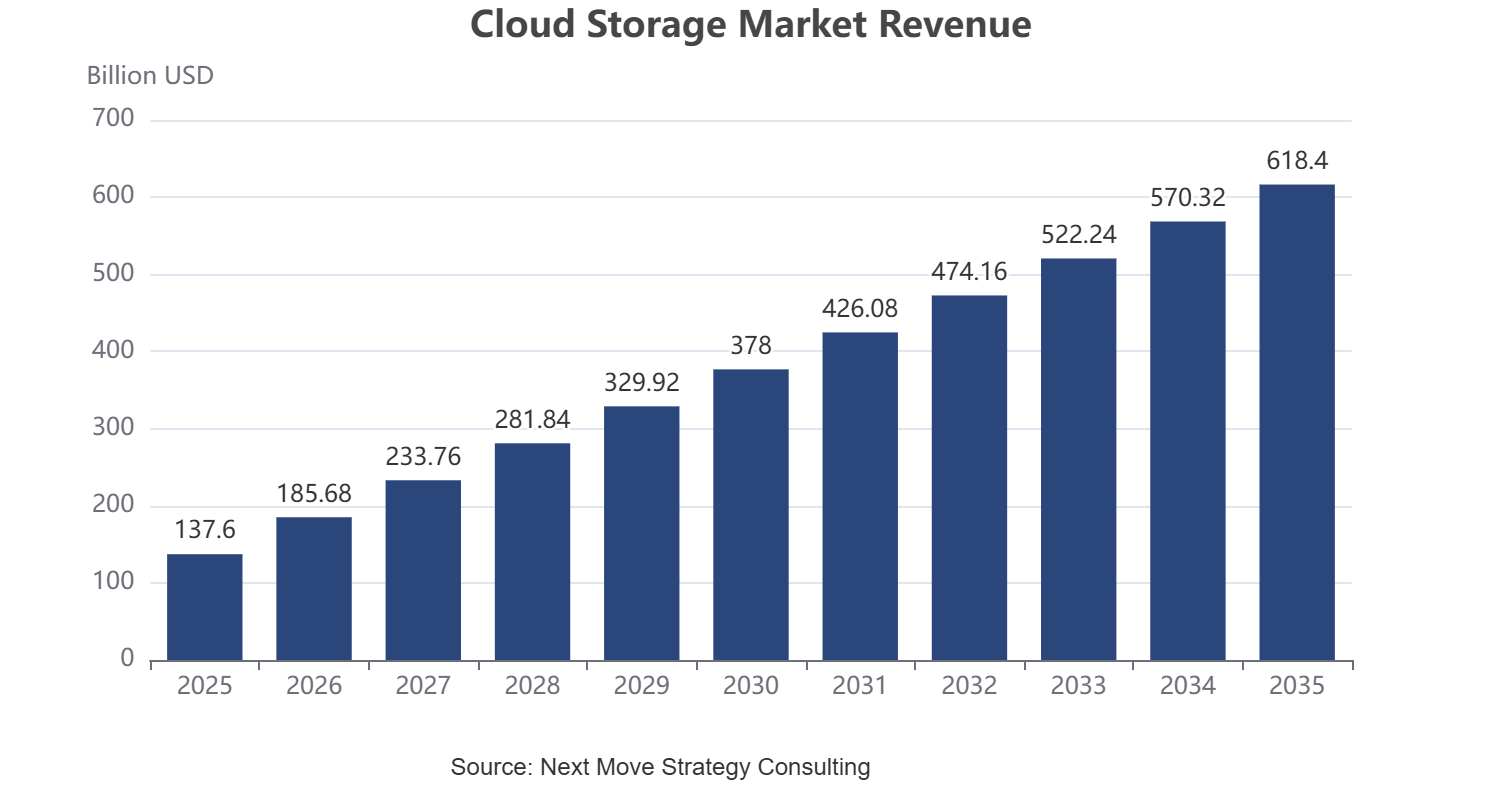
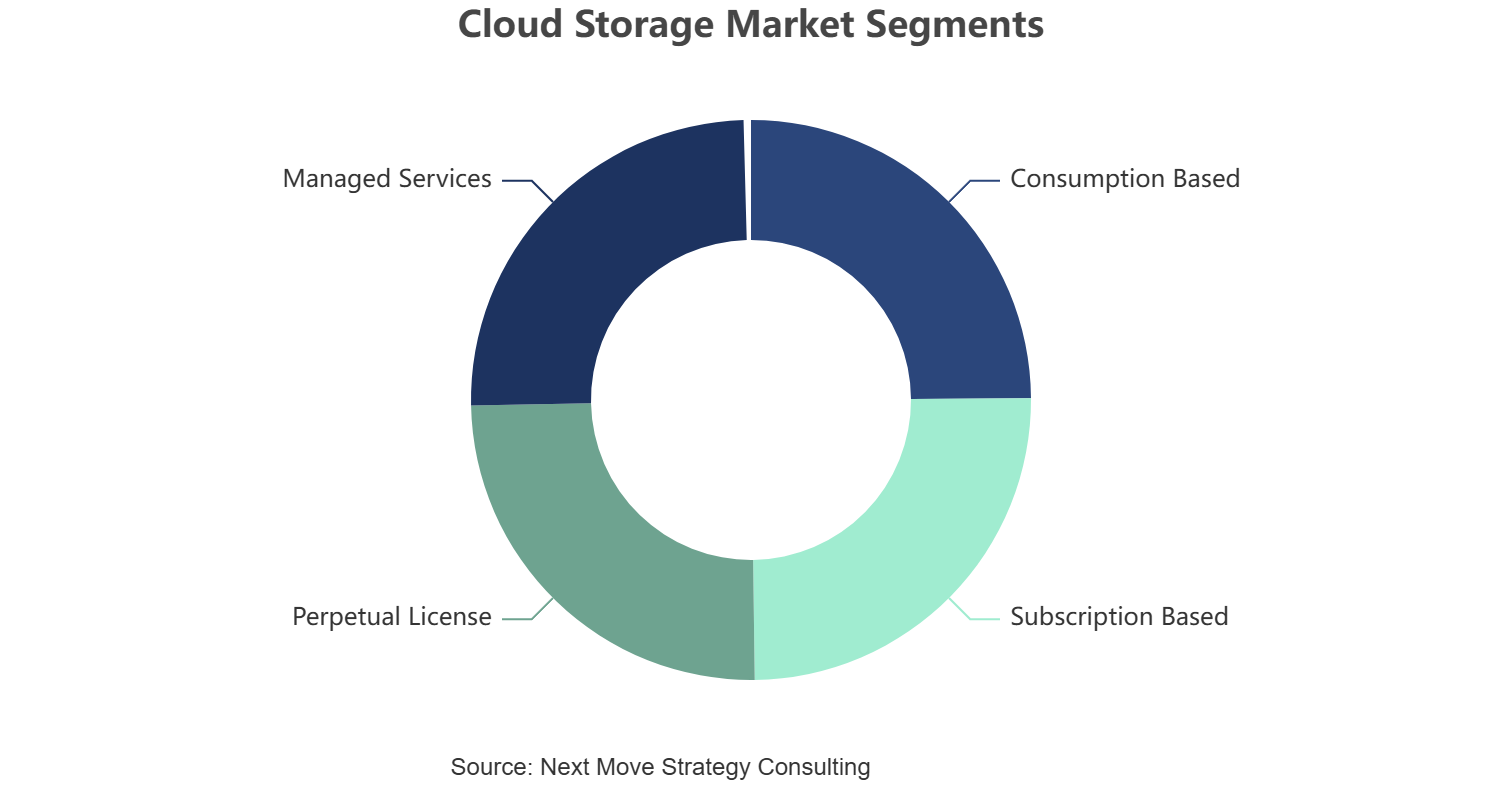
About the Author
 Liza Phukan
— Liza Phukan is Research Associate at Next Move Strategy Consulting, where she has covered emerging industries and market research across sectors for 3.5 years. Her work includes analyzing industry developments, validating market data, and developing structured business content from research findings. She uses secondary research and data-validation practices to turn complex market information into clear decision-useful market analysis for business audiences and support report development and B2B.
Liza Phukan
— Liza Phukan is Research Associate at Next Move Strategy Consulting, where she has covered emerging industries and market research across sectors for 3.5 years. Her work includes analyzing industry developments, validating market data, and developing structured business content from research findings. She uses secondary research and data-validation practices to turn complex market information into clear decision-useful market analysis for business audiences and support report development and B2B.
About the Reviewer
 Supradip Baul
— Supradip Baul is an accomplished business consultant and strategist with over a decade of rich experience in market intelligence, strategy, technology, and business transformation. His work has included rigorous qualitative and quantitative analysis across multiple industries, helping clients shape investment decisions and long-term roadmaps. Earlier in his career, he was associated with Gartner, where he contributed to industry-leading reports and market share analyses. He has worked with leading global companies and holds an MBA with a dual specialization in Marketing and Finance.
Supradip Baul
— Supradip Baul is an accomplished business consultant and strategist with over a decade of rich experience in market intelligence, strategy, technology, and business transformation. His work has included rigorous qualitative and quantitative analysis across multiple industries, helping clients shape investment decisions and long-term roadmaps. Earlier in his career, he was associated with Gartner, where he contributed to industry-leading reports and market share analyses. He has worked with leading global companies and holds an MBA with a dual specialization in Marketing and Finance.
At Next Move Strategy Consulting, we understand that insightful market research is the cornerstone of successful business decisions. That's why we employ a robust and multifaceted approach, combining various methodologies to deliver the most accurate and actionable data for our clients.

Research Landscape
We navigate the world of research with two primary approaches:
Qualitative Approach
Our qualitative research methodologies involve immersive techniques such as in-depth interviews, focus groups, and observational studies. By engaging directly with individuals and stakeholders, we uncover valuable insights that quantitative data alone may overlook.

Quantitative Research
In tandem with qualitative methodologies, NMSC leverages the power of Quantitative Research to provide a robust foundation of numerical insights. Through systematic data collection and analysis, we quantify patterns, preferences, and market trends, offering a comprehensive view of the business landscape.
Our quantitative research approach employs diverse tools, including surveys, experiments, and statistical modelling. These methodologies enable us to gather data from a large and representative sample, ensuring the statistical significance of our findings. By employing structured questionnaires and standardized data collection methods, we guarantee the reliability and validity of the information we present to our clients.
Quantitative research is particularly effective in measuring the prevalence of trends, assessing market size, and gauging the impact of various factors on consumer behavior. The numerical precision attained through this approach equips our clients with actionable insights, facilitating data-driven decision-making and strategy formulation.


Our Specialized Toolbox for Industry-Specific Market Research
We deploy a specialized arsenal of techniques tailored to meet your unique requirements. Here's a glimpse into our comprehensive toolbox:

Information Procurement
The stage entails acquiring market data or relevant information through various sources and methodologies.


Market Research Approach
We utilize both top-down and bottom-up approaches in market research analysis to achieve a comprehensive understanding of the market dynamics, leveraging the broad perspective of industry trends and macroeconomic factors alongside detailed insights from specific segments and individual companies.

Porters Five Forces Analysis
We conduct Porter's Five Forces analysis to evaluate the competitive landscape of an industry, providing us with insights into factors that affect profitability and strategic positioning.

SWOT Analysis

Forecasting
We utilize a forecasting model to predict future consumption by considering parameters like population, economics, regulations, market competition, drivers, constraints, technology, and pricing. We also employ statistical techniques such as multilinear regression, exponential smoothing, moving average, ARIMA, and Monte Carlo simulations for accurate predictions. In econometric forecasting, we analyzed short-term and long-term event impacts, attributing values based on regulatory frameworks, economic factors, and market events.





 Speak to Our Analyst