Edge-In to Cloud Market

Edge-in to cloud market size was USD 18.5 bn in 2025, projected to reach USD 95.6 bn by 2035 at a 17.5% CAGR from 2026 to 2035, per this market report.

Download Free Sample PDF
Base Year (2025)
$18.50 Billion
Forecast (2035)
$95.60 Billion
CAGR (2026-2035)
17.5%
Top Region
North America

What Is the Edge-In to Cloud Market Size?
The global edge-in to cloud market size was valued at USD 18.5 billion in 2025 and is estimated at USD 22.4 billion in 2026, forecast to reach USD 95.6 billion by 2035, expanding at a 17.5% CAGR between 2026 and 2035. North America leads with approximately 44% share, while hardware dominates all other components with approximately 46% share.

We observed that growth is broad-based across every segmentation axis, with software-defined orchestration and healthcare-linked adoption driving the dominant structural shifts through 2035.

Edge-In to Cloud Market Revenue Forecast
Values in USD Billion

2025 $18.50 Billion
2025
2026 $21.74 Billion
2026
2027 $25.54 Billion
2027
2028 $30.01 Billion
2028
2029 $35.26 Billion
2029
2030 $41.43 Billion
2030
2031 $48.69 Billion
2031
2032 $57.21 Billion
2032
2033 $67.22 Billion
2033
2034 $78.98 Billion
2034
2035 $95.60 Billion
2035

Key Takeaways

By Component: Hardware held the largest share of approximately 46% (USD 8.51 billion) in 2025; Software is the fastest-growing sub-segment at 23.7% CAGR from 2026–2035.

By Application: Data Center Modernization held the largest share of approximately 26% (USD 4.81 billion) in 2025; AI and Machine Learning Workloads is the fastest-growing sub-segment at 25.0% CAGR from 2026–2035.

By End-Use Industry: IT and Telecommunications held the largest share of approximately 24% (USD 4.44 billion) in 2025; Healthcare and Life Sciences is the fastest-growing sub-segment at 26.9% CAGR from 2026–2035.

By Deployment Model: Consumption-Based / As-a-Service held the largest share of approximately 58% (USD 10.73 billion) in 2025 and is also the fastest-growing sub-segment at 20.7% CAGR from 2026–2035.

By Organization Size: Large Enterprises held the largest share of approximately 68% (USD 12.58 billion) in 2025; Small and Medium Enterprises is the fastest-growing sub-segment at 21.1% CAGR from 2026–2035.

Dominant Region: North America dominated with approximately 44% revenue share (USD 8.14 billion) in 2025.

Fastest-Growing Region: Asia-Pacific is expected to register the highest CAGR of 23.4% during 2026–2035.

Dominant Country: U.S. led with approximately USD 7.00 billion in 2025.

Fastest-Growing Country: India is the fastest-growing country at approximately 31.8% CAGR from 2026–2035.

Market Opportunity: The edge-in to cloud market is expected to create an absolute dollar opportunity of USD 73.2 billion between 2026 and 2035, presenting significant investment potential across consumption-based, AI-ready, and healthcare-linked edge-to-cloud platforms.

According to Next Move Strategy Consulting analysis, vendors are increasingly embedding agentic AI operations directly into hybrid cloud management planes, a shift that favors platform providers with unified edge-to-cloud portfolios over point-solution infrastructure vendors as enterprises consolidate procurement through 2035.

What Does the Edge-In to Cloud Market Encompass?
The edge-in to cloud market encompasses hardware, software, and services that unify distributed edge computing environments with centralized and hybrid cloud infrastructure under a single consumption-based management plane. Our assessment indicates that the scope spans edge servers, storage, and networking hardware, cloud management and orchestration software, and consulting, integration, and managed services delivered to large enterprises and small and medium enterprises across consumption-based and traditional ownership models. The category has evolved from siloed on-premises and public cloud deployments into unified, agentic AI-powered hybrid operating platforms capable of managing infrastructure from data center to network edge.
Regulatory frameworks such as data sovereignty requirements under the European Union's General Data Protection Regulation shape how vendors architect edge-to-cloud platforms that keep sensitive workloads on-premises while retaining cloud-like agility. We observed that technology adoption is shifting toward agentic AI operations that autonomously plan, orchestrate, and govern infrastructure and application agents across hybrid environments. Next Move Strategy Consulting's analysis indicates that this structural shift, combined with rising AI workload deployment, is redefining procurement priorities across the edge-in to cloud market.

Ecosystem Analysis of the Edge-In to Cloud Market

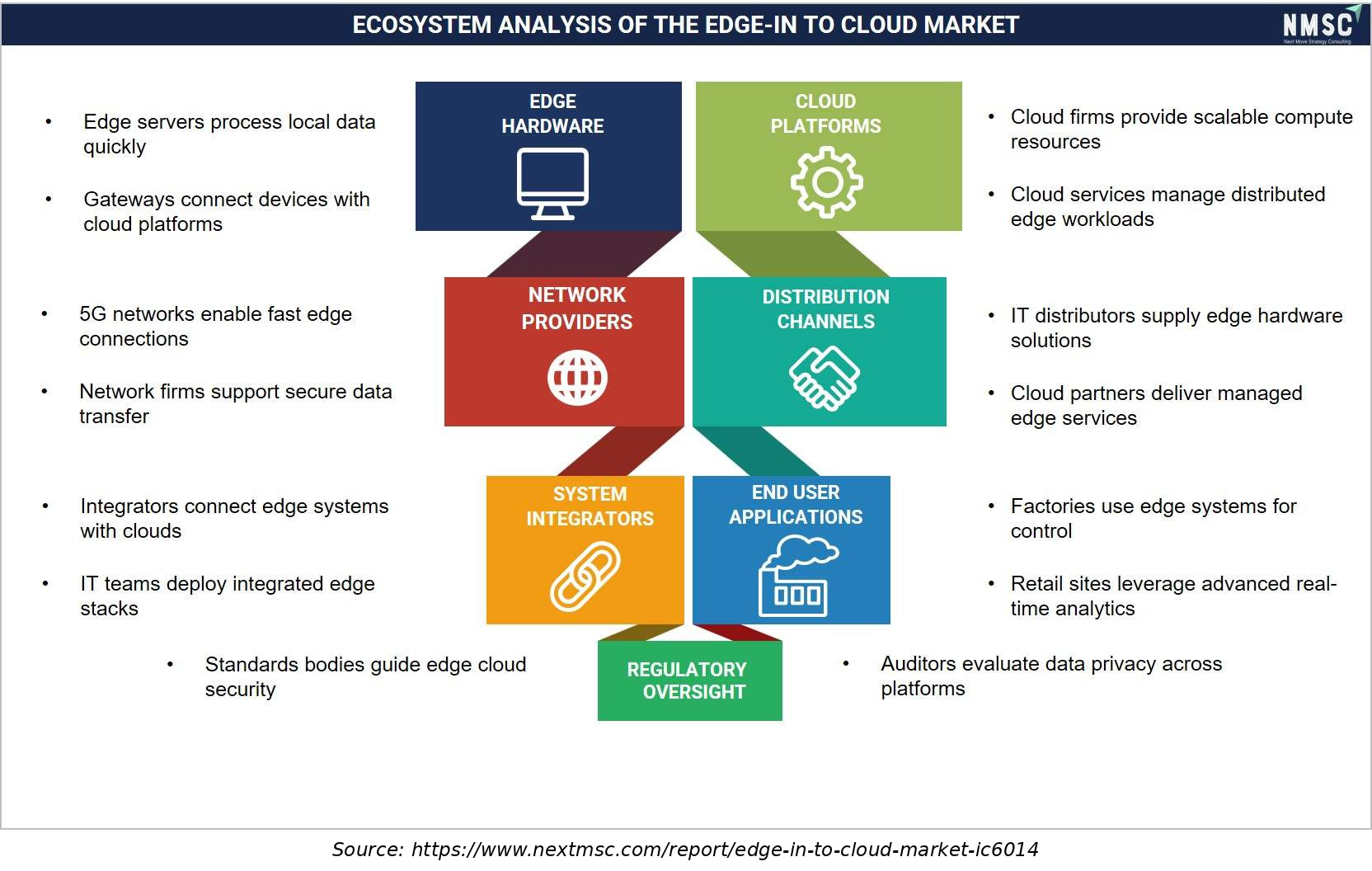
The ecosystem analysis of the Edge-In to Cloud Market highlights the interconnected roles of edge hardware providers, cloud platforms, network providers, distribution channels, system integrators, end-user applications, and regulatory bodies. These ecosystem participants collectively support infrastructure deployment, connectivity, cloud integration, application delivery, and regulatory compliance, shaping the development and adoption of edge-to-cloud solutions across industries.

Market Drivers & Dynamics

Interactive Dataset
Rising enterprise AI workload deployment demand driver +5.0% North America, Asia-Pacific 2026–2035
Expanding consumption-based, as-a-service procurement preference driver +4.0% Global 2026–2035
Growing agentic AI and hybrid cloud automation adoption driver +3.0% North America, Europe 2026–2035
Data sovereignty and hybrid data residency requirements driver +2.0% Europe, Asia-Pacific 2026–2035
Rising Asia-Pacific digital infrastructure investment driver +2.0% Asia-Pacific 2026–2035
Legacy virtualization migration and modernization programs driver +1.5% Global 2026–2032
Hybrid infrastructure integration and interoperability complexity restraint −2.0% Global 2026–2032
High upfront platform migration and transition costs restraint −1.5% Global 2026–2030
Data governance and multi-cloud security complexity restraint −1.0% North America, Europe 2026–2032
Source: Next Move Strategy Consulting

Growth Drivers

What Is the Primary Growth Driver of the Edge-In to Cloud Market?

Rising enterprise AI workload deployment demand is the primary driver of the market. Company financial disclosures show enterprise-wide AI infrastructure investment accelerating across hybrid environments as organizations scale beyond pilot deployments. We observed that this demand, reinforced by expanding agentic AI framework adoption, continues to anchor baseline investment in hardware and software categories across developed and emerging digital economies alike.

How Is Consumption-Based Procurement Driving Market Growth?

Expanding consumption-based, as-a-service procurement preference is accelerating market growth toward flexible, marketplace-enabled hybrid cloud platforms. Company disclosures indicate that up to 70% of enterprise applications remain essential systems requiring on-premises or colocation deployment due to data gravity and regulatory considerations. Our assessment indicates that this hybrid reality, combined with expanded marketplace commerce capability, is compressing the gap between cloud-like agility and on-premises infrastructure requirements.

Growth Inhibitors

What Is Restraining Edge-In to Cloud Market Expansion?

Hybrid infrastructure integration and interoperability complexity restrains adoption among enterprises managing fragmented, multi-vendor environments. Company disclosures continue to highlight the technical debt and legacy infrastructure complexity constraining enterprise innovation velocity. We found that high upfront platform migration costs further restrain smaller enterprise adoption, though vendor-sponsored migration de-risking programs are gradually reducing this barrier for virtualization transitions.

What Are the Growth Opportunities?

How Can Agentic AIOps Unlock Value for Hybrid Cloud Operators?

Agentic AI operations platforms that autonomously govern infrastructure and application agents present a whitespace opportunity for vendors seeking to reduce enterprise operational complexity. Suppliers that scale governed, auditable agentic AIOps capability stand to capture recurring revenue as enterprises consolidate fragmented hybrid management tools into unified platforms.

Where Does Healthcare Data Sovereignty Create New Demand?

Healthcare organizations seeking AI-powered diagnostic capability while maintaining strict clinical data governance represent an underpenetrated opportunity for compliance-focused edge-to-cloud vendors. Providers that secure clinical-workflow integration partnerships can capture recurring revenue tied to patient-data residency and regulatory compliance requirements.

How Can Asia-Pacific Digital Infrastructure Investment Benefit Regional Vendors?

Asia-Pacific enterprises pursuing rapid digital infrastructure modernization create an opportunity for vendors localizing hybrid cloud platforms for regional data residency requirements. Early movers that adapt consumption-based models for China, India, and Japan can differentiate ahead of multinational competitors scaling distribution across the region's expanding digital infrastructure budgets.

Segmentation Analysis

2025 (USD Billion)
2035 (USD Billion)
Hardware 2025: $8.51 Billion | 2035: $32.50 Billion
Hardware
Services 2025: $5.55 Billion | 2035: $26.77 Billion
Services
Software 2025: $4.44 Billion | 2035: $36.33 Billion
Software
Hardware $8.51 Billion $32.50 Billion 13.6%
Services $5.55 Billion $26.77 Billion 16.6%
Software $4.44 Billion $36.33 Billion 23.7%

Which Component Segment Dominates the Edge-In to Cloud Market?

Hardware led the market with USD 8.51 billion in 2025, supported by sustained demand for edge servers, storage, and networking equipment underpinning every hybrid deployment. We observed that Software is the fastest-growing component, expanding at a 23.7% CAGR from 2026 to 2035, as agentic AI orchestration and cloud management platforms increasingly become the primary differentiator between competing hybrid cloud offerings.

2025 (USD Billion)
2035 (USD Billion)
Data center
IoT and indu
AI and machi
Retail and d
High-perform
Segment Item 2025 (USD Billion) 2035 (USD Billion) CAGR
Data center modernization $10.0 USD Billion $40.0 USD Billion 18.0%
IoT and industrial edge $17.1 USD Billion $51.1 USD Billion 16.0%
AI and machine learning workloads $24.2 USD Billion $62.2 USD Billion 22.0%
Retail and distributed branch connectivity $31.3 USD Billion $73.3 USD Billion 12.0%
High-performance computing $38.4 USD Billion $84.4 USD Billion 19.0%

Segment-wise data is locked

Unlock complete segment-wise numbers for By Application.

Unlock Full Data

Which Application Segment Leads Market Demand?

Data Center Modernization remained the leading application within the market, valued at USD 4.81 billion in 2025 on sustained enterprise investment in replacing legacy infrastructure with hybrid-ready platforms. Our findings suggest that AI and Machine Learning Workloads is the fastest-growing application, registering a 25.0% CAGR from 2026 to 2035, as enterprises scale AI deployment beyond pilot projects into production-grade hybrid infrastructure.

2025 (USD Billion)
2035 (USD Billion)
IT and telec
Manufacturin
BFSI
Retail and e
Government a
Segment Item 2025 (USD Billion) 2035 (USD Billion) CAGR
IT and telecommunications $10.0 USD Billion $40.0 USD Billion 20.0%
Manufacturing $17.1 USD Billion $51.1 USD Billion 18.0%
BFSI $24.2 USD Billion $62.2 USD Billion 12.0%
Retail and e-commerce $31.3 USD Billion $73.3 USD Billion 22.0%
Government and public sector $38.4 USD Billion $84.4 USD Billion 25.0%

Segment-wise data is locked

Unlock complete segment-wise numbers for By End-Use Industry.

Unlock Full Data

Which End-Use Industry Segment Leads the Edge-In to Cloud Market?

IT and Telecommunications remained the leading end-use industry, valued at USD 4.44 billion in 2025 on sustained demand for hybrid infrastructure supporting network and data center operations. Based on research conducted by Next Move Strategy Consulting, we found that Healthcare and Life Sciences is the fastest-growing end-use industry at a 26.9% CAGR from 2026 to 2035, driven by clinical data governance requirements and expanding AI-powered diagnostic workload deployment.

2025 (USD Billion)
2035 (USD Billion)
Consumption-
Traditional
Segment Item 2025 (USD Billion) 2035 (USD Billion) CAGR
Consumption-based / as-a-service $10.0 USD Billion $40.0 USD Billion 18.0%
Traditional CapEx ownership $17.1 USD Billion $51.1 USD Billion 24.0%

Segment-wise data is locked

Unlock complete segment-wise numbers for By Deployment Model.

Unlock Full Data
2025 (USD Billion)
2035 (USD Billion)
Large enterp
Small and me
Segment Item 2025 (USD Billion) 2035 (USD Billion) CAGR
Large enterprises $10.0 USD Billion $40.0 USD Billion 10.0%
Small and medium enterprises $17.1 USD Billion $51.1 USD Billion 24.0%

Segment-wise data is locked

Unlock complete segment-wise numbers for By Organization Size.

Unlock Full Data

Growth Opportunities

Our analysis shows that three forward-looking opportunities stand out for stakeholders positioning within the edge-in to cloud market over the 2026–2035 forecast period.

How Can Agentic AIOps Unlock Value for Hybrid Cloud Operators?

Agentic AI operations platforms that autonomously govern infrastructure and application agents present a whitespace opportunity for vendors seeking to reduce enterprise operational complexity. Suppliers that scale governed, auditable agentic AIOps capability stand to capture recurring subscription revenue as enterprises consolidate fragmented hybrid management tools into unified platforms.

Where Does Healthcare Data Sovereignty Create New Demand?

Healthcare organizations seeking AI-powered diagnostic capability while maintaining strict clinical data governance represent an underpenetrated opportunity for compliance-focused edge-to-cloud vendors. Providers that secure clinical-workflow integration partnerships can capture recurring revenue tied to patient-data residency and regulatory compliance requirements.

How Can Asia-Pacific Digital Infrastructure Investment Benefit Regional Vendors?

Asia-Pacific enterprises pursuing rapid digital infrastructure modernization create an opportunity for vendors localizing hybrid cloud platforms for regional data residency requirements. Early movers that adapt consumption-based models for China, India, and Japan can differentiate ahead of multinational competitors scaling distribution across the region's expanding digital infrastructure budgets.

Strategic Framework of the Edge-In to Cloud Market

Strategic Framework of the Edge-In to Cloud Market

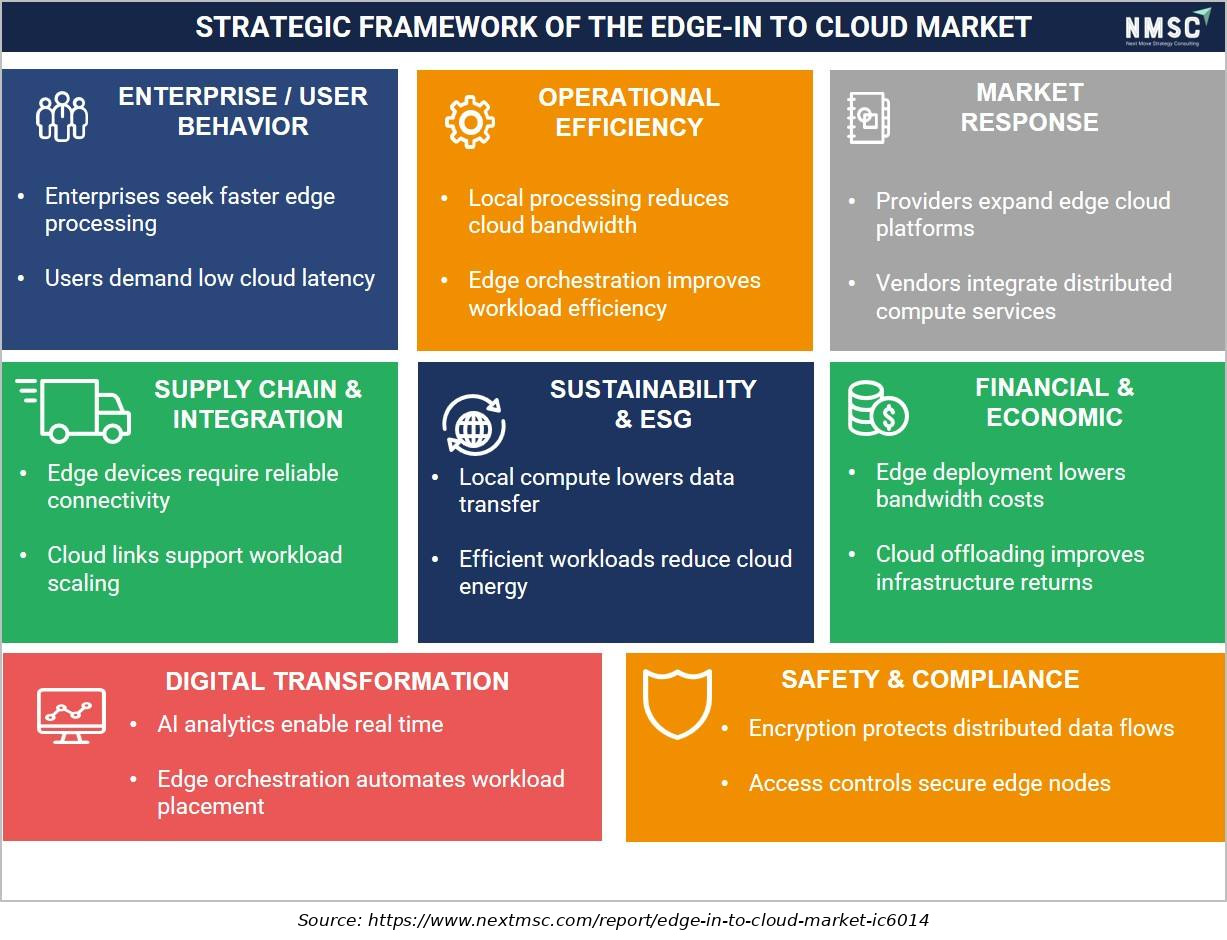
The strategic framework of the Edge-In to Cloud Market examines key market dynamics across enterprise and user behavior, operational efficiency, market response, supply chain integration, sustainability and ESG, financial and economic factors, digital transformation, and safety and compliance. These dimensions highlight how enterprises and providers address low-latency processing, workload optimization, connectivity, cost efficiency, AI-driven operations, sustainability, and secure edge-to-cloud infrastructure.

Regional Outlook

2025 (USD Billion)
2035 (USD Billion)
North Americ
Europe
Asia-Pacific
Middle East
Latin Americ
Region 2025 (USD Billion) 2035 (USD Billion) CAGR (%)
North America $10.0 USD Billion $40.0 USD Billion 9.0%
Europe $17.1 USD Billion $51.1 USD Billion 27.0%
Asia-Pacific $24.2 USD Billion $62.2 USD Billion 25.0%
Middle East & Africa $31.3 USD Billion $73.3 USD Billion 23.0%
Latin America $38.4 USD Billion $84.4 USD Billion 12.0%

Regional data is locked

Unlock complete regional numbers for this market.

Unlock Full Data

Competitive Landscape

We observed that the edge-in to cloud market features a moderately consolidated competitive landscape, with diversified infrastructure technology groups competing alongside hyperscale cloud providers and specialized edge platform vendors on unified orchestration capability.

Dimension Description
Market Structure Moderately consolidated; diversified infrastructure groups such as Hewlett Packard Enterprise Company and Dell Technologies Inc. compete alongside hyperscale providers such as Amazon.com, Inc. and Microsoft Corporation for unified hybrid platform deployments.
Innovation Focus Agentic AI operations, consumption-based marketplace commerce, and virtualization migration de-risking programs dominate current innovation pipelines across leading vendors.
Strategic Partnerships & Expansion Activity Selective strategic partnership expansion, exemplified by Vultr's June 2026 selection of HPE and NVIDIA for large-scale AI datacenter deployments using NVIDIA GB300 NVL72 systems.

How Do Companies Compete in the Edge-In to Cloud Market?

Companies compete primarily on unified orchestration breadth, consumption-based pricing flexibility, and AI infrastructure partnership depth across the industry. Diversified vendors such as Hewlett Packard Enterprise Company and Dell Technologies Inc. leverage established hybrid cloud platforms to serve enterprise customers, while hyperscale providers such as Amazon.com, Inc. and Alphabet Inc. compete by extending cloud-native services outward toward the edge.

Which Competitive Archetypes Dominate the Edge-In to Cloud Market?

Two archetypes dominate the market: infrastructure technology groups offering consumption-based, unified hybrid cloud platforms, and hyperscale cloud providers extending cloud services to edge locations. Hewlett Packard Enterprise Company exemplifies the infrastructure archetype through its GreenLake platform, while Amazon.com, Inc. exemplifies the hyperscale archetype through its edge-extending cloud service portfolio.

How Are Companies Differentiating Through Innovation in Edge-In to Cloud?

Innovation and differentiation strategy increasingly center on agentic AI operations and marketplace-enabled commerce. HPE's GreenLake Intelligence launch and its subsequent GreenLake Marketplace expansion both illustrate this shift toward unified, AI-native hybrid cloud experiences. Our analysis shows that vendors unable to demonstrate credible agentic AIOps capability risk losing enterprise contracts to more integrated competitors.

What M&A and Expansion Activity Is Shaping the Edge-In to Cloud Market?

Strategic partnership and capacity expansion continue to shape competitive positioning within the industry. Vultr's selection of HPE and NVIDIA for AI datacenter deployment and HPE's Partner Growth Summit 2026 announcements on platform migration programs illustrate how vendors pursue capability expansion through partnership rather than large-scale consolidation across the current competitive cycle.

Key Market Players

Our assessment indicates that the following 20 companies are actively shaping product innovation, platform expansion, and partnership strategy within the global edge-in to cloud market.

Hewlett Packard Enterprise Company Dell Technologies Inc. Cisco Systems, Inc. Microsoft Corporation Amazon.com, Inc. International Business Machines Corporation Broadcom Inc. NVIDIA Corporation Schneider Electric SE Lenovo Group Limited Equinix, Inc. Rackspace Technology, Inc. Nutanix, Inc. Alphabet Inc. Oracle Corporation Super Micro Computer, Inc. Akamai Technologies, Inc. Fastly, Inc. Hitachi, Ltd. Pure Storage, Inc.

Latest Developments

We found that recent platform launches and partnerships within the edge-in to cloud market are concentrated on agentic AI operations and AI infrastructure expansion, reflecting the industry's transition toward unified, AI-native hybrid cloud platforms.

Date Event
July 2026 Schneider Electric and AMD launched a jointly developed, validated Helios reference design supporting 246 kW AI racks and modular clusters up to 10.4 MW IT load. It integrates power, cooling, digital twins and operational monitoring, helping customers deploy high-density AI infrastructure faster with reduced integration complexity.
July 2026 Supermicro launched turnkey Kubernetes Edge AI appliances with Red Hat OpenShift and Everpure Portworx. The validated hardware-software stack is preloaded for AI workloads, simplifying deployment, orchestration and data management at distributed edge locations while extending enterprise Kubernetes capabilities closer to where data and inference workloads originate.
June 2026 Fastly and Skyfire integrated identity and payment-backed credentials into Fastly’s programmable edge cloud platform. The partnership enables enterprises to identify, verify and transact with autonomous AI agents at the edge in real time, without re-architecting existing infrastructure, supporting emerging agentic applications and machine-driven digital commerce.

Expert Insights

Matthew Prince

Co-founder & CEO | Cloudflare

"Cloudflare was born on the edge, and now delivers all of our offerings as close to the user as possible for the lowest latency and best customer experience."

Analyst Interpretation

Matthew Prince's statement highlights the increasing importance of edge infrastructure, proximity to users and low-latency service delivery. As enterprises adopt real-time applications, AI-enabled services and data-intensive workloads, processing and delivering services closer to users can improve responsiveness and application performance. This trend supports the expansion of distributed edge infrastructure as an important extension of cloud-based computing and digital services.

Investment Opportunities

What Capital Inflows Are Targeting the Edge-In to Cloud Market?

Capital inflows into the edge-in to cloud market are increasingly directed toward agentic AI capability development and AI infrastructure partnership expansion. Vultr's selection of HPE and NVIDIA for large-scale AI datacenter deployment illustrates this trend toward strategic infrastructure partnership investment. We observed that investors favor vendors demonstrating validated enterprise adoption of consumption-based platforms as a proxy for long-term recurring revenue growth.

How Is Infrastructure Investment Supporting Edge-In to Cloud Platform Expansion?

Infrastructure investment is expanding hybrid cloud data center and AI compute capacity across North America, Europe, and Asia-Pacific to serve rising enterprise demand. Our findings suggest that vendors are investing in agentic AI orchestration infrastructure, exemplified by HPE's GreenLake Intelligence framework, to compress the distance between infrastructure procurement and operational deployment, supporting the automation required for large-scale AI workload growth.

What ESG Considerations Are Shaping Edge-In to Cloud Investment Decisions?

Environmental, social, and governance considerations increasingly factor into edge-in to cloud investment decisions, with data center energy efficiency and governed AI operations as key criteria. The European Union's General Data Protection Regulation continues to inform data residency and governance disclosures for hybrid cloud platforms. We found that investors increasingly favor vendors with transparent AI governance controls, treating auditable agentic operations as a governance indicator alongside technical performance.

Key Benefits for Stakeholders

How Does This Report Benefit Enterprise and Industry Leaders?

Enterprise and industry leaders gain access to validated segmentation, competitive benchmarking, and regional demand forecasts that support technology-investment and vendor-selection decisions across the edge-in to cloud industry. Our analysis shows that detailed component, application, and end-use industry breakdowns help technology and procurement teams align specifications with agentic AI and consumption-based requirements while identifying underserved categories for portfolio expansion.

How Does This Report Benefit Investors and Financial Analysts?

Investors and financial analysts benefit from consistent, single-point market size and CAGR estimates that support valuation and capital-allocation decisions across the edge-in to cloud supply chain. We observed that the report's regional and segment-level growth differentials help identify which vendors are best positioned to capture above-market growth in Asia-Pacific and software categories through 2035.

How Does This Report Benefit Technology Vendors and Product Teams?

Technology vendors and product teams gain insight into emerging platform requirements, including agentic AIOps, marketplace-enabled commerce, and virtualization migration support, that are reshaping the industry. Our findings suggest that this analysis helps R&D teams prioritize development roadmaps around orchestration and governance capabilities increasingly required by enterprise procurement processes.

Key Market Segments Evaluated

By Component

  • Hardware
  • Services
  • Software

By Application

  • Data Center Modernization
  • IoT and Industrial Edge
  • AI and Machine Learning Workloads
  • Retail and Distributed Branch Connectivity
  • High-Performance Computing
  • Other Applications

By End-Use Industry

  • IT and Telecommunications
  • Manufacturing
  • BFSI
  • Retail and E-commerce
  • Government and Public Sector
  • Healthcare and Life Sciences
  • Energy and Utilities
  • Other Industries

By Deployment Model

  • Consumption-based / as-a-service
  • Traditional CapEx ownership

By Organization Size

  • Large enterprises
  • Small and medium enterprises

Conclusion & Recommendations

The long-term outlook for the market remains highly favorable, with global revenue projected to expand from USD 18.5 billion in 2025 to USD 95.6 billion by 2035 at a 17.5% CAGR. We observed that sustained AI workload deployment, consumption-based procurement, and agentic AI adoption will continue underpinning demand across component types through the forecast period.

What Strategic Positioning Should Edge-In to Cloud Suppliers Pursue?

Suppliers should prioritize agentic AI orchestration and marketplace-enabled commerce while pursuing AI infrastructure partnerships to secure long-term enterprise contracts. Our assessment indicates that vendors investing early in software-defined orchestration and healthcare-focused compliance capability, alongside consumption-based pricing flexibility, will be best positioned to capture premium pricing within the edge-in to cloud market.

How Attractive Is the Edge-In to Cloud Market for New Investment?

The edge-in to cloud industry presents a highly attractive investment case, supported by a USD 73.2 billion absolute dollar opportunity between 2026 and 2035 and above-average growth in Asia-Pacific and AI workload categories. We found that investment attractiveness is highest for vendors combining validated enterprise adoption with proven agentic AI and AI infrastructure partnership capability.

What Market Shifts and Key Risks Should Stakeholders Monitor?

Stakeholders should monitor hybrid integration complexity, high migration costs, and evolving data governance requirements as key risks to the edge-in to cloud market. Our analysis shows that vendors unable to adapt to unified orchestration expectations risk losing enterprise contracts to competitors with stronger agentic AI capability, particularly within Europe's increasingly regulation-driven procurement environment.

What Are the Key Growth Pathways for the Edge-In to Cloud Market?

Key growth pathways include expanding agentic AIOps capabilities, scaling AI and machine learning workload support, and deepening penetration into Asia-Pacific and healthcare end-use channels. Next Move Strategy Consulting's analysis indicates that vendors pursuing these pathways while maintaining cost competitiveness in core hardware categories will be best positioned to capture the edge-in to cloud market's projected growth through 2035.

FAQs

About the Author

Liza Phukan

Liza Phukan

Liza Phukan is Research Associate at Next Move Strategy Consulting, where she has covered emerging industries and market research across sectors for 3.5 years. Her work includes analyzing industry developments, validating market data, and developing structured business content from research findings. She uses secondary research and data-validation practices to turn complex market information into clear decision-useful market analysis for business audiences and support report development and B2B.

About the Reviewer

Supradip Baul

Supradip Baul

Supradip Baul is an accomplished business consultant and strategist with over a decade of rich experience in market intelligence, strategy, technology, and business transformation. His work has included rigorous qualitative and quantitative analysis across multiple industries, helping clients shape investment decisions and long-term roadmaps. Earlier in his career, he was associated with Gartner, where he contributed to industry-leading reports and market share analyses. He has worked with leading global companies and holds an MBA with a dual specialization in Marketing and Finance.

Download Free Sample

Gustaf Hummel Burstrom

GUSTAF HUMMEL BURSTROM

Founder

Revline Tools AB

Joseph and the team at Next Move Strategy Consulting have been excellent to work with, in supplying us with relevant market data and forecasts for our specific category. We had some special requirements and they were able to do a custom package to suit our needs. We would definitely recommend them to any other company needing market data and forecasts

Gaurav Jaiswal

GAURAV JAISWAL

Founder & CEO

Yano Charge Private Limited

The EV Charging market research report provided by the NextMSC was exceptionally detailed and insightful. It offered a comprehensive analysis that proved to be a game-changer for our strategic planning. Truly a testament to the NextMSC’s expertise and thoroughness in EV market landscape & analysis.

Mohit Agarwal

MOHIT AGARWAL

Chief Manager

DryChem India Pvt. Ltd.

Next Move Strategy Consulting is an amazing team of consultants. We required a market study report for our investors on top priority and the team went above and beyond our expectations to deliver the same with ample supporting data within a short time span enabling us to secure the investments and keep our project timeline maintained. Their professionalism, attention to detail, and timely delivery of actionable recommendations have left a lasting impression on our organization.

Nishant Awate

NISHANT AWATE

Business Development Global Sales

Zehnder Group Deutschland GmbH

Our experience working with Next Move Strategy Consulting was positive. The team was responsive, professional, and open to incorporating our specific requirements throughout the project. The India AHU market study was comprehensive and well structured, covering market value and volume forecasts, product and application segments, and key industry trends. The inclusion of both AHU and residential MVHR market insights made the study particularly relevant for our strategic market assessment. Overall, the report provides a solid foundation for evaluating market potential, identifying priority segments, and supporting business-development decisions in India.

Semih Kavaklioglu

SEMIH KAVAKLIOGLU

Co-Founder & Sales Manager

Decortie

I work a lot in the marketing industry and I know that research is an essential part of any campaign. I have used Market research reports for my own products and I found them to be very informative and well-researched. The team here produces insightful reports for a good price

Custom Market Research Services

We will customize the research for you if the listed report does not fully match your requirements.

Get 30% Free Customization

Select License

This website uses cookies to ensure you get the best experience on our website. Learn more

✖