Cobalt Market Global Industry Analysis and Forecast (2026-2035)

The global Cobalt Market is valued at USD 25.49 Billion in 2026 and is projected to reach USD 48.59 Billion by 2035, growing at a CAGR of 7.43% from 2026 to 2035. Key growth factors include rising electric vehicle battery demand and expanding battery-grade cobalt refining capacity, with Asia-Pacific leading the market and Cobalt Chemicals accounting for approximately 52% share.

Download Free Sample PDF
Base Year (2025)
$22.92 Billion
Forecast (2035)
$48.59 Billion
CAGR (2026-2035)
7.4%
Top Region
Asia-Pacific

What Is the Cobalt Market Size?

The global cobalt market size was valued at USD 22.92 billion in 2025 and is estimated at USD 25.49 billion in 2026, forecast to reach USD 48.59 billion by 2035, expanding at a 7.43% CAGR between 2026 and 2035. Asia-Pacific leads with approximately 62% share, while Cobalt Chemicals dominates the product type landscape with approximately 52% share.

We observed that the Democratic Republic of the Congo's export quota regime, in force since 2025, is reshaping global cobalt supply availability and pricing at a pace few other critical mineral markets have experienced this decade.

Cobalt Market Global Industry Analysis and Forecast (2026-2035) Revenue Forecast

Values in USD Billion

2025 $22.92 Billion
2025
2026 $24.62 Billion
2026
2027 $26.45 Billion
2027
2028 $28.42 Billion
2028
2029 $30.53 Billion
2029
2030 $32.80 Billion
2030
2031 $35.23 Billion
2031
2032 $37.85 Billion
2032
2033 $40.66 Billion
2033
2034 $43.69 Billion
2034
2035 $48.59 Billion
2035

Key Takeaways

By Product Type: Cobalt Chemicals held the largest share of approximately 52% (USD 11.92 billion) in 2025 and is also the fastest-growing sub-segment at 9.0% CAGR from 2026–2035.

By Source: Primary Mined Cobalt held the largest share of approximately 86% (USD 19.71 billion) in 2025; Recycled Cobalt is the fastest-growing sub-segment at 13.8% CAGR from 2026–2035.

By Application: Battery Materials held the largest share of approximately 62% (USD 14.21 billion) in 2025 and is also the fastest-growing sub-segment at 8.8% CAGR from 2026–2035.

By End-Use Industry: Electric Vehicles held the largest share of approximately 44% (USD 10.08 billion) in 2025; Energy Storage Systems is the fastest-growing sub-segment at 11.9% CAGR from 2026–2035.

Dominant Region: Asia-Pacific dominated with approximately 62% revenue share (USD 14.21 billion) in 2025.

Fastest-Growing Region: North America and Middle East & Africa are both expected to register the highest CAGR of 9.5% during 2026–2035.

Dominant Country: China led with approximately USD 9.66 billion in 2025.

Fastest-Growing Country: India is the fastest-growing country at approximately 11.6% CAGR from 2026–2035.

Market Opportunity: The cobalt market is expected to create an absolute dollar opportunity of USD 23.10 billion between 2026 and 2035, presenting significant investment potential across battery-grade cobalt chemicals and non-DRC supply diversification.

According to NMSC analysis, refiners and battery makers are increasingly qualifying non-DRC and recycled cobalt feedstock as a hedge against export-quota volatility, a diversification pattern also reshaping sourcing strategy across the broader [lithium-ion battery](https: //www.nextmsc.com/report/lithium-ion-battery-market) supply chain that cobalt feeds into.

What Does the Cobalt Market Encompass?

The cobalt market encompasses the mining, refining, and chemical processing of cobalt into metal, chemical, and intermediate forms sold to battery, superalloy, cemented carbide, and catalyst manufacturers. Our assessment indicates that the scope spans primary mined and recycled cobalt supplied to electric vehicle, consumer electronics, energy storage, aerospace, and industrial manufacturing end users, supported by the 20 companies profiled in this report. Cobalt-bearing ore still in the ground and finished battery cells themselves fall outside this market definition.
The category has evolved from a niche superalloy input into a strategically monitored battery metal as lithium-ion cathode demand has scaled globally. The Democratic Republic of the Congo, the source of the majority of global mined cobalt, imposed an export quota regime that took effect in 2025 following an earlier full export suspension, directly constraining the volume of cobalt hydroxide and concentrate reaching international refiners. We observed that technology adoption is shifting toward cobalt-lean and cobalt-free battery cathode chemistries in some vehicle segments, even as absolute cobalt demand keeps rising, a dynamic that is reshaping refiner sourcing strategy across the broader electric vehicle battery supply chain.

Market Drivers & Dynamics

Interactive Dataset
Electric vehicle battery cathode demand growth driver +2.4% Asia-Pacific, Europe, North America 2026-2035
Energy storage system deployment scaling driver +1.6% Global 2026-2035
Non-DRC and recycled cobalt supply diversification investment driver +1.3% North America, Europe 2026-2032
Battery-grade cobalt sulfate refining capacity expansion driver +1.7% Asia-Pacific 2026-2035
Aerospace superalloy demand recovery driver +0.9% North America, Europe 2026-2032
Government critical mineral stockpiling and localization programs driver +1.1% North America, Europe 2026-2032
DRC export quota volatility and allocation uncertainty restraint -1.5% Middle East & Africa 2026-2030
Cobalt-lean and cobalt-free battery chemistry substitution restraint -1.2% Global 2026-2035
Price volatility discouraging long-term refiner contracting restraint -0.8% Global 2026-2030
Source: Next Move Strategy Consulting

Growth Drivers

What Is the Primary Growth Driver of the Cobalt Market?

Electric vehicle battery cathode demand growth is the primary driver of the market. We observed that battery-grade cobalt sulfate consumption continues to scale alongside global electric vehicle production, even as some automakers introduce lower-cobalt or cobalt-free cathode chemistries for specific vehicle segments. This behavioral pattern continues to anchor baseline demand for cobalt chemicals, positioning refiners with battery-grade sulfate capacity to capture the largest share of incremental market growth through the forecast period.

How Is Refining Capacity Expansion Driving Cobalt Market Growth?

Battery-grade cobalt sulfate refining capacity expansion is accelerating market growth as precursor cathode active material producers scale output to match electric vehicle and energy storage cell production. Our assessment indicates that this capacity build-out, concentrated among Asia-Pacific refiners including Zhejiang Huayou Cobalt Co., Ltd. and GEM Co., Ltd., is compressing the lead time between mined cobalt hydroxide supply and finished battery-grade chemical output.

Growth Inhibitors

What Is Restraining Cobalt Market Expansion?

DRC export quota volatility and allocation uncertainty restrain broader market expansion, as the quota regime that took effect in 2025 introduces unpredictable tonnage availability for refiners dependent on Congolese cobalt hydroxide. We found that this policy-driven supply constraint adds procurement planning risk compared with jurisdictions offering more stable regulatory frameworks, slowing long-term offtake contracting relative to a market with predictable export volumes.

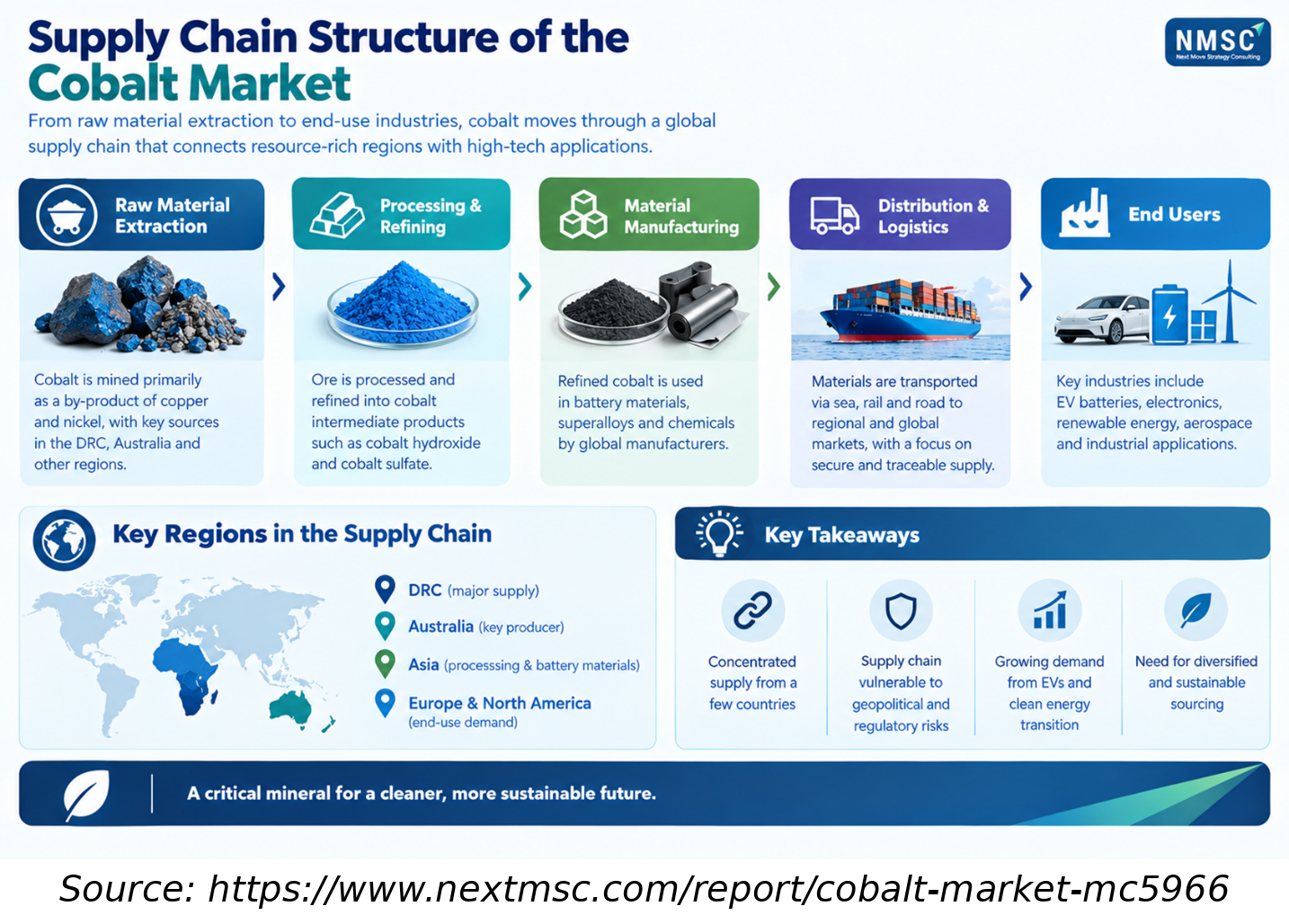
Supply Chain Structure of the Cobalt Market

The cobalt supply chain spans mining, refining, material manufacturing, logistics, and downstream applications such as EV batteries, electronics, renewable energy, aerospace, and industrial systems. The market relies on geographically concentrated resources, specialized processing capabilities, and traceable transportation networks. Supply diversification, responsible sourcing, and sustainable practices remain important considerations for strengthening resilience and meeting rising technology-driven demand.

Segmentation Analysis

2025 (USD Billion)
2035 (USD Billion)
Cobalt Chemicals 2025: $11.92 Billion | 2035: $28.18 Billion
Cobalt Chemi
Cobalt Metal 2025: $7.11 Billion | 2035: $12.63 Billion
Cobalt Metal
Cobalt Intermediates 2025: $3.90 Billion | 2035: $7.77 Billion
Cobalt Inter
Cobalt Chemicals $11.92 Billion $28.18 Billion 9.0%
Cobalt Metal $7.11 Billion $12.63 Billion 5.9%
Cobalt Intermediates $3.90 Billion $7.77 Billion 7.2%

Which Product Type Segment Dominates the Cobalt Market?

Cobalt Chemicals led the market with USD 11.92 billion in 2025, reflecting the fact that battery cathode manufacturing requires cobalt in chemical form, primarily cobalt sulfate, rather than refined metal. We observed that Cobalt Chemicals is also the fastest-growing product type, expanding at a 9.0% CAGR from 2026 to 2035, as battery precursor producers continue converting mined cobalt hydroxide into battery-grade chemical feedstock at an accelerating pace.

2025 (USD Billion)
2035 (USD Billion)
Primary Mine
Recycled Cob
Segment Item 2025 (USD Billion) 2035 (USD Billion) CAGR
Primary Mined Cobalt $10.0 USD Billion $40.0 USD Billion 25.0%
Recycled Cobalt $17.1 USD Billion $51.1 USD Billion 11.0%

Segment-wise data is locked

Unlock complete segment-wise numbers for By Source.

Unlock Full Data
2025 (USD Billion)
2035 (USD Billion)
Battery Mate
Superalloys
Cemented Car
Catalysts
Pigments and
Segment Item 2025 (USD Billion) 2035 (USD Billion) CAGR
Battery Materials $10.0 USD Billion $40.0 USD Billion 27.0%
Superalloys $17.1 USD Billion $51.1 USD Billion 9.0%
Cemented Carbides $24.2 USD Billion $62.2 USD Billion 19.0%
Catalysts $31.3 USD Billion $73.3 USD Billion 17.0%
Pigments and Ceramics $38.4 USD Billion $84.4 USD Billion 18.0%

Segment-wise data is locked

Unlock complete segment-wise numbers for By Application.

Unlock Full Data

Which Application Segment Is Growing Fastest in the Cobalt Market?

Battery Materials remained the dominant application, valued at USD 14.21 billion in 2025, consistent with lithium-ion battery cathode production consuming the majority of global refined cobalt output. Our findings suggest that Battery Materials is also the fastest-growing application, registering an 8.8% CAGR from 2026 to 2035, as electric vehicle and energy storage system cell production continues to scale faster than superalloy, cemented carbide, and catalyst demand combined.

2025 (USD Billion)
2035 (USD Billion)
Electric Veh
Consumer Ele
Energy Stora
Aerospace an
Industrial M
Segment Item 2025 (USD Billion) 2035 (USD Billion) CAGR
Electric Vehicles $10.0 USD Billion $40.0 USD Billion 14.0%
Consumer Electronics $17.1 USD Billion $51.1 USD Billion 24.0%
Energy Storage Systems $24.2 USD Billion $62.2 USD Billion 22.0%
Aerospace and Defense $31.3 USD Billion $73.3 USD Billion 12.0%
Industrial Manufacturing $38.4 USD Billion $84.4 USD Billion 27.0%

Segment-wise data is locked

Unlock complete segment-wise numbers for By End-Use Industry.

Unlock Full Data

Which End-Use Industry Is Growing Fastest in the Cobalt Market?

Electric Vehicles remained the leading end-use industry, reaching USD 10.08 billion in 2025 on sustained global battery cell production scaling. We found that Energy Storage Systems is the fastest-growing end-use industry, registering an 11.9% CAGR from 2026 to 2035, as grid-scale and behind-the-meter battery storage deployment accelerates alongside renewable power capacity additions, creating a second major demand pillar alongside electric vehicles.

2025 (USD Billion)
2035 (USD Billion)
North Americ
Canada
Mexico
Europe: UK
Germany
Segment Item 2025 (USD Billion) 2035 (USD Billion) CAGR
North America: U.S. $10.0 USD Billion $40.0 USD Billion 24.0%
Canada $17.1 USD Billion $51.1 USD Billion 22.0%
Mexico $24.2 USD Billion $62.2 USD Billion 20.0%
Europe: UK $31.3 USD Billion $73.3 USD Billion 22.0%
Germany $38.4 USD Billion $84.4 USD Billion 13.0%

Segment-wise data is locked

Unlock complete segment-wise numbers for By Region.

Unlock Full Data

Growth Opportunities

Our analysis shows that three forward-looking opportunities stand out for stakeholders positioning within the cobalt market over the 2026-2035 forecast period.

Non-DRC Refining Capacity Addresses Supply Concentration Risk

Producers that scale cobalt refining capacity outside the Democratic Republic of the Congo, following the approach of Electra Battery Materials Corporation in North America and Terrafame Ltd in Finland, can capture offtake contracts from battery makers seeking to reduce exposure to DRC export-quota volatility. This positions geographically diversified refiners to secure premium long-term supply agreements.

Battery Recycling Infrastructure Creates a Second Cobalt Supply Pillar

Recyclers that scale closed-loop battery recovery capacity, following Umicore SA's model, can capture a growing share of cobalt supply as end-of-life battery volumes rise alongside the maturing electric vehicle fleet. Vendors offering validated, battery-grade recycled cobalt output stand to capture share from refiners dependent solely on primary mined feedstock.

Energy Storage System Demand Diversifies the Cobalt Buyer Base

Cobalt chemical suppliers that establish dedicated supply agreements with grid-scale and behind-the-meter energy storage system integrators can capture a fast-growing demand pool distinct from electric vehicle cathode buyers. Suppliers positioned early in this segment, the fastest-growing end-use industry at an 11.9% CAGR from 2026 to 2035, stand to diversify revenue away from single-buyer-category concentration.

Ecosystem Analysis

Regional Outlook

2025 (USD Billion)
2035 (USD Billion)
Asia-Pacific
Europe
North Americ
Middle East
Latin Americ
Region 2025 (USD Billion) 2035 (USD Billion) CAGR (%)
Asia-Pacific $10.0 USD Billion $40.0 USD Billion 9.0%
Europe $17.1 USD Billion $51.1 USD Billion 27.0%
North America $24.2 USD Billion $62.2 USD Billion 25.0%
Middle East & Africa $31.3 USD Billion $73.3 USD Billion 23.0%
Latin America $38.4 USD Billion $84.4 USD Billion 12.0%

Regional data is locked

Unlock complete regional numbers for this market.

Unlock Full Data

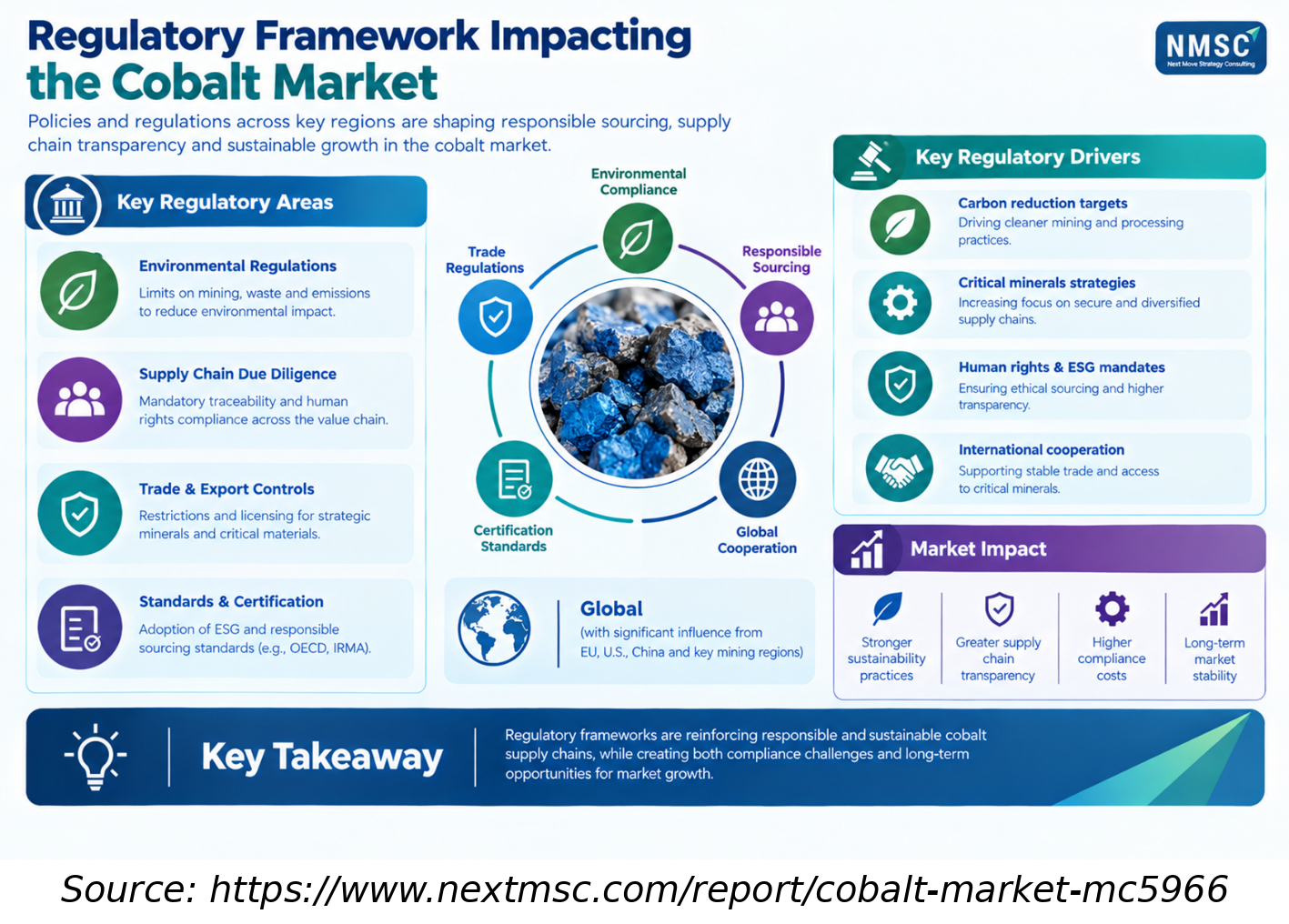
Regulatory Framework Impacting the Cobalt Market

The cobalt market is increasingly influenced by environmental regulations, supply-chain due diligence, trade controls, certification standards, and ESG requirements. Regulatory frameworks emphasize responsible mining, human-rights compliance, traceability, emissions management, and transparent sourcing practices. These measures can increase compliance requirements and operating costs while encouraging higher supply-chain transparency, sustainable production practices, and stronger long-term market resilience.

Competitive Landscape

We observed that the cobalt industry features a moderately consolidated competitive landscape, with diversified mining conglomerates controlling upstream DRC production alongside Asia-Pacific chemical refiners and emerging non-DRC and recycling specialists.

Dimension Description
Market Structure Moderately consolidated at the mining stage, where Glencore plc and CMOC Group Limited control a majority of Democratic Republic of the Congo output, while chemical refining is more fragmented among Asia-Pacific processors.
Innovation Focus Battery-grade cobalt sulfate conversion capacity, closed-loop battery recycling, and non-DRC refining capability dominate current innovation and capital investment pipelines across leading producers.
Supply and Capacity Activity Selective upstream consolidation and downstream capacity investment, exemplified by CMOC Group Limited's continued expansion of Tenke Fungurume and Kisanfu mining output alongside Glencore plc's ongoing DRC production allocation under the 2025 export quota regime.

How Do Companies Compete in the Cobalt Market?

Companies compete primarily on mining scale, DRC production allocation, and downstream chemical conversion capability across the industry. Diversified mining conglomerates such as Glencore plc and CMOC Group Limited leverage large-scale DRC production assets to secure export quota allocations, while Asia-Pacific chemical refiners such as Zhejiang Huayou Cobalt Co., Ltd. and GEM Co., Ltd. compete on battery-grade sulfate conversion capacity and integrated cathode material supply relationships.

Which Competitive Archetypes Dominate the Cobalt Market?

Three archetypes dominate the market: diversified mining conglomerates controlling upstream DRC and non-DRC production, Asia-Pacific chemical refiners converting mined feedstock into battery-grade materials, and emerging non-DRC and recycling specialists. Glencore plc and CMOC Group Limited exemplify the diversified mining archetype, Zhejiang Huayou Cobalt Co., Ltd. and GEM Co., Ltd. exemplify the chemical refining archetype, and Electra Battery Materials Corporation and Umicore SA exemplify the non-DRC and recycling archetype.

How Are Companies Differentiating Through Innovation in Cobalt Production?

Innovation and differentiation strategy increasingly center on battery-grade chemical conversion capacity and closed-loop recycling capability. Umicore SA exemplifies this direction through its established closed-loop battery recycling operations recovering cobalt for reuse in new cathode material. Our analysis shows that producers unable to demonstrate battery-grade chemical conversion or recycled-content capability risk exclusion from long-term offtake agreements as battery makers prioritize supply chain resilience.

What Supply Allocation Activity Is Shaping the Cobalt Market?

Supply allocation decisions under the DRC export quota regime continue to reshape competitive positioning within the industry. Glencore plc and CMOC Group Limited's respective quota allocations, administered under the framework that took effect in 2025, illustrate how regulatory allocation now functions as a primary determinant of company-level production volume, a dynamic with limited precedent among other major mined commodity markets.

Key Market Players

Our assessment indicates that the following 20 companies are actively shaping production scale, refining capacity, and supply diversification strategy within the global cobalt market.

Glencore plc CMOC Group Limited Umicore SA Vale S.A. Eurasian Resources Group S.à r.l. Zhejiang Huayou Cobalt Co., Ltd. Jinchuan Group Co., Ltd. Sherritt International Corporation Sumitomo Metal Mining Co., Ltd. Freeport-McMoRan Inc. Anglo American plc GEM Co., Ltd. PJSC MMC Norilsk Nickel Electra Battery Materials Corporation Cobalt Blue Holdings Limited Managem Group Nickel Asia Corporation Terrafame Ltd Jervois Global Limited China Hanrui Cobalt Co., Ltd.

Latest Developments

We found that recent activity within the cobalt market is concentrated on supply diversification, battery recycling, refinery development, and customer qualification, reflecting the industry's broader response to regulatory-driven supply constraints.

Date Event
May 2026 Sumitomo Corporation entered separate MOUs with Sumitomo Metal Mining, Envirostream Australia, and Phoenix Recycling Group to explore battery recycling in Oceania. The planned model would collect used lithium-ion batteries containing cobalt, produce black mass locally, and recycle it at Sumitomo Metal Mining’s Japanese facilities into battery materials.
Mar 2026 Electra Battery Materials and LG Energy Solution signed a new binding term sheet updating their long-term agreement for battery-grade cobalt from Electra’s Ontario refinery. The arrangement reinforces LG Energy Solution as a cornerstone customer while Electra advances construction of its planned cobalt sulfate refinery.
Mar 2026 Cobalt Blue reported that cobalt sulphate produced using its proprietary flowsheet met stringent trace-metal specifications for prospective pCAM customers. The company also delivered 4 kg of high-purity cobalt sulphate to CSIRO’s Cathode Precursor Production Pilot Plant and continued evaluating battery black-mass feedstock options.

Investment Opportunities

Capital Inflows Are Concentrating in Supply Diversification Projects

Capital inflows into the market are increasingly directed toward non-DRC mining and refining projects and closed-loop battery recycling capacity. We observed that Electra Battery Materials Corporation and Terrafame Ltd continue to attract investor and government interest as North American and European alternatives to Democratic Republic of the Congo-dependent supply chains.

Infrastructure Investment Is Expanding Battery-Grade Chemical Conversion Capacity

Infrastructure investment is expanding battery-grade cobalt sulfate and precursor chemical conversion capacity across Asia-Pacific, North America, and Europe to serve rising battery cell production. Our findings suggest that refiners are investing in dedicated chemical conversion facilities, complementing adjacent investment in the broader battery recycling infrastructure that supplies a growing share of secondary cobalt feedstock.

Responsible Sourcing Certification Shapes ESG and Governance Priorities

Environmental, social, and governance considerations are central to investment decisions, with responsible sourcing certification and artisanal mining supply chain due diligence as key criteria for cobalt market participants. We found that investors increasingly favor producers demonstrating validated responsible sourcing credentials for Democratic Republic of the Congo-origin material, treating traceability and human rights due diligence as governance indicators alongside production scale and cost metrics.

Key Benefits for Stakeholders

Enterprise and Industry Leaders Gain Sourcing and Supply Chain Planning Support

Enterprise and industry leaders gain access to validated segmentation, competitive benchmarking, and regional demand forecasts that support sourcing and supply chain planning decisions across the cobalt industry. Our analysis shows that detailed product type, source, and application breakdowns help procurement teams align cobalt sourcing strategy with rising battery-grade chemical demand while identifying underserved segments for supply diversification.

Investors and Financial Analysts Gain Consistent Valuation Benchmarks

Investors and financial analysts benefit from consistent, single-point market size and CAGR estimates that support valuation and capital-allocation decisions across the cobalt supply chain. We observed that the report's regional and segment-level growth differentials help identify which producers are best positioned to capture above-market growth in North America and Energy Storage Systems categories through 2035.

Technology Vendors and Product Teams Gain Refining Capacity Planning Insight

Technology vendors and product teams gain insight into emerging design requirements, including battery-grade chemical conversion, closed-loop recycling integration, and non-DRC feedstock qualification, that are reshaping the industry. Our findings suggest that this analysis helps refining and processing teams prioritize development roadmaps around cobalt sulfate conversion capacity increasingly required by battery cell manufacturer procurement processes.

Key Market Segments Evaluated

By Product Type

  • Cobalt Chemicals
  • Cobalt Metal
  • Cobalt Intermediates

By Source

  • Primary Mined Cobalt
  • Recycled Cobalt

By Application

  • Battery Materials
  • Superalloys
  • Cemented Carbides
  • Catalysts
  • Pigments and Ceramics
  • Other Applications

By End-Use Industry

  • Electric Vehicles
  • Consumer Electronics
  • Energy Storage Systems
  • Aerospace and Defense
  • Industrial Manufacturing
  • Other Industries

By Region

  • North America 
    • U.S.
    • Canada
    • Mexico
  • Europe 
    • UK
    • Germany
    • France
    • Italy
    • Spain
    • Sweden
    • Denmark
    • Finland
    • Netherlands
    • Rest of Europe
  • Asia-Pacific 
    • China
    • India
    • Japan
    • South Korea
    • Taiwan
    • Indonesia
    • Vietnam
    • Australia
    • Philippines
    • Malaysia
    • Rest of APAC
  • Middle East & Africa 
    • Saudi Arabia
    • UAE
    • Egypt
    • Israel
    • Turkey
    • Nigeria
    • South Africa
    • Rest of MEA
  • Latin America 
    • Brazil
    • Argentina
    • Chile
    • Colombia
    • Rest of LATAM

Conclusion & Recommendations

The long-term outlook for the market remains positive, with global revenue projected to expand from USD 22.92 billion in 2025 to USD 48.59 billion by 2035 at a 7.43% CAGR. We observed that battery cathode demand growth, energy storage system deployment, and non-DRC supply diversification investment will continue underpinning demand across electric vehicle, consumer electronics, and industrial applications through the forecast period.

What Strategic Positioning Should Cobalt Producers Pursue?

Producers should prioritize battery-grade chemical conversion capacity and geographically diversified refining capability to secure long-term offtake agreements amid DRC export quota volatility. Our assessment indicates that producers investing early in closed-loop recycling integration and non-DRC supply sources will be best positioned to capture premium pricing within the cobalt market.

How Attractive Is the Cobalt Market for New Investment?

The cobalt industry presents a moderately attractive investment case, supported by a USD 23.10 billion absolute dollar opportunity between 2026 and 2035 and above-average growth in North America and Energy Storage Systems categories. We found that investment attractiveness is highest for producers combining battery-grade chemical conversion capability with diversified, non-DRC-dependent supply sources, positioning them to serve both electric vehicle and energy storage buyer segments simultaneously.

What Market Shifts and Key Risks Should Stakeholders Monitor?

Stakeholders should monitor DRC export quota volatility, cobalt-lean and cobalt-free battery chemistry substitution, and price volatility discouraging long-term contracting as key risks to the cobalt market. Our analysis shows that producers unable to demonstrate supply chain resilience risk losing long-term offtake agreements to competitors with more geographically diversified and recycled-content-capable production bases.

What Are the Key Growth Pathways for the Cobalt Market?

Key growth pathways include expanding battery-grade cobalt chemical conversion capacity, scaling closed-loop battery recycling infrastructure, and deepening penetration into energy storage system supply agreements. NMSC's analysis indicates that producers pursuing these pathways while managing DRC export quota exposure will be best positioned to capture the cobalt market's projected growth through 2035.

FAQs

About the Author

Mihul Sharma

Mihul Sharma

Mihul Sharma is Research Associate at Next Move Strategy Consulting, where he has covered technology, industrial, and healthcare markets for 3 years. His work applies structured business research, market analysis, and secondary-source review to assess market trends, competitive developments, and growth opportunities. He supports report development by fully synthesizing industry data, company information, and market signals into concise findings for strategy and investment-focused research teams.

About the Reviewer

Supradip Baul

Supradip Baul

Supradip Baul is an accomplished business consultant and strategist with over a decade of rich experience in market intelligence, strategy, technology, and business transformation. His work has included rigorous qualitative and quantitative analysis across multiple industries, helping clients shape investment decisions and long-term roadmaps. Earlier in his career, he was associated with Gartner, where he contributed to industry-leading reports and market share analyses. He has worked with leading global companies and holds an MBA with a dual specialization in Marketing and Finance.

Download Free Sample

Melanie Samko

MELANIE SAMKO

Director of Marketing

TOSOH BIOSCIENCE, INC.

The information provided by NMSC is incredibly valuable, thank you so much for such a excellent work. I really appreciate it. I will make sure to reference all of it, in my summary document.

Diana Trejo

DIANA TREJO

Assistant Manager

Sumitomo Corporation de Mexico, S.A. de C.V.

Recently, we purchased a report on the Mexico Data Center Market from Next Move Strategy Consulting. The service has been excellent, with support that is always timely and thoroughly professional. The information provided is interesting, highly useful, and delivered with clarity. I would highly recommend NextMSC for anyone seeking insightful and dependable analysis.

Pratyush Kumar Das

PRATYUSH KUMAR DAS

Assistant Manager

Polycab India Limited

We would like to express our appreciation for the data and insights provided by nextmsc. We are very pleased with the quality and depth of the information, which has proven to be highly valuable and beneficial for our business decision-making.

Nishant Awate

NISHANT AWATE

Business Development Global Sales

Zehnder Group Deutschland GmbH

Our experience working with Next Move Strategy Consulting was positive. The team was responsive, professional, and open to incorporating our specific requirements throughout the project. The India AHU market study was comprehensive and well structured, covering market value and volume forecasts, product and application segments, and key industry trends. The inclusion of both AHU and residential MVHR market insights made the study particularly relevant for our strategic market assessment. Overall, the report provides a solid foundation for evaluating market potential, identifying priority segments, and supporting business-development decisions in India.

Gaurav Jaiswal

GAURAV JAISWAL

Founder & CEO

Yano Charge Private Limited

The EV Charging market research report provided by the NextMSC was exceptionally detailed and insightful. It offered a comprehensive analysis that proved to be a game-changer for our strategic planning. Truly a testament to the NextMSC’s expertise and thoroughness in EV market landscape & analysis.

Custom Market Research Services

We will customize the research for you if the listed report does not fully match your requirements.

Get 30% Free Customization

Select License

This website uses cookies to ensure you get the best experience on our website. Learn more

✖