Anodizing Market By Production Format (Batch Anodizing,Sheet Anodizing and Other Anodizing) By Process Type (Chromic Acid Anodizing and Other Processes) By Finish Class (Clear, Dyed, Electrolytic Color, Bright, Matte,Textured and Other Finish Classes) and By End User (Building and Construction, Automotive and Transportation, Aerospace and Defense, Consumer Electronics and Appliances Medical and Life Sciences, Energy, and Other End Use Industries) – Global Analysis & Industry Forecast, 2026–2035
Industry: Materials and Chemical | Publishing Date: May 19, 2026 | Last Updated: September 30, 2026 | No of Pages: N/A | No. of Tables: N/A | No. of Figures: N/A | Format: PDF | Report Code: MC3868
Industry Outlook
The global Aluminum Anodizing Market size is valued at USD 3.04 billion in 2025 and is expected to reach USD 3.23 billion by 2026. Looking ahead, the industry is projected to expand significantly, reaching USD 5.59 billion by 2035, registering a CAGR of 6.28% from 2026 to 2035.
The aluminum anodizing industry sits at the intersection of lightweight metals demand and surface-engineering requirements across automotive, aerospace, architecture, electronics, and industrial markets. As OEMs and tier suppliers prioritize lightweighting and corrosion resistance, anodizing remains the preferred finishing route because it adds durable, wear-resistant oxide layers while enabling decorative and functional finishes.
Major integrated aluminum producers and surface-specialists are reshaping the value chain: rolling and recycling leaders are expanding downstream finishing services while specialist surface technology firms scale precision anodizing lines and hard-coat capabilities. For example, large aluminum manufacturers are reporting expanding automotive and industrial demand and highlighting surface treatment capabilities in their 2024–2025 disclosures. Novelis’ 2024 filings describe continued focus on downstream value capture, while Alcoa and Constellium emphasize higher aluminum production and investment in advanced applications that require surface finishing.
What Are the Key Aluminum Anodizing Market Trends?
How Is Lightweighting in Automotive and Transport Reshaping Demand for Anodized Aluminum Finishes?
Global demand for aluminium components used in automotive structures and EV architectures is rising as OEMs target lower vehicle mass to extend range and improve efficiency. Constellium and Novelis reported rising end-market demand tied to automotive structures and closures in their 2024 disclosures, linking downstream finishing needs, including anodizing and hard coatings, to higher volumes of extrusions and rolled products. This increases demand for anodizing lines that handle complex profiles and provide durable, wear-resistant finishes for battery housings, body structures, and visible exterior trim. Analysis: anodizing suppliers should expect higher unit volumes but also tighter technical specs (thickness control, adhesion after subsequent forming or welding). Actionable insight: anodizing operations ought to invest in automated process controls and slot new lines for profile and continuous belt processing to capture OEM conversion from painted steel to aluminum in targeted vehicle platforms.
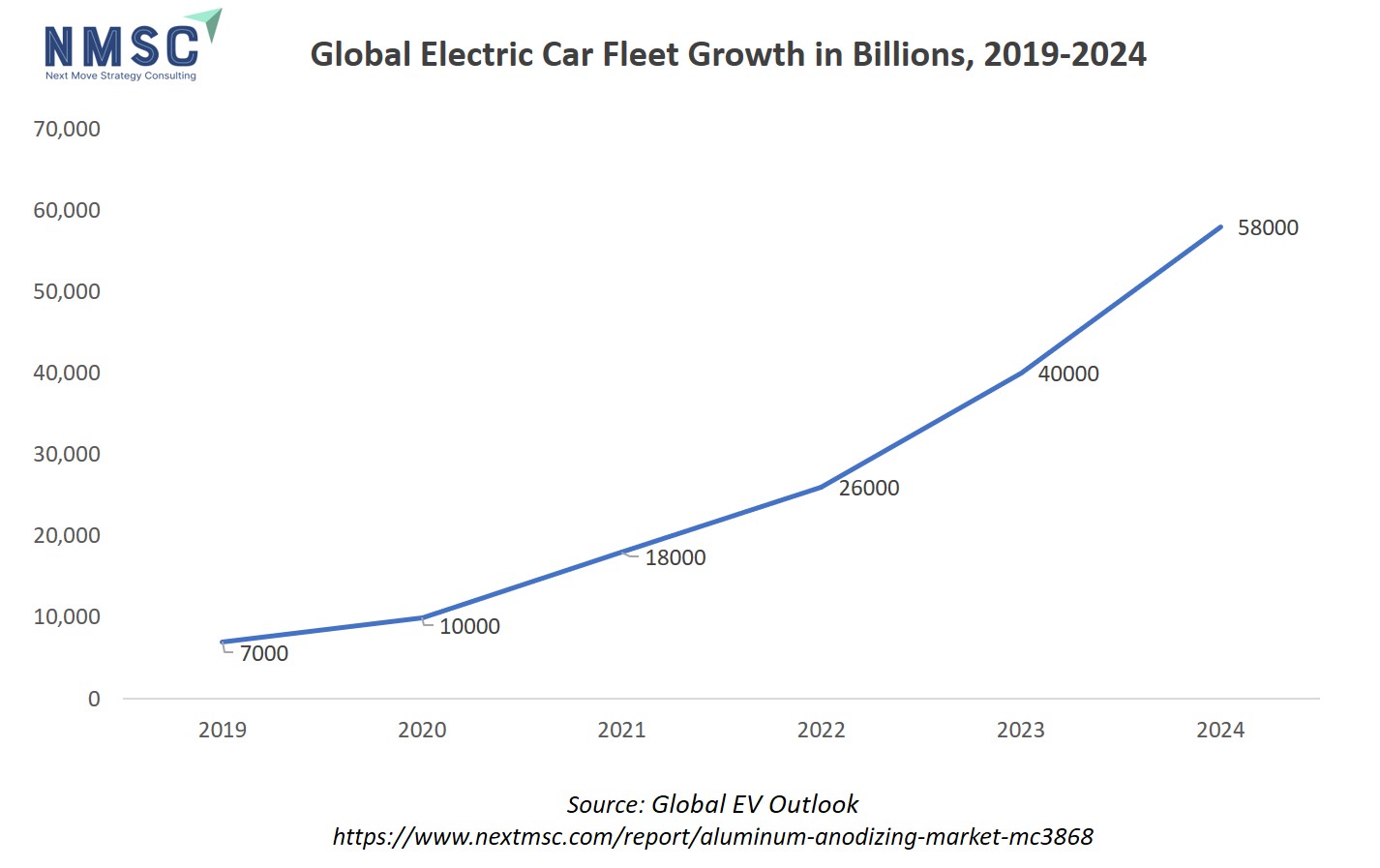
This chart shows a rapid increase in the global electric car fleet from 2019 to 2024, growing from 7000 billion to 58000 billion vehicles. Such robust expansion in the electric vehicle (EV) sector directly impacts the aluminum anodizing industry, as EVs heavily utilize lightweight and corrosion-resistant anodized aluminum components in batteries, body panels, and structural parts. Rising EV production amplifies demand for anodized aluminum to improve durability, aesthetic appeal, and performance, positioning the industry as a key beneficiary of global fleet electrification trends.
How Is the Sustainability and Recycling Wave Influencing Anodizing Feedstock and Process Economics?
Leading aluminum producers are prioritizing recycling and low-carbon material streams as core elements of their growth and sustainability strategies. Recent reports from Novelis and Alcoa underscore large-scale investments in recycling infrastructure, decarbonization initiatives, and downstream integration to boost recycled content and optimize feedstock flows. Recycled and low-carbon aluminum are emerging as key differentiators for OEMs pursuing Scope 3 emission reductions. However, anodizing and finishing operations processing higher shares of recycled aluminum must address feedstock variability in chemistry and surface condition, which impact pretreatment efficiency and bath life. Actionable insight: surface treatment providers should implement stricter incoming material specifications, adaptive pretreatment systems, and advanced bath management to maintain process stability and validate lifecycle-based sustainability claims.
How Are Advanced Anodizing Processes Creating New Technical Markets?
Advanced anodizing variants such as hard anodizing and plasma electrolytic oxidation (PEO) are moving from niche aerospace and industrial use toward higher-volume applications requiring wear and thermal resistance. Specialist surface-technology firms and industrial groups are raising R&D and capacity allocation toward these processes; Aalberts and other surface-tech operators cite investments in precision finishing and hardcoat capabilities in 2024 reports. Data point: demand for hardcoat finishes is driven by EV powertrain components, heat-exposed housings, and high-wear consumer electronics housings. Analysis: PEO and hard anodizing command higher processing costs and yield constraints but enable premium pricing and new performance specs (tribological behaviour, dielectric strength). Actionable insight: anodizers should pilot hard anodize/PEO lines under contract development agreements with aerospace and EV tier customers to de-risk scale-up and establish qualifying test records before full commercial rollout.
What Are the Key Market Drivers, Breakthroughs, and Investment Opportunities That Will Shape the Aluminum Anodizing Market in the Next Decade?
The industry is influenced by both macro-trends in materials production and surface-treatment technologies. On the one hand, global pressure toward lightweighting, sustainability, and higher performance coatings is pushing demand upward. On the other hand, cost pressures, regulatory compliance, and technical scale-up constraints moderate pace of adoption. Breakthroughs in advanced finishes and increased vertical integration by aluminum producers point to new investment frontiers. This section dissects major growth drivers, key inhibitors, and emerging opportunities that shape future strategic direction.
Growth Drivers:
How Is Demand for High-Performance Finishes in Automotive and Industrial Sectors Driving Aluminum Anodizing Market Expansion?
Rising demand from the automotive, electronics, and industrial machinery sectors is accelerating investment in high-performance anodizing capacity. End-users are increasingly specifying aluminum finishes with superior hardness, wear resistance, and thermal stability, particularly for electric vehicle components, housings, and structural elements. This trend is prompting suppliers to install advanced hard-anodizing or plasma electrolytic oxidation (PEO) lines near extrusion and casting facilities to streamline production. These high-spec finishes enable premium pricing that offsets higher operational and energy costs. Companies that proactively expand or co-locate high-performance anodizing capacity close to major OEM or tier-1 plants will be well-positioned to capture early adoption opportunities in next-generation vehicle platforms and industrial system designs.
How Is Sustainability Regulation and Recycled-Content Demand Accelerating Anodizing Process Innovation?
Increasing regulatory scrutiny and OEM sustainability mandates are pushing anodizing operations to adapt for recycled and low-carbon aluminum feedstocks. Growing use of recycled-content alloys introduces variations in impurity levels and oxide-layer behaviour, necessitating enhanced pretreatment, process monitoring, and chemistry control. In response, anodizers are investing in digital bath management, traceable quality systems, and adaptive surface conditioning to maintain consistency and qualify for sustainability-linked supply contracts. Firms that embed carbon tracking and recycled-content verification into their anodizing workflows will gain a competitive edge, as OEMs increasingly prioritize suppliers that demonstrate verifiable low-carbon, circular material credentials across their finishing processes.
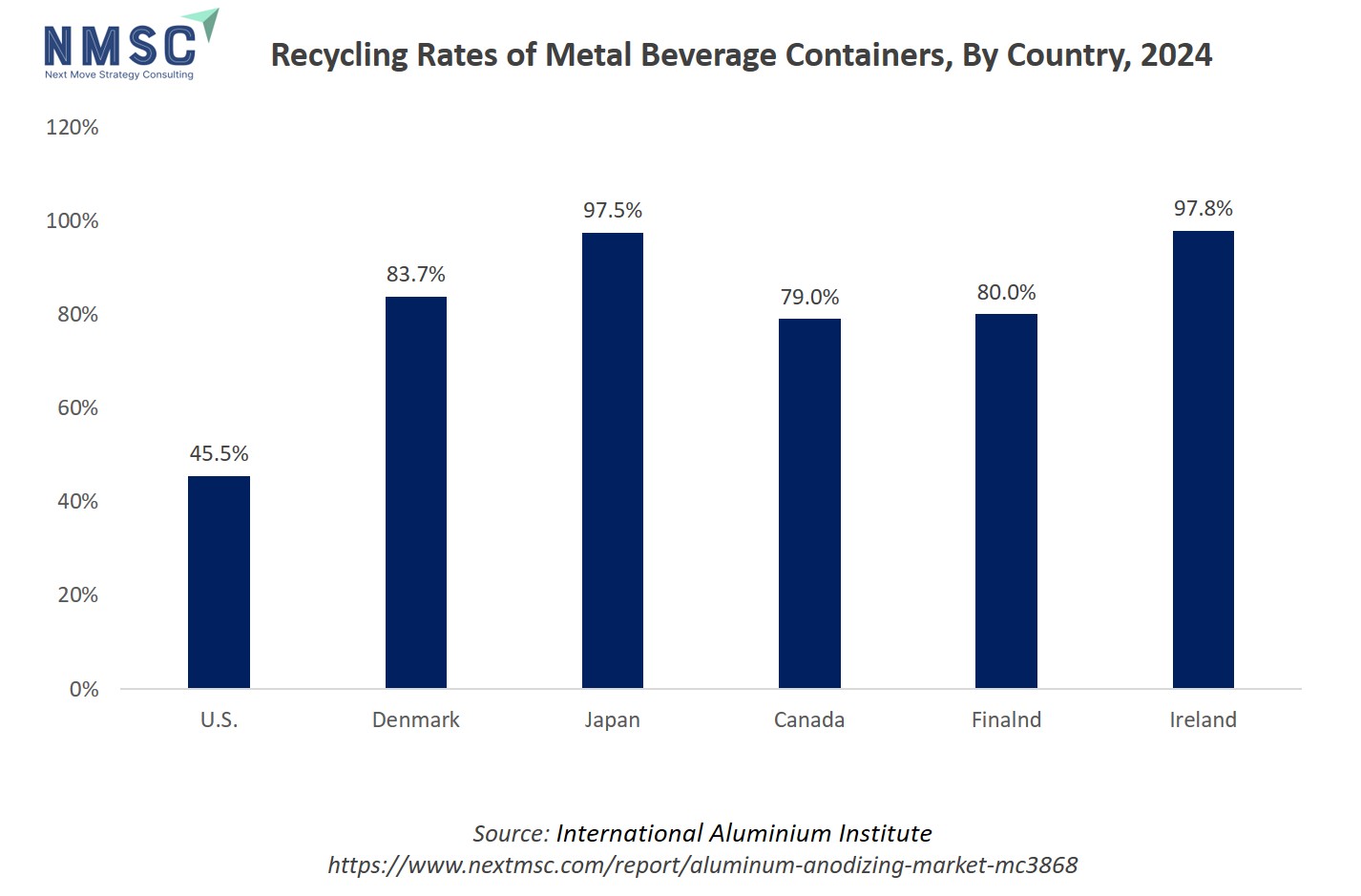
The chart displays recycling rates for metal beverage containers across several countries in 2024, showing significant variations: while Japan and Ireland achieve extremely high rates (97.5% and 97.8% respectively), the U.S. lags behind at just 45.5%. These high recycling rates in countries like Japan, Ireland, Denmark, and Finland are critical for the aluminum anodizing market growth, as recycled aluminum is a major feedstock for anodizing due to its lower environmental impact and cost efficiency. Strong recycling infrastructures in these regions help ensure a stable, sustainable supply of aluminum for value-added processes like anodizing, supporting circular economy initiatives within the broader metals and manufacturing sectors.
Growth Inhibitors:
What Challenges Do Capital Intensity and Process Reproducibility Pose for Anodizing Scale-Up?
Scaling anodizing operations, particularly hard anodizing and plasma electrolytic oxidation, remains constrained by high capital requirements, stringent process control, and environmental compliance costs. Establishing large-scale anodizing lines demands precise bath chemistry management, energy-intensive power systems, and robust effluent treatment infrastructure. These requirements elevate both setup and operational costs while exposing producers to regulatory and energy-price volatility. Yield loss during early ramp-up and long qualification cycles further slow commercialisation. Without disciplined investment in process reproducibility and environmental safeguards, new entrants struggle to meet OEM validation timelines, limiting their ability to capitalize on the growing demand for advanced anodized finishes in automotive and industrial markets.
How Do Smart and Functional Anodized Coatings Open New Revenue Streams in Aerospace, Electronics, and EV-Adjacent Applications?
Anodizing technology is evolving beyond decorative and corrosion-resistant applications toward smart and functional coatings that add measurable system value. Innovations such as dye-embedded functional layers, dielectric barriers, and sensor-compatible anodic surfaces are unlocking new opportunities in aerospace, EV platforms, and high-performance electronics. These coatings support functions like thermal dissipation, electromagnetic shielding, and sensor integration, allowing differentiation and higher margin capture. Strategic investment in pilot programs for metrology-integrated or multifunctional anodizing processes yield early-mover advantages. Suppliers partnering with OEMs to validate such advanced coatings stand to secure multi-year contracts and premium pricing in emerging segments aligned with electrification, connectivity, and lightweighting trends.
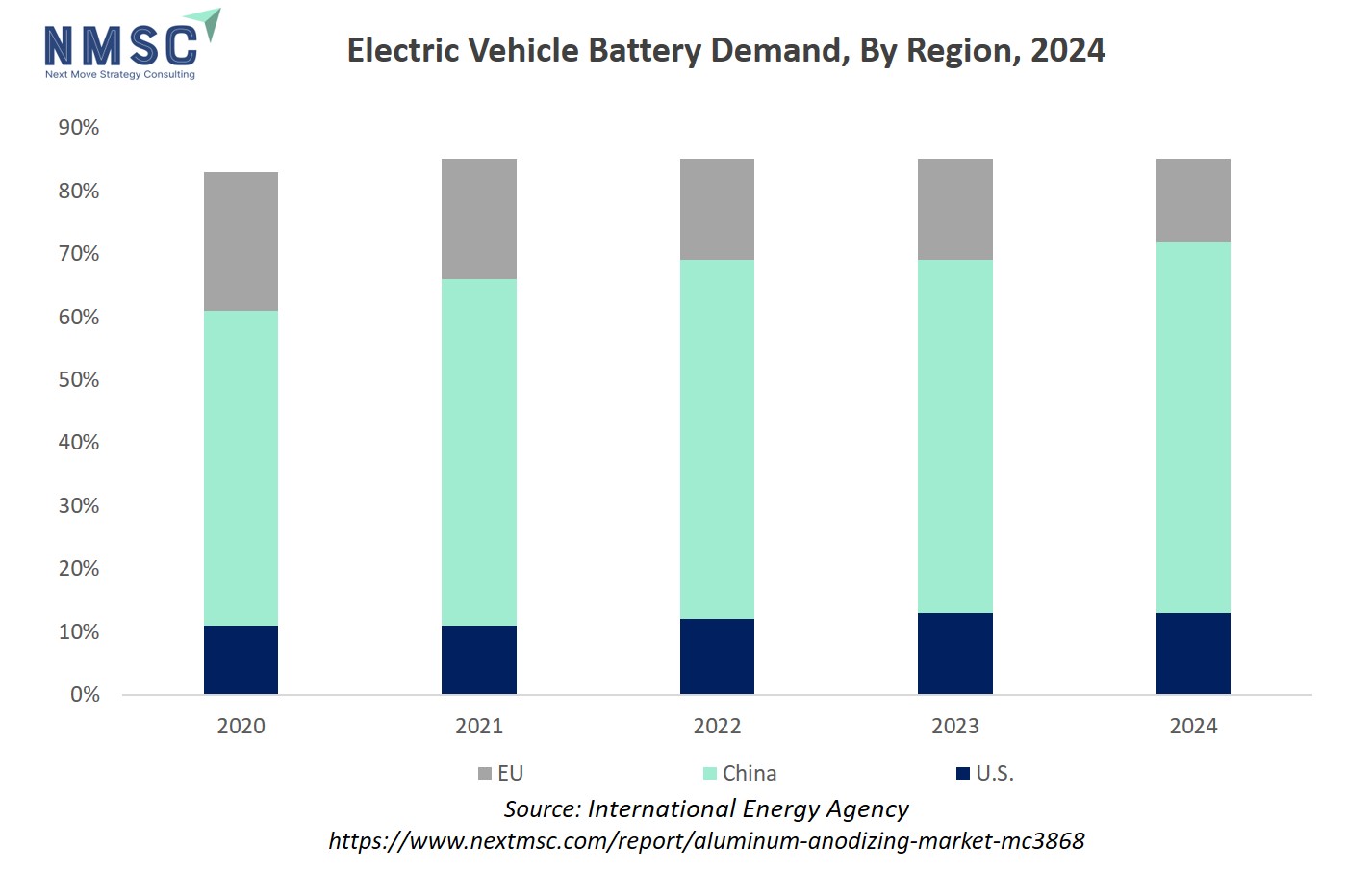
The chart displays the distribution of global electric vehicle (EV) battery demand by region from 2020 to 2024, highlighting China’s significant dominance, followed by the EU and the U.S. This sustained. Increasing demand, driven largely by China, underscores the importance of robust supply chains for battery materials, where aluminum plays a crucial role, not just in battery enclosures but also in lightweight components vital for EV efficiency. As battery and EV production accelerate, demand for advanced aluminium products, including anodised components for thermal management and durability, is expected to rise, further linking these industrial value chains.
How Is the Aluminum Anodizing Market Segmented in This Report, and What Are the Key Insights from the Segmentation Analysis?
By Product Insights
Is Nano-Porous Anodizing Outperforming Conventional Porous Finishes?
Based on product, the market is segmented into nano-porous and porous.
Nano-porous finishes (very fine pore structure for decorative or barrier-layer use) are increasingly specified in consumer electronics housings and architectural panels where visual quality, smoothness, and dye uptake precision matter. Although industrial anodizing volume still resides in conventional porous types, demand for nano-porous finishes is growing in premium consumer goods and electronics segments, driven by aesthetic differentiation and tighter tolerance standards. Providers investing in precise pore-control pretreatment and post-anodize sealing are gaining acceptance in new product launches.
By Process Type Insights
Is Sulfuric Acid Anodizing Still the Backbone, or Is Hard-Coat / PEO Gaining Traction?
Based on process type, the market is segmented into sulfuric acid anodizing, hard anodizing, chromic acid anodizing, phosphoric acid anodizing, plasma electrolytic oxidation (PEO), and decorative anodizing.
Sulfuric acid anodizing remains the predominant process method because of its established cost profile and compatibility with a wide range of alloys. However, hard-coat anodizing and plasma electrolytic oxidation (PEO) are growing faster in sectors requiring high wear, heat, or dielectric performance (such as EV powertrain housings, aerospace brackets, or industrial valves). Suppliers that add hard-coat or PEO capacity are positioning themselves for higher-margin applications, though those processes require longer cycle-times, thicker coatings, and more energy consumption, which must be offset by premium pricing.
By Finish Type Insights
Are Dyed or Patterned Finishes Overtaking Clear Natural Anodizing?
Based on finish type, the market is segmented into clear/natural, dyed/colored, patterned/textured, and hardcoat (black/military spec).
Traditional clear/natural (no-dye) remains dominant in many industrial, architectural, and functional-use cases. However, dyed/colored and patterned/textured finishes are gaining share in consumer-facing applications (consumer electronics, premium automotive trim, architectural facade elements). These finishes require tighter process control (dye concentration, sealing consistency), and anodizers that certify color-fastness / UV-durability are capturing more specification in design-led markets.
By Production Scale Insights
Does Mass-Production Anodizing Differ from Prototype and Low-Volume Segments?
Based on production scale, the market is segmented into prototype/low-volume, medium-batch production, and high-volume/mass production.
Anodizing providers must manage dramatically different economics across small-batch prototype work (e.g. R&D labs, design proofing) and high-volume industrial/automotive fleets. High-volume plants benefit from economies of scale, continuous belts, automated rinsing and drying systems, and lower per-part handling cost. Prototype or specialty-batch anodizing incurs premium processing time, manual handling, and tighter tolerances. Investment decisions must balance these segments; growth in EV and electronics nudges mid-volume manufacturers toward scaled-up production lines.
By Application Insights
Is Automotive Components the Largest Consumer of Anodized Finishes Today?
Based on application, the market is segmented into automotive components, aerospace & defense parts, architectural panels, consumer electronics housings, medical devices & implants, marine equipment, industrial machinery components, and consumer goods & appliances.
Automotive components remain among the largest single applications for anodizing, especially for visible trims, battery housing components, structural brackets, and closures in electric vehicles. Demand for corrosion-resistant and wear-resistant finishes in EV battery assembly modules and aluminum body panels positions the automotive application as a key growth engine. Expansion of anodizing capacity adjacent to vehicle-assembly or extrusion plants lower logistics cost and accelerate time-to-market for anodized trims.
By End-User Insights
Are OEMs Dominating the Demand Side?
Based on end user, the market is segmented into original equipment manufacturers (OEMs), consumer goods, energy, automotive, aerospace, construction, and others.
End-user segmentation groups OEMs (original equipment manufacturers) and other large purchasers (aerospace, consumer electronics manufacturers, construction façade contractors). OEMs maintain the strongest influence over finish specification, quality audits, and traceability for safety or warranty performance. Therefore, anodizing suppliers seeking long-term contracts are focusing proposals on meeting OEM-grade audit and certification standards. Meanwhile, aftermarket or secondary finishing (for architectural retrofits or specialty rebuilds) plays a smaller portion but remains relevant in niche applications.
Regional Outlook
The aluminum anodizing market share is geographically studied across North America, Europe, Asia Pacific, Middle East & Africa, and Latin America and each region is further studied across countries.
Aluminum Anodizing Market in North America
The North American aluminum anodizing Market is experiencing robust growth, driven by rising applications across automotive, construction, aerospace, and electronics industries. Demand is increasing for lightweight, durable, and corrosion-resistant aluminum in electric vehicles, architectural façades, and industrial machinery. Government regulations promoting energy-efficient and sustainable materials, along with urban infrastructure development, are further boosting adoption. Advanced anodizing technologies, such as hard anodizing and low-waste processes, improve surface quality and production efficiency. Collaborations between manufacturers and OEMs enhance supply chains, while consumer demand for high-performance, aesthetically appealing, and environmentally friendly aluminum products continues to strengthen market growth across the U.S. and Canada.
Aluminum Anodizing Market in the United States
The United States stands as one of the largest markets for aluminum anodizing globally, driven by robust construction activity, strong automotive production, and advanced aerospace manufacturing. Anodized aluminum’s superior corrosion resistance, strength, and aesthetic versatility make it an ideal choice for architectural facades, EV components, and aircraft structures. The growing emphasis on energy-efficient buildings and sustainable materials continues to propel demand across sectors. Furthermore, innovations in hard anodizing and electrolytic coloring are improving surface durability and finish quality, expanding its application scope. The U.S. government’s investment in sustainable infrastructure and domestic manufacturing initiatives further strengthen market prospects. In 2024, the U.S. auto industry employed an average of 4,486,300 people, representing 2.8% of all nonfarm jobs—underscoring the sector’s pivotal contribution to anodic oxidation demand and overall market expansion.
Aluminum Anodizing Market in Canada
Canada’s aluminum anodizing market is experiencing steady growth, driven by expansion in the construction, transportation, and renewable energy sectors. Anodized aluminum is increasingly used in building façades, window frames, and solar panel structures due to its durability, corrosion resistance, and low maintenance requirements. Government initiatives promoting green building practices and energy-efficient materials further support market adoption. The country’s thriving aerospace industry also contributes, leveraging anodized aluminum for lightweight, high-strength applications. Additionally, investments in environmentally friendly anodizing technologies are enabling manufacturers to enhance production efficiency and meet growing domestic and export demand, positioning Canada as a strong and sustainable market for anodized aluminum solutions.
Aluminum Anodizing Market in Europe
Europe’s aluminum anodizing market is growing steadily, fueled by automotive, aerospace, and construction industry demand in countries like Germany, France, the UK, and Spain. Rising adoption of anodized aluminum in electric vehicles, industrial equipment, and architectural projects supports market expansion. The EU’s stringent environmental regulations promote sustainable anodizing practices and recycling, while technological advancements, such as color anodizing and micro-arc oxidation, enhance durability and aesthetics. Consumer preference for high-quality, corrosion-resistant materials and energy-efficient solutions further drives adoption. Collaborations between metal fabricators and anodizing solution providers ensure product innovation, consistent supply, and competitiveness across the European market.
Aluminum Anodizing Market in the United Kingdom
The United Kingdom’s aluminum anodizing market is expanding, driven primarily by the automotive sector. Anodized aluminum is increasingly used in vehicle components, including structural parts, EV body panels, and interior fittings, due to its lightweight, corrosion-resistant, and durable properties. The surge in electric vehicle adoption—nearly 382,000 new BEVs registered in 2024, surpassing Germany—further strengthens demand for high-performance anodized aluminum in advanced automotive applications. Government incentives promoting zero-emission vehicles and innovation in automotive technologies support manufacturers in integrating anodized aluminum across both conventional and electric vehicle platforms, reinforcing the UK as a key European market for automotive anodizing solutions.
Aluminum Anodizing Market in Germany
Germany’s aluminum anodizing market is significantly driven by the construction sector, which consistently demands high-quality, durable, and aesthetically appealing materials. Anodized aluminum is widely used in building façades, window frames, curtain walls, and roofing due to its corrosion resistance, low maintenance, and long-lasting performance. The country’s focus on sustainable, energy-efficient, and modern architectural designs further encourages the adoption of anodized aluminum in both residential and commercial construction projects. Innovations in hard anodizing, color customization, and surface finishing enhance its versatility, while government incentives and regulations promoting green building practices reinforce its integration, establishing the construction sector as a key growth driver for Germany’s market.
Aluminum Anodizing Market in France
France’s aluminum anodizing market is being strongly supported by the construction sector, which is benefiting from the ambitious France 2030 investment plan. With USD 58.7 billion mobilized to modernize strategic sectors, including sustainable construction, demand is rising for high-performance materials such as anodized aluminum for façades, curtain walls, window frames, and structural components. The focus on energy-efficient buildings, green architecture, and eco-friendly materials under government initiatives encourages adoption of corrosion-resistant and durable anodized aluminum solutions. Ongoing urbanization, infrastructure modernization, and renovation of commercial and residential projects further drive market growth. Additionally, innovations in electrolytic coloring, hard anodizing, and surface finishing enhance the aesthetic and functional appeal of aluminum, making it a preferred choice in France’s evolving construction landscape.
Aluminum Anodizing Market in Spain
Spain’s aluminum anodizing market is growing steadily, driven primarily by the country’s robust automotive industry, which is the second-largest in Europe and the ninth-largest globally. Anodized aluminum is increasingly used in lightweight vehicle components, enhancing fuel efficiency and supporting the production of electrified models. Nine multinational automotive brands operate 18 manufacturing plants across Spain, producing 2.38 million vehicles in 2024, including 44 models, 25 of which are electrified. The automotive sector contributes around 10% of Spain’s GDP and 18% of total exports, generating an external trade surplus of USD 17.6 billion in 2024, covering vehicles and auto parts. Growing demand for electric vehicles (EVs), coupled with stringent energy-efficiency and safety standards, continues to drive the adoption of anodized aluminum, making Spain a key market for advanced automotive materials in Europe.
Aluminum Anodizing Market in Asia Pacific
The Asia Pacific market is one of the fastest-growing globally, driven by rapid industrialization, increasing automotive production, and growing construction activities in China, India, Japan, South Korea, and Australia. Anodized aluminum is widely applied in EV components, consumer electronics, architectural structures, and industrial equipment for its durability, corrosion resistance, and visual appeal. Government initiatives promoting energy efficiency, lightweight materials, and sustainable building practices further accelerate adoption. Technological advancements in anodizing processes, such as plasma electrolytic oxidation and color anodizing, improve efficiency and surface quality. Expanding domestic manufacturing capabilities and export opportunities strengthen the region’s global market dominance.
Aluminum Anodizing Market in China
China leads the global aluminum anodizing market, driven by its vast automotive manufacturing capacity and rising vehicle sales. The robust growth in vehicle production—3.226 million units in September 2025, up 14.9% year-on-year following a 16.4% increase in August—directly fuels demand for anodized aluminum components used in lightweight vehicle structures, EV parts, and advanced glazing solutions. Collaboration between OEMs and anodizing manufacturers ensures large-scale deployment of high-quality, corrosion-resistant, and energy-efficient aluminum components. Rapid adoption of electric vehicles (EVs) and stringent safety and environmental regulations further reinforce the market, positioning China as the largest and fastest-growing automotive anodized aluminum market in the Asia-Pacific region.
Aluminum Anodizing Market in Japan
Japan’s aluminum anodizing sector is characterized by advanced manufacturing technologies and strong demand from the automotive, electronics, and aerospace sectors. The country’s precision engineering standards drive the use of anodized aluminum in consumer devices, transportation parts, and architectural elements. Growing electric vehicle production and interest in sustainable materials support market expansion. Additionally, Japanese manufacturers are focusing on high-quality finishes and innovative color anodizing methods to enhance product aesthetics and functionality. Continuous R&D investments, coupled with strong export potential, position Japan as a key contributor to the growth and technological advancement of the global market.
Aluminum Anodizing Market in India
India’s market is expanding rapidly, driven by rising construction activity, automotive production, and industrial development. Increasing demand for durable, corrosion-resistant materials in façades, windows, and rail infrastructure is supporting market growth. Government initiatives such as “Make in India” and “Smart Cities Mission” encourage domestic production of anodized aluminum for architectural and energy-efficient applications. The country’s growing EV sector is also adopting anodized aluminum for lightweight vehicle components. Furthermore, modernization of anodizing facilities and the adoption of sustainable finishing processes are improving output quality, making India a fast-emerging regional hub for aluminum anodizing operations.
Aluminum Anodizing Market in South Korea
South Korea’s market is growing strongly, supported by advanced manufacturing capabilities and a high concentration of automotive, electronics, and aerospace industries. The increasing shift toward EV production and energy-efficient construction materials is driving demand for anodized aluminum. The material’s durability and aesthetic appeal make it suitable for high-tech consumer products and industrial equipment. Ongoing investments in sustainable anodizing methods and automated production technologies are improving operational efficiency. Additionally, the country’s focus on innovation and export competitiveness positions South Korea as a major contributor to the Asia-Pacific aluminum anodizing industry’s expansion.
Aluminum Anodizing Market in Australia
Australia’s aluminum anodizing market is experiencing robust growth, fueled by rising infrastructure investments, renewable energy projects, and increasing demand for durable, low-maintenance building materials. Anodized aluminum is extensively used in architectural façades, solar panel frames, and marine applications due to its corrosion resistance and aesthetic versatility. The country’s growing emphasis on sustainable construction and eco-friendly manufacturing practices further supports adoption. Expansion of local anodizing capacities, along with collaborations between anodizing firms and construction companies, is strengthening market presence. Additionally, increasing industrial exports and government-backed green initiatives continue to bolster the long-term growth prospects of the market.
Aluminum Anodizing Market in Latin America
The Latin American aluminum anodizing market is gaining momentum, supported by expanding construction and automotive sectors across Brazil, Mexico, and Argentina. Growing investments in residential and commercial infrastructure are boosting the use of anodized aluminum in façades, railings, and window systems. The increasing focus on sustainability and energy efficiency further promotes the use of recyclable materials. Automotive manufacturers are also integrating anodized aluminum components to enhance vehicle durability and aesthetics. Local producers are investing in advanced anodizing plants to meet domestic demand and reduce imports, strengthening the region’s position in the global aluminum anodizing value chain.
Aluminum Anodizing Market in the Middle East & Africa
The Middle East & Africa market is expanding rapidly due to major infrastructure and urban development projects in countries such as the UAE, Saudi Arabia, South Africa, and Egypt. The demand for anodized aluminum in architectural façades, decorative panels, and industrial applications continues to rise due to its resistance to corrosion and extreme temperatures. Governments are increasingly supporting sustainable construction and local manufacturing initiatives, boosting regional production capacity. Furthermore, growing use in the transportation and energy sectors and ongoing investments in high-quality surface finishing technologies are contributing to the overall market growth across the region
Competitive Landscape
Which Companies Dominate the Aluminum Anodizing Market and How Do They Compete?
Market Dominated by Aluminum Anodizing Giants and Specialists
The anodizing and surface-treatment market is led by integrated aluminum producers and specialized finishing companies, including Alcoa Corporation,Norsk Hydro ASA,Novelis Inc. and affiliated downstream surface-technology operators. These players leverage vertical integration across alloy production, recycling, and downstream finishing to maintain control over quality, cost, and specification traceability. By aligning feedstock management with surface-treatment capabilities, they reliably meet OEM requirements for both decorative and high-performance anodized products. This integration creates barriers to entry for smaller suppliers lacking access to upstream materials or advanced finishing infrastructure, allowing established players to capture a disproportionate share of premium markets in automotive, industrial, and electronics applications.
Innovation and Adaptability Drive Market Success
Innovation and operational adaptability are central to success in anodizing and surface technology markets. Companies are investing in advanced finishing lines, process automation, and digital monitoring systems to enhance product quality, consistency, and throughput. Strategic acquisitions of complementary surface-technology firms further enable portfolio differentiation and access to new capabilities, such as hard anodizing or plasma electrolytic oxidation. Close partnerships with OEMs ensure alignment with evolving design requirements, regulatory standards, and sustainability expectations. Service providers that combine technological sophistication with operational flexibility are better positioned to secure competitive contracts, deliver premium finishes, and respond rapidly to shifts in customer demand, including high-performance, EV-related, and smart coating applications.
Market Players to Opt for Merger & Acquisition Strategies to Expand Their Presence
Mergers, acquisitions, and portfolio optimization are increasingly employed by anodizing and surface-treatment firms to enhance market positioning. Companies pursue acquisitions to expand geographic coverage, diversify technology offerings, including hard anodize and plasma electrolytic oxidation, and obtain necessary certifications or quality credentials. While detailed public disclosures of anodizing-specific transactions are limited, strategic statements from firms highlight acquisition appetite and the pursuit of integrated finishing capabilities. Consolidation enables companies to achieve economies of scale, integrate upstream and downstream operations, and accelerate innovation adoption. By strategically combining inorganic growth with internal R&D, firms strengthen their competitive positioning and improve their ability to serve OEMs and industrial clients with advanced, sustainable, and high-performance anodized aluminum solutions.
List of Key Aluminum Anodizing Companies
-
Alcoa Corporation
-
Norsk Hydro ASA
-
Novelis Inc.
-
Hindalco Industries Limited
-
Aalberts N.V.
-
Bodycote plc
-
Pioneer Metal Finishing LLC
-
Valence Surface Technologies LLC
-
Lorin Industries Inc.
-
Anoplate Corporation
-
Techmetals Inc.
-
Ano-Mag LLC
-
Dajcor Aluminum Ltd.
-
Spectra Aluminum Products Inc.
-
Chicago Anodizing Company
-
Linetec Services LLC
-
General Magnaplate Corporation
-
Metal Finishing Company Inc.
-
Consolidated Metal Finishing Inc.
-
Superior Metal Technologies LLC
What Are the Latest Key Industry Developments?
-
Major aluminum producers such as Alcoa Corporation, Norsk Hydro ASA, Novelis Inc., and Hindalco Industries Limited are increasing investments in low-carbon aluminum and recycled-content solutions for automotive, packaging, and architectural anodizing applications. The transition toward sustainable aluminum production is becoming a major competitive differentiator in 2026.
-
Decorative and architectural anodizing demand is also rising significantly in 2026. Companies such as Lorin Industries Inc., Dajcor Aluminum Ltd., Spectra Aluminum Products Inc., and Linetec Services LLC are expanding anodized aluminum solutions for building facades, curtain walls, solar infrastructure, transportation systems, and premium consumer products. Sustainable architectural coatings and matte anodized finishes are especially gaining traction in commercial construction projects.
What are the Key Factors Influencing Investment Analysis & Opportunities in the Aluminum Anodizing Market?
Investment decisions in the aluminum anodizing sector are driven by a balance of technical risk, capital intensity, end-market growth, and sustainability credentials. Investors increasingly prioritize proof of recycled-content traceability, low-carbon processing, and alignment with ESG objectives, with integrated anodizing capacity adjacent to recycled-material flows, such as partner lines associated with major aluminum producers, commanding potential valuation premiums. Capital is being allocated to high-margin finishes, including hard-coat anodizing, plasma electrolytic oxidation, and decorative or coloured anodizing, particularly for applications in EV components, consumer electronics housings, and aerospace structural parts. Regional investment hotspots include Asia-Pacific, for proximity to electronics and automotive OEMs, and Europe and North America, for certified finishing capacity with ESG traceability. Joint ventures or acquisitions that combine alloy supply and anodizing capabilities provide lower-risk scaling options compared with greenfield builds.
Key Benefits for Stakeholders:
Next Move Strategy Consulting (NMSC) presents a comprehensive analysis of the aluminum anodizing market trends, covering historical trends from 2020 through 2024 and offering detailed forecasts through 2030. Our study examines the market at regional and country levels, providing quantitative projections and insights into key growth drivers, challenges, and investment opportunities across all major aluminum anodizing segments.
Report Scope:
|
Parameters |
Details |
|
Market Size in 2026 |
USD 3.23 Billion |
|
Revenue Forecast in 2035 |
USD 5.59 Billion |
|
Growth Rate |
CAGR of 6.28% from 2026 to 2035 |
|
Analysis Period |
2025–2035 |
|
Base Year Considered |
2025 |
|
Forecast Period |
2026–2035 |
|
Market Size Estimation |
Billion (USD) |
|
Growth Factors |
|
|
Companies Profiled |
20 |
|
Countries Covered |
33 |
|
Market Share |
Available for 10 companies |
|
Customization Scope |
Free customization (equivalent to up to 80 analyst-working hours) after purchase. Addition or alteration to country, regional & segment scope. |
|
Pricing and Purchase Options |
Avail customized purchase options to meet your exact research needs. |
|
Approach |
In-depth primary and secondary research; proprietary databases; rigorous quality control and validation measures. |
|
Analytical Tools |
Porter's Five Forces, SWOT, value chain, and Harvey ball analysis to assess competitive intensity, stakeholder roles, and relative impact of key factors. |
Key Market Segments
By Production Format
- Batch Anodizing
-
Rack Anodizing
-
Barrel Anodizing
-
-
Sheet Anodizing
-
Coil Anodizing
-
Other Anodizing
By Process Type
-
Chromic Acid Anodizing (Type I)
-
Low Voltage Chromic Acid (Type IB)
-
Non-Chromic Alternatives (Type IC)
-
- Sulfuric Acid Anodizing (Type II)
-
Standard Sulfuric
-
Thin Film Sulfuric (Type IIB)
-
-
Hard Anodizing (Type III)
-
Other Anodizing Processes
By Finish Class
-
Clear
-
Dyed
-
Electrolytic Color (Two-Step)
-
Bright
-
Matte (Etched)
-
Textured (Patterned)
-
Other Finish Classes
By End User
-
Building and Construction
-
Automotive and Transportation
-
Aerospace and Defense
-
Consumer Electronics and Appliances
-
Industrial Machinery and Equipment
-
Marine
-
Medical and Life Sciences
-
Energy
-
Other End Use Industries
Geographical Breakdown
-
North America: U.S., Canada, and Mexico.
-
Europe: U.K., Germany, France, Italy, Spain, Sweden, Denmark, Finland, Netherlands, and rest of Europe.
-
Asia Pacific: China, India, Japan, South Korea, Taiwan, Indonesia, Vietnam, Australia, Philippines, Malaysia and rest of APAC.
-
Middle East & Africa (MEA): Saudi Arabia, UAE, Egypt, Israel, Turkey, Nigeria, South Africa, and rest of MEA.
-
Latin America: Brazil, Argentina, Chile, Colombia, and rest of LATAM
Conclusion & Recommendations
The aluminum anodizing market is increasingly critical in downstream finishing of lightweight aluminium systems, driven by strong demand in automotive (especially EV), electronics, aerospace, and architecture. As finish-quality expectations and sustainability credentials grow, anodizing becomes not just a secondary service, but core to material performance and brand compliance.


About the Author
 Ridip Gogoi
— Ridip Gogoi is a Research Associate at Next Move Strategy Consulting, where he supports cross-vertical market research and analysis across multiple industry sectors, with four years of experience. His work includes market analysis, data validation, secondary research, and insight development, helping structure evidence into clear findings for business and strategy decisions. He contributes to research quality checks and reporting, with a focus on consistency, source review, and clarity accuracy.
Ridip Gogoi
— Ridip Gogoi is a Research Associate at Next Move Strategy Consulting, where he supports cross-vertical market research and analysis across multiple industry sectors, with four years of experience. His work includes market analysis, data validation, secondary research, and insight development, helping structure evidence into clear findings for business and strategy decisions. He contributes to research quality checks and reporting, with a focus on consistency, source review, and clarity accuracy.
About the Reviewer
 Supradip Baul
— Supradip Baul is an accomplished business consultant and strategist with over a decade of rich experience in market intelligence, strategy, technology, and business transformation. His work has included rigorous qualitative and quantitative analysis across multiple industries, helping clients shape investment decisions and long-term roadmaps. Earlier in his career, he was associated with Gartner, where he contributed to industry-leading reports and market share analyses. He has worked with leading global companies and holds an MBA with a dual specialization in Marketing and Finance.
Supradip Baul
— Supradip Baul is an accomplished business consultant and strategist with over a decade of rich experience in market intelligence, strategy, technology, and business transformation. His work has included rigorous qualitative and quantitative analysis across multiple industries, helping clients shape investment decisions and long-term roadmaps. Earlier in his career, he was associated with Gartner, where he contributed to industry-leading reports and market share analyses. He has worked with leading global companies and holds an MBA with a dual specialization in Marketing and Finance.
At Next Move Strategy Consulting, we understand that insightful market research is the cornerstone of successful business decisions. That's why we employ a robust and multifaceted approach, combining various methodologies to deliver the most accurate and actionable data for our clients.

Research Landscape
We navigate the world of research with two primary approaches:
Qualitative Approach
Our qualitative research methodologies involve immersive techniques such as in-depth interviews, focus groups, and observational studies. By engaging directly with individuals and stakeholders, we uncover valuable insights that quantitative data alone may overlook.

Quantitative Research
In tandem with qualitative methodologies, NMSC leverages the power of Quantitative Research to provide a robust foundation of numerical insights. Through systematic data collection and analysis, we quantify patterns, preferences, and market trends, offering a comprehensive view of the business landscape.
Our quantitative research approach employs diverse tools, including surveys, experiments, and statistical modelling. These methodologies enable us to gather data from a large and representative sample, ensuring the statistical significance of our findings. By employing structured questionnaires and standardized data collection methods, we guarantee the reliability and validity of the information we present to our clients.
Quantitative research is particularly effective in measuring the prevalence of trends, assessing market size, and gauging the impact of various factors on consumer behavior. The numerical precision attained through this approach equips our clients with actionable insights, facilitating data-driven decision-making and strategy formulation.


Our Specialized Toolbox for Industry-Specific Market Research
We deploy a specialized arsenal of techniques tailored to meet your unique requirements. Here's a glimpse into our comprehensive toolbox:

Information Procurement
The stage entails acquiring market data or relevant information through various sources and methodologies.


Market Research Approach
We utilize both top-down and bottom-up approaches in market research analysis to achieve a comprehensive understanding of the market dynamics, leveraging the broad perspective of industry trends and macroeconomic factors alongside detailed insights from specific segments and individual companies.

Porters Five Forces Analysis
We conduct Porter's Five Forces analysis to evaluate the competitive landscape of an industry, providing us with insights into factors that affect profitability and strategic positioning.

SWOT Analysis

Forecasting
We utilize a forecasting model to predict future consumption by considering parameters like population, economics, regulations, market competition, drivers, constraints, technology, and pricing. We also employ statistical techniques such as multilinear regression, exponential smoothing, moving average, ARIMA, and Monte Carlo simulations for accurate predictions. In econometric forecasting, we analyzed short-term and long-term event impacts, attributing values based on regulatory frameworks, economic factors, and market events.





 Speak to Our Analyst