Colombia Drone Market By Component (Hardware, Software, and Services), By Platform Type (Multi-Rotor, Fixed-Wing, Hybrid VTOL, and Others), By Autonomy Level (Remotely Piloted, Assisted, Advanced, and Fully Autonomous), By Maximum Take-off Weight {Nano (<250 g), Micro (250 g–2 kg), Small (>2 kg–25 kg), and Others}, By End-User (Consumer Drone, Commercial & Industrial Drone, Government & Public Safety Drone, and Military Drone) – Analysis & Forecast, 2025–2035
Industry: Aerospace & Defense | Latest Edition: September 3, 2026 | No of Pages: 264 | No. of Tables: 140 | No. of Figures: 128 | Format: PDF | Report Code: AD5732
Colombia Drone Market Size & Forecast
|
Parameters |
Details |
|
Market Size in 2025 |
USD 303.6 million |
|
Market Size in 2026 |
USD 347.3 million |
|
Revenue Forecast in 2035 |
USD 584.7 million |
|
Market Size Growth Rate |
CAGR of 5.96% from 2026 to 2035 |
|
Market Volume in 2025 |
11 thousand units |
|
Market Volume in 2026 |
14 thousand units |
|
Volume Forecast in 2035 |
31 thousand units |
|
Market Volume Growth Rate |
CAGR of 9.58% from 2026 to 2035 |
|
Analysis Period |
2025–2035 |
|
Base Year Considered |
2025 |
|
Forecast Period |
2026–2035 |
|
Market Size Estimation |
Million (USD) |
|
Companies Profiled |
10 |
|
Market Share |
Available for 10 companies |
Industry Outlook
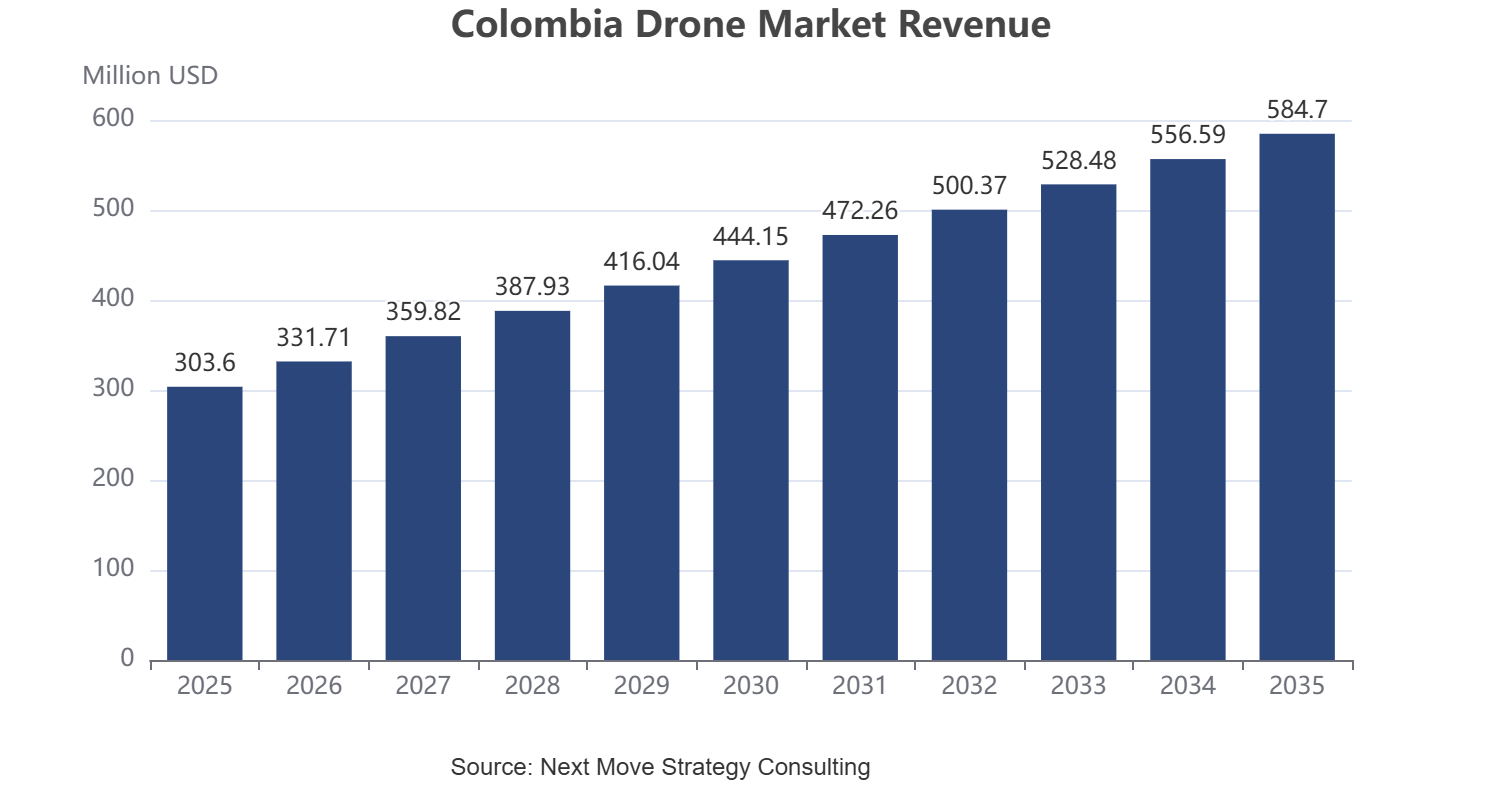
The Colombia Drone Market was valued at USD 303.6 million in 2025 and is estimated to reach USD 347.3 million in 2026, progressing to USD 584.7 million by 2035 at a revenue CAGR of 5.96% during 2026–2035. In volume terms, the market stood at approximately 11 thousand units in 2025, with the estimate for 2026 placed at 14 thousand units, and volume expected to reach 31 thousand units by 2035 at a unit CAGR of 9.58%, underpinned by growing commercial, agricultural, and security-sector drone adoption.
Ecosystem Analysis of the Colombia Drone Market:
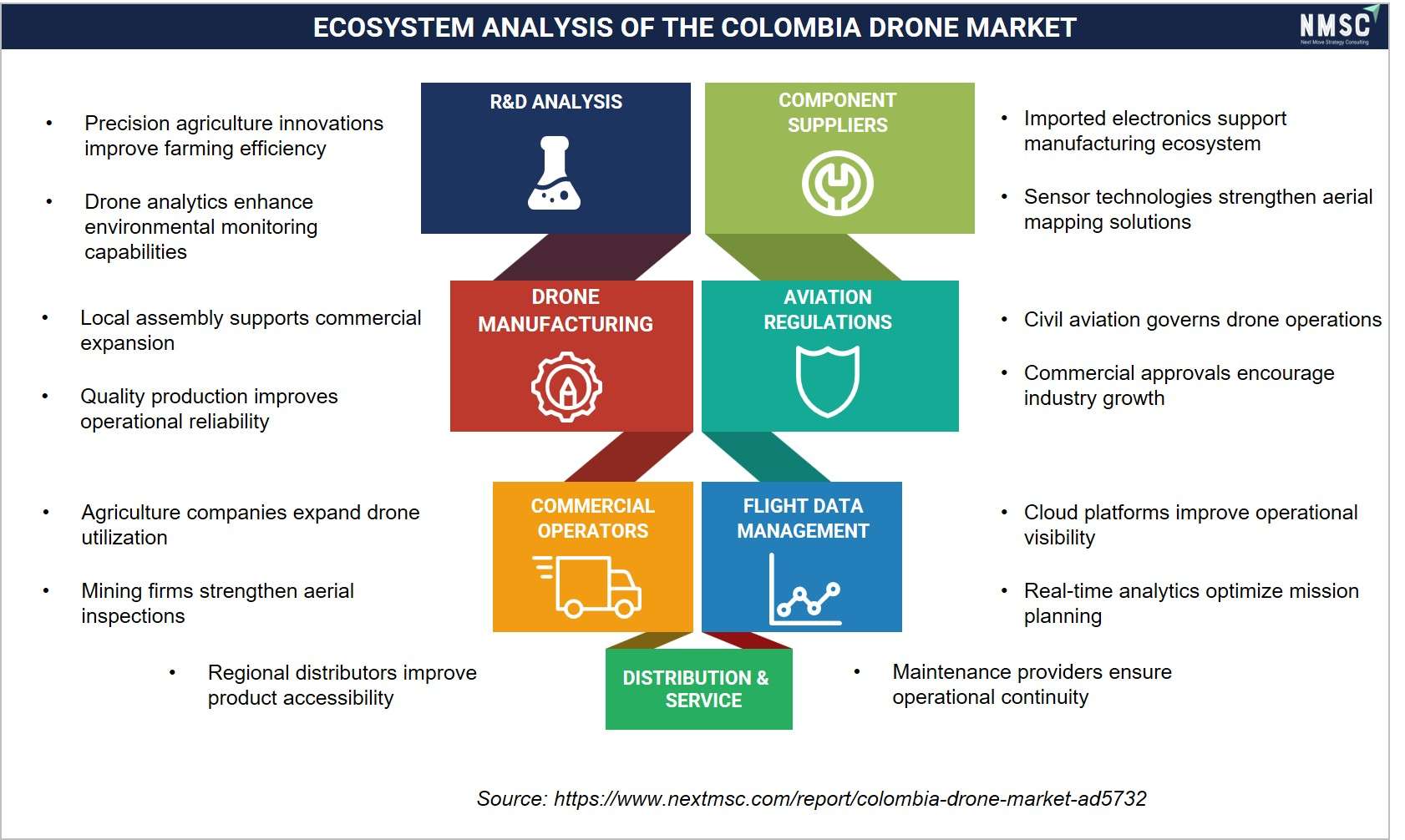
The above ecosystem analysis maps the key operational components, such as R&D analysis, component suppliers, drone manufacturing, aviation regulations, commercial operators, flight data management, and distribution and service, shaping the Colombia drone market. From our analysis, we observed that R&D analysis and component suppliers drive technological advancements, while aviation regulations ensure safety and compliance standards. Commercial operators and flight data management optimize operational efficiency, whereas distribution and service networks support market accessibility, reflecting a well-integrated ecosystem across the Colombia drone market.
What Are the Key Growth Drivers, Restraints, and Opportunities Shaping the Colombia Drone Market Through 2035?
Growth Catalyst & Risk Assessment Matrix
|
DRIVERS / TRENDS / RESTRAINTS |
(+/–) % IMPACT ON CAGR FORECAST |
GEOGRAPHIC RELEVANCE |
IMPACT TIMELINE |
|
Terrain-driven demand for drone-based surveying, infrastructure inspection, and environmental monitoring across Colombia’s diverse geographic zones |
+1.0% |
Andean corridors, Amazon basin, Pacific and Caribbean coasts |
Short to Medium term (1–4 years) |
|
Sustained security, counternarcotics, and border surveillance procurement creating institutional demand from Colombia’s defense and law enforcement agencies |
+0.9% |
Border regions, urban centers, and conflict-affected departments |
Medium term (2–5 years) |
|
Agricultural adoption in coffee, floriculture, and sugarcane sectors supported by AEROCIVIL regulatory clarity and expanding DaaS model availability |
+0.7% |
Coffee Belt, Valle del Cauca, Caribbean lowlands |
Medium to Long term (3–6 years) |
|
Limited domestic manufacturing capacity and Colombian peso volatility increasing hardware costs and constraining commercial fleet investment |
–0.8% |
Nationwide; most acute outside Bogotá and Medellín |
Short term (1–3 years) |
|
Drone-enabled logistics for medicines, humanitarian supplies, and healthcare delivery to remote communities gaining momentum through BVLOS regulatory expansion |
+0.8% |
Amazon Basin, Andean foothills, remote rural municipalities |
Long term (4–8 years) |
Colombia's drone market is shaped by a distinctive combination of terrain-driven operational necessity, sustained security sector demand, and a commercial ecosystem anchored in agriculture and infrastructure inspection. From our analysis, we observed that Colombia's mountainous geography and extensive rural landmass make drone deployment economically compelling for connectivity-independent data collection and logistics across regions where road access is limited or cost-prohibitive. Government and defense procurement, historically tied to counternarcotics and border surveillance requirements, is progressively expanding toward disaster response, environmental monitoring, and smart city management as civilian applications diversify the market base.
Growth Drivers:
How Is Colombia’s Geographic Diversity and Infrastructure Agenda Driving Commercial Drone Demand?
Colombia's diverse geography, encompassing Andean mountain ranges, Amazon basin territories, Pacific and Caribbean coastlines, and extensive interior plains, creates structurally elevated demand for drone-based surveying, mapping, and environmental monitoring. The country's infrastructure development agenda, including road concession projects, hydroelectric expansion, and oil and gas pipeline inspection, generates recurring commercial contracts for fixed-wing and hybrid VTOL platforms capable of extended coverage missions. These geography-driven use cases provide stable commercial revenue for enterprise drone operators and hardware suppliers operating across Colombia's varied operational environments.
How Is Government and Security Sector Procurement Providing a Structural Revenue Base for the Colombia Drone Market?
Colombia's security establishment, encompassing the National Police, Armed Forces, and border protection agencies, has historically been an early and consistent drone adopter for surveillance, counternarcotics monitoring, and personnel force protection in areas of difficult access. This institutional familiarity with drone operations is now expanding into broader government applications including natural disaster response coordination, wildfire detection in the Orinoco llanos, and traffic management in major urban centers. Government procurement continuity provides a reliable revenue baseline that partially offsets the volatility inherent in commercial market growth cycles.
How Are Agricultural Adoption and AEROCIVIL’s Regulatory Progress Accelerating Commercial Drone Deployment in Colombia?
Colombia's agricultural sector, encompassing coffee, floriculture, sugarcane, and banana production across diverse microclimates, is progressively adopting drone-based crop spraying, disease detection, and precision irrigation management. The AEROCIVIL regulatory framework for RPAS operations is providing an increasingly structured environment for commercial operators, reducing certification ambiguity and supporting the expansion of drone service providers targeting agribusiness clients. Growing awareness of drone economics among mid-size agricultural operators and a nascent DaaS ecosystem are broadening addressable demand beyond large enterprises to include smaller production units.
Growth Inhibitor:
How Are Import Dependency and Currency Risk Limiting Market Expansion in Colombia’s Drone Sector?
The Colombia Drone Market faces constraints stemming from limited domestic manufacturing capacity, high import dependency, and a relatively narrow technology talent pool for advanced drone systems integration and maintenance. The Colombian peso's sensitivity to commodity price cycles and external financing conditions creates cost unpredictability for hardware import-dependent commercial operators and government procurement processes. Additionally, airspace management complexity in a country with multiple simultaneous low-altitude operator categories, combined with inconsistent regulatory enforcement in secondary cities, slows the formalization of commercial drone operations beyond Bogotá and Medellín's organized enterprise base.
Growth Opportunity:
What Opportunity Does Drone-Enabled Logistics for Remote Communities Present in Colombia’s Drone Market?
Colombia's challenging terrain and under-connected rural population create a compelling case for drone-enabled logistics and healthcare supply chain solutions targeting communities in the Amazon and Andean foothills that lack reliable road access. Drone delivery models for medicines, blood products, and humanitarian supplies to remote healthcare facilities represent a high-social-impact, commercially viable use case that is attracting both NGO-backed pilots and commercially structured service providers. As AEROCIVIL progressively extends BVLOS operational approvals, the addressable logistics opportunity will expand materially, creating early-mover advantages for operators establishing certified route networks.
How Is the Colombia Drone Market Segmented in This Report, and What Are the Key Insights from the Analysis?
By Component Insights
How Does Component Segmentation Reveal Investment Priorities?
Based on component, the Colombia Drone Market is segmented into hardware, software, and services.
The market encompasses a comprehensive ecosystem of hardware, software, and service solutions supporting drone deployment across commercial, government, and defense applications. According to our analysis, we found that hardware components provide the foundation for flight performance and mission execution, while software platforms enhance autonomy, operational control, and data-driven decision-making. At the same time, service offerings, including training, maintenance, data processing, and Drone-as-a-Service (DaaS), are enabling organizations to improve operational efficiency while reducing deployment complexity and lifecycle costs.
By Autonomy Level Insights
How Does Autonomy Level Segmentation Reflect Technology Adoption?
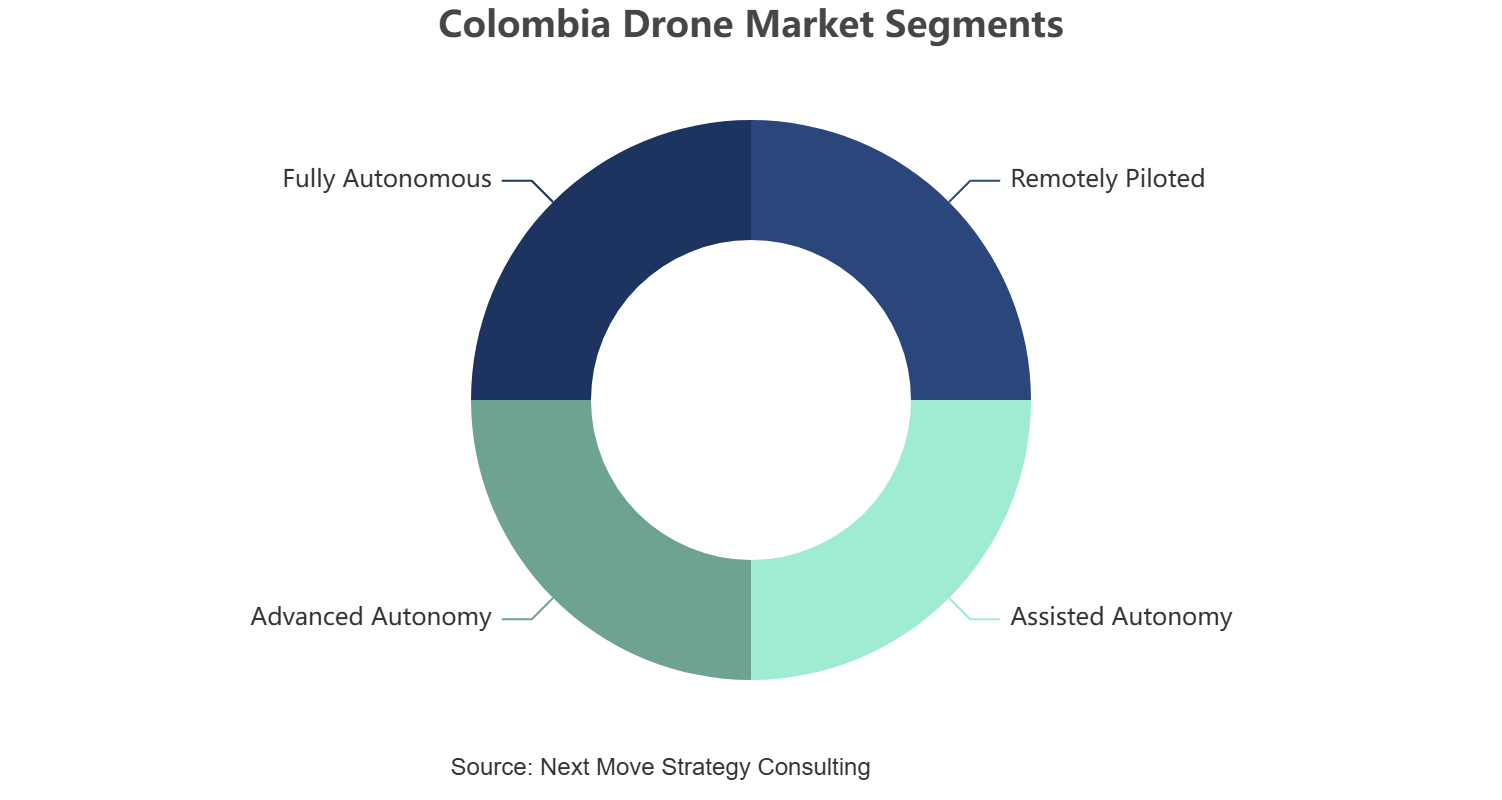
Based on autonomy level, the Colombia Drone Market is segmented into remotely piloted, assisted autonomy, advanced autonomy, and fully autonomous operational categories.
The market is progressing toward higher levels of automation as technological innovation and operational requirements continue to evolve across commercial, government, and defense applications. According to our analysis, we found that remotely piloted platforms support a broad range of routine operations, while assisted autonomy improves flight efficiency through features such as automated navigation, stabilization, and obstacle avoidance. As regulatory frameworks and autonomous technologies mature, advanced and fully autonomous systems are expected to support increasingly complex missions requiring greater operational independence, precision, and fleet scalability.
Key Segments
By Component
-
Hardware
-
Airframe
-
Avionics & Core Systems
-
Payloads & Sensors (Cameras, LiDAR, Multispectral, etc.)
-
Communication Systems (C2 Links)
-
-
Software
-
Flight Control & Autonomy
-
Data Processing & Analytics
-
Fleet Management
-
-
Services
-
Drone-as-a-Service (DaaS)
-
Training & Certification
-
Maintenance, Repair & Overhaul (MRO)
-
Data Processing Services
-
By Platform Type
-
Multi-Rotor
-
Fixed-Wing
-
Hybrid VTOL (Vertical Take-Off and Landing)
-
Single-Rotor (Helicopter)
-
Tethered UAV
-
Loitering Munition
-
MALE/HALE/UCAV
By Autonomy Level
-
Remotely Piloted
-
Assisted Autonomy
-
Advanced Autonomy
-
Fully Autonomous
By Maximum Takeoff Weight (MTOW)
-
Nano: < 250 g
-
Micro: 250 g – 2 kg
-
Small: > 2 kg – 25 kg
-
Medium: > 25 kg – 150 kg
-
Large: > 150 kg – 600 kg
-
Very Large/Tactical: > 600 kg
By Price/Performance Grade
-
Consumer Grade (< $1,000)
-
Prosumer Grade ($1,000 – $10,000)
-
Enterprise Grade ($10,000 – $100,000)
-
Military Grade (> $100,000)
By End-User
-
Consumer Drone
-
Commercial & Industrial Drone
-
Aerial Imaging & Cinematography
-
Surveying & Mapping (Geomatics)
-
Agricultural Applications (spraying, crop monitoring)
-
Infrastructure Inspection (energy, utilities, transport)
-
Logistics & Delivery (package transport)
-
Environmental & Scientific Monitoring
-
-
Government & Public Safety Drone
-
Emergency Response & Disaster Management
-
Law Enforcement & Security
-
Firefighting & Public Safety
-
Smart City Management
-
-
Military Drone
-
Intelligence, Surveillance & Reconnaissance (ISR)
-
Combat Operations
-
Electronic Warfare (EW)
-
Target Acquisition & Designation
-
Logistics & Resupply
-
Decoy & Countermeasure Systems
-
Competitive Landscape
Colombia's drone market features a competitive landscape anchored by international hardware manufacturers and defense systems integrators serving both commercial and institutional segments. Our assessment indicates that competitive differentiation in Colombia's market is increasingly determined by after-sales service capability, in-country regulatory expertise, and ability to provide localized operator training and maintenance support rather than hardware specifications alone. Government and defense procurement programs place particular value on supplier presence and long-term service commitment, creating structural advantages for players with established local legal entities and technical support infrastructure.
Key Players
-
Wingtra AG
-
Teledyne FLIR LLC
-
Thales Colombia S.A.S.
-
Autel Robotics Co. Ltd.
-
Quantum-Systems GmbH
-
Flyability SA
-
ideaForge Technology Limited
-
Saab Colombia S.A.S.
-
Wingcopter GmbH
-
Lockheed Martin Colombia S.A.S.
The Colombia Drone Market features Wingtra and Quantum-Systems serving fixed-wing and hybrid VTOL professional survey applications, while Teledyne FLIR and Autel Robotics address thermal imaging and multi-rotor commercial segments, respectively. Thales Colombia and Saab Colombia serve defense and government-grade systems requirements alongside Lockheed Martin Colombia for higher-tier defense programs. Flyability addresses confined-space industrial inspection niches, ideaForge contributes surveillance-grade multi-rotor platforms, and Wingcopter brings drone delivery expertise to Colombia's logistics-focused commercial segment.
Porter's Five Forces Analysis of the Colombia Drone Market:
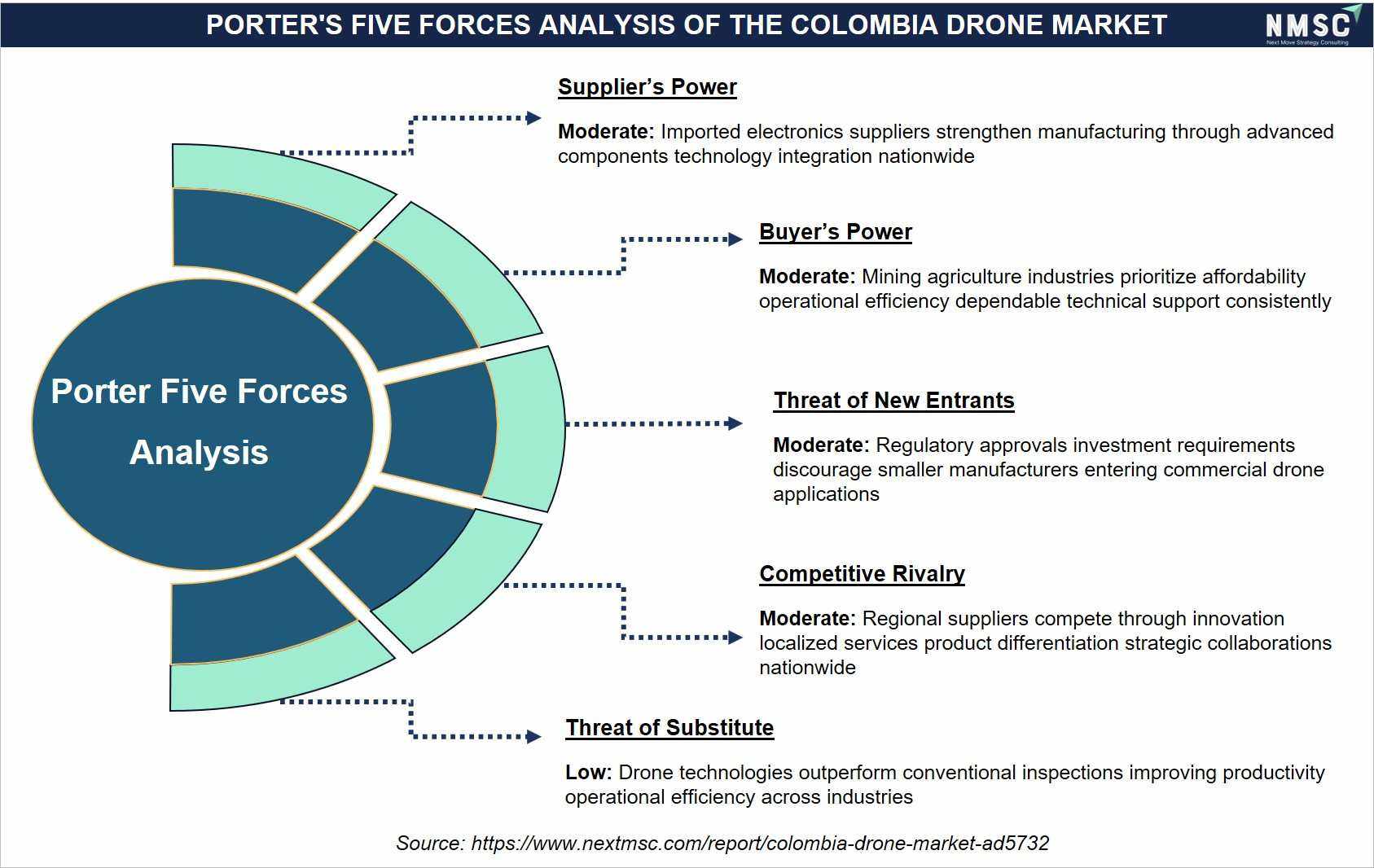
The above Porter's Five Forces analysis maps the key competitive forces, such as threat of new entrants, bargaining power of suppliers, bargaining power of buyers, threat of substitutes, and industry rivalry, shaping the Colombia drone market. From our analysis, we observed that industry rivalry remains moderate with growing local participation, while the bargaining power of suppliers is influenced by imported component dependencies. The threat of new entrants is constrained by regulatory requirements, whereas the bargaining power of buyers is increasing with agricultural and infrastructure applications driving demand across the market.
Key Benefits for Stakeholders
Next Move Strategy Consulting’s analysis of the Colombia Drone Market provides stakeholders with a structured, quantified view of revenue and volume trends from 2025 through 2035 segmented across component, platform type, autonomy level, maximum takeoff weight, and end-user categories, enabling rigorous strategic planning and evidence-based investment decisions across Colombia’s evolving drone market.
Commercial operators, government agencies, and technology providers gain operational and competitive intelligence specifically calibrated to Colombia's regulatory, geographic, and institutional context. Competitive profiling across key market participants supports partnership evaluation, supplier selection, and market entry strategy for companies seeking to establish or expand their presence. Financial stakeholders benefit from transparent revenue and volume projections grounded in Colombia-specific demand drivers rather than regional generalizations.
|
Parameters |
Details |
|
Customization Scope |
Free customization (equivalent to up to 80 analyst-working hours) after purchase. |
|
Pricing and Purchase Options |
Avail customized purchase options to meet your exact research needs. |
|
Approach |
In-depth primary and secondary research; proprietary databases; rigorous quality control and validation measures. |
|
Analytical Tools |
Porter’s Five Forces, SWOT, value chain, and Harvey ball analysis to assess competitive intensity, stakeholder roles, and relative impact of key factors. |
Conclusion
The Colombia Drone Market is on a steady growth path, advancing from USD 303.6 million in 2025 to USD 584.7 million by 2035 at a revenue CAGR of 5.96%, with unit volumes growing from 11 thousand to 31 thousand units at a CAGR of 9.58%. Terrain-driven commercial demand, sustained government and security sector procurement, and a progressively structured AEROCIVIL regulatory environment are the primary growth catalysts. Drone-enabled logistics for remote communities and expanding BVLOS operational approvals represent the most differentiated opportunity in a market characterized by strong institutional demand.
About the Author
 Mayurima Roy
— Mayurima Roy is Research Analyst at Next Move Strategy Consulting, where she has spent 4 years working across the firm's full industry coverage rather than a single fixed vertical. Her work centers on structured research, ongoing trend tracking, competitive assessment, and insight-led content development, translating complex market data into clear, decision-ready narratives that support informed client decision-making across diverse global industries, market sectors, and world regions every day.
Mayurima Roy
— Mayurima Roy is Research Analyst at Next Move Strategy Consulting, where she has spent 4 years working across the firm's full industry coverage rather than a single fixed vertical. Her work centers on structured research, ongoing trend tracking, competitive assessment, and insight-led content development, translating complex market data into clear, decision-ready narratives that support informed client decision-making across diverse global industries, market sectors, and world regions every day.
About the Reviewer
 Supradip Baul
— Supradip Baul is an accomplished business consultant and strategist with over a decade of rich experience in market intelligence, strategy, technology, and business transformation. His work has included rigorous qualitative and quantitative analysis across multiple industries, helping clients shape investment decisions and long-term roadmaps. Earlier in his career, he was associated with Gartner, where he contributed to industry-leading reports and market share analyses. He has worked with leading global companies and holds an MBA with a dual specialization in Marketing and Finance.
Supradip Baul
— Supradip Baul is an accomplished business consultant and strategist with over a decade of rich experience in market intelligence, strategy, technology, and business transformation. His work has included rigorous qualitative and quantitative analysis across multiple industries, helping clients shape investment decisions and long-term roadmaps. Earlier in his career, he was associated with Gartner, where he contributed to industry-leading reports and market share analyses. He has worked with leading global companies and holds an MBA with a dual specialization in Marketing and Finance.
At Next Move Strategy Consulting, we understand that insightful market research is the cornerstone of successful business decisions. That's why we employ a robust and multifaceted approach, combining various methodologies to deliver the most accurate and actionable data for our clients.

Research Landscape
We navigate the world of research with two primary approaches:
Qualitative Approach
Our qualitative research methodologies involve immersive techniques such as in-depth interviews, focus groups, and observational studies. By engaging directly with individuals and stakeholders, we uncover valuable insights that quantitative data alone may overlook.

Quantitative Research
In tandem with qualitative methodologies, NMSC leverages the power of Quantitative Research to provide a robust foundation of numerical insights. Through systematic data collection and analysis, we quantify patterns, preferences, and market trends, offering a comprehensive view of the business landscape.
Our quantitative research approach employs diverse tools, including surveys, experiments, and statistical modelling. These methodologies enable us to gather data from a large and representative sample, ensuring the statistical significance of our findings. By employing structured questionnaires and standardized data collection methods, we guarantee the reliability and validity of the information we present to our clients.
Quantitative research is particularly effective in measuring the prevalence of trends, assessing market size, and gauging the impact of various factors on consumer behavior. The numerical precision attained through this approach equips our clients with actionable insights, facilitating data-driven decision-making and strategy formulation.


Our Specialized Toolbox for Industry-Specific Market Research
We deploy a specialized arsenal of techniques tailored to meet your unique requirements. Here's a glimpse into our comprehensive toolbox:

Information Procurement
The stage entails acquiring market data or relevant information through various sources and methodologies.


Market Research Approach
We utilize both top-down and bottom-up approaches in market research analysis to achieve a comprehensive understanding of the market dynamics, leveraging the broad perspective of industry trends and macroeconomic factors alongside detailed insights from specific segments and individual companies.

Porters Five Forces Analysis
We conduct Porter's Five Forces analysis to evaluate the competitive landscape of an industry, providing us with insights into factors that affect profitability and strategic positioning.

SWOT Analysis

Forecasting
We utilize a forecasting model to predict future consumption by considering parameters like population, economics, regulations, market competition, drivers, constraints, technology, and pricing. We also employ statistical techniques such as multilinear regression, exponential smoothing, moving average, ARIMA, and Monte Carlo simulations for accurate predictions. In econometric forecasting, we analyzed short-term and long-term event impacts, attributing values based on regulatory frameworks, economic factors, and market events.





 Speak to Our Analyst