

CPAP Cleaners Market Global Industry Analysis and Forecast (2026–2035)

CPAP Cleaners Market size was USD 364.57 Million in 2026, projected to reach USD 664.63 Million by 2035, growing at a CAGR of 6.9% from 2026 to 2035. Key drivers include rising sleep apnea diagnosis, home therapy expansion, and increasing hygiene awareness among patients, with North America leading the market.

Download Free Sample PDF
Base Year (2025)
$341.0 Million
Forecast (2035)
$664.6 Million
CAGR (2026-2035)
6.9%
Top Region
North America

What Is the CPAP Cleaners Market Size?

The global CPAP Cleaners Market reached USD 341.04 Million in 2025 and is estimated at USD 364.57 Million in 2026, forecast to reach USD 664.63 Million by 2035 at a CAGR of 6.9% between 2026 and 2035. North America leads with approximately 42% revenue share in 2025, while Automated CPAP Cleaners is the dominant product type, holding approximately 51% of total market revenue.

We observed that material and design shifts are central to the CPAP cleaners landscape. Device makers are selecting durable plastics and components that tolerate repeated ozone and ultraviolet exposure. Operational scale is also expanding as manufacturers standardize cleaning chambers across product lines. Next Move Strategy Consulting's analysis indicates that these engineering choices are improving consistency in how cleaners sanitize masks, tubing, and humidifier chambers.

CPAP Cleaners Market Global Industry Analysis and Forecast (2026–2035) Revenue Forecast

Values in USD Million

2025 $341.0 Million
2025
2026 $364.6 Million
2026
2027 $389.7 Million
2027
2028 $416.6 Million
2028
2029 $445.4 Million
2029
2030 $476.1 Million
2030
2031 $508.9 Million
2031
2032 $544.1 Million
2032
2033 $581.6 Million
2033
2034 $621.7 Million
2034
2035 $664.6 Million
2035

Key Takeaways

By Product Type: Automated CPAP Cleaners held the largest share, expanding from USD 175.38 Million in 2025 to USD 305.36 Million by 2035; Manual / Chemical-Based Cleaning Kits is the fastest-growing at 9% CAGR from 2026–2035.

By Technology: UV-C Light Sanitization held the largest share, expanding from USD 131.68 Million in 2025 to USD 227.13 Million by 2035; Ultrasonic Cleaning is the fastest-growing at 8.1% CAGR from 2026–2035.

By Distribution Channel: Online Retail held the largest share, expanding from USD 138.24 Million in 2025 to USD 283.75 Million by 2035; Pharmacies & Retail Stores is the fastest-growing at 8% CAGR from 2026–2035.

By End User: Home Users held the largest share, expanding from USD 171.55 Million in 2025 to USD 305.6 Million by 2035; Travel & Portable Users is the fastest-growing at 9% CAGR from 2026–2035.

Dominant Region: North America dominated the market with approximately 42% revenue share (USD 143.24 Million) in 2025, anchored by established sleep therapy infrastructure, high CPAP prescription volumes, and a mature home healthcare reimbursement framework.

Fastest-Growing Region: Asia-Pacific is expected to register the highest CAGR of 10% during 2026–2035, driven by rising sleep apnea awareness, expanding diagnostic capacity, and growing adoption of home healthcare equipment across high-density markets.

Dominant Country: The U.S. led the market with an estimated USD 107.43 Million in 2025 (~75% of North America), supported by a large diagnosed sleep apnea population, dense vendor presence, and high home CPAP prescription volumes.

Fastest-Growing Country: India is the fastest-growing major country, projected to expand from USD 11.46 Million in 2025 at a CAGR of approximately 11.5%, driven by rising obesity-linked sleep apnea cases, growing private hospital networks, and expanding e-commerce access to medical accessories.

The CPAP cleaners market presents an absolute dollar opportunity of USD 300.06 million between 2026 and 2035. This gain reflects growth from USD 364.57 million in 2026 to USD 664.63 million by 2035. Much of this value will come from replacement cycles and new patient enrollments in home therapy. We observed that suppliers offering validated, low-maintenance cleaners are best positioned to capture this expansion across both consumer and clinical channels.

Competitive consolidation is reshaping the CPAP cleaners industry. Established sleep therapy brands are forming partnerships with specialist cleaner manufacturers to broaden their product portfolios. Such OEM partnerships give smaller firms access to distribution networks and regulatory expertise. Supply chain scale is also rising, as larger producers secure component sourcing for ultraviolet lamps and sanitation modules. Our assessment indicates that scale advantages will favor firms with diversified manufacturing footprints.

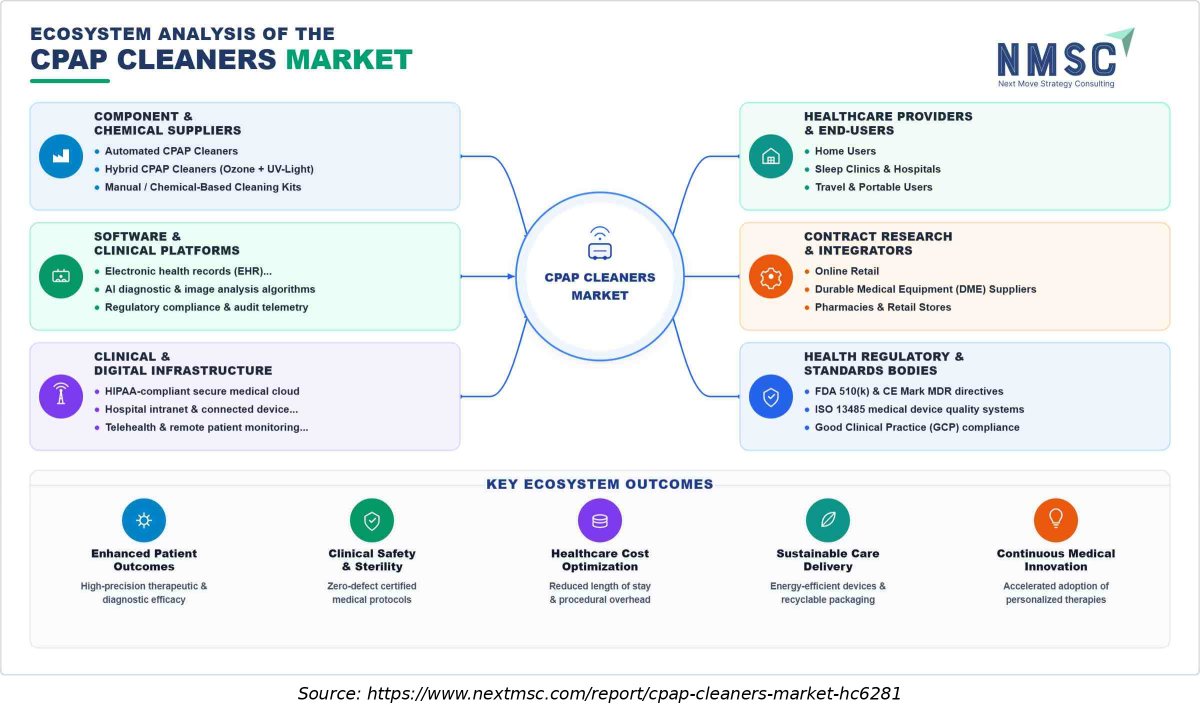
Ecosystem Analysis of the CPAP Cleaners Market

The ecosystem analysis of the CPAP Cleaners Market illustrates the interconnected roles of component and chemical suppliers, software and clinical platforms, and clinical and digital infrastructure. It also highlights healthcare providers, end-users, contract research organizations, integrators, and regulatory bodies. These stakeholders collectively support patient safety, clinical efficacy, healthcare cost optimization, sustainable care delivery, and continuous medical innovation.

What Does the CPAP Cleaners Market Encompass?

The market covers devices and solutions that sanitize continuous positive airway pressure equipment. Product types include ozone-based cleaners, ultraviolet cleaning units, and manual cleaning solutions. Core technologies rely on controlled disinfection cycles that target masks, tubing, and humidifier chambers. Scope also extends to accessories such as replacement filters and drying systems used alongside primary cleaning devices.

Design specifications in CPAP cleaners emphasize compact housing, quiet operation, and safe material contact. Manufacturers increasingly select materials that resist degradation from repeated ozone and light exposure. Certifications from recognized regulatory bodies remain important for buyer confidence. We noticed that products carrying clear safety documentation are gaining preference among clinicians and home users alike.

Market Drivers & Dynamics

Interactive Dataset
Rising Sleep Apnea Diagnosis driver High Immediate
Home Therapy Expansion driver High Immediate
Hygiene Awareness Among Patients driver Medium Medium-term
Regulatory Scrutiny of Cleaning Claims restraint High Immediate
Consumer Preference for Manual Cleaning restraint Medium Medium-term
Device Material Compatibility Concerns restraint Low Long-term
Source: Next Move Strategy Consulting

Growth Drivers

Rising Sleep Apnea Diagnosis

Growing CPAP patient populations expand the installed base requiring regular mask and tubing sanitation

Home Therapy Expansion

Patients using CPAP at home need convenient cleaners that fit daily bedside routines

Hygiene Awareness Among Patients

Greater awareness of microbial buildup in CPAP equipment supports adoption of dedicated cleaners

Growth Inhibitors

Regulatory Scrutiny of Cleaning Claims

Agency warnings on ozone and ultraviolet cleaners limit unvalidated product launches and marketing

Consumer Preference for Manual Cleaning

Many users continue hand washing masks, reducing demand for dedicated cleaning devices

Device Material Compatibility Concerns

Repeated ozone exposure may affect certain mask and tubing materials over long periods

What Are the Growth Opportunities?

Can Multi-Device Cleaners Capture Households with Several Patients?

Households with more than one CPAP user represent an underserved segment. Multi-device cleaning units can sanitize masks and accessories for several patients in a single cycle. This design reduces the space and time needed for daily sanitation. Suppliers that offer larger chambers with clear capacity labels may capture share among families and caregivers managing multiple therapy routines at home.

Does Pharmacy Channel Expansion Represent an Untapped Volume Opportunity?

Pharmacy and retail channels remain underdeveloped for CPAP cleaners. Many patients buy therapy supplies through clinics or online stores without seeing cleaning options. Placing validated cleaners on pharmacy shelves could expose new buyers at the point of refill. Retail partnerships also offer manufacturers a practical route to educate users about approved cleaning practices and regulatory-compliant products.

Can Clinical Sleep Centers Become Distinct Premium Markets?

Sleep centers and clinical facilities require high-throughput sanitation for returned or loaned equipment. Industrial-grade cleaners with documented validation could serve these settings at premium price points. Such units support infection control protocols and reduce equipment turnaround times. Suppliers that secure clinical certifications may build a distinct premium tier separate from consumer home models.

Segmentation Analysis

2025 (USD Million)
2035 (USD Million)
Automated CPAP Cleaners 2025: $175.4 Million | 2035: $305.4 Million
Automated CP
Hybrid CPAP Cleaners (Ozone + UV-Light) 2025: $100.6 Million | 2035: $204.8 Million
Hybrid CPAP
Manual / Chemical-Based Cleaning Kits 2025: $65.1 Million | 2035: $154.5 Million
Manual / Che
Automated CPAP Cleaners $175.4 Million $305.4 Million 5.7%
Hybrid CPAP Cleaners (Ozone + UV-Light) $100.6 Million $204.8 Million 7.4%
Manual / Chemical-Based Cleaning Kits $65.1 Million $154.5 Million 9%
2025 (USD Million)
2035 (USD Million)
Category A
Category B
Category C
Category D
Segment Item 2025 (USD Million) 2035 (USD Million) CAGR
Category A $10.0 USD Million $40.0 USD Million 16.0%
Category B $17.1 USD Million $51.1 USD Million 22.0%
Category C $24.2 USD Million $62.2 USD Million 16.0%
Category D $31.3 USD Million $73.3 USD Million 26.0%

Segment-wise data is locked

Unlock complete segment-wise numbers for By Technology.

Unlock Full Data
2025 (USD Million)
2035 (USD Million)
Category A
Category B
Category C
Category D
Segment Item 2025 (USD Million) 2035 (USD Million) CAGR
Category A $10.0 USD Million $40.0 USD Million 25.0%
Category B $17.1 USD Million $51.1 USD Million 19.0%
Category C $24.2 USD Million $62.2 USD Million 25.0%
Category D $31.3 USD Million $73.3 USD Million 19.0%

Segment-wise data is locked

Unlock complete segment-wise numbers for By Distribution Channel.

Unlock Full Data
2025 (USD Million)
2035 (USD Million)
Category A
Category B
Category C
Category D
Segment Item 2025 (USD Million) 2035 (USD Million) CAGR
Category A $10.0 USD Million $40.0 USD Million 26.0%
Category B $17.1 USD Million $51.1 USD Million 16.0%
Category C $24.2 USD Million $62.2 USD Million 18.0%
Category D $31.3 USD Million $73.3 USD Million 8.0%

Segment-wise data is locked

Unlock complete segment-wise numbers for By End User.

Unlock Full Data

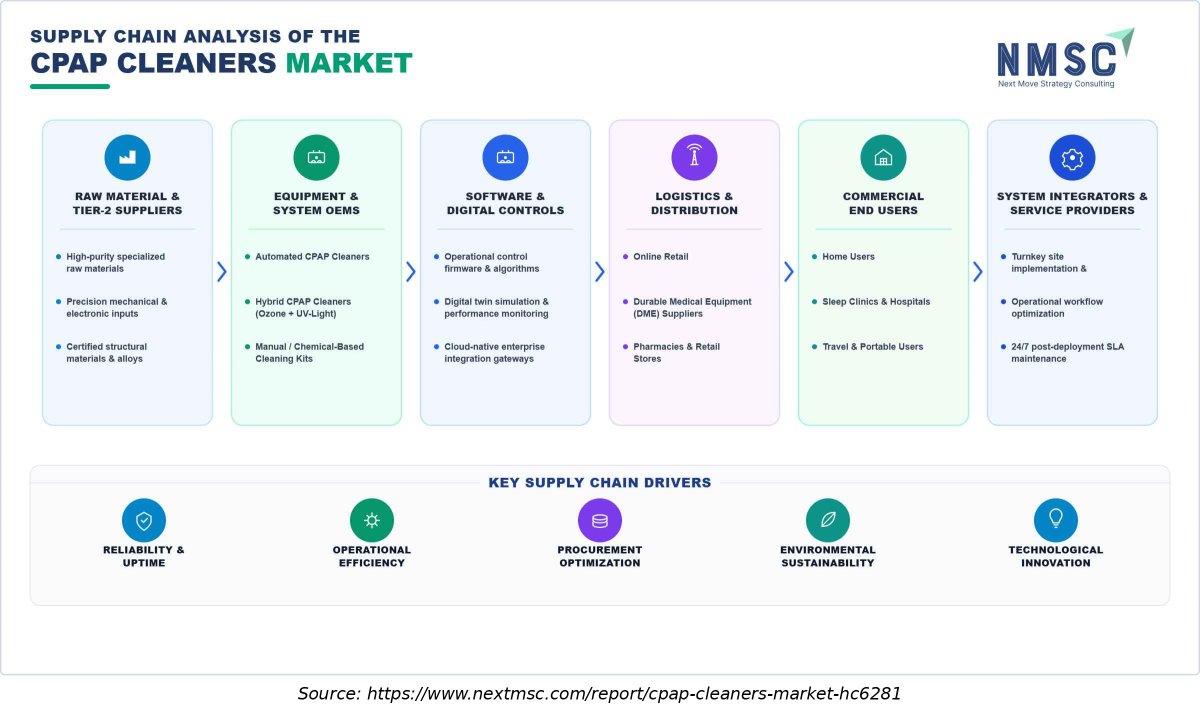
Supply Chain Analysis of the CPAP Cleaners Market

Supply Chain Analysis of the CPAP Cleaners Market
The supply chain analysis of the CPAP Cleaners Market illustrates the flow of products and services from raw material and Tier-2 suppliers through equipment and system OEMs, software and digital control providers, and logistics and distribution channels to commercial end-users. System integrators and service providers ensure installation, operational optimization, and ongoing maintenance. The supply chain is driven by reliability and uptime, operational efficiency, procurement optimization, environmental sustainability, and technological innovation.

Growth Opportunities

Our analysis shows that three structural whitespace opportunities are positioned to generate disproportionate commercial returns in the CPAP Cleaners Market through 2035:

Can Multi-Device Cleaners Capture Households with Several Patients?

Households with more than one CPAP user represent an underserved segment. Multi-device cleaning units can sanitize masks and accessories for several patients in a single cycle. This design reduces the space and time needed for daily sanitation. Suppliers that offer larger chambers with clear capacity labels may capture share among families and caregivers managing multiple therapy routines at home.

Does Pharmacy Channel Expansion Represent an Untapped Volume Opportunity?

Pharmacy and retail channels remain underdeveloped for CPAP cleaners. Many patients buy therapy supplies through clinics or online stores without seeing cleaning options. Placing validated cleaners on pharmacy shelves could expose new buyers at the point of refill. Retail partnerships also offer manufacturers a practical route to educate users about approved cleaning practices and regulatory-compliant products.

Can Clinical Sleep Centers Become Distinct Premium Markets?

Sleep centers and clinical facilities require high-throughput sanitation for returned or loaned equipment. Industrial-grade cleaners with documented validation could serve these settings at premium price points. Such units support infection control protocols and reduce equipment turnaround times. Suppliers that secure clinical certifications may build a distinct premium tier separate from consumer home models.

Regional Outlook

2025 (USD Million)
2035 (USD Million)
North Americ
Europe
Asia-Pacific
Latin Americ
Middle East
Region 2025 (USD Million) 2035 (USD Million) CAGR (%)
North America $10.0 USD Million $40.0 USD Million 9.0%
Europe $17.1 USD Million $51.1 USD Million 27.0%
Asia-Pacific $24.2 USD Million $62.2 USD Million 25.0%
Latin America $31.3 USD Million $73.3 USD Million 23.0%
Middle East & Africa $38.4 USD Million $84.4 USD Million 12.0%

Regional data is locked

Unlock complete regional numbers for this market.

Unlock Full Data

Competitive Landscape

The market features a mix of established therapy device manufacturers and specialized sanitization brands. ResMed Inc. and Philips Respironics, Inc. anchor the ecosystem through integrated therapy offerings. Specialist firms such as SoClean Inc. and Lumin (Human Design Medical), Inc. compete on dedicated cleaning performance. Smaller brands intensify rivalry through direct-to-consumer positioning and affordable manual kits.

How Do Companies Compete in the CPAP Cleaners Market?

Companies compete primarily on disinfection efficacy, regulatory clearance status, device safety, and total cost of ownership including consumables. Market leaders that secured FDA authorization and validated their sanitization claims early are gaining clinician and patient trust ahead of competitors relying on unvalidated ozone or ultraviolet claims. In addition, leading vendors are strengthening distribution partnerships with durable medical equipment suppliers and online retailers to expand patient reach and secure recurring consumable sales.

Which Competitive Archetypes Dominate the CPAP Cleaners Market?

Industry participants encompass three dominant competitive archetypes: Established Sleep Therapy OEMs, Specialist CPAP Cleaner Manufacturers, and Direct-to-Consumer and Manual Kit Brands. Established sleep therapy OEMs command the largest installed patient base by bundling masks, tubing, and accessories with CPAP devices through DME and clinical channels. However, specialist cleaner manufacturers are capturing accelerated growth through dedicated sanitization performance, while direct-to-consumer brands compete through online retail and affordable manual kits.

What Innovation and Differentiation Strategies Are Companies Pursuing?

Leading vendors differentiate through continued research investment in ultraviolet and ozone sanitization performance, cycle-completion sensor feedback, and material-compatible chamber design. Manufacturers that demonstrate validated bacterial reduction and compatibility with widely used masks and tubing command premium pricing over unvalidated alternatives. Furthermore, bundling cleaners with replacement filters and cleaning solutions through subscription supply provides durable revenue and reduces customer migration to competing brands.

What M&A and Partnership Activity Is Shaping the Market?

Mergers and acquisitions in CPAP Cleaners increasingly target technology platforms that improve patient safety and therapy adherence. Strategic buyers seek majority stakes in firms with regulatory clearance and proven sanitization designs. Consolidation also aims to broaden distribution reach and combine complementary cleaning technologies. Investors view clearance-backed innovators as attractive acquisition targets.

Key Market Players

Based on research conducted by NMSC, the following 20 companies represent the validated leadership set across CPAP Cleaners Market developers, manufacturers, and solution providers:

ResMed Inc. Philips Respironics, Inc. SoClean Inc. Lumin (Human Design Medical), Inc. Sleep8 Inc. Hoto, Inc. Mdesk / MDesk CPAP Cleaner brands, Inc. Nature Cleaning Products (CPAP Cleaning Solutions) CleanCPAP / CleanCPAP Pro, Inc. Sleep Apnea Cleaner (SleepApnea.org affiliated brands), Inc. Hibernation Fitness / Sanitizing Sleep Brands, Inc. Fisher & Paykel Healthcare, Inc. Löwenstein Medical, Inc. React Health (BMC Medical), Inc. Inogen Inc. B Medical Inc. Drive DeVilbiss Healthcare, Inc. Medline Industries, Inc. Ecolab Inc. Clorox Healthcare, Inc.

Latest Developments

During our market evaluation, we noticed that recent commercial activities, platform introductions, and partnerships within the industry reflect the latest market developments:

Date Event
September 2026 SoClean partnered with Marketing Architects to launch a national campaign for its SoClean 3+ device. The campaign emphasizes the product's FDA-cleared intended use for reducing bacteria on compatible CPAP masks and ventilation hoses.

Investment Opportunities

Where Are Capital Inflows Concentrating in the CPAP Cleaners Market?

Capital inflows are concentrating in clearance-backed sanitization technologies and automated cleaner designs that can demonstrate validated bacterial reduction. Subscription and consumables-based recurring revenue models are attracting investor attention because their predictability supports premium valuations for suppliers with a growing installed base of users.

How Is Infrastructure Investment Shaping Market Capacity?

Infrastructure investment is concentrating on manufacturing capacity for ultraviolet lamps, ozone modules, and sanitation chambers, as well as the validation testing and quality systems needed for regulatory submissions. Supplier diversification and component sourcing agreements are a core capital allocation priority, as manufacturers seek to protect production continuity and maintain compliance records across product lines.

What ESG Considerations Are Influencing Market Investment?

Environmental, Social, and Governance considerations focus on residue-free sanitization, recyclable components, and patient safety through controlled ozone and ultraviolet exposure. Manufacturers are increasingly incorporating product safety documentation and material sustainability disclosures into reporting, creating structured demand for cleaners that reduce chemical use and meet recognized safety certifications.

Key Benefits for Stakeholders

How Does This Report Benefit Industry Leaders and Healthcare Suppliers?

Cleaner manufacturers, sleep therapy brands, and DME suppliers gain segment-level revenue forecasts and CAGR benchmarks across all segmentation axes, enabling product and portfolio decisions grounded in consistent 2025–2035 quantitative data. The end-user and technology segmentation provide empirical evidence for prioritizing home, clinical, and travel-oriented product development as patient adoption scales.

How Does This Report Benefit Investors and Financial Analysts?

Investors and financial analysts gain a reconciled market-sizing model valued at USD 341.04 million in 2025 and reaching USD 664.63 million by 2035, competitive landscape assessments, and company development tracking that supports corporate valuation and capital-allocation decisions. Segment breakdowns provide granular visibility into recurring revenue quality and margin expansion across technology tiers.

How Does This Report Benefit Cleaner Developers and Product Teams?

Cleaner developers, product managers, and engineering teams gain clear visibility into high-growth market vectors, emerging regional demand hubs, and buyer requirements across home, clinical, and travel user tiers. The competitive archetypes analysis and development benchmarks highlight strategic positioning pathways to capture disproportionate share of the USD 300.06 million absolute growth opportunity through 2035.

Key Market Segments Evaluated

By Product Type

  • Automated CPAP Cleaners 
    • UV-C Sanitizing Units
    • Ozone-Based Units
    • Ultrasonic Units
  • Hybrid CPAP Cleaners (Ozone + UV-Light) 
    • Combined Ozone-UV Chambers
    • Ozone-UV with Humidifier Drying
  • Manual / Chemical-Based Cleaning Kits 
    • Disinfectant Sprays
    • Cleaning Wipes
    • Soap-Based Wash Kits

By Technology

  • UV-C Light Sanitization 
    • Single-Chamber UV
    • Multi-Surface UV
  • Ozone Sanitization 
    • Ozone Generators
    • Ozone-Safe Mask Compatibility
  • Ultrasonic Cleaning 
    • Tank-Based Ultrasonic
    • Portable Ultrasonic
  • Chemical Disinfection 
    • Enzymatic Cleaners
    • Alcohol-Free Sprays

By Distribution Channel

  • Online Retail 
    • Brand E-commerce
    • Marketplaces (Amazon, etc.)
  • Durable Medical Equipment (DME) Suppliers 
    • Insurance-Covered Supply
    • Out-of-Pocket Purchase
  • Pharmacies & Retail Stores 
    • National Pharmacy Chains
    • Independent Pharmacies
  • Direct-to-Patient / Sleep Clinics 
    • Clinic Prescribed
    • Telehealth Sleep Programs

By End User

  • Home Users 
    • Adult Patients
    • Pediatric Patients
  • Sleep Clinics & Hospitals 
    • Sleep Labs
    • Hospital Respiratory Departments
  • Travel & Portable Users 
    • Compact UV Wands
    • Battery-Powered Units

By Region

  • North America 
    • U.S.
    • Mexico
    • Canada.
  • Europe 
    • Germany
    • France
    • UK
    • Italy
    • Spain
    • Rest of Europe.
  • Asia-Pacific 
    • China
    • Japan
    • India
    • South Korea
    • Thailand
    • Rest of APAC.
  • Latin America 
    • Brazil
    • Argentina
    • Rest of Latin America.
  • Middle East & Africa 
    • South Africa
    • Saudi Arabia
    • UAE
    • Rest of MEA.

Conclusion & Recommendations

The long-term outlook for the CPAP Cleaners Market is strongly positive, with revenue expanding from USD 364.57 million in 2026 to USD 664.63 million by 2035 at a 6.9% CAGR. Growth is underpinned by rising sleep apnea diagnosis, home therapy expansion, and continuous innovation in validated sanitization technologies. Participants that align portfolios with these forces will capture sustained value.

What Strategic Positioning Recommendations Does NMSC Offer?

CPAP Cleaners vendors should prioritize regulatory clearance, validated disinfection claims, and sensor-enabled cycle verification to capture high-growth segments. Sleep therapy OEMs should expand cleaner portfolios through partnerships with specialist manufacturers to avoid losing patient accessory spend to dedicated cleaner brands. Subscription supply of filters and cleaning solutions should be developed as a standard offering to capture recurring consumable demand among home users who prefer convenient replenishment.

How Attractive Is the CPAP Cleaners Market for Investment?

Investment attractiveness is high, supported by the USD 300.06 million absolute growth opportunity between 2026 and 2035 and the recurring revenue characteristics of consumable and subscription supply models that enable predictable cash flows at above-average sector growth rates. Asia-Pacific at 10% CAGR represents the highest relative growth, while North America offers the largest absolute revenue base with the most mature patient population and established reimbursement channels that accelerate adoption.

What Are the Key Market Shifts and Risks in the CPAP Cleaners Market?

Key market shifts include the transition from manual hand-washing routines to automated, clearance-backed sanitization, the expansion of subscription supply models, and the widening of distribution from clinics and DME suppliers to online and pharmacy channels. Primary risks include regulatory scrutiny of ozone and ultraviolet cleaning claims, material compatibility concerns with repeated exposure, and continued consumer preference for manual cleaning among cost-sensitive users.

What Are the Primary Growth Pathways Through 2035?

Primary growth pathways include multi-device household cleaners, pharmacy channel expansion, and premium clinical sleep center units, supported by new patient enrollment in home therapy. Our analysis shows that vendors combining validated sanitization performance, portable designs, and regulatory-compliant claims are best positioned to capture a disproportionate share of the USD 300.06 million absolute growth opportunity between 2026 and 2035, particularly in high-growth emerging regions where adoption is accelerating from a low base.

FAQs

About the Author

Liza Phukan

Liza Phukan

Liza Phukan is Research Associate at Next Move Strategy Consulting, where she has covered emerging industries and market research across sectors for 3.5 years. Her work includes analyzing industry developments, validating market data, and developing structured business content from research findings. She uses secondary research and data-validation practices to turn complex market information into clear decision-useful market analysis for business audiences and support report development and B2B.

About the Reviewer

Supradip Baul

Supradip Baul

Supradip Baul is an accomplished business consultant and strategist with over a decade of rich experience in market intelligence, strategy, technology, and business transformation. His work has included rigorous qualitative and quantitative analysis across multiple industries, helping clients shape investment decisions and long-term roadmaps. Earlier in his career, he was associated with Gartner, where he contributed to industry-leading reports and market share analyses. He has worked with leading global companies and holds an MBA with a dual specialization in Marketing and Finance.

Download Free Sample

Henri Knyphausen

HENRI KNYPHAUSEN

Partner at Singulier [Ex-BCG]

Singulier

I recently engaged NEXTMSC.com for a commercial due diligence project within the intralogistics sector, and I am pleased to provide a reference based on my experience. In utilizing NEXTMSC.com's services, I found their report to offer valuable insights into market dynamics and key industry players. The initial report provided a solid foundation for our analysis. However, as we were investigating a smaller target in the market, and I had specific customization requests requiring additional research. These requests included detailed information on product portfolios of various players and sub-market sizes, both inclusive and exclusive of certain product categories. NEXTMSC.com demonstrated commendable responsiveness and agility in accommodating these customization requests. Within a timeframe of 1-2 weeks, they delivered a revised report that met our specific needs. Furthermore, they were receptive to my follow-up inquiries, ensuring clarity and understanding of the data provided. The final deliverable significantly contributed to our due diligence efforts. One of NEXTMSC.com's notable strengths lies in their qualitative research capabilities. However, for future engagements, I would recommend the inclusion of a quantified market model in Excel format. Such a model would offer the ability to conduct in-depth analyses and explore various market segments, including country-specific data and subcomponent breakdowns. Based on my positive experience, I would not hesitate to work with NEXTMSC.com again. Their responsiveness, willingness to accommodate customization requests, and commitment to delivering actionable insights make them a reliable partner for commercial research projects.


Gustaf Hummel Burstrom

GUSTAF HUMMEL BURSTROM

Founder

Revline Tools AB

Joseph and the team at Next Move Strategy Consulting have been excellent to work with, in supplying us with relevant market data and forecasts for our specific category. We had some special requirements and they were able to do a custom package to suit our needs. We would definitely recommend them to any other company needing market data and forecasts

Gaurav Jaiswal

GAURAV JAISWAL

Founder & CEO

Yano Charge Private Limited

The EV Charging market research report provided by the NextMSC was exceptionally detailed and insightful. It offered a comprehensive analysis that proved to be a game-changer for our strategic planning. Truly a testament to the NextMSC’s expertise and thoroughness in EV market landscape & analysis.

Amos Chang

AMOS CHANG

Strategy Consultant

Kardex Group

I have bought the intralogistics market reports from NMSC two times so far. Joseph and his team are always very helpful and flexible in responding to any customization requirements on the report. Their expertise in market reports really helps us steer the day-to-day business. I will definitely recommend and come back myself whenever there is a need.

Rishabh Jogani

RISHABH JOGANI

Strategy Analyst

Accenture Japan

We are incredibly impressed with the market report on the real estate market in India provided by Next Move Strategy Consulting. The report was thorough, insightful, and well-structured, offering deep analysis and actionable recommendations. It not only captured the current trends and dynamics but also provided a forward-looking perspective that has been invaluable for our strategic planning. Their team demonstrated exceptional professionalism, attention to detail, and a profound understanding of the industry. The data-driven insights and clarity of presentation exceeded our expectations, making complex market trends easy to understand. We highly recommend Next Move Strategy Consulting to anyone looking for reliable and comprehensive market research services. Their expertise has given us the confidence to navigate the complexities of the Indian real estate market with clarity and foresight.

Custom Market Research Services

We will customize the research for you if the listed report does not fully match your requirements.

Get 30% Free Customization

Select License

This website uses cookies to ensure you get the best experience on our website. Learn more

✖